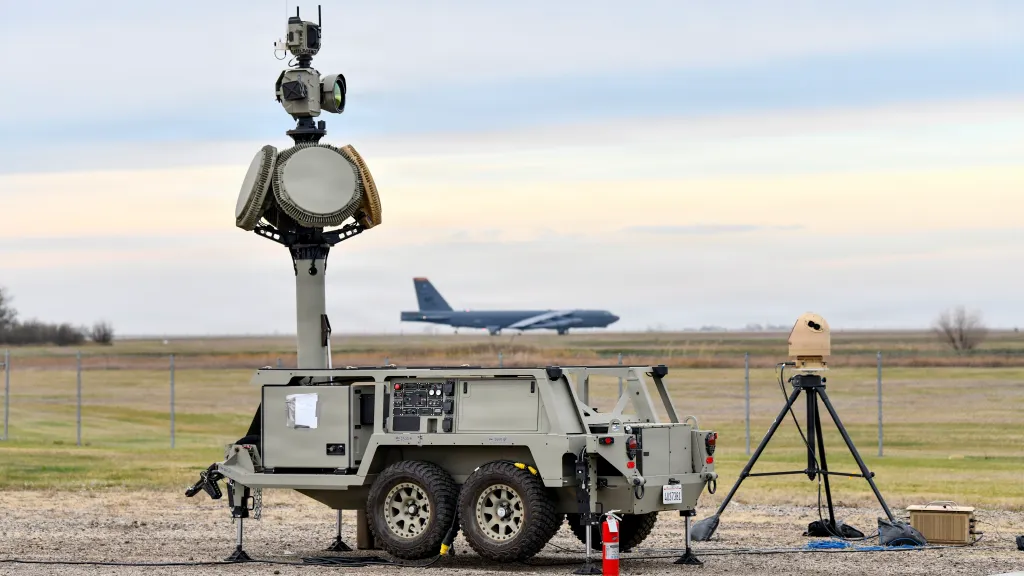
Multiple recent drone incursions over U.S. bases housing strategic military assets amplify concerns The War Zone has been documenting for years about highly worrisome drone flights over these installations and critical capabilities. These incidents, as we’ve noted, present a risk to national and local security.
One of the drone overflights took place earlier this month at Barksdale Air Force Base in Louisiana, home of B-52 Stratofortress bombers and nuclear weapons storage facilities, and a key part of the airborne leg of America’s nuclear triad. Another was at an unspecified installation last month, the commander of U.S. Northern Command mentioned in recent written testimony for the Senate Armed Services Committee (SASC). Both situations took place after the U.S. began bombing Iran in a campaign that has included B-52, B-1 Lancer and B-2 Spirit bombers. It is unknown at this point if there is a connection, however, as we have frequently reported, the military is highly concerned about drones operating with near impunity over its facilities. In addition to interfering with flights and their potential use as weapons, drones can surveil and map the electronic emissions throughout a base, gaining insight into vulnerabilities. They can also photograph key areas and operations, providing additional valuable intelligence for any adversary.
One of these incidents spurred NORTHCOM to deploy its new counter-drone fly-away kit, designed to give installation commanders the ability to detect, quantify, and defeat small drones that they cannot defend against on their own. We’ll discuss that in greater detail later in this story.

The incursions at Barksdale began the week of March 9, a spokesperson for the 2nd Bomber Wing at the base told us, offering few details about what happened beyond saying “we are working closely with federal and local law enforcement agencies to investigate these incursions.”
The incident sparked a shelter-in-place order lifted later that day.
According to ABC News, a confidential briefing document dated March 15 stated that the “drones came in waves and entered and exited the base in a way that may suggest attempts to ‘avoid the operator(s) being located,’” the network reported. “Lights on the drones suggested the operators ‘may be testing security responses’ at the base.”
“Between March 9-15, 2026, BAFB Security Forces observed multiple waves of 12-15 drones operating over sensitive areas of the installation, including the flight line, with aircraft displaying non-commercial signal characteristics, long-range control links and resistance to jamming,” the document stated. “After reaching multiple points across the installation, the drones dispersed across sensitive locations on the base.”
The document added that more drone incursions could be expected and that they “pose a significant threat to public safety and national security since they require the flight line to be shut down while also putting manned aircrafts already inflight in the area at risk.”
It is not publicly known if there have been any additional incursions since the document was issued. Base officials declined to tell us.

Another incident took place at an unspecified location in February as the U.S. was beginning to attack Iran.
“In the early hours of Operation EPIC FURY last month, a deployed [fly-away kit] successfully detected and defeated sUAS operating over a strategic U.S. installation,” Air Force Gen. David M. Guillot, the commander of NORTHCOM, explained in a written statement to SASC on March 19.
Guillot did not say which base or provide any other details. On Tuesday, a NORTHCOM spokesperson declined to specify which base Guillot was referring to but confirmed there were multiple incursions and personnel used the flyaway kit’s “jamming protocol.”
“We will not name the base nor the type of installation where our Flyaway Kit is deployed in order to preserve operational security,” NORTHCOM added. “Specifically, connecting the Flyway Kit to a specific base can potentially illuminate that base’s vulnerabilities to an adversary. Additionally, by confirming a specific Counter-small Unmanned Aircraft System (C-sUAS) platform, we would potentially give an adversary an advantage in circumventing our C-sUAS capabilities at that location.”
So far, NORTHCOM has only one fly-way kit, but more should be delivered “in the Spring of 2026,” Guillot added in his written statement.
The kit currently deployed is produced by Anduril. The company describes it as a “rapidly deployable, modular, and battle-tested counter-UAS system designed to detect, track, identify, and defeat Group 1-3 drones.” It uses Anduril’s Pulsar system for radio-frequency detection and electromagnetic effects to jam radio signals controlling drones. There are also drone-on-drone interceptors. You can read more about that in our story about the system here.

While Guillot offered scant details in his written testimony, he provided some additional insights into the military’s efforts to counter drones over the homeland. His command is tasked with coordinating those efforts.
“We’ve seen an increase from last year in the number of detections over military installations over the course of the year.,” he said in response to a question from Sen. Eric Schmitt (R-MO), who represents Whiteman Air Force Base, home of B-2s used in Epic Fury. “Some of that might be due to the fact that we have more detection capability now than we did in the past, and then our ability to defeat them has improved. Whereas a year ago, almost every one that was detected was not defeated, now about a quarter of the ones that we detect we’re able to defeat. I pay particular attention to Whiteman and other strategic bases, whether submarine silos or aircraft, and work very closely with Admiral [Richard. A] Correll at STRATCOM to make sure that either through the services or through our own capabilities at NORTHCOM, we are protecting those vital locations from UASs.”

Northcom, Southcom Commanders Testify Before Senate Armed Services Committee 03.19.2026
Whiteman declined to comment about whether that base has seen any drone incursions, citing operational security concerns.
The incursions over Barksdale are reminiscent of those that took place over Langley Air Force Base in December 2023 that The War Zone was the first to report. It remains publicly unknown who operated those drones, which has been the case with incursions at military installations across the U.S. and Europe as well that we also were the first to write about.
That these latest drone flights took place in the wake of Epic Fury is alarming. Iran’s drone capabilities loom large in the mind of U.S. intelligence even here in the homeland. Also, it’s worth noting that B-52s at Barksdale sit almost entirely out in the open and, with just 76 of these airframes available across the force, they are extremely valuable assets and thus potentially very high-value targets. This is especially true since there are just a few that could be regenerated if any are lost. Moreover, Stratofortresses are expected to provide a large portion of U.S. conventional and nuclear aerial strike capabilities for decades to come.
We have been warning about the threat to American aircraft on flightlines from even the lowliest of drones for many years. These warnings have taken on new urgency after last year’s Ukrainian near-field attacks on Russian long-range aviation, dubbed Operation Spider Web. This operation alone suddenly turned what were once theoretical nightmares into very real possibilities.
We will continue to monitor this situation and provide updates when warranted.
Contact the author: howard@thewarzone.com