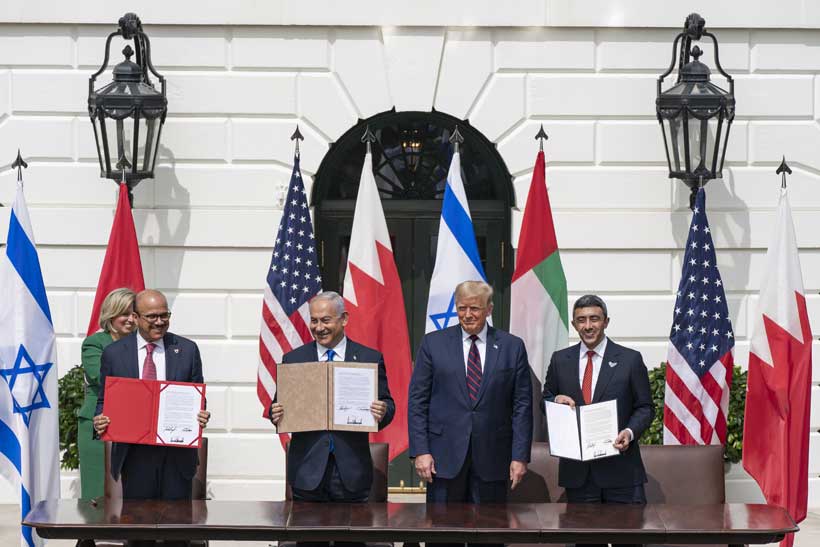
Whilst the Abraham Accords have held throughout the war in Gaza, there can be no doubt they have changed. It is clear that we are no longer in the era of normalization that we saw in 2020. Arab states like Saudi Arabia are hesitant to make high-profile deals with Israel; a December 2023 poll showed that 96% of Saudis wanted Arab states to cut ties with Israel during the Gaza War. A practical solution to this issue is triangulation—third countries that host, finance, or oversee less public deals. This would shift the center of cooperation to a third country, entrenching economic ties and spreading both the benefits and reputational risk. Perhaps most importantly, it creates countries outside of bilateral agreements that have a stake in keeping the gears of the Accords turning. These quiet triangles are not a substitute for those normalization deals; they are a bridge to stability and ultimately more high-profile announcements, culminating in normalization with Saudi Arabia.
The first phase of the Accords was heavy on optics—summits, highly publicized Memoranda of Understanding (MOUs), and big press conferences. Since then, crises in the Middle East have pushed cooperation off camera. ‘Quieter’ forms of cooperation like trade have held steady since October 7th. In fact, trade between Israel and the UAE increased by 11% in 2024 compared to 2023. This happened largely thanks to the Comprehensive Economic Partnership Agreement, which removed tariffs on 96% of goods and streamlined customs on most goods. Thus, a rules-based system was created that kept trade flowing, even when it was deemed too dangerous for Israelis to be in the UAE.
With trade holding throughout the Gaza War, third-country triangulation presents opportunities to get the Accords back on track. The case study for effective triangulation is I2U2, launched in July 2022, which brought together India, Israel, the UAE, and the US in practical sectors—food, water, energy, transport, health, and space. The joint statement by the leaders committed the UAE to invest up to $2 billion in integrated food parks in India. India would provide land and regulatory facilitation. US and Israeli private sectors would supply technologies across the chain. I2U2 also gave the green light to a 300 MW hybrid renewable energy project in Gujarat. These are formal commitments, although somewhat under the radar—and yet they have deepened relations between Israel and the UAE in a joint project.
The value of I2U2 lies in its architecture: a neutral venue in India, Emirati capital, and US-Israeli tech working together in measurable sectors is precisely the template that must be replicated. However, delivery has been slow, with projects moving at policy speed, rather than startup pace. But the goal is to build durable and sustainable frameworks, not short-term projects. The slow speed is therefore not a flaw but a cost of a system that outlasts political tensions.
A crucial consideration is the location of these projects. Triangulation can often collapse when tensions peak. The 2022 Jordan-UAE-Israel water and energy deal, known as ‘Project Prosperity,’ is the clearest cautionary example of this. The project proposed to use UAE-backed solar capacity, built in Jordan, to export electricity to Israel. Israel would then, in return, supply desalinated water to Jordan. The deal brought opposition even before it was signed. In Jordan, in 2021, thousands protested against it, and in November 2023, Jordan confirmed that they would not sign the deal, citing ‘Israel’s barbarism in Gaza’ as the reason. This does not invalidate the model. It does, however, emphasize its constraints. When the host country is directly exposed to the politics of the conflict, as Jordan is, it raises public backlash and therefore stalls development. Thus, it is crucial to create buffers. For example, if costs are front-loaded, it becomes expensive to cancel. Low visibility milestones, before any grandstanding, will allow for slow but steady development.
In stark contrast, the 2022 EU-Egypt-Israel gas framework shows how triangulation can overcome this issue. Israeli gas goes to Egypt’s Idku and Damietta plants, where it is treated and sent to European buyers. While the exports have not been constant, the route has stayed open. This is because the value is processed in a third venue and sold to a fourth constituency in the EU. By utilizing existing infrastructure and contracts while being grounded in bureaucracy rather than the state directly, the deal was allowed to function away from political posturing. In contrast, Prosperity placed the solar plant, its core asset, in Jordan, with few external buyers and few sunk costs; therefore, pausing the deal had little effect on either party. Prosperity reflected politics. Like I2U2, the deal with Egypt reflects business interests and thus far more stability.
Saudi Arabia is the scaler of triangulation. Riyadh has already taken the meaningful step to open its airspace to all carriers. The next strategically valuable project that Saudi can invest in is the India-Middle East-Europe Economic Corridor (IMEC). The Saudi segments of the route include rail links, dry ports, and standards. These segments are all low-visibility, high-impact infrastructure that anchors cooperation without triggering domestic backlash. Crucially, these steps can be taken without formal recognition, which Saudi public opinion is not ready to support. The US and Saudi Arabia look to be coming to an agreement on a defense package. This deal can be utilized as leverage to create concrete milestones for IMEC. If Saudi helps move this corridor towards construction, it will do more to stabilize the Accords than any summit. In the Middle East, it is far easier to reverse speeches and words than sunk costs and investment into projects like IMEC. Saudi Arabia can act, quietly and without domestic backlash, to knit the architecture of the second phase of the Accords.
The Accords do not need another summit. They need projects that hold because of strong structures, despite a volatile Middle East. By building in third countries, front-loading sunk costs, and not having state-run projects, triangulation can be incredibly effective. I2U2 shows the success of this template, Project Prosperity shows its limits, and the EU-Egypt-Israel gas route shows its durability. Saudi corridors can be the scaler for these projects. Quiet triangles, not grandstanding, will not only keep the Accords alive but also deepen and strengthen them, allowing the Accords to ultimately grow.