Saudi Arabia

Pakistan PM, army chief wrap up key trips in push for more US-Iran talks | US-Israel war on Iran News

Field Marshal Asim Munir leaves Tehran while premier Shehbaz Sharif heads home from Turkiye amid hopes of another round of US-Iran talks.

Pakistan’s army chief and the prime minister have wrapped up separate diplomatic visits aimed at advancing efforts to end the United States-Iran conflict, with Field Marshal Asim Munir leaving Tehran and Prime Minister Shehbaz Sharif returning from Turkiye.

Munir met Iran’s leadership and peace negotiators during a three-day visit to Tehran, a Pakistani military statement said on Saturday.

Recommended Stories

list of 4 itemsend of list

The visit demonstrated Pakistan’s “unwavering resolve to facilitate a negotiated settlement… and to promote peace, stability and prosperity,” the military said ahead of expected US-Iran talks in Islamabad in the coming days.

Munir held talks with the country’s president, foreign minister, parliament speaker and head of Iran’s military central command centre.

Parliament Speaker, Mohammad Bagher Ghalibaf, and Foreign Minister, Abbas Araghchi, led the Iranian delegation to Islamabad for peace talks with the US last week, the highest level face-to-face contact between Washington and Tehran in decades.

Those talks ended without agreement, and a ceasefire is due to expire on April 22.

But diplomacy has continued, with Pakistan’s Prime Minister, Shehbaz Sharif, visiting Saudi Arabia, Qatar and Turkiye to push the peace process.

His three-country trip concluded on Saturday, with Sharif and Foreign Minister Ishaq Dar departing a diplomacy forum in Antalya, according to statements from both officials.

“I leave Antalya [Turkish city] with fond memories and a renewed commitment to further strengthening the enduring fraternal bonds between our two nations, and to continuing our close cooperation to advance dialogue and diplomacy for lasting peace and stability in the region,” Sharif posted on X.

The flurry of diplomacy comes as further negotiations are expected in Pakistan in the coming days as Islamabad intensifies contacts with regional and global leaders in an effort to sustain momentum towards a US-Iran deal.

Pressure for a deal between the two countries has grown after Iran reimposed restrictions on the Strait of Hormuz, hours after its reopening following the start of a ceasefire in Lebanon. Tehran accused the US of violating a deal to reopen the strategically important waterway.

Donald Trump has said a second round of talks with Iran could be held in Pakistan in the coming days. The New York Post reported that Trump praised Munir, saying he was “doing a great job”.

Reporting from Islamabad, Al Jazeera’s Kamal Hyder said Munir landed back home on Saturday as Pakistan prepared for another round of US-Iran talks expected “within the next few days”.

“We have also seen a lot of praise from the Trump administration on social media, praising the Pakistani leadership. So all eyes are on Islamabad. Serious differences remain, but there is a flurry of diplomatic activity and a hope and expectation that some sort of breakthrough may happen,” he said.

Source link

Why The Middle East Crisis Cannot Be Read Through Power Alone

There is another way to read the ongoing Middle East crisis, one that makes legible what standard analysis consistently struggles to explain. It begins not with capability but with the geometry of the system through which capability must travel to produce effects. The United States and its partners possess overwhelming military superiority over Iran, and that superiority is not in question, yet the conflict has produced a pattern that defies its logic. A superpower coalition has been unable to impose coherent strategic outcomes against an adversary operating through proxies, low-cost disruption, and the systematic exploitation of global commercial vulnerabilities.

Over the past two years, we have seen multiple instances of this kind of disruption with consequential effects on the global system. Houthi drones force the rerouting of global shipping, with Red Sea cargo volumes falling by roughly 50% through early 2024 as major carriers diverted around the Cape of Good Hope, adding up to two weeks to transit times, driving freight costs sharply higher across European markets, and costing Egypt nearly $800 million per month at peak in lost Suez Canal revenue. A non-state network spanning Lebanon, Yemen, Iraq, Syria, and Gaza has absorbed sustained air campaigns, targeted eliminations of senior commanders, and repeated ground operations without losing its capacity to generate coordinated pressure across multiple theaters simultaneously. The asymmetry seems to follow a deliberate strategic logic that raw power analysis struggles to read, precisely because the conflict operates on a surface that capability assessments were never designed to map. What this suggests is that the decisive variable is not what actors possess but whether the relationships connecting them can transmit coordinated action when the system is under strain.

When that system cannot coordinate, something important breaks down. An alliance that formally exists but faces operational friction at every decision point ceases to be an alliance in any meaningful strategic sense. A security guarantee that cannot be transmitted rapidly to the partner it is meant to protect has, in effect, already failed its primary function. It follows that the gap between what a system formally is and what it can actually do under pressure is not a secondary consideration but the surface on which this conflict is being decided. Conventional analysis, calibrated to count warheads and assess intentions, consistently leaves this gap unmapped.

Analysts know that Saudi Arabia’s OPEC production decisions have repeatedly positioned Riyadh against Washington’s economic preferences, they know that European energy dependency complicates transatlantic alignment, and they know that Iran’s proxy network extends across five countries and absorbs military pressure without fracturing. Yet what the available frameworks cannot do is convert that knowledge into a structural reading of the system. They show that these conditions exist. What they cannot show is how those conditions interact, where they compound, and what the aggregate geometry of their interaction means for whether coordinated action is possible at all.

Power analysis was built to read capability differentials between states, and it does that well. Alliance theory was built to read the conditions under which formal commitments hold or fail, and it does that too. Neither, however, was built to read the operational weight of the ties through which capability and commitment must travel to produce effects.

The instruments available are calibrated to answer questions different from those the current situation poses. Deploying them on a problem they were not designed to read produces the consistent failure to explain what is actually happening that has marked analysis of this conflict from the start.

Adjacency mapping is an instrument designed to read that gap by mapping connectivity, by which I mean their operational weight, specifically their capacity to carry coordinated action under strain. What distinguishes it from standard approaches is its unit of analysis. Rather than the actors themselves, it treats the weight of the relationships as primary. The question it asks is not who holds power but whether the ties connecting power-holders can transmit that power when the system needs them to. Two states can be formally allied, operationally integrated in name, and structurally disconnected at the same time, and nothing in standard analysis will tell you which of those conditions is actually operative until the moment of crisis reveals it.

The instrument assigns each significant relationship in the system a weight between 0 and 1, reflecting how frequently the two actors interact operationally, how reliably information moves between them, how the tie has behaved under recent stress, and how quickly it transmits pressure when the system is under strain. At the higher end of the scale, a weight at or above 0.6 indicates that coordination approaches automaticity, and the tie carries load without constant investment to maintain it. Around 0.3, friction accumulates. In this setting, decisions require deliberate effort at every juncture, slowing the system and making it susceptible to gradual degradation that never triggers a visible rupture. At or below 0.2, the tie has effectively ceased to function as a transmission pathway, leaving the actors operationally disconnected regardless of what their formal relationship nominally says.

These weights are analytical judgements calibrated against observable evidence. In other words, their value lies in making visible what experienced analysts already carry as intuition and in giving that intuition a structure precise enough to argue about. The numbers are therefore analytical judgements, not measurements. A more rigorous application would derive them from quantifiable indicators across each dimension, including military interoperability, intelligence exchange depth, crisis responsiveness, economic interdependence, and signaling consistency, averaged and weighted systematically. That work lies beyond the scope of this piece, but the architecture is designed to accommodate it.

There is a risk management dimension to this reading that is worth making explicit. Standard geopolitical risk assessment focuses on actor-level variables such as regime stability, military capability, and leadership intentions. What adjacency mapping adds is a structural layer that those assessments typically miss. A coalition whose load-bearing relationships operate in the friction zone is exposed to a category of risk that capability assessments do not capture and that becomes visible only when the system is read structurally.

What the matrix adds is the ability to see how compound weakness across multiple relationships produces cascading effects that bilateral assessment alone would struggle to predict. A system whose dominant actor holds several weak partnerships faces more than friction. As a consequence, the geometry of those weaknesses determines whether any concerted response is structurally possible at all. Aggregate capability becomes, in that light, secondary to that question.

If we apply this to the Middle East security complex, the instrument produces one possible reading. This reading differs considerably from the picture conventional analysis generates. Its value is not in the precision of the numbers but in making the system’s geometry visible enough to argue about.

The matrix below maps operational connectivity across the system’s key actors. The numbers are analytical judgements, not measurements.

The geometry they make visible is what matters here.

  US IL SA QA UAE OM KW BH PK IR PN
US 0.8 0.4 0.8 0.6 0.5 0.7 0.8 0.6 0.1 0.1
IL 0.8 0.5 0.4 0.6 0.2 0.2 0.4 0.1 0.1 0.1
SA 0.4 0.5 0.5 0.6 0.4 0.6 0.7 0.6 0.2 0.1
QA 0.8 0.4 0.5 0.4 0.4 0.4 0.3 0.3 0.2 0.1
UAE 0.6 0.6 0.6 0.4 0.3 0.5 0.6 0.4 0.1 0.1
OM 0.5 0.2 0.4 0.4 0.3 0.3 0.3 0.3 0.4 0.1
KW 0.7 0.2 0.6 0.4 0.5 0.3 0.5 0.2 0.2 0.1
BH 0.8 0.4 0.7 0.3 0.6 0.3 0.5 0.2 0.2 0.1
PK 0.6 0.1 0.6 0.3 0.4 0.3 0.2 0.2 0.5 0.1
IR 0.1 0.1 0.2 0.2 0.1 0.4 0.2 0.2 0.5 0.7
PN 0.1 0.1 0.1 0.1 0.1 0.1 0.1 0.1 0.1 0.5

The matrix is intentionally non-symmetric. Where operational influence flows asymmetrically between two actors, the weights reflect that directionality.

The matrix reveals, in this light, a system whose dominant actors are connected at fundamentally different weights. And more significantly, its most important bilateral relationship is operating in the friction zone. It’s formally excluded adversary has constructed the only alternative connectivity architecture in the system. What this implies is that the geometry of the conflict runs considerably deeper than standard alliance analysis tends to suggest.

On the coalition side, the US has high adjacency with Qatar, Bahrain, Israel, and Kuwait, ties that enable rapid coordination and require little maintenance, constituting the operational backbone of what Washington can actually activate quickly.

Its relationship with Saudi Arabia, however, sits at 0.4. That number is analytically more significant than almost anything else in the matrix. Saudi Arabia remains, on most readings, the relationship on which Gulf order coherence formally depends, the anchor of the security architecture since the 1970s, and it is operating in the friction zone where every significant decision requires renegotiation from scratch rather than flowing through an established channel. Saudi Arabia’s invitation to join BRICS in August 2023, yuan-denominated oil transactions with China, and its participation in the Chinese-brokered rapprochement with Iran in March 2023 all point in the same direction. Riyadh is hedging structurally toward China and the broader non-Western order, a posture that sits uneasily alongside its formal security alignment with Washington. Taken together, these are not isolated political episodes but evidence of a tie that has been operating below the coordination threshold for years and whose weakness is, on this reading, the system’s most consequential structural vulnerability.

Through the normalization architecture, the UAE has arguably become the system’s most structurally reliable node at 0.6 with both the US and Israel, its operational integration exceeding Saudi Arabia’s despite Saudi Arabia’s formal primacy. The Abraham Accords of September 2020 established the formal foundation for that integration. The operational depth it has since generated, across intelligence sharing, defence cooperation, and coordinated positioning on Iran, has made the UAE the coalition’s most functionally connected Gulf partner. Oman holds what is perhaps the system’s most anomalous position, meaningful adjacency with both the US coalition and Iran simultaneously, a profile no other state actor in the matrix replicates. That structural position gave Oman the back-channel role it played through the early phases of the conflict, with documented precedent in the secret US-Iran nuclear negotiations that began in Muscat in 2012 and ran through 2013. As the conflict has intensified, Pakistan has assumed the primary mediation function, but Oman’s position as a quiet facilitator has not disappeared; it has simply been supplemented by a node with more direct access to both capitals at this particular moment.

Pakistan has emerged as the conflict’s primary mediation node, hosting the highest-level direct negotiations between Washington and Tehran since 1979 and brokering the April 2026 ceasefire. That role reflects a structural position the matrix makes legible: high Saudi adjacency, a functioning Iran tie, and a rehabilitated relationship with Washington that no other regional actor currently combines. China’s influence over both Pakistani and Iranian decision-making operates as an exogenous pressure that the matrix only partially captures, and Pakistan’s own domestic constraints, including its difficulty developing direct channels with the IRGC, limit how far that mediation role can ultimately reach.

Iran’s position is where the matrix becomes most analytically revealing. Across the state actors in the system, Iran’s adjacency sits at or near fragmentation, built up through sanctions, absent operational channels, and decades of adversarial signalling that have left Tehran formally isolated from the coordination architecture the United States and its partners have constructed.

And yet the only high-weight tie Iran holds is with its proxy network at 0.7. That single number may go further toward explaining the architecture of the entire campaign than any other figure in the matrix.

It is an asymmetric relationship in which Tehran’s capacity to activate and direct exceeds the reverse influence those actors exert over Iranian strategic decisions. What that single structural condition implies goes further toward explaining the architecture of Iranian pressure operations than most analyses of Iranian intentions or capabilities tend to reach. Iran is geographically central and formally excluded. It is precisely that combination, positioned to apply pressure across every theatre while bearing none of the coordination costs that formal inclusion imposes. That, from this vantage point, is what makes legible a strategy that standard analysis, focused on actors and their capabilities, cannot see.

Seen through this lens, what Iran is doing across the region is something more structurally ambitious than a military campaign. It is attempting to restructure the matrix itself. The goal appears to be less about battlefield victory than about the gradual degradation of the ties connecting the United States to its regional partners, below the threshold at which coordinated response becomes automatic, eroding the will to keep paying the price of alignment while simultaneously building alternative adjacency in the nodes where US-aligned connectivity is weakest.

The Houthi campaign against Red Sea shipping is calibrated to stay below the threshold that would compel a unified military response. It introduces friction into the economic relationships connecting European states to the Gulf system, raising the cost of alignment with Washington’s regional posture without forcing the kind of direct confrontation that would unite the coalition. Strikes on Gulf infrastructure follow the same calibration, persistent enough to signal that the US security guarantee cannot insulate its partners from costs, yet restrained enough to avoid crossing the point at which coalition fragmentation becomes irrelevant because a unified response becomes compulsory. Across Iraq and Syria, simultaneous pressure from affiliated militias prevents the concentration of attention that sustained coalition coordination requires. In each case, the instrument targets a relationship rather than a capability, specifically the weight of the ties whose degradation would restructure the system’s geometry without requiring Iran to displace the existing order directly.

The US-Saudi tie at 0.4 is the primary focus of that degradation effort. Should that threshold be breached, Saudi Arabia hedges. As hedging reduces operational interactivity the tie weakens further. The process risks becoming self-reinforcing. Iranian military superiority over any individual partner is not required to sustain it.

The same logic extends across European actors, though not uniformly. Germany’s industrial exposure to energy price volatility, France’s residual strategic autonomy instinct, and the EU’s institutional preference for de-escalation all produce different thresholds for continued alignment with Washington. Their shared energy dependency gives them asymmetric stakes in the Gulf system’s stability, but their appetite for risk diverges from Washington’s in ways that are not identical across capitals, and each time Iran forces a decision about the cost of continued alignment, that divergence fragments the coalition’s coordination surface further.

By sustaining operational ties with non-state actors across the region, Iran is constructing alternative adjacency in precisely the nodes where US-aligned connectivity is weakest. These are populations and factions that the existing regional order has excluded from the dominant coalition’s coordination architecture. Deliberately so — Iran is building in the structural gaps the system leaves open. Displacing the existing order appears unnecessary. Becoming the more reliable pole of alignment for the actors that order has failed to integrate may be sufficient. All that is required is that the order fragment sufficiently at its margins for that offer to appear credible, and the current trajectory of US-Saudi friction and European hedging is steadily moving in that direction.

The coalition’s instruments are calibrated to military threats. The system, however, is failing along a different surface entirely, or so this reading suggests. The formal architecture remains largely intact, security guarantees have not been withdrawn, Gulf states remain formally aligned, and normalisation agreements hold. And yet the operational adjacency that gives that architecture its functional weight is under sustained pressure from an actor that has correctly identified the gap between formal commitment and operational tie as the system’s primary vulnerability. That identification is outpacing the coalition’s capacity to respond.

On this reading, the surface on which the conflict appears to be decided is not the one the coalition is defending.

What adjacency mapping reveals is a story about geometry. The system’s dominant actor holds formal commitments at weights the system cannot sustain under the pressure being applied to it. Its adversary, in turn, has built the only alternative coordination architecture in the space that those weakening ties leave open. The conflict is likely to be determined by which ties the system can no longer afford to lose under sustained and calibrated pressure. The question is whether the actors currently holding those ties in the friction zone can rebuild them to the coordination threshold before the process of degradation becomes irreversible. That is a question that capability assessments are not well-positioned to answer, and one that a structural reading of the system’s connectivity at least helps to make visible.

Source link

World Cup 2026: Saudi Arabia sack coach Herve Renard | Football News

Frenchman Herve Renard, who won AFCON with Zambia and Ivory Coast, departs Saudi role despite World Cup qualification.

Frenchman Herve Renard has been relieved of his duties as Saudi Arabia coach, less than two months before the start of the FIFA World Cup 2026 in North America.

The 57-year-old had returned for a second spell as Saudi coach at the end of 2024, having led them at the last World Cup four years ago in Qatar.

Recommended Stories

list of 4 itemsend of list

“That’s football … Saudi Arabia have qualified for the World Cup seven times, including twice with me,” Renard told the news agency AFP on Friday.

“And there’s only one coach who has led them through both the qualifiers and the World Cup; that’s me, in 2022. At least there will be that sense of pride.”

Saudi Arabia players celebrate with French coach Herve Renard during the FIFA World Cup 2026 Asian qualifier football match between Saudi Arabia and Iraq at King Abdullah Sports City in Jeddah on October 14, 2025. (Photo by Abdel Ghani BASHIR / AFP)
Saudi Arabia players celebrate with French coach Herve Renard after securing World Cup qualification [File: Abdel Ghani Bashir/AFP]

Renard, a two-time Africa Cup of Nations (AFCON) winner with Zambia and the Ivory Coast, was in charge of Saudi Arabia from 2019 to 2023 before being replaced by Italian coach Roberto Mancini.

From 2023 to 2024, he served as coach of the France women’s team and reached the quarterfinals of both the 2023 Women’s World Cup and the 2024 Paris Olympics.

Ex-Morocco coach Renard was later brought back by Saudi Arabia to succeed Mancini, as the Italian left his role after an underwhelming 14-month stint.

Former Greece international Georgios Donis is reportedly being lined up as the man to take over from Renard. A source close to the negotiations told AFP that talks are under way between the federation and Saudi club Al Khaleej, where Donis has been in charge since 2024.

Saudi Arabia's French head coach Herve Renard (C) and members of Saudi Arabia's delegation pose on the red carpet upon arrival to attend the draw for the 2026 FIFA Football World Cup taking place in the US, Canada and Mexico, at the Kennedy Center, in Washington, DC, on December 5, 2025. (Photo by Roberto SCHMIDT / AFP)
Saudi Arabia’s French head coach Herve Renard, centre, and members of Saudi Arabia’s delegation at the 2026 FIFA Football World Cup draw [Roberto Schimdt/AFP]

Saudi Arabia are in Group H at the 2026 World Cup, alongside two former champions, Spain and Uruguay, and debutants Cape Verde. All their group games are scheduled to be played across the United States.

The Arab nation has made six World Cup appearances, with a round of 16 finish in 1994 in the US their best result thus far.

The Saudi team suffered a group-stage exit in the last World Cup in 2022, but made headlines worldwide with a shock 2-1 group win over eventual champions Argentina.

Saudi Arabia is also due to host the 2034 World Cup.

Source link

Saudi Arabia-hosted Asian Cup draw rescheduled due to US-Israel war on Iran | Football News

Draw for the 24-team 2027 AFC Asian Cup, originally set for Saturday, moved to May 9.

The draw for the 2027 ⁠Asian Cup ⁠in Saudi Arabia has been rescheduled for May 9 in Riyadh as the ⁠United States-Israel war on Iran disrupts regional sporting events.

The draw, originally scheduled for last Saturday, will be held at the historic At-Turaif District in Diriyah. The Asian Football Confederation (AFC) said ⁠on Wednesday that the postponement was ‌made to ensure the full participation of all key stakeholders and member associations.

Recommended Stories

list of 4 itemsend of list

A number of sporting events across the region have been postponed or cancelled due to the war, which began on February 28.

Saudi Arabia is set to ⁠host the 24-team, quadrennial continental championship for the first time from January 7 to February 5. With 23 of the ⁠24 teams already confirmed, the draw will divide the qualified ⁠nations into six groups of ⁠four.

The final qualification place will be decided on June 4 when Lebanon face Yemen in a playoff.

Defending champions ‌Qatar have already secured their place at the finals along with four-time winners Japan and fellow ‌World ‌Cup qualifiers South Korea, Iran, Jordan, Australia and Uzbekistan.

Source link

UK PM Keir Starmer visits Gulf to shore up ‘fragile’ US-Iran ceasefire | US-Israel war on Iran

NewsFeed

As UK Prime Minister Keir Starmer arrived in Doha as part of a Gulf tour spanning Saudi Arabia, the UAE, Bahrain and Qatar, he discussed efforts to secure the US-Iran ceasefire and reopen the Strait of Hormuz. Starmer warned there’s more ‘work to do’, stressing the need for regional partners to restore global energy flows.

Source link

What is Iran’s Strait of Hormuz protocol and will other nations accept it? | US-Israel war on Iran News

The Strait of Hormuz, which links the Gulf to the Gulf of Oman, has held global attention since Israel and the US began their war on Iran in February.

Until fighting began, the narrow channel, through which 20 per cent of the world’s oil and liquefied natural gas (LNG) supplies are shipped from Gulf producers in peacetime, remained toll-free and safe for vessels. The strait is shared by Iran and Oman and does not fall into the category of international waters.

Recommended Stories

list of 4 itemsend of list

After the US and Israel began strikes, Iran retaliated by attacking “enemy” merchant ships in the strait, effectively halting passage for all, stranding shipping, and creating one of the worst-ever global energy distribution crises.

Tehran continued to refuse to re-open the strait to all traffic at the start of this week, despite US President Donald Trump’s threats to bomb Iran’s power plants and bridges if it did not relent. Trump backed away from his threat on Tuesday night when a two-week ceasefire, brokered by Pakistan, was declared.

That followed a 10-point peace proposal from Iran that Trump described as a “workable” basis on which to negotiate a permanent end to hostilities.

As part of the truce, Tehran has now issued official terms it says will guide its control of the Strait going forward. The US has not directly acknowledged the terms ahead of talks set to begin in Islamabad on Friday. However, analysts say Tehran’s continued control will be unpopular with Washington, as well as other countries.

During the crisis, only a few ships from specific countries deemed friendly to Iran and those which pay a toll have been granted safe passage. At least two tolls for ships are believed to have been paid in Chinese yuan, in what appears to be a strategy to weaken the US dollar, but also to avoid US sanctions. China, which buys 80 percent of Iran’s oil, already pays Tehran in yuan.

Here’s what we know about how shipments will work from now on:

INTERACTIVE - Strait of Hormuz - March 2, 2026-1772714221
(Al Jazeera)

Who is controlling the strait now?

On Tuesday, Iran’s Foreign Minister Abbas Aragchi said Iran would grant safe passage through the strait during the ceasefire in “coordination with Iran’s Armed Forces and with due consideration of technical limitations”.

On Wednesday, the Islamic Revolutionary Guard Corps (IRGC) released a map of the strait showing a safe route for ships to follow. The map appears to direct ships further north towards the Iranian coast and away from the traditional route closer to the coast of Oman.

In a statement, the IRGC said all vessels must use the new map for navigation due to “the likelihood of the presence of various types of anti-ship mines in the main traffic zone”.

Alternative routes through the Strait of Hormuz have been announced by Iran's Islamic Revolutionary Guard Corps (IRGC), providing new entry and exit pathways for maritime traffic.
Alternative routes through the Strait of Hormuz have been announced by Iran’s Islamic Revolutionary Guard Corps (IRGC), providing new entry and exit pathways for maritime traffic [Screen grab/ Al Jazeera]

It is unclear whether Iran is collecting toll fees during the ceasefire period.

However, Trump said on Tuesday the US would be “helping with the traffic buildup” in the strait and that the US army would be “hanging around” as the negotiations go on.

The Strait will be “OPEN & SAFE” he posted on his Truth Social media site on Thursday, adding that US troops would not leave the area, and threatening to resume attacks if the talks don’t go well.

It’s not known to what extent US troops are directing what happens in the strait now.

Delhi-based maritime analyst C Uday Bhaskar told Al Jazeera that there is a lot of “uncertainty” about who can sail through the strait, and that only between three and five ships have transited since the war was paused.

How does Iran’s 10-point plan affect the Strait?

Among Tehran’s main demands listed on its 10-point plan are that the US and Israel permanently cease all attacks on Iran and its allies – particularly Lebanon – lift all sanctions, and allow Iran to retain control over Hormuz. The plan has not been fully published but is understood to be a starting point for talks.

Iranian media say Iran is considering a plan to charge up to $2m per vessel to be shared with Oman on the opposite side of the strait. Other reports suggest Iran could charge $1 per barrel of oil being shipped.

Revenues raised would be used to rebuild military and civilian infrastructure damaged by US-Israeli strikes, Tehran said.

Oman has rejected the idea. Transport minister Said Al-Maawali said on Wednesday that the Omanis previously “signed all international maritime transport agreements” which bar taking fees.

Interactive_Iran_US_Ceasefire_April8_2026

What does international law say about tolls on shipping?

Critics of Iran’s plan to charge tolls say it violates international law guiding safe maritime passage, and should not be part of a final ceasefire agreement.

The United Nations Convention on the Law of the Sea (UNCLOS) says levies cannot be charged on ships sailing through international straits or territorial seas.

The law allows coastal states to collect fees for services rendered, such as navigation assistance or port use, but not for passage itself.

Neither the US nor Iran has ratified that particular convention, however.

Even if they had, there could be ways to get around this law anyway. Analyst Bhaskar told Al Jazeera that if Iran instead charged fees to de-mine the strait and make it safe for passage again, that could be allowable under maritime laws.

There is no precedent in recent history of countries officially taxing passage through international straits or waterways.

In October 2024, a United Nations Security Council report alleged that the Iran-backed Houthis in Yemen were collecting “illegal fees” from shipping companies to allow vessels to pass through the Red Sea and the Bab-el-Mandeb strait, where it was targeting ships linked to Israel during the Gaza war.

Last week, a top adviser to Supreme Leader Mojtaba Khamenei suggested the Houthis could shut the Bab al-Mandeb shipping route again in light of the war on Iran.

INTERACTIVE - Bab al-Mandeb strait red sea map route shipping map-1774773769
(Al Jazeera)

How might countries react to a Hormuz toll?

Tolls for passage through the Strait of Hormuz would likely most affect oil and gas-producing countries in the Gulf, but ripple effects will spread to others as well, as the current supply shocks have shown.

Gulf countries, which issued statements calling for the reopening of the passage and praising the ceasefire on Wednesday, would also face a continuing degree of uncertainty, analysts say, as Iran could again disrupt flows in the future.

Before the ceasefire was announced, Bahrain had already proposed a resolution at the UN Security Council calling on member states to coordinate and jointly reopen the passage by “all necessary means”. It was backed by Qatar, the UAE, Saudi Arabia, Kuwait and Jordan. On April 7, 11 of 15 UNSC members voted in favour of that resolution.

But Russia and China vetoed the resolution, saying it was biased against Iran and did not address the initial strikes on Iran by the US and Israel.

Beyond the region, observers say the US is unlikely to accept indefinite toll demands by Iran as part of the negotiations expected to begin on Friday.

A toll to pass through the Strait of Hormuz “is not going to go down well with President Trump and his expectations that the strait should be open for everyone”, Amin Saikal, a professor at the Australian National University, said.

Other major powers have also voiced opposition. Ahead of the ceasefire, Britain had begun discussions with 40 other countries to find a way to reopen the strait.

Practical realities in the strait might see a different scenario play out with ship owners losing millions each day their vessels remain stranded seeking to get them out quickly and undamaged experts say. They are more likely to comply with Iran, at least for now.

“If I were the owner of a VLCC [very large crude carrier] which weighs about 300,000 tonnes, whose value could be a quarter billion dollars…I would believe the Iranians if they said we have laid mines,” Bhaskar said.

Source link

Kuwait’s power, water plants damaged as Iran keeps attacking Gulf states | News

Bahrain and the UAE also reported attacks resulting in fires, which were put out quickly.

Kuwait has said Iranian drone attacks damaged two power and water desalination plants and sparked a fire at an oil complex, without causing injuries.

Gulf countries have borne the brunt of Tehran’s response to the US and Israeli strikes on Iran since February 28.

Recommended Stories

list of 4 itemsend of list

Fatima Abbas Johar Hayat, a spokesperson for Kuwait’s Ministry of Electricity, Water and Renewable Energy, said on Sunday the “criminal aggression” caused “serious material damage” overnight to the two plants and the outage of two electricity-generating units.

The attack is the latest to target civil infrastructure in Kuwait. Other drone attacks overnight caused a fire at the Shuwaikh Oil Sector Complex and “significant damage” to a government office complex.

Reporting from Kuwait City, Al Jazeera’s Malika Traina referred to the incident as “devastating news” because “water desalination here and across the Gulf is extremely important. In Kuwait, around 90 percent of the country’s drinking water comes from these plants”.

Alongside the United Arab Emirates, Kuwait has been at the “epicentre” of Iranian attacks over the past few days, said Al Jazeera’s Victoria Gatenby, reporting from Doha, Qatar.

“The concern here in the region is that if President [Donald] Trump and the Israeli prime minister, Benjamin Netanyahu, follow through on those threats to escalate attacks on Iran, the result may be that Tehran attacks similar facilities here in the Gulf,” said Gatenby.

Gulf patience is not ‘unlimited’

Bahrain also faced Iranian attacks on Sunday.

Bahrain’s Gulf Petrochemical Industries Co said that several of its operational units were subjected to an attack by Iranian drones, while earlier in the day, the country’s national oil company, Bapco Energies, said an oil tank at one of its storage facilities was hit.

Both attacks caused a fire but were later brought under control and extinguished, Bahraini media reported.

No casualties were reported in either attacks, and damage from both was being assessed.

Earlier, Bahrain’s Ministry of the Interior had reported on the Bapco Energies fire without specifying where the blaze had broken out.

The Interior Ministry has said civil defence crews “extinguished a fire in the facility” that broke out “as a result of the Iranian aggression”.

The announcement came an hour after Bahrain activated air raid sirens.

Authorities in neighbouring Abu Dhabi on Sunday also stated they responded to several fires that broke out at the Borouge petrochemical plant, caused by falling debris from an interception.

“Operations at the plant have been immediately suspended pending a damage assessment,” read a statement issued by Abu Dhabi Media Office.

No injuries have been reported so far, it added.

Saudi Arabia, meanwhile, intercepted missiles early on Sunday, the kingdom said.

“Iran has said that it is only really attacking US military bases and US assets in the region, but we know from what’s been happening over the past five weeks and from what Gulf leaders have been saying that they have very much been targeting civilian infrastructure and critical energy infrastructure in this region as well,” said Gatenby.

While Gulf countries have shown “incredible restraint” in the face of attacks over the past five weeks, it is not because they lack the ability to respond and, increasingly, countries are talking about the fact that their patience is not unlimited, said Gatenby.

Saudi Arabia, in particular, has been talking in the past week about its right to self-defence under Article 51 of the UN Charter, she said.

“The GCC countries continue to say their main priority is de-escalation and dialogue, but some others have been saying this defensive posture may have to change if they continue to be attacked,” said Gatenby.

Source link

GCC chief urges UN to halt Iranian attacks, protect Gulf waterways | US-Israel war on Iran News

Jassim al-Budaiwi calls on UN Security Council to guarantee ‘uninterrupted navigation through all strategic waterways’.

The head of the Gulf Cooperation Council (GCC) has called on the United Nations to act to immediately halt Iranian attacks across the region, condemning the strikes as a “flagrant violation” of international law and the United Nations Charter.

Speaking at the UN Security Council (UNSC) on Thursday, GCC Secretary-General Jassim al-Budaiwi urged the council to “take all necessary measures” to bring an end to Iran’s attacks on Gulf countries.

Recommended Stories

list of 3 itemsend of list

The UNSC must “take all necessary means” to “protect maritime corridors and guarantee the uninterrupted maritime navigation through all strategic waterways” in the region, al-Budaiwi said.

He also stressed that the six GCC states – Saudi Arabia, Qatar, Bahrain, Oman, Kuwait and the United Arab Emirates – must be included in any talks or deals with Iran “to enhance regional security and prevent further escalation or the repetition of such attacks in the future”.

“The GCC reaffirms the urgent need to immediately halt these attacks; restore security, stability and calm in the region, and ensure the safety of air and maritime navigation, the safety of international supply chains, and the protection of global energy markets,” al-Budaiwi said.

Iran has carried out daily missile and drone attacks across the Middle East, including in Arab Gulf nations, since the United States and Israel launched a war against the country on February 28.

While Iranian officials have said they are acting in self-defence and striking US and Israeli-linked targets, the attacks have struck civilian sites across the Gulf, including several of the region’s critical energy facilities.

Iran also has effectively closed the Strait of Hormuz, a key Gulf waterway through which about one-fifth of the world’s oil and liquified natural gas supplies transit, sending global energy prices skyrocketing.

Reporting from the Emirati city of Dubai on Thursday evening, Al Jazeera’s Zein Basravi said frustrations are growing across the Gulf as the US-Israeli war on Iran drags on.

“The GCC countries were from day one – months before this war even began – trying to keep it from happening. But it was like trying to stop a slow-moving car crash. And effectively, that crash has happened in their front yard,” Basravi said.

He noted that 85 percent of the projectiles fired by Iran have targeted Gulf countries, with the UAE the hardest hit.

“Their primary threats are the retaliatory attacks by Iran,” Basravi said of the GCC. “And their primary focus is bringing that to an immediate close – and that means ending the conflict as soon as possible.”

Source link

Iran attacks cause fire in Kuwait, Bahrain; kill man in UAE | US-Israel war on Iran News

Shrapnel from an Iranian drone interception kills a Bangladeshi national in the UAE’s Fujairah city.

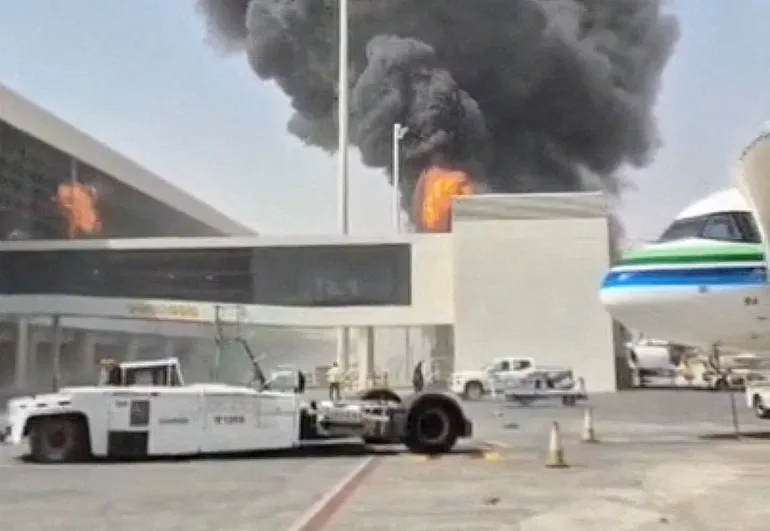
Iran’s drones have hit fuel tanks at Kuwait’s international airport, causing a large blaze, and authorities in Bahrain have reported a fire at an undisclosed company facility, as the United States-Israel war on Iran continues for a fifth ⁠week.

Abdullah al-Rajhi, a spokesman for the General Directorate of Civil Aviation in Kuwait, on Wednesday said the airport had been subjected to “brazen attacks by drones from Iran and the armed factions it supports”.

Recommended Stories

list of 3 itemsend of list

The raids targeted fuel tanks at the airport, “leading to a large fire breaking out at the site”, al-Rajhi was quoted as saying by the official Kuwait News Agency (KUNA).

Emergency teams were on site, and “the damage is material with no human injuries,” he said.

Bahrain’s Ministry of Interior said civil defence crews were “extinguishing a fire in a facility of a company as a result of the Iranian aggression”.

“Relevant authorities are taking their measures at the site,” it added, without naming the company.

Vessel hit

A tanker was ‌hit by an unknown projectile near the Qatari capital Doha, causing damage to the hull at the waterline, the United Kingdom Maritime Trade Operations said, adding the crew were safe.

The vessel was struck about 17 nautical miles (equivalent to about 32km) north of Qatar’s Ras Laffan industrial hub, the country’s main gas production facility, which was hit by Iranian missiles last month, causing significant damage.

Confirming the incident, Qatar’s Ministry of Defence said the country was targeted by three cruise missiles launched from Iran, one of which struck an oil tanker.

In a post on X, the ministry said it intercepted two of the missiles, while the third hit a tanker leased to QatarEnergy. The tanker’s 21-person crew was evacuated, the ministry said. No injuries were reported.

In the United Arab Emirates (UAE), the official WAM news agency said shrapnel from a drone interception fell on a farm in the al-Rifaa area of Fujairah city and killed a Bangladeshi national. It said authorities were dealing with the incident.

Saudi Arabia’s Ministry of Defense said several drones were “intercepted and destroyed”, without reporting any injuries.

The oil-rich Gulf has borne the brunt of Iran’s attacks in response to the US-Israeli air strikes on the country.

Iran has claimed to be attacking US assets in the region, but Gulf nations say Tehran has targeted civilian infrastructure.

On Tuesday, a United Nations Development Programme (UNDP) report said gross domestic product (GDP) in the Arab world was estimated to decline by approximately 3.7 to 6 percent after a month of war, equivalent to a contraction of $120bn to $194bn.

Meanwhile, US President Donald Trump and his administration have sent contradictory statements about how and when the war might end.

“We’ll be leaving very soon,” Trump told reporters at the White House on Tuesday, saying the exit could take place “within two weeks, maybe two weeks, maybe three”.

Washington had previously threatened to intensify operations if Tehran did not accept a 15-point US ceasefire ⁠framework that had, among its core demands, commitments by Iran not to pursue nuclear weapons, halt all uranium enrichment and fully reopen the Strait of Hormuz.

Tehran dismissed the proposal as “maximalist” and “unreasonable”, stressing it is not seeking war and wants a permanent end to the conflict. It also demanded compensation for the destruction caused by US-Israeli attacks against the country.

Source link

How important are the Gulf economies to the world? | US-Israel war on Iran News

Impact of US-Israeli war on Iran poses serious risks beyond energy sector.

The US-Israeli war on Iran is hitting Gulf Arab nations hard – but with a wider impact in today’s interlinked world.

As well as global oil and gas supplies, Gulf states play a critical role in many economies.

So how are they connected – and what could be at risk?

Presenter: James Bays

Guests:

Nikolay Kozjharnov – Research associate professor in energy security at the Gulf Studies Center at Qatar University

Cornelia Meyer – Macroeconomist and oil and gas specialist

Torbjorn Soltvedt – Associate director at global risk intelligence company Verisk Maplecroft

Source link

US-Israel war on Iran: What’s happening on day 27 of attacks? | US-Israel war on Iran News

The US and Israel’s war on Iran is intensifying, as Trump again claims Iranian leaders want to ‘make a deal’.

The United States and Israel’s war on Iran continues, with an Al Jazeera correspondent in Tehran reporting strikes are “increasing in number and in intensity” amid conflicting claims about whether negotiations are taking place.

US President Donald Trump says talks are happening, but Iran rejects the talks, saying it will continue to “resist” US aggression.

On Thursday, Iran carried out retaliatory strikes against Israel and several Gulf countries, as the Middle East conflict sees no signs of ending, and global energy and food prices continue to rise.

In Iran

  • Intensifying attacks: US-Israeli attacks on Iran are “increasing in number and in intensity”, according to Al Jazeera correspondent, with Israel announcing extensive strikes on central Isfahan. Alongside US forces, Israel has launched a “wave of extensive strikes” across Iran.
  • Civilian casualties reported: Iranian media reported that two teenage boys were killed in a recent US-Israeli strike on a residential area in a village in the county of Shiraz.
  • Iran talks: US President Donald Trump insisted that Iran was taking part in peace talks.
  • Iran chooses ‘resistance’: Foreign Minister Abbas Araghchi said Tehran will continue its “resistance” and does not intend to negotiate.
  • US targets missile capacities: The US has hit two-thirds of Iran’s production facilities for missiles and drones, a top officer said.
  • Threat to Iranian island: Tehran warned enemies may try to occupy one of its islands with support from an unnamed regional country.
  • Iran’s leverage: Jane Foley, an analyst from Rabobank, noted that Tehran’s position on negotiations leaves the ball firmly in their court. Because the critical Strait of Hormuz remains effectively closed, she suggests Iran could have the power to dictate the terms of any resolution.
  • New toll legislation: The Iranian parliament is preparing a draft law that would mandate the collection of tolls and duties from ships and tankers transiting the Strait of Hormuz, treating the waterway like a standard transit corridor.

In the Gulf

  • Hezbollah plot uncovered in Kuwait: Authorities arrested six people allegedly linked to Hezbollah, accused of planning assassinations in the Gulf state, the Interior Ministry said.
  • Saudi Arabia: Saudi Arabia’s Defence Ministry on Thursday morning announced the interception and destruction of a drone in the Eastern Province. Its air defence systems intercepted and destroyed at least two dozen drones targeting the Eastern Province, home to the majority of the kingdom’s oil facilities, on Wednesday.
  • Bahrain: A fire broke out at a facility in the Muharraq Governorate due to what the Interior Ministry described as “Iranian aggression”.
  • United Arab Emirates: The UAE’s Defence Ministry said on Thursday that its air defence systems have been actively responding to and intercepting incoming missiles and drones from Iran.

In the US

  • Trump says Iran wants a deal: Trump again claims Iranian leaders want to “make a deal so badly” but are afraid to say so “because they figure they’ll be killed by their own people”.
  • Trump threatens ‘hell’ if no deal: Trump is ready to “unleash hell” on Iran if Tehran does not accept a deal to end the war, the White House warned on Wednesday.
  • Strategic posturing: Jason Campbell, a former Pentagon official, said US threats to “hit Iran harder” are more about signalling than intensifying attacks.
  • Intentional vagueness: Campbell told Al Jazeera that Trump is deliberately omitting specific details because he wants the Iranian regime to believe the US is fully capable and willing to execute these harsher attacks.

In Israel

  • Missile salvoes: Israel’s army on Thursday morning said it had detected a wave of missiles from Iran heading towards the country, the second salvo in less than 30 minutes.
  • Rockets and missiles targeting Israel: Iranian missiles continue to target central and northern Israel. Additionally, Hezbollah has fired volleys of rockets into the Western Galilee region.

In Iraq, Lebanon

  • Gulf issues Iraq demand: Gulf states and Jordan have urged Iraq to stop attacks by pro-Iran armed groups from its territory.
  • Ground clashes with Hezbollah: Israeli troops have crossed the border into Lebanese territory and are actively engaging in ground combat. Hezbollah says its fighters are continuing to clash with invading Israeli troops in south Lebanon.
  • Defending Lebanese soil: Hezbollah’s Secretary-General Naim Qassem stated that the group is now in a war against both the US and Israel and will do everything it can to defend Lebanese territory.

Oil markets and food

  • Oil prices climb: Oil prices have climbed higher amid fading hopes of de-escalation in the Iran war following Tehran’s rejection that talks with the US are under way.
  • Food supply shocks: Antony Currie, a columnist for Breakingviews, warned that the Iran war will likely have a more severe impact on global food security than Russia’s 2022 invasion of Ukraine.

Source link

Deaths and debts: Missiles in Gulf shake millions of South Asian families | US-Israel war on Iran

A week into the United States-Israeli war on Iran, and Iran’s attacks on its Gulf neighbours, Jaya Khuntia spoke – as he often did – to his Doha-based son Kuna on the phone.

It was March 6, about 10pm, and Khuntia and the family were worried. “He told me, ‘I am safe here, don’t worry,’” the father recalled from the conversation with Kuna.

It was the last time they spoke.

The next day, the family in Naikanipalli village of India’s eastern Odisha state received a phone call from Kuna’s roommate telling them that the son had suffered a heart attack after hearing the sound of missiles and debris from interceptions falling near their residence. He collapsed and was later declared dead. Kuna’s body reached home days later.

Al Jazeera cannot independently confirm the cause of Kuna’s death, but the family of the 25-year-old, who worked as a pipe fitter in Qatar’s capital, is among millions across South Asia directly affected by the war in the Middle East.

Of the eight people killed in the United Arab Emirates in Iranian attacks, two were Emirati military personnel, a third a Palestinian civilian, and the remaining five were from South Asia: Three from Pakistan, and one each from Bangladesh and Nepal. All three people killed in Oman were from India. An Indian national and a Bangladeshi national are the only deaths in Saudi Arabia.

Migrant workers from South Asia total nearly 21 million people in the Gulf nations, a third of the total population of the region. At stake, for their families back home, is the safety of their loved ones and the future of their dreams.

The Khuntia family had taken on a 300,000-rupee ($3200) debt in 2025 for the marriages of their two daughters. Kuna’s income in Doha – where he had moved only in late 2025 – of 35,000 rupees ($372) was helping them collect what they needed to pay back the loan. Kuna had been sending back about 15,000 rupees ($164) every month.

“We thought our suffering was finally ending,” Jaya said, his voice trembling. “My only son would say, ‘Baba, don’t worry, I am here.’ He was our only hope… our everything.”

That hope is now extinguished. “That one call finished us,” Jaya cried. “He promised to return after clearing our debts … but he came back in a coffin. We have nothing left now. Losing our only son is the biggest debt we have to live with.”

Kuna Khuntia, a 25-year-old pipe fitter from India's Odisha, who died of a heart attack in Doha Qatar [Photo courtesy the Khuntia family]
Kuna Khuntia, a 25-year-old pipe fitter from India’s Odisha, who died of a heart attack in Doha, Qatar [Photo courtesy the Khuntia family]

‘I thought we would be next’

In all, Bahrain, Kuwait, Oman, Qatar, Saudi Arabia and the UAE – the six Arab countries in the Gulf – host 35 million foreign nationals, who form a majority of their total population, 62 million.

They include 9 million people from India, 5 million each from Pakistan and Bangladesh, 1.2 million from Nepal, and 650,000 from Sri Lanka. Most of them are engaged in blue-collar work, building or supporting the industries and services that are at the heart of the Gulf’s success and prosperity.

But since the US and Israel launched their war on Iran, these migrant workers have often been among the most vulnerable. That vulnerability extends beyond deaths and injuries to the very nature of their work: Oil refineries, construction areas, airports and docks, where many work, have been targeted in Iranian attacks.

The suspension of work at many of these facilities, coupled with fears of a major economic downturn in the region, has also left many workers and their families worried about the future of their jobs.

Hamza*, a Pakistani migrant labourer working at an oil storage facility in the UAE, recalled a recent attack that he witnessed. “A drone struck a storage unit right in front of us. We were completely shaken. Most of us there are from India, Pakistan and Bangladesh.

“We couldn’t sleep for nights after that. The drone was so close that it could have killed us, too,” Hamza added. “For a moment, I thought we would be next.”

Despite these dangers, he said, leaving is not an option.

“We want to go back, but we can’t,” Hamza said. “Our families depend on us. It’s dangerous here, but if we stop working, they will have nothing to eat. We have no choice.”

Experts say Hamza’s sentiment is common across South Asian blue-collar workers in the Gulf, because of poverty and limited employment opportunities back home.

Imran Khan, a faculty member at the New Delhi Institute of Management working on migration economics, said migrant labourers from South Asia are often driven by desperation to take up jobs in the Middle East. He said Western countries have, in recent years, dramatically raised entry barriers for less-educated blue-collar foreign workers.

“These workers are the worst affected during crises – whether war or natural disasters,” he says. “I have been speaking to several migrant labourers, particularly Indians in the Middle East, and many are living in distress since the conflict began.”

But, like Hamza, most cannot afford to leave, Khan said.

“They cannot simply quit. Their income would stop immediately, and there are very limited opportunities back home,” he explained. “They have families to support, and without these jobs, survival becomes difficult.”

Indian labourers work at the construction site of a building in Riyadh November 16, 2014. India is pressing rich countries in the Gulf to raise the wages of millions of Indians working there, in a drive that could secure it billions of dollars in fresh income but risks pricing some of its citizens out of the market. Picture taken November 16. To match story INDIA-MIDEAST/WORKERS REUTERS/Faisal Al Nasser (SAUDI ARABIA - Tags: BUSINESS CONSTRUCTION EMPLOYMENT)
Indian labourers work at the construction site of a building in Riyadh, November 16, 2014 [Faisal Al Nasser/Reuters]

Families – and societies – that depend on remittances

Middle Eastern countries remain a key source of remittances for South Asian nations such as India, Pakistan, Bangladesh, Sri Lanka and Nepal. The remittances these five countries receive from the region, $103bn, are comparable to Oman’s total gross domestic product (GDP).

Just the remittances that India receives from the Gulf, $50bn, are more than Bahrain’s entire GDP. Pakistan receives $38.3bn in remittances, Bangladesh $13.5bn, Sri Lanka $8bn, and Nepal $5bn.

With the recent escalation of conflict in the Middle East, experts warn these flows could be significantly affected, especially if Gulf economies contract and layoffs follow.

Faisal Abbas, an expert in international economics and director at the Centre of Excellence on Population and Wellbeing Studies, a Pakistan-based research institute, said remittances from the Middle East form a crucial economic backbone for South Asian nations, not just families.

“Remittances are a critical pillar for Pakistan and other South Asian economies, and a large share comes from Middle Eastern countries,” he explained. “If the situation worsens, it will not be a positive development for the region.”

Pakistan’s remittances from the Gulf constitute nearly 10 percent of its GDP, about $400bn.

Abbas added that the effect may extend beyond remittance flows. “Migration patterns could also be disrupted. Many workers may return home, while those planning to migrate might reconsider,” he said. “This could further increase unemployment in a region already facing job shortages.”

Unlike Hamza, a number of South Asian workers are planning to return home.

Noor*, a migrant worker from Bangladesh employed at an oil facility in Saudi Arabia, said he no longer feels safe and plans to return home once his contract ends.

“I will never come back here again,” he said. “It’s too dangerous. We can’t even sleep at night. The fear never leaves us.”

Noor said drone attacks had occurred close to his workplace. “We saw it happen in front of us,” he said. “That fear stays with you… It doesn’t go away.”

His family, too, is deeply affected. “My children cry every time they call me. They are scared for my life,” he added.

He said he knows that returning to Bangladesh would mean more economic hardship for his family. But Noor said he had made up his mind.

“I would rather go back and struggle to survive with my family than live here in constant fear,” he said. “At least there, I will be with them.”

*Some names have been changed at the request of workers who fear retribution from contractors for speaking to the media.

Source link

Democrats call for review of Paramount’s Middle Eastern financial backers

Democratic lawmakers are demanding scrutiny into Paramount Skydance’s financial backers amid rising concerns about potential foreign influence of U.S. media properties.

In a letter this week to Federal Communications Commission Chairman Brendan Carr, seven U.S. senators criticized Carr’s suggestion that Paramount’s $111-billion bid for Warner Bros. Discovery, backed by billionaire Larry Ellison and his family, was on a fast track to receive FCC approval with scant oversight.

Such complicated mergers typically receive an intense government review. The proposed merger would combine two legendary film studios, dozens of cable channels, HBO, CBS and two major news organizations, CNN and CBS News.

Ellison and his son, David, who chairs Paramount, are friendly with President Trump, who has long agitated for changes at CNN, which is slated to be absorbed by Paramount.

The company has said it expects to complete the deal by the end of September.

The Democrats expressed concerns that the fix may be in. Trump’s Justice Department has been reviewing whether the merger would violate U.S. antitrust laws, but a key deadline passed last month without comment from the department’s antitrust regulators.

Also at issue is the Middle Eastern money the Ellison family has been expecting to pull off Paramount’s leveraged buyout of its larger entertainment company rival. The acquisition would leave the combined company with nearly $80 billion in debt.

Late last year, Paramount disclosed that it had lined up $24 billion from wealth funds representing the royal families of Saudi Arabia, Qatar and Abu Dhabi, who would then become equity partners in the combined company.

Paramount has described the funds as largely passive investors, saying the royal families would not have input into corporate decision-making. They also would not control seats on the Paramount-Warner board.

Congressional Democrats previously have warned about potential national security concerns. The senators, led by Cory Booker (D-N.J.) and Chuck Schumer (D-N.Y.), remain concerned, particularly because the transaction will help shape the future of Hollywood production and the direction of key news outlets, including CNN, which maintains a strong presence around the world.

Members of the party have called on Carr to conduct “a full and independent” analysis of the foreign ownership interests before signing off on the merger. The FCC could play an important role, they said, because the tie-up includes Paramount-owned CBS, which holds FCC broadcast station licenses.

Paramount declined to comment. FCC officials did not respond to a request for comment.

Booker and Schumer pointed to Carr’s comments at an industry conference in Spain earlier this month. During an appearance at the Mobile World Congress, Carr suggested the Paramount-Warner deal could be swiftly approved because the foreign investment would warrant only a “very quick, almost pro forma review,” Carr reportedly said.

The FCC has a duty to examine foreign ownership, the lawmakers said, referencing the U.S. Communications Act, which forbids owners from outside the U.S. from holding more than 25% of the equity or voting interests in an entity that maintains an FCC license.

The lawmakers mentioned the FCC’s move earlier this year to tighten its foreign ownership framework to bolster transparency.

Paramount has not yet disclosed its final list of equity partners.

The company previously disclosed its proposed partners in Securities & Exchange Commission filings. However, last month, the composition of the Paramount-Warner deal changed when Larry Ellison agreed to fully guarantee the $45.7-billion in equity needed to finance the $31-a-share buyout of Warner investors.

Before Ellison stepped up, Warner board members had expressed concerns about Paramount’s financing. The tech billionaire’s increased involvement helped carry the Paramount deal over the finish line. Netflix bowed out Feb. 26, ceding the prize to Paramount.

Still, Paramount is expected to line up billions of dollars from outside investors.

It would be significant if Saudi Arabia’s Public Investment Fund, the Qatar Investment Authority and Abu Dhabi’s L’imad Holding Co., contributed $24 billion to the deal, the Democrats wrote.

“This is not incidental capital, it represents roughly one-fifth of the total transaction value,” Booker and the others wrote. “And it is not clear that this will be the only foreign investment.”

Initially, Paramount included Chinese technology company Tencent Holdings as a minority investor, but Paramount later removed Tencent from the investor pool due to concerns about its problematic status — it has been blacklisted by the U.S. Department of Defense.

Bloomberg News reported earlier this month that Tencent might return to the fold.

“This constellation of foreign investment from China and from Gulf States, with complex and sometimes competing relationships with the United States, demands rigorous, not perfunctory review,” Booker and the others wrote.

The letter also was signed by Sens. Dick Durbin (D-Ill.), Elizabeth Warren (D-Mass.), Richard Blumenthal (D-Conn.), Sheldon Whitehouse (D-R.I.) and Mazie K. Hirono (D-Hawaii).

They keyed in on the role of Saudi Arabia’s sovereign wealth fund, saying it was controlled by Crown Prince Mohammed bin Salman “whom the U.S. intelligence community concluded ordered the murder of Washington Post journalist Jamal Khashoggi in 2018.”

The proposed $24-billion investment would give “these governments a significant financial stake in the future content, licensing, and strategic decisions of a combined entity that includes some of the most-watched news and entertainment networks in America.”

It is also unclear whether the current tensions in the Middle East over the Iran war will have an impact on Paramount’s investor syndicate.

Trump’s son-in-law Jared Kushner, a proposed Paramount investor, also withdrew late last year.

Paramount shares held steady at $9.17. The company’s stock is down 31% since Feb. 27, when the company prevailed in the Warner auction.

Source link

Saudi Arabia expels Iran military attache and four team members | US-Israel war on Iran News

The move follows a drone strike on the Red Sea port of Yanbu, Saudi Arabia’s main oil export outlet, after Iran blocked the Strait of Hormuz.

Saudi Arabia has given Iran’s military attache and embassy staff 24 hours to leave the kingdom due to “repeated Iranian attacks” on its territory.

The Saudi Ministry of Foreign Affairs said in a statement on Saturday that it had declared personae non gratae the “military attache of the Embassy of the Islamic Republic of Iran to the Kingdom, the assistant military attache and three members of the mission staff”.

Recommended Stories

list of 3 itemsend of list

The move comes amid the US-Israeli war on Iran, which has seen Tehran target Saudi Arabia and its Gulf neighbours hosting US military assets with increasingly damaging retaliatory attacks on civilian hubs and energy facilities, unleashing chaos across the region and roiling global energy markets.

Saudi Arabia, which holds the world’s second-largest proven crude oil reserves, has come under attack by hundreds of Iranian missiles and drones since the start of the war, the vast majority of which have been intercepted, authorities have said.

Among the attacks, energy facilities in the east of Saudi Arabia have been repeatedly targeted, as well as the capital, Riyadh, where the US Embassy was hit by two drones earlier this month.

On Thursday, oil loadings at the Red Sea port of Yanbu were disrupted after a drone fell on the nearby Aramco-Exxon refinery, SAMREF.

The port is the only export outlet for Saudi Arabia after Iran effectively blocked tanker traffic leaving the Gulf via the Strait of Hormuz.

Saturday’s statement came after Saudi Foreign Minister Prince Faisal bin Farhan Al Saud said earlier in the week that trust in Iran had been “shattered”, asserting his country’s right to defend itself.

The foreign minister said that Saudi Arabia and other Gulf states had “very significant capacities and capabilities that they could bring to bear should they choose to do so”.

Saudi Arabia’s relations with Iran have historically been rocky, but the two countries embarked on a Beijing-brokered rapprochement three years ago.

On Saturday, the Foreign Ministry said that continued Iranian attacks would lead to further escalation and have “significant consequences” for current and future relations.

The statement followed Qatar’s decision on Wednesday to declare the Iranian Embassy’s military and security attaches in Doha as personae non gratae, along with their staff.

Source link

Who are the Gulf’s military allies, and how are they helping in Iran war? | Drone Strikes News

Gulf countries are coming increasingly under attack from Iranian strikes as the United States-Israeli war on Iran continues to escalate.

On Friday, Saudi Arabia intercepted multiple waves of Iranian drones and Kuwait Petroleum Corporation said its Mina al-Ahmadi refinery had been targeted by several early-morning drone attacks, leading to some units being shut down.

Gulf countries have repeatedly insisted that their defences are sufficient to repel these Iranian strikes. However, they also have military partnerships and agreements in place with other countries which could potentially provide more assistance as tensions escalate.

In this explainer, we look at what these partnerships are, how they are helping the Gulf and whether they could do more.

What military partnerships do the Gulf countries have?

The Gulf countries have a handful of military partnerships of different kinds.

Qatar

Qatar is home to the largest military base hosting US assets and troops in the region – Al Udeid.

The 24-hectare (60-acre) base, located in the desert outside the capital Doha, was established in 1996 and is the forward headquarters for US Central Command, which directs US military operations in a huge swath of regional territory stretching from Egypt in the west to Kazakhstan in the east.

It houses the Qatar Emiri Air Force, the US Air Force, the United Kingdom’s Royal Air Force, as well as other foreign forces.

Qatar is the second largest Foreign Military Sales (FMS) partner to the US after Saudi Arabia. FMS is the official, government‑run channel the US uses to sell weapons, equipment and services to other governments.

In January, the US State Department said that “recent and significant” sales to Qatar included the Patriot long-range missile system, the National Advanced Surface to Air Missile System, early warning systems, radars and attack helicopters.

On September 9, 2025, Israel struck a residential area of Qatar’s capital, Doha, targeting senior leaders of Hamas including negotiators for a ceasefire in Israel’s genocidal war in Gaza.

On September 29, US President Donald Trump signed an executive order reaffirming support for Qatar, saying: “The United States shall regard any armed attack on the territory, sovereignty, or critical infrastructure of the State of Qatar as a threat to the peace and security of the United States.”

On Wednesday, Israel struck Iran’s critical South Pars gasfield. Soon after, Iran retaliated, hitting a major gas facility at Qatar’s Ras Laffan plant.

In response, Trump wrote in a Truth Social post guaranteeing that Israel would not attack the South Pars field again unless Iran again “unwisely” attacked Qatar.

Trump added that, if it did, the US “with or without the help or consent of Israel, will massively blow up the entirety of the South Pars Gas Field at an amount of strength and power that Iran has never seen or witnessed before”.

There is also a Turkish military base in Qatar as the two countries collaborate via defence cooperation agreements and joint training.

In recent years, Qatar has also strengthened ties with the United Kingdom through joint training and exercises and with France from which it buys weapons.

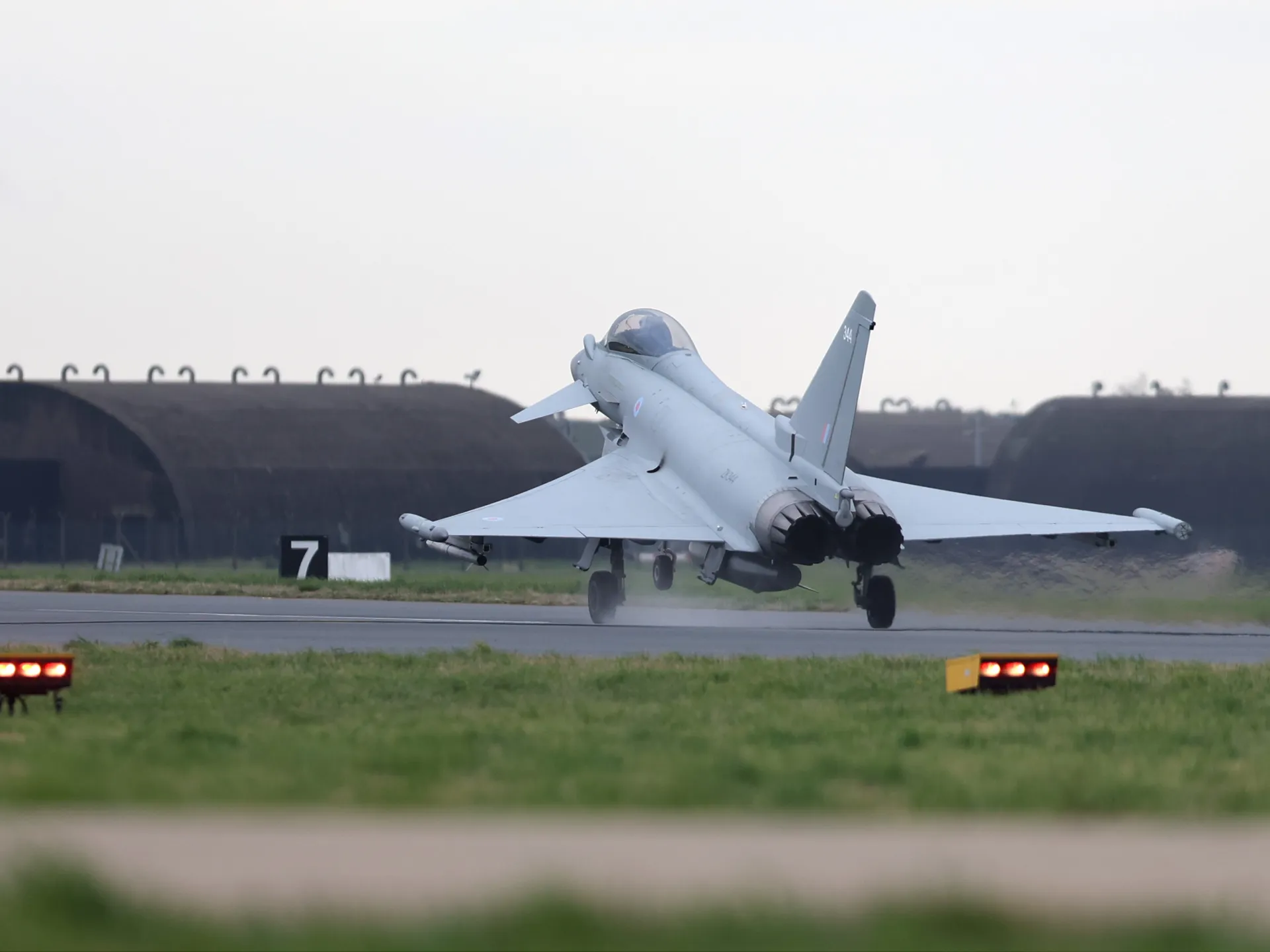
Earlier this month, UK Prime Minister Keir Starmer said he would send four additional Typhoon fighter jets to Qatar to help with defence.

Despite initially stating that the UK would not permit the US to use UK bases for strikes on Iran, Starmer partially relented on March 1 when he granted a US request to use UK bases for “defensive” strikes on Iranian capabilities.

Nevertheless, Starmer has stated that the UK will not send its own assets or troops or otherwise become involved in the ongoing war.

Saudi Arabia

Saudi Arabia hosts US military assets and personnel at the Prince Sultan Air Base (PSAB), located near Al Kharj, southeast of Riyadh.

Saudi Arabia is also the largest Foreign Military Sales (FMS) partner of the US.

There is no formal mutual‑defence treaty between the US and Saudi Arabia, similar to NATO’s Article 5. Instead, there are defence cooperation agreements between Riyadh and Washington.

Pakistan and Saudi Arabia have had a decades-long security partnership. This was strengthened in September 2025, when the two countries signed a formal mutual defence pact.

The extent to which Pakistan, which shares a 900km (559-mile) border with Iran in its southwest, can and will intervene is unclear, however.

On March 3, Pakistan’s Deputy Prime Minister and Foreign Minister Ishaq Dar told a news conference he had personally reminded Iranian Foreign Minister Abbas Araghchi of Pakistan’s defence obligations to Saudi Arabia.

“We have a defence pact with Saudi Arabia, and the whole world knows about it,” Dar said. “I told the Iranian leadership to take care of our pact with Saudi Arabia.”

An estimated 1,500 to 2,000 Pakistani troops are stationed in Saudi Arabia.

United Arab Emirates

The UAE also hosts US assets and personnel at its Al-Dhafra airbase, including advanced aircraft such as F-22 Raptor stealth fighters and various surveillance planes, drones and airborne warning and control systems (AWACS).

On Thursday, the US announced an $8.4bn arms deal with the UAE, for the Gulf nation to buy drones, missiles, radar systems and F-16 aircraft.

Recently, the UAE has bolstered its military partnership with India. In January this year, the president of the UAE, Sheikh Mohamed bin Zayed Al Nahyan, visited India.

During this meeting, India and the UAE reaffirmed the India-UAE Comprehensive Strategic Partnership. Established in 2017, this is a bilateral agreement focused on defence cooperation, energy security and technology exchange.

The UAE and India do not have a mutual defence-style agreement in place, however.

Oman

The US has long-term access agreements for key air and naval facilities in Oman, notably the Port of Duqm and Port of Salalah, both of which have been subject to Iranian strikes over the past three weeks.

The UK and Oman also have a defence cooperation agreement and conduct regular joint exercises.

Pakistan and Oman also have military ties where they hold regular joint naval exercises.

However, there are no mutual defence commitments in place.

Bahrain

The US operates the Naval Support Activity (NSA) in Bahrain. Home to the US Navy’s Fifth Fleet, the base provides security to ships, aircraft, detachments and remote sites in the region.

Bahrain and the UK also have a comprehensive security pact. Earlier this month, Starmer held talks with King Hamad bin Isa Al Khalifa of Bahrain and confirmed that the UK would send aircraft to bolster Bahrain’s security.

Kuwait

Kuwait hosts Camp Arifjan, a major US Army installation that functions as the main logistics, supply and command hub for US military operations across the Middle East, especially within the US Central Command (CENTCOM) area of responsibility.

On Thursday, the US announced an $8bn arms deal with Kuwait – for air and missile defence radar systems.

In 2023, Kuwait signed an agreement on military cooperation with Pakistan, focusing on joint training and military exercises.

These are not mutual defence agreements, however.

What could these partners be doing to better assist Gulf countries?

Experts say military allies of Gulf nations could provide naval escorts to ships transiting the Strait of Hormuz. One-fifth of the world’s oil and gas supplies are shipped through this route in peacetime from Gulf producers.

On March 2, Ebrahim Jabari, a senior adviser to the commander-in-chief of Iran’s Islamic Revolutionary Guard Corps (IRGC), announced that the Strait of Hormuz – through which 20 percent of the world’s oil and gas is transported – was “closed”. This has contributed to the recent surge in oil prices, which have surpassed $100 a barrel, compared with the pre-war Brent crude price of about $65.

In recent days, countries have been individually scrambling to negotiate safe passage for ships with Iran. A handful of mainly Indian, Pakistani and Chinese-flagged ships have been able to get through as a result.

“Pakistan and India are working with Iran to ensure of safe passage of tankers for their markets,” David Roberts, a senior academic in international security and Middle East studies at Kings College London, told Al Jazeera.

Roberts said that theoretically, the countries could also offer a naval escort for their tankers and other tankers.

“As neutrals, this might be a plausible gambit, but would need the acquiescence of Iran. Support establishing a shipping channel from the monarchies to China, Pakistan, India is plausible with concerted pressure from the three states, but Iran will be reluctant to give up that pressure point.”

Roberts said that European countries on the other hand, are “stretched thinly” when it comes to offering any such military support in the Strait of Hormuz.

He suggested the UK could send “another plane or two” to Qatar to join their joint Typhoon squadron. However, he added that it is difficult to make predictions about what support is likely to be forthcoming.

“Gulf states clearly need support. But it’s not clear what can be offered by anyone,” Roberts said.

He added they likely need more munitions for missile defence but stocks are tight everywhere.

Source link

Iran war: What is happening on day 21 of US-Israel attacks? | US-Israel war on Iran News

Tehran has warned of zero restraint if energy facilities are attacked again, while Netanyahu signals that there could be a ‘ground component’ to the war.

Iran has warned it will show “zero restraint” if its energy facilities are attacked again, a day after Israel struck the South Pars gasfield and Tehran attacked energy sites across the Gulf.

In the United States, President Donald Trump raised controversy during a meeting with Japan’s Prime Minister Sanae Takaichi by invoking the 1941 bombing of Pearl Harbour while defending the element of surprise in the Iran attack.

Meanwhile, as the conflict intensifies, concerns over supply disruptions have pushed global oil and gas prices higher, with sharp increases reported across the United Kingdom and Europe.

In Iran

  • Escalation: After Israel struck Iran’s South Pars gasfield, Tehran hit targets in Haifa, Israel, and Ras Laffan, Qatar, warning of “zero restraint” if its energy facilities are attacked again and claiming Iran has only used a “fraction” of its firepower so far.
  • Widespread regional missile strikes: Iran’s Islamic Revolutionary Guard Corps (IRGC) announced a new wave of missile and drone attacks on US bases and central and southern Israel, including Tel Aviv, Haifa, and Jerusalem.
  • Humanitarian toll:  The Iranian Red Crescent Society reported that more than 18,000 civilians have been injured and 204 children have been killed in Iran since the war began on February 28. In all, more than 1,400 people have been killed in Iran.
  • US airbase in Germany: Iran said it had asked Germany to clarify the role of the Ramstein Air Base in the war. “The role of Ramstein is not officially clear for us,” Tehran’s ambassador to Germany, Majid Nili, said. The Ramstein Air Base matters because it is one of the US military’s most important hubs and a key link in operations in the Middle East.
  • Macron eyes UN action on Hormuz: French President Emmanuel Macron said he will consult United Nations Security Council members on a framework to secure navigation in the Strait of Hormuz, a vital global chokepoint through which about 20 percent of the world’s oil and gas flows – once fighting subsides.

INTERACTIVE - Joint US-Israeli strikes and Iran's attacks - MARCH 19, 2026 copy-1773920176

In the Gulf

  • Gulf attacks: UAE and Kuwaiti air defences were responding to missile attacks on Friday, authorities in the Gulf states said. Saudi Arabia’s Ministry of Defense said it had intercepted and destroyed 10 drones in the country’s east and another in the north.
  • UAE arrests: Authorities detained at least five members of a “terrorist network” linked to Iran and Hezbollah that allegedly used business fronts to infiltrate the economy as part of a coordinated external plan, the official WAM news agency reported.
  • Qatar – Ras Laffan attack: Iran hit Qatar’s key LNG facility, cutting about 17 percent of output for as long as five years, the CEO of QatarEnergy has said. With Qatar supplying 20 percent of global LNG, disruptions are expected, with force majeure likely on some contracts to Belgium, Italy, South Korea, and China. Diplomatically, Qatar’s prime minister and Turkiye’s foreign minister held a joint news conference condemning the act of sabotage as a “dangerous escalation” by Iran. On Thursday, Qatar’s defence forces again reported ballistic missile attacks.
  • Missile and drone interceptions in Bahrain: Bahrain’s Defence Force reported shooting down five incoming missiles recently, bringing its total interceptions to 139 missiles and 238 drones since the start of the conflict more than two weeks ago.

INTERACTIVE - DEATH TOLL - tracker - war - US Israel and Iran attacks - March 19, 2026-1773925057

In the US

  • ‘Pearl Harbour’ remarks: Trump defended not informing allies about the US strikes on Iran, saying “we wanted surprise.” He then turned to Japanese Prime Minister Sanae Takaichi, who was visiting the White House and was seated next to him, and invoked the 1941 bombing of Pearl Harbour, saying, “Who knows better about surprise than Japan? Why didn’t you tell me about Pearl Harbour, OK? Right?”
  • Diplomatic shockwaves: Analyst Mireya Solis called Trump’s Pearl Harbour remark to Japan’s PM “unusual – a shock” that brings up a bitter rivalry rather than emphasising shared allied bonds.
  • US war objectives unchanged: Defense Secretary Pete Hegseth said US goals remain the same since February 28 – targeting Iran’s missile systems, military industry and navy, and preventing a nuclear weapon, with no set end date.
  • No US ground troops: Trump said he was not sending US ground troops to Iran, telling reporters: “If I were, I certainly wouldn’t tell you. But I’m not putting troops.” However, Trump has frequently changed his position on whether he is open to deploying boots on the ground in Iran.
  • F-35 incident: A US F-35 fighter jet made an emergency landing at a Middle East airbase after a combat mission over Iran. The aircraft landed safely and the pilot is stable, while US officials investigate reports it may have been struck by Iranian fire. If that is the case, it would be the first US jet struck by Iran during the current war.

In Israel

  • Explosions over Jerusalem: Israel’s military said it had identified three rounds of missile fire in the hour and a half preceding midnight, and another a few hours later.
  • Netanyahu says Iran ‘decimated’: Israeli Prime Minister Benjamin Netanyahu said at a news conference he saw “this war ending a lot faster than people think … We are winning and Iran is being decimated.”
  • Trump and Netanyahu: Netanyahu also denied that Israel “dragged” the US into the war, asking, “Does anyone really think that someone can tell President Trump what to do?”
  • Israel ‘acted alone’: The PM also said Israel acted on its own when it struck an Iranian gasfield. “President Trump asked us to hold off on future attacks and we’re holding out.”
  • Netanyahu signals possible ground phase: “It is often said that you can’t win, you can’t do revolutions from the air. That is true. You can’t do it only from the air. You can do a lot of things from the air, and we’re doing, but there has to be a ground component as well,” the Israeli prime minister said in his remarks.
  • Next stage questions: Al Jazeera’s Rob McBride described Netanyahu’s comments about a possible ground component as “intriguing”, suggesting a potential next stage while raising questions about how it would unfold. Netanyahu’s remarks were also seen as an attempt to reassure Israelis that the nearly three-week war has been worthwhile.
  • Core objectives: Netanyahu also reiterated goals of dismantling Iran’s nuclear programme, degrading its ballistic missile capabilities, and shaping conditions for a future without the “current regime”.
  • Regional framing: “In a wider sense, he was also claiming that with their American allies, they were reshaping the Middle East altogether, and that the balance of power and the dynamics within that – that Israel, he said, had never been stronger, while Iran, he claimed, had never been weaker,” McBride said.

In Lebanon

  • Severe humanitarian crisis and displacements:  Since Israeli attacks on Lebanon escalated on March 2, the death toll in the country has surpassed 1,000 people, with at least 2,584 wounded. Furthermore, residents in towns such as Machghara and Sahmar in the Bekaa Valley reported receiving threatening phone calls from foreign numbers urging them to evacuate.
  • Ongoing clashes and military actions: Fierce fighting continues in southern Lebanon, where the Israeli army has expanded its ground troop presence. Hezbollah has claimed responsibility for multiple attacks, including firing missiles at Israeli soldiers and vehicles in the southern Lebanese towns of al-Aadaissah, Meiss el-Jabal, and Maroun al-Ras.
  • Diplomatic efforts for a truce: Amidst the heavy fighting, Lebanese President Joseph Aoun has renewed calls for a truce and the opening of negotiations with Israel to end the war.

Oil and gas

  • Global economic effect: The Ras Laffan strike cut about 17 percent of LNG capacity, with losses near $20bn a year and an estimated 9 percent annual hit to Qatar’s gross domestic product, according to Al Jazeera’s Dmitry Medvedenko, who was reporting from Doha.
  • Soaring global prices: Concerns over these supply disruptions have triggered a surge in global oil and gas prices. Gas prices have risen sharply across the UK and Europe. The ripple effects are being felt in developing nations as well; for instance, fuel prices in Zimbabwe recently topped $2 per litre for the first time as a direct result of the conflict’s effect on oil and gas exports.
  • International pushback and warnings: Due to the escalating energy crisis, the European Council has urgently called for a moratorium on strikes against energy and water facilities.
  • US may ‘unsanction’ Iranian crude: US Treasury Secretary Scott Bessent said Washington might “unsanction” Iranian oil that is already being shipped to ease oil prices. In comments to Fox Business, Bessent also said the US government could release more oil from its strategic reserves.

Source link