July 23 (UPI) — President Donald Trump said on social media Thursday that Saudi Arabia must sign the Abraham Accords as part of its nuclear deal with the United States.
Trump added that the nuclear deal will be approved but Saudi Arabia’s entry into the Abraham Accords is a required condition.
“The Civil Nuclear Deal (There will be no enrichment of material!) being made between the United States Department of Energy and Saudi Arabia, which pertains only to non-military use such as the ones that Iran and UAE (and others) already have, will be approved, but it is totally subject to Saudi Arabia joining the very respected and successful Abraham Accords,” Trump wrote. “The United States is not opposed to Civil (Non-Enriched) Nuclear Facilities.”
Energy Secretary Chris Wright and Saudi Energy Minister Prince Abdulaziz bin Salman signed the agreement on Wednesday. The Department of Energy says U.S. companies will benefit from the deal with involvement in establishing nuclear facilities in Saudi Arabia to the tune of billions of dollars.
The nuclear deal is to last 30 years and will involve the United States supporting Saudi nuclear development.
The Abraham Accords are meant to normalize relations between Israel and Arab nations in the Middle East, including the United Arab Emirates. Saudi Arabia’s entry into the Abraham Accords would be a step toward a diplomatic relationship with Israel.
Saudi Arabia has called for progress toward Palestinian statehood, a sticking point that has drawn Israel’s criticism of the nuclear deal with the United States.
Lawmakers on both sides of the aisle have also voiced skepticism over the nuclear deal, fearing that it may ultimately lead to the enrichment of uranium and plutonium for the development of nuclear weapons.
“This agreement will set off a nuclear race in the region, further disincentivizing Iran from limiting its own program,” Sen. Chris Murphy, D-Conn., posted on social media.
Secretary of Defense Pete Hegseth speaks during a Senate Appropriations Committee hearing on President Donald Trump’s June 24 supplemental funding request at the U.S. Capitol on Tuesday. Photo by Bonnie Cash/UPI | License Photo
Weekly insights and analysis on the latest developments in military technology, strategy, and foreign policy.
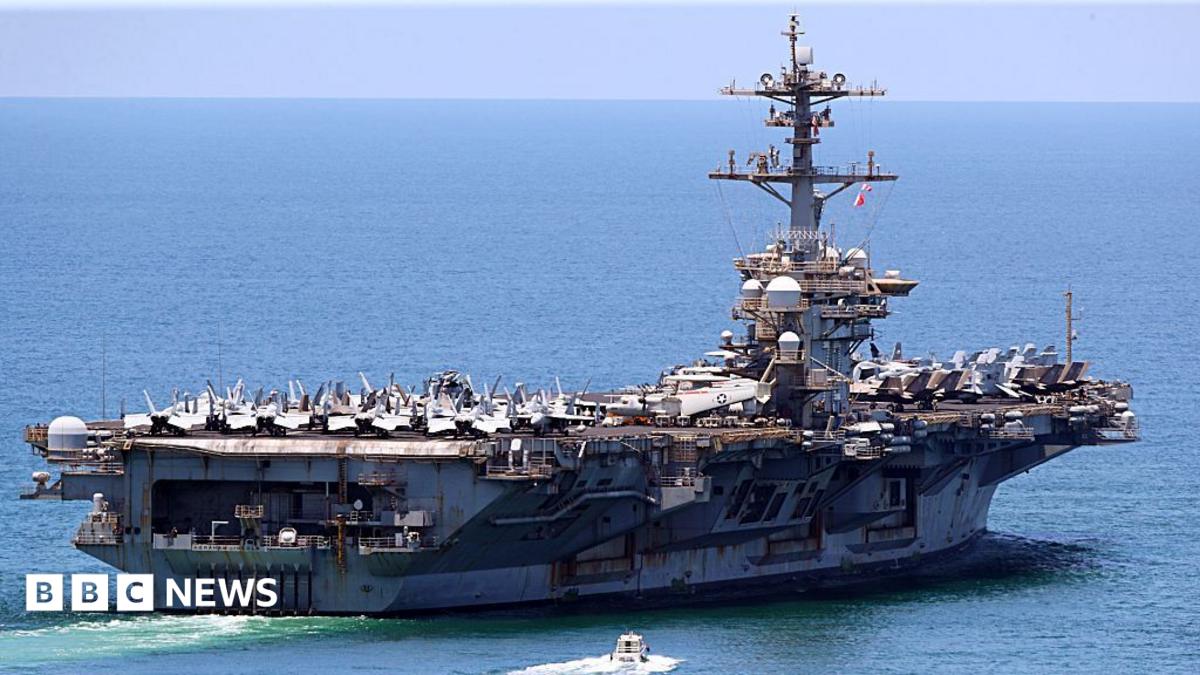
The U.S. Navy’s Nimitz class aircraft carrier USS Abraham Lincoln has been underway for 210 straight days – well over half a year – in support of Operation Epic Fury and the subsequent blockade of Iran. This looks to be a record-setting milestone. Lincoln, the flagship of Carrier Strike Group 3 (CSG-3), is currently operating in Middle Eastern waters.
Aircraft attached to Carrier Air Wing 9 fly over the flight deck of USS Abraham Lincoln, June 28, 2026. U.S. Navy photo U.S. Central Command Public Affa
Abraham Lincoln, the fifth Nimitz class supercarrier and self-styled “most capable CSG in the fleet,” departed Naval Base Guam on December 12, 2025, after a quick one-day port call. Port calls, or temporary visits to friendly countries, allow the crew to disembark for “liberty” – to step on solid ground – and break up the grueling, nonstop schedule experienced during deployments. However, the stop in Guam, a strategic U.S. territory in the Western Pacific, was so brief that much of the crew likely never went ashore.
USS Abraham Lincoln pulls into Naval Base Guam for a scheduled port visit, Dec. 11, 2025. U.S. Navy photo by Valerie Maigue Valerie Lynn Maigue
Lincoln and CSG-3, made up of more than 5,000 Sailors and Marines, quietly left Naval Base San Diego three weeks earlier on November 21, 2025. At the time, the U.S. military buildup in the Caribbean was the focus of public attention, and Lincoln was expected to conduct a routine Pacific patrol. An Iran contingency was on the table following Operation Midnight Hammer, when B-2 bombers struck nuclear targets deep inside Iran, and Lincoln’s Composite Training Unit Exercise (COMPTUEX) included preparing for a fight in the Middle East. COMPTUEXs are weeks-long capstone training events for carrier strike groups that come right before they deploy.
Abraham Lincoln pulls out of San Diego on November 21, 2025. U.S. Navy photo by Mass Communication Specialist 3rd Class Mario Castro Gamez Petty Officer 3rd Class Mario Castro Gamez
After leaving Guam, Lincoln conducted operations in the South China Sea before entering the Indian Ocean and arriving in the northern Arabian Sea in late January. Aircraft from Carrier Air Wing (CVW) 9 launched sorties in the opening salvo of Operation Epic Fury, and the CSG was instrumental in enforcing the naval blockade that followed. Since the Memorandum of Understanding (MOU) was signed on June 17, Lincoln has remained in the northern Arabian Sea, launching retaliatory strikes during the recent skirmishes.
F-35C Lightning II, attached to Marine Fighter Attack Squadron (VMFA) 314, staged for flight operations on the flight deck of USS Abraham Lincoln in support of Operation Epic Fury, Mar. 3, 2026. U.S. Navy photo U.S. Central Command Public Affa
The CSG has been deployed for more than seven months now and would likely be among the first naval assets to rotate out of the theater if an agreement is reached between the U.S. and Iran. The details and scale of the drawdown of forces in the U.S. Central Command (CENTCOM) AOR, as per the MOU agreed to by American and Iranian officials last month, are to be determined within 30 days if a final deal is reached before the deadline in mid-August. A new spate of tit-for-tat strikes just this week has created serious uncertainty around future talks between Washington and Tehran. More than 20 U.S. Navy surface combatants are still operating in the region.
“We’ve officially claimed the title for most consecutive days at sea for any modern aircraft carrier,” Lt. Commander Alexis Travis, an officer currently serving aboard Lincoln, wrote on Instagram on June 16.
We have reached out to the Navy to confirm whether this is indeed a record-breaking period at sea. However, we have not received a response as of the time of publication.
In June 2020, the U.S. Navy did announce that the Nimitz class carrier USS Dwight D. Eisenhower and the Ticonderoga class cruiser USS San Jacinto had set a new record after spending 161 days consecutively operating at sea. Eisenhower did not make a stop in port until the next month, having been at sea for 206 consecutive days in the end. This was, in part, due to the COVID-19 pandemic, when port access was severely limited due to quarantine restrictions. The carrier had left Norfolk in January 2020 for a deployment to the Middle East and launched combat sorties during Operation Freedom’s Sentinel in Afghanistan, returning home nearly seven months later without a single stop. Prior to that, USS Theodore Roosevelt held the record in 2002, supporting the post-9/11 response. Roosevelt left Norfolk in September 2001 to participate in Operation Enduring Freedom and spent 160 days at sea before anchoring in Bahrain for a reprieve in February the following year.
USS Dwight D. Eisenhower transits the Arabian Sea on June 12, 2020, during a record-setting deployment. U.S. Navy photo by Mass Communication Specialist 1st Class Aaron Bewkes
In April, USS Gerald R. Ford, the newest American carrier and largest in the world, logged the longest deployment on record at 326 days. Ford, while deployed for nearly eleven months, was operating primarily in the U.S. European Command-6th Fleet area of responsibility (AOR) and U.S. Southern Command-4th Fleet AOR, which is relatively friendly territory, and made at least nine port calls in Marseille, Oslo, Palma de Mallorca, Split, St. Thomas Island, and Souda Bay. Between port calls and stops to refuel and make emergent repairs, Ford averaged a visit to port every 36 days.
USS Gerald R. Ford arrives at the NATO Marathi Pier Complex in Souda Bay, Crete, Greece, during a scheduled port visit on Feb. 23, 2026. U.S. Navy photo by Mass Communication Specialist 3rd Class Hannah Donahue Petty Officer 3rd Class Hannah Donahue
The Lincoln CSG, which also includes guided-missile destroyers from Destroyer Squadron (DESRON) 21, served as the tip of the spear in Operation Epic Fury. DESRON 21 fired dozens of Tomahawk Land Attack Missiles (TLAMs) against Iran, and provided defensive measures for the CSG, using Standard Missiles and other armaments to intercept incoming threats. The embarked “air wing of the future,” CVW 9, launched thousands of sorties and pressured Iran’s southern axis during the 40-day war, successfully escorted commercial ships through the contested Strait of Hormuz, and hunted and disabled Iranian-affiliated vessels attempting to run the blockade. The carrier’s air wing notably includes F-35C Joint Strike Fighters assigned to Marine Fighter Attack Squadron 314 (VMFA 314), giving it better penetrating capabilities. The CSG has proven its ability to blend and interoperate high, medium, and low-end naval and joint capabilities, for offensive and defensive purposes, as well as integrate across platforms, including manned and unmanned systems, conventional and unconventional, surface and subsurface, overt and covert, and more, during nonstop combat operations.
USS Abraham Lincoln, USS Michael Murphy, USS Frank E. Petersen Jr., USNS Henry J. Kaiser, USNS Carl Brashear, USCGC Robert Goldman, and USCGC Clarence Sutphin. Jr. sail in formation in the Arabian Sea, Feb. 6, 2026. U.S. Navy photo by Mass Communication Specialist 1st Class Jesse Monford
The destroyers escorting Lincoln were able to make port calls before the war began, but some have been at sea for over four months. USS Frank E. Petersen Jr., the Integrated Air and Missile Defense (IAMD) Commander, moored at Navy Terminal in the Port of Duqm, Oman, for two days in mid-February. USS Michael Murphy, the last destroyer to leave the Persian Gulf before the first shots were fired, docked in Dubai, UAE, from February 25-27, and left the day before the city was targeted in the initial waves of Iran’s counterattack. Satellite imagery reviewed by TWZ at the time showed Murphy’s precise location the day prior was targeted. USS Spruance, the only San Diego-based destroyer operating with CSG-3, deployed on the same day as Lincoln, and has been at sea for just as long, with one port call in December in Guam. Spruance was spotted firing a black TLAM on the first day of Epic Fury.
Arleigh Burke-class guided-missile destroyer USS Spruance fires a Tomahawk Land Attack Missile (TLAM) in support of Operation Epic Fury, Feb. 28, 2026. U.S. Navy photo NAVCENT Public Affairs
“Literally no one signed up for this,” Lt. Commander Travis also wrote on Instagram. “And yet here we are, still doing it safely and successfully. Just a strong group doing tough stuff, breaking records and then waking up and doing it again.”
When the crew serving tirelessly aboard Lincoln will next set foot on land is unknown, and with the fate of the U.S.-Iran MOU similarly uncertain, it may be some time.
Contact the author: ian.ellis-jones@teamrecurrent.io
Donald Trump announced that he has requested several countries, including Qatar, Saudi Arabia, Pakistan, Egypt, Jordan, and Turkey, to join the Abraham Accords to normalize relations with Israel as part of an agreement with Iran.
U. S. President Donald Trump announced that he has requested several countries, including Qatar, Saudi Arabia, Pakistan, Egypt, Jordan, and Turkey, to join the Abraham Accords to normalize relations with Israel as part of an agreement with Iran. He stated he spoke to the leaders of these countries, as well as the United Arab Emirates and Bahrain, which have already signed the accords.
Trump expressed his wish for all these countries to immediately sign the accords and suggested that if Iran agrees to a deal with the U. S., it would be an honor to include Iran in this coalition. He mentioned the complexity of the negotiations that the U. S. has been working on and said most countries should be open to making a historic settlement with Iran.
While Trump indicated that negotiations with Iran were progressing, he didn’t provide details about a potential deal. He also noted that Egypt and Jordan already have relations with Israel, and he remains optimistic about Saudi Arabia joining the accords, although no movement from Riyadh has been observed.