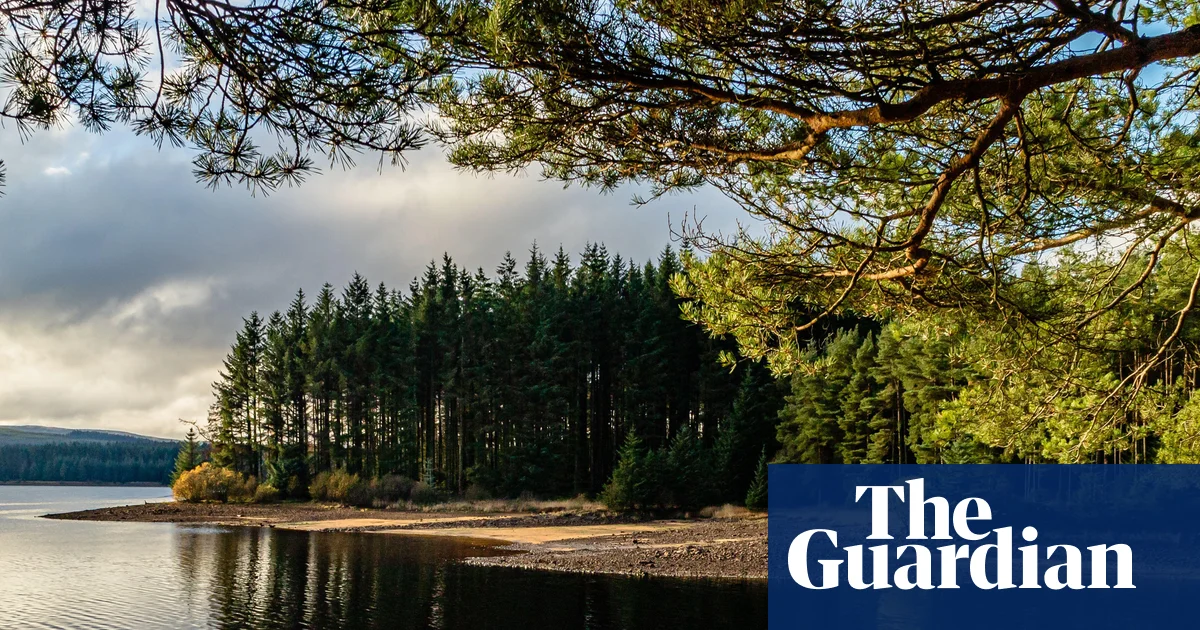
Deep in Kielder Forest, on the northern side of the vast Kielder Water stands Silvas Capitalis, a giant, two-storey timber head, one of the most striking of the 20 sculptures tucked between the pines. It’s an eerie sight, almost shocking; its mouth ajar, as if astounded by all it sees. It’s my first visit to Kielder, and my face has been wearing a similar expression since I stepped out of the car at the lakeside trying to take in the scale of the landscapes unfolding around me.
Kielder doesn’t look like England – at least, not the England I know. For a start, it’s vast; 250 sq miles (648 sq km), with 158m trees, mostly sitka spruce conifers planted by hand. And even though it’s a plantation, there’s a wilderness feel that reminds me of Finland or Canada; a great swathe of nature at its most intense. It’s a working forest, involving 500 full-time jobs (not including tourism) and 2026 marks the centenary of the very first plantings, when the UK was in need of timber reserves after the demands of the first world war.
The desolate moorland around Kielder Castle had been identified as a suitable site for a new forest by Roy Robinson, who was instrumental in the creation of the Forestry Commission in 1919. “He was a visionary,” says Alex MacLennan, part of the Kielder team for more than 20 years. “It was hard farming country, but perfect for forestry. Originally, there were eight villages planned, to house the timber workers. But three decades later, when the first trees were ready to be felled, mechanisation and new tools such as chainsaws meant they only needed three.”
All of which means development in the forest is minimal; the main tourist area is at the Kielder Waterside, where 50 unobtrusive lodges are tucked between the trees, some of which were damaged when Storm Arwen roared in five years ago and tore down a million trees across the forest and the wider Northumberland national park. “It’s given a very different feel to the place,” says Gary Storey, general manager of Waterside, “and a chance to replant with different species, native to the UK – silver birch, oak, aspen, wild cherry – something other than the sitka spruce.”
The careful management of Kielder has made it a benchmark for forestry in the UK, not least for the low-impact tourism that has been carefully folded in. Aside from Kielder Waterside, there are a handful of places to stay, including Calvert Kielder, which in addition to offering self-catering lodges, specialises in respite care breaks packed with forest-based, accessible activities. There are also remote spots with facilities where camper vans can park up for £15 a night and a campsite (two-person pitch £20). “We’re not Center Parcs, and we’re never going to be,” says Liz Blair, director of the Kielder Partnership, when we chat over coffee. “But we’re working to make sure it’s accessible and welcoming for everyone, however you want to enjoy it.”
Many people who visit, including me, set off along the Lakeside Way; a 26-mile (42km) route that encircles Kielder Water, linking the sculptural works and immersing walkers and cyclists in the dense forest. When I visit, the silence that hangs between the trees feels almost thick enough to touch; only broken by the occasional rat-a-tat of a woodpecker, calling out for a mate.
But if Kielder is quiet by day, at night it becomes almost unworldly; a pitch-black void, bereft of almost all signs of life, save for the bright stars of England’s first dark sky park (the Northumberland international dark sky park). Driving up to the observatory, I’m glad to have my sister Caroline beside me in the car, keeping up a flow of chatter as the 2-mile off-road route winds further and further into the silent forest.
It’s the Northumberland dark skies festival when we visit, and we settle in for a fascinating (if slightly science-heavy) talk on exoplanets (planets outside our solar system) before braving the bitter cold to walk across to the telescope room. Sadly, it’s cloudy, but it’s still an extraordinary place, staffed with a mix of professional astronomers and passionate volunteers.
Kielder is a place of superlatives; England’s biggest forest, the UK’s largest human-made lake by capacity, the darkest skies – along with quite possibly the most terrifying mountain bike trails in the country. The Deadwater Double Black Downhill opens officially on 1 May, a rock-strewn, ledge-filled, vertiginous route that I wouldn’t want to walk, let alone cycle. It’s one of several new initiatives planned to celebrate the centenary, including a new Room on the Broom trail for kids, based on the book by Julia Donaldson and Axel Scheffler; the Kielder celebration weekend (4-6 Sept); and the reopening of Kielder Castle in the summer after extensive renovations.
The forest may be vast, but it’s just one part of the Northumberland national park; the least populated and least visited of the UK’s 15 national parks. Coming from the built-up south-east, there’s an extraordinary beauty in the stark, untouched landscapes – a stillness, a peace, unmatched by anywhere closer to home. The history is pretty impressive too; we dip into the ruined Roman fortress at Vindolanda, take a windswept walk along Hadrian’s Wall and warm up with a fabulously hearty lunch of Cumberland sausage, mustard-mash and thick onion gravy at the centuries’ old Twice Brewed Inn.
But nothing quite matches my late afternoon judder up to the top of Deadwater Fell in Alex’s Forestry Commission van. Standing at the very peak, 571 metres (1,900ft) above sea level, it feels as if I can see for ever; a 360-degree widescreen vista, from the Cheviot Hills in the north-east to the peaks of the western Lake District, the snow-capped Pentland Hills rising up towards Edinburgh, like great white meringues. It’s genuinely awe-inspiring. I’m just glad I don’t have to mountain-bike back down.
This trip was supported by Visit Northumberland, Visit Kielder and Crabtree & Crabtree cottages. Birks Stable Cottage sleeps six, from £472 for a three-night break