Manchester United’s 0-3 home loss to Bournemouth has left the 20-time champions winless in eight Premier League games.
Published On 25 Oct 202625 Oct 2026
Amid increasing pressure on his team and a growing threat to his own position as manager, Michael Carrick says he will do what is best for Manchester United after a 3-0 demolition by Bournemouth plunged his future into doubt.
Winless in eight games in all competitions, the 20-time English champions slipped to within one point of the relegation zone after a damaging defeat at Old Trafford on Sunday.
“It’s a tough situation,” Carrick told British broadcaster Sky Sports. “What is next? I don’t know.
“I’ll always do what’s best for this football club. I’ve said it all along; I don’t change that now. I love what I do. I love the responsibility, but we’ll have to wait and see.”
Asked in a post-match news conference if he expects to be sacked in the coming days, Carrick replied: “I totally understand the situation. I’m not expecting anything in particular, to be honest. I’m carrying on as normal. I love this place.”
Despite a dismal run of results, the United fans largely supported the former midfielder as he made his way off the field at full-time before they turned on the club’s players.
“I have mixed emotions to have that connection with the supporters in the moment we’re in. I need time to digest that,” added Carrick.
“I appreciate their support but the situation is where it’s at. We haven’t been good enough.”
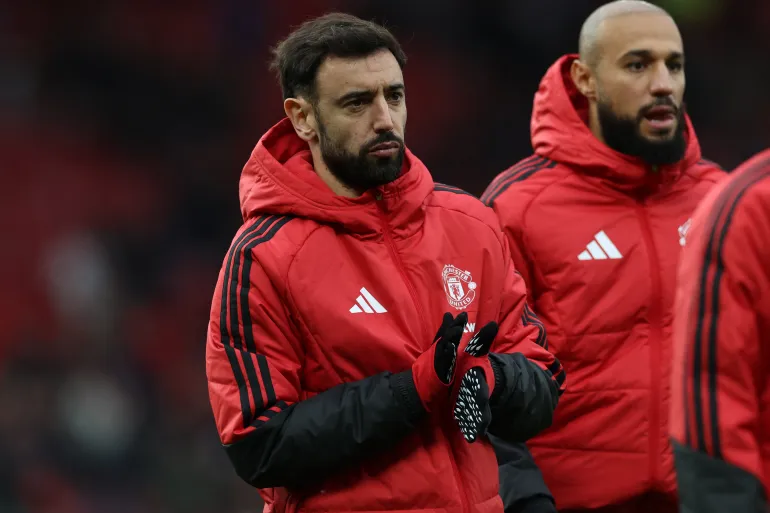
Manchester United’s captain Bruno Fernandes did not feature in the match against Bournemouth [File: Darren Staples/AFP]
Carrick’s decision to drop captain Bruno Fernandes to the bench and not even introduce the Portuguese international as a substitute backfired.
Fernandes, last season’s Premier League player of the year, had criticised Carrick’s tactics after the 4-1 thrashing by Como on Wednesday.
Carrick said before the game that his call was a “pure football” decision, but it was hard to believe Fernandes was not being punished as he was left on the bench for the entire match.
“There’s always times in games when you are trying to change the course of the game and to make a difference,” said Carrick as he swerved questions on Fernandes’s absence. “Those were the decisions we made today.”
Carrick was appointed on a two-year deal only in May after a successful caretaker spell in charge led United to third place in the Premier League last season.
However, he has been unable to arrest the club’s steep decline since his former boss Alex Ferguson retired as manager in 2013.
United were outspent by many of their rivals in the transfer market as they added just three midfielders – Youri Tielemans, Andrey Santos and Carlos Baleba.
But Carrick said a lack of investment did not justify such a decline in results.
“Last season to finish third was a really good achievement in the circumstances,” added Carrick.
“We understood where that left us, what was next, what needed to be done and how we needed to improve, and where we were at as a team and as a group at that stage.
“I definitely knew that we hadn’t cracked it and there was a lot of work to be done, but that doesn’t mean to say that it should have gone this way.”
Manchester United manager’s troubles grow as seven players are out injured before a Champions League trip to Como.
Published On 21 Oct 202621 Oct 2026
Manchester United manager Michael Carrick says he needs no reassurances from the club’s hierarchy as he knows winning games is the only way to silence speculation over his future.
Before a Champions League trip to Italian side Como on Wednesday, United have won just two of their 10 games in all competitions this season.
The Red Devils are off to their worst start to an English top-flight campaign in 40 years, having been knocked out of the League Cup by Brighton last month and comfortably beaten by Atletico Madrid last week in the Champions League.
Carrick was appointed manager on a permanent basis in May only after an impressive spell as interim boss in the second half of last season.
But he has quickly become just the latest manager under pressure at Old Trafford at a club that has fallen from grace since Alex Ferguson’s retirement in 2013.
Several Manchester United players will miss the trip to Como for their Champions League tie [Ed Sykes/Reuters]
“I know we’ve got to win football games for everything to flow and everything to fit into place. That’s the great thing about it; we can do something about it,” Carrick told his pre-match news conference in Italy.
“I don’t need any reassurance. It’s pretty clear.
“I know the role, I know the responsibilities. I don’t need anyone else to kind of tell me that or tell me when it’s going well or when it needs to be better. I know that myself.”
Carrick’s hopes of turning things around have not been aided by a growing injury list.
Lisandro Martinez started Sunday’s 1-1 draw at Leeds, despite his stinging criticism of the club’s lack of transfer activity following the defeat at Atletico, but had to be replaced at half time.
The Argentinian international will miss the trip to Como, as will Luke Shaw, Kobbie Mainoo, Marcus Rashford, Benjamin Sesko, Patrick Dorgu and Ayden Heaven.
Dodgers left-hander Blake Snell, sitting next to soon-to-be free agent Tarik Skubal at their lockers in the aftermath of their team’s elimination from the National League Championship Series elimination, made a promise:
“I’ll be recruiting,” he interjected with a smile, as Skubal declined to comment on free agency, saying it was too soon to try to predict what the future would hold for him.
That would be Snell’s side project between rounds of video games — 2K specifically. (Skubal admittedly “sucks” at the game, but Snell says his teammate “has heart, though.” The rest can be taught.)
The expected lockout, and MLB’s insistence on a salary cap in their CBA proposals, have also cast doubt on what the system will look like next year — whenever the season begins.
Not to mention, the stars in the Dodgers’ lineup, already the oldest in the majors (weighted by at-bats and games played), will be another year older.
Could this be the end of an era?
“I don’t feel that at all,” Skubal said. “It’s hard to win the World Series, and this group has done it the last two seasons. Obviously, not this year, but … I think that this group is incredibly talented. And the preparation and the work ethic that this group has — I don’t buy into that narrative.”
Said Snell: “We’re only getting better.”
Plenty of people outside of the Dodgers’ downcast clubhouse Thursday evening saw the Brewers’ four-game sweep of the defending back-to-back champions as the fall of a dynasty. But the players inside fervently disagreed.
“When you have Shohei Ohtani on your team, Yoshinbou Yamamoto, Freddie Freeman, Mookie Betts and the years ahead of these guys, you can never think that it’s going to be the end,” Rojas said. “And I know this organization so well, they’re not going to be satisfied with this loss. I think they’re going to move forward and continue to improve the team in any capacity, and I believe that we’re going to be even better next year.”
Said Hernández: “I don’t know what’s going to happen with me personally, moving forward for next year. But this team is well-positioned to keep winning and keep competing deep into October. So not only is this locker room very talented, but there’s a lot of guys knocking on the door in the minor-league system that can be really impactful players. So the organization is in good hands.”
Rookie Josue De Paula showed down the stretch, and with his plate discipline even in high-octane moments in the postseason, just how impactful the young players in the Dodgers’ system could be. And there are more behind him.
This offseason, the Dodgers front office will try to strike a balance between continuity and fresh faces. For some of their impending free agents, who spoke highly of the organization, that meant uncertainty in the immediate aftermath.
“I love this place,” Hernández said. “I’ve played for three other teams, but every time I look at my career, I obviously go back to this place. I’ve been here the longest. I hope I get back. I feel like I have a lot left. … I would love to have one more try, trying to win another one. But I don’t really know what’s going to happen.”
Vesia, too, said he’d love to return.
“From the coaching staff, to the front office, to the players that have taken me under their wing, have helped mold and shape me into who I am and how I carry myself, how I go about my business,” Vesia said of his six years in the organization. “And if it wasn’t for the people in this room, I would not be where I’m at today. So, very thankful. This whole experience has been life-changing.”
Skubal is in a unique situation. In line to be the top free agent pitcher in this year’s class, he held his cards closer to the vest. But he gave a glowing review of his time with the Dodgers.
“It was an honor and a privilege to be here and compete with these guys, and to wear L.A. across your hat and across your chest,” he said. “It’s something that I took a lot of pride in. And, obviously, didn’t end the way that I wanted it to. But that’s life. That’s baseball. I had a ton of fun here, and I loved competing with these guys.”
With three weeks left to go until election day and polls showing her on the brink of losing, Los Angeles Mayor Karen Bass has begun to channel the Sun King himself, Louis XIV:
L’État, c’est moi.
Gaslighting voters by insisting the political establishment that has left Los Angeles a mess and that she personifies is worth keeping in office for four more years is her only hope for victory. It’s a wild strategy that reached a crescendo during Tuesday night’s debate, as Bass kept bringing up the fact that L.A.’s ancien régime just doesn’t like her democratic socialist opponent, Nithya Raman.
“Your colleagues have a very difficult time working with you,” Bass snapped at one point, later claiming that Raman’s constituents don’t care for her even though the council member won reelection two years ago. The mayor twice bragged that immigrant rights groups support her; twice referenced Imelda Padilla, the moderate San Fernando Valley council member whose internet dragging of Raman has been out of the Burn Book from “Mean Girls”; and described her opponent as “not ready for prime time.”
Well, the way the mayor’s term has gone in the last couple of years, if it was a prime-time TV show, it might be called “Breaking Bad 2.” And it wouldn’t exactly be a hit.
If it were, two-thirds of Angelenos wouldn’t have decided to vote for anyone but Bass in the primary.
Bass arguably won the debate Tuesday night, but it felt like the technical “victory” — and that’s probably the wrong word — of a politician who is simply more polished. The mayor really needed a knockout punch, and that she did not achieve.
Instead, she in effect told voters that the last four years of disasters, inefficiencies and ineptitude are still a better option than taking a chance on the City Hall equivalent of the classroom dork.
Yet people are so angry at Bass and what she represents that a democratic socialist has a great shot at becoming L.A.’s next mayor — an unthinkable prospect even last year, with no one to blame but the ruling class that has left this great city hobbled, cynical and at the point of giving up.
So the establishment doesn’t like Raman: So what? And: Boo-hoo.
Casting Raman as a political leper while asserting that Bass represents stability and good times ahead isn’t the winning strategy that Bass and Raman’s critics think it is. It’s really just a sad coda for Bass.
She’s been a good soldier for L.A., someone who has participated in nearly every progressive movement to pass through Southern California since volunteering for Robert F. Kennedy’s presidential campaign as a teenager nearly 60 years ago. Even as Bass embarked on a 22-year political career that has seen stops in Sacramento, Washington and City Hall, the native Angeleno always successfully depicted herself as a political outsider.
Because she was:a Black woman in a realm not meant for people like her. She was someone who co-founded a pioneering nonprofit in the crucible of a changing South L.A. in the 1990s and always seemed to land on the right side of history until becoming mayor in 2022.
Sadly, Bass didn’t turn out to be the visionary L.A. desperately needed.
Mayor Karen Bass, left, sits for Tuesday’s debate with Councilmember Nithya Raman, right. Between them are NBC4 reporter Conan Nolan, NBC4 News anchor Colleen Williams and Telemundo 52 anchor Alejandra Ortiz.
(Eric Thayer / Los Angeles Times)
Like so many baby boomers, Bass eventually became The Man without realizing it. Today, she not only stands as the figurehead of the city’s liberal potentates, but she’s also calling on them to rally around one of their own — and they have responded in kind. Democratic politicians, bureaucrats and labor leaders, once rabble-rousers like Bass who nowadays seem to exist mostly to keep their sinecure, have labored mightily to convince unbelieving voters that Bass deserves another shot.
That’s always been the marvel of L.A.’s political establishment. It can take someone like Bass, once considered so radical that her days visiting communist Cuba in the 1970s torpedoed her chances of becoming then-presidential candidate Joe Biden’s running mate in 2020, and transform her into an anodyne incumbent. It can make democratic socialists like Councilmembers Eunisses Hernandez, Ysabel Jurado and Hugo Soto-Martínez — people who explicitly ran to take on a sclerotic City Hall — full-throated Bass supporters who have refused to support one of their own in Raman.
Raman was also becoming part of L.A.’s political chosen ones, to the point she initially endorsed Bass. But she now embraces her turn as the machine’s biggest sellout — whether it’s a true change of heart or a chameleonic self-serving measure, as critics maintain, remains to be seen. It was Raman who said at the end of the debate, “When the mayor is confronted with issues, she blames the system. With your support, we can actually change the system” — catnip to enough Angelenos that Raman seems to be at the cusp of victory and a monumental upset.
After the debate, NBC reporter Robert Kovacic interviewed elected officials to let them hype up Bass or Raman. The latter’s proxy was City Controller Kenneth Mejia, another person loathed by L.A.’s political know-it-alls because he keeps bucking the establishment. Mejia gushed about how Raman “destroyed” Bass with the enthusiasm of a Swiftie.
Bass’ supporters were Councilmember Monica Rodriguez and Assemblymember Rick Chavez Zbur, both of whom gravely parroted their candidate’s warnings about just how dangerous a Raman mayoralty would be. Chavez Zbur reduced Raman’s not-bad performance to a “host of complaints” — ironic, because most of Bass’ night was spent bashing Raman instead of offering much of anything positive.
Rodriguez, meanwhile, told Kovacic that voters shouldn’t choose Raman because “we can’t afford that level of indecisive leadership.”
I rolled my eyes when Rodriguez — whose office declined a chance for her to sit down with me to talk up why Latinos should support Bass — said that.
She’s part of the fabled eastern San Fernando Valley Latino political machine, another group of former gatecrashers who assumed the trappings and stylings of the old guard once they assumed power. Rodriguez long blasted Bass with the same venom she reserved for Raman until the latter mounted her challenge — but now that Rodriguez’s power is under threat, she’s all of a sudden decided to become Bass’ ride-or-die?
Moves like that remind me of another French monarch, Louis XV. “After me, the deluge,” he is supposed to have said, a warning of what would happen once his reign ended.
If Bass’ vow to rule the same as before represents a decisive leader, more and more Angelenos seem to be saying, give us the Raman flood.
Besides, nobody ever said, nor ever put on a campaign sticker, “The establishment? It’s cool!”
Natasha Whitley has saved a huge amount compared to the costs people expect to pay
Natasha Whitley on her budget holiday to the Maldives(Image: Natasha Whitley/SWNS)
A budget traveller who has been to the Maldives four times has revealed how she spent less than £350 on one trip.
Natasha Whitley, 30, first travelled to the country in April 2024 with friend Kara, 26, for five days and tried out two islands – Thulusdhoo and Dhiffushi. Staying in cheap accommodation costing just £60 per night and a local ferry costing them just £1 to get from the airport, Natasha “loved it”.
Since then Natasha started her own business for solo travellers, Say Yes Adventures, and returned to the Maldives a further three times as part of group trips. Her most recent visit in February 2026 saw her travel solo on a new island – Fulidhoo – for three nights.
She flew from Gatwick Airport with her flights costing £800 – but it cost just £2.50 for the three-and-a-half-hour ferry trip from Malé to Fulidhoo. She stayed at a hotel costing £260 for three nights, she explored the local island and tried out local food like Maldivian fish curry while there. After paying £29 for a speedboat back from Malé, she continued on to stay at an all-inclusive resort called Niva Kuramathi Maldives – which she says was “not affordable at all but interesting to see the contrast”.
Love of travel
Natasha, a content creator from Bournemouth, Dorset, said: “I’ve always loved travel and I was lucky my parents were interested in travel. They met while travelling in the 80s, so it’s always been a part of my life and story.
“I’m a pharmacist and I worked for four years and took a career break, which was meant to be eight months – it was a big round-the-world trip to Australia, New Zealand, Hawaii and Central America all on a budget.
“I quit my pharmacy job for a content creation summer job. I met my friend Kara the following year and put the feels out there to see if she wanted to come to the Maldives with me.
“There’s not much online about the Maldives on a budget – people know it as somewhere super expensive and a honeymoon destination. In terms of budget I think we said we’d spend around £100 per day on accommodation and activities.
“We spent less than that and spent £420 over the five or six days. You see all the resorts across from you on the local islands, which is crazy because people are paying thousands and you’re spending a fraction of the price in the same waters. Staying on local islands has saved me a lot of money.”
2026 trip
In February 2026, Natasha headed out on her fourth trip to Fulidhoo.
She said: “In the Maldives my favourite food is the Maldivian fish curry, which is usually five dollars. From that island you can do snorkelling trips and watch wild stringrays and nurse sharks from the jetty at night.
“You can snorkel off the beach as well. If you’re nervous about solo travelling just start small, don’t think big because a big six-month trip can be quite overwhelming. The best way to start is to join a group trip because you travel solo, but as soon as you arrive you’re in a group of people, so you get a bit of both”.
In total, Natasha has spent more than 100 nights in the Maldives over the last two years, which would have cost her more than £45,000. You can follow Natasha’s adventures on @travelsbytash and find out more about her group travel company Say Yes Adventures at sayyesadventures.com.
Costs for Natasha’s trip to Fulidhoo
Accommodation: £261 for 3 nights, including breakfast
Transport: £2.50 for local ferry, £30 for speedboat
Food: £7 to £10 per meal
Total cost: £344.50
Example costs for a trip to a resort
Accommodation: £2,482 for 3 nights in an overwater bungalow with private pool and full-board
Transport: £127 return speedboat from Malé
Food: £47, including shrimp pad-Thai at à-la-carte restaurant
She was part of a generation whose parents were from the rancho of El Cargadero, Zacatecas, and started families in el Norte while waiting out the Mexican Revolution in the 1910s and the Cristero Revolt in the 1920s. Many returned to their home village when things calmed down.
After growing up in Mexico, my grandmother moved to California with my grandfather and their children in the 1960s. Only the American government considered her a native-born U.S. citizen, while society dismissed her as a Mexican. We grandchildren always considered our Mama Chela a doña — a grand Mexican dame who never wore pants and frequently covered her hair with a veil out of modesty. All she remembered from her early childhood in Arizona were snippets of the nursery rhymes “Did You Ever See a Lassie?” and “The Bear Went Over the Mountain.”
The El Cargadero diaspora, which mostly settled in Anaheim, saw our forebears’ American birth as a stroke of provenance allowing them to legally enter the U.S. and give their progeny a head start that other Mexicans could only dream of. It’s a story I’ve repeatedly told over my decades-long journalism career, and no one has yet challenged my description of my grandmother as an immigrant.
If they did, I’d think they had too much time on their hands, or maybe that they were a wackjob contrarian.
Cue Steve Hilton.
The Republican candidate for California governor is trying to make a scandal out of his Democratic opponent, Xavier Becerra, portraying himself as the son of Mexican immigrants. Twice last week during their CNN debate, Becerra said his parents came to California “with $12.” In previous interviews during his decades in the political spotlight, Becerra has shared that his father, Manuel, was born in Sacramento in 1928 and moved to Mexico as a child during the Great Depression, eventually returning to the land of his birth.
Hilton, who has been endorsed by President Trump, has as much a chance of becoming the Golden State’s next governor as Stephen Miller. But he and his supporters have latched on to Becerra’s statement like it was the borderlands version of stolen valor. Critics combed through Becerra’s family genealogy like Indiana Jones searching for the Holy Grail, then posted their findings online — Becerra’s dad grew up in Tijuana before coming back to California, then married in Guadalajara before returning in the 1950s to Sacramento, where Xavier was born — to claim that Becerra is one giant, pandering fraudster.
“Unlike Xavier Becerra, I am an immigrant,” the British-born son of Hungarian refugees harrumphed on social media. He followed up by declaring that Becerra is “LYING” about his family’s American experience “in order to score identity points.”
What more proof do California voters need that Hilton is laughably out of touch with how we live? Many Mexican Americans, including my cousins and me, consider family members raised in Mexico to be immigrants, even if they were born in the U.S. Growing up down south forever shapes your language, work ethic, appreciation for how hard life can be and so much more. When they return to the U.S., such people often find themselves ostracized as paisa — country — and must learn the mores of American life, just like those born abroad.
To argue that calling them immigrants is technically wrong is like getting angry at people who don’t pronounce Los Feliz the Spanish way. For Becerra’s critics to claim he’s stretching his immigrant roots to appeal to Latino voters is an insult to Latinos. We know a cultural faker when we see one, and the Becerra family story isn’t an anomaly; it’s our lives.
Gubernatorial candidate Steve Hilton addresses patrons at Victorio’s Ristorante in North Hollywood in September.
(Jason Armond / Los Angeles Times)
“It’s a weird gotcha,” said Cal State Fullerton Chicano studies professor Alexandro José Gradilla, whose wife’s grandmother was born in California and raised in Mexico, then bounced between the two countries for the rest of her life. “What’s the dis? Where’s the dunk? It’s so normative, especially of that generation. We cannot have the 2026 definition of immigration, the border and policy apply to a completely different landscape.”
Becerra’s critics subscribe to “this very American bias that an immigrant only moves once to the U.S., the land of opportunity, of hope — all that mythology,” Gradilla continued. During the Ellis Island era, he noted, European immigrants returned to their home countries with their U.S.-born children, and then those children faced many of the same hardships as first-time arrivals when they came back to the U.S. as adults.
“‘We don’t call those people expats or returnees — ‘immigrant’ is the only intelligible label we understand,” the profe concluded. “Until we come up with a better label, Becerra’s dad is an immigrant.”
There are many legitimate reasons to bash Becerra, from his refusal to participate in more debates to his paltry number of public rallies to a platform that sounds like more of what created California’s current woes. His family history isn’t it.
Hilton’s fixation on Becerra’s immigrant bona fides shows how desperate he is to gain some traction, any traction, with Latino voters. He at least has picked up on Latinos’ regard for immigrant success stories. But after bragging about being the candidate of legal immigrants, for Hilton to hold being born here against someone who went back and forth between the U.S. and Mexico is a weak salsa pendejada.
Hilton would have been better off with his conservative base if he had labeled Becerra the son of an anchor baby.
At a press conference with elected officials to oppose Proposition 39, which would mandate voter identification, my colleague Nicole Nixon asked Becerra about Hilton’s attacks on his dad. Becerra finally unlocked the inner cholo so many of us have been waiting to see, instead of the Chicano Ned Flanders he’s been projecting for decades.
“So this is what happens when people who don’t understand immigration start to pontificate,” he responded, summarizing his family story once again and pointing out the discrimination his father faced as someone of Mexican heritage, birthright citizenship be damned.
“Steve Hilton may not know that [Mexican American history] because he’s not from the U.S.,” Becerra said. “Steve Hilton may not know that because even though he’s an immigrant, he hasn’t taken the time to research.”
Wow, the brown Democratic candidate calling the white Republican candidate a dumb immigrant — California politics sure have changed!
But Becerra’s smackdown had a point. Conservatives deeply misunderstand what it is to be Mexican American. We’ve never fit into the American assimilation story and so have created our own narrative, one that people like Hilton refuse to accept at their own peril.
Hilton needs to take a Chicano studies class, where discussions about the fluidity of Mexican identity inevitably come up.
And, wouldn’t you know it, Gradilla planned to bring up that very subject with his students this week — he didn’t even know about Hilton’s attacks against Becerra until I told him.
“For Hilton, anyone of Mexican heritage in this country needs to be grateful, you need to be loyal, and you need to be here,” Gradilla said. “Who would ever want to leave the U.S.? Well, some people have to.”
The New England Patriots quarterback finished second in the Associated Press poll of national media members, with 23 first-place votes and 361 total points. Rams quarterback Matthew Stafford edged him out with 24 first-place votes and 366 overall points.
Chances are, Maye won’t be receiving any votes this year — at least not if the first three games are any indication of how the rest of the season will go. Months after helping the Patriots to a surprise Super Bowl appearance, the third-year player and two-time Pro Bowl selection is not playing close to the standard he established last year.
Maye has thrown only one touchdown pass so far this season after tossing 31 a year ago. And he has been intercepted six times already in 2026 after getting picked off only eight times total last season.
The Patriots are 1-2 at the moment, the same record they had after the first three games last season. But Maye showed promise in those games a year ago, throwing for five touchdowns and two interceptions.
During a 35-6 loss to the Jacksonville Jaguars on Sunday, Maye was picked off twice and also fumbled two times, losing one. The lost fumble came first, when an untouched Maye lost grip of the ball while reaching back to pass late in the first quarter.
After the game, Maye told reporters that blood from center Jared Wilson’s hand had gotten on the ball and made it slippery. But, he added, “at the same time, I’ve got to hold onto the football.”
Jaguars two-way player Travis Hunter, the 2024 Heisman Trophy winner and second overall draft pick in 2025, got his first NFL interception when he picked off Maye in the end zone late in the second quarter.
Then in the third quarter, on the Patriots’ first play from scrimmage after falling behind 21-3, Maye had a pass intercepted by Jacksonville’s Jarrian Jones. Jones stepped in front of a pass intended for Kyle Williams and returned it to the New England 5-yard line.
The Jaguars scored on the next play to take a 28-3 lead, after which Patriots coach Mike Vrabel could be seen on the sideline with both hands on Maye’s shoulders in an apparent attempt to comfort his quarterback.
“My conversations with each person on that sideline, I have to do my best each and every play, whoever I’m communicating with, to try to get the best out of them,” Vrabel told reporters Monday. “So I’ll have conversations with a lot of people. I’ve got a lot of faith and confidence in everybody that’s here. That’s why they’re here.”
Maye, who completed 14 of 25 passes for 199 yards and was sacked three times, finished with a passer rating of 48.6, the second-lowest of his career.
“It’s disappointing,” Maye told reporters after the game. “I think the ball starts rolling like that, we can’t get out of our own way — can’t get out of my own way, personally. So I gotta look myself in the mirror and take it to the turning point. … I’ve got to start with myself and lead these guys and we’ve got to get back after it.”
After the 2025 season, Maye revealed that he had injured his throwing shoulder during the AFC championship game against the Denver Broncos and received an injection to help with the pain before the Patriots’ 29-13 loss to the Seattle Seahawks in Super Bowl LX. Both he and Vrabel have said they don’t feel there have been any lingering effects from that injury.
On Sunday, Maye told reporters that his confidence hasn’t wavered despite the rough start to the season.
“This is an opportunity to band together and realize that the best football that we play is together,” he said, “and realize that’s going to start with me, protecting the football and protecting this team. Because that’s my job and I’ve been failing to do that.”
SACRAMENTO — What’s so wrong about requiring every Californian to show a government ID before they’re allowed to vote? That’s what Proposition 39 backers ask. And it’s a fair question.
Here are some valid answers:
It would make California’s already notoriously slow vote count even more pokey.
It would be an added hassle for citizens attempting to exercise their voting right.
It would cost taxpayers a bundle, perhaps hundreds of millions of dollars each year.
It’s another solution by politicians to a problem that really doesn’t exist.
Practically everyone, regardless of political affiliation, must understand by now that there simply is no evidence of widespread — significant, meaningful — voter cheating in California or anywhere else in America. This despite conspiracy-theorists’ fruitless searching and President Trump’s lies about “rigged” elections.
It’s my belief that the main reason Republicans placed Proposition 39 on the California ballot was to boost GOP voter turnout in the Nov. 3 election. And recent independent polling shows that the measure does appeal strongly to Republicans — but not Democrats, who are united in opposition.
The proposition appears to be headed for defeat, largely because Democratic voters in this deep blue state equate it with the discredited president. Trump has turned into poison for Republican candidates in competitive races and any cause that reminds people of him.
You’re reading the L.A. Times Politics newsletter
Expert columnists cover the insights, legislation, players and politics you need to know.
By continuing, you agree to our Terms of Service, which include arbitration and a class action waiver. You agree that we and our third-party vendors may collect and use your information, including through cookies, pixels and similar technologies, for the purposes set forth in our Privacy Policy such as personalizing your experience and ads.
That’s why the Proposition 39 campaign last week released a new major TV ad that essentially asks voters to ignore the president.
This is how conservative consultant Jon Fleischman summarized the ad’s message to Democrats in his blog: “You can hate Trump and still back Voter ID.”
Require voters to show some government-issued identification each time they vote in person, such as a driver’s license or passport. Don’t have one? The state would issue a free ID card to any voter who asked.
Californians who cast mail ballots — more than 80% of voters — would be required to write the last four digits of a government ID number on the return envelope. The number would be determined when initially registering to vote.
The measure also would impose some basically noncontroversial mandates that make sense separately. It would require election officials to maintain accurate voter registration files, weeding out people who have moved or died and verifying citizenship. But counties already do that pretty well.
The contrived bogeyman for election fraud scaremongers is the undocumented immigrant community. But these people, living on the edge and hiding from the government, aren’t going to risk deportation by trying to vote in an election they couldn’t care less about. And political candidates aren’t going to waste their time and money on them. Their targets are the large numbers of apathetic legal voters who sit out elections.
Currently, Californians must provide identification when registering and swear under penalty of perjury — a felony — that they are U.S. citizens. And they must record their signatures when registering and scribble it on the back of the ballot envelope when voting by mail.
Requiring me to add a four-digit number on the back of my “absentee” ballot envelope means I’d have to register all over again to record the PIN. And then remember it every election. A pointless pain.
Assemblyman Carl DeMaio (R-San Diego), a conservative firebrand, instigated and authored Proposition 39. “I do believe that voter fraud is a real problem. Absolutely,” he told me.
But he said the proposition has two main goals: 1, to clean up voter files and make sure ballots are properly validated and counted. 2, to increase public confidence in the voting process. “We have a perception problem,” he says. “Voters have low trust” in the election system.
Republicans mistrust a lot; Democrats not so much.
A California poll released last week by the UC Berkeley Institute of Governmental Studies showed that 84% of Republican voters had a “major concern” about voter fraud. Only 21% of Democrats did.
Can anyone doubt who’s driving the Republicans’ anxiety? The bellicose president. “Mail-in voting means mail-in cheating,” Trump has reiterated. “It’s terrible what’s going on.”
This from the hypocrite who mails in his ballots.
Fortunately, Proposition 39’s crafters left mail ballots pretty much alone, except for requiring a nuisance PIN on the ballot envelope.
That “absolutely” will slow down vote counting, says Assemblywoman Gail Pellerin (D-Santa Cruz), who heads the Assembly Elections Committee and was the longtime chief elections official of Santa Cruz County. Under Proposition 39, officials not only would need to check voters’ signatures against those on file, but also their PINs.
And voting in person would drag while people dug for an ID and an official checked it, Pellerin says. Some people are bound to be denied their voting right by mistake, she asserts.
Tony Quinn, formerly a GOP redistricting consultant and a longtime political analyst, points out that a disproportionately high portion of in-person voters are Republicans. Proposition 39 is “imposing a burden on them,” he says. “I don’t think the authors realize who’s voting in person these days. They sense illegal aliens.”
The UC institute poll showed Proposition 39 being supported by 39% of likely voters and opposed by 52%. It was backed by 92% of Republicans, but Democrats were 80% against. And they outnumber Republicans by nearly 2-to-1 in California.
The proposition also trailed in a poll by the Public Policy Institute of California: 43% yes, 55% no.
In the PPIC poll, Republicans said 39 was by far the most interesting proposition on the ballot.
Trump’s influence? Among the paltry 27% of voters who approve of his job performance, 88% support Proposition 39. But of the 72% who disapprove of the president, 73% oppose the measure.
Trump is toxic.
Proposition 39 is more government regulation for no good reason.