Sereen Banna said the partners of Downtown LA Law Group called her “Erin Brockovich” for her work helping hundreds sue over noxious fumes spewing out of a landfill in northern Los Angeles County.
An ambitious paralegal, Banna said she embraced the role she had in empowering residents to take on companies suspected of polluting their neighborhoods.
Her bosses were proud, too, she said. Banna, 28, recalled them saying she would make them all billionaires someday.
But in early 2024, Banna said, she discovered a troubling trend in some of the firm’s most lucrative cases: Clients who claimed they were paid before joining lawsuits.
On Dec. 16, Banna sued Downtown LA Law Group, also known as DTLA, stating the firm failed to address her complaints about “illegal solicitation, as well as deceptive and unethical practices aimed at persuading individuals to become clients through misrepresentations.”
She accused the firm, which she left in the fall of 2024, of amassing plaintiffs through “practices that appeared designed to exploit vulnerable individuals.”
DTLA called the allegations “baseless,” saying they came from a disgruntled former employee.
“Any allegations of fraud, paid referrals, or unethical practices by DTLA Law Group are not only unsubstantiated, but false,” the firm said in a statement. “We intend to fight this in the court of law, where the facts will show that we operate with unwavering integrity, prioritizing client welfare.”
Banna’s lawsuit caps a tumultuous year for DTLA. A partnership between three childhood friends, DTLA has grown from a small firm focused on car crash victims into a civil litigation powerhouse, filing thousands of cases related to the January wildfires and sexual abuse in government facilities. The firm filed nearly a quarter of the cases in the $4-billion sex abuse settlement approved last spring by Los Angeles County — the largest of its kind in U.S. history.
But the meteoric rise has drawn scrutiny.
The Times reported in the fall that nine of the firm’s clients who sued over sex abuse in L.A. County facilities said recruiters paid them to file a lawsuit, including four who said they were told to fabricate claims. The L.A. County district attorney’s office is now conducting a probe into the allegations.
With the investigation pending, questions have lingered about how DTLA managed to amass so many plaintiffs so quickly. The Times spoke to more than 40 of the firm’s clients and 10 former employees, many of whom described aggressive tactics to bring in new clients and reap profits stretching back years.
More than a dozen people represented by DTLA in personal injury cases said they were recruited at a crisis point in their lives with promises of massive payouts and pressured into expensive surgeries that attorneys said would make their case more valuable. The more medical procedures, they were told, the more damages attorneys could claim.
At the end, some clients say, they were left with a fraction of what they were promised.
DTLA said in a statement it exists “to support clients through some of the most difficult moments of their lives.”
“That includes helping them avoid unnecessary financial stress while their cases are pending,” the firm said. “Medical care decisions are made solely by clients and their physicians.”

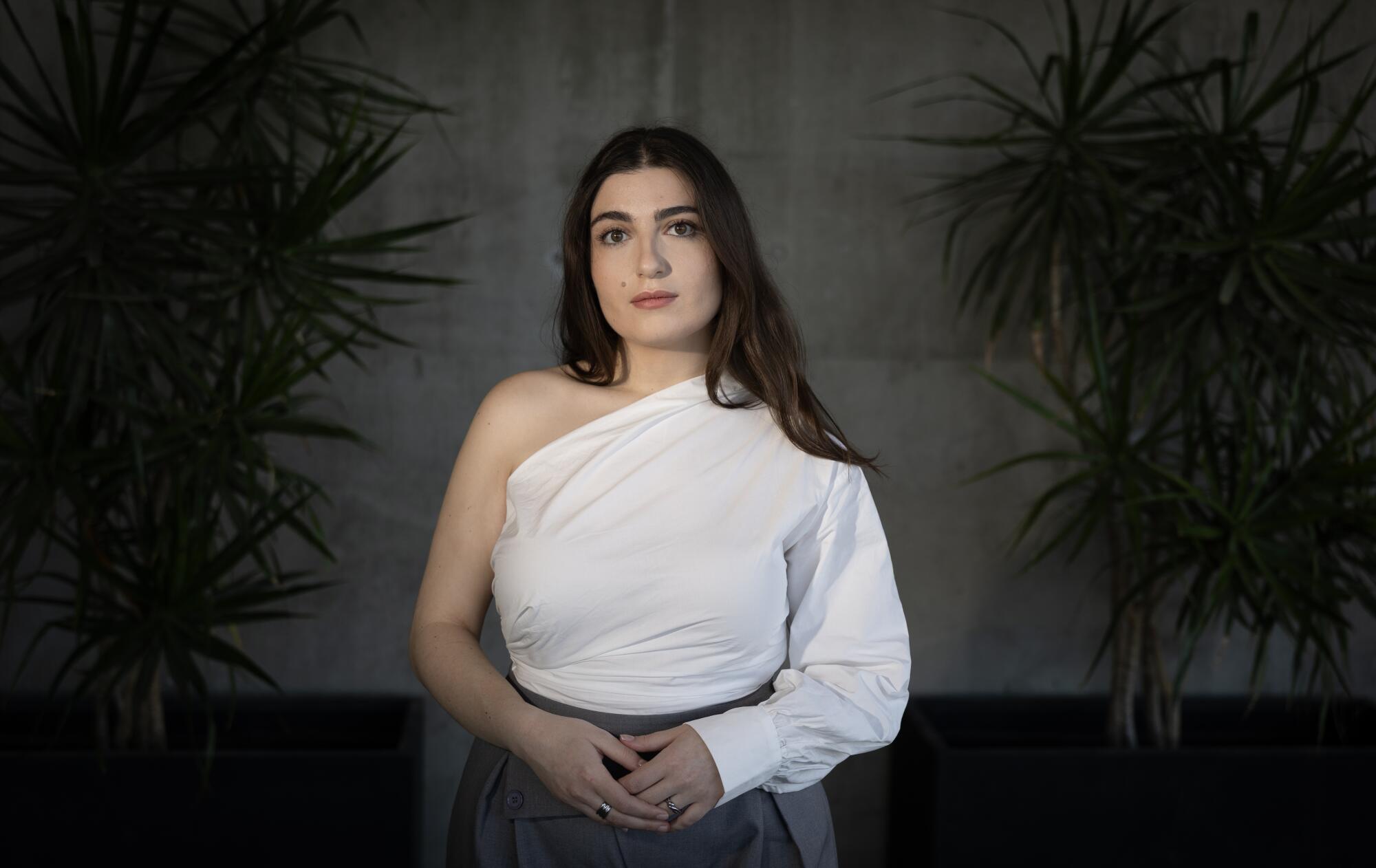
Sereen Banna, a former DTLA paralegal, sued the firm on Dec. 16, alleging it did not listen to her complaints of unethical solicitation. The firm has denied wrongdoing.
(Allen J. Schaben / Los Angeles Times)
Banna said in her lawsuit she “repeatedly complained” about how clients were being solicited.
She said in an interview she reported the first paid landfill client she was aware of — a woman who received a $20 gift card — to her bosses in early 2024. In her lawsuit, she alleged “such conduct constitutes unlawful and unethical behavior for attorneys.”
She said her boss told her the alleged payments would be investigated.
“At that point, I was reminded it was above my pay grade,” she said.
‘A really big part of the recruitment process’
Banna said she resigned from DTLA in October 2024, around the time the firm began pursuing a new cohort of clients: human trafficking victims who’d been abused in hotels.
Banna said one of her colleagues, an intake coordinator, told her a man named Kevin Johnson had paid one sex worker $20 to come into the office.
Over the last two years, five ex-workers told The Times, Johnson became an increasingly common sight at the firm as he started shepherding in clients he’d found to sue over sex abuse in the juvenile halls and the Eaton fire. Like most former employees, the ex-workers requested anonymity, fearing professional retaliation.
Johnson, a 54-year-old entertainer who hosts gospel brunches and soul nights in Inglewood according to his social media, did not respond to messages or a letter left at his home. The firm is currently representing him in a lawsuit over a Mid-City car crash.
California law bans a practice known as capping, in which non-attorneys solicit clients to join litigation with a firm. DTLA has denied working with cappers and Johnson did not respond to questions about his recruitment for the firm.
Former employees said Johnson was responsible for bringing in a large number of clients.
“He is a really big part of the recruitment process for Downtown LA,” said Banna, who described how she was called to do intake with sex abuse clients after Johnson brought them into the offices of one of the partners.
Johnson wasn’t a DTLA employee, yet workers say he was a familiar face around the office.
He was close with the partners and chummy with employees, handing out lucky $2 bills to workers last holiday season, three former employees said. Two said that at one point he had his own swipe card, so he could come and go freely.
A digital trail connects Johnson to DTLA’s client list.
The Times found more than a dozen friends of Johnson’s on Facebook who appeared to have a sex abuse lawsuit filed with the county. To do this, The Times cross-referenced a list of county sex abuse plaintiffs represented by DTLA with Johnson’s Facebook friends to see how many shared identifying details.
Larisa Ellis, whom Johnson describes on Facebook as his wife, paid someone who later had a DTLA sex abuse lawsuit $50 at a social services office in November 2024 with the payment caption “Thanks for using our referral service,” according to a Cash app transaction. Ellis did not respond to a message and a letter left at their home.
“DTLA does not pay clients to retain our services or for referrals,” the firm said in a statement.

Austin Beagle and Nevada Barker, former clients of DLTA, said they were paid to sue over alleged sexual abuse in L.A. County by a man named Kevin, whose last name they didn’t know. Beagle and Barker later had their lawsuit dismissed.
(Joe Garcia / For The Times)
Nevada Barker and Austin Beagle, two former DTLA clients, previously told The Times a man named Kevin, whose last name they didn’t know, paid them $100 each in DTLA’s office after they made false claims of sex abuse. Barker identified Johnson through pictures as the man who paid her.
The couple said they were under the impression they were being compensated to be actors in a movie. The firm later asked the court to dismiss their lawsuits.
“He said he worked for a referral service and the lawsuit needed enough participants to go through,” said Beagle. “He didn’t work for the law office.”
‘Tell her I got $ for her’
Several clients told The Times they were offered money by DTLA partner Farid Yaghoubtil if they could find people to sign up for lawsuits with the firm.
“He called it an advancement, ” said LaShelle Allison, 53, a former client who said she referred several car accident victims for Yaghoubtil. “Here’s $250,’ ‘Here’s $650,’ ‘Here’s $500 for rent.”
California is one of the few states where lawyers are allowed to loan clients money.
The State Bar has a general rule that lawyers are not supposed to pay “personal or business expenses.” The bar makes exceptions that include if the client promises in writing to repay the loan, for providing funds to promote “the interests of an indigent person,” and for “advancing costs” to protect a client, with repayment contingent on the outcome of the matter.
DTLA said in a statement that it offers small loans to clients “in limited situations.”
“The firm has offered small, interest-free micro-advances to help with short-term needs like temporary housing or basic expenses, specifically so clients do not feel compelled to turn to third-party lenders,” the firm said. “These advances are entirely voluntary, never tied to medical or legal decisions, and are only recovered if a case is successfully resolved.”
Akeem Smith, 40, had DTLA sue on his behalf at least four times, twice for car crashes, once after he was punched at a night club and again over a shopping cart mishap at Rite Aid.
Smith referred 10 potential clients to Yaghoubtil, nearly all car crash victims, according to text messages between the two men. In return, Smith said, he was told he’d be compensated, though he said he was disappointed to find he was never paid for the clients he referred.
Instead, Smith said he received monthly advances of about $2,000 based on potential settlements the firm was expecting in his cases.
Smith said he would encourage clients to sign up for cases with DTLA but did not pay them. He told some about money Yaghoubtil was offering.
“Tell her I got $ for her,” Yaghoubtil texted Aug. 9, 2022, regarding a woman who Smith said had been in an accident and was considering not moving forward with the firm. “Get her back for me.”

Akeem Smith stands in front of the old DTLA office in East Hollywood.
(Ronaldo Bolanos / Los Angeles Times)
After The Times reached out to DTLA seeking comment on the allegations made by Smith, Yaghoubtil texted Smith asking him to notify the reporter that “everything you told her was a lie” and to remind The Times that he was still a client of the firm, according to a message Smith shared.
The next day, after telling The Times he planned to go into DTLA’s office, Smith falsely accused the reporter via text of harassment and failing to disclose they were a journalist.
In August, Smith made an ill-fated attempt to sue the firm, representing himself in a lawsuit accusing them of keeping too much of his settlement money. He asked for the case to be dismissed a month later.
Smith said he became dependent on the firm for income and, sometimes, shelter. In the summer of 2022, Smith moved into a downtown building where he paid rent to Yaghoubtil’s uncle, according to text messages between the two men. The handwritten lease, rife with misspellings, said he could stay there until he “seatel his case whit Dawntow Law Group.”
Smith said he made monthly trips to pick up checks from DTLA, which was providing him money for his rent, bills, food and car repairs, according to loan statements and text messages between the two men.
Smith said he flitted in and out of homelessness during that time — his first time ever without stable housing.
“When I met you I had my own everything,” Smith texted Yaghoubtil July 18, 2022 “Now I don’t even have clothes.”
Listed in Smith’s phone as “Farid Ferrari,” Yaghoubtil replied, “What happened to the money you got?”
Landlords, landfills and ‘incentives in exchange for signatures’
Downtown LA Law Group, founded in 2016, is run by three longtime friends.
Yaghoubtil, 42, is cousins with founding partner Daniel Azizi, 43. They met Salar Hendizadeh, 44, in elementary school, according to an interview they did with a commercial real estate company.
All attended Beverly Hills High School together, yearbooks show.
Hendizadeh left the firm in October, according to a letter sent to staff this month. The note did not explain why but said Hendizadeh “cannot be conducting any firm related business.” He did not respond to an inquiry from The Times.
Many clients who spoke to The Times said that among the partners, Yaghoubtil in particular vied hard to get their business.
In January 2019, William Brighton, who was in the VA hospital recovering from a car accident, asked a judge for a restraining order against Yaghoubtil, accusing him of making “numerous visits at the hospital to coerce (and bribe) me to retain them as counsel.”
He said Yaghoubtil offered him $1,000 to switch from his current law firm, according to the request for a restraining order. Brighton later asked a judge to dismiss the case.
DTLA did not address questions about the restraining order request.
The firm expanded quickly, outgrowing four different offices before landing this year in a 52,000-square-foot headquarters in the Arts District. They moved beyond their bread-and-butter fare of personal injury, adding departments for mass torts — cases that involves thousands of people suing over the same thing — and housing law.

An empty plot of land where the DTLA partners used to own an apartment building across the street from their East Hollywood office. Multiple tenants sued the partners for living conditions and the building is now demolished.
(Ronaldo Bolanos / Los Angeles Times)
The trio moonlighted as landlords themselves, owning an apartment building across the street from their East Hollywood office. They were sued by several units in 2023 and 2024 over living conditions, including allegations of infestations of rats, vermin and cockroaches that tenants said made their lives “a living hell.” One of the cases settled for $2 million, according to court records.
The partners were charged in October 2024 with a misdemeanor for failing to maintain the building. The case was dismissed and the building is now demolished.
Around 2024, their mass torts business began booming, starting with the landfill lawsuits, in which the firm accused the operators of recklessly allowing nauseating odors.
Heather Stone said she saw representatives of DTLA looking for people for landfill cases outside a Santa Clarita Walmart in 2024, one of two residents who told The Times they saw representatives at the store who appeared to be recruiting clients.

Castaic’s Chiquita Canyon Landfill, which residents say emits noxious odors, is the subject of a flood of lawsuits brought by DTLA.
(Allen J. Schaben / Los Angeles Times)
Banna said in an interview that she later learned some clients for the landfill cases had been receiving gift cards to sign petitions at box stores in the area and those names later appeared on signed retainers even though clients were adamant they never signed up for a lawsuit. She accused the firm in her lawsuit of “providing gift cards, money gifts, and similar incentives in exchange for signatures.”
The firm said in a statement it would be impossible for someone to believe they were signing a petition when they were signing up for a lawsuit due to the large number of documents required to come on board.
“If someone made that claim, we would certainly discontinue our services at their request,” the firm said.
A former DTLA case manager, who asked to remain anonymous, fearing professional repercussions, said the alleged recruitment effort became clear to him after he was assigned to call people from a list he’d been provided of new Chiquita Canyon clients and found several who believed they had signed up for a petition, not a case.
“A lot of these people were completely unaware of what they were signing up for,” the former case manager said.
Surgeries and promises of ‘lottery money’
Three former case managers, who worked as liaisons between clients and attorneys, described the same modus operandi at DTLA: Sign up personal injury clients, then get them to agree to surgeries.
The more surgeries, they were told, the more profit, as it would make the case more valuable by allowing lawyers to claim higher medical damages.
The case managers said partners pushed surgeries and would give bonuses when clients went under the knife. Doctors — who stood to benefit by being able to bill for the procedures — would have gifts dropped off at the office, the ex-employees said.
The firm said any allegations of unethical practices were the result of “disgruntled former employees … who have ulterior self-serving motives.”
The case managers reported getting $500 checks from the firm when they got a client to agree to a surgery — often with the word “bonus” in the memo. The Times viewed one of these “bonus” checks, which the former employee said was for a client’s skin graft.
If they didn’t convince their clients to get surgeries, the former case managers said they feared losing their job. Yaghoubtil would ask case managers to send him a list of their surgeries at the end of the month, according to messages viewed by The Times.
“Our sx numbers for the month of May were very low,” said Yaghoubtil in a June 3 Teams message to 64 staff members, using an abbreviation for surgery. “Many were unable to produce even a single procedure… this is not acceptable.”
“How can you go an entire month and not have at least one of your cases worked up?” he continued. “It does not go un-noticed and will be letting go of those who are not trying hard enough.”
The firm said in a statement that it doesn’t interfere with a client’s medical care decisions.
“DTLA’s role is to advocate, inform, and support with transparency, compassion, and respect at every stage of the process,” the firm said.

DTLA recently moved into a new office at the former Lucky Brand headquarters in the Arts District of Los Angeles.
(Myung J. Chun / Los Angeles Times)
Jacqueline McClelland, 60, said she was assured “lottery money” by a DTLA attorney in July 2018 after she slipped in a puddle of oil in a Willowbrook shopping plaza.
The insurer for the plaza called her up and offered her $1 million if she didn’t lawyer up, she said. But she said her DTLA attorney promised they could get her far more — as long as she went to all the doctors they recommended. She turned the insurer down.
Her case settled for $350,000.
It was not even close to enough to pay for the half-million in fees she said she’d racked up, primarily from going to doctors. She said she is still in excruciating back pain from her surgery.
DTLA took 46% of the settlement and sent the rest of the money to a judge to decide how to divvy between her and the 31 doctors, clinics and loan companies she owes, according to a court record filed on behalf of DTLA to determine the distribution. A volunteer at a Watts high school, McClelland has spent a year lawyerless in court fighting for any bit of it she can get.
“Is someone helping you?” asked Judge Gary Tanaka at a Dec. 17 hearing in his Torrance courtroom where she had been appearing with such regularity that the clerk knows her by first name.
“No one. Sorry, your honor, no one has helped me at all,” said McClelland, standing in a court proceeding she said repeatedly she did not understand. “Downtown LA Law just gave me to the wolves.”
“I would agree with that,” said Scott Meehan, an attorney representing one of the doctors fighting her for her settlement money.
DTLA said it could not comment on privileged conversations with McClelland. The firm said in a statement that all medical providers had legitimate liens that entitled them to money from the client’s settlement, including McClelland’s.

Jacqueline McClelland, a former client of DTLA, stands outside Los Angeles Superior Court in Torrance on Dec. 17 ahead of her court hearing.
(Myung J. Chun / Los Angeles Times)
The Times found court records for more than 60 DTLA clients who had costs, typically medical bills, that ended up being more than their settlement. In those cases, DTLA couldn’t convince the doctors to reduce fees, and the attorney would hand the remaining money over to let the court decide how to divvy it up among everyone who needed to be paid.
But the lawyers get their cut — in some cases, more than three-quarters of the settlement, according to lawsuits filed on the firm’s behalf to determine who gets the remaining money.
“Our clients only pay for legal fees and costs if they win a lawsuit or get a settlement,” DTLA said in a statement.
After he was beaten by a Santa Monica security guard, David Villatoro, a 33-year-old construction worker, said a DTLA attorney told him he could get half a million easy, probably double that. But only if he went to a litany of doctors’ appointments, including a neck surgery.
It would mean losing his construction job and going on disability. But he claims his attorney said the surgery would make the case more valuable.
“That’s where the big bucks come in,” he recalled the attorney saying.
The big bucks never came.
Instead, months after the case settled, Villatoro got an email telling him not to contact the firm anymore about his case. Attorneys had taken 58% of his settlement money — about $72,000 — and he would have to go to court to fight for a cut of what was left along with the doctors.
He said he still can’t turn his head fully to the right.
“I’m just so confused,” he said. “I was so naive. It was my first time ever, ever, ever getting a lawyer.”
Laura Stephenson, a 57-year-old baker, was told by her DTLA attorney that her slip-and-fall in her Menifee cul-de-sac could net millions. But she would need to do a shoulder surgery.
She hesitated. It would mean too much time away from her bakery and she wasn’t sure she wanted to do it. The attorney convinced her by offering her a loan for $10,000, she said.
More than four years after the fall, she has received no money and can’t fully move her arm. The firm took 77% of her $175,000 settlement, according to a court filing to decide how to distribute the money. The rest went to the court to distribute, and she is still fighting to get a portion.
“I am living this nightmare,” said Stephenson, one of eight people The Times spoke with who said they filed a complaint with the State Bar.
The firm said all medical treatment was voluntary and ethics rules prevent sharing more information about discussions with clients.
“DTLA does not force anyone to receive medical treatment they do not want,” the firm said.
Uber, a common target of DTLA, sued the firm and one of the main surgeons used by clients, Greg Khounganian, last summer for racketeering, alleging the firm had “side agreements” with him to inflate medical bills for unnecessary procedures. Uber’s lawsuit alleged that many patients underwent an unnecessary spinal fusion that takes months to recover from in order to get a larger settlement.
In some cases, Uber alleged, Khounganian inflated the bills by as much as 640%. If the case didn’t settle for much, the lawsuit stated, Khounganian would agree to dramatically reduce their liens.
In an Instagram post, DTLA called the lawsuit a “calculated attempt by a billion-dollar corporation” to suppress legitimate claims. An attorney representing Khounganian said the doctor had a spotless professional record and had never faced any disciplinary action.
“He is assuredly a first-rate and widely respected orthopedic surgeon,” Stephen Larson, an attorney for Khounganian, said in a statement. “Uber’s meritless lawsuit, we believe, is part of its nationwide political and lawfare campaign to suppress liability for accidents caused by Uber’s drivers.”
Khounganian sought to have Uber’s case against him dismissed, with his attorneys calling it in one court filing “a lawsuit designed purely for tabloid effect with no meaningful effort at substance.”
One person, who saw another doctor for a heart valve condition that heightened the risk of complications, could no longer walk for more than 10 minutes after their surgery, Uber alleged in the lawsuit.
DTLA clients said the firm would often insist on sending them to specific L.A. doctors even if they lived in a different county, or, in some cases, a different state.
Christy Strickland, who had a case over a fall that occurred while working for the delivery app Instacart, said the firm insisted L.A. doctors were cheaper than those in Texas. So she said they flew her in from Houston and once gave her gas money to drive, putting her up in a hotel for two weeks to recuperate along with two of her children.
Those travel expenses would total more than $10,000 — including two $482 Uber rides, according to a breakdown. She said she was never told those travel costs would be coming out of her money.
“YOU AND YOUR DOCTOR advised me to get these surgeries and I have told you that I am still in pain even more since the surgery,” she emailed Yaghoubtil in July 2023. “Do you know how it feels to wake up in the morning and your back hurts so bad all you can do is just lay there until it subsides?”
In November, Yaghoubtil, speaking on a podcast episode called “Lawyering With Empathy,” emphasized his focus was never high-dollar verdicts. The well-being of clients, he said, always came before profit.
“We love a client,” he said. “If we have to, we’ll go down fighting with them.”
Times staff writer Christopher Buchanan contributed reporting.