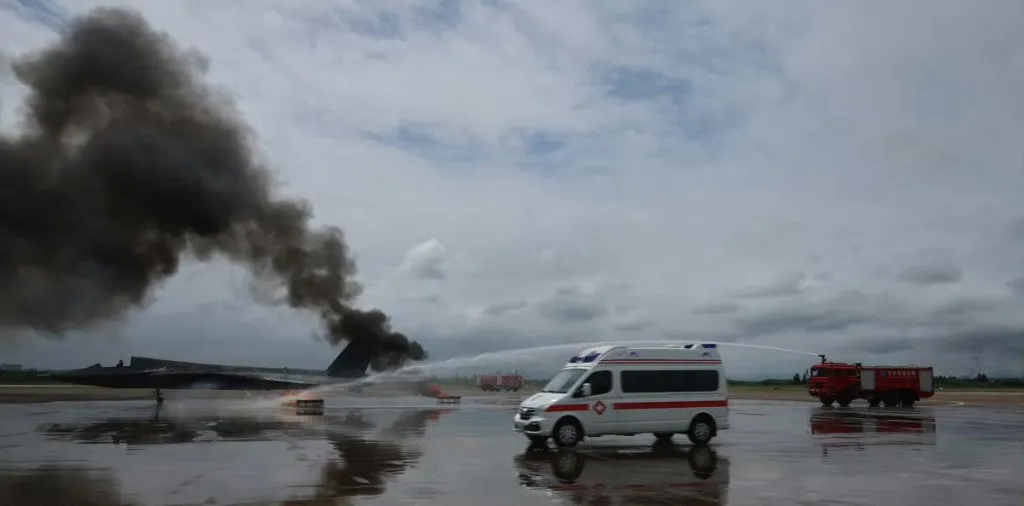
In 2022, a satellite image emerged showing unusual fighter-like ‘shapes’ with a very loosely similar appearance to the stealthy J-20 at a remote Chinese airbase. Three years later, another image appeared showing a broadly similar, but also distinctly different-looking object at a different airport in China. The mystery of these ‘airframes’ now seems to be at least partially solved with new pictures of a mock-up being used for airfield firefighting training.
Images of the aircraft fire trainer in question are now circulating on social media, but where or when they were taken is not immediately clear. Markings seen on the tarmac are different from what is present on the aprons at Lintao Air Base, where the ‘shapes’ were spotted back in 2022, as well as at Jining Qufu Airport, where the other object was spotted in 2025.

The overall design of the vaguely J-20-like aircraft fire trainer also aligns more with the object that previously appeared at Jining Qufu Airport. Both share a distinct modified diamond-like delta planform, as well as canards, and twin vertical tails. It is worth noting that the ground-level images we have now also show a cockpit configuration that is more representative of the newer J-35. Regardless, the articles seen at Lintao had differently shaped wings and longer, more slender noses.

In general, aircraft fire trainers can be anything that loosely represents a desired class of aircraft – fighter, airliner, etc – and can range from specially built systems to repurposed old aircraft hulks. Training aids of this kind are designed to offer a readily reusable way to add realism to airfield firefighting drills. They are in widespread use globally by national militaries and civilian fire departments. The shapes previously seen at Lintao could still serve some other purpose as full-scale mock-ups, or decoys, as well.


The emergence of the firefighting trainer also comes as the People’s Liberation Army Air Force’s (PLAAF) fleet of real J-20s continues to expand, something TWZ explored in detail earlier this year. The PLAAF may have some 500 J-20s in service now, with examples assigned to at least 14 operational units and three training bases, according to one estimate. There are projections that the total fleet could grow to 1,000 airframes by 2030 if production of the jets continues apace. This is inclusive of all variants, including a two-seat version that first broke cover in 2021.

The growing size of China’s fleets of J-20s, as well as other more modern fighters, can only increase demands for training, both for pilots and ground crew, as well as maintenance and sustainment requirements. Ever larger numbers of routine day-to-day sorties raise the risk of crashes and other accidents just as a matter of course.


Also, while the object spotted at Jining Qufu Airport in 2025 now seems pretty definitively to have been a firefighting trainer, a steady stream of new, real advanced aircraft designs have been emerging in China in recent years. This includes crewed and uncrewed types with a multitude of shapes and sizes, ranging from the J-36 and J-XDS next-generation fighters to various sleek combat drones to several types of pilotless flying wings. New Chinese aviation developments do have a history of emerging suddenly, as TWZ has often been the first to report.
As China’s fleets of more advanced operational aircraft continue to expand in scale and scope, we can expect to see similar growth in the infrastructure and other assets necessary to support their operations, including new aircraft fire trainers.
Special thanks to Andreas Rupprecht, an expert on Chinese aviation and contributor to this website, who goes by @RupprechtDeino on X, for bringing this to our attention.
Contact the author: joe@twz.com