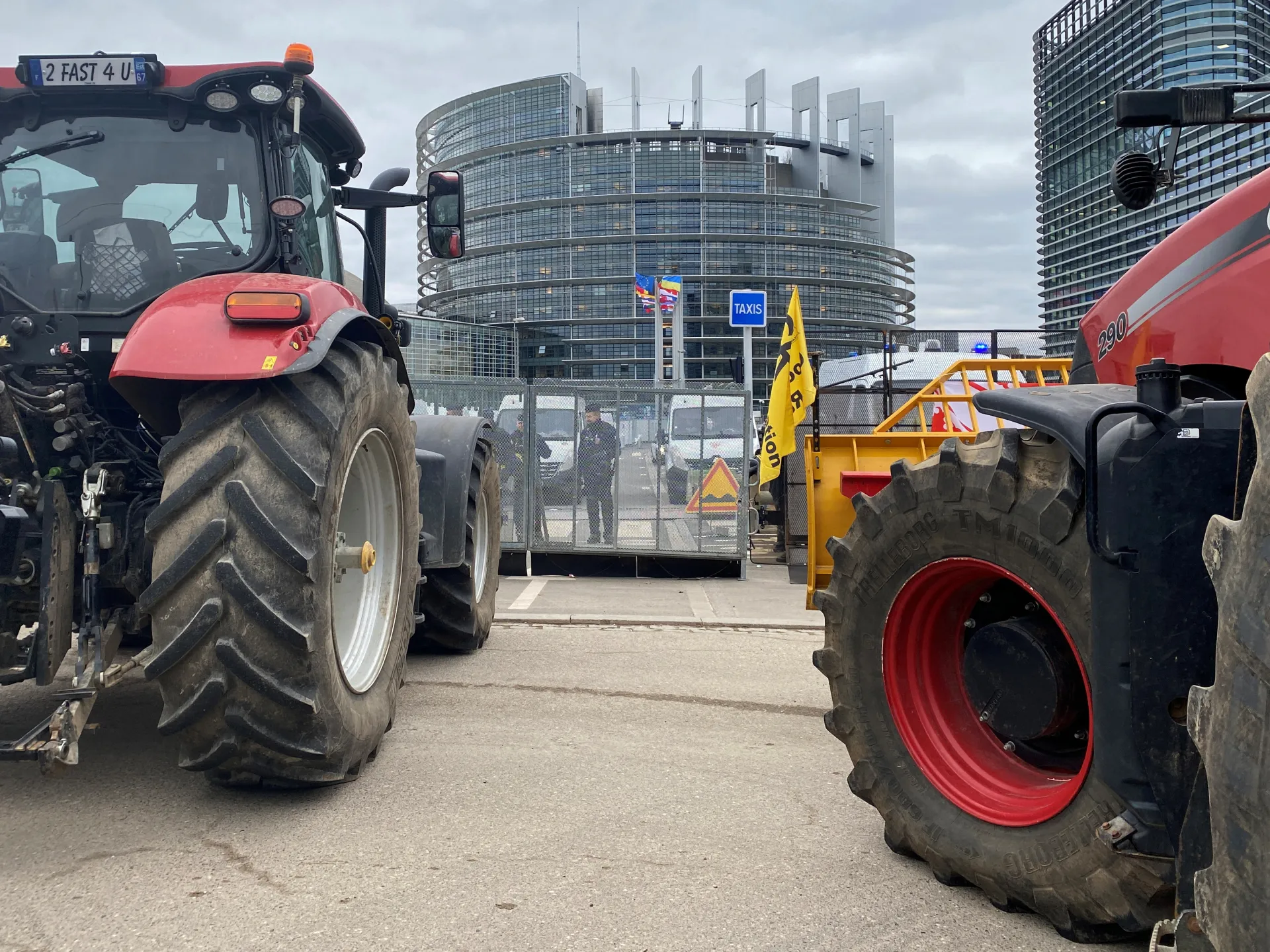
European Union agriculture ministers are meeting in Brussels to discuss the availability of fertiliser as the war on Iran disrupts global supply chains.
The talks come as the European Commission pushes a new Fertiliser Action Plan aimed at supporting farmers who face a significant rise in costs for fertilisers. It is hoped the measures could boost agricultural production and reduce Europe’s dependence on food imports.
Recommended Stories
list of 4 itemsend of list
The plan includes possible fertiliser stockpiles, emergency support for farmers and measures to increase imports from countries other than Russia and Belarus, which are involved in the war with Ukraine.
It comes amid disruption in the Strait of Hormuz caused by the US-Israel war on Iran. The vital shipping route normally carries about one-third of the world’s seaborne fertiliser trade, raising fears that rising fuel and fertiliser costs could place further pressure on farmers already struggling with high expenses.
While the EU is less directly impacted by fertiliser shortages than some other parts of the world, disruptions to supplies have exposed divisions within the bloc about how to protect food supplies and shield farmers from rising costs.
How exposed is Europe?
Europe imports large volumes of fertiliser, bringing in two million tonnes of ammonia, 5.8 million tonnes of urea and 6.7 million tonnes of nitrogen fertilisers and mixtures in 2024, according to EU data.
The EU also produces its own nitrogen fertiliser, but this depends heavily on imported gas. When conflicts in the Gulf region pushes up gas prices, it also makes fertiliser made inside Europe more expensive.
The blockade has raised concerns over global food security, particularly in Africa and South Asia, where countries are more dependent on Gulf supplies.
The Middle East accounts for only about 3 percent of the EU’s ammonia imports and 1 to 2 percent of its nitrogen fertiliser imports, so the blockade of the Strait of Hormuz has not significantly affected European supplies.
But the bloc is still being hit through higher global prices and rising energy costs because European nitrogen fertiliser is made using gas, which has increased in price due to the disruption in the strait – while some countries are more at risk to rising costs due to low stockpiles.
Nitrogen fertiliser prices in Europe are now about 70 percent above their 2024 average, according to reporting on the commission’s plan.
That vulnerability became clear after Russia’s full-scale invasion of Ukraine in 2022, when soaring gas prices forced several European fertiliser plants to scale back or temporarily shut down because production was no longer profitable.
The commission says its new plan combines immediate measures to improve affordability and security of supply with longer-term steps to strengthen domestic production and reduce dependence on imports.
What is the EU proposing?
The plan includes emergency financial support for farmers through the EU agricultural budget, liquidity schemes and more flexible advance payments under the Common Agricultural Policy.
The commission is also looking at ways to support farmers who reduce their reliance on synthetic fertilisers, including through bio-based alternatives and more efficient fertiliser use.
In a second measure, the EU has moved to suspend duties on some nitrogen fertilisers, including urea and ammonia, from countries other than Russia and Belarus. Some nitrogen fertiliser imports currently face tariffs of between 5.5 and 6.5 percent. The Reuters news agency reported that the suspension could save importers about 60 million euros ($68m).
European Commission President Ursula von der Leyen said the plan was aimed at building “a stronger European fertiliser industry” while supporting farmers and accelerating “sustainable, home-grown solutions”.
But Irish Agriculture Minister Martin Heydon warned that rising fertiliser prices caused by the Middle East crisis would affect the cost of food production and the competitiveness of European farmers.
“The rise in fertiliser prices as a result of the Middle East crisis will impact on the cost of food production and, consequently, on the economic sustainability and competitiveness of European farmers,” he said.
Which countries are most exposed?
The impact is not evenly spread across Europe, with Ireland particularly vulnerable because it has little domestic fertiliser production and depends heavily on imports. Its livestock-heavy farming system also relies on nitrogen fertiliser for grassland, with many farmers buying supplies between February and September.
Ireland imported 1.7 million tonnes of fertiliser in 2025, leaving farmers exposed to international price swings.
Other countries are better prepared. Finland has long maintained security-of-supply stockpiles that include fertiliser, grain and fuel. Sweden has also announced plans to stockpile fertiliser, seeds and grain as part of its “total defence” strategy after joining NATO.
There are also divisions inside the EU over how far Brussels should go. Italy and France have pushed for relief from the bloc’s Carbon Border Adjustment Mechanism, which adds costs to carbon-intensive imports.
Some farming unions argue that the carbon levy has become another cost for farmers at a time of crisis. Environmental groups, however, have warned Brussels not to weaken nitrogen pollution rules, saying that doing so could increase pollution and health costs if excess nitrates enter water supplies.
Poland and Germany, meanwhile, home to major nitrogen fertiliser producers, have been more focused on opposing any measures that could weaken protections for domestic industry – and are therefore more opposed to reducing levies on imports.
Will food prices rise?
EU officials are not expecting an immediate food price shock, with many farmers in the bloc still using fertiliser bought long before the Iran war disrupted supply chains.
But officials are concerned that higher fertiliser costs could create problems in supply chains later in the year. Fertiliser affects food prices with a delay, as gas becomes fertiliser, fertiliser then feeds crops, and crops eventually become food – so the effects are often felt up to six months after the initial disruption.
Meanwhile, there are fears that anger in rural areas already hit by higher fuel, energy and input costs could lead to a backlash against green policies in the EU at a time when right-wing and populist parties are gaining ground in Europe.
But Europe still remains less exposed than many regions. The most severe risks are in countries more dependent on Gulf fertiliser and energy supplies, especially in parts of Africa and South Asia.
WASHINGTON — Precarious talks to end the war with Iran appeared close to collapse on Tuesday as renewed fighting across the region threatened to derail fragile progress toward a comprehensive settlement.
U.S. strikes against targets in southern Iran — the first since a ceasefire was declared in the war seven weeks ago — coupled with escalating attacks by Israel in Lebanon have undermined optimism that an agreement was within reach.
The attacks occurred just hours after U.S. and Iranian diplomats arrived in Qatar for peace talks. Iran’s top negotiators left Doha on Tuesday without comment. News of the strikes, and threats of retaliation by Tehran, sent global oil prices soaring back to more than $100 a barrel.
U.S. Central Command described Monday’s actions as “self-defense strikes” that were restrained and modest in scope, targeting missile launch sites and Iranian boats “attempting to emplace mines” in the Strait of Hormuz.
But the attack came as President Trump and Secretary of State Marco Rubio had been projecting confidence that a framework agreement to end the war could be reached within days. Under the proposed deal, Iran would restore the strait to its prewar status as a free and open international waterway, while both sides entered 60 days of negotiations over the removal of Iran’s nuclear stockpile.
Laying mines in the strait in the 11th hour of the negotiations could signal to the Trump administration that Iran is not serious about reopening traffic there. But the Iranians said Tuesday that renewed U.S. strikes suggest it is Washington that is unprepared to commit to peace.
Iran’s Foreign Mministry condemned what it called “aggressive actions” by the United States, describing them in a statement as a violation of the ceasefire agreement.
“The commission of these aggressive acts — occurring concurrently with the ongoing diplomatic track mediated by Pakistan — has once again exposed the hostile nature and perfidy of the ruling establishment in the United States,” the statement said.
Iran “will not leave any hostile act unanswered,” the ministry added.
Mojtaba Khamenei, Iran’s elusive supreme leader, declared in a scheduled speech that U.S. allies throughout the Middle East “will no longer serve as a shield” for the American military, suggesting retaliatory strikes against U.S. assets in the region could be imminent.
Prospects for a diplomatic breakthrough were already dim. Over the last week, U.S. and Iranian officials projected optimism while outlining seemingly incompatible visions of a deal.
Trump has repeatedly said Iran would not receive any sanctions relief until its stockpile of fissile material is removed and destroyed. But Iranian officials reiterated Tuesday that unfreezing the country’s overseas assets remains a precondition for continued negotiations.
And it is unclear whether Iran would agree to a peace deal with the United States that does not also restrict the actions of Israel, whose leader, Prime Minister Benjamin Netanyahu, has expressed deep skepticism about the diplomatic process.
Netanyahu said in recent days that Israel would not be bound by any nuclear pact, and that his government would continue military action against targets throughout the region — including in Lebanon — as it views necessary.
Israel’s continued assault on Lebanon nearly jeopardized the ceasefire between Iran and the United States before Trump brokered a separate, temporary halt to the fighting there. Since then, however, Israeli strikes have resumed, and Netanyahu vowed to intensify his campaign against Hezbollah, the Lebanese Shiite militant group.
“We are not removing our foot from the pedal,” Netanyahu said in a video address Monday. “On the contrary, I said to step on the pedal even more.”
Israel’s military ramped up its operations Tuesday, attacking what it said were more than 100 Hezbollah sites across southern and eastern Lebanon, while extending ground incursions deeper into Lebanese territory.
The overnight strikes struck weapons storage facilities, command centers, observation posts and infrastructure sites, according to an Israeli military statement.
Israeli media also reported that Israeli troops were operating beyond a 6.2-mile zone they occupy in southern Lebanon, in what many fear may be a prelude to a wider invasion.
Those fears were further stoked Tuesday by fresh Israeli evacuation orders for the entirety of Nabatiyeh, southern Lebanon’s second-largest city.
Hezbollah upped its campaign as well, peppering Israeli troops in southern Lebanon and areas of northern Israel with drones and rocket attacks, according to statements from the group. Hezbollah-affiliated media reported the group’s fighters clashing with Israeli troops to prevent their advance.
In recent weeks, Hezbollah has increasingly relied on fiber-optic drones — which are both low-cost and impervious to jamming — to harass Israeli positions.
On Sunday, an Israeli soldier was killed and another wounded when a Hezbollah kamikaze drone hit their armored personnel carrier, according to the Israeli military; 23 Israeli soldiers and a civilian defense contractor have been killed in the current conflagration between Israel and Hezbollah, Israel’s military says.
The latest bout of hostilities between Hezbollah and Israel began March 2, when the Iran-backed group launched attacks on Israel to avenge the killing of Iran’s ayatollah, Ali Khamenei.
So far, Israeli strikes have killed 3,213 people, wounded more than triple that number, and left more than a million displaced, according to Lebanese health authorities.
A ceasefire signed April 17 sidelined the capital, Beirut, from strikes but has done little to stop the fighting otherwise, with Hezbollah and Israel continuing attacks despite unprecedented direct negotiations taking place between the Israeli and Lebanese governments.
It was unclear whether Netanyahu’s warning meant Beirut would be targeted once more. Israeli drones buzzed throughout the day over the capital and the Hezbollah-dominated southern suburbs Tuesday.
Hezbollah opposes direct negotiations and insists it will keep fighting until Israel withdraws from Lebanon and stops attacks. Israel has demanded the Lebanese government do more to disarm Hezbollah and to move toward a peace deal.
In a statement issued on Monday, Russia’s Ministry of Foreign Affairs said it planned to target “decision-making centres and command posts” and drone manufacturing facilities in the Ukrainian city in a series of strikes.
Recommended Stories
list of 3 itemsend of list
Due to these facilities being allegedly “scattered throughout Kyiv”, Moscow told “foreign citizens, including personnel of diplomatic missions and international organisations, to leave the city as soon as possible”, the statement read.
The ministry’s statement also urged Kyiv residents to avoid all military and administrative infrastructure facilities in the capital, which could be potential targets.
A later statement said that Russian Foreign Minister Sergey Lavrov had advised US Secretary of State Marco Rubio of the plan and urged him to evacuate his embassy staff from Kyiv.
What is behind Russia’s latest threats, and how significant are the threats to foreigners in Kyiv?
Here’s what we know:
Why is Russia threatening to attack Kyiv?
Ukraine has greatly improved its drone warfare capabilities in recent months, leading to more successful targeting of Russian military and energy infrastructure.
Most of these drones are homegrown interceptors, which have been designed to pursue attack enemy unmanned aerial vehicles (UAVs) before they hit their targets.
They can also carry a wider range of payloads and do not self-destruct, unlike one-way drones, so they can be used again in future missions.
On May 17, at least five people were killed after Ukraine launched what Russian officials described as one of the largest drone barrages of the war, with waves of UAVs dispatched to Moscow and several other regions overnight. The Indian embassy in Russia said one Indian worker was killed and three others injured in drone strikes in the Moscow region.
Moscow region’s Governor Andrei Vorobyov added that a woman was killed after a drone slammed into a house in Khimki, north of Moscow. Vorobyov added that apartment buildings and infrastructure sites were damaged in the attacks.
The Russian foreign ministry statement on Monday labelled the Staroblisk attack as a “flagrant disregard for international humanitarian law”, and “yet another blatant demonstration of the Nazi and terrorist nature of the Kyiv regime”.
What has Ukraine said?
Ukraine’s military has denied responsibility for the strike on the student dorm, saying it had struck an elite drone command unit.
Since then, Russia has also heavily targeted Kyiv and its surrounding areas with massive missile and drone attacks. resulting in at least four people killed and more than 60 injured overnight Tuesday and Wednesday.
On Monday, Ukrainian officials also reported that strikes killed several people in the eastern Kharkiv and Donetsk regions.
So how significant are Russia’s latest threats?
While both Russia and Ukraine have repeatedly launched attacks on one another’s cities, this was the first time Moscow had issued a direct warning to foreigners in Ukraine.
Commenting on this threat, Ukraine’s Foreign Minister Andrii Sybiha urged allies not to give in to “Russian blackmail”.
French Ambassador Gael Veyssiere noted that people in Kyiv were going about their daily lives on Monday, after the weekend’s strikes.
“It’s a way to demonstrate resilience, and I think it’s extremely important that we, around the world, we would support that,” Veyssiere told the Reuters news agency.
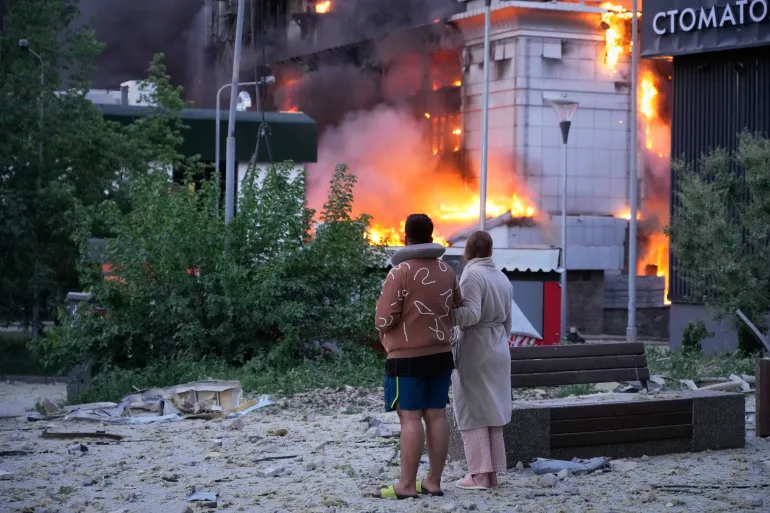
People watch as a building burns after a Russian missile attack in Kyiv, Ukraine, Sunday, May 24, 2026 [Efrem Lukatsky/AP Photo]
According to Philip Bednarczyk, the German Marshall Fund of the United States’ Warsaw office director, Russia’s latest threat comes after “its attempts to break Ukraine’s will to fight over the course of the coldest winter during this war failed”.
“It is becoming clear that their war aims are not being met on the front lines, and conversely, Ukraine has taken an upper hand. Russia needs to change tactics and the narrative somehow, and this warning is an attempt to do so,” he told Al Jazeera.
What is the status of diplomacy in peace talks?
Russia and Ukraine have been holding peace talks since the war began in February 2022, but with little or no concrete outcomes.
When Donald Trump became the president of the US for the second time in January 2025, he promised to end Russia’s war in Ukraine.
He has since met both Russia’s President Vladimir Putin and Ukraine’s President Zelenskyy in separate meetings to discuss ending the war, but so far these efforts have not borne fruit.
The truce talks have largely stalled due to Russia’s insistence on keeping territory it has seized from Ukraine.
On May 22, US State Secretary Marco Rubio said that while trilateral talks had been unsuccessful, the United States was ready to organise a new round of peace talks.
But Washington has also been occupied with its war on Iran, which broke out on February 28, and analysts say EU nations might have to play a bigger part in peace talks between Moscow and Kyiv.
“Unfortunately, US attention from this administration was not able to bring peace, and it looks that attention has gone towards other parts of the world, like Iran,” Bednarczyk said.
“Europe will have to take up that role, and I believe is capable of doing so, but it is extremely important to have American backing.”
But he was also sceptical about how serious Russia is right now about peace. “After all, this is their war of choice,” he said.
EU spokesperson Anitta Hipper says Russia’s threat to diplomats and foreign citizens is an ‘unacceptable escalation’.
Published On 26 May 202626 May 2026
Germany, the Netherlands, Norway and the European Union have summoned Russian envoys a day after Moscow warned foreigners and diplomats to leave the Ukrainian capital ahead of renewed air strikes.
On Tuesday, EU spokesperson Anitta Hipper called Russia’s threat to diplomats and foreign citizens an “unacceptable escalation”.
Recommended Stories
list of 3 itemsend of list
Hipper added in a post on X that the charge d’affairs had been summoned, calling on Moscow to “stop hitting civilians & Russia to engage in genuine peace talks starting with a full and unconditional ceasefire”.
At the beginning of May, Russia and Ukraine agreed to a three-day ceasefire for Moscow’s celebrations to mark its victory over Nazi Germany in 1945 at the end of World War II, but fighting quickly resumed with both sides accusing the other of violating the agreement.
On Monday, Moscow said that it planned to launch more strikes on Kyiv after it launched a barrage of drones and missiles on Ukraine over the weekend that killed four people.
Among the weapons Russia used in its attacks were its Oreshknik hypersonic missile, which can travel 10 times the speed of sound.
The warning came after Russia accused Ukraine of targeting a vocational school last week in the Russian-occupied Luhansk region that killed 21 people.
Russian President Vladimir Putin ordered his military on Friday to prepare options for retaliation in response to the attack.
“Under the current circumstances, the Russian Armed Forces are starting to launch systematic strikes against Ukrainian military-industrial facilities in Kyiv,” Russia’s Ministry of Foreign Affairs said in a statement on Monday.
“The strikes will target both decision-making centres and command posts … We are warning foreign citizens, including personnel of diplomatic missions and international organisations, to leave the city as soon as possible,” it added.
But in response to the call to leave the country, Germany’s Federal Foreign Office said on Tuesday that Moscow was resorting to “threats, terror & escalation”, which is why they summoned the Russian ambassador.
“We made it clear to Russia today: We will not be intimidated by threats and will continue to support Ukraine with full force,” the ministry wrote on X.
Norway and the Netherlands also summoned their Russian ambassadors over threats to attack Kyiv.
With no clear end to the war in sight, United States Secretary of State Marco Rubio reiterated on Tuesday that Washington had remained ready to mediate between Russia and Ukraine, as talks have stalled.
Two years ago, Bashir Muhammad received an invitation to attend a journalism summit in Niamey but declined. That decision, and the argument it provoked, told him everything he needed to know.
He runs one of the growing number of Hausa-language digital news platforms that have emerged across northern Nigeria in the past decade, serving local audiences that legacy English-language media have largely ignored. That profile made him a target. In 2024, Bashir was approached by Mariam Laouali – a woman known across West African Hausa media circles as Sarkin Abzin. She is a prominent Nigerien broadcaster and, as he would come to understand, a committed supporter of the military regime that had seized power in Niamey the previous year.
In July 2023, the military junta, led by General Abdurrahman Tchiani, overthrew the democratically elected President Muhammad Bazoum. The coup met with strong resistance from the international community, particularly the Economic Community of West African States (ECOWAS), under the leadership of Nigeria’s President Bola Tinubu. This led to severe diplomatic tensions between ECOWAS and the new military regime in Niger, culminating in threats of invasion from Nigerian leaders and ultimately the division of ECOWAS and the formation of the Alliance of the Sahel States (AES). While some diplomatic efforts have been restored, tensions remain, and the Niger Republic, supported by Russia and its AES allies, has been engaged in information efforts to attack ECOWAS countries, particularly Nigeria and Benin Republic. Bashir felt this approach could be part of the recruitment efforts.
The pitch sounded professional. Sarkin Abzin told him of a pan-African summit of Hausa-language journalists to be convened in Niamey. It was the first of its kind, according to her. She described it as an exercise in cross-border media cooperation and a chance for journalists from across the continent’s Hausa-speaking belt to build something together.
Bashir had questions, but he did not like the answers, so he declined.
Sarkin Abzin pushed back, insisting that he should consider it, but he became more suspicious. The conversation escalated. By the end, she was visibly frustrated. It ended there.
“She didn’t take it well,” Bashir told HumAngle, sitting in his home office while casually scrolling on his computer, searching for her Facebook page. “The way she reacted told you this wasn’t just about journalism.”
He was right. It was not all about journalism. The summit in Niamey was just bait. What Sarkin Abzin and her sponsors in the Niger Republic seemed to want was access to northern Nigeria’s forty million Hausa speakers and to exploit their grievances and distrust of Nigerian leaders.
Many Nigerians were consumed by anxiety and bitterness over the country’s dire economic pressures. Many also harboured deep anger toward their leaders – particularly President Bola Tinubu, against whom protests erupted in August 2024, during which some demonstrators raised Russian flags and called for a coup. For that reason, this was a country where recruiting the discontented would come easily, because the grievances were already there, waiting.
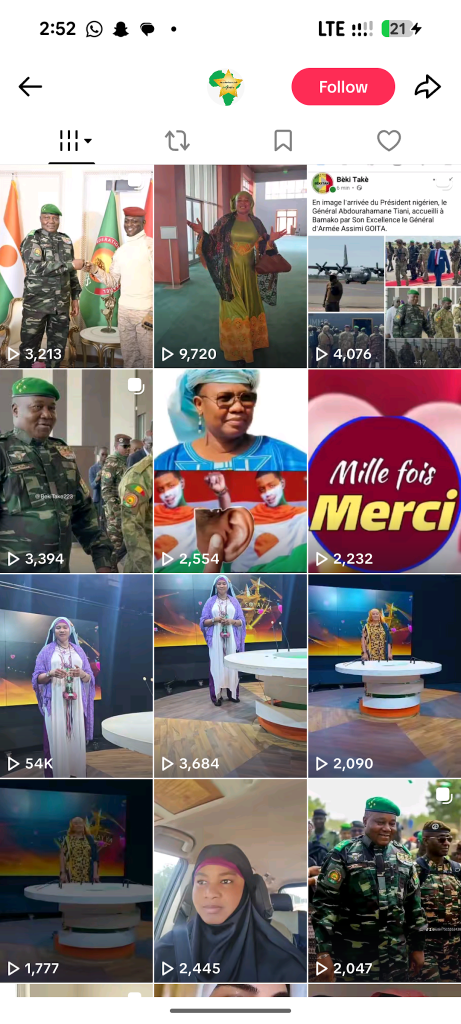
Pro-junta actors and AES-aligned influence networks have been weaponising TikTok’s virality to erode confidence in Nigerian democratic leadership, particularly targeting President Tinubu and the broader ECOWAS establishment.
Online influencers and sympathetic media outlets, including some based within Nigeria itself, have circulated claims accusing Nigerian politicians of backing insurgent networks and conspiring with foreign powers to destabilise the AES states.
Photos: Sarkin Abzin’s TikTok account @tauraruwarafrika is one of many pro-junta accounts spreading anti-ECOWAS sentiments.Screenshots: Multiple TikTok accounts monitored by HumAngle spread pro-junta and anti-Nigerian misinformation.
The recruitment drive
Sarkin Abzin’s tour of northern Nigerian newsrooms and radio stations in 2024 was, in retrospect, the visible edge of something much larger. She moved through Kano, through the northwest, knocking on the doors of editors and station managers, carrying the same pitch: come to Niamey, meet your counterparts, and build solidarity. Several journalists, like Bashir, declined quietly. A general manager at a prominent radio station in Kano, who pleaded anonymity, told HumAngle that Sarkin Abzin had reached him, but that he had turned her down.
“Looking at the timing when there was a diplomatic rift between Nigeria and Niger, and the suspicion of foreign influence, I felt it was unwise to join,” he said.
However, not everyone had the luxury of that suspicion, or the will to act on it. Musa Abba (not real name), a journalist at a private radio station in Kebbi State, saw a conference invitation and a chance to connect with Hausa journalists beyond Nigeria’s borders. His station was invited and the managers nominated him. Accommodation and food were covered by the organisers. The journey, according to him, was arranged through the Nigerian Union of Journalists (NUJ), in a vehicle shared with other attendees and, notably, with some politicians and government officials who had also been invited.
What he found in Niamey, however, upended the premise of the invitation entirely.
He concluded that “it was a sophisticated plan to form Hausa journalists who will be promoting the Nigerien junta and anti-West sentiment across Hausa-speaking countries.”
On her TikTok page, Sarkin Abzin does not hide her bias. She promotes Sahel juntas and specifically asks her followers to promote Tchiani.
In a social media exchange with Fati Niger, a Kannywood musician originally from the Niger Republic who had called for a return to democratic rule, Sarkin Abzin’s response betrayed her sentiments. “We don’t care about entertainment,” she mentioned in a TikTok video. What mattered, she said, was building their country and confronting those she described as “hypocrites and oppressors within the West,” as well as “hypocrites among us here, those in exile in every country in the world, including Nigeria, and those Nigerians who support the old system [of democracy] and do not stand behind these soldiers under Abdourahamane Tchiani.”
The summit Sarkin Abzin organised had state backing, institutional cover, and a well-hosted programme. It had everything, in other words, that a genuine journalism conference would have – except genuine journalism at its centre.
Get our in-depth, creative coverage of conflict and development delivered to you every weekend.
Subscribe now to our newsletter!
The irony is that the junta in Niger has been repressing and arresting journalists in the country. Moussa Ngom, Committee to Protect Journalists (CPJ)’s Francophone Africa representative, explained that “arrest and detention have become tools of choice for Nigerien authorities to try to control information they find undesirable.”
Human Rights Watch (HRW) reported that in October 2025 six journalists were arrested in Niamey – Moussa Kaka and Abdoul Aziz of Saraounia TV; Ibro Chaibou and Souleymane Brah from the online publication Voice of the People; Youssouf Seriba of Les Échos du Niger; and Oumarou Kané, founder of the magazine Le Hérisson – over their alleged role in circulating a government press briefing invitation on social media, criticising the introduction of the mandatory payment for “Solidarity Fund for the Safeguarding of the Homeland”, a form of security levy in Niger.
The conference that wasn’t
The organisation behind the summit, Kungiyar Yan Jarida Na Afrika Masu Magana Da Harshen Hausa or, in French, Résegu Africain des journalistes en langue Haoussa (Association of Hausa-speaking Journalists in Africa), was founded by Sarkin Abzin herself. She held a senior position at RTN, the Nigerien state broadcaster. Her organisation, she told prospective attendees, had the backing of the Nigerien government institutions.
Screenshots from a video of Sarkin Abzin speaking at the event.
Inside the hall at the Centre International de Conférences Mahatma Gandhi in Niamey, when the summit was opened on Aug. 24, 2024, the keynote speakers were not press freedom advocates, editors or media economists. They were politicians. Prime Minister Ali Lamine Zeine appeared as Tchiani’s representative, delivering a speech whose original French had been translated into Hausa. He spoke about Niger’s exit from ECOWAS as a show of sovereignty.
The junta had, by this point, accused ECOWAS countries, particularly Nigeria and Benin, of colluding with France to destabilise Niger and sabotage its economy- allegations that, according to independent fact-checkers, had no credible evidentiary basis but which had proven effective at consolidating domestic support by replacing accountability with external threat. The Niamey summit was the moment that the narrative was offered to Nigerian voices who could carry it home.
Among those who spoke was Hamza Almustafa, a Nigerian retired general and a politician who used the platform to denounce the West. Najaatu Muhammad, a prominent northern Nigerian political figure, delivered what several attendees described as the most incendiary address of the proceedings. She told her audience that the Nigerian federal government was conspiring to sever Niger from Nigeria – to cut through bonds of religion and culture that no colonial border had ever truly divided. Abuja, she suggested, served Paris and Washington before it served Kano or Sokoto.
A prominent Nigerian politician, Najaatu Muhammad, addressing the journalists at the event.
“It was not really a journalists’ meeting,” Musa told HumAngle, “By the time the politicians started speaking, those of us who understood what was happening knew we had made a mistake.”
Sarkin Abzin’s organisation had achieved, in a single day, what overt propaganda rarely manages: it had placed legitimate reporters in a room and given the junta’s narratives the texture of a press conference. The journalists went to Niamey to cover something. They came back as part of it.
HumAngle reached out to Sarkin Abzin for comment. She did not respond.
The Hausa messages
The Niamey summit was not the opening move in this campaign.
On Christmas Day of 2024, General Tchiani sat before the cameras of Radio-Télévision du Niger and delivered what a casual viewer might have mistaken for a holiday address. Although French had been Niger’s official language, he spoke in Hausa – a lingua franca in both Niger and most of northern Nigeria, spoken by millions across West Africa.
His choice of language was deliberate. The message was not addressed to Niamey alone. It was addressed to Kano and other Hausa-speaking states, particularly in Northern Nigeria, where there is an already visible pro-Russian and anti-West sentiment, as reflected in 2024 when Russian flags were raised during a nationwide protest against insecurity and economic hardship.
The claims Tchiani made were engineered to sound verified. He alleged that France had paid Nigerian authorities to establish a military base in Borno State with the sole aim of destabilising Niger and its Sahel Alliance partners. He also accused France of supplying Boko Haram fighters in the Lake Chad basin with anti-aircraft weapons. He claimed that France and ISWAP had struck an agreement to establish a Lakurawa training camp in the Gaba forest near Sokoto, and that Nigerian leaders were aware. He named Nigerian security officials by name. He cited dates and operational specifics to express the grammar of verified intelligence, though deployed in the service of disinformation.
The hook embedded in the allegations was not entirely invented, which is precisely what made it effective. Nigeria’s Defence Headquarters had classified Lakurawa as a terrorist organisation with jihadist affiliations just weeks earlier, in November 2024. HumAngle’s own investigations had revealed the group had operated in the northwest for around six years, with local security authorities having previously and dangerously dismissed it as a harmless faction of herders from across the border. The name was already known. The fear was already settled. Tchiani simply attached a culprit to both.
In Sokoto and Zamafara, where communities had been facing terrorist violence for years, the allegation did not sound outlandish.
“People said, ‘We always knew France was behind this,’” a civil society worker in Kano who monitors social media, Muhammad Hamza, told HumAngle. “Tchiani just confirmed what they already believed.”
When BBC Hausa published testimonies refuting Tchiani’s claims, the reaction was contemptuous. “We know you won’t agree because you’re all on the same side,” one commenter wrote. “But we believe what he said. We have seen the signs.”
A survey conducted by HumAngle in Kano State found that 50 per cent of the respondents believed Tchiani’s claims, 30 per cent were undecided, and only 20 per cent rejected them outright. Many pointed to President Tinubu’s perceived closeness to France as a reason for suspicion.
A survey held in Northern Nigeria by HumAngle shows a strong sentiment towards the military junta in Niger.
One respondent, Abubakar Saidu, explained his reasoning, “President Tinubu has been close to France since he assumed power, and we all know that France can create terrorists to attack Niger due to their diplomatic fallout.”
Nuhu Ribadu, Nigeria’s National Security Advisor, had attempted to refute the claim, but it was unsuccessful. According to him, “Nigeria has never given its land to any foreign troops—not even Britain. When the [United States] requested a military base, we denied them, but Niger gave them.”
In a country with an audience that receives official rebuttals as confirmation of the original charge, its psyche could easily be captured. Nigerians didn’t believe Ribadu.
“This is the new reality of information warfare. It is no longer just about truth versus falsehood. It is about who controls the language in which truth is told. It is about who defines the enemy—and, ultimately, who is believed,” Kano-based security analyst Balarabe Ismail told HumAngle in April 2025.
Tchiani returned to the theme in June 2025, this time in a three-hour televised address delivered in Hausa, Zarma, and French, in which he again accused Nigeria of conspiring with France and the United States to sponsor terrorism, alleging a covert meeting in Abuja in December 2024 attended by CIA agents and Nigerian security officials who discussed arming groups targeting Niger.
The headquarters of disinformation
Analysts had already identified increased activity from disinformation networks affiliated with Russia in Niger following the coup in Niger.
According to a report by Al Jazeera, since the July 2023 coup, Niger had become the latest hotbed of disinformation in the Sahel, with social media inundated by false rumours, misleading videos, and manipulated audio clips. The template, according to the report, was borrowed from Mali and Burkina Faso, where Wagner-linked networks had deployed online assets, locally cultivated contacts, and Russian state media to produce a sustained information environment that preceded, accelerated, and then legitimised military takeovers. In Niger, the same playbook ran faster because the infrastructure was already warm.
Following the death of Wagner Group founder Yevgeny Prigozhin in 2023, these operations were absorbed into two successor structures: the Russian Africa Corps, which provides military presence on the ground, and the Africa Initiative news agency, connected to Russian intelligence services and overseen from Moscow. Africa Initiative is an upgrade and institutional legitimacy that Wagner never possessed. With press credentials, cultural programming, and regional language capacity, it successfully dressed influence as media development.
The three Alliance of Sahel States junta leaders — in Niger, Mali, and Burkina Faso — have converged around a shared political project. They launched a joint television channel to promote a unified narrative across their territories, a regional media infrastructure whose audience mandate extends explicitly beyond their borders — into the Hausa-speaking communities of northern Nigeria, who share language, faith, and enough legitimate frustration to make the narratives land without the need for fabrication in every detail.
Sarkin Abzin’s journalist recruitment initiative sits within this structure. The goal may not have been to turn Nigerian journalists into salaried agents but to create a class of northern Nigerian media voices who feel a degree of solidarity with the junta’s framing.
A security analyst who works on influence operations in West Africa and spoke to HumAngle on condition of anonymity offered some insight. “What Niger and Russia are doing is not complicated,” he said. “They are creating the conditions under which Nigerian citizens begin to see their own government as the enemy.”
The operation has not yet achieved its full objective. Bashir Muhammad’s refusal was one of the resistance points among others. Some journalists who attended the Niamey summit have since spoken, cautiously, about the gap between what they were promised and what they found. The WhatsApp group formed after the summit, according to Musa Abba, the journalist who attended, had almost collapsed.
“They promised to continue communicating via WhatsApp and to organise more summits in other countries, but more than a year later they said nothing and group members didn’t say anything either,” he said. Even Sarkin Abzin’s Facebook page is no longer active.
This article was produced by HumAngle with support from the African Academy for Open Source Investigations (AAOSI) and the African Digital Democracy Observatory (ADDO) as part of an initiative by Code for Africa (CfA). Visit https://disinfo.africa/ for more information.
ONE of Britain’s biggest holiday park operators is offering to cover the cost of customers’ fuel to get to their sites as prices continue to skyrocket.
With oil prices hitting their highest since 2022 due to ongoing tensions in the Middle East, petrol, diesel, and plane fuel costs are being passed on to consumers.
Sign up for the Travel newsletter
Thank you!
Research found 15.4 million Brits have changed holiday plans this year due to rising costsCredit: SWNS
TOP 10 COSTS PUTTING BRITS OFF SUMMER HOLIDAYS
General expenses while away
Flights
Eating out
Food and drink while away
Fuel to get there
Attraction tickets
Airport parking
Luggage fees
Parking/tolls
Train fares
As a result, Hoseasons is offering to pay back the money spent travelling to their sites via its newly launched ‘Fuel Cover’ scheme this summer.
It follows research which found 15.4 million Brits (28 per cent) have changed holiday plans this year due to rising costs.
Nearly six in 10 of the 2,000 adults polled said the hidden costs of going away, including travel, fuel and expenses while there, are putting them off booking a trip this summer.
Simon Altham, chief operating officer for the brand, which commissioned the poll, said: “UK breaks remain a hugely popular option for families looking for flexibility, value and quality time together, giving people the chance to properly switch off and reconnect closer to home.
“We know rising travel costs are becoming a bigger consideration for many holidaymakers this summer.
“Fuel, in particular, can quickly add to the overall cost of a trip, especially for families travelling during peak holiday periods.
“That’s why we wanted to help ease some of that pressure and support people continuing to take the UK breaks they were already planning this summer.”
The study also found, 7.6 million (27 per cent) of those planning a UK break admitted they would travel shorter distances for a UK getaway this year.
Those travelling by car expect to spend an average of £68 on fuel for their next UK holiday journey.
Rising costs are also influencing where people travel, with 28 per cent now more likely to choose a UK break over going abroad.
Among those still looking to get away, 26 per cent have set a lower overall budget for their trip, while 23 per cent are looking for self-catering accommodation.
A similar proportion (23 per cent) said they’re actively seeking cashback or money-saving deals before booking.
Despite the financial pressures, the research carried out through OnePoll found 56 per cent of those planning to holiday this year are still likely to book a getaway this summer.
And 61 per cent believe holiday companies need to do more to encourage people to book trips in the current climate.
Hoseasons customers can claim back up to £75 in fuel costs through its new Fuel Cover initiative per booking between 20 May and 30 August for travel before 30 September. Bookings must be made by phone and quoting the code “FUEL75”.
Simon Altham from Hoseasons added: “Travel costs are one of the biggest considerations for holidaymakers at the moment.
“Fuel, in particular, can quickly become one of the biggest extra costs for families travelling during peak holiday periods.
“That’s why we’ve designed the offer to ease some of the pressure and help families make the most of their summer breaks.”
For nearly 20 years, Mario Habib has run a barbershop in Beirut’s Furn el Chebbak neighbourhood – through wars, economic collapse and political crisis in Lebanon. Mario says many customers now come not just for haircuts, but for relief, conversation and a sense of normal life in a country where, as he puts it, ‘normal life itself became the dream’.
President Donald Trump was able to purge his most vocal critics within the Republican Party, as Americans voted for the congressional candidates who will run in November’s midterm elections.
One of the most prominent politicians to be unseated was Representative Thomas Massie, who pushed for the release of the Epstein files.
The Democratic Party partially released a report about performance that noted “a persistent inability or unwillingness to listen to all voters”.
Host Steve Clemons asks former Trump aide Hogan Gidley, and Matt Duss – former adviser to Senator Bernie Sanders – about the challenges facing both parties.
Russia has launched one of its largest attacks on Kyiv since the war began, firing hundreds of drones and missiles across Ukraine overnight.
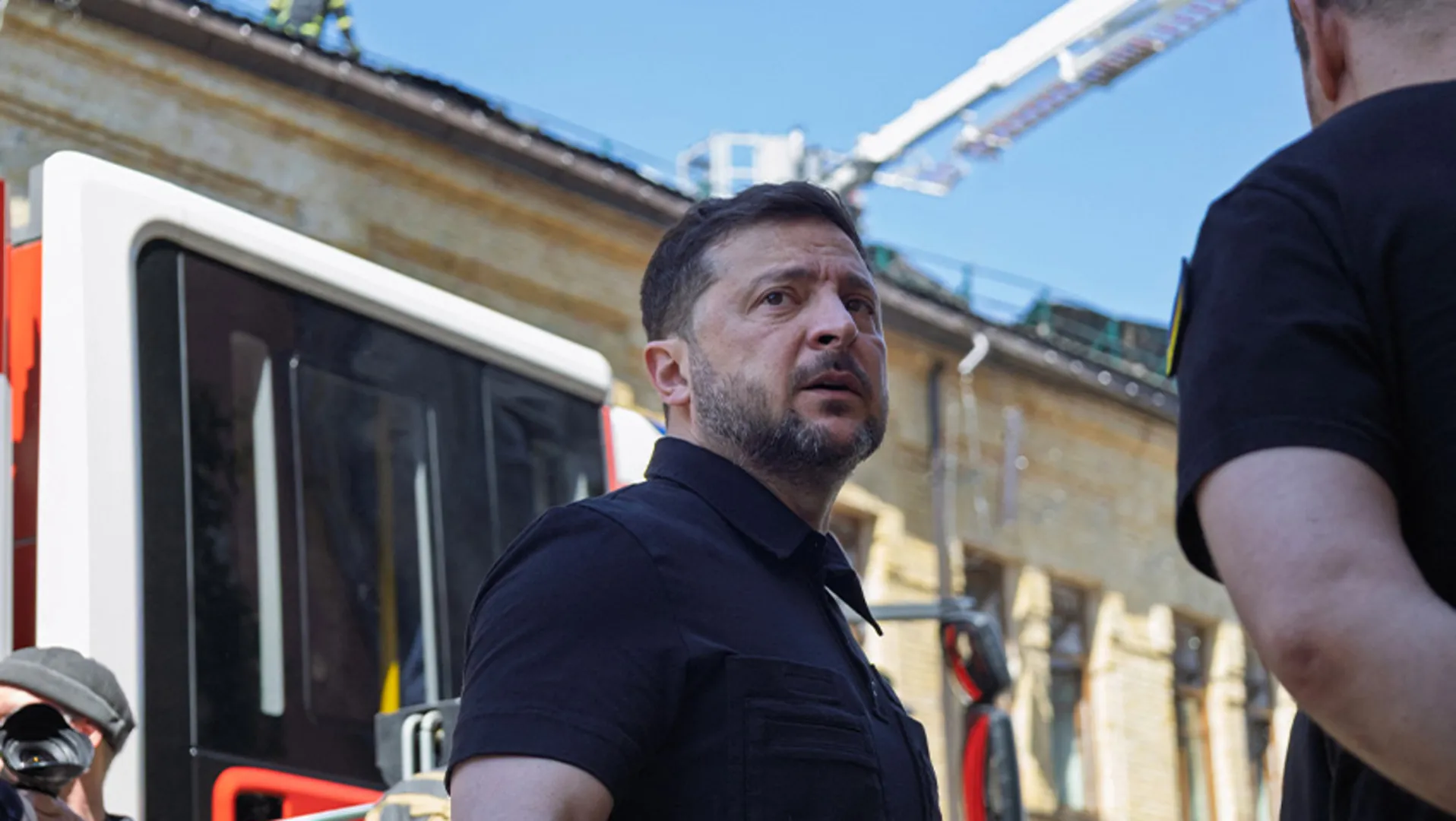
Speaking to Al Jazeera after visiting damaged sites, President Volodymyr Zelenskyy condemned the strikes and the targeting of civilian infrastructure, as Ukraine vowed retaliation.
Tehran, Iran – Iran and the United States have evoked historical and geographical references to the MENA region as the world awaits the announcement of a possible deal to end the conflict between the two countries.
Iranian officials have revived key moments in the nation’s history to drive forward a message of a David-versus-Goliath battle between the two sides, with the underdog ultimately victorious.
This comes as US President Donald Trump announced that a deal with Iran had been “largely negotiated”, with Tehran also indicating there could be an agreement soon. Both sides have been keen to portray any deal to end their 66-day conflict as a victory.
Historic messaging
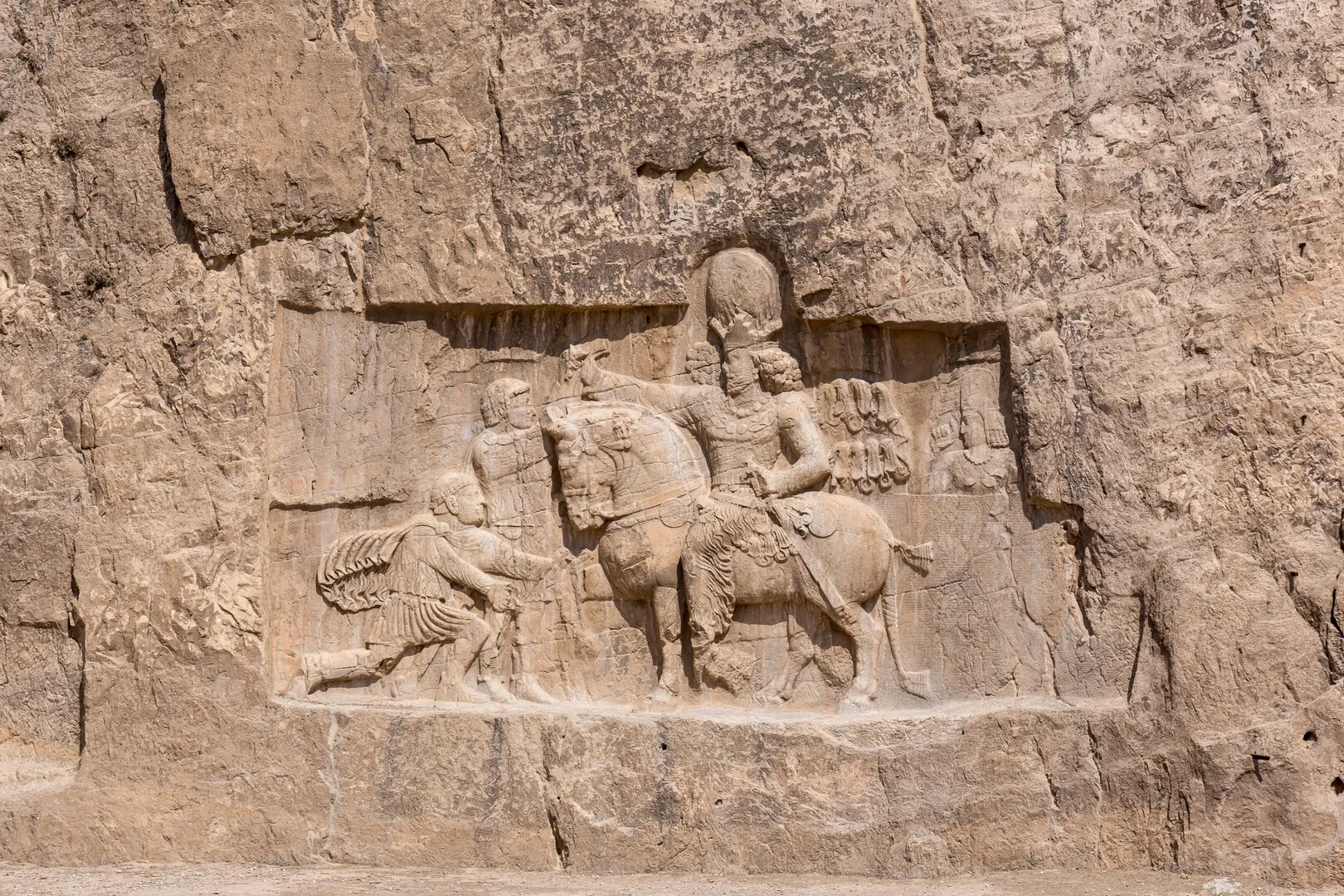
Iran’s Foreign Ministry spokesman Esmaeil Baghaei drew parallels to the march of the Romans against the Persians in the third century, with the invading party ultimately being forced to “come to terms” with the latter.
Baghaei also posted an image of Roman Emperor Valerian after he was captured by Persia’s King Shapur I in the year 260. It is an illustration repeatedly drawn on by Iranian authorities in recent months to evoke nationalist sentiments and promote the idea that the country is again bravely standing up to another invading force.
Sunday also happened to mark the anniversary of a more recent conflict, when Iran – under a new revolutionary government still in place today – fought an eight-year war with its neighbour, Iraq, from 1980 to 1988.
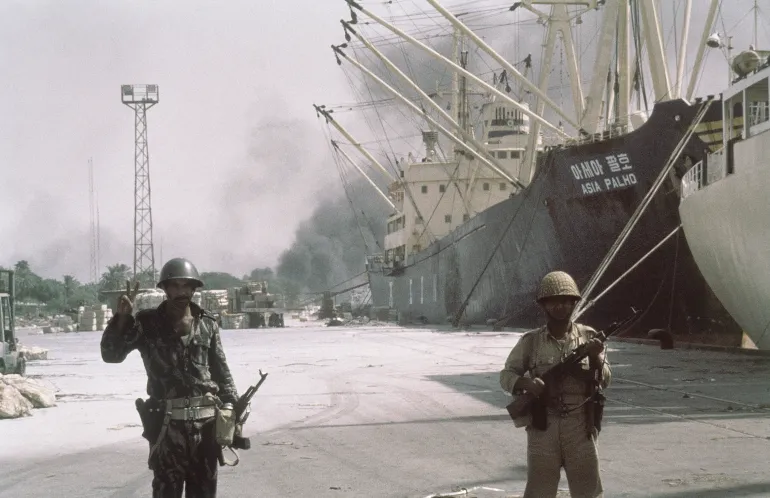
Every year, the Islamic Republic celebrates the 1982 recapture of Khorramshahr, a city with an Arabic-speaking majority in the western Iranian province of Khuzestan.
Khorramshahr marked a turning point for the Iranian side in a protracted war that killed hundreds of thousands from both sides, with that battle being one of the bloodiest.
It has been used in government discourse and messaging during the latest war with the US and Israel to symbolise the country’s long history of resistance and determination to maintain the sovereignty of its lands.
Iraqi troops stand guard over shipping at the dockside in occupied Khorramshahr, Iran, October 7, 1980 [AP Photo]
Ahmad Vahidi, the commander-in-chief of Iran’s Islamic Revolutionary Guard Corps (IRGC), used the battle to signal that Tehran would continue to fight the US and Israel in the region.
“The liberation of Khorramshahr is a lasting model for victory in future Khorramshahr, and the liberation of Quds sharif [Jerusalem], and the destruction of the evil Zionist regime by the axis of resistance and the fighters of the Islamic world,” he said, in reference to Israel.
Masoud Pezeshkian, Iran’s relatively moderate president, linked the event to the current standoff.
“Iran’s Khorramshahr today is the Persian Gulf and the Strait of Hormuz,” he wrote on X. “Resistance, sacrifice and fighting off aggression are rooted in the culture of this land.”
Preparing for peace
Mohammad Mokhber, an adviser to Iran’s slain Supreme Leader Ayatollah Ali Khamenei, said both former Iraqi leader Saddam Hussein and US President Donald Trump failed to fully recognise Iran’s power when starting a war.
“The first was buried in the trenches of Khorramshahr, while the second has been afflicted with a political crisis in a quagmire created by the Zionist regime,” he wrote on X.
Kazem Gharibabadi, a member of Iran’s negotiating team and its deputy foreign minister for international affairs, linked the issue of Khorramshahr with the United Nations Charter and the country’s current concerns.
“Any nation that falls victim to aggression and occupation has an intrinsic right for legitimate defence to safeguard its territory, independence and integrity,” he said.
Gharibabadi added that Tehran is currently following the same logic of “peace-seeking paired with power, diplomacy paired with integrity and decisive defence”.
First Vice President Mohammad Reza Aref said the recapture of the city in 1982 showed that the new government could defeat aggression on its own terms.
Tehran now aims to “overcome our savage enemy” through holding its ground, he wrote on X.
The latest barrage of messaging from leaders in Tehran came after Trump appeared to suggest that he wanted to take control of Iran.
On his Truth Social account on Saturday, the US president posted a photo of the US flag covering the map of Iran, with the question: “United States of the Middle East?”
In response, the X accounts of multiple Iranian embassies abroad posted a US map covered with the flag of the Islamic Republic, with the question: “United States of Iran?”
The Trump administration has emphasised that it wants a long-term suspension of uranium enrichment in Iran and the extraction of high-enriched nuclear material from the country.
It also wants the Strait of Hormuz – through which one-fifth of the world’s oil shipments normally pass, but which Iran has blockaded – reopened fully without any tolls from Iran, officials have said.
Israeli officials have remained largely silent about a US deal with Tehran, but have reportedly been pushing to resume the war.
Iran’s foreign ministry spokesman has invoked ancient Persia’s victory in the face of a failed invasion by the Roman Empire. The post suggests the US has been forced to make concessions in a deal to end its war on Iran on Tehran’s terms.
May 23 (UPI) — Secretary of Defense Pete Hegseth delivered a graduation speech to graduating West Point cadets Saturday, and told them they are “ready” for war.
“West Point is set apart. It’s special. It’s above politics,” Hegseth said at the U.S. Military Academy in West Point, N.Y., Saturday. “Success here is based on merit. It’s how you perform that matters.”
He accused former “foolish and feckless leaders” of pushing identity politics on the academy.
“The battlefield does not grade on a curve, and you can’t throw your pronouns at the enemy,” The Hill reported Hegseth said. “Combat is the ultimate test, and our best Americans must ace it.”
He said previous “woke and weak leaders” tried to transform the school into “woke Princeton.” Hegseth got a bachelor’s degree from Princeton.
“They embraced the [diversity, equity and inclusion] craze and tried to introduce diversity and inclusion studies,” Hegseth said. “They hired professors who advocated for anti-American ideologies right here in these halls, but no more.
“You are fit, not fat. You are disciplined, not distracted,” Hegseth told the cadets.
While he didn’t mention the war in Iran, he told the graduates that they “are stepping into the arena at a time when the stakes could not be higher.”
“We’re sending you to lead, we’re sending you to forge warriors, and we are sending you, perhaps, to war, and you are ready,” he said.
On stage were also Rep. Steve Womack, R-Ark., Rep. Pat Ryan, D-N.Y., Army Secretary Dan Driscoll and other military officials.
Last year, President Donald Trump delivered the graduation speech.
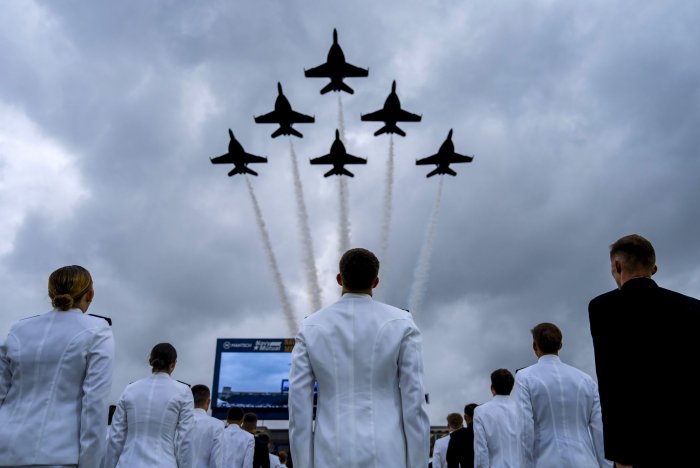
The Blue Angels perform a flyover during graduation and a commissioning ceremony at the U.S. Naval Academy in Annapolis, Md., on May 22, 2026. Photo by Bonnie Cash/UPI | License Photo
WASHINGTON — President Trump said Saturday that the United States and Iran have agreed on the basic terms of an agreement to end the two countries’ nearly three-month-long war and reopen the Strait of Hormuz.
“An Agreement has been largely negotiated,” Trump wrote in a social media post. “Final aspects and details of the Deal are currently being discussed, and will be announced shortly. In addition to many other elements of the Agreement, the Strait of Hormuz will be opened.”
Iran’s state television network quoted Foreign Ministry spokesman Esmail Baghaei as saying the draft pact will be a “framework agreement” that defers talks toward limiting Iran’s nuclear program until later. Trump did not mention the nuclear issue in his statement.
If that is the form the deal takes, it would represent at least a short-term concession from the president, who initially demanded a definitive end to Iran’s nuclear program as the price of peace.
Trump has also relaxed an earlier U.S. demand that Iran give up its right to enrich uranium and says he would be satisfied with a deal to “suspend” enrichment for 20 years.
Those signs of U.S. flexibility have raised alarm from Iran hawks, reportedly including Israeli Prime Minister Benjamin Netanyahu. They say they fear Trump is so intent on restoring the flow of oil from the gulf that he might agree to a deal that falls far short of U.S. goals.
Mark Dubowitz, a leading critic of past agreements with Iran, said he worries that Trump might settle for “a foolish agreement” to reopen the Strait of Hormuz.
“I’m concerned that the administration is looking to cut some ‘Phase One’ deal” in which Iran is given “significant sanctions relief in exchange for agreement to reopen the strait,” he said in an interview Friday. “I think that would be a foolish agreement. Iran would get real money, but they could continue to close the strait any time they wanted simply by making threats.”
Robert Kagan, a conservative foreign policy scholar at the Brookings Institution, wrote that a deal to reopen the strait while deferring the nuclear issue would amount to a U.S. “surrender.”
“On the present trajectory, Iran will emerge from the conflict many times stronger and more influential than it was before the war,” Kagan wrote in the Atlantic.
When the war began in February, Trump said he wanted not only to end Iran’s nuclear activities and destroy its ballistic missile program, but bring about regime change as well.
Instead, the nuclear talks have focused on narrower, more achievable goals: a “suspension” of nuclear enrichment for 20 years or less and removal or destruction of Iran’s highly enriched uranium, the essential ingredient for a nuclear weapon.
“A basic agreement shouldn’t be impossible to achieve,” said John W. Limbert, who worked on Iran policy at the State Department for three decades, and was one of the American hostages seized by Iranian militants in 1979. “The deal would be some kind of verifiable limits on the nuclear program in return for economic relief.”
“The fact that we’re talking about a suspension of all enrichment, and the question is whether it will be five years, 20 years or halfway in between — that’s important,” said Nate Swanson, an Iran expert who worked at the National Security Council under President Biden and Trump. “That sounds like you really have the basis for an agreement. … But don’t fool yourself to think that completely addresses the situation.”
Swanson said other issues, including Iran’s nuclear research and its advanced ballistic missiles, haven’t been addressed.
Despite signs of progress toward an agreement, the gaps between the two countries remain large.
Part of the problem is that both sides appear to believe they have won the war, said Danny Citrinowicz, a former Iran analyst at Israel’s defense intelligence agency.
Trump and other U.S. officials frequently assert that the United States has gained the upper hand by destroying Iran’s navy, air force and many of its missiles.
But the Iranians use a different scoring system, Citrinowicz said.
“Iran does not measure success the same way Washington often does,” he wrote in an email. “From Tehran’s perspective, simply holding firm in the face of American pressure can be framed as a win.”
“Tehran believes time is working against Trump politically and strategically,” he added. “Iran is prepared for prolonged confrontation; the United States, far less so.”
And even if a negotiated agreement is reached, the deals under discussion now won’t resolve all the conflicts between the two countries.
“An interim deal to buy time [is] probably where we end up,” Swanson said. “Buying time is not a bad thing. Ending a war is not a bad thing. But it’s not a comprehensive solution.”
Latest Truth Social post comes amid ‘delicate diplomacy’, expert says, as US and Iran indicate progress in talks.
Washington, DC – President Donald Trump has posted a photo of the United States flag covering the map of Iran, with the question: “United States of the Middle East?”
The post on Truth Social on Saturday represented another potentially incendiary message from Trump amid ongoing negotiations for a more lasting ceasefire in the US-Israeli war with Iran, experts said.
Recommended Stories
list of 3 itemsend of list
It carries the potential to roil both regional allies and foes alike given Washington’s past intervention in the Middle East, most notably during the US invasion of Iraq from 2003 to 2011, as well as the Trump administration’s push to increase its influence abroad.
The sentiment also appears to run counter to the Trump administration’s repeated statements that it is not seeking a prolonged occupation of Iran. The US has maintained it is not seeking outright regime change in its war, which it launched alongside Israel on February 28, but that it would welcome such change as a byproduct of the military campaign.
Even for a president known for outlandish social media posts and conflicting messaging on the war, the post could have implications for ongoing negotiations aimed at a more lasting ceasefire, according to Vali Nasr, professor of international affairs and Middle East studies at Johns Hopkins University.
He pointed to Trump’s threat in early April that an “entire civilisation will die” if Iran did not agree to a deal at the time. Hours later, both sides agreed to a pause in fighting.
That pause has held since, save for a handful of flare-ups, with the US continuing to blockade Iranian ports and Tehran effectively closing the Strait of Hormuz.
“First he declared he wanted to eradicate Iran’s civilisation now he is declaring that he wants to turn Iran into an American property,” Nasr wrote on X.
“It is this kind of grotesque behaviour that undermines diplomacy and unites Iranians in defence of their country,” he added. “In the middle of delicate diplomacy he casts doubts on America’s true intentions.”
The White House did not immediately respond to a request for comment.
Fragile negotiations continue
On Saturday, both US and Iranian officials indicated a new deal may be within reach.
Trump told CBS News both sides were “getting a lot closer”. US Secretary of State Marco Rubio said an update could be coming shortly, the broadcaster reported.
Iranian Foreign Ministry spokesperson Esmaeil Baghaei said the two sides were “currently working to finalise” a memorandum of understanding, and that “the opinions have been converging”.
Still, there have been no official announcements related to key sticking points in the standoff, including the future of Iran’s nuclear programme, the fate of its highly enriched uranium stockpile, and its future influence over the Strait of Hormuz.
Trump regularly uses his Truth Social account, which he launched after being briefly banned from Twitter, now X, in the wake of the 2020 election, to make major announcements, attack political enemies, and post AI-generated images and videos.
The foreign policy of his second term has been defined by efforts to grow US influence abroad, particularly in the Americas. That has included the military abduction of Venezuelan leader Nicolas Maduro, continued threats against Cuba, and vows to take control of Greenland, the semi-autonomous Danish territory in the North Atlantic.
The Trump administration has adopted the term the Donroe Doctrine, a reference to the 1823 Monroe Doctrine, which sought to diminish European influence in the Western Hemisphere.
On Saturday, Trump also posted an image of his face peering over a mountain range in Greenland.
As petrol prices rise, new survey suggests economic confidence in the US is at -45, the worst since 2022.
Published On 22 May 202622 May 2026
Only 16 percent of Americans view the economy in the United States as “good” or “excellent”, a new Gallup poll suggests, as inflation continues to rise amid the war on Iran.
The survey, released on Friday, deepens US President Donald Trump’s political woes ahead of the midterm elections in November, which will determine whether his Republican Party can retain control of Congress.
Recommended Stories
list of 3 itemsend of list
The survey, dubbed Gallup’s Economic Confidence Index, showed confidence in the economy has dropped to -45.
Forty-nine percent of respondents said economic conditions are poor and 34 percent rated them as fair. At the same time, 76 percent said they think the economy getting worse, while 20 percent said it is getting better.
The index averages the results on economic conditions, currently at -33 and economic outlook, currently at -56.
It was the worst set of findings on the economy that the index recorded since 2022 when the cost of living rose after the COVID-19 pandemic and Russia’s invasion of Ukraine.
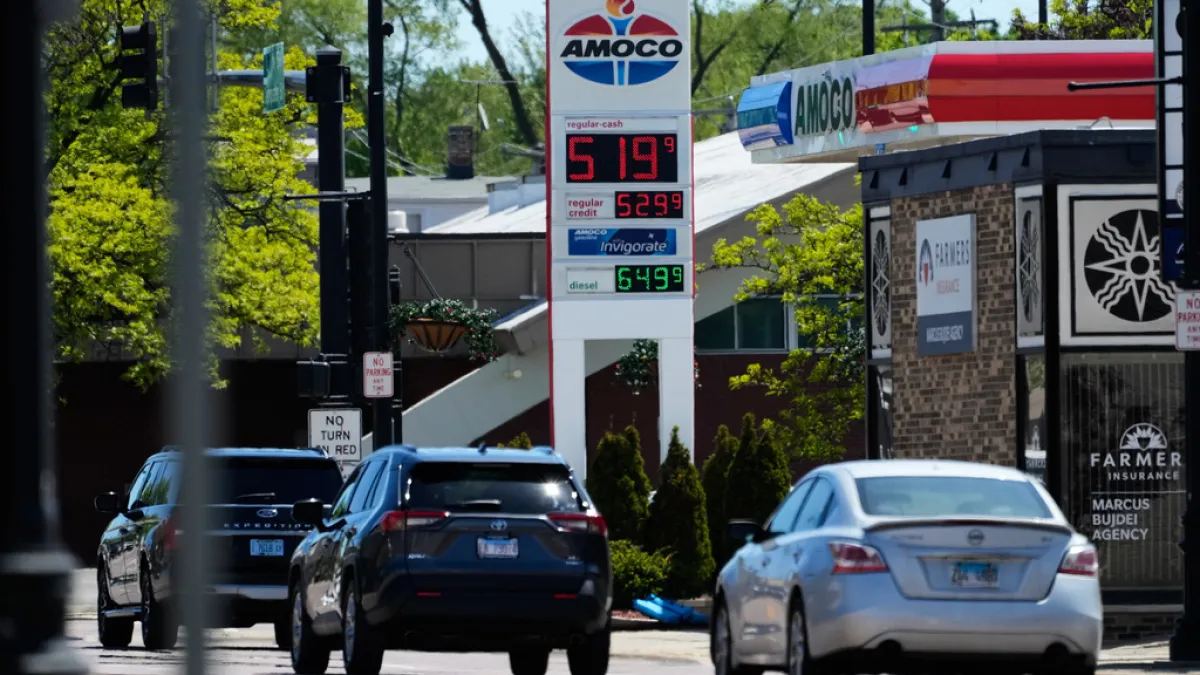
Petrol costs in the US have skyrocketed since the start of the conflict with Iran late in February. The average price of one gallon (3.8 litres) of gasoline has risen to $4.55 from less than $3 before the US and Israel launched the war.
According to official government reports, consumer prices overall rose in March and April due to the energy crisis.
Iran has responded to the US and Israeli strikes – which killed several top officials, including Supreme Leader Ali Khamenei, as well as hundreds of civilians – by closing the strategic Strait of Hormuz, sending oil and gas prices soaring.
The US has also imposed a naval siege on Iranian ports, deepening the strain on energy supplies across the world.
Despite the ceasefire that began in April, the blockades have persisted in the absence of a permanent end to the war, and Iran is now claiming sovereignty over Hormuz, which operated as a free international passageway before the war.
Parts of the strait run through Iranian and Omani territorial waters.
Although the US is one of the world’s largest oil producers, energy prices are set globally, so the disruption has spiked costs for American consumers.
As a candidate, Trump promised to be a president of “peace”, saying he would pursue “America first” policies that would prioritise domestic issues over foreign interventions.
But the US president joined Israel in attacking Iran without direct provocation. His administration argues that the military campaign is necessary to prevent Tehran from obtaining a nuclear weapon.
Iran denies seeking nuclear weapons. And Trump’s own intelligence chief Tulsi Gabbard has said that Tehran is not building a nuclear bomb.
Trump has repeatedly argued that the cost of the war is worth it, stressing that petrol prices will drop rapidly once the conflict is over.
Last month, the US State Department released a legal justification of the war, saying that Washington joined the conflict “at the request of and in the collective self-defence of its Israeli ally, as well as in the exercise of the United States’ own inherent right of self-defence”.
The Gallup survey on Friday is the latest in a series of negative polls for the Trump administration.
A New York Times/Sienna poll released earlier this week suggested that only 31 percent of voters approve of Trump’s handling of the war with Iran.
Earlier this month, the US president suggested the economic fallout from the war and its effect on people in the US do not play a role in his approach to Iran.
“I don’t think about Americans’ financial situation. I don’t think about anybody,” he said. “I think about one thing: We cannot let Iran have a nuclear weapon. That’s all. That’s the only thing that motivates me.”
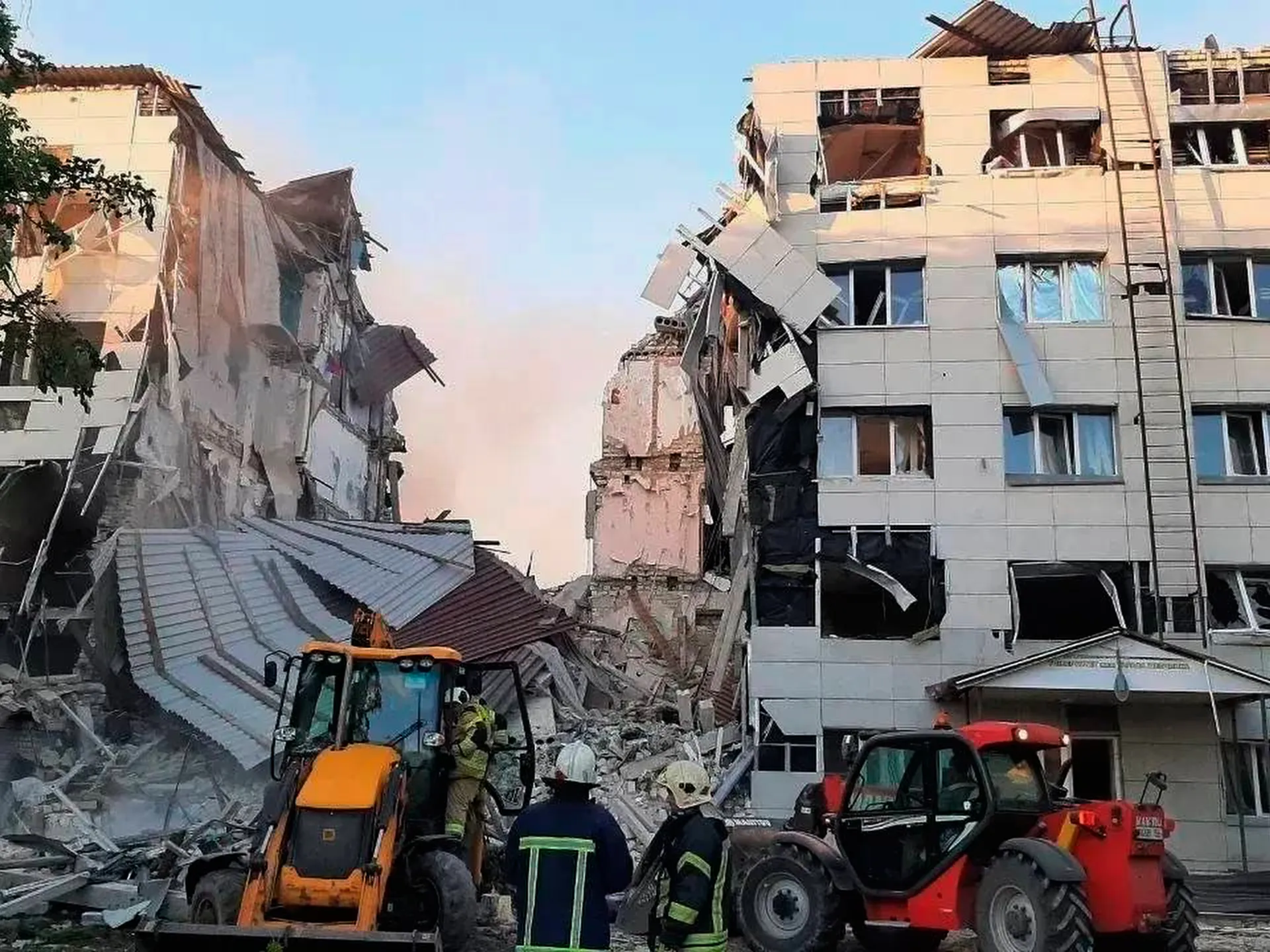
A Ukrainian strike collapsed a five-storey college dormitory in the Russian-occupied city of Starobilsk, killing four people and injuring at least 39 others. Rescue operations continue as more people are believed to be trapped under the rubble.
US and Iran continue mediated talks, exchanging draft proposals aimed at reaching a formal agreement.
Published On 22 May 202622 May 2026
Iran and the United States are continuing mediated talks aimed at ending the conflict, with Iranian media reporting that both sides are exchanging messages and draft proposals to establish a formal framework for an agreement.
Al Jazeera’s correspondent Almigdad Alruhaid reported from Tehran that Pakistani officials were engaged in “intense mediation activity” between the two countries.
The diplomatic push comes as US Secretary of State Marco Rubio said there were “some good signs” for a possible breakthrough. However, US President Donald Trump also warned Washington could take “very drastic” action if Iran refuses to give up its uranium stockpiles.
Here is what we know:
In Iran
‘War crime’ on medical research centre: Iran has accused the US and Israel of committing a “war crime” by bombing the Pasteur Institute of Iran early in the war, after The Lancet journal warned that the attack severely damaged a key pillar of the country’s public health system.
Thousands rescued from rubble: The Iranian Red Crescent said its aid workers rescued more than 7,200 people trapped beneath rubble during US and Israeli attacks, sharing footage of survivors being pulled from destroyed buildings for the first time.
War diplomacy
Nuclear ‘red lines’ must shift: Doug Bandow, a senior fellow at the Cato Institute, said the US and Iran will need to move beyond conflicting “red lines” on Tehran’s nuclear programme for negotiations to make progress. Speaking to Al Jazeera, Bandow said both sides must be willing to compromise and continue serious talks if they want to avoid further escalation and move away from war.
Rubio sees ‘good signs’ in talks: US Secretary of State Marco Rubio said negotiations with Iran have shown “some progress”, while cautioning that it remains unclear whether a deal can be reached in the coming days. Rubio said President Donald Trump still prefers a diplomatic agreement, but warned Washington has “other options” if talks fail.
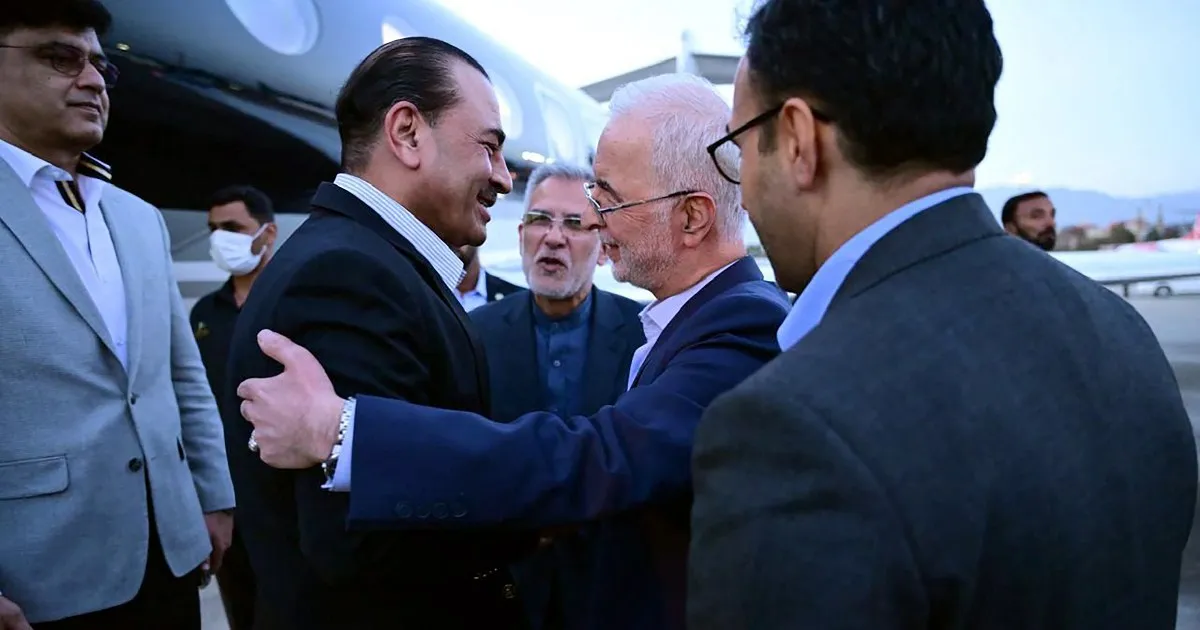
Pakistani mediation efforts intensify in Tehran: Al Jazeera’s Alruhaid said senior Pakistani officials are engaged in “intense mediation activity” in Tehran as efforts accelerate to prevent further escalation. While one senior Iranian official said negotiators were close to a deal and working on draft texts, another source cautioned it was still too early to say whether a final agreement was within reach.
In the US
US forces at ‘peak readiness’: CENTCOM said the USS Abraham Lincoln strike group remains at “peak readiness” in the Arabian Sea, sharing images of warplanes taking off as Washington maintains pressure on Iran amid ongoing mediation efforts.
US reportedly suffers major Reaper drone losses: Iran has destroyed more than two dozen MQ-9 Reaper drones operated by US forces since the conflict began, according to Bloomberg News. The reported losses are estimated at $1bn, nearly 20 percent of the Pentagon’s pre-war inventory.
US pauses Taiwan arms sales: Acting Navy Secretary Hung Cao told a Senate hearing that Washington has paused a $14bn arms sale to Taiwan to ensure the US has enough munitions for its military campaign against Iran, a move Republican Senator Mitch McConnell called “distressing”.
In Lebanon and Palestine
Israeli strike kills two in southern Lebanon: The Israeli military said it carried out an air raid that killed two people near the Lebanon-Israel border, after detecting what it described as “suspicious movement” in southern Lebanon.
US sanctions allies of Hezbollah: The US has imposed sanctions on nine people accused of helping Hezbollah undermine Lebanon’s sovereignty and obstruct efforts to disarm the group, including Lebanese politicians, security officials and Iran’s ambassador-designate to Beirut.
Palestinian envoy condemns aid blockade: Palestine’s UN envoy Riyad Mansour said Israel is continuing to collectively punish more than two million Palestinians through its blockade on aid and ongoing attacks, warning the world must not become “accustomed to seeing Palestinians killed”.
US urges humane treatment of flotilla detainees: According to Al Jazeera’s Ali Harb, the US State Department said activists detained by Israeli forces after attempting to break the Gaza blockade “must be treated humanely and consistent with international law”, while also reiterating Washington’s opposition to the flotilla movement.
May 21 (UPI) — House Republicans abruptly pulled legislation to curb President Donald Trump‘s ability to continue the war with Iran on Thursday amid Democratic accusations that GOP leaders shelved the measure over fears it would pass.
House Concurrent Resolution 86 was listed on House Majority Leader Steve Scalise‘s schedule for possible consideration on Thursday but no vote was held before the House left Washington.
The resolution was delayed until after the lower chamber returns from recess on June 2, leaving Democrats fuming.
“Are we not voting on it because the American people are sick and tired of this illegal war that is costing tens of billions of dollars, gas prices are through the roof, people can’t afford their groceries? Is that why you’re pulling it?” Rep. Jim McGovern, D-Mass., asked on the House floor as cheers and boos erupted behind him.
“You guys don’t have the guts … to vote on this.”
NEWS: Republicans just pulled a vote on the Iran War Powers Resolution because they knew they were going to lose. They rigged the rules to protect the president’s historically unpopular war from a fair up or down vote. pic.twitter.com/v2JzwD7UKJ— Rep. Jim McGovern (@RepMcGovern) May 21, 2026
The resolution, sponsored by Rep. Gregory Meeks, D-N.Y., directs Trump to remove U.S. forces from hostilities with Iran unless authorized by Congress.
Democrats put the measure forward amid a larger congressional push aimed at reining in Trump’s ability to go to war in the Middle East. Democrats in the Senate on Tuesday advanced similar legislation in the eighth vote they have forced on the matter since the war began Feb. 28.
While Democrats have said the war is illegal without congressional authorization, Trump and his Republican Party argue the effort is moot, claiming the war ended with a fragile cease-fire announced last month.
The Senate measure advanced with support from a handful of Republicans who have split from their party on the issue as the war has continued. In the House, where the GOP also holds a narrow majority, defections were anticipated. Republican Rep. Thomas Massie of Kentucky has supported previous similar measures.
“Let’s be clear: Republicans pulled this vote because they knew they were going to lose it,” Meeks, ranking member of the House Foreign Affairs Committee, said in a statement after the House recessed.
“They know this war is a political and strategic disaster. They know that as Americans head into Memorial Day weekend paying over [$]4.50 a gallon at the pump, they cannot go home and explain they voted to keep this war going. So, instead of casting that vote, they ran from it.”
Rep. Richard Neal, D-Mass., accused House Speaker Mike Johnson, R-La., and House Republicans of abdicating their responsibility by postponing the vote.
“This is a disservice to the American people and the troops being put in harm’s way.”
House Minority Leader Hakeem Jeffries, D-N.Y., lambasted Trump for starting the war without articulating its objectives and exit strategy and without garnering public support or congressional approval for it.
“Even as we prepare to recognize our nation’s fallen heroes on Memorial Day, House Republicans refuse to show up and be accountable to the brave service members that have been recklessly put in harm’s way,” he said in a statement.
“The American people will remember in November.”
President Donald Trump speaks at an event with Environmental Protection Agency (EPA) Administrator Lee Zeldin in the Oval Office at the White House on Thursday. Photo by Al Drago/UPI | License Photo
Acting Navy Secretary Hung Cao’s remarks come as US President Donald Trump gives mixed signals on the sale.
Published On 22 May 202622 May 2026
A top United States military official has said Washington is pausing a $14bn arms sale to Taiwan to conserve munitions for its war on Iran.
Acting Navy Secretary Hung Cao provided the update to lawmakers during a Senate hearing on Thursday, a week after the weapons sale took centre stage in talks between US President Donald Trump and Chinese leader Xi Jinping in Beijing.
Recommended Stories
list of 4 itemsend of list
“Right now, we’re doing a pause in order to make sure we have the munitions we need for Epic Fury – which we have plenty,” Cao told the Senate Appropriations Subcommittee on Defense.
“But we’re just making sure we have everything, but then the foreign military sales will continue when the administration deems necessary.”
Cao said any decision to move forward with the sale – which would be the largest ever weapons transfer to Taiwan – would be made by Secretary of Defense Pete Hegseth and Secretary of State Marco Rubio.
The war has been paused since the US and Iran agreed to a ceasefire on April 8, but the sides have yet to reach a permanent peace deal.
The US Congress approved the weapons package for Taiwan in January, but the sale requires Trump’s sign-off to move forward.
If approved, the sale would surpass a record-breaking $11bn arms package for Taiwan approved by Trump in December.
Taiwanese Premier Cho Jung-tai told reporters on Friday that Taiwan would continue to pursue arms purchases, according to Taiwanese news outlet FTV News.
William Yang, senior analyst for northeast Asia at the Crisis Group, said in a social media post that the pause will “exacerbate anxiety and scepticism about US support in Taiwan and make it difficult for the Taiwanese government to request additional defence budget for the foreseeable future”.
Trump, who has confirmed that he discussed the arms sale with Xi, said last week in an interview with Fox News that he “may” or “may not” approve the package.
Trump has also suggested that the package could be used as a “negotiating chip” – despite a decades-old precedent against consulting with Beijing on arms sales.
China claims self-governing Taiwan as part of its territory, and objects to Washington’s ongoing but unofficial support for Taipei.
The US government does not officially recognise Taiwan but is committed to helping the island to defend itself under the 1979 Taiwan Relations Act, enacted shortly after Washington severed diplomatic ties with Taipei.
Such a move would break with four decades of diplomatic protocol against direct talks with the Taiwanese leader and almost certainly provoke an angry response from Beijing.
Trump held a phone call with former Taiwanese President Tsai Ing-wen after his 2016 election win, but their talks took place before he was sworn in as president.