Higher crude prices due to the disruption in the Strait of Hormuz have helped Russia earn more from energy exports.
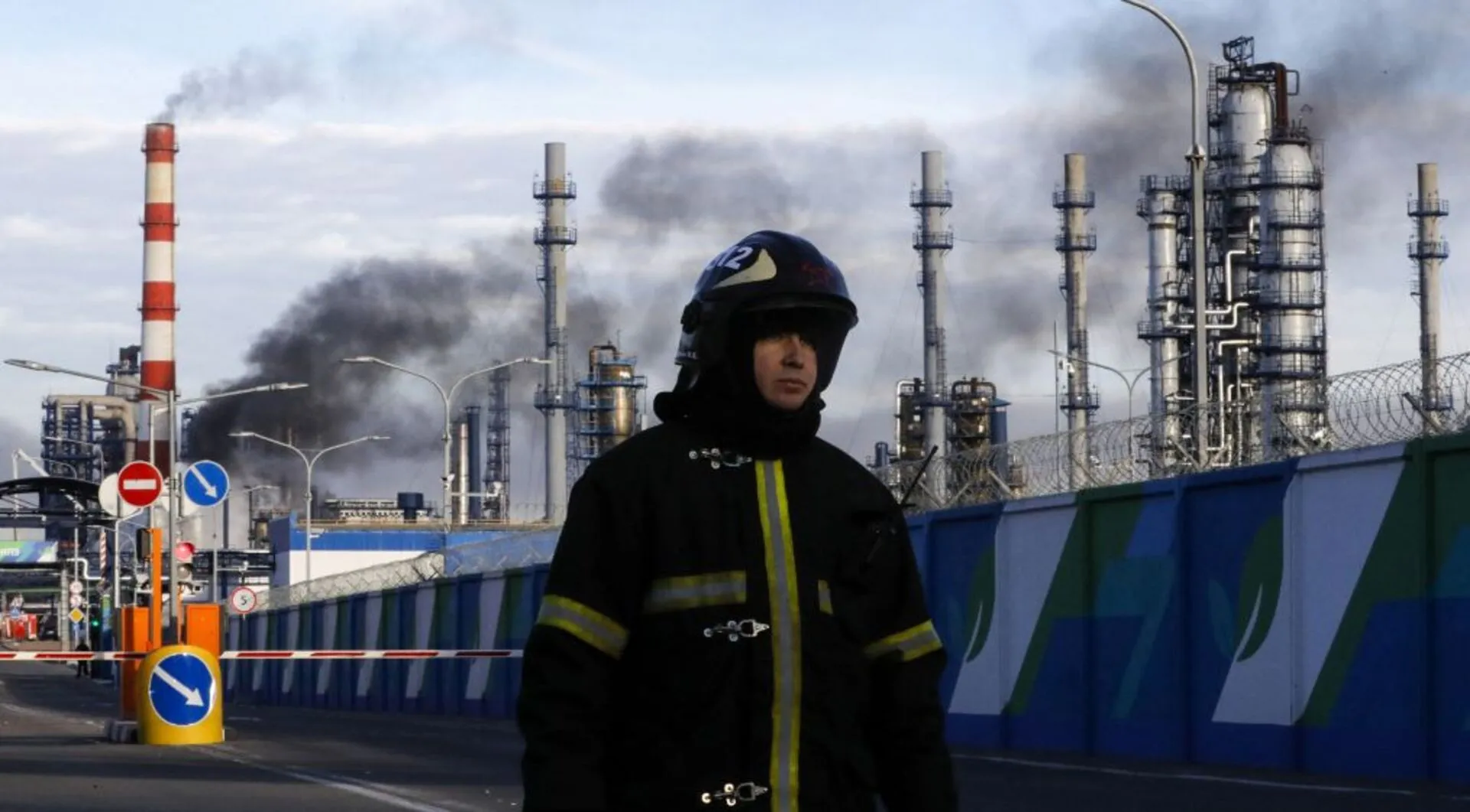
One nation that’s hoping to gain from the United States-Israel war on Iran is Russia, the world’s third largest oil producer. Higher crude prices due to the disruption in the Strait of Hormuz have allowed Russia to earn more from its oil and gas exports. A sanctions waiver announced by the US is also helping Moscow. But its revised budget plans are at risk after repeated Ukrainian attacks on its ports and oil refineries. Russia has banned petrol exports to protect against domestic fuel shortages. So can Russia help fill the global energy gap, or is its capacity already under threat?
LONDON — President Trump has said he is strongly considering pulling the U.S. out of NATO, ratcheting up his criticism of European allies and exposing a wider rift in the transatlantic alliance — this time over America’s war alongside Israel against Iran.
While Trump’s talk of a possible NATO pullout dates back years, the comments to Britain’s Telegraph newspaper, published Wednesday, were among the clearest and most disparaging yet — suggesting the fracture has deepened perhaps to a point of no return.
Asked whether he would reconsider U.S. membership in the alliance after the war on Iran ends, Trump replied: “Oh yes, I would say (it’s) beyond reconsideration.”
Contacted by The Associated Press, NATO did not provide an immediate comment.
British Prime Minister Keir Starmer, asked about the comment, said Britain was “fully committed to NATO” and called it “the single most effective military alliance the world has ever seen.”
Many European leaders have felt political pressure over the war, which faces opposition in their countries and has sent petroleum prices soaring as Iran has effectively shut the Strait of Hormuz, the narrow waterway between Iran and Oman through which about one-fifth of the world’s oil passes.
“Whatever the pressure on me and others, whatever the noise, I am going to act in the British national interest in all the decisions I make,” Starmer said Wednesday.
Long-simmering tensions within the alliance have bubbled up again over the war. As energy prices have spiked, Trump has been desperate to get countries to send their ships to the Strait. He’s called his NATO allies “cowards,” pulling at any rhetorical lever he can to get help with the fallout of a war that no ally was consulted on or asked to take part in.
For years, Trump has berated America’s European allies, urging them to assume greater responsibility for their own security and spend more on defense. He has argued that the U.S. has done more for them than the other way around.
A U.S. pullout would essentially spell the end of NATO, which flourished for decades under American leadership.
On Truth Social on Tuesday, Trump lashed out at countries “like the United Kingdom, which refused to get involved in the decapitation of Iran,” and suggested they buy U.S. oil or go to the Strait of Hormuz themselves “and just take it.”
He also wants allies to help fix damage from the war that they had no part in starting.
The U.K. is working on plans that could help assuage Trump.
On Thursday, Foreign Secretary Yvette Cooper will host a virtual meeting of 35 countries that have signed up to help ensure security for shipping in the Strait after the war. Starmer said military planners will also work on a postwar security plan for the strait.
The backdrop: NATO not on board to join U.S. in war
NATO is built on Article 5 of its founding treaty, which pledges that an attack on any one member will be met with a response from them all.
As the Iran war has spread, missiles and drones have been fired toward NATO member Turkey and a British military base on Cyprus, fueling speculation about what might prompt NATO to trigger its collective security guarantee and come to their rescue.
The alliance has not intervened or signaled any plan to. Secretary-General Mark Rutte — who has voiced support for Trump and America’s role in the alliance — has been focusing mostly on Russia’s war against Ukraine, which borders four NATO countries.
NATO operates uniquely by consensus. All 32 countries must agree for it to take decisions, so political priorities play a role. Even invoking Article 5 requires agreement among the allies. Turkey or the U.K. cannot trigger it alone.
In the Mideast war, Trump has bristled at the across-the-board rejection from European and other allies, and even rival China, to help secure the Strait of Hormuz.
Many European Union and NATO member country leaders have fumed since the war’s outset on Feb. 28 because they weren’t informed ahead of time, seen as a break with precedent.
Trump insisted he needed the element of surprise, and he spoke out about possible military action and visibly built up U.S. forces in the region in the run-up to the war.
Rising voices, and tougher action, from Europe over the Mideast war
European leaders have called for the war to stop and want the United States and Iran to return to negotiations over Tehran’s nuclear program, which America and Israel see as a threat.
The vocal opposition in Europe to Trump’s war against Iran has started to turn into action.
Spain — the most vocal critic in Europe — on Monday said it closed its airspace to U.S. planes involved in the Iran war.
Early last month, France agreed to let the U.S. Air Force use a base in southern France after receiving a “full guarantee” from the United States that planes not involved in carrying out strikes against Iran would land there.
Other countries have spoken out against it: Frank-Walter Steinmeier, Germany’s largely ceremonial president, last week called the aggression against Iran a “dangerous mistake” in violation of international law.
U.S. relations with Europe had already soured in recent months over Trump’s call for Greenland — a semiautonomous territory of stalwart NATO ally Denmark — to become part of the United States, prompting many EU countries to rally behind Copenhagen.
Lawless and Keaten write for the Associated Press. Keaten reported from Geneva. AP writer Lorne Cook in Brussels contributed to this report.
Former US Senior State Department official Jennifer Gavito argues why US attacking Iran’s nuclear facilities may be a sign that the war is coming to an end.
Iran’s foreign minister says message exchanges continue with Washington, but insists there are no negotiations, and no trust.
Iran’s Foreign Minister Abbas Araghchi tells Talk to Al Jazeera that Iran is not negotiating with the United States, despite ongoing exchanges of messages, including direct communication from US envoy Steve Witkoff.
Araghchi says talks lack trust, adding that no response has been given to US proposals, and that there is no basis for negotiations. Araghchi outlines Iran’s conditions for ending the war, warns against threats and deadlines, and signals a readiness to continue defending the country as regional tensions escalate.
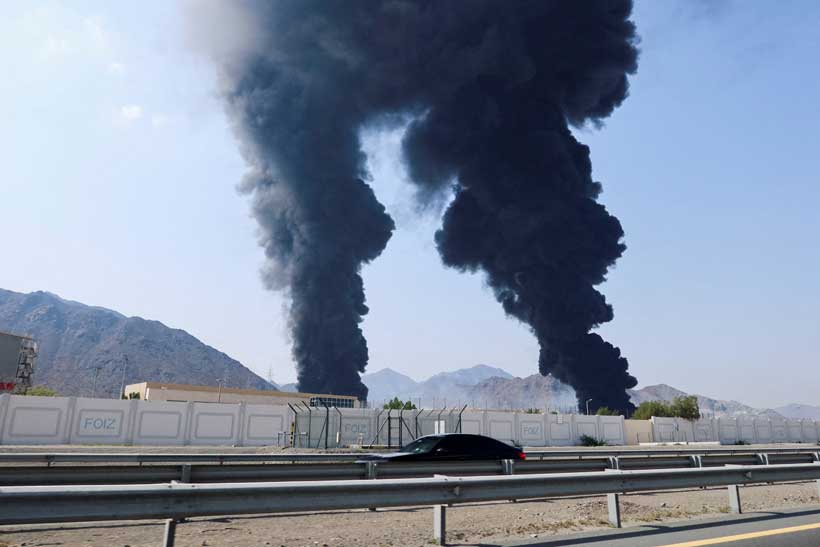
Shrapnel from an Iranian drone interception kills a Bangladeshi national in the UAE’s Fujairah city.
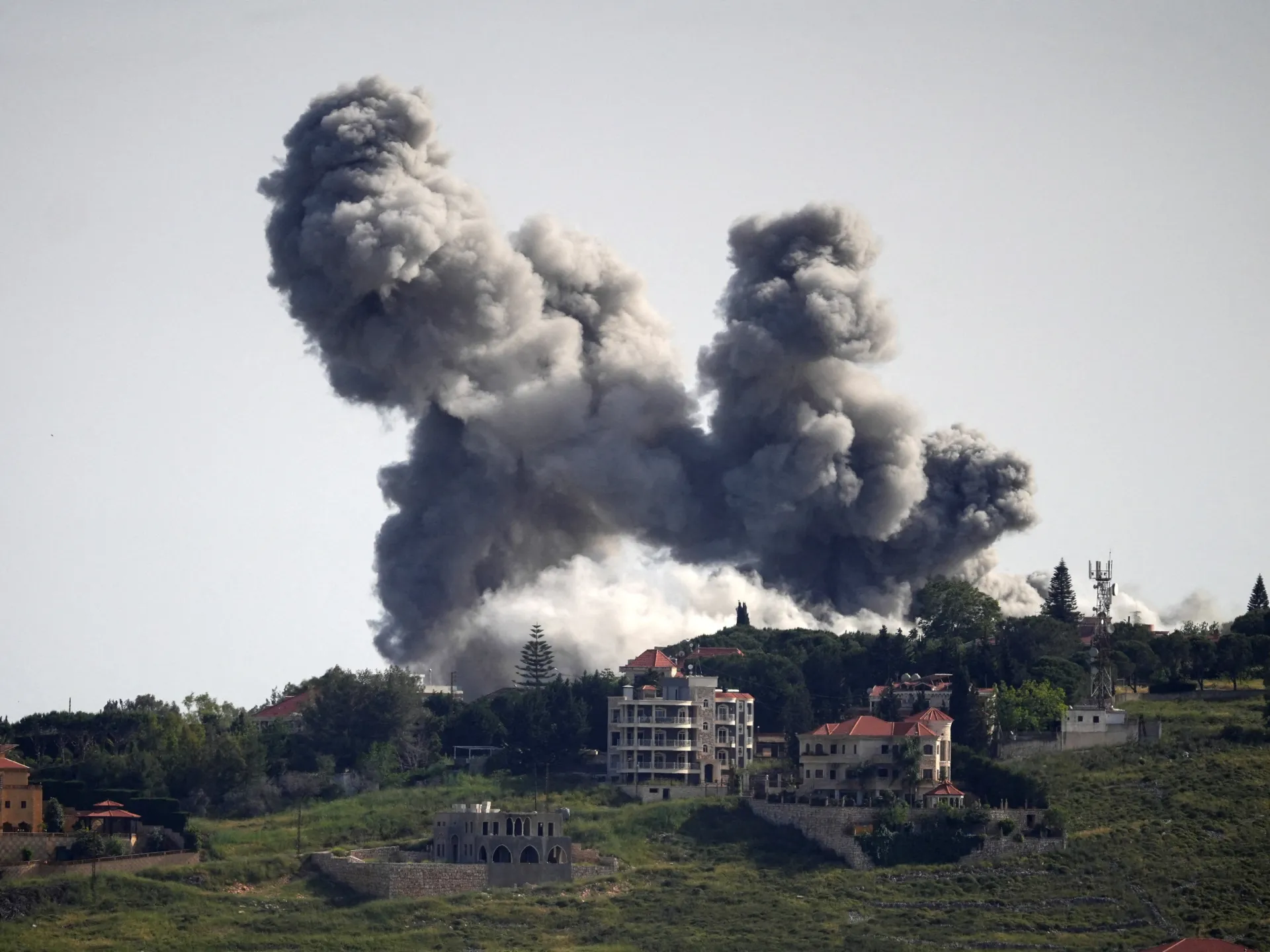
Iran’s drones have hit fuel tanks at Kuwait’s international airport, causing a large blaze, and authorities in Bahrain have reported a fire at an undisclosed company facility, as the United States-Israel war on Iran continues for a fifth week.
Abdullah al-Rajhi, a spokesman for the General Directorate of Civil Aviation in Kuwait, on Wednesday said the airport had been subjected to “brazen attacks by drones from Iran and the armed factions it supports”.
Recommended Stories
list of 3 itemsend of list
The raids targeted fuel tanks at the airport, “leading to a large fire breaking out at the site”, al-Rajhi was quoted as saying by the official Kuwait News Agency (KUNA).
Emergency teams were on site, and “the damage is material with no human injuries,” he said.
Bahrain’s Ministry of Interior said civil defence crews were “extinguishing a fire in a facility of a company as a result of the Iranian aggression”.
“Relevant authorities are taking their measures at the site,” it added, without naming the company.
Vessel hit
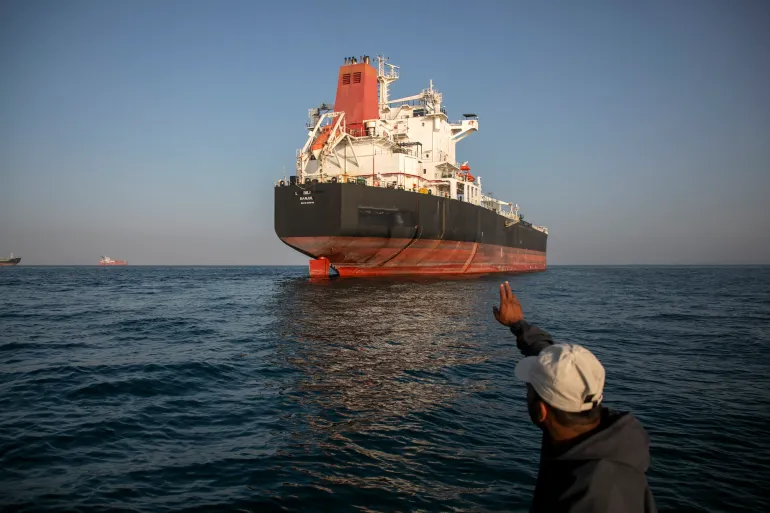
A tanker was hit by an unknown projectile near the Qatari capital Doha, causing damage to the hull at the waterline, the United Kingdom Maritime Trade Operations said, adding the crew were safe.
The vessel was struck about 17 nautical miles (equivalent to about 32km) north of Qatar’s Ras Laffan industrial hub, the country’s main gas production facility, which was hit by Iranian missiles last month, causing significant damage.
Confirming the incident, Qatar’s Ministry of Defence said the country was targeted by three cruise missiles launched from Iran, one of which struck an oil tanker.
In a post on X, the ministry said it intercepted two of the missiles, while the third hit a tanker leased to QatarEnergy. The tanker’s 21-person crew was evacuated, the ministry said. No injuries were reported.
In the United Arab Emirates (UAE), the official WAM news agency said shrapnel from a drone interception fell on a farm in the al-Rifaa area of Fujairah city and killed a Bangladeshi national. It said authorities were dealing with the incident.
Saudi Arabia’s Ministry of Defense said several drones were “intercepted and destroyed”, without reporting any injuries.
The oil-rich Gulf has borne the brunt of Iran’s attacks in response to the US-Israeli air strikes on the country.
Iran has claimed to be attacking US assets in the region, but Gulf nations say Tehran has targeted civilian infrastructure.
On Tuesday, a United Nations Development Programme (UNDP) report said gross domestic product (GDP) in the Arab world was estimated to decline by approximately 3.7 to 6 percent after a month of war, equivalent to a contraction of $120bn to $194bn.
Meanwhile, US President Donald Trump and his administration have sent contradictory statements about how and when the war might end.
“We’ll be leaving very soon,” Trump told reporters at the White House on Tuesday, saying the exit could take place “within two weeks, maybe two weeks, maybe three”.
Washington had previously threatened to intensify operations if Tehran did not accept a 15-point US ceasefire framework that had, among its core demands, commitments by Iran not to pursue nuclear weapons, halt all uranium enrichment and fully reopen the Strait of Hormuz.
Tehran dismissed the proposal as “maximalist” and “unreasonable”, stressing it is not seeking war and wants a permanent end to the conflict. It also demanded compensation for the destruction caused by US-Israeli attacks against the country.
Police inspect a strike site in Tel Aviv after a missile hit the city, causing injuries as the US-Israeli war on Iran enters its fifth week. Meanwhile, Washington signals the conflict could soon wind down, even as timelines remain unclear.
Renewed optimism over a possible de-escalation in the Iran war, now in its fifth week, gave a strong boost to stock markets in Europe and Asia on Wednesday.
ADVERTISEMENT
ADVERTISEMENT
At the time of writing, the Euro Stoxx 50 is up over 1%, while the broader pan-European Stoxx 600 is around 2.5% higher.
In London, the FTSE 100 has risen roughly 0.8% with Germany’s DAX 30 and France’s CAC 40 making equal moves to the upside. Italy’s FTSE MIB has jumped the most and is 1.7% higher.
During a press gaggle at the White House on Tuesday, US President Donald Trump stated that the country would “probably” stop attacks on Iran within two to three weeks “‘whether we have a deal or not”.
Following Trump’s comments, the front month future contracts for oil also saw a sharp decline, with Brent crude and WTI both trading around 4% lower and below $100 a barrel.
Trump also stressed that the US would “not have anything to do with” what happens next in the Strait of Hormuz.
Despite the relief, markets are eagerly anticipating Trump’s address to the nation about the conflict, which will occur overnight on Wednesday, according to the White House Press Secretary.
Asian markets, US futures and precious metals
Asian shares also rose sharply on Wednesday after Trump’s statement.
At the time of writing, South Korea’s Kospi has recovered losses from earlier this week, surging over 8%, while Tokyo’s Nikkei 225 rose more than 2%.
A survey by Japan’s central bank released on Wednesday showed that business sentiment among major manufacturers had improved despite concerns over the Iran war.
Hong Kong’s Hang Seng index is also over 2% higher, while the Shanghai Composite has jumped around 1.5%. Additionally, India’s Sensex rose roughly 2%, Australia’s ASX 200 is up 1% and Taiwan’s Taiex climbed more than 4%.
“De-escalation hopes have given markets a lift, but we think the effects of the war would, in many cases, persist even if it were to end soon,” said Thomas Mathews, head of markets for Asia Pacific at Capital Economics, in a research note on Wednesday.
US futures are also all trading between 0.7% and 1.2% higher.
The move comes after US stocks recorded their strongest day in almost a year on Tuesday, when the S&P 500 rose 2.9%, its largest gain since May.
The Dow Jones Industrial Average climbed 2.5%, while the Nasdaq jumped 3.8%.
“It’s worth considering how markets might respond if the war were to end very soon. Do markets have further to recover if sentiment continues to improve? The answer is almost certainly yes,” Mathews added.
In other trading, gold rose is up 1.4% trading at around $4,730 while silver is down roughly 1% to $74.3 an ounce.
WASHINGTON — President Trump said Tuesday that he expects the United States to end its involvement in the war with Iran within three weeks, declaring there probably will be “no reason” for American forces to stay in the region even as top defense officials maintain Tehran’s military capabilities have not been fully eliminated.
Trump told reporters during an Oval Office event that he is confident the U.S. objectives in the conflict will be largely achieved by then, whether Iran makes a “deal” with the United States or not.
“If they come to the table that will be good, but it doesn’t matter whether they come or not,” Trump said. “We’ve set them back. It will take 15 to 20 years to rebuild what we have done to them.”
Trump added that he believes the threats to the Strait of Hormuz, a key oil route, will be “all cleared up” by the time the U.S. leaves the region. But if issues remain, he said, that will not be a problem for the United States.
“That’s not for us,” he said. “That will be for whoever is using the strait.”
Trump’s comments came hours after Defense Secretary Pete Hegseth said that, a month into the war, Iran still has the ability to launch offensive missiles, despite ongoing U.S. and Israeli efforts to weaken Tehran’s military capabilities and weapons programs.
“Yes, they will shoot some missiles, but we will shoot them down,” Hegseth told reporters at a Pentagon briefing, acknowledging the remaining threat.
The comment, made during the first public briefing on the conflict in nearly two weeks, underscored that despite weeks of intensive U.S. military operations and repeated assertions by Trump that Iran’s military has been “obliterated,” the threats posed by Iranian forces have not been fully eliminated.
Gen. Dan Caine, the chairman of the Joint Chiefs of Staff, told reporters at the briefing that the U.S. military remains focused on “interdicting and destroying” Iran’s weapons warehouses and facilities.
“We’ve continued to do the work against Iran’s missile, drone and naval production facilities,” Caine said.
Although air and naval strikes have been the primary focus so far, U.S. officials have not ruled out the possibility of ground operations as thousands of American soldiers and Marines have begun arriving in the Middle East.
Hegseth said it is up to Trump to determine whether ground operations in Iran will become the next phase in the conflict, which the president has said he is open to ending through diplomatic talks.
Trump repeated over the weekend that Iran is “begging to make a deal” to end the war, but on Monday, the president threatened to target Iran’s power-generating plans and oil wells and even desalination plants if a “deal is not shortly reached.”
President Trump speaking Tuesday in the Oval Office.
(Alex Brandon / Associated Press)
White House Press Secretary Karoline Leavitt told reporters Monday that the administration will “operate within the confines of the law,” when asked about Trump’s threat to target infrastructure that would potentially harm civilians.
Caine told reporters Tuesday that the U.S. would only “strike lawful targets” when asked about American military considerations for civilian targets.
“We are always thinking about those considerations and developing options to be able to mitigate those risks,” Caine said.
Since the start of the war, Iranian officials have condemned a series of U.S. military attacks that have hit schools, including a Feb. 28 strike at an elementary school that killed at least 175 people, many of them children.
As Trump issues a new wave of threats on key infrastructure, he has at the same time touted ongoing diplomatic talks with Iran and reportedly told aides he’s willing to end the war without resolving Iran’s de facto blockade of the Strait of Hormuz that has rattled global energy markets.
Americans have also felt the financial pinch because of the war when it comes to energy prices. Gasoline prices in the United States reached an average of $4 a gallon Tuesday, a price that Trump says Americans are willing to pay to endure because “they are also feeling a lot safer.”
“All I have to do is leave Iran, and I will be doing that very soon and, [prices] will come tumbling down,” Trump said.
Hegseth, for example, said those diplomatic talks are “very real,” but stressed that the military pressure will continue alongside those negotiations and that ground operations remain an option.
“Our adversary right now thinks there are 15 different ways we can come at them with boots on the ground. And guess what? There are,” Hegseth said. “If we needed to, we could execute those options on behalf of the president of the United States and this department, or maybe we don’t have to use them at all. Maybe negotiations will work.”
He said the goal was to remain “unpredictable.” Caine added that the presence of U.S. ground forces in the region can serve as a “pressure point” as diplomatic efforts continue.
As the hostilities continued in the region on Tuesday, the State Department warned American citizens in Saudi Arabia that U.S. officials were “tracking reports of threats against locations where American citizens gather.
“We advise U.S. citizens that hotels and other gathering points including U.S. businesses and U.S. educational institutions may be potential targets,” officials wrote in a new warning.
And in Rome, Pope Leo XIV told reporters that he hopes Trump is “looking for an offramp” to end the war in Iran and made an appeal to “decrease the amount of violence,” according to the Associated Press.
Meanwhile, Trump administration officials have faced challenges in securing support from some U.S. allies, an issue that Hegseth and the president have publicly pointed out.
On Tuesday, Trump complained that countries have “refused to get involved” in the war and efforts to reopen the Strait of Hormuz.
U.S. allies’ access to oil has been affected by Iran’s chokehold on the key waterway as a result of the joint operation launched by U.S. and Israel. But now, Trump wants those countries to deal with the strait.
“All of those countries that can’t get jet fuel because of the Strait of Hormuz, like the United Kingdom, which refused to get involved in the decapitation of Iran, I have a suggestion for you: Number 1, buy from the U.S., we have plenty, and Number 2, build up some delayed courage, go to the Strait, and just TAKE IT,” Trump wrote on his social media website.
Trump added that countries will have to “start learning how to fight” for themselves.
“The U.S.A. won’t be there to help you anymore, just like you weren’t there for us,” Trump wrote. “Iran has been, essentially, decimated. The hard part is done. Go get your own oil!”
In a separate post, Trump singled out France for barring Israeli military planes from flying over its airspace.
“The USA will REMEMBER!!!” Trump posted on his social media website.
At the Pentagon, Hegseth acknowledged that the U.S. military has faced “roadblocks or hesitations” from U.S. allies when asking for assistance or use of their bases — and said the president is simply noting that “we don’t have much of an alliance.”
“A lot has been shown to the world about what our allies would be willing to do for the United States of America when we undertake an effort of this scope on behalf of the free world,” Hegseth said.
Residents living near Erbil’s international airport in northern Iraq, say falling drone debris has damaged vehicles and properties amid the escalating war on Iran.
The recently revised food pyramid may put fruit as a medium priority, but there is nothing the Trump administration likes more than the apple of discord.
Every news cycle, the president seems intent on introducing something new for Americans to argue about: the wisdom (and legality) of war in Iraq; the term “affordability”; the efficacy of mail-in ballots (which the president recently used); the meaning of birthright; the legitimacy of a vice president who has been publicly admonished by two popes for writing a book about his conversion to Catholicism — heck, we’re still arguing about that new food pyramid.
But there is one recent development upon which we really should all agree — erecting a gold statue of President Trump in the middle of his proposed presidential library is a No Good, Very Bad Idea.
On Tuesday, the president’s son Eric posted a first-look video for said library, which will reside on the waterfront in Miami. While questions were raised about the inclusion of the Boeing 747-8 the president controversially accepted as a gift from Qatar and the apparent lack of space in the sky-scraping library for, you know, books, it was the enormous gold statue of Trump towering over the stage in a proposed auditorium that drew the most immediate attention.
That Trump chose to reveal this little (well, actually quite big) beauty mere days after millions of Americans across the country participated in a coordinated No Kings march can be taken as either breathtaking irony or, more probably, a rage-baiting metaphoric middle finger.
As he has been recently wont to do, California Gov. Gavin Newsom quickly responded on his press office X account with photos of gold statuary depicting former chairman of the Chinese Communist Party Mao Zedong, North Korea’s Kim Il-Sung and Turkmenistan’s Saparmurat Niyazov and the observation that “The gold statue in Trump’s new library (of himself) looks awfully familiar to a few others from around the world.”
Trump’s obsession with gold will no doubt obsess future generations of historians, artists, psychoanalysts and Wikipedia editors — the guerrilla art group Secret Handshake on Monday put up a gold toilet statue on the National Mall mocking the president’s plans to renovate the Lincoln bathroom during a time of war and strife, as tribute, according to the statue’s plaque, “to an unwavering visionary who looked down, saw a problem and painted it gold.”
But even allowing for personal taste, a big golden statue of Trump is a terrible idea. For him.
In times of trouble and/or leadership changes, statues are often the first to go — as Trump knows well, since he’s working to replace the Confederate generals displaced after the Black Lives Matter movement and recently erected, near the White House, a replica of the Christopher Columbus statue thrown into Baltimore’s Inner Harbor during 2020 protests.
After hearing the Declaration of Independence read publicly for the first time, members of the Sons of Liberty tore down a statue of King George III from Bowling Green; during the French Revolution, the kings all across Paris came down; ditto Napoleon when he fell out of favor. In Russia, tsarist monuments were replaced by statues of Communist leaders, which in turn were torn down — statues of Stalin also fell in Hungary, Georgia and Albania. More recently, a statue of Saddam Hussein famously met the same fate.
As Robert Frost might have put it: Something there is that doesn’t love a statue of a divisive leader. Especially if it’s gold.
OK, I added that last bit.
There are plenty of famous and popular gold statues — Thailand’s Golden Buddha; the Golden Madonna of Essen in Germany; Jeanne d’Arc in Paris; Prometheus at Rockefeller Center in New York; even Tutankhamun’s death mask and solid gold coffin, which travel the world. But, as perhaps you have noticed, they trend toward the religious, mythic or historic, i.e. dead.
In the lavish memorial erected by his grieving widow, Queen Victoria, Prince Albert is golden, but few world leaders are permanently gilded, and certainly not before their deaths. (London’s golden statue of King Charles II was erected during his lifetime but originally in bronze — the gold was added later. It also depicts Charles in Roman garb, so I suppose the Trump statue could be worse — at least we don’t see his naked knees.)
In the United States, golden statuary is rare and usually metaphoric — the Oregon Pioneer, the Golden Driller, the Spirit of Communication. Gold remains captivating, an aspirational symbol of success (“gold standard”) and wealth (“golden touch”), but it can also bring with it an air of mockery (“golden boy”) and warning. The original golden touch belonged to King Midas, who loved it until he accidentally killed his daughter by turning her into a gold statue.
Displays of it, particularly in architecture or public art, are often perceived as tacky, kitschy or, heaven forbid, nouveau riche. Trump is fine being perceived as all of these things; he has long embraced the gleaming excesses of Versailles — the golden elevator will also be featured in the new proposed library.
His personal taste is his right and is shared by many.
In terms of statuary, however, “golden” is most typically associated with “idol,” figures that are erected specifically to be worshiped — the Golden Calf that made God and Moses so angry comes to mind — and Americans, historically, have not been big fans of idolatry.
Hence the separation of church and state, a three-branch government and a president with a limited term. The early colonists were very much anti-idol worshippers and even modern Catholics, as Vice President Vance surely knows, have long been criticized by their Protestant counterparts for a love of statuary, reliquaries and other iconography that some have argued fall into idolatry.
Trump clearly has no problem with idolatry, as long as he is the idol in question — he has long characterized his supporters as people who will love him no matter what he does. So no one should be surprised that his son would anchor the Trump presidential library with an enormous golden statue of his father — Trump is not a man to be satisfied with bronze or, heaven forbid, a marble bust.
No doubt, any criticism of that statue will be met with derision from Trump supporters. In its many guises, idolatry has survived, despite regular and often cataclysmic proof of its dangers, for centuries and many people will consider a much-larger-than-life golden statue of a president to be perfectly splendid.
But someone might want to mention to the president that flashing a big gold statue of himself while cities are still doing cleanup from enormous No Kings marches might seem funny to some. But to others … well, Versailles was once a dazzling royal residence.
’14 years of war is enough for Syria’: Syrian President Ahmed al-Sharaa says Syria will remain outside the US-Israeli war on Iran unless it is directly targeted. His comments come as fighting continues across the region for a 31st day.
Tehran, Iran – Strikes by the United States and Israel have hit Tehran, Isfahan, and other Iranian cities, as local commanders said they were prepared for a war of attrition involving potential US ground incursions.
Numerous air raids struck areas across the capital before and after midnight – and periodically throughout Tuesday – once more leading to electricity outages in multiple areas. The Ministry of Energy confirmed that shrapnel and shock waves damaged a main power transfer line, but said the disruption was fixed within hours.
Recommended Stories
list of 3 itemsend of list
A number of industrial areas in nearby Karaj and surrounding towns were also struck, while the Israeli army released a new aerial map to warn citizens to stay away from an area of Vardavard, located west of Tehran, pending attacks. The area is a base for multiple pharmaceutical companies.
Authorities reported extensive damage was done to a major pharmaceuticals company, Tofigh Darou, which was believed to have been targeted with multiple projectiles.
Iran produces more than 90 percent of its medicine domestically due to US sanctions, and the company is among the top producers of ingredients used in a wide range of drugs, including cancer medication and immunomodulator medication used to treat multiple sclerosis.
In central Iran’s Isfahan, residents were shocked after a large number of heavy bunker-buster bombs were dropped over a mountainous area next to the metropolis in an apparent attempt to target military installations. The munitions caused secondary explosions that were some of the largest recorded since the start of the war over a month ago and lit up the night sky, followed by massive sounds that reverberated across the city.
In Zanjan to the northwest of Iran, local media showed footage of considerable destruction after a building described as the “administrative department” of Hosseinieh Azam, a major religious centre, was hit. At least four people were killed and others injured, according to local authorities, who did not identify the deceased.
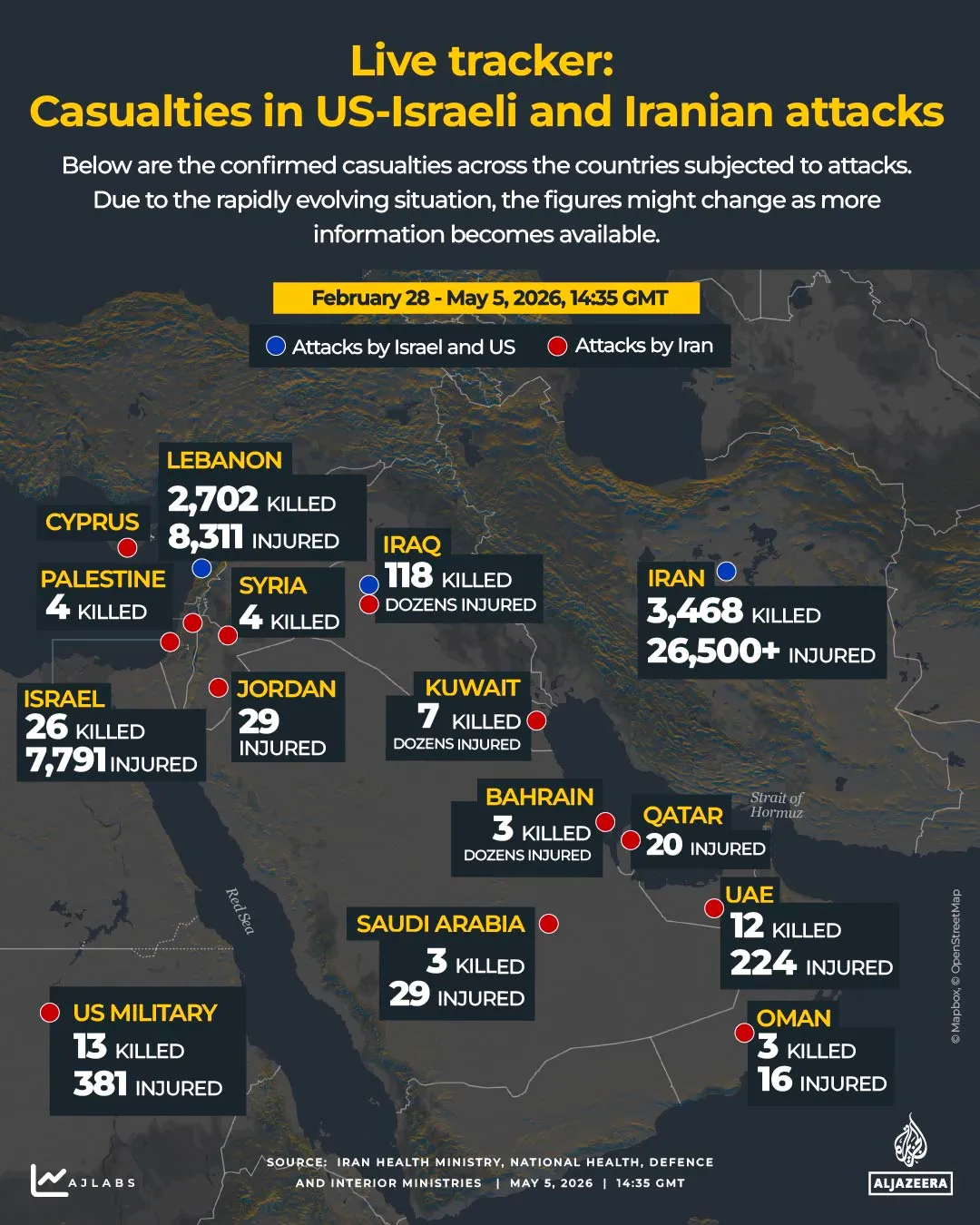
Iranian authorities say that more than 2,000 people have been killed in US-Israeli strikes since the start of the war on February 28, and a large number of residential units, schools, hospitals, and historical sites have been impacted.
US and Israeli warplanes this week also bombed multiple civilian nuclear sites, the country’s top steel manufacturers and their electricity sources, petrochemical plants, and the Iran University of Science and Technology in Tehran, where an imaging satellite had been developed. A professor at the university, who had helped advance Iran’s missile programme, was assassinated along with his two children at their home in northern Tehran last week.
US President Donald Trump again threatened to attack oil and gas installations, destroy power generation plants, and “possibly” obliterate all of Iran’s water desalination plants.
‘Wish they will take to the grave’
The top commanders of Iran’s Islamic Revolutionary Guard Corps (IRGC), currently believed to be running the war and deciding the future of the country, have continued to signal defiance after this week’s attacks.
The spokesman of the Khatam al-Anbiya Central Headquarters of the IRGC said on Tuesday that Tehran’s enemies are “humiliated and on the path of destruction” as the US raises the prospects of launching ground attacks on strategic islands on Iran’s southern shores.
The idea of gaining dominance over the Strait of Hormuz through military attack is a “wish they [the US] will take forever to the grave”, Ebrahim Zolfaghari said in a video message as an Iranian drone attack sparked fire on a Kuwaiti tanker at Dubai Port.
The IRGC also released footage of ballistic missiles fired towards Israel and countries across the region, as well as footage of shooting down what it said were two of the US military’s advanced MQ-9 Reaper drones. It said retaliatory attacks would be launched against technology companies linked to the US and Israel in the region.
State television aired a programme where analysts said they believed a ground military incursion by US soldiers amassing in the region could militarily benefit the Islamic Republic, as they could sustain losses while trying to take over fortified positions held by the IRGC on the islands.
“American vessels are the most vulnerable point of the enemy,” Ali Fadavi, one of the most senior remaining commanders of the IRGC, told state television during an interview broadcast on Tuesday.
He claimed that US warships are generating “fake signals” from their transponders and are actually situated far further from Iranian shores than they show, which the commander said reflected “full preparedness of our forces”.
Ali Akbar Velayati, a former foreign minister and longtime foreign policy adviser to the late Supreme Leader Ayatollah Ali Khamenei, said in a social media post that any ground aggression would escalate the war into an “historical and civilisational defence”, in reference to Israel and US officials branding the conflict a war for civilisation.
Iran announces more executions
Iranian authorities continue to warn through state media that they take any form of local dissent seriously, and are prepared to exact punishments that include execution by hanging.
Two more people were executed on Tuesday morning, the judiciary confirmed, saying they were armed members of the foreign-based Mojahedin-e-Khalq (MEK) group that is considered a “terrorist” outfit by Tehran.
This comes after executions on Monday, as well as others over recent weeks, some of which were also related to Iran’s nationwide protests in January, when thousands were gunned down on the streets of Tehran and cities across the country.
The United Nations and human rights organisations accuse state forces of carrying out an unprecedented crackdown against peaceful protesters, but the authorities blame “terrorists” and “rioters” backed by the US and Israel.
Iran’s judiciary spokesman Alireza Jahangir told state television on Tuesday that new indictments have been issued against 200 “mercenaries” who are accused of assisting the US and Israel, including by recording footage of air strikes and sending them to foreign-based outlets in defiance of the theocratic establishment.
The judiciary reiterated that punishments for national security charges will include full confiscation of assets, as well as execution. A number of local and foreign-based Iranian celebrities and businesspeople have already had their assets seized for opposing the Islamic Republic.
The government of President Masoud Pezeshkian late on Monday held its first cabinet meeting since the start of the war, with an image showing a makeshift space decorated with a blue covering at an undisclosed location serving as the meeting place.
Israel’s Channel 14 alleged in a report that Pezeshkian has been pushing to gain negotiating powers with the US, as Trump claims talks have advanced. But the Israeli outlet said IRGC chief Ahmad Vahidi declined the request and did not want to give concessions to the US and Israel. Iran has not commented on the report.
“Any decision-making about ending the war will be adopted strictly while considering all raised conditions and in the framework of ensuring dignity, security and interests of the great Iranian nation,” Pezeshkian was quoted as saying during the cabinet meeting, in reference to Iran’s demands for guarantees and reparations.
WASHINGTON — President Trump is threatening to deploy ground troops to seize critical oil infrastructure on Iran’s Kharg Island, a military gambit that experts say would risk American lives and could still fail to end the war.
If Trump wants to hobble Iran’s oil industry for leverage in negotiations, a better option might be setting up a blockade at sea against ships that have filled up at Kharg Island’s oil terminals, the experts said.
The island — located on the other side of the Persian Gulf from U.S. bases in Kuwait and Saudi Arabia — is the beating heart of Iran’s oil industry, through which 90% of its exports pass. It is important because Iran’s coastline is mostly too shallow for tanker ships to dock.
“Putting people on the ground might be the most psychologically compelling way of striking a blow at Iran,” said Michael Eisenstadt, a former U.S. military analyst who now directs the Military and Security Studies Program at the Washington Institute for Near East Policy.
“On the other hand, you’re putting your own troops at jeopardy,” said Eisenstadt, a retired Army reserve officer who served in Iraq. “It’s not far from the mainland. So they can potentially rain a lot of destruction on the island, if they’re willing to inflict damage on their own infrastructure.”
Seizing Kharg Island could escalate the conflict, said Danny Citrinowicz, an Iran expert at Israel’s Institute for National Security Studies.
He said Iran and its proxies — including Yemen’s Houthi rebels — could intensify their retaliation, including by laying mines in the Strait of Hormuz or striking targets with drones across the Arabian Peninsula, from the Persian Gulf to the Red Sea.
Commodities researchers and investment banks warn major retaliation could have lasting implications for energy prices and the global economy.
“It will be hard to take. It will be hard to hold,” Citrinowicz said of Kharg Island. “And it might damage the economy, but not in a way that will force the Iranians to capitulate.”
Trump says ‘maybe we take Kharg Island’
Trump is under growing pressure to end the monthlong conflict with Iran, which has attacked U.S. bases and allies in the region.
Iran also has largely closed the Strait of Hormuz, a narrow chokepoint through which 20% of the world’s oil normally flows, causing fuel prices to soar and other economic tumult.
Trump said in a social media post Monday that “great progress is being made” in talks with Iran to end military operations. But he said that if a deal is not reached “shortly” and the strait is not immediately reopened, the U.S. would obliterate power plants, oil wells, Kharg Island and possibly even desalination plants.
Trump has raised the idea of American forces seizing Kharg Island.
“Maybe we take Kharg Island, maybe we don’t. We have a lot of options,” Trump told the Financial Times. “It would also mean we had to be there (on Kharg Island) for a while.”
Asked about Iranian defenses there, he said: “I don’t think they have any defense. We could take it very easily.”
Secretary of State Marco Rubio said Friday that ground troops would not be needed to achieve the Trump administration’s goals. He did not repeat that assertion Monday after being asked about plans for U.S. ground troops, saying “the president has several options at his disposal” but diplomacy is Trump’s preference.
“Now, they are making threats about controlling the Hormuz Strait in perpetuity, creating a tolling system and the like,” Rubio told ABC’s “Good Morning America.” “That’s not going to be allowed to happen. And the president has a number of options available to him, if he so chooses, to prevent that from happening.”
U.S. has hit targets on the island crucial to Iran
The U.S. has already struck various targets on the island, including air defenses, a radar site, the airport and a hovercraft base, according to satellite analysis by the Institute for the Study of War and American Enterprise Institute’s Critical Threats Project.
Petras Katinas, an energy researcher at the Royal United Services Institute, said disrupting Kharg Island would not completely halt oil exports as Iran has other small ports. But it would reduce the oil revenue flowing to Iran’s government, “forcing flows through a much smaller, costlier and less efficient export system,” he said.
However, Tehran has too much at stake to surrender over a single asset, no matter how economically significant, said Citrinowicz, the Iran expert at Israel’s Institute for National Security Studies.
While occupying Kharg might offer Washington some leverage in any negotiations, he said the notion that control of the island could be traded for Iran’s stockpile of enriched uranium was far-fetched.
“It’s in no way a decisive blow,” Citrinowicz said.
U.S. troops face risk from Iran’s mainland if they tried to seize Kharg Island
A U.S. Navy ship carrying about 2,500 Marines recently arrived in the Middle East, while at least 1,000 troops from the 82nd Airborne Division are expected soon. Another 2,500 Marines are being deployed from California. The Trump administration has not said what all those troops will be doing, but the 82nd Airborne is trained to parachute into hostile or contested territory to secure key territory and airfields.
One of the reasons American troops would be vulnerable on Kharg Island is its close proximity — about 33 kilometers (21 miles) — to the Iranian mainland, from which missiles, drones and artillery could be fired. Despite continued U.S. and Israeli strikes, the Islamic Republic is still attacking targets across the region, including a Saudi air base hundreds of miles away where more than two dozen American troops were injured last week.
Even with American ships and planes providing support, there would still be a relatively short window of time to shoot down every drone or missile launched from the mainland at the island, Eisenstadt said.
“The coast tends to be mountainous, so the drones can come in through mountain passes where it’s hard for our radar to pick up,” he said. “And we don’t have the warning time.”
Eisenstadt says a sea blockade against ships carrying Iranian oil would be a safer strategy and achieve the same goal of controlling most of Iran’s oil industry.
“Throw up a quarantine that seeks to seize Iranian oil shipments that are exiting the Gulf,” agreed Clayton Seigle, an energy security expert at the Center for Strategic and International Studies. It could be done at a distance “outside the range of the lion’s share of Iran’s weapon systems.”
Seigle argued against destroying Kharg Island’s oil infrastructure, which Trump also suggested.
“We were supposed to be coming to the rescue of the people that had been rising up and protesting for a better future,” Seigle said. “So to cripple Iran’s revenue-generating potential for many years to come would definitely not work in that direction.”
Finley and Metz write for the Associated Press. Metz reported from Ramallah, West Bank.
Italian press reports that the government has refuse to authorise US to land bombers at a base in Sicily for transit to the Middle East, where they could be used to strike Iran.
In a new report, Doctors Without Borders says sexual violence is the ‘defining feature’ of the conflict in Sudan.
Hanaan was 18 years old when she was raped by members of the Rapid Support Forces (RSF), a paramilitary group accused of committing widespread “war crimes” during nearly three years of fighting against Sudan’s army.
She was walking alongside a female friend to her makeshift home in an encampment for displaced people in South Darfur, when four men on motorbikes stopped them and asked where they were going.
Recommended Stories
list of 3 itemsend of list
“Two took each girl, and they raped us,” she told Doctors Without Borders, an international medical NGO known by its French initials MSF.
“I feel uncomfortable in my body, heavy. I don’t feel pain, apart from in my back – because they beat me, they beat me with their guns on my back,” she said.
Hanaan – not her real name – shared her testimony as part of a report released by MSF on Tuesday, which details the widespread use of sexual violence as a weapon in Sudan’s ongoing brutal civil war.
The NGO said 3,396 survivors of sexual violence sought treatment in MSF-supported health facilities across North and South Darfur between January 2024 and November 2025.
The data, presented in the report titled, There is Something I Want to Tell You…, was drawn from MSF programmes in just two of Sudan’s 18 states and reflects only a fraction of the crisis, while the true scale of the phenomenon remains unknown.
Women and girls accounted for 97 percent of survivors treated in MSF programmes. The RSF and allied militias were found to be primarily responsible for the systematic abuse.
Children among the survivors
“Sexual violence is a defining feature of this conflict – not confined to front lines, but pervasive across communities,” Ruth Kauffman, MSF emergency health manager, said in a statement.
“This war is being fought on the backs and bodies of women and girls. Displacement, collapsing community support systems, lack of access to healthcare and deep-rooted gender inequalities are allowing these abuses to continue across Sudan.”
Following the RSF’s capture of el-Fasher, the capital of North Darfur, on October 26, 2025, MSF treated more than 140 survivors fleeing to Tawila. Among them, 94 percent were attacked by armed men, with many reporting assaults along escape routes.
The assaults “deliberately targeted non-Arab communities as a means of humiliation and terror, echoing previous RSF atrocities such as the dismantling of Zamzam camp”, the report said. The RSF took control of famine-hit Zamzam camp in the western Darfur region after two days of heavy shelling and gunfire in April 2025.
Survivors described attacks not only during fighting, but in everyday settings, such as fields, markets and displacement camps.
Children were also among the survivors. In South Darfur, one in five survivors was under 18, including 41 children younger than five, the organisation said.
MSF called on the United Nations, donors and humanitarian actors to urgently scale up health and protection services in Darfur and all of Sudan, and on all parties to the conflict to cease and prevent sexual violence and hold perpetrators accountable.
The Middle East conflict has cut off 20 percent of the world’s fuel supply. Countries are scrambling for alternatives.
The disruption in the Strait of Hormuz has cut access to one-fifth of the world’s oil and gas supply, leaving many countries scrambling for alternatives.
So what can they rely on to make up for the shortfall in a quick time?
Many Asian countries are turning to coal, reopening shuttered plants and expanding production.
Policymakers say immediate energy needs supplant environmental concerns.
Others are hoping to turn to renewables. Solar power is now the cheapest form of electricity in many parts of the world. But renewables, especially wind, have faced hostility from the Trump administration.
A broker for U.S. Defense Secretary Pete Hegseth sought to make a large investment in major defense firms in the lead-up to the Iran war, according to the Financial Times. The Pentagon has dismissed the report.
US Department of Defense demands retraction of report alleging broker sought multimillion-dollar investment for Hegseth.
Published On 31 Mar 202631 Mar 2026
The United States Department of Defense has demanded the retraction of a newspaper report alleging that a broker for defence chief Pete Hegseth attempted to make a large investment in weapons companies in the run-up to the war on Iran.
Pentagon spokesman Sean Parnell demanded the “immediate” retraction on Monday after The Financial Times reported that a wealth manager for the defence secretary contacted BlackRock about making a multimillion-dollar investment in a defence-related fund in the weeks leading up to the war.
Recommended Stories
list of 4 itemsend of list
Hegseth’s broker at Morgan Stanley ultimately did not go ahead with the investment in the exchange-traded fund, whose holdings include Lockheed Martin and Northrop Grumman, because it was not yet available for purchase at the time, The Financial Times reported, citing three unnamed sources.
“This allegation is entirely false and fabricated. Neither Secretary Hegseth nor any of his representatives approached BlackRock about any such investment,” Parnell said in a post on social media.
“This is yet another baseless, dishonest smear designed to mislead the public.”
Hegseth and his department “remain unwavering in their commitment to the highest standards of ethics and strict adherence to all applicable laws and regulations,” Parnell said.
Al Jazeera could not independently confirm the Financial Times report.
The Defense Department did not immediately respond to a request for comment sent outside of usual business hours.
The Financial Times and Morgan Stanley also did not immediately respond to inquiries.
BlackRock declined to comment.
The report comes amid scrutiny of well-timed trades in financial and prediction markets that have fuelled speculation that figures with insider knowledge may be profiting off of US President Donald Trump’s war plans.
While The Financial Times reported that the attempted investment by Hesgeth’s broker did not go ahead, the defence chief would not have made money on such a purchase in the month since the war began.
While the iShares Defense Industrials Active ETF has risen more than 25 percent over the past year, it has fallen nearly 13 percent since the US and Israel launched strikes on Iran on February 28.
In an exclusive interview with Al Jazeera, US Secretary of State Marco Rubio outlines Washington’s position on Iran, saying US objectives will be achieved ‘within weeks, not months’. Rubio says talks are taking place between parties inside Iran and the United States, mainly through intermediaries, while warning that the Strait of Hormuz ‘will be opened one way or another’ after the military operation ends. He also says Iran must take concrete steps to abandon any ambition to acquire nuclear weapons.