The decision was reported by the Washington Post, The New York Times and Politico, all citing anonymous sources. Overton is an aide at the White House’s Domestic Policy Council and will be tapped to be the next FDA commissioner, sources say.
Overton will replace Marty Makary, who left the position in May, and the Senate will have to confirm her to the position.
The FDA commissioner is one of the most powerful jobs in U.S. health care. The FDA oversees drugs, vaccines, tobacco products, the bulk of the food supply and more. The position has remained open longer than expected as some have turned it down over fears of administration interference, the Post reported.
The position has been run by acting FDA Commissioner Kyle Diamantas, a friend of Donald Trump Jr., and a former partner at the law firm Jones Day.
Overton is board-certified in public health and general preventive medicine and was a general surgery resident at Johns Hopkins Hospital in Baltimore, where she also earned a doctorate in clinical investigation. She worked at the America First Policy Institute, a conservative think tank. She has also written articles calling abortion “corrosive” to women. She called abortion pills “far more dangerous to women” and has called for more controls on the pills.
In September, Secretary of Health and Human Services Robert F. Kennedy Jr. said Overton and Calley Means worked on a Make America Healthy Again strategy report calling for more review of chemicals in food and an increase in oversight over pharmaceutical advertisements, The Times reported.
Makary left the position in May because he disagreed with the administration’s policy of allowing tobacco and e-cigarette companies to sell flavored vapes. The White House had been pressuring Makary to allow the vapes, but he disagreed, citing their appeal to teens and young adults.
The FDA approved mango and blueberry vapes just after Trump had lunch with tobacco executives, The Times reported.
While she is a doctor and has been present for many FDA announcements at the White House, she hasn’t run a large agency before. The FDA has thousands of employees and shapes food safety and pharmaceutical policies.
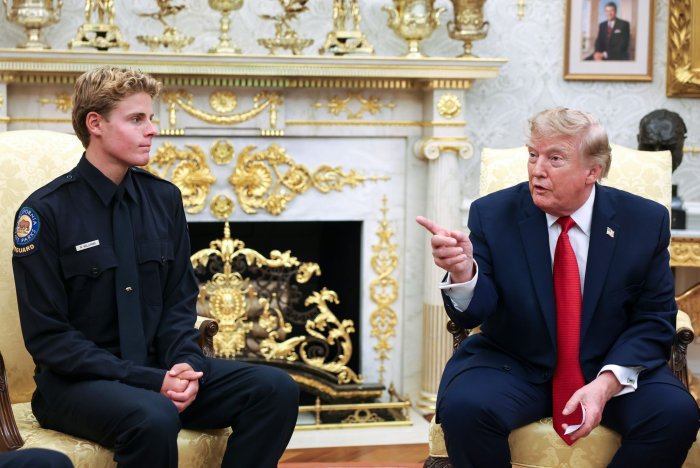
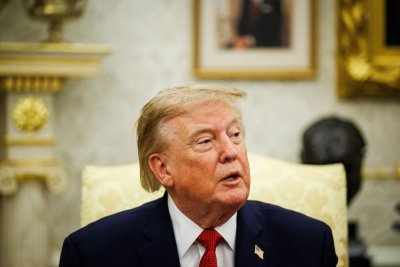
President Donald Trump hosts lifeguard Ryder Williams in the Oval Office of the White House on Monday. Photo by Samuel Corum/UPI | License Photo
Aug. 19 (UPI) — David Morens, a former National Institute of Allergy and Infectious Diseases employee, pleaded guilty to taking part in a scheme to hide federal records during the COVID-19 pandemic.
Morens made his guilty plea on Tuesday in federal court to one count of conspiracy to commit offenses and defraud the United States. The charges stem from his alleged involvement in a scheme to evade Freedom of Information Act requests and the Federal Records Act by hiding federal records.
Morens is one of three people alleged to be part of the scheme. He faces up to five years in prison.
The person referred to as “co-conspirator 1” by the Justice Department was a CEO of a New York-based nonprofit that received the “Understanding the Risk of Bat Coronavirus Emergence” grant in 2014. That grant is a key part of the indictment as its termination precipitated the alleged scheme.
Co-conspirator 1 created a subaward with the grant and awarded it to the Wuhan Institute of Virology in Wuhan China, which has been the subject of theories that the COVID-19 virus leaked from the lab, sparking the pandemic.
The Justice Department said that Morens and two co-conspirators carried out the scheme after one of the co-conspirators’ National Institute of Health grant was terminated. The three people involved planned the scheme to restore the terminated grant.
In his guilty plea, Morens admitted that he hid emails that related to the pandemic in a personal account to avoid them being publicly released, circumventing public records laws. He had previously explained that he did this to stop the spread of misinformation about COVID-19 and to protect Dr. Anthony Fauci from receiving threats.
Fauci has not been accused of any wrongdoing in relation to the case.
Morens served as a senior adviser at NIAID’s Office of the Director between 2006 and 2022. The Justice Department indicted him in April on five counts related to the plan to hide federal records from the public.
President Donald Trump hosts lifeguard Ryder Williams in the Oval Office of the White House on Monday. Photo by Samuel Corum/UPI | License Photo
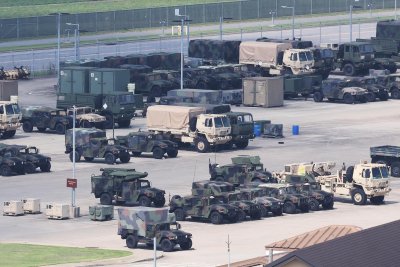
Military vehicles line up at Camp Humphreys, the main U.S. base in Pyeongtaek, on Wednesday as the allies conduct the annual Ulchi Freedom Shield combined exercise. Seoul announced Wednesday the drills would be cut short following orders by U.S. President Donald Trump. Photo by Yonhap
SEOUL, Aug. 19 (UPI) — South Korea and the United States will significantly scale down their ongoing Ulchi Freedom Shield joint military exercise, Seoul’s Joint Chiefs of Staff said Wednesday, cutting it short by almost a week following an order by U.S. President Donald Trump.
“South Korea and the United States have agreed to make partial adjustments to the exercise period and scale at the suggestion of the U.S. side,” the JCS said in a statement.
“First, it was decided to adjust the duration of this UFS exercise to run from the 17th to the 21st,” the statement said. “Second, it was decided to conduct the combined field maneuver training on a reduced scale.”
The allies are discussing specific details of the field training reduction, the JCS added.
Ulchi Freedom Shield began Monday and was originally scheduled to run through Aug. 27.
The move comes after Trump called for the drills to be “substantially reduced” in a Truth Social post Sunday, saying they are expensive and “send a signal that is totally inappropriate and hostile” to North Korea.
South Korean Foreign Minister Cho Hyun said Wednesday morning that Seoul was not given advance notice of Trump’s directive.
“Neither our government nor officials within the U.S. government had any prior knowledge of what President Trump revealed on Truth Social,” Cho said at a parliamentary hearing. “Consequently, we were not notified beforehand.”
In his Sunday post, Trump said Pyongyang “has been unthreatening and respectful” while he has been in the White House.
Speaking to reporters in the Oval Office on Monday, Trump touted his personal relationship with North Korean leader Kim Jong Un, saying Kim had “always treated me with great respect.”
“I understand him. He understands me,” Trump said, adding that Kim had responded to his requests for talks but providing no further details.
The Wall Street Journal, citing U.S. officials, reported Tuesday that Trump is pushing aides to arrange a meeting with Kim as soon as this fall, although no official planning is underway. Trump has privately discussed holding talks during his next trip to Asia, which could come in November when world leaders gather for the Asia-Pacific Economic Cooperation summit in Shenzhen, China.
North Korea, meanwhile, has not publicly responded to Trump’s overture. In a commentary published earlier Wednesday, before Seoul announced the reduction, the state-run Korean Central News Agency criticized Ulchi Freedom Shield as “frantic exercises” pushing the Korean Peninsula to the “threshold of a war.”
The commentary threatened that Pyongyang would continue exercising its “right to self-defence” to counter what it called military threats from the allies.
North Korea frequently condemns U.S.-South Korean military drills as rehearsals for an invasion.
Trump similarly called for suspending or scaling back the exercises in his first term, when he pursued direct diplomacy with Kim that included summits in Singapore and Hanoi and a brief meeting at the DMZ.
After the 2018 Singapore summit, Trump surprised observers by announcing that the United States would halt what he called “provocative” joint military exercises with South Korea. That year’s Ulchi Freedom Guardian exercise was canceled, while several subsequent drills were reduced in scale.
Japan has issued an unusually direct criticism of its U.S. ally after Washington imposed sanctions on International Criminal Court President Tomoko Akane and senior trial lawyer Abdoulaye Seye.
Japan’s foreign ministry described the sanctions as “very unfortunate” and reaffirmed Tokyo’s support for the ICC and its role in prosecuting serious international crimes. The statement marks a rare public disagreement between Tokyo and Washington over an issue of international law.
The dispute comes as the administration of U.S. President Donald Trump intensifies its campaign against the Hague based court. Washington has increasingly challenged the ICC over its investigations and arrest warrants involving Israeli Prime Minister Benjamin Netanyahu and former Israeli Defence Minister Yoav Gallant, as well as its earlier investigation into U.S. personnel in Afghanistan.
Stay ahead of the geopolitical week.
MD Briefing delivers expert analysis across five global fronts — the Indo-Pacific, energy, geoeconomics, European security, and the Middle East — every Monday morning. Free.
For Japan, however, the issue is particularly sensitive. Tokyo depends heavily on the United States for its national defence, yet it has consistently supported the ICC and the broader international legal framework surrounding it.
Why Did the U.S. Sanction ICC Officials?
U.S. Secretary of State Marco Rubio said the sanctions targeted individuals involved in ICC efforts to investigate, arrest, detain or prosecute officials from governments that have not consented to the court’s jurisdiction.
Among those sanctioned was Tomoko Akane, a Japanese judge who serves as ICC president. Abdoulaye Seye, a Senegalese senior trial lawyer, was also targeted. Seye was part of the prosecution team that sought an arrest warrant for Netanyahu and has been nominated for election as an ICC judge.
Washington argues that the ICC has exceeded its authority by pursuing officials from countries that have not accepted its jurisdiction.
The United States is not a member of the ICC and has repeatedly objected to the court’s actions involving American personnel and Israeli officials.
The latest sanctions therefore represent another escalation in Washington’s confrontation with the institution.
Why Is Japan Supporting the ICC?
Japan joined the ICC in 2007 and has consistently supported its role in prosecuting war crimes, genocide and crimes against humanity.
Tokyo’s foreign ministry said Japan remains committed to strengthening the rule of law internationally while maintaining communication with countries involved in the dispute.
Japan’s position reflects its broader commitment to international institutions and rules based governance.
For Tokyo, the ICC is not simply a legal institution. It is part of a wider international order in which disputes and allegations of serious crimes are addressed through established legal mechanisms.
That creates an obvious tension with Washington’s increasingly confrontational approach.
Why Is This Significant for U.S. Japan Relations?
Japan rarely criticises the United States publicly, particularly on issues involving national security.
The two countries maintain a close military alliance, with U.S. forces playing a central role in Japan’s defence and regional deterrence.
Japan’s decision to openly describe the sanctions as “very unfortunate” therefore carries diplomatic significance.
It does not indicate that Tokyo is abandoning Washington or challenging the broader alliance. Instead, it demonstrates that the two countries can maintain close security cooperation while disagreeing sharply over international law.
That distinction is becoming increasingly important as U.S. foreign policy under Trump diverges from the positions of several traditional allies.
The ICC Dispute Is Also Creating Friction in Europe
Japan is not the only U.S. ally to object to the latest sanctions.
The Netherlands, which hosts the ICC, has also criticised Washington’s action. Dutch Foreign Minister Tom Berendsen said the Netherlands opposed the sanctions and invited Akane to discuss continued support for the court.
The development places Washington increasingly at odds with European partners as well as Japan.
The disagreement therefore extends beyond the U.S. relationship with a single international institution. It raises broader questions about how far America’s allies are willing to follow Washington when its policies conflict with international institutions they continue to support.
What Do the Sanctions Actually Do?
The sanctions have significant practical consequences.
They freeze any U.S. assets held by the targeted individuals and largely cut them off from the American financial system. Because most internationally active banks maintain close connections with the U.S. financial system, the effects can extend beyond American jurisdiction.
The U.S. Treasury Department has also authorized a temporary wind down of transactions involving Akane and Seye through September 17.
The measures therefore do more than express political disagreement. They can directly affect the ability of sanctioned individuals to conduct international financial activities.
Washington’s Wider Campaign Against the ICC
The sanctions against Akane and Seye are part of a broader U.S. campaign against the court.
Washington previously imposed sanctions on several ICC prosecutors and judges after the court issued arrest warrants for Netanyahu and Gallant and pursued an earlier investigation involving U.S. troops in Afghanistan.
Rubio has also indicated that the administration intends to intensify efforts against the ICC through diplomatic pressure on other countries.
According to Reuters, Washington has sought to encourage countries to leave the institution, with at least five countries already responding to the call.
The strategy therefore goes beyond individual sanctions. It represents an attempt to challenge the ICC’s legitimacy and reduce its international reach.
Why Does Japan’s Position Matter?
Japan’s response is significant because Tokyo has generally been closely aligned with Washington on major strategic questions.
Japan faces a challenging regional security environment involving China, North Korea and wider tensions in the Indo Pacific. Maintaining a strong U.S. alliance remains central to Japanese security policy.
Yet Tokyo has also invested heavily in supporting international institutions and the rule of law.
The ICC dispute highlights the possibility that these two pillars of Japanese foreign policy can sometimes pull in different directions.
Japan may need American military power for its security while simultaneously disagreeing with Washington on how international law should operate.
That is not necessarily a crisis in the alliance, but it illustrates its increasingly complicated political foundations.
Could the Dispute Deepen Divisions Among U.S. Allies?
The ICC controversy could contribute to a wider pattern of disagreement between Washington and its traditional partners.
The United States is increasingly willing to use economic and diplomatic pressure against international institutions it considers hostile to American interests. Several European governments, by contrast, continue to view those institutions as essential components of the rules based international order.
Japan’s criticism adds an important Asian voice to that disagreement.
If more U.S. allies openly defend the ICC, Washington could face growing diplomatic isolation on the issue even while maintaining strong bilateral security relationships.
That could make the dispute increasingly difficult to contain as a narrow disagreement between the United States and an international court.
How Far Can Japan Disagree With Washington?
Japan’s criticism of the ICC sanctions should not be interpreted as a fundamental rupture in the U.S. Japan alliance.
Tokyo remains heavily dependent on Washington for defence and security, and there is little indication that the ICC dispute will fundamentally alter that relationship.
Its importance lies elsewhere.
Japan is signalling that alliance solidarity does not necessarily require complete alignment on international law.
For Tokyo, supporting the ICC is consistent with a broader foreign policy objective: maintaining an international system governed by rules and institutions rather than purely by the power of individual states.
Washington’s position is increasingly different. The Trump administration views the ICC as a potential threat to American sovereignty and to officials from the United States and allied governments who could face prosecution by the court.
This creates an unusual strategic contradiction.
The United States and Japan remain closely aligned against major security challenges in the Indo Pacific, yet they are increasingly capable of finding themselves on opposite sides of debates over the international legal order.
The consequences could extend beyond the ICC itself.
If Washington continues using sanctions and diplomatic pressure against international institutions while its allies continue defending them, the United States may find that its strategic partnerships remain strong militarily but become more divided politically.
For Japan, the challenge will be maintaining its essential alliance with Washington without abandoning its support for the international legal institutions it considers important.
The ICC dispute therefore reveals a broader tension within the U.S. alliance system: strategic partners may remain united on security while increasingly disagreeing over the rules and institutions that are supposed to govern international politics.
Aug. 19 (UPI) — Federal prosecutors have charged a man from the Bronx with hate crime offenses alleging he assaulted a security guard and a congregant in a racially motivated attack at a Manhattan synagogue last week.
Larry Montes was arrested following the alleged attack at Central Synagogue on Friday and was charged by New York State.
On Tuesday, the Justice Department charged him with two counts of committing hate crimes, each of which carries a maximum penalty of 10 years’ imprisonment, and one count of damage to religious property resulting in bodily injury, which carries a maximum 20 years’ imprisonment.
“These charges serve as notice that the Department of Justice will intervene to protect the public in the face of antisemitic and racially motivated attacks,” Assistant Attorney General Harmeet Dhillon of the Justice Department’s Civil Rights Division said in a statement.
According to the complaint, Montes was allegedly among some 375 people who attended Shabbat service Friday night at the synagogue. During the service, he is alleged to have stood up and begun shouting and then struck two ceremonial silver candlesticks, which were damaged.
As a security guard attempted to remove Montes from the building, Montes allegedly uttered profanities about those in attendance and allegedly punched a woman.
After being handcuffed, he allegedly looked at a Black security guard cursed and called him a racial slur, before spitting on and head-butting the security guard.
During an interview with law enforcement, Montes allegedly issued antisemitic statements.
As of the end of July, there were 360 hate crime incidents committed in New York City, 205 of which were motivated by anti-Jewish bias, according to the city statistics.
Aug. 18 (UPI) — Stocks fell on all three major U.S. indices Tuesday as investors were spooked by elevated bond yields and the prospect of higher oil prices as the war between the United States and Iran drags on without apparent resolution.
Tech stocks led the downturn as the Nasdaq Composite dropped by 1.3%, followed by losses on the S&P 500 (0.6%) and the Dow Jones Industrial Average (0.2%).
Most analysts put the blame for the markets’ poor showing on news that 30-year Treasury yield surpassed 5.3% for the first time since the global financial crisis in 2007, reflecting sagging demand from global buyers willing to underwrite sovereign U.S. debt.
Concerns over rampant government deficit spending and the United States’ burgeoning debt of nearly $40 trillion are pushing treasury yields higher, analysts noted.
The shorter 10-year Treasury, meanwhile, ended above 4.7%, compared to below 4% before the start of the Iran War in February.
Rising “T-bill” yields are considered a danger signal for the broader economy and consumer spending because they can have the knock-on effect of pushing up virtually all borrowing costs, from auto loans to mortgages.
The latter is being reflected in costlier mortgage rates. A 30-year, fixed-rate mortgage on Tuesday stood at 6.75% after ending last week at 6.69%.
Meanwhile, oil prices on Tuesday reached their highest level in more than two weeks after President Donald Trumpthreatened to “bomb” Oman if it interferes with his plans to open the strategic Strait of Hormuz.
The benchmark Brent crude futures traded around $91 per barrel, while U.S. West Texas Intermediate crude futures rose to $84 per barrel.
Aug. 18 (UPI) — President Donald Trump late Tuesday announced a three-day pause on imposing 50% tariffs on Canada less than two hours before they were to go into effect, saying a trade deal has been made.
The tariffs were to go into effect at 12:01 a.m. Wednesday, but were delayed by Trump’s announcement on social media issued about 90 minutes before the deadline.
No specifics on what the deal entailed were offered, though Trump said the controversial Keystone XL Pipeline project, revoked by former President Joe Biden over climate change concerns, “may be awoke from the grave!”
The deal remains to be finalized, he said.
While congratulating Trump, U.S. Trade Representative Jamieson Greer added that the deal includes “comprehensive access for all American goods,” economic security commitments, digital trade alignment and other provisions protecting the U.S. market.
Prime Minister Mark Carney of Canada has yet to comment.
Greer had been leading negotiations with Canadian representatives ahead of the deadline. He said last week that the negotiators were reviewing options and that he expects Canada to drop certain measures it had already taken in response to the U.S. tariffs, The New York Times reported.
“If a country retaliates against us, we’re obviously not going to tolerate that,” Greer told reporters Friday. “We’ll take action. My sense is the Canadians want to have a more conciliatory approach, but we’ll see.”
Trump signed orders in July to impose 50% tariffs on $20 billion worth of Canadian goods, including cement and hockey sticks, representing about 2% of the entire trade between the United States and Canada, starting Wednesday.
“President Trump is taking action to hold Canada accountable for its continued discrimination against and unreasonable and unequal treatment of U.S. commerce that has burdened and disadvantaged hard-working Americans,” the White House said in a statement at the time.
“Canada’s nasty. They are. They’re nasty,” Trump said. “I love the people, but they’re nasty. Nasty leadership.”
Canadian Prime Minister Mark Carney and Trump spoke on the phone Monday, a Carney spokeswoman said. She didn’t give any details.
Canadian negotiators also want to ease the tariffs already imposed on Ottawa industries. There are tariffs of up to 50% on steel, aluminum and autos. Some tariffs also affect Canadian softwood lumber.
Canadian lumber manufacturing CEO John Brink told CTV that tariffs have devastated the lumber industry. He said, “most of the lumber industry in Canada is paying up to 45.16% in tariffs and duties combined. So the effect has been devastating.”
Brink said about half of British Columbia’s lumber manufacturing capacity has shut down.
“There used to be 800 secondary manufacturers in British Columbia alone. We are now down to about 50. Not all due to tariffs and duties, but due to a combination of [factors],” Brink added.
“I think the big question for the United States is: Are they even interested in securing an agreement, a deal, some kind of operational détente, or is Trump’s real objective just to flex? Is it just to demonstrate he’s in control? In which case, we’re chasing a phantom deal,” CTV News political commentator Scott Reid said.
He added that the deadline will be “the most important, most significant and most treacherous of Mark Carney’s political career.”
Greer has said he expects Canada to make concessions if a deal goes through. But not everyone in the Great White North wants that.
“Canadians elected Mark Carney to both stand up to Trump while also trying to negotiate a deal, or negotiate down the tariffs, and I don’t think those are mutually exclusive, but it is a narrow path for sure,” said Brian Clow, a former senior official in Prime Minister Justin Trudeau‘s government, The Times reported.
If no deal is made, expect the trade war to escalate, Clow said.
“If the U.S. decides to proceed with imposing these new tariffs tomorrow, Canada, although this current government has eased back on retaliation, will have to respond in some way,” he said.
Former senior White House trade adviser Kelly Ann Shaw told CTV that negotiations look “promising” for Canada.
“I’ve been involved in a number of international trade negotiations and other negotiations throughout my career, and the hardest issues always get resolved at the very last moment,” Shaw told CTV Tuesday.
“So I don’t expect any sort of announcement until later today, possibly as late as midnight,” Shaw said. “But the fact the two parties are still at the table, I take as a good sign.”
Trump has long used tariffs as a mechanism for both punishment and negotiation, and during his second term, he attempted to impose sweeping tariffs, including against Canada, but they were thrown out by the U.S. Supreme Court in February.
The tariffs paused late Tuesday were to join the 10% import duty on many Canadian goods, as well as previously imposed tariffs ranging from 10% to 50% on products, such as steel, aluminum, copper, automobiles and softwood lumber.
Canada responded by imposing a temporary 25% tariff on certain wood cabinets and vanities, as well as a 25% tariff on U.S. vehicles, as well as selected steel and aluminum products, among others.
President Donald Trump hosts lifeguard Ryder Williams in the Oval Office of the White House on Monday. Photo by Samuel Corum/UPI | License Photo
Aug. 18 (UPI) — The United States on Tuesday sanctioned two senior officials of the International Criminal Court, as the Trump administration cracks down on the global tribunal it calls a threat to U.S. sovereignty.
Secretary of State Marco Rubio and the rest of the Trump administration has aggressively targeted the court over arrest warrants it issued in November 2024 for Prime Minister Benjamin Netanyahu of Israel and his former defense minister, Yoav Gallant, on allegations of war crimes committed during the war in Gaza.
Though not a member of the court, the United States has rejected the warrants, even under the former Biden administration, and has been critical of its jurisdiction over U.S. citizens and potential for politicization. Under the administration of President Donald Trump, Washington has used its powers to target the court with punitive measures.
On Tuesday, Rubio unveiled sanctions against ICC President Tomoko Akane and ICC Senior Trial Lawyer Abdoulaye Seye on accusations that they were “directly engaged in efforts by the ICC to investigate, arrest, detain or prosecute officials whose government has not consented to ICC jurisdiction.”
“The ICC has repeatedly attempted to assert authority over nationals of the United States and other countries that have not consented to its jurisdiction or ratified the Rome Statute,” he said in a statement, referring to the international treaty that established the court in 2002 to try individuals accused of genocide, war crimes, crimes against humanity and the crime of aggression.
“This sets a dangerous precedent.”
UPI has contacted the Hague-based court for comment.
The sanctions, which freeze all property of those designated, come under an authority given to the secretary of state by an executive order Trump signed in the presence of Netanyahu at the White House in February 2025, during his third week back in office.
Last month, Rubio announced the launch of a whole-of-government campaign to dismantle the threat the Trump administration alleges it poises to the United States. Along with increased sanctions and visa revocations of ICC personnel, the campaign includes encouraging other countries to exit the court and increased scrutiny of countries that receive U.S. assistance but do not criticize the ICC, as well as nations under the so-called U.S. security umbrella are also being urged to reject the ICC’s authority to prosecute U.S. officials and service members.
“The ICC has become a kangaroo court that cloaks its abuse of power in language of international law while undermining the very principles of justice,” said Netanyahu, whom the ICC has accused of using starvation as a weapon of war and crimes against humanity, including murder and persecution.
“I commend Secretary of State Marco Rubio for leading the Trump administration’s determined efforts against the ICC’s illegitimate overreach, and for making clear that the corrupt officials who lead the ICC will face consequences,” he added in the statement.
The court described Trump’s executive order in February as an unprecedented attack that undermines its ability to administer justice and a threat to international law that protects millions of victims.
Following the announcement Tuesday, the Netherlands came to the court’s defense while international human rights organizations chastised the United States.
“International courts and tribunals must be able to freely carry out their mandates,” Foreign Affairs Minister Tom Berendsen of the Kingdom of the Netherlands, said in a statement, saying he has invited Akane to discuss the country’s support.
“We fully support the court and its staff,” he said.
Margaret Satterthwaite, the United Nations special rapporteur on the independence of judges and lawyers, said she was “alarmed” by the sanctions being imposed on judicial operators for doing their jobs.
“Sanctioning independent judges and lawyers for their work to end impunity and ensure justice for the most grave crimes is a shocking betrayal of the Nuremberg promise and a violation of the human rights guarantee of fair trial and access to justice,” she said in a statement.
Erika Guevara Rosas, senior director for research, advocacy, policy and campaigns at Amnesty International, rebuked the punitive action as a “reprehensible assault” on the international justice system that was part of an intimidation campaign meant to obstruct its work.
“These sanctions are not about sovereignty. They are about shielding powerful actors from accountability and punishing those tasked with investigating and prosecuting the gravest crimes under international law,” she said.
Kenneth Roth, senior fellow at Yale University and former executive director of Human Rights Watch, said in a statement that Trump was sanctioning the court “so that American and Israeli officials can commit war crimes (and worse) with impunity.”
“No one should accept this utter lawlessness,” he said.
Last week, HRW and three other human rights groups sued the Trump administration over sanctioning judges and prosecutors of the ICC.
President Donald Trump hosts lifeguard Ryder Williams in the Oval Office of the White House on Monday. Photo by Samuel Corum/UPI | License Photo
Aug. 18 (UPI) — Medical experts and a family member testified in a Massachusetts courtroom Tuesday that Lindsay Clancy’s mental health was so precarious that she cannot be held responsible for the strangulation deaths of her three children.
A trio of doctors and Clancy’s former mother-in-law, Susan Clancy, each testified in her defense as her attorneys sought to show the 36-year-old defendant is not guilty of murdering her children — 5-year-old Cora, 3-year-old Dawson and 8-month-old Callan — at their Duxbury, Mass., home on Jan. 24, 2023 due to mental illness.
While not denying she killed the children, they contend she is not criminally responsible because she was suffering from bipolar disorder and postpartum psychosis.
The Plymouth County, Mass., District Attorney’s Office, however, argues that Clancy was not experiencing psychosis when she strangled the children and jumped from a window, suffering permanent paralysis from the waist down.
After the prosecution rested its case last week, the defense continued with its own case.
Among the medical experts taking the stand Tuesday was Dr. Paul Zeizel, a clinical and forensic psychologist who testified about meeting with Clancy at the hospital after the killings.
After testifying that Clancy told him she had “fuzzy” memories of the killings, he said she told him she heard a man’s demanding she kill the children and then herself.
Zeizel forcefully suggestions of having “planted” that story with Clancy.
Also testifying for the defense was another medical expert, former medical examiner Dr. Elizabeth Laposata, who spoke about the injuries Clancy suffered in her suicide attempt in an apparent effort to counter prosecutors’ suggestions that she had not jumped out a window.
Another medical witness, Dr. Donald Condie, testified that Clancy exhibited symptoms consistent with postpartum depression, such as brain fog and anxiety.
The day’s testimony also included emotional words from Susan Clancy, the mother of Patrick Clancy, who said the couple had a “very good relationship,” WBTS-TV reported.
“She was very nurturing, very loving, she was a wonderful mother. Wonderful,” she said of Lindsay. “She loved her children, all of them, very, very much.”
A former nurse, Susan Clancy she said she noticed a change in Lindsay’s personality after the birth of Callan, the youngest child.
“She reached out to me in November and told me that she felt unwell,” she said. “Mostly, she had insomnia, she was losing her appetite, she was very anxious and sad.”
Weekly insights and analysis on the latest developments in military technology, strategy, and foreign policy.
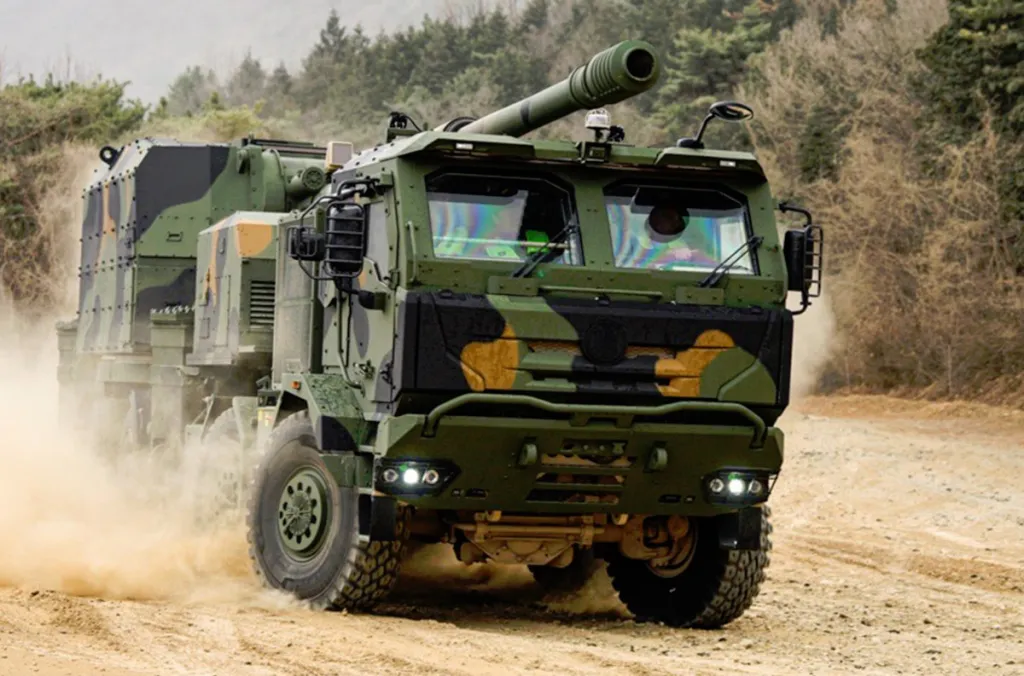
The U.S. Army has chosen Hanwha Defense USA to advance to the next phase of its Mobile Tactical Cannon (MTC) program. The company will now provide prototypes of its wheeled 155mm K9 Mobile Howitzer for further testing. This, in turn, could lead to its adoption as a replacement for the Army’s existing towed 155mm M777 howitzers.
“The U.S. Army announced today an agreement with Hanwha Defense USA, Arlington, Virginia, for the development of prototypes for the Mobile Tactical Cannon program, a critical priority in the Army’s ongoing continuous transformation and long-range fires modernization efforts,” according to a press release the service put out this evening. “Awarded competitively under an Other Transaction Authority (10 U.S.C. Section 4022), the firm-fixed-price agreement will provide the Army with up to 18 wheeled Self-Propelled Howitzer Systems for rapid prototyping, testing, and Soldier experimentation over an estimated four-year period of performance. The amount of this action is $100,302,961 with a total cumulative face value of $262,903,274.”
A stock picture of Hanwha’s wheeled 155mm K9 Mobile Howitzer. Hanwha
OTAs are a contracting mechanism that U.S. government agencies regularly use to help accelerate advanced research and development and prototype efforts.
The Army’s release does not explicitly mention the K9 Mobile Howitzer (K9MH), also known as the K9A2. However, Hanwha Defense USA has confirmed that this is the design it will be supplying in its own press release. The company had also announced this would be its entry for the MTC competition back in March. American Rheinmetall, BAE Systems, General Dynamics Land Systems, and Elbit Systems USA had also been in the running.
“The agreement provides for the accelerated delivery of six prototype MTC systems, with an option for an additional 12. Soldiers will use these platforms in a series of operational experiments to assess performance, reliability, and supportability in realistic combat conditions,” the release adds. “This Soldier-centric, experiment-driven approach reflects the Army’s continuous transformation initiative to rapidly deliver lethal capabilities, incorporate immediate Soldier feedback, and adapt the force to pace emerging threats in multi-domain operations.”
The K9MH was developed from Hanwha’s earlier tracked K9 design, variants and derivatives of which are already in service in South Korea, as well as Australia, Egypt, Estonia, Finland, India, Norway, Poland, and Turkey. Both the tracked and wheeled designs share the same 52-caliber 155mm cannon. Caliber here is a measurement of length in relation to the diameter of the barrel. A 52-caliber 155mm barrel is just under 26 and a half feet long. The M777’s barrel is 39 calibers long, or just around 16.7 feet.
K9 and K10 prove compatibility with US munitions during a live-fire demonstration at YPG
In general, longer barrels on howitzers translate to greater range. Hanwha says the maximum range of the K9MH is just over 37 miles (60 kilometers), though it is unclear if this is only when using rocket-assisted or other specialized ammunition. The stated maximum range of the M777, even when using specialized rounds, is just under 20 miles.
As a self-propelled howitzer, the 8×8 K9MH also offers the benefit of integrated mobility over the towed M777, which requires a separate vehicle to move it from point A to point B. “Its emplacement/displacement times of under 30 seconds enables ‘shoot and scoot’ tactics,” according to Hanwha’s website.
The K9MH can also carry 40 rounds of ammunition onboard, as well as be rapidly reloaded in the field via a companion K10 resupply vehicle.
“We’re focused on creating a U.S.-anchored K9 Mobile Howitzer manufacturing network – with Opelika, Alabama, as the current phase I launch point – that can deliver advanced Mobile Tactical Cannons at the speed and scale the U.S. Army needs,” Jason Pak, Hanwha Defense USA Head of Land Systems-Artillery, also said in a statement.
“Hanwha’s global supply chain and local production experience in Australia, Egypt, Poland and Romania demonstrate a proven commitment to local execution we’re excited to bring to the U.S.,” Michael Coulter, Hanwha Defense USA CEO, said in his own statement. “Localization is central to Hanwha’s global business model, leveraging our global leading industrial technology and process in Korea to create sovereign industrial strength in the U.S., whether it be in shipbuilding, munitions or combat vehicles.”
The Army has been actively exploring the idea of replacing the M777 with a new wheeled self-propelled howitzer since at least 2019, and has even conducted shoot-offs of various designs in the past. The service has also made clear that its selection of Hanwha Defense USA to advance in the MTC effort does not guarantee that it will field the K9MH.
US Army soldiers train with an M777 towed howitzer. US Army
“Data and insights gained from these experiments will directly inform senior leaders’ decisions on future fielding. If approved for fielding, MTC will replace M777 towed artillery systems in select formations, significantly increasing their lethality, mobility, reliability, and survivability on the modern, highly transparent battlefield,” per the Army’s release today. “By rapidly prototyping these systems, the Army is advancing a more mobile and adaptable fires formation aligned with the rigorous demands of large-scale combat operations.”
The release does not elaborate on what “select formations” might be in line to eventually receive K9MHs. However, a past MTC contracting notice says the initial focus is on replacing M777s within Brigade Combat Teams equipped with Stryker wheeled light armored vehicles. Airborne, airmobile, and ‘leg’ infantry brigades also have M777s that could be supplanted by new wheeled self-propelled howitzers.
The possibility of the Army replacing at least a portion of its existing M109-series tracked self-propelled 155mm howitzers has also been raised in the past. However, the service’s press release today makes clear that the focus of the MTC program right now is still on replacing towed M777s. There is a long-standing debate about the relative pros and cons of wheeled versus tracked self-propelled howitzers, with the U.S. Army long having favored the latter. Tracked designs typically offer greater off-road mobility and are often more heavily armored. They are also generally heavier overall, which can negatively impact mobility and transportability more broadly, and can be more costly to acquire and operate.
A current-generation version of the M109 in US Army service. US Army
“If you look at the [fight] in Ukraine on either side, it’s really hard to move out and get fires ready to go. … The Paladin [the name applied to the latest A6 and A7 variants of the M109] is just incapable of it at speed,” Secretary of the Army Dan Driscoll told members of the House Appropriations Committee at a hearing earlier this year. “And so while we think the Paladin will be in our lives for a while, because we want to be good custodians of the assets the American taxpayer has given us, we think that new purchases to balance that platform out should be something different.”
At that time, Driscoll was defending his service’s omission of funding for any more M109A7s in its Fiscal Year 2027 budget proposal.
It is worth noting here that both sides in the ongoing conflict in Ukraine have and continue to employ tracked and wheeled self-propelled howitzers, as well as towed types. The war has underscored the continued importance of artillery, in general. At the same time, mobility, and greater speed while on the move, are ever more important considerations in an era of drone warfare and expanded kill chains that put anything that stays in one place too long at higher risk
MTC is part of a larger Self-Propelled Howitzer-Modernization (SPH-M) effort that could also include the separate acquisition of a new tracked self-propelled howitzer. There have been several abortive Army attempts to replace the venerable M109 family since the 1990s. This includes the advanced XM2001 Crusader, which was canceled in 2002 ostensibly due to growing costs. The service axed the more recent XM1299, developed under its Extended Range Cannon Artillery (ECRA) program in 2024. The XM1299 featured a 58-caliber cannon and had a demonstrated range of 40 miles (just over 60 kilometers). The Army has previously said that the length of the barrel presented technical challenges that contributed to the program’s cancellation.
XM2001 Crusader Howitzer Prototype
A prototype the US Army had used in the development of the XM1299. US Army
Today’s announcement is also another important win for South Korea’s defense industry, which has made major export gains globally in recent years. Poland, in particular, has become a huge customer for South Korean arms exports, including versions of the K9. Further progress in the U.S. Army’s MTC program could offer a major inroad into the American market for Hanwha.
With today’s announcement, the Army has taken an important new step toward adding a new wheeled 155mm self-propelled howitzer to its arsenal.
Aug. 18 (UPI) — A group of university organizations and labor unions filed a federal lawsuit Tuesday challenging a new government rule that limits the time international students can spend in the United States.
The U.S. Department of Homeland Security announced the final rule last month, ending the previous “duration of status” policy for international students.
Under that rule, the United States admitted students with F-1 and J-1 visas for the duration of their status: That is, they entered to pursue a course of study and remained until they earned their chosen degree or degrees.
Students needed to maintain a required course load and comply with the general conditions of their immigration status. There are about 1.5 million students with F-1 and J-1 visas in the United States.
Under the changed policy, international students are capped at four-year stays unless they undergo a federal review to be considered for an extension. Such reviews are to include submitting biometric information and undergoing security, identity and fraud screening.
In announcing the final rule, Homeland Security Secretary Markwayne Mullin said the duration of status policy “undermined national security” and that the new rule restores the U.S. ability to “properly screen and manage those who remain in our country.”
The group filing the lawsuit Tuesday asked for a preliminary injunction stopping the new rule before it is implemented. The Presidents’ Alliance on Higher Education and Immigration (one of the parties to the lawsuit) said the Department of Homeland Security did not adequately justify or assess the rule, address public comments on it or consider better alternatives.
“These changes will create significant uncertainty and administrative burdens for international students and exchange visitors and the institutions that support them,” the Alliance said in a statement. “They will also interfere with academic decision-making, disrupt students’ educational and professional plans and undermine the ability of U.S. colleges and universities to attract and retain global talent.”
Randi Weingarten, president of the American Federation of Teachers, also a party to the lawsuit, said the new rule shows that the United States is “once again breaking the law for its own political purposes and, in doing so, is hurting Americans and American enterprise.”
“And it’s using international students — who we’ve welcomed here to help us — as its pawns,” Weingarten said. “American is a leader in cutting-edge research because generations of scientists from every corner of the globe have been free to pursue difficult questions, challenge conventional wisdom, collaborate openly and publish their findings — without political interference.”
The new rule also requires journalists with I visas to renew their status every 240 days. Jon Schleuss — the president of the NewsGuild-CWA, also a party to the lawsuit — said those visas support the important work of international journalists in the United States.
“Our First Amendment makes it clear that the United States is supposed to be a champion of a free press, not an opponent,” Schleuss said. “These rule changes are just another attempt by this administration to chill reporting done by talented journalists.”
President Donald Trump hosts lifeguard Ryder Williams in the Oval Office of the White House on Monday. Photo by Samuel Corum/UPI | License Photo
Aug. 18 (UPI) — Two counties and two cities are suing the Trump administration over conditioning national security funding on local governments adopting sweeping election procedures, calling the requirement illegal federal overreach.
The Brennan Center for Justice filed the lawsuit Monday in the U.S. District Court for the District of Columbia on behalf of Nashville and Davidson County, Tenn., Harris and El Paso counties, Texas, and Columbus, asking it to declare the decision to impose election administration conditions on grants unlawful and enjoin its enforcement.
“This is the kind of federal overreach we’ve come to expect from the Trump administration,” Harris County Attorney Abbie Kamin said in a statement emailed to UPI. “To threaten law enforcement and public safety funding our agencies rely on, to withhold dollars that protect our communities for a partisan power grab is not only improper, it’s dangerous.”
Since returning to office, President Donald Trump has taken a series of actions he says are to improve election integrity and security but that Democrats and civil rights advocates have described as efforts to interfere with and undermine U.S. elections.
In June, the Federal Emergency Management Agency, under the Department of Homeland Security, updated compliance requirements for Homeland Security Grant Program funds, which are to help local governments prevent terrorism. Conditions added include creating a plan for transitioning to hand-marked paper ballots, conducting a 5% post-election manual audit and citizenship verification for all poll workers and registered voters, among others.
FEMA said it will withhold 20% of the recipient’s total HSGP funding until receipt of proof of compliance with the new requirements.
The jurisdictions suing the administration described the withholding of funds as FEMA holding their money “hostage” and its new election-related conditions “arbitrary and capricious.”
“Never before has FEMA purported to regulate how states and counties run elections,” they said in the lawsuit, stating that such a change would require congressional authorization, which FEMA does not have.
“The power to administer elections belongs to the states, subject only to conditions imposed by Congress — not the president, not the secretary of Homeland Security and not FEMA.”
The plaintiffs state that FEMA has not provided a “reasoned explanation” for the change in funding administration while ignoring the legal, financial and logistical “chaos” the new conditions will cause with midterm elections less than two months away and the potential harm withholding anti-terrorism funds could cause.
“Holding cities hostage by threatening anti-terrorism funding if they don’t go along with the president’s absurd election manipulation is as dangerous as it is illegal,” Columbus City Attorney Zach Klein said in a statement.
“We’re fighting back to protect public safety and election integrity. We will not be bullied by this president and his administration.”
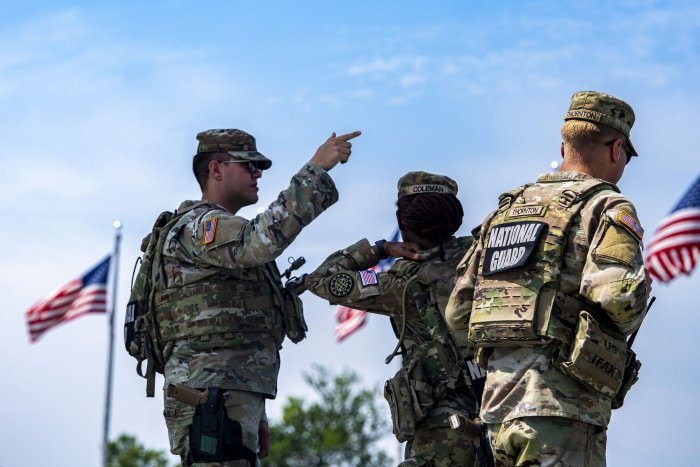
Members of the National Guard patrol near the Washington Monument on Tuesday. Photo by Bonnie Cash/UPI | License Photo
SEOUL, Aug. 18 (UPI) — U.S. President Donald Trump said Monday that North Korean leader Kim Jong Un has responded to his overtures for talks, one day after he ordered a sweeping reduction in U.S.-South Korea joint military exercises, citing his “very good relationship” with Kim.
Trump made the remarks during a press availability in the Oval Office, fueling speculation that his directive could be aimed at reopening dialogue with Pyongyang.
Asked why Kim had not responded to his requests for a conversation, Trump replied, “How do you know he hasn’t responded?”
“He has,” Trump said when pressed. He declined to elaborate, saying only that developments were “very positive.”
Trump went on to tout his personal relationship with Kim, saying the North Korean leader had “always treated me with great respect.”
“I understand him. He understands me,” Trump said. “He didn’t like Biden. He didn’t like Obama. He didn’t like anybody, but I get along with him very well.”
In a Truth Social post on Sunday, Trump said the allies’ Ulchi Freedom Shield drills, which began Monday, are expensive and “send a signal that is totally inappropriate and hostile” to North Korea. He said Pyongyang “has been unthreatening and respectful” while he has been in the White House.
Trump also noted that South Korea declined his request to help with the denuclearization of Iran.
“Therefore, and based on the fact that it is too late to cancel, I have instructed Secretary of War, Pete Hegseth, to substantially reduce the Joint Military Exercises!” he wrote.
In a text message to reporters on Monday, an official with Seoul’s Joint Chiefs of Staff said the Ulchi Freedom Shield drills had started as scheduled.
“The UFS exercise is proceeding as planned,” the official said.
Later in the day, the presidential Blue House released a statement saying that Seoul was “paying close attention” to Trump’s comments, adding that it hoped friendly relations between Washington and Pyongyang would lead to meaningful peace talks between the two countries.
“To this end, we will exert necessary diplomatic efforts as a pacemaker under close cooperation with the United States,” the statement said.
The Blue House added that it has actively participated in international discussions for a cease-fire in Iran and freedom of passage in the Strait of Hormuz and is “closely discussing practical and military contribution measures with the U.S. side.”
As of Tuesday, it was not clear what aspects of the exercise would be reduced under Trump’s order. In a statement reported by news agency Yonhap, the Pentagon said it “is actively working on executing the Commander-in-Chief’s directive.”
The order drew criticism from Democrats in Congress, who warned that reducing the exercises could undermine military readiness and weaken confidence in U.S. security commitments.
“When President Trump cuts military exercises to flatter a dictator or punishes South Korea for declining to join a war he started, all of our allies — and adversaries — think that America’s commitments are negotiable,” Sen. Jack Reed, the ranking member of the Senate Armed Services Committee, said in a statement. “Kim Jong Un has won a propaganda victory and South Korea, one of our strongest allies, has been punished for no reason beyond Trump’s ego.”
Peter Lee, a research fellow at the Seoul-based Asan Institute for Policy Studies, said Trump’s order reflects his transactional approach to the alliance and longstanding skepticism about the costs of U.S. military commitments in South Korea.
“This latest directive should also be seen as a reminder that President Trump still has many cards he can play to pressure South Korea,” Lee told UPI. “The task for the Lee administration is therefore how to reduce this ‘unfaithful ally’ narrative that President Trump periodically returns to and instead lean into the ‘model ally’ framing that others such as [Defense] Secretary Hegseth have touted.”
Victor Cha, Korea chair at the Center for Strategic and International Studies, said Trump’s move went beyond his repeated public overtures to Kim and appeared aimed at drawing the North Korean leader back to the negotiating table.
“This is really the first concrete action he’s taken to try to entice Kim, and he’s used the timing of these exercises as the way to do it,” Cha said during a CSIS discussion Monday.
Pyongyang has not yet publicly responded to Trump’s announcement, and Cha said he did not expect an immediate reaction.
“I’m sure it’s a message that’s been heard … but I don’t think the North Koreans are going to respond right away,” he said. “I think they’re going to bide their time and wait a little bit.”
Trump similarly called for suspending or scaling back the exercises since his first term, when he pursued direct diplomacy with Kim that included summits in Singapore and Hanoi and a brief meeting at the DMZ.
After the Singapore summit in 2018, Trump surprised observers by announcing that the United States would halt what he called “provocative” joint military exercises with South Korea. That year’s Ulchi Freedom Guardian exercise was canceled, while several subsequent drills were reduced in scale.
In his White House press availability, Trump denied that he was prioritizing North Korea over Washington’s allies in South Korea.
“I’m actually making it much safer,” he said in response to a question.
Trump also elaborated on his request for South Korea’s assistance with the war in Iran, saying he raised the issue in a recent call with President Lee Jae Myung.
“I said, ‘Would you like to give us a little hand? We don’t need help with Iran, but if you’d like, give us a hand with Iran.’ He said, ‘No thanks,'” Trump said.
Trump said he viewed Seoul’s refusal as a matter of “fairness,” citing the cost of maintaining U.S. forces in South Korea and his longstanding push for Seoul to shoulder more of the expense.
“We have 39,000 soldiers over there guarding you from Kim Jong Un, your next-door neighbor, and you are not going to help us on a very easy military operation in Iran,” he said.
The United States has roughly 28,500 troops stationed in South Korea.
Later Monday, Trump posted a meme of Kim on his Truth Social account. The image showed the North Korean leader surrounded by military officials and speaking into a telephone, with the caption: “Hey Donald, we cool … right?”
Aug. 18 (UPI) — The Pentagon has directed 30 U.S. academic institutions to immediately and comprehensively review their collaborations for ties to “foreign entities of concern” under threat of losing future federal research funding.
The Department of Defense announced the directive Monday, giving the unidentified institutions until Aug. 31 to report their findings in order to maintain eligibility for federal grants.
“Universities are critical partners in executing a wide range of Department of War research programs, and the Department must therefore ensure that our research investments are well protected from foreign exploitation,” Joseph Jewell, assistant secretary of Defense for Science and Technology, said in a statement, referring to the Defense Department by its secondary title authorized by President Donald Trump last year. Its statutory name remains the Department of Defense.
The audits are part of a broader effort to protect Defense Department research from foreign adversaries and follow legislation Congress passed in December 2024 as part of the fiscal 2025 National Defense Authorization Act requiring annual reviews of research grants for compliance with Pentagon research-security policies.
The institutions are to review academic, financial and research ties with entities identified under Section 1286 of the fiscal year 2019 NDAA, as well as those associated with rebranded Confucius Institutes.
The list includes 130 academic and research institutions located in China, Russia and Iran. The list was updated last month.
The Pentagon said the audits are to protect U.S. taxpayer-funded research from getting into the hands of adversarial nations as well as from unauthorized transfer and intellectual property theft. It added that the audits will also aid the Department of Defense in better anticipating emerging threats and adapting to evolving adversarial tactics.
The Department of Defense “has zero tolerance for academic partnerships that compromise our national security,” Emil Michael, under secretary of Defense for Research and Engineering, said in a statement.
The institutions are also being directed to implement mitigation plans that include terminating what the Pentagon called “problematic partnerships.”
Members of the National Guard patrol near the Washington Monument on Tuesday. Photo by Bonnie Cash/UPI | License Photo
Weekly insights and analysis on the latest developments in military technology, strategy, and foreign policy.
President Donald Trump doubled down on Monday about one of his reasons for ordering the Pentagon to “substantially reduce” joint military training exercises with South Korea. Trump said he is upset Seoul would not assist his war against Iran after years of U.S. protection from North Korea. This all started a day earlier in a Truth Social post where he said his close relationship with North Korean dictator Kim Jong Un and concerns about the cost of military exercises were motivating factors for his decision.
“South Korea has been protected by us for many, many years, and during my first term, they agreed to pay close to $3 billion a year for protection because they essentially weren’t paying,” Trump explained at an afternoon press conference. “And I asked them to do that at my request. They weren’t happy about it, but they agreed. I asked for $10 billion and they were very unhappy, but we agreed for a short term that it would be $3 billion, and next year would go up, and the next year would go up. So they start paying for their protection.”
That stopped when Joe Biden became president, Trump complained.
“When I called recently, the president of South Korea, who I like, I think he’s very nice actually. But I called him. I said, ‘Would you like to give us a little hand? We don’t need help with Iran, but if you’d like, give us a hand with Iran.’ He said, ‘No thanks.’ And I said, ‘Wait a minute. We have 39,000 soldiers over there guarding you from Kim Jong Un, your next-door neighbor, and you’re not going to help us on a very easy military operation in Iran. That’s strange.’”
Trump claimed South Korean President Lee Jae-Myung said, “No, no, we’d rather not get involved.”
“I said, ‘well, why are we involved in helping you?’” the American leader proclaimed.
Trump blasts South Korea:
I called the president of South Korea. I said, “Would you help with Iran? If you would like, we don’t need help.” He said, “No thanks.”
I said, “What do you mean? We have 39,000 soldiers over there guarding you from Kim Jong Un, and you are not going… pic.twitter.com/xD1dZ1AANQ
Monday afternoon, the Pentagon said it “is actively working on executing the Commander-in-Chief’s directive”regarding the annual Ulchi Freedom Shield military exercise in South Korea. It already began on Monday as scheduled. When asked by TWZ for details about the timeline or how much U.S. support for the exercise will be reduced, the Pentagon declined comment.
South Korea’s presidential Blue House said it was reviewing Trump’s comments, adding that it would continue working with the U.S. on details related to the drills and the “maintenance of firm combined defense posture,” CNN noted.
There are about 28,500 U.S. troops on the peninsula and many have already begun preparation for the exercise, according to U.S. Forces Korea (USFK). While the U.S. has typically provided few details about how many of its troops take part in Ulchi Freedom Shield, there will be about 18,000 South Korean forces involved, which mirrors last year’s levels.
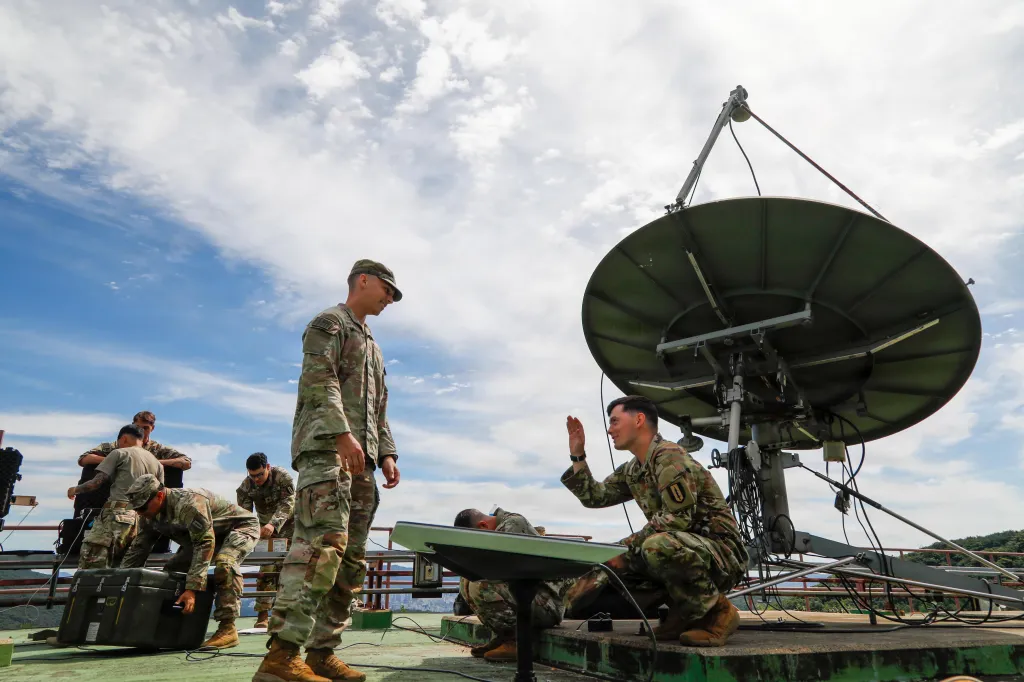
Soldiers assigned to the 304th Expeditionary Signal Battalion-Enhanced install and inspect communications equipment in support of Ulchi Freedom Shield at CP Tango, Aug. 11, 2026. (U.S. Army photo by Cpl. Shin Haegyeom) Pfc. Haegyeom Shin
Scheduled to run through Aug. 27, Ulchi Freedom Shield is “a defense-oriented exercise featuring live-fire, constructive, and field training exercises that engage alliance forces and governmental agencies,” according to U.S. Forces Korea. This year’s drills were designed to reflect evolving threats from North Korea including drones, GPS disruption and cyberattack.
The goal is to “build understanding between Combined Forces Command, United States Forces Korea, the United Nations Command, and ROK Joint Chiefs of Staff (JCS), ROK government agencies.”
U.S. Army inspector general assigned to the 19th Expeditionary Sustainment Command reviews a High Mobility Multipurpose Wheeled Vehicle (HMMWV) with Soldiers during a pre-convoy operations inspection at Camp Henry ahead of Ulchi Freedom Shield 2026. (U.S. Army photo by Cpl. Ji Won Park) Kailil Kendrick
The exercise traditionally integrates ground, air, naval, space, cyber and information elements. It focuses on a wide range of training for urban warfare, counter Weapons of Mass Destruction, wet-gap crossing, air defense mobilization, tactical aviation dogfighting, contested logistics and combat search and rescue among many other aspects.
“This combined exercise program highlights the ironclad commitment between the two nations to maintain a robust combined defense posture and to defend the people of the ROK from any threat,” USFK said about last year’s exercise.
Republic of Korea soldiers assigned to the 312th Wet Gap Battalion, ROK 7th Engineer Brigade, cross the bridge with armored vehicles during combined wet gap crossing training as part of Ulchi Freedom Shield near Yeoju, South Korea, Aug. 27, 2025. (U.S. Army photo by Kpfc. Choi Yoonhyeok). Spc. Cheyenne Mayer
As noted earlier in this story, Trump said he ordered the rollback in U.S. participation in joint exercises on the peninsula as a result of his bonds with North Korea’s leader and concerns about cost involved. He also said South Korea’s decision not to provide more support for the war against Iran was a factor.
“Based on my very good relationship with Kim Jong Un, of North Korea, I am not happy with the fact that the United States has, long ago, agreed to participate in Joint Military Exercises with South Korea,” Trump stated on Truth Social. “These exercises are not only costly, with much of these costs paid for by the United States of America (as usual!), but send a signal that is totally inappropriate and hostile, to a Country that, as long as Donald J. Trump has been President, has been unthreatening and respectful. Therefore, and based on the fact that it is too late to cancel, I have instructed Secretary of War, Pete Hegseth, to substantially reduce the Joint Military Exercises!”
In addition, Trump proclaimed that: “While somewhat unrelated (?), I recently asked the President of South Korea if they would like to join us in the Denuclearization of the Islamic Republic of Iran, and they said, ‘No thanks!’”
Trump’s Truth Social post came days after North Korea fired a ballistic missile toward the sea off the Korean peninsula’s east coast as a message of protest against the looming training exercise. As we have noted in the past, joint exercises like these are typically met by missile tests and other saber-rattling from north of the border, although Ulchi Freedom Shield is a regular summer occurrence, albeit one that focuses closely on North Korean threats.
Last week, the South Korean military “fired warning shots after a group of North Korean soldiers crossed the inter-Korean land boundary, prompting them to return to their side,” the Yonhap News Agency reported on Sunday. “It marked the South Korean military’s first warning shots this year in response to North Korean troops crossing the boundary. No prior MDL violations by the North Korean military had been reported this year.”
Trump’s Truth Social post hit just as South Koreans – 13 hours ahead of Eastern Time – were starting their work week. In-Bum Chun, a retired South Korean lieutenant general who ran that nation’s special operations forces and is now a military analyst, told TWZ that Ulchi Freedom Shield is a “very” important event for South Korea. He suggested there will be mixed reactions to Trump’s move in the country, with people on the left favoring the move, people on the right seeing it as “a good reason for nuclear weapons” and moderates not taking a stand either way.
With plans to build its own nuclear-powered submarines with ballistic missile capabilities, Seoul is at least keeping its nuclear options open, which you can read more about here.
Meanwhile, South Korea’s president has proposed officially ending the conflict with the North. The Korean War, which erupted in 1950, has been effectively frozen since an armistice was signed in 1953.
South Korean protesters hold placards as they attend a rally to oppose the joint military exercise between South Korea and the U.S. named Ulchi Freedom Shield (UFS), in front of the U.S. embassy in Seoul on August 17, 2026. (Photo by Jung Yeon-je / AFP) JUNG YEON-JE
The president’s move toward a détente with the North is a repeat of previous actions toward Pyongyang. During his first term in 2018, Trump promised Kim that he would halt U.S.-South Korea military exercises, saying they are “provocative” and “tremendously expensive.”
Given the ongoing presence in the Middle East, the U.S. military is under strain, which is likely an unspoken motivating factor as well for the move to curtail training with South Korea.
There is growing concern among Asian allies about Trump’s commitment to the region. In January, the National Defense Strategy was unveiled and no longer focused primarily on countering China — a dramatic shift from even the first Trump administration. Last week, Trump ordered the USS George Washington, the only aircraft left in the western Pacific, to head toward the Middle East to relieve the beleaguered USS Abraham Lincoln. The Lincoln is at the center of a controversy over the mental and physical health conditions of those aboard after a long deployment.
USS George Washington (CVN 73) Nimitz-class aircraft carrier, USS Robert Smalls (CG 62) Ticonderoga-class guided missile cruiser and USS Shoup (DDG 86) Arleigh Burke-class Flight IIA guided missile destroyer westbound in the Singapore Strait – August 13, 2026 SRC: INST- dc_ah pic.twitter.com/kZWHc9QISt
The two countries’ “exposure to a nuclear-armed North Korea, adds urgency to moving the relationship beyond its current surface-level fence-mending,” the East Asia Forum recently noted.
Meanwhile, in an issue that has spanned several U.S. administrations, there is a large backlog in the amount of U.S. military aid promised to Taiwan. Under the Trump administration, however, there is growing distrust in Taiwan about whether America will come to its aid should China invade.
It is unclear why Trump is once again making overtures to Kim. Today at the White House, he said that the North Korean leader has responded to his request for a conversation, though he offered no further details.
During his first term, Trump sent three aircraft carriers to patrol the waters off the peninsula after a 2017 Pyongyang ballistic missile test and promised to unleash “the fire and fury” of America’s nuclear arsenal on North Korea. While that eventually spurred three face-to-face meetings between Trump and Kim, there was no change in the North Korean leader’s ambitions and his nuclear program only grew.
Aug. 17 (UPI) — The U.S. House Ethics Committee announced Monday that it is investigating Rep. Jimmy Gomez over allegations of sexual misconduct, the latest House member to come under an ethics probe.
The release from the bipartisan committee did not detail the allegations, only stating it was investigating the California Democrat for possibly having “engaged in sexual misconduct in violation of the Code of Official Conduct or any other applicable standard of conduct, including engaging in inappropriate sexual contact with a House staffer.”
The committee noted that while it has made its investigation public that does not mean an ethics violation has been committed.
The announcement comes months after the New York Post reported in April that Gomez kissed a congressional aide to another House Democrat at a backyard party hosted by former Rep. Eric Swalwell in the summer of 2023. The report stated the aide was two decades younger than Gomez, who is now 51, but was 48 the summer of the alleged kiss.
The Monday announcement confirms an early June CNN report that the ethics committee was investigating Gomez over allegations of sexual misconduct.
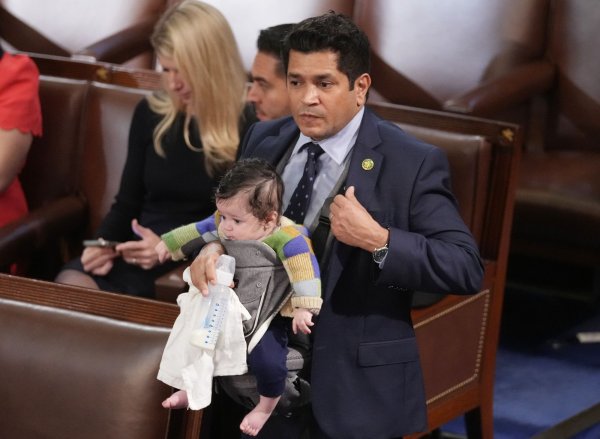
Gomez is married to Mary Hodge and together they have one son. In January 2023, Gomez and his son made headlines as the new father brought his infant son to the House, wearing him on the chamber floor in a baby carrier.
Rep. Jimmy Gomez, D-CA, carries his infant son Hodge on the chamber floor of the House at the U.S. Capitol in Washington, D.C., on Thursday, January 5, 2023. File Photo by Pat Benic/UPI
Following the June CNN report, Gomez released a statement acknowledging that he made mistakes in his marriage but that he violated no House ethics rules, while stating he would cooperate with its investigation.
Gomez on Monday issued a very similar statement to Courthouse News in response to the committee’s announcement, stating, “Although my actions were consensual in nature and haven’t violated the law or House Ethics rules, that doesn’t diminish the impact that these mistakes have made on those I care about most.”
“I have and continue to sincerely apologize to my family, friends and the people that II have the privilege to serve,” he said.
“I am deeply sorry to my wife for the pain and embarrassment that I have brought into our lives.”
The investigation into Gomez is the latest probe involving House members of both parties that the ethics panel has launched this summer.
Earlier this month, the panel made public an investigation into allegations of domestic violence and illegal drug use by Rep. Max Miller, R-Ohio. It also completed its investigation of Rep. Chuck Edwards, R-N.C., finding substantial reason to believe he violated House rules concerning sexual harassment and creating a hostile workplace and recommended that he be censured. Edwards has since announced he is dropping his re-election campaign.
In April, both Swalwell, D-Calif., and Tony Gonzales, R-Texas, resigned amid House Ethics investigations into alleged sexual misconduct. The Swalwell probe included allegations involving an employee, while the Gonzales probe was looking into allegations involving a congressional employee and alleged special favors.
Members of the National Guard patrol near the Washington Monument on Tuesday. Photo by Bonnie Cash/UPI | License Photo
Aug. 17 (UPI) — An American Airlines jet blew two tires while landing at Chicago O’Hare International Airport on Monday afternoon, according to federal investigators.
Passengers deplaned from the Boeing 737-800, which had departed from New York City’s LaGuardia Airport, via stairs and were bused to the terminal, according to the FAA, which said it was investigating.
American Airlines said in a statement the flight experienced “a tire issue” after landing, resulting in first responders meeting the aircraft “out of an abundance of caution” and in accordance to procedures.
“The aircraft has been taken out of service to be inspected by our maintainance team,” American Airlines said.
“We apologize to our customers for their experience.”
An image made with a drone shows an Amazon Web Services data center in Ashburn, Va., on Sept. 23, 2025. File Photo by Jim Scalzo/EPA
Aug. 17 (UPI) — Nvidia announced on Monday that it will finance an OpenAI data center in Ohio for up to $105 billion.
The credit from Nvidia will fund the data center’s first 4.25 gigawatts in computing capacity with an option to bring 3.75 gigawatts more online. The center is slated to begin operating in Pike City, Ohio, in 2028.
The data center will be located at the PORTS-Pike Technology Campus in Pike City. It will be constructed and managed by SB Energy, a subsidiary of SoftBank Group.
Nvidia is also providing the compute power to the data center.
“This is the essential economic point: the [Load Power Supply] commitment secures a long-lived AI factory site, while the NVIDIA compute inside can be upgraded repeatedly,” NVIDIA said in a press release. “Each new generation can deliver greater production, more intelligence and better economics.”
SB Energy and SoftBank agree to build enough power supply for 10 gigawatts of energy and invest at least $4.2 billion into the regional power grid infrastructure. Nvidia has also agreed to invest $1.5 billion into SB Energy.
OpenAI said the data center will support 35,000 construction jobs through 2032. It will also support 2,500 long-term jobs.
OpenAI will pay the least on the data center as its tenant, Nvidia said.
Members of the National Guard patrol near the Washington Monument on Tuesday. Photo by Bonnie Cash/UPI | License Photo
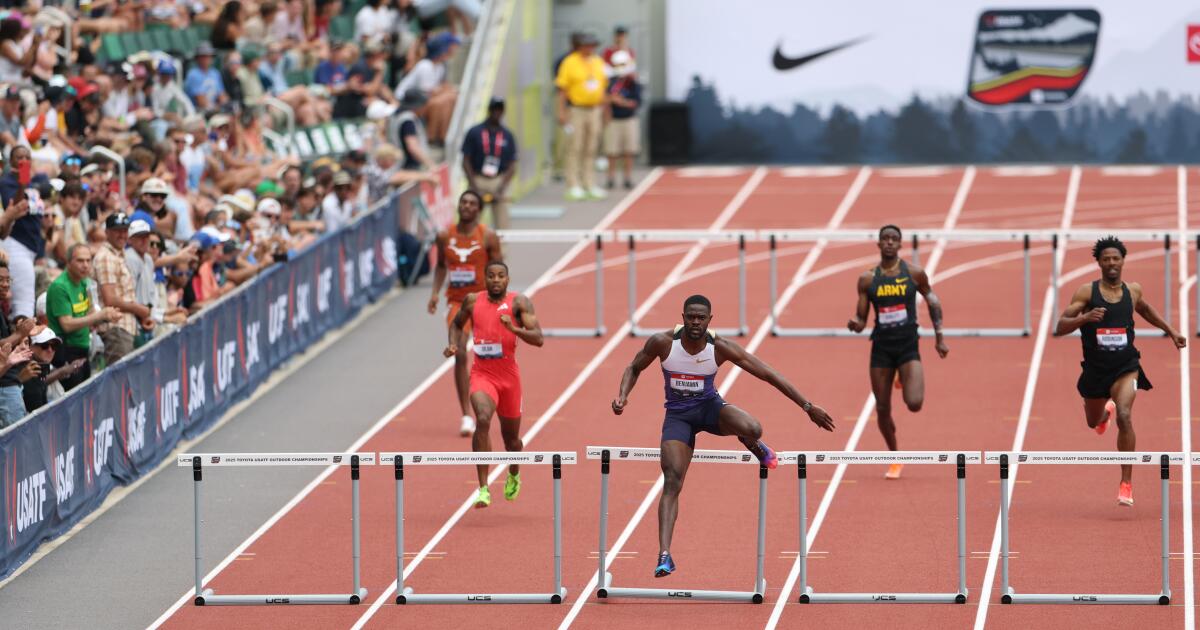
The U.S. track and field Olympic trials will return to Eugene, Ore., leaving Los Angeles on the sideline weeks before it hosts the 2028 Summer Games.
The trials, set for June 17-22, 2028, will be the sixth straight held at Hayward Field on the University of Oregon campus, which has adopted the nickname “TrackTown USA.” It has proven over decades to be America’s only consistently viable host for big-time track events.
The six-day schedule will be different from past trials, which usually spanned two weekends, with a couple of off days in the middle. Those six days will not include selection for the decathlon, heptathlon or the 10,000 meters, all of which will be held earlier in the spring — at locations still to be determined — to allow for additional recovery.
The Olympics begin July 14, with the track meet starting the next day; this marks the first time track will cover the opening days of the Games since 1968.
Some athletes complain about the cost of traveling to and staying in a metro area of around 400,000, but USA Track and Field Chief Executive Max Siegel said Eugene’s “record of success in selecting America’s best track and field athletes speaks for itself.”
He said U.S. athletes have won 52 gold medals in athletics since 2008, when Eugene’s streak of hosting trials began.
The decision to keep the string going comes as something of a surprise, however. There was a thought that the Coliseum, which will host the Olympic track meet, would make for a perfect host for the trials, though there were problems involved with holding two major events in such a short period.
Other L.A. venues include UCLA’s Drake Stadium, which is serving as an Olympic training site; and what was known as the Mt. SAC Stadium in nearby Walnut. That stadium was awarded the 2020 trials, but they were moved to Eugene after problems arose over renovations of the venue. Those trials were ultimately held in 2021 at Hayward.
Hayward Field also hosted world championships in 2022 and the U.S. track nationals 10 times, including last year, and will do so again in 2027.
Tropical Storm Lala moved westward and farther away from Hawaii on Wednesday after delivering torrential rainfall and flooding to the islands. Photo courtesy of NOAA
Aug. 17 (UPI) — As of Monday, Lala has moved away from Hawaii, but the hurricane — a tropical storm as of Sunday — left widespread damage in its wake.
The storm brought intense rain and high winds to the islands, although it didn’t make landfall. By Monday, it was moving to the west, getting stronger and expected to become a hurricane again at sea. Behind it, Hawaii’s residents began to clean up the damage — and a lot of mud.
The flooding swept about 100 homes off their foundations on Hawaii’s Big Island. Gov. Josh Green said that no one was believed to have died in those incidents. A car crash Sunday that killed one person is no longer considered to be related to Lala, CNN reported.
“Everyone is safe and healthy,” Green said, CBS News reported. “But, boy, a lot of work ahead.”
Tens of thousands of people were without power Monday. The heavy rainfall set off landslides that also wiped out roads. Kimo Alameda, mayor of Hawaii County, said power restoration in some areas could take days or longer and that six bridges were at least partially destroyed.
In a social media post Monday, Alameda said that the Department of Water Supply is asking all Hawaii (Big) Island customers to limit water use to essential purposes only.
All state and county offices, schools and courts were closed Monday.
Five places on the islands received 35 inches or more of rain, and Kapalua in Maui County received 48 inches.
The National Hurricane Center said Monday that Lala is moving west and expected to turn toward the west-northwest and northwest on Wednesday and Thursday. Its maximum sustained winds are now about 65 mph. It could become a hurricane again by Tuesday.
“Large waves generated by Lala will continue to trend down from east to west across the Hawaiian waters, but life-threatening surf and rip current conditions will persist today,” the NHC said.
Aug. 17 (UPI) — A group of Texas families are asking the U.S. Supreme Court to hear a challenge to a state law that requires public schools to post a version of the Ten Commandments in a visible spot in every classroom.
The more-than-two-dozen families of various religious faiths and none are appealing a lower court’s decision in April to uphold Senate Bill 10. The families are from 22 school districts throughout the state and are represented by the American Civil Liberties Union, the ACLU of Texas, Americans United for Separation of Church and State and the Freedom from Religion Foundation.
“Texas politicians shouldn’t have a seat at the table in deciding how our children receive their religious education,” said plaintiffs Rebekah and Ted Lowe of Austin, who are raising their children in Christian and Jewish religious traditions. “This law puts one version of religious beliefs above all other in our public schools and sends a message to our children that what we teach them about religion at home is somehow wrong.”
“I’m not only worried about my own kids, but I’m deeply concerned about all the children in my congregation,” said plaintiff Rabbi Joshua Fixler of Houston. “These displays put children in the position of having to defend themselves and their families’ religious beliefs against a government mandate that makes them feel different and separate from their classmates.”
In April, the Fifth Circuit Court of Appeals ruled that the law does not violate the First Amendment’s establishment clause — which prevents the government from establishing a religion — or free exercise clause — which forbids government from prohibiting “free exercise” of religion.
“This is a major victory for Texas and our moral values,” said Ken Paxton, Texas’s Republican attorney general, after the ruling. “The Ten Commandments have had a profound impact on our nation, and it’s important that students learn from them every single day.”
However, in its release on the request Monday, the ACLU noted that a Supreme Court case in 1980 — Stone vs. Graham — already dealt with the matter of the Ten Commandments in public schools. In that case, the high court found that a Kentucky law requiring the Ten Commandments to be posted in every public-school classroom was unconstitutional and violated the establishment clause.
In the filing Monday, the lawyers for the families involved said the court should again reject the idea of government-imposed religion.
“If the permanent, unavoidable imposition of biblical scripture in public-school classrooms does not interfere with, or threaten to undermine, parents’ ability to direct their children’s religious education and ot instill particular religious beliefs and practices, it is difficult to imagine what would,” the filing said.
Aug. 17 (UPI) — The percentage of U.S. adults who say they’ve taken part in any form of gambling over the past year has dropped from 64% in 2016 to 45% in 2026, a new Gallup poll released Monday said.
In almost every category in the poll, the percentage of people saying they’d taken part in a gambling activity dropped, with the three greatest drops coming among those who said they’ve purchased a state lottery ticket (49% to 31%), gambled in person at a casino (26% to 14%) or participated in an office pool on a sports event (15% to 7%).
“These lower reported gambling rates coincide with a decline in the percentage of Americans who say that gambling is ‘morally acceptable,’ from 67% in 2016 to a new low of 57% earlier this year,” Gallup said.
The poll found that reports of gambling were down among all major subgroups of Americans. About 54% of upper-income Americans (those with an annual household income of $100,000 or more) said they gambled, compared to 45% of middle-income Americans (annual household income of $50,000 to $99,999) and 40% of lower-income adults (annual household income of less than $50,000).
About 49% of men said they gambled, compared to 40% of women. About 50% of older people (50 and older) said they gambled, compared to 41% of younger adults. Women ages 18 to 49 were the least likely group to say they gambled, about 35%.
In the history of the poll, first conducted on this subject in 1989, people have always been most likely to say they’ve participated in state lotteries, Gallup said. For the first 10 years, majorities said they’d played a state lottery. Percentages then fell to the high-40% range before the current lowpoint.
The peak in those reporting they’d gambled at a casino was in 2003, with 30% of people saying they’d done so. Gallup said the decline in in-person gambling might be due to the rise of online gambling. While only 4% said they’ve done so, it was the only category without a percentage decline.
Gallup also said that reported gambling rates are higher in online surveys than in this recent poll, which was conducted by telephone interviews with live interviewers. A parallel web survey by Gallup in June showed greater amounts of those saying they’d gambled in the past year across all 13 categories and a 53% overall percentage.
Gallup surveyed 2,201 adults between June 1-July 19 with a 3% margin of error.