Aug. 24 (UPI) — The U.S. State Department officially delisted Syria as a state sponsor of terrorism on Monday, marking a significant step toward the country’s reintegration into the global economy and the international community.
The announcement by Secretary of State Marco Rubio comes about a month and a half after President Donald Trump informed Congress of his intent to lift Syria’s decades-old terrorism designation that barred it from most U.S. foreign assistance and clamped down on what could be exported to it. It also meant the United States would oppose foreign institutions, such as the World Bank, granting it loans.
Along with the delisting of Syria, Rubio said he also removed Hay’at Tahrir al-Sham, the coalition of northern Syria-based Sunni Islamist groups that led the military campaign that toppled Syrian President Bashar Al-Assad in late 2024, from its list of specially designated global terrorists.
“These actions were all taken in recognition of the positive actions taken and further commitments by the Syrian government under President Ahmed al-Sharaa to fully distance Syria from acts of international terrorism,” Rubio said in a statement, listing as reasons Damascus’ joining the Global Coalition to Defeat the Islamic State and conducting terrorism-disrupting operations targeting ISIS and Iran-backed Hezbollah.
Rubio said removing the designations “eliminates the final major barrier for private sector investment in Syria and promotes economic recovery and reintegration into the global economy.”
Al-Sharaa issued a statement congratulating the Syrian people on their country’s removal from the U.S. state sponsors of terrorism list.
“Today, Syria is casting off a black mark from its shoulders, and with its own hands, tearing out a page from its painful past, so that it may set out toward development, reconstruction and building,” he said in a recorded statement.
“Great people of Syria, you have done it again. The sanctions have been lifted from you and the restrictions have been removed. I ask almighty God to help us serve you.”
Syria was among the first countries designated by the United States as a state sponsor of terrorism in 1979 over its hostility to Israel, fighting with Lebanon, partnership with Iran, alignment with Russia, support for terrorist groups and development of weapons of mass destruction, according to a Congressional Research Service report.
Since the fall of al-Assad in late 2024, Syria’s relations with the United States — and much of the Western world — have steadily improved. In June, Trump signed an executive order ending most U.S. sanctions on Damascus and informed Congress in July of his intent to delist it as a state sponsor of terrorism, starting the 45-day congressional notification clock before it could be formally removed.
“Lifting Syria’s designation as a state sponsor of terrorism is a historic step that returns it to its natural place within the global economic system,” Safwat Raslan, the governor of the Central Bank of Syria, said in a statement Monday.
“And we at the Central Bank of Syria are working to build a modern and reliable financial system, capable of keeping pace with and benefiting from all opportunities. And what is to come is better, God willing.”
WASHINGTON — The Trump administration is preparing to revoke the business and tourism visas of up to 200,000 foreigners who have applied for or are currently seeking asylum status in the United States. If it happens, the move would be the largest single mass revocation of visas in U.S. history and would likely face legal challenges.
Unless challenged or revised, the State Department is expected to announce in the coming weeks the revocation of so-called B1 and B2 visas issued between 2016 and 2026 whose holders have sought asylum or are now seeking asylum, according to State Department documents obtained by The Associated Press and two U.S. officials. The action will be taken in coordination with the Department of Homeland Security.
“We are coordinating with DHS to identify and revoke the nonimmigrant visas of foreigners who have come to the United States claiming to be short-term visitors, but then file for asylum to stay here permanently,” said State Department spokesman Tommy Pigott.
He declined to comment on the number of visas that might be revoked, saying “as the process will be ongoing, the number of revocations remains dynamic and will be done on a rolling basis.”
The revocations would not necessarily result in their immediate deportation, the officials said. Most of those with asylum cases currently pending would be recategorized but would lose their status as business or tourism travelers, according to the officials, who spoke on condition of anonymity because the revocations are not final yet.
Since President Donald Trump took office for his second term last year, his administration has steadily ramped up restrictions on visa applicants — demanding more information about their social media histories, requiring the posting of expensive bonds for the processing of visas, and outright banning the issuance of visas to citizens of certain countries.
In a social media post on Monday, Deputy Secretary of State Christopher Landau called out people who he said try to use tourist and business visas to get into the United States and then apply for asylum.
“People in the US and all over the world are fed up with bogus asylum claims,” Landau wrote on X. “Asylum isn’t supposed to be a loophole to circumvent immigration law.” Landau cited the case of a Colombian citizen who came to the U.S. in 2015 on a tourist visa and then applied for asylum.
B1 visas are generally issued for business trips and B2 visas are generally issued for tourism, family visits or medical care. It was not immediately clear from the documents or the officials how many of these visa holders are seeking or have sought asylum in the United States and would be affected by the revocations.
Current applicants for B1 and B2 visas are asked to affirm that they will not apply for asylum in the United States and prove that they intend to return to their home countries.
In the past 18 months, the State Department has revoked about 175,000 visas for people who have been convicted or accused of crimes ranging from drunken driving to rape and robbery, as well as for people who have spoken out publicly against U.S. policies, particularly in the Middle East.
The administration has also moved to crack down on so-called birth tourism, a practice the administration claims is used by foreign pregnant women to come to the United States to give birth so that their child will benefit from birthright citizenship. Trump has tried several times to end birthright citizenship, but those challenges have been rejected by courts, including the Supreme Court.
The State Department documents obtained by the AP suggest screening of current B1 and B2 visa holders began after the State Department received information about asylum requests from the Citizen and Immigration Service.
Prices for U.S. ethanol blending credits plunged Monday to their lowest levels in more than four months, Reuters reported, after the Environmental Protection Agency extended a September 1 compliance deadline for refiners and ruled on long-pending small refinery exemption requests by
Aug. 24 (UPI) — The U.S. Supreme Court on Monday ruled that President Donald Trump can begin implementing measures from an executive order intended to restrict mail-in voting in many states and Washington, D.C.
However, legal challenges to that order could still cause issues for that plan before the midterm elections in November.
The ruling Monday means that the Department of Homeland Security can begin moving forward with compiling state-specific lists of people it believes are eligible to vote in the states — all led by Democrats – that had challenged the executive order.
Another part of the executive order required the U.S. Postal Service to require states that want to send ballots through the mail to submit lists of eligible voters with information allowing those ballots to be tracked by the government. A lower court had blocked that policy nationwide in a separate case, meaning that more legal action will be needed before the postal service can continue.
The high court’s ruling did not address the overall legality of the executive order.
“If the Postal Service’s final rule harms the states, theymay challenge that rule,” the ruling said.
The postal service entered an unpublished version of that final rule into the Federal Register late Friday despite the court injunctions against it.
Trump has repeatedly and without evidence claimed that mail-in voting is “inherently corrupt” and full of fraud, although voting experts have criticized the order and say such fraud is exceedingly rare. The president himself has voted by mail as recently as this year, NPR reported.
In a dissent, Jackson said the ruling “needlessly injects chaos and uncertainty into the upcoming midterm elections,” CNN reported.
She noted that, in the past, the Supreme Court has turned away challenges to election law because they were too close to elections. “Today’s revelation is that such claims can also come too early — never mind that an election is looming and related harms are presently occurring.”
WASHINGTON — The United States unveiled plans Monday for new sanctions against Iran that Trump administration officials said are designed to sever Tehran from the global financial system as the nearly six-month conflict between the two countries drags on.
Treasury Secretary Scott Bessent, who previewed the announcement last week as “economic D-Day,” described the measures as the opening of an all-out financial assault on the Iranian government and its trade partners — a group that includes China, India, Turkey and the United Arab Emirates.
“To those who enable Tehran, do not discount the cost of testing Washington’s resolve,” Bessent said at a news conference. “No nation should expect to enjoy the rewards of our system while helping those who seek to destroy it.”
Bessent said it was time for world leaders to “make a decision” between “America and Iran,” adding that President Trump has already been calling foreign leaders to make specific requests ahead of the new sanctions.
But when asked whom the president had been talking to, Bessent said he would not “name names.” He also said the secondary measure would not take effect immediately, arguing that the administration is trying to give “everyone the opportunity to remedy bad behavior.”
“Why would I want to blow up the global financial system?” Bessent said when a reporter pressed him on why the sanctions weren’t immediate. “We believe that it is important to level set and give people a cure period, but they should know that that will move very quickly and that we are serious.”
The pressure campaign will build on a naval blockade and other sanctions the Trump administration has already imposed in its effort to force Tehran into a deal that ends the war on U.S. terms.
Trump’s latest economic push against Iran revives a familiar strategy from presidents of both parties, using financial leverage to pressure Tehran toward more serious negotiations over its nuclear program. Sanctions helped bring Iran to the table before a 2015 nuclear deal brokered by President Obama, but the agreement was widely criticized as weak by Republicans. After Trump withdrew from the agreement in his first term, a new “maximum pressure” campaign failed to secure a new deal.
Trump’s decision to return to a strategy of economic coercion has signaled to Iran that the fighting phase of the war is probably over, for now, with the U.S. administration choosing a path “neither of war nor of peace,” Masoud Pezeshkian, Iran’s president, said this week.
Iranian officials, who had been anticipating the move, pushed back on Washington’s strategy even before Bessent began speaking Monday.
Foreign Minister Abbas Araghchi told Iranian state media over the weekend that the sanctions amounted to a repackaged version of decades-old American pressure tactics that Tehran has already learned to withstand. Esmail Baghaei, Iran’s foreign ministry spokesman, warned of “grave consequences” for any countries cooperating with what he said was “illegal behavior” by the United States. And Mohsen Rezaei, the secretary of Iran’s Supreme Security Council, suggested that the economic pressure could shut down oil exports through the Strait of Hormuz, a threat that would ripple through global energy markets.
That defiance underscores the central gamble of Washington’s strategy. Rather than aiming sanctions at Iran alone, Bessent’s plan to potentially squeeze major economies like China and India over their ties to Tehran could pose a diplomatic risk to the U.S.
The fallout could also reach beyond foreign diplomacy as a hit to global markets also risks compounding Trump’s troubles at home ahead of the midterm elections, as Americans grow unhappy with the economy and their support for the conflict in the Middle East plummets. The Iran sanctions also land as the administration wages a separate trade fight with Canada, adding uncertainty to global and domestic markets.
Whether Washington will be able to apply pressure on Iran’s trade partners remains an open question.
China alone shares nearly $10 billion in bilateral trade with Iran, and paid roughly $31.2 billion for unreported Iranian crude oil imports in 2025, according to the U.S.-China Economic and Security Review Commission. That makes China the largest buyer of Iranian crude oil by a wide margin, accounting for more than 90% of Iran’s oil exports, according to the commission.
It is unclear whether Trump has spoken to China’s leader, Xi Jinping, about the sanctions. But the two leaders are set to meet in Washington next month, adding to the diplomatic dynamics of the moment.
Other trading partners have already made some moves.
Afra Al Hameli, a spokesperson for the Emirati Ministry of Foreign Affairs, said in a post on Aug. 18 on X that all trade, commercial exchanges and financial transactions with Iran have been halted until further notice. She added that the Emirates was “firmly committed to safeguarding the integrity of the international financial system.”
Bessent said Monday that he expects other countries will “take similar actions as we continue our engagement.”
In an opinion article written for the Financial Times last week, Bessent has cast the new measures as the “single greatest financial offensive ever marshalled against an adversary.”
Bessent wrote that countries that “sever Iran’s remaining financial and commercial connectivity” will see their economies reinvigorated, and those who don’t will experience the end of their “lasting prosperity.”
“Any nation that serves as a financial artery of a withering regime should expect to share in its isolation,” he wrote. “To become a sanctuary for terror is to become, in the eyes of the United States, a global pariah.”
Ahead of the announcement Monday, Trump posted on Truth Social that Iran was “completely collapsing.”
Meanwhile, Iran’s central bank governor, Abdolnaser Hemmati, said the U.S. had already done all that it can against Iran and that the central bank had been shoring up its foreign currency reserves for months. Last week, he said Iran’s crude exports had “virtually stopped.”
“[The Americans] have done everything, so what else can they do?” he said in an interview with Tasnim News.
Despite his assurances that the central bank was working on preventing a devaluation of the Iranian rial, the currency has struggled to remain above a black market exchange rate of 2 million per dollar — a record low. The Central Bank rate stands at roughly 1.5 million rial to the dollar.
Though experts question the effectiveness of additional economic pressure on Tehran, Bessent’s threat to target Iran’s trading partners — especially the UAE, China and Turkey, who together comprise almost three-quarters of Iran’s foreign imports — will undoubtedly be painful for Iranians.
For example, Iran uses the UAE as a reexport hub and buffer, and receives vehicle spare parts from China, according to the Observatory for Economic Complexity. Iranian economic experts say both the agricultural and pharmaceutical sectors also rely on imports from countries such as Brazil and Turkey.
Ceballos reported from Washington and Bulos from Beirut.
Weekly insights and analysis on the latest developments in military technology, strategy, and foreign policy.
The U.S. Navy made a major splash this weekend when it revealed the existence of the AIM-424 Malice Long-Range Air-to-Air Missile (LRAAM), which is already deep in development. At the same time, the service also highlighted plans for a new Compact Air-to-Air Missile (CAAM) optimized for shorter-range engagements and internal carriage on stealthy fighters like the F-35 and future drones as part of its larger future missile vision. Readers can first get caught up on what is known about the long-range AIM-424 in our initial reporting on that missile here.
As described so far, the core goals for CAAM sound virtually identical to what the service has outlined previously in relation to a “Compact Variant” of the AIM-9X Sidewinder (AIM-9X CV), which TWZ was first to report on. A missile in this general category would offer a boost in magazine depth that could be especially valuable for more localized defense of carriers and other high-value assets against large waves of missiles and drones.
The “Compact Air-to-Air Missile (CAAM) effort is a future inner boundary weapon. Requirements are being evaluated and assessed by N98 [the Air Warfare Division of the Office of the Chief of Naval Operations] at this time,” a Navy official told TWZ when asked for more information. “The Navy does not plan to provide routine updates beyond approved public releases because of operational security and program sensitivity.”
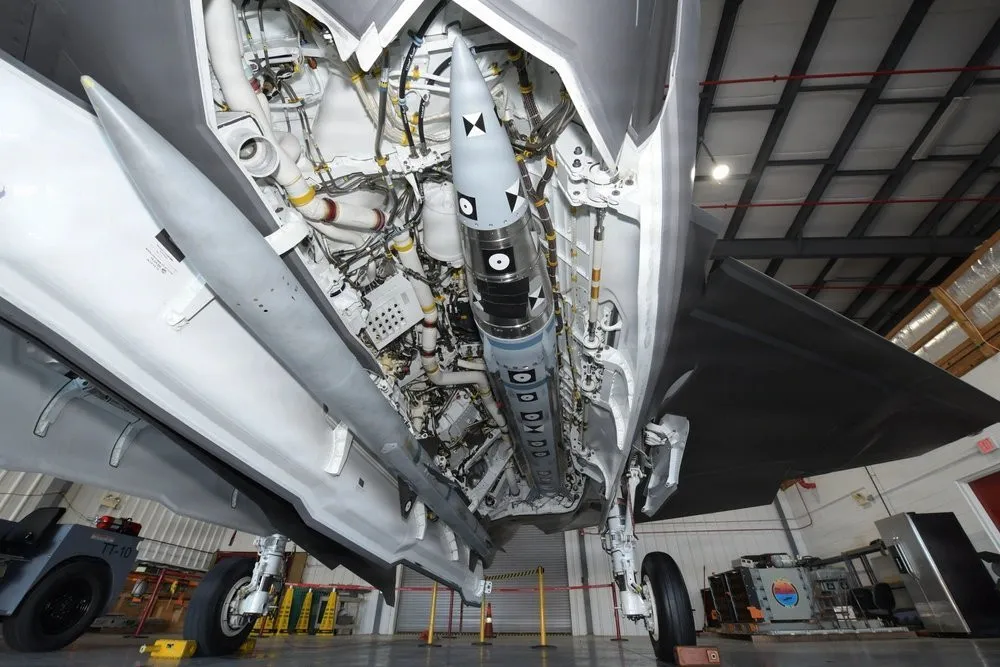
An inert AIM-424 Malice Long-Range Air-to-Air Missile (LRAAM) seen loaded in one of the internal bays on an F-35C Joint Strike Fighter. The Navy is also pursuing the Compact Air-to-Air Missile (CAAM) with an eye toward internal carriage. USN
Mention of CAAM was included in the same briefing where the AIM-424 was first unveiled at the Tailhook Association’s annual convention this weekend. A central focus of the CAAM is on “increasing internal carriage capacity for inner boundary weapon,” according to that presentation.
For the Navy, at present, “internal carriage” is a consideration most applicable to the service’s F-35Cs and, by extension, other variants of the Joint Strike Fighter. Internal weapons bays will also be a feature on whatever design the Navy may ultimately select as its future sixth-generation carrier-based combat jet, currently referred to as F/A-XX. Future Collaborative Combat Aircraft (CCA) type drones or other uncrewed aircraft the service might acquire in the future could also have internal bays. We will come back to this later on.
The description of CAAM as an “inner boundary weapon” points to a focus on shorter-range engagements, where there could also be less total time to react overall.
In terms of what the Navy’s core requirements for the CAAM might be beyond internal carriage, details are limited. A rendering included in the presentation at Tailhook this weekend shows a relatively generic-looking design with fins only at the tail and a yellow band around the front of the body indicating the presence of a high-explosive warhead.
Multi-mission Affordable Capacity Effector (MACE) is Blackbeard missile.
The Compact Air-to-Air Missile (CAAM) could be conceptually similar to the Small Advanced Capabilities Missile (SACM), Lockheed Martin’s CUDA, or Raytheon’s Peregrine.
However, earlier this year, the Naval Air Warfare Center Weapons Division (NAWCWD), part of Naval Air Systems Command (NAVAIR), did put out a contracting notice regarding rocket motor developments to support CAAM and other developments.
NAWCWD “intends to procure on a Full and Open competition basis to develop and demonstrate technology that results in greatly enhanced kinematic capability for the next generation of tactical missiles,” the notice explained. “To support this technological development efforts, NAWCWD is interested in maturing high total impulse loaded and energy tailorable solid propulsion systems for transition into compact weapon systems, including a Compact Air-to-Air Missile (CAAM).”
“Requirements will include tasking and products needed to provide a Concept Design with build-to-print data package, identify critical technology gaps, conduct critical component and rocket motor experiments, conduct a Design for Manufacturing & Assembly study to identify features required to meet manufacturing and cost goals, and provide a plan to mature the CAAM HLG Concept Design to a maturity state ready to enter a Department of Defense (DOD) Engineering and Manufacturing Development (EMD) program,” the notice added.
“HLG” here stands for “Highly Loaded Grain.” This, in turn, refers to solid-fuel rocket motors designed to maximize output per volume. This is an area of missile technology where the Navy has already been heavily investing for years with a broad eye toward increasing the range and improving the performance of future missiles. Furthermore, a missile with an HLG rocket could offer substantially increased capability over a similarly-sized design with a non-HLG motor. This, in turn, offers particular advantages when designing missiles for carriage in internal bays with rigid dimensions.
“The Next-Generation Highly Loaded Grain project team has matured the technology and seeded the development of future mission-modular propulsion systems that can increase weapon ranges by up to 1.5x while maintaining inner boundaries for short-range and time-critical missions,” according to one fact sheet detailing notable achievements by NAVAIR’s Naval Air Warfare Center Weapons Division (NAWCAD) in 2023. Note here also the explicit mention of ‘inner boundary’ design considerations.
“The Next-Generation Highly Loaded Grain project team has matured the technology and seeded the development of future mission-modular propulsion systems that can increase weapon ranges by up to 1.5x while maintaining inner boundaries for short-range and time-critical… pic.twitter.com/gA7mlcSSi7
As mentioned earlier, the Navy has previously used virtually identical language to describe the planned AIM-9X CV, which is also a joint program with the U.S. Air Force.
“The AIM-9X CV repackages the SIP IV technology into a compact airframe optimized for internal carriage on advanced aircraft with improved kinematic performance,” according to the Navy’s Fiscal Year 2027 budget request, released earlier this year. “The program will deliver increased capability to the warfighter with greater standoff range, increased aircraft weapon station capacity, and maintains inner boundary performance.”
How exactly the CAAM and the AIM-9X CV programs may be related is unknown, but they clearly have the same general goals if they are not different names for the same development effort. From what was shown this weekend, CAAM is a distinctly different-looking missile from the AIM-9X, and plans for a compact Sidewinder variant or derivative could also be a stepping stone to a new design intended to fill the same general role.
U.S. defense contractors have been publicly showing concepts for compact air-to-air missiles for years now. This includes Raytheon’s Peregrine, unveiled in 2019, which was said to be roughly half the size of an AIM-120 Advanced Medium Range Air-to-Air Missile (AMRAAM) while still offering comparable range. The company said it also had equivalent maneuverability to current-generation Sidewinders. Raytheon is the prime contractor for the AIM-120 and the AIM-9, as well as the newly unveiled AIM-424.
In the late 2010s, Boeing also put forward a concept for a multi-stage Long-Range Air-to-Air Missile (LRAAM), which had a design that raised the possibility of whether the first stage could be used as a more compact, stand-alone weapon. In 2022, Boeing notably received funding for further development of that missile under a contract from the Air Force Research Laboratory (AFRL) to “investigate advanced missile sub-system components to support the Compact Air-to-Air Missile [CAAM] and Extended Range Air-to-Air Missile Systems [ERAAM].”
A model of Boeing’s multi-stage LRAAM concept. Joseph Trevithick
Regardless, the use case for such a CAAM-type missile is clear-cut, especially for the Navy and its carrier air wings. In particular, the service is facing a threat ecosystem that is rapidly evolving in scale and scope, including multiple different classes of anti-ship missiles (ballistic, cruise, hypersonic) and long-range one-way attack drones. There is a very real prospect of large-volume and complex attacks made up of very different tiers of weapons incoming from multiple vectors simultaneously, creating a greater risk that both long- and short-range defenses will be overwhelmed. TWZ previously explored this reality in depth in discussing how the long-range AIM-174B, an air-launched version of the Standard Missile-6 (SM-6) that was officially unveiled in 2024, fits into the service’s larger plans.
How The Navy’s New Very Long-Range AIM-174 Will Pierce China’s Anti-Access Bubble
Added localized defensive capability and capacity could also be relevant for aerial force packages pressing their way to a target in hostile territory, where similarly growing aerial threats could materialize suddenly and in close proximity. Depending on its capabilities, CAAM might even be able to provide a new layer of defensive capability against incoming anti-air missiles, including for larger aircraft. So, giving individual aircraft more total engagement opportunities will only become more valuable, if not vital, as time goes on.
As noted, stealth platforms with limited internal bay space face particular constraints in this regard. For years, more magazine depth via smaller missiles has been seen as a key avenue for improving payload limitations for platforms like the F-35 and F-22 when operating in their most low-observable (stealthy) configuration. In many scenarios, these aircraft can get closer to their targets without detection, offering different options for the employment of what could be shorter-range weapons. A compact air-to-air missile design that still offers comparable performance to larger existing designs, through the use of a high-load-grain rocket motor and other features, would be even more of a boon. Having something that is capable of short-to-intermediate-range engagements, but that can be loaded in greater numbers internally would expand tactical flexibility, amplify lethality, and increase utility of the aircraft as they can down more targets on a single sortie in certain scenarios.
The continued growth of drone threats, especially those posed by long-range one-way attack types, has added another dimension to this equation. Limited magazine depth limits the ability to rapidly retask stealthy platforms to respond to often unpredictable high-volume drone attacks. Furthermore, the anti-air version of the 70mm Advanced Precision Kill Weapon System II (APKWS II) laser-guided rocket, the U.S. military’s current go-to lower-cost air-to-air weapon against drones, cannot be fired at all from the internal bays on the F-35 or the F-22. CAAM can offer the ability to address these threats better than aircraft like the F-35 and F-22 can today.
A weapon like CAAM would also be especially relevant for future collaborative combat aircraft, which have extreme constraints on payload capacity, internal and external, as well as total takeoff weight. For CCA-type uncrewed aircraft, keeping the airframe size as small as possible to meet requirements is also essential for meeting affordability and producibility targets. Arming these platforms with an AIM-120-sized missile might not necessarily be required, or even be ideal, especially when operating along the leading edge of the air-to-air battle, closer to threats. In those scenarios, having the option of carrying even twice as many missiles per sortie, internally (if available) or externally, even if they have shorter reach, could be hugely beneficial.
A US Air Force YFQ-44A Fury drone with an inert AIM-120 under its wing. USAF
There could easily be interest in a CAAM-like missile from other branches of the U.S. military, if it is not already a joint service effort. The Air Force is already known to be involved in the AIM-9X CV effort. The service has publicly pursued new compact and lower-cost air-to-air missile concepts over the years under various different project names. This includes its own CAAM effort, through which Boeing previously received funding.
What is clear now is that the Navy is pushing to maximize the anti-air capabilities of its aircraft at both the shorter- and longer-range ends of the engagement spectrum.
Aug. 24 (UPI) — A group of grocers filed two lawsuits Monday over New York City Mayor Zohran Mamdani’s plan to open five city-run grocery stores, saying it would harm neighborhood supermarkets.
The Multicultural Business Coalition, an organization that says it represents owners of smaller stores, said in the filings that the city would violate business owners’ civil rights if the new stores open and that officials did not study how the planned stores would affect existing businesses.
Kenneth Roldan, the president of the coalition, said the plan would have a “devastating” effect on small grocery stores. He called it “a direct assault on minority business,” The New York Times reported.
The plan for city-owned grocery stores, which would sell some items at a 30% discount, was part of Mamdani’s platform as he ran for mayor. It calls for five stores, one in each borough of New York City, to open by 2029.
Mamdani said at a news conference Monday that the new stores are needed to address the high cost of groceries and that they would not offer significant competition in the city.
“I’m confident both in the legality of this, that it will stand up in court, and the importance of delivering it,” Mamdani said.
The new stores would reevaluate prices once a month and set the cost for food items at 30% below retailers, The Hill reported. The city would own the land and cover the rent and construction costs. A private operator, selected through a request for proposals, would manage daily operations.
“We are talking about a reflection of a cost-of-living crisis that has seen grocery prices increase by about 30 percent over the last few years, and we’re also talking about delivering five city-run grocery stores in a city of 8.5 million people that has more than 1,000 grocery stores,” Mamdani said.
The first store is expected to open in 2027 in the Hunts Point neighborhood in the Bronx. An East Harlem store is expected to open by 2029. The city has not yet selected sites in Queens, Brooklyn and Staten Island.
Giuseppe Penone: The Reflection of Bronze exhibition is on display at the Gagosian art gallery in New York City on April 21, 2026. Photo by John Angelillo/UPI | License Photo
Aug. 24 (UPI) — Immigration officials arrested the father of a sailor on board the USS Abraham Lincoln, an aircraft carrier that’s come under scrutiny for conditions on board.
In a Facebook post Sunday, sailor Joshua Aviles said his father, Luis Manuel Aviles Roa of Nicaragua was arrested Saturday.
Department of Homeland Security officials told CBS News the arrest happened during a traffic stop in Key West, Fla. Luis Manuel Aviles Roa was in the custody of Immigration and Customs Enforcement officials and faced deportation proceedings.
“I just got a call that my dad was taken by ICE,” Joshua Aviles wrote. “If you know my dad, you know he is a hardworking, humble man who is always willing to help anyone if he can.
“This is heartbreaking for me. I don’t know how I can mentally continue working 12+ hour days knowing that my dad is somewhere, possibly being treated like a criminal.”
The USS Abraham Lincoln has been under an extended deployment to the Middle East and was en route back to the United States. The journey could take several weeks.
Luis Manuel Aviles Roa’s stepdaughter, Katty Delgado, told NBC News that he had been living in the United States for about two decades. She said she had no knowledge of any criminal history for her stepfather and that he had a pending immigration application seeking legal status.
“He’s doing everything the right way,” she told the outlet.
DHS did not deny that Luis Manuel Aviles Roa lacks a criminal record. Officials said that having “a family member in the military is not a free pass to violate our nation’s laws.”
“We are simply enforcing the laws passed by Congress,” the DHS statement said. “This administration does not pick and choose which laws to enforce.”
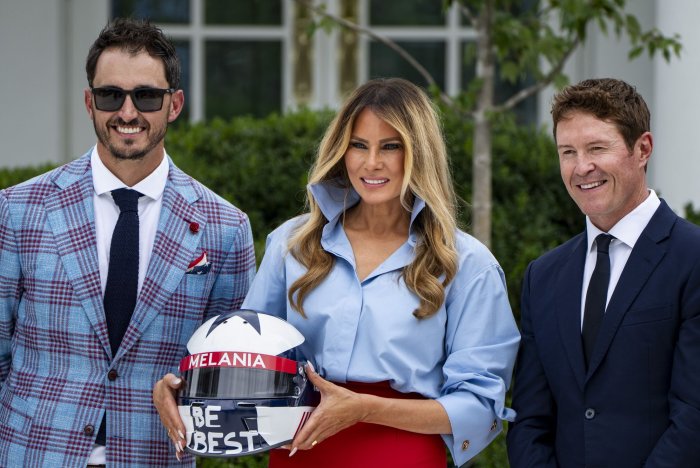
NTT IndyCar Series Drivers Scott Dixon (R) and Graham Rahal (L) pose with first lady Melania Trump during an event in the Rose Garden of the White House on Thursday. The first lady announced that a $2 million donation from IndyCar and Fox Corporation will fund Fostering the Future scholarships at Indiana University and Purdue University to expand academic opportunities for individuals transitioning from foster care. Photo by Bonnie Cash/UPI | License Photo
California Attorney General Rob Bonta walks to speak to press in front of the Supreme Court in Washington, D.C., on November 5. On Sunday, he accused Paramount of leaking details about a meeting the state had with the company on Friday. File Photo by Annabelle Gordon/UPI | License Photo
Aug. 24 (UPI) — California Attorney General Rob Bonta said he canceled a planned sit-down meeting with Paramount to discuss the company’s attempt to merge with Warner Bros. Discovery after details from an earlier meeting leaked.
Bonta accused Paramount of acting in bad faith in a statement issued Sunday night to The New York Times and Deadline.
“Not only did Paramount leak the alleged substance of settlement discussions, but they misrepresented these discussions, demonstrating a lack of good faith,” he said. “As soon as Paramount stops playing games and engages sincerely, my office is happy to meet again.”
Bonta is one of 12 attorneys general who sued in July to block the proposed $111 billion merger of Paramount and Warner Bros., saying it would undermine competition in the entertainment industry, increase costs for consumers and put jobs at risk.
The lawsuit came one month after the Justice Department approved the planned merger, saying it doesn’t harm consumers in the United States.
State officials met with Paramount representatives on Friday to set the agenda for Monday’s scheduled meeting. California Gov. Gavin Newsom confirmed the meeting happened Friday, Deadline reported. The entertainment news outlet said it learned of the meeting from multiple sources.
The Times reported that state officials and Paramount representatives sought to work toward negotiations after the company threatened to leave California and Newsom said he wanted a settlement in the case.
NTT IndyCar Series Drivers Scott Dixon (R) and Graham Rahal (L) pose with first lady Melania Trump during an event in the Rose Garden of the White House on Thursday. The first lady announced that a $2 million donation from IndyCar and Fox Corporation will fund Fostering the Future scholarships at Indiana University and Purdue University to expand academic opportunities for individuals transitioning from foster care. Photo by Bonnie Cash/UPI | License Photo
A fast-growing wildfire in Nevada has grown to 10,000 acres since it began burning just outside Reno on Saturday, forcing thousands to evacuate. Photo courtesy of Nevada Governor’s Office/X
Aug. 23 (UPI) — A fast-growing wildfire in Nevada has grown to 10,000 acres since it began burning just outside Reno on Saturday, officials said.
The Hawk Fire remained uncontained as of Sunday and forced 14,000 homes to be evacuated.
Gov. Joe Lombardo declared a state of emergency in Washoe County, which contains Reno, and urged residents to stay vigilant and heed warnings.
“This is an active and rapidly evolving situation, and I urge everyone in the affected areas to remain vigilant and follow the direction of local officials,” he said in a statement on X.
Reno Mayor Hillary Schieve said “structures have already been burned in this fire.”
“Evacuating before the fire arrives also allows our firefighters to focus their efforts on battling the blaze,” the mayor said in a statement on X.
Truckee Meadows Fire Chief Richard Edwards said the fire is being driven by strong winds, ABC News reported.
“The wind-driven fires move very rapidly into our residential areas, creating a lot of challenges for our firefighters to save homes and protect lives,” Edwards added.
Reno’s Northwest Specialty Hospital said it was evacuating patients due to the fire.
“The safety and well-being of our rehabilitation and behavioral health patients and staff remain the highest priority and we are evacuating out of an abundance of caution,” the hospital said in a statement.
“Patients have been safely transported to appropriate locations where their care will continue without interruption ” no patients or staff remain in the building.”
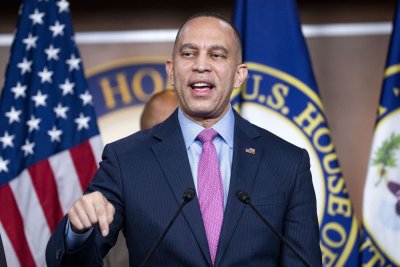
House Democratic Leader Jeffries, D-NY, speaks during a press conference in Washington, DC on Feb. 4. Jeffries reportedly met with Jared Kushner, U.S. President Donald Trump’s son-in-law and adviser. File Photo by Bonnie Cash/UPI | License Photo
Aug. 23 (UPI) — House Democratic Leader Hakeem Jeffries, D-N.Y., met privately with U.S. President Donald Trump‘s son-in-law and informal adviser Jared Kushner in recent weeks to discuss possible common ground, according to media reports Sunday.
According to the report, the meeting occurred in New York City and covered a wide range of issues.
Jeffries is widely seen to be the next House speaker if Democrats win the majority of the chamber in the November election.
“Throughout this Congress, Republicans have adopted a my-way-or-the-highway approach to governing that has failed the American people. To stop the madness, we have repeatedly made clear that an extremist approach will not work and will be met with forceful opposition. The American people want bold change and that’s what House Democrats will deliver,” Jeffries said in a statement to news agencies.
Kushner reportedly encouraged Jeffries to meet with Susie Wiles, Trump’s chief of staff.
Kushner has served a foreign envoy for Trump, notably on Ukraine, Gaza, and Iran.
House Speaker Mike Johnson, R-La., said Sunday he was unaware of the meeting. “I don’t know what that’s about,” Johnson said on Fox News‘s “The Sunday Briefing.” “I know Jared has interest in a lot of other things going on.”
“He’s not really directly involved in the admin, at least in the day-to-day in the White House,” he added.
The group exhibition “To Share a Stomach” is a bit like the children’s game Telephone, in which a phrase, whispered from person to person, inevitably comes out a bit garbled. Urgently conceived by curator Aram Moshayedi in March, on the heels of the latest U.S.-Israeli attacks on Iran, it features works envisioned by 25 Iranian artists that were fabricated with varying degrees of collaboration by 24 counterparts here in the U.S.
Hampered by significant internet blackouts, displacements and the loss of studios and artwork in Iran, as well as an extremely compressed timeline (just five months), the results are understandably rangy and uneven. Yet the show, now on view at the Brick through Sept. 19, is an achingly beautiful meditation on the difficulty of communication and the shared goodwill that intermittently, imperfectly, surmounts it.
Sina Ghadaksaz and John Ziqiang Wu, “What the Clouds Remember and the Mountains Forget,” 2026; Carmen Argote, “Aram’s sneakers: Mount Eynali,” August 6, 8–1030p.m., 2026; Mohammadreza Jahanshir, “Glory / 50904020,” 2026; Maryam Lashkari, Hodjat Salimi, and Oscar Tuazon, “Can You S…?,” 2026; Kelly Akashi and Mimi Amini with David Gutierrez, Matt Rademacher and Kazuki Takizawa, “The Anatomy of a Postponed Intent: The Glass Blade,” 2026; Fatemeh Kazemi and Olivia Mole, “The Conference of the Birds,” 2026, can be seen in the exhibition “To Share a Stomach,” at the Brick in Los Angeles.
(Ruben Diaz 2026)
None of the works address the recent bombardments directly, although the precarious context of ongoing threat, instability and struggle can be felt in almost all of them. Ducking into Maryam Lashkari, Hodjat Salimi and Oscar Tuazon’s interactive sculpture — an enormous cardboard tube lying on its side — feels like entering a culvert or a bomb shelter. Inside, one lies on a crude bed of felt blankets and dons a set of headphones; the sounds of jet planes, a party, conversations and emergency sirens are interspersed with an imperious voice reading a guided meditation on how to be present in one’s body during a bombing. The harsh realities of war are woven into the textures of everyday life, warping and fraying into something absurd. Viewers may scan a QR code for their own copy of the audio track, which deteriorates in sound quality with every download.
Slow disintegration also appears in a triptych of videos by Ismail Ghanbari (facilitated by Tala Madani but not credited as a collaboration). In the largest central one, we see Ghanbari holding two nearly destroyed boxing gloves as he explains how he trained so intensely for a performance in which he boxed for five hours that the gloves began to fall apart. Their tattered remnants, barely held together with patches and stitching, are poignant metaphors for a battered will that keeps fighting even as protections wear thin.
Vulnerability and violence also co-exist in Mimi Amini and Kelly Akashi’s collaboration: a sword made of clear glass. Hanging from the rafters, the tip of its blade points down ominously over viewers’ heads, emphasizing both the danger of the weapon and its fragility. If it fell, would it pierce one’s skull or shatter into bits? It exists suspended between latent violence and the risk of its own annihilation.
Fatemeh Kazemi and Olivia Mole, “The Conference of the Birds,” 2026; Fatemeh Kazemi, “What the Birds Did Not Tell Upon Their Return,” 2026, in the exhibit, “To Share a Stomach,” at the Brick in Los Angeles.
(Ruben Diaz 2026)
These impressions are responses to the works as they exist in the gallery, but the show has another layer, revealed in an accompanying booklet that reproduces the initial emails or texts from the Iranian artists to the curator. Interwoven with stories of life during wartime are proposals or instructions, allowing viewers to assess for themselves how much the works in the gallery reflect the artists’ original ideas. For example, the tube-bunker was initially envisioned as a “completely dark space” twinkling with a variety of malfunctioning countdown clocks. Ghanbari’s video appears in lieu of the gloves themselves, and Amini’s original digital rendering of the glass sword is much more detailed and intricate than the comparatively “low-res” version on view.
If we think of an artwork as an intentional, carefully wrought creation that comes directly from an artist, what are we to make of these incomplete, unfaithful interpretations? I was reminded of the reality TV show “Nailed It!,” in which amateur bakers fail spectacularly to reproduce complex cakes. I cackle at the distance between perfection and utter collapse, but I also feel a pang of tenderness: I am moved by their effort.
Artists, of course, are no strangers to things not going to plan. While the exhibit is enabled by the entwined ubiquity of the English language and the internet, the artists know these technologies aren’t transparent. Most of the Iranian artists left their instructions generously open-ended, inviting the interpretations and transmutations of their U.S. peers. In some cases, it seems the partners did not continue the conversation; whether due to disagreement, bombardment or government-imposed internet blackouts (described to chilling effect in an essay by Negar Karimkhani) is unclear. The U.S. artists were constrained by a very compressed timeline (and presumably budget and space) to fabricate and display the works. Even without these limitations, to hand over one’s vision to someone else, and conversely, to shoulder the responsibility for realizing it are both touching acts of trust.
Ali Ansari and Renée Petropoulos, “Between Entries”, 2026; Salman Khoshroo and Daid Roy, “Defensive Wall,” 2026; Ismail Ghanbari, “Proxy (Neyabati) 1,” “Proxy (Neyabati) 2,” “Proxy (Neyabati) 3,” 2026, on view as part of the exhibition, “To Share a Stomach,” at the Brick in Los Angeles.
(Ruben Diaz 2026)
Viewers must exert themselves a little too. Understanding who is responsible for what work and to what degree requires consulting a floor plan, a checklist and the booklet: an awkward juggling act that would have been eased by some wall labels. Still, as I shuffled papers, I became part of the buffering, incomplete chain of communication. As Amini wrote of the glass blade, “the perfection of this form is preserved only with the mental space shared between the conceptualizing artist and the interpreting artist.” I venture to add the viewer to that space, thinking of Yoko Ono’s instruction artworks (across town at the Broad) which short-circuit any physical acts of making to take shape only in our minds.
This kind of intimacy — thinking, envisioning, constructing together — is rare when it comes to American intersections with Iran. I was previously unfamiliar with the Iranian artists in the show, and I’m sure I missed many cultural and linguistic references in their works. My focus on pieces evoking violence predictably reflects my limited knowledge of Iran as other than a locus of U.S. antagonism (the result of a different information blackout).
Yet, “To Share a Stomach” lays down — gingerly, gently — an alternate connective thread, spun from a mutual recognition of fallibility. In his introductory essay, curator Moshayedi reveals that the show’s title is his mistranslation of the Farsi word for “empathy.” (The correct translation is “to share a heart.”) He goes on to confess that after many years’ study, he finally gave up on learning the language. We will never understand each other perfectly; I am still moved by the effort.
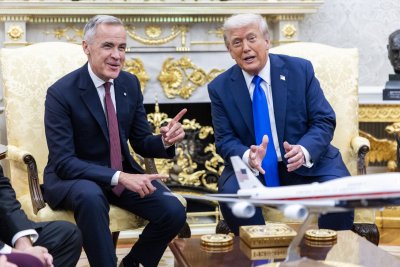
U.S. President Donald Trump (R) meets with Canadian Prime Minister Mark Carney (L) on Oct. 7, 2025. Trump on Sunday said Canada wants the “benefits of being a state, without being one.” File Photo by Shawn Thew/UPI | License Photo
Aug. 23 (UPI) — U.S. President Donald Trump on Sunday accused Canada of wanting the “benefits of being a state, without being one” as trade tensions between the U.S. and its northern neighbor escalate.
“Canada wants the benefits of being a State, without being one!!!,” Trump posted on social media overnight. “They have also charged our great farmers, for many years, massive amounts of Tariffs. No more!!!”
Trump’s remarks came after Canadian Prime Minister Mark Carney said Ottawa next month would impose retaliatory tariffs on the U.S. after the Trump administration’s 50% tariffs on Canada took effect.
Carney told a press conference that his government would “match Washington’s new tariffs dollar for dollar in order to protect Canadian workers, farmers, families and businesses.”
He said further details on the retaliatory tariffs would be released in the “coming days,” with the levies targeting steel, dairy, appliances, agricultural equipment, pulp and paper, and electronics.
Carney said Ottawa is “reluctantly” taking this step.
Trump has previously discussed making Canada the 51st state, which Canadian leaders have rejected.
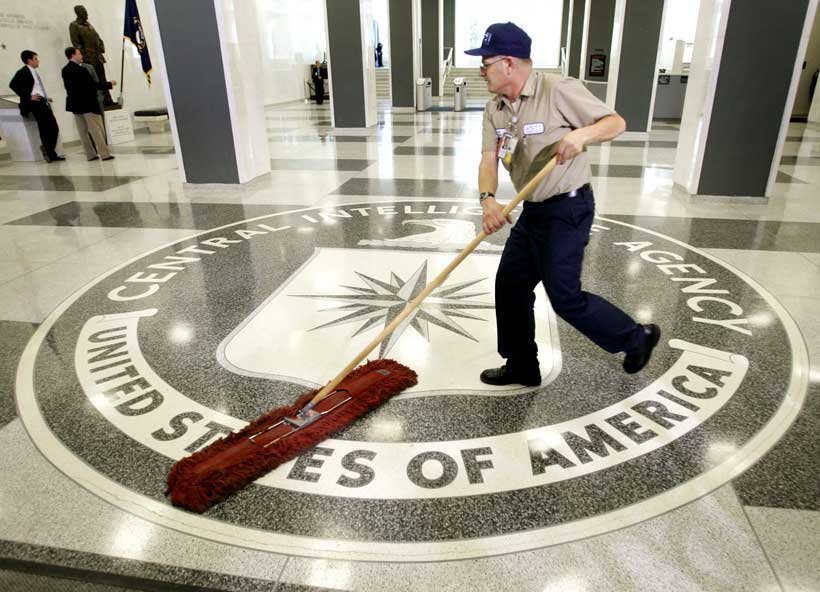
Chinese media and intelligence are closely following the exodus of the American Central Intelligence Agency CIA personnel, particularly the months-long wait for new retirees to receive their financial entitlements. The agency is facing what it describes as an unprecedented number of retirements as the Trump administration seeks to reduce its workforce. Chinese media and intelligence perspectives on this unprecedented exodus of CIA officers align with their own. The delayed payments are a key focus, with both China and the US focusing on exploiting these developments to highlight institutional weaknesses within the American administration and the declining effectiveness of espionage against Beijing. Beijing is using the CIA exodus and delayed retirement payments to cast doubt on the efficiency of American institutions, targeting disaffected and dismissed intelligence operatives to gather information. This is achieved by promoting the idea of the US administration’s collapse and attracting these affected security professionals to bolster Chinese counterintelligence capabilities. Here, Beijing is exploiting the widespread layoffs and dismissals within the CIA and other US federal agencies, turning the affected employees into valuable assets to bolster Chinese counterintelligence capabilities. The Chinese strategy focuses on transforming these dismissed experts from defenders of US national security into offensive tools that expose Washington’s vulnerabilities.
The most prominent trends in official and semi-official Chinese commentary and analysis regarding the dismissal of CIA personnel can be summarized as follows: (Chinese mockery of the China-defeat strategy and the backfiring on the strategist). This is the same point made by Chinese media reports, such as the official Xinhua News Agency, which indicated that the Trump administration had previously announced that its restructuring and hiring freeze aimed to focus on China-defeating and the trade war. However, the actual result was the dismissal of skilled and experienced personnel within the CIA. This exposes the structural failures of the US, and Chinese media highlighted the crisis as evidence of administrative chaos within the United States. The pressure to downsize the federal government has paralyzed the Office of Personnel Management (OPM). This has left Washington unable to even pay the pensions of its retired spies on time. Here, Chinese intelligence, military, political, strategic, and media circles seized upon this crisis to promote the idea of eroding American national security and the golden opportunity it presented for counterintelligence. Chinese think tanks and intelligence agencies seized upon internal American warnings that leaving thousands of former intelligence officers without income for months made them easy targets for infiltration. Beijing interpreted this as a tacit admission of the fragility of institutional loyalty within the American system in the face of financial pressures. Beijing viewed it as evidence of American administrative disarray and a prime example of the brain drain of accumulated expertise. Chinese analyses, assessments, and evaluations focused on the fact that the deferred resignation and contract buyouts programs have prompted senior analysts and field officers within the CIA (those with extensive networks and deep knowledge of Asian affairs) to abruptly leave the service, creating an intelligence gap that will be difficult to fill in the near future. From the Chinese perspective, this exposes the American narrative of transparency and efficiency and reinforces the idea of the political manipulation of intelligence. Therefore, China is exploiting this unprecedented crisis within the CIA to bolster its ongoing narrative that US intelligence agencies have become tools in partisan political conflicts within Washington. Beijing views the mass exodus as a reflection of the professional officers’ lack of confidence in the administration’s political direction. Beijing is using this as part of a counter-propaganda strategy, with Chinese media outlets employing these facts to send messages to the international community, developing countries, and the Global South, suggesting that the United States, which seeks to impose its global security hegemony, is suffering from severe internal divisions that prevent it from managing its fundamental sovereign affairs efficiently and professionally.
Regarding the Chinese political and media exploitation of the CIA staff exodus crisis, the Chinese media machine promotes these crises as evidence of the collapse and disarray of the US federal administration model. It exploits the inability of US institutions to meet their financial obligations (to portray Washington as incapable of protecting even its most sensitive agencies). Therefore, Chinese intelligence, analytical, and strategic circles employ propaganda to highlight the fragility of job security and social stability within US decision-making circles. Furthermore, China strategically and intelligence-wise exploits this internal US crisis. Chinese intelligence agencies monitor these vulnerabilities to target former employees or those facing termination. Beijing offers inducements or clandestine channels of communication through consulting and research fronts to ensnare individuals who are psychologically and financially distressed. China also exploits the frustration resulting from delayed pensions or forced layoffs to facilitate infiltration, counter-recruitment, and the acquisition of sensitive secrets.
Chinese intelligence, such as the Ministry of State Security (MSS), operates through specific and deliberate mechanisms. The MSS, which oversees Chinese intelligence operations, exploits vulnerabilities such as fractured loyalty, financial weakness, and psychological and material incentives. Beijing focuses on federal officers and probationary personnel who have been laid off from the CIA and harbor resentment, bitterness, and a desire for revenge against their former superiors. Chinese intelligence, analytical, and strategic circles then work to support these individuals to fill the financial gap. The sudden loss of a job for a security officer with high financial obligations creates fertile ground for recruitment, as China offers substantial and enticing financial incentives to secure their loyalty. Chinese intelligence circles are also actively employing digital recruitment through front companies. These are sham consulting firms. Beijing is establishing networks of consulting companies, think tanks, and fake recruitment agencies that appear Western and 100% legitimate to target talent on LinkedIn. Through these platforms, Chinese intelligence officers target former CIA employees who are seeking employment on well-known job search platforms like LinkedIn. They use disguised accounts, sometimes employing artificial intelligence, to apply for jobs. Then begins the process of gradually extracting information. The relationship starts with requests for ordinary, non-classified (publicly available) research in exchange for lucrative financial rewards to build trust. The employee is then gradually drawn into providing sensitive information and moving to encrypted communication platforms.
Stay ahead of the geopolitical week.
MD Briefing delivers expert analysis across five global fronts — the Indo-Pacific, energy, geoeconomics, European security, and the Middle East — every Monday morning. Free.
Here, Chinese intelligence agencies work to feed their counterintelligence efforts with tactical information. When China succeeds in recruiting a compromised American security operative, it doesn’t just seek international secrets but focuses on acquiring high-quality information that serves its counterintelligence apparatus. The most prominent of these is uncovering the methods of operation of the US Central Intelligence Agency (CIA). Understanding American recruitment mechanisms, how spies are planted, and methods of vetting and infiltration. Identifying profiles and characteristics (profiles) to understand the psychological and behavioral traits the CIA seeks in informants, which helps China detect potential spies within its own territory or within the People’s Liberation Army early on. This also involves uncovering technical and cyber vulnerabilities by identifying the encryption tools and systems used by US agencies, thus giving Chinese counterintelligence the ability to fortify its networks and penetrate counterespionage operations. Exploiting the absence of exit briefings, Western and American intelligence reports have revealed that some federal employees who were hastily discharged did not undergo standard exit briefings. This procedural gap left employees without direct warnings or clear reporting mechanisms should they be approached by hostile entities. Beijing exploited this as a golden opportunity to operate with minimal oversight. In response to this risk, US security agencies, such as the FBI and the National Counterintelligence and Security Center NCSC), issued heightened security alerts and shut down and blocked dozens of fake websites belonging to Chinese recruitment networks targeting discharged CIA employees.
Aug. 22 (UPI) — The United States Postal Service has prepared a final rule changing how mail voting is administered under an executive order issued by President Donald Trump despite a pair of court injunctions against it, documents show.
An unpublished version of the rule was entered into the Federal Register late on Friday, indicating the USPS intends to press ahead with implementation of a measure the administration says is necessary to prevent fraud in mail-in voting — a popular method of casting ballots that Trump has called “inherently corrupt.”
But critics contend actual fraud in mail-in voting is exceedingly rare and have denounced the measure as one of the most serious attempts by the administration to federalize control of elections in violation of the U.S. Constitution, which reserves such power for the states.
A federal judge 10 days ago expanded an earlier injunction against Trump’s executive order, under which the USPS would be required to decide who will get mail-in ballots.
The injunction blocked it from implementing Section 3 of the order for this year’s midterm elections, which most polls shows will likely favor Democratic congressional candidates.
Despite the court rulings, USPS promulgated the final rule with Friday’s filing, thus making it available to be officially published in the Federal Register on Wednesday. After that it would theoretically take effect immediately, even though it will be blocked for this year’s midterm elections unless a court decides otherwise.
The current filing is an amended version of the initial proposal which received more than 200,000 comments during its review phase.
Trump signed the order on March 31 directing the Department of Homeland Security to build a list of citizens from federal data, which would then be sent to state election officials.
The USPS would then only send absentee or mail-in ballots to people it has determined are eligible to vote, and the U.S. Attorney General would investigate and prosecute election officials who issue federal ballots to those ineligible to vote.
“Yesterday’s new mail-in voting rule is an attempt to weaponize USPS as part of the Trump administration’s efforts to take over elections,” Michael McNulty of the bipartisan political reform group Issue One said in a statement issued Saturday.
“If it holds up in court, it would mean postal workers shift from neutral transporters of a state-led process to a federal gatekeeper of states’ outbound mail ballots — requiring states to provide USPS with voter-level ballot information and giving USPS authority to reject ballots that do not meet the new federal requirements.”
He dismissed Trump’s oft-stated concerns about voter fraud as “tired, debunked conspiracy theories to justify gaining control over secure, verified, and effective methods of voting, including mail-in voting, to tilt the playing field” in favor of Republican candidates.
Meghan Markle, the Duchess of Sussex, had been in talks to return to acting when she and Prince Harry, the Duke of Sussex, return to Britain. File Photo by Jim Ruymen/UPI | License Photo
Aug. 22 (UPI) — The casting of Meghan Markle to play a role in the Netflix series The Gentlemen has been withdrawn amid intense backlash in Britain, it was reported Saturday.
The Duchess of Sussex had been in talks to return to acting when she and Prince Harry, the Duke of Sussex, return to Britain after living in California for the past six years.
She had been hoping to join the third season of the Guy Ritchie show The Gentlemen on Netflix.
But the casting was reportedly withdrawn.
“The backlash in the UK was so intense, it became untenable to go forward,” wrote Tina Brown, the former editor in chief of Vanity Fair and the New Yorker, in her Substack.
Markle, who starred in seven seasons of the legal drama Suits, stepped back from acting in 2018 after marrying Prince Harry.
It was reported this week that the couple is planning on returning to Britain within days.
They plan on living in a private residence outside London with Prince Archie, 7, and Princes Lilibet, 5, and have reportedly enrolled the children in a British school for the fall term.
The Sussexes, who stepped away from royal duties in 2020, will return as private citizens and are not expected to resume their previous roles.