President Donald Trump speaks Monday in the Oval Office of the White House in Washington, D.C. In an interview Monday, Trump threatened to bomb Oman if it “gets in the way” of any potential deal with Iran. Photo by Samuel Corum/UPI | License Photo
Aug. 17 (UPI) — U.S. President Donald Trump threatened Monday to bomb Oman if the nation’s leaders get “in the way of” any potential Iran deal with the United States.
“If Oman gets in the way, we’ll bomb the [expletive] out of them,” Trump told Fox News.
Oman is not part of the U.S. conflict with Iran, but Omani negotiators have been speaking with Iran over a deal between the two Middle Eastern nations to reopen the Strait of Hormuz.
Esmail Baghaei, a spokesman for the Iranian Foreign Ministry, said Monday that Oman and Iran had reached an understanding about a map of the transit route in the waterway. About a third of the world’s crude oil passes through the strait.
Iranian officials have previously said that they’ll reopen the strait only after the United States ends its naval blockade of Iran’s ports and stops attacking Iran. They’ve also requested the end of sanctions and compensation for damage from the attacks.
A two-month window to negotiate peace with Iran, established in the June “memorandum of understanding” between the United States and Iran, officially ended Monday with no progress. The two countries have also strikes for more than a month despite the agreement. Trump told Fox News on Monday that he is “in no hurry” to reach a permanent deal.
“I have no time schedule,” Trump said. The president has repeatedly said that the conflict will end “soon” and promised imminent peace deals that haven’t come to fruition. He also said in the interview that Iran should “put up the white flag of surrender” and denied reports that the United States munitions have been depleted.
Trump previously threatened to “blow up” Oman in May during a Cabinet meeting. On Friday, he threatened to make the Strait of Hormuz “a territory of the United States.”
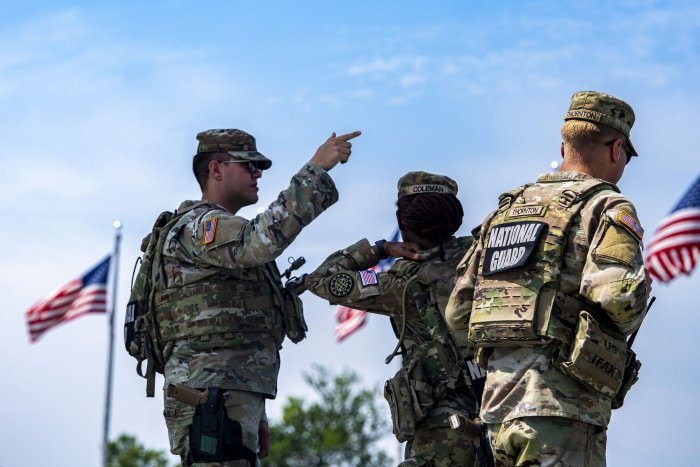
Members of the National Guard patrol near the Washington Monument on Tuesday. Photo by Bonnie Cash/UPI | License Photo
LONDON — British Prime Minister Andy Burnham exchanged messages with an impostor posing as President Trump’s chief of staff, according to reports published Monday.
A spokesperson for Burnham declined to comment, saying it was policy not to discuss “national security matters.”
Politico cited four unnamed officials in first reporting that Burnham thought he was messaging with Susie Wiles before he became suspicious and cut off communications.
Last year, the U.S. government investigated a series of messages that elected officials, business executives and other prominent figures in the U.S. received messages from someone posing as Wiles.
Soon after those incidents, the State Department warned U.S. diplomats of attempts to impersonate Secretary of State Marco Rubio and possibly other officials using artificial intelligence. The warning followed the discovery that an impostor posing as Rubio had attempted to reach out to at least three foreign ministers, a U.S. senator and a governor.
The FBI had also warned of “malicious actors” misusing AI to impersonate senior U.S. government officials.
Burnham, who became prime minister less than a month ago, has tried to forge good ties with the White House. Trump initially warmed to Burnham’s predecessor, Keir Starmer, before souring on him.
SEOUL, South Korea — South Korea on Monday expressed hopes for resumption of diplomacy between the U.S. and North Korea to ease animosities on the Korean Peninsula, as President Trump’s order to cut military exercises with South Korea caused concerns it might hurt the allies’ readiness against North Korean threats.
Trump cited his good relationship with North Korean leader Kim Jong Un for the decision, a likely bid to reengage with Kim, who views U.S.-South Korean military exercises as invasion rehearsals. But experts say the North Korean leader, now emboldened by his advancing nuclear arsenal and expanding military cooperation with Russia, won’t likely return to talks unless he is assured of serious U.S. concessions.
The 11-day, summertime Ulchi Freedom Shield exercises began Monday morning as scheduled and it wasn’t known which parts of the training were being downsized. Trump’s announcement baffled many in South Korea, a key U.S. ally in Asia where national security is a top priority due to threats from nuclear-armed North Korea.
Trump orders military to ‘substantially reduce’ drills
Trump said in a social media post that the exercises are not only costly but “send a signal that is totally inappropriate and hostile” to North Korea, which he said “has been unthreatening and respectful” during his time in the White House.
Trump instructed Defense Secretary Pete Hegseth to “substantially reduce” the exercises. He added that he recently asked President Lee Jae Myung if South Korea would join the U.S. in the “denuclearization” of Iran, “and they said, ‘No thanks!’”
Trump’s move is the latest example of the American president appearing to turn against an ally in favor of a leader cast by previous administrations as an adversary. Trump and others in his administration also have railed against NATO allies over a perceived lack of support for his war against Iran, even as they seek to confront an increasingly aggressive Russia in the Baltic region.
The trust many South Koreans have in the U.S. has eroded following a tariff war instigated by Trump’s administration and his transactional approach to security.
South Korea hopes for talks between U.S. and North Korea
The office of South Korea’s president said later Monday that the government hopes “friendly relationship” between Trump and Kim would lead to “meaningful dialogue” between the U.S. and North Korea and start discussions on promoting peace and stability on the Korean Peninsula. It said that South Korea will make necessary diplomatic efforts for that.
South Korea and the U.S. are closely discussing practical and military contributions that can be made to restore freedom of navigation in the Strait of Hormuz, according to South Korea’s presidential office.
Lee is a liberal who espouses improved ties with North Korea. Since taking office last year, his government has taken proactive steps to improve ties with North Korea, including turning off front line loudspeakers that blared K-pop music and world news. On Saturday, Lee offered to hold talks to formally end the 1950-53 Korean War, which ended with an armistice, not a peace treaty.
The conservative People Power Party, the main opposition party, lambasted Lee for allegedly “turning a blind eye on the public’s security concerns” caused by Trump’s announcement and prioritizing hopes for U.S.-North Korea diplomacy.
North Korea has shunned any talks with South Korea and the U.S. and accelerated weapons testing activities since Kim’s high-stakes nuclear diplomacy with Trump broke down in 2019. Kim also has bolstered his diplomatic credentials by aligning with Russia over its war against Ukraine and taking steps to deepen cooperation with China.
In September 2025, Kim suggested he could resume talks with the American president if the U.S. drops “its delusional obsession with denuclearization” of North Korea. Experts say Kim likely aims to use his enlarged nuclear arsenal to win major concessions like extensive sanctions relief.
“Trump’s recent social media posts about Kim Jong Un suggest a willingness to reengage, but North Korea is busy profiting from Russia’s war against Ukraine while modernizing its own military,” said Leif-Eric Easley, a professor at Ewha University in Seoul.
Downsizing the U.S. and South Korean drills “can damage alliance coordination, slow the process of South Korea taking on greater responsibility for its own defense, and weaken deterrence against possible conflicts in Asia,” Easley said.
Duyeon Kim, a senior analyst at Washington’s Center for a New American Security, said “reducing joint drills weakens military readiness over time against another potential North Korean attack.”
Military drills test tactics and anger North Korea
South Korea’s military earlier said the Ulchi Freedom Shield exercises this year would be similar to previous years in scale, with about 18,000 South Korean soldiers taking part.
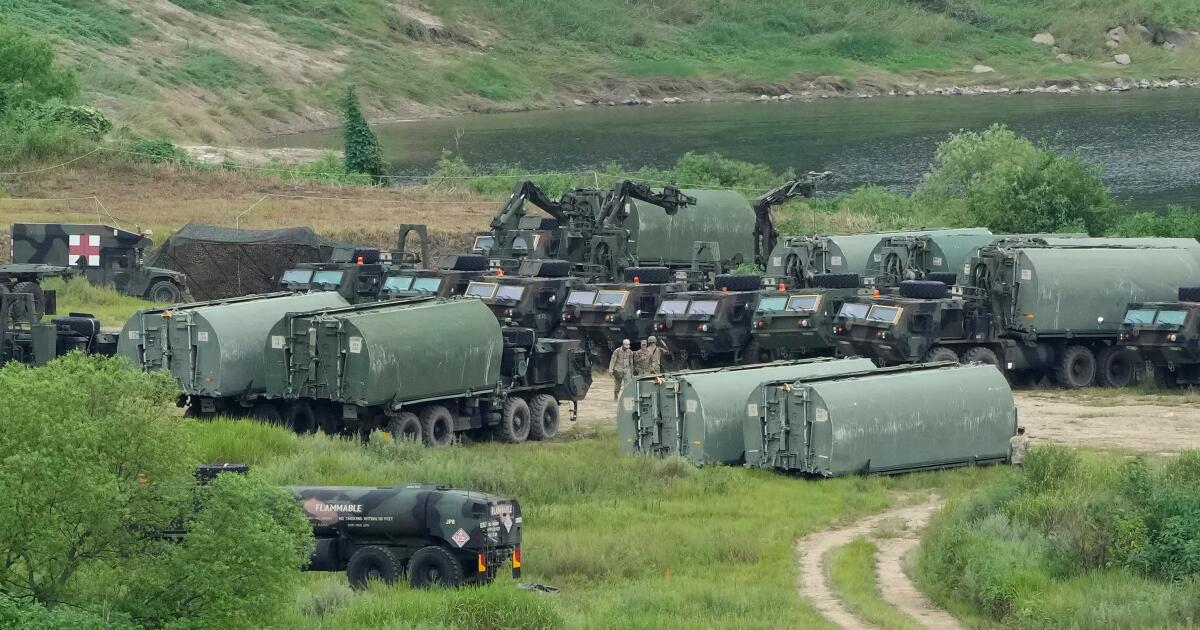
The U.S. military said the drills would incorporate lessens from recent conflicts such as North Korea’s battlefield experiences in the Russia-Ukraine front, while including a live-fire exercise to test joint precision targeting and maneuver, a wet gap crossing and distribution of prepositioned military equipment.
North Korea’s Foreign Ministry on Friday accused the U.S. and South Korea of plotting more provocative drills this year and vowed to respond with “a new level of a deterrent.” Earlier this month, North Korea fired two ballistic missiles into the sea in a likely protest of the drills.
Duyeon Kim, the analyst, said North Korea uses U.S.-South Korean drills “for domestic propaganda purposes to create a false narrative of a hostile America and justify its nuclear weapons program.”
This is not the first time Trump has sought to suspend the drills. After his first summit with Kim in 2018, Trump unilaterally announced the suspension of the U.S.-South Korean summertime exercises, calling them “very provocative” and “tremendously expensive.”
Kim Dong-yub, a professor at the University of North Korean Studies in Seoul, said North Korea feels less urgency to return to talks with the U.S. and South Korea now than when it entered talks with its rivals in 2018, but is unlikely to completely ignore Trump’s overture.
He predicted North Korea will likely say it has noted Trump’s post but will wait for further action showing the U.S. intends to drop hostilities against North Korea.
Weekly insights and analysis on the latest developments in military technology, strategy, and foreign policy.
“I want to talk a little bit about forward [forces] and air base defense. Let’s be clear, we got our rear-end handed to us from drones and other vehicles, aerospace vehicles, if you will, including three F-5s that took off in Iran and flew low level and dropped bombs on an airbase,” retired U.S. Air Force Gen. Glen VanHerck just declared during a panel discussion today centered on counter-drone defenses at the annual Space & Missile Defense (SMD) Symposium in Huntsville, Alabama, at which TWZ is in attendance. Before his retirement in 2024, VanHerck served as head of U.S. Northern Command (NORTHCOM) and the U.S.-Canadian North American Aerospace Defense Command (NORAD).
“That’s embarrassing as an airman to me to say that happened,” VanHerck added, noting that this was the first time in decades U.S. forces had been subjected to an aerial attack of this kind.
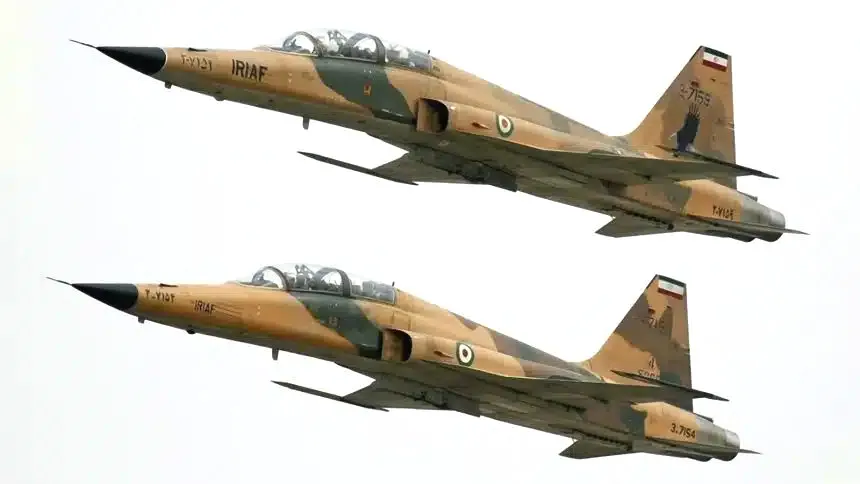
A series of reports, as well as unconfirmed claims from Tehran, state that Iranian F-5s targeted Camp Buehring in Kuwait on an extremely dangerous low-level bombing mission. The attack reportedly came on or around March 1, just three days after U.S. and Israeli forces began launching combined strikes on Iran.
A stock picture of a pair of Iranian F-5s. Iranian quasi-state media
At the time of writing, the U.S. government still does not appear to have officially confirmed the Iranian F-5 strikes on Camp Buehring. TWZ has reached out to U.S. Central Command (CENTCOM) in light of VanHerck’s remarks today, and the command declined to comment.
NBC News was first to report on this attack in a story in April, citing anonymous U.S. officials. At that time, the outlet also said only that a single Iranian F-5 had struck Camp Buehring. American forces have been present at this base continuously since the lead-up to the invasion of Iraq in 2003.
In June, Iranian state media outlet PressTV aired a segment with additional claimed details about the operation, as well as interviews with what were said to be the pilots who took part. That report said that a trio of heavily refurbished Iranian F-5s, known locally as Kowsars, had been sent on the mission. Iran acquired a fleet of 166 F-5E/Fs from the United States in the 1970s under the regime of the Shah. How many of those jets were still operational to any degree when the latest conflict broke out on February 28 is unclear. The Iranian Air Force was heavily targeted by U.S. and Israeli forces from the start.
According to PressTV, the F-5s flew to Kuwait from Iran at extremely low altitudes, at times below 50 feet, and at high speed to evade detection, including by E-3 Sentry Airborne Warning and Control System (AWACS) jets flying above. The pilots maintained radio silence the entire time.
Iranian Pilots Shocking Revelation:
– During recent Iran-US war, Iranian Pilots used decads old F-5 aircraft to bomb US Base in Kuwait.
– F-5 flew about 15m above the surface to avoid detection and the pilots already had done homework regarding the engagement envelope of US… pic.twitter.com/EYsqxz9iHA
The PressTV report also claimed that pilots followed a route specifically designed to avoid Patriot surface-to-air missile batteries and other air defenses at Camp Buehring. Though this remains unconfirmed, it is worth noting that Patriot has known limitations when it comes to its engagement envelope. New capabilities are being developed for the system now to expand its flexibility to address targets approaching from different vectors, as well as ones that have already passed overhead. Without the aid of some type of look-down sensor capability, ground-based air defense systems more broadly cannot see through the horizon or topography, either.
Many questions remain about how Iranian F-5s would have been able to ingress and egress from Kuwait unscathed, and successfully drop unguided bombs on Camp Buehring in the process. It’s unclear where the jets launched from, and it is very possible they needed to carry significant extra fuel in external tanks just to have made the trip to and from Iran in the first place. This would also have impacted their top speed and capacity to carry ordnance.
As an aside, a pair of Iranian Su-24 Fencer swing-wing combat jets also attempted to strike targets in Qatar on March 2, but that would have been a much shorter trip across the Persian Gulf. Those jets were also shot down by Qatari F-15s before they could reach their destination.
Qatari MoD released statement noting that the QEAF downed two Iranian Su-24MK strike aircraft. Would be interesting to know which asset(s) shot them down.
In addition to the sensors associated with Patriot and other air defense systems on the ground, as well as E-3s in the air, the U.S. military has spent years developing a more integrated air and missile defense network with allies and partners across the Middle East. It is also worth noting here that Iran very actively targeted air and missile defense radars in the region early in the conflict, something we noted was its own separate wake-up call, as you can read more about here. This raises a question of what else Iran may have brought to bear in support of this operation. Iranian forces could have launched additional missile and/or drone strikes against sensors, command-and-control nodes, and other sites to help clear the way. Electronic warfare, cyber attacks, and/or deception of various kinds could have been employed, as well.
During the panel today, VanHerck said he did not believe any of this should have come as a surprise, and that it speaks to larger issues surrounding base defense facing the U.S. military today.
“People are like, ‘How come that happened? We got surprised.’ No, we didn’t get surprised,” he said. “What happened was we had two services pointing fingers at each other, and nobody made a decision on whose mission and role responsibility that was, candidly.”
Whether VanHerck’s comments here reflect his specific understanding of what happened during the attack on Camp Buehring in March, or if he was speaking more generally, is unclear. The two services he refers to here are the U.S. Air Force and the U.S. Army. As part of the delineation of official roles and responsibilities after the Air Force was split from the Army in 1947, the latter service was given the lead role in defending both services’ bases against aerial attacks. Today, the Army has a broader responsibility for ground-based air and missile defense across the joint force, abroad and at home, as well.
“The department needed to say it is this service or that service’s responsibility moving forward,” VanHerck continued today. “I’m not taking sides in that. The bottom line is, we didn’t make the decision, we accepted risk, and now we’re paying the price of that risk that we accepted, candidly.”
Now, “the Air Force chief has stood up and said, ‘Okay, I’m going to take that mission on,’” VanHerck also noted. “What we can’t have happen in the next year is a bifurcated solution where you have Patriots and THAADs [Terminal High Altitude Area Defense systems] operating up here, and you have counter-drone … down here, and they’re not fusing data and sharing C2 [command and control] and collaboration. That can’t happen, and we’ve got to make sure we get together and don’t allow that to happen.”
When it comes to Iran’s reported F-5 attacks on Kuwait earlier this year, much remains unknown and unconfirmed. However, it is certainly the opinion of retired Gen. VanHerck that it should be taken seriously and speaks to the urgency with which much bigger problems with the U.S. air and missile ecosystem need to be addressed.
Aug. 16 (UPI) — U.S. President Donald Trump said Sunday he ordered the Pentagon to scale back its joint military exercises with South Korea, saying that Seoul declined to help the denuclearization of Iran.
In a social media post, Trump said the drills scheduled to begin this week are expensive and “send a signal that is totally inappropriate and hostile” to North Korea. He said North Korea “has been unthreatening and respectful” white he has been in the White House.
“Therefore, and based on the fact that it is too late to cancel, I have instructed Secretary of War, Pete Hegseth, to substantially reduce the Joint Military Exercises!” Trump wrote.
The annual Ulchi Freedom Shield exercises, involving 18,000 South Korean troops over 11 days, were to strengthen readiness against threats from North Korea and began Monday to run through Aug. 27.
North Korea, which has long condemned the exercises as preparations for invasion, last week denounced the scheduled drills, describing them as a provocation that would raise tensions in the region.
South Korea has yet to response to Trump’s surprise and last-minute direction.
On Saturday, Trump posted a June 2019 photo of his meeting with North Korean leader Kim Jong Un at the Korean Demilitarized Zone. He wrote that he gets along “GREAT!” with Kim “despite the unfriendly look on this particular picture.”
The Glen Canyon Dam is shown releasing water into the Colorado River at the Grand Canyon in Page, Ariz., on March 5, 2008. Water levels in Lake Powell, the reservoir created by the dam, fell to their lowest levels on record over the weekend amid continuing severe drought. File Photo by Tami Heilemann/Department of the Interior/UPI | License Photo
Aug. 16 (UPI) — Lake Powell, a vital man-made water reservoir on the Colorado River, has fallen to its lowest level on record as the U.S. West endures a severe, long-lasting drought, official statistics show.
The lake’s levels fell to 3519.91 feet on Saturday — low enough to break the record of 3,519.92 feet set in April 2023, according to a reading published Sunday by the Bureau of Reclamation.
Federal officials say the effects of long-term drought had reduced Colorado River Basin system storage to about 36% of capacity as of April. This was due to a combination of the lowest snowpack on record last winter and record-breaking heat in March, which intensified drought conditions across the river basin.
The situation has set off widespread concerns over elevated risks to the essential water and power infrastructure that supplies more than 40 million people across the West.
The lake, which spans Utah and Arizona, is a reservoir created by the Glen Canyon Dam in Page, Ariz.
The Bureau of Reclamation in April predicted Lake Powell’s water year minimum probable inflow at just 2.78 million acre-feet — only 29% of historical average and one of the lowest on record.
It also warned lake could decline to below 3,490 feet — the minimum power pool level — by this summer without major intervention.
If Glen Canyon Dam declines below that level, water releases would be restricted, creating “uncertainty for users, downstream impacts, instability in regional power and water supplies, and a reduction in power generation.”
Another vital reservoir in the Colorado River Basin, Lake Mead, is also currently at its lowest level since it was created in the 1930s.
The Bureau of Reclamation and the Department of the Interior remain “committed to reducing the collective risk of both Lake Powell and Lake Mead falling below critical elevations to protect critical infrastructure to continue to meet the water and hydropower needs of the basin,” a spokesman told CNN on Sunday.
Weekly insights and analysis on the latest developments in military technology, strategy, and foreign policy.
The head of U.S. Space Command (SPACECOM) says having a “credible, acknowledged” means of damaging or even destroying enemy assets in space is vital to deterring opponents and surviving if a major fight in orbit does break out. American officials have already been steadily more open about their desire for new offensive “orbital warfare” capabilities. China’s breakneck expansion of its intelligence-gathering and other capabilities in orbit, as well as its arsenal of anti-satellite weapons, has been a central factor behind this push.
U.S. Space Force Gen. Stephen Whiting made an explicit call for new “integrated space fires” capabilities, including both non-kinetic and kinetic options in orbit and/or within the atmosphere, during a talk yesterday at the annual Space & Missile Defense (SMD) Symposium in Huntsville, Alabama, at which TWZ is in attendance. SPACECOM is the main joint service command in charge of all U.S. military activities in space.
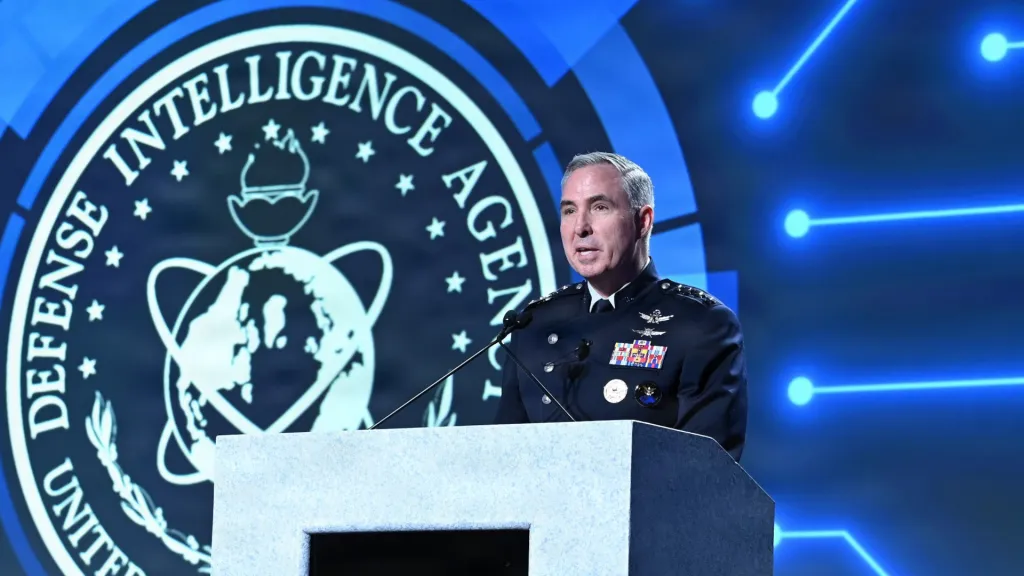
U.S. Space Force Gen. Stephen Whiting, head of US Space Command, seen speaking at the separate 2026 DoDIIS Worldwide Conference on August 10, 2026. DIA
“From the broadest perspective, maybe the most critical characteristic of the responsive and adaptive national security space architecture called for in the President’s Ensuring American Space Superiority executive order is that survivability matters at least as much as performance,” Whiting said. “In space, there is no safe harbor. You can’t dig a trench or build a shield. Our satellites are consistently or predictably in an opponent’s weapons engagement zone. And we can build the most high-performing, exquisite satellites in human history, but if they depend on fragile, targetable supporting infrastructure, their performance will drop to zero on the first day of the next war.”
“Space survivability isn’t just good to have or nice to have. It is need to have. Now let’s get specific. I’ve explained how durable we need our kit to be, but now I want to tell you about our FY29-to-33 [Fiscal Years 2029 to 2033] integrated priorities list,” the SPACECOM boss continued. “We’ve looked at risks and potential gaps and determined these are the top five capabilities we need to meet our Title 10 and Unified Command Plan responsibilities. This isn’t just a wish list. It’s a clear demand signal to several audiences, describing the warfighting capabilities we need to meet our mission.”
“Number one and two are integrated space fires and counter-pLEO that enable us to establish space superiority,” he said. pLEO, also sometimes written P-LEO, stands for proliferated low Earth orbit, and refers to distributed constellations of hundreds or potentially thousands of satellites in that orbital region. The U.S. military itself is investing heavily in this arena to develop and field new space-based capabilities that are more resilient to attack.
DARPA
The other three lines of effort Gen. Whiting outlined during his talk had to do with improved command and control, better situational awareness in space, and increased ability to maneuver assets in orbit.
“We’re a combatant command, and we fight to win wars,” Whiting declared. “To win, we need credible, acknowledged, kinetic, and non-kinetic fires. They are a key component of how we establish space superiority and restore credible deterrence.”
“Our space assets need to shoot, move, and communicate just like the rest of the joint force, so that our space assets can enable the joint force to shoot, move, and communicate,” the head of SPACECOM also said. “In short, space needs to fight like the joint force to empower the joint forces’ ability to fight and undermine our adversaries’ ability to do so.”
Whiting did not elaborate on what these future integrated fires and counter-pLEO capabilities might look like. An accompanying briefing slide did include a graphic depicting a kinetic attack on a satellite originating from within the Earth’s atmosphere utilizing what might be a laser-directed energy weapon.
A close-up look at the “integrated space fires” graphic, at left, and the full briefing slide from Gen. Whiting’s talk, at right. National Defense Industry Association
The threats that directed energy weapons, as well as cyber attacks, pose to friendly satellites, even ones in distributed constellations, had come up at a separate panel discussion at the SMD Symposium on Tuesday.
“If you have 10,000 satellites that are providing you with service, surely you’re not going to try and attack with a direct ascent ASAT [anti-satellite interceptors fired from within the Earth’s atmosphere] 10,000 satellites,” U.S. Army Lt. Gen. Rick Zellmann, Deputy Commander of SPACECOM, said during the panel. “I encourage our adversaries to try and shoot down 10,000 satellites that way. I don’t think they will. And, so, just like we do, our targeting folks will try to find the various nodes where you can get a one-to-many solution.”
“Those, I think, one-to-many solutions for proliferated constellations are twofold. One is cyber,” he continued. “I think the other is directed energy, because that doesn’t cost too much for a shot, right? So those two technologies are the ones I’d be concerned about.”
“Non-kinetic effects of directed energy, mounted on all types of platforms, from the surface all the way to space and everywhere in between,” could also be “opportunities,” Brig. Gen. Drew Morgan, the deputy head of the Army’s Space and Missile Defense Command (SMDC), another one of the panelists, also said later on. In a space context, non-kinetic directed energy ‘effect’ could include what is known as ‘dazzling’ using lasers to blind optics on satellites without causing permanent damage. In the past, U.S. officials have said that friendly assets in orbit are routinely subjected to various kinds of non-destructive attacks.
At present, a family of ground-based electronic warfare systems called the Counter Communications System (CCS) is the U.S. military’s only publicly acknowledged offensive counter-space capability. In June, the U.S. Space Force announced it had “operationally accepted” the latest version of the system, called Block 10.3, and also known by the codename Meadowlands.
Trailer-mounted antennas associated with the Counter Communications System (CCS). USSF
There have been hints for years that the U.S. military might have other operational anti-satellite capabilities in the classified realm, or at least have been actively experimenting with them. In 2019, then-Secretary of the Air Force Heather Wilson notably suggested a public live-fire demonstration of some kind could be necessary to deter potential opponents, such as Russia and China, from attacking American space-based assets.
“Protective measures on satellites is just like thinking about protective measures on aircraft, okay? And we’re working through that,” Lt. Gen. Gregory Gagnon, head of the Space Force’s Combat Forces Command (CFC), told TWZ and others more recently at a roundtable at the Air & Space Forces Association’s (AFA) Warfare Symposium in February. “I won’t provide specifics, because I want those protective measures to work, right? I don’t want to tell Beijing and Moscow what I’ve done.”
“But protecting and defending satellites can’t simply be done by protect and defend. You can’t run away from a bully forever. Sometimes you got to turn around and punch,” Gagnon continued. “So protect and defend, although necessary, is insufficient to deliver space control. We also need, as part of our joint force, the ability to attack.”
The first official painting commissioned by the Space Force, seen here, explicitly depicts a duel between a reusable spaceplane and a hostile ‘killer satellite.’ USSF
At that time, Gagnon also stressed that challenging China’s still-growing array of space-based capabilities was another key driver behind this desire for new offensive counter-space capabilities.
What “[China’s] President Xi [Jinping] has decided to do is build the second-best remote sensing architecture in the world from outer space, and that’s now what they have,” Gagnon also said at that time. “So when 2013 started, and he came to power, he had less than 100 satellites that were the total of what China had in outer space. They have about 1,900 today. Over 500 of those satellites are remote sensing satellites, which are purposely designed and networked to track mobile forces such as U.S. carriers, destroyers, and cruisers in the Pacific, as well as aircraft that deploy around the Pacific. Those have been built with a purpose. The purpose is to cue their long-range fire weapons.”
Gen. Whiting also said during his talk at the SMD Symposium yesterday that China, and its anti-satellite capabilities in particular, remained the greatest challenge facing the U.S. military in the space domain.
“Number one is the development of counter-space weapons that I highlighted in my remarks. These are not future possibilities,” the head of SPACECOM said. “Some of you have played the war games over the years where we have to give the ‘red force’ [the side playing the mock adversary] additional capability, maybe project five years forward and give them what we think they’ll have. And, no, the capabilities we talked about are real, they exist today, and we have to face them.”
“These include direct ascent ASAT missiles, ground-based lasers, jammers, and maneuverable co-orbital ASATs, and dual-use satellites like the SJ-21, which can target the satellites we rely upon for missile warning and defense missions,” the SPACECOM boss had said in his opening remarks. “They are, in no uncertain terms, expanding military options for sustained offensive operations against the satellites we rely on to defend the homeland and project power. These developments intend to degrade our current space superiority, and would potentially give China a maneuver and logistics advantage in space, something we would never accept on the land, at sea, or in the air.”
The SJ-21 satellite mentioned here has been a particularly hot topic of discussion since it was launched in 2021. It has a grappling arm with a demonstrated ability to tow other satellites in space. This is ostensibly intended to be used for non-military applications, such as on-orbit servicing and moving debris, but has obvious potential to be weaponized.
Long March-3B launches Shijian-21
In general, so-called inspector-type satellites capable of rendezvousing and maneuvering closer to other objects in space have an inherent ability to be used to launch attacks, destructive and otherwise, using a variety of different means, as well as gather intelligence. This includes kinetic attacks where the inspector could be used as an interceptor and simply smashed into the target. U.S. military officials have been warning about the dual-use potential of inspector satellites for years now, especially in the context of examples that Russia has put into orbit.
A U.S. Defense Intelligence Agency graphic highlighting some of the ways on-orbit attack can be carried out, including via robotic arms. DIA
This all speaks further to counter-space capabilities U.S. forces could themselves bring to bear in the future. Last month, Northrop Grumman in the United States notably launched the first of what it hopes will be a constellation of new Mission Robotic Vehicle (MRV) satellites capable of performing on-orbit refueling and other servicing missions for commercial and military customers. The U.S. Defense Advanced Research Projects Agency (DARPA) and the U.S. Naval Research Laboratory (NRL) played key roles in the development of a payload equipped with a pair of robotic arms for the MRV. Questions about whether the MRVs with their arms could also have an offensive counter-space role have already been raised, as you can read more about here.
“Depends on where you sit, right, you know? But to say that it’s the responsibility for the U.S. government to protect its citizens from emerging threats makes perfect sense to me,” outgoing Chief of Space Operations Gen. Chance Saltzman said last year. “And we clearly see a country like the PRC [People’s Republic of China] investing heavily in these kinds of threats, whether it’s hypersonic [weapons], whether it’s threats from space. And so now it’s time for the U.S. government to step up to the responsibilities to protect American citizens from those threats.”
Saltzman was speaking at the time in the context of a discussion about Golden Dome’s space-based interceptors during an interview broadcast online as part of Defense One‘s State of Defense 2025: Air Force and Space Force virtual conference.
How much will ultimately be acknowledged about the U.S. military’s future planned “integrated space fires” capabilities, as well as exactly what might be in its anti-satellite arsenal already, remains to be seen. Regardless, Gen. Whiting’s comments this week have now at least made the active pursuit of new counter-space weapons a matter of public record.
An E-2D Hawkeye prepares to launch from the flight deck of the Nimitz-class aircraft carrier USS Abraham Lincoln in 2018. U.S. Central Command Adm. Brad Cooper visited the ship on Saturday. U.S. File Photo by Mass Communication Specialist 3rd Class Jeff Sherman/Navy
Aug. 16 (UPI) — The commander of U.S. Central Command visited the USS Abraham Lincoln days after the aircraft carrier drew public attention over reports of poor conditions on board and attempted suicides of sailors.
Adm. Brad Cooper visited the ship as part of a 10-day tour of the Middle East, U.S. Central Command said in a statement. Cooper also met with senior civilian and military leadership in Bahrain, Iraq, Iran, Israel, Jordan, Saudi Arabia, and the United Arab Emirates.
The Lincoln, which is based in San Diego, has been at sea for a record of more than 260 days after being deployed to Venezuela and then the Middle East, where it is currently.
Families of sailors serving on the ship have told media outlets several crew members have tried to jump overboard or have been stopped from doing so in recent months. There have also been reports of a lack of fresh food on board and moldy showers, among other issues.
“Unfortunately, the media are trying to paint our warriors as victims,” Navy Secretary Hung Cao said in a statement on Friday. He later said that Lincoln would return home and be replaced with the USS George Washington.
Senate Democrats have been pressing the Trump administration about the conditions on the Lincoln as well as its planning for its conflict with Iran.
“I was just speaking to a spouse just about three days ago and this is the current problem right now,” U.S. Sen. Ruben Gallego, D-Ariz., said on ABC News’ This Week on Sunday. “It really goes to the deep, deep, deep problem here is that this administration did not plan for this war, did not plan how to get out of this war, did not really understand how this war was going to escalate.”
Defense Secretary Pete Hegseth has said media reports have “completely misrepresented” the situation, while President Donald Trumptold reporters that the deployment’s length is “not nearly long enough.”
Members of the National Guard patrol near the Washington Monument on Tuesday. Photo by Bonnie Cash/UPI | License Photo
U.S. shipments of central air conditioners and air-source heat pumps surged in June, although slower growth for the first half of the year suggested the monthly increase followed uneven demand earlier in 2026.
Manufacturers shipped a combined 1.02 million central
Aug. 16 (UPI) — Police arrested a 19-year-old found hiding in a closet on the Virginia State University campus hours after he allegedly shot five people, local officials said.
Camron Harris was in custody at Chesterfield County Jail on suspicion of four counts of malicious wounding and four counts of use of a firearm in the commission of a felony, WTVR-TV in Richmond, Va., reported. He was being held without bond.
Police said more charges may be filed.
The shooting took place on the VSU campus around 1:30 a.m. Saturday.
The victims ranged in age from 17 to 23 years old. A 21-year-old man sustained critical injuries, while the other four, including a 19-year-old woman, had non-life-threatening injuries, WRIC-TV in Richmond reported. The only student of the school was a 20-year-old man who was released from the hospital.
Officers discovered Harris around 4 p.m. Saturday hiding in a closet in Seward Hall on campus. He didn’t attend the school.
The campus had not started fall classes at the time of the shooting, but officials put the school on lockdown until about 8:30 a.m. Saturday. Classes were expected to begin Monday.
VSU is a historically Black university with about 5,100 undergraduate students.
Weekly insights and analysis on the latest developments in military technology, strategy, and foreign policy.
The deputy commander of United States Northern Command (NORTHCOM) was asked on Thursday if he could defend against an attack by a swarm of drones in the homeland. His reply was blunt and chilling: “No.”
“We don’t have the sensors, and depending on where that swarm is going to attack, it depends on whether we have any sensors at all, and also on whether we’ve got any effectors to go after that problem,” stated Army Lt. Gen. Joseph Jarrard, who also serves as the Vice Commander, United States Element, North American Aerospace Defense Command (NORAD). He was addressing an audience at the Space and Missile Defense Symposium (SMD) in Huntsville, Alabama, attended by TWZ.
“So we are ill-equipped right now to handle something like that, and obviously we’ve seen it used,” the general added. “We’re seeing it used on a daily basis around the world, and we’ve got to figure out how to mitigate that threat, but we’re not there yet.”
Though Jarrard didn’t offer any specific examples of potential threat scenarios, the most glaring is Ukraine’s Operation Spiderweb attack on Russian air bases. Drones stored in pre-positioned trucks were launched nearby remotely and destroyed a large number of Russian bombers and other critical aviation assets.
You can see a video of one of those attacks below.
Another example of a similar near-field attack was the first-person view (FPV) drone strike on a U.S. Army helicopter in Iraq earlier this year, which you can read more about here.
The following video captures that incident.
An Iranian-backed militia carried out a successful FPV drone strike on Camp Victory in Iraq yesterday, successfully hitting multiple targets.
These incidents underscore the very real risk faced by military infrastructure, other critical assets and VIPs in the United States, a point that TWZ has repeatedly raised for a decade. In particular, near-field attacks like Operation Spiderweb pose a huge threat and one that would be hard to stop once it began. Compared to a combat theater, there are fewer defenses and far less surveillance, let alone similar alert levels, at sensitive installations all over the U.S. With advances in drone technology and accessibility, attacks coming from within the U.S. could be executed by longer-range drones, as well, which presents additional challenges for preparing defenses.
Speaking at SMD, Jarrard acknowledged many of these concerns and offered some insights into the challenges the command faces and how it is working to address them.
While the authority to use counter-drone systems is still catching up with the technology, Jarrard noted that his commands are working to apply lessons from Operation Noble Eagle (ONE) on the counter-drone effort. ONE, which came into being following the September 11th attacks, changed America’s air defense posture. It included putting fighters on higher readiness and upping the surveillance over the United States with regular air patrols and flights by AWACS surveillance aircraft. In addition, new rules of engagement were put in place and trained for.
“We are integrating some of the TTPs [tactics, techniques and procedures] that we use in that mission to also incorporate with the counter-UAS mission, so some of that is just a natural flow from the ONE mission,” the general proffered at SMD without offering further details. “But the other problem is detection. That is obviously the biggest issue, and so how we are able to detect is one of our biggest concerns right now.”
“We’re using the assets that we have, radars, et cetera, but it’s going to be also involving local law enforcement because it’s not just installations, Army or military installations, but it’s also things like we did [by] interacting with the federal authorities and local law enforcement with respect to the FIFA World Cup,” Jarrard suggested. “We’ve got to be interoperable with the systems that they’re procuring, using, utilizing, and they’ve all got to talk together, and so that’s where we’ve got to get to with respect to the interoperability between not just military systems, but also those that are protecting our cities, critical infrastructure, et cetera, that are off our installations.”
Inside Look at US Drone Security During FIFA World Cup 2026
However, given that these systems have to be requested and then delivered, there is a limit to just how much protection they can provide, especially against an attack like Spiderweb that popped up with no warning. The fly-away kits would not arrive until after such an attack occurred, unless there was intelligence that gave some kind of warning. Meanwhile, there is a huge lack of capacity when it comes to installing these systems on a more permanent basis at installations that really need them, let alone critical civilian infrastructure and other high-value targets.
Jarrard’s comments at SMD, while troubling, were also a refreshing acknowledgment by someone in charge of protecting the U.S. that we remain woefully vulnerable to the kind of attack Ukraine launched against Russia last year, and admitting the problem will hopefully help with putting real solutions in place in the not-so-distant future.
Weekly insights and analysis on the latest developments in military technology, strategy, and foreign policy.
The U.S. Army is on the hunt for a new lower-cost strike missile capable of hitting targets more than 621 miles (1,000 kilometers) away. The Affordable High Speed Strike (AHSS) missile could be more of a traditional ballistic missile-like weapon or feature an air-breathing propulsion system. AHSSs could be fired from new uncrewed launcher vehicles that the Army is pursuing separately, as well as certain existing crewed types like the M142 High Mobility Artillery Rocket System (HIMARS). The service sees these future weapons as offering a particularly important new way to strike enemy air bases, air defense nodes, missile launchers, and other high-value targets within a particular theater of operations.
AHSS was among the many programs the Army’s Combat Capabilities Development Command’s Aviation & Missile Center (DEVCOM AvMC) highlighted at its booth at the annual Space & Missile Defense (SMD) Symposium in Huntsville, Alabama. TWZ was in attendance at this conference, which wrapped up yesterday. Aviation Week was first to report on AHSS from this event.
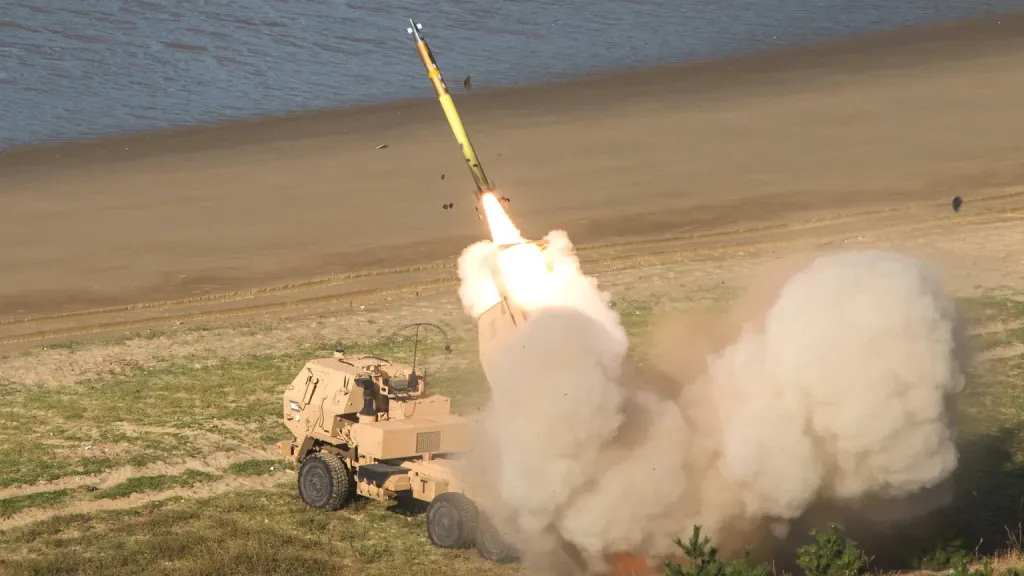
A US Army M142 HIMARS launcher vehicle fires a 227mm guided artillery rocket. The service says this is one launcher that could be used to fire AHSS missiles in the future. US Army
“AHSS is an entirely new missile,” a DEVCOM spokesperson said, according to Aviation Week. At the same time, the Army is also clearly in the very early stages of defining what it wants from this new weapon beyond general affordability and reach.
A graphic on display at DEVCOM’s booth at the SMD symposium showed renderings of two distinctly different notional missiles under the AHSS heading, as seen at the top of this story and below. One has a traditional ballistic missile-type design with a cruciform fin arrangement at the tail end. The other notional missile has a more novel design with an air-breathing propulsion system feeding from an intake in the nose. In broad terms, the intake has a style commonly associated with high-speed jet engines such as ramjets and scramjets. It also has a completely different tail configuration, as well as what appears to be a long, slender stabilizing strake visible along the right side of the body.
Jamie Hunter
Aviation Week‘s story also highlights the Army’s current separate development of an entire new family of Common Autonomous Multi-Domain Launcher (CAML) vehicles. However, the current AHSS concept also includes “an option to be launched from a crewed HIMARS,” the DEVCOM spokesperson said, according to that outlet.
The prototype uncrewed version of HIMARS seen here, called the Autonomous Multi-Domain Launcher (AML), was an important stepping stone to the CAML program. US Army The Autonomous Multi-domain Launcher (AML) prototype. US Army
US Marines load an ammunition pod into an M142 HIMARS launcher during an exercise. USMC
“This project directly supports Precision Fires capabilities by developing, maturing, and demonstrating affordable high speed strike missile technologies for responsive, mobile, deployable, survivable, and sustainable Army conventional theater strike weapons,” the Army said about AHSS in its 2027 Fiscal year budget proposal, which was released earlier this year. The program will “provide hardware and software technologies demonstrated, including affordable advanced propulsion, complementary warhead, guidance, navigation and control technologies, and integration onto Army mobile launch platforms.”
“The Army needs affordable, responsive high speed strike capability to attack theater level targets, provide offensive counter-air capability, and be launched from Army mobile, deployable, and survivable platforms,” the Army budget documents add.
The specific mention of the offensive counter-air (OCA) mission set is interesting as it is far more commonly associated with air assets. However, it is simply defined as “offensive operations to destroy or neutralize enemy aircraft, missiles, launch platforms, and their supporting structures and systems both before and after launch, and as close to their source as possible,” according to the January 2020 edition of the U.S. military’s official Dictionary of Military and Associated Terms. Long-range surface-to-surface missiles are very applicable for pursuing these objectives, something we will come back to later on.
It is also worth noting that DEVCOM’s graphic at the SMD Symposium used the exact same air-breathing missile render to represent the planned Increment 4 version of the Precision Strike Missile (PrSM). The baseline version of PrSM, or Increment 1, is a traditional short-range ballistic missile with ability to hit targets at least around 310 miles (500 kilometers) away, if not further. The Army’s current stated plan for Increment 4 is to acquire a new variant or derivative of PrSM with a range of at least 621 miles/1,000 kilometers. For further context, the Increment 2 PrSM, which is in active development now, is an anti-ship-focused variant with a new seeker system, allowing it to engage moving targets. The Increment 3 plan is centered on new unspecified “enhanced” payloads, which could include swarms of loitering munitions.
A look at the full DEVCOM graphic on display at the annual SMD Symposium this week. Jamie HunterA Lockheed Martin rendering of an air-breathing missile design tied to its work on an Increment 4 PrSM concept. Lockheed Martin
The Army has also talked in the past about an Increment 5 variation of PrSM with even greater range. This would put it in the same general category, at least in terms of reach, as AHSS. As noted, DEVCOM has stressed that AHSS is distinct from other existing efforts.
On top of this, defense startup Castelion is developing a ground-launched version of its Blackbeard missile for the Army. Blackbeard is a lower-cost design said to be capable of traveling at hypersonic speeds. The exact maximum range of this missile is unclear, but the Army has said in the past that it is targeting “80% of the Precision Strike Missile (PrSM) Increment 4 capability.”
Looking back at Castelion’s most important 2025 test flight on our path to deliver credible deterrence. Thanks to @Saronic for providing autonomous shipborne telemetry support that enabled critical data capture.
A key underlying factor in all of this was the collapse of the Intermediate-Range Nuclear Forces (INF) Treaty in 2019. Under the INF, the United States and Russia were both prohibited from developing and fielding nuclear or conventionally-armed ground-based ballistic and cruise missiles with maximum ranges between 310 and 3,420 miles (500 and 5,500 kilometers). The AHSS section in the Army’s 2027 Fiscal Year budget request specifically mentions that such developments are now “unconstrained by previous treaties.”
Depending on what kind of capability is ultimately pursued under AHSS, as well as PrSM Increment 5, the Army could be on track to field its first new medium-range ballistic missile (MRBM) since the INF went into force in 1988. MRBMs are categorized as ballistic missiles with maximum ranges between 620 and 1,860 miles (1,000 and 3,000 kilometers). Members of Congress have notably been openly supportive of the Army acquiring exactly this kind of long-range capability in the past.
Pairing this capability with new and improved crewed and uncrewed launchers could offer more flexibility for employing these weapons, while also helping to reduce vulnerability to enemy attacks. TWZ has highlighted now on several occasions how uncrewed mobile launch systems would offer even greater advantages for future expeditionary and distributed operations. Uncrewed platforms could be pushed further forward without necessarily exposing human operators to greater risks. This would also allow a smaller force of human personnel to operate a larger number of total launchers, in general.
As such, AHSS also underscores the importance of acquiring new, lower-cost munitions that are also more readily procurable, something that has become a focal point for the entire U.S. military in recent years. As a point of comparison, the unit cost of an Increment 1 PrSM is around $1.5 million. It is also a long-lead item where the time between when orders are placed and deliveries occur is measured in years.
What the timeline might be for AHSS developments to evolve into an actual operational capability is unclear. The Army has asked for just over $94.2 million to support AHSS work in the 2027 Fiscal Year. In its report, Aviation Week also noted that the service has previously disclosed that Australia is an international partner in the AHSS effort. This is a capability that could be of interest to other branches of the U.S. military and other foreign allies and partners. The U.S. Marine Corps, in particular, has an interest in longer-range strike capabilities to support its new expeditionary and distributed concepts of operations, and axed its plans to field Tomahawks fired from uncrewed 4×4 launcher vehicles last year,
With the Army exploring initial concepts for AHSS now, more about its vision for these missiles may begin to emerge.
New York City police arrested a man at Central Synagogue on hate crime charges after he disrupted a Shabbat service and allegedly assaulted a 63-year-old woman. File Photo Peter Foley/EPA
Aug. 15 (UPI) — A man in New York was arrested on hate crime charges after disrupting a Shabbat service and allegedly injuring a congregant in a Manhattan synagogue on Friday, police said.
Larry Montes, 46 of the Bronx, was arrested at Central Synagogue in the Upper East Side and charged with two counts of assault as a hate crime and one count of criminal mischief as a hate crime.
“As synagogue security was escorting him out, he struck a member of the congregation, damaged synagogue property, and then spit at and headbutted a member of the security team,” Police Commissioner Jessica Tisch said in a statement on X.
Amid the confusion, there were shouts of panic as people in the synagogue scrambled, CNN reported.
One congregant, a 63-year-old woman, suffered a cut to her lip and injuries to her right forearm, according to the news outlet.
“Every New Yorker must be able to observe their religion without fear of violence,” Mayor Zohran Mamdani said in a statement on X. “This despicable act has no place in our city, and our administration will do everything in our power to keep Jewish New Yorkers safe.”
As of August, 360 hate crimes were reported in the city this year, including 205 targeting Jewish people, The New York Times reported.
Sources told CNN that Montes has a history of mental health issues.
President Donald Trump wants the Strait of Hormuz, between Oman and Iran, to become U.S. territory. Photo by Stringer/EPA
Aug. 15 (UPI) — President Donald Trump on Friday said he wants the Strait of Hormuz to become U.S. territory.
Speaking at an event in New York, Trump said he plans to declare ownership of the waterway between Oman and Iran once the war is over.
“After we finish defeating Iran, which is being very badly defeated, pretty soon I’ll be declaring the Hormuz strait a territory of the United States,” Trump said, as reported by the Guardian.
“Essentially, that’s what it is,” he added. “We have the blockade — no ships get through unless we want them to.”
Iran’s deputy foreign minister, Kazem Gharibabadi, on Saturday called the president’s remarks “fanciful delusions.”
“Once and for all, accept the reality: up to this point, you have suffered strategic and heavy defeats,” Gharibabadi said in a statement on X. “The Strait of Hormuz has been Iranian, is Iranian, and will remain Iranian.”
“This strait will only be closed and opened under Iran’s command, and as long as you do not accept the reality of defeat and cease your fanciful delusions, Iran will continue to enforce the blockade,” Gharibabadi added.
Traffic through the strait, through which 20% of the world’s oil and gas usually pass, has slowed dramatically since Trump launched the war with Iran on Feb. 28.
Six ships traveled through the strait last weekend, where usually as many as 140 would pass in a single day, The Hill reported.
Both Trump and Iranian officials claim to have control of the strait.
“We have control over it, nobody else, only us,” Trump told reporters earlier this week, The Hill reported. “Our Navy is unbelievable and things are going great for our country.”
WASHINGTON — President Trump’s war against Iran is stretching the limits of U.S. aircraft carriers and leaving the western Pacific without one of the key American warships as China shows more signs of aggression.
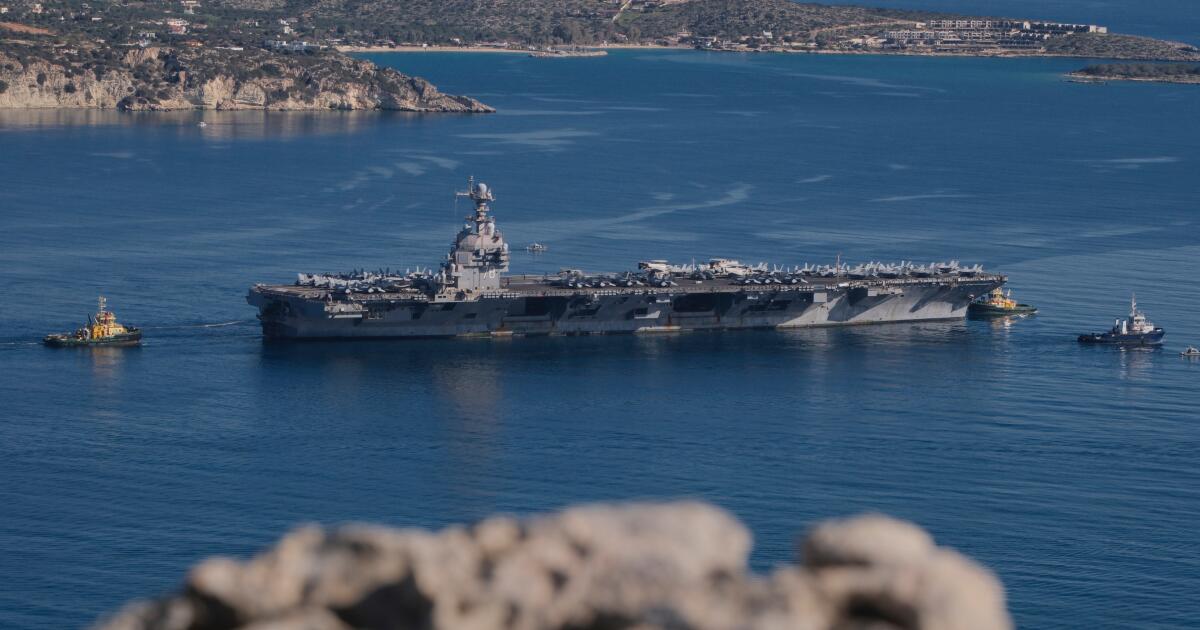
The USS George Washington is departing the Pacific to relieve the USS Abraham Lincoln in the Middle East, amid growing concerns about mental health and supply issues aboard the long-deployed carrier. The Lincoln has had its time at sea extended from its original May return date to support the war in Iran.
The lack of a U.S. carrier in the Pacific may be short-lived if the Navy deploys another in the next couple of months. But it shows how the open-ended operations with Iran are running some American sailors ragged, analysts say, while the Trump administration further retreats from the Asia-Pacific region and focuses on the Western Hemisphere.
“The administration says that the Pacific is supposed to be the most important behind the Western Hemisphere,” said Greg Poling, director of the Southeast Asia Program at the Center for Strategic and International Studies. Instead, the U.S. is “doing the exact opposite” of its previously expressed goal of pulling out of the Middle East.
American allies in the Pacific are unsettled over the unpredictability of the Trump administration, Poling said, while China “is quite happy with U.S. distraction, with the frustration of U.S. allies and partners.”
China may take advantage
Beijing sees the U.S. military presence in the region as a threat to China’s rise and an obstacle to its ambition to seize Taiwan, the self-governing island it claims as its own. But the United States has argued that the Pacific region is too important economically to lose.
No one expects China to invade Taiwan just because an American aircraft carrier has left the region. But the carrier’s absence gives the Chinese another opportunity to show its strength, said Bryan Clark, a former Navy submariner who is a defense analyst at the Hudson Institute.
“They’re using this as part of the narrative to demonstrate to the Philippines, to Japan, to Indonesia and others that the U.S. is not the big dog in the western Pacific anymore,” Clark said. “They would just prefer that countries in the region decide that China is the bigger power and the U.S. is not able to guarantee their security anymore.”
China conducted naval exercises this week with Indonesia and recently has shown signs of aggression toward Japan and the Philippines, two key U.S. allies that also have territorial disputes with Beijing.
China carried out military drills this month near the Scarborough Shoal in the South China Sea. Both China and the Philippines have claims over the shoal. Last month, a Chinese guided-missile destroyer conducted a live-fire exercise off Japan’s southernmost island of Okinotori.
Adm. Frank Bradley, head of the U.S. Special Operations Command, has been trying to reassure regional allies of Washington’s commitment. He was in Manila on Thursday, telling his Filipino counterparts that U.S. special operations forces are ready to step up joint exercises to strengthen the countries’ alliance. He also is expected to travel to Japan.
Evan Sankey, a policy analyst at the Cato Institute who focuses on U.S. policy toward China, said aircraft carriers provide psychological assurance to U.S. allies. The absence of carriers in the region, he said, “adds to the general sense that the U.S. is distracted by events in the Middle East.”
Trump has relied on aircraft carriers for military actions
Trump has relied heavily on aircraft carriers to support his numerous military operations during his second term. The USS Gerald R. Ford returned home in mid-May after an 11-month deployment, the longest since the Vietnam War, during which it supported the U.S. fight against Iran and the capture of Venezuelan President Nicolás Maduro.
The Ford had experienced a fire in a laundry space that forced the carrier to turn around and return to the Mediterranean Sea for repairs and left hundreds of sailors without places to sleep.
The USS Lincoln has been at sea 268 days as of Saturday, a record deployment without a port visit, as the Ford had. Democratic lawmakers and families of the sailors have been calling for investigations and greater visibility into conditions aboard the ship, which is preparing to return to its home port in San Diego.
Warships and their crews can handle only so much, said Robert Farley, who teaches national security and diplomacy at the University of Kentucky and often writes about aircraft carriers.
“People don’t get enough rest. It’s psychologically exhausting. And R&R is part of keeping the crew healthy,” Farley said. “Sometimes it’s framed as, ‘These people haven’t had a vacation.’ But we are dealing with well-known limits on the capacity of a crew to operate at top efficiency over time. And that just declines.”
Clark, of the Hudson Institute, said the squeeze on the nation’s aircraft carriers stems from the lack of preparation and planning for the Iran war.
“If we were going to mobilize to do this kind of conflict, and we anticipated it might go this long, we might have done some changes to the carrier schedule to make sure more would be available,” Clark said.
Clark said the Navy has 11 aircraft carriers and typically deploys two or three at a time. But it could soon deploy four if the USS Theodore Roosevelt leaves San Diego for the Middle East, allowing the Washington to return to Pacific.
But the massive warships will need maintenance, probably causing a bottleneck at the nation’s only two carrier shipyards.
“We’ll end up with a maintenance debt that needs to be paid for the next few years,” Clark said. “We’ll probably have less carrier presence than we’ve had in the previous years because carriers will be lined up to get into the shipyard.”
Role in modern warfare
Michael Swaine, a senior research fellow in the Quincy Institute’s East Asia Program, questions the future need for aircraft carriers as warfare rapidly changes.
Carriers can be more easily targeted with drones and missiles, particularly by an adversary such as China, Swaine said, while smaller ships and submarines can be as effective in striking targets as the fighter jets that launch off a carrier.
Top Navy officials have indicated a desire to move away from a heavy reliance on carriers. Adm. Daryl Caudle, chief of naval operations, told the Associated Press in February that he wants to convince commanders to use smaller, newer ships and other assets instead of consistently turning to huge aircraft carriers.
Aug. 15 (UPI) — Five people were injured by multiple shooters at Virginia State University in Ettrick, Va., early Saturday morning.
Police responded to the area outside of residence halls around 1:30 a.m. and found five people with gunshot wounds. They were taken to the hospital, and one is in critical-condition. The others had injuries that weren’t life-threatening.
The campus, which had not started fall-semester classes yet, was put on lockdown until about 8:30 Saturday morning. But police have not said if anyone has been arrested. Residence halls opened a week ago, and classes are set to begin Monday.
The Chesterfield County Police Department is investigating the incident with the help of VSU police, the Hanover County Sheriff’s Office and the Bureau of Alcohol, Tobacco, Firearms and Explosives.
Virginia State is a historically Black university about 24 miles south of Richmond. It has about 5,100 students enrolled in undergraduate programs.
Federal authorities charged Melissa L. Farris, 41 of Kentucky, with felony vandalism for allegedly spray painting the National Mall’s World War II Memorial. Photo courtesy of U.S. Attorney’s Office in Washington, D.C.
Aug. 14 (UPI) — A Kentucky woman was arrested for allegedly vandalizing the National Mall’s World War II Memorial, officials said Friday.
Melissa L. Farris, 41 of Elizabethtown, is charged with depredation against federal property and destruction of veterans’ memorials, both of which are felonies. She faces 10 years in prison on each charge.
“Vandalizing our World War II Memorial is a despicable attack on a sacred monument honoring the Americans who fought and died for our freedom,” U.S. Attorney Jeanine Pirro said in a statement on X.
Farris was arrested about 2 p.m. on Thursday when U.S. Park Police responded to reports of a disorderly person, according to the criminal complaint.
The words “Clean Hands Dirty $” were sprayed onto the walls in orange paint. There were also splatters of green and pink paint.
Officials said Farris had been arrested four days earlier for allegedly camping on federal property, the criminal complaint said.
She is also alleged to have posted videos on social media admitting to the vandalism.
In the postings, Farris said she is “cognitively aware” and “doing so to push my whistleblower case into the courtroom,” according to the criminal complaint.
“Our beautiful World War II Memorial was just hit by Spray Painting Vandals,” President Donald Trump said in a statement on Truth Social. “THERE CAN BE NO GREATER INSULT TO THOSE AMERICAN HEROES WHO DIED IN WORLD WAR II.”
Members of the National Guard patrol near the Washington Monument on Tuesday. Photo by Bonnie Cash/UPI | License Photo
Aug. 14 (UPI) — An American missionary who was kidnapped in Niger last fall has been released, officials said Thursday.
Kevin Rideout, 50, was abducted by three men from outside his home in the capital of Niamey on Oct. 21.
The details of his release are unclear, but he was in FBI custody and in good health as of Thursday, The New York Times reported.
Rideout, a pilot, was in Niger working for SIM, a North Carolina-based missionary organization.
“We are grateful to confirm that our good friend and brother in Christ, Kevin Rideout, has been released after over nine months in captivity,” SIM International Director Phil Bauman told CNN in a statement. “Kevin is in good health in the care of US officials.”
President Donald Trump said “the United States of America looks forward to welcoming” him home.
“Kevin was kidnapped by Jihadi terrorists in West Africa – the epicenter of Islamist terrorism, where there have been more deadly attacks in the past year than anywhere else on Earth,” the president added on Truth Social.
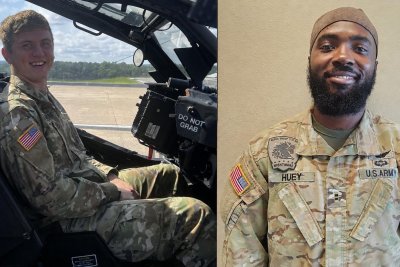
Two U.S. Army pilots were killed when an Apache attack helicopter from Fort Hood crashed in Texas. They were identified as Chief Warrant Officer 2 Deontre T. Huey (right) and Warrant Officer Seth L. Olmstead (left). Photo courtesy of the U.S. Army
Aug. 14 (UPI) — The U.S. Army on Friday identified the two soldiers killed when an Apache attack helicopter from Fort Hood crashed in Texas.
The pilots were Chief Warrant Officer 2 Deontre T. Huey and Warrant Officer Seth L. Olmstead, military officials said in a statement.
They died on Wednesday near Salado when the helicopter, an AH-64E Apache, “experienced a mishap” during a maintenance test flight.
“Our hearts and deepest condolences are with the families of the soldiers we lost Wednesday,” said Lt. Gen. Kevin D. Admiral, III Armored Corps and Fort Hood commanding general, in a statement.
“The Army is a family, and a tragedy like this is felt throughout our formations and our community,” Admiral added.
Huey and Olmstead were assigned to Bravo Company, 1st Battalion, 227th Aviation Regiment, 1st Air Cavalry Brigade, 1st Cavalry Division.
Huey, 34 of Killeen, Texas, enlisted in the Army in February 2014 as a motor transport operator. He had been assigned to the unit since February 2022.
Olmstead, 25 of Belton, Texas, joined the Army in January 2024 as a warrant officer candidate. He had been assigned to the unit since October 2025.
The crash of the helicopter sparked a large wildfire in the area, forcing some local residents to evacuate.
Officials said the fire covered some 155 acres.
On Thursday, a safety investigation team from the U.S. Army Combat Readiness Center in Fort Rucker, Alabama, arrived to lead the investigation into the incidents.
Health officials in California are defending the traditional childhood vaccination schedule against efforts by the Trump administration to weaken it.
The longstanding childhood vaccine schedule is safe, California’s top health official said, and continues to be recommended by the American Academy of Pediatrics — the nation’s leading group for pediatricians — as well as the other states in the West Coast Health Alliance: Hawaii, Oregon and Washington.
“They’re safe. They’re important for kids to be thriving and healthy in schools,” Dr. Erica Pan, director of the California Department of Public Health and the state public health officer, said of vaccines. And she credited California’s robust vaccine requirements as a condition of enrollment for schoolchildren as a reason why the state so far has kept a lid on the huge outbreaks of measles seen in other parts of the nation.
Her full-throated defense comes after President Trump issued an executive order Monday recommending that the singular measles, mumps and rubella, or MMR, vaccine should be separated into three and that all childhood immunizations should be given at separate visits “to the maximum extent feasible.”
“We want it in three separate vaccinations, given at separate times,” he said during the signing ceremony. “Together, there could be a possibility they’re quite lethal. And separately it looks like they are not at all lethal, but just very effective.”
The American Academy of Pediatrics blasted the order as “unscientific and dangerous,” and criticized comments made by administration officials suggesting a link between autism and vaccines — a claim that has been discredited by many studies.
“Dozens of studies involving millions of people show there is no link between vaccines and autism, and yet federal leaders continue to promote this outdated, disproven idea to scare families,” said the academy’s president, Dr. Andrew Racine.
The Infectious Diseases Society of America has been equally unequivocal.
“The MMR vaccine does not cause autism,” the group says on an online fact page, adding that the measles vaccine prevents thousands of deaths a year worldwide.
Pan said Trump’s executive order does not change vaccine requirements for schoolchildren in California. And insurance companies continue to cover vaccinations for schoolchildren.
When Trump was asked whether there was any evidence for his claims regarding the MMR vaccine, he answered: “No. What I’ve heard is that there are some people that say it is that way, and I say, ‘Well, let’s say there’s a 5% chance of it. Let’s split it up.’ ”
There is no evidence to back up those assertions, medical organizations and mainstream experts say. The first version of the combination MMR shot was approved in 1971, and versions of it have been given to hundreds of millions of children safely over several generations, with more than 90% of children receiving the shot nationally, experts say.
Combining protection against the three diseases has been considered a miracle of modern medicine. Before the vaccine era, hundreds of children a year in the U.S. were either killed by measles or suffered swelling of the brain as a result of the disease. Tens of thousands were also hospitalized each year.
Mumps can cause deafness and inflame the brain, pancreas, testicles, ovaries and breast tissue. And rubella risks causing severe birth defects in pregnant women.
“There is no data supporting doing this in separate shots,” Pan said. “And, in fact, it will take more visits and more pokes in the arm, literally, for children to do this.”
With vaccination rates declining in many parts of the country, measles has resurged in the U.S. in the past two years, resulting in the first child deaths from the disease in 22 years, as well as hundreds of pediatric hospitalizations.
So far this year, there have been 2,566 cases of measles nationwide, which is already more than the 2,289 reported in all of 2025, according to data from the U.S. Centers for Disease Control and Prevention. The most recent case count is also higher than any calendar year since 1991 — the final year of the nation’s last measles epidemic.
Beyond scheduling difficulties for parents, clinics and doctors’ offices, no company even makes separate immunizations for measles, mumps and rubella, Pan said. “There’s no scientific basis for it. There’s no current availability to do that.”
Trump’s executive order further recommends that children should get vaccinated against 11 diseases, a reduction from the 18 currently recommended by the CDC. The order also suggested that his administration would challenge certain states’ laws that require vaccination as a condition of entry into schools.
California in 2015 enacted a law that strengthened vaccine requirements for schoolchildren. The law ended the ability of parents to cite personal beliefs in seeking to exempt their children from certain vaccinations.
Children can still be exempted and attend school in California if they have a medical reason. And California law does allow parents to skip immunizations for children who are enrolled in independent study programs and do not receive classroom-based instruction.
California’s law was passed following a large measles outbreak centered at Disneyland that resulted in 131 cases in California alone, and spread to six other states, as well as Canada and Mexico. At least 12 of those infected in California were infants too young to be vaccinated.
After the law passed, California saw its measles vaccination rates improve. In 2013, the vaccination rate among California kindergartners hit a low of 92.3%, below the 95% threshold doctors say is needed to keep a lid on outbreaks. Since the law took effect, that rate has ranged between 95.1% and 97.3%.
The most recent figure was 96.1% for the 2024-25 school year.
States that have suffered large measles outbreaks have poorer vaccination rates. South Carolina, for instance, has been home to an outbreak linked to about 1,000 cases — considered one of the largest in the U.S. in more than 30 years. That state’s most recent kindergarten measles vaccination rate was 91.2%, well below the optimal 95% threshold.
There are five immunizations required as a condition of entry into kindergarten in California: polio; DTaP, which protects against diphtheria, tetanus and pertussis; hepatitis B; MMR; and varicella, or chickenpox.
California’s most severe measles epidemic in recent memory occurred between 1988 and 1990 — an era before health officials recommended children receive a second dose of the measles vaccine. That epidemic led to 75 deaths in California and more than 3,000 hospital admissions. A major problem officials identified at that time was that poor parents could not afford vaccinations for their children. One of the nation’s largest outbreaks in 1989 involved mostly preschool-aged children in Los Angeles.
There was also a national measles epidemic between 1989 and 1991, which, according to a study published by the CDC, led to 166 suspected measles deaths and more than 11,000 hospitalizations.
Recommendations to give children a second dose of the vaccine, and the introduction of the federal Vaccines for Children program in the 1990s to help parents pay for immunizations, were credited with driving measles circulation down to historic lows.
Doctors say that it has been striking to see the U.S. go from a place where ongoing domestic measles transmission was effectively eliminated in 2000 to being on the precipice of the disease regaining a foothold.
“We’re seeing in this country cases, hospitalizations and deaths higher than we’ve seen in over 30 years,” Pan said. “We did such a great job — we eliminated measles by the year 2000, and now we’re going backward.”
Lawrence Mayor Brian DePena, 61, was charged with wire fraud and money laundering for allegedly using $1.,5 million in COVID loans for small businesses to fund his campaign, pay personal taxes and pay off other loans. DePena applied for pandemic relief loans in 2020 and 2021 to support Tenares Tire Services, an auto shop he owned in Lawrence. Photo courtesy of U.S. Attorney’s Office in Massachusetts
Aug. 14 (UPI) — A Massachusetts mayor was arrested Friday on charges of fraudulently obtaining more than $1.5 million in COVID loans for small businesses, federal prosecutors said.
Lawrence Mayor Brian DePena, 61, was charged with wire fraud and money laundering for allegedly using the loans to fund his campaign, pay personal taxes and pay off other loans.
DePena applied for pandemic relief loans in 2020 and 2021 to support Tenares Tire Services, an auto shop he owned in Lawrence.
Prosecutors say he used nearly $900,000 of the loans to pay off mortgages, $85,000 for personal tax debts and at least $130,000 to fund his campaign.
“This was emergency financial assistance meant to be a safety net for struggling businesses, not Mr. Depena’s own personal ATM,” said Ted Docks, special agent in charge of the FBI’s Boston office, in a statement.
DePena was first elected mayor of Lawrence in 2021 and was reelected last November.
If convicted, he faces up to 20 years in prison for each charge.
“Mayor DePena was elected to be a leader for the City of Lawrence,” U.S. Attorney Leah Foley said in a statement. “He was looked up to and trusted by his constituents, but he betrayed that trust through his alleged corruption and lies,”
Todd Burkhalter, the founder and CEO of Drive Planning in Atlanta, Ga., ran a years-long scheme that defrauded thousands of investors of nearly $400 million, prosecutors said. File Photo by Mike Theiler/UPI | License Photo
Aug. 14 (UPI) — An Atlanta executive was sentenced to 20 years in prison on Friday for running what authorities described as “likely the largest Ponzi scheme in Georgia history.”
Todd Burkhalter, the founder and CEO of Drive Planning, ran a years-long scheme that defrauded thousands of investors of nearly $400 million, prosecutors said.
He used the funds for lavish purchases, including a $2 million yacht, a $2.1 million luxury condo in Cabo San Lucas, Mexico, and $800,000 in vehicles.
“Todd Burkhalter lured investors to send millions of dollars to Drive Planning for investments that he knew didn’t actually exist,” Georgia U.S. Attorney Theodore Hertzberg said in a statement.
“He promised investors that they were guaranteed substantial returns on their investments, and he ruthlessly encouraged them to deplete their kids’ college funds, take early distributions from retirement accounts, and borrow significant sums at high interest rates,” he added. “The sentences in this case should discourage other financial advisors from choosing insatiable greed and lies over honest investment strategies.”
FBI Special Agent in Charge Marlo Graham said Burkhalter brazenly continued his scheme even while under federal investigation.
“Todd Burkhalter organized what is likely the largest Ponzi scheme in Georgia history to fund an extravagant lifestyle,” Graham said in a statement.
Prosecutors said Burkhalter defrauded more than 2,000 investors from September 2020 to June 2024.
He has also been sentenced to pay more than $230 million in restitution.
Earlier this week, two other people were sentenced in the scheme.
The company’s chief operating officer, David Bradford, was sentenced to four years in prison and $4.2 million restitution.
Julie Edwards, Drive Planning’s chief administrative officer, was sentenced to to years prison and ordered to pay $630,000 in restitution.