The United States on Sunday responded to Iran’s latest proposal to end the U.S.-Isreali war there, which has led to tankers like the pictured Indian-flagged carrier unable to transit the Strait of Hormuz. File Photo by Divyakant Solanki/EPA
May 3 (UPI) — Iran said on Sunday that it is reviewing the United States’ response to its most recent peace proposal, a 14-point plan that was reviewed by President Donald Trump on Saturday night.
The response was delivered to Iranian negotiators on Sunday, Iranian state media outlets PressTV and Tasnim reported, with officials clarifying some reports on the plan they said have been incorrect.
The 14-point plan is entirely focused on bringing an end to the two-month-old conflict, with no provisions about nuclear materials or other weapons, Esmaeil Baghaei, spokesperson for Iran’s foreign ministry, said in an interview.
When asked about Iran’s new plan on Saturday, Trump expressed doubt that it would meet U.S. requirements but said that he would be reviewing its exact language last night.
“The plan we have presented is centered on ending the war,” Baghaei said. “There are absolutely no details regarding the country’s nuclear issues in this proposal.”
The basics of Iran’s proposal are focused on ending hostilities and then opening a 30-day period for intense negotiation of other issues, including the withdrawal of U.S. military forces from areas around the country, lifting the U.S. naval blockade and ending the war on all fronts, including in Lebanon, Tasnim reported.
But Baghaei said that reports of a suspension of nuclear activities or U.S.-Iran cooperation on clearing mines from the Strait of Hormuz are not true.
“These are among the things that I believe are fabricated by the imagination of some media outlets,” Baghaei said. “We are not currently engaged in any negotiations over the nuclear issue and decisions about the future will be made in due course.”
Iranian officials said that the U.S. proposal had included a two-month cease-fire, which Iran countered with a 30-day period to resolve issues and to actually end the war.
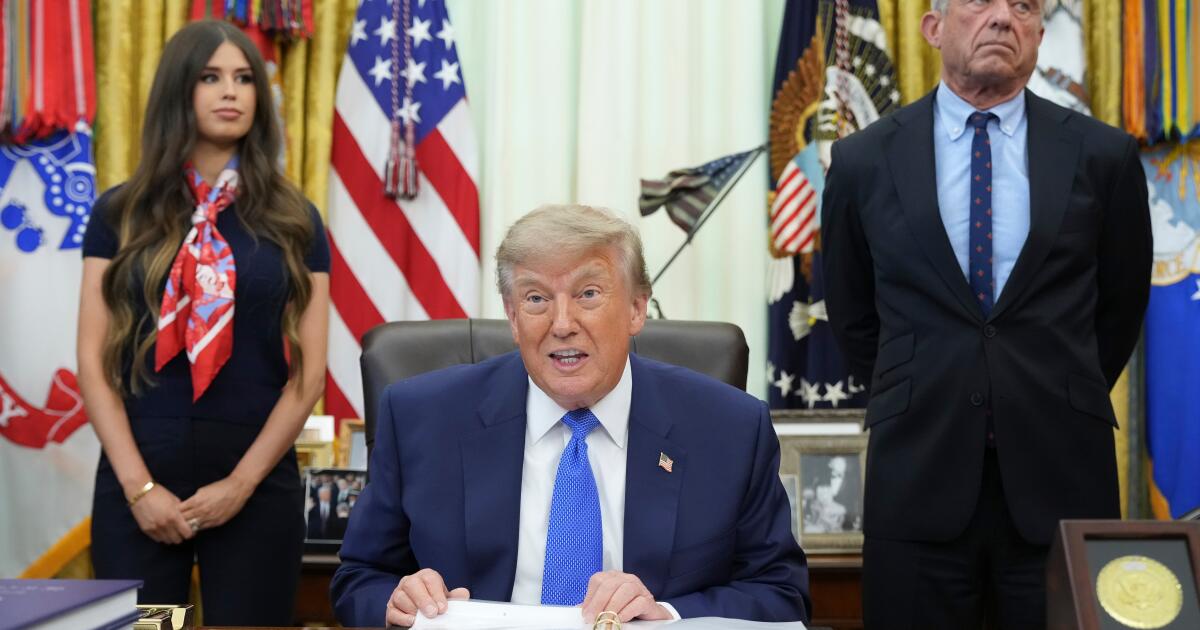
President Donald Trump signs a series of executive orders in the Oval Office of the White House on Thursday. Trump signed an order to expand workers’ access to retirement accounts. Trump also signed legislation ending a 75-day partial shutdown of the Department of Homeland Security after the House voted in favor of funding. Photo by Aaron Schwartz/UPI | License Photo
Members of the U.S. Army and Tunisian Armed Forces discuss training objectives during explosive ordnance disposal squad tactics exercises in Bizerte, Tunisia, during African Lion 2026. Two soldiers were reported missing on Saturday night in an incident unrelated to the military exercise. Photo by Staff Sgt. Cameron Christensen/U.S. Army
May 3 (UPI) — Two members of the U.S. Army were reported missing during a training event in Morocco on Sunday morning by the United States Africa Command.
The soldiers were participating in the U.S. military’s largest Africa-based exercise, African Lion, when the soldiers went missing on Saturday night during near the Cap Draa Training Area, which is near the city of Tan Tan, Morocco, AFRICOM said in a press release.
Military officials said their disappearance is unrelated to the exercise, but rather than they had gone on a hike near the training range and may have slipped off a cliff into the ocean, The New York Times reported.
“U.S., Moroccan and other assets from African Lion immediately initiated coordinated search and rescue operations, including ground, air and maritime assets,” AFRICOM said in the release.
“The incident remains under investigation and the search is on-going,” the command said.
The soldiers were discovered missing during a base-wide head-count around 9 p.m. local time, with helicopters searching throughout the night and various aircraft — including larger planes and drones — picking up the search on Sunday morning near the coast, CBS News reported.
African Lion is an annual joint military exercise that includes the U.S. military, NATO allies and African partner nations, and is hosted by Morocco, Ghana, Senegal and Tunisia, according to U.S. Army Europe and Africa.
This year’s event, scheduled to run from April 27 to May 8, includes 5,000 people from 40 countries.
President Donald Trump signs a series of executive orders in the Oval Office of the White House on Thursday. Trump signed an order to expand workers’ access to retirement accounts. Trump also signed legislation ending a 75-day partial shutdown of the Department of Homeland Security after the House voted in favor of funding. Photo by Aaron Schwartz/UPI | License Photo
May 2 (UPI) — Spirit Airlines closed Saturday morning, with no options for those already booked on the airline.
“Unfortunately, despite the company’s efforts, the recent material increase in oil prices and other pressures on the business have significantly impacted Spirit’s financial outlook,” the airline said in a statement. “With no additional funding available to the company, Spirit had no choice but to begin this wind-down.”
All flights are canceled, and passengers shouldn’t go to the airport, Spirit said. Those who booked directly with the company will get refunds, but others should reach out to their travel agent or booking site, the company said.
The company reported around 17,000 employees as of the shutdown.
“We’ve activated our airline partners to ensure passengers are not stranded, communities maintain route access, fares do not skyrocket, and Spirit’s workforce is connected to new job opportunities,” Secretary of Transportation Sean Duffy said in a statement.
United, Delta, JetBlue and Southwest are all capping ticket prices for Spirit customers who now need to rebook cancelled flights, Duffy’s statement said. But those prices will only be available for 72 hours.
Last week, President Donald Trump said the government could buy the airline, and it has been working on a $500 million rescue plan that would give the government a large ownership stake. But the company couldn’t get support between bondholders and the government for the deal.
Trump told reporters at the White House Friday that an announcement about Spirit was coming within the next couple of days.
“I guess we’re looking at it. If we could do it, we’d do it, but only if it’s a good deal,” Trump said about a bailout plan. “But if we can’t make a good deal – no institution’s been able to do it. I said I’d like to save the jobs. … I would say we’re driving a tough deal, but it’s one of those things. We will do it or we won’t.”
Spirit CEO Dave Davis explained the shutdown.
“The sudden and sustained rise in fuel prices in recent weeks ultimately has left us with no alternative but to pursue an orderly wind-down of the company,” Davis said in a statement. “Sustaining the business required hundreds of millions of additional dollars of liquidity that Spirit simply does not have and could not procure. This is tremendously disappointing and not the outcome any of us wanted.”
Spirit customer Angela Moreno told NBC News that she was planning to fly from Fort Lauderdale to Nashville for a wedding Saturday.
“The whole family is going there from different states, so it’s very shocking,” she said. “There’s many people who cannot attend the wedding as of now.”
She said she’s struggling to find replacement tickets.
“They’re refunding the tickets, but the only tickets right now are $600,” she said. “I hope the best for those people who really needed that flight.”
Henry Hartevelt, airline industry analyst at Atmosphere Research Group, told The Washington Post that Spirit was struggling long before the war. Bad business decisions, overexpansion and loss of focus caused its internal issues, and increased competition from other budget airlines added to its woes.
Spirit’s core demographic earns less than $80,000 per year, and those customers took the brunt of the inflation hit during the COVID-19 pandemic, he added.
“So [there’s] no single cause of Spirit’s demise, but Spirit has been teeter-tottering on the verge of shutting down for a long time,” Harteveldt told The Post. “It’s very unfortunate. More than [17,000] people may lose their jobs if it does shut down, and we lose an airline and a source of price competition.”
A Texas judge extended a temporary injunction on the state health department’s ban on smokable hemp, which went into effect this year after Texas Gov. Greg Abbot vetoed a ban passed last year by the state legislature. File Photo by Paul Brinkmann/UPI
May 2 (UPI) — A Texas judge on Friday temporarily paused the state’s ban on smokable hemp products, such as flower and joints, after three industry groups and multiple companies based in the state sued over it.
The state in March expanded its limit on THC in hemp products from 0.3% levels of Delta-9 THC to cover any form of THC beyond the state’s previous limit of 0.3% total THC in dry weight of the intoxicating group of chemicals.
This variety of chemicals includes Delta-8, various forms of Delta-9, and all other cannabinoids, with the exception of CBD and CBG.
The rule adopted by the state’s health department effectively banned all smokable forms of hemp because vapes and e-cigarettes that contain any form of cannabinoid were banned in Texas last September, the Texas State Law Library reported.
Since the federal government fully legalized hemp with low levels of Delta-9 THC, companies have produced hemp with boosted levels of other cannabinoids, including THCA, a non-psychoactive chemical that converts to Delta-9 THC when heated.
The groups that used the state contend that the health department overstepped their constitutional authority and that the new rules have done irreparable harm to the Texas hemp industry, CBS Austin reported.
“We are obviously excited about this ruling,” said Jason Snell, one of the attorneys that represents the industry groups and companies, KUT News reported.
“[The judge] issued a statewide injunction which prohibits what we believe are illegal rules from going into effect, which would cripple the hemp industry statewide and deprive consumers and every day Texans from access to legal products,” Snell said.
The Texas legislature last May passed a bill that would have effectively banned all of the products, but Texas Gov. Greg Abbot vetoed, which led the health department attempting to ban the products itself.
A previous temporary restraining order on the rule was set to expire Friday afternoon at 5 p.m., but the ruling — which covers all consumable hemp products — will now allow the industry to keep doing business.
President Donald Trump signs a series of executive orders in the Oval Office of the White House on Thursday. Trump signed an order to expand workers’ access to retirement accounts. Trump also signed legislation ending a 75-day partial shutdown of the Department of Homeland Security after the House voted in favor of funding. Photo by Aaron Schwartz/UPI | License Photo
May 2 (UPI) — A company that makes the abortion drug mifepristone on Saturday asked the U.S. Supreme Court to immediately pause a ruling that prevents doctors from prescribing it during telehealth visits.
Late Friday, a three judge panel on the 5th Circuit Court of Appeals unanimously ruled in favor of the state of Louisiana in a case asking the court to block doctors from prescribing the drug in telehealth visits.
Louisiana in the last four years has moved to prevent women in the state from obtaining abortion care legislators there were among the first to ban abortion after the repeal of Roe v. Wade, and later blocked doctors from prescribing the medical abortion pill in virtual telehealth visits.
The company, which is not the only drugmaker planning to file an appeal, said that patients will be stuck in limbo because of the lack of clarity it leaves for legal use of the drug, NBC News and Politico reported.
Roughly half of all abortions in the United States are performed using medications.
“Danco has been free to rely on procedures set by the FDA to distribute its product,” lawyers for the company said in a filing with the court.
“The Fifth Circuit’s decision immediately ends that,” the lawyers said. “A stay should issue to prevent the disruption and confusion that will result if the decision below were to remain operative.”
In addition to Danco, Politico reported that GenBioPro, which also manufactures the drug, has indicated that it will also file an appeal with the court.
Mifepristone was approved by the U.S. Food and Drug Administration in 2000 for medical termination of pregnancy and, until the COVID-19 pandemic, could only be prescribed during in-person appointments.
Early in the pandemic and the country locked down in an effort to stem the spread of the virus, doctors sued the FDA to allow them to prescribe mifepristone during telehealth visits.
The FDA temporarily changed the rule, but in 2023 adopted it permanently as some states started to restrict access to abortion and abortion services after the Supreme Court struck down Roe v. Wade.
Pharmaceutical companies and patient advocates warned that the restriction circumvents the FDA’s regulatory authority, which is based on evidence and data, and that it may offer a path for people to challenge other medications based on personal interest or opinion.
In the case of Danco, it also immediately filed the appeal because it is the only product it makes and “without a valid legal framework for distributing that product, Danco will lose its only source of revenue and may be unable to continue operating.”
President Donald Trump signs a series of executive orders in the Oval Office of the White House on Thursday. Trump signed an order to expand workers’ access to retirement accounts. Trump also signed legislation ending a 75-day partial shutdown of the Department of Homeland Security after the House voted in favor of funding. Photo by Aaron Schwartz/UPI | License Photo
Every two years for more than a decade, Melani Candia has gotten approved to stay in the U.S. with her husband and two cats and — more recently — continue to work in special education in Florida.
But this year, delays in Deferred Action for Childhood Arrivals, a program that has shielded her and hundreds of thousands of others from deportation, led to her missing her renewal deadline, losing her job and fearing detention in the country she has called home since she was 6 years old.
She said that as an immigrant in the U.S., fear has become her “new baseline.” “But now, having a new level of vulnerability, it was a very quick increase in the fear,” said Candia.
Renewal wait times for the Obama-era program that allows people who were brought to the U.S. as children to temporarily remain in the country and work have increased to levels not seen since 2016 when there were significant technical issues.
Some of the program’s more than 500,000 beneficiaries, often referred to as “Dreamers,” have waited months for an answer only to see their deadline pass without a decision. Now they’re stuck in a type of limbo in which their work authorization disappears, oftentimes along with their driver’s license, and their ability to stay in the U.S. is at risk.
“It’s not just anecdotal; it’s happening at a larger scale than we’ve ever seen before,” said Greisa Martinez Rosas, executive director of United We Dream, an immigrant youth-led network.
No numbers were available on how many people have recently missed their renewal deadline despite applying 120 to 150 days before their DACA lapses, which is what U.S. Citizenship and Immigration Services, or USCIS, recommends.
“Under the leadership of President Trump, USCIS is safeguarding the American people by more thoroughly screening and vetting all aliens, which can lengthen processing times,” Zach Kahler, an agency spokesperson, said in a statement.
Wait times nearly 5 times longer
DACA grants those who qualify two-year, renewable permits to live and work in the U.S. It does not confer legal status but is meant to offer protection from deportation.
From October 2025 through the end of February 2026, the median wait time for renewals was about 70 days, compared with about 15 days in fiscal year 2025, according to USCIS. This is the longest median wait time since 2016, when it was about 79 days, according to the agency’s data, which did not include 2020 because of the pandemic.
The Department of Homeland Security attributed the 2016 delays to technical issues that emerged as it transitioned to fully processing DACA renewals in its electronic immigration system.
At the end of April, USCIS was reporting that the majority of renewal requests were being completed within about 122 days. That marked a two-week increase from the processing times listed earlier that month.
Federal lawmakers and immigrant groups say some applicants recently have had to wait six months — about 183 days — or longer.
“The delays that people are concerned about used to be sort of a matter of weeks at a time,” Sen. Alex Padilla (D-Calif.) said in an interview. “Now it’s from a few months to many, many months.”
He is one of dozens of lawmakers behind letters sent to federal agencies that question the inflated wait times and whether people who have missed their renewal deadline are being targeted for arrest or deportation.
More than five months after Elsa Sanchez submitted her DACA renewal request, she is still waiting for an answer. When the deadline passed at the beginning of April, she was put on leave at her job at a healthcare IT company and now, as a single mother of a college freshman, has no income.
It’s made her worried about everything from traveling to spending money on pricier household products like shampoo and detergent.
“I’m like, ‘I don’t know, maybe I can cut down on that. Maybe I don’t need this,’” she said. “Because I’m saving every penny.”
Sanchez said something similar happened about a decade ago, but this time she’s scared of the possible repercussions amid Trump’s mass deportation agenda.
Since DACA’s introduction in 2012, it’s faced myriad legal battles, including two that made it to the Supreme Court. And now, though the government is still approving renewals, a 2025 federal court decision means it isn’t processing first-time applications and has left the door open for another possible trip to the Supreme Court.
Hundreds of ‘Dreamers’ arrested
In the first 11 months of 2025, more than 250 DACA recipients were arrested and 86 deported, then-Homeland Security Secretary Kristi Noem said earlier this year. She said the majority of those arrested had “criminal histories,” without indicating the nature of the crimes or if they were arrests, charges or convictions.
In a separate response to a Democratic congresswoman’s inquiry, Homeland Security reported conflicting numbers, saying that 270 were arrested and 174 DACA applicants were removed in the first nine months of 2025.
Their eligibility is dependent in part on not having a felony conviction, a significant misdemeanor or three misdemeanors. Previously, if their status was in jeopardy, they would get a warning and still have the chance to fight it before immigration officers detained them and began efforts to deport them.
Kahler of USCIS said that DACA recipients are not automatically protected from deportation.
“Any illegal alien who is a DACA recipient may be subject to arrest and deportation for a number of reasons — including if they committed a crime,” he said, using an outdated term for immigrants widely considered disparaging.
U.S. Immigration and Customs Enforcement did not respond to questions about whether DACA beneficiaries were being targeted after missing their renewal deadlines.
But federal lawmakers have recently noted people picked up by Immigration and Customs Enforcement after their DACA lapsed.
Their protections may have been further eroded with a precedent decision recently in which the Board of Immigration Appeals determined that DACA status alone is not enough to stop deportation.
Losing DACA eligibility, and a job
Experts have suggested the longer wait times could be related to the restarting of biometric appointments, which were paused during the COVID-19 pandemic emergency. Some may also not be getting approved by their deadline because they’re not sending it in by the recommended time.
Maria Fernanda Madrigal is an immigration attorney and DACA recipient who submitted her renewal application about a month and a half before the deadline because she said that’s all the processing time that’s been needed in the past. She said she was also waiting for her job to hold a DACA workshop so she could get the more than $550 fee for renewal waived.
Her DACA lapsed recently, and the mother of three was let go from her job.
“My first concern was my cases, to be honest, because I knew I was going to have to hand off everything, and my team is already overworked,” said Madrigal.
Immigration attorneys have also said that USCIS has paused processing renewals for people from dozens of countries the agency described in recent policy memorandums as “high-risk” following presidential proclamations. The National Immigration Law Center estimated that as many as 3,000 to 4,000 people could be impacted.
“This process that has no timeline is leading to people from certain countries experiencing a pause. And we don’t know how long that pause will be in place,” said Ignacia Rodriguez Kmec, attorney at the National Immigration Law Center.
Every day, Candia checks on her renewal. She said she’s most afraid of being locked up in bad conditions in an ICE detention facility, but also thinks about what it would be like returning to Bolivia after more than 25 years.
“If God forbid that happened, it would break my heart because I’ve been in this country since I was 6,” she said. “My entire life is here.”
May 2 (UPI) — An Iranian general said more fighting with the United States is “possible” after President Donald Trump rejected the most recent peace plan offered by Iran.
“Evidence has shown that the United States is not committed to any promises or agreements,” said Iranian Brig. Gen. Mohammad Jafar Asadi, spokesman for Iran’s military headquarters, Iranian news agencies reported.
“Surprise measures are planned for the enemy, beyond their imagination,” Asadi said.
President Donald Trump, speaking at an event in West Palm Beach, Fla., said Friday that the United States is “better off” without making a peace agreement.
“Frankly, maybe we’re better off not making a deal at all. Do you want to know the truth? Because we can’t let this thing go on,” CNN reported he said. “Been going on too long.”
Trump had told CNN before leaving for Florida that he wasn’t satisfied with Iran’s latest peace offer.
Trump said he doesn’t think Iran can make a deal, saying, “They’ve made strides, but I’m not sure if they ever get there,” saying there is “tremendous discord” among Iranian leaders.
The president also said Friday that his options, as it relates to Iran, are making a deal or to “blast the hell out of them and finish them forever,” CNN reported.
Iran is holding to its plan to continue to control the Strait of Hormuz.
“With its dominance and control over nearly [1,300 miles] of Iran’s coastline in the Persian Gulf and the Strait of Hormuz, the IRGC [Revolutionary Guards] Navy will make this water area a source of livelihood and power for the dear Iranian people and a source of security and prosperity for the region,” the Iranian Tasnim news agency reported Saturday.
Trump has repeatedly demanded the strait be fully open.
Iranian Deputy Foreign Minister Kazem Gharibabadi said Iran believes in interest-based diplomacy, Al Jazeera reported.
“Iran has presented its plan to Pakistan as a mediator with the aim of permanently ending the imposed war, and now the ball is in America’s court to choose the path of diplomacy or to continue the confrontational approach,” Al Jazeera reported that Gharibabadi said. “Iran is ready for both paths in order to ensure its national interests and security, and in any case, it will always maintain its pessimism and distrust of America and its honesty in the path of diplomacy,” he added.
President Donald Trump signs a series of executive orders in the Oval Office of the White House on Thursday. Trump signed an order to expand workers’ access to retirement accounts. Trump also signed legislation ending a 75-day partial shutdown of the Department of Homeland Security after the House voted in favor of funding. Photo by Aaron Schwartz/UPI | License Photo
May 2 (UPI) — The United States has started warning allies that delivery of weapons systems are likely to be delayed because stockpiles have been drained during the war in Iran.
The Department of Defense has warned several allies in Europe — including the United Kingdom, Poland, Norway and Estonia — that there will be delivery delays for several missile systems, Breaking Defense and The Financial Times reported.
The delays, which may also spread to deliveries to Asian allies, have been linked to growing concerns about the numbers of U.S. weapons used since the war in Iran started.
Concerns have also come up as to whether lower stockpiles could affect the United States’ ability to defend itself and its allies.
The Department of Defense already has been relocating weapons from bases in other parts of the world both to the U.S. stockpile and for use in the Iran war, which President Donald Trump noted on Friday.
“All over the world, we have inventory,” he said. “And we can take that if we need it.”
Among the weapons systems that could be affected are the HIMARS and NASAMS missile systems, shortages of which were reported in Estonia and Norway in April.
The president of Finland also said in recent days that some U.S. weapons stockpiles normally stored in the country have been rerouted, which lines up with Trump’s comments yesterday.
In Asia, Japan and South Korea are reportedly bracing for delays beyond the ones it already has not received, including Patriot missile interceptors and Tomahawk cruise missiles.
Delays that have already happened, and the potential for more, could affect foreign nations’ reliance on weapons manufactured by the United States, experts have said.
“Japan already was deeply frustrated with delivery delays for systems they have paid for,” former Pentagon official Christopher Johnstone told the Financial Times.
“This reality will drive Japan, South Korea and other allies to focus more heavily on indigenous and non-American options, even in areas where U.S. equipment is clearly superior,” he said.
The reports of delays come after Defense Secretary Pete Hegseth on Thursday told members of the Senate Arms Services Committee that he is aware of concerns about the stockpile after two months of an intense campaign in Iran.
In response to questions about the Pentagon’s request for a nearly 50% increase in its budget, Hegseth noted that some of the increase is because of weapons used during the war, and that it could take “months and years” to fully replenish the stockpile.
Trump has asked defense companies to “quadruple” their manufacturing pace, but there are limits to how much production can be sped up, according to industry experts.
President Donald Trump signs a series of executive orders in the Oval Office of the White House on Thursday. Trump signed an order to expand workers’ access to retirement accounts. Trump also signed legislation ending a 75-day partial shutdown of the Department of Homeland Security after the House voted in favor of funding. Photo by Aaron Schwartz/UPI | License Photo
May 2 (UPI) — The Pentagon announced Friday that the United States would draw down 5,000 troops from Germany, and Germany responded Saturday that the move was anticipated.
The decision came after Chancellor Friederick Merz made comments criticizing the war with Iran, saying the United States has been “humiliated” by the war.
“The Secretary of War has ordered the withdrawal of approximately 5,000 troops from Germany,” Pentagon spokesperson Sean Parnell said in a statement. “This decision follows a thorough review of the Department’s force posture in Europe and is in recognition of theater requirements and conditions on the ground. We expect the withdrawal to be completed over the next six to 12 months.”
“The Chancellor of Germany should spend more time on ending the war with Russia/Ukraine (Where he has been totally ineffective!), and fixing his broken Country, especially Immigration and Energy, and less time on interfering with those that are getting rid of the Iran Nuclear threat, thereby making the World, including Germany, a safer place!” the president said.
At a visit to a school in Germany on Monday, Merz said U.S. officials had entered a war without a clear strategy, saying the “whole affair is ill-considered to say the least.”
“The Iranians are obviously very skilled at negotiating, or rather, very skillful at not negotiating, letting the Americans travel to Islamabad and then leave again without any result,” CNN reported Merz said. “An entire nation is being humiliated by the Iranian leadership, especially by these so-called Revolutionary Guards. And so I hope that this ends as quickly as possible.”
On Tuesday, Trump said that Merz “doesn’t know what he’s talking about.”
In response to the announcement of the drawdown, German Defense Minister Boris Pistorius downplayed the news and called it “foreseeable.”
He said it illustrated the need for Germany to take more responsibility for its own security and said the country is “on the right track.”
As of December 2025, there were 36,436 active-duty U.S. military personnel permanently stationed in Germany, according to the U.S. Defense Manpower Data Center.
After the removal of 5,000 troops, Germany will still host more than 30,000 U.S. personnel.
On Friday, Trump told reporters in the White House that Italy had “not been of any help to us,” and accused Spain of being “absolutely horrible.” He said he may remove troops from those countries, too. Italy and Spain have denied any U.S. military planes that are used in the war against Iran from using their bases.
Germany has allowed limited use of its military infrastructure, though it hasn’t allowed its use as staging grounds for strikes.
Merz has said Germany will help if the war moves to a post-war stage, such as a stabilization mission, CNN reported. Berlin recently announced it was sending a naval minesweeper to the Strait of Hormuz once a lasting cease-fire deal is in place.
Lawmakers of both parties have opposed the decision to remove personnel from Europe.
Sen. Roger Wicker, R-Miss., and Rep. Mike D. Rogers, R-Ala., chairs of the Senate and House Armed Services committees, issued a joint statement Saturday against the decision and telling the Department of Defense to work with the oversight committees. They said they were “very concerned” about the move.
“Rather than withdrawing forces from the continent altogether, it is in America’s interest to maintain a strong deterrent in Europe by moving these 5,000 U.S. forces to the east,” the statement said. “Allies there have made substantial investments to host U.S. troops, reducing costs for the U.S. taxpayer while strengthening NATO’s front line to help deter a far more costly conflict from ever beginning.
“Any significant change to the U.S. force posture in Europe warrants a deliberate review process and close coordination with Congress and our allies. We expect the Department to engage with its oversight committees in the days and weeks ahead on this decision.”
House Armed Services Committee member Rep. Adam Smith, D-Wash., said that pulling the troops isn’t “grounded in any coherent U.S. national security policy, strategy, or even analysis.”
“It is counter to what is needed and will embolden Russia,” Smith said in a statement Friday. “It doesn’t matter that our presence in Germany is essential to our national security. … It doesn’t matter that withdrawing a brigade combat team from Europe runs counter to the intent of the law that Congress passed overwhelmingly last year. All that matters are the hurt feelings of a president who is seeking political vengeance.”
Sen. Jack Reed, D-Rhode Island, the ranking Democrat on the Senate Armed Services Committee, asked Trump to reverse the decision.
“Weakening our military footprint in Europe at a time when Russian forces continue to mercilessly attack Ukraine and harass our NATO allies is a priceless gift to [Russian President] Vladimir Putin and suggests American commitments to our allies are dependent on the president’s mood,” Reed said in a statement Friday.
President Donald Trump signs a series of executive orders in the Oval Office of the White House on Thursday. Trump signed an order to expand workers’ access to retirement accounts. Trump also signed legislation ending a 75-day partial shutdown of the Department of Homeland Security after the House voted in favor of funding. Photo by Aaron Schwartz/UPI | License Photo
May 1 (UPI) — May Day demonstrations are expected Friday, as organizers call for boycotts of school, work and shopping in protest of the Trump administration’s policies.
The May Day Strong protests are to mark International Labor Day. While Labor Day in the United States is in September and is a celebration of the achievements of organized labor, May Day — May 1 — is traditionally a day of protest.
The message this year is that the United States should be “focusing on workers over billionaires,” National Education Association President Becky Pringle told NPR.
“We know there are bus drivers in New York and teachers in Idaho and nurses in Louisiana who are feeling the impact of a system that has decided … to put billionaires ahead of everyone else,” she said.
More than 500 labor unions, student groups and community organizations are expected to participate, organizers said.
A student group, Sunrise Movement, said on X that more than 100,000 students were expected to miss school in the one-day strike. The organization said it is made of “young people fighting fascism to win a Green New Deal.”
This year, rising prices and stagnant wages make this year’s protest especially important, Terrence Wise, an organizer with Missouri Workers Center in Kansas City, Mo., told USA Today.
“If you want to see real change, you’ve got to be a part of the solution. Because if you’re not out organizing and you’re not out in the streets and you’re not talking to your neighbors, you’re part of the problem,” Wise said.
May Day began in Chicago in 1886 as a protest demanding an eight-hour workday and is celebrated around the world.
“People have figured out who’s rigging the game and are taking action,” People’s Action Executive Director Sulma Arias told USA Today. “What we expect is people to come out and deliver a clear message. … They understand that they’re seeing broken promises by an administration that promised to make things more affordable. And yet none of that has happened for everyday people who are still struggling.”
White House spokesperson Kush Desai said the administration of President Donald Trump supports workers.
“The Trump administration has never wavered from standing up for American workers, from renegotiating broken trade deals to securing trillions in manufacturing investments to slashing taxes on overtime to securing our border. President Trump will always have the backs of American workers,” Desai said.
Groups arrive to participate in a May Day protest to voice concerns on issues ranging from actions of the Trump Administration, immigration, social issues, the Iran war, among others in Chicago, on May 1, 2026. May first is also known at International Workers Day. Photo by Tannen Maury/UPI | License Photo
We can analyze China’s current stance on the escalating Iranian conflict by understanding its true position. China does not desire a full-scale war that would destroy its oil interests, but it is not averse to the continuation of the neither-peace-nor-war situation that drains its adversaries, such as Washington. This positions China as a player that pushes for calm during critical times, while simultaneously providing Iran with the economic lifeline it needs. Here, China plays a dual and complex role in the Iranian conflict (the Iranian-American/Israeli conflict), balancing its strategic support for Tehran to safeguard its energy interests and undermine American influence with its pursuit of a ceasefire to avoid widespread economic chaos.
Based on current developments up to early May 2026 and statements by Iranian officials that war is a possibility, the regional and international landscape reveals a divide between actual military escalation and cautious diplomacy. The Chinese position and the likelihood of war can be analyzed based on several factors. China views the current conflict with Iran as a proxy war, prioritizing stability over stability. China considers Iran a strategic partner, and its stance is characterized by a delicate balance. The Chinese Foreign Ministry has repeatedly called for de-escalation and a complete ceasefire to prevent further escalation in the Middle East, while simultaneously condemning American escalation. China has stated that American and Israeli military operations against Iran violate its sovereignty and has expressed grave concern about the potential imposition of a blockade on Iranian ports and the Strait of Hormuz. While Beijing seeks to protect its investments and economic interests, China is deeply concerned about any disruption to oil and energy supplies, especially since a direct war would lead to imported inflation, negatively impacting its economy. Therefore, China’s current stance is characterized by a cautious, mediating role. China is attempting to play the part of a peace broker but is also wary of the potential damage a war could inflict on its relations with the United States, especially given the ongoing diplomatic exchanges between the two countries.
Regarding the likelihood of war (and the expected scenarios), despite the tense rhetoric, a full-scale, direct war between the United States and Iran remains a risky prospect for all parties. Current indicators suggest that a war is already underway (indirectly), particularly since the start of direct military operations (US/Israeli strikes) against Iran and its allies in February 2026. This indicates that a direct war remains a strong possibility. The option of blockade and proxies also remains a possibility. Chinese intelligence and military assessments suggest that Iran might prefer to carry out its threats through proxies in the region or by disrupting oil shipments in the Strait of Hormuz, rather than engaging in a direct war, to avoid a conventional military defeat. Despite Chinese diplomatic efforts to contain the situation, and despite the escalation, attempts are still underway, such as Pakistani mediation, to reach a ceasefire. This indicates a desire among the parties to keep the door open for political solutions.
As for my perspective on the proxy war between China and Iran against the United States and Israel, the current conflict is likely to continue as a proxy war of attrition, with limited and precise strikes, rather than a full-scale ground invasion. China will likely exert further pressure, continuing to push for diplomatic solutions because any large-scale war would threaten the stability of global energy supplies, on which it depends. It’s worth noting that the region is going through a critical moment and a dangerous phase of mutual deterrence. Iranian officials’ statements are as much messages of deterrence as they are an acknowledgment of the potential for escalation.
Regarding China’s role in the continuation of the war or its support for Iran (strategic and economic support), China considers the Iranian Strait of Hormuz and its purchases of Iranian oil as a vital economic lifeline. China is the largest buyer of Iranian oil (approximately 80-90% of exports), providing Tehran with crucial funding to sustain its activities. China also seeks to help Iran circumvent US sanctions, assisting Iran in bypassing these sanctions through an unofficial oil fleet, thus keeping the Iranian economy afloat. Furthermore, there is a strategic Chinese-Iranian partnership opposed to the West and US sanctions against Tehran. China views Iran as a partner in undermining the US-led global order through organizations such as BRICS and the Shanghai Cooperation Organization. Moreover, China is exploiting the current situation to its advantage. Chinese intelligence, military, defense, and security analyses suggest that the continuation of the Iranian war drains US resources and provides China with an opportunity to enhance its influence, absorbing the shock of the war and potentially emerging with strategic gains.
At the same time that China is playing a role in halting the Iranian war through mediation diplomacy to de-escalate tensions, with China acting as a hidden mediator to urge Tehran to cooperate and reach a ceasefire with the United States to protect its economic interests, despite China’s support for Iran, the war harms China by closing the Strait of Hormuz and threatening its energy security. This prompts Beijing to urge an end to the war and the reopening of waterways. Therefore, China is pursuing a policy of diplomatic pressure, consistently calling for restraint and believing that the best solution is an immediate ceasefire, according to statements by its permanent representative to the United Nations.
Accordingly, we conclude that a full-scale war is theoretically possible but practically unlikely as a final option due to the exorbitant cost to all parties. However, the continuation of retaliatory strikes and economic sanctions remains the most probable scenario at present.
Former U.S. Rep. David Rivera, R-Fla., was convicted on Friday of lobbying on behalf of the Venezuelan government without declaring himself to be a foreign agent. Photo by U.S. House of Representatives
May 1 (UPI) — Former U.S. Rep. David Rivera, R-Fla., was found guilty on Friday of being paid to secretly lobby elected U.S. officials to ease sanctions against Venezuela.
Rivera and a co-conspirator were each found guilty of taking payment from Nicholas Maduro to try to repair ties between the South American nation and the United States but never registering as an agent of a foreign country, The Miami Herald and NBC News reported.
A 12-person jury found the former Miami-Dade congressman and consultant Esther Nuhfer guilty of lobbying Secretary of State Marco Rubio and Rep. Pete Sessions, R-Texas, and attempting to set meetings up for Delcy Rodriguez, Venezuela’s then-foreign minister and current acting president.
Rivera was also found guilty of conspiring to commit money laundering and tax evasion.
Rivera had long been friends with his former roommate Rubio and became friends with Sessions when he was in Congress, and after Maduro gave him a $50 million contract he attempted to leverage those relationships.
Both Rivera and Nuhfer were caught having not registered themselves of lobbying for the federal government on behalf of another nation.
The convictions come after a 5-week trial that saw Rubio, who was in the Senate in 2017, when he met with Rivera and was told a plan to convince Maduro to step down was afoot.
Rivera denied that he was working on behalf of Maduro and the Venezuelan government, insisting that he was working to overthrow the now-deposed ruler rather than to promote his interests.
Nuhfur was released on bond ahead of her sentencing, while Rivera was judged to be a flight risk and will remain in jail until he is sentenced.
Rivera also still faces charges in another foreign lobbying case, as well.
A federal appeals court on Friday night blocked the nationwide sale of mifepristone, also known as the abortion pill, after the state of Louisiana sued the federal government for allowing it to be sold during telehealth appointments and mailed to patients. File Photo by Bill Greenblatt/UPI | License Photo
May 1 (UPI) — A federal appeals court on Friday night issued a ruling that enacts a nationwide block on the prescription of the abortion pills in telehealth appointments and mailing them to patients.
A three-judge panel on the 5th Circuit Court of Appeals ruled in favor of the state of Louisiana, which had used to end a Food and Drug Administration rule that allows doctors to prescribe mifepristone without having an in-person visit, ABC News, Politico and The New York Times reported.
Mifepristone was first approved by the FDA in 2000 for medical termination of pregnancy, and until the COVID-19 global pandemic required that the drug be prescribed to patients during in-person doctor’s appointments.
After enacting a strict abortion ban in 2022, Louisiana then moved to reclassify mifepristone as a controlled substance and criminalized its possession, effectively making it illegal in the state.
Although Louisiana had made it illegal to prescribe or possess in the state, people could obtain prescriptions from out-of-state doctors have virtual telehealth visits, with the mails mailed to people’s homes.
As the COVID-19 pandemic spread across the country in spring 2020 and forced much of in-person life to stop, doctors sued the FDA for an exception to the in-person requirement to prescribe mifepristone.
The agency in 2021 announced that it would exercise “enforcement discretion” because of the COVID-19 public health emergency.
After Roe v. Wade was struck down by the U.S. Supreme Court, several states across the country moved to outlaw most abortions, but mifepristone continued to be available through telehealth appointments and the mail.
Louisiana told the court that it needed relief because of an alleged influx of abortion pills to the state, making the argument that mail-delivered abortion pills endanger the safety of women there.
“We are alarmed by this Court’s decision to ignore the FDA’s rigorous science and decades of safe use of mifepristone in a case pursued by extremist abortion opponents,” Evan Masingill, CEO of GenBioPort, which manufacturers the drug, told Politico in a statement.
“We remain committed to taking any actions necessary to make mifepristone available and remain accessible to as many people as possible,” Masingill said.
Sarina Hosseiny said she had never heard of Qassem Suleimani, an Iranian general assassinated by the U.S. in 2020.
That is, not until this year, when threatening comments cropped up on social media claiming that she and her mother were relatives of Suleimani and were terrorists who should be deported.
The 25-year-old, who studies fashion at Los Angeles Trade Technical College, now sits in an immigration detention facility in Texas, alongside her 47-year-old mother. And other L.A. Iranian Americans helped put her there.
Sarina Hosseiny, 25, shown in an undated photo, is a student at Los Angeles Trade Technical College now held at an immigration detention facility in Texas, alongside her 47-year-old mother.
(Courtesy of Hosseiny family)
“They were sending me death threats. Literally saying like, they were gonna find me and kill me and my mom and all this stuff,” Hosseiny said in a phone interview from the facility last week. “All I’ve ever posted is that I was against war and just innocent people dying.”
In recent weeks, as the war in Iran continues, the U.S. State Department has detained five L.A. area-based Iranian nationals, including Hosseiny and her mother — all of whom are green card holders — and moved to strip them of their residency.
The arrests have exposed a rift in the Iranian American community, which has grown increasingly polarized in recent years, leading to online smear campaigns and at times violence.
In L.A., home to the largest concentration of people of Iranian descent outside Iran, a vocal segment has joined forces with Trump-aligned far-right conservatives, including Laura Loomer, to wage campaigns against other Iranians they believe should not be allowed to live here.
Many in the local community fled Iran after the Islamic Revolution in 1979 and cheered the recent U.S. military attacks on their native country. Some have turned on Iranian Americans who have expressed antiwar opinions, interpreting that stance as support for the current government.
A poster in support of Iran’s former crown prince, Reza Pahlavi, hangs in a window of the Gallery Eshgh, which sells artwork and clothing reflecting Iranian culture on Westwood Boulevard in Los Angeles in April 2026.
(Kayla Bartkowski / Los Angeles Times)
The tensions are interpersonal, with arguments at family gatherings and friendships strained or shattered. But much of the conflict also takes place online, as when a San Diego-based “mommy influencer” — who normally posts images of herself and her three young children in a luscious backyard shucking nuts, arranging tulips and peeling pomegranates — urged her Instagram followers to contact Loomer so that “the deportation of [the Islamic Republic’s] lackeys can be arranged.”
Anger at the Iranian government has been channeled toward family members of current or former officials, with online petitions describing them as living luxuriously in the States even as ordinary Iranians face repression from a brutal government back home.
Agoura Hills residents Seyed Eissa Hashemi and Maryam Tahmasebi, both psychology professors, were detained by immigration authorities in early April — as was their son, Seyed Mobin Hashemi. The elder Hashemi, the State Department said, is the son of Masoumeh Ebtekar, who gained fame as a spokeswoman for militants who stormed the U.S. Embassy in Tehran in 1979 and became a reformist politician pushing for environmental protections and women’s rights.
The petition that led to the family’s detention amassed more than 140,000 signatures, with many identifying themselves as members of the Iranian diaspora in the U.S., Australia or elsewhere. The creator of the petition on Change.org, a user who also published petitions targeting five other families, did not respond to a request for comment.
The Times was not able to reach Hashemi or the family’s attorney. U.S. Secretary of State Marco Rubio said on social media when announcing their detentions that the Obama administration had granted visas to the family members, who have been lawful permanent residents since June 2016.
The Department of Homeland Security declined to respond to questions about Hosseiny and her mother’s case. White House spokesperson Abigail Jackson also declined to comment. The State Department and Loomer did not respond to requests for comment.
Jamal Abdi, president of the National Iranian American Council, said that some of the sentiment comes from real grievances about corruption in Iran, such as the banker who embezzled millions before fleeing to Canada. But he said that rumors have been weaponized to muffle voices opposing U.S. and Israeli military aggression in Iran and exploited by the Trump administration to exercise a show of strength at home during a flailing war.
The flags of pre-revolution Iran are prominently displayed in the Jordan Market, a purveyor of Persian groceries on L.A.’s Westwood Boulevard, in April 2026.
(Kayla Bartkowski / Los Angeles Times)
“This witch hunt has become really pervasive, and it’s not new,” Abdi said. “What seems to be new is there’s an administration who is willing and eager to entertain this McCarthyism and actually punish people based on what the mob is calling for.”
In the section of Westwood known as “Tehrangeles,” support for Reza Pahlavi, the exiled crown prince and son of the late shah, is apparent. A campaign to install him as Iran’s leader intensified in January, as protests ripped through the country. Supreme Leader Ayatollah Ali Khamenei was killed in a U.S.-Israeli attack in February.
“Make Iran Great Again” signs and posters of a stern-faced Pahlavi are plastered on nearly every window. Iran’s flag before the 1979 revolution — green, white and red with a lion and a rising sun — flutters from many overhangs.
In early March, as the U.S. widened its assault on Iran, crowds from the diaspora rallied in the neighborhood, dancing and celebrating even as the death toll in Iran grew and reports said a missile strike had killed more than 100 schoolchildren.
In Westwood these days, many are more tepid in their support for the war than at the outset and are hesitant to speak openly, whether because of potential backlash here in the U.S. or repercussions for relatives in Iran.
Iranians who don’t back a return to a monarchy under Pahlavi or American and Israeli intervention have gotten “a hell of a lot of backlash,” said Narges Bajoghli, an associate professor of Middle East studies at John Hopkins University. Bajoghli cited a groupthink dynamic stoked by popular Persian-language media such as Iran International, as well as U.S.-funded counter-propaganda programs during Trump’s first term.
After Aida Ashouri, a human rights lawyer who is running for L.A. city attorney, posted a video explaining why she opposes the U.S. war in Iran, the comments came rolling in.
“Please deport this woman,” one user wrote, tagging Rubio and Immigration and Customs Enforcement. “She is constantly spreading suspicious anti war propaganda.”
Aida Ashouri, who is running for L.A. city attorney, poses for a picture at Astralab on April 24, 2026.
(Etienne Laurent / For The Times)
Ashouri, a U.S. citizen, spent her childhood frequenting businesses in Westwood, but she no longer feels comfortable there, fearing some sort of altercation. Some businesses removed her campaign posters from their windows after the war began, she said.
“It’s 100% impacting my campaign. It’s hard to connect with the Iranian community now, even though I’m Iranian,” she said.
The State Department has said it revoked the green cards of Iranians it targeted in recent weeks, including Hosseiny and her mother. Immigration experts said it’s not so simple, as a legal process has to play out, during which the green cards remain valid.
Even so, Muzaffar Chishti of the Migration Policy Institute said that the executive branch has vast discretion in immigration law, particularly when invoking national security justifications, and defense attorneys may face an uphill battle.
Aaron Reichlin-Melnick, a senior fellow at the American Immigration Council, said he is “personally troubled by the idea that we need to deport someone because of who their grandparent is.”
“The government doesn’t usually outsource its investigatory processes to external people,” he said, referring to Loomer and others. “There’s still a lot of questions about how these people are being found and targeted.”
After Hosseiny and her mother, Hamideh Soleimani Afshar, were arrested by U.S. Immigration and Customs Enforcement agents on April 3, the State Department asserted that they were the Iranian general’s grand-niece and niece. Afshar had denounced America as the “Great Satan” and shown “unflinching support for the Islamic Revolutionary Guard Corps” while “enjoying a lavish lifestyle in Los Angeles,” the State Department said.
Social media posts, showing Soleimani Afshar posing for glamour shots and photos of Hosseiny in a similar vein, were published by numerous news outlets.
Loomer took credit on April 4 for the two women’s arrests, writing on X that over several months she had “quietly been documenting” their social media activity and shared the information with the Department of Homeland Security and the State Department.
Within hours, however, Hosseiny and her mother’s connection to the slain general was disputed, with his daughter writing on social media that they had “no relation whatsoever” to her family. A review of family documents, as first reported by Dropsite News, shows that Afshar’s father had no brothers and that the general is from a different province than Afshar’s family.
Hosseiny said her mother has been sharply critical of the U.S. and Israel’s military assault in Iran. But Hosseiny “always thought that in America, people have freedom.”
She said that her mother’s health has deteriorated as she battles severe autoimmune-related anemia and that her mother’s home and car were broken into, amid the stream of online hate.
After four weeks in detention, Hosseiny said, she is “still in disbelief.” Her friends have been raising funds for her legal defense.
Times staff writer Cierra Morgan contributed to this report.
1 of 2 | Joseph DeTrani, right, speaks with Greg Scarlatoiu at the International Council on Korean Studies annual conference titled “Challenges of the U.S.-South Korea Alliance 2026” at the Hudson Institute in Washington on Wednesday. Photo by Asia Today
May 1 (Asia Today) — Former U.S. Six-Party Talks envoy Joseph DeTrani said North Korean leader Kim Jong Un still wants to normalize relations with the United States but is demanding that Washington recognize North Korea as a nuclear weapons state.
DeTrani said U.S. leverage in negotiations with North Korea has weakened sharply compared with the period around the 2005 Six-Party Talks joint statement, as Pyongyang has significantly expanded its nuclear and missile capabilities and China and Russia have effectively shielded the North.
He opposed calls by some Korea specialists in the United States for arms control negotiations with North Korea, saying Washington should maintain complete, verifiable denuclearization as its ultimate goal. At the same time, he said the United States should pursue interim freeze measures, including a halt to nuclear testing and production of fissile material.
DeTrani made the remarks Wednesday during a presentation and discussion with Greg Scarlatoiu, president of the Committee for Human Rights in North Korea, at the annual International Council on Korean Studies conference, “Challenges of the U.S.-South Korea Alliance 2026,” held at the Hudson Institute in Washington.
DeTrani previously served as director of the National Counterproliferation Center under the Office of the Director of National Intelligence and as U.S. representative to the Korean Peninsula Energy Development Organization. He spent 13 years handling negotiations with North Korea and participated in intelligence work that first confirmed the North’s highly enriched uranium program.
DeTrani said the Sept. 19, 2005, joint statement from the fourth round of the Six-Party Talks was meaningful because it explicitly confirmed North Korea’s commitment to abandon “all nuclear weapons and existing nuclear programs.”
The statement also committed North Korea to returning at an early date to the Nuclear Non-Proliferation Treaty and International Atomic Energy Agency safeguards. The United States affirmed that it had no nuclear weapons on the Korean Peninsula and no intention to attack or invade North Korea with nuclear or conventional weapons.
But DeTrani said North Korea refused U.S. demands during both plenary and bilateral talks to explicitly include its highly enriched uranium program in the agreement, explaining why the final text did not directly mention the program.
He said North Korea would not have agreed to the 1994 Agreed Framework if Washington had tried to explicitly include highly enriched uranium, adding that Pyongyang has consistently shown since around 2000 that it wanted to pursue such a program for nuclear weapons development.
DeTrani said the U.S. negotiating “tool kit” was relatively strong in 2005 but has lost much of its effectiveness by 2026.
He said Wang Yi, now China’s foreign minister, played an active and constructive role as chair of the Six-Party Talks at the time. Today, however, China and Russia are effectively accepting North Korea as a nuclear weapons state and blocking additional U.N. Security Council sanctions, he said.
DeTrani said China still controls about 90% of North Korea’s foreign trade and oil supply, but added that it is difficult to expect Beijing to use that leverage to move Pyongyang in the direction Washington wants.
On Russia, DeTrani said North Korea is likely receiving assistance for its satellite, nuclear and missile programs in exchange for sending more than 12,000 troops, artillery shells and ballistic missiles to support Russia’s war in Ukraine, following the June 2024 comprehensive strategic partnership treaty between Kim and Russian President Vladimir Putin.
Still, DeTrani warned against assuming that the alignment among North Korea, China and Russia is permanent. He said historical distrust between Pyongyang and Beijing, along with geopolitical competition between Moscow and Beijing, remains a source of internal friction.
DeTrani estimated North Korea now has 50 to 60 nuclear weapons based on fissile materials such as highly enriched uranium and plutonium and could expand that arsenal to 100 weapons within several years.
International Atomic Energy Agency Director General Rafael Grossi warned during a visit to South Korea on April 15 that North Korea is expanding uranium enrichment capabilities at Yongbyon and at a new facility resembling the Kangson enrichment site in satellite imagery, describing the program as having advanced to a “very serious” level.
DeTrani said North Korea recently displayed the Hwasong-20, a solid-fuel, road-mobile intercontinental ballistic missile with multiple independently targetable reentry vehicle capability and an estimated range of 15,000 kilometers, demonstrating a potential ability to reach the entire United States.
He said North Korea has more than 400 ballistic missiles, ranging from short-range systems to long-range intercontinental missiles, and is focusing on solid-fuel, road-mobile short-range systems such as the KN-23, KN-24 and KN-25.
DeTrani also said Kim recently visited the second 5,000-ton destroyer, Choe Hyon, and that North Korea aims to build a third and fourth destroyer while securing 12 nuclear-capable destroyers by 2030.
He said North Korea is constructing an 8,700-ton nuclear-powered submarine, a move he described as strengthening the second leg of a nuclear triad intended to preserve retaliatory nuclear capability even after a first strike.
DeTrani said another major change is North Korea’s nuclear doctrine, which now allows for automatic preemptive nuclear use if there is an imminent or perceived imminent threat to the leadership or command and control system.
“With satellite and imagery intelligence, I think we have verification capabilities and will not be deceived,” DeTrani said. “But North Korea remains a black hole, and there is still a great deal of information we cannot access.”
DeTrani said Kim, like his father Kim Jong Il and grandfather Kim Il Sung, understands that normalization with the United States could restore international confidence and open the door to institutions such as the International Monetary Fund and World Bank.
He said Kim’s request at the February 2019 Hanoi summit for relief from U.N. Security Council sanctions imposed since 2016, in exchange for steps related to the Yongbyon nuclear facility, reflected that calculation.
DeTrani said President Donald Trump had built a degree of trust with Kim, and that Kim has conditionally signaled a willingness to meet Trump again.
But DeTrani said in his presentation that it would not be surprising if North Korea had given up on the United States and South Korea, given the Iran conflict, tensions between the United States and NATO, and China and Russia’s de facto acceptance of North Korea’s nuclear status.
He said if Washington recognizes North Korea as a nuclear weapons state, Pyongyang would claim victory and use that recognition to extract more concessions from China and Russia.
Asked about proposals for nuclear nonproliferation or arms control talks with North Korea, DeTrani said, “I absolutely disagree.”
Such an approach, he said, would reinforce the North Korean regime’s belief that the United States will eventually accept it as a nuclear weapons state and would damage the broader nuclear nonproliferation system.
DeTrani identified North Korea’s nuclear program as the biggest challenge facing the U.S.-South Korea alliance in 2026. He also cited additional alliance issues, including debate over the possible use of about 28,500 U.S. troops stationed in South Korea in a Taiwan Strait or South China Sea contingency and support for keeping the Strait of Hormuz open.
Zayn Malik, the former One Direction star turned solo artist, canceled all U.S. dates for his upcoming tour. The hitmaker was recently hospitalized for an undisclosed illness.
“To my fans: Thank you so much for all the support and love you’ve shown me on the album release and more importantly your love, prayers, and well wishes for my health,” Malik wrote Friday in an Instagram story. “I’ve felt it, and it’s meant the world. I’ve been at home recovering and I’m doing well and will be better and stronger than before.
“I’ve had to take another look at my schedule for the months ahead and have to reduce the number of shows on the KONNAKOL Tour,” he continued. “I want to make sure I still get out and see as many of you as I possibly can. I’m really looking forward to playing these shows for you, and I hope to see the rest of you around the world very soon. Big Love, Z”
While the “Side Effects” singer still has forthcoming shows in the United Kingdom and Mexico later this month, he nixed the U.S. leg of the tour, which was slated to kick off this July in Philadelphia. Other major stops included Pittsburgh, Milwaukee, Chicago, Indianapolis, Nashville, Phoenix, San Diego, Inglewood, Anaheim, San Francisco and Seattle, with the tour concluding in Miami on Nov. 20.
The announcement comes weeks after Malik, 33, revealed he was hospitalized. The singer didn’t disclose what condition he was suffering from, but on April 17 — the day his latest album “Konnakol” dropped — he shared a since-expired Instagram story that included selfies of the singer in a hospital bed hooked up to an IV.
“To my fans – Thank you to all of you for your love & support now & always – been a long week and am still unexpectedly recovering,” he wrote alongside the photo. “Heartbroken that I can’t see you all this week, I wouldn’t be in the place I am today without you guys and am so thankful for your understanding.”
The “Prayers” singer also thanked “all the incredible hospital staff of [doctors], nurses, cardiologist, management, admin and everyone who had helped along the way and continue to”.
Earlier this year, Malik performed his first ever seven-night residency in Las Vegas at Dolby Live at Park MGM.
May 1 (UPI) — President Donald Trump on Friday said that his administration had made a “final” bailout offer to Spirit Airlines as reports suggest it is on the verge of shutting down.
Although Trump said his administration is still discussing a $500 million bailout for the beleaguered airline, its investors have not agreed to the government’s proposal and Spirit could shut down as soon as Saturday, The Wall Street Journal and CBS News reported.
Trump has for the past two weeks said the government would try to get involved to save the airline and its 7,500 employees, unveiling last weekend a plan to loan Spirit $500 million under the Defense Production Act and become its main debtor.
The price of jet fuel has doubled since Feb. 28 because of the war in Iran, raising costs for all airlines globally, but Spirit has been working to emerge from bankruptcy for the second time in a year and its financial plan has been completely upended.
“We’re looking at it,” Trump told reporters on Friday, hours after reports of the airline’s demise started to spread.
“If we could do it, we’d do it, but only if it’s a good deal,” he said. “No institution has been able to do it. I said I’d like to save the jobs but we’ll have an announcement sometime today … We gave them a final proposal.”
Spirit told a bankruptcy court on April 23 that its cash was “not going to last for very much longer” and that, without some sort of bailout, it would likely have to cease operations within a matter of days.
The Trump administration’s bailout plan — of which some Republicans and members of Trump’s administration have been critical — would give Spirit the loan it needs in exchange for the government becoming its largest debtor and potentially owning 90% of the airline.
The Fort Lauderdale-based airline told the South Florida Sun-Sentinel that it is “operating as usual,” and travelers at its main hub at Fort Lauderdale-Hollywood International Airport said that their flights had not been canceled.
Officials at Miami-International Airport also told the Sentinel that they had not been notified by Spirit that it was shutting down.
Spirit is said to have revolutionized air travel as one of the first of several value airlines that has managed to offer flights at rock-bottom prices, but it also has struggled since the COVID-19 pandemic.
The company flew less than half the number of flights in April than it had two years ago — it dropped from roughly 25,000 to 12,000 — and has not turned an annual profit since 2019, The New York Times reported.
Having renegotiated contracts with its employees, shook off engine defects that doomed parts of its fleet and charted a path forward, Spirit was expected to emerge from bankruptcy in better shape sometime this summer.
After the war in Iran launched, affecting oil and gas prices worldwide, the cost of jet fuel doubled and tanked the company’s financial plan.
In the event that Spirit does shut down, United Airlines, American Airlines and JetBlue Airways all have said they are preparing to assist the airline’s customers and employees, which includes helping customers to travel in places where they operate routes similar to Spirit, CNBC reported.
LONDON — President Trump sang the praises of King Charles III after the monarch’s state visit this week. He even lifted some tariffs on Scotch whisky as a favor to the British monarch.
The king delivered a diplomatic master-class on the trip, mixing praise for his host with subtle criticism. It’s unclear, though, whether it will make a major difference to a trans-Atlantic relationship troubled by divisions over issues including the Iran war.
“In the short term probably yes, in the long term probably no,” said Kristofer Allerfeldt, a University of Exeter professor specializing in American history. But he said Charles had “definitely clawed back some of the prestige of the monarchy” in his homeland with his assured performance.
“He’s done us proud,” Allerfeldt said.
Like all royal visits, the four-day trip to Washington, New York and Virginia by the king and Queen Camilla was a carefully choreographed diplomatic event carried out at the request of the U.K. government. Timed to help mark the United States’ 250th birthday, it was a chance to heal rifts between the U.K. government and the Trump administration.
Trump has criticized Keir Starmer
The president has lambasted Prime Minister Keir Starmer — whom he once praised — over his unwillingness to join U.S. military attacks on Iran, dismissing Britain’s leader as “not Winston Churchill,” the World War II prime minister who coined the phrase “special relationship” for the U.K.-U.S. bond.
It’s part of a wider split between Trump and the United States’ NATO allies, whom he has called “cowards” and “useless” for not joining action against Iran.
None of that has soured Trump’s fondness for the British monarchy, which seems to have been deepened by the president’s unprecedented second state visit to the U.K. in September.
Some U.K. opposition politicians had called for the king’s reciprocal trip to be canceled, lest the president do or say something to embarrass the monarch.
In the end, there was much warmth and few awkward moments — though Trump did not always adhere to the convention that conversations with the monarch should remain private.
At a white-tie state dinner on Tuesday, Trump said “Charles agrees with me, even more than I do” that Iran must never have nuclear weapons.
Trump also said that “if that were up to him,” the king “would have followed the suggestions we made with respect to Ukraine.”
Buckingham Palace appeared relaxed about Trump’s Iran comment, noting that “the king is naturally mindful of his government’s longstanding and well-known position on the prevention of nuclear proliferation.”
The king’s speech chided Trump policies
On Ukraine, however, differences were clear. The U.K. has been one of Kyiv’s strongest supporters in its fight against Russia’s invasion, and in a speech to Congress the king underscored the importance of the need for “unyielding resolve” to support Ukraine.
It was one of several implicit rebukes to the “America first” U.S. administration in the speech, the centerpiece moment of the trip.
With regal understatement and in a cut-glass accent, Charles stressed the essential role of NATO, the importance of checks on executive power, the threat posed by climate change and the strength drawn from “vibrant, diverse and free societies.” He spoke of his pride at having served in the Royal Navy, a force Trump has disparaged.
“It’s difficult to imagine he could have gone much further in what he said and what he didn’t say,” historian Anthony Seldon told The Guardian. “He judged it incredibly well: very brave, very smart, very clever.”
Allerfeldt noted the “extraordinary” reception from both sides of the political aisle to the speech, which drew multiple standing ovations.
“Apart from the section on the natural world and the environment, both Republicans and Democrats stood up and applauded,” he said.
In a less formal speech at the state banquet, the king even drew laughs when he joked about British troops burning down the White House in 1814.
The king alluded to Epstein’s victims
The trip was judged a success despite the shadow of the king’s younger brother Andrew Mountbatten-Windsor, who has been stripped of his royal title of Prince Andrew, exiled from public life and put under police investigation over his friendship with Jeffrey Epstein. He has denied committing any crimes.
Epstein victims had urged the king to meet with them and other sexual abuse survivors. He didn’t, but he did refer obliquely to the issue in his speech to Congress, mentioning the need to “support victims of some of the ills that, so tragically, exist in both our societies today.”
Andrew Lownie, author of a biography of the former Prince Andrew called “Entitled,” praised the speech as “the best defense of the monarchy in years.”
After the royal couple left the U.S., Trump announced he was lifting certain tariffs on Scotch “in honor of the King and Queen of the United Kingdom.”
Buckingham Palace toasted the announcement, saying the king “sends his sincere gratitude for a decision that will make an important difference to the British whisky industry and the livelihoods it supports.”
Trump called the king “a phenomenal representative” for his country, before turning back to a familiar theme: criticizing Starmer.
The president told Sky News that Charles is “a much different person than your prime minister.
“Your prime minister has to learn to deal the way he deals, and he’ll do a lot better,” he said.
Four students, a security guard and the suspect were injured in a stabbing at a Tacoma, Wash., high school Thursday. File Photo by Bonnie Cash/UPI | License Photo
May 1 (UPI) — A student stabbed four students, a security guard and themselves at a Tacoma, Wash., high school.
The four students at Foss High School are in critical but stable condition, and the suspect and security guard suffered minor injuries after the incident on Thursday. The school canceled classes and after-school activities for Friday.
The suspect was arrested and taken to Pierce County Jail on five counts of first-degree assault. Police have not released the suspect’s name or age.
A student at the school, Imonie, told Fox 13 Seattle a video was sent to some students at the school.
“In class we hear, ‘This is a lockdown,’ and everybody’s like, ‘What is going on?’ And then all of a sudden I see the video Air Dropped to my friend’s phone, and we see the whole video happen — the whole fight and stuff — and it was just crazy. It was so bad, there was blood everywhere. And then I heard that, basically, the person who had the knife was — I don’t even know. They said it was some older kid that had already been to jail and stuff, so they came in with a knife. They only fought because, over a puff,” said Imonie, also in the 9th grade.s
She said she doesn’t feel safe at the school.
The school said counselors would be made available to students when classes resumed on Monday.
Artemis II pilot Victor Glover (L) and mission specialist Christina Koch meet with President Trump in the Oval Office of the White House on Wednesday. Photo by Graeme Sloan/UPI | License Photo
May 1 (UPI) — Federal prosecutors are suing New Jersey for offering qualifying noncitizen residents in-state college tuition and state-funded benefits, the latest state the Trump administration has accused of discriminating against out-of-state Americans in its anti-immigration crackdown.
The Justice Department has brought nine lawsuits challenging states’ laws often called Dream Acts, which generally offer noncitizens who have lived in and attended high school in the state for several years the same college tuition that citizen residents are charged.
The Justice Department filed its lawsuit Thursday, asking the court to block New Jersey from enforcing two laws: one passed in 2013 that offers in-state tuition to eligible noncitizen residents, and another passed in 2018 that extends their eligibility to state financial aid programs and scholarships.
Federal prosecutors alleged in the lawsuit that the laws “blatantly discriminate in favor of illegal aliens over U.S. citizens from other states” and violate federal law, which bars states from offering postsecondary education benefits based on residency to people unlawfully present in the country unless U.S. citizens are eligible for the same benefits.
“Imagine being denied the opportunity of education in our own country. By granting illegal aliens in-state tuition, the state of New Jersey is doing just that,” Associate Attorney General Stanley Woodward said in a statement.
The lawsuit comes as the Trump administration carries out an aggressive anti-immigration policy that has included mass round-ups of noncitizens to revoking deportation protections for those from war- or catastrophe-torn nations.
Almost exactly a year ago, President Donald Trump signed the “Protecting American Communities from Criminal Aliens” executive order, which directed the attorney general to identify laws “favoring aliens over any groups of American citizens,” including state laws “that provide in-state higher education tuition to aliens but not to out-of-state American citizens.”
Of the nine lawsuits challenging these Dream Act laws to date, Texas, Kentucky and Oklahoma have resolved their cases either through agreements, consent decrees or joint motions.
Lawsuits are still pending in Illinois, Minnesota, Virginia, Nebraska, California and now New Jersey.
According to the Higher Ed Immigration Portal, 21 states and Washington, D.C., provide in-state tuition to undocumented students, while 18 and D.C. also provide access to state financial aid.
Artemis II pilot Victor Glover (L) and mission specialist Christina Koch meet with President Trump in the Oval Office of the White House on Wednesday. Photo by Graeme Sloan/UPI | License Photo
President Donald Trump dropped tariffs on whiskey coming out of the United Kingdom — scotch, in particular — after King Charles and Queen Camilla concluded their trip to the United States this week. File Photo by Billie Jean Shaw/UPI
April 30 (UPI) — President Donald Trump on Thursday lifted tariffs that he had levied but limited business between bourbon makers in Kentucky and Scotland.
Trump announced he was scrapping the tariffs after King Charles III and Queen Camilla were starting to wrap up their visit to the United States this week, which included the king addressing a joint session of Congress, a state dinner at the White House and a trip through Virginia before they head home.
King Charles and Queen Camilla have just wrapped up a four-day trip to the United States, which Trump scheduled and invited them for after a state dinner in the United Kingdom last year.
“In honor of the King and Queen of the United Kingdom … I will be removing the Tariffs and Restrictions on Whiskey having to do with Scotland’s ability to work with the Commonwealth of Kentucky on Whiskey and Bourbon, two very important Industries within Scotland and Kentucky,” Trump said in a post on Truth Social.
“People have wanted to do this for a long time, in that there had been great Inter-Country Trade, especially having to do with the Wooden Barrels used,” he said.
Trump reinstituted a tariff on whiskey and other spirits coming out of the European Union in March 2025 that he had instituted during his first term in the White House that had been discontinued by the Biden administration in 2021.
Some whiskey distilleries in Kentucky age their bourbon in barrels that have been used to age Scotch and the tariff had increased costs for U.S. whiskey manufacturers — and in the absence of a U.K. tariff on American spirits — had been a problem, USA Today reported.
In the reverse, bourbons that are sold as “Kentucky bourbon” — a specific product unique to Kentucky, and which includes brands such as Jim Beam, Woodford Reserve and Buffalo Trace, among many others — are required to be aged in new, charred oak barrels that are later sold to some scotch distillers who use them to age their spirits, Politico reported.
Artemis II pilot Victor Glover (L) and mission specialist Christina Koch meet with President Trump in the Oval Office of the White House on Wednesday. Photo by Graeme Sloan/UPI | License Photo
Casey Means speaks during a Senate Committee on Health, Education, Labor, and Pensions hearing on her nomination to be surgeon general on February 25. On Thursday, President Donald Trump pulled her nomination. File Photo by Bonnie Cash/UPI | License Photo
April 30 (UPI) — President Donald Trump on Thursday pulled the nomination of Casey Means for surgeon general and replaced her with Dr. Nicole Saphier.
“Nicole is a STAR physician who has spent her career guiding women facing breast cancer through their diagnosis and treatment while tirelessly advocating to increase early cancer detection and prevention, while at the same time working with men and women on all other forms of cancer diagnoses and treatments. She is also an INCREDIBLE COMMUNICATOR, who makes complicated health issues more easily understood by all Americans. Dr. Nicole Saphier will do great things for our Country, and help, ‘MAKE AMERICA HEALTHY AGAIN,'” the president posted.
Means’ nomination had stalled in the Senate. In February, she answered senators’ questions about vaccines, psychedelics and abortion pills.
Trump blamed Sen. Bill Cassidy, R-La., a physician, because he had refused to say if he would support Means.
He said, in a separate post: “Hopefully all of the Great Republican People of Louisiana, which I won, BIG, three times, will be voting Bill Cassidy OUT OF OFFICE in the upcoming Republican Primary!”
In January, Trump endorsed Rep. Julia Letlow, R-La., for the Louisiana Republican primary against Cassidy.
When reporters asked Cassidy about Trump blaming Means’ failed nomination on him, Cassidy said, “I can promise you, there are multiple people on the committee who decided to vote no,” Politico reported.
Artemis II pilot Victor Glover (L) and mission specialist Christina Koch meet with President Trump in the Oval Office of the White House on Wednesday. Photo by Graeme Sloan/UPI | License Photo