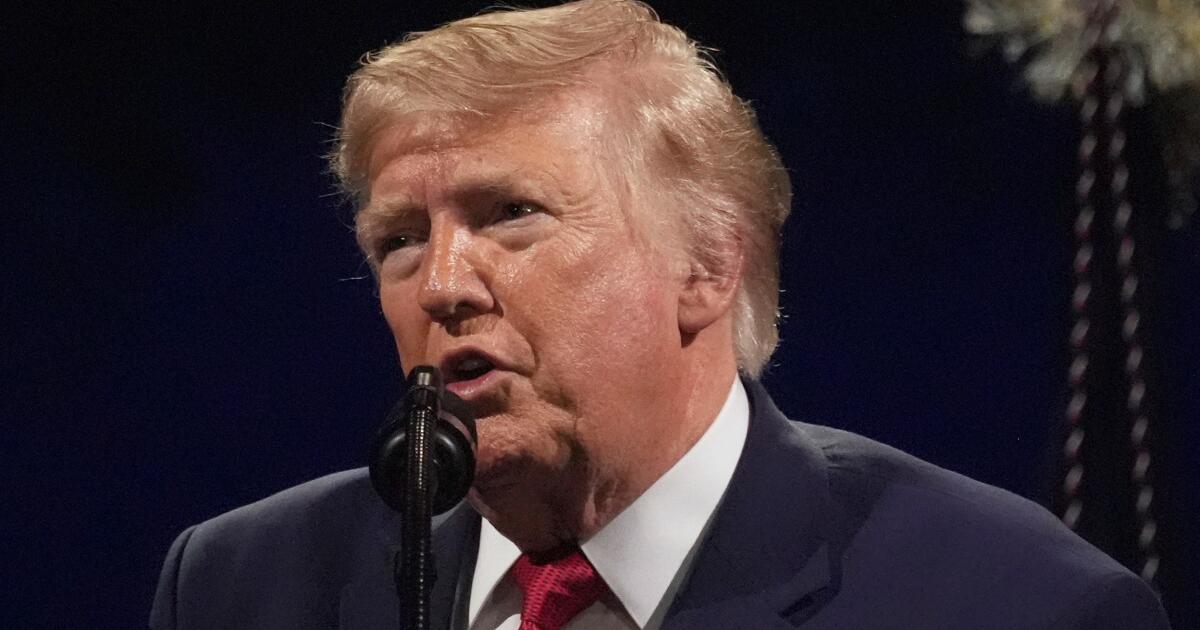
trump

Trump’s mass deportation agenda is at a crossroads with the Homeland Security shake-up

The Department of Homeland Security will soon be under new management, an opportunity to reset President Trump’s immigration agenda or to double down on his signature campaign promise to conduct the largest deportation operation in American history.

The White House’s political director recently encouraged party lawmakers during a retreat at the Republican president’s golf club in Florida to focus on immigration enforcement against criminals, a pivot from the mass deportation agenda he ran on. House Speaker Mike Johnson said the aggressive operations have created a “hiccup” for the party, which is now embarking on a “course correction.”

Yet all indications are that Trump’s mass deportation operation is not stalling but intensifying, with billions of dollars being spent to hire Immigration and Customs Enforcement officers, build warehouse detention sites and meet the administration’s goal of rounding up and removing some 1 million immigrants from the U.S. this year.

“We are at an interesting moment where it has been an inflection point — the public has finally seen what mass detention and mass deportation mean,” said Sarah Mehta, who tracks the issue at the American Civil Liberties Union.

“This is not an agency that’s slowing down,” she said. “They’re really going forward with some of the cruelest policies.”

White House spokeswoman Abigail Jackson said the president’s policies have sent immigrants out of the U.S., either through forced deportations or on their own, and sealed up the U.S.-Mexico border.

“Nobody is changing the administration’s immigration enforcement agenda,” she said.

Senators ready to grill Trump’s DHS nominee over deportations

The questions put Homeland Security at a crossroads. Secretary Kristi Noem is on her way out, and Trump’s nominee to replace her, Sen. Markwayne Mullin of Oklahoma, appears this week for Senate confirmation hearings.

After the intense deportation sweeps in Minneapolis and other cities — and the deaths of at least three U.S. citizens at the hands of officers — Democratic lawmakers are refusing to provide routine funding unless the department changes its policies.

At the same time, those who believe Trump won the White House with his mass deportation agenda are disappointed the administration did not achieve its goals last year and insist he must do better.

“There has been a lot of talk in Congress and now in the White House about kind of backing away from President Trump’s, candidate Trump’s, mass deportation promise,” said Rosemary Jenks, co-founder of the Immigration Accountability Project, which argues for deportations.

“We believe that now is an opportunity,” she said. “We’ve got to get the deportation numbers up.”

A nation of immigrants no longer?

The debate is playing out as the United States, celebrating its 250th year, squares its founding as a nation of immigrants with images of masked federal agents breaking car windows and detaining people suspected of being in the U.S. without proper legal standing.

The Congress, controlled by Republicans, provided some $170 billion in last year’s tax cuts bill to fuel the effort, more than tripling the budget of ICE.

GOP Sen. Eric Schmitt of Missouri, in a fiery speech, fought back against the Democrats’ proposed restraints. “This question about deporting illegal immigrants was on the ballot. President Trump was not bashful,” he said. “And the American people supported the idea that we are going to deport people.”

Yet there are signs of cracks in the Trump coalition. Some Republicans prefer what one called a more humane approach and are sharing their views with Mullin.

Sen. Ron Johnson (R-Wis.), considered a stalwart against illegal immigration, said in his state it’s immigrants who milk most of the dairy cows, and he’s heard from restaurant groups that rely on immigrants to fill jobs.

“Can we just turn back the clock and have … all these people who came in here illegally, just be back home?” he asked.

“In terms of actually implementing that, it’s a lot tougher — particularly, in fact, when you realize a lot of these people, most of them, came here to seek opportunity, wanting freedom,” he said. “They’re working, supporting their family, contributing to organizations and community.”

Mass deportation group wants more

The Mass Deportation Coalition, a group of conservative organizations including the Heritage Foundation and Erik Prince, founder of the security firm Blackwater, was formed recently to keep the administration on track.

It calls last year’s focus on removing violent criminal immigrants “phase one” and says “phase two” should focus this year on deporting immigrants beyond those with violent criminal histories.

Mark Morgan, who served as acting head of ICE and Customs and Border Protection during Trump’s first term and is part of the coalition, said that doesn’t mean roving patrols through Home Depot parking lots. It’s about strategic enforcement focused on immigrants at worksites and those who have overstayed visas and whom a judge has already ordered removed, he said.

But they’re facing opposition from within the Republican Party, Morgan said, particularly from those who want to narrow deportation to mainly criminals and from business groups that want to ease up on worksite enforcement.

“The Republicans that are saying that their definition of targeted enforcement is only criminal, they’re wrong. They’re on the wrong side of this,” he said.

“That’s why you see some of the base that’s really becoming apoplectic because they’re like, ‘Wait a minute. You’re talking about only removing criminals now? That’s not what you promised,’” Morgan said.

What’s coming next

The deportation advocates as well as those working to protect the rights of immigrants see that the Trump administration’s best chance at reaching its goals is creating an environment so unwelcoming for immigrants that they just leave — what’s often called self-deportation.

Mehta, at the ACLU, expects the administration will step up efforts to end temporary permissions that allow immigrants to remain in the U.S. — particularly refugees and asylum seekers — while their cases are making their way through the system. She called it a “deliberate attempt to make people undocumented — to take away lawful status — and then to be able to enforce against them.”

Sen. Alex Padilla (D-Calif.) said he fears that more nonviolent immigrants will be rounded up to fill the new warehouses being equipped as the Trump administration tries to reach its deportation goals.

That’s unacceptable, he said, and among “the key questions that Senator Mullin will have to answer at his confirmation hearing.”

Mascaro, Santana and Cappelletti write for the Associated Press.

Source link

Pro-Palestine protester Leqaa Kordia freed from US immigration detention | Donald Trump News

The 33-year-old Columbia University protester had been held in immigration detention centre for a year.

Leqaa Kordia, a Palestinian woman detained in the United States after taking part in pro-Palestine demonstrations in 2024, has been released after a year in custody.

The 33-year-old, who grew up in the occupied West Bank before moving to the US in 2016, was held at a detention facility in the state of Texas since March last year.

“I don’t know what to say. I’m free! I’m free! Finally, after one year,” a smiling Kordia told reporters after leaving the detention centre on Monday.

An immigration judge had ruled Kordia was eligible to be released on bond three times. Immigration officials appealed the first two rulings but Kordia was freed on $100,000 bond after government lawyers did not challenge the third.

After her release, Kordia said she was looking forward to going home and hugging her mother “so hard.” But she also said she would keep fighting on behalf of people still being held at the detention centre

“There is a lot of injustice in this place,” she said. “There is a lot of people that shouldn’t be here the first place.”

Kordia, who lost nearly 200 members of his family during Israel’s genocidal war against Palestinians in the Gaza Strip, was among several protesters targeted by immigration officials for taking part in pro-Palestine demonstrations at Columbia University in 2024.

Until Monday, she was the only person targeted in connection with the demonstration who was still in immigration detention after the release of others, including Mahmoud Khalil and Mohsen Mahdawi.

Kordia, who was held at Prairieland Detention Center in Alvarado, was recently hospitalised for three days following a seizure after fainting and hitting her head at the privately run detention facility.

At a hearing on Friday, Kordia’s lawyers said she had a neurological condition that had worsened while in custody, putting her at an elevated risk of seizure. They reiterated that she could stay with US citizen family members and did not pose a flight risk.

The immigration judge, Tara Naslow, agreed.

“I’ve heard testimony. I’ve seen thousands of pages of evidence presented by the respondent, and very little evidence presented by the government in any of this,” Naslow said.

Source link

Why the FCC is unlikely to pull TV licenses over Iran news coverage

Federal Communications Commission Chairman Brendan Carr is using his bully pulpit to push back against coverage of the U.S. military action in Iran that his boss President Trump doesn’t like, marking an extraordinary escalation in his clashes with the media.

On Saturday, Carr posted a message on X suggesting TV stations could lose their government licenses to use the public airwaves if they “don’t operate in the public interest.”

Underneath his statement, Carr shared a social media post from Trump, who complained about the New York Times and Wall Street Journal stories on the five refueling tankers were hit during an Iranian missile strike on the Prince Sultan Air Base in Saudi Arabia.

Carr seized on Trump’s missive to issue a warning to TV outlets, which are frequently threatened by the president when he is angry at their coverage.

It’s the latest attempt by the FCC chair to apply pressure on media companies that irritate Trump with critical coverage of his administration.

Since becoming FCC chairman last year, Carr has repeatedly threatened to use the levers of power he has to punish TV and radio stations when they get in Trump’s crosshairs. His behavior has alarmed free speech advocates.

“Broadcasters that are running hoaxes and news distortions — also known as the fake news — have a chance now to correct course before their license renewals come up,” Carr wrote, without providing evidence to back up his claims. “The law is clear. Broadcasters must operate in the public interest, and they will lose their licenses if they do not.”

Carr’s threats are based on his assertions that said he wants to enforce the FCC’s public interest obligation for broadcasters that use the airwaves. He made similar remarks in the fall, which prompted two major TV station groups to keep ABC’s “Jimmy Kimmel Live!” off the air for a week due to remarks the host made regarding slain right-wing activist Charlie Kirk.

Trump and Defense Secretary Pete Hegseth have repeatedly attacked news organizations for any reporting that doesn’t say the war in Iran is anything but a rousing success.

On Friday, Hegseth said took aim at CNN and said “the sooner David Ellison takes over that network the better.”

Ellison, the chief executive of Paramount who, along with his father, has forged strong ties to the White House, will have control over CNN in addition to CBS if the company’s deal to acquire the news outlet’s parent Warner Bros. Discovery is completed.

Carr made the appointment of an ombudsman for CBS News a condition to approve Ellison’s Skydance Partners deal to acquire Paramount last year. Paramount also drew scrutiny over its controversial decision to pay $16 million to settle Trump’s legal salvo against “60 Minutes” over the editing of an interview with his 2024 opponent, then-Vice President Kamala Harris. Most legal analysts viewed the case as frivolous.

The FCC has no jurisdiction over CNN, which is why most of Carr’s barbs are aimed at ABC, CBS and NBC, which air on local TV stations. He once wrote on X, “More Americans trust gas station sushi than the legacy national media.”

Trump said in a social media post Sunday that he was “thrilled” with Carr’s remarks and would support his efforts to go after what he called “Highly Unpatriotic ‘News’ Organizations.”

“They get Billions of Dollars of FREE American Airwaves, and use it to perpetuate LIES, both in News and almost all of their Shows, including the Late Night Morons, who get gigantic Salaries for horrible ratings,” Trump wrote.

Andrew Jay Schwartzman, a Washington-based public interest communications attorney, believes Carr’s conduct and threats violate the 1st Amendment, adding that any serious attempt to revoke licenses would be tied up in legal challenges.

“Even if he started to try to deny a license renewal as quickly as he could, Brendan Carr would be long gone before that case would be over,” Schwartzman said. “The law intentionally sets out a very steep burden for the FCC to deny a license renewal; the process takes many years, during which time the licensee continues to operate normally under ‘continuing operating authority.’”

Carr’s remarks Saturday drew immediate blowback from Democrats and 1st Amendment advocates, noting the FCC’s role does not include policing the free press.

“Once again, this FCC pretends it has the power to control news coverage,” FCC Commissioner Anna Gomez said Monday in a statement. “In reality, the FCC has vanishingly little power over national news networks. It licenses local broadcast stations, not networks, and no licenses are up for renewal until 2028.”

Calif. Gov. Gavin Newsom weighed in as well, posting, “If Trump doesn’t like your coverage of the war, his FCC will pull your broadcast license. That is flagrantly unconstitutional.”

Sen. Ron Johnson (R-Wis.), usually a reliable voice of support for the Trump administration, expressed his concerns over Carr’s remarks.

“I’m a big supporter of the 1st Amendment,” Johnson told Fox News on Sunday. “I do not like the heavy hand of government no matter who’s wielding it. I’d rather the federal government stay out of the private sector as much as possible.”

Gomez added that while attempts to pull licenses border on folly, Carr’s threats and attacks on the media can create a chilling effect and erode the public’s confidence in the press.

“Over the past year, this FCC has attacked the media as part of a years-long campaign by this Administration and its allies to discredit factual, independent coverage while blaming the press for growing public distrust,” Gomez said. “Meanwhile, it is the FCC’s own credibility and public trust that are rapidly eroding.”

Trump is not the first president to target TV station licenses in response to negative news coverage. At the height of the Watergate scandal in the 1970s, Richard Nixon’s allies attempted to challenge the TV licenses for three stations owned at the time by the Washington Post.

The effort didn’t get far.

The last Los Angeles outlet to lose its broadcast license was KHJ in 1987, when the station was part of RKO General, a media company owned by the General Tire and Rubber Co. The case was related to corporate malfeasance and not broadcast content on the stations.

The process to revoke the RKO licenses took seven years from the moment the FCC voted in favor of the move.

“Since then, only small mom-and-pop radio stations have been litigated,” Schwartzman said. “The cases nearly always involve lying to the government, felony convictions or failure to pay regulatory fees. In one recent case, a small owner convicted of tax evasion still kept his license.”

There would be other logistical hurdles to the FCC making good on Carr’s threats.

As Gomez noted, Carr’s FCC only has regulatory control over the TV stations that carry the network signals. If stations were drop network programming for any reason, they could violate their affiliation contracts and lose the right to carry NFL football and other content that delivers big ratings and revenue.

Sinclair Broadcast Group wanted Kimmel to apologize to Kirk‘s family and contribute to his organization Turning Point USA before putting the host’s late night show on the air.

That did not happen and “Jimmy Kimmel Live!” returned to Sinclair’s stations anyway.

Source link

Supreme Court will rule on Trump’s plan to end temporary protection for Haitians, Syrians

The Supreme Court agreed Monday to rule on whether the Trump administration may end the temporary protection that had been extended in the past to migrants who live and work in the United States.

At issue are legal protections for about 6,000 Syrians and up to 350,000 Haitians.

The court’s announcement signals the justices want to resolve this issue in a written opinion rather through emergency appeals.

Twice last year, the court’s conservatives set aside decisions from judges in San Francisco who said President Trump’s Homeland Security secretary had overstepped her authority.

Those cases involved the temporary protection status extended to about 600,000 Venezuelans.

But those decisions did not set clear precedents, and in recent weeks, judges in New York and Washington, D.C., blocked the administration’s plan to end the special protections for Haitians and Syrians.

Frustrated by what he labeled “indefensible” decisions, Trump’s Solicitor Gen. D. John Sauer advised the court to hear arguments and issue a written ruling on the issue.

The justices on Monday agreed to just that. Arguments will be heard in April, and a decision will be handed down by July.

Immigrant-rights advocates argued the repeal of the special protection would be cruel and unjust to migrants who have established lives and careers in this country.

In 1990, Congress authorized giving temporary shelter to non-citizens from countries experiencing armed conflict, natural disaster or “extraordinary and temporary conditions” that prevent them from returning there.

In 2012, the Homeland Security secretary extended this protection to Syrians in response to a “brutal crackdown” engineered by its then-President Bashar al-Assad.

Last year, citing Assad’s fall from power, Trump’s Secretary Kristi Noem proposed to cancel the temporary protection for Syrians. Lawyers for the Syrians questioned how this could be seen as an emergency requiring an immediate ruling.

They said about 6,100 Syrians who have lived here lawfully for years.

They are “highly sought-after doctors and medical professionals, reporters, students, teachers, business owners, caretakers, and others who have been repeatedly vetted and by definition have virtually no criminal history. The government apparently needs urgent authority to send them to a country in the middle of an active war,” the lawyers said.

In 2010, the Obama administration extended the protection to Haiti after an earthquake caused death and damage in Port-au-Prince, the capital.

Judges in New York and Washington blocked those repeals and said the high court had given “no explanation” for its decision upholding the repeal for Venezuelans.

Those judges said the Supreme Court’s earlier orders orders “involved a TPS designation of a different country, with different factual circumstances, and different grounds for resolution by the district court.”

Sauer pointed to a provision in the 1990 law that says judges have no authority to second-guess the government’s decision to end it.

“There is no judicial review of any determination of the [Secretary] with respect to the designation, or termination or extension of a designation, of a foreign state under this subsection,” the law says.

In the three weeks since Trump’s attorney filed his emergency appeal, there have been two significant changes since then.

Trump fired Homeland Security Secretary Kristi Noem. And his war launched against Iran threatens countries throughout the Mideast, including Syria.

In agreeing to hear the pair of cases, the justices did not disturb the lower court rulings that blocked the repeals for now.

Source link

Trump claims strikes on Iran prevented nuclear war | Donald Trump

NewsFeed

Offering another rationale for the US-Israeli war on Iran, Donald Trump claimed he ordered strikes to prevent a nuclear conflict that would have turned into World War III. He also said not even the “greatest experts” thought Iran would retaliate with attacks on Gulf states.

Source link

‘Fourth world nation’: Trump slams Somalia, Ilhan Omar | Migration

NewsFeed

Speaking at the Oval office, US President Donald Trump stated that Somalia is a “fourth world nation” while repeating claims without evidence that Congresswoman Ilhan Omar had illegally entered the country by marrying her brother. Omar has consistently denied the “sick” allegations.

Source link

California, other states sue to block Trump effort to roll back fair housing protections

California and a coalition of other states sued the Trump administration Monday over its efforts to roll back fair housing rules that bar certain types of discrimination by landlords, including against LGBTQ+ people.

California Atty. Gen. Rob Bonta said a U.S. Department of Housing and Urban Development rule change threatening funding for states that offer housing protections for LGBTQ+ and other marginalized individuals who are not explicitly covered by federal law is illegal, undermines state efforts to combat discrimination and would push vulnerable people onto the streets.

“In effect, the Trump administration is attempting to roll back civil rights enforcement in housing at the federal level, and pressure states to weaken their own protections as well,” Bonta said during a news conference Monday. “That’s not just bad policy, it’s unlawful.”

Representatives from HUD and the White House did not immediately respond to a request for comment.

The federal Fair Housing Act explicitly bans discrimination based on seven traits: race, color, national origin, religion, sex, familial status and disability. Under rules set forth during the Obama administration, the U.S. Department of Housing and Urban Development has for years interpreted the law as banning discrimination based on sexual orientation and gender identity.

Many states, including California, also have adopted laws explicitly banning discrimination against LGBTQ+ people and other marginalized groups not mentioned in the federal law, with California also banning discrimination based on marital status, ancestry, source of income and veteran or military status.

In September, HUD issued new guidance threatening to decertify state housing agencies — stripping their federal funding and ability to investigate discrimination claims — if they provide anti-discrimination protections other than those spelled out in the Fair Housing Act. The guidance also barred state agencies from using federal funds to “promote gender ideology,” “fund or promote elective abortions” or promote illegal immigration, according to the lawsuit.

The guidance followed that of HUD Secretary Scott Turner, a former NFL player and Trump loyalist, who announced last year that HUD would no longer adhere to a 2016 Obama-era rule protecting transgender people from housing discrimination, which Turner said “tied housing programs, shelters and other facilities funded by HUD to far-left gender ideology.”

“We, at this agency, are carrying out the mission laid out by President Trump on January 20th [2025] when he signed an executive order to restore biological truth to the federal government,” Turner said in a statement, referring to Trump’s order calling on federal agencies across the government to rescind protections for transgender Americans.

“This means recognizing there are only two sexes: male and female,” Turner said. “It means getting government out of the way of what the Lord established from the beginning when he created man in His own image.”

Among other things, the administration said rules barring discrimination against transgender people allowed “biological men to enter shelters intended for women impacted by trauma, domestic abuse and violence.”

LGBTQ+ advocacy groups condemned the move, noting that transgender Americans face heightened discrimination in a slate of areas — including housing — and need protections. They also contended that HUD’s new policies violate a 2020 U.S. Supreme Court decision barring employment discrimination based on gender or gender identity.

Bonta said the Fair Housing Act “set a floor, not a ceiling, for protections against discrimination,” which means that states “have the authority to go further and protect more people,” as California has endeavored to do.

He said HUD has supported the state’s anti-discrimination work for decades through the Fair Housing Assistance Program, which provides funding to state and local agencies to investigate and enforce laws against housing discrimination. HUD’s new guidance “threatens to undermine that system” by demanding an end to state protections not just for LGBTQ+ people, but for military veterans, immigrants as well as women receiving abortions and other reproductive healthcare, he said.

“Families across California are already struggling to find homes they can afford, and the last thing they need is for the federal government to make it harder,” Bonta said. “At its core, this lawsuit is about protecting a fundamental civil right: the right to rent, buy, or live in housing without discrimination.”

Bonta said California interprets the Fair Housing Act’s ban on sex discrimination as protecting LGBTQ+ people, but the Trump administration doesn’t agree — making the state’s more explicit protections important.

He said about $3 million in federal funding is currently at stake for California, with millions more at stake in other states.

Illinois Atty. Gen. Kwame Raoul, who is helping lead the lawsuit and spoke alongside Bonta Monday, said states with robust antidiscrimination laws “will not go backwards and we will not give in to threats” from the Trump administration.

“These actions are part of a broader, ongoing pattern by this administration to subvert the legal protections our country has put in place to combat discrimination, and to tear down the hard fought progress we have made for civil rights,” Raoul said. “It is also just the latest page in the president’s illegal playbook to use funding and programs created by Congress to try to strong arm states into adopting Trump’s preferred policies.”

The states allege that HUD’s targeting of state antidiscrimination policies comes after it downsized its own workforce and significantly reduced its ability to investigate housing discrimination complaints and enforce fair housing laws. They say the new guidance violates multiple federal laws, including laws that govern federal spending and rule changes, and are asking the federal court to immediately invalidate the guidance as unlawful.

Bonta and Raoul are joined in the lawsuit by the attorneys general of Arizona, Colorado, Connecticut, Delaware, the District of Columbia, Hawaii, Maine, Maryland, Massachusetts, Michigan, New Jersey, Rhode Island, Vermont and Washington.

Source link

As Trump pushes deportations, immigration data becomes harder to find

The Trump administration likes to promote its immigration enforcement agenda through numbers, with ambitious goals to deport 1 million people, report zero releases at the U.S.-Mexico border and arrest thousands of alleged gang members.

For all the boasting, the administration has been releasing less reliable, carefully vetted data than its predecessors on a signature policy that has become one of the most contentious of Trump’s second term.

The gap in information and a loss of figures from an office that has tracked immigration data back to the 1800s have left researchers, advocates, lawyers and journalists without important statistics to hold the Republican administration to account.

“They aren’t publishing the data,” said Mike Howell, who heads the conservative Oversight Project, an advocacy group pushing for more deportations. Instead, Howell said, the Department of Homeland Security has put out numbers in news releases “that purport to be statistics with no statistical backup and the numbers have jumped all over the place.”

With mass deportations a priority, new restrictions and increased enforcement have led to a surge in immigration arrests, detentions and deportations.

But finding the metrics that once measured those changes can be hard. It is an extension of earlier administration moves to limit the flow of government information by scrubbing or removing federal datasets or by the firing last year of the top official overseeing jobs data.

Important data is no longer publicly available

The Office of Homeland Security Statistics is responsible for publishing figures from Homeland Security agencies, including removals and the nationalities of those deported, to provide a comprehensive picture of immigration trends at the border and inside the United States.

Originally known as the Office of Immigration Statistics, it tracked such data since 1872. In its current form, created under the Biden administration, it also started publishing monthly reports that allowed researchers to track developments almost in real time.

But key enforcement metrics on its website have not been updated since early last year. A note on the page where the monthly reports were says it “is delayed while it is under review.”

“It’s the most timely data. It’s the most reliable data,” Austin Kocher, research professor at Syracuse University who closely follows immigration data trends, said about the monthly reports. “It has the most omniscient view of immigration enforcement across the entire agency.”

An interactive dashboard launched by U.S. Immigration and Customs Enforcement in December 2023 once let users examine whom the agency was arresting, their nationalities, criminal histories and removal numbers. ICE called it a “new era in transparency.”

Though intended for quarterly updates, the latest data is from January 2025. The agency’s annual report, typically released in December, had not been published as of mid-March.

Other agencies also publish data that touches on immigration, and parts of it do continue to roll out, such as U.S. Customs and Border Protection statistics detailing border encounters or data from the Department of Justice’s immigration courts.

But experts say other data has slowed.

The State Department’s most recent visa issuance data is from August. Key statistics from U.S. Citizenship and Immigration Services have not been updated since October.

The now-missing data had helped researchers study the effects of different policies. Lawyers could cite the figures to support their litigation. Journalists saw in them a powerful tool to hold the government to account on public claims or to report on important trends.

“We’re all a little bit in the dark about exactly how immigration enforcement is operating at a time when it’s taking new and unprecedented forms,” said Julia Gelatt, associate director of the U.S. Immigration Policy Program at the Migration Policy Institute.

DHS did not respond to detailed questions about why it was no longer releasing specific data.

“This is the most transparent Administration in history, we release new data multiple times a week and upon reporter request,” the department said in a statement.

Researchers contend with a patchwork of numbers

Figures the administration has released are inconsistent and unverifiable.

In a Jan. 20 news release, DHS said it had deported more than 675,000 people since Trump returned to the White House. A day later, in a second release, the department put the figure at 622,000. In congressional testimony March 4, Homeland Security Secretary Kristi Noem said the figure was 700,000.

But ICE, an agency within DHS, also releases figures on how many people it has removed from the country, part of a large data release mandated by Congress. An Associated Press analysis of the figures put that number at roughly 400,000 over Trump’s first year.

DHS has said 2.2 million people who were in the U.S. illegally have gone home on their own, but the department has given no explanation for the count. Experts have questioned the source of that figure, saying this was not something that DHS historically has tracked.

The department did not respond to questions about where that data came from.

With key sources of data halted, researchers, advocates and others have had to rely on information the administration is obliged to report or that has come to light through legal action.

The publication of ICE detention figures — how many people are detained, for how long and whether they have committed a crime — is required by Congress and is generally released every two weeks. But the figures’ release has faced some delays and its data gets overwritten with every new publication, complicating the work of people who need access to it.

The University of California, Berkeley’s Deportation Data Project, a research initiative, successfully sued through the Freedom of Information Act to access data about ICE arrests including nationalities, conviction status and whether arrests occurred at jails or in the community.

Graeme Blair, co-director of the project, said every administration has struggled with transparency in immigration enforcement, and given the Trump administration’s ambitious enforcement goals, the team wanted to secure and verify information that the government might not publicly release.

“Given the scale of what they were talking about doing, it seemed really important to be able to understand, to be able to double check those numbers,” he said.

But there are limitations, he said. The data obtained through the lawsuit only runs through Oct. 15. It does not cover recent operations such as the Minneapolis enforcement surge, when federal immigration officers fatally shot two protesters, leading to widespread demonstrations and scrutiny of enforcement tactics.

The absence of data is one of the few issues that has drawn bipartisan criticism.

“We deserve to know the numbers, just like we deserve to know who’s in our country and who needs to leave,” Howell said.

Santana writes for the Associated Press.

Source link

BBC asks U.S. court to dismiss Trump’s $10 billion defamation lawsuit

The BBC filed a motion Monday asking a U.S. court to dismiss President Trump’s $10 billion lawsuit against it.

The British national broadcaster said that the Florida court where the case is expected to be heard does not have jurisdiction over it. It also argued that Trump could not show that it intended to misrepresent him.

Trump filed a lawsuit in December over the way a BBC documentary edited a speech he gave on Jan. 6, 2021. The claim seeks $5 billion in damages for defamation and a further $5 billion for unfair trade practices.

Last month a judge at the federal court for the Southern District of Florida provisionally set a trial date for February 2027.

The BBC argued that the case should be thrown out because the documentary was never aired in Florida or the U.S.

“We have therefore challenged jurisdiction of the Florida court and filed a motion to dismiss the president’s claim,” the corporation said in a statement.

In a 34-page document, the BBC also argued that Trump failed to “plausibly allege facts showing that defendants knowingly intended to create a false impression.”

Trump’s case “falls well short of the high bar of actual malice,” it added.

The documentary — titled “Trump: A Second Chance?” — was aired days before the 2024 U.S. presidential election.

The program spliced together three quotes from two sections of a speech Trump made on Jan. 6, 2021, into what appeared to be one quote, in which Trump appeared to explicitly encourage his supporters to storm the Capitol building.

Among the parts cut out was a section where Trump said he wanted supporters to demonstrate peacefully.

The broadcaster’s chairman has apologized to Trump over the edit of the speech, admitting that it gave “the impression of a direct call for violent action.” But the BBC rejects claims it defamed him. The furor triggered the resignations of the BBC’s top executive and its head of news last year.

Source link

Trump says chief of staff Susie Wiles has breast cancer but will keep working through treatment

White House chief of staff Susie Wiles has been diagnosed with early stage breast cancer but will continue working during her treatment, President Donald Trump said in a social media post on Monday.

Trump said Wiles’ prognosis is “excellent” and described her as “one of the strongest people I know.” He said Wiles plans to begin treatment immediately but made no suggestion she was pulling back on her work as one of his closest advisers.

“During the treatment period, she will be spending virtually full time at the White House, which makes me, as President, very happy!” Trump said on his Truth Social platform. “She will soon be better than ever!”

It comes as the Republican president confronts mounting challenges on global and national fronts, from the war in Iran and soaring oil prices to this fall’s midterm elections and American’s concerns over affordability.

Wiles, 68, is a longtime Trump ally who rose from his campaign co-chair to his closest adviser and counsel. The first woman to become White House chief of staff, Wiles spent decades as a lobbyist and political operative in Florida and led Trump’s 2016 effort in the state.

Binkley writes for the Associated Press.

Source link

Trump calls for naval coalition to open Strait of Hormuz: Can it work? | Explainer News

United States President Donald Trump has called for a naval coalition to deploy warships to secure the Strait of Hormuz, through which one-fifth of world oil shipments transit, as oil markets reel from supply disruptions caused by the US-Israeli war with Iran.

What is essentially the closure of the Strait of Hormuz by Iran in response to the attacks by the US and Israel has sent oil prices soaring to more than $100 per barrel.

Iran’s new supreme leader, Mojtaba Khamenei, has promised to keep the maritime artery closed while another top official in Tehran warned that oil prices could shoot up beyond $200 per barrel.

Trump said he hoped a naval coalition could secure the vital waterway, which connects the Gulf to the Gulf of Oman and the Arabian Sea. Iran has struck more than a dozen ships trying to sail through the narrow waterway since the hostilities started two weeks ago.

But will Trump’s solution work?

hormuz
A tanker sits at anchor in Port Sultan Qaboos in Muscat, Oman, as oil shipments through the Strait of Hormuz have plummeted [File: Benoit Tessier/Reuters]

What has Trump said?

The US president has been facing domestic pressure over starting the war alongside Israel with no endgame or off-ramps in sight.

“On the strait of Hormuz, they had NO PLAN,” US Democratic Senator Chris Murphy wrote in a post on X. “I can’t go into more detail about how Iran gums up the Strait, but suffice it [to] say, right now, they don’t know how to get it safely back open.”

After threatening to bomb Iran more, Trump called on China, France, Japan, South Korea and the United Kingdom to send warships to secure the strait.

Trump claimed “100% of Iran’s military capability” had already been destroyed but added that Tehran could still “send a drone or two, drop a mine, or deliver a close-range missile somewhere along, or in, this waterway”.

“Hopefully China, France, Japan, South Korea, the UK, and others, that are affected by this artificial constraint will send ships to the area so that the Hormuz Strait will no longer be a threat by a nation that has been totally decapitated,” Trump wrote in a post on his Truth Social platform.

“In the meantime, the United States will be bombing the hell out of the shoreline, and continually shooting Iranian Boats and Ships out of the water. One way or the other, we will soon get the Hormuz Strait OPEN, SAFE, and FREE!”

Not long after, Trump returned to the keyboard, extending the invitation to all “the Countries of the World that receive Oil through the Hormuz Strait” to send warships, adding that the US would provide “a lot” of support to those who participated.

trump
Israeli soldiers walk by a billboard commissioned by the evangelical Christian group Friends of Zion during the US-Israel war on Iran in Tel Aviv, Israel [File: Nir Elias/Reuters]

What has Iran said?

Alireza Tangsiri, commander of the Islamic Revolutionary Guard Corps Navy, said in a statement that claims by the US about destroying Iran’s navy or providing safe escort for oil tankers were false.

“The Strait of Hormuz has not been militarily blocked and is merely under control,” he said in a statement.

Iranian Foreign Minister Abbas Araghchi later doubled down on this, saying the strait remained open to international shipping except for vessels belonging to the US and its allies.

“The Strait of Hormuz is open. It is only closed to the tankers and ships belonging to our enemies, to those who are attacking us and their allies. Others are free to pass,” Araghchi said.

Khamenei – son of the late Supreme Leader Ali Khamenei, who was killed on the first day of the US-Israeli strikes – suggested in his first statement since taking power that the Strait of Hormuz would remain closed to provide leverage for Iran during the conflict.

iran
F-18 combat aircraft are parked on the deck of the USS Abraham Lincoln aircraft carrier in the Gulf of Oman near the Strait of Hormuz during a 2019 deployment [File: Ahmed Jadallah/Reuters]

What are the challenges in the Strait of Hormuz?

The strait, which is just 21 nautical miles (39km) wide at its narrowest point, is the only maritime passage into the Arabian Gulf (known as the Persian Gulf in Iran). Shipping lanes in the waterway are even narrower and more vulnerable to attacks.

It separates Iran on one side from Oman and the United Arab Emirates on the other.

In brief, there is no way in or out by sea when the Strait of Hormuz is closed.

Alexandru Hudisteanu, a maritime security expert who served 13 years in the Romanian navy, told Al Jazeera that in the type of coalition that Trump is hinting at, “interoperability is the biggest hurdle.”

“That’s the ability of cruises to work together or with different units and different doctrine when basic communication would be an issue,” he said.

Then, there is the geography of the Strait of Hormuz: “a very unforgiving environment to sail with this type of wartime threats”, Hudisteanu said. “Especially difficult under missile threats and these asymmetric potential mines or unmanned systems that could damage or destroy ships.”

Providing escorts to ships would be a costly option, and it would pose risks to participating foreign warships from possible Iranian attacks, which would likely further drag more countries into the ongoing war.

From Iran’s point of view, “the fact that the shoreline is so close and the actual maritime passage is highly congested and confined is an advantage by default,” Hudisteanu added. Geographically, Iran keeps it as a gauntlet, with no way out for the ships unless Tehran allows it.

Another major challenge for any naval coalition trying to secure the passage would be the timeline of any operation.
”The security of the strait could be achieved. It’s just a matter of how much time you need and how many assets you need,” the analyst said. Rushing through it “could have negative implications for the security of the mission and the region”.

Smoke rising from a ship after an attack.
Smoke rises from the Thai bulk carrier Mayuree Naree near the Strait of Hormuz after an attack on March 11, 2026 [Handout/Royal Thai Navy via AFP]

How have countries responded?

No country has so far publicly agreed to Trump’s call to send warships to secure the Strait of Hormuz.

London said it is “intensively looking” at what it can do to help reopen the maritime passage. British Energy Secretary Ed Miliband said: “We are intensively looking with our allies at what can be done because it’s so important that we get the strait reopened.”

Chinese Ministry of Foreign Affairs officials said Beijing is calling for hostilities to stop and “all parties have the responsibility to ensure stable and unimpeded energy supply.”

Japan said the threshold is “extremely high” to send its warships on such a mission. “Legally speaking, we do not rule out the possibility, but given the current situation in which this conflict is ongoing, I believe this is something that must be considered with great caution,” said Takayuki Kobayashi, policy chief of Japan’s ruling Liberal Democratic Party.

France also confirmed that it will not send ships. The Ministry for Europe and Foreign Affairs said in a statement on Saturday: “Posture has not changed: defensive it is,” in reference to President Emanuel Macron’s assertion that France will not join the war against Iran.

South Korea, which imports 70 percent of its oil from the Gulf, said it was “closely monitoring” Trump’s statements and “comprehensively considering and exploring various measures … to ensure the safety of energy transport routes”.

INTERACTIVE - Strait of Hormuz - March 2, 2026-1772714221
(Al Jazeera)

Are countries negotiating with Iran?

Some countries have been negotiating with Iran to secure passage for their petroleum shipments.

Two Indian-flagged tankers carrying liquefied petroleum gas (LPG) have sailed through the Strait of Hormuz. New Delhi depends on this passage for 80 percent of its LPG imports.

The war on Iran has caused a critical shortage of cooking gas for India’s 333 million households. New Delhi has long had ties with Iran, but the government of Prime Minister Narendra Modi has not condemned the killing of Ali Khamenei. It has condemned Iran’s retaliatory attacks on Gulf countries, where millions of Indian citizens work and send $51bn in remittances home every year.

Iran’s ambassador to India, Mohammad ⁠Fathali, said Tehran had allowed some Indian vessels to pass through the Strait of Hormuz in a rare exception to the blockade but did not confirm the number of vessels.

A Turkish-owned vessel was similarly granted permission last week after Ankara negotiated passage directly with Tehran. Fourteen more Turkish vessels are awaiting clearance.

France and Italy also reportedly opened talks with Iranian officials to negotiate a deal to allow their vessels through the strait, but there has been no official confirmation yet.

“Iran is affecting maritime supply,” Hudisteanu said. “It’s affecting the maritime security of the region and the entire ecosystem and bringing the entire world to the table as the global price for oil and gas increases.”

Source link

How Congress became an afterthought in the war with Iran

Secretary of State Marco Rubio had some explaining to do when he arrived on Capitol Hill for a classified briefing with lawmakers in early March.

Members of Congress wanted to know why, two days earlier on Feb. 28, the United States and Israel had attacked Iran and killed its supreme leader — without notifying them first. After the briefing, Rubio told reporters the U.S. preemptively struck Iran to get ahead of an Israeli attack. A day later, he tried to clarify his remarks.

“The bottom line is this: The president determined we were not going to get hit first,” Rubio said. “It’s that simple, guys.”

For members of Congress, the moment underscored how marginal a role Congress has been able to play in a war that, two weeks in, has spread into more than a dozen neighboring countries, led to the deaths of at least 13 American service members and cost billions of dollars.

In the two weeks since the war began, Congress has largely been sidelined. Lawmakers have cycled through classified briefings, TV interviews and hallway scrums with reporters, but have taken little formal action related to Trump’s war efforts — just two unsuccessful votes aimed at limiting the conflict.

Most of the debate has taken place online, where some GOP lawmakers have drawn rebukes from colleagues for saying America “needs more Islamophobia” and other Islamophobic rhetoric about Iran and its people.

At the same time, Trump has pressed Congress to focus instead on a controversial voting law, signaling to the Republican-led Congress that he wants their focus on the election rather than a historic moment abroad. The president, meanwhile, has offered shifting explanations on how much longer he intends to be at war in the Middle East, telling Fox News’ Brian Kilmeade on Friday that he will conclude the hostilities when “I feel it in my bones.”

Taking Trump’s statements at face value, Democrats and some Republicans have begun to worry that more American troops could be deployed inside Iran to complete the mission — and lawmakers are still trying to understand the war’s threat to the global energy markets as fighting encroaches on the Strait of Hormuz and Americans face soaring gas prices.

The Republican majorities have for the most part rallied behind President Trump, and have blocked measures in both the House and Senate that would have halted the war against Iran and forced him to seek congressional approval for additional hostilities.

House Speaker Mike Johnson (R-La.) likened efforts to rein in Trump’s war efforts to siding “with the enemy.” Sen. Lindsey Graham (R-S.C.) was even more effusive, arguing there is a precedent for presidents using military force without congressional authority.

“The norm in this country is not to declare war by Congress, but for the military to be used by the commander in chief. Sometimes authorization from the Congress is requested, sometimes it is not,” Graham said during a Senate floor speech. “More than not, it is not requested.”

Presidents have frequently used military force without a formal declaration of war — including in Korea, Vietnam and Iraq — but experts argue there is a difference between bypassing a formal declaration and sidelining Congress altogether.

Former Defense Secretary Leon Panetta, who served under President Obama, pointed to the 2011 raid that killed Osama Bin Laden, the mastermind behind the Sept. 11, 2001, attacks, as an example of how the process once worked.

Even though it was a covert Special Forces operation, Panetta said, he personally briefed key congressional leaders before Bin Laden’s killing took place.

That kind of consultation, he said, no longer happens. Instead, lawmakers learn about military operations the same way ordinary Americans do — by watching the news — and then demand to be briefed, he said.

“By that time, the country is pretty much committed to war,” Panetta said.

Presidents of both parties have expanded their power to wage war unilaterally, but Panetta said he believes Trump has crossed a new threshold by dispensing not just with congressional approval but with the courtesy of a briefing.

“It’s not good for our democracy. It’s not a good process,” he said. “It’s not what our forefathers would have wanted.”

Rubio, however, has argued the administration has kept congressional leaders apprised. He told reporters there is no legal requirement to notify all members of Congress and that he briefed the Gang of Eight — a group made up of the top Republicans and Democrats in the House and Senate, as well as the leaders of the respective intelligence committees — within 48 hours of the attack against Iran.

“We notified congressional leadership,” Rubio said. “The law says we have to notify them 48 hours after beginning hostilities. We’ve done that.”

In the statement issued Friday, the White House defended the president’s approach to the war in relation to how its involved Congress, adding that Trump and administration officials “continue to keep bipartisan lawmakers in Congress apprised of the operation as the United States continues to dominate.”

“Past presidents have talked about this for 47 years — but only President Trump has had the courage to do something about it,” White House spokesperson Olivia Wales said.

Democrats say they’re ‘flying blind’

Democratic lawmakers, including some who have been included in classified briefings, have accused administration officials of keeping them “in the dark” and are beginning to demand public congressional hearings.

“I want this administration to testify in public, under oath, regarding a bunch of questions we have in order for the American people to see for themselves,” said Rep. Jimmy Gomez (D-Los Angeles). “I do believe this administration has lied to the American public and Congress.”

Gomez, a member of the House Permanent Select Committee on Intelligence, said he never expected that he would have to spend so much time trying to discern if the administration is lying to lawmakers.

“I think it’s that’s what makes the job harder,” he said.

Democrats, who are in the minority, have limited power to call those briefings, but have continued to put pressure on the administration in a public way.

Senate Democrats last week sent a letter to Defense Secretary Pete Hegseth, demanding answers by Wednesday about reports that a U.S. airstrike hit an Iranian elementary school.

Iranian officials said the explosion killed at least 175 people, most of them children. The U.S. has not taken responsibility for the attack, and Hegseth has said the matter is under investigation. Trump, without providing evidence, has claimed Iran was responsible for the attack.

Seeking answers has been a common theme among Democrats since the start of the war. Sen. Richard Blumenthal (D-Conn.), for instance, said after a classified briefing last week that he had “left with more questions than answers” and a real concern about the possibility of deploying American troops to Iran.

Power of the purse

If the war continues, Congress still retains some leverage.

Under the War Powers Resolution passed by Congress in 1973, unauthorized deployments into hostile situations must end after 60 days unless Congress votes to declare war or passes legislation authorizing the use of the military.

Rep. Brad Sherman (D-Sherman Oaks), who sits on the House Foreign Affairs Committee, said he has told Hegseth and Rubio that if they violate that provision it will be like “stealing money” for actions that are not approved by Congress and warned they could be held civilly liable.

The 60-day deadline will be a key moment for Congress to step in, Sherman said; otherwise there will be growing concern about Trump having “unchecked power.”

So far, he thinks Republicans in control view their job as “butler to the president,” and that the Constitution already gives Trump “too much power over the military.”

“If Congress is controlled by people who want to be servants to the president, it’s going to do an incredibly bad job of being a check on the president,” he said.

Beyond the War Powers Resolution, lawmakers also have power over the appropriations process and could deny the administration’s request to boost military funding.

“The Congress can stop military action by cutting off funding. If you don’t like the war in Iran, say we won’t pay for it. We have the constitutional power of the purse,” Graham said in a Senate floor speech early in March.

The Trump administration’s war with Iran cost $11.3 billion during its first six days, according to the Associated Press.

But Rep. Mike Levin (D-San Diego), who sits on the House Appropriations Committee, says he is aware of the figure only because of news reports — not because the Pentagon has been transparent.

“We are flying blind in the sense that we just don’t know. We don’t know how much is being spent or what it’s being spent on,” Levin said.

Levin says the military will probably need to bolster its munitions stockpile at the rate the conflict is going.

If the Pentagon does request more money, Levin said, he would try to ensure that “not one more dollar goes toward any of this without clear answers and a clear plan.”

Source link

Trump’s delay of wheelchair rule frustrates disabled flIers

Seth McBride’s life was forever changed on a snowy mountainside in British Columbia.

McBride was — and is — a thrill-seeker. Growing up in Juneau, Ala., with the untamed outdoors as his stomping ground, he loved to rock climb, mountain bike and, especially, strap on his skis and fly, soaring headlong off heart-pounding cliffs, crags and cornices.

A few months before his senior year in high school, McBride was at a terrain park at Whistler Blackcomb resort. He was 17. He launched a maneuver he’d completed many times before, a back flip off a steep jump. Only this time, he over-accelerated, over-rotated and came down on his neck. Right away he knew something was wrong.

“As soon as I landed,” McBride recalled more than 25 years later, “I lost all sensation in my legs and my lower back.”

The prognosis was grim; doctors told McBride he probably would never walk again, and he hasn’t.

But that’s scarcely slowed him down.

Views of the 47th president, from the ground up

Before they had kids, McBride and his wife biked 6,500 miles — McBride using a special, hand-cranked cycle — from Portland, Ore., to the southern tip of Argentina. He’s traveled the world as a wheelchair rugby player, winning gold, silver and bronze medals at Paralympic Games in Beijing, Rio de Janeiro and London.

McBride — adventurer, daredevil — appears unflappable. Until it comes to air travel.

It’s not the hassles and aggravation that most people put up with. Every trip requires McBride, 43, to undergo a special regimen, dehydrating himself so he won’t have to use the bathroom in flight. Every excursion includes the likelihood of being uncomfortably jostled or, worse, dropped as he’s being transferred to his seat. He can never be certain his wheelchair, his lifeline, won’t be damaged or missing once his plane lands.

“There are very few places or in my life that I feel less independent” than an airport, said McBride, who still plays competitive rugby at the club level. “None of the systems are set up for wheelchair users to be able to manage things on their own.”

Wheelchairs at Portland International Airport in Oregon

Wheelchairs at Portland International Airport. The all-purpose equipment can’t serve the various needs of disabled travelers.

(Will Matsuda / For The Times)

For a time, as the Biden administration was winding down, it looked as though that was about to change somewhat. The federal government issued a set of regulations that would require airlines, among other things, to assume liability for damaged and delayed wheelchairs and improve training for staff working with passengers facing mobility issues.

But the Trump administration, which has made deregulation one of its highest imperatives, put those requirements on hold while a trade association and several major airlines sue to keep the changes from taking effect.

For McBride and others like him, it’s a disappointing setback that follows years of pressing Washington to make air transit just a bit more decent and humane.

“It sucks,” McBride said of the dignity-deflating status of a wheelchair traveler. “I know quite a few people who simply won’t fly anymore.”

::

When the Biden administration published new airline regulations in the Federal Register, it spelled out its reasoning.

Passengers forced to surrender their wheelchairs “must rely on airline staff and contractors to properly handle a wheelchair or scooter and return it in a timely manner in the condition it was received. Advocates have stressed … that, when an individual’s wheelchair or scooter is damaged by an airline, the individual’s mobility, health and freedom are impacted until the device can be returned, repaired or replaced.”

What’s more, “Advocates note that wheelchairs are often custom fitted to meet the needs and shapes of each user. Spending time in an ill-fitting chair can cause serious injury, such as pressure sores, and even death because of a subsequent infection.”

The Department of Transportation estimated that, in 2024, 1 of every 100 wheelchairs or scooters placed on a domestic flight was lost, damaged or delayed. Which may not seem like a terribly large number, unless you’re the person whose well-being, and even survival, depends on their wheelchair or scooter being at the ready and operational upon arrival.

Mia Ives-Rublee directs the Disability Justice Initiative at the Center for American Progress, a left-leaning think tank. She said airlines, which cater to luxury travelers and treat everyone else like sardines, have long put profit and expedience ahead of the needs of their disabled passengers.

“We’ve seen this tension continue to build as disabled people become more active and the world becomes more accessible. They want to travel, or have jobs that require travel,” said Ives-Rublee. While discrimination is plainly illegal, “Airlines aren’t doing enough to protect our devices,” which has the effect of making it “very difficult for disabled people to travel.”

Ives-Rublee has had nearly a half dozen wheelchairs broken by airlines in the last 20 years, which can be costly as well as life-threatening. A manually operated wheelchair can run as much as $2,000, Ives-Rublee said. A mechanized wheelchair can cost as much as a used car.

Travelers at Portland International Airport in Oregon

McBride mainly travels from Portland’s airport. “There are few places in my life” he feels less independent.

(Will Matsuda / For The Times)

(McBride said he’s suffered nicks and scrapes on his “everyday chair.” Worse, was the damage done to wheelchairs he uses in rugby competition, which “is obviously a big deal” when he’s traveling for a match.)

In their lawsuit opposing the rules change, airlines and their trade group said the Biden administration overstepped its authority and the new requirements were too burdensome. Strict liability for wheelchair damage also could expose air carriers to “unreasonable financial risk,” the suit claimed.

The wheelchair rules were supposed to take effect just before Biden left office. The Trump administration postponed them until March 2025, then pushed implementation to August 2025. Now, the Department of Transportation says it will issue a new rule this coming August, with a 60-day comment period to follow — meaning no change will come until at least 2027.

Ives-Rublee hasn’t much hope for relief.

“Given the nature of the administration right now, I doubt they’re putting much effort into protecting” the Biden-era regulations, she said

::

The last thing McBride wants is anyone feeling sorry for him. He’s no victim.

“It was something s— that happened to me,” he said of the accident that left him paralyzed. “But s— stuff happens to people all the time. What matters is how you move forward and what you can do with your life after that happens.”

McBride was seated at the kitchen table of his custom-built home, two miles above the Columbia River in rural Washington state. The house — one level, bright and airy, with concrete floors to smooth the path of his wheelchair — perches at the end of a steep dirt road. A forest in the backyard gives his children, ages 4 and 8, the same freedom to romp through nature he enjoyed growing up in Alaska. There’s also a climbing wall in his son’s bedroom.

Working remotely, McBride writes for New Mobility, a magazine for wheelchair users, and heads communications and marketing for the United Spinal Assn., a nonprofit advocacy group.

His politics run to the left side of the spectrum. (On a cold, drizzly morning, McBride wore a black Oregon Ducks hoodie, honoring his alma mater, the University of Oregon, and its home in liberal Eugene.) Yet while he’s no Trump fan, McBride doesn’t consider making life easier for wheelchair users to be a partisan issue. After all, he pointed out, it was a Republican president, George H. W. Bush, who signed into law the landmark Americans
With Disabilities Act.

“We’ve made a lot of progress as a community working with Republicans, working with Democrats,” he said, as the sun made a brief appearance, illuminating the Douglas firs outside his door. “The basic issues of people being able to access the same services and the same experiences as everyone else shouldn’t be political. … It’s a safety thing.”

He’s not unalterably opposed to deregulation, per se.

“I think it’s a huge issue within systems when it’s overly complex for companies or people to do anything,” McBride said. “But lots of time regulations are there for a reason. It’s when private companies aren’t necessarily doing a good enough job protecting the safety or the rights of all people within a society.”

Given a chance to address Trump or the head of his Transportation Department, Sean Duffy, McBride would say this: Come, let’s take a plane ride.

“Go on a trip with my rugby team and see what it’s like when you have multiple wheelchair users on the same plane,” he said, “and how difficult it is and why we feel like regulations are needed so we can have a modicum of safety and dignity when we’re flying.”

The cost of accommodation might take away some from the airlines’ bottom line. But certain things can’t be priced in dollars and cents.

Source link

Trump seeks to close $1.6-trillion revenue gap with new tariffs

The Trump administration is stepping up its ambitious effort to replace about $1.6 trillion in lost tariff revenue that was eliminated by the Supreme Court’s decision to strike down a range of the president’s import taxes.

Recovering that lost revenue, which the White House was counting on to help offset the steep, multitrillion-dollar cost of its tax cuts, is possible but will be challenging, experts say. The administration has to use different legal provisions to impose new import taxes, and those provisions require longer, complex processes that U.S. companies can use to seek exemptions. It could be months or more before it is clear how much revenue the replacement tariffs will yield.

“I wouldn’t bet against this administration being able to get back on paper the same effective tariff rate they had before,” said Elena Patel, co-director of the Urban-Brookings Tax Policy Center. But the new approach will “make it easier for people to contest the tariffs, which is going to put a big asterisk on the revenue until all that is settled.”

On Wednesday, U.S. Trade Representative Jamieson Greer said the administration will investigate 16 economies — including the European Union — over whether their governments are subsidizing excessive factory capacity in a way that disadvantages U.S. manufacturing. The investigation will also cover China, South Korea and Japan, Greer said.

In addition, he said, there would be a second investigation of dozens of countries to see whether their failure to ban goods made by forced labor amounts to an unfair trade practice that harms the United States. That investigation will also cover the EU and China, as well as Mexico, Canada, Australia and Brazil.

Both investigations are being conducted under Section 301 of the 1974 Trade Act, which requires the administration to consult with the targeted countries, as well as hold public hearings and allow affected U.S. industries to comment. A hearing as part of the factory capacity investigation will be held May 5, while a hearing on the forced labor investigation will occur April 28.

It’s a far cry from the emergency law that President Trump relied on in his first year in office, which allowed him to immediately impose tariffs on any country, at nearly any level, simply by issuing an executive order.

Moments after the Supreme Court’s ruling, Trump imposed a 10% tariff on all imports under a separate legal authority, but that duty can only last for 150 days. The president has said he would raise it to 15%, the maximum allowed, but has yet to do so. Some two dozen states have already challenged the new taxes. The administration is aiming to complete its Section 301 investigations before the 10% duties expire.

The effort underscores the importance that the Trump White House has placed on tariffs as a revenue-raiser at a time when the federal government is facing huge annual budget deficits for decades into the future. Previous administrations, by contrast, used tariffs more sparingly to narrowly protect specific industries.

Erica York, vice president of federal tax policy at the Tax Foundation, noted that the first investigation covers roughly 70% of imports, while the second would cover nearly all of them.

“That breadth suggests the goal isn’t to address the issues at hand, but instead to re-create a sweeping tariff tool,” she said.

Trump portrays tariffs as a way to force foreign countries to essentially help pay the cost of U.S. government services, even though all recent economic studies find that American companies and consumers are paying the duties, including analyses by the Federal Reserve Bank of New York and economists at Harvard University. In his State of the Union address last month, Trump even touted his tariffs as a potential replacement for the income tax, which would return the United States’ tax regime to the late 19th century.

Trump also wants tariffs to help pay for the tax cuts he extended in key legislation last year. The tax cut legislation is expected, according to the most recent estimates by the nonpartisan Congressional Budget Office, to add $4.7 trillion to the national debt over a decade, while all Trump’s import taxes, including ones not struck down by the court, were projected to offset about $3 trillion — or two-thirds of that cost.

The high court’s ruling Feb. 20 that he could no longer impose emergency tariffs eliminated about $1.6 trillion in expected revenue over the next decade, according to the CBO.

Some of Trump’s import taxes remain place, including previous tariffs on China and Canada that were imposed after earlier 301 investigations. The administration has also imposed tariffs on some specific products, including steel, lumber and cars. Those, combined with the 10% tariff for part of this year, should yield about $668 billion over the next decade, the Tax Foundation estimates.

“It’s going to take a really big patchwork of these other investigations to make up for the [lost] tariffs,” York said.

The administration’s efforts are also unusual because they reflect an overreliance on tariffs to bring in more government revenue. Trump has also said the import taxes are intended to return manufacturing to the United States — manufacturing jobs, however, are down since he returned to office — and he has used the tariffs to leverage trade deals.

“What makes this really different,” said Kent Smetters, executive director of the Penn Wharton Budget Model, “it is really the first time tariffs have been mainly used as a revenue raiser.”

Patel, meanwhile, argues that raising revenue can be done more reliably and straightforwardly by Congress. Laws like Section 301 are traditionally intended to be used to address specific trade policy concerns in particular countries.

“It’s not supposed to be there to raise revenue,” she said. “If we want to raise revenue through tariffs, then Congress should impose a broad based tariff.”

Rugaber writes for the Associated Press.

Source link

Trump’s war rhetoric is coarse. It’s also heard differently, depending on the audience

In one of his latest missives on social media, President Trump complained that he wasn’t getting enough credit for “totally destroying the terrorist regime of Iran, militarily, economically, and otherwise.”

“We have unparalleled firepower, unlimited ammunition, and plenty of time,” he wrote of a war that has crippled the global supply of oil, sharply increased gas prices, cost U.S. taxpayers billions, left thousands dead and wounded, and so far defied Trump’s own “short term” timetable.

“Watch what happens to these deranged scumbags today,” Trump added. “They’ve been killing innocent people all over the world for 47 years, and now I, as the 47th President of the United States of America, am killing them. What a great honor it is to do so!”

Again and again in recent days, Trump and other top officials in his administration — notably Secretary of Defense Pete Hegseth — have projected confidence and power in Iran in a coarse and triumphant tone that is unprecedented for U.S. wartime presidents and their Cabinet members, according to experts in presidential rhetoric and propaganda.

They have consistently described the war in terms of how hard the U.S. is hitting Iran, rather than why it must do so. They’ve talked of destroying the Iranian navy and air force, wiping out its leadership and making the U.S. “more respected” globally than it has ever been, including by showing no mercy.

“This was never meant to be a fair fight, and it is not a fair fight. We are punching them while they’re down, which is exactly how it should be,” Hegseth said.

Missing is the solemnity of past wartime leaders facing dead U.S. soldiers, a recalcitrant enemy and a precarious tactical position, replaced by a message of U.S. mercilessness — of contempt for Iran rather than concern for its civilians or a focus on the American ideals that U.S. presidents have long tried to rally the world around, especially in times of war.

“At a time when people can see the effects of the war when they fill up their gas tank, and when there have been American casualties, the triumphalist tone is just not something a president normally does,” said Robert C. Rowland, a professor of rhetoric at the University of Kansas and author of the book “The Rhetoric of Donald Trump: Nationalist Populism and American Democracy.”

“Many presidents wouldn’t have that tone for personal moral reasons,” Rowland said, “but they also know that it can backfire when things don’t go well.”

James J. Kimble, a communication professor and propaganda historian at Seton Hall University, said U.S. presidents have “by and large” struck a respectful tone in wartime, though there are some exceptions. President Truman, justifying dropping atomic bombs on Japan, wrote that “when you have to deal with a beast, you have to treat him as a beast,” while the U.S. produced World War II posters designed to “demonize and dehumanize the German enemy,” he noted.

Still, Trump’s messaging — including his “expressing glee at the death of foreign combatants” — has been “much coarser,” Kimble said.

“It’s moving beyond the idea of defeating the enemy on the field of battle, and more into a kind of defeat as humiliation — intentional humiliation,” he said. “It’s schoolyard bullying, along with the physical violence.”

Asked about Trump’s rhetoric, Anna Kelly, a White House spokeswoman, said Trump “will always be proud to recognize the incredible accomplishments of our brave service members.”

“Under the decisive leadership of President Trump, America’s heroic war fighters are meeting or surpassing all of their goals under Operation Epic Fury,” she said. “The legacy media wants us to apologize for highlighting the United States military’s incredible success, but the White House will continue showcasing the many examples of Iran’s ballistic missiles, production facilities, and dreams of owning a nuclear weapon being destroyed in real time.”

Trump has built his political career around blunt rhetoric, and his messaging on Iran has drawn applause from his supporters. Polling has shown the public is heavily divided on the war — drawing far less public support than past wars, but broad support from Republicans.

White House Press Secretary Karoline Leavitt has accused the media of ignoring “clear” objectives that the president and others have set for the war effort, including wiping out Iran’s missile systems, preventing it from developing a nuclear weapon and stopping what Trump had a “feeling” was a coming attack on the U.S.

However, Trump and Hegseth have themselves strayed from that framework with their brash rhetoric, and their focus on the killing of Supreme Leader Ayatollah Ali Khamenei and other Iranian leaders.

Trump has dismissed reports that the U.S. bombed an Iranian school full of children by suggesting that Iran may actually have been responsible, despite reported findings by U.S. intelligence that it was an American attack.

Hegseth has added to concerns about careless U.S. bombing by expressing disdain for wartime rules designed to limit civilian casualties, calling them “stupid rules of engagement.”

“Our war fighters have maximum authorities granted personally by the president and yours truly,” Hegseth said. “Our rules of engagement are bold, precise and designed to unleash American power, not shackle it.”

The White House has also pushed out a wave of wartime propaganda on social media, often striking the same irreverent, bullish tone, experts noted.

One video interspersed movie clips of superheroes and soldiers with real footage of Iranian targets getting blown up, under the words, “JUSTICE THE AMERICAN WAY.” The clip drew condemnation, including from the actor Ben Stiller, who objected to the inclusion of footage from his film “Tropic Thunder,” saying, “War is not a movie.”

Hegseth’s bravado has also been caricatured on “Saturday Night Live,” which opened two weeks in a row with a satirical portrayal of him as angry, dimwitted and hyped up on the violence of war.

All of it has come against a backdrop of Islamophobic remarks from members of Congress on X, with Rep. Andy Ogles (R-Tenn.) writing that “Muslims don’t belong in American society” and Sen. Tommy Tuberville (R-Ala.) posting a picture of the 9/11 terrorist attack next to an image of New York City Mayor Zohran Mamdani, who is Muslim, and writing “the enemy is inside the gates.”

Certainly Iranian leaders have expressed similar contempt for the U.S. for years. Khamenei, killed at the start of the war, was known for stoking anti-American sentiment, speaking to crowds amid chants of “death to America.”

However, U.S. presidents have traditionally spoken with more reserve. They have slammed U.S. enemies, but often by drawing a contrast between them, the U.S. and the values the U.S. purports to defend globally. They have expressed confidence in past U.S. missions, but been wary of taking a celebratory or triumphant tone — especially at the start of a war, amid intense fighting, as American troops are still dying.

Not so with Trump, who on Wednesday said, “You never like to say too early you won. We won. We won … . In the first hour, it was over.”

He also said, “Over the past 11 days, our military has virtually destroyed Iran,” and “they don’t have anything.”

On Thursday, six U.S. service members were killed when a refueling aircraft crashed in Iraq. On Friday, the U.S. military announced it was sending 2,500 Marines and an additional U.S. warship to the conflict.

Kimble said there are several ways to view Trump’s war rhetoric. One is “through the lens of PSYOPS, or psychological operations” — or intentional messaging aimed at discouraging the enemy, akin to the U.S. dropping leaflets in World War II telling foreign combatants that they must surrender or die. In that view, Trump is speaking directly to the Iranians, trying to get them to “perceive victory as impossible.”

Another is to view Trump and Hegseth as projecting a tough image for their MAGA base, their Democratic rivals and any other nations they might be preparing to challenge, such as Cuba.

Rowland said Trump “always has to be the big dog in the room,” and his war messaging should be viewed in that context.

“A lot of the rhetoric is performative cruelty,” Rowland said. “It’s more about him coming across as dominant than it is about making a case that the war has been good for the U.S. and the region and the West and the world.”

Source link

Trump is searching for an endgame to the Iran war

After two weeks of war with Iran, the Trump administration is being forced to temper its expectations of a swift end to the conflict, with U.S. intelligence and defense officials expressing doubt it can achieve the overthrow of Iran’s government and the destruction of its nuclear program through military means.

It was an outcome forewarned by analysts at the State Department, the CIA and the Pentagon, who together alerted the administration to the pitfalls full-scale war with Iran would bring before President Trump decided to proceed, two U.S. officials told The Times, granted anonymity to speak candidly.

Certain military goals of Operation Epic Fury laid out at the start of the war are still seen as achievable at the Pentagon, with U.S. and Israeli strikes making steady progress degrading Iran’s ballistic missile infrastructure, its drone program and its navy.

But a prewar U.S. intelligence assessment, that an air assault was unlikely to topple the Islamic Republic, still holds, with the intelligence community now casting doubt the assault had any more political effect than to radicalize a government already devoted to the destruction of Israel and harming the United States.

The casket of Ali Shamkhani, Iran's slain influential security adviser, proceeds during a military procession at his funeral

A military procession in Tehran carries the casket of Ali Shamkhani, political advisor to Iran’s last Supreme Leader Ayatollah Ali Khamenei, who was also killed in U.S.-Israeli attacks.

(Atta Kenare / AFP/Getty Images)

Concern has only grown that Iran’s new government will make the fateful strategic decision to build a bomb after the war, unless Trump decides to escalate the conflict with a perilous ground invasion. And the White House now contends with a new mission imperative, created by its decision to launch the war itself, of reopening the Strait of Hormuz to vital shipping traffic that carries 20% of the world’s daily oil and liquid natural gas supply.

The foreign policy strategy Trump publicly laid out as his playbook for the conflict — to come down hard on the government, decapitating its leadership, and hope the remnants would seek mercy — has not worked, with Tehran looking for new ways to expand the war and maximize pain for the U.S. administration.

Trump has minimized the conflict as an “excursion” that would end “very soon,” while also calling it a war, vowing to take the time he needs to “finish the job.” He says it will conclude whenever he decides to end it.

It remains possible that a declaration from Trump that the fighting is over results in a ceasefire, as it did in June of last year, when Trump demanded an end to 12 days of war between Iran and Israel. But the Iranians have a vote, too — and senior leadership in the Islamic Republic have made plain they plan to continue fighting this time whether Trump likes it or not.

On Friday, the Pentagon announced that an additional expeditionary unit of 2,500 Marines was being deployed to the region to support the effort.

“Starting wars is an easy matter,” Ali Larijani, secretary of Iran’s Supreme National Security Council, wrote on social media. “Ending them does not happen with a few tweets.

“We will not leave you until you admit your mistake and pay its price,” he added.

It is a sore lesson for a president whose decade in public life has been distinguished by an exceptional ability to warp reality to his liking.

“The White House has created a dilemma for America: If it declares victory and ends the war, it leaves in place a weakened Iranian government with the means and renewed motivation to pursue nuclear weapons,” said Reid Pauly, a professor of nuclear security and policy at Brown University.

“If it presses on with the war,” Pauly added, “it risks the kind of mission creep that may eventually find American boots on the ground.”

In a news release last week, the White House said that, “from the opening hours of this historic campaign, the objectives were clear: obliterate Iran’s ballistic missile arsenal and production capacity, annihilate its navy, sever its support for terrorist proxies, and ensure the world’s leading state sponsor of terrorism will never acquire a nuclear weapon.”

Yet, at the start of the operation, Trump issued a promise to the people of Iran that, at the end of the U.S.-Israeli campaign, Iran’s military and paramilitary infrastructure would be so badly hobbled that a rare, generational opportunity would emerge for them to take their government back.

“To the great proud people of Iran, I say tonight that the hour of your freedom is at hand,” Trump said. “Stay sheltered. Don’t leave your home. It’s very dangerous outside. Bombs will be dropping everywhere. When we are finished, take over your government. It will be yours to take. This will be probably your only chance for generations.”

Trump said in the days that followed he would need to have a say over the next ruler, after assassinating the country’s longtime supreme leader, Ayatollah Ali Khamenei. But the Iranian system of clerics and militants defied the president, selecting in Khamenei’s son a man viewed as even more hostile to the West than his father was.

Israeli leadership, too, set out regime change as a goal of the war. Yet even their officials now say that a substantial leadership change in Tehran is an unlikely result.

Trump would go on to insist on the “unconditional surrender” from the Iranian government, a demand that he later said would be satisfied by the incapacitation of Iran’s military.

Repeating his conviction that the war will end soon, Trump told Fox News’ Brian Kilmeade in an interview Friday that he would order an end to the fighting “when I feel it. When I feel it in my bones.”

“The problem with the administration’s approach is that it has constantly shifted its goals. Some are achievable, such as degrading Iran’s conventional force. Others are not, such as picking the next leader of Iran,” said Ray Takeyh, a scholar on Iran at the Council on Foreign Relations.

“The mixed messages have led to confusion at home,” Takeyh added, “and lack of planning for oil shortages and getting the Americans out of the region shows that process and personnel can actually matter.”

Mark Dubowitz, CEO of the Foundation for Defense of Democracies, said the joint U.S.-Israeli campaign was always designed to unfold in three phases: degrading Iran’s ability to wage war, reducing Iran’s ability to repress democratic forces inside the country, and finally, encouraging the Iranian people to rise up.

“The president controls the strategy, but no president fully controls the endgame because the regime gets a vote,” Dubowitz said. “The endgame is not a scripted political transition directed from Washington. It is a regime under simultaneous military, economic, and internal pressure — to strip of its war-making and repression capabilities — and whether that produces succession, fracture, or collapse will ultimately be decided in Tehran.”

Whether the conflict will achieve the destruction of Iran’s nuclear program is an equally grave question in Washington, where officials are debating over a list of stark options on how to physically destroy, bury or retrieve the fissile material that Tehran could use to build a nuclear weapon — a threat seen as only more grave under the stewardship of an angry and vengeful government.

“The war was publicly justified, to the extent it was justified at all, in terms of destroying Iran’s nuclear program. Very few strikes have been directed against nuclear-related targets, however — almost certainly because those that survived last June’s attacks are invulnerable to air attack,” said James Acton, co‑director of the nuclear policy program at the Carnegie Endowment for International Peace.

“Unless the U.S. and Israel attempt high-risk special forces operations or a ground incursion,” he added, “Iran will end the war with its surviving nuclear infrastructure largely intact and greater incentives to build the bomb.”

Pauly agreed it is unrealistic to expect the United States and Israel can destroy Iran’s nuclear program through air power alone. The U.N. International Atomic Energy Agency believes Iran has roughly 440 kilograms — about 970 pounds — of 60% highly enriched uranium, possibly spread across multiple facilities.

“Securing this material will require either U.S. ground troops or, after some coercive bargain is reached, international inspectors,” Pauly said.

In an exchange with reporters last week at the Pentagon, Defense Secretary Pete Hegseth had few details to offer on what U.S. options were to remove or eliminate an accessible uranium stockpile, enriched to near weapons grade, that had been buried in a U.S. operation last year intended on obliterating the nuclear threat.

Diplomacy, he suggested, might be required to secure the material.

“I will say we have a range of options, up to and including Iran deciding that they will give those up,” he told reporters, “which of course we would welcome.”

Source link

Trump: Affected countries to help open Strait of Hormuz back up

March 14 (UPI) — President Donald Trump on Saturday said that a coalition of nations affected by Iran choking off the Strait of Hormuz will send warships to open it back up.

Trump said that although the United States and Israel have “destroyed 100% of Iran’s military capability” in its war in Iran, its attempt to close the strait — by attacking ships and possibly laying mines along the shipping route — is affecting global trade.

Iran started to limit traffic in the strait since the war started two weeks ago and on Thursday, Iran’s new supreme leader, Mojaba Khamenei, said it would remain closed as a tactic to pressure the United States and Israel to end their attacks on the country.

The Strait of Hormuz is a significant global trading route, and sees roughly 20% of the global oil and fuel supply pass through it every day.

“Many countries, especially those who are affected by Iran’s attempted closure of the Hormuz Strait, will be sending War Ships, in conjunction with the United States of America, to keep the Strait open and safe,” Trump said in a post on Truth Social, Axios and The Guardian reported.

“Hopefully China, France, Japan, South Korea, the UK, and others, that are affected by this artificial constraint, will send Ships to the area so that the Hormuz Strait will no longer be a threat by a Nation that has been totally decapitated,” Trump said.

On Friday, several news organizations confirmed with the Department of Defense that the USS Tripoli, an amphibious assault ship that was operating in the Philippine Sea, is headed to the Middle East.

The Tripoli brings with it 2,500 Marines of the 31st Marine Expeditionary Group, along with 2,500 more sailors, after U.S. Central Command requested additional military options for the conflict.

The 31st MEU can conduct ground operations, which the Trump administration has not ruled out in Iran, but Joint Chiefs of Staff Chair Gen. Dan Caines told reporters at a press conference that the Pentagon plans to go after Iran’s mine-laying capability and its ability to attack commercial vessels.

An Iranian man raises a portrait of new supreme leader Mojtaba Khamenei during a rally on Revolution Street in Tehran on March 9, 2026. Photo by Hossein Esmaeili/UPI | License Photo

Source link

Trump administration threatens news outlets over critical coverage of Iran | US-Israel war on Iran News

The administration of President Donald Trump has warned that news outlets could have their broadcasting licences revoked over critical reporting on the war against Iran, accusing the media of “distortions”.

Federal Communications Commission Chairman Brendan Carr said in a social media post on Saturday that broadcasters must “operate in the public interest”, or else lose their licences.

Recommended Stories

list of 3 itemsend of list

“Broadcasters that are running hoaxes and news distortions — also known as the fake news — have a chance now to correct course before their license renewals come up,” Carr wrote.

The warning was the latest apparent threat from Carr, who has repeatedly attracted scrutiny for statements that appear to pressure broadcasters to conform with Trump priorities.

Last year, for instance, Carr called on the channel ABC and its distributors to “find ways to change conduct, to take action” on comedian Jimmy Kimmel, whose late-night show had been critical of the president.

“We can do this the easy way or the hard way,” Carr said of Kimmel on a podcast. ABC temporarily suspended Kimmel’s show in the aftermath of those comments.

Carr’s latest statement prompted swift condemnation from politicians and free-speech advocates, who likened his remarks to censorship.

“This is a clear directive to provide positive war coverage or else licenses may not be renewed,” Senator Brian Schatz of Hawaii wrote.

“This is worse than the comedian stuff, and by a lot. The stakes here are much higher. He’s not talking about late night shows, he’s talking about how a war is covered.”

Aaron Terr, the director of public advocacy at the Foundation of Individual Rights and Expression (FIRE), likewise denounced Carr for seeking to silence negative war coverage.

“The First Amendment doesn’t allow the government to censor information about the war it’s waging,” Terr said.

Trump denounces war coverage

Carr’s latest statement came in response to a social media post from Trump, accusing the “fake news media” of reporting that US refuelling planes had been struck in an Iranian attack in Saudi Arabia.

“The base was hit a few days ago, but the planes were not ‘struck’ or ‘destroyed’,” Trump said in a Truth Social post. “Four of the five had virtually no damage, and are already back in service.”

He added that reporting to the contrary was intentionally misleading. “Lowlife ‘Papers’ and Media actually want us to lose the War,” he wrote.

The president and his allies have faced accusations that they use the power of the state to penalise dissent and critical news coverage, raising concerns about press freedom.

Polling shows that the war, launched by the US and Israel on February 28, is largely unpopular in the US.

A recent Quinnipiac poll found that 53 percent of voters oppose the military action against Iran, including 89 percent of Democrats and 60 percent of independent voters.

The war has also been condemned by legal experts as a clear violation of international law, which prohibits unprovoked attacks.

Trump, however, has offered shifting rationales as to why he believes Iran posed an imminent threat to US security.

He has also asserted that the war is proceeding successfully, despite ongoing Iranian attacks on US forces across the region and the shutdown of the Strait of Hormuz, a key trade artery.

“We’ve won. Let me tell you, we’ve won,” he told a rally this week in Kentucky. “In the first hour, it was over.”

His administration, meanwhile, has blamed the news media for turning public opinion against the war.

“Yet some in this crew, in the press, just can’t stop,” Secretary of Defense Pete Hegseth said during a briefing on Friday.

A former Fox News host, Hegseth called for “patriotic” reporters to write more optimistic headlines instead. He denounced TV banners that read, for example, “Mideast war intensifies.”

“What should the banner read instead? How about ‘Iran increasingly desperate’? Because they are. They know it, and so do you, if it can be admitted,” Hegseth said.

He criticised the news outlet CNN, in particular, for a report asserting that the Trump administration had underestimated the chances of Iran closing the Strait of Hormuz.

Hegseth quipped that he hoped a prospective deal would soon place CNN under the control of David Ellison, son of close Trump ally and tech executive Larry Ellison.

“The sooner David Ellison takes over that network, the better,” he added.

Source link