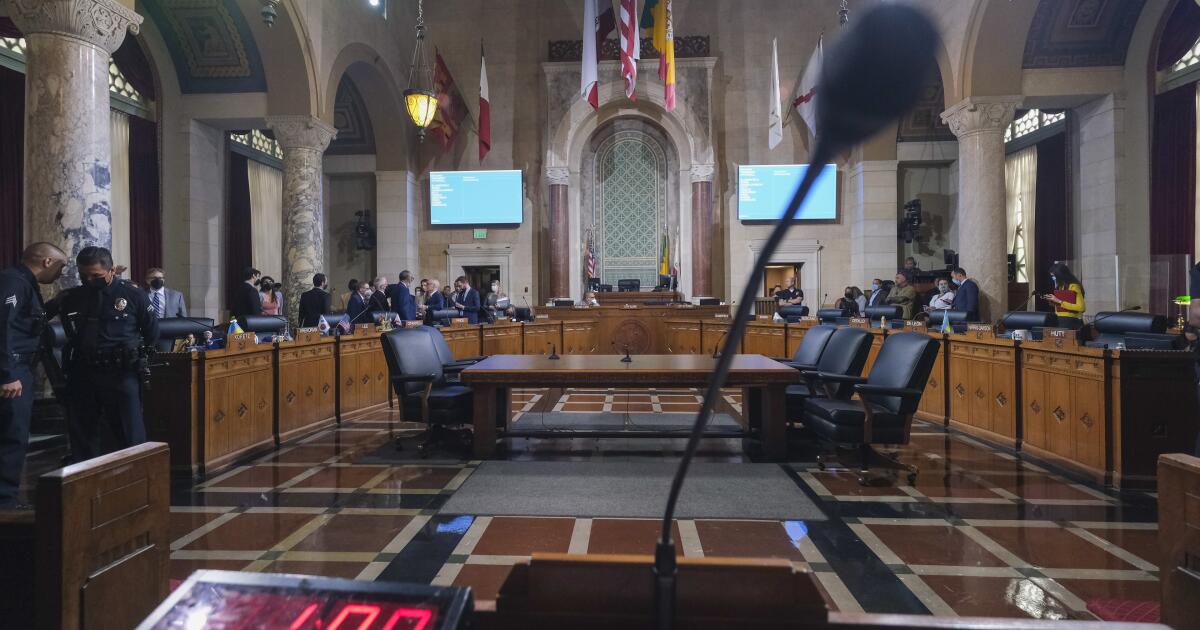
Good morning, and welcome to L.A. on the Record — our City Hall newsletter. It’s Noah Goldberg, with an assist from David Zahniser and Melissa Gomez, giving you the latest on city and county government.
Former Deputy City Atty. Michelle McGinnis wants to know why she was escorted out of City Hall in front of her colleagues, forced to turn in her work computer and placed on administrative leave in April 2024.
In her search for answers, a separate issue has arisen: whether her former boss is withholding or deleting text messages.
In a lawsuit against the city, McGinnis subpoenaed text messages about her between City Atty. Hydee Feldstein Soto and one of her top deputies, Denise Mills.
But according to a new petition that McGinnis filed in Los Angeles County Superior Court, Feldstein Soto produced zero text messages between her and Mills, and Mills produced just three with Feldstein Soto. The subpoena also asked for messages on Signal and other apps.
McGinnis’ lawyer, Caleb Mason, said the lack of texts strains credulity and probably means that some were deleted or withheld. McGinnis, who headed the criminal branch of the City Attorney’s Office, was fired in January 2025.
“It is obviously relevant and critical … to see what Ms. Feldstein [Soto] and Ms. Mills were saying to one another about Ms. McGinnis … that led to the extraordinary and unprecedented action of escorting a Branch Chief out of the building,” Mason wrote in a Feb. 23 brief.
A deputy city attorney representing Feldstein Soto and Mills disputed Mason’s claims in court filings, calling the new petition “uncomprehensible [sic]” and asserting that the two officials complied with the subpoenas. The attorney also sent 2,061 pages of documents to Mason.
Feldstein Soto, in a declaration, said that she “diligently searched for any documents” and shared them with her lawyer.
Mills said she did the same. In an effort to “retrieve any backup text messages,” she performed a factory reset of her phone on Jan. 30. McGinnis said the subpoenas were served on Dec. 15.
McGinnis’ lawyer said that was tantamount to spoliation — or destruction of evidence.
“Every court and every attorney in the country knows that ‘performing a factory reset’ means erasing information from a phone,” he wrote.
“It is reckless or negligent to reset a device when you know the opposing party is seeking that info,” said Laurie Levenson, a professor of law at Loyola Law School.
Still, Levenson said, politicians and lawyers often prefer speaking in person or on the phone to avoid their communications being exposed in a lawsuit. So it’s possible that the two didn’t exchange many text messages.
Feldstein Soto said in a statement that she has turned over all text messages about McGinnis. “There is nothing new here,” she said. “Ms. McGinnis was terminated, for cause. We remain confident in that decision.”
The city has argued that McGinnis “routinely opposed” Feldstein Soto’s policy and prosecutorial decisions.
McGinnis was placed on administrative leave due to a “pattern of insubordination and failure to meet minimal job requirements,” the city wrote in a legal filing in 2024.
The lawsuit that McGinnis filed against the city in 2024 alleged that Feldstein Soto retaliated against McGinnis and made prosecutorial decisions based on “personal relationships” or “perceived political gain.” The lawsuit also accused Feldstein Soto and Mills of “inappropriate alcohol consumption” in the office.
Other local politicians have also coughed up remarkably few text messages in response to public records requests.
Mayor Karen Bass came under scrutiny following the Palisades fire over the fact that her text messages auto-delete after 30 days, destroying potentially critical information about her decisions surrounding the devastating blaze. The Times sued the city after Bass’ counsel argued that her texts were “ephemeral” and not subject to public records requests. L.A. County Supervisor Kathryn Barger also said she auto-deletes messages after 30 days — and sometimes manually deletes them.
City Council President Marqueece Harris Dawson, meanwhile, turned over zero texts, emails, Signal and WhatsApp messages in response to a Times public records request for his communications with Bass from Jan. 6 to Jan. 16, 2025 — before, during and after the Palisades fire.
Harris-Dawson’s office said it had “conducted a search and found no responsive records for this request.”
You’re reading the L.A. on the Record newsletter
State of play
— IDK, VOTERS SAY: A majority of Angelenos have not made up their minds about the June 2 mayoral primary, according to a poll released this week. Bass had the most support at 20%, while reality TV star Spencer Pratt had 10% and Councilmember Nithya Raman had 9%, the poll found.
— HOMELESS DEATHS DROP: For the first time in the decade that homeless mortality has been tracked in Los Angeles County, fewer people have died on the streets and in shelters than the year before, the Department of Public Health reported Tuesday. A sharp decrease in overdose deaths drove a decline of 10% in the rate of homeless deaths from all causes in 2024, the most recent data analyzed by the county.
—LAST-MINUTE MEMO: The City Council was set to vote on a $177-million contract for the Legal Aid Foundation of Los Angeles to continue representing tenants for the next three years, with other groups providing related services. But the night before the March 3 vote, Feldstein Soto sent a confidential memo to council offices recommending that council members “reconsider the award of such a large contract to a frequent litigant against the city.”
— CAMPAIGN REVELATION: Community organizer Jordan Rivers, who is running against incumbent Tim McOsker to represent Council District 15, said he will continue his campaign after a report surfaced that he stabbed a neighbor when he was 12. Rivers, now 22, stabbed the 8-year-old boy in the neck and shoulders, inflicting “severe and life threatening physical and emotional injuries,” a lawsuit said. On Monday, Rivers said it was an “accident” that happened a decade ago.
“I do not believe that past situations or indeed past mistakes define or determine who a person is or what they are,” he said.
— LAPD REFORMS: A series of proposed changes to the city’s charter — essentially its constitution — could give elected leaders in Los Angeles more oversight over the Police Department and enable the police chief to fire problem officers. The changes, recommended by the city’s Charter Reform Commission, have long been sought by advocates and are likely to face fierce opposition.
— SUPE SPEAKS: Embattled Los Angeles schools chief Alberto Carvalho made his first public statement since the FBI raided his home and district office on Feb. 25. He denied any wrongdoing and asked to return to his duties.
“While the government’s investigation remains ongoing, no evidence has been presented by prosecutors supporting any allegation that Mr. Carvalho violated federal law,” the statement said.
— A WEEK OF WIPEOUTS: With city officials finalizing the list of candidates for the June 2 election, a number of hopefuls failed to gather enough signatures to qualify for the ballot. They include community leader Eddie Ha, publicist Dory Frank and entrepreneur Jeremy Wineberg on the Westside; residential connectivity specialist Rosa Requeno on the Eastside; neighborhood council member Jon Rawlings in the San Fernando Valley; and neighborhood council president Adriana Cabrera, civil rights attorney Chris Martin and social worker Michelle Washington in South L.A.
— REWORKING ULA (TAKE 3): The City Council voted Wednesday to create an ad hoc committee to look at potential changes to Measure ULA, the tax on high-end property sales passed in 2022. City leaders have made two previous moves to rewrite the measure, neither of which succeeded.
— VOTING OLYMPIC VALUES: The council voted Friday to “express concern” about LA28 Olympics committee chairman Casey Wasserman, saying his appearance in the Epstein files poses a “potential conflict” with the values of the Olympic movement. Several elected officials at City Hall, including Bass, had already called for Wasserman to step down.
— MEETING OF MAYORS: On Friday, about 20 mayors and city council members from across L.A. County, including Bass, came together to discuss the impact that immigration raids have had on their communities. Many raised concerns about the role of local law enforcement in allowing federal agents to act with what they described as impunity.
One mayor suggested that all the cities that contract with the L.A. County Sheriff’s Department should get together to demand accountability for deputies in their interactions with immigration agents.
QUICK HITS
Where is Inside Safe? The mayor’s signature program went to Washington and Lincoln boulevards in Councilmember Traci Park‘s district, bringing more than 20 people inside, according to a mayoral spokesperson.
On the docket next week: The Los Angeles chapter of the Democratic Socialists of America will meet on Saturday, March 21, at Immanuel Presbyterian in Koreatown. Members are expected to vote on whether to make an endorsement in the mayoral primary.
Stay in touch
That’s it for this week! Send your questions, comments and gossip to LAontheRecord@latimes.com. Did a friend forward you this email? Sign up here to get it in your inbox every Saturday morning.
March 14 (UPI) — President Donald Trump announced that U.S. forces “totally obliterated” every military target on Iran’s Kharg Island, a key port that exports the vast majority of Iran’s oil.
In a post on Truth Social on Friday evening, Trump described the attack as “one of the most powerful bombing raids in the History of the Middle East.”
He said he directed U.S. Central Command to carry out the bombings after Iran halted ships’ passage through the Straight of Hormuz. About 20% of the world’s crude oil passes through the strait.
“For reasons of decency, I have chosen NOT to wipe out the Oil Infrastructure on the island,” Trump wrote.
“However, should Iran, or anyone else, do anything to interfere with the Free and Safe Passage of Ships through the Strait of Hormuz, I will immediately reconsider this decision.”
Kharg Island is about 15 miles south of the Iranian mainland through which about 90% of the country’s oil exports pass, The Washington Post reported. It’s a critical piece of Iran’s economy and a full attack on the oil infrastructure there could hinder Iran’s ability to pay its military.
Iranian officials said the site was “proceeding normally” after the U.S. attack.
In response to Friday’s bombings on Kharg Island, Iran threatened its own attack on key oil infrastructure in the United Arab Emirates, CNN reported.
Oil has been a key factor in the war in Iran, which began Feb. 28 with surprise U.S. and Israeli airstrikes on dozens of Iranian sites. AAA reported Saturday that the average price of a gallon of gasoline was $3.68 in the United States, up 23% since the start of the war.
This could, in turn, have a dramatic impact on other aspects of the U.S. economy, including food prices, jet fuel and fertilizer.
An Iranian man raises a portrait of new supreme leader Mojtaba Khamenei during a rally on Revolution Street in Tehran on March 9, 2026. Photo by Hossein Esmaeili/UPI | License Photo
Contradicting his secretary of State and other top officials, President Trump on Saturday suggested without evidence that China — not Russia — may be behind the cyberattack against the United States and tried to downplay its impact.
In his first comments on the breach, Trump scoffed at the focus on the Kremlin and minimized the intrusions, which the nation’s cybersecurity agency has warned posed a “grave” risk to government and private networks.
“The Cyber Hack is far greater in the Fake News Media than in actuality. I have been fully briefed and everything is well under control,” Trump tweeted. He also claimed the media are “petrified” of “discussing the possibility that it may be China (it may!).”
There is no evidence to suggest that is the case. Secretary of State Michael R. Pompeo said late Friday that Russia was “pretty clearly” behind the attack.
“This was a very significant effort and I think it’s the case that now we can say pretty clearly that it was the Russians that engaged in this activity,” he said in the interview with radio talk show host Mark Levin.
Officials at the White House had been prepared to put out a statement Friday afternoon that accused Russia of being “the main actor” in the hack, but were told at the last minute to stand down, according to one U.S. official familiar with the conversations who spoke on condition of anonymity to discuss private deliberations.
It is not clear whether Pompeo got that message before his interview, but officials are now scrambling to figure out how to square the disparate accounts. The White House did not immediately respond to questions about the statement or the basis of Trump’s claims.
Throughout his presidency, Trump has refused to blame Russia for well-documented hostilities, including its interference in the 2016 election to help him get elected. He blamed his predecessor, Barack Obama, for Russia’s annexation of Crimea, has endorsed allowing Russia to return to the Group of 7 of nations and has never taken the country to task for allegedly putting bounties on U.S. soldiers in Afghanistan.
Pompeo in the interview said the government was still “unpacking” the cyberattack and some of the details would likely remain classified.
“But suffice it to say there was a significant effort to use a piece of third-party software to essentially embed code inside of U.S. government systems and it now appears systems of private companies and companies and governments across the world as well,” he said.
Though Pompeo was the first Trump administration official to publicly blame Russia for the attacks, cybersecurity experts and other U.S. officials have been clear over the past week that the operation appears to be the work of Russia. There has been no credible suggestion that any other country — including China — is responsible.
Democrats in Congress who have received classified briefings have also affirmed publicly that Russia, which in 2014 hacked the State Department and interfered through hacking in the 2016 presidential election, was behind it.
It’s not clear exactly what the hackers were seeking, but experts say it could include nuclear secrets, blueprints for advanced weaponry, COVID-19 vaccine-related research and information for dossiers on government and industry leaders.
Russia has said it had “nothing to do” with the hacking.
While Trump downplayed the impact of the hacks, the Cybersecurity and Infrastructure Security Agency has said it compromised federal agencies as well as “critical infrastructure.” Homeland Security, the agency’s parent department, defines such infrastructure as any “vital” assets to the U.S. or its economy, a broad category that could include power plants and financial institutions.
One U.S. official, speaking Thursday on condition of anonymity, described the hack as severe and extremely damaging.
“This is looking like it’s the worst hacking case in the history of America,” the official said. “They got into everything.”
Trump had been silent on the attacks before Saturday.
Deputy White House Press Secretary Brian Morgenstern told reporters Friday that national security advisor Robert O’Brien has sometimes been leading multiple daily meetings with the FBI, the Department of Homeland Security and the intelligence agencies, looking for ways to mitigate the hack.
He would not provide details, “but rest assured we have the best and brightest working hard on it each and every single day.”
The Democratic leaders of four House committees given classified briefings by the administration issued a statement complaining that they “were left with more questions than answers.”
“Administration officials were unwilling to share the full scope of the breach and identities of the victims,” they said.
Pompeo, in the interview with Levin, said Russia was on the list of “folks that want to undermine our way of life, our republic, our basic democratic principles. … You see the news of the day with respect to their efforts in the cyberspace. We’ve seen this for an awfully long time, using asymmetric capabilities to try and put themselves in a place where they can impose costs on the United States.”
What makes this hacking campaign so extraordinary is its scale: 18,000 organizations were infected from March to June by malicious code that piggybacked on popular network-management software from an Austin, Texas, company, SolarWinds.
It’s going to take months to kick elite hackers out of the U.S. government networks they have been quietly rifling through since as far back as March.
Experts say there simply are not enough skilled threat-hunting teams to identify all the government and private-sector systems that may have been hacked. FireEye, the cybersecurity company that discovered the intrusion and was among the victims, has already tallied dozens of casualties. It’s racing to identify more.
Many federal workers — and others in the private sector — must presume that unclassified networks are teeming with spies. Agencies will be more inclined to conduct sensitive government business on Signal, WhatsApp and other encrypted smartphone apps.
“We should buckle up. This will be a long ride,” said Dmitri Alperovitch, co-founder and former chief technical officer of the leading cybersecurity firm CrowdStrike. “Cleanup is just Phase 1.”
Florida became the first state to acknowledge falling victim to a SolarWinds hack. Officials told the Associated Press that hackers apparently infiltrated the state’s healthcare administration agency and others.
SolarWinds’ customers include most Fortune 500 companies, and its U.S. government clients are rich with generals and spymasters.
If the hackers are indeed from Russia’s SVR foreign intelligence agency, as experts believe, their resistance may be tenacious. When they hacked the White House, the Joint Chiefs of Staff and the State Department in 2014 and 2015 “it was a nightmare to get them out,” Alperovitch said.
The Pentagon has said it has so far not detected any intrusions from the SolarWinds campaign in any of its networks — classified or unclassified.
Weekly insights and analysis on the latest developments in military technology, strategy, and foreign policy.
U.S. President Donald Trump says there “will be no deal” with Iran unless it surrenders unconditionally, a day after Iran’s Foreign Minister said the country was prepared to stand up to a ground invasion. Trump has also said that any new leadership of the country would have to be “acceptable” to the United States. This follows what has now been seven days of heavy U.S.-Israeli bombardment, including a new major wave of strikes by Israel targeting Iranian leadership in Tehran overnight.
You can catch up with our past coverage of ongoing operations against Iran here.Latest updates on the war are down the page of this article.
Trump’s statement was made via a post on his Truth Social social media network.
“There will be no deal with Iran except UNCONDITIONAL SURRENDER!,” he wrote. “After that, and the selection of a GREAT & ACCEPTABLE Leader(s), we, and many of our wonderful and very brave allies and partners, will work tirelessly to bring Iran back from the brink of destruction, making it economically bigger, better, and stronger than ever before. IRAN WILL HAVE A GREAT FUTURE. “MAKE IRAN GREAT AGAIN (MIGA!).”
BREAKING: Trump on Iran:
There will be no deal with Iran except UNCONDITIONAL SURRENDER!
After that, and the selection of a GREAT & ACCEPTABLE Leader(s), we, and many of our wonderful and very brave allies and partners, will work tirelessly to bring Iran back from the brink of… pic.twitter.com/6Q6TqyHTbt
Trump has increasingly talked about changing the regime in Tehran in recent days, and his desire to be personally involved in that process. This comes despite pushback from other U.S. officials about regime change being an explicit goal of what has been dubbed Operation Epic Fury.
“We want to go in and clean out everything,” Trump told NBC Newsin a phone call on Thursday. “We don’t want someone who would rebuild over a 10-year period.”
“We want them to have a good leader,” the president added. “We have some people who I think would do a good job.”
Trump declined to offer any names, but said he was taking steps to make sure the people on his list make it through the war alive.
EXCLUSIVE: Trump says he wants Iran’s leadership structure gone and wants to ensure his own list of possible leaders survive the war. https://t.co/KRwAmgz2tN
Trump acknowledged that Khamenei’s son, Mojtaba Khamenei, is the most likely successor, but finds that outcome unacceptable and insists he play a role in determining Iran’s next leader, Axios reported.
“They are wasting their time. Khamenei’s son is a lightweight,” Trump told Axios. “I have to be involved in the appointment, like with Delcy in Venezuela.”
Trump was referring to the Venezuelan Vice President Delcy Rodriguez, who took over after the capture of dictator Nicolas Maduro in a dramatic U.S. operation in January.
🚨 EXCLUSIVE: Trump says he must be involved in picking Iran’s next leader.
He said that Mojtaba Khamenei, son of assassinated supreme leader Ali Khamenei, is the most likely successor — and finds that unacceptable.https://t.co/73b4PVOLW2
Trump had also called for Iran’s unconditional surrender during the 12 Day War between Israel and Iran last year, before helping broker a ceasefire agreement between the parties.
The last time Trump demanded Iran’s “unconditional surrender” was during the 12-Day Israel–Iran war (June 13–24, 2025).
Trump twice demanded Iran’s “unconditional surrender” back then.
Before Trump made his unconditional surrender demand, U.S. Navy Adm. Brad Cooper, commander of U.S. Central Command (CENTCOM), laid out how destructive Epic Fury has been to Iran’s military.
“Over the last 24 hours of the operation, compared to where we were at the start, ballistic missile attacks have decreased by 90%, drone attacks have decreased by 83% since day one,” he told reporters, including from The War Zone, during a press conference at CENTCOM headquarters in Tampa, Florida, on Thursday evening. Cooper added that these attacks have also wiped out a large chunk of Iran’s Navy, destroying 20 ships so far.
U.S. Admiral Brad Cooper gives update on Iran: “We are now starting our sixth day of a historic mission to eliminate Iran’s ability to threaten America. The president and Secretary Hegseth have been crystal clear in their expectations and we are at a high level of execution.” pic.twitter.com/Acr4WpQJpc
Overnight, the Israeli Defense Forces (IDF) said it carried out a massive 50-jet raid on Tehran, targeting an underground bunker complex intended for use by Supreme Leader Ali Khamenei and other top leaders. Khamenei was killed elsewhere in the opening phase of what the IDF called Operation Roaring Lion.
The bunker “spanned multiple streets in the heart of Tehran and contained numerous entrances and meeting rooms” for senior Iranian leaders, the IDF explained. It was intended to be used by Khamenei as “a secure emergency command center,” but after his death, “the compound continued to be used by senior Iranian regime officials,” the IDF claimed.
הבונקר התת-קרקעי, נבנה מתחת למתחם והיה נכס חירום מאובטח לניהול הלחימה על ידי המנהיג, שחוסל טרם הספיק להשתמש בו במבצע ‘שאגת הארי’. לאחר חיסול ח’אמנהאי, המתחם המשיך לשמש את בכירי המשטר האיראני.
לאורך שנים, המשטר השקיע את מאמציו להקמת המתחם התת-קרקעי, במטרה לבסס עבורו מקום לקידום… pic.twitter.com/LlPmHSFlR7
The “senior commander” targeted by these Israeli air strikes was Asghar Hijazi, Times of Israel military correspondent Emanuel “Mannie” Fabian reported on X, citing Israeli defense sources.
“Hijazi is said to be the acting head of the supreme leader’s office, following the killing of Ali Khamenei,” Fabian added.
The “senior Iranian commander” targeted in an Israeli airstrike in Tehran a short while ago is Asghar Hijazi, according to Israeli defense sources.
Hijazi is said to be the acting head of the supreme leader’s office, following the killing of Ali Khamenei. https://t.co/7T58UKmkLp
— Emanuel (Mannie) Fabian (@manniefabian) March 6, 2026
Videos emerging from Tehran showed multiple explosions and ensuing fireballs rising in the distance. Local residents described the attack as “the worst, strongest, and most horrifying ever.”
For their part, Iranian officials have been publicly rejecting the possibility of new talks and/or a ceasefire with the United States and Israel amid the ongoing conflict. Iran’s Foreign Minister Sayed Abbas Araghchi also said yesterday that his country was prepared for a ground invasion.
“Relying on its defensive capabilities and the support of the Iranian nation, the Islamic Republic defends the country’s national sovereignty and territorial integrity within the framework of its inherent right to legitimate self-defense and will respond decisively to any aggressive act,” Araghchi told his Cuban counterpart today.
Significant pressure is clearly being put on the regime in Tehran to capitulate, at least to some degree. Top Iranian leadership figures are being actively targeted, as are individuals who could step in to fill the resulting voids. What the U.S. government, as well as its Israeli allies, may actually be willing to accept in order to bring the conflict to an end remains to be seen.
We have concluded our rolling coverage in this piece.
UPDATE: 5:33 PM EST –
After a meeting with major defense contractors called as the U.S. continues to burn through munitions during Epic Fury, Trump said they were boosting weapons production.
“They have agreed to quadruple Production of the ‘Exquisite Class’ Weaponry in that we want to reach, as rapidly as possible, the highest levels of quantity,” the president proclaimed. “Expansion began three months prior to the meeting, and Plants and Production of many of these Weapons are already under way.”
In his post, Trump again asserted that there is “a virtually unlimited supply of Medium and Upper Medium Grade Munitions, which we are using, as an example, in Iran, and recently used in Venezuela. Regardless, however, we have also increased Orders at these levels.”
Air Force Chief of Staff Gen. Ken Wilsbach posted a message on X praising airmen for their efforts during Epic Fury.
U.S. Treasury Secretary Scott Bessent said “tonight will be our biggest bombing campaign” against Iran.
“We will do the most damage to the Iranian missile launchers and the factories that built them.”
INTERESTING: U.S. Treasury Secretary Scott Bessent on Iran:
Tonight will be our biggest bombing campaign.
We will do the most damage to the Iranian missile launchers and the factories that build the missiles. pic.twitter.com/zCYvaytdeC
Videos have emerged on social media claiming to show attacks across Iraq.
Some purport to show an attack on Camp Victory, a facility housing U.S. forces near Baghdad’s international airport. You can see explosions followed by fireballs and smoke in the video. It is not clear who is attacking.
🇮🇶🇮🇷🇺🇲‼️ FEROZ BOMBARDEO IRANÍ: REPORTAN QUE LA BASE CAMPO VICTORIA (EEUU) EN BAGHDAD ESTARÍA EN LLAMAS POR ATAQUE CON 2 MISILES Y DRONES pic.twitter.com/a7VAMWrBpv
— (FRAPP) ANTIFASCISTA #AntiKast #OrgullosoDel42% (@Informa3Chile) March 6, 2026
Another video shows a claimed strike by U.S. helicopters on an Iranian-backed militia group in Mosul. We cannot independently confirm any of these claims and have reached out to CENTCOM for more information.
US helicopters struck at least twice a Kataeb Seyyed a-Shuhadaa’ HQ in al-Rashidiya, Mosul, tonight. KSS is an Iranian-backed militia that has carried out attacks against Iraqi Kurdistan & US interests in Iraq under the facade group Awliyaa’ a-Damm. pic.twitter.com/JdG9u5nqWt
There is also a video claiming to depict an Iranian drone strike on energy facilities in Basra.
Iranian drone strikes hit energy infrastructure in Burjesia/Basra, including a Baker Hughes facility, the Rumaila oil field, and Basra airport. pic.twitter.com/CeeHpKKFSk
The IRGC offered a threatening response to Trump’s order to have U.S. Navy vessels escort commercial ships through the Strait of Hormuz. Iran has previously claimed it had shut down the Strait, and the IRGC said it welcomes these escorts, with a reference to the American supertanker Bridgeton, which hit a mine in the Persian Gulf while being escorted by U.S. Navy warships in 1987. That incident took place in the so-called “Tanker War” that took place during the Iran-Iraq War.
IRGC Spox:
Iran strongly welcomes US’ willingness to escort oil tankers and the claim of the presence of US forces for passage through the Strait of Hormuz, and in fact, the IRGC is waiting for their presence.
Amid all the turmoil, the French aircraft carrier Charles de Gaulle has passed through the Strait of Gibraltar and is now in the Mediterranean.
France’s aircraft carrier Charles de Gaulle has passed through Gibraltar into the Mediterranean Sea and is moving toward the Middle East. pic.twitter.com/TCK9Wuv5i6
CENTCOM released its latest Epic Fury graphic update showing targets hit and assets deployed. So far, more than 3,000 targets have been hit, including 43 Iranian ships that have been destroyed or damaged, according to the command.
(CENTCOM)
The aircraft carrier USS Gerald R. Ford has transited the Suez Canal and is now in the Red Sea, according to the Navy. Images posted on the Pentagon’s video and image distribution site show the carrier and one of its escorts, the Arleigh Burke class guided missile destroyer USS Bainbridge in the canal.
The world’s largest aircraft carrier, USS Gerald R. Ford (CVN 78), transits the Suez Canal, March 5, 2026. (U.S. Navy photo) U.S. Central Command Public AffaArleigh Burke class guided-missile destroyer USS Bainbridge (DDG 96) transits the Suez Canal, March 5, 2026. (U.S. Navy photo) U.S. Central Command Public Affa
A Chinese satellite image emerged of the Ford and two of its escorts crossing through the canal. This move makes sense considering that the ballistic missile threat against Israel that the carrier strike group was helping defend against has diminished. Being in the Red Sea would provide assets needed to defend against any attacks from the Houthis of Yemen should that Iranian proxy decide to get into the fight.
The Pentagon also released photos of B-52 Stratofortress bombers that took part in Epic Fury.
Aircrew members board a B-52H Stratofortress prior to taking off in support of Operation Epic Fury, March 4, 2026. (U.S. Air Force photo) U.S. Central Command Public Affa
There are claims that Iran struck a Patriot air defense site in the UAE, however we cannot confirm this. We reached out to CENTCOM for more details.
“There may be other countries to join action against Iran and its interests in the region,” the outlet noted.
These claims come days after Azerbaijani officials vowed they would retaliate for an Iranian drone strike on their territory that wounded four people.
We cannot confirm that, however, video emerged earlier today showing Azerbaijani military equipment being moved closer to that nation’s border with Iraq.
The U.K. Defense Ministry (MoD) issued its latest update on operations in the Middle East.
Iran’s intelligence ministry said on Thursday that “separatist terrorist groups” planned to enter the country from its western borders and carry out attacks in urban and border areas, taking advantage of wartime conditions, Iran International reported. “A joint preemptive operation by the intelligence ministry and the Islamic Revolutionary Guard Corps destroyed a significant portion of the groups’ positions and capabilities and inflicted heavy losses,” the ministry said in a statement.
UPDATE 1:07 PM EST –
White House Press Secretary Karoline Leavitt offered an explanation of what Trump means by his unconditional surrender demand on Iran.
“When Trump, as Commander in Chief, determines that Iran no longer poses a threat to the US and the goals of Operation Epic Fury have been fully realized, then Iran will essentially be in a place of unconditional surrender, whether they say it themselves or not,” she explained.
Karoline Leavitt on Iran:
When Trump, as Commander in Chief, determines that Iran no longer poses a threat to the US and the goals of Operation Epic Fury have been fully realized, then Iran will essentially be in a place of unconditional surrender, whether they say it themselves… pic.twitter.com/RMQpAJxx4E
The Army in recent days abruptly canceled a major training exercise for the headquarters element of the 82nd Airborne Division at Fort Bragg, North Carolina, according to The Washington Post.
“This is fueling speculation within the Defense Department that soldiers specializing in ground combat and a range of other missions may be sent to the Middle East as the conflict with Iran widens,” the publication posited.
SCOOP: The Army in recent days canceled a training exercise for the headquarters element of the 82nd Airborne Division, fueling speculation among soldiers that they may be called upon for a still undefined mission as the war with Iran widens.
Ukraine is in talks with the U.S. and Gulf allies about replicating Kyiv’s acoustic detection network to counter Iranian attack drones, Financial Times is reporting, citing people familiar with the matter. Consisting of thousands of acoustic sensors across Ukraine, this system helps detect and track incoming Russian kamikaze drones, alert traditional air defenses in advance, and also dispatch ad hoc drone hunting teams to shoot them down.
New: Ukraine is in talks with the US and several Gulf states about replicating Kyiv’s acoustic detection network to counter Iranian attack drones, according to people familiar with the matter. w/ @fabrice_deprezhttps://t.co/ME2ErGPq8X
Air Force Gen. Dan Caine, chairman of the Joint Chiefs of Staff, posted a message on X honoring six soldiers killed in Kuwait by an Iranian drone on March 1.
“It is with profound sadness that we mourn the loss of six American heroes from the 103rd Sustainment Command U.S. Army Reserves out of Des Moines, Iowa,” Caine noted. “Major Jeffrey R. O’Brien, Captain Cody A. Khork, Chief Warrant Officer 3 Robert M. Marzan, Sergeant First Class Nicole M. Amor, Sergeant First Class Noah L. Tietjens, and Sergeant Declan J. Coady.”
A message from the Chairman of the Joint Chiefs of Staff Gen. Dan Caine:
It is with profound sadness that we mourn the loss of six American heroes from the 103rd Sustainment Command U.S. Army Reserves out of Des Moines, Iowa: Major Jeffrey R. O’Brien, Captain Cody A. Khork,…
Secretary of State Marco Rubio told Arab foreign ministers in a series of phone calls Thursday that the war is expected to last several more weeks, Axios is reporting, citing “sources with direct knowledge of the conversations.”
Rubio said the current military focus is on Iran’s missile launchers, stockpiles and factories, the outlet reported, adding that the secretary “told the ministers the U.S. goal is not regime change — while simultaneously making clear Washington wants different people running the country.”
U.S. Secretary of State Marco Rubio told Arab foreign ministers in calls Thursday that the war with Iran is expected to last several more weeks, according to sources familiar with the conversations. Rubio said the current military focus is on Iran’s missile launchers, stockpiles…
At least one B-1B Lancer bomber landed at RAF Fairford in the U.K. today. This is part of an ongoing buildup of U.S. forces as Epic Fury drags on.
UPDATE: 12:58 PM EST –
“The Iranian terrorist regime has attacked 12 different countries and continues to deliberately target civilians through the Middle East,” CENTCOM commander Adm. Brad Cooper has said in a new statement. “Last night, Iranian forces fired seven attack drones at civilian, residential neighborhoods in Bahrain. This is unacceptable and will not go unanswered. We will continue work with regional partners to address this threat to innocent people across the region.”
There are as-yet unconfirmed reports that U.S. B-1 bombers are headed to RAF Fairford in the United Kingdom, and that they will begin flying strikes on Iran from that base. In a press conference late yesterday, Secretary Pete Hegseth and Adm. Cooper both talked about the continued flow of U.S. forces, including bombers, to support Operation Epic Fury.
USAF B-1B bombers from Dyess AFB are expected to deploy to RAF Fairford in the near term.
Their arrival would significantly increase the tempo of long-range strike operations against targets in Iran. The B-1B carries one of the largest conventional payloads in the U.S. arsenal,…
Restricted airspace around RAF Fairford for the next month (at least) shows the USAF will be deploying bombers to the airfield shortly. Note: NOTAMs are on the www. Credit JS below. https://t.co/i0qiHSGs0m
French authorities have denied that U.S. aircraft are using bases in the country to support operations over Iran, but are instead operating from them to aid in “the defense of our partners in the region.”
✖️No U.S. assets deployed on French bases in the Middle East.
✔️Yes: U.S. assets accepted on Istres Airbase (France) as part of a routine NATO procedure. They are not involved in U.S. operations in Iran but strictly supporting the defense of our partners in the region. https://t.co/NcZ1TyWc8z
It has now been reported that the U.S. Navy submarine that torpedoed the Iranian frigate IRIS Dena in the Indian Ocean was the Los Angeles class USS Charlotte. Separately, another Iranian ship has now sought refuge in India. This is in addition to the IRIS Bushehr, which is now impounded in Sri Lanka.
7th Fleet Los Angeles-class fast-attack sub USS Charlotte (SSN 766) fired the single Mk 48 torpedo that sunk Iranian frigate IRIS Dena (75), @JimLaPorta reports.
One of 30+ Iranian vessels destroyed this week and the first enemy ship sunk by a U.S. sub since WW2. Periscope view: pic.twitter.com/gAGc9I7BjY
BREAKING: Iranian Navy warship IRIS Lavan docked in Kochi with its 183 member crew on March 4, the same day that IRIS Dena was torpedoed. The ship had requested accommodation on Feb 28 and received permission on March 1. The crew is being accommodated in Indian Navy facilities. pic.twitter.com/yLVwPvu54L
The vessel requested entry into Sri Lankan waters on March 4 citing mechanical issues, hours after U.S. forces sank companion vessel IRIS Dena off Galle, killing almost 100 Iran sailors https://t.co/T1wF2qvz2Ipic.twitter.com/13ljHDPTn7
The satellite image below is said to show the aftermath of an attack on an Iranian underground ballistic missile facility.
The video below is said to show an Iranian ballistic missile attack on Prince Sultan Air Base in Saudi Arabia, though it is currently unconfirmed.
Video footage purported to show an Iranian ballistic missile strike on Prince Sultan Air Base in Al-Kharj, Saudi Arabia, with the missile impacting very close to several U.S. servicemembers, thankfully said to have resulted in only minor injuries to personnel at Prince Sultan. pic.twitter.com/Nlju8TCZ22
Pictures and videos showing Iranian ballistic missiles with cluster munition payloads being employed continue to appear online. Images of the submunitions themselves have also now been emerging following the use of these missiles.
The Ministry of Defense of the United Arab Emirates (UAE) says the country’s forces intercepted another nine ballistic missiles and 109 drones fired by Iran today. UAE authorities say they have now intercepted 190 ballistic missiles, eight cruise missiles, and 1,110 drones since the conflict began.
UAE air defences intercept 9 ballistic missiles, 109 drones
The UAE Ministry of Defence announced that the country’s air defence systems detected 9 ballistic missiles today (6th March 2026), all of which were intercepted and destroyed.
MS NOW‘s “Morning Joe” is reporting that authorities in the UAE have now frozen billions of dollars in Iranian assets held in the country.
BREAKING NEWS: #morningjoe has learned that the UAE has frozen billions of dollars in Iranian assets. The move will likely have crippling effects on an already weakened Iranian economy. https://t.co/Da41RisQqY
What is said to be the first U.S. State Department-facilitated evacuation flight from Israel has arrived in Greece, according to JewishInsider.
New from me: The first State Department evacuation flight from Israel landed in Athens on Friday afternoon, where its passengers were greeted on the tarmac by U.S. Ambassador to Greece Kim Guilfoyle.https://t.co/ICBx7NpaHH
U.S. Central Command (CENTCOM) has now released a video showing a strike on the Iranian ‘drone carrier’ Shahid Bagheri, an unusual ship you can read more about here. At a press conference late yesterday, U.S. Navy Adm. Brad Cooper, head of CENTCOM, said an unnamed “Iranian drone carrier ship, roughly the size of a World War II aircraft carrier” had been targeted in “just the last few hours.” In a post on X on March 2 denying claims of an attack on a U.S. carrier, CENTCOM said “the only carrier that has been hit is the Shahid Bagheri.” It remains unclear whether the Shahid Bagheri was struck multiple times.
U.S. forces aren’t holding back on the mission to sink the entire Iranian Navy. Today, an Iranian drone carrier, roughly the size of a WWII aircraft carrier, was struck and is now on fire. pic.twitter.com/WyA4fniZck
A video clip, taken from the shore, has now also emerged that is said to show the Shahid Bagheri on fire following a strike. The U.S. military has made clear that the destruction of Iran’s naval capabilities is a core objective of Operation Epic Fury.
U.S. Central Command continues to release other footage from ongoing strikes on targets in Iran.
Iranian targets are being decimated by U.S. forces, paving the way for continued delivery of overwhelming American military firepower. pic.twitter.com/wQUER9cXWw
✈️⛽️ Additional USAF Tankers (6) heading to Ben Gurion airport/airbase, Tel Aviv.
There were around 30 of them already parked there yesterday. Their role is to refuel different fighter jets in the region attacking Iran. pic.twitter.com/YJ6yBr6mRJ
The Israel Defense Forces have shared a video taken in the cockpit of a fighter flying over Iran.
The Israeli Air Force publishes footage from the cockpit of IAF fighter jets flying over Iran.
“We continue to fight, as required around the clock, and feel your support all the time. We wish you, Israeli citizens, a safe and quiet Shabbat,” a pilot is heard saying in a… pic.twitter.com/cvljwuAJ02
— Emanuel (Mannie) Fabian (@manniefabian) March 6, 2026
Deputy Prime Minister of the United Kingdom David Lammy has said the country would be within its rights to take “defensive action” in response to Iranian threats, including taking “down sites [Iran] that are anticipating attacking our people.” There are no indications that British forces have struck targets in Iran yet.
Publicly available data continues to show a decline in the number of Iranian ballistic missiles and drones launched in retaliatory attacks over the course of the conflict so far.
Day 8 👇
Iran Missile launches during the first 8 days of conflict:
🚀 Ballistic Missiles: 🔴 Day 1 — 350 🔴 Day 2 — 175 🔴 Day 3 — 120 🔴 Day 4 — 50 🔴 Day 5 — 40 🔴 Day 6 — 32 🔴 Day 7 — 28 🔴 Day 8 — 15
CBS News has reported that quadcopter-type drones may have conducted surveillance of U.S. facilities in Kuwait ahead of an attack that killed six American servicemembers.
Iranian intelligence utilized various means to track service members after they left the base.
➡️ In anticipation of the offensive and expected retaliation to include strikes on Camp Arifjan, the Tactical Ops Center (TOC) was moved to the same facility at the port used during… https://t.co/R8VcPGIESm
Qatari authorities say an Iranian attack struck facilities housing its naval personnel in Bahrain.
Qatar Condemns Iranian Attack on Buildings in Bahrain Housing Qatari Amiri Naval Forces Personnel
Doha | March 06, 2026
The State of Qatar condemns, in the strongest terms, the Iranian attack that targeted buildings in various areas of the sisterly Kingdom of Bahrain housing… pic.twitter.com/9Zd8lihCEi
— Ministry of Foreign Affairs – Qatar (@MofaQatar_EN) March 6, 2026
The Washington Post has reported that Russia may be providing Iran with information to help with targeting American forces in the Middle East, citing unnamed officials.
Exclusive: Russia is providing Iran with targeting information to attack American forces in the Middle East, the first indication that another major U.S. adversary is participating — even indirectly — in the war. https://t.co/SfBeKxq7zC
— The Washington Post (@washingtonpost) March 6, 2026
The video below is said to show the remains of an Iranian ballistic missile and its transporter-erector-launcher inside a structure following a strike.
A ballistic missile launcher concealed inside a hay storage site was struck today by U.S. and Israeli aircraft.
The boy who filmed the aftermath wrote: “It doesn’t matter where the launchers are, the Americans and Israelis will find them and target them heavily. Kudos to them.” pic.twitter.com/swI0PvEH6a
The videos below are said to show strikes on targets in the Iranian city of Ilam.
The satellite imagery below is said to show the aftermath of Iranian attacks earlier this week on facilities in Fujairah in the United Arab Emirates (UAE).
🇦🇪 Satellite images of oil facilities in Fujairah, UAE.
❗️UAE is considering freezing billions of dollars in Iranian assets held in the country and possibly seizing Iranian ships, – WSJ
🇶🇦 Qatar says the ongoing war could force Gulf countries to stop energy exports if it… pic.twitter.com/K5U49eikL0
South Korea’s Chosun newspaper has reported that 1,000 guidance kits for Paveway-series laser-guided bombs were moved from storage at Osan Air Base in December, possibly in support of preparation for Operation Epic Fury. However, the sourcing for the story is unclear, and it says that officials in the country have declined to comment.
The U.S. moved 1,000+ Paveway guided-bomb kits from Osan Air Base to the U.S. in Dec 2025, possibly later used in strikes on Iran.
Seoul says the transfer happened without prior consultation.
South Korean media outlets are also reporting that the Cheongung-II surface-to-air missile system, which is in service in the UAE, has made its combat debut, citing members of the country’s National Assembly and unnamed military officials.
S Korea’s Cheong-Gung air defense system in service since 2015.
It made its combat debut with UAE air defense forces, successfully intercepting several Iranian ballistic missiles on 3 March 2026. pic.twitter.com/OT3Pzj1UVk
— Christopher Wipper (@SGTWipper1Each) March 5, 2026
Pro-Iranian Iraqi militants claim to have launched kamikaze drones aimed at Jordanian military bases.
#USA / #Iraq / #Jordan 🇺🇸🇮🇶🇯🇴: Iraqi group “Rijal Al-Bas Al-Shadid” (Men of Great Strength) carried out attacks on Jordanian military bases.
Group seemingly launched several #Iran-made 🇮🇷 X-Tail “Shahed-101” Kamikaze Drones (OWA-UAVs) towards Jordan. pic.twitter.com/QT2ERJ7IJL
There are reports that ships continue to come under attack in and around the Strait of Hormuz. Maritime traffic through this highly strategic waterway continues to be at a virtual standstill due to the ongoing conflict.
While MOST vessels are waiting out the situation at the Strait of Hormuz, the Cook Islands flagged bitumen tanker PUSHPAK just sailed right through with AIS active. pic.twitter.com/FHiP76R8E9
Qatari Energy Minister Saad Sherida Al Kaabi has warned that all Gulf energy producers could halt production “within weeks and drive oil to $150 a barrel” if the ongoing conflict continues unabated in an interview with the Financial Times newspaper. Some oil fields are already cutting back production as available storage capacity in the country fills up as exports slow, according to The Wall Street Journal.
“Qatar expects all Gulf energy producers to shut down exports within weeks and drive oil to $150 a barrel, the country’s Energy Minister Saad al-Kaabi told the Financial Times in an interview published on Friday. “Everybody that has not called for force majeure we expect…
The U.S. government is reportedly easing sanctions on Russian oil exports to India amid disruption in global markets as a result of ongoing operations against Iran, the Financial Times has also reported.
The US is temporarily easing sanctions on Russian oil sales to India to address supply shortages and reduce the impact of the surge in prices in the wake of US and Israeli attacks on Iran. The decision to ease sanctions represents a major shift in policy:https://t.co/v5X5lhptE4
The U.S. Embassy in Baghdad has issued a new alert saying U.S. nationals are “strongly encouraged to depart as soon as they are safely able to do so” and advising them to use overland routes given regional airspace closures. The Embassy has suspended regular consular services.
Security Alert – U.S. Embassy Baghdad, Iraq – March 6, 2026 – Update 1 Location: Iraq Event The U.S. government cares about your safety and will continue to share information you need to make informed decisions about your security. The U.S. government is assessing all options to… pic.twitter.com/MbEhCFSmGj
— U.S. Embassy Baghdad (@USEmbBaghdad) March 6, 2026
The Japan Self-Defense Forces will deploy a transport aircraft to the Republic of Maldives in the Indian Ocean as part of an effort to aid Japanese nationals in departing the Middle East.
“The Ministry of Foreign Affairs has reported that, with regard to supporting the departure of Japanese nationals, transportation for those staying in Kuwait, Bahrain, Qatar, and the United Arab Emirates will be carried out sequentially starting as early as tomorrow onward. In light of this, the Ministry of Defense is proceeding with preparations for the Self-Defense Forces as a precaution, in preparation for unforeseen circumstances such as the inability to operate civilian charter flights,” Japanese Defense Minister Shinjiro Koizumi wrote on X, according to a machine translation of the post below. “The one Air Self-Defense Force transport aircraft moving to and positioning in the Republic of Maldives will be operated by pilots, maintenance personnel, and others from the Air Support Command (the Air Self-Defense Force unit that conducts air transport of supplies and air traffic control), with medical officers also on board.”
Sri Lankan authorities have released a video showing Iranian sailors from the frigate IRIS Dena being rescued after it was torpedoed by a U.S. submarine in the Indian Ocean earlier this week.
New video released by the Sri Lankan navy shows Iranian sailors being rescued after a US submarine attack sank their ship in international waters. pic.twitter.com/LnbsLxlMWB
Reuters has reported that U.S. officials are increasingly of the view that American forces were responsible for a strike on a primary school for girls in Mindab, Iran, but that the investigation is ongoing. Iranian officials have said that 150 students died as a result. The school directly abuts an Islamic Revolutionary Guard Corps (IRGC) facility in Mindab, which is believed to have been the target of the strike.
The girls’ school in Minab, in southern Iran, was hit on Saturday during the first day of U.S. and Israeli attacks on the country. Iran’s ambassador to the U.N. in Geneva, Ali Bahreini, said the strike killed 150 students. Reuters could not independently confirm the death toll.
At a presser Wed morning, SecDef Pete Hegseth said that the U.S. investigating. “”All I know, all I can say, is that we’re investigating that,” Hegseth said. “We, of course, never target civilian targets.”
The Pentagon has not yet responded to an additional request for comment.
March 13 (UPI) — A State Department official was barred Friday from going to Brazil because of a proposed visit to jailed former Brazilian President Jair Bolsonaro, who is in prison for plotting a coup four years ago.
The official, Darren Beattie, was approved for a visa to attend a critical minerals summit next week, but his visa was pulled because the meeting with Bolsonaro was determined to be outside his diplomatic authorization, Brazil’s Supreme Court ruled Thursday, Bloomberg and The Guardian reported.
After the ruling, current Brazilian President Luiz Inacio Lula da Silva ordered his government to revoke Beattie’s visa entirely, at least partially because U.S. President Donald Trump denied Brazilian health minister Alexandre Padilha a visa and revoked visas held by his wife and daughter.
“That American guy who said he was coming here to visit Bolsonaro, he’s been barred from visiting and I have forbidden him from to Brazil so long as they don’t free up the visa of my health minister, which has been blocked,” Lula said Friday.
Bolsonaro is serving a 27-year prison sentence after he was convicted for plotting a coup after losing the 2022 election to Lula.
The charges were based on Bolsonaro’s supporters storming government buildings in January 2023 — a plan that had started in 2021, before the 2022 election — in an effort to prevent Lula from taking office.
Brazilian Foreign Minister Mauro Vieira said that although Beattie’s visa application included the minerals summit and meetings with other Brazilian officials, he only asked for the other meetings after asking for the Bolsonaro visit.
Trump and many within his administration, including Beattie, have been critical of the Brazilian Supreme Court and the country’s officials for jailing Bolsonaro on the coup charges.
“It should be noted that a visit by a foreign state official to a former president in an election year may constitute undue interference in the internal affairs of the Brazilian state, Vieira told the Supreme Court.
Lula and Flavio Bolsonaro, who is the son of the former president, are currently locked in a close race for Brazil’s presidency after a poll found them tied for the first time with 41% of participants, which would lead to a runoff election.
The Brazilian presidential election is scheduled for Oct. 4, and a runoff would be Oct. 25.
President Donald Trump speaks during an event celebrating Women’s History Month in the East Room of the White House on Thursday. Photo by Bonnie Cash/UPI | License Photo
Fans of the musical “Hamilton” know three things about the nation’s first Treasury secretary because of Lin-Manuel Miranda’s brilliance. First, that Alexander Hamilton cheated on his wife, Eliza. Second, he was killed by the vice president, Aaron Burr. Third, and most importantly, he was considered a highly principled man. And when it came to the topic of nationalizing elections, do you know how this Revolutionary War vet and founding father characterized doing so?
A threat.
Referring to corruptible public officials, Hamilton wrote in the Federalist Papers: No 59: “With so effectual a weapon in their hands as the exclusive power of regulating elections for the national government, a combination of a few such men, in a few of the most considerable States, where the temptation will always be the strongest, might accomplish the destruction of the Union, by seizing the opportunity of some casual dissatisfaction among the people to discontinue the choice.”
Hamilton’s prescient views became the framework for the Election Clause in the Constitution. And since returning to the White House, President Trump has been searching for ways to usurp it. Last month he made calls to nationalize elections. This month he’s at it again.
He’s also pushing Congress to pass his so-called SAVE Act, which would require voters to show proof of citizenship when they register to vote. It sounds innocuous until you realize a driver’s license isn’t good enough; a passport would often be required. But half the country doesn’t have a passport, and it costs roughly $200 and a few weeks to get one. The logistical burden is unreasonable and cruel: Consider that this year, during primary season, we’ve already witnessed natural disaster — such as the tornadoes that recently ripped through the Midwest or the fires in Texas — upend entire communities. Many people would not have been able to vote, simply because they had been separated from their papers during the disaster.
The financial obstacles that would be created by the SAVE Act are at least as onerous: Why would Congress choose to financially burden voters — with what is essentially an unlawful poll tax — at a time when the unemployment rate and gas prices are up and the approval rating for nearly everyone in office is down? There are a couple of reasons. One is that the party controlling Congress hopes to suppress voting in order to defy the will of the American majority and cling to power.
Another reason lawmakers support this terrible bill is simply that Trump wants it. Some Republicans in office are so afraid of angering a vengeful president that they would rather entertain his authoritarian tendencies than go through the fire of his opposition during a primary.
For politicians such as Sen. John Cornyn (R-Texas), who this week changed his long-held position on the filibuster in order to push the SAVE Act, it’s simply about political survival. He needs the president’s endorsement heading into the runoff for his Senate seat.
Trump has called the election overhaul bill his top priority — not the war he started with Iran, not returning the billions collected from illegal tariffs, not justice for Jeffrey Epstein’s victims. Before there was a Constitution, there was a warning, written by Hamilton and other founders, whose concerns about nationalized elections are well documented and have proved to be well founded.
You would think a nation in the midst of beating its proverbial chest about our 250th birthday would take more heed from the country’s founders. But nope: This week Florida state lawmakers, in an attempt to appease their state’s most powerful resident, passed an election overhaul law that mirrors the federal SAVE Act. More red states are likely to follow, not because a national wave of voter fraud has been unearthed by authorities, but because the authorities want to stay in the good graces of someone who has yet to prove any widespread fraudother than his own.
The party that famously railed against “the bridge to nowhere” is now offering bills that solve nonexistent problems. Or in some cases, creating problems, particularly for women who changed their names after marriage so their state IDs don’t match their birth certificates.
Cornyn is not alone in exchanging his principles for Trump’s favor; he’s just the most recent. However, the manner in which he announced his flip flop was particularly tone deaf.
“If a man takes a swing at you and barely misses, that doesn’t make him a pacifist — it just means he has bad aim,” Cornyn wrote in an op-ed about the bill for the New York Post, the newspaper founded by Hamilton in 1801. “Standing still and giving him a second free swing wouldn’t be wise or honorable: it would be foolish.”
In 2016, then-candidate Trump took his first big swing at our elections when he implied — without evidence — that his opponent, Sen. Ted Cruz, had rigged the election after losing to him in the Iowa Republican caucus. Reportedly Trump even tried to get the state’s party chair to overturn the result. He’s been throwing jabs at our elections ever since. The Jan. 6 riot was a haymaker that barely missed. Given the president’s propensity to hand out Trump 2028 hats, it seems passing the SAVE Act would be, in Cornyn’s words, setting voters up to stand there while Trump takes another swing at our democracy.
The following AI-generated content is powered by Perplexity. The Los Angeles Times editorial staff does not create or edit the content.
Ideas expressed in the piece
Alexander Hamilton, writing in Federalist No. 59, warned that exclusive state power over federal elections posed an existential threat to the Union, cautioning that “a combination of a few such men, in a few of the most considerable States” could “accomplish the destruction of the Union” through control of election regulations[1]
The SAVE Act requiring proof of citizenship to vote imposes unreasonable logistical and financial burdens on voters, effectively functioning as a poll tax by requiring passports costing approximately $200 that roughly half the country does not possess[1]
Natural disasters and unforeseen circumstances already disrupt voting access, and citizenship verification requirements would further prevent Americans from voting by separating them from necessary documentation during emergencies such as tornadoes or fires[1]
The stated rationale for election overhaul legislation—addressing voter fraud—is not supported by evidence, as authorities have failed to unearth a national wave of voter fraud despite repeated claims[1]
Republicans supporting the SAVE Act are motivated by partisan interests rather than election security concerns, with some lawmakers abandoning long-held principles to secure Trump’s political endorsement during primary races[1]
Election nationalization efforts represent an authoritarian threat to democracy that the nation’s founders specifically warned against, making it imperative to heed historical lessons about centralized electoral control[1]
Different views on the topic
Hamilton argued in the Federalist Papers that the national government required ultimate authority over election regulations to prevent state legislatures from abandoning their responsibility to choose federal representatives, which could render “the existence of the Union entirely at their mercy”[4]
The Constitution’s design allocates election regulation authority primarily to states with a federal backstop, recognizing that the national government must possess a check on state power to maintain union stability and prevent states from exploiting their regulatory control[3][4]
Federalist No. 60 establishes that the system of separated powers—with the House elected directly by people, the Senate by state legislatures, and the president by electors—creates structural safeguards preventing any single faction from monopolizing electoral control[2]
Voter identification requirements serve legitimate election integrity purposes, with proponents arguing that citizenship verification represents a reasonable measure to ensure eligible voter participation[1]
In remarks that are likely to stoke concerns through the corridors of CNN, Secretary of Defense Pete Hegseth said Friday he is looking forward to Paramount’s ownership of the network.
“The sooner David Ellison takes over that network the better,” Hegseth said during a morning briefing.
Hegseth’s invoking the name of the Paramount Skydance chief executive — whose company will take control of CNN once its deal to merge with Warner Bros. Discovery is finalized — amplified the fear many have that the cable news channel will seek to appease the Trump administration.
The typically combative Hegseth made the remarks after blasting CNN’s reporting on the U.S. military action in Iran. CNN said the Trump administration underestimated the impact its attack would have on the Strait of Hormuz, echoing the claims of other media outlets. Oil tankers have been unable to get through the passage due to attacks by Iranian drones, escalating gas prices as a result.
“CNN doesn’t think we thought of that,” Hegseth said. “It’s a fundamentally unserious report.”
Paramount declined to comment on the remarks by Hegseth, a former Fox News host who has a lot of experience in bashing the mainstream media. A CNN representative said the network stands by its reporting.
Trump has a friendship with Ellison’s father, Larry, and the two have reportedly discussed changes to CNN once Paramount takes ownership. But it’s the rare time such expectations have been offered up publicly by a top member of the administration.
Trump, who has long expressed disdain for CNN, expressed his preference for Paramount to prevail over Netfilx in its pursuit of Warner Bros. Discovery so that CNN would be in the hands of the Ellisons.
In his last public statement about CNN, David Ellison said he wants to be in the “truth business” and insisted there would be no corporate interference in the network’s coverage.
“CNN is an incredible brand with an incredible team, and we absolutely believe in the independence that needs to be maintained, obviously, for those incredible journalists, and we want to support that going forward,” Ellison told CNBC on March 5.
Paramount has been forced to battle the perception of that its news organizations will tilt to the right under its stewardship. One of David Ellison’s first moves after his company Skydance Media took over CBS was installing Bari Weiss as editor in chief of the network’s news division despite having no experience in TV news. Ellison acquired Weiss’s the Free Press, a centrist digital news site that often targets excesses of the political left and is staunchly pro-Israel.
The acquisition and the appointment of Weiss were seen as a way to help smooth the regulatory approval of Skydance’s acquisition of Paramount last year. CBS News has been under intense scrutiny for signs that is shifting its coverage to please the administration.
A number of CBS News journalists unhappy over the division’s direction under Weiss have already departed. Scott MacFarlane, the Justice Department correspondent who announced his exit Monday, was said to be particularly unhappy over the network’s handling of the anniversary of the Jan. 6, 2021, attack on the U.S. Capitol by Trump supporters who wanted to overturn the 2020 election results.
Anderson Cooper also passed on signing a new deal with “60 Minutes,” where he has been a correspondent since 2007. But with the merger, the CNN anchor will still be a part of the company.
Weiss’ has had some early missteps. The Jan. 6 story was among several highly criticized segments during the first week of “CBS Evening News with Tony Dokoupil.” She delayed a “60 Minutes” segment on the government’s use of an El Salvador prison to detain undocumented migrants for more reporting, only to have it air with minor changes. The delay prompted charges that Weiss was trying to placate the White House, which CBS denied.
Notwithstanding the controversy, some insiders contend there has not been a significant shift in how CBS News is covering most stories.
The network was among the first to report that the severity of injuries to U.S. service members from an Iranian drone attack in Kuwait were far more serious than the government initially said.
CBS News is also moving ahead with the hiring of Jeremy Adler, once a top advisor to former congresswoman and outspoken Trump nemesis Liz Cheney, to handle communications for Weiss, according to people familiar with the plan who were not authorized to speak publicly.
Axios — citing unnamed sources — reported that White House officials are angry about Adler joining the network, as Cheney was vice chairman of the committee that investigated the Jan. 6 insurrection.
Cheney, the daughter of former Vice President Dick Cheney and one of the most conservative members of Congress during her time, supported Trump’s opponent Kamala Harris in the 2020 election.
Adler was Cheney’s deputy chief of staff and senior communications advisor from 2019 to 2023. He also served as a regional press secretary on now-Secretary of State Marco Rubio’s 2016 presidential campaign.
President Trump announced on social media Friday that Richard Grenell, the former ambassador to Germany who Trump appointed as president of the John F. Kennedy Center for the Performing Arts more than a year ago, is stepping down. Grenell will be replaced by Matt Floca, the vice president of facilities operations at the center.
“Ric Grenell has done an excellent job in helping to coordinate various elements of the Center during the transition period, and I want to thank him for the outstanding work he has done,” Trump posted on Truth Social, adding that after an upcoming two-year closure for renovations, the center “will be, at its completion, the finest facility of its kind anywhere in the World!”
Brazilian President Luiz Inacio Lula da Silva says Darren Beattie was ‘prohibited from visiting’ Bolsonaro in prison.
Published On 13 Mar 202613 Mar 2026
Share
The government of Brazil has revoked the visa of Darren Beattie, a far-right adviser to United States President Donald Trump who had planned to visit ex-President Jair Bolsonaro in his prison cell in Brasilia.
Brazilian President Luiz Inacio Lula da Silva confirmed on Friday that Beattie’s visa has been pulled. He equated it to the US pulling visas from Brazilian officials in Washington, DC.
Recommended Stories
list of 3 itemsend of list
Among them was Brazilian Health Minister Alexandre Padilha, whose US visa was revoked last year.
“That American guy who said he was coming here to visit Jair Bolsonaro was prohibited from visiting, and I forbade him from coming to Brazil until they release the visa for my health minister,” Lula said during an event in Rio de Janeiro.
Separately, Brazilian officials told news services, including the AFP, that Beattie had lied about the purpose of the visit on his visa request.
Bolsonaro is a far-right ally of President Trump, and he is currently serving a 27-year sentence for his role in a coup plot after Brazil’s 2022 election.
Friday’s decision shows the continued tension between the Brazilian and US governments, even as Trump and Lula have enjoyed warming relations.
Last August, Trump placed Brazil under heavy tariffs — some of the highest in the world — in protest against Bolsonaro’s prosecution. He demanded that the country’s legal system drop the case against Bolsonaro and accused Brazil of persecuting right-wing voices.
After Trump met Lula at the United Nations General Assembly in September and again at a summit for the Association of Southeast Asian Nations (ASEAN) in October, relations between the two leaders improved.
Lula also reached out by telephone in October in a bid to ease the cumulative 50-percent tariffs on certain Brazilian products. On November 20, Trump responded by issuing an executive order “modifying the scope of tariffs” on Brazilian exports like beef and coffee.
But speculation has remained high that Trump could again intervene in the country’s domestic politics to boost the prospects of the Brazilian right.
Brazil is set to hold a new presidential election in October, where Lula is facing off against Bolsonaro’s eldest son, Flavio.
Lawyers for the imprisoned Bolsonaro had asked the Brazilian Supreme Court to approve a visitation request from Beattie this week, but the court rejected that request on Thursday.
Beattie, a strong critic of Lula’s government, was fired during Trump’s first term in office following reports that he had attended a white nationalist conference.
Bolsonaro, meanwhile, was placed in intensive care on Friday, with hospital officials saying the 70-year-old had a “high fever, a drop in oxygen saturation, sweating and chills” linked to pneumonia.
Miguel Diaz-Canel says discussions held to find solutions ‘through dialogue’ as Washington tightens oil blockade.
Published On 13 Mar 202613 Mar 2026
Share
Cuban officials have held talks with the United States government to seek solutions to the crippling blockade imposed by Washington, President Miguel Diaz-Canel said, as the Trump administration’s threats to take over the Caribbean nation escalate.
“These talks have been aimed at finding solutions through dialogue to the bilateral differences we have between the two nations,” Diaz-Canel said in a video aired on national television on Friday.
Recommended Stories
list of 3 itemsend of list
Diaz-Canel said “international factors have facilitated these exchanges”.
He said no petroleum shipments have arrived on the island in the past three months, which he blamed on the US energy blockade.
Critical oil shipments from Venezuela were halted after the US attacked the South American country and abducted President Nicolas Maduro.
Cuba’s western region was hit by a massive blackout last week, leaving millions without power.
The talks come days after President Donald Trump levelled his latest threat at Cuba, saying the White House’s plans for the Caribbean nation may include a “friendly takeover”.
‘Impact tremendous’
Diaz-Canel added that Cuba, which produces 40 percent of its petroleum, has been generating its own power but that it hasn’t been sufficient to meet demand.
He said the lack of power has affected communications, education and transportation, and that the government has had to postpone surgeries for tens of thousands of people as a result.
“The impact is tremendous,” he said.
The president added that the aim was “to determine the willingness of both parties to take concrete actions for the benefit of the people of both countries”.
“And in addition, to identify areas of cooperation to confront threats and guarantee the security and peace of both nations, as well as in the region,” he said.
For decades, severe US economic sanctions on Cuba have crippled its economy and cut it off from global trade. In response, Cuba has depended on oil supplies from foreign allies, including Mexico, Russia and Venezuela.
Six days after the commencement of Operation Epic Fury, President Trump took to Truth Social to announce, in the context of the ongoing joint American-Israeli military campaign against the Islamic Republic of Iran: “There will be no deal with Iran except UNCONDITIONAL SURRENDER!” In the same post, the president seemed to equate such “unconditional surrender” with “the selection of a GREAT & ACCEPTABLE Leader” to lead Iran, which would enable the country to come back from the “brink of destruction” and emerge “stronger than ever.”
Just three days after announcing “unconditional surrender” as his goal, Trump, speaking on March 9 in Doral, Fla., proclaimed that the end of the war will happen “very soon.” One might be forgiven for experiencing some whiplash — especially because earlier that same day, Trump told Fox News he was “not happy” with Iran’s naming of a new supreme leader, Mojtaba Khamenei. In fact, around the same time he was demanding “unconditional surrender” the prior week, Trump had already called Khamenei the younger “unacceptable.”
What exactly is going on here?
Trump is a conservative nationalist, which means his general approach to foreign policy and his specific foreign policy “excursions” are guided by his view of how best to secure the American national interest. Accordingly, since Operation Epic Fury started, Pentagon press briefings featuring Secretary of War Pete Hegseth and Chairman of the Joint Chiefs of Staff Dan Caine have repeatedly emphasized empirical metrics for measuring success, such as Iranian naval vessels sunk, Iranian air force planes shot down, Iranian ballistic missile silos and launch sites destroyed and so forth.
Trump hasn’t said it explicitly, but the Trump administration’s goal — and thereby, definition of victory — in Operation Epic Fury seems clear enough: the neutralization of Iran as an active, ongoing threat to the United States and our interests. If nothing else, at least, that is how victory in the current campaign should be defined.
That does still raise at least one pressing question, though, especially in the context of exiled Crown Prince Reza Pahlavi’s call to the Iranian people to prepare for “the decisive stage of our final struggle”: Where does that most controversial of foreign policy goals, “regime change,” fit into the puzzle?
At this point, it is undeniable that wholesale regime change is the most desirable outcome for the conflict in Iran. The pursuit of regime change as a goal unto itself is often now disparaged, coming in the aftermath of the failed neoconservative boondoggles earlier this century. But it ought to be axiomatic that there are some foreign regimes that behave in a manner that redounds to the American national interest, and there are some foreign regimes that behave in a manner that is contrary to the American national interest. It is natural and logical that we would wish for the latter types of regime to be heavily reformed or outright replaced — especially with the local populace leading the way.
Perhaps even more to the point: One does not take out a 37-year-ruling despot like Ali Khamenei, as the American and Israeli militaries did in the opening hours of the present operation, and not hope for full-scale regime change. All people of goodwill should be hoping for that outcome — for the Iranian people to rise up like lions and throw the yoke of tyranny off their necks once and for all, delivering a long-sought victory for the American national interest in the process.
But it’s entirely possible full-scale regime change won’t happen. The people of Iran just witnessed tens of thousands of their countrymen brutally gunned down during the anti-regime uprisings of late December and early January. They are an unarmed populace facing Nazi-esque regime jackboots, in the form of the Islamic Revolutionary Guard Corps and the Basij paramilitary.
All of that, then, raises one final question: Is it possible for there to be victory in Operation Epic Fury, and for the Iranian regime to be neutralized as a threat to the United States and our interests, if there isn’t full-scale regime change in Tehran?
In theory, the answer is yes. Venezuela provides a model.
Delcy Rodríguez, the current leader, is a hardened Marxist-Leninist in the mold of her predecessors Hugo Chávez and Nicolás Maduro. But Rodriguez has been fully cooperative with the United States since the astonishing January operation to extract Maduro for the simple reason that she has no real choice in the matter: She remains in power, yes, but only on the condition of an “offer” presented by Trump and Secretary of State Marco Rubio that, to borrow from Vito Corleone in “The Godfather,” Rodríguez “can’t refuse.” Rodríguez has thus been fully cooperative in areas such as American oil extraction and the reestablishment of diplomatic relations with the United States.
In theory, a similar arrangement is possible with a decimated, chastened regime in Tehran. And some experts predict that such an arrangement will characterize the regime in Iran a year or two from now. In practice, however, there is the ever-thorny problem that has frustrated and perplexed Westerners for decades when they attempt to reason with zealous Islamists: They do not fear death. A socialist like Delcy Rodríguez can, ultimately, be reasoned with; an Islamist like Mojtaba Khamenei (or his successor), perhaps not.
The cleanest solution to the Iran quagmire at this particular juncture — and the one that most clearly fulfills Trump’s “unconditional surrender” victory criterion — is indeed full-scale regime change. That is certainly the outcome that would be best for the neutralization of the Iranian threat and the corresponding advancement of the American national interest. I’m far from certain it will happen. But like many, I pray that it will posthaste.
Josh Hammer’s latest book is “Israel and Civilization: The Fate of the Jewish Nation and the Destiny of the West.” This article was produced in collaboration with Creators Syndicate. X: @josh_hammer
Washington, DC – In September, the United States began launching dozens of deadly military strikes against alleged drug-smuggling boats in the Caribbean Sea and eastern Pacific.
Nearly half a year later, remarkably little is known about the strikes. The identities of the nearly 157 people killed have not been released. Any purported evidence against them has not been made public.
Recommended Stories
list of 3 itemsend of list
But a group of United Nations and international law experts are hoping to change that on Friday, when they testify at the Inter-American Commission on Human Rights (IACHR).
The international hearing will be the first of its kind since the strikes began on September 2, and rights advocates hope it can help lead to accountability as individual legal cases related to the strikes proceed.
Steven Watt, a senior staff lawyer with the American Civil Liberties Union’s human rights programme, said the goal of the hearing will be threefold.
“Our ask will be to conduct a fact-finding investigation into what’s going on,” Watt said.
The second aim, he continued, would be “to assert or to arrive at a conclusion that there is no armed conflict here”, in what would be a rebuke to US President Donald Trump’s previous claims.
Finally, Watt said, he hopes the proceedings will yield long-sought transparency from the Trump administration on “whether or not they have a legal justification for these boat strikes”.
“We don’t think there are any,” Watt added.
‘We don’t know the names’
The experts set to testify at Friday’s hearing said the IACHR has a unique mandate to uncover the truth behind the US strikes.
The commission, based in Guatemala City, Guatemala, is an independent investigative body within the Organization of American States, of which the US was a founding member in 1948.
While the Trump administration has claimed it has a right to carry out the deadly attacks as part of a wider military offensive against so-called “narco-terrorists”, rights groups have decried the campaign as a series of extrajudicial killings.
They argue that Trump’s deadly tactics deny those targeted of anything that approaches due process.
Legal experts have also dismissed Trump’s claims that suspects in drug-related crimes are equivalent to “unlawful combatants” in an “armed conflict”.
Few details have emerged from the air strikes. Several families have come forward, however, to informally identify the dead as their loved ones.
Victims are said to include 26-year-old Chad Joseph and 41-year-old Rishi Samaroo, who were sailing home to Trinidad and Tobago when they were killed in October, according to relatives.
A complaint filed against the US government said both men travelled often between the islands and Venezuela, where Joseph found work as a farmer and fisherman, and Samaroo laboured on a farm.
The family of Colombian national Alejandro Carranza, 42, have also said he was killed in September when the US military attacked his fishing boat off the country’s coast.
The US has yet to confirm the victims’ identities, and only two survivors have ever been rescued in the 45 reported strikes.
A clearer picture of what happened will be a significant step towards accountability, according to experts like Watt.
“[The IACHR] is uniquely positioned to identify who all these persons are,” Watt said. “We just know the numbers from the United States. We don’t know the names or the backgrounds of these people.”
The IACHR has launched a range of human rights investigations in recent decades, including probes into the 2014 mass kidnapping of 43 students in Iguala, Mexico, and a series of murders in Colombia from 1988 to 1991 dubbed the Massacre of Trujillo.
The commission has also examined US policies, including extrajudicial detentions at Guantanamo Bay, Cuba, during its so-called “global war on terror”.
The IACHR has the power to seek resolutions to human rights complaints or refer them for litigation before the Inter-American Court of Human Rights.
Just last week, the court ordered Peru to pay reparations to the family of a woman who died during a government-led forced sterilisation campaign in the 1990s.
The Carranza family has filed its own complaint to the IACHR, and the families of Joseph and Samaroo have also lodged a lawsuit against the US in a federal court in Massachusetts.
Angelo Guisado, a senior staff lawyer at the Center for Constitutional Rights (CCR), said a fuller accounting of the US actions is needed to prevent future abuses. He is among the experts testifying on Friday.
“You can’t normalise assassinating fishermen off the coast of South America,” Guisado told Al Jazeera. “That’s just sadistic and an abomination to the rules-based order that we’ve created.”
“So we hope that the commission can do some investigation.”
A war against ‘narco-terrorists’?
One of Guisado’s goals for Friday’s hearing will be to unpack the Trump administration’s argument that the attacks are necessary from a national security standpoint.
Even before the US strikes began, the Trump administration began framing the Latin American drug trade as an existential threat to the US.
As part of that re-framing, the administration borrowed messaging from its “global war on terror”, taking the unorthodox approach of labelling several cartels “foreign terrorist organisations”.
Speaking last week at a meeting of Latin American leaders, White House security adviser Stephen Miller maintained there is no “criminal justice solution” to drug cartels.
Instead, he affirmed that the US would use “hard power, military power, lethal force, to protect and defend the American homeland”, even if that meant carrying out deadly operations throughout the Western Hemisphere.
Guisado, however, noted that the administration has admitted that the targeted boats were largely carrying cocaine, not the highly addictive fentanyl responsible for the majority of US drug overdoses.
He explained that the administration has done little to prove its claims that drug traffickers are part of a coordinated effort to destabilise the US.
Such hyperbolic language, Guisado added, could be used as a smokescreen to conceal illegal actions.
“When you invoke national security interest, it seems as if scrutiny and any legitimate analysis or condemnation gets pushed to one side in favour of an ersatz martial law,” Guisado said.
“The idea that you could just proclaim anyone a narcoterrorist and do whatever you want with them is just so repugnant to our system of fairness, justice and law.”
Watt, meanwhile, said he hopes the IACHR will draw a clear “line in the sand”, separating drug crimes from what is conventionally considered an armed conflict.
He also would like to see the IACHR clearly outline the US’s human rights obligations.
“But even if there was an armed conflict — of which there isn’t — the laws of war would prohibit the type of conduct that the United States is engaging in here,” Watt explained.
“It would be an extrajudicial killing. It would be a war crime.”
Transparency or accountability
Friday’s hearing will only be an initial step towards accountability, and critics question how effective the IACHR will ultimately be.
The US has regularly shrugged off human rights probes at international forums, and it is not party to entities like the International Criminal Court in The Hague, raising barriers to the pursuit of justice.
Despite being a member of the OAS, the US has also not ratified the American Convention on Human Rights, one of the organisation’s founding documents.
It is, therefore, unclear how binding any IACHR decisions could be, although Watt argued that it is “longstanding jurisprudence of the commission that the declaration imposes obligations on non-ratifying member states”.
Still, legal experts said Friday’s hearing may yield clarity on the Trump administration’s legal argument for the boat strikes.
The IACHR has said US government representatives are set to appear at the hearing.
To date, the US Department of Justice has not released the Office of Legal Counsel’s official reasoning for the boat strikes, considered the foundational legal document for the military actions.
A separate memorandum from that office addressed the US abduction of Venezuelan President Nicolas Maduro on January 3, which it framed as a drug enforcement action.
That memo touched on the boat strikes, but it only served to raise further questions about Trump’s rationale.
“This will be an opportunity for the United States to put its case before the commission,” Watt said.
“But of course, it depends on US cooperation,” he continued. “They’re going down there, but it’ll be interesting to see what they actually say”.
WASHINGTON — Cuba’s top diplomat in Washington says Havana is prepared to enter diplomatic talks with the United States, reiterating the country’s willingness to engage even as tensions escalate with President Trump asserting that the island nation’s government could soon collapse.
“We are ready to engage with the U.S. on the issues that are important for the bilateral relation, and to talk about those in which we have differences,” Ambassador Lianys Torres Rivera, who leads Cuba’s mission in Washington, told The Times on Wednesday.
Any dialogue would need to respect Cuba’s sovereignty and its “right to self-determination,” the ambassador said.
“We are sure that it is possible to find a solution,” she said.
Her comments in a wide-ranging interview come at a particularly volatile moment for Cuba, which is under mounting economic pressure after the Trump administration imposed an oil blockade that has choked off the island’s energy supplies.
The measures have deepened a humanitarian crisis and prompted Cuban President Miguel Díaz-Canel to call for an “urgent” overhaul to the country’s economic model.
The situation in Cuba worsened after U.S. forces removed Venezuelan President Nicolás Maduro in January, allowing Washington to later cut off oil shipments from Venezuela to its longtime ally. The Trump administration later pressured other suppliers, including Mexico, to reduce deliveries.
“We are doing our best, and we are being very creative, but it has a serious impact,” Torres Rivera said of the blockade. “It is a collective punishment against the Cuban people.”
The White House this week framed Cuba’s worsening economic and humanitarian conditions as a potential opening to pressure Havana into negotiations.
“The country is obviously in a very weak place, economically speaking, the people are crying out for help, and the president believes and knows the Cuban regime wants a deal,” White House Press Secretary Karoline Leavitt said during a news briefing Tuesday.
Rep. Mario Diaz-Balart (R-Florida) told the Miami Herald on Wednesday that the Trump administration had been having secret, high-level conversations with several people in former President Raul Castro’s inner circle, a similar approach that was taken in Venezuela before Maduro’s capture. (The operation to seize Maduro killed 32 Cuban officers stationed in the country.)
Cuban President Miguel Díaz -Canel, fourth from right, holds up a Cuban flag during a rally in Havana on Jan. 16, 2026, to protest the killing of Cuban officers during the U.S. operation that captured Venezuelan President Nicolás Maduro.
(Ramon Espinosa / Associated Press)
Another report by the USA Today this week said the Trump administration was close to announcing an economic deal with Cuba that would ease travel restrictions, among other things. A representative with the Cuban government declined to comment on the report.
The White House has not specified what a deal may look like. But Trump has said the United States is interested in a “friendly takeover” and has suggested that the move would allow Cubans to visit the island, a place that many Cuban exiles have worried about returning to while the current regime is in place.
“It is just a question of time before a lot of unbelievable people are going back to Cuba,” Trump said at an event last week.
Several news outlets have reported that the Justice Department is examining possible federal charges against officials within Cuba’s government, a move that could prompt a change in the island’s government.
Torres Rivera said she is aware of the reports but said the “judicial accusations” are an “instrument of political coercion without any legitimacy.”
“It is not something we are losing sleep over,” she said.
As for the potential negotiations, Torres Rivera did not provide specifics but talked about restoring diplomatic ties somewhat to how they existed during the Obama administration.
“We are neighbors,” she said. “We have common challenges, common threats, and we can speak about all that, and we can speak on the basis of respect for each other’s sovereignty and each other’s right of self-determination. We are ready for that.”
President Trump has approached diplomacy with Cuba with a harsher tone.
“As we achieve a historic transformation in Venezuela, we’re also looking forward to the great change that will soon be coming to Cuba,” Trump said Saturday, one week after U.S. and Israeli forces attacked Iran and killed Supreme Leader Ayatollah Ali Khamenei.
He added: “Cuba’s at the end of the line. They’re very much at the end of the line. They have no money. They have no oil. They have a bad philosophy. They have a bad regime that has been bad for a very long time.”
Trump said that he has put Secretary of State Marco Rubio in charge of leading the talks with Cuba and that he believes a “deal would be made very easily with Cuba.”
Torres Rivera did not offer an opinion on Rubio being tapped to lead the negotiations. Rubio is the son of Cuban immigrants who came to Florida three years before Castro’s brother, revolutionary Fidel Castro, rose to power in 1959. She reiterated that Cuba is “ready to engage” in talks regardless of who is leading them.
“We are not talking about persons, we are talking about the government and we are ready to engage with the U.S. to talk about the very important issues that we have in bilateral relations,” she said.
President Trump was uncommonly lucky in his first term, neither inheriting nor provoking a crisis of the sort that tests U.S. presidents, until COVID struck in his final 10 months. (He failed that test, contributing to his 2020 reelection defeat.) Trump 1.0 was bequeathed a growing economy from President Obama, and the incoming president assembled a roster of capable advisors who often acted to prevent him from doing nutty things at home and abroad.
Trump 2.0 made sure that no such human guardrails populated his second Cabinet, only genuflecting enablers. Unrestrained, he has presided over one crisis on top of another, all of his own making. Tariff mayhem and high prices. Armed agents and troops in American cities. Repeated violations of court orders. Demolition at federal agencies and the White House.
And now Trump has taken the nation to war against Iran in league with Israel’s Benjamin Netanyahu. Depending on the moment and the audience, a contradictory Trump is either claiming the war is “very complete” or that much remains to be done to “decimate” Iran. On Wednesday he blithely told Axios, “Any time I want it to end, it will end,” even as U.S. officials planned further actions.
In any case, Trump’s war of choice and the killing of the supreme leader of Iran’s terroristic theocracy now has spawned another potential crisis, counterterrorism experts warn: the risks of retaliatory terrorist threats at home. And that is a threat, whether from homegrown extremists or sleeper cells of the sort that came alive for 9/11, that is likely greater because of the initial self-induced crisis of Trump’s second term: his whacking of the federal government.
Trump authorized Elon Musk’s destruction of the bureaucracy in the name of “government efficiency” and continues to exact retribution against any federal employee who had anything to do with investigating and prosecuting him during his interregnum. Longtime agents and operatives have been eliminated at the FBI, Justice Department, Department of Homeland Security, CIA and elsewhere. Especially at the FBI, counterterrorism experts with centuries of collective experience are gone and many who remain have been diverted to Trump’s top priority: mass deportations.
Consequently, the president who promised to “Make America Safe Again” has arguably made Americans less safe.
I raised this scary prospect just over a year ago as Trump’s teardown of the purported Deep State was underway. And now a Mideast war that Trump promised never to start has further incentivized Iran and its jihadi proxies to hit back, just as he’s diminished the nation’s early-warning systems.
Enough intelligence remains, however, that even in the days before Trump ordered the first strikes against Tehran, government analysts were picking up “worrisome signs” of Iranian plotting against U.S. targets, the New York Times reported. After the U.S.-Israel onslaught and death of Ayatollah Ali Khamenei on Feb. 28, the government intercepted a possible Iranian “operational trigger” to “sleeper assets” outside Iran, according to ABC News.
Counterterrorism expert Colin P. Clarke, executive director of the Soufan Center, which focuses on global security and transnational terrorism, wrote this week in the Atlantic that U.S. agencies’ record of disrupting Iranian-backed plots in America was in jeopardy given the recent changes in funding, personnel and priorities. “Because of this,” he concluded, “the U.S. homeland is arguably more vulnerable than it has been in a long time.”
In a follow-up exchange of emails, Clarke told me, “Many of this administration’s moves have been myopic — shifting counterterrorism resources to immigration, firing FBI agents working counterintelligence, etc. A week before the U.S. went to war with Iran, the FBI Director Kash Patel was off gallivanting in Milan at the Olympics [where he struggled to chug a Michelob Ultra, a firing offense in its own right] when he should have been preparing for the potential for an Iranian response on U.S. soil.”
Patel’s preposterous partying with the U.S. men’s hockey team while war-planning was underway in Washington was widely, justifiably mocked. But it stands as a metaphor for the entire Trump administration’s cavalier attitude toward homeland security. Its abusive focus on both migrants and citizens protesting on the migrants’ behalf is a distraction from actual threats to the country.
Patel, like his boss at the Justice Department, Atty. Gen. Pam Bondi, has made plain in words and actions that the president’s political enemies are the real public enemies No. 1. One of Bondi’s first acts was creation of a “weaponization working group” to identify, fire or prosecute those in her department who’d investigated and prosecuted Trump, many of whom also had experience in domestic and transnational terrorism. The association representing FBI agents called her purges “dangerous distractions” from the work “to make America safe again.”
Days after starting the Iran war, when homeland security should have been on red alert, Trump fired his secretary of Homeland Security, Kristi Noem. Her costly cosplaying as the homeland’s heroine on horseback in anti-migrant videos, along with her penchant for luxury jets allegedly to transport deportees, was too much even for him.
Yet all three “national security” officials — Noem, Bondi and Patel — simply reflect Trump’s own warped approach and blasé attitude toward the homefront.
When Time magazine last week asked the commander in chief whether Americans should be worried about potential terrorist strikes at home, he replied, “I guess.”
“We plan for it,” he added. “But yeah, you know, we expect some things. Like I said, some people will die. When you go to war, some people will die.”
The administration is planning for it all right. An extraordinary number of senior Trump officials have taken up residence in houses on military bases, including Bondi, Noem, the secretaries of State and Defense, Marco Rubio and Pete Hegseth, and White House consigliere Stephen Miller.
The rest of us just have to keep our fingers crossed. I guess.
Lawmakers express concerns as Trump officials project $50bn more may be needed for Iran war funding.
Published On 12 Mar 202612 Mar 2026
Share
Officials from President Donald Trump’s administration have estimated during a congressional briefing this week that the first six days of the war on Iran had cost the United States at least $11.3bn, a source familiar with the matter told the Reuters news agency.
That figure, from a closed-door briefing for senators on Tuesday, did not include the entire cost of the war, but was provided to lawmakers as they have clamoured for more information about the cost.
Recommended Stories
list of 3 itemsend of list
Several congressional aides have said they expect the White House to soon submit a request to Congress for additional funding for the war. Some officials have said the request could be for $50bn, while others have said that estimate seems low.
The administration has not provided a public assessment of the cost of the conflict or a clear idea of its expected duration. Trump said during a trip to Kentucky on Wednesday that “we won” the war but that the US would stay in the fight to finish the job.
The $11.3bn figure was first reported on Wednesday by The New York Times.
The human cost
The US-Israeli war on Iran has so far killed about 2,000 people, mostly Iranians and Lebanese, as the conflict has spread across the Middle East, with Iranian retaliatory strikes on neighbouring countries hosting US assets, sending energy prices soaring.
The United Nations children’s agency (UNICEF) says the “intensifying conflict” has killed or wounded 1,100 children, creating a “catastrophic” situation for millions of children across the Middle East.
About 800,000 people have already been displaced in Lebanon by relentless Israeli bombardment.
Administration officials also have told lawmakers that $5.6bn of munitions were used during the first two days of strikes.
Members of Congress, who may soon have to approve additional funding for the war, have expressed concern that the conflict will deplete US military stocks at a time when the defence industry was already struggling to keep up with demand.
Democratic lawmakers have demanded public testimony under oath from administration officials about the Republican president’s plans for the war, including how long it might last and what his plans are for Iran once the fighting has stopped.
Trump on Wednesday said the war with Iran may end “soon” because there is “practically nothing left” for the US military to bomb. He did not provide any evidence for that claim.
Global currency and commodity markets stabilised slightly on Tuesday after a volatile start to the week triggered by the war involving Iran, United States and Israel. The U.S. dollar steadied against major currencies after earlier declines, following remarks from U.S. President Donald Trump that the conflict could end “very soon.”
Financial markets had been thrown into turmoil a day earlier amid fears that a prolonged war could trigger a major global energy shock. The conflict has disrupted oil and gas exports through the critical Strait of Hormuz, a vital shipping route for global energy supplies.
Although markets calmed somewhat after Trump’s comments, the broader environment remains highly uncertain as investors continue to assess the potential economic fallout from the conflict.
Dollar Holds Ground as Oil Prices Ease
In Asian trading, the U.S. dollar was largely steady against other major currencies after retreating from the highs reached during Monday’s market turbulence.
The currency traded at around 157.73 yen against the Japanese yen and about $1.1632 against the euro, reflecting a stabilisation following the sharp movements seen earlier.
Meanwhile, oil prices remained elevated but declined from the dramatic peaks reached at the start of the week. Brent crude traded at roughly $93 per barrel, still significantly higher than levels before the outbreak of the war but well below Monday’s surge toward $120.
The pullback in oil prices helped ease immediate concerns about a severe energy shock, although analysts caution that volatility could continue if the conflict escalates again.
Investors Remain Cautious
Despite the relative calm in currency markets, analysts say investors are far from convinced that the crisis is nearing resolution.
Rodrigo Catril, a currency strategist at National Australia Bank, warned that markets could continue to experience sudden shifts in sentiment as geopolitical developments unfold.
According to Catril, it remains unclear whether the Iranian leadership would be willing to pursue de-escalation, suggesting that the risk of renewed market volatility remains high.
The Islamic Revolutionary Guard Corps in Iran dismissed Trump’s suggestion that the conflict could end quickly, describing the remarks as “nonsense.”
Risk-Sensitive Currencies Under Pressure
Currencies closely linked to global economic sentiment weakened as investors remained cautious.
The Australian dollar slipped to around $0.7063, while the New Zealand dollar fell to roughly $0.5912. These currencies often decline during periods of geopolitical uncertainty or when investors shift toward safer assets.
The dollar, by contrast, has benefited from its traditional role as a safe-haven currency during times of crisis. The escalation of the conflict and disruption to energy markets prompted investors to move funds into U.S. assets, supporting the currency.
The British pound recovered from losses earlier in the week to trade around $1.3434.
Energy Prices and Global Growth Concerns
Investors remain concerned that sustained high energy prices could slow global economic growth. Rising oil costs increase expenses for businesses and households, effectively acting as a tax on economic activity.
At the same time, higher energy prices could complicate monetary policy by pushing inflation upward and making it harder for central banks to lower interest rates.
Analysts at Deutsche Bank noted that a broader market sell-off in risk assets would likely require several conditions to occur simultaneously: persistently high oil prices, a shift in central bank policy expectations and clear evidence of a slowing global economy.
Strategist Henry Allen said markets are now significantly closer to those thresholds than they were just a week ago, though the full conditions for a major downturn have not yet materialised.
Analysis: Markets Brace for Prolonged Volatility
The market reaction to the Iran war underscores how closely global financial conditions are tied to geopolitical developments in the Middle East.
While Trump’s comments about a possible quick end to the conflict helped stabilise markets temporarily, the underlying risks remain substantial. The disruption of energy supplies through the Strait of Hormuz continues to threaten global oil flows and could trigger renewed price spikes if the conflict intensifies.
For investors, the situation presents a delicate balance. On one hand, hopes for de-escalation could stabilise energy prices and reduce pressure on financial markets. On the other, continued fighting or further disruptions to oil shipments could quickly reignite volatility across currencies, commodities and equities.
Until there is clearer evidence of either de-escalation or escalation, markets are likely to remain highly sensitive to political developments, with the dollar continuing to benefit from its role as a global safe haven.
March 11 (UPI) — A bipartisan group of senators penned a letter to the Government Accountability Office on Wednesday calling for an investigation into the Justice Department over its handling of the Jeffrey Epstein files release.
The letter accuses the Justice Department of noncompliance with the Epstein Files Transparency Act, the bipartisan law overwhelmingly passed by both chambers of Congress last year. The lawmakers shared concern that the department has still not released all of the files it is required to by the law, despite a December deadline.
Sens. Dick Durbin, D-Ill., Ben Ray Lujan, D-N.M., Jeff Merkley, D-Ore., and Lisa Murkowski, R-Alaska, signed the letter. They also shared concerns about the files that have been released, including victims’ names not being redacted and alleged coconspirators’ names being redacted.
The Government Accountability Office is an independent and nonpartisan agency in the legislative branch. Its purpose is to operate as a watchdog over the federal government, with the authority to investigate and perform audits.
“Contrary to Congress’s explicit directive to protect victims, these records included email addresses and nude photos in which the names and faces of publicly-identified and non-public victims could be identified,” the letter said. “But when it came to information identifying powerful business and political figures who are alleged coconspirators or material witnesses, DOJ appears to have heavily redacted those.”
The senators are requesting that Comptroller General Orice Williams Brown reviews the department’s process it used to review, redact and release the files. They specify that they want the Government Accountability Office to investigate whether the release of the files “has serve to cover up child sexual abuse.”
The Epstein files have continued to be a source of contention between lawmakers and the Trump administration more than two months after the Justice Department was required by law to release the files.
Lawmakers have pushed for answers about the delayed and mistake-filled release from Attorney General Pam Bondi, leading to fiery exchanges in a House Judiciary Committee hearing last month.
The House Oversight Committee issued a subpoena for Bondi’s testimony last week. Five Republicans joined all of the Democrats in the committee in voting for the subpoena.
“This horrific scandal is one where powerful, wealthy men groomed, abused, and raped young women, men, and children,” the letter from the senators reads. “It is critical to understand what led to DOJ’s failure to redact the victims; information and re-victimize those individuals while violating the Epstein Files Transparency Act in its redactions of information related to their alleged abusers.”
MIAMI — Voting technology firm Smartmatic is seeking to dismiss a criminal indictment for money laundering, blaming President Trump and his allies for seeking its prosecution as part of a “campaign of retribution” against those they blame for his 2020 election loss.
Smartmatic’s parent company, UK-based SGO Corporation, was added to a criminal indictment last fall previously charging several executives with paying $1 million in bribes to election officials in the Philippines.
In a motion to dismiss the indictment filed Tuesday, attorneys for Smartmatic said the company had been cooperating with the Justice Department since it first learned of its investigation in 2021, including by producing millions of pages of documents and making presentations to federal agents. A trial date for the executives, including co-founder Roger Pinate, had been set and the company believed that it was in the clear.
But when Trump returned to the White House, the Justice Department reversed course and decided to press charges against Smartmatic. Attorneys for the company said the decision was prompted by Trump’s demands to prosecute his perceived enemies and his “mantra” that Smartmatic helped rig the 2020 U.S. presidential election won by Joe Biden — allegations that are at the heart of a $2.7-billion lawsuit filed by Smartmatic against the president’s allies in the media.
“The prosecution of SGO furthers their collective false narrative that President Trump did not actually lose the 2020 election,” Smartmatic said in the filing in Miami federal court.
The White House did not immediately respond to a request for comment.
Attorneys likened the prosecution to the Justice Department’s targeting of Kilmar Armando Ábrego García, a Salvadoran migrant who was criminally charged for conduct years earlier after he successfully sued the Trump administration over its decision to deport him.
In the years since the election, the filing states, “Smartmatic USA has exercised its right to hold those individuals and entities legally accountable for their deluge of defamatory statements and the attendant damage inflicts on its business, putting it squarely in the crosshairs for retribution.”
The criminal case against Smartmatic and its employees stems from payments, between 2015 and 2018, that were allegedly made to obtain a contract with the Philippine government to help run that country’s 2016 presidential election. Pinate, who no longer works for Smartmatic but remains a shareholder, has pleaded not guilty.
As part of the criminal case, prosecutors in August sought the court’s permission to introduce evidence they argue shows that revenue from a $300-million contract with Los Angeles County to help modernize its voting systems was diverted to a “ slush fund” controlled by Pinate through the use of overseas shell companies, fake invoices and other means.
They also accused Pinate of secretly bribing Venezuela’s longtime election chief by giving her a luxury home with a pool in Caracas. Prosecutors say the home was transferred to the election chief in an attempt to repair relations following Smartmatic’s abrupt exit from Venezuela in 2017 when it accused then-President Nicolas Maduro ’s government of manipulating tallied results in elections for a rubber-stamping constituent assembly.
Smartmatic was founded more than two decades ago by a group of Venezuelans who found early success running elections while the late Hugo Chavez, a devotee of electronic voting, was in power. The company later expanded globally, providing voting machines and other technology to help carry out elections in 25 countries, from Argentina to Zambia.
But Smartmatic has said its business tanked after Fox News gave Trump’s lawyers a platform to paint the company as part of a conspiracy to steal the 2020 election.
Fox said it was legitimately reporting on newsworthy events but eventually aired a piece refuting the allegations after Smartmatic’s lawyers complained. Nonetheless, it has aggressively defended itself against the defamation lawsuit in New York — arguing that the company was facing imminent collapse over its own internal misconduct, not due to any negative coverage.
US President Donald Trump on Tuesday threatened Iran with unprecedented military consequences if it had placed mines in the Strait of Hormuz and failed to remove them, Anadolu reports.
“If for any reason mines were placed, and they are not removed forthwith, the military consequences to Iran will be at a level never seen before,” Trump wrote on his social media platform Truth Social.
He added that removing the mines would be “a giant step in the right direction.”
Trump, however, also noted that US has “no reports of” Tehran putting out mines in the waterway.
The warning came after a CNN report that Iran has begun laying mines in the strait. Sources told the news outlet that only a few dozen had been placed so far, but Iran still had up to 90% of its small boats and mine-laying vessels intact, leaving it capable of deploying hundreds more.
The Strait of Hormuz is one of the world’s most critical energy chokepoints, with around 20 million barrels of oil passing through it daily. Iran’s IRGC had previously announced the closure of the strait to transit following the start of the US-Israeli attacks on Iran on Feb. 28, pushing oil prices above and raising fears of a prolonged global energy disruption.
The escalation in the Middle East flared since Israel and the US launched a joint attack on Iran on Feb. 28, and to date killing more than 1,200 people, including Ayatollah Ali Khamenei, who was the supreme leader. At least eight US service members have been killed since the beginning of the campaign.
WASHINGTON — Attorneys for a Sacramento DACA recipient who was deported to Mexico last month have filed a lawsuit against the federal government seeking her immediate return to the U.S.
Maria de Jesus Estrada Juarez, 42, was detained Feb. 18 during a scheduled interview for her green card application. She was deported to Mexico the next day, despite having active deportation protection through the Obama-era program Deferred Action for Childhood Arrivals.
According to the lawsuit, Estrada Juarez, who worked as a regional manager for Motel 6, was deported without being provided notice of a lawful removal order and without the opportunity to fight her case before an immigration judge.
“Maria’s deportation was unlawful and violated basic principles of due process,” said her attorney Stacy Tolchin. “She had a valid DACA status, she appeared for her immigration appointment as instructed, and she should never have been removed from the country.”
Estrada Juarez’s case garnered public attention and outrage from members of Congress, including Sen. Alex Padilla (D-Calif.), after being published in the Sacramento Bee.
According to her lawsuit, which was filed Tuesday,it’s unclear whether an order for her removal was ever issued. And even if one was issued, the complaint says, “Petitioner could not legally be removed from the United States while in DACA status.”
The complaint states that the one document Estrada Juarez received was a verification of her physical removal from the U.S. — not a removal order. The document states that she is barred from returning to the U.S. for 10 years because she had been ordered removed by an immigration judge.
The lawsuit calls that contention untrue — Estrada Juarez has never been in removal proceedings and has never seen an immigration judge. Her arrest at her immigration interview was the first time she learned she had been ordered removed in 1998.
The Department of Homeland Security told The Times that a judge had ordered Estrada Juarez’s deportation in 1998 “and she was removed from the United States shortly after.”
“She illegally re-entered the U.S. — a felony,” Homeland Security said. “She was arrested and her final order re-instated. ICE removed her from the U.S. on February 19, 2026.”
In 2014, Estrada Juarez went to Mexico using a travel permission for DACA recipients known as advance parole. She reentered the U.S. legally on Dec. 28, 2014.
According to the lawsuit, “reinstatement of removal requires an illegal reentry, and Petitioner’s last entry was on advance parole so would not fall under that ground.”
The lawsuit includes an emergency request for the federal government to facilitate Estrada Juarez’s return while the case is pending.
Estrada Juarez applied for legal permanent residency, or a green card, through her daughter, Damaris Bello, 22, a U.S. citizen. Her DACA status is valid until April 23, according to the lawsuit, and she has a pending renewal application.
Estrada Juarez said the U.S., where she lived for 27 years since her arrival at age 15, is the only home she has ever known.
“I followed the rules and showed up to my immigration appointment believing I was taking the next step toward stability,” she said. “Instead, I was taken away from my daughter and forced out of the country overnight.”