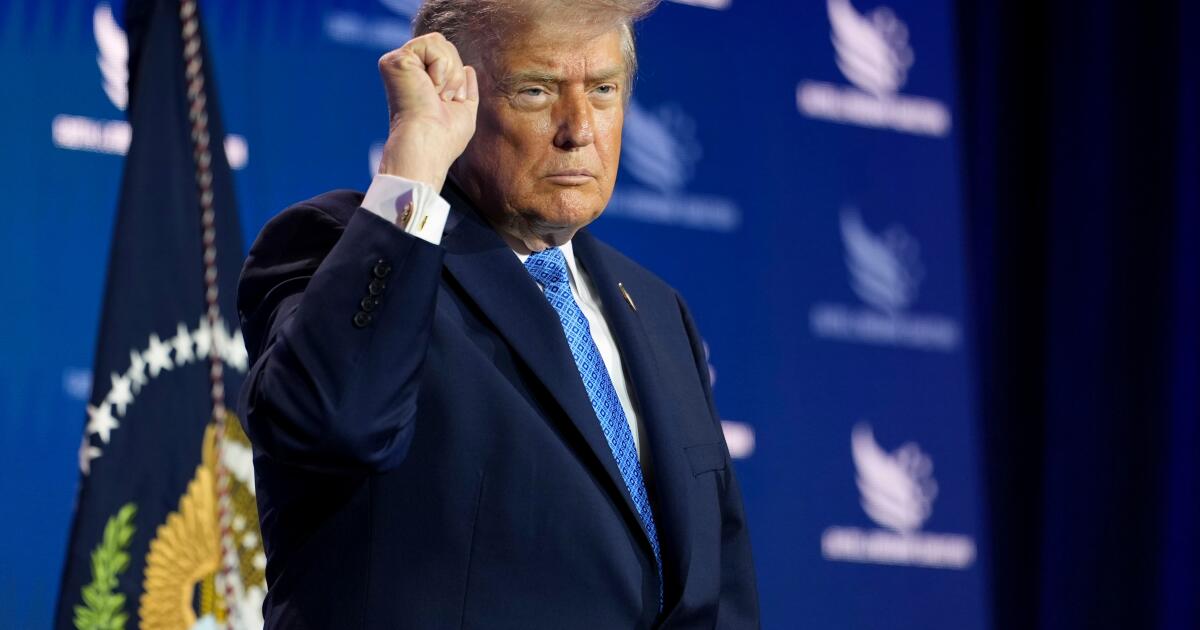
trump

Trump projects confidence, claims Iran is ‘begging’ for deal, but war exit remains murky

President Trump on Thursday continued projecting confidence in the U.S. war effort in Iran, suggesting online and during a high-level Cabinet meeting that Iran has been “obliterated,” that its leaders were “begging” for a deal, and that the U.S. is “roaming free” over Iran and “NEEDS NOTHING” from its European allies.

His description of the war as all but finished — he actually said “we’ve won” — stood in contrast to the facts on the ground, where Iran continued to launch attacks and threaten oil tanker traffic in the vital Strait of Hormuz, and the U.S. continued sending troops and warships to what is already the largest U.S. military buildup in the Middle East in decades.

Trump’s framing of the conflict also contrasted with that of Iranian officials, who have remained publicly defiant, downplayed negotiations and outwardly rejected several of Trump’s conditions for ending the war — as Trump himself acknowledged, accusing them of saying one thing in private and another in public.

“They better get serious soon, before it is too late,” the president wrote on social media, “because once that happens, there is NO TURNING BACK, and it won’t be pretty.”

“They are begging to make a deal, not me,” Trump reiterated later Thursday, while hosting his first Cabinet meeting since the war began. “Anybody that sees what is happening understands why they are begging to make a deal.”

Trump asserted that Iran’s military capabilities have been destroyed, and that the American mission is “ahead of schedule.” He said American forces were operating without opposition over Iran, and “there’s not a damn thing they can do about it” because they’ve been “beat to s—.”

Trump’s outward confidence, a defining feature of the war campaign that has been consistently echoed by Secretary of Defense Pete Hegseth and other administration loyalists, continued despite growing concerns this week in Congress — and not only from Democrats.

Several Republicans emerged from a classified war briefing Wednesday clearly frustrated with the administration for not providing a clearer picture of the path out of the now monthlong war, or clear answers on whether it planned to deploy ground troops.

“We want to know more about what’s going on,” said Rep. Mike Rogers (R-Ala.), chairman of the House Armed Services Committee. “We’re just not getting enough answers.”

“I can see why he might have said that,” said Sen. Roger Wicker (R-Miss.), chairman of the Senate Armed Services Committee.

Democrats have hammered the president — contrasting the war and its massive budget with rising fuel costs for average Americans and lamenting the deaths of U.S. service members.

“Thirteen American lives lost and tens of billions of taxpayer dollars spent in just three weeks since Donald Trump plunged us into war without congressional authorization. There is still no plan, no clear justification, and no end in sight,” Sen. Alex Padilla (D-Calif.) said. “Americans called for lower prices, not endless wars.”

For weeks, Trump, Hegseth and other war leaders such as Gen. Dan Caine, the chairman of the Joint Chiefs of Staff, have focused on U.S. wins in the conflict — tallying up Iran’s sunken ships and grounded planes, assassinated leaders and undermined missile capabilities.

In recent days, Trump has suggested that, because of those wins, Iran is buckling and its leaders reaching out for a deal. He has said the U.S. is pushing a 15-point plan that will forever block Iran from developing a nuclear weapon or threatening the U.S. or its allies. And he and others in his administration have accused the media of ignoring tremendous battlefield wins to harp on losses instead.

Israel, America’s major partner in the conflict, has projected similar confidence while showing no signs of slowing its attacks on Iran. On Thursday it announced it had killed several senior Iranian naval commanders, including Commodore Alireza Tangsiri, the head of Revolutionary Guard’s navy.

Israel’s Defense Minister Israel Katz said the deaths should send a “clear message” that Israel will continue to hunt down top Iranian military officials. Iran did not immediately acknowledge Tangsiri’s death.

The head of U.S. Central Command, Adm. Brad Cooper, praised Tangsiri’s killing, said U.S. strikes would continue, and called on Iranian fighters to “immediately abandon their post and return home to avoid further risk of unnecessary injury or death.”

Meanwhile, death, destruction and environmental and economic damage from the war spread far beyond Iran, where officials recently increased their estimated death toll to nearly 2,000.

Israel was fighting off a barrage of incoming missiles Thursday, with booms heard in Tel Aviv and Jerusalem and an impact reported in the central town of Kafr Qassem. Iraqi Defense Ministry spokesman Maj. Gen. Tahsin al Khafaj on Thursday said 23 people had been wounded in a Wednesday strike on a military clinic in western Iraq’s Anbar province.

Israeli soldiers grieve during a funeral

Israeli soldiers grieve during the funeral of Staff Sgt. Ori Greenberg, 21, at the Mount Herzl military cemetery in Jerusalem on Thursday.

(Odd Andersen / AFP via Getty Images)

Thousands of additional U.S. troops are on their way to the region, while many of the tens of thousands already stationed there have been displaced into hotels and other temporary housing — diminishing their war-fighting capabilities — by Iranian attacks that have left the 13 regional military bases they normally live on “all but uninhabitable,” the New York Times reported.

Iran announced Thursday that it had launched drone and missile attacks on a U.S. military base in Kuwait and a separate air base used by American forces in Saudi Arabia.

Jasem Mohamed al-Budaiwi, the secretary-general of the Gulf Cooperation Council, accused Iran of charging fees for ships to safely transit the Strait of Hormuz, continuing the economic toll on global oil supplies. Environmental experts warned of massive pollution from burning oil and gas fields.

Russia, emboldened by the Iran war, which has drawn resources away from Ukraine and led the U.S. to ease sanctions on Russian oil, has launched a renewed spring offensive against Ukraine.

The distance between U.S. and Iranian messaging about the war and their negotiations to end it — which foreign officials have said are occurring through intermediaries — has contributed to the tensions and the reluctance of allies to get involved, with some citing similar frustrations as Republicans in Congress this week.

Many allies have largely stayed out of the conflict despite Trump vacillating between demanding their help and insisting it isn’t necessary.

In one of his posts to social media Thursday morning, Trump blasted allies in the North Atlantic Treaty Organization, or NATO, for having “DONE ABSOLUTELY NOTHING TO HELP” in the conflict, and said the U.S. would “never forget.”

During his Cabinet meeting, Trump said that when the “right deal” is made with Iran, the Strait of Hormuz will reopen — while insisting that Iran no longer has any “mine droppers” that would threaten merchant vessels passing through the key oil route.

Steve Witkoff, one of Trump’s top advisors leading the negotiations in the Middle East, said the Iranians were looking for an “offramp,” that Pakistan is serving as a mediator between Washington and Tehran, and that the U.S. has presented a 15-point plan that “forms the framework for a peace deal.”

“These are sensitive, diplomatic discussions and you have directed us to maintain confidentiality on the specific terms and not negotiate through the news media, as others do,” Witkoff said. “We will see where things lead and if we can convince Iran that this is the inflection point, with no good alternatives for them other than more death and destruction.”

Trump has also declined to say whom Washington is negotiating with in Iran, but described them as “very smart,” “not fools,” and “very lousy fighters, but great negotiators.”

He also said he knows they are “the right people” for the U.S. to be dealing with because they had given him a “present” — and proved they are in control — by allowing “eight big boats of oil” travel through the strait this week.

Asked if he intended to send U.S. troops into Iran to take its enriched uranium, he called it a “ridiculous question” that he wouldn’t answer.

Treasury Secretary Scott Bessent said he is confident that more merchant vessels will soon be able to safely pass through the Strait of Hormuz. He also told the president that he believed the oil market is currently “well supplied” and that once the war ends, energy prices will drop.

Hegseth repeatedly slammed the media for falsely framing the war effort as floundering or unfocused, saying Iran’s “air defenses are gone,” its leaders hiding in “underground bunkers,” and its fighters losing morale.

He said Iranian officials in private are admitting “very heavy losses,” and that the U.S. and the world are benefiting from having Trump, whom he called the “ultimate deal maker,” working toward a peace deal.

In the meantime, he said, the U.S. military will “continue negotiating with bombs.”

Source link

Trump administration says it made error in ICE arrests at courthouses

U.S. attorney Jay Clayton acknowledged in a letter to U.S. District Court Judge Kevin Castel that the department had been incorrectly relying on an Immigration and Customs Enforcement memo to make arrests in immigration courts. This led to agents showing up to immigration court hearings and detaining dozens of people. File Photo by Craig Lassig/EPA

March 26 (UPI) — A Trump administration attorney admitted in federal court that the Department of Justice misrepresented an internal memo to justify arrests in immigration courts.

U.S. attorney Jay Clayton acknowledged in a letter to U.S. District Court Judge Kevin Castel that the department had been incorrectly relying on an Immigration and Customs Enforcement memo to make arrests in immigration courts. This led to agents showing up to immigration hearings and detaining dozens of people.

The memo, “2025 ICE Guidance,” directed federal agents that they “may conduct civil immigration enforcement actions in or near courthouses when they have credible information” that a person targeted for detainment would be “present at a specific location.”

Clayton wrote that the Trump administration was unaware of the error until Tuesday. ICE personnel received an email reminding them that “the May 27, 2025, Guidance does not apply to Executive Office for Immigration Review courts, regardless of their location.”

“Based on our discussions with ICE today, this regrettable error appears to have occurred because of agency attorney error,” Clayton wrote. “We deeply regret that this error has come to light at this late stage, after the parties have expended significant resources and time to litigate this case and this court has carefully considered Plaintiffs’ challenge to the 2025 ICE guidance.”

Civil Rights organizations brought a lawsuit against the Trump administration over the arrests of people attending immigration court hearings last year.

“In the months since the Court relied on the government’s representation to deny Plaintiffs preliminary relief, Defendants have continued arresting noncitizens at their immigration court hearings, resulting in their detention — often in facilities hundreds of miles away,” the New York Civil Liberties Union and American Civil Liberties Union responded in a court filing.

Amy Belsher, an attorney with the New York Civil Liberties Union representing plaintiffs, said in a statement that the admission by the Trump administration was a “shocking revelation.”

“It is yet again another example of ICE’s brazen disregard for the lives of immigrants in this country,” Belsher said in a statement. “It is now clearer than ever that there is no justification for ambushing and arresting people who are showing up for court.”

In January, former Milwaukee County, Wisc., Judge Hannah Dugan resigned from her post after being convicted for obstructing law enforcement last year. Dugan was charged after helping an immigrant evade federal immigration agents who showed up at their immigration hearing to detain them.

Dugan faces up to five years in prison and a $250,000 fine. She has not been sentenced.

President Donald Trump speaks as Secretary of State Marco Rubio listens during a cabinet meeting at the White House on Thursday. Photo by Will Oliver/UPI | License Photo

Source link

Suburbanites embrace anti-Trump resistance before No Kings protests, saying, ‘This is our fight’

A few years ago, Allison Posner was barely involved in politics.

Now the 42-year-old mother of two from Maplewood, New Jersey, hands out food and diapers to immigrant families outside a nearby detention facility. She waves signs on a highway overpass between school pickups and orthodontist appointments. And this weekend, she’ll lead a No Kings protest march across this affluent town alongside her husband, her children and thousands of others who are convinced President Trump represents a direct threat to American democracy.

“The people in the suburbs are definitely radicalizing,” said Posner, a freelance actor.

A growing faction of concerned citizens living in suburban communities across the United States — places once known for political moderation or even conservatism — are increasingly positioned on the front lines of the anti-Trump resistance. More than a year into the Republican president’s second term, the soccer moms are becoming bona fide activists taking to their well-manicured streets to fight Trump and his allies.

The leftward lurch could cost Republicans control of Congress for the president’s final two years in office. It could also reshape the Democratic Party by elevating a fresh crop of fiery progressive candidates emboldened to push back against the Trump administration more aggressively than the establishment may prefer.

Indivisible, the activist organization spearheading the third round of No Kings protests this weekend, said roughly two-thirds of more than 3,000 planned demonstrations will be held outside urban areas. Overall, more than 9 million people are expected to turn out nationwide for what leaders predict will be the largest day of protesting in U.S. history.

“We’re going to be everywhere,” Indivisible co-founder Ezra Levin said.

Organizers said sign-ups have been especially enthusiastic in suburban areas with high-profile congressional races like Scottsdale, Arizona; Langhorne, Pennsylvania; East Cobb, Georgia; and here in northern New Jersey’s 11th District, which holds a special election April 16.

Democratic voters last month chose Analilia Mejia, a former political director for Vermont independent Sen. Bernie Sanders, as their candidate to replace Mikie Sherrill, the more moderate Democrat who was recently elected as New Jersey’s governor.

Posner said she’s excited to have a fighter represent her district, someone who can channel the outrage she sees every day.

“I’m seeing people from the PTA or the neighborhood who would have never joined a protest in the past, who are now asking how they can get involved,” Posner said. “This is not some other people’s fight. This is our fight.”

‘Our hair is on fire’

For decades, affluent suburbs like those in northern New Jersey helped elect Republicans who fit the districts they represented: business-oriented, culturally moderate and disinterested in ideological fights.

That began to change in the Trump era.

Across the country, college-educated suburban voters recoiled from Trump’s brand of politics. They shifted sharply toward Democrats in the 2018 midterms and in the presidential elections that followed. Districts like New Jersey’s 11th, once a Republican stronghold, have since become part of a new liberal coalition rooted in places that were, until very recently, politically competitive.

Even in Summit, New Jersey, one of the nation’s wealthiest suburbs, Jeff Naiman feels as if he’s living in an “authoritarian nightmare” of Trump’s making.

“It’s like our hair is on fire,” says Naiman, a 59-year-old radiologist who leads his local chapter of Indivisible. “Our country’s being torn apart.”

He’s supporting Mejia, and he has no doubt she’ll win next month’s special election — and again in November’s general election.

“In this environment,” Naiman said, “I think the chances of her losing the general election are basically zero.”

Mejia, an outspoken progressive activist endorsed by Sanders and Rep. Alexandria Ocasio-Cortez, D-N.Y., emerged from the crowded Democratic primary last month, beating more moderate candidates like former congressman Tom Malinowski.

She’s critical of Israel’s war in Gaza, calls for the abolition of the U.S. Immigration and Customs Enforcement and backs Medicare for All. She’s also eager to raise concerns about what she describes as Trump’s dictatorial tendencies and will be one of the featured speakers at a No Kings protest this weekend.

“A ZIP code does not protect anyone from rising violent authoritarianism,” she said in an interview.

Mejia still describes herself as a soccer mom, even as her Republican critics accuse her of trying to soften her activist image ahead of Election Day.

“My youngest plays baseball and soccer, my oldest lacrosse and basketball,” she said. “And when I take my children to activities, to games, and I speak to other parents, I know that we’re all experiencing this economy and this political moment very similarly.”

Mejia defended herself against accusations of antisemitism for her position on Israel, which she accused of committing genocide in the war in Gaza, a topic that emerged as a key issue in the race.

“When I say Palestinians have rights, like Jewish people and Israelis have rights, that is not antisemitism, that is humanism,” she said while acknowledging there is antisemitism within the Republican and Democratic parties. “I am an Afro Latina raising two Black sons in America. I know othering kills. I know how dangerous it is when we dehumanize communities.”

A Republican balancing act

New Jersey’s 11th District was represented by a Republican until Sherrill was elected during the 2018 midterm elections that served as a harsh verdict at the halfway mark of Trump’s first term.

Joe Hathaway, the Republican nominee in next month’s special election and a town councilman from Randolph Township, hopes to convince voters that Mejia is too radical for them. Republican strategists in Washington, too, believe a surge of far-left Democratic candidates nationwide like Mejia in otherwise moderate districts might help their party maintain its razor-thin House majority this fall.

Yet suburban Republicans are facing serious political headwinds from the leader of their own party in the White House. Hathaway, for example, initially declined to say whether he voted for Trump.

“I don’t think it’s important,” he said in an interview, before acknowledging that he cast his ballot for the president three times. “This job is representing the district. NJ-11 comes first, before a president, before your party.”

Hathaway backs the president’s war in Iran and many of the economic policies in Trump’s big tax and spending cuts bill. But he was also quick to highlight areas of disagreement.

The Republican said he supports most of the Democrats’ demands in the Department of Homeland Security shutdown fight, including proposals to require federal immigration agents to wear body cameras, clearly identify themselves, take off face masks and receive better training.

He also wants Republicans who lead Congress to stand up to Trump, whose use of executive authority Hathaway said is “pressure testing” the checks and balances outlined in the Constitution.

“Congress needs to reassert that it is the first branch of government and take more of a leadership role than it’s been doing,” he said.

Inside the suburban shift

Suburban Americans have been slowly moving away from the Republicans over the past 15 years, according to Gallup polling that tracks party affiliation over time.

Trump was unable to stop the shift despite warnings that Democrats would “destroy” the suburbs with low-income housing.

In 2020, Democrat Joe Biden won 54% of voters who said they lived in the suburbs while Trump won only 44%, according to AP VoteCast. That was a substantial improvement on Democrat Hillary Clinton’s performance in a smaller survey of validated 2016 voters conducted by the Pew Research Center, which found that Clinton and Trump split the group about evenly.

The suburbs have also grown more diverse and educated over the past few decades, demographic shifts that may make Democrats more confident. In both of the past two presidential elections, AP VoteCast found that college-educated and non-white suburban voters were much likelier to support the Democratic candidate.

Naiman, the Summit radiologist, said he’s witnessed a transformation in his town, which was represented by Republicans at the state and federal level for decades until Trump took over.

“I don’t think that Summit is going to be swinging towards Republicans anytime soon — at least not as long as Trumpism is around,” he said.

Peoples writes for the Associated Press. AP polling editor Amelia Thomson DeVeaux in Washington contributed to this report.

Source link

Missed paychecks and airport delays: Pressure mounts on Congress to end the funding shutdown

Pressure is mounting on Congress to end the funding shutdown that has resulted in travel disruptions, missed paychecks and even warnings of airport closures, but lawmakers have yet to resolve the underlying issue of reining in President Trump’s immigration enforcement operations.

Senators intend to vote Thursday on a Republican proposal that would fund the Transportation Security Administration and much of the Department of Homeland Security, except the enforcement and removal operations conducted by U.S. Immigration and Customs Enforcement. That plan is expected to fail.

Democrats argue it does not go far enough at putting guardrails on officers from ICE, Customs and Border Protection and other federal agencies who are engaged in the immigration sweeps, particularly after the deaths of two Americans protesting the actions in Minneapolis.

Trump, who has largely left the issue to Congress to resolve, threatened to send the National Guard to airports, in addition his deployment of ICE agents who are now checking travelers IDs — a development drawing concerns.

“They need to end this shutdown immediately or we’ll have to take drastic measures,” Trump said Thursday during a Cabinet meeting at the White House.

With Congress set to leave town by week’s end for its own spring break recess, calls are intensifying for an end to the 41-day stalemate that’s put the livelihoods of TSA officers at risk as they provide airport security without pay.

Multiple airports are experiencing greater than 40% callout rates of TSA workers and more than 480 of its nearly 50,000 transportation security officers have now quit during the shutdown. Nationwide, nearly 11% of TSA workers — more than 3,200 on a single day — missed work.

Trump stays out of the fray

The Republican president initially signed off on the plan the GOP senators brought to him late Monday. By Tuesday, he said he would not be happy with any deal.

Trump did not directly address the status of negotiations late Wednesday evening during an annual fundraising dinner for the House Republicans’ campaign committee as Speaker Mike Johnson, R-La., works to keep majority control of the chamber in the November elections.

But Trump criticized Democrats for refusing to settle their demands on immigration changes. On Thursday, he revived his campaign for senators to end the filibuster as a way to overpower opposition to GOP policies, something most Republican senators do not want to do.

The GOP’s big tax cuts bill that Trump signed into law last year funneled billions to DHS, including $75 billion for ICE operations, ensuring the money is flowing for his immigration and deportation agenda even with the funding shutdown. ICE and other immigration officers are still being paid.

The situation is partly of Trump’s making, a strategy the president put in place last fall when he cut a deal with Democrats to end a previous federal shutdown. At that time, Trump agreed to fund the federal government, except for DHS, which was then put on temporary funding that has expired.

A stopgap measure

The Republican offer added one new restraint on immigration officers, funding the use of body cameras that had previously been agreed to. It excluded other policies that Democrats have demanded, such as that federal agents wear identification, remove their face masks and refrain from conducting raids around schools, churches or other sensitive places.

Senate Democratic leader Chuck Schumer of New York said they needed to see real changes. “We’ve been talking about ICE reforms from day one,” he said.

Democrats had been in several days of talks with the White House, including with border czar Tom Homan, that appeared to be making progress toward a deal. The White House presented its own offer with several items Democrats had been demanding, including officer IDs and training.

But those negotiations broke down over the weekend.

Republicans say Democrats are putting the country at risk. They say the Trump administration has already made strides to meet Democrats’ demands and has shown a new approach to its immigration operations, swearing in Oklahoma Sen. Markwayne Mullin as the new homeland security secretary to replace Kristi Noem.

But conservative Republicans also panned the proposal, demanding full funding for immigration operations and skeptical of the promise from GOP leaders that they would address Trump’s proof-of-citizenship voting bill in a subsequent legislative package.

Senate Majority Leader John Thune, R-S.D., said late Wednesday that if Democrats put a “more realistic offer on the table, we’ll be back in business.”

Asked if Congress would consider a stopgap measure to temporarily fund the department, Thune said: “We’ll see.”

Airport lines grow as TSA workers endure hardships

Passengers are facing more four-hour waits to clear security at George Bush Intercontinental Airport in Houston.

The airport’s website said Thursday morning that travelers should expect to wait two hours, 30 minutes in the security line at one of its open terminals and four hours at the other.

Lines and wait times are expected to grow Thursday and Friday because of “significantly higher passenger traffic,” according to an update on the airport’s website.

“This is a dire situation,” the acting TSA administrator, Ha Nguyen McNeill, testified at a House hearing Wednesday.

She described the multiple hardships facing unpaid TSA workers — piling up bills and eviction notices, even plasma donations to make ends meet — and warned of potential airport closures if more employees refuse to come to work.

“At this point, we have to look at all options on the table,” she said. “And that does require us to, at some point, make very difficult choices as to which airports we might try to keep open and which ones we might have to shut down as our callout rates increase.”

She cited the growing financial strain on the TSA workforce.

“Some are sleeping in their cars, selling their blood and plasma, and taking on second jobs to make ends meet,” she said.

McNeil also said TSA officers working at the nation’s airports have experienced a more than 500% increase in the frequency of assaults since the shutdown began.

“This is unacceptable, and it will not be tolerated,” McNeill said.

Mascaro and Freking write for the Associated Press. AP writers Rebecca Santana and Ben Finley in Washington; Wyatte Grantham-Philips in New York; Rio Yamat in Las Vegas; Russ Bynum in Savannah, Ga., and Gabriela Aoun Angueira in San Diego contributed to this report.
Source link

From Trump to Dr. Oz: 10 reality TV personalities who went into politics

Perhaps it was predictable that reality TV would become a pipeline into American politics. After all, political theater was the ultimate unscripted spectacle before reality TV became a genre unto itself.

Consider the raw drama of the first televised presidential debate, where a sweaty Richard Nixon and confident John F. Kennedy traded barbs. Or Anita Hill’s should-have-been-damning testimony against then-Supreme Court justice candidate Clarence Thomas during Senate Judiciary Committee hearings in 1991. Or President George W. Bush’s 2003 “mission accomplished” speech from a carrier off the coast of California, mere weeks into a war in Iraq that lasted years.

Modern programmed reality TV isn’t political theater, but it has become a springboard into modern politics for some stars of the genre. From President Trump to Dr. Oz, Caitlyn Jenner to Sean Duffy, campaigns and political offices are littered with the names of former cast members from reality series. Here’s a list of the most memorable jumps from trash TV to the smoldering dumpster of 21st century politics.

decorative section break

Donald Trump, president of the United States, ’The Apprentice’

Before he was a two-time president of the United States, Trump was one of America’s most recognizable make-believe bosses thanks to his 14-season run on NBC’s reality competition “The Apprentice,created by reality TV kingmaker Mark Burnett. With his practiced executive scowl and scripted boardroom catchphrase, “You’re fired!,” the show burnished his image as a decisive billionaire dealmaker, even as his real-life business results were far less impressive. Off camera, Trump’s businesses filed for Chapter 11 bankruptcy protection six times between 1991 and 2014. Never mind. It was his knack for showmanship, and his undying need for attention, that proved the perfect entry into post-decorum politics. How does pretending to be in charge on a middling reality competition qualify anyone to safely and successfully run the most powerful nation on Earth? It doesn’t. Sleep tight.

decorative section break

Sean Duffy, Transportation secretary, ’The Real World’ and ‘Road Rules: All Stars’

Sean Duffy first appeared on MTV’s “The Real World: Boston,” where he was introduced as a flirtatious, conservative lumberjack/student hybrid. In short, he was a casting director’s dream. He later joined “Road Rules: All Stars,” where he met his future wife Rachel Campos-Duffy. Trading hot tub confessionals for courtrooms, Duffy became a Wisconsin district attorney and then a congressman. By 2025, he’d risen to secretary of Transportation under Trump, completing a career arc from staged arguments with pretend roommates to heated exchanges with the press about the effects of a government shutdown on airport safety. Dude.

decorative section break

Markwayne Mullin, Homeland Security secretary, MMA fighter

After a fiery confirmation hearing, Mullin is now Trump’s second secretary of Homeland Security in the 2.0 administration, following the disastrous tenure of wannabe reality show star Kristi Noem. Mullin was not a reality star per se, but in his role as a professional mixed martial arts (MMA) fighter he performed in cages for live, streaming and pay-per-view cable audiences. As an early 2000s champ in the sport, Mullin boasted an undefeated 5-0 record and the Oklahoma chapter of the National Wrestling Hall of Fame inducted him in 2016. How do these MMA skills, or his former life running the family plumbing business qualify him to protect the national security of this great nation? It’s unclear, but his fighting instincts have already resulted in a viral moment out of a 2023 Senate hearing, when he challenged Teamsters President Sean O’Brien to a physical fight, offering to “finish it here.” Now he’ll be running the DHS. What could go wrong?

decorative section break

Omarosa Manigault Newman, former assistant to Trump and director of communications for the office of public liaison, ‘The Apprentice’

Newman became one of reality television’s more memorable villains thanks to her run on “The Apprentice,” where her Machiavellian ways and unapologetic ambition revolted viewers and impressed her fake boss. She would eventually parlay that dubious notoriety into more than one role in the first Trump White House. Her tenure was brief, ending in a high-profile departure and her accusation that Trump is a “racist, a bigot and a misogynist.” She then wrote a book, “Unhinged: An Insider‘s Account of the Trump White House.” Perhaps she’ll adapt her written account into a reality show, only to reignite her fame and win the White House. From there? She’d hire Trump, of course, then swiftly end his run on the show with two simple words: “You’re Fired!”

decorative section break

Spencer Pratt, Los Angeles mayoral candidate, ‘The Hills’

Best known as one-half of reality TV’s most polarizing couple on “The Hills,” Pratt built a reputation as a needling instigator, often leaning into the role of villain with annoying enthusiasm. After stints on other reality shows such as “Big Brother U.K.,” he began speaking out about local California issues, including wildfire recovery and environmental policy. Earlier this year Pratt, a Republican, announced that he would be running for mayor of Los Angeles in the upcoming mayoral election, challenging incumbent Karen Bass. Does he really want to govern the Left Coast, or is his candidacy a ploy for a new reality show? Let’s hope it’s the latter.

decorative section break

Caitlyn Jenner, California gubernatorial candidate, ‘Keeping Up With the Kardashians’

An Olympic gold medalist long before reality TV fame, Jenner reentered public consciousness through a show about nothing. The hit series relaunched her into the spotlight as a member of one of America’s most visible families. Using that fame, she ran as a Republican in 2021 in California’s gubernatorial recall election, positioning herself as a political outsider. Her campaign leaned heavily on her life story — from her athletic achievement to her personal reinvention — but she failed to keep up with the competition.

decorative section break

Clay Aiken, U.S. congressional candidate, ‘American Idol’

Aiken rose to fame as the earnest, vocally gifted runner-up on “American Idol” circa 2003. His polite demeanor, impressive vocal range and dramatic rendition of “Bridge Over Troubled Water” earned him a devoted fanbase known as the “Claymates.” Aiken went on to have a semi-successful music career before running for Congress in North Carolina as a Democrat in 2014. Aiken made the mistake of leaning into his strengths as a thoughtful, policy-oriented candidate rather than relying on his past achievement as a vapid reality show contestant. He lost, of course.

decorative section break

Jim Bob Duggar, Arkansas state House representative and state Senate candidate, ’19 Kids and Counting’

As the patriarch of TLC’s “19 Kids and Counting,” Jim Bob Duggar became synonymous with a conservative Christian lifestyle when the show aired in 2008; it garnered high ratings and ran for 10 seasons. He espoused many of the same ideals as an elected official in the Arkansas House of Representatives from 1999 to 2003, before leaving the political stage for reality TV. But the show was canceled in 2015 when the Duggars’ eldest son, Josh, admitted to molesting several girls, some of whom were his sisters. A conviction on child pornography charges followed. (More recently, his brother Joseph was charged with child sex abuse.) Jim Bob Duggar attempted a political comeback in 2021 when he ran for a vacated seat in the Arkansas state Senate, leaning on what he believed was his reputation as an upstanding family man. Reality bit back, and he lost.

decorative section break

Mehmet Oz, U.S. Senate candidate and administrator of Centers for Medicare & Medicaid Services, ‘The Dr. Oz Show’

Like so many questionable figures Americans came to trust in the 2000s, Dr. Oz got his start as a frequent guest on “The Oprah Winfrey Show.” He went on to launch “The Dr. Oz Show,” where he dispensed health advice to millions of viewers. His blend of seemingly measured medical guidance and on-camera charisma appealed to viewers who were tired of looking at egg-headed doctors, like the kind who practice real medicine off screen. He announced his candidacy for the U.S. Senate in Pennsylvania as a Republican in 2021, focusing on an anti-establishment platform. He lost the general election to Democrat John Fetterman, but the doctor is still in. Trump appointed him administrator of the Centers for Medicare & Medicaid Services.

decorative section break

Sarah Palin, former Alaska governor and vice presidential nominee, ‘Sarah Palin’s Alaska’

File this under “Folks who tried to reinvent themselves on reality TV after tanking in politics.” Sarah Palin served as the ninth governor of Alaska before being selected as Sen. John McCain‘s running mate ahead of the 2008 presidential election. After losing to Barack Obama and Joe Biden, she veered away from politics, a decision that probably had nothing to do with an ethics scandal dubbed Troopergate that involved Palin. Burnett saw an opportunity, producing the 2010 TLC reality series “Sarah Palin’s Alaska.” It followed the Palin family engaging in activities such as fishing, prospecting for gold and camping in the region. In short, it looked like a tourism ad for Alaska and was canceled after one season. It also failed to kickstart her political career. She lost her 2022 bid for Alaska’s U.S. House seat, failing in both a special election and her general election comeback attempt. Apparently it isn’t Sarah Palin’s Alaska, after all.

Source link

Harrison: ‘There is going to be some kind of a military escalation.’ | Donald Trump

.

‘Despite all of the talk of diplomacy, there is going to be some kind of a military escalation.’

NewsFeed

Ross Harrison, Senior Fellow at the Middle East Institute, says public talk of diplomacy between the US and Iran is hiding hardline positions, warning that despite the messaging, the situation is still likely heading toward military escalation.

Source link

Most Americans say U.S. military action against Iran has gone too far, a new AP-NORC poll finds

Most Americans believe recent U.S. military action against Iran has gone too far, and many are worried about affording gasoline, according to a new AP-NORC poll.

As the war launched by the U.S. and Israel continues in its fourth week, the survey from the Associated Press-NORC Center for Public Affairs Research indicates that while President Trump’s approval rating is holding steady, the conflict could be swiftly turning into a major political liability for his Republican administration.

While Trump is deploying more warships and troops to the Middle East, about 59% of Americans say U.S. military action in Iran has been excessive.

Meanwhile, 45% are “extremely” or “very” concerned about being able to afford gas in the next few months, up from 30% in an AP-NORC poll conducted shortly after Trump won reelection with promises that he would improve the economy and lower the cost of living.

There is significant support for at least one of the president’s objectives, which is preventing Iran from obtaining a nuclear weapon. About two-thirds of Americans say that should be an “extremely” or “very” important foreign policy goal for the U.S. However, they are just as likely to say it’s important to keep U.S. oil and gas prices from rising — a juxtaposition that could be difficult for the White House to manage.

About 4 in 10 U.S. adults continue to approve of Trump’s performance as president, which is unchanged from last month. His approval on foreign policy, while slightly lower than his overall approval, also largely held steady.

Trump has left unclear his next steps on Iran. Despite escalating threats, he’s also suggested diplomatic talks could resolve the fighting. Americans remain broadly apprehensive about Trump’s ability to make the right decisions on the use of military force outside the U.S., and they mostly oppose more aggressive steps, such as deploying ground forces.

Republicans and Democrats prioritize keeping gas prices low

Keeping the price at the pump down is the rare goal that unites Americans in both major political parties.

About three-quarters of Republicans and about two-thirds of Democrats say it’s highly important to prevent U.S. oil and gas prices from going up.

However, concern about the current situation isn’t evenly felt. Only about 3 in 10 Republicans said they’re “extremely” or “very” worried about affording gas in the next few months, as opposed to about 6 in 10 Democrats.

Trump’s focus on Iran’s nuclear program also appears more compelling to Republicans than to Democrats. About two-thirds of Americans say the U.S. should prioritize keeping Iran from obtaining a nuclear weapon, but about 8 in 10 Republicans say this is at least “very” important, compared with about half of Democrats.

The war has exacerbated political debates over the role that Israel should play in U.S. foreign policy, especially since Israeli Prime Minister Benjamin Netanyahu was a leading voice for attacking Iran. Only about 4 in 10 U.S. adults say preventing Iran from threatening Israel should be a high priority.

Toppling Iran’s leaders is viewed as slightly less important. Only about 3 in 10 say it’s at least “very” important for the U.S. to replace Iran’s government with one that’s friendlier to U.S. interests.

Most Americans say U.S. action has gone too far in Iran

As Trump provides mixed messages on whether the Iran war will end soon, about 9 in 10 Democrats and about 6 in 10 independents say the Iran attacks have “gone too far.”

Republicans are more divided. About half of Republicans say the U.S. military action has been “about right,” but relatively few want to see it go further. Only about 2 in 10 Republicans say the U.S. military action has not gone far enough, while about one-quarter say it’s gone too far.

Recent AP-NORC polling has found that about 6 in 10 Americans say Trump has “gone too far” on a range of issues, including his approach to tariffs and presidential power. That number, which is broadly reflective of his overall approval, signals that while Trump’s actions in Iran are unpopular, it’s still comparable to other controversial moves he’s taken as president.

Further entrenching the U.S. in the war could change that, depending on what happens next. About 6 in 10 Americans “somewhat” or “strongly” oppose deploying U.S. troops on the ground to fight Iran, including about 8 in 10 Democrats and roughly half of Republicans. Just under half of Americans oppose airstrikes targeting Iranian leaders and airstrikes against military targets in Iran, while about 3 in 10 are in favor and about 3 in 10 don’t have an opinion.

Many Americans distrust Trump on use of military force abroad

About half of U.S. adults have “only a little” trust or “none at all” in Trump when it comes to making the right decisions about the use of military force outside the U.S., in line with an AP-NORC poll from February.

About 34% of U.S. adults approve of the way Trump is handling foreign policy, similar to 36% in February. That measure has been consistent in recent months despite a cascade of actions, including confrontations over Greenland and an attack on Venezuela, that have generated controversy at home and abroad.

It’s also very similar to Trump’s approval on Iran in the new poll, which found that 35% of Americans have a positive view of his handling of that issue.

Sanders and Catalini write for the Associated Press. The AP-NORC poll of 1,150 adults was conducted March 19-23 using a sample drawn from NORC’s probability-based AmeriSpeak Panel, which is designed to be representative of the U.S. population. The margin of sampling error for adults overall is plus or minus 4 percentage points.

Source link

Mexico will continue accepting Cuban medical workers despite US pressure | Donald Trump News

Mexican President Claudia Sheinbaum praises services from Cuban doctors, who often work in underserved rural areas.

Mexican President Claudia Sheinbaum has confirmed that her country will continue receiving Cuban medical workers, as part of a longstanding programme meant to build goodwill between the island and other Latin American countries.

Her remarks on Wednesday come as the United States pressures Latin American countries to sever their ties to Cuba’s medical programme.

Recommended Stories

list of 3 itemsend of list

Sheinbaum, however, told reporters during a news conference that the agreement was a benefit to Mexico. Thousands of Cuban medical workers have deployed there since 2022 to work largely in poor, rural areas.

“We have a very good agreement that’s also been a great help to us. It’s a bilateral agreement that’s been very beneficial for Mexico,” said Sheinbaum.

“It’s hard to get Mexican doctors and specialists to go out to many rural areas where we need medical specialists, and the Cubans are willing to work there.”

In February, the US passed a law that opens the door to sanctions on countries that continue to participate in the programme.

It called for the US secretary of state to issue a report within 90 days about which countries continue to pay the government of Cuba for the “coerced and trafficked labour of Cuban medical professionals”.

The move comes amid a wider push to further isolate Cuba and topple the government in Havana, a longtime target of US ire. So far, countries including the Bahamas, Honduras, Guatemala, Jamaica and Guyana have ended their participation in the Cuban medical exchange programme.

Cuba has long depicted the decades-old programme as a means of signalling solidarity with other countries. It has also become an important source of foreign revenue for the island nation, which has been under a restrictive US economic embargo since 1960.

The administration of US President Donald Trump, however, has depicted the programme as akin to forced labour.

“Basically, it’s human trafficking,” Secretary of State Marco Rubio told reporters in February.

“I mean, they’re barely even being paid. Their freedom of movement is tightly restricted. And we want these countries to understand that’s what they’re participating in.”

Experts at the United Nations have also raised similar concerns, including about the confiscation of passports, which the Cuban government justifies as a means of preventing trained doctors from fleeing the country after their state-sponsored studies.

The pressure on the Cuban medical missions is part of a broader push under Trump’s second term to seek regime change on the island.

By threatening tariffs on Cuba’s trading partners, Trump has largely cut the island off from accessing the foreign oil necessary to power its electrical grid.

Trump has also said that he hopes to “take” Cuba and install a new government that will be more pliant to US demands.

The Mexican government has tried to balance its friendly relations with Cuba with the US’s demands.

In the absence of energy shipments, Sheinbaum’s government has sent vessels with humanitarian aid to the island.

Source link

Trump will travel to Beijing for rescheduled China trip May 14-15, after delay due to Iran war

President Trump will travel to Beijing for a rescheduled summit with Chinese President Xi Jinping on May 14 and 15, the White House announced on Wednesday.

Trump had been scheduled to travel to China later this month but previously announced he was delaying the trip so he could be in Washington to help steward the U.S. and Israeli war against Iran. The Republican president had announced a rescheduled trip even though the war in Iran continues and the U.S. is pressing Tehran to accept a ceasefire proposal.

The president and First Lady Melania Trump also plan to host Xi and his wife, Peng Liyuan, for a White House visit later this year, press secretary Karoline Leavitt said.

Leavitt, when asked if the new dates for Trump’s trip could suggest he believes the Iran war could end soon, offered an optimistic tone that the conflict could reach an endgame before he travels.

“We’ve always estimated four to six weeks,” Leavitt responded. “So you could do the math on that.”

The United States and Israel launched the attacks against Iran on Feb. 28.

The China trip had been planned for months but began to unravel as Trump pressured Beijing and other world powers to use their military might to protect the Strait of Hormuz, a critical waterway for the flow of oil. The strait has been effectively closed as Iran targets energy infrastructure and traffic through it.

Trump said last week while meeting with Irish Prime Minister Micheál Martin in the Oval Office that he would be going to China in five or six weeks’ time instead of at the end of the month. He said he would be “resetting” his visit with Xi.

“We’re working with China — they were fine with it,” Trump said then. “I look forward to seeing President Xi. He looks forward to seeing me, I think.”

Trump’s visit to China is seen as an opportunity to build on a fragile trade truce between the two superpowers, but it has become tangled in his effort to find an endgame to the war in Iran. Soon after pressing China and other nations to send warships to secure access to Middle Eastern oil, Trump indicated last week that his travel plans depended on Beijing’s response, though he added then that the U.S. didn’t need help from the allies that rebuffed his request.

Madhani writes for the Associated Press.

Source link

Iran dismisses Trump’s peace plan as ‘deceptive,’ as U.S. deploys more troops to Mideast

The Trump administration has offered Iran a 15-point ceasefire plan aimed at temporarily halting the war in the Middle East, as the Pentagon simultaneously orders thousands of Marines, paratroopers and a warship to the region.

The plan presented to Iranian leadership Tuesday broadly included a 30-day ceasefire and sanctions relief for Iran in exchange for a laundry list of U.S. demands, according to the Associated Press and other outlets.

But Iran dismissed the proposal Wednesday, criticizing the White House’s terms as “excessive” and out of step with reality, according to Iranian state-run media.

Those terms included limitations on Tehran’s missile stockpiles, and the permanent end to its nuclear program, its support for regional militias including Hezbollah, and of its blockade of the Strait of Hormuz, various outlets reported, citing Pakistani officials mediating the negotiations.

Several of those provisions have long been considered nonstarters for Iran, which sees its missile stockade and regional alliances as central to national security.

Iranian officials responded with defiance and skepticism.

“Iran will end the war when it decides to do so and when its own conditions are met,” an Iranian official told state media. “Not when Trump envisions its conclusion.”

The official outlined the Islamic Republic’s terms for ending the conflict, which included a halt to “aggression and assassinations,” an end to fighting on all fronts, enforceable guarantees that hostilities will not resume, compensation for war damages and a formal recognition of Iran’s sovereignty over the Strait of Hormuz.

Iranian Foreign Minister Abbas Araghchi has stated that Iran is not interested in a ceasefire but rather a comprehensive “end of war” on all fronts, including the lifting of sanctions and guarantees to allow Iran to pursue peaceful nuclear enrichment for energy and medical applications.

Iranian officials told state media that they believed the Trump administration’s diplomatic efforts were deceptive.

“You have reached a stage where you are negotiating with yourselves,” Iranian military spokesman Ebrahim Zolfaqari said in a televised address Wednesday. “Do not call your defeat an agreement.

Since the start of the conflict, Iranian leaders have voiced suspicion of any diplomatic talks with the Trump administration, pointing to prewar diplomatic efforts as evidence they were “tricked.” The Islamic Republic says it made clear in those talks that it had no interest in developing nuclear weapons, but Trump launched his military campaign nonetheless.

There have been conflicting media reports over Tehran’s exact position. Statements from Iranian officials and state-linked outlets have left open the possibility that elements of the proposal are still under review, while some reports frame the response as an outright refusal.

The Iranian response also conflicts with President Trump’s insistence that negotiations were progressing.

“We have had very, very strong talks,” he said Sunday in Florida. “We have points, major points of agreement. I would say almost all points of agreement will at some point very, very soon meet.”

Compounding the issue, Israel — which continues to carry out routine bombing campaigns over Iran — has stayed out of the talks.

Trump and Israeli Prime Minister Benjamin Netanyahu spoke about the peace deal in a phone call Tuesday. In a televised address, Netanyahu said that Trump “believes there is an opportunity” to realize U.S.-Israeli war objectives in an agreement “that will safeguard our vital interests.”

“At the same time, we continue to strike both in Iran and in Lebanon,” Netanyahu said. “We will safeguard our vital interests in any scenario.”

The negotiations are being facilitated by Pakistan, with support from Egypt and Turkey — countries that have pushed to contain a conflict that has killed more than 2,400 people, further destabilized the embattled region and disrupted global oil markets.

As Washington pursued a diplomatic end to the conflict, the Pentagon deployed an additional 2,000 troops from the 82nd Airborne Division to the Mideast. An additional 5,000 Marines and thousands of sailors are already en route to the region, where 50,000 more Marines are currently stationed.

House Speaker Mike Johnson (R-La.) told reporters on Wednesday that the deployment “sends a signal to Iran that they need to get their act together,” but denied any coming escalations by the American side. Johnson instead said that he believes “Operation Epic Fury is almost done.”

Now in its fourth week, the operation began with a series of intensive airstrikes that killed Iran’s Supreme Leader, Ali Khamenei, and dozens of other high-ranking officials. Since then, the U.S. and Israel have carried out over 9,000 strikes targeting Iranian military infrastructure and nuclear program.

Defense Secretary Pete Hegseth told reporters in the Oval Office Tuesday that while the president’s diplomatic envoys seek a peace deal, his department of war will continue to “negotiate with bombs.”

“The president has made it clear that you will not have a nuclear weapon. The War Department agrees,” Hegseth told reporters Tuesday in the Oval Office. “Our job is to ensure that, and so we’re keeping our hand on that throttle.”

Iranian retaliatory strikes have hit Gulf infrastructure and halted energy production and shipping in the region, spurring global fears of an enduring supply crunch. Meanwhile, Israel has expanded operations in Iran and sought to expand its borders into Lebanon.

Oil prices, which had surged above $120 per barrel earlier in the conflict, fell sharply this week on hopes that a ceasefire could ease supply woes.

In a statement Wednesday, U.N. Secretary-General António Guterres demanded an end to the fighting, which he said “has broken past limits even leaders thought imaginable.”

He specifically called on the U.S. and Israel to end the war, as “human suffering deepens, civilian casualties mount, and the global economic impact is increasingly devastating.”

Times staff writers Ana Ceballos, in Washington, D.C., and Nabih Bulos, in Beirut, contributed to this report.
Source link

Hiltzik: Doing the math on Trump’s war budget

Governing, the political sages tell us, is all about making choices, particularly when leadership faces finite resources and the choices are between war and peace; this is the “guns or butter” balancing raised by Lyndon Johnson’s pursuit of the Vietnam War and, appropriately, by President Trump’s Iran war.

Thus far, according to budget experts and the Trump administration itself, the war has cost Americans about $25 billion, with the White House reportedly preparing to seek $200 billion more in military funding. That points to the obvious question of what the U.S. could buy if it stopped spending on the Iran adventure.

Here’s the short answer: Medicaid coverage, free school lunches, and housing, child care and community college assistance for tens of millions of Americans. Those estimates come from Bobby Kogan, senior director for federal budget policy at the liberal Center for American Progress.

$11.3 billion would have fully funded the training of 100,000 new nurses to solve our staffing crisis. Instead, it was spent in just six days on an illegal war with no endgame.

— Rep. Diana DeGette (D-Colo.)

Kogan is not alone in doing the math. Similar estimates have been published by the Century Foundation and Mother Jones.

Democrats in Congress have offered their own juxtapositions: “$11.3 billion would have fully funded the training of 100,000 new nurses to solve our staffing crisis,” Rep. Diana DeGette (D-Colo.) observed on social media. “Instead, it was spent in just six days on an illegal war with no endgame.” (She wrote when that was the government’s estimate on spending in only the first week of the Iran war.)

Get the latest from Michael Hiltzik

Commentary on economics and more from a Pulitzer Prize winner.

Details will follow. But first, a reminder that the “peace dividend” — that is, the surge of available resources for socially beneficial spending after the cessation of hostilities — has always been an elusive concept.

In part that’s because it invariably gets tied up in conflicts over precisely what peacetime programs political leaders wish to fund, and that often involves tougher decisions than whether to mount a bombing campaign against a perceived adversary.

“What happened to the peace dividend?” economist Augusto Lopez-Claros asked last year, referring to the supposed surfeit of funds that was to flow after the end of the Cold War. His answer was that there were always alternatives, many of them militaristic in nature, in the wings to suck up the funds that had been spent in the past.

The issue has especially acute significance today, not merely because of the Iran war. The Trump administration and Republicans in Congress have been campaigning to cut federal spending, almost entirely on social programs such as Medicaid and on Social Security and Medicare benefits, ostensibly because they contribute heavily to our “unaffordable” federal budget deficits.

Never mind that the largest single contributor to the deficit is the massive tax cut enacted by Republicans in 2017, during the first Trump term, which were made permanent by the GOP’s budget bill last year.

Placing military spending in the context of alternatives is typically shunned by Republicans and conservatives. The Wall Street Journal editorial board derided the exercise as “dorm room politics,” referring specifically to an estimate by Rep. Ro Khanna (D-Fremont) that the $200 billion reportedly sought by the White House “would pay for free college for every American,” and more.

That doesn’t mean the exercise isn’t worthwhile, however. Kogan acknowledges that it wouldn’t be up to the Pentagon to redirect its budget to the social programs that could be funded with its funding request, but his point in making the comparisons is “to get a sense of scale.”

So let’s dive in, starting with Kogan’s work. He matched the cost of several social services against the $25 billion estimated to be spent on the war through the end of this week and the $200-billion new request. He also broke down some of the spending by ordnance. The price of one Tomahawk missile, invoiced about $3.5 million each, could cover Medicaid for a year for 275 people, for example; the U.S. has fired an estimated 300 of them in the Iran war so far, for more than $1 billion.

Kogan calculated that more than 3.1 million people could be covered by Medicaid for $25 billion, and 24.8 million could be covered for $200 billion. He based this estimate on the Congressional Budget Office’s finding that the federal share of Medicaid came last year to $668 billion to cover about 82 million adult and child enrollees, or about $8,048 per person annually.

Then there’s free school lunches, which the government has pegged at up to $4.69 per day for about 30 million children receiving meals in school. If they all received free lunch, that would come to a little over $25 billion, based on a 180-day school year. (Only about two-thirds of those children receive free meals, with the rest receiving cut-price meals or paying full price.)

Child care isn’t typically a governmental responsibility (though it should be); Kogan uses an estimate from the nonprofit organization Child Care Aware that care cost Americans about $13,128 on average in 2024; inflating that to a 2026 figure yields an average of $14,048, meaning that 1.78 million households could be covered for about $25 billion, and about 14.2 million for $200 billion.

Tuition for a two-year path to an associate degree in community college, that portal to higher education for millions of Americans, will cost an average of $8,700 this year by Kogan’s reckoning, based on the College Board’s estimate of $8,300 for 2025. That means that about 2.87 million Americans could have their tuition fully covered for about $25 billion, and nearly 23 million students could be covered for $200 billion.

The progressive Century Foundation contributed estimates of how much in social program spending could be accommodated for $200 billion. Its roster includes the cancellation of all medical debt for the 100 million Americans shouldering about $194 billion in medical debt. The enhanced Affordable Care Act premium subsidies that expired this year could be continued for almost six years for about $200 billion, extrapolating from the 10-year, $350-billion estimate produced by the CBO. “Ensuring health coverage for all Americans,” the foundation noted, “could save an estimated 68,000 lives per year.”

The foundation also notes that $200 billion could ameliorate the draconian cuts in Medicaid imposed by the preposterously named One Big Beautiful Bill that the GOP enacted as a budget measure in July. The work requirement in that bill is estimated to reduce Medicaid spending by $326 billion over 10 years, according to the CBO, mostly by throwing enrollees out of the program. The work rules, which as I’ve reported do nothing to enhance employment, could be deferred for six years, preventing the loss of coverage for about 5.2 million Americans.

Mother Jones reported soberly that $200 billion would cover the wages of 2.8 million public school teachers, based on an average salary of $72,030, as reported by the National Education Assn.

The publication took a rather more fanciful approach for some calculations. It reported that $200 billion would pay for 2,666 sequels to the “Melania” documentary, based on the $75-million reported cost of its production and marketing by Amazon, its sponsor. And 500 more White House ballrooms, based on the latest projection of $400 million for just one.

Obviously all these calculations are somewhat chimerical. No one really believes that if Congress rejects the $200-billion ask, that money would be redeployed for any of these social programs, at least while the GOP remains in control of the government purse strings. The basic arithmetic itself is subject to cavils resulting from the murkiness of some of the cost calculations and projections.

But they’re not far wide off the mark in terms of orders of magnitude. Millions of dollars in social spending could be covered by billions of dollars in military spending, and much more productive investments could be made in the years and decades to come.

The lost “peace dividend” encompasses not just domestic needs, but also “the potentially catastrophic risks that we are taking on in the future because we are misallocating resources now,” Lopez-Claros observed — “spending massively on defense while leaving unattended climate change mitigation, pandemic preparedness, the shamefully high levels of malnourishment in the world, among others. We may well come to regret this and by then, unfortunately, it might be too late.”

Even before the first bombs fell on Iran, after all, the U.S. was shortchanging all those imperatives. “Just last July, Trump signed into law the biggest cuts to the social safety net in all U.S. history,” Kogan says, including “the biggest cuts to Medicaid ever, and the biggest cuts to SNAP, ever.” (The GOP budget bill cut SNAP, the food stamp program, by $186 billion, leaving “nearly 3 million young adults ages 18 to 24 who receive SNAP vulnerable to losing that assistance,” the Urban Institute estimated after the bill was signed.

At their heart, these calculations are not really about dollars and cents. The financial figures just help us keep score of the choices that define us as a nation.

Source link

US talking to itself, says Iran as Trump claims wheels of diplomacy turning | US-Israel war on Iran News

Iran’s military has said the United States is failing in its war and negotiating with itself to save face, dismissing claims by US President Donald Trump that talks are under way to end the conflict.

“Has the level of your inner ⁠struggle reached the stage ⁠of you negotiating with yourself?” Ebrahim Zolfaqari, spokesperson for the unified command of Iran’s armed ⁠forces, Khatam al-Anbiya Central Headquarters, said on Wednesday in comments carried by Iran’s semiofficial Fars news agency.

Recommended Stories

list of 3 itemsend of list

“Don’t call your failure an agreement,” he added, mocking US leadership.

The statement is the latest official Iranian denial that Tehran is engaged in diplomacy with Washington, even as Trump insists talks are ongoing and reports circulate of the US sending a peace proposal.

Speaking to reporters at the White House yesterday, the US president said Washington is speaking to the “right people” in Iran, which he claimed wants to make a deal “so badly”.

“They are talking to us, and they’re making sense,” said Trump.

Trump’s position marks a stark shift from days earlier, when he threatened to strike Iran’s power plants if Tehran did not fully reopen the Strait of Hormuz, where it has threatened vessels from “enemy” nations. Hours before the ultimatum expired on Monday – and US markets reopened for the trading week – Trump said he would delay any planned attack by five days, citing diplomatic progress. Iranian officials denied this.

Zolfaqari said there would be no return to previous oil prices or the prior regional order “until our will is done”.

‘Obscurity in Iran’

Questions over possible diplomacy were amplified by US media reports that Washington had sent Tehran a 15-point plan to end the war.

The Wall Street Journal, quoting unnamed officials, reported that the plan calls on Iran to dismantle its three main nuclear sites, end any enrichment on its soil, suspend its ballistic missile programme, curb support for its regional allies and fully reopen the Strait of Hormuz. In return, Iran would have nuclear-related sanctions lifted and the US would assist the country’s civilian nuclear programme, according to the Journal.

Al Jazeera’s Mohamed Vall, reporting from Tehran, said there is “total confusion” in Iran over the status of potential negotiations.

“Contrary to the clarity with which Donald Trump seems to speak, there is obscurity in Iran,” said Vall. “What we hear instead are the officials and politicians here saying the complete opposite. They say there is no negotiation.

“There is total confusion, total obscurity, and it’s really making this situation very interesting and very strange,” he added.

While there is a “cloud of mistrust” between the US and Iran, Tehran is engaged diplomatically with several regional countries, including Pakistan, said Al Jazeera’s Tohid Asadi, also reporting from Tehran. Islamabad, which appears to have emerged as a possible mediator in the conflict, delivered the US’s plan to Tehran, according to The New York Times.

Israel, Iran trade strikes

Amid the competing claims about negotiations, Israel continued to strike Iran, and the US reportedly prepared to send more troops to the Middle East.

Israel’s military said it carried out a series of late-night strikes on infrastructure in Tehran. Iran’s Fars news agency reported at least 12 people killed and 28 wounded in an “enemy attack” on the residential area of Varamin in southern Tehran.

Iran, for its part, claimed to fire more missiles at Israel, including targeting a military base in the northern Israeli city of Safad, as well as sites in the cities of Tel Aviv, Kiryat Shmona and Bnei Brak. There were no immediate reports of casualties from that missile salvo, though an earlier rocket attack by Hezbollah killed one woman in northern Israel.

Meanwhile, the US was expected to send at least 1,000 soldiers from the Army’s elite 82nd Airborne Division to the ⁠Middle East, adding to some 50,000 US soldiers already in the region, the Reuters and AP news agencies reported.

“As the US is preparing for peace talks, it’s also preparing for war,” said Al Jazeera’s John Hendren from Washington, DC. “Diplomacy and military moves are going on at the same time.”

Source link

Trump says Iran wants to ‘make a deal’ as it continues to strike Israel and gulf nations

President Trump said Tuesday that Iran wants to “make a deal” with the United States to end the war in the Middle East, saying that negotiations are ongoing with the conflict in its fourth week.

Iran has publicly denied that talks are happening. But Trump told reporters during an Oval Office event that negotiations are underway and being led by Vice President JD Vance and Secretary of State Marco Rubio.

“I’d like to think we are in a good bargaining position,” Trump said.

Trump said he remains skeptical of Tehran’s intentions, saying he doesn’t necessarily “trust them,” but indicated that he is encouraged to continue talks after receiving what he described as a “very big present worth a tremendous amount of money” from Iran.

“I am not going to tell you what the present is,” Trump told reporters. But he said it was a “significant prize” related to “oil and gas” that signaled to him that he was “dealing with the right people.”

Conflicting messages over the diplomatic efforts between Washington and Tehran come as Pakistan has offered to host peace talks in Islamabad aimed at ending the hostilities, which have killed more than 2,400 people, further destabilized the Middle East and disrupted global oil markets.

“Pakistan welcomes and fully supports ongoing efforts to pursue dialogue to end the WAR in Middle East, in the interest of peace and stability in region and beyond,” Prime Minister Shehbaz Sharif wrote on X.

Any potential talks between the United States and Iran would face significant challenges. Key U.S. demands — particularly related to Iran’s ballistic missile and nuclear programs — remain difficult to resolve, even though Trump claims Iran has already agreed to concessions related to its ability to have nuclear weapons.

It is also unclear who within Iran’s leadership would be willing to negotiate, especially as Israel has vowed to keep targeting Iranian leaders after killing several already.

Trump has not publicly responded to Pakistan’s offer to act as an in-between for the United States and Iran. He also sidestepped a question about a New York Times report that said the Saudi crown prince, Mohammed bin Salman, has been pushing him to continue the war against Iran.

The president instead expressed confidence in his senior advisors handling the negotiations with Iran. He did not specify who U.S. officials are engaging with, but insisted they are “talking to the right people.”

When asked by a reporter why he had agreed to a cease-fire with the Iranians, Trump said: “They are talking to us, and they’re making sense.”

As the talks continue, Trump said that the United States is “way ahead of schedule” in its war with Iran, a nation that he said was so battered that it had no choice but to come to the negotiating table. Iran, however, showed on Tuesday that it still has firepower as it fired a new wave of missiles at Israel, Iraq and other gulf nations.

Iran fired at least 10 waves of missiles at Israel. In Tel Aviv, a missile with a 220-pound warhead slammed into a street in the city center, blowing out windows of an apartment building and sending smoke billowing. Four people suffered minor wounds, rescue worker Yoel Moshe said.

In Kuwait, power lines were hit by air defense shrapnel, causing partial electricity outages for several hours. Bahrain said it was attacked with missiles and drones, and that an Emirati soldier serving with its forces had been killed. The United Arab Emirates said air defense systems responded to similar attacks, and Saudi Arabia said it destroyed Iranian drones targeting its oil-rich Eastern Province.

Israel pounded Beirut’s southern suburbs, saying that it was targeting infrastructure used by the Iran-linked Hezbollah militant group, and carried out an extensive series of strikes on Iranian “production sites,” without providing more information.

On Tuesday, Defense Minister Israel Katz said Israel intended to seize Lebanon’s south Lebanon to a create a “security zone.”

Speaking at an assessment meeting with the Israeli military’s chief of staff, Katz said the military would control up to the Litani River, a waterway that runs through south Lebanon, meeting the Mediterranean some 20 miles north of the border with Israel.

“Hundreds of thousands of residents of southern Lebanon who evacuated northward will not return south of the Litani River until security for the residents of the north [of Israel] is ensured,” he said.

His words were the clearest articulation yet of Israel’s plans in Lebanon, going far beyond the “limited and targeted ground operations” announced by the Israeli military earlier this month.

Lebanon, meanwhile, took steps to undercut Tehran’s influence in the country and its support for Hezbollah. In a statement released on X on Tuesday, Lebanese Foreign Minister Youssef Raggi said the government was expelling Iranian Ambassador Mohammad Reza Shibani and declared him persona non grata. He gave Shibani until Sunday to leave the country.

Hezbollah condemned the move and called it a “grave national and strategic mistake.” Political figures aligned with the group also issued public statements urging the Iranian ambassador to ignore the decision.

In Washington, Trump said he would like to find a resolution that would avoid further casualties and damage to critical infrastructure in the region.

“If we can end this without more lives being down, without knocking out $10-billion electric plants that are brand new and the apple of their eye, I’d like to be able to do that,” he said. “But they can’t have certain things.”

Defense Secretary Pete Hegseth, meanwhile, told reporters that he would rather “negotiate with bombs.”

“The president has made it clear that you will not have a nuclear weapon. The War Department agrees,” Hegseth said. “Our job is to ensure that, and so we’re keeping our hand on that throttle, as long and as hard as is necessary to ensure the interests of the United States of America are achieved on that battlefield.”

His comments came as thousands of U.S. Marines were on their way to the region, raising speculation that the U.S. may try to seize Kharg Island, which is vital to Iran’s oil network. The U.S. bombed the Persian Gulf island more than a week ago, hitting its defenses but saying it had left oil infrastructure intact.

The Pentagon declined to comment on the deployment.

Ceballos and Quinton reported from Washington. Times staff writer Nabih Bulos in Beirut contributed to this report.

Source link

Melania Trump hosts world counterparts and tech reps to discuss children, education and technology

Melania Trump on Tuesday called on nations to work together to improve access to education and technology for children around the world, delivering her plea as she addressed a gathering of her counterparts from more than 40 countries.

The first lady’s Fostering the Future Together initiative, which she announced last year, and an inaugural two-day summit that she opened Tuesday are examples of how Melania Trump has expanded her portfolio to embrace global issues.

“As people we dream. As leaders we progress. As nations we will build,” she said in opening remarks. “Beginning today, let’s accelerate our new global alliance, this bond, to positively impact the progress of our children.”

She called on participants to host regional meetings, conduct research studies, begin new partnerships and collaborate with another member country “to cultivate the skills young people need to be successful in this rapidly evolving world.”

She said the goal of empowering children will be achieved by creating innovative programs, advocating for supportive education policies, sponsoring tech-focused legislation and building strong public-private partnerships.

“This room is filled with extraordinary human capital,” the first lady said. She urged the leaders seated around a large U-shaped table in a State Department auditorium to “harness it to elevate your children, to empower your people and to accelerate your economies.”

The gathering included technology companies such as Microsoft, Google and OpenAI.

Among those participating were Olena Zelenska, the spouse of Ukrainian President Volodymyr Zelensky, and Sara Netanyahu, the wife of Israeli Prime Minister Benjamin Netanyahu.

The first lady announced the Fostering the Future Together initiative during the U.N. General Assembly session last fall.

Superville writes for the Associated Press.

Source link

Minnesota sues Trump administration over shootings, including deaths of Alex Pretti and Renee Good

Minnesota officials sued the Trump administration on Tuesday for access to evidence they say they need to independently investigate three shootings by federal officers, including the killings of Renee Good and Alex Pretti.

The lawsuit claims that the federal government reneged on its promise to cooperate with state investigations after the surge of federal law enforcement in Minneapolis, and are seeking a court order demanding that the Trump administration comply.

“We are prepared to fight for transparency and accountability that the federal government is desperate to avoid,” Hennepin County Atty. Mary Moriarty told reporters.

The lawsuit marks an escalation in the clash between Minnesota leaders and the Trump administration over the investigations into the high-profile shootings by federal officers that sparked public outcry and protests. The Trump administration has suggested that Minnesota officials don’t have jurisdiction to investigate, but state officials insist they need to conduct their own probes because they don’t trust the federal government to investigate itself.

“There has to be an investigation any time a federal agent or a state agent takes the life of a person in our community,” Moriarty said.

The administration sent thousands of officers to the Minneapolis and St. Paul area for the immigration crackdown as part of President Trump’s national deportation campaign. The Department of Homeland Security considered its largest immigration enforcement operation ever a success but was staunchly criticized by Minnesota’s leaders who raised questions over officers’ conduct.

There continues to be fallout from Operation Metro Surge in the form of a Homeland Security shutdown, as Democrats in Congress hold up funding in an effort to secure restraints on Trump’s immigration agenda.

Minnesota’s lawsuit said the federal government is not permitted to “withhold investigative evidence for the purpose of shielding law enforcement officers from scrutiny where a State is investigating serious potential violations of its criminal laws, targeting its citizens, within its borders.”

Moriarty said Tuesday that the federal government “has adopted a policy of categorically withholding evidence,” calling the practice unprecedented and alarming. She said the lawsuit followed formal demands for evidence after the federal government blocked Minnesota investigators from accessing evidence related to the shootings.

In addition to the Pretti and Good cases, the lawsuit demands access to evidence in the case of Julio Cesar Sosa-Celis, who was shot and wounded in his right thigh by a federal agent in January.

Federal officials initially accused Sosa-Celis and another man of beating an Immigration and Customs Enforcement officer with a broom handle and a snow shovel. But federal prosecutors later dropped all charges against the men and authorities opened a criminal investigation into whether two immigration officers lied under oath about the shooting.

Emails seeking comment were sent to DHS and the Justice Department.

The Justice Department in January said it was opening a federal civil rights investigation into Pretti’s killing but has said a similar federal probe was not warranted in the killing of Good. The decision in Good’s case marked a sharp departure from past administrations, which moved quickly to investigate shootings of civilians by law enforcement officials for potential civil rights offenses.

Deputy Atty. Gen. Todd Blanche has said that the department’s Civil Rights Division does not investigate every law enforcement shooting and that there have to be circumstances and facts that “warrant an investigation.”

Moriarty has said a lack of confidence in the federal government’s review of these incidents makes the state’s independent investigations into the shootings, as well as officers’ actions during the immigration enforcement operation altogether, especially important. The county office received over 1,000 tips from the public on the shootings of Good and Pretti via an online portal they opened to collect evidence. Earlier this month, Moriarty initiated a second portal and said her office was investigating a number of incidents of potentially unlawful action by officers over the course of the immigration enforcement operation.

Fingerhut and Richer write for the Associated Press. Fingerhut reported from Des Moines, Iowa.

Source link

Senators consider deal to fund Homeland Security but not ICE enforcement

Senators raced Tuesday to clinch an emerging proposal to end the Homeland Security shutdown by funding much of the department, including the Transportation Security Administration airport workers going without pay, but excluding ICE enforcement operations that have been core to the dispute.

The sudden sense of urgency comes as U.S. airports are snarled by long security lines, with travelers being told to arrive hours before their flights in Houston, Atlanta and Baltimore Washington International. Routine Homeland Security funding was halted in mid-February ahead of the busy spring travel season. Nearly 11% of TSA workers — more than 3,200 — missed work Monday, and at least 458 have have quit altogether since the shutdown began, according to Homeland Security.

Democrats are refusing to fund the department without restraints on Trump’s immigration and deportation agenda after agents killed two citizens in Minneapolis.

A potential breakthrough came late Monday, after a group of Republican senators met at the White House with President Trump after his decision to deploy federal immigration officers at some airport security checkpoints — a move some lawmakers warned could lead to heightened tensions.

“All I can say is that the discussions have been very positive and productive, and hopefully headed in the right direction,” said Senate Majority Leader John Thune (R-S.D.) late Monday evening.

Senate Democratic Leader Chuck Schumer sounded a similarly hopeful tone: “Both sides are working in a serious way.”

Hopes high for a quick deal

Next steps in Congress could move quickly, if lawmakers can reach a deal, or sputter out just as fast.

The contours of the deal under consideration would fund most of Homeland Security, but not one main part of ICE — the enforcement and removal operations that are core to Trump’s deportation agenda.

Under the proposal being floated, ICE’s Homeland Security Investigations would be funded as well as Customs and Border Protection. But that would come with guardrails — keeping officers from those divisions in their traditional roles, rather than deploying them in urban immigration roundups.

The plan would also include a number of changes in immigration operations that Democrats have demanded, including mandating that officers wear body cameras and identification. The ICE officers manning airports are already going without face-covering masks, another key demand Democrats want as part of any deal.

Since so much of ICE is already funded through Trump’s big tax breaks bill, and immigration officers are still receiving paychecks despite the shutdown, senators said the new restraints would also be imposed on operations that rely on that funding source, as well.

Republican Sen. Katie Britt of Alabama, a chief negotiator, returned from the White House meeting hopeful they had a solution to “land this plane.”

Both chambers of Congress are controlled by the Republican president’s party, and any deal reached in the Senate would also have to be approved by the House.

Political standoff, long airport lines

Key to the standoff appears to have been the senators’ ability to shift the president’s attention off his plan to link any department funding to his push to pass the so-called SAVE America Act, a strict proof-of-citizenship and voter ID bill that has stalled in the Senate ahead of the midterm elections.

Over the weekend Trump injected his demand for the voting bill as a condition for ending the funding standoff. Some GOP senators have pitched the idea of tackling it in the months ahead as part of a broader legislative package the party could pass on its own, similar to last year’s big tax cuts bill.

Sen. Chris Coons (D-Del.) who was not part of the group at the White House, said his understanding was that there was a “sense of urgency” coming from the talks as the airport disruptions worsen.

Senators are expected to discuss the proposals during their private caucus lunches Tuesday afternoon. “First step is to get the proposal in writing,” said Sen. Angus King, an Independent from Maine. “I want to see exactly what that means.”

Changes at Homeland Security

The deal could provide a political exit from the standoff over the embattled Homeland Security department, which was stood up in the aftermath of the Sept. 11, 2001, attacks but has come to symbolize Trump’s aggressive mass deportation agenda, with its goal of removing 1 million immigrants this year.

Under mounting political pressure, Trump ousted Homeland Security Secretary Kristi Noem amid the public outcry over the immigration operations, and senators late Monday confirmed one of their own, Markwayne Mullin, as the president’s handpicked replacement.

Mullin, an Oklahoma senator who aligns with Trump’s agenda, provides a potentially new face for the department. During his confirmation hearing, Mullin touched on another key demand of Democrats — ensuring a judge has signed off on warrants that immigration officers use to search people’s homes, rather than simply relying on administrative warrants issued by the department.

“This is significant,” Sen. Peter Welch (D-Vt.) said about the progress toward changes. “Noem is gone. That’s a big deal.”

ICE’s budget nearly tripled under last year’s bill, to $75 billion, which has been untouched by the shutdown. Rather its routine annual funding, some $10 billion, would be cut almost in half under the proposal.

After weeks of missed paychecks, many TSA agents have called in sick or even quit their jobs as financial strains pile up. Union leaders representing the workers have pushed Congress to reach a deal.

Mascaro and Cappelletti write for the Associated Press. AP writers Rio Yamat, Wyatte Grantham-Philips, Kevin Freking and Seung Min Kim contributed to this report.

Source link

Trump casts Florida mail ballot as he pushes Congress to severely limit that voting option

President Trump has cast another mail ballot in Florida as he continues to publicly bash the voting method as a source of fraud and push Congress to curtail the practice.

Palm Beach County voter records show the president voted by mail in a Tuesday special election for state legislative seats and that his ballot has been counted. Early in-person voting in the contest ran through Sunday, when Trump was still at his south Florida estate.

The White House said Tuesday that Trump’s ire is at states using universal mail-in voting, not individual instances of voters needing accommodations to vote by mail. A spokeswoman pushed back specifically at the idea that his voting practice contradicts his push for new federal voting rules.

“As President Trump has said, the SAVE America Act has commonsense exceptions for Americans to use mail-in ballots for illness, disability, military, or travel — but universal mail-in voting should not be allowed because it’s highly susceptible to fraud,” said White House spokeswoman Olivia Wales in a statement.

A report by the Brookings Institution published in 2025 found that cases of mail voting fraud occurred in only 0.000043% of total mail ballots cast, or about four cases out of every 10 million mail votes.

Wales added: “As everyone knows, the President is a resident of Palm Beach and participates in Florida elections, but he obviously primarily lives at the White House in Washington, D.C. This is a non-story.”

Nonetheless, Trump has in the last week called mail-in voting “cheating” and “corrupt as hell.” He is urging Congress to pass the SAVE Act. The sweeping bill would bar universal mail ballots and, as Wales noted, limit the options to a select few voters such as those with disabilities, military commitments or who are traveling on Election Day. The measure faces steep odds in the closely divided Senate even with the president’s pressure.

Trump has fixated on mail ballots since he began falsely claiming that his 2020 presidential election loss to Democrat Joe Biden was the result of fraud. Multiple U.S. courts and Trump’s own attorney general have found no evidence of fraud that affected the outcome, despite the COVID-19 pandemic increasing the share of the electorate that cast mail ballots that year.

“We’re the only country in the world that does it that way. Corrupt as hell,” Trump said last week at the White House when hosting Irish Prime Minister Micheál Martin.

Dozens of countries, including European democracies that are traditional U.S. allies, use some form of mail-in voting.

Trump said last week that the SAVE Act was the “biggest thing” pending in Washington, even as Congress and administration grapple with the Iran war and a partial shutdown of the Department of Homeland Security.

Last August, Trump used a White House meeting with Ukrainian President Volodymyr Zelensky to blast mail voting.

“We’re going to start with an executive order that’s being written right now by the best lawyers in the country to end mail-in ballots because they’re corrupt,” Trump said. “And it’s time that the Republicans get tough and stop it because the Democrats want it. It’s the only way they can get elected.”

The president, who changed his official personal residence and voter registration from New York to Florida during his first term, does not have a standing vote-by-mail request for all elections, according to the county records. That means he has to request a mail ballot for any individual election.

The ballot today includes Florida state House District 87 and Senate District 14.

Trump offered an endorsement late Monday in the House contest via his Truth Social platform.

“There is a very important Special Election tomorrow, Tuesday, March 24th, for Florida State House District 87 in beautiful Palm Beach County. … TO ALL GREAT PATRIOTS IN FLORIDA STATE HOUSE DISTRICT 87: GET OUT AND VOTE FOR JON MAPLES! Polls are open from 7:00 A.M. to 7:00 P.M.” Trump wrote, without mentioning that he had voted by mail or at all.

The Florida election comes one day after the Supreme Court heard oral arguments in a Mississippi case questioning whether states can count mail-in ballots that are postmarked by Election Day but not received until later. Trump has criticized those allowances in 14 states and the District of Columbia.

Barrow writes for the Associated Press.

Source link

Senate ready to confirm Mullin to Homeland Security as TSA standoff deepens

The Senate is on track to confirm Markwayne Mullin as Department of Homeland Security secretary, President Trump’s nominee to take over the embattled department after firing Kristi Noem amid a public backlash over the administration’s immigration enforcement and mass deportation operations.

Mullin, a Republican senator from Oklahoma known for his close friendship with Trump, has tried to present himself as a steady hand, saying that his goal as secretary would be to get the department off the front page of the news. But Mullin tangled with Republican Sen. Rand Paul of Kentucky, the chairman of the Homeland Security Committee, who questioned Mullin’s character and temperament during last week’s combative confirmation hearing.

Senators advanced Mullin’s nomination on Sunday during a rare weekend session on a largely party-line vote, and confirmation is expected late Monday.

He would take the helm of the department at a difficult time. The department’s routine funding has been shut down, leading to long waits at U.S. airports during the busy spring break travel season, as Democrats demand changes in immigration enforcement operations after the deaths of two U.S. citizens during protests this year in Minneapolis.

Trump announced over the weekend he’s ordering immigration officers to help Transportation Security Administration agents, which lawmakers and others warned could escalate tensions at crowded airports.
Although the senator comes to the position after more than a dozen years in Congress, and with the management experience of running an expanding family plumbing business in Oklahoma, he has not been seen as a key force in immigration issues.

A former mixed martial arts fighter and collegiate wrestler who has led early-morning workout sessions in the members-only House gym, he became close with members of both parties and is often seen as a negotiator in partisan Washington.

It is his loyalty to Trump that landed him the job, and he’s not expected to sway from the president’s approach. Mullin was a strong supporter of Trump’s immigration agenda and ICE officers before being tapped for the Homeland Security job.

“I can have different opinions with everybody in this room, but as secretary of homeland I’ll be protecting everybody,” Mullin said during his confirmation hearing.

Santana writes for the Associated Press.

Source link

Trump refuses end to DHS shutdown until SAVE Act passes

March 23 (UPI) — President Donald Trump on Sunday said there will be no end to the partial government shutdown until Congress passes the Safeguard American Voter Eligibility Act.

“I don’t think we should make any deal with the Crazy, Country Destroying, Radical Left Democrats unless, and until, they Vote with Republicans to pass ‘THE SAVE AMERICA ACT,'” Trump posted on Truth Social.

“It is far more important than anything else we are doing in the Senate, and that includes giving these same terrible people, the Dems (who are to blame for this mess!), a Five Billion Dollar cut in ICE [Immigration and Customs Enforcement] funding, a deal which, even when disguised as something else, is unacceptable to me and the American people – UNLESS it includes their approval of Voter I.D., (with picture!), Citizenship to Vote, No Mail-In Voting (with exceptions), All Paper Ballots, No Men In Women’s Sports, and No Transgender MUTILIZATION of our precious children,” he added.

Trump also wrote that Thune should “clearly identify” the Republicans who are not supporting the bill and said they were, “Voting against AMERICA.”

“They will never be elected again! In other words, lump everything together as one, and VOTE!!! Kill the Filibuster, and stay in D.C. for Easter, if necessary,” he said.

Lawmakers have not supported abandoning the supermajority needed to end debate.

The DHS, which includes the Transportation Security Administration, shut down on Feb. 14 because Congress couldn’t agree on a funding bill for the department. Democrats don’t want to fund it until guardrails are put on the agency, and Republicans haven’t agreed to Democrats’ demands.

Because of this, TSA workers have been working without pay for more than a month. Some are quitting or taking days off work, creating long lines at airports.

Congress is scheduled to leave Washington in a few days for a recess. If there’s no deal, the partial shutdown could last two months. It would be the longest shutdown of a federal agency.

The Senate is considering staying in session to resolve the shutdown, but House Republicans say they won’t change plans, Politico reported that three anonymous sources said.

The House will likely vote again Thursday.

Trump told NewsNation Sunday that Democrats were going to fold after he said he would send Immigration and Customs Enforcement agents to help TSA agents.

But Sen. Lisa Murkowsky, R-Alaska, doesn’t agree that plan is appropriate.

“This is not the answer for what we need to do. We need to figure out how we get DHS funded. My preference, of course, is to get all of DHS funded, get it done and behind us. But I think we all need to be looking to see if there are any [other] avenues that can gain support. We got to figure it out before [the end of] next week,” The Hill reported she said.

Source link