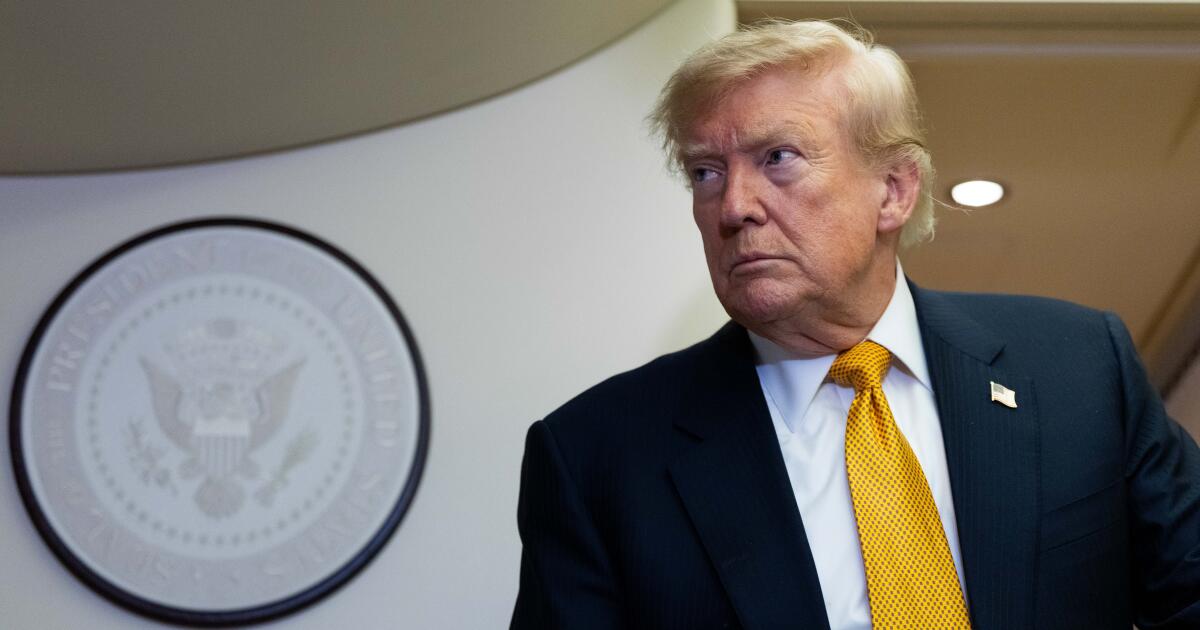
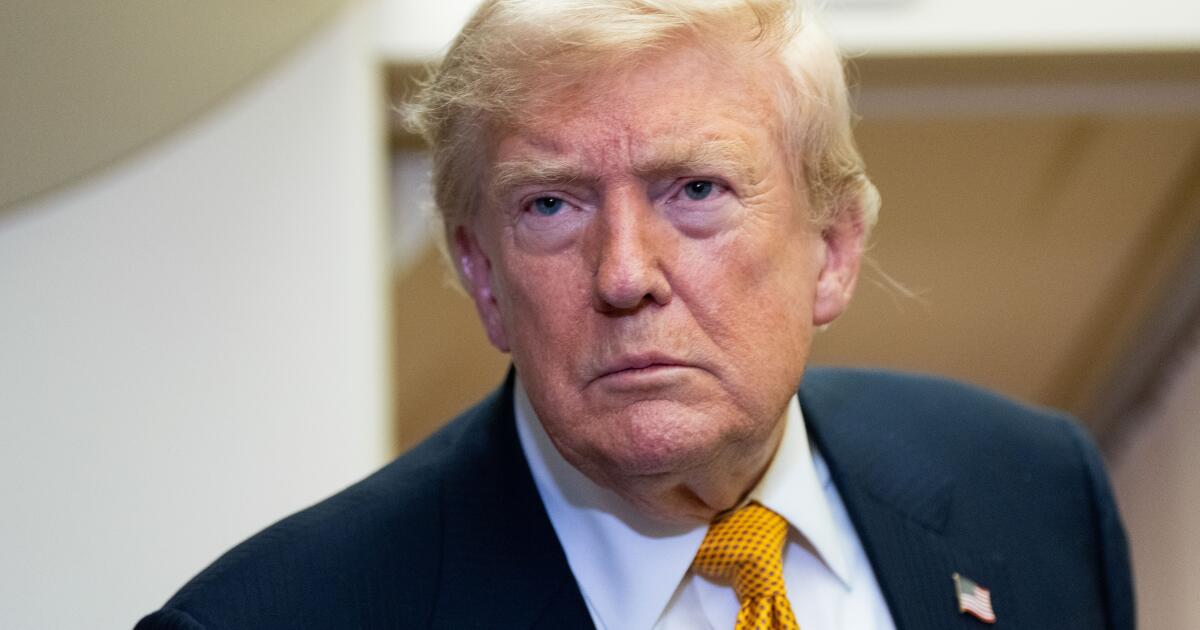
England captain Harry Kane says he once played golf with United States President Donald Trump, describing the experience as “surreal”.
The striker will lead England for their World Cup quarter-final against Norway in Miami on Saturday (22:00 BST) and, in the build-up to that game, revealed he had played golf with Trump in Florida 18 months ago.
“I played alright to be honest,” said Bayern Munich striker Kane.
“He invited me to play when I was down in Palm Beach. So yeah, when the president invites you somewhere…
“It was a pretty surreal experience just to meet him and obviously play golf with him.
“His golf is pretty good, to be honest with you. I hope I can play golf as good as him when I’m his age, that’s for sure. A unique experience, but I was just grateful that he invited me to play.”
The US is co-hosting the 2026 World Cup along with Canada and Mexico, and Kane’s comments followed Trump, 80, saying the pair had played together.
“I think Kane is a great player,” said Trump after Kane, who has six goals and one assist for England at the World Cup, helped the Three Lions beat Mexico 3-2 in the last 16.
“I played golf with him and I like him a lot. He’s a good golfer too. He’s really great.”
Albanian prosecutors probe forged deeds tied to Kushner resort land as protests over the project intensify.
Published On 11 Jul 202611 Jul 2026
Albania’s anticorruption prosecution service is investigating whether the deeds to a stretch of protected coastline earmarked for a Jared Kushner-backed resort were forged, according to case files reviewed by the Reuters news agency, adding another legal complication to a project that has already provoked months of street protests.
The files, compiled by the Special Structure Against Corruption and Organised Crime (SPAK), name Artur Shehu, a Miami-based businessman, as the seller who transferred the land to Albania Land Development, the entity behind the Kushner-linked scheme, in April.
Recommended Stories
list of 3 itemsend of list
Prosecutors allege Shehu and his associates funnelled proceeds from cocaine trafficking into Albanian property, using falsified titles to disguise the money’s origin, and have since frozen roughly 110 million euros ($126m) tied to the sale in a notary’s account.
Shehu’s lawyer, Kujtim Cakrani, rejected the allegations outright. “Nothing that has been alleged regarding Mr Artur Shehu’s character is true,” he told Reuters, adding that his client was neither a trafficker nor a document forger and had lawfully sold land his family had held since Ottoman times.
Cakrani said Shehu was untroubled by the arrest warrant, arguing it was widely assumed in Albania that prosecutors answered to political and business interests. He also said Shehu fled to the United States and won asylum in 1998 after gang violence killed his brother and uncle.
The SPAK files, running to 200 pages and not previously made public, were issued the same day the agency unveiled separate arrest warrants for 20 people accused of narcotics trafficking and money laundering.
Reuters found no evidence that Kushner, Sazan Real Estate Development or other backers of the resort knew of any suspicions surrounding Shehu when the land changed hands.
The disclosure comes amid sustained unrest over the development, which sits on wetlands and beaches along Albania’s southern coast that are home to sea turtles and flamingos, the latter adopted as a symbol by the self-styled “Flamingo Revolution” against the resort and alleged government corruption in general.
Kushner and his wife, Ivanka Trump, have said the idea for the resort came to them after they spotted the coastline from a yacht. He unveiled renderings of hotels, villas and marinas on social media in 2024.
Nightly rallies that began in May, initially focused on the project, have broadened into a wider movement demanding Prime Minister Edi Rama’s resignation over accusations of corruption.
A crackdown last week saw riot police deploy tear gas and water cannon against demonstrators outside parliament, injuring 15 officers and leading to 25 arrests. A Tirana court freed 19 of those detained on Sunday, placing two under house arrest and ordering a dozen others to report periodically to judicial police.
Entela Koja, one of the protesters, said “this is a revolution against the big guys who want to use Albania like a playground for the rich.”
Villagers near the site have separately pursued a decade-long legal challenge to Shehu’s ownership claim, presenting title deeds and tax records they say establish that they are the rightful owners.
Nikolin Markpalaj, one of the landowners, told Al Jazeera: “I told them it would not be easy for them to take this land and enjoy someone else’s land and property. What is happening in this country is madness.”
Rama’s government has dismissed the protests as orchestrated by political rivals and insists the project complies with Albanian and European Union law.
July 10 (UPI) — The Trump administration on Friday rescinded a key provision of the Endangered Species Act that protected habitat crucial to imperiled wildlife.
For 50 years, the ESA definition of “harm” included not only specific species, but also their habitat from modification or degradation.
But on Friday, the administration said it was reversing the rule to focus on “actions that directly injure or kill listed wildlife.”
“For years, federal agencies abused the ESA to obstruct lawful land use and burden American families and businesses,” Interior Secretary Doug Burgum said in a statement.
“That approach turned routine activity into a regulatory trap, drove up costs that impacted people’s lives, and expanded federal authority beyond what Congress intended,” Burgum said. “This action restores common sense, respects private property, provides much-needed certainty for landowners and follows the statute Congress actually passed.”
Enacted in 1973, the ESA has played a vital role in maintaining biodiversity.
Conservation experts say the act was key in saving many species from extinction, including the whooping crane, bald eagle and gray wolf.
Environmental advocates have vowed to sue over the rule change.
“For the first time ever, a presidential administration now claims that species protected by the Endangered Species Act shouldn’t be safe from habitat modification that destroys where they live, raise their young, or search for food,” Earthjustice attorney Kristen Boyles said in a statement.
“Let’s be clear: there is no support for the Trump administration’s rule — no scientific support, no legal support, no public support,” Boyles added. “We will see the Trump administration in court.”
MINNEAPOLIS — Somali and Muslim communities in Minnesota are once again condemning a social media post by President Trump, alleging it communicates “anti-Muslim bigotry” toward children.
Trump posted a 14-second video clip showing children singing in graduation outfits, with girls also wearing hijabs. The children had sashes that read “kindergarten” on one side and “graduate” on the other. The video posted Monday appears to be from a Somali TV Minnesota news clip filming a ceremony at a charter school in St. Paul.
Included in Trump’s TruthSocial post is a screenshot of a caption from an X account that first posted the video in June. The caption said, “Public school in St. Paul, Minnesota. Every girl is in a hijab … in kindergarten.”
The post drew statements from the Council on American-Islamic Relations, the Somali American Partnership and Minnesota Gov. Tim Walz.
“By using his global platform to amplify anti-Muslim bigotry and target Muslim children at this elementary school, President Trump is putting lives at risk,” said a statement from the national and Minnesota chapter of CAIR.
Trump and other Republican leaders have repeatedly been accused of making xenophobic and racist attacks against Muslim Americans in recent months. Trump has specifically singled out the Somali community in Minnesota numerous times, calling them “garbage” in December.
“Somali Americans are an integral part of Minnesota’s past, present, and future,” the Somali American Partnership said in a statement. “Our children deserve to be recognized for their potential — not used to fuel fear, division, or anti-Muslim and anti-immigrant narratives.
“Those with public platforms have a responsibility to protect children, not endanger them.”
In a statement on X, Walz accused Trump of “attacking a group of kindergarteners because of the clothes they wore to school.”
The Somali American Partnership, a collection of Minnesota-based nonprofit organizations that assist the Somali community, plans to hold a news conference Wednesday to address “the growing climate of anti-Somali and anti-Muslim rhetoric.”
Members of the Muslim community in Minnesota have expressed fear for their safety numerous times in recent months, citing such rhetoric. In May, community members tied the rhetoric to a disturbance at a mosque in Lakeville, days after three people were killed at a San Diego mosque.
Last fall, Jaylani Hussein, the executive director of the Minnesota chapter of CAIR, said there had been more than 40 instances of vandalism, arson or other disturbances at mosques in the last three years, higher than any other state. Damage totaled more than $3 million, Hussein said.
He said at the time that Islamophobic comments directed at Muslim institutions in Minnesota were “completely on a new level.”
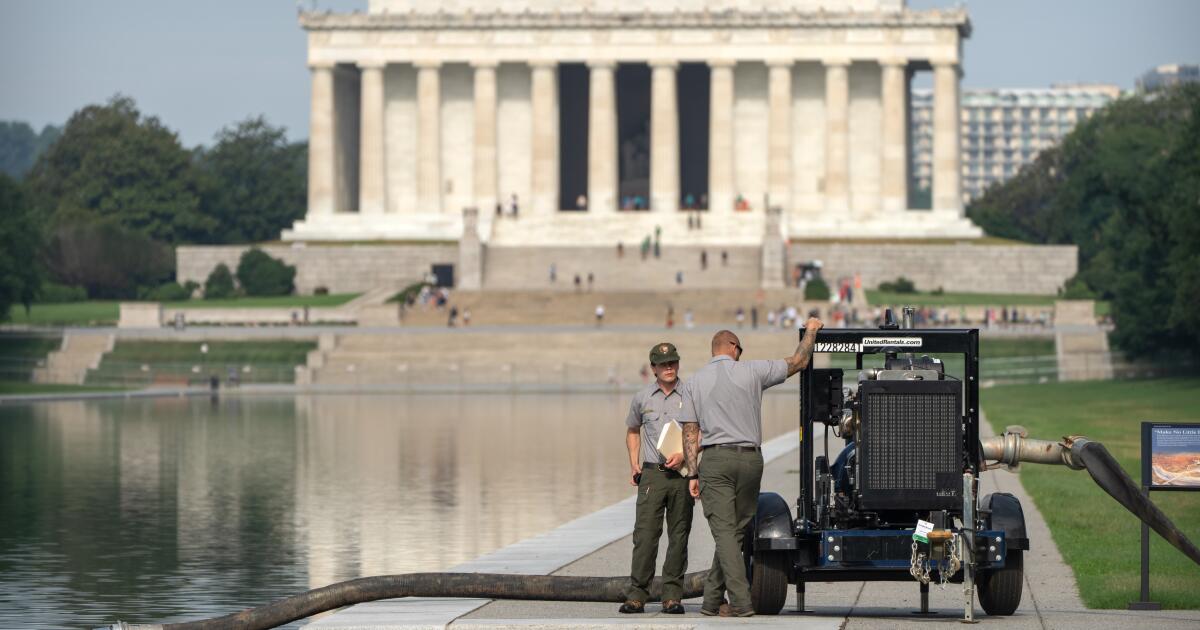
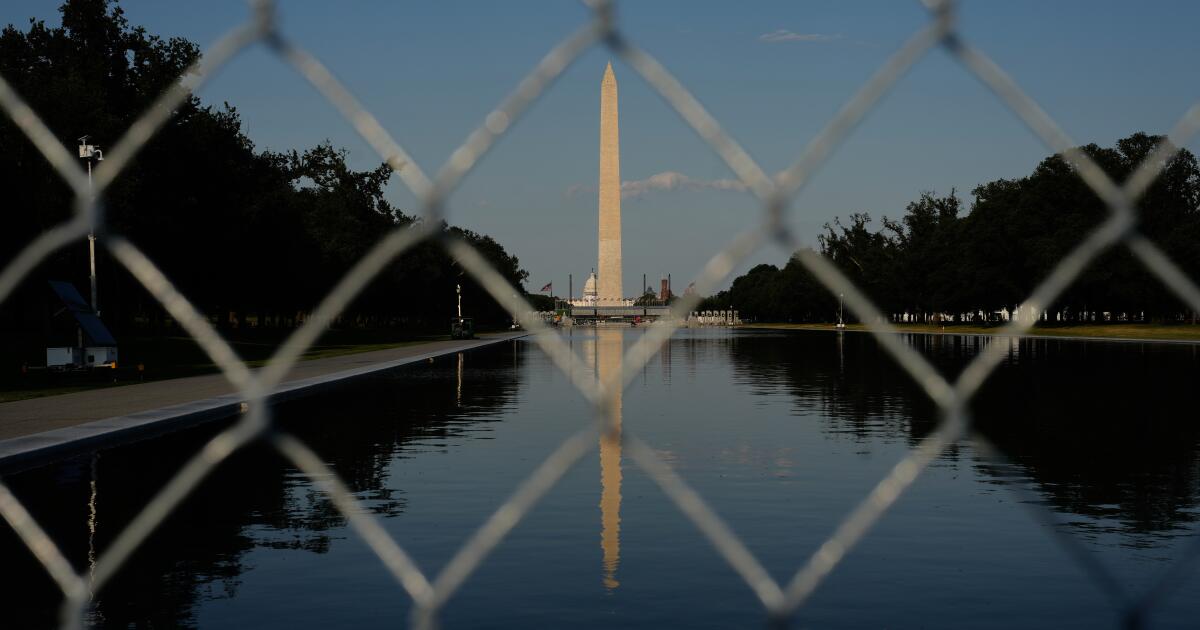
WASHINGTON — Crews are again draining the Lincoln Memorial Reflecting Pool as President Trump’s problem-plagued efforts to revamp the waterway pushes well past his initial goal of having it ready by July 4 to mark the nation’s 250th birthday.
The president at first suggested his renovations would last a century. But within weeks of the project originally reaching completion last month, the water was beset by an algae bloom and pieces of the new coating appeared to be peeling off the bottom.
Trump has blamed the peeling on vandals, though critics allege it’s from shoddy repair work.
Interior Secretary Doug Burgum, whose agency oversees the National Park Service, told conservative podcaster Katie Miller in an interview released earlier this week that the new round of draining was planned. He also said that the water might still contain debris from an extensive Independence Day fireworks display over the National Mall.
“Drain the water, clean up the fireworks stuff,” Burgum told Miller, who is the wife of deputy White House chief of staff Stephen Miller. “Repair the vandalism that was done. Fill it back up again.”
The work on the Reflecting Pool is just one of a number of projects Trump has spearheaded across the nation’s capital. Most prominently, he demolished the White House’s East Wing to build a $400-million ballroom and plans to build a towering arch between the Lincoln Memorial and Arlington National Cemetery.
He initially announced his intentions to beautify the Reflecting Pool this spring, saying he wanted it completed before the nation’s 250th birthday celebrations.
Water was drained and Trump directed that the bottom be painted what he called “American flag blue.” In May, the president posted on his social media site of the pool: “The goal is to have it done, at this higher level, prior to July 4th — We are ahead of schedule!”
But problems began quickly after the initial work was finished. Trump blamed vandals, and court documents later showed that the National Park Service reported to the U.S. Park Police a June 9 incident in which a sharp knife or razor cut the pool’s new liner.
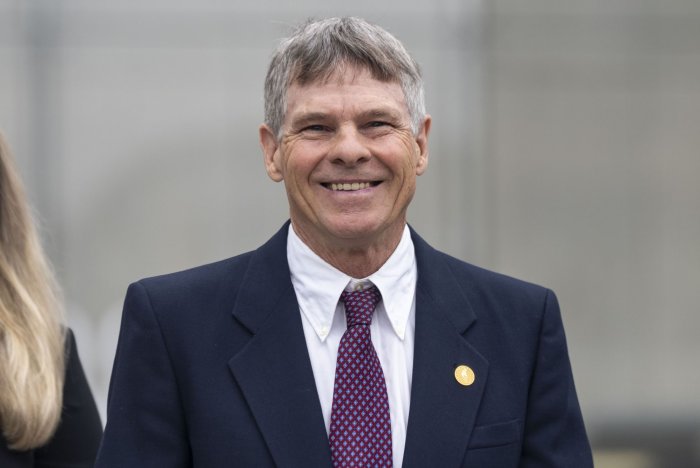
On Thursday, former Olympic canoe racer David Hearn pleaded not guilty in D.C. Superior Court to deliberately damaging the Reflecting Pool. Hearn has said he reached inside the pool to examine the peeled sealant and let go of a chunk when he was told to by a park worker.
His attorneys and other Trump administration critics have derided the case as an abuse of prosecutorial power and maintain he is being scapegoated for the poor job done fixing up the Reflecting Pool.
At least three other people have been charged in the same court with misdemeanors for allegedly removing pieces of paint from the Reflecting Pool, according to online court records. All three pleaded not guilty during their initial court appearances Wednesday.
The pool was closed for the Independence Day celebration, which featured what Trump said was the largest fireworks display in the world. The president had said that the pool would have to be drained anew as part of the new round of repairs.
Burgum has also said that the Trump administration won’t seek bids for the new rounds of repairs. He told CNN’s “State of the Union” last weekend: “We’ll use the same company because they did a fantastic job.”
Ohio-based Green Water Solutions, also known as Greenwater Services, was given a $1.7-million contract to install a water-purification system in the Reflecting Pool, while Virginia-based Atlantic Industrial Coatings was awarded $14.7 million to repaint and waterproof the pool’s concrete floor.
Democratic senators and House members are investigating the pool project, including seeking answers about how much taxpayer funding is involved.
The dismissals leave the federal election body vacant as Trump presses for broader changes to US voting rules.
Published On 10 Jul 202610 Jul 2026
President Donald Trump has removed the last remaining members of an independent federal commission that helps support United States elections, leaving the bipartisan body with no sitting commissioners.
The White House confirmed the news on Friday, with only months to spare before November’s midterm elections.
Recommended Stories
list of 3 itemsend of list
“The President, and head of the Executive Branch, reserves the right to remove individuals that may not be totally aligned with the important task of securing America’s elections,” the White House said in a statement.
It added that the administration had been “working across all agencies and local partners to safeguard elections from fraud and abuse” in the run-up to the midterms.
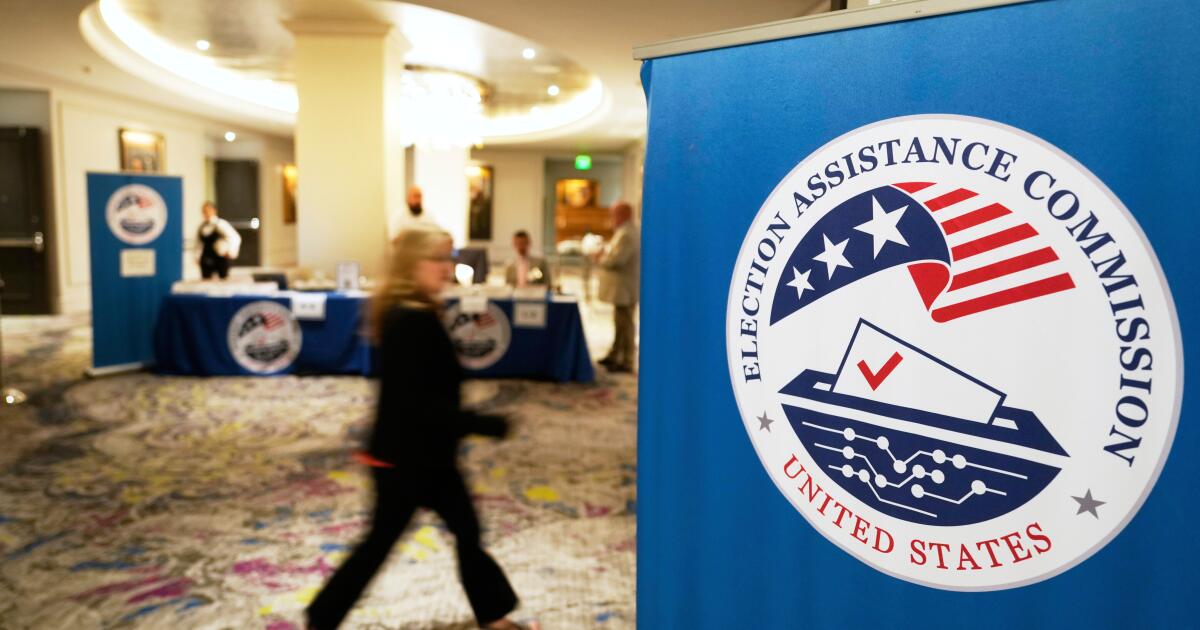
The decision concerns the Election Assistance Commission (ECA), an independence office created by Congress in 2002 to support state and local election officials. Among its duties are creating non-binding election guidelines, certifying voting systems and maintaining the national mail voter registration form.
Four commissioners typically helm the agency. But on Thursday, the two Democratic appointees — Thomas Hicks and Benjamin Hovland — were fired by email, according to the news agency Reuters.
The lone remaining Republican, Christy McCormick, resigned. A fourth commissioner, Republican appointee Donald Palmer, had already left in April.
The commission is required by law to be made up evenly of Democrats and Republicans, and it was put in place to help after the disputed 2000 presidential election.
Trump’s decision to fire the remaining commissioners has further raised concerns that he may seek to intervene in the upcoming midterm elections, which will decide control of Congress for the rest of his term.
Under the US Constitution, election administration is the responsibility of the state, not the federal government.
The Election Assistance Commission had previously declined to implement part of Trump’s March 2025 executive order that called upon it to require proof of citizenship on the national mail voter registration form.
A federal judge later blocked that part of that executive order, ruling the president had exceeded his authority. Trump has appealed the ruling.
Voters are already required to affirm their citizenship before voting, as non-citizen voting is illegal in the US. Instances of non-citizen voting are rare.
The firings are the latest in a broader effort by the president to reshape how elections are conducted.
The Trump administration has pushed to tighten vote-by-mail rules and threatened to withhold some federal funding from states that refuse to adopt new election requirements. Many of those efforts have been challenged in court.
Earlier this week, the administration also sent out letters warning election officials that they could face prosecution if they fail to remove noncitizens from voter rolls.
Trump has defended the actions as necessary to protect election integrity. He has repeatedly claimed that his loss to Democrat Joe Biden in the 2020 election was the result of fraud, a claim not backed by evidence.
The latest firings come after the US Supreme Court last month expanded the president’s power to fire members of independent agencies, even without cause.
The court ruled six to three in Trump’s favour, arguing that “neither Congress nor the courts may saddle” the president with executive-branch leaders he does not approve of.
The president is allowed by law to appoint replacements to the commission. It is not yet clear whether Trump plans to nominate replacements or leave the seats vacant.
WASHINGTON — President Trump dismissed all remaining members of the bipartisan U.S. Elections Assistance Commission this week, his latest move to assert control over national elections in the final months before midterm voting.
The White House defended the move as justified by a recent U.S. Supreme Court decision handing the president greater authority to reshape independent government agencies, including by replacing appointed leaders.
Democrats and some independent elections experts blasted it as politically motivated, counter to the interests of voters and foolhardy with the November election so close.
“Purging commissioners just months before the midterm elections and further gutting support for our state and local elections officials is a blatant part of his plan to politicize our elections and enable more unlawful and dangerous election interference,” said Sen. Alex Padilla (D-Calif.), the top Democrat on the Senate Rules Committee, which oversees federal elections.
Padilla alleged the dismissals are an attempt by Trump “to dismantle yet another independent guardrail of our democracy designed to keep elections fair and secure.”
A White House official framed the dismissals in starkly different terms, saying the departing commissioners were “not totally aligned with the important task of securing America’s elections and ensuring every legal vote is counted.” It did not say when the president planned to appoint new commissioners.
The four-member commission was created by Congress in 2002 as part of the Help America Vote Act to help states improve their voting systems and voter access. By law, no more than two commissioners may belong to the same political party.
Historically, it has provided voluntary guidance and best practices for voting systems, and served as a sort of clearinghouse for election performance around the country — so that states and localities can learn from each other.
Since 2018, the panel has also disbursed more than $1 billion in election security grants, according to a report by the Bipartisan Policy Center. Those grants are then used to protect IT systems from foreign and domestic cyberattacks, update voting systems, ensure the accuracy of voter rolls and protect the integrity of ballots after they are cast.
Without leadership, the panel cannot take any official action until new members are nominated and confirmed by the Senate.
Benjamin W. Hovland, one of the Democratic commissioners removed by Trump, told NBC News that taking away a key federal agency designed to help state and local election administrators will have a negative effect on already strained elections officials.
“When you’re asking more and more of people without giving them the necessary resources, you know, mistakes happen,” he said.
California Secretary of State Shirley Weber, in a statement to The Times, said Trump was “injecting unnecessary chaos, confusion and instability into the very systems that Americans rely on to make their voices heard,” but that California “will not be intimidated or deterred” from maintaining elections “in which everyone can fairly and securely participate.”
Gov. Gavin Newsom’s office said on X that “Newsom’s election protection efforts become more important by the day” — a reference to his recent push for state legislation that would make it a felony in California for anyone to seize ballots before a vote has been certified.
Newsom had said Thursday that Trump’s efforts to seize control over elections represented a “five-alarm fire” that must be confronted.
“We will lose this country unless we are vigilant about what’s going on in terms of election security,” he said.
Trump’s dismantling of the commission comes as he wages a much broader campaign to rewrite voting rules. He has sought to place new restrictions on mail ballots, to enhance voter ID and proof of citizenship requirements for voters, to subject state voter rolls to federal oversight and purges, and to assert federal control over how and whether the U.S. Postal Service delivers mail ballots.
Much of that agenda, pushed through executive orders and other administrative actions, has been stymied by the courts, while stalling out in Congress, where it lacks support.
Whether Trump’s move to dismantle and reconstitute the commission will prove an effective path to instituting his election agenda — or will face its own court challenges — remains unclear, experts said.
Rick Hasen, an election law expert and director of the Safeguarding Democracy Project at UCLA Law, wrote that Trump could try to illegally direct the commission to “do his bidding” by amending the federal voter registration form to require proof of citizenship.
“If he tries anything like this, it will be high profile and very important litigation that will end up at the Supreme Court on the emergency docket over the summer,” Hasen wrote.
Michael Waldman, president and chief executive of the Brennan Center for Justice at NYU Law, said in a statement that Trump’s terminations were “deeply concerning” in light of his “relentless efforts to try to interfere in elections.”
But he also said that the “guardrails” Congress put on the commission remain intact, require it to be made up of a bipartisan group and preclude Trump from directing it to enforce his voting agenda.
Sen. Adam Schiff (D-Calif.) said Trump’s firing of the commissioners was part of a broader effort by the president to “sow distrust in our voting system so he can contest the results if they are not to his liking.”
Kim Alexander, president of the California Voter Foundation, said the very name of the commission makes it clear that it was “designed to assist states and localities, not dictate what states and localities must do” with elections. She said California has “the most robust standards” for elections in the country, which won’t change with the removal of the commissioners.
Still, she said word of the firings rocketed around a conference of county elections officials in San Diego on Thursday — with some wondering whether the dismissals would threaten federal funding for election administration moving forward, and others lamenting the loss of the current commissioners’ deep experience.
Dean Logan, head of the L.A. County Registrar-Recorder/County Clerk’s office, said in a statement to The Times that “any sudden change to the support structure for elections in the middle of an election cycle is concerning,” but that California “has a strong local and state foundation for election administration and voting systems support, and that will minimize any potential disruption caused by this action.”
In recent months, Trump has leveraged federal agencies to overhaul the nation’s voting rules in ways no previous president has attempted. He has repeatedly pressured Republican lawmakers to pass a federal law that would require voters to provide proof of citizenship when they register, show identification when casting a ballot and force states to send voter data to the Department of Homeland Security.
Republican leaders have said the proposed SAVE America Act does not have enough votes to pass in the Senate. The GOP resistance has angered Trump, who on Friday said he was refusing to sign a bipartisan housing bill in protest.
The housing bill, which Trump called a “yawn” this month, would become law at midnight Friday without Trump’s signature.
WASHINGTON — President Trump will let the bipartisan housing bill approved by Congress become law without his signature, saying Friday that he was refusing to put his name on it because of the little progress made in passing a strict voter ID bill that he has been pushing.
“I will not sign the Housing Bill, which has been fully approved by Congress and sent to the White House, in PROTEST over the fact that the United States Senate is not capable of passing THE SAVE AMERICA ACT,” Trump posted on social media.
Trump had 10 days until the Friday deadline to sign the bill, issue a veto, or allow the measure to take effect without his signature. He has chosen to let the measure become law without his express approval, undercutting his administration’s claims that he considers it a priority to combat inflation.
Trump’s rejection of the bipartisan housing legislation exacerbates tensions with his own party in a midterm election year and cuts short their efforts to address a key voter concern about rising costs. His post comes more than a week after he canceled plans to sign the bipartisan legislation, announcing he was using it as leverage in his push for a strict voter ID bill.
The 21st Century ROAD to Housing Act aims to lower the cost of housing and spur more home construction. It’s the broadest federal effort in decades to address America’s housing affordability problems, as state and local regulations have made it difficult to build in many of the communities that are also sources of job growth and economic opportunity. White House economists estimated earlier this year a national shortage of 10 million homes and the bill could help to close a portion of that gap.
But Trump called the bill “a yawn” and “so unimportant” compared to legislation that would require proof of citizenship for all voters.
He surprised Republican lawmakers on June 24, when, shortly before a planned signing ceremony at the Capitol, he announced he would not approve the bill until lawmakers first passed the voting legislation.
That bill, the SAVE America Act, doesn’t have enough Republican support to pass.
House Speaker Mike Johnson, R-La., said after submitting the housing bill to the White House that he told Trump he should get the “fattest black marker you have, and sign your name really big on that.”
“I hope he does sign it,” Johnson told reporters at the time. “If he doesn’t, it’s still law. We’ll still celebrate it.”
He said he also understood Trump was trying to make a point that the elections bill is the top priority. “And I think he’s making it very effectively,” Johnson said.
Still, Trump’s decision not to sign the bill gave Democrats an opening to criticize him on the issue of affordability.
“His priorities couldn’t be clearer: higher cost for families and more power for himself,” Senate Democratic leader Chuck Schumer said on X.
The housing bill passed the Senate on an 85-5 vote and the House approved it with an 358-32 vote.
That legislation seeks to cut federal housing rules, slim-down environmental reviews, make it faster to build homes and limit the ability of corporations to buy single-family homes.
The bill does not address all of the causes of the country’s housing woes, including a shortage of construction workers, climbing insurance costs and wages that have not risen fast enough for renters and buyers.
But the bill has drawn support from the real estate industry and housing advocates.
The U.S. housing market has been a driver of recent affordability challenges as skyrocketing prices have kept aspiring buyers out of the market. The National Association of Realtors said Thursday that the median sales price increased 1.8% in June from a year earlier to $440,600, an all-time high on data going back to 1999.
Price and Boak write for the Associated Press. AP reporter Kevin Freking contributed to this report.
CONCORD, N.H. — Two transgender girls who were the first to challenge President Trump’s executive order, “Keeping Men Out of Women’s Sports,” have withdrawn their lawsuit in New Hampshire based on a recent U.S. Supreme Court ruling that upheld state bans on transgender athletes in girls’ sports and their own personal hardships, their lawyer said.
“This case was always about two courageous young girls who simply wanted the same opportunities as their peers to participate in school life,” their lawyer, Chris Erchull of GLAD Law, said in a statement Thursday. “Their willingness to stand up to extraordinary hostility made clear the human cost of laws that target transgender youth.”
The teenagers, Parker Tirrell and Iris Turmelle, took on Trump’s executive order last year, amending their 2024 complaint against New Hampshire’s law on banning transgender girls from school sports. A federal judge had granted a court order allowing them to play as the case proceeded.
For Tirrell, it meant being able to keep playing on her high school girls’ soccer team. For Turmelle, it was having a chance to try out for different sports.
Both sides agreed to pause the case and wait for a ruling from the Supreme Court as it considered similar state laws barring transgender girls and women from playing on school and college athletic teams in Idaho and West Virginia. Last month, the court upheld the laws. It also said that barring transgender girls and women doesn’t run afoul of the federal law known as Title IX, which prohibits sex discrimination in education.
One teen and her family decided to move from New Hampshire
Turmelle and her family moved out of New Hampshire last summer following proposed legislation against transgender people. One measure signed into law by Republican Gov. Kelly Ayotte last year prohibits medical professionals from providing puberty blockers and hormone replacement therapy to new transgender patients under age 18.
“Though there may be a carve-out for people already receiving gender-affirming care, that is way too close a call for us to risk staying,” Turmelle’s mother, Amy Manzetti, wrote in an op-ed piece at the time. “Other New Hampshire laws also seek to erase her.”
Most Republican-controlled states in the past five years have adopted laws or policies limiting gender-affirming care for transgender minors and limiting which school bathrooms transgender people can use, as well as sports restrictions. The Williams Institute at UCLA estimates that about 3% of youth ages 13 to 17 identify as transgender.
“The challenges with relocation are significant and burdensome — this includes having to find new employment, buying and selling homes, packing and moving possessions, integrating kids with a new school system, losing access to longstanding family and friends, and potential loss of income,” Corinne Goodwin, the executive director of Eastern PA Trans Equality Project in Pennsylvania, said in an email.
“But these families do so because they love their kids and know that supporting them with the care and opportunities they need is critical to their long-term success and happiness.”
The other teen gave up playing soccer at high school
Tirrell, 17, began her junior year last fall on the girls’ junior varsity soccer team. Things were fine at first, and each time she scored a goal, she got a round of ice cream from her parents. But a few weeks into the season, she decided to stop playing.
“With all of the political stuff going on, soccer wasn’t just about the game anymore,” her mother, Sara Tirrell, told The Associated Press in an interview.
It became more about preparing for the possibility of conflict.
“Were there any local Facebook groups where they were sort of agitating about potential protests and how do we prepare, and what are we walking into, and we never kind of knew,” she said. “We were on a lot of pins and needles, especially after the previous season.”
She was referring to a controversy at an away game where two dads from an opposing team were banned from school grounds for wearing pink wristbands marked “XX” to represent female chromosomes. They sued the school district and a judge ruled against them. They have appealed their case.
Last fall, there was an increased presence of school administrators at the games and bus drivers pulled in closer to the field so the students weren’t in the parking lot, she said.
“Parker didn’t talk about it a lot, but I think she could see that stress for everybody — for her, for her teammates, for her coaches,” Sara Tirrell said. “She felt kind of bad about pulling them all into that circus again. And so she ultimately said, ‘This isn’t fun anymore and I don’t want to do it.’”
Parker’s father described the atmosphere as “palpable tension.”
Even playing on her own turf, “there would typically be a couple of police officers at the home games where there weren’t previously,” Zach Tirrell said.
In the past, Parker also played soccer in a recreation league and could still do so.
“But I think it all kind of still sort of weighs on her,” her mother said. “It’s the same group of kids that she plays with who, honestly, have been very supportive and love to have her on the team and have expressed that to her many times over. But I think she still has that worry in her brain around, ‘What are other people going to say and do if I show up at a game?’”
Parker’s parents hope she’ll return to playing soccer some day. In the meantime, “she plans to be around and use her voice to continue standing up to discrimination,” her mother said. “In some ways she’s had to grow up a lot faster than some of her peers.”
McCormack writes for the Associated Press. AP writer Geoff Mulvihill in Haddonfield, N.J., contributed to this report.
The housing legislation will become US law at midnight with or without President Donald Trump’s signature.
Published On 10 Jul 202610 Jul 2026
United States President Donald Trump says he will not sign a bipartisan housing affordability bill in protest at the Senate not passing the controversial SAVE America Act voting legislation.
In a post on Truth Social on Friday, Trump said he would not support signing the unrelated housing bill, which would speed up environmental reviews for construction projects, expedite development, and limit the number of single-family homes institutional investors can buy.
Recommended Stories
list of 4 itemsend of list
The bill will become law with or without the president’s signature. Once a bill reaches the president’s desk, the officeholder has 10 days to either sign it into law or veto the legislation. If he does neither, it becomes law at midnight.
House Speaker Mike Johnson said the president is unlikely to issue a last-minute veto.
The housing legislation, known as the 21st Century ROAD to Housing Act, which Trump called a “yawn” on June 29, was a rare moment of bipartisan agreement in a starkly divided US Congress. It passed the Senate by a vote of 85-5 and the House by a vote of 358-2.
The provisions included in the legislation are popular. A Bipartisan Policy Center poll suggested that 70 percent of Americans support banning institutional investors that own more than 350 homes from buying additional single-family homes.
The legislation would also establish incentive programmes for communities to build more housing and encourage the development of modular homes. It also includes provisions that would make it easier for communities to convert underutilised land into residential housing.
Housing remains a major pressure on Americans, with 79 percent saying the cost of housing is either “an extremely important” or “very important” issue, according to the Bipartisan Policy Center.
The US median home price hit a record $440,600 in June, while mortgage rates remain elevated. The average 30-year fixed mortgage rate is currently at 6.49 percent.
Voting act pressures
Trump cancelled the original signing ceremony for the housing legislation on June 24 in an effort to pressure Republicans to pass the SAVE America Act. Among its provisions, the bill would require proof of citizenship to register to vote and create a national voter database using state records.
It would also impose new limitations on mail-in voting, even though roughly one-quarter of Republicans voted by mail in the 2024 presidential election, according to an MIT survey.
A version of the voting legislation passed the House but failed to clear the Senate’s 60-vote filibuster threshold.
Under current election law, states administer elections, not the federal government.
The White House did not respond to Al Jazeera’s request for comment.
President Trump has ousted members of a bipartisan federal election commission that resisted his efforts to require would-be voters to document their U.S. citizenship before registering.
The White House on Friday confirmed the executive action against members of the Election Assistance Commission, which distributes federal grants to states, oversees the testing of voting systems and maintains the national voter registration forms.
It’s the latest move in the Republican president’s effort to expand White House influence over how U.S. elections are conducted and comes after a recent U.S. Supreme Court ruling that gave the president new personnel authority to fire members of independent agency boards.
“The President, and head of the Executive Branch, reserves the right to remove individuals that may not be totally aligned with the important task of securing America’s elections and ensuring every legal vote is counted. The Slaughter decision gives the President precedence to do so,” said a White House statement to AP.
The president removed the commission’s two Democratic members, Thomas Hicks and Benjamin Hovland. The panel’s Republican member, Christy McCormick resigned. Former Republican commissioner Donald Palmer already had left his post voluntarily earlier this year.
The changes were first reported by VoteBeat, a news outlet that covers elections and voting across the U.S.
While the White House statement did not offer a specific reason for Trump’s action, the commission has previously declined to change the national voter registration form to require documentation of an applicant’s U.S. citizenship, as Trump’s urged in a sweeping March 2025 executive order on U.S. elections. A federal judge blocked the order, ruling it exceeds the president’s authority since the U.S. Constitution grants authority over elections management and oversight to Congress and the states. The administration has indicated it will appeal.
It was not clear whether Trump planned to nominate new members immediately or leave the positions vacant — a move that, months ahead of midterm elections, could prevent the agency from distributing new grants to state or local elections offices and, at the least, complicate its role in overseeing testing and certification of voting systems around the country.
“The Administration from the start has been working across all agencies and local partners to safeguard elections from fraud and abuse, and investing in a strong infrastructure to sustain that mission especially in the midterm elections,” the White House said.
Congress created the four-member commission as part of the Help America Vote Act, a bipartisan law signed by Republican President George W. Bush in 2002. The act requires the commission to include two Democrats and two Republicans, nominated by the president and confirmed by the Senate. Hicks and McCormick were appointed by President Barack Obama. Trump appointed Hovland during his first presidency.
According to VoteBeat, Hicks and Hovland were notified of their removal by an email signed by Morgan DeWitt Snow, the deputy director of presidential personnel in the Executive Office of the President.
July 10 (UPI) — A bipartisan housing bill that swept the House and Senate is set to become law at midnight Friday if President Donald Trump doesn’t veto it, and he said Friday morning on social media that he won’t sign it.
The 21st Century Road to Housing Act was passed on June 29 by a wide margin of Democrats and Republicans in both chambers of Congress, but the president canceled a signing ceremony at the last minute and said he wouldn’t sign it until Congress passed Trump’s pet project, the SAVE America Act, which they don’t have the support to do.
“I will not sign the Housing Bill, which has been fully approved by Congress and sent to the White House, in PROTEST over the fact that the United States Senate is not capable of passing THE SAVE AMERICA ACT, which is polling at 97% with the Republican Party, and very high with the non-politician Dumocrats,” he wrote.
He didn’t mention a veto, but it’s still a possibility.
“The Act states, quite simply, that to Vote a person must show PHOTO VOTER I.D., PROOF OF CITIZENSHIP, AND THAT THERE WILL BE NO MORE CROOKED, CORRUPT, & DESTABILIZING MAIL-IN BALLOTS (EXCEPTIONS for Military, Disabled, Illness, and Travel!). THE SAVE AMERICA ACT’S non-passage is CRAZY, and a serious threat to any politician who votes against it! If the Dumocrats, or any RINO (or worse!) working with them, do not allow a positive Vote on SAVE AMERICA, TERMINATE THE FILIBUSTER, and pass this, and every other Bill that true Republicans have ever dreamt of (In addition to the upcoming Budget BOMB and the 1929 catastrophic style DEBT CEILING BILL!). The Dumocrats will TERMINATE THE FILIBUSTER, if and when they ever get the chance to do so, in their very first hour – And I will no longer be able to call them Dumocrats again! The title of DUMB will revert to the Republicans who allowed this horrible calamity to happen to our Party, and our Nation, itself! MAKE AMERICA GREAT AGAIN!” he wrote.
If the president vetoes the bill, Congress will likely have the votes to override it. It would need a two-thirds majority to pass the override in the House and Senate.
“This is the exact kind of bill they want to point to and say Republicans are working on issues that their voters care about, and Democrats would want the same,” Julian Zelizer, a history and public affairs professor at Princeton University, told The Washington Post. “That’s not the signal that the administration is sending.”
Since the bill passed and Trump refused to sign it, he has called it “a yawn.”
“To me, compared to the SAVE America Act, everything is a big yawn,” he said.
The SAVE Act is an election bill that would require voters to prove they are citizens when registering to vote. Critics argue that it would disenfranchise too many voters because of the types of proof it would require.
The housing bill includes measures that modernize building standards, encourage renovating older homes, encourage communities to build more housing with funding and grant programs, local governments to reform restrictive zoning policies around building housing and effectively ban private equity from buying up single-family homes. Critics of the bill say it doesn’t go far enough, but they acknowledge it’s a good first step.
It’s the first bipartisan measure that’s passed this Congress.
Some Democrats have been publicly pushing the president to sign the bill.
“It’s been sitting on President Trump’s desk long enough. Sign the bill,” Sen. Amy Klobuchar, D-Minn., posted on X.
Sen. Mark Kelly, D-Ariz., said on X, “Republicans and Democrats worked together to pass a bill to build more housing and stop hedge funds from buying up single-family homes, but Trump is holding it hostage. He needs to stop playing games and sign the bill so more Americans can finally afford homes.”
Olympic canoeist David Hearn departs the Moultrie Courthouse after pleading not guilty to damaging the Lincoln Memorial Reflecting Pool on Thursday. Hearn was indicted on July 2 on one count of destruction of property of more than $1,000 for allegedly damaging the Reflecting Pool, carrying a maximum penalty of 10 years in prison if convicted. Photo by Bonnie Cash/UPI | License Photo
A new rule proposed by the White House Office of Management and Budget would fundamentally overhaul the way federal grants are awarded and overseen — a sweeping change that one scientific society said “would all but end the use of scientific merit in the selection of grants and programs across the government.”
Proposed in late May, the rule would give political appointees unprecedented control over federal grants for research, education and infrastructure, and specifies that government funds can only be spent on projects “aligned with administration policies and priorities,” according to a copy of the proposed rule.
The rule would also restrict research topics, limit U.S. scientists’ ability to collaborate with colleagues in other countries and make it easier for the government to suspend or cancel grants at any time.
The changes are intended to improve “transparency, accountability, and oversight for Federal awards” while “ensuring that American tax dollars are not wasted or misused,” according to the White House office.
But critics say that if the rule is implemented, the final sign-off for grants will no longer be in the hands of subject-matter experts within individual agencies, but in those of political appointees.
“This touches all parts of American life,” said Dr. Eric Rafla-Yuan, a psychiatrist who practices at the Veterans Administration and San Diego County’s psychiatric hospital.
“Control of how all of the federal grants and programs are funded will fall under a small group of highly partisan individuals who would have very few limits on how they spend these billions of taxpayer dollars,” said Rafla-Yuan, who also chairs the Committee to Protect Public Mental Health advocacy group. “This touches everyone’s life, even if they don’t realize it.”
OMB published the proposed rule May 29, opening a 45-day comment period that closes July 13.
By midday Thursday, the Federal Register logged nearly 100,000 comments about the proposal, many of them expressing concern.
“I understand the need for oversight, fiscal responsibility, and accountability. That is not the issue,” wrote Jack Feldman, a neuroscientist who holds the David Geffen School of Medicine Chair in Neuroscience at UCLA. “The issue is whether scientific research is to be judged by scientific merit, or whether it can be approved, denied, or terminated according to broad political criteria that may change from one administration to the next.”
Crucially, the rule converts policies governing federal grants from “guidance” into binding regulations that all agencies would be required to follow. It would give political appointees power to override federal agencies’ merit-based reviews and mandate that a political appointee review decisions to ensure that all awards “demonstrably advance the President’s policy priorities.”
The elevation of political appointees in what were previously merit-based decisions has alarmed many scientists.
“The proposed rule changes would all but end the use of scientific merit in the selection of grants and programs across the government,” read a statement from the Planetary Society, a nonprofit dedicated to space research.
Researchers and science groups have also expressed concern about a section of the rule prohibiting the promotion of “theories of disparate-impact liability” — a legal concept that refers to policies that appear neutral but cause disproportionate harm to certain groups.
The section’s vague language and many loopholes could have a chilling effect on any research that studies the effects of a disease, policy or public health intervention on any specific group of people, Rafla-Yuan said.
As an example, he said, “if there’s a specific age range that is at higher risk for suicide, and we want to figure out, well, what’s going on with people that are aged 14 to 19 … we can’t do that under the wording in this rule.”
New restrictions on collaborations with scientists in other countries would hinder opportunities for U.S. researchers and limit innovation, said Joanne Padrón Carney, chief government relations officer for the American Assn. for the Advancement of Science.
“Science is a global enterprise. Especially in biomedical and public health fields, diseases don’t care about borders or government policies,” she said.
California’s congressional delegation sent a letter Wednesday asking OMB to rescind the proposal, outlining concerns about its impact on scientific innovation, U.S. competitiveness and the fiscal stability of local governments, many of which rely on federal grants for local services.
The proposed rule grants the federal government broad powers to suspend or cancel grants for any reason, introducing “unprecedented unpredictability into local governance,” the lawmakers wrote, “leaving vital infrastructure projects unfinished and abandoning vulnerable populations who rely on these services.”
Republican Sen. Susan Collins has also asked the White House to withdraw certain parts of the letter and extend the public comment period, saying the proposed rule as written would “harm small and rural communities, undermine scientific and biomedical research, and conflict with Congress’ control over the federal funding process.”
July 10 (UPI) — President Donald Trump has reportedly fired the three remaining members of an independent, bipartisan commission that helps states administer elections, intensifying Democratic concerns that he is trying to interfere in November’s midterm elections.
Trump fired the Election Assistance Commission’s two Democrats, Benjamin Hovland and Thomas Hicks, while allowing its Republican commissioner, Christy McCormick, to resign on Thursday, according to The New York Times, NPR and ProPublica, which was the first to report on the development.
With the exit of the three commissioners, the commission has no sitting members. Republican Commissioner Donald Palmer resigned in late April.
The EAC was established by the Help America Vote Act of 2002 in response to issues surrounding the 2000 election. Its mission is to improve the administration of elections and help Americans participate in the voting process, according to the Congressional Research Service.
The midterm elections have loomed large over Trump’s second term. He has repeatedly warned that Democratic impeachment proceedings and investigations would follow Republicans losing the House, which they hold by a narrow 218-212 majority.
Trump has sought to influence the outcome by pushing Republican-led states to conduct unorthodox mid-decade redistricting to create additional GOP-favored seats, setting off a redistricting fight with Democrats. The president, who wrongly maintains that the 2020 election was stolen from him, has also repeatedly voiced skepticism over the integrity of U.S. elections, pushing legislation to impose stringent voting restrictions that critics say would disenfranchise voters.
Democrats and critics have been warning that Trump is trying to undermine the upcoming midterm elections and create a pretext for his administration to intervene. They say the hollowing out of the EAC removes election expertise and oversight from the process.
“Firing every remaining member of the bipartisan Election Assistance Commission months before the midterms is a brazen attempt to seize control of our elections before a single vote is cast,” Senate Minority Leader Chuck Schumer, D-N.Y., said in a statement.
“He is gutting the independent agency that certifies voting systems and helps election officials run secure elections.”
Sen. Alex Padilla, D-Calif., ranking member of the Senate Rules Committee, and Rep. Joe Morelle, D-N.Y., ranking member of the Committee on House Administration, called the firings illegal.
“Trump continues to double down on his efforts to erode trust in our elections, undermine independent oversight and further his administration’s attempt to ‘take over’ elections,” the Democratic pair said in a statement, referencing Trump’s repeated calls for Republicans to “take over” the election process.
“Americans deserve elections that are safe, secure and run free from political interference — not overseen by partisan loyalists and election deniers beholden to Trump.”
Michael Waldman, president and CEO of the Brennan Center for Justice at NYU Law, described the ousting as “deeply concerning” given “Trump’s relentless efforts to interfere in elections.”
“Until bipartisan replacements are confirmed, the agency cannot lawfully make any decisions that affect how Americans vote,” he warned in a statement.
July 10 (UPI) — The Justice Department filed a lawsuit against Maryland on Thursday challenging the state’s laws that limit local law enforcement’s cooperation with immigration agents, the latest legal salvo in the Trump administration’s crackdown on immigration.
Federal lawyers with the Justice Department’s Civil Division have filed about 20 lawsuits against so-called sanctuary policies that the Trump administration argues violate the Constitution’s Supremacy Clause, under which federal law supersedes state policies.
“Federal immigration officers merely enforce the laws that our nation’s elected representatives in Congress passed, reflecting the will of ‘We the People,'” Associate Attorney General Stanley Woodward said in a statement.
“When sanctuary jurisdictions enact laws to shield illegal aliens from federal law enforcement, it is not merely federal law that is violated, but the voices of everyday American voters silenced.”
The Community Trust Act, passed by Maryland’s General Assembly, took effect immediately on May 31, 2026, limiting local cooperation with federal immigration authorities amid the Trump administration’s aggressive crackdown.
Opponents criticize the law as permitting the harboring of undocumented migrants, while advocates argue such policies are needed to create safe communities by reducing barriers that hinder immigrants from communicating with law enforcement.
In the lawsuit, the Justice Department argues that by enforcing the Community Trust Act, Maryland was unlawfully interfering with the federal government’s enforcement of federal law, in violation of the Supremacy Clause.
“Maryland has no lawful interest in assisting removable aliens to evade federal law enforcement. The state’s prohibitions on cooperation with federal immigration agencies have endangered public safety, resulting in criminals being released into Maryland rather than turned over to immigration authorities for removal from the United States, as required by Congress,” the federal lawyers said in the complaint.
“The challenged laws are not a mere passive effort to avoid providing state or local resources to federal officials but rather are an active and deliberate effort to obstruct federal immigration enforcement.”
The Maryland Freedom Caucus, a group of Republican state delegates, celebrated the lawsuit’s announcement in a Thursday statement, saying it is challenging “Maryland’s dangerous penchant for favoring noncitizens over lawful Marylanders.”
From targeting sanctuary laws to seeking to end humanitarian protections for migrants from crisis-hit countries, the Trump administration has sought to remove obstacles to its mass deportation campaign, drawing staunch opposition from civil and human rights advocates.
Under a Trump executive order, the Justice Department has identified dozens of states, counties and cities, mostly Democratic-led, that have sanctuary laws.
Olympic canoeist David Hearn departs the Moultrie Courthouse after pleading not guilty to damaging the Lincoln Memorial Reflecting Pool on Thursday. Hearn was indicted on July 2 on one count of destruction of property of more than $1,000 for allegedly damaging the Reflecting Pool, carrying a maximum penalty of 10 years in prison if convicted. Photo by Bonnie Cash/UPI | License Photo
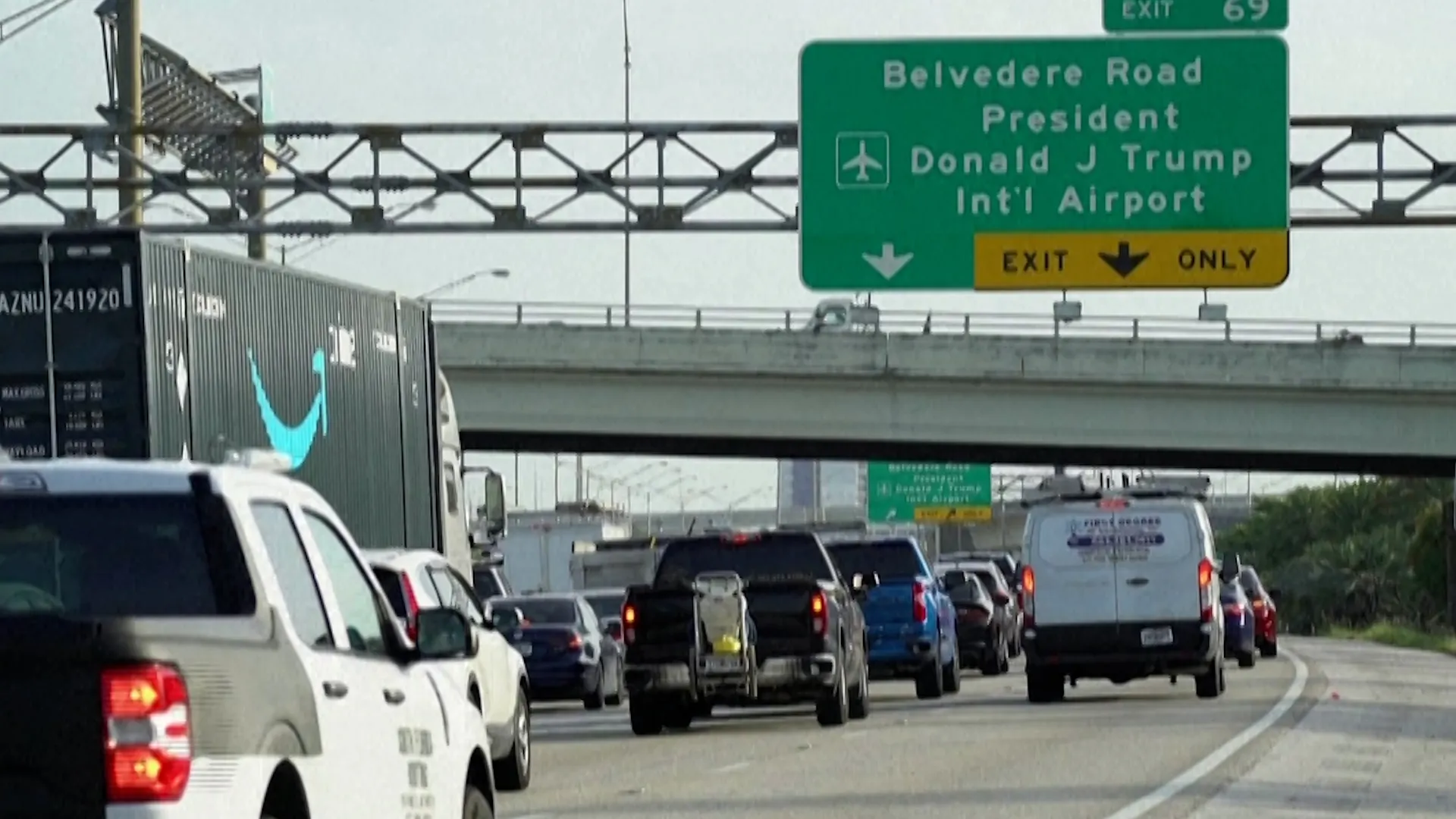
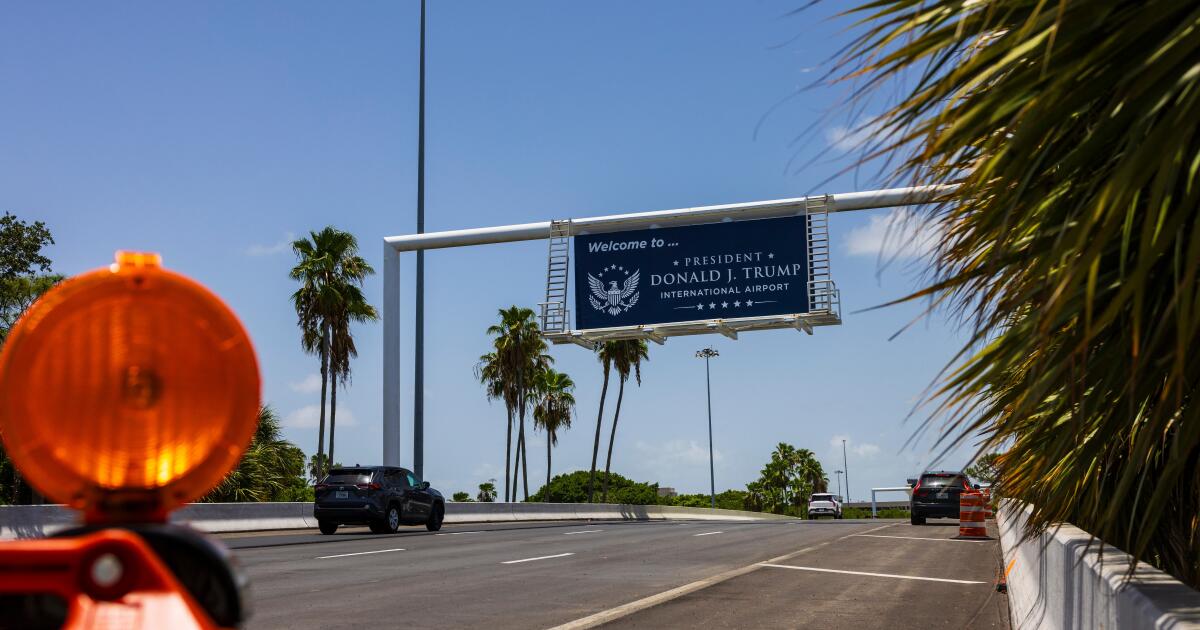
Palm Beach International Airport has officially been renamed President Donald J. Trump International Airport, with new signage installed throughout the terminal. The move has prompted mixed reactions, with supporters welcoming the tribute while critics argued it was ‘in poor taste.’
WEST PALM BEACH, Fla. — A South Florida airport officially changed its name Thursday to the President Donald J. Trump International Airport.
Signs for the Palm Beach International Airport have been removed as new signage goes up.
“Because an entire airport transformation doesn’t happen overnight, you’ll notice a combination of both our classic look and our new brand elements coexisting while traveling through the terminal over the next several weeks,” airport officials said in a Facebook post.
“Trump Force One,” a Boeing 757 owned by the Trump Organization, was the first plane to arrive at the airport under its new name, shortly after 5 a.m. The president’s son, Eric Trump, was one of the passengers. The Trump family regularly uses the West Palm Beach airport when they visit President Trump’s Mar-a-Lago home in nearby Palm Beach. A stretch of road from the airport to Trump’s estate was renamed Donald J. Trump Boulevard earlier this year.
“There is no person who has done more for Florida and our country, and no one more deserving of this incredible honor,” Eric Trump posted on X. “As a son, and someone who flies out of this airport nearly every day, I will forever be proud to see the initials ‘DJT’ on my boarding pass.”
Although the name change took effect Thursday, the three-letter airport code will change from PBI to DJT on Aug. 18.
Florida Gov. Ron DeSantis signed legislation earlier this year that made the name change possible. Changing the airport’s name is expected to cost as much as $5.5 million for new signs, branding and other updates.
Keegan Collett, who was departing the airport Thursday morning on his way to Cincinnati, said he was surprised to see the new name. He said he doesn’t think Trump deserves to have an airport named after him but isn’t necessarily bothered by it.
“At the end of the day, it’s just the name of an airport,” Collett said. “There’s bigger things. I feel like it’s just more of a distraction. Why even worry about it?”
In Dandridge, Tenn., Thursday morning, Treasury Secretary Scott Bessent, U.S. Sens. Marsha Blackburn and Bill Hagerty and Rep. Tim Burchett attended a ceremony to rename the I-40 Bridge in East Tennessee to the Donald J. Trump Bridge.
Bessent said ahead of the ceremony that “no one is more deserving” of the honor than Trump.
Trump received 82% of the vote in Jefferson County, where Dandridge is located, in the 2024 election.
President Trump’s administration is threatening to withhold some federal funding from states that don’t make changes to voting practices and is warning state election officials that they face arrest if they don’t remove noncitizens from voter rolls.
Letters to states and grant application details are the latest in a line of actions by Trump’s administration to shape details of running elections that have long been the job of states.
Courts have largely rejected the administration’s previous efforts, which reflect untrue claims about widespread voting fraud and come less than four months ahead of crucial midterm elections where Democrats seek to take control of one or both chambers of Congress and check Trump’s power.
“The overall point is that Trump is trying to use whatever levers of power and persuasive power that he might have to try to interfere with how states and localities are going to conduct the 2026 election,” said Rick Hasen, a UCLA law professor and the director of the Safeguarding Democracy Project. “Some of this is aimed at changing how the rules are conducted. Some of it appears to be aimed at undermining voter confidence in the integrity of the election process.”
Justice Department warns election officials of prosecution
In letters sent Tuesday, to election officials for all 50 states and the District of Columbia — often secretaries of state — the Department of Justice’s Civil Rights Division said they and other election administrators could face criminal charges if they knowingly allow nonvoters to vote or remain on voting rolls.
It also called on the states to tell the federal government within five days how they intend to comply with the law.
Derek Muller, a law professor at the University of Notre Dame who specializes in election law, said it’s not clear the 50-state letter means anything except to restate some parts of the law, with a request to follow up, “which I’m sure many states will ignore.”
The letter also warns that anyone who knowingly and willfully gives false information in registering to vote or voting would face criminal prosecution.
Antiterrorism grants include election requirements
A Federal Emergency Management Agency antiterrorism grant announcement in June includes a list of election-related requirements, saying that 20% of grants for states and urban areas would be withheld until they comply.
The program includes more than $1 billion for states and local and tribal governments for a variety of programs aimed at preventing terror at crowded places, online, with border security — and around elections. FEMA expects to award 56 grants.
“Recipients can ensure that their efforts contribute to a secure, transparent, and resilient electoral process, thereby reinforcing public trust and the integrity of democratic institutions,” the grant announcement says, noting that securing election infrastructure is a national security priority.
The list of items for states includes verifying the citizenship of all registered voters and election workers.
Places that use electronic voting systems that use bar codes or QR codes to count votes would have to submit plans to switch to hand-marked paper ballots. Every jurisdiction would have to show it audits results.
UCLA’s Hasen said it could be difficult even for states that want to comply. It’s too close to the midterm election to make some of the changes, he said, and some would require state legislatures to pass new laws.
The White House on Wednesday referred questions to FEMA, which did not immediately respond to an interview request.
Response from states appears to be partisan
Some states are pushing back, while others are defending the latest actions.
They seem to be breaking along party lines.
Oregon’s secretary of state, Democrat Tobias Read, accused the Justice Department of “knocking on our door again with more threats and no evidence to back up their fever dreams about non-existent voter fraud.”
Oregon elections are secure, accurate, and fair, he said, adding that he isn’t “intimidated by political threats or manufactured controversy.”
The Michigan secretary of state’s office, headed by Democrat Jocelyn Benson, said it has discussed its work repeatedly with the Justice Department and in public statements, congressional hearings and court testimony — information that it said “is either in the DOJ’s possession or easy reach.”
“We will be happy to provide it again to help address any confusion,” the office said in a statement.
In a statement, Ohio Republican Secretary of State Frank LaRose defended the Justice Department’s missive to states, saying it’s reminding them of their legal obligation regarding election integrity. A lot of states aren’t taking it seriously, he said without giving examples or citing evidence. He said Ohio has worked with the federal government to ensure that its voter rolls are accurate and that only U.S. citizens vote.
Georgia’s secretary of state’s office says the state has already taken many of the actions required in the FEMA grant, including a citizenship audit of voter rolls.
Several of Trump’s election actions have faced resistance
Trump has repeatedly and wrongly asserted that fraud cost him reelection in 2020, and his administration has put forth a series of policies and actions aimed at how elections are run.
In recent days, courts have rejected the Justice Department’s effort to collect the names and contact information for every election worker in Georgia in the 2020 election and others trying to force New Hampshire and Pennsylvania to turn over detailed information about registered voters. With those rulings, the federal government has lost similar cases more than 10 times around its requests for details from 30 states and the District of Columbia.
Last week, a group of Democratic governors asked the U.S. Postal Service to withdraw its proposed rule seeking to implement an order from Trump to create a list of eligible voters — and potentially limit who can receive a ballot in the mail. A court previously put the order on hold, saying it was unconstitutional.
Also last week, the Supreme Court rebuked Trump and ruled that states can count mailed ballots that arrive after Election Day.
Mulvihill and Levy write for the Associated Press. AP writers Gabriela Aoun Angueira, Bill Barrow, Kate Brumback and Josh Kelety contributed to this report.
WASHINGTON — A former Olympic canoe racer pleaded not guilty on Thursday to deliberately damaging the recently renovated Lincoln Memorial Reflecting Pool, a politically charged case that his defense attorneys and other Trump administration critics have derided as an abuse of prosecutorial power.
David Hearn, who competed in three Summer Olympics, entered the plea through one of his attorneys during his initial appearance in Washington, D.C. Superior Court. Hearn, 67, of Bethesda, Md., was indicted last Thursday on a single felony count of property destruction.
In front of a packed courtroom, D.C. Superior Court Judge Carmen McLean did not require Hearn to be supervised by the court while he is free awaiting a trial. A status hearing was scheduled for Aug. 5.
Prosecutor Kevin Reddington said the government wasn’t seeking any court supervision for Hearn, but just a “ stay-away order” without specifying in court where it wanted to keep Hearn away from.
Mary Dohrmann, one of Hearn’s attorneys, urged the judge not to impose any conditions of court supervision, calling Hearn an “upstanding citizen and member of the community.”
“The government’s evidence is weak,” she added.
Dozens of supporters, many carrying homemade signs, gathered outside the courthouse and waited for Hearn to leave after the hearing.
President Trump ordered a multimillion-dollar renovation of the Reflecting Pool ahead of the nation’s 250th anniversary this month, but the project has been plagued with problems. Workers have used chemicals to curtail an algae bloom. Trump has said the pool likely would need to be drained again for liner repairs after chunks of blue coating were seen floating at the surface.
Trump has claimed without substantiation that vandals dumped fertilizer into the pool and slashed the coating with a box cutter. U.S. Atty. Jeanine Pirro, the top federal prosecutor for the District of Columbia, said last week that six other people were arrested on misdemeanor charges related to the $16 million pool project.
Hearn’s attorneys have said the charges against him are based on a “concocted narrative” and “should be alarming to every American.”
“This indictment reflects the administration’s effort to shift blame for their own failures,” the lawyers said in a statement. “The justice system exists to determine facts, not to provide political cover.”
Hearn previously told the Associated Press that he was detained by National Guard troops and U.S. Park Police for five hours after stopping by the pool during a 64-mile bike ride on June 19. He said he reached in to examine newly peeled coating and briefly touched a chunk attached to the side of the pool, but obeyed a park worker who told him to let go of it.
Pirro accused Hearn of causing more than $1,000 in damage by ripping up recently installed sealant from the pool and acting belligerently toward an employee who told him to stop.
NATO leaders emerged from their summit in Ankara relieved that U.S. President Donald Trump reaffirmed Washington’s commitment to the alliance, but European officials acknowledge that relations with the United States remain fragile and expect further periods of uncertainty.
While the gathering ended on a positive note, diplomats say the alliance continues to face questions over Trump’s long-term approach to NATO, burden sharing and Europe’s security.
Summit ends on a more positive note
The two-day summit began amid fresh tensions after Trump criticized several allies, announced he wanted to cut off U.S. trade with Spain, and revived disputes over defense spending.
However, the atmosphere improved significantly by the end of the meeting.
Stay ahead of the geopolitical week.
MD Briefing delivers expert analysis across five global fronts — the Indo-Pacific, energy, geoeconomics, European security, and the Middle East — every Monday morning. Free.
Trump endorsed the summit declaration reaffirming NATO’s Article 5 mutual defense commitment, praised the unity among allies, and approved a license allowing Ukraine to manufacture Patriot missile interceptors.
European leaders viewed those moves as an important signal that Washington remains committed to the alliance despite months of increasingly strained relations.
Trump also described the summit as one filled with “love,” easing fears that the gathering could end in open confrontation.
European allies remain cautious
Despite the improved tone, European governments are preparing for continued volatility in transatlantic relations.
Officials note that Trump’s approach toward NATO has often shifted rapidly, creating uncertainty over U.S. security commitments.
Recent disputes have included Trump’s renewed interest in Greenland, criticism of allies during the Iran conflict, and repeated suggestions that European members should assume greater responsibility for their own defense.
Many European capitals believe maintaining strong ties with Washington remains essential despite these disagreements.
Without U.S. military capabilities, officials fear NATO’s ability to deter Russia would be significantly weakened.
Rutte emphasizes America’s central role
NATO Secretary General Mark Rutte stressed that the United States remains the alliance’s indispensable military power.
He noted that the U.S. economy accounts for roughly half of NATO’s combined economic strength and that American military capabilities remain unmatched within the alliance.
According to Rutte, NATO’s credibility and deterrence against Russia remain intact despite recent political tensions.
Not everyone shares that optimism.
Some former U.S. defense officials argue that repeated political disputes have already damaged perceptions of alliance unity and provided Moscow with opportunities to question NATO’s cohesion.
Several European diplomats privately acknowledged that while the summit avoided a major crisis, it did little to erase concerns created over recent months.
Defense spending helps ease tensions
One factor that helped calm relations was Europe’s significant increase in defense spending.
Trump has long argued that NATO members rely too heavily on the United States for their security.
Ahead of the summit, NATO officials highlighted large increases in military spending by European members and Canada, presenting the figures as evidence that Trump’s pressure has produced tangible results.
Alliance officials also emphasized billions of dollars in new defense procurement agreements announced during a defense industry forum held before the summit.
The deals covered surveillance aircraft, transport planes, drones and other military equipment worth more than $50 billion.
The announcements were intended to demonstrate that allies are translating higher defense budgets into concrete military capabilities.
NATO counters criticism over Iran conflict
Alliance officials also sought to push back against Trump’s criticism that NATO members failed to support the United States during the conflict with Iran.
Officials argued that, with the exception of Spain restricting U.S. access to military facilities, most allies honored existing agreements governing American military operations.
Those efforts were designed to reassure Washington that European allies remain reliable security partners even when political disagreements arise.
Pentagon review adds fresh uncertainty
Despite the summit’s relatively positive conclusion, uncertainty remains over America’s future military posture in Europe.
The Pentagon has already reduced some of the forces allocated to NATO defense plans and recently launched a review of approximately 80,000 U.S. troops stationed across Europe.
The review has fueled concerns that Washington could further reduce its military presence on the continent as European governments work to strengthen their own defense capabilities.
European leaders seek fewer flashpoints
Several officials suggested NATO may reduce the frequency of high-profile leaders’ summits to avoid repeated political confrontations.
Plans for a NATO leaders’ meeting in Albania next year have reportedly been put on hold as alliance members reassess the format of future gatherings.
Some diplomats believe limiting opportunities for public disputes could help preserve alliance unity while allowing practical cooperation to continue behind the scenes.
Why the Ankara summit mattered
The Ankara summit represented an important test of NATO’s ability to manage internal political differences while maintaining collective security.
Turkey, as host nation, sought to strengthen its standing within the alliance and improve relations with Washington, while NATO leadership worked to keep attention focused on defense cooperation rather than political disagreements.
Although tensions remain, the summit demonstrated that both the United States and European allies continue to recognize the strategic importance of NATO amid Russia’s war in Ukraine and growing global security challenges.
Future outlook
The immediate crisis surrounding the Ankara summit may have eased, but European governments expect relations with the Trump administration to remain unpredictable.
Future disagreements over defense spending, U.S. troop deployments, support for Ukraine, trade disputes and broader geopolitical issues are likely to continue testing alliance unity.
For now, NATO leaders appear determined to strengthen Europe’s military capabilities while keeping the United States firmly engaged, recognizing that preserving transatlantic cooperation remains central to the alliance’s long-term security strategy.
Weekly insights and analysis on the latest developments in military technology, strategy, and foreign policy.
In his latest spat with a fellow NATO member, U.S. President Donald Trump condemned Spain as a “wasted cause” and “terrible partner” in the alliance. Speaking at the NATO Summit in Ankara, as NATO Secretary General Mark Rutte looked on, Trump said he wanted to cut off all trade relations with Spain. While Spanish officials have stressed that relations won’t be affected, it does raise questions about the long-term status of the U.S. military presence in Spain, should the situation deteriorate further.
.@POTUS: “Spain is a wasted cause. We don’t want to do any trade business with Spain anymore by the way… Spain is a terrible partner in NATO. They don’t participate, they don’t pay. I don’t want anything to do with Spain.” pic.twitter.com/3prqux6p54
— Rapid Response 47 (@RapidResponse47) July 8, 2026
“We don’t want to do any trade business with Spain anymore… I’d like you to cut it off,” Trump said. “Spain is a terrible partner in NATO. They don’t participate; they don’t pay. I don’t want anything to do with Spain. Cut off all trade with Spain, please, including visits. Watch them, watch them come running back; oh, they’ll come running back.”
He continued: “We don’t have to trade with them. I don’t want to do any more trade with them… Don’t even talk to them; they’re hopeless, bad people, because you know they have everybody else going and paying and working… They’re open about it, they’re hostile about it, and let’s see how hostile they remain when they call up, and they ‘please, please, we want to trade with you, sir. We want to trade with you, sir.’ They make so much money with us, and we’re going to see that they make a lot less. I want no business with them.”
According to U.S. Congress figures, mutual trade between the two countries was worth $75 billion in 2025, and the United States made $3 billion more from the relationship than Spain.
In an effort to heal the rift, Spanish Prime Minister Pedro Sánchez later insisted that relations with the United States were “very positive,” and that he had spoken to Trump.
“We talked about the World Cup… there was no tension whatsoever, on the contrary it was all very friendly,” said Sánchez.
Spanish Prime Minister Pedro Sanchez downplays tensions with President Donald Trump after the US leader threatens to halt trade with the NATO ally, describing their exchange as informal and courteous with “absolutely no tension.” pic.twitter.com/SRNfdfuWkV
— Al Arabiya English (@AlArabiya_Eng) July 8, 2026
The BBCreported that government sources in Madrid said that Spain had no plan to change their “excellent social, cultural, and economic relationship.”
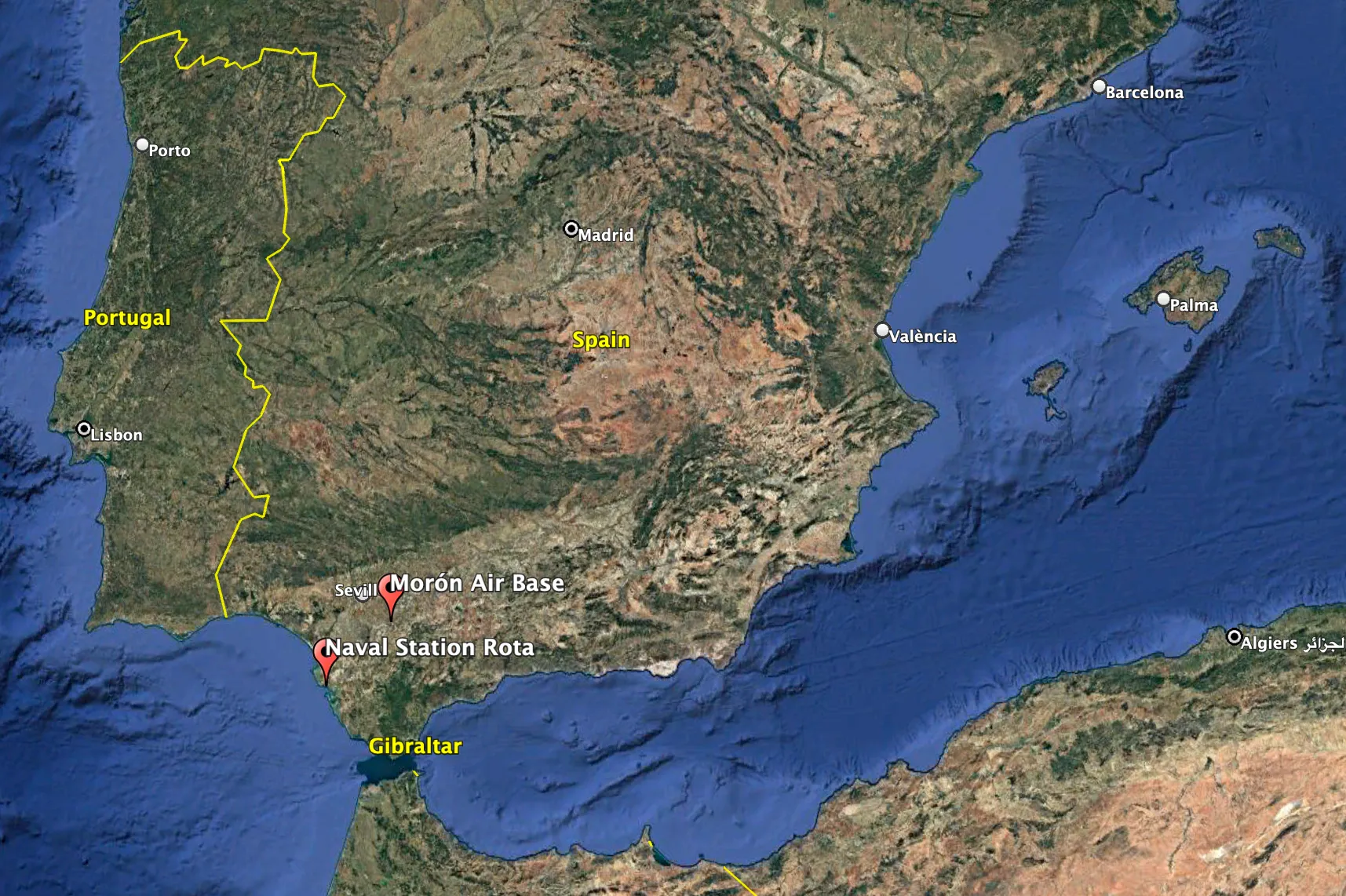
The background to this is Trump’s unhappiness with the Sánchez government refusing the U.S. military permission to use its bases at Morón and Rota in Spain for missions during the war against Iran.
Another point of conflict is Sánchez’s refusal to increase defense spending to five percent of GDP, in line with NATO targets.
This is not Trump’s first threat to cut off trade relations with Spain. The same had happened back in March, in response to Sánchez’s stance on the Iran war.
While there was no change to trade between the two countries after that, were relations between the United States and Spain to worsen, the continued access to Morón and Rota would become a question.
The approximate location of Morón and Rota in southern Spain. Google Earth
Of the two, Naval Station Rota, in the province of Cádiz, is the most critical. It sits in a strategic position at the mouth of the Mediterranean, which is one of the world’s most important naval control points.
Described by the U.S. Navy as “the gateway to the Mediterranean,” Rota is one of the most strategically important U.S. military hubs in Europe, critical to supporting U.S. and allied naval operations across multiple theaters. The installation is central for Naval Forces Europe-Africa/Central (EURAFCENT) and the U.S. Sixth Fleet.
Located on a 6,100-acre Spanish Navy facility in southern Spain, Rota functions as a major logistical gateway linking North America with Europe, the Mediterranean, Africa, and the Middle East.
Naval Station Rota. Google Earth
The base supports the movement of personnel, equipment, fuel, and supplies through its three operational piers, a 670-acre airfield capable of supporting U.S. Navy and Air Force aviation operations, and some of the largest weapons and fuel storage facilities in Europe.
Perhaps the highest-profile resident unit at Rota is Destroyer Squadron 60 (DESRON 60), one of three U.S. Navy destroyer squadrons permanently based outside the continental United States and the only one of these to call Europe home.
In 2024, the Arleigh Burke class destroyer USS Oscar Austin arrived at Rota, as the first of two additional destroyers to join the Forward Deployed Naval Force-Europe, which will have an eventual total of six. These warships are notably modified with special defenses tailored to the European theater, as you can read about here.
The USS Oscar Austin arrives at its new homeport of Naval Station Rota, Oct. 15, 2024, as the first of two additional DDGs to join the Forward Deployed Naval Force-Europe. U.S. NavyA SeaRAM defense system awaits testing aboard USS Porter, March 3, 2016. Porter, a destroyer forward-deployed to Rota, Spain, was preparing for deployment in the U.S. Sixth Fleet area of operations. U.S. Navy photo by Lt.j.g Laura Adams/Released U.S. Naval Forces Europe-Africa/
Other key Navy units at Rota include Helicopter Maritime Strike Squadron Seven Nine (HSM-79), the “Griffins,” flying the sub-hunting MH-60R Seahawk, and Explosive Ordnance Disposal Mobile Unit Eight.
MH-60R Seahawk helicopters assigned to Helicopter Maritime Strike Squadron 79 land on the flight deck of the Spanish Galicia class landing platform dock Castilla during a bilateral flight operations exercise at Rota, April 28, 2026. U.S. Navy photo by Mass Communication Specialist 1st Class Drace Wilson Petty Officer 1st Class Drace Wilson
Turning to Morón, this airbase is located southeast of the city of Seville in southern Spain. While Naval Station Rota is a springboard for U.S. maritime forces, Morón provides a similar role for the Air Force. Its strategic position means it plays a key role as a forward operating location for air operations, rapid response missions, and contingency support across Europe, Africa, and the Middle East.
Morón Air Base. Google Earth
The base’s capabilities include airfield operations, aircraft support, logistics, maintenance, communications, security, and host-nation support, all of which are geared toward rapid deployment and sustainment of U.S. forces when and where they are needed.
U.S. Marines with Special Purpose Marine Air-Ground Task Force-Crisis Response-Africa (SPMAGTF-CR-AF) 19.1, Marine Forces Europe and Africa, prepare to conduct a helicopter support team training event using a U.S. Marine Corps MV-22 Osprey at Morón Air Base, Spain, March 13, 2019. U.S. Marine Corps photo by Sgt. Katelyn Hunter Staff Sgt. Katelyn Hunter
Resident U.S. Air Force units at Morón, under the Third Air Force, include the 496th Air Base Squadron, a geographically separated unit (GSU) that comes under the command of the 86th Airlift Wing at Ramstein Air Base in Germany. The 86th Airlift Wing flies C-130J airlifters as well as C-21A and C-37A staff transports.
Morón also serves as a critical node in the transatlantic and transeuropean tanker bridges, making it a key logistical gateway for the massive movements that are critical to buildups in Europe and the Middle East, as well as for more routine transatlantic deployments.
A KC-10, KC-46, and three KC-135s sit on the flight line at Morón Air Base on April 14, 2022. At the time, the three airframes represented the entire might of the U.S. Air Force’s refueling arsenal. The KC-10 has since been retired. U.S. Air Force photo by Staff Sgt. Nathan Eckert Tech. Sgt. Nathan Eckert
As well as other U.S. Air Force assets that temporarily deploy to Morón, including from the Bomber Task Force, the base also regularly hosts deployments of U.S. Marine Corps aircraft.
Two B-1B Lancers with the 9th Expeditionary Bomb Squadron from Dyess Air Force Base, Texas, are prepared for takeoff in support of Bomber Task Force Europe at Morón Air Base, Spain, April 4, 2024. U.S. Air Force photo by Senior Airman Zachary Wright Staff Sgt. Zachary Wright
Both Morón and Rota operate under the U.S.-Spain Agreement on Defense Cooperation, which allows the United States and Spain to operate alongside one another and share critical infrastructure.
Morón Air Base and Naval Station Rota remain key nodes in the U.S. military’s global posture, providing a strategically positioned bridge between Europe, Africa, and the Middle East. Their combined capabilities allow U.S. forces to rapidly move, stage, and sustain aircraft, ships, personnel, and equipment across multiple theaters.
A Spanish Air Force Eurofighter flies next to a U.S. Marine Corps MV-22 Osprey with Special Purpose Marine Air-Ground Task Force-Crisis Response-Africa 20.1, Marine Forces Europe and Africa, as part of a tactical recovery of aircraft and personnel (TRAP) exercise near Morón Air Base, Spain, May 6, 2020. U.S. Marine Corps photo by Cpl. Kenny Gomez Sgt. Kenny Gomez
A loss of access to Morón and Rota would extend far beyond a bilateral dispute between Washington and Madrid. While the United States could maintain operations through other European and regional locations, replacing the unique combination of air, maritime, and logistical capabilities provided by the two installations would take time and impose additional strain on U.S. forces. Loss of access to these bases, especially Rota, could be one of Spain’s most powerful cards to play if Trump’s rhetoric turns into action.
More importantly, any decision by a NATO member to restrict access to critical allied infrastructure would have broader implications for the alliance, raising questions about the reliability of defense commitments and the political cohesion that underpins collective security.