We did it! America made it to 250 years of existence!
OK, not everyone may be feeling especially celebratory as we hit the semiquincentennial, as culture critic Mary McNamara wrote in her essay this week, but we can still find some solace in wanting to do better and be better. I’ve always believed the arts are a reflection of the heart and soul of a people. And in a country as multicultural and diverse as ours, that can look very many different ways. While it’s true that social media and the internet at large has siloed us, nothing stays the same and, like it or not, change and progress are very much at the root of America’s existence, as is acceptance of different ways of living. What makes this country great are those varied experiences and how art can be an entryway to them.
If that gives you enough inspiration, there are several Fourth of July events to watch over the weekend, including traditions like the “Macy’s 4th of July Fireworks Show,” now in its 50th edition, on NBC, Telemundo and Peacock, and Nathan’s Hot Dog Eating Contest on ESPN and ABC as part of their “Disney Celebrates America” programming. If you’re looking for something fresh, the America250 initiative will be streaming a ball drop from Times Square in New York beginning Friday night, which CNN is also covering via “Independence Eve Live With Anderson & Andy: Celebrating 250,” a New Year’s Eve-style production with Anderson Cooper and Andy Cohen. Similarly, PBS will be broadcasting “A Capitol Fourth: 250th Weekend Celebration” from the U.S. Capitol and from George Washington’s home in Mount Vernon. It will feature performances from the National Symphony Orchestra, Trace Adkins, Patti LaBelle, Kool & The Gang and more.
On Saturday, America250 will stream “America’s Block Party” from the L.A. Memorial Coliseum, which features performances by Chris Stapleton, the Smashing Pumpkins, Chaka Khan and Anthony Ramos. CBS will also air some of those acts on “The Great American Block Party 250,” along with performances from the Washington Monument in Washington, D.C., by the Zac Brown Band, Jon Batiste, Goo Goo Dolls and the War and Treaty (it will also stream on Paramount+).
You are reading Screen Gab newsletter
Sign up to get recommendations for the TV shows and streaming movies you can’t miss, plus exclusive interviews with the talent behind your favorite titles, in your inbox every Friday
By continuing, you agree to our Terms of Service, which include arbitration and a class action waiver. You agree that we and our third-party vendors may collect and use your information, including through cookies, pixels and similar technologies, for the purposes set forth in our Privacy Policy such as personalizing your experience and ads.
In keeping with this week’s theme, we’ve also rounded up several series and films that we recommend watching over the long holiday weekend that tell a story about America or Americans in all their glory — imperfect, diverse and unique. Now that’s something to celebrate. — Maira Garcia
Turn on
Recommendations from the film and TV experts at The Times
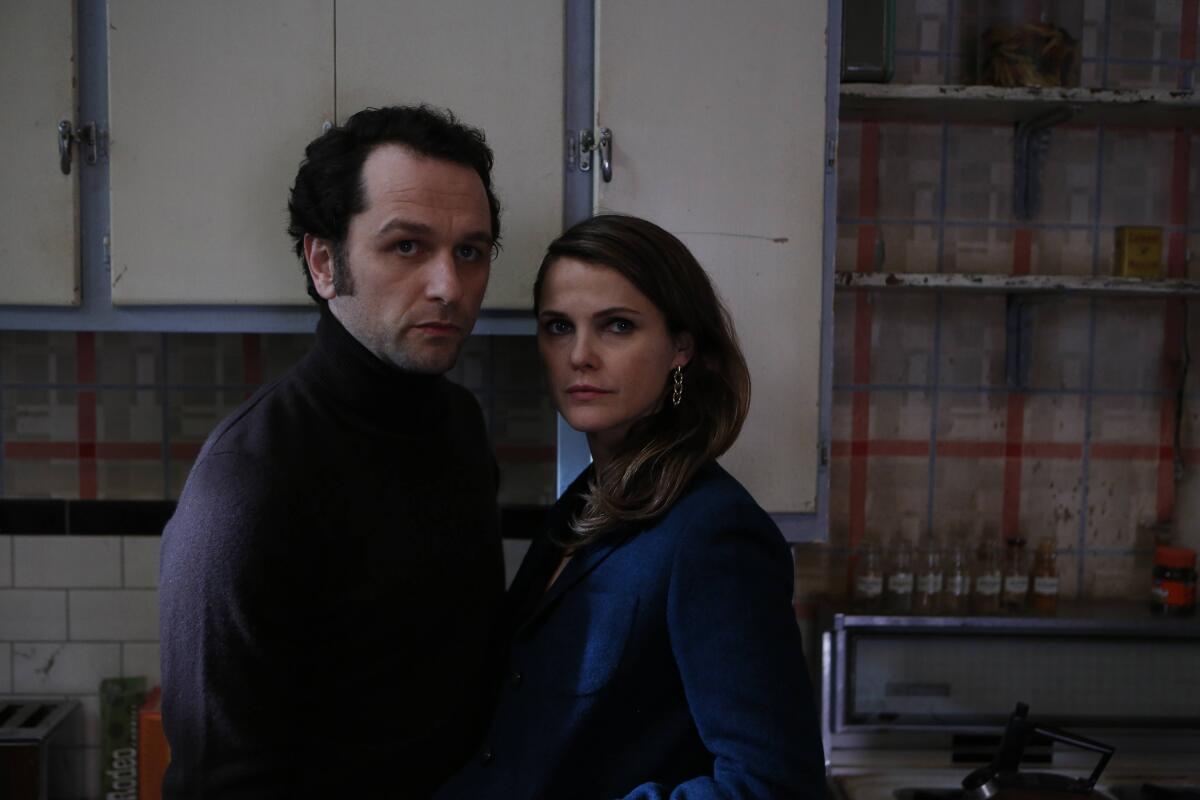
“The Americans” (Hulu)
Matthew Rhys as Philip and Keri Russell as Elizabeth in “The Americans.”
(FX )
This series may seem like an odd choice to recommend during the July 4 holiday, particularly when the main characters are driven by values that are pointedly un-American. The FX series, which concluded its six-season run in 2013, stars real-life couple Keri Russell and Matthew Rhys as Russian spies posing as a suburban couple living in Washington in 1981. Critics celebrated the drama as the couple took on their assignments to undermine the U.S. government while also concealing their true identities from their friendly neighbor — an FBI counterintelligence agent — and their two American-born children. Their journey is further complicated as they grow more attached to American lifestyles and values. Rhys, who is currently stirring up awards season buzz with his lead roles in Apple TV‘s “Widow’s Bay” and Netflix’s “The Beast in Me,” won an Emmy for lead actor in a drama during the show’s final season. Fans of “The Americans” are still shaken by the memory of the devastating series finale. — Greg Braxton
“Spirit of ’76” (VOD)
Jeff McDonald, left, David Cassidy and Steven McDonald in “The Spirit of ’76.”
(Philosophical Research Society)
In this energetic, colorful, low-budget 1990 ode to the bicentennial year, travelers from a colorless 2176 attempt to travel to 1776 to reclaim foundational knowledge lost when “the magnetic storm degaussed all recorded history.” They arrive instead on July 4, 1976, where a different sort of freedom holds sway — freedom to get down, freedom to boogie. It’s a friends-and-family affair, written and directed by Lucas Reiner, with appearances by his brother Rob and father Carl; a story co-authored by Roman Coppola; and costumes by his sister Sofia. David Cassidy and Olivia d‘Abo star as among the visitors from the future; Leif Garrett (like Cassidy, a 1970s TV and pop idol) is a disco-mad lothario. Also on board are Tommy Chong, Barbara Bain, Don Novello, Moon Zappa and performance artists the Kipper Kids as men in black. Julie Brown is a sex worker who has something to say about the Gulf of Tonkin Resolution that will sound distressingly timely. Brothers Jeff and Steve McDonald — from the band Redd Kross, and not playing brothers — are the bike-riding, long-haired, slang-slinging teens who join in to help the time travelers accomplish their mission. One word: tetrahydrozoline. — Robert Lloyd
“The Simpsons” (Disney+, Hulu)
“The Simpsons” has long been an American staple on television.
With more than 800 episodes across 37 seasons, “The Simpsons” is basically on track to reaching its own semiquincentennial milestone. Its relevance in today’s landscape may be debated, but the animated series has audaciously and consistently captured the American experience with its piercing satire about societal and cultural events and shifts, as well as its reflections on the frustrations and absurdities of daily life for a middle-class family living in a quintessential American suburb — an ideal that has long stood as a standard of success for generations of Americans and now feels like a fantasy for many who still strive for it. (Insert GIF of Homer disappearing into a shrub here.) It’s one of the most entertaining time capsules of a good chunk of America’s run so far. And hey, there are plenty of July 4 episodes to pre-game, pair with, or distract from your social obligations. — Yvonne Villarreal
“American Movie” (VOD)
Bill Borchardt, left, and Mark Borchardt in the documentary “American Movie.”
(Sony Pictures Classics)
One of the breakout documentaries of the ’90s, Chris Smith’s portrait of aspiring Wisconsin filmmaker Mark Borchardt suggests that if you want to understand America, you could do worse than spend some time in his company. Borchardt has no Hollywood connections, no money and seemingly no realistic path to finishing his low-budget horror movie “Coven” (which he stubbornly insists on pronouncing “COE-ven”). Working the graveyard shift at a cemetery and battling his own drinking, he somehow keeps persuading friends and relatives to help him inch the film toward completion. The movie is often hilarious but it never makes Borchardt the punchline, leaving open the question of whether he’s a genuine outsider artist or simply incapable of recognizing impossible odds. When he starts feeling sorry for himself, he has a way of snapping out of it: “No one has ever, ever paid admission to see an excuse.” As America marks its 250th birthday, with so many of the country’s problems seeming unsolvable, Borchardt reminds us that impossible sometimes just means unfinished. — Josh Rottenberg
“Reservation Dogs” (Hulu, Disney+)
Willie Jack (Paulina Alexis), Elora Danan Postoak (Devery Jacobs), Bear (D’Pharaoh Woon-A-Tai) and Cheese (Lane Factor) in “Reservation Dogs.”
(Shane Brown / FX)
This is perhaps too on the nose, but what is the story of America without Native Americans and Indigenous storytellers? Don’t worry, “Reservation Dogs” is not meant to be a history lesson. A coming-of-age dramedy, the series follows a group of teenagers living in a small town in the Muscogee Nation in rural Oklahoma. Culturally specific and infinitely relatable, the teens are grieving one of their own as they navigate familiar perils of adolescence: future aspirations (or lack thereof), relationships and rivalries, family and more as they grow into who they are meant to be. Created by Sterlin Harjo and Taika Waititi, the show was celebrated for its representational milestones both in front and behind the camera for the entirety of its three season run. But what keeps this show on my perpetual rewatch list is its humor, heart and endless humanity. And Cheese! — Tracy Brown
“Star Trek: Strange New Worlds” (Paramount+)
Una (Rebecca Romijn), Capt. Pike (Anson Mount) and Spock (Ethan Peck) in “Star Trek: Strange New Worlds.”
(Marni Grossman / Paramount+)
Despite being set on a starship traveling through the far reaches of space, “Star Trek” is a quintessentially American show that celebrates very American ideals and aspirations. The franchise depicts a future where good people want to do good, are endlessly curious, believe in justice and diplomacy and strive to maintain peace. They’re also willing to fight for what they believe in. “Strange New Worlds,” though created in our modern streaming times, captures a lot of the spirit and swagger of the original series — and not just because it features some characters that originated there. The show follows Capt. Christopher Pike (Anson Mount) and the crew of the U.S.S. Enterprise as they explore strange new worlds and boldly go where no one has gone before. Pike wields a kind of empathetic, nice dad next door charm and all the capabilities of a decorated starship officer, which makes him a perfect ambassador for his exploratory mission. He’d probably also make a good host of a big Fourth of July backyard bash. — T.B.
“Mo” (Netflix)
Mo Amer in Season 2 of his eponymous Netflix series.
(Eddy Chen / Netflix)
The immigrant experience has been portrayed in a number of films and series over the years — though I’d argue there still aren’t enough. This series created by and starring comedian Mo Amer captures not only the realities of navigating the American immigration system, with its draconian requirements and regulations, but also the experience of multicultural life in the melting pot that is Houston, Texas. Here, Amer plays a fictional version of himself, a Palestinian refugee who is trying to get legal status while encountering personal and professional roadblocks at every turn. It’s funny and melodramatic, occasionally veering into silliness, but it brilliantly highlights the very real struggle of finding your place in the world when you don’t know where you can call home or where you belong (the Spanish saying, ni de aqui, ni de alla, neither from here nor there, applies). And it’s one of the very few humanizing onscreen depictions of the Palestinian American experience. — Maira Garcia
“Pose” (Hulu) and “Fellow Travelers” (Paramount+)
Mj Rodriguez as Blanca and Billy Porter as Pray Tell in “Pose.” (FX)
Tim (Jonathan Bailey) and Hawk (Matt Bomer) in “Fellow Travelers.” (Ben Mark Holzberg / Showtime)
The struggle for gay rights has been a long chapter in American history and in the case of these two series, one depicts it through New York’s ballroom scene and the other through the halls of Washington. “Fellow Travelers,” created by Ron Nyswaner and based on Thomas Mallon’s novel of the same name, depicts the romance between Hawkins “Hawk” Fuller (Matt Bomer) and Timothy “Tim” Laughlin (Jonathan Bailey) beginning in the 1950s during the height of McCarthyism and the Lavender Scare and goes through the decades, culminating with the AIDS crisis of the ‘80s. If you want a good cry this weekend, start here. “Pose,” meanwhile, is at turns celebratory and heartbreaking as it depicts the experience of a group of Black and Latino members of the ball scene in the ‘80s and ‘90s. The series highlights the opulent costumes and performers in drag who would leave it all on the floor for a chance at glory among their peers, but also the interpersonal relationships and challenges faced by trans characters like Blanca (Mj Rodriguez, who scored an Emmy nomination for her performance in 2021), Elektra (Dominique Jackson) and Angel (Indya Moore), as well as gay characters like Pray Tell (the inimitable Billy Porter). Both shows are reminders that LGBTQ+ rights were hard won and that the struggle continues. — M.G.
Like a good striker, Folarin Balogun never loses sight of the goal. And the goal for the U.S. team in this summer’s World Cup hasn’t been just to win, which they’ve done, but to inspire.
“Little kids are watching, and we have to show them the correct way to handle things, even when you think it’s unjust,” Balogun said Friday.
“It’s not an excuse to be disrespectful, to not do the right thing. I’m aware that the World Cup might be the first time a lot of American viewers are tuning in. So it’s important, whether things happen to you good or bad, just to continue to be yourself.”
That doesn’t mean Balogun didn’t think the red card was unjust. He does. And he definitely thinks something bad happened to him and his team since Balogun, the Americans’ leading scorer with three goals in as many games, will have to sit out the team’s most important game in a generation.
It’s just means that Balogun, who celebrated his 25th birthday Friday, is also mature enough to understand a game — even a World Cup elimination game — is just a game.
“It’s been a roller coaster,” he said before the team’s training session at the University of Washington. “There’s been lots of different emotions. I’ve been upset, I’ve been happy. But for me, it was just important to stay calm. I never want to react out of anger and out of emotion.”
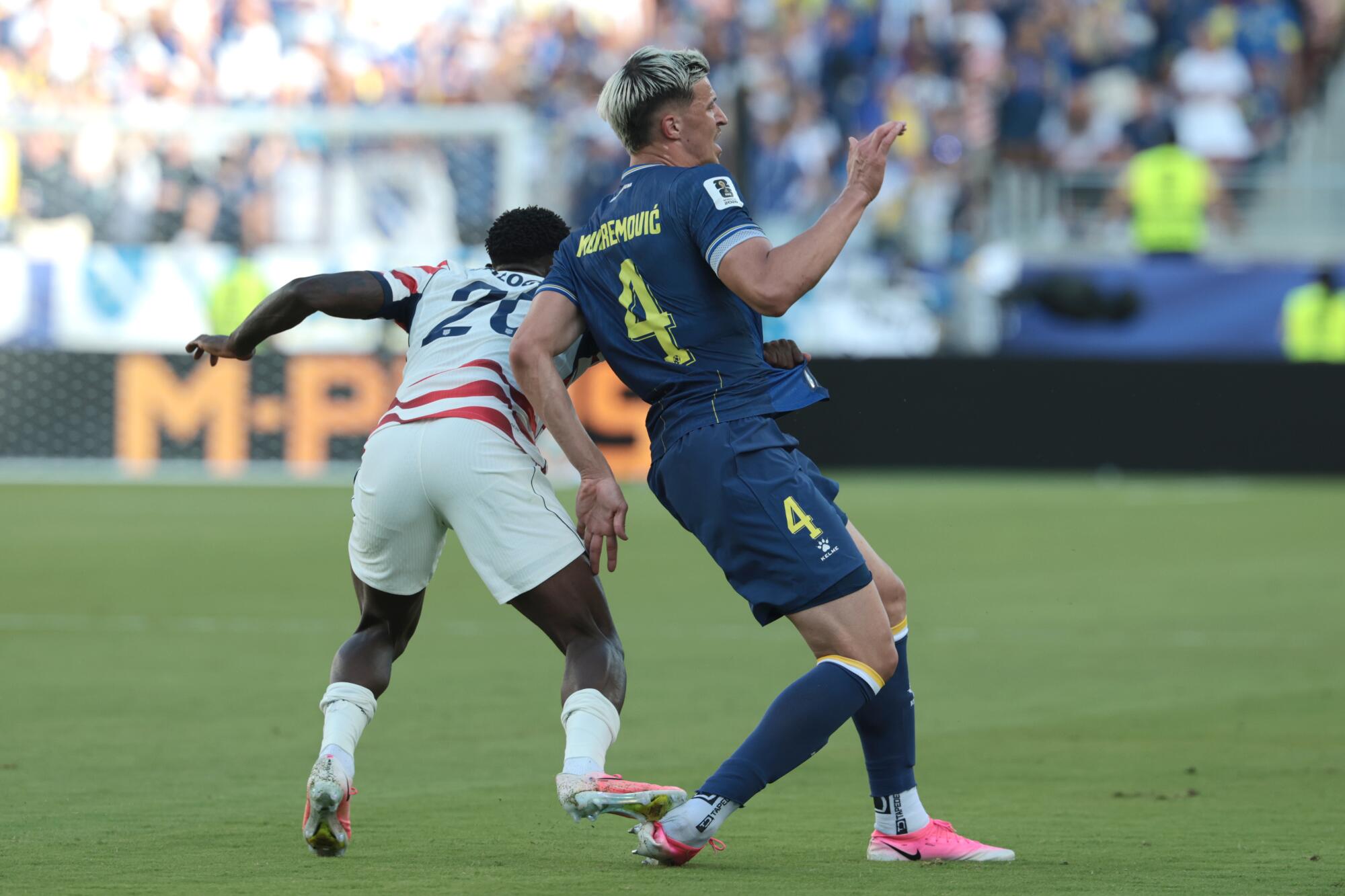
Balogun, who had given his team a 1-0 lead in the waning seconds of the first half, collided with Tarik Muharemovic 16 minutes into the second half, and when the Bosnian defender planted his right leg below Balogun’s right foot, the American inadvertently stomped on his right ankle, twisting it awkwardly.
U.S. forward Folarin Balogun steps on Bosnia-Herzegovina defender Tarik Muharemovic’s foot and received a red card.
(Robert Gauthier/Los Angeles Times)
Both players went down and Claus did not signal a foul or pull card. But after the video assistant referee urged him to watch a replay, Claus walked away from the monitor and flashed the red card. That left the U.S. to finish Wednesday’s game with just 10 men and disqualified Balogun for Monday’s game. U.S. Soccer said Friday FIFA’s disciplinary committee did not add any games to Balogun’s suspension.
“There’s the scenarios that you simply can’t avoid,” he said, “and it has to be taken into context when it’s being reviewed. I felt it wasn’t on this occasion. There’s nowhere else to put your leg. It’s going to be unavoidable.
“I think a yellow card would have been fair. [But] it’s something that’s happened, so we have to move forward, and I have to accept it. The most important thing is just to focus on the bigger picture, which is Belgium.”
Replacing Balogun won’t be easy since he’s emerged as one of the team’s most effective and creative players, either scoring of setting up the go-ahead goal in all three of the U.S. wins.
“We’ve got guys that can fill in and have to be ready for the opportunity to step up,” midfielder Tyler Adams said. “When you miss a player like Balo, obviously things change a little bit. But we’ve been flexible. Guys have shown that they’re ready to play.”
The most likely replacements are Ricardo Pepi and Haji Wright. Pepi, who scored 16 goals for PSV in the Dutch Eredivisie this season, played 90 minutes in place of Balogun in the U.S. loss to Turkey in the final group-stage match. Wright, who had 17 goals for Coventry City in the English Championship, played in all four U.S. games in the 2022 World Cup, scoring once, but he has made just one appearance in this summer’s tournament.
“Balo is an important part of our team, and it’s a disappointing way for him to miss the next game,” said Wright, who grew up in Culver City and spent three years in the Galaxy academy. “But, I’ll always be ready and prepared for whatever comes.”
A victory over Belgium would send the U.S. to the quarterfinals of a World Cup for just the second time. It would also give it four wins in the tournament, double the number of victories in any previous World Cup and marking the first time the Americans have won twice in the knockout stages in the same tournament.
U.S. forward Ricardo Pepi pursues the ball during a World Cup match against Bosnia-Herzegovina at Levi’s Stadium in Santa Clara , Calif., on Wednesday.
(Robert Gauthier/Los Angeles Times)
It’s a moment, Adams acknowledged Friday, many players have waited for their whole lives.
“You need to embrace the moment, that’s for sure,” he said. “To have the opportunity to play in a round-of-16 game — which, obviously, last World Cup we did, but it was the first knockout game, not the second — it’s exciting. It was nice to get a little bit of a taste of what it feels like to play with something a little bit more on the line in the last game. I think that’s good preparation.
“Advancing and taking this thing as far as we can is the most important thing. We have a good opportunity here to do so.”
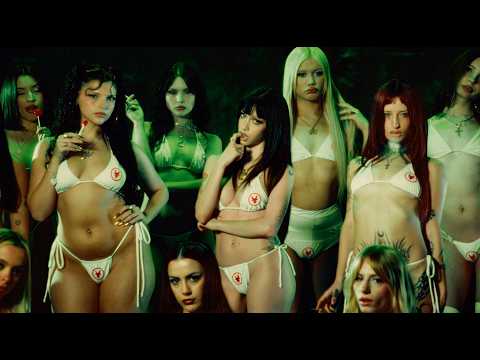
In an era hallmarked by what experts call a “sexrecession,” Six Sex is a symbol of liberation.
The Argentine baddie fashions herself as a baby-voiced, bikini-clad fembot, beamed in from the clubs of Buenos Aires — and has become known for cheeky, instructive celebrations of desire. Her songs are designed to galvanize like-minded club rats into Dionysian revelry, or, in the case of the song “How to Make Your Ass Bigger,” squats.
To a certain subset of the Latine underground, she represents a pure-hearted hypersexuality. Yet, for the artist behind the persona, Francisca Agustina Cuello, this wasn’t always the intention.
“I don’t know if it was because I still had to keep my innocence or what, but I didn’t envision the project that way,” she said, calling from a hotel room in Barcelona. “That response sort of came about from the people, towards me. So, I said OK, I’m making it my own.”
In doing so, Cuello has churned out six thumping EPs as Six Sex, a campy character that she describes as a “fable” — a mix of “fantasía y hedonismo.”
That dynamic is taken to extremes on her debut album, “Ultra”, released June 6. It’s a dark and propulsive journey through decades of electronic dance music, best described by its own opening words portending “ultra terrorific fantasy.” (The phrase conjures up images of grandeur, but really, it evokes that “Blades of Glory” quote: “no one knows what it means, but it’s provocative.”)
“I feel like nothing I say is all that serious,” she said about her lyrics. “It’s a thing about my personality to be silly and goof around.”
“Ultra” centers Cuello’s winking, suggestive sense of humor. “Not Your Mom” features a conversation with a garbled, omnipotent voice akin to the parents in Charlie Brown; “FUchi!” features schoolyard taunts about “low dickie energy;” the album ends with “No More Porn,” a playful yet powerful subversion of sexual expectations.
“At the same time, for me, that acts as a filter,” she added with a laugh. “Weeding out the people who get scandalized by it, and identifying the people who get it and say: ‘Yas, yo también quiero tener cuatro novios.’”
Earlier this year, Cuello took the stage at Don Quixote, performing in front of a sold-out crowd for her Los Angeles debut. The smell of sweat permeated the air as she ripped through several of her hits — including collaborations with Reysha Rami and German producer MCR-T. Every single one of her signature ponytail flips sent the room into hysterics. The audience screamed every word at the top of their lungs; it was the loudest, most raucous show I’d been to in years.
Cuello took a breather in the middle of her world tour to chat with De Los over Zoom about all things Six Sex: her new record, her writing style and how it feels to connect with fans spun into febrile intensity.
This interview has been condensed for clarity and was translated from Spanish to English.
“[I’m] weeding out the people who get scandalized,” says Six Sex of her provocative music.
(Catalina Jacobo)
I was really taken by the “Ultra” album cover. You’re wearing a white bikini and in this “come to Jesus” pose. What was the goal? [laughs] It was hard, because I wanted the cover to represent what the entire journey of the album meant to me. I was looking for something strong and heavy in visual terms, because with “Ultra”, this is the first time I’ve finished a long, heavy project and I see the start of something. It’s like something new was unlocked. I found a new way to convey feelings, and a new way to create as well. It’s not like I just finished, and it is what it is. Rather, it is the beginning of something bigger.
Is there an element of separation at all between the artistry and you as a person? I think they’re pretty close. It’s as if Six Sex was sort of a fable, or like a hentai or comic [version of] my life. It’s also happened that things I wrote as a joke later became reality. But generally, I draw inspiration from things that actually happened to me.
Is it weird to put those intimate experiences on an album? No, not for me. Because I’m not speaking so seriously, I don’t feel exposed. Even though my persona and my character are very close to one another, I don’t have to prove anything to anyone. I’m not trying to make you believe in something. The songs stop being about me as soon as someone else listens to them. There are certain things we can all see ourselves represented in, and I think my music aims for that, too.
I want to ask about your performance style. I saw you live in Los Angeles and was really taken by the energy exchange between yourself and the crowd. How do you approach live performance? Nowadays, I’m in a balance between performance and being a human being that connects with people and can pause to look in the eyes of the audience to register how they feel. I like being in a showgirl role, and at the same time, knowing when to step out of it.
Sometimes I go up there after having a crappy day, thinking that I’m gonna screw it up. And when I get up there and connect with the people, everything flows in a perfect way.
Does the music transform when it’s performed live, versus on a record? A lot of your music seems designed to be played in the club. I think it’s very personal. For me, I’m a bit autistic; sometimes when I’m at a show, I get different sensations. It really depends on the person. I like seeing people’s reactions live when I start playing these songs for the first time. People were super hyped. They were enjoying them and jumping around a lot. It feels really fresh.
You reference ‘90s club classics all over “Ultra,” including by U.K. band the Prodigy on “Bitch Up.” How did these sounds come into your life? These sounds evoke a special kind of nostalgia for me. Even though I hadn’t been listening to them lately, they sounded like something I wanted to bring back to the table — songs my uncle used to listen to when I was really young. Like a CD [of] pirated songs that somehow ended up at my house, and at the time I was like, “Wow, what is this music?”
There’s an element of Six Sex that gives “fembot,” like a female, sexy robot. I’m curious if you feel that playing out in your work. [laughs] I didn’t know about the fembot thing. I don’t use Twitter. I [keep] a bubble… against some things that I don’t know. But I’ve always liked the idea that people have that perception of me, to some extent.
How do you feel about the rise of AI as a musician, especially considering your persona adopts that perception? I mean… I don’t have a formed opinion on the matter. I do think that, I don’t know, it’s all very relative. For one thing, I obviously feel like it strips away the human value, but at the same time, it’s also a tool for humans. So it’s kind of contradictory. I feel weird about it…. I don’t know.
Zooming out, I’ve noticed Argentina has been having a musical moment over the last few years between yourself, Ca7riel y Paco Amoroso, Juana Rozas… How do you feel Argentina being represented or even challenged in your music? I feel that culturally, Argentina is a very rich country. However, I do feel like, over generations, a paradigm was broken, and new sounds have been created that don’t necessarily abandon the roots of our music, but were created out of counterculture.
That same kind of counterculture is what makes Argentina be in such turmoil. It’s also the context of our country. Economic, political, social. The key Argentinian figures we refer to nowadays are constantly changing. And that allows you to listen to a variety of genres from Argentina, from people doing different things, and at the same time raising the flag and saying: “Yo soy argentino.” And we love that.
WASHINGTON — As America’s 250th birthday arrives this weekend, President Trump’s mark is clearly visible on Washington.
Visitors to the nation’s capital are being met with cranes hanging over the White House and construction at the site of the demolished East Wing. Fences crisscrossing the National Mall to hem in the Great American State Fair have blocked the famed sightline from the U.S. Capitol to the Washington Monument to the Lincoln Memorial.
Some fountains newly sparkle as a result of Trump’s renovations. National Guardsmen patrol the sidewalks. The partisan flavor of the Trump-aligned Freedom 250 organization’s events is on display, and the fireworks show Saturday will feature a rally-style speech from Trump, with fireworks reportedly pushed back to 11 p.m.
President Trump examines the maintenance work Wednesday on the exterior of the White House.
(Alex Wong / Getty Images)
The memorial’s Reflecting Pool, where fireworks will be set off Saturday, was barricaded from the public earlier than usual after onlookers flocked last week to see the algae and peeling paint that followed Trump’s renovation, and Trump accused vandals of tampering with it.
“You don’t have a sense of ‘land of the free’ here,” said Melissa McFarlane, 61, standing along the fencing on the Mall. She said she was born in Silver Spring, Md., and she grew up watching July 4 fireworks on the Mall with her parents.
She recalled the nation’s 200th anniversary celebrations as “open and inviting” but said this year’s “heavy-duty fencing” and the presence of National Guardsmen made it feel different.
“It’s majorly disorganized, which is weird for our country,” McFarlane added.
A sign outside Lafayette Park near the White House.
(Julia Demaree Nikhinson / Associated Press)
Trump has fixated on making changes to the nation’s capital in his second term, declaring in an early executive order that his administration would make the district “safe and beautiful.” Some of the renovations have been successful; fountains are running anew, including the long-dormant cascading water feature at the city’s popular Meridian Hill Park.
Interior Secretary Doug Burgum said Sunday on “Fox & Friends” that more than 50 parks and circles have been restored and 22 fountains, along with repairs to lights on the National Mall.
“President Trump should be thanked for all he is doing to leave things better than he found them for the good of our great nation,” an Interior Department spokesperson said in a statement. “D.C. residents and visitors are experiencing working fountains, clean parks and safe streets across the district for the first time in decades, all thanks to President Donald J. Trump.”
On Sunday, the president took a tour of some of his construction sites, walking through Lafayette Park with Burgum before traveling to the East Potomac golf club he plans to renovate, which sits on federal land. Trump walked part of the property and inspected blueprints in view of reporters; he was then driven by the site where he wants to erect a marble arch.
Over the weekend, he posted on Truth Social about his improvements to the city in a post about D.C. mayoral candidate Janeese Lewis George, casting it as a “Safe and Prestigious Community” that is now at risk of being “destroyed” by Lewis George.
“I have worked too hard to make Washington, D.C., the Envy of the World, with almost No Crime, and a Beautification process that has been second to none,” Trump wrote.
Construction crews build scaffolding outside the Kennedy Center on June 13 before removing President Trump’s name from the venue’s exterior.
(Tasos Katopodis / Getty Images)
Involvement by presidents in the city’s plan goes back to George Washington, said Matthew J. Bell, an architecture professor at the University of Maryland. That is not unusual, nor is it strange for cities, including Washington, to change over time, he said.
“It’s probably more a matter of timing in terms of inconvenience for people coming for the Fourth,” Bell said of the ongoing construction. “If there had been a more coordinated plan for some of these things … it probably could’ve been managed better.”
At the National Mall, the fencing design for the state fair drew head shakes and confusion from some tourists. Visitors are corralled into a walkway by the Freedom 250-branded fencing on one side and low metal barriers on the other.
It’s normal for fencing to be used to control foot traffic for events on the mall, said Charles A. Birnbaum, chief executive of the Cultural Landscape Foundation, but he perceived the problem as slapdash placement, including of the Ferris wheel, which was put on the mall’s axis.
“Things are being plopped down,” said Birnbaum, whose organization sued the administration over the repainting of the Reflecting Pool. “It speaks to what Trump is doing at the ballroom, what he’s proposed [with] the arch — he’s just plopping these things down in major view sheds that have major historical and cultural significance.”
People walk past the Ferris wheel at the Great American State Fair on the National Mall.
(Jen Golbeck / Associated Press)
The fountains in Lafayette Park are running again near the White House on June 23.
On Monday, McFarlane and two friends were outside the fencing, leaning against the metal barriers in front of the Department of Agriculture, which faces the National Mall.
“It’s a little too secure,” said one of them, John, 60, who was visiting from Burbank and declined to give his last name.
He gestured over the barrier to a manicured plot with shady benches. “Here’s the People’s Garden,” he said, reading its sign, “and we can’t go in.”
A construction crane works on the White House ballroom on Monday.
(Julia Demaree Nikhinson / Associated Press)
Visitors take photos Tuesday of a model of President Trump’s proposed marble arch at the Great American State Fair on the National Mall.
(Mark Schiefelbein / Associated Press)
Early-morning joggers observer the refilling of the Lincoln Memorial Reflecting Pool on June 5.
(John McDonnell / Associated Press)
The anniversary celebrations also come on the heels of the reflecting pool controversy. Last week, after chunks of paint were spotted in the water, Trump blamed vandals for tampering with the pool and said people had been arrested at the site. Two dead ducks were found in a pond about 250 feet away from the pool.
The area last week was surrounded by surveillance cameras and patrolled by National Guardsmen as lifelong resident John Cates strolled the area.
“It’s kind of creepy,” Cates said about the security cameras mounted around the pool. “It is unnecessary that we have to have this pond deemed a high security risk. That is weird.”
The area was fenced off at the end of last week. Fencing normally occurs in preparation for the July 4 fireworks show, but it went up “a couple days early to protect the pool,” Burgum said in the Fox News interview. He said seven people had been arrested in connection with the pool.
Tom Ayers, 34, was disappointed to find the fences already up on Monday. He traveled with his father from Wisconsin for the 250th, but they were finding it difficult to get around the Mall and they were upset to see the East Wing gone.
When they reached Lafayette Park, where the fencing had yet to be removed, they were again disappointed by the obscured view of the White House. Ayers’ father recalled a different scene in 1976, when he visited as a child for the nation’s bicentennial.
“I was kind of hoping for a summer similar to that,” Ayers said, “but overall, it seems nowhere close.”
Times staff writer Ana Ceballos in Washington contributed to this report.
How well do you remember your U.S. history class from high school or college? Did some of the key moments in America’s 250 years of existence involve Larry David playing a founding father? OK, maybe not, but it’s fun to imagine what that would be like. And that’s precisely what David and Jeff Schaffer have done with their new HBO series “Life, Larry and the Pursuit of Unhappiness.”
The series, premiering Friday, is a timely look at some of America’s big moments in history with a comedic twist that will remind viewers of “Curb Your Enthusiasm,” partly because it also features some cast members from the show. The series arrives on the cusp of the 250th anniversary of America’s founding, and offers an alternative history that’s still steeped in facts. Schaffer stopped by Guest Spot to talk about creating the series with David and what it was like to work with former President Obama.
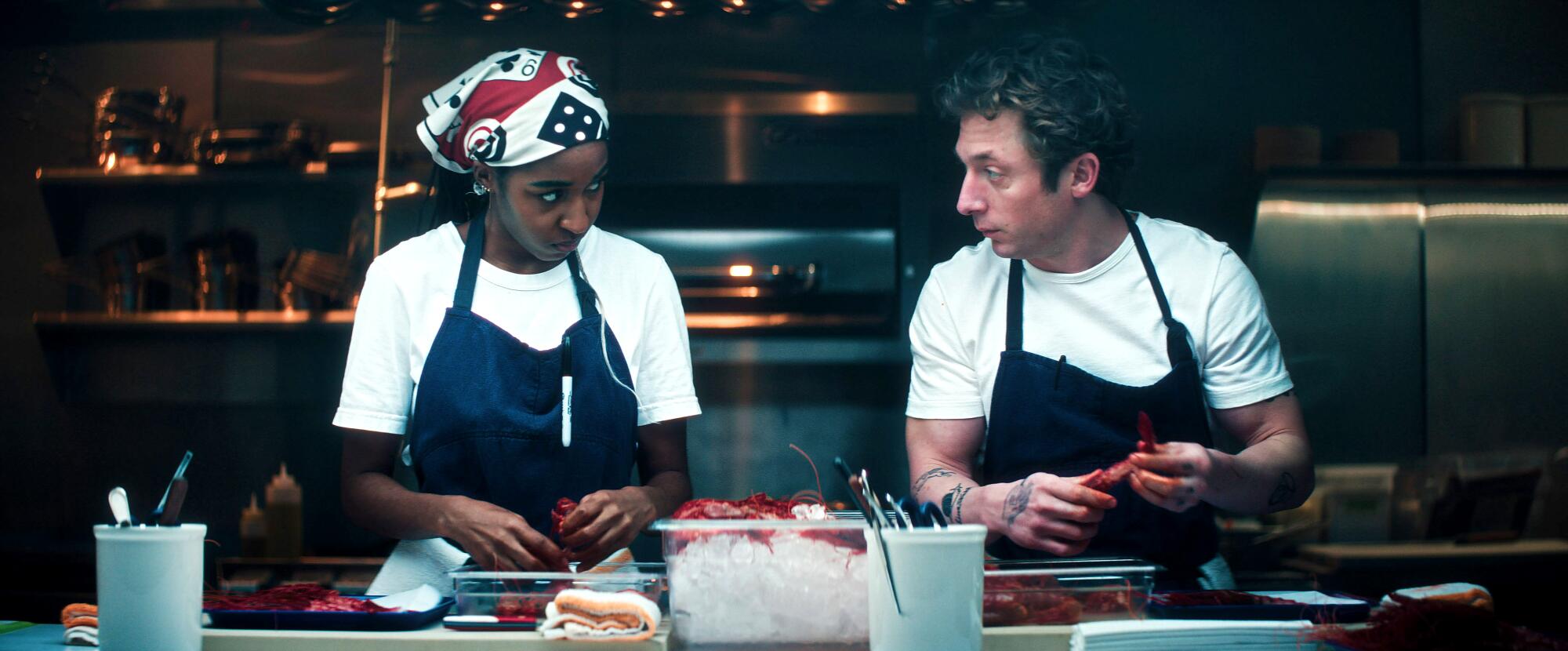
Speaking of laughter, if you like yours with a whole lot of drama, FX dropped the final season of “The Bear” Thursday on Hulu. The series, which premiered in 2022 and made phrases like “cousin,” “yes, chef,” and “every second counts” memorable, ties up a lot of strings for its crew of chefs. Jeremy Allen White and Ayo Edebiri, the actors who were at the center of the show for five seasons, spoke to us about “The Bear” coming to a close, where their characters end up and what it feels like to leave them behind (be forewarned, the interview has lots of spoilers).
The finale feels like a fitting end to one of the best shows of the past decade (so far) — but we won’t say much more. Enjoy each episode like a multi-course meal at a fine-dining restaurant. You’ll want to savor each bite before it’s over.
You are reading Screen Gab newsletter
Sign up to get recommendations for the TV shows and streaming movies you can’t miss, plus exclusive interviews with the talent behind your favorite titles, in your inbox every Friday
By continuing, you agree to our Terms of Service, which include arbitration and a class action waiver. You agree that we and our third-party vendors may collect and use your information, including through cookies, pixels and similar technologies, for the purposes set forth in our Privacy Policy such as personalizing your experience and ads.
Also in this week’s Screen Gab, our writers recommend an animated series with monsters and mystery and a documentary about one of America’s greatest bands. I’ll get my flags, fireworks and BBQ supplies ready in the meantime. — Maira Garcia
Turn on
Recommendations from the film and TV experts at The Times
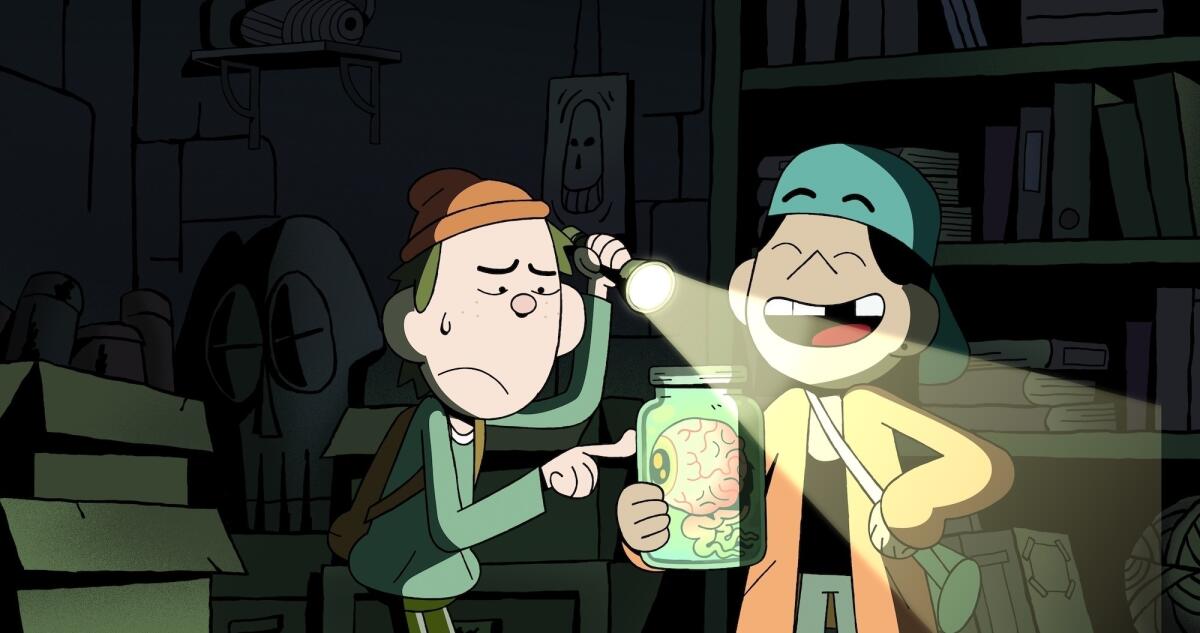
Bobby and Romy in Disney+’s “The Doomies.”
(Disney)
“The Doomies” (Disney+)
If you’re missing “Widow’s Bay,” and like cartoons, here’s another tale of monsters loose in a coastal tourist town, with the difference that the town, called “Ouimpre,” is decidedly on the Atlantic coast of northwest France. (It’s a Franglais pun.) There are half-timbered buildings; what used to be a Camembert factory after it was a beret factory; a cafe that serves crepes, not pancakes; and boulangeries, not bakeries. (It’s a French production; Disney encouraged animator Andrés Fernandez to go local.) As in “Stranger Things,” which no one may be missing by now, the protagonists are kids — Romy, who is excitable and impulsive, and Bobby, who is neither — abetted by a formidable female teenage demon slayer and a lighthouse keeper with occult knowledge. The series is energetic, funny and character-driven — even the monsters. The action is well-staged and intense, the color palette moody and evocative, and the design not at all reminiscent of a hundred other cartoons, which makes the show refreshing as well as fun. — Robert Lloyd
Earth, Wind & Fire in HBO’s “Earth, Wind & Fire (To Be Celestial vs. That’s The Weight Of The World)”
(Jeffrey Mayer / HBO)
“Earth, Wind & Fire (To Be Celestial vs. That’s the Weight of the World)” (HBO Max)
Even if you think you don’t know Earth, Wind & Fire, chances are they’ve soundtracked a wedding, bar mitzvah, awkward office party or some other memorable celebration in your life. Somewhere between “Shining Star,” “Let’s Groove” and “September,” the band mastered the art of coaxing three or four generations of a family onto the same dance floor. Questlove’s new documentary explores how that happened. If his recent Sly Stone film examined how genius can curdle into self-destruction, this one asks a different question: How did Earth, Wind & Fire founder Maurice White build something that lasted? Abandoned by his mother as a child, White set out to create not just a band but a family, assembling a sprawling ensemble around a musical and spiritual vision. Questlove is too thoughtful a filmmaker to sand down the rough edges. White emerges as both inspiring and flawed: a gifted bandleader, spiritual seeker and demanding perfectionist whose drive sometimes came at a personal cost. Drawing on interviews with everyone from former bandmates to Stevie Wonder, Lionel Richie and Barack and Michelle Obama, Questlove builds a portrait of White that never shies away from his contradictions. In the process, he shows how White’s fascination with spirituality, Egyptology and the cosmic unknown shaped both the band’s music and mythology. You may occasionally wish the film lingered longer on the performances themselves (for a reminder of what made Earth, Wind & Fire such a formidable live act, start with the 1975 concert album “Gratitude”). But by the end, you have a deeper appreciation for the band’s unlikely feat: turning something so eccentric into something so universal. — Josh Rottenberg
Guest spot
A weekly chat with actors, writers, directors and more about what they’re working on — and what they’re watching
Larry David in “Life, Larry and the Pursuit of Unhappiness.”
(John Johnson / HBO)
Is Larry David about to be the most entertaining (and crankiest) history teacher America has ever had?
To celebrate the arrival of the nation’s semiquincentennial, the comedian teamed up with Barack and Michelle Obama’s Higher Ground Productions to revisit the truth of our history with some comedic chaos. The result is “Life, Larry and the Pursuit of Unhappiness,” a seven-episode sketch comedy series from the mind of David and his longtime “Curb Your Enthusiasm” collaborator Jeff Schaffer that pairs reenactments of seminal milestones from America’s past with David’s misanthropic humor — or, as its creators dub it, “‘Curb’ in costume.” Subtitled “An Almost History of America,” it features a star-studded roster of actors dressing up in period clothes alongside David, including “Curb’s” Jeff Garlin, J.B. Smoove and Susie Essman, as well as Bill Hader, Kathryn Hahn, Jon Hamm and Jerry Seinfeld. The first episode premieres Friday at 9 p.m. ET/PT on HBO and will stream on HBO Max.
Over a video call, Schaffer discussed the show’s genesis, former President Obama’s improv skills and the British TV series that has him entertained. — Yvonne Villarreal
Tell me about getting into business with the Obamas. Their production company approached Larry. How did it evolve into this?
Larry and President Obama know each other a little bit. They really enjoy each other’s company, or at least Larry enjoys needling Obama, and Obama really enjoys needling Larry. The moment that we all met together to have our first meeting, the first thing Obama does — I’ve never met the president [prior]— he starts just ragging on Larry’s golf game, and how he wears so much sunscreen on the golf course. And Larry just goes to President Obama, “Oh, I’m sorry, my dad’s not from Kenya.” And that’s how it started. They have a great rapport and they wanted to do something special for the 250th [anniversary]. Larry says no to everything — his best friend can be having a premiere of a movie, and Larry will go, “Where is it in Hollywood?” But Larry’s not going, that’s too far. When this came around, Larry was like, “Huh, that’s actually pretty interesting.” He responded right away to the historical nature of it because, as he would say, he’s an American history buff.
The genesis for Larry and I is that we had done a tiny test run of this with that FTX ad for the Super Bowl a few years back. I don’t know, whatever happened to those people — I’m sure they’re fine — but he remembered how much fun he had being in costume. And honestly, I think he forgot how much he hated being in a wig. It’s like childbirth, enough time had passed.
Given the sort of tenor of the times, why does this type of comedic look at America’s history feel like the appropriate way to mark this anniversary?
It’s the 250th and I get that celebrating the country right now may feel like throwing a birthday party for your friend who’s in rehab — he’s all f— up — but we still love him, right? There’s a way to look at the country’s history, warts and all, the two steps forward and the one step back. And I think one of the best ways to do that is through comedy.
Going back to President Obama — what are the negotiations to get him to appear in it? Or was that on the table from the beginning?
Once I saw the two of them interact together, that became my primary mission. We’ll write the sketches, and we’ll do the documentary stuff, we’ll make it all historical and fun, whatever, but we have to get you two on screen together. It was also sort of the promise of the show, too. When I originally talked to Amy Gravitt at HBO about it, I remember I said, “What if I could give you a show that brought together two people half of America loves?”
What was it like directing them in a scene together? He gives the opening remarks at the start of the show.
He is a truly inspiring, amazing human being who also happens to have great comedic timing. He and Larry get into a groove immediately, which is very fun, and it was honestly one of the coolest things I’ve ever done in my life, directing them. The president said, “I guess I like being annoyed by Larry. Once we get together, I start sounding like him.” It’s like Larry’s this black hole of negativity that sucked Obama in for these brief periods of time; it was just fun.
Is he good at improv then on the spot like that?
Yes, he is. He’s got some really funny stuff in the sketch they’re in together that is all him — 100% the president.
Do you have a favorite moment from this first episode — it features the Declaration of Independence, segregation and Rosa Parks.
There’s different things in each of them. The thing that I’m most excited about is when you don’t know what the next one’s going to be, and then when the narration for the little documentary section starts, and it starts talking about Rosa Parks, I can just see [viewers] going, “Oh no …” That’s a great “Curb” feeling. It’s a comedy horror film — “Oh no, don’t do that, oh no.” Then you get sucked in.
We tried really hard to make sure that production-wise, there’s historical accuracy, so it really felt like you were in this moment. Then Larry gets dropped in, and all hell breaks loose. Same thing with World War I — I got to shoot a whole bunch of World War I fighting — and there’s Larry pretending to be dead. One of the things that attracted us to it in the very beginning was the idea of the juxtaposition between these big dramatic moments and then Larry. History is writ large, and Larry writes so small and that dynamic is fun for us.
One of the great things about a show like this — or what’s come before, like “Drunk History” — are the lessons that can be learned. Is there something you learned while filming this series or a takeaway you had in looking back at our history?
There are things I did not know. One of the things that was also enjoyable is being able to talk about modern things in a historical context, even with that phone. We don’t write dialog — we write some, but it’s basically like doing “Curb.” Larry knew that people were going to ask some questions about the phone, but I just was peppering these people with questions about all of the modern stuff, and just watching Larry get angrier and angrier at these people. At a certain point, the membrane of actor, of character to real human being was breached. He was so mad at them, but that’s what making the show is. Actually, at the end of the our shoot, President Obama said to me, “I see how it works. Larry makes the world uncomfortable, and you make sure the world makes Larry uncomfortable.” That’s literally how we make the show.
Would this format work for current historical events? How do you think, 250 years from now, a reboot of this show would tackle something like telling the story of the UFC fight on the White House lawn?
That’s the problem — we’ve entered an era of America parodying itself. It’s insane. One of my good friends, Dave Mandel, used to do a “Veep” and he’s like, “What do you do now?” I think what we tried to do, and you’ll see as you go further into episodes, we try to address a lot of things that are happening right now through a historical lens. So we might be back in colonial times, and we might be back in the ‘50s, but we’re actually talking about something that’s happening right now.
Before I let you go, what is the TV show or movie out right now that you’re telling everyone to watch?
I just started watching “Steve and Alice” [Hulu, Disney+]. It’s so well done; it’s so dark and funny and really engaging.
What’s the comfort show or movie you return to again and again?
I can pretty much put on any “Lord of the Rings” [HBO Max] movie anywhere and not be able to get my butt off the seat.
It’s at once a practical and existential question that plagues the two lead chefs in FX’s “The Bear.” He was the emotionally tortured and volatile chef who left behind a rising career in Michelin-starred restaurants to return to Chicago, his hometown, to run his recently deceased brother’s floundering sandwich joint. She was a Culinary Institute of America-trained chef with potential and a steady demeanor seeking mentorship and an opportunity to work with a prodigy. Together, Carmen “Carmy” Berzatto and Sydney “Syd” Adamu — played by Jeremy Allen White and Ayo Edebiri, respectively — transformed the Original Beef of Chicagoland from a hole-in-the-wall into the titular fine-dining establishment.
But now their partnership in the kitchen has come to an end.
Created by Christopher Storer, “The Bear’s” fifth and final season picks up the morning after Syd, Richie (Ebon Moss-Bachrach) and Nat (Abby Elliott) learn Carmy is quitting the food industry and leaving the restaurant in their hands at a make-or-break moment. And the pressure mounts for Syd to decide if she’ll jump ship to pursue another opportunity. The eight-episode season, now streaming in full on Hulu, largely stretches across one day as the restaurant’s debts accumulate, suppliers cut them off and an unrelenting storm floods the kitchen and threatens to upend a night of service the chefs desperately need to have one last shot at survival and one last performance as a team to deliver an improbable turnaround.
In some ways, it’s a journey that mirrors the actors’ own trajectories. Before “The Bear” became a runaway hit, White was best known for his role on Showtime’s long-running dark comedy “Shameless,” while Edebiri primarily worked as a stand-up comedian and writer. Just as their characters have evolved and gained electric momentum in their careers, so have the actors. Both garnered Emmy Awards for their performances on “The Bear,” and they have added a multitude of film and TV credits to their résumés since. Edebiri is currently starring opposite Don Cheadle in the revival of “Proof,” her Broadway debut, while White will be starring this fall as an investigative reporter in Aaron Sorkin’s “The Social Reckoning,” a companion piece to “The Social Network” that chronicles Facebook’s whistleblower scandal.
Over separate video calls from New York, Edebiri and White reflected on “The Bear’s” conclusion and what it means to leave the characters that supercharged their careers behind. Here are edited excerpts from the conversations.
Ayo Edebiri as Sydney Adamu and Jeremy Allen White as Carmen “Carmy” Berzatto in a scene from Season 5 of “The Bear.”
(FX)
After living inside these characters’ skins for so many years, what’s it like to be done playing them?
Edebiri: They keep saying that we’re done, so I guess that really is the thing of it. Obviously I know that it’s over, but even when we were finishing our first seasons, it didn’t matter how much critical acclaim we got because we’re on a show that’s a part of a network that has a deal with the streaming service — there’s all these things that are continually in flux or that you know that you have no control over. As an actor, you’re used to this state of limbo or not totally knowing or being prepared for an ending, so I think I’m not overwhelmed by it, if that makes sense.
White: I don’t know yet. We were very lucky to understand for a long time when the show was going to end and, to a degree, how the show was going to end. It was difficult to see the direction it went — I have strong feelings about Carmy and where he ends up and how his story might continue on. So much of this season, for Carmy, is about a surrender or acceptance of his place in the world and his place in the kitchen, and it’s the first time he’s really been able to get very honest with himself since we’ve met him. And, in doing so, he chooses to leave, and that was hard for me, for Jeremy. Maybe there’s a world in which he tries this and he comes back. I think I had a different understanding for a while of Carmy’s future. I want him to be happy and healed, but it felt like … I don’t know — imagining him outside of a kitchen was hard for me.
I want to unpack that a little bit more. He wants to be happy. But it was interesting to see him wrestle with how his work hinders that — is it the crutch or the salvation? Did you find yourself having an existential moment as Jeremy taking in what Carmy was wrestling with, or have you reckoned with it before?
White: He threw himself into this work, into this world, pretty young in life. And he was really good at it. But a big part of him burying himself has so much to do with his brother, with his family. I was finishing something too. And, yes, of course, I was thinking of goodbyes, and I was thinking of moving on, and new pursuits and all of these things. I was checking in with myself and what it might feel like to just make such a hard turn in life. I thought a lot about what you get back from your work, but I think ultimately, what Carmy and I don’t share is he was causing so much chaos in his work life; it wasn’t just himself that he was punishing at times. It came down to this surrender to an easier way, a softer way, which was to turn it over to Syd, to turn it over to Richie, to turn it over to Tina in the kitchen — that part, I had an easier time understanding.
“The most beautiful thing about their relationship is their true unconditional belief in one another,” says Allen about Sydney and Carmy in “The Bear.”
(David Urbanke / For The Times)
Syd was facing a crossroads: a shiny new job that could take her to the next level or sticking with this seemingly sinking ship that has taken her to the next level, but where she’s felt unappreciated or stifled at times. Ayo, what did you think of the choice she made?
Edebiri: We’re really fortunate to have such amazing writers who thought about her and her journey. [There’s] an awareness of Sydney’s womanhood and Blackness and youth, but I think [they treated] her with the full dignity of just being a human being and getting able to be a complex character in this show and giving her the dignity of being just as flawed as the other characters. [The choice she made] just made sense to me. It made sense in the architecture of the show. It was gratifying to get to build to that with everybody.
The bulk of this final season has the team dealing with this massive storm that’s created a slew of setbacks at a make–or–break moment for the restaurant. It leads to one final symphony in the kitchen together.
White: Those days were beautiful. So much of our show is shot so quickly, but then we really get to slow down with these choreographed pieces of kitchen ballet, and that’s also when we feel really strong as a group of performers, where we’re incredibly reliant on one another, not just for the emotional beats of a scene, but in this very technical aspect as well. I remember going back to Season 1 and filming Episode 7, “The Review,” which was the single-take episode, and just how much camaraderie came from that, and how much respect came from that for everyone — that feeling of real success that we could do this. It’s a really nice thing that happens sometimes on sets, where there is such a nice mirror of what’s going on with the characters and what’s going on with the cast. In this last push, and this team effort, we want these things as the characters, and we want these things as the cast. We want these people to have what they want, what they deserve, so it was really exciting shooting that last episode or two where all those things are coming into place.
Edebiri: That’s Chris’ thing — it’s like a classical piece of music or something; there’s different movements. His own challenge that he puts on himself, and that, in turn, puts on us, is that we’re still in the same piece of music, but everything just has a different feeling. He’d been talking about it since, low-key, Season 3, but definitely started talking about it a little bit more concertedly when we were filming [Season] 4. It was really starting to take shape in his brain. This challenge of having it be in this one day, and how each episode can feel different, was really exciting to him, so in turn, it became exciting to us.
Were you hoping for more runway to chart what the characters were facing?
Edebiri: No, I think it was cool. I was just like, “Yeah, let’s see what it is.” That’s kind of what everything has been with this show. Part of her emotional journey for the last season, what was on a slower track, in a way, there was something also really fun in having the pressure cooker of one day, and everything getting to ramp up and be quite immediate, which I think has been reminiscent of Seasons 1 and 2 in a fun way.
Tina (Liza Colón-Zayas), left, Sydney (Ayo Edebiri), Richie (Ebon Moss-Bachrach) and Carmy (Jeremy Allen White) in “The Bear.” The restaurant faces multiple setbacks, including a storm that causes damage and dwindling supplies.
(FX)
Carmy and Sydney’s dynamic has been so fundamental to the series. These are two people who see something in each other that the other doesn’t. What do you admire about their relationship as friends and as co–workers?
White: The most beautiful thing about their relationship is their true unconditional belief in one another. They see the beautiful things in one another that the other one is not able to witness in themselves. Even though trust has been tested and trust has been broken at times, there is such a loyalty to the best in themselves. They know that they can rely on one another. In a lot of ways, they saved each other. That piece in the opening episode of Season 3, where Carmy gets the call about Mikey and serves the scallop to Syd without ever having met her — there is this invisible tether that was not witnessed by either of them, but it inspired Syd, and whether Carmy knew it or not, this thing was loved and enjoyed by someone that was birthed from this very traumatic moment. There’s just this beautiful, invisible tether that has always existed and will always exist between the two of them.
Edebiri: What I admire about it is the fact that they are able to bring out — through a lot of miscommunication and hard work, but ultimately, I think, with good intentions — the best in each other. They want to see each other be the best versions of themselves.
How is that reflected in your dynamic? Jeremy, who is Ayo as a scene partner and what has she brought out in you as a performer, and vice versa?
White: I was really so lucky to kind of witness Ayo in real time — everybody else had to wait some months to see her on the show. I remember genuinely being struck by her presence, her groundedness. It felt like, if this makes sense, wrong because she was doing it so well. She’s incredibly smart, she’s a wonderful writer, and she’s very skilled improvisationally, and so, in acting with her, there’s something that always makes you feel very in the moment. You can never like relax, in the best way. It’s like you always have to surrender yourself to each moment.
Edebiri: When we first started, I was coming from the comedy world, and he was coming from a much more dramatic world. Our approaches were so different. He has such amazing presence of being and a quiet focus and has such care for the work. He’s a really great leader. There are ideas in society of men in power, and what power held by men has to look like and feel like, and he’s very gentle — especially in the show, which can live so much in the space of chaos and anxiety, having a gentle spirit really helps with filming. He’s so good at making that very clear and helping teach me that as well … I’ve definitely learned from him, without realizing it, ways to protect yourself and protect your peace, and protect also the peace of your co-workers — you get the work done, you be serious about it, but it doesn’t have to be torture.
Edebiri on working with White: “When we first started, I was coming from the comedy world, and he was coming from a much more dramatic world. Our approaches were so different. He has such amazing presence of being and a quiet focus and has such care for the work.”(David Urbanke / For The Times)
What was it like to see them get this thing they’ve been after — not one, but two Michelin stars?
White: Reading that moment —there’s been so much pain and heartache … for years and years and years, and I was just so relieved to see this joyous moment on the page. It felt so, so close to the surface of me already. And we — Jeremy and Ayo — have shared so many insane, joyous moments in our lives since the show. So it felt familiar in the best way. I’m so glad for that moment for both of them — for Carmy and Syd.
Edebiri: We’re shooting it so fast. You always wish you just had more time, and that was one of the last scenes — I think it was the last thing that he and I shot. There’s obviously a bit of a preciousness and emotionality that you’re feeling in that moment, while also tapping into what’s happening to the characters. It’s this thing that, in the brain of myself, we’ve been building to this over five seasons. There’s obviously a somewhat meta reflection of what we’ve gone through — this is just such a crazy journey. But I think at the end of it, especially because of what we know is going to change in their relationship, that in their working proximity, that they are not going to be close, but they know that they were able to do this thing and build this thing together, I think [is] what felt very special, and felt very cool. I hope it’s something that people who have loved the show also feel.
Fans have intense feelings about their relationship, as I’m sure you know. Has it surprised you how strongly people feel about their dynamic?
White: I know that exists. I don’t have too much knowledge on how that all works. It’s funny, I’m very aware of it now because it’s become part of a conversation around the show, but it was nonexistent in our approach to the work. It wasn’t even a thought for either of us. It didn’t occur to us. But I understand it. There is an intimacy, of course, with these two characters. And there is this trust. They lean on each other and they admire each other so much. I’m not like — nobody’s crazy to feel that. There is love there, it’s just not a romantic partnership.
Edebiri: It surprised me the first two [seasons] because I don’t think that that’s what we were doing. Anytime that you say otherwise, I’ve learned [not to]. It’s been hard when doing press, it feels like we get asked specific questions to try to give a specific answer, but the point of art is we make it and we give it. If people are having a response, that’s great, and if I don’t agree with you, I don’t think I’m shutting it down or anything. We made something, then you’re picking something up — that’s the exchange.
White says he knows fans have intense feelings about the relationship between Carmy and Syd. “It’s funny, I’m very aware of it now because it’s become part of a conversation around the show, but it was nonexistent in our approach to the work. It wasn’t even a thought for either of us.”(David Urbanke / For The Times)
Carmy has a few heartfelt conversations this season, but one that really stands out is the one with his mom, played by Jamie Lee Curtis, while revisiting the family home he’s stayed away from for years. He cooks for her. She’s remorseful. Jeremy, what did you think of that moment for Carmy?
White: There’s resistance in it. People like Carmy, you can give them the answer, you can give them the sorry, you can give them the opportunity, and a lot of the times they don’t know what to do with it, or they push it away, or they push it down. What that scene was about, for Carm, was becoming available to even listen. That was the conflict of the scene and the moment. But he was able to eventually get to that acceptance to release some of the resentment, to release some of the anger. Then he is able to show up for her, which was what has been absent. He was able to take it and give her something. It’s been years, if ever, that he’s really been able to do that, to get out of his own way, and be of service in that way to his mother.
Ayo, it was really touching to see Syd naming Tina her chef de cuisine. How did you feel about what that sets up for where Syd and the Bear might be headed with these women as partners in the kitchen?
Edebiri: I loved it. I love getting to work with Liza [Colón-Zayas]. I’ve been so privileged to also be able to direct her — she’s just phenomenal. I think about these two characters, where they started Day 1; Tina was pretending not even to speak English just to stay away from the girl. It was rough from the get-go, but I think both for Liza and I, as two women of color as well, we felt so invested in their relationship and the community they built with each other. There’s something very moving about that to me. Part of the thing for Sydney, she doesn’t know — I think Carmy can see it — that one of her strengths is that they’re different types of leaders. Part of what I think makes Sydney a great leader is that she’s able to delegate and actually remove herself when she knows that she might not be the best in a situation, it might be somebody else.
I haven’t actually seen it. I can’t watch the episodes, but I know when we were filming it, it was both very sweet and very funny. I don’t know if they kept any of the improv from Liza.
You can’t watch because you’re emotional about it or because you just don’t have access?
Edebiri: No, I don’t want to. We were doing all this press and everybody was, “You were so emotional; you wanted to cry, right?” And I’m like, “No, I just don’t want to watch.” I’ll watch it later. The only season that I watched before [it aired], frankly, was 3 and 4 because I had episodes that I made in it. I love the show and I know the show is good. I don’t enjoy watching myself.
I do love that Syd’s ethos in the kitchen is borrowed from “Ratatouille.”
Edebiri: Yes, f—ing rat. It tracks for Sydney.
“I love getting to work with Liza [Colón-Zayas],” says Edebiri about her co-star, whose character is named chef de cuisine. “I’ve been so privileged to also be able to direct her — she’s just phenomenal.”
(FX)
Jeremy, what was your reaction when you read Carmy is in a suit interviewing for an internship at an architectural firm? And what he expresses there?
White: I understand and I’m proud of the courage that it takes [to do a life pivot], but also I tried to play that scene in a way where I didn’t want it to be entirely clear [what happens next]. I wanted the question to be like, “Is this guy still so f— up in the head that he’s trapped regardless of his place in this world, or place of work? Is it a romance that he’s saying goodbye to? Is it a love that he still has, and he’s not quite over yet?” Then I was like, “Do we snap out of that scene and we’re back on the clock?” What is this? I think the goal of the scene is it shouldn’t be all too clear and wrapped up.
What do you think?
White: I could see there’s obviously so much love. There’s love for the people he works with, and there’s love for the paces he’s gone through, but I didn’t know. … I didn’t know if it was a goodbye or an admittance. I think I was trying to find something between him coming clean and being like, you know what, I don’t belong anywhere else or I’m so in love with this thing, but it’s not good for me, and I think it exists somewhere in between that.
Ayo, what was your reaction to Carmy interviewing at the firm?
Edebiri: I was like, “Yeah, that makes sense. This boy’s a noodle.” He’s a fool, he’s ridiculous. It makes sense.
Where do you think he goes from here? Have you thought about it? Do you think he will ever find his way back to the kitchen?
White: I haven’t thought about it too much. I do think there’s something really honest about that direction that Carmy was moving into, but I would hope there’ll always be room for him somewhere in a kitchen.
Edebiri: Syd is like, “You can’t do anything else, brother. Like, what’s the plan?” I don’t know if he takes a break, if he comes back to help her, if he does his own thing.
What do you think happens to the Bear?
Edebiri: I think they do well. It’s not just her; it’s her and Sugar and Richie and Marcus and Tina. She got in it for Carmy, but I think she ended up finding her own voice. I think they keep going, at least for a few more years. I really do.
White: I have to believe that all the pain and suffering and trauma — not only that Carmy has gone through, but that everybody has gone through — is for some greater good. That there is a payoff. My hope is that it would be successful. They’ll have the endurance and the motivation to make it.
Author Harlan Coben, known for gripping thrillers that place ordinary people in extraordinary circumstances, has provided enough source material for book-to-screen adaptations on Netflix that it merits its own landing page. The latest screen translation of his work begins with a parent’s worst nightmare.
“I Will Find You” follows an imprisoned father wrongfully convicted of brutally murdering his son. When he learns his child may still be alive, it sets off a harrowing, twist-filled search for the truth. User discretion is advised as to whether that makes it the perfect binge for the Father’s Day weekend. “I Will Find You” is also the first series in Coben’s partnership with the streamer to take place in the U.S. — other projects have been set in countries across Europe, including the U.K., France and Spain, in four different languages. Coben and showrunner Robert Hull stopped by Guest Spot to discuss the eight-episode series.
You are reading Screen Gab newsletter
Sign up to get recommendations for the TV shows and streaming movies you can’t miss, plus exclusive interviews with the talent behind your favorite titles, in your inbox every Friday
By continuing, you agree to our Terms of Service, which include arbitration and a class action waiver. You agree that we and our third-party vendors may collect and use your information, including through cookies, pixels and similar technologies, for the purposes set forth in our Privacy Policy such as personalizing your experience and ads.
Also in this week’s Screen Gab, our streaming recommendations include a series of brief historical videos that honor the 250th anniversary of the Declaration of Independence and a Netflix documentary that revisits Michael Jackson’s 2005 child molestation trial.
And if you’re a fan of “House of the Dragon,” which returns Sunday with its third season, check out coverage from Tracy Brown, our resident expert on all matters related to Targaryen family drama. She assembled a guide to refresh your memory on the events of the second season and spoke with Emma D’Arcy ahead of the new season.
Keep on reading (and watching). See you next week.
—Yvonne Villarreal
Turn on
Recommendations from the film and TV experts at The Times
In the spirit of the old CBS “Bicentennial Minutes” (the spirit of the old CBS for that matter) — which ran in commercial breaks from July 4, 1974, until Dec. 31, 1976, and featured celebrities telling a story from “200 years ago today” — historian and podcaster Heather Cox Richardson has mounted a series of similarly timed semiquincentennial videos, as “250 to 250.” Narrated by an array of scholars, politicians, activists, public servants and others, its overarching theme is that “the story of America has been one of the constant efforts of Americans — from all races, ethnicities, genders, and abilities — to make real the belief that we are all created equal and have a right to have a say in our democracy.” (It can’t be said too often.) Segments (there are 25 as of this writing) include the Constitutional Convention, the Triangle Shirtwaist Fire, the Erie Canal, the AIDS Memorial Quilt, Man o’ War, Eisenhower’s “D-day: In Case of Failure” statement, Rita Moreno, the Everglades, the Social Security Act, Fannie Lou Hamer, An Wang (the inventor of magnetic core memory), Thomas Paine’s “Common Sense” and L.A. Times reporter Rubén Salazar, killed by a sheriff’s rubber bullet during the 1970 National Chicano Moratorium March Against the Vietnam War. — Robert Lloyd
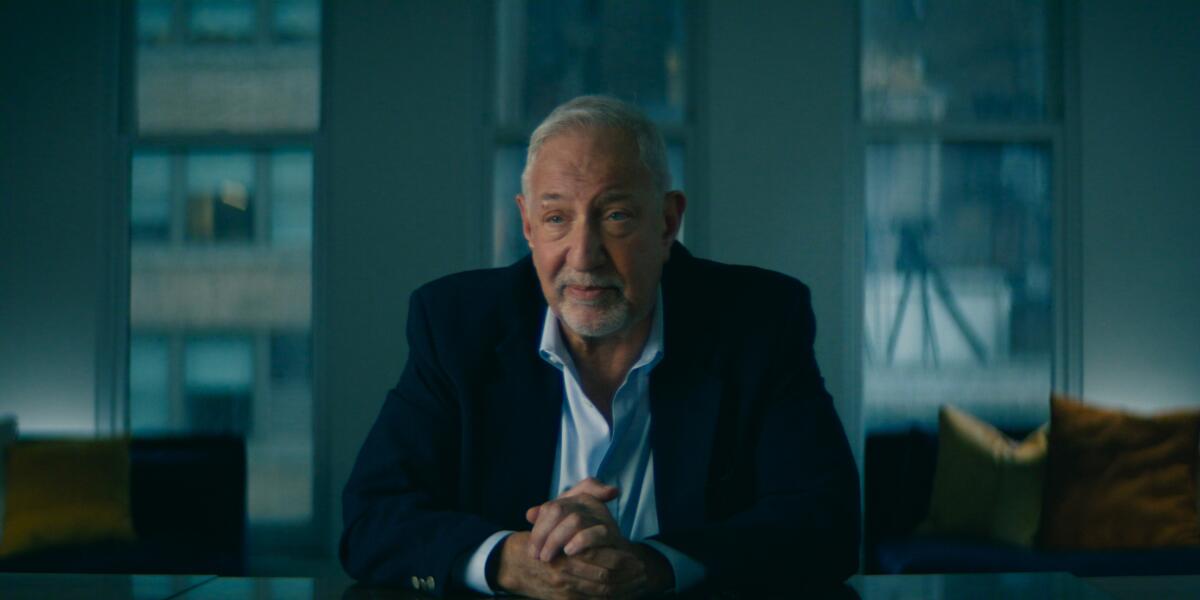
A still from “Michael Jackson: The Verdict” of Mark Geragos, who briefly served as the singer’s defense attorney.
(Netflix)
“Michael Jackson: The Verdict” (Netflix)
Moviegoers embraced “Michael,” propelling Antoine Fuqua’s film about the global superstar to become the highest-grossing music biography in movie history. But reviewers and others have continued to criticize the absence of references to the child molestation allegations that continually shadowed the singer. Netflix’s documentary “Michael Jackson: The Verdict,” however, brought it into focus. Directed by Nick Green, it chronicles the 2005 child molestation trial that threatened to derail Jackson’s career after a young boy accused him of abuse. The three-part series uses archival footage and new interviews with attorneys involved in the case, journalists, fans and members of Jackson’s inner circle to explore the trial, which sparked international attention, and its aftermath. Although the project is unlikely to affect Jackson’s popularity much, some of the revelations uncovered during the investigation are disturbing. — Greg Braxton
Guest spot
A weekly chat with actors, writers, directors and more about what they’re working on — and what they’re watching
Sam Worthington as David Burroughs, a wrongfully imprisoned father, in “I Will Find You.”
(Christos Kalohoridis/Netflix)
What would you do to save your child? “I Will Find You” follows David Burroughs (Sam Worthington), a father serving a life sentence for the gruesome killing his toddler son. But when his ex-sister-in-law Rachel Mills (Britt Lower), an out-of-work reporter, presents him with evidence that suggests his young son, Matthew, is still alive, it sets in motion a daring prison escape and a high-stakes rescue mission in search of the truth. And that’s just one of the parent-child dynamics that fuel the series to illustrate, as Coben told us, how most parents are “trying to do what we think is best for our child — and that could lead to greatness or it could lead to disaster.” Over a recent video call, Coben and showrunner Robert Hull discussed the chilling premise and the book moment that was most challenging to bring to screen. Beware of spoilers ahead. — Y.V.
Harlan, Netflix wanted to make this before you even finished the book. How did that shape or intensify your normal writing process? Is it hard to turn off the noise of the pressure that carries?
Coben: Actually, no. In terms of writing the novel, I’ve learned that the worst novels are the ones that you write thinking you’re going to make a great TV series or a movie. If you write a novel going, “Ooh, I can’t wait for it [to be adapted],” it’s going to stink — trust me. My caveat to that is, though, I don’t care about making changes. I don’t have fidelity to the novel. Once I knew it was going to be already a TV series, I made sure I cut off any thoughts of that, and just told Robby, “Your job is going to be to worry about how to adapt whatever I do.” The way it started was Robby and I had met, and we wanted to do something together at Netflix. We wanted to maybe do the first one that was going to be filmed [and take place in the U.S.], and weren’t sure which to do. I pitched the idea to Robby as I started writing the book, and Robby’s eyes lit up. We went to Netflix and [executives] were like which book is this? I’m “Well, it’s not a book yet; it’s a third of a book right now. I’ll finish it while Robby’s working on the pilot and the adaptation.
Robby, what pulled you into this story?
Hull: As a father myself, I would easily give my life to save my children. What would be terrifying is to not have that opportunity. And Harlan created this character [in that situation] — he says very early on in the book, “A father’s job is to protect my son, and I didn’t do that.” He’s [David] living in this spiritual prison, regardless. And in this day and age, to have someone come and say, “Hey, there might be a way for you to correct the past, to change the most horrible thing that’s ever happened to you” — I thought that was just an incredible way to start a story.
Britt Lower as Rachel Mills and Sam Worthington as David Burroughs in “I Will Find You.”
(Netflix)
Was there a moment from the book, or a twist, that was most challenging to bring to screen, or one that you were most excited about?
Hull: It’s actually the same moment: When Rachel comes [to the prison] and shows David the photograph very early on. That is a scene that has to establish who Rachel is, establish her back story, her pathos, her connection to David, introduce the mystery, David’s reaction to the mystery. There is so much going on. You have to check off in three pages and in the hands of possibly actors other than Sam and Britt, that could be a real train wreck of a scene. Sam’s reaction when he first sees that photo is just unmistakably incredible, and you don’t have to write it. He tells you in three or four seconds the last five years of what he’s been through, and the possibility that maybe things can be different just by staring at a photo, which is incredible.
Coben: That’s one of my favorite scenes too. Also the ending, making sure that landed and gave the emotional punch that I wanted and I felt when I was writing the book. I think we delivered it less-was-more there. It closes it and it leaves it, so you can interpret it your own way, and you can bring it. We were thinking, it’d be really interesting to ask people a year from now, “Where do you think those characters are?”
Let’s talk about that part of the ending — so spoiler warning starts here. The book goes more deeply into how Rachel and David’s relationship evolves into a romance by the end. The series is more vague — we see them hold hands. Robby, how did you want that moment to play?
Hull: If you want them to be together and you’re hoping they are, then I’ve done my job right. I actually don’t want to answer that question because the relationship is so complex and so dynamic. Early on, we didn’t want the traditional two-hander, where [it’s] “Oh, now they’re going to fall in love, now they’re going to come together.” No, Rachel’s her own character with her own story and pathos, and at the end, what they’ve been through together, if that moment is the promise of something more, great; if it’s the promise of “look what we’ve been through,” that’s OK too. That’s what I was going for, at least.
Do you think there’s more of David’s story to tell? Would you want a Season 2 to explore what happens next?
Coblen: I’m probably the only writer who will say this: No, not really. I don’t do Season 2’s unless I think they’ll be better than Season 1’s. Let me do new stories instead. This is a complete story to me. Now, if somebody says to me, “I’ve come up with an idea that might work, that could be as compelling as being [in prison] for five years for the murder of your child for the same character? I never say never. I’ve learned that in my career. But we’ll see. I don’t think so.
Robby’s like, “but I want a Season 2.”
Hull: The moment he said, “If you can come up with a story better than the one we told …,” I was like, “Oh, guess we’re not doing a Season 2.”
Before I let you go, what have you watched recently that you’re recommending to everyone?
Coben: “Your Friends & Neighbors” [Apple TV] by my pal Jonathan Tropper and my other pal Jon Hamm. I’m proud of the job they’ve done on that show and I’m happy for them.
Hull: “Run Away,” ’Safe,” “Fool Me Once.” [Each are a Coben adaptation for Netflix]. Those are the three I’m digging right now.
In this week’s episode of The Envelope podcast, Rachel Sennott discusses finding the voice of “I Love L.A.” — and finding her footing as series creator — during a tumultuous time in her life.
Kelvin Washington: Welcome to The Envelope, Kelvin Washington alongside you know who, Yvonne Villarreal, Mark Olsen. Always great to have you two here and spend some time with you. We talked about it earlier, we had Emmy season — a few weeks ago we discussed it. But now Emmy nominations are on the way. Yvonne, I’ll start with you, just maybe someone, a show, a couple of things you’re looking at saying, “Hey, I would love to see this or that person nominated.”
Yvonne Villarreal: I wanna give some shout-outs to the women right now. I was really frustrated when Rhea Seehorn didn’t get love until the final season of “Better Call Saul,” and I’m hoping — and I do have a lot of hope — that she will be recognized for “Pluribus.” [I] was a really big fan of “The Comeback” this season. I would like to [see] Lisa Kudrow get in there. Show-wise, I would like to see “The Testaments” in there. I don’t know how much of a dark horse that one is, but that’s my pick for show.
Washington: You’ve been riding “The Testaments.” What about you, Mark?
Olsen: I’m sort of leapfrogging over nominations, and I’m just thinking about what would be exciting on the show. And last year, I remember Stephen Colbert won for talk show kind of right after his show had been canceled, and that seemed like a very exciting moment. And so this year, with Jimmy Kimmel, where this is the first Emmy cycle since he had his suspension last year, and really has been in the news, I just think if he were to be nominated and then to win, that just would be such an exciting moment at the show. What’s he gonna say? I just would really love to see that.
Washington: Yeah, he seems like he would have some things to say, right? Because just kind of the nature of who he is. We’ll have to wait and see. And just for me, a couple of people. Just a fan of this particular person, Janelle James is hilarious to me. She plays in “Abbott Elementary.” She plays that role great. And then this one is no real surprise, probably 50-plus-year career, but Martin Short. Every time I see him, he’s amazing, steals the scene. So those are folks that just jump off on the radar for me.
All right, I’ll get to you, Mark. You had a chance to sit down with Rachel Sennott of “I Love L.A.,” creator and star of it. Tell me a little bit more about that.
Olsen: She’s been kind of a real, like, bright light on the comedy scene for the last few years in films like “Shiva Baby,” “Bodies Bodies Bodies” and “Bottoms,” and, you know, she also was like a writer as well as a performer. And so with “I Love L.A.,” which is a look at sort of like the young creative class in Los Angeles, she is the star of the show, she created the show, she writes on the show, she’s executive producer, she actually made her directing debut with one of the episodes. And so it’s just exciting to see her sort of really like come into her voice and come into her own with this new show.
Washington: Kind of reminds me a little bit of, you know, now maybe a decade ago Issa Rae’s surge in L.A. and comedy creating, and then Riz Ahmed, who you spoke with last week — same thing creating and starring and stuff. Seems like that’s the energy [we’re] getting from a lot of the young talent. Well, here is Mark and Rachel now.
Rachel Sennott, creator and star of HBO’s “I Love L.A.”
(Evan Mulling / For The Times)
Mark Olsen: We’re here with Rachel Sennott, creator, executive producer, writer, star, and for the first time, director on the show “I Love L.A.,” as well as co-creator and writer on “Big Mistakes.” That’s a lot.
Rachel Sennott: When you say it like that, I’m like, “Oh, my God.” And I’m also a friend, daughter, let’s not forget girlfriend. Yeah, those are all things that I am doing. And I am so grateful and having so much fun doing that.
Olsen: Hopefully this isn’t something that just I get a kick out of, but we’re here at the L.A. Times offices in El Segundo, and the Randy Newman song “I Love L.A.,” one of the first lines in the song is “Rolling down the Imperial Highway.” And we are in fact on Imperial Highway.
Sennott: We’re here right now. We’re living it.
Olsen: Tell me about the title of the show, its relationship to the song and what was it that you liked about having the show called “I Love L.A.”
Sennott: We were between two titles for a while, “I Love L.A.” and “Climbers,” and the reason we went with “I Love L.A.” is because in the process of making the show, I moved here from New York and I had a hard time when I was first here. And in the process of filming the pilot, I really fell in love with L.A., and I think getting to make something here, I all of a sudden saw L.A. through this lens where everything was like a movie. I would go on my walks that I usually go on. I would walk through my neighborhood, I would go to my spots, and I just saw it through this different lens, and I was really falling in love with it in the process of making the show. And I think with “Climbers,” that title fell a little bit — it was a double meaning of like social climbers and then also, being the age that I am, where I feel like ever since I got to college, ever since I became an adult, there’s been this chaotic energy in the world and uncertain ground where things never felt expected. It was always unexpected events. Graduating into COVID and then there was a strike and everything. So I feel like Sisyphus, where you’re always pushing the rock up the hill and it’s never enough. But we were worried that “Climbers” would seem too negative … We didn’t want to set people up already judging the characters.
Olsen: And then what has it been like for you learning to be a showrunner in making “I Love L.A.”? It’s funny, your co-showrunner Emma Barrie, she mentioned how you were very organized, but she was struck that you had everything in a pink binder with horses on it. So it was you trying to learn this new thing while also holding on to your essence.
Sennott: I feel so grateful for everyone who works on the show with me. I learned a lot from Emma. I learned from Lorene [Scafaria], who inspired me so much as a director. Aida [Rodgers], our producer, Amy [Gravitt] and Allie [Wasserman] at HBO; Max [Silvestri], who’s one of our EPs and writers. Showrunning is a million different jobs, and some of the jobs I’d done before, some of them I hadn’t, and I felt like I got to see different people shine in certain things, people who are more talented or more skilled at structure than me, people who have directed before, people who understand shots and basically learn from everyone and see that everyone wants the show to be the best it can be. They’re bringing stuff to the table. And so I benefited from everyone else’s skills and talents and just being like, “If you know how to do this better than me, I’m gonna learn from you and watch you and hopefully take from that so I can do my job better.”
Olsen: In a lot of the press as you’ve been talking about the show, you’ve been talking a lot about the concept of the Saturn return and this sort of chaotic period people have in their late 20s. You yourself now are 30 —
Sennott: Yes, I made it. I literally just finished. I was relieved, but my Saturn return was the process, getting the show picked up and the first season of the show. That was my Saturn return.
Olsen: Can you already feel that something has settled or things are different somehow?
Sennott: Yes, a thousand percent. My Saturn return, the dates that it was the strongest were the month around when the show got picked up. Making the pilot was so amazing and I learned so much. And then I was in this moment where I had to pick — basically, I couldn’t take on acting jobs because I was gonna hopefully do the show, but I didn’t know if the show was picked up yet or not. And so I had to say no to certain things and kind of take this leap. At the same time I went through a breakup, and then I got arrested for having CBD in the Cayman Islands. And it was just a very chaotic month of my life where I was like in jail for six hours on a break with my boyfriend, so he, like, had no idea where I was, and I was like, I don’t even know if I have a show, I just said no to this other thing. I just felt like I didn’t know what was happening. I’m someone who it’s hard for me to take risks sometimes, and that was a big risk and leap into what I thought I should be doing. And then the rest of it was learning for the first season how to do a job I’d never done before. Obviously, I still have more to learn, but I think that was a big Saturn return for me, the roller coaster of it.
Olsen: It’s so interesting to hear you say that you think of yourself as a person who’s afraid of risk, because that’s not my impression of you.
Sennott: You’re like, “Stop taking risks. Chill on the risks, every second.” No, I think it’s more [that] I didn’t necessarily believe in myself as a creator on my own, and that was really scary for me. That was the risk, I think.
Olsen: Because especially in building up to making “I Love L.A.,” in your career, I feel like you’ve created this comedic persona for yourself. What is the biggest distinction between the Rachel I think I know and like the actual you?
Sennott: You mean the characters that I play? Or like the persona?
Olsen: These sort of hard-charging, very ambitious, but maybe not always understanding of themselves characters, and you. I’m just interested in how you see the distinction between that persona and the actual you.
Sennott: Well, I hope that the characters that I’ve played have been somewhat different from each other. I think “Shiva Baby,” that character, was a little bit more anxiety-inward. Alice in “Bodies” was way more outward and kind of no filter, said every inside thought. Maia on “I Love L.A.,” I think, is kind of bitter in the beginning of the first season and is pinning her failures, blaming them, on her friend. All of those characters, I always draw on some element of myself. I think all actors, you have to find some connection to the character. But I think I’m hopefully more grounded and balanced and mature than the character. I hope.
Olsen: You’ve talked about how “I Love L.A.” really explores the foibles and challenges that people have leading these very, like, online lives and the way that people nowadays are really sort of tethered to their phones all the time. Is that something that you feel like you grapple with yourself? Is it something you yourself have had to kind of get over?
Sennott: I would say I started my career on the internet, and I grew up on the internet, and basically, I created a different sort of persona on the internet that was based in truth of a time when I was in my early 20s in New York, and it was a lot more messy and a little chaotic, and I was just going through things in my life at that time [that inspired] — I say “writing,” but like the tweets, the jokes, the videos, whatever, that were coming out of me. And then I felt I changed, but I still wanted to kind of project that character. And so I actually ended up putting that character into Tallulah [played by Odessa A’zion]. And I think Maia was a little bit more the version of myself when I first moved to L.A. and I felt isolated and it was during COVID, and I felt I was kind of gripping onto my friends in a codependent way. And so I think the show is sort of dealing with, whether or not you’re an influencer or person online, anyone who’s grown up on the internet is projecting some sort of version of themselves. So I think it was that I was trying to explore.
Olsen: You mentioned that the character of Tallulah is this version of you that you used to be. So what was it like for you creating this character that was almost like your id unleashed?
Sennott: It felt like I was separating myself from her. At first, [it] maybe could have felt like a caricature. And then when we cast Odessa, who is so talented and just, as an actor, she has such depth and range, and I think she asked questions and brought so much to it. Then it actually made me sever myself from the character, and the character became its own thing that she brought to life.
Olsen: Your character, Maia, in some ways is the audience surrogate, she’s kind of the most “normal” character on the show. And considering that in “Bottoms” or “Bodies Bodies Bodies” you often were the outrageous character, what has it been like for you to play this character that’s a little more self-contained?
Sennott: It’s been fun. I think we sort of found her during the first season. I feel that Episodes 6 through 8 are really where the show finds its footing and where we find what’s the comedy of Maia. It takes a little for her to kind of crack open, what’s funny about her as a character, but also I think Tallulah is almost like an agent of change for her — Maia was set in her ways and sort of struggling and depressed, and I think Tallulah puts her on track, and she’s going through her Saturn return and all that stuff. And so I think we get to see at the end of the season and just having been writing Season 2, I think that we get see her do a lot more fun stuff.
Olsen: It’s funny, as viewers, a lot of times people say, “Oh, you know, there’s this show you should watch, it really gets going on like Episode 3” or whatever. And I don’t think I’ve ever heard a creator say before, like, “Oh, 6, 7, and 8, we figured it out.” Do you feel you knew that in the moment, or has that only come to you as you’ve been working on Season 2?
Sennott: I think as we were editing the first season. Tone is something that you can say, like, “We want it to be like, this needs this, and it’s that and that and the tone of that.” But tone is what you find in the edit. I think you shoot different versions of a line, of a scene, and then you piece it together. And I think for me, that’s when I felt like, “This is the tone of the show. This is the world of the show.” And in writing Season 2 as well, just living more in that world.
Olsen: You kind of touched on this, but the characters on the show, they kind of skirt this line between being endearing and annoying. What is it that you like about that?
Sennott: Because I think that’s how people are. I am not interested in seeing perfect people or people who are flawed in a way that’s not actually real. So I love all the characters. I think Alani [played by True Whitaker], for example, is someone where you could really easily be like, “Oh, a nepo baby, she’s so privileged, whatever.” I think she’s the character with the biggest heart. She’s the best friend out of the whole group. She cares for everyone. She’s so deeply sensitive. And she’s actually been through a lot of s— and she drops these little things, these clues where you’re like, “Gee, she went through something crazy but is choosing to look at life half-full,” and I think that’s fun. I like the characters who make you feel or expect something of them and then show you another side. Charlie [played by Jordan Firstman] I think does that as well, where you meet him and you think he’s a little acerbic, he’s a little judgmental, and then he goes through loss and grief when Lukas, spoilers, Lukas Landry dies, RIP Lukas. That’s really hard for him. I’ve been friends with Jordan for so long, and I love him so much. I think he’s so talented. But I think he showed a totally new side of himself with the character.
Olsen: I agree. I found those scenes very touching. There’s an emotion there that’s kind of unexpected. Another moment that I really like in the show is Odessa’s character, she wants to change a dinner reservation to five people at 8 o’clock. And then you have to spend hours trying to make that happen. And I really appreciated how it’s something that sounds like it should be simple, and for some people it’s no big deal. But then for other people, it’s the biggest hurdle imaginable. Did you like that the show explores this sort of proximity to ease? Sometimes you end up at this party in a big, big house, but it’s not your house. Was that something you wanted to explore about life in L.A.?
Sennott: Totally. There’s also something specific to L.A. and specific to the industry we’re exploring — which is the internet as opposed to Hollywood — that I would say is relatable to me, to anyone in their late 20s, early 30s. When you’re in your early 20s, everyone’s sort of grouped together or feels like they’re in the same bucket. It’s like, “Oh we’re all doing this same thing, we’re all roommates, we’re all in school together, we’re all whatever.” But people make decisions that you don’t even see. I feel like the first time I found out that one of my friends had a SEP IRA, I was like, “When did we all decide that we’re getting SEP IRAs?” And it was a friend who loves to party, and I was thrown. Now I’m panicking I didn’t do that. Or who’s getting in a serious relationship, whatever. People start making decisions in their late 20s, all of a sudden everyone’s off on different paths. It’s like, “Wait, you’re getting married, but you’re still partying the way that we did when we were in college.” This person is moving, this person is changing their career path. And so you all of a sudden feel a little bit betrayed or on your own, and it’s isolating, and that is something that, yes, we’re doing it through a specific lens of L.A. and this world and these characters, but I think it’s really relatable to people at that age.
Olsen: I’ve heard you describe yourself as a zillennial cusp.
Sennott: Yeah, I’m cusp, and I feel like I relate to a little bit of both.
Olsen: But do you feel a pressure for the show to feel like some sort of a generational statement, to capture these kind of big-picture things?
Sennott: No. Ayo [Edebiri] and I were texting each other because there’s always an article that’s like, “Turns out these b— are 30. Yeah. They’ve been lying the whole time. They said they’re Gen Z.” I’m like, “I didn’t say anything. I was born in ’95. I’m 30.” Call me what you want, but I was just writing to what I feel at the time. I think people who grew up on the internet in the way that I did will relate to it, but I think you can relate too if you’re older or you’re younger.
Olsen: As people are writing about the show, they very frequently are referencing “Girls,” “Insecure,” “Sex and the City.” But I’ve heard you reference “Entourage” quite a bit. Could you explain that?
Sennott: “Girls” and “Sex and the City” and “Insecure,” all of those shows, all HBO shows, are formative to me as an artist. I remember watching “Girls,” I was in high school and looking at colleges with my dad and we went and toured [New York University], and in the hotel room that night, he was like, “I heard so much about this new show, ‘Girls,’ we should watch it. And it was the episode with Patrick Wilson where they f— in his nice apartment the whole time, and we turned it on and my dad was like, “OK, you can watch this later on your own, this is for you.” And I remember going to bed being like, “I’ve gotta go to New York, like whoa, this is crazy.” I think naturally those were already gonna inspire me. “Entourage” and “Atlanta,” those were two references that I mentioned a lot when we were making the show. “Entourage” because I feel I got to come up in this industry with my friends, and when I’m with my friends I feel completely invincible, and so there was that aspect. It was like, “I wanna see ‘Entourage’ but from a different point of view and perspective and a slightly different industry.” And then “Atlanta,” there is already having a family relationship and friendship on top of managing. Like how [Earn] manages Paperboi. And then I think “Atlanta” did such a great job of capturing a city that has almost magical realism elements to it. And L.A., a lot of the time, there’s things that happen here that are crazy, that feel almost unreal, but they are real. So that was a big inspiration for the show as well. Like the opening of the show, sex during an earthquake. That’s happened to me, but it also feels a little ridiculous, but it happens in L.A.
Olsen: You mentioned earlier that in waiting for the show to come around, you felt you were having to turn things down or you were really having to sort of change your mindset in a way. Can you talk a little more about that? With the show “Big Mistakes” that you created with Dan Levy, is that one of the things that you had to step away from or readjust how you were gonna be involved because of the fact that you were going to have “I Love L.A.”?
Sennott: I was more talking about acting roles. When you step into a creator role, it’s a different mindset than acting jobs and you have to commit to a longer time period. When you’re just acting in things, you can pop in, pop out and you leave set and you’re like, “I love you guys so much. I’ll see you in a year at the premiere,” which is fabulous too — love doing that. But when you are creating something, you’re in it from beginning to end, and you really wanna give your all to it. So I think I was more talking about just, like, betting on myself as a creator, as opposed to just acting.
Olsen: And how has that felt now that you’re on the other side of it, with one season of “I Love L.A.” made? How do you feel about having made that decision, having bet on yourself like that?
Sennott: I think it’s changed me, in a way where I’m so happy I did it. And it’s sometimes harder and there’s more parts to it, but I feel more in myself creatively than I ever have before, I think.
Olsen: It changed you how?
Sennott: Just because you all of a sudden see all the different parts of the process of making something and all these different jobs that maybe I wasn’t as aware of before. And I think there’s also something beautiful about popping into something and acting and just being like, “I am present as my character. This is what I am thinking about. I’m thinking about what does the character want.” And that’s amazing too. But I feel so lucky to have been able to experience other parts of making something.
Olsen: What was it like learning how to switch hats, especially during production? I would imagine you have a producer brain, you have an actor brain, then for one episode you have a director brain.
Sennott: I had to like sort of take it day by day. There are days where it’s a lighter scene for me and I can be on the side approving locations, taking meetings during lunch. There was a day where I had two sex scenes, for Episodes 6 and 7. So we shot the end of 7, the fight scene with me and Josh [Hutcherson], and the sex scene where it’s Maia and Dylan but she’s fantasizing about Ben. It was a lot. And so I was like, to Emma and Max and Aida, “Let’s not do any other meetings today in the middle of the day,” and they were like, “Totally got you.” That day I was more focused. I really needed to be present in the scene and have this be my main focus. And then on a day where I’m shooting like, “you’re texting on your phone” and “you’re walking on your walking treadmill,” I can do other stuff. So I think it was just taking each day as it comes and having so much support from the rest of the team.
Olsen: It’s wild to think of just one day providing all this material for the show. Just a single day could be so pivotal.
Sennott: Yeah, totally. A lot can happen in a day and then other days you’re like, “I’m just opening doors.” You never know.
Olsen: How did you come to conceive of how you kind of wanted to depict the online world, how people text, whether they’re FaceTiming and things like that? The show obviously exists with that world, as part of it, but you didn’t spend a whole lot of time animating texts. How did you come to conceive of how to depict people’s online life?
Sennott: I wanted it to feel how it does in the real world, which is the internet is just a big part of everyone’s life, but people aren’t explaining it to each other all the time. So we wanted to have the internet feel like the real internet, but our own internet. We didn’t want to ever reference anything that would date us because the internet moves so fast. So, like, Coke Larry, for example, when Dylan gets made into a meme, whatever, that’s our own thing, but it moves the same way as the internet does. And we tried not to have too much phone screens, texting, whatever. Like for example you [just] see snippets of Tallulah making videos or posting or whatever. In “Entourage,” you don’t really see that much of Vince acting. You see all the stuff around it. So that was sort of our model for the show.
Olsen: You directed the final episode of the season. Do you expect to be directing more in Season 2?
Sennott: Yeah.
Olsen: And how did you find the experience? What did you like about it?
Sennott: I loved it. You’re just in every aspect of the process. You are thinking about everything, and it was so engaging and exciting, and afterwards I felt fried, and I like crawled onto the edit couch and I was like limp and it took a lot out of me. People describe it like giving birth. And then you’re like, “I gotta do it again.” So that’s kind of how I felt on the other end.
Olsen: Can you talk a little about that final episode? The show is called “I Love L.A.” You send the main characters to New York for the final episode, which has turned into kind of a controversial decision. A lot of people have talked about that. Can you talk just a little about deciding to end the season in New York?
Sennott: I think it was because it was sort of addressing the fact that these girls went to school in New York together. They lived in New York and they chose to move to L.A., and I think when you do that there’s always going to be the push and pull of the two cities, and going back to New York, it was almost like getting a chance to get back together with your ex and being like, “You know what, there’s a reason it didn’t work out.” And they end the episode with, “I miss L.A.” So I think that’s kind of what we were aiming to do.
Olsen: And then before we wrap up, I should be sure to ask, is there anything that you could tell us about Season 2? What can people look forward to?
Sennott: It’s sort of what we were talking about earlier, Episodes 6 through 8, I think, I just feel we’ve locked in to our tone, we get to see other sides of characters we haven’t before, we go deeper on certain characters. And I think there’s some fun stuff that we set up in the finale that we get to explore.
It’s Friday afternoon in North Hollywood and Ziggy Marley is perched on a stool inside his newly built Rebel Lion Studio, tucked in one of the neighborhood’s creative enclaves.
The nine-time Grammy winner is surrounded by a collection of lion figurines, guitars, traditional hand drums and a piano. Along the walls hang two replicas of backdrops his legendary father, Bob Marley, used on tour in the 1970s. The murals, depicting Rastafari icons and Haile Selassie I and Marcus Garvey, were featured in the 2024 biopic “Bob Marley: One Love.”
“These are what we used as the backdrop for the concert scenes. Them spiritual to me,” Marley says in patois as the smell of palo santo dances around the rehearsal space.
Music has been both an inheritance and lifelong pursuit for Marley. From sitting in studio sessions with his father as a child to building a five-decade career of his own, he has remained a curious student of the craft, one willing to challenge convention in search of a deeper meaning. That spirit is evident on “Brightside,” his ninth solo album, which was released on vinyl on April 18 (Record Store Day) and May 1 on streaming.
Rather than recording the eight-track project in 440 Hz, the standard tuning frequency for most modern music, he opted for 432 Hz, a tuning some musicians and theorists believe creates a warmer, more meditative listening experience. He also slowed down his songwriting process, giving each lyric room to carry its message of hope through turbulent times. The album, which may be his most personal yet, also features “Many Mourn for Bob,” the first song he has written directly about his late father.
“I think it shows the next stage that I probably am in,” says Marley, adding that he felt connected to his father on a spiritual level. “We took another step in the relationship, to another place that it’s never been before.”
Ziggy Marley is bringing his “Brightside” tour to the Hollywood Bowl on June 21 alongside reggae star Burning Spear.
(Dania Maxwell / For The Times)
He adds, “When I was doing the song, it kind of came to me like this song could’ve been my father’s song. It could’ve been a song that he wrote.”
The reflective nature of “Brightside” arrives at another pivotal time in Marley’s career. This year marks the 20th anniversary of “Love Is My Religion,” the Grammy-winning album that launched his solo career and crystallized a personal philosophy he still carries today. He is also set to release his sixth children’s book, “True to Myself,” in September.
As we wrap up our conversation, Marley has only a few minutes before Rebel Lion Studio shifts back into work mode. Within minutes, bandmates, background singers and production crew members begin funneling into the space, hauling in stacks of equipment as promotion and preparations continue the “Brightside” tour, which stops at the Hollywood Bowl on June 21.
This interview has been lightly edited for length and clarity.
You recorded your latest album, “Brightside,” here at Rebel Lion Studio, which you designed and built from the ground up. Can you take me back to the beginning of that process and why you wanted to do it?
I grew up around my father and my mother as growing musicians trying to succeed and there was one thing I kept hearing over and over throughout my life: independence. Their whole mission was to be independent. I saw them work and I saw my father build a studio. I saw him have a space where he can do more music and control his own time. That was a dream of mine for a long time, ever since I started doing music because usually we use other people’s studios. I couldn’t have this in my house. It’s too much. It’s a dream come true.
We’re surrounded by two beautiful murals. Is there a particular item that is personal to you?
The murals are replicas of my father’s backdrops that they used. The original artwork is by Neville Garrick, but he helped us re-create them for the Bob Marley movie. These are the murals we used as the backdrop for the concert scenes. They are spiritual to me cause that’s Haile Selassie and Marcus Garvey, two very important beings for us. Inspirational.
On “Brightside,” Ziggy Marley dedicated a song to his father, Bob Marley, for the first time in his career.
(Dania Maxwell / For The Times)
“Brightside” is your ninth solo album. What mindset were you in emotionally and spiritually when you started working on it?
I never thought about making an album, I was just writing songs. You just tap into things in your subconscious that are waiting to become music, I feel like. Then when the time comes for writing songs, the time comes. It’s like a season. Like you have blueberry or orange season. So there’s a season for me when I write songs. Then you say, “All right, let’s make an album then.” But you don’t think about an album before. It’s just an expression or a feeling just to make music, not for any reason but to make it. It happened over a period of years. Ideas and experiences that eventually come out. But closer to the time I [made] the album, I remember writing some of the later songs like “Why Let the World.” It was a song that I wrote because I was feeling down and everything that was happening in the world and the country. Just so much negativity and I just felt like I needed to take a break from it. To recharge yourself. We cannot fight every day. We need to take a break and then get back to it. I needed to teach myself to take some time. It was more of a mental thing than an emotional thing. Stuff I deal with my father, personal life and stuff with my spirituality and my faith. So there’s a lot of me in this record.
“Many Mourn for Bob” is the first song you’ve explicitly written about your father. Your brother, Stephen, is also on the vocals. What surprised you emotionally once that song was finished?
I’m not sure I thought about it like that. The experience of expressing that emotion, it’s a spiritual experience. I think it shows the next stage that I probably am in and even my relationship with my father on that spiritual level. It’s a different place. We took another step in the relationship, to another place that it’s never been before. When I was doing the song, it kind of came to me like this song could’ve been my father’s song. It could’ve been a song that he wrote. That’s how I felt about it. This is partly his song. It’s me and him making this song. This song is his song too.
How has your relationship with grief changed over the years?
It’s more of a comrade, understanding, empathy and having the maturity and the experience to understand what he went through as a man, as a human being. I think that’s what it is, really. A better understanding of what he went through, not the glory. The pain, the mental and emotional state. You’re more than just an idol. You’re more than just a legend. You’re more than just a father. To go deeper than that, so that’s the next level.
Yeah, the skit you used of him saying “I’m just a man from the ghetto” on the song really summarizes that.
That’s the real him. That’s him right there. Even in the tone of his voice, you can hear the real Robert coming out.
Another standout song from the album is “Racism Is a Killa.” One thing that you do well is having a heavy topic, but finding a way to still make it feel hopeful and joyful. Why was it important for you to approach the track this way rather than from a place of anger, heaviness or sounding preachy?
I think it started out preachy and angry, but over time, it kind of evolved and I kind of evolved too ‘cause my own evolution is represented in the music. And you know something, doing that song helped me evolve because I had to think about it differently without the anger. The song made me do that. Like how else can I approach this? It’s inspiration that causes these things. It’s not an intellectual thing. I didn’t do that intellectually. Like over time, something just started coming out of me. I never really thought about it before, but I can see it now.
In the video, which features your daughter, Zuri, you referred to the condition as “Racismosis” in the video and sang about how it can be cured.
It’s kind of like a sickness, a disease. It’s a virus. We can minimize the virus and stop the disease. It’s true. Racism is a killa. This virus can kill ya. Literally kill ya. Spirtually kill ya. Emotionally kill ya. Mentally kill ya. It kill ya in different ways. It kills the victim and it kills the person perpetrating it. It’s killing everyone, but we can cure it though. It starts with the children. I have a friend of mine who said, “Yo, my little son loves this song. He doesn’t want to stop. He says ‘Put on “Racism is a Killa.”’ So that’s where the antidote is starting. The minds of the children. The music with a conscious message gives them the right consciousness that they grow up with. That is how we take our time and lower the spread of the virus.
You recently released an alternate version for “Racism Is a Killa” with Big Boi. How did that collaboration come together and what excited you about working with him?
I’ve loved Big Boi and Outkast from a long time ago. He’s a legend and a strong voice. There’s different layers to it and I feel like Big Boi took it to that other layer. So yeah, we just love Big Boi and I’m going to jump on something he does. [Laughs]
I’d be remiss if I didn’t ask your approach for your album and how you swapped the typical 440 Hz for 432 Hz. Do you remember the first time you heard the music played back that way?
It’s a long journey because for most of my life in music, I’ve tried to be a student. I’ve tried to keep an open mind and learn more and more. With this album, there’s an inspirational side of music and that’s where I lean into most of the time, but as I grew up, I started to understand there’s also a science too. It’s also mathematics. The universe, it’s all mathematics and science, and I shouldn’t shun the science of music just because I think the inspiration is all it should be. I think a part of that was learning that for myself and opening up and saying, “Yo, let me put some science into this.” Frequency. What does frequency do to people? Frequency affects people. Frequency is a weapon. It’s a tool. I’m sure the army has some kind of frequency thing. So frequency is powerful. I wanted to try something different anyway. I want to be different. I want my frequency to be different from the majority of frequencies that’s being played out there, because it’s fun for me to be different.
When I was working on the demos, I was like “Let me try this 432 Hz thing” and I like how it feels for me personally, how I sing on the frequencies. It resonates differently and makes me feel different. We did it and it felt good, and we did it live, and from my point of view, I felt a different energy with the audience too. So all of those experiments led me to the final conclusion to say, “Yeah, let me do the record in 432.” It’s really nice vibes, which the world needs a different frequency. We can use it.
This year marks the 20th anniversary of “Love Is My Religion,” your first solo Grammy-winning album. When you think back to that era of your life, who was Ziggy back then?
A lot was changing because I moved to L.A. during that time.
You got married around that time too, right?
Yeah. I don’t really fight change. I just try to navigate them and figure them out cause sometimes change is hard. There was a lot of change living here, moving around, trying to find a place, music, but then it’s like we are continuously updating ourselves. I’m continually updating. You know how you update your OS. I’m updating my OS. My operating system is being updated throughout my experience in life. There’s always something else out there for me to evolve to. So during that period of my life, “Love Is My Religion” came to me when someone asked me, “What religion are you?” And I just said “Love is my religion.” I never thought about it before, never contemplated it, never even thought of those words together before in my life, and they just came out to me that day. So the album represents a time in my life when I realized there’s a spiritual awakening that I had. “Love Is My Religion” is a spiritual awakening. That’s my thing. That’s who I am. That’s why it’s a milestone.
“If you think you’re going to change this world with music and you’re trying to send a message out there, you have to speak to children,” Ziggy Marley says.
(Dania Maxwell / For The Times)
You’re kicking off the “Brightside” tour this month, which includes a stop at the Hollywood Bowl. What are you most excited about when it comes to bringing this album to people for the first time live?
I’m excited about playing the music. I think it’s about the music. These new songs, they vibrate very highly for me and I’m excited about experiencing and expressing that. And also kind of not doing it for the audience. I don’t want to do it for the audience. I want the audience to experience what I’m experiencing, what I’m expressing. I want them to feel me. I don’t want them to be like “Hey look at me.” [Laughs] There’s still connectivity going on, but I want them to feel the songs the real way. That’s what I’m excited about for people to feel it the way that I feel it.
You even posted the lyrics and told fans to get to practicing, so they can really understand the message.
Yeah. Just reading them for me, I really like the writing I did on this. I also took some time with this too. I was saying to someone that I developed a deeper relationship with the lyrics and the words than I did before. My relationship with the words here are very mature. I feel good about it. That’s why I want people to know the words because words are very important. Words are very important. If you know the words you get a deeper understanding of what I’m talking about and what I’m feeling.
After nearly 50 years of making music, Ziggy Marley built his own studio in North Hollywood called Rebel Lion Studio. He plans to turn it into a multipurpose creative space.
(Dania Maxwell / For The Times)
Look on the bright side is a phrase that people say often, but what do those words mean to you right now?
Sometimes we can get in a place [where] we can’t see the other side of things because we’re so caught up in that one place. Like the cliché, there’s two sides to a story, ya know? The universe is always yin and yang, but there’s always another side of things. But I feel like the way we are being programmed in a way through media and everything, it’s like there’s only one side. Everything is like this, there’s nothing else going on over there that we need to see, we only need to see this. This is all that’s going on in the world. There’s nothing good, there’s nothing nice, there’s no good people, there’s no love. So it’s a realization too. A realization that there’s the other side. Never get to that place where we think it’s just that side alone because we get so much of it. It’s a reminder, I think, for us like “Come on guys.” The thing about it too, sometimes you can feel like — even for me — some people say, “Hey look on the bright side,” some people find that like “Why are you happy? Why you so chirpy?” [Laughs]
That’s true.
I’m proud that I’m on the bright side. I’m living on the bright side, I don’t care. You don’t like me because I’m living on the bright side? You want me to be like you, you want me just live on the dark side with you, right? So it’s like a proudness of being positive and having that outlook in life, and not feeling like you have to [fall to] peer pressure. More positivity in life, not just the negativity. I’m confident in that too. So it’s kind of like that too, you know, like being proud, lifting up that side of me. Yeah, I’m happy to be living on the bright side.
I was warned in the waiting room of Pasadena’s WeFly: “This is not an arcade,” said flight trainer Corry Joyce. No, what WeFly offers is a professional-grade simulator, one that is traditionally used to train pilots. I am not a pilot, or a pilot-to-be, but I wanted a sense of how planes work, and maybe a chance to fly over my hometown. Only once I strapped into my seat, I found myself to be incredibly nervous. There was no danger here. Joyce, thankfully, would intervene at any mistake, and would helpfully remind me that, unlike real planes, “This one has a pause button.”
And yet to set foot in a WeFly cockpit is to be alternately in awe and overwhelmed. I was in a near 1:1 replica of the insides of a Boeing 737 Max. Buttons, knobs, switches and flashing lights surrounded me. And to fly a plane, I would have to let go of everything I knew about driving a car. Turning in the air, for instance, is much different than turning on a runway. And do I watch the screen, or look out the windshield? Often the former, even though I enjoyed buzzing Long Beach’s Queen Mary, flying under the Golden Gate Bridge and circling Chicago’s Wrigley Field. When it came time to land however, my palms got a little sweaty. Navigating height, winds and the steadiness of my plane was a challenge, one akin to handing a grade-schooler a calculus book, summarized Joyce. Let’s just say I needed his co-piloting skills. And I’m not great at math.
Typically, WeFly’s clientele, says Joyce, are a mix of aviation aficionados or non-commercial pilots. The space also gets a fair share of those with a fear of flight, arriving at WeFly with the hopes to conquer it. “They want a sense of control,” Joyce tells me. But WeFly is also ideal for anyone who is amazed by air flight, or those who may someday dream of being a pilot. Though it uses “Microsoft Flight Simulator,” it is no game. Sessions for 30 minutes start at $129, and WeFly’s trainers will tailor it toward one’s experience. I made sure, for instance, that crashing was turned off. But I forgot, however, to turn with the brakes when it came time to land. Yet the plane was intact, and, as Joyce reminded me, “At least you’re on airport property.”
WASHINGTON — The terms of a deal to end President Trump’s war with Iran remained a secret on Monday as both sides claimed victory and the months-long conflict reached a nebulous end.
The memorandum of understanding, providing a rough framework to conclude the war, was signed digitally Sunday, with a ceremony scheduled to take place on Friday in Switzerland, U.S. officials said.
Trump hailed the document as a breakthrough after months of negotiations. Yet its broad contours remained unclear more than a day after the deal was announced, as each side offered conflicting public messaging about what had been agreed.
Iran said it would continue regulating traffic through the Strait of Hormuz, a strategic paradigm shift from the prewar status quo that was denied by the White House. The two sides expressed disagreement over whether the status of Iran’s ballistic missile program would be addressed in future negotiations, or whether Israel’s withdrawal from Lebanon was a part of the deal.
And Trump administration officials rejected Iranian claims that the United States would provide immediate sanctions relief as misleading “spin.”
Hours later, another U.S. official suggested that Iran, in fact, might receive some relief at the front end.
“We are prepared to release frozen funds, and we are prepared to release sanctions,” a senior U.S. official told reporters on a call. “And we’ll do some small gestures of that in the beginning, if they make some small gestures to us that show they’re willing to meet their commitments as well.
“We’ll know over the next two to three weeks whether those understandings will turn into actual agreement,” the official added.
Trump started the war in February citing Iran’s nuclear program, which had expanded after he withdrew from a prior nuclear agreement negotiated by President Obama. That deal capped more than two years of intensive diplomacy but ultimately failed under the weight of political criticism from Republicans — led by Trump — over its inclusion of sanctions relief for Tehran.
Trump administration officials said the new agreement would include a commitment from Iran not to develop or purchase nuclear weapons — a vow the Islamic Republic has repeatedly made through the Nuclear Non-Proliferation Treaty, the Obama-era deal and a religious edict from the late supreme leader. Yet the enforcement mechanisms for policing Iran’s nuclear work were left to negotiate another day.
Iran could get sanctions relief
In an interview with CBS News, Vice President JD Vance acknowledged that Iran could get significant sanctions relief — and up to $300 billion in reconstruction funds — if they abide by U.S. terms, such as the full reopening of the Strait of Hormuz, one of the world’s most important commercial waterways.
“Our expectation is that the strait is going to be opened in a toll-free way for the long term, and that’s the sort of thing that we’re going to figure out in these technical negotiations,” Vance said.
In a separate interview, he described the president’s policy as “extending an open hand” to Tehran.
“The hard-liners of the Iranian system will overemphasize the benefits that Iran gets,” he added, “while underemphasizing all the things that they have to concede, and all the things that they have to provide, in order to get these benefits.”
Uncertainty across the region
The news of peace came with a sense of bewilderment and uncertainty in a region that suffered as collateral damage through months of war.
Sunni Arab states that once hoped Iran would emerge weakened from the war issued tepid support for an agreement that could ultimately leave the fate of their oil exports at the whims of an emboldened adversary. And Israeli leaders, across the political aisle, expressed deep concerns over the deal in private, warning they would not be bound by an agreement to which they were not a party.
Israel’s decisions moving forward — particularly in Lebanon— may ultimately decide whether the agreement survives over the next 60 days, when Washington and Tehran plan on ironing out its more technical details.
Hours after word of the signing came out, a stream of cars crowded the highway leading to southern Lebanon, full of displaced families desperate to check on homes and villages they hadn’t seen for more than 100 days.
They did so in defiance of Lebanese officials, who called on people to remain where they were until an official end to war in Lebanon — a secondary front in the larger U.S.-Israel war on Iran that has nevertheless seen staggering levels of destruction.
A woman and her children return to their Lebanese village Monday following the ceasefire announcement.
(Mohammed Zaatari / Ap Photo/mohammed Zaatari)
In the more than three months since the Lebanese Shiite group Hezbollah attacked Israel, nearly 3,800 people have been killed, and almost a quarter of the country’s 6 million people are displaced. Israeli troops occupy more than 10% of Lebanese territory, leaving a trail of destruction that has seen swaths of the country’s south all but razed.
‘Everything is gone’
None of that discouraged Hassan Shareef from leaving where he was staying in Beirut at 7 a.m. to head to Nabatieh, one of south Lebanon’s largest cities and a frequent target of Israeli strikes in recent weeks, to check on his tailoring business.
“I wasn’t afraid. I had to come. But what I saw would make you cry,” he said. “Everything is gone. My house, I can’t live in it. And the business is destroyed.”
Aqeel Khalaf, an herbalist, hit the road in the early morning with his brother, son and daughter-in-law. They reached Nabatieh in two hours.
Yet it was less of a homecoming than Khalaf hoped: Israeli troops were still stationed near his village, a few miles down the road from where he stood in Nabatieh’s central market. Their house was tantalizingly close, but for the moment it might as well have been on the moon.
“It’s hard for me, but the Lebanese army told us we can’t go yet. We have no choice,” Khalaf said. “Maybe in 24 hours, when things crystallize with the deal.”
He could at least check on his shop here in the central market, though he already knew there would be damage: The family regularly checked satellite images of the area and saw the building was hit about a week ago.
Standing before it, Khalaf saw how the wall of the adjacent building had toppled onto the ground floor, flooding the shop with rubble and coating everything with a film of fine gray dust. A nearby blast had collapsed the roof.
“Nabatieh was hit very hard this time,” he said. Still, he could salvage something, he said, pointing to his son as he fished out boxes of herbal treatments from under the rubble.
Two ceasefires in the last two months, forged during U.S.-led talks between the Lebanese and Israeli governments but without Hezbollah or Iran’s involved, were broken as soon as they were announced. A previous ceasefire from November 2024 saw Hezbollah stop all attacks while Israel continued military operations in south Lebanon.
This iteration of the truce appeared to have more success: On Monday, Hezbollah launched no missiles but announced an attack on an Israeli force to stop its advance; and the Israeli military mostly stayed its fire as well, barring a number of shelling incidents and a drone strike on a car in the village of Kfar Tebnit that injured a journalist and killed one person, according to Lebanese media.
Obstacles to a durable peace
Lebanese army units, meanwhile, deployed in parts of the south, barring motorists from reaching areas near Israeli troops. Lebanon’s army remained on the sidelines during the war, but 30 soldiers, including a general, having been killed in Israeli attacks since March 2. Hezbollah attacks killed at least 30 Israeli soldiers and one civilian contractor.
Obstacles to a more durable peace remain. Israeli officials insist on freedom of action against Hezbollah, and they will create a so-called security zone in Lebanon indefinitely so to protect Israel’s northern border. For its part, Hezbollah says it will respond to any attack and will continue fighting until Israel withdraws.
Though the truce appeared to be holding for now, Khalaf, who had raced to reopen his Nabatieh shop after the 2024 ceasefire, was waiting this time. For now, he would take what stock he could and open a shop in Sidon or Beirut.
“We have to work and feed our families. But the damage is too much this time. I’ll come back when things are better,” he said. “And my home too. When I get to see it, even if it’s a mound of rubble, I’ll pitch a tent on it and rebuild.”
Wilner reported from Washington and Bulos from Nabatieh.
WASHINGTON — President Trump planned to mark his 80th birthday on Sunday with a celebration that once would have seemed unfathomable: a cage-fighting show on the storied South Lawn of the White House.
In the week ahead, some hard realities of the office have threatened to overshadow the ostentatious UFC mixed martial arts extravaganza, where combatants sealed inside a wire-mesh octagon try to punch, kick, chop and pummel each other into submission.
Trump has found himself boxed into an unpopular and costly war he helped start in Iran. An agreement to end the conflict could be close, but the crucial details are still to be negotiated. Meanwhile, about a mile from Trump’s birthday bash, crews pried the president’s name off the John F. Kennedy Center for the Performing Arts facade after a judge ruled that renaming it to include Trump was not allowed.
Regardless, the president will walk out of the White House and be surrounded by Cabinet leaders, top administration officials, Republican lawmakers and 4,000-plus spectators screaming themselves hoarse in a temporary arena under “The Claw,” a spaceship-like metal arch fitted with lighting, sound equipment and large screens. Thousands more will be watching on big screens from the nearby Ellipse.
“This event is a one-of-one event, incredible event. I love it,” said UFC chief Dana White, a close friend of Trump, during a Friday night hype session at the Lincoln Memorial where pairs of fighters shoved and scuffled for the cameras under the stoic gaze of Honest Abe’s marble likeness.
Trump has sought to tie Sunday’s event — which features seven fights running past midnight — to larger, months-long celebrations of the 250th anniversary of the signing of the Declaration of Independence.
But it is much more geared toward feting himself, so much so that the Group of 7 summit for leaders of industrialized nations pushed back their get-together so that the president could attend his cage-match party and then fly straight to France for the meetings.
The weather, though, could put a damper on things. Strong thunderstorms and heavy lightning disrupted Friday’s Lincoln Memorial event, and the forecast for Sunday evening also looked threatening.
“I’m sick and tired of hearing about the weather,” White declared Friday, before conceding that he’d prefer to hold future UFC events inside arenas only.
A very different 80th birthday celebration
When Trump’s predecessor, President Biden, turned 80 in November 2022, he celebrated with a private family brunch at the White House, a reminder of just how much and how quickly things have changed.
Asked about the contrast, White House spokesperson Allison Schuster said that the fight “will be one of the most entertaining nights in American history” and said that the timing was appropriate. “Having this spectacle take place at the people’s house on Flag Day during our nations’ semiquincentennial anniversary is a fitting tribute,” Schuster said in a statement, apparently including a punctuation error in referring to “nation’s.”
When he turned 80, Biden was the oldest president in U.S. history, and was months away from launching a reelection bid that he would ultimately abandon after a disastrous debate against Trump and mutiny among Democrats concerned that voters would perceive him as too old to handle a second term.
Trump has now supplanted Biden as the oldest person to be elected U.S. president. He’s constitutionally barred from running again, yet constantly toys with the notion publicly. That’s despite polls showing rising public skepticism about Trump’s mental and physical health — recalling concerns Biden faced as he turned 80.
A Washington Post/ABC News/Ipsos poll conducted in April found that less than half of U.S. adults think Trump has the mental sharpness or physical health to serve effectively as president.
The White House countered with a lengthy statement from Trump’s former White House physician, Republican Rep. Ronny Jackson of Texas, saying that Trump’s “stamina, focus, and strength are exceptional and on display every day. Claims to the contrary are pure fiction.” Jackson added that polling concerns were “being propagated by the same biased, liberal, Trump-hating press that completely ignored the absolute cognitive and physical disaster that was President Biden.”
Trump has nonetheless undergone four publicly announced physical examinations this term alone, with White House physician Dr. Sean Barbabella recently declaring him in “excellent health.”
‘Bread and circuses’ — Trump-style
The UFC event is an apt metaphor for Trump’s pugilistic political style. He has also long been a practitioner of political misdirection, purposely presenting people with something other than his presidency to focus on when things aren’t going well.
With the war in Iran grinding on despite weeks of assurances from Trump that its end is nigh, gas prices staying high, renewed concerns about inflation and plummeting job approval ratings for Trump — a White House birthday party unlike anything America has ever seen is definitely a diversion.
“This is all distraction,” said Mike Fontaine, a classics professor at Cornell University, who likened it to the gladiatorial games of Imperial Rome, when combatants brutalized each other for public entertainment meant to bolster rulers’ popularity and quell potential unrest.
“This is a classic strategy,” Fontaine said. “In ancient Rome, the phrase would be ‘bread and circuses.’”
Trump says the UFC is paying for the event, and though its full cost hasn’t been divulged, the National Park Service said in a court filing that $60-plus million and tens of thousands of hours of labor have gone into it, while seven government agencies have “allocated significant resources and manpower.”
UFC also announced Friday that it was adding as an official partner for the event World Liberty Financial to create a $250,000 athlete bonus pool for Sunday night’s winners. The cryptocurrency company is co-owned by the Trump family, founded with the president’s special envoy Steve Witkoff and run by the diplomat’s son Zach. The arrangement further blurs lines between the Trump family’s financial interests and the events and construction projects the president has prioritized and used government resources to pull off, which many critics and political analysts have labeled corrupt.
Still, Fontaine said that when it comes to a personal flair for pageantry, Trump’s second-term tendency to lean into “hardcore masculinity and brute fighting” is marrying the UFC’s blood sport with Trump’s distinctive sense of humor and enduring sense of showmanship.
“President Trump has a once-in-a-generation talent for this stuff,” he said.
There was a time in the beginning of Sublime’s recent revival when Jakob Nowell, the son of the band’s late singer Bradley Nowell, saw himself simply as a good son trying to help his adoptive uncles — drummer Bud Gaugh and bassist Eric Wilson — restart his dad’s iconic Long Beach trio. The goal wasn’t to take the place of his frontman father who died of an overdose in 1996. “I’ll never look at it as my band. Sublime is my dad’s band, and I’m helping out, that’s all,” he told The Times in 2024. Luckily, he was wrong.
The journey of finding his own voice through his father’s sly, shambolic poetry and reggae rock anthems, along with his determination on the road with Gaugh and Wilson through a barrage of festivals and tour dates helped him eventually step into his own as a songwriter and Gen Z rock star. It’s all been done with the mission to preserving his dad’s legacy and having fun while doing it. Now it feels as natural as the trio sitting together on the waterfront in LBC’s shoreline marina within earshot of the bellowing horn of the Queen Mary earlier this year as they were finishing the recording of “Until the Sun Explodes,” the first album under the Sublime moniker in 30 years.
Just like the band’s original recipe of shoving punk, dub reggae, hip-hop and ska into a blender, the new songs dutifully stick to the formula along with Jakob’s soulful caterwauls that sound scarily similar to his dad. But what emerges from the 21-song tracklist is the evolution of a trademark sound that gives a nod to the past while standing strong on its own, just like Jakob, despite coming to the interview on crutches while healing from a performance-related knee injury. The band members chatted with The Times about recapturing the effortless essence of their immortal beach-ready sound and looking forward to a second chance to chase an endless summer.
This interview was edited for length and clarity
It’s kind of a rare thing for all three of you guys to be in one place at the same time. What was it like working in the studio together to finish the new album?
Bud Gaugh: Magical. Things are just coming together. We showed up, Jake had an idea for another song, and he sent us a little demo and said “Hey, this is what I’ve been thinking about.” And then we get down to the studio [in San Pedro], and he’s like, “Oh yeah, so I had another idea,” and kind of changed it. We jumped in there [and by the end of our sessions, we had written] brand new songs to the list of songs that we already had.
The band’s revival has been a long time in the making. I remember when you guys had your first show together, a surprise gig a couple years ago as part of a benefit show for the Bad Brains frontman H.R. Do you feel you’ve come a long way since then?
Eric Wilson: I never thought the chemistry would be like it was with Bradley.
Jakob Nowell: Especially now that we’ve been playing together this long, the chemistry is very much there. We’re just comfortable and having fun. Jamming together is the best. We get in there to do a take for a song, and I’m always like “Let’s just do like three more!” It’s just that much fun, and that’s how it feels playing live too.
When did the idea for creating a new album come about?
Gaugh: It was pretty much just while we were playing shows, At first, the idea was that we were getting together to do this benefit for H.R. [at Teragram Ballroom in December 2023]. We went from “How’s this going to work?” and then [after the show] it was like, “Wow, this is something special. We should definitely go out and play some more shows, and get this music out there and get the opportunity to bring the music to the people in the purest form that we possibly could.” As we’re doing that, it’s like we’re seeing the reaction in the fans, and we were feeling it emotionally. We realized this is going to be bigger than we ever thought. That’s when we really decided where it was going to go.
Jakob Nowell, right, once thought Sublime was only his late father’s band; now, fronting the Long Beach trio, he’s leading a new chapter that still honors Bradley Nowell’s legacy.
(Allen J. Schaben / Los Angeles Times)
Were any of the songs on the new album mined from previously unreleased material or did you start fresh?
Nowell: There was that song we did with Stick Figure [“Feel Like That”], so I think that kind of inspired us. [We realized] “Oh s—, there really is some meat on the bone.” And then I had found some old recordings of stuff that were just like jams without even like vocals or whatever. Then it became just this thing during sound check or maybe in the middle of sets, we’d just start jamming these random progressions and stuff, and it kind of just evolved from there naturally.
The new songs that I’ve heard fit right in the vein of what people love about Sublime. What was it like putting some of those new songs in the setlist as you were building them?
Nowell: It was like magic. We were joking yesterday that sometimes we’ll play a new song for the first time just randomly and I’d see people try mouthing the lyrics and stuff and I’ll say “you’ve never even heard this before! I know you haven’t. We don’t even really know what the hell we’re saying.”
Gaugh: You frontin’! [Laughs]
Nowell: But [the new material] sounded like it was supposed to be there, so it was kind of a rad little test in a lot of ways. We almost don’t even have to think about it. That’s always going to be the guiding goal of any band trying to make fun music that’s relatable.
Wilson: What if you’re Slayer? That’s not true if you’re Slayer.
Jakob, it seems like you’ve gotten a lot more comfortable in the frontman role since joining the band. What’s it like just taking the lead, not just for the sake of your dad, but for the fans?
Nowell: Oh, dude, it’s the best. I don’t even have to think about it. We really feel like this is — we’re a band, you know?
Gaugh: It’s [Jakob’s] band too. Now it’s our band. It’s us.
Nowell: It feels like that whenever we’re hanging out, just doing stuff, or at the studio or at these shows. So, this upcoming year feels like a really rad adventure. We got all these different eras [of fans] — people who were in their 50s when [Sublime’s] first stuff dropped, who are still alive, and then their kids and their grandkids and great grandkids. Everybody finds a piece of the discography they can relate to. That’s what is most exciting. It’s not just one or two songs, people sing along to everything.
I was at Warped Tour in Long Beach last year when you guys played and —
Nowell: That was my favorite set!
To me that felt like it encapsulated what you were talking about with the multigenerational groups of fans that have enjoyed you guys and associate you with Long Beach.
Gaugh: It was like a homecoming for me. I remembered playing the Chili Cook off, you know, right over there in the same area [as Warped Tour], and it was just bringing me back 30 years. It’s so meaningful to be in our backyard playing our music again, right there. This is where it all started. It’s come full circle.
Nowell: It was like playing at a local bar in a cool way. I had this huge group of people up front, they were just talking and shouting and saying stuff, like f–ing with us and joking around. I was like “Damn this is great!”
How about you, Eric? How’d you feel playing Warped?
Wilson: [Mumbles] It was f–ing awesome.
Now that you’ve played all these festival shows, from Coachella to No Values, you’ve got your own festival going on. Can you talk a little bit about Sublime Fest and your Sublime Reef Madness Cruise and how you came up with it?
Nowell: We could put on a bunch of the bands we love, and some of our boys, like Vandals, and make it our own vibe.
Gaugh: You walk around Coachella and there’s so many different elements there. Wouldn’t it be neat if we could make like all this like a Long Beach element, a Sublime element. Looking at this thing, it’s like “Oh wow. So we can actually get some of our friends and set up like a tattoo booth, and have our idea of art and everything out there, and mix it all together — food, art, music — bringing all these different elements, and friends of ours that play music. We get to decide who’s going to share the stage with us, so it’s really neat. It’s like planning a high school party or something like that.
Nowell: The biggest backyard party ever seen.
You guys always had your own sound going on, what’s it like to see that the fans still want it?
Wilson: It took a lotta years to catch on, but it did.
Nowell: Yeah, the kids really want that, like ‘90s, Y2K kind of vibe. That was the last era of like cool authenticity and stuff. You can see it when young people make stuff to look retro … when things get so high fidelity, we’re almost losing a little element, so I think these festivals kind of seek to bring some of that back in a way that everybody can get into.
With “Until the Sun Explodes,” Sublime’s first album in three decades, Jakob Nowell, Bud Gaugh and Eric Wilson rediscover their studio chemistry, jamming new songs that feel instantly familiar onstage.
(Allen J. Schaben / Los Angeles Times)
You guys also have the timeless iconography of the Sublime sun logo. The title of the album is “Until the Sun Explodes.” Does that title have any particular meaning to you?
Nowell: It’s almost just another way of saying “forever,” like “Oh baby I’m gonna love you till the sun blows up.” That’s gonna happen in billions of years, if at all. The fact that [Sublime’s] lasted this long and has this many fans is evidence to me that we wanna be here forever. I think that’s what everybody wants for themselves.
Jake, you’ve taken steps to advance your own aspirations and music with your label, Sunburnt Records, how does that fit into where Sublime is right now?
I was inspired by the whole Skunk Records thing [Sublime’s first label], Evan Zinger with [his lifestyle brand] SRH, and just all the local brands I grew up with when I was a kid. So just trying to do a cool, chill local thing that has that vibe of putting on small shows and kind of getting to use this new notoriety to be like, man, I have so many friends in these small bands like Strange Case and Eight Ball, and other bands up and down Southern California. Let’s put on shows and sneak them on a Sunburnt Stage at [Sublime Fest] and if people really like that Sublime sound here’s a bunch of kids who are carrying the torch like Slightly Stoopid did when they started out. Mike Watt always said “start your own band!” So the more we can inspire people to do that and be some small part of that, it’s a dream come true.
Do you feel like this version of Sublime is something Brad would be proud of?
Gaugh: We all kind of brought our own element to the music orignally. So we just kind of followed that recipe. Jake’s his own person, he’s got his own influences, and we just kind of stick with that idea. Jake brings in his feelings, and Eric brings in his and we sat there and recorded this song, and then as we were recording it, we’re coming up with ideas. It’s like, “Oh wait, we should do this here, slow that down there, stop here,” it’s all a conglomeration of ideas, everyone does their part, brings in their own spices and we mix it in a pot like gumbo.
Some people are still processing “Euphoria’s” evolution away from its roots as a gritty drama that explored highly mature and dark teenage experiences to, in its final season, a fever dream-esque look at adulthood that played like a full-blown neo-noir crime thriller. But another show’s creative transformation has taken the stage now.
The third season of AMC’s adaptation of Anne Rice’s “Interview With the Vampire” brings a reset to the captivating world of bloodsuckers. While the first two seasons adapt the original 1976 novel, relying heavily on the recollection of Louis de Pointe du Lac (Jacob Anderson) as he recounts his centuries-long life and romance with Lestat de Lioncourt (Sam Reid) to a journalist, the new season shifts narrative focus and perspective over to Lestat, who transforms into a charismatic frontman of a glam-rock band to publicly set the record straight. As such, the series has been retitled “The Vampire Lestat,” which is the name of Rice’s second novel. For this week’s Guest Spot, I spoke with showrunner Rolin Jones about the show’s rebranding and Reid’s commitment to the musical challenge.
You are reading Screen Gab newsletter
Sign up to get recommendations for the TV shows and streaming movies you can’t miss, plus exclusive interviews with the talent behind your favorite titles, in your inbox every Friday
By continuing, you agree to our Terms of Service, which include arbitration and a class action waiver. You agree that we and our third-party vendors may collect and use your information, including through cookies, pixels and similar technologies, for the purposes set forth in our Privacy Policy such as personalizing your experience and ads.
Also in this week’s Screen Gab, TV critic Robert Lloyd steers us away from the usual streaming options to recommend a man’s video journal that documents his quest to travel the world by foot, while culture critic Mary McNamara suggests a new British comedy about codependent BFFs navigating the sort of tricky development that would end most friendships.
Speaking of endings to relationships, it was announced this week that “Doctor Who” showrunner Russell T Davies is exiting the series (again) seven months after Disney+ decided not to continue its partnership with the BBC to distribute the long-running sci-fi series. BBC also announced it will not air the show’s previously announced Christmas special this year. Lloyd, a longtime Whoverse follower, is a voice of calm through it all. He shares his thoughts on why the new questions swirling around the franchise don’t necessarily have to be cause for alarm — evolution is part of the show’s essence, he reminds us. Elsewhere in current events, if you’ve been curious (… sure, that’s the right word!) about the UFC Freedom 250 live event that will unfold in an oversize cage on the White House South Lawn in celebration of Trump’s 80th birthday and the country’s 250th anniversary — and will be streamed live on Paramount+ — check out our explainer about the controversy — and lawsuit — it has sparked.
Now if you’ll excuse me, I have another Matthew Rhys story to read so I can maintain my executive membership in the fan club. See you next week!
— Yvonne Villarreal
Turn on
Recommendations from the film and TV experts at The Times
In February 2023, Alexander Campbell, then 27, set out from Sydney to walk west around the world. Currently he is somewhere around Albania, having traversed, among other places, Bangladesh, Nepal, Pakistan, Kazakhstan, Turkey and Bulgaria. He’s been documenting his progress on camera all along the way, but it wasn’t until Day 938, in Georgia, that he began posting the longer, “uneventful” videos that make his channel such a singular, meditative, even hypnotic, form of vicarious travel. Walking alone to the sound of his own footsteps, through sun, rain, sleet, snow and dark of night, over mountains and deserts, through forests and fields, he becomes a character in a peripatetic, nearly one-man show. The occasionally encountered friendly local will warn him about wolves or bears or the hunters who might mistake him for one, though he meets more dogs than people. (He calls them all “Buddy,” warily.) Titles include “I Slept in a Barn Full of Stray Dogs,” “I Got Caught in a Snowstorm With Nowhere to Sleep” and “Something Was Out There in the Forest.”) — Robert Lloyd
Jemaine Clement, left, and Nicola Walker in “Alice and Steve.”
(Lara Cornell / Hulu)
“Alice and Steve” (Hulu, Disney+)
What would you do if your ex-turned-longtime bestie slept with your 26-year-old daughter? Well, Alice (“The Split’s” Nicola Walker) 100% loses her mind. Sure, during a drunken convo at a bar, she did tell Steve (“Flight of the Conchords’” Jemaine Clement) that he could have any woman he wanted, but she most certainly wasn’t talking about Izzy (Yali Topol Margalith). Having just returned home after breaking up with her boyfriend, Izzy decides that Steve, now bunking down on the sofa, is “strangely hot” enough for a little rebound sex and then a romantic relationship. And Steve, though initially regretful and more than a little shell-shocked, decides this is what he wants too. “I really like her,” he says by way of sheepish explanation. It leaves Alice no choice but to hilariously alternate between screaming and scheming as she tries to put a stop to the proceedings even at the expense of her marriage, her career, her friendship with Steve and her self-respect.
Clement’s sad-sack charm successfully boosts the leap of faith required to keep Steve from becoming an oblivious creep, but the show belongs to Walker. Her Alice becomes a blazing embodiment of the emotional maelstrom inside every woman who is expected to somehow put on a supportive, understanding face no matter how outrageous or impossible the situation. The laughs she elicits are exhalations of shock, recognition and relief. We can’t all ditch the high road for pure, luxurious fury, but it’s mighty fun to watch someone who does. — Mary McNamara
Guest spot
A weekly chat with actors, writers, directors and more about what they’re working on — and what they’re watching
Sam Reid as Lestat De Lioncourt in “The Vampire Lestat.”
(Sophie Giraud / AMC)
If you thought posting cryptic digs about an ex on your social media accounts as a way to cope with unresolved emotions was petty, this TV vampire may have you beat. The wild new, music-infused season of “The Vampire Lestat” (formerly “Interview With the Vampire”) revolves around Lestat de Lioncourt (Reid) on an elaborate mission to tell his side of the story after his ex-lover, Louis de Pointe du Lac (Anderson) published a scandalous memoir — with the help of journalist — that detailed their turbulent romance. In his bid to control the narrative, Lestat becomes an immortal glam rocker who launches a music tour and enlists the same journalist — newly turned into a vampire — to direct and film a music documentary about his life. The result is a flamboyant seven-episode season that blends rock-opera style performances (the season will feature 20 original songs) with personal reflections from its flashy frontman. As it enters its second week of release on AMC and AMC+, creator and showrunner Rolin Jones spoke over video call recently to discuss the show’s creative pivot and more. — Y.V.
To kick off the new season, there was an immersive premiere concert event at the historic Beacon Theatre in New York City earlier this month. Was that a surreal experience? Did you feel like a music manager?
I have a hard time talking about the work — the selling of the work, all that kind of stuff. I want to finish my edit, and then I want to like disappear at the Arctic. I knew we were doing this and I knew that there were like fans from all over the world flying in for it — some who didn’t have tickets. I knew there were people who had worked on the show from Seasons 1, 2, and 3 who got on a plane, asked for a ticket, and made a pilgrimage there. I was really moved by it. It was about as good as these things can ever be. It felt really beautiful. It felt like Vampire Church. It was pretty cool. And Sam — “surprising” is not the word because I’ve worked with him for a long time — was way better than he should have been. It’s incredible.
In this TV landscape, taking a show and giving it a new title as it enters its third season is a daring move. The series moves focus to the second book in Rice’s oeuvre. And while it continues the story of these characters, at the same time, it feels like a new show. What made you nervous about carrying out that kind of creative transformation? And what was thrilling about it?
We could start with a thrilling part because the idea to be able to go to the people who worked really hard and say, “Hey, let’s rebuild it” — that’s exciting. That part’s cool. The executing part about it is where the terror begins because most worthwhile art — you can call TV art — invariably has to have risk and danger involved in it, otherwise you’re probably performing a magic trick. No offense to magicians. But you want something that when you turn off the TV, you’re not immediately forgetting. The more risk you do, in terms of form, in terms of all that, you want to be able to feel like you can pull it off because, otherwise, they [the audience] have nothing to grasp onto. [And they say,] “You just destroyed this thing we love, how dare you!” But generally speaking, everybody — from the top of the network down to the actors who are doing it — was down for it. Mostly because, if you listen to our fandom, I think they demand it. They’re out there on a limb telling everybody “it’s the greatest TV show, and blah blah blah” and you have to deliver that for them so that they can continually confidently bombard all their friends and neighbors and say, “Watch the show.” There’s nobody who didn’t give everything [to this season]. It was a real collective leap together.
Sam undergoes quite the transformation to make this rock star vampire persona believable. What struck you about how he approached embodying Lestat this season?
I gained 20 pounds in Toronto, and that’s because I kept stuffing my face with bread, and about every three or four times I would have this big sloth of butter on bread, I’d go, “Poor Sam” because I know Sam had not touched a piece of bread. Let’s start there — 0% body fat, the dimensions on the waist. The level of dedication. He was living and breathing every second about the role and about the demands of it — sing songs, and not only sing songs, but go learn to be a musician, and go train with people who have been doing it their whole life so you can fake it. I feel very confident saying this: Anybody who watches this season and Sam’s performance will feel like, at the end, they saw one of the 10 greatest performances in the history of our medium. I think he absolutely disappeared. James Gandolfini did not sing songs, Swearengen [the “Deadwood” character played by Ian McShane] did not sing songs. Mr. White [the “Breaking Bad character played by Bryan Cranston] did not sing songs. I’ll put him [Sam] up against all of them. He’s incredible.
What if he wants to go off and be a rock star now?
He could do it.
Jacob Anderson as Louis De Pointe Du Lac in Season 3 of “The Vampire Lestat.”
(Sophie Giraud / AMC)
You have a rock band posing as vampires fronted by an actual vampire who is the focus of a documentary being directed by a vampire passing as a human. And for all this to work, the band has to be good. What was the challenge of making this fictional band’s stardom believable — the charisma, the presence on stage, the discography? It’s a tall order, in addition to making a compelling TV show.
Anytime you have seen these things, following a band, there’s so many ways it can fall flat. You can do three or four of the things you need to do, and if one of them falls apart, you’re still stuck there, going, “Eh.” We all, who are working on it, love music. We’ve all been in clubs. The first thing we did was remove the stardom for budget reasons, but also for singular storytelling — he decided to do rock ’n’ roll in the year 2025. Some basic building blocks, we need songs. So with [composer and songwriter] Daniel Hart, we bring him into the [writers’] room because it’s not only writing songs, but writing the context about when and where he’s [Reid] singing them. He has to be aware of what we’re doing in the room. We also have to be able to pivot when he has pure inspiration; he can come in with something we’ve never talked about, and go “Boom!” And it’s OK, now what do we do with this song? And quite often this year we restructured episodes because the song was beating our episode. [We had to] hire actors who can play or musicians that can act — and that’s not everybody, so that shrinks that down. Make sure when you’re in the club, or whether you’re singing the song in rehearsal, let us uglify it, embrace the mistake, make it a little dirty. We have a song this year that has some of the most beautiful orchestrations, but because of where it landed in the season and what it talked about, we ended up going with the most stripped down, bare version of it. Don’t worry, you’ll get to hear these beautiful orchestrations [at some point]. [It’s also thinking about] how do you carve out the time you need to shoot it and the playback elements of it, and what sacrifices you have to make on other set pieces that you would normally put in is a lot. But everything from the beginning was with one thing in mind: Do not suck. How can we suck less? Let’s not suck. And we just kept going over and over again with that.
At the end of the first episode we see Lestat reunited with his undead mom, Gabriella, who he has, I think it’s fair to say, an oddly intimate relationship with —
Multifaceted.
And obviously the Louis-Lestat romance is far from being over. What are you interested in exploring within those two dynamics, in particular, moving forward since they’re so central to Lestat?
It becomes immediately about him going, “Let me try to explain this … I might have just repelled 80% of you.” I’m really interested in the viewers who are really off-put by it. I want to see where they’re at by the end of Episode 7, if they trust us. And see what they’re feeling. I guess [some people feel], “Oh, you’re not allowed to do this in the TV world unless you got f— dragons and s—, but all the things that you would have thought [that the network might say], “Don’t do this,” we didn’t really have a lot of those obstacles. There was a lot of trust. The thing with the Lestat character is like it’s probably harder to cuddle up to him like you could Louis. Louis is a Faustian tale; here it’s like a Faustian tale but Elton John’s at the center of it. There’s a series of questions like “Why do you keep doing this to yourself? Why do you keep get trapped into these things?” It’s like going on odyssey, or as Jacob called it, an idiocy, with a character that is exotic and eccentric and contradictory. For us going forward, as we wrote it, every time we fell into the something that felt well-made or cool on a twist or turn level, we found we were very suspicious of it, and we were trying to make alien TV as best we could. So, what do I want? It’s less about exploring those two dynamics, although they’re richly part of this fabric. It was, how can you take them on a magic carpet ride, a very difficult one? The idea is to actually have, by the end, every single person recognize that part of themselves in him. And how can you normalize him over seven episodes? How can you deliver that to an audience?
I know you’ve been super–busy, but what’s the last thing you watched that you found yourself recommending to everyone or something that you were obsessed with right now?
A TV show I’m watching, one that I’m enjoying right now, is “Widow’s Bay” [Apple TV]— that has been very enjoyable. It’s so much fun.
Matthew Rhys’ facial expressions are so good.
Oh, he’s great, and that show just really knows what it is, and is joyfully silly, and has a great atmosphere. It’s one of the most beautifully shot things I’ve seen in a while. I’m not finished yet.
OK, before I let you go, I hope we get a concert out in L.A. at some point.
Wouldn’t that be nice? Where would you put it up? Echoplex?
“It’s my favorite city in the world,” says the comedian, musician and actor best known for the beloved sketch comedy series “Portlandia” and for “Saturday Night Live.” “It has a really strong sense of community for such a giant city,” he adds, noting the recent celebration surrounding the new Los Angeles County Museum of Art and Metro’s D Line extension.
In Sunday Funday, L.A. people give us a play-by-play of their ideal Sunday around town. Find ideas and inspiration on where to go, what to eat and how to enjoy life on the weekends.
Armisen enjoys being behind the wheel, which is how he first noticed Hulu’s “Deli Boys,” where he plays casino boss Max Sugar in the show’s second season.
“Strangely, I was a fan before I was a fan of the show,” he says. “I was a fan of the billboards. I saw ads for it, and I was immediately curious. Like, ‘What is that? Why is it called ‘Deli Boys’? Who are these people?’ There was something about the three leads, a sort of chemistry or charisma, that I wanted to be a part of.”
For him, the perfect Sunday involves traversing the city, checking out record stores and visiting museums like the Museum of Jurassic Technology in Culver City. “I fell in love with it as its own art piece,” he says. He also enjoys going to live shows, sometimes performing and spending time at home with his family. For him, the ideal day in L.A. “is a mix of all of those things.”
The one place you won’t find the sun-averse actor is the beach. “Los Angeles is a great place for people who hate the sun,” he says. “There’s a goth quality to it. So many of the best punk bands came out of Los Angeles.” He appreciates that you can avoid the sun by staying in your car. “It feels like I get to confront my hatred for the sun without being in it,” he says.
This interview has been lightly edited and condensed for length and clarity.
5 a.m.: Early rising
I love Los Angeles so much that sometimes, when I wake up, it’s still dark outside. So it’ll be, like, 5 or 6 o’clock in the morning, and it’s dark, but the palm trees are silhouetted in the sky. Right away, I’ll have granola or Grape Nuts with almond milk and blueberries. And then I just like to sit in silence while it’s still dark out, while sipping two mugs of coffee. If I do go out, the Village Bakery and Cafe on Los Feliz Boulevard is really nice for breakfast or if you have to meet someone. There is a scramble there that I really like. But lately, I’ve also been getting granola with yogurt.
8 a.m.: Make it a work day in Elysian Valley, a.k.a. Frogtown
I like to make every day a work day. So even if I have a day off, I still try to do one work-related task. I have a music-and-writing space in Frogtown where I’ve had an office for a while. I had one there when we wrote “Portlandia.” I’ve got my drums set up, and I usually like to get things ready for touring. I have all these flight cases and drums there and I get all my equipment together. I’ll just clean them up a little bit. Sometimes I practice — not practicing to get my rudiments up for drumming — but just because I enjoy drumming so much.
11 a.m:. Lunch in Frogtown
There are a few places in Frogtown where I like to have lunch. There’s a vegan cafe near me called Just What I Kneaded, which is great, or the Spoke Bicycle Cafe, which is a little down the river. I like the chickpea farro bowl with Brussels sprouts and tempeh. Sometimes I’ll go to Wax Paper and order the Kai Ryssdal sandwich. Their sandwiches are really good and are named for National Public Radio hosts. We have to embrace being pretentious. I think in these cafes, we should talk about the Velvet Underground. It’s almost like cosplaying. Like, let’s really be Silver Lake. Well, you know, with bicycles.
1 p.m.: Run errands at the Americana at Brand
I can’t just stay in Frogtown, so I’d next go to the Americana at Brand outdoor mall because sometimes, when a place is devoid of all those pretensions, it’s actually very relaxing. You can walk around and get a lot of errands done. I love the sushi place the Bar — Hand Rolls by Seabutter.
2 p.m.: Take a drive through Griffith Park
I love driving. That’s one thing that I love about Los Angeles. Everywhere I go, I get to be in my car. I like listening to the radio. It’s just a peaceful place to be. There’s something special about it, especially as day turns into dusk. I like going down Sunset Boulevard or Beverly Boulevard. I also love driving Crystal Springs Drive through Griffith Park. It is the prettiest drive. The speed limit is nice and slow. In the summer, there’s a free Shakespeare festival in that same park. I haven’t made it yet because I’m usually traveling, but I’ve always wanted to go.
3 p.m.: Hit the record stores
I know it’s a cliché for me to say I go to record stores, but I do. I like going to Amoeba Music in Hollywood. I’ll get any reissue, like a new box set. And there’s always something that’s just come out. Sometimes I’ll go to a musical instrument store called Caveman Vintage Music in Lincoln Heights just to pick up a few things that I’ll need, you know, drumsticks or whatever. Or sometimes I’ll get a weird little amp or keyboard.
6 p.m.: Sushi dinner in Glendale
If I go out to dinner, I like going to Sasabune in Glendale. It’s on the third floor of a building near the Americana. In my opinion, Los Angeles has the best sushi in the world. Ventura Boulevard in the Valley is amazing, but this place is my favorite restaurant in the world. Wow. I love it.
8 p.m.: See live music
Once a month, although not usually on Sundays, I play covers at a bar and record store called Permanent Records Roadhouse in Cypress Park. Sometimes I do stand-up at Largo at the Coronet. But I love to see live bands. The Bellwether and the Teragram Ballroom are great venues to see bands. Those two, I’d say, are my two favorites to go to because I like a little bit of space, because I can’t be up at the front. You know, I’m so famous that bands stop playing [laughs] when they see me. No, I’m just a patron. I’m a fan. TheGreek Theatre is a fantastic place to see live music. And the Ford amphitheater! The last time I went, I thought, ‘Why don’t I come to every show here?‘ because it’s the perfect size. It’s outdoors. It’s not gigantic. Every seat is good. It’s really, really great. I saw Neil Young there. I saw Paul McCartney at the Fonda Theatre in March, and he was unbelievable. I love that he played there. I like the Hollywood Bowl, obviously, but everybody knows that.
Shrek’s abs are more defined than some might expect. Or is it that the shade of his green skin makes them appear more chiseled under bright lights? Maybe it’s just disorienting because no one anticipated gawking at his torso inside the historic downtown Los Angeles venue founded by Hollywood legends Charlie Chaplin, Mary Pickford, Douglas Fairbanks and D.W. Griffith.
These are thoughts that swirl in one’s head while attending this year’s Las Culturistas Culture Awards ceremony, held on a recent Saturday night at the United Theater. An offshoot of the popular podcast that actor-comedians Matt Rogers and Bowen Yang have hosted since 2016, the award show aims to celebrate the year’s biggest pop culture moments and plays like a fever dream more dazzling and deliciously random than a late-night scroll session on TikTok.
After launching in 2022 as a live event outdoors at Lincoln Center, the guerrilla awards show reached TV screens for the first time last year. This year’s ceremony, which will air June 17 on Bravo and stream on Peacock, coincides with the podcast’s 10th anniversary and features a kaleidoscopic array of attendees, including screen veterans like Lisa Kudrow and Will Ferrell, reality TV favorites like “Summer House’s” Ciara Miller and “The Real Housewives of Dubai’s” Chanel Ayan, and anthropomorphic icons like Miss Piggy and a certain green ogre. And the prizes? It’s the only place you can find categories like “Real Housewives Award for Best Way to Start a Confrontation,” “Pornhub Category We Would Never Click On” and “Hilary Duff Award for Millennial Excellence.”
Over lunch at the NBCUniversal lot in Universal City, Rogers and Yang discussed the show’s evolution. These are edited excerpts from the conversation.
Matt Rogers, left foreground, and Bowen Yang perform a musical number inspired by “Heated Rivalry” during this year’s Las Culturistas Culture Awards.
(Monty Brinton / Bravo)
I will probably regret starting our conversation this way, but we all have our blind spots and, to thoroughly prepare for this interview, I watched “Shrek” for the first time last night.
Yang: Oh great! The first one?
Rogers: How’d you feel?
I get it now.
Rogers: Get what, that he is attractive or …?
I’m not quite there yet. You guys reference the film a lot on your podcast and Shrek has also been a figure on the awards show, including this year. I was hoping you’d explain Shrek as a heartthrob to me as if we’re in a pop culture class. When did this idea really take shape?
Yang: Over at least a couple years, to my knowledge, there’s been this online meme culture around Shrek, where it’s like, “Oh my God, Shrek is like a sex king,” but now it’s even spilled over into like dating life. I don’t know if you’ve heard of this, but there’s a verb called Shreking in dating, where it has to do with women dating a guy that’s below their league because he will be nice to them; he will be a Shrek to their Fiona. That’s an interesting thing — you date someone slightly in another zone than you, so that you can be like, “Well, that’s my Shrek,” but meanwhile, there’s the tension between that and Shrek being someone that people are actually attracted to. This just speaks to the enduring power of Shrek as a pop culture icon.
Rogers: I think what it is, is he has an amazing accent. It’s a very powerful thing. He’s independent, he’s self-sufficient, he’s a movie star.
Yang: He said it at the awards. I mean, he’s a rich celebrity.
Rogers: We saw the real Shrek at the awards and he looks pretty f—ing good to me.
Yang: He looked good to me. I don’t know what these Gen Zers are talking about with this Shrek being below your league.
What are the calls with publicists like now to get their clients to participate?
Yang: Last year was a communication puzzle to solve. We were like, “OK, we have to really convey this the right way.” We thought, perhaps naively, now that we’ve done it, now that there’s a proof of concept, it’s going to be much clearer. I think it was clearer, but there was still that degree of, “oh, this is …” — not to like give ourselves too much credit, but this is a concentric circle outside of what is very established in the form of an award show. You’ve got publicists who are like, “Well, we would love for our client to win an award.” And you’re like, “No, that’s not really the point.”
Rogers: Presenting is just as good as winning, just as good as performing. But I think it’s weird that we have been so late to stumble on what the show really is, which is it’s a variety show. And, so, in wrapping your head around it that way, it’s actually pretty easy to get across. It just has the drag of an award show, and that’s our way in.
But I do understand the publicist hesitation because I will say, in a world where it’s your job to protect your client, you’re putting them in a situation that is like, “OK, they’re going to an award show — that’s something this town takes very seriously.” So, it’s an ask to be like, “Hey, can you come take the piss out of this concept that you’re then probably gonna spend eight months of the year trying to actually achieve?” I would be lying if I said that we didn’t want one day to win one of those awards. It’s an acknowledgment of your work, but in that, Bowen and I think the No. 1 thing that’s the funniest thing in the world is people who take themselves that seriously. It’s a healthy mix of appreciation for this thing that was actually a big element of the culture that made us say culture was for us, which was watching award shows when we were kids, and also the reality that we now know as people that are in the industry of what they really are, which is they’re just shows. We’re not condemning them, we’re having fun with it.
1
2
1.Scenes from the 2025 Las Culturistas Culture Awards: Jeff Goldblum, left, accepting the award for Most Amazing Impact in Film for his appearance in “Jurassic Park,” alongside presenter Patti Harrison. (Griffin Nagel / Bravo)2.Allison Janney was a guest of honor, receiving the Lifetime of Culture award.(Jordan Strauss / Bravo)
Have you been asked to tweak the name of a category or punch it up even more?
Yang: Last week was the window when our producers could be very honest with us and say if something may not be working. Back to the Shrek [bit in this year’s show], actually, that ended up being much dirtier and bluer than it was on stage.
Really? I already knew I wouldn’t be able to include the award category because of Times standards. So the actual bit was raunchier?
Yang: It was even raunchier. It went for it.
Rogers: But it’s also a testament to how much freedom they give us to make our show. If they were concerned at all about us desecrating the image of Shrek, we certainly did not feel that way. I am really shocked and grateful that we get to do something that it feels like we’re getting away with something.
Take me back in time with young Bowen and young Matt. What do you remember about your enthusiasm for award shows growing up?
Yang: It was watching Billy Crystal at the Oscars do song and dance numbers, zing these things in for a laugh that we’re referencing the year, being in these video packages where he was in the movies. That it was live television and just this pageantry of people congratulating themselves, congratulating each other. I would tune in live every single year to all the award shows and I would follow the host changes. I remember Whoopi’s first year [hosting the Oscars]; I remember Ellen’s first year. I was really obsessive. It opened the door for all these things that I currently love, and that I’ve somehow had a fortunate experience in, which is live television, song and dance numbers — everything that Billy Crystal was doing. It keyed me in on how show business works, down to production elements and how filmmaking comes together.
Rogers: I just remember, I looked at the screen and I was like, “Oh, that’s where I belong. I belong with them. I don’t belong out here.” I was one of those Gold Derby kids — I would be on the forums; I still sometimes look at the odds and rankings and stuff. It was like gay sports, particularly with the best actress and best supporting actress races. And then obviously the Grammys, and all of that. One year I was watching, I think it was the People’s Choice Awards or the American Music Awards or something, and Shania Twain lost to LeAnn Rimes, and I cried for a day. I took it so seriously and my mother turned to me and said, “You need to stop.” But you couldn’t tell me it didn’t matter at the time. [Reporter’s note: Twain lost the favorite country new artist award to Rimes at the 1997 American Music Awards.]
As the profile of Bowen Yang and Matt Rogers’ variety-style award show has risen, getting stars on board is an interesting puzzle: “You’ve got publicists who are like, ‘Well, we would love for our client to win an award,’” Yang says. “And you’re like, ‘No, that’s not really the point.’”
(Jason Armond / Los Angeles Times)
What do you remember about your first experience at a major awards show?
Rogers: He was nominated as writer for “SNL” and took me as his date. We were sitting there — the “Queer Eye” guys were sitting like three rows behind us.
Yang: We watched Phoebe Waller-Bridge sweep with “Fleabag.”
Rogers: We watched Michelle Williams win for “Fosse/Verdon.” It was funny because we had gone to the bar and were double-fisting drinks back to the seats and I said to Bowen, “Oh my God, I’m like the Busy Philipps to your Michelle Williams.”
Yang: And who shows up behind us?
Rogers: Busy Philipps taps on our shoulders and goes, “You guys are killing it with those drinks.” And I’m like, she doesn’t even know I’m her. Cut to minutes later, Michelle walking up and giving a banger of a speech.
Yang: That was like our first brush with it. Even now we go to these, and we’re like, this is really something; it’s incredible. We were at the Oscars last year, front row, witnessing all of it go down, witnessing the moment where upsets would happen, feeling the vibe in the room shift. The benefit of our show is that the vibe is pretty high throughout; it does not decline as soon as there are losers in the room.
Las Culturistas Culture Awards took place in late May and is being telecast roughly two weeks later. Do you see it ever going the live route?
Yang: We don’t know. That is my not so secret dream, is to do it live one day. There’s just something about doing it live — and it occurs to me now that I’ve been very lucky and fortunate to have have my reps in. There’s just something so wonderful about it being this event where everyone is tuning in, enjoying it the same time you are. That is really something special.
Rogers: If he’s down, I’m down.
I’m sure this changes each year, but who’s your dream person to snag for an appearance?
Rogers: I would say the people that make it very apparent that they have sketch comedy and impression skills, and maybe you wouldn’t necessarily know that they do until they show that.
Yang: Ariana Grande.
Rogers: Our dream was for Ariana to come do an original character. We actually floated to her the idea — there was going to be like a Banksy reveal of MsMojo, and it was going to be revealed that it was Ariana Grande was MsMojo. But she actually was in rehearsals for the Eternal Sunshine World Tour. Little did we know she also was recording “Petal.” She was a bit too busy to play MsMojo, I guess, this time.
Yang: These two are forever paired in my head, but it’s because she’s another sketch performer: Cher. And sometimes the dream guests are not big names, it’s the people that we came up with in comedy. And actually one of the consumer research reports that we got back before we started writing this year’s show was that the thing that people loved about the Culture Awards was this crossover of reality talent, A-listers and Oscar winners, and comedy people — that mix, those three [types of] people mingling together is what the viewers want.
Rogers: I’m just so proud in every single way of the diverse array of talent that we were able to bring together. I looked out in the audience and it was just a party of so many friends and people we’ve met in the business — people that I didn’t even get to meet that night, but I was just gagged they’re there, especially in the edit, which you’ll see. This is Bowen’s first year in the edit, he had to miss it last year, but that’s what’s so cool about going through the footage, is you’re like, “Oh my God, there’s someone I’ve loved my entire life next to my cousin.” We were saying to each other that it ended up being like a weird love letter to our younger selves, having Mandy Moore and singing “Only Hope” with her and doing the “Pokémon” theme song and getting to hang out with Pikachu.
Do you worry about it ever getting too big?
Rogers: If it ever gets to a point where it couldn’t be funny, that wouldn’t work. We want it to always stay true to what it is, which is it’s our comedy special together. As long as it doesn’t feel like it’s selling out — and I can understand people watching it and being like, “Oh, they obviously had to have Nintendo characters because it’s NBCUniversal or obviously they had to include “Summer House” — none of that is true.
Yang: There’s no mandate.
Rogers: This is genuinely what we would want the show to be, and so as long as it’s that, we’re good.
So what’s your “I don’t think so, honey” on awards shows?
Rogers: I don’t think so, honey — 10 nominees for best picture at the Oscars. Why?
Yang: Totally. Tea.
Rogers: I actually think it helps things that are weirder win because it’s too many. And the way that they ranked choices. I’m a popular-vote person anyway.
Yang: I need us to really get on the same page about play-off music. Sometimes people are encouraged to go on, sometimes we turn against that. Let’s stop innovating, let’s stop trying to break the mold on them. Let’s just respect that as much as we can, unless it’s egregious.
And it’s always a bit within the show.
Yang: This is what I was about to get to. The hosts now are always trying to bitify that; it’s more of a practical thing to keep the show moving. Don’t try to put a hat on top of a hat by making it a comedic moment too. We’ve never really played with that trope, even though we could, and maybe should. For now, my attitude towards play-off music is, these people might not ever be on this stage again.
How soon do you start planning the next one?
Rogers: Hopefully, they give us the green light.
Ana Gasteyer, left, Jamie Lee Curtis and Patti Harrison at the 2025 Las Culturistas Culture Awards.
(Jordan Strauss / Bravo)
How did you go about deciding which categories would return this year and which you invent along the way?
Yang: We did an audit this year of all the categories from the last few years of doing this.
Rogers: Less made it back last year.
Yang: I think maybe about 30 max previous categories [returned] — that’s a decent ratio, 70-30 is nice. From there, we just kind of molded the clay on the table a little bit. We have the benefit of making this a recursive reinvented show every year; the categories itself are the premise, it’s the micro-premise within the segment or the element. The jokes are the nominees. Why not create new opportunities at every turn.
“Las Culturistas” expanded into a video podcast last year. How do you feel about this evolution we’re seeing to the format?
Rogers: It’s not that when I’m on camera with Bowen doing the podcast, like, “Oh, I wish I could be more relaxed,” I just wish the whole industry hadn’t gone this way because I feel like when you’re on camera, you can’t help but be a little bit more self-conscious, and that is going to come through in the podcast product. If I had my druthers, none of them would be on film. I can understand that it helps a lot and I can note a marked difference in the amount of times I get recognized now that we are on social media. It absolutely “helped” our podcast get bigger. That being said, I don’t think it was a good thing for podcasting that they all became TV shows.
Yang: It changes the register and the tone by nature. You cannot help but be motivated by different things, by the appearance of it, by the presentation of it, beyond what it was, which is just radio, which is a really important American form.
As two people who grew up being connoisseurs of pop culture, what is it like to be on the other side of it, to feel the intensity of it — I’m talking about what happened with the Jasmine Crockett comments — to become part of the conversation? What lesson came from that?
Yang: We are experiencing something in an acute way that I think everyone is experiencing, which is we are seeing ourselves in the third person. Everyone is kind of modulating their behavior based on how they are appearing out of body. It’s the way we all move through the world now, which can be snapshot and projected very widely out into the world for whatever reason.
Rogers: When you’re talking candidly, you can never know what piece of what you’re saying is going to be the piece that gets scrutinized again and again and again and again by what feels like the entire internet. And if you did, you would, of course, be more specific, and you would be able to really clearly say why you are saying what you are saying. We have had learning experiences with that, and so what we can do going forward is be more clear about the things that we do believe and stand by. That is something that even 10 years in the game we are learning how to do.
Yang: And I think on a very large scale, what is going to happen is that we are all going to adjust for the fact that we have behaviorally changed because of this idea that we’re seeing ourselves in the third person constantly. For me, personally, I’ve had to wrestle with this idea after being on “SNL” for seven years and having to evaluate myself and having an audience evaluate me every week. I’ve changed behaviorally; I need to get over this fear of being seen. I need to get better about listening to my own voice.
Rogers: The internet is a very weird place and the thing is, it deliberately ignores nuance. It willfully tries to make something seem lowest common denominator, so that there can be a community based around that thing. And that is not good for the world. It’s not good for discourse. It’s not good for our politics. It’s really bad for our politics. Until we can all get on the same page about the ways in which we are willfully misunderstanding each other and calling it discourse, it won’t get better.
Yang: The misunderstandings are about people’s tones, and not necessarily about the things that people are pointing toward.
He had a heart-tugging origin story that saw him transform from a has-been television star into one of the thousands of residents who lost their home in last year’s Palisades fire. He faced an unpopular incumbent in Mayor Karen Bass. He was powered by a vigorous social media presence and an angry electorate thirsty for change.
He was able to capitalize on those conditions to outraise his main rivals, Bass and city council member Nithya Raman, and transform his candidacy from an afterthought into a national story. Running as a Republican in a super-blue city like L.A. put him at an automatic disadvantage — one that might have been extremely difficult to overcome in the end. But the Pratt posse started to feel like a bona fide movement the more it thundered on, the type of revolt against the old guard that in previous eras led to the passage of Proposition 13 and the recall of Gov. Gray Davis — the type of movements that forever alter California politics.
Pratt, however, faced an apparently insurmountable obstacle.
Pratt.
With almost all votes counted, he’s going to finish in third place with about 26% of the electorate — the same slice Donald Trump received in 2024 — while Bass and Raman proceed to face each other in November. Political strategists will teach his failed attempt to their clients as a cautionary tale of how a candidate blew every advantage they had when they couldn’t afford to lose one.
Pratt’s first mistake was thinking that Angelenos wanted a campaign of wanton rage. Yes, many residents are furious at the state of the city. Yes, they want change. Yes, the angry Angeleno archetype is a real phenomenon that flares up in local elections to smack back at the powers that be.
But L.A. is not MAGAlandia — running from the right on apocalyptic, whiny messaging will only get you the few Republicans that remain in the city and some disaffected liberals. Pratt didn’t run as a MAGA candidate, but it’s hard to say he didn’t run like one — even as he swore he was running for everyone.
He took every opportunity to ridicule progressives in a city where four democratic socialists sit on the city council, one of them — Raman — has a good chance of becoming the next mayor, and five of the six candidates endorsed by the local chapter of the Democratic Socialists of America either won outright or are moving on to the general election.
Instead of making overtures to that side of the populist coin, Pratt recorded videos obsessing over Bass’ trip to communist Cuba in the 1970s, a well-known fact he treated as revelatory and which made Pratt sound like he was stuck in a John Birch Society meeting circa 1965. His dismissal of Raman as “stupid” and the mayor as “Basura” — trash — came off as facile juvenilia at a time when we already have the Big Juvenile Delinquent running things in the White House. Ridiculing homeless people as “zombies,” “vagrants” and “bums” only riled up the worst elements of the city and turned off anyone with a heart.
Keith Casey of Casey’s Family BBQ serves up food as L.A. mayoral candidate Spencer Pratt hosts a campaign “block party” event on 10th Avenue in Los Angeles on May 20.
(Robert Gauthier / Los Angeles Times)
Pratt undoubtedly attracted votes from a good amount of non-MAGA people fed up with various problems afflicting L.A. But many of the supporters who brayed the loudest on his behalf were the same people already doing daily propaganda on social media for a failed, hate-filled president and his baleful cronies.
Pratt acted like he believed the AI-generated videos created by fans that cast him as a comic-book hero was real life instead of forgetting that he was a novice trying to take on two experienced politicians. While Bass and Raman trekked across the city during the primary, Pratt limited his public appearances mostly to the Westside and random encounters with supporters he posted on social media. The few times he appeared outside those safe spaces came off as safari expeditions in a mysterious city the 42-year-old lifelong Angeleno obviously didn’t know.
Take the South L.A. block party he hosted last month. Instead of having something thoughtful to say about the state of Black L.A. or how its political leaders continue to neglect the region, all Pratt seemed to take away from that afternoon was that it was in the territory of the Rollin’ 60s Neighborhood Crips, a detail he shared ad nauseum on social media and to the press — as if kicking it with gang members would fix L.A. or gain him any votes or grant some kind of street cred.
That self-centered cluelessness ended up torpedoing Pratt’s best campaign moment. In the one debate he participated in, Pratt put Bass on the defensive, turned Raman into a tongue-tied mess, kept his answers sharp and relatable, and even earned the praise of the moderators. He should’ve demanded more gatherings like that to flex his mastery of television cameras, make his case to as many Angelenos as possible and showcase the self-proclaimed Pratt Daddy as someone willing to take on hard questions anytime, anyplace, from anyone.
Instead, Pratt declined an invite to their only other scheduled debate and never bothered with the forums civic groups across the city held in order for their members to hear from candidates. Instead, Pratt flew out to New York the week before election day to appear on Fox News.
Sticking to largely sycophantic media who lobbed softball questions hardened his ceiling. Pratt needed to proselytize — not preach to the choir.
The thing is, Pratt made some strong points about the inefficiencies of L.A.’s political status quo and the outrage that is having tens of thousands of people live on our streets. And there’s something appealing about an outsider crashing City Hall, which is way too beholden to sclerotic lifers who can be as clueless about what the city needs as Pratt turned out to be.
Instead, he platformed people who saw L.A. as a hellhole — or “shithole,” as Trump likes to call certain places. It was hard to see what some of Pratt’s loudest and most strident supporters actually thought was worth preserving in the city — but not why they felt he was their man.
In the wake of his loss, Pratt sure hasn’t push back against unfounded claims by too many of his followers and Trump, Vice President JD Vance and House Speaker Mike Johnson that Democrats somehow rigged the election against him. Quite the contrary, Pratt has insinuated on social media that they’re onto something.
That last point reinforces the ultimate reason Pratt could never become L.A.’s next mayor: He really doesn’t believe in L.A.
Angelenos don’t mind haters — it’s the type of city that frustrates residents even on its best days. But one insult residents won’t brook is someone who doesn’t have confidence in better days ahead for the city no matter how dire things may be.
Angelenos can spot a phony from far away — and Spencer, you’re turning out to be phonier than the fake drama on any of the television shows you ever appeared in.
You vowed to leave L.A. if you didn’t win the race for mayor. Maybe you should stay and try to righteously pressure Bass and Raman to make much needed changes. If you do, urge your followers to do the same instead of them pouting and sitting out the mayor’s race.
But if you don’t, well, maybe you never really loved L.A. as much as the City of Angels, warts and all, deserves. And you kind of need to really love L.A. to really fix what ails it.
Memorizing your lines seems like such a foundational part of an actor’s job that there wouldn’t be much to say about it. Yet when a group of performers recently got onto the topic during The Envelope’s Emmy Limited Series / TV Movie Roundtable, it turned out everyone had their own way of doing it. And all were eager for tips and tricks, whether it be an app, a line-drilling coach (“Can I have that number?”), writing down the first letter of each word or even writing a monologue backward.
“We have to share tools, guys,” said Camila Morrone, who plays a bride-to-be who learns her fiancé’s family dark secrets in the horror thriller “Something Very Bad Is Going to Happen.” “It’s funny that we all have such different methods.”
Joining Morrone were Jamie Bell, who stars in “Half Man,” about the extremely dysfunctional, toxic relationship between two stepbrothers; Linda Cardellini, who appears in “DTF St. Louis” as a dissatisfied woman caught in a dangerous love triangle; Michael Peña, who plays a detective assigned to the case of a missing child while his own boundaries are tested in “All Her Fault”; Andrew Rannells, who is a man coming to terms with his own life while helping to plan a funeral in “Miss You, Love You”; and Constance Zimmer, who channels the mother of Carolyn Bessette Kennedy in “Love Story: John F. Kennedy Jr. and Carolyn Bessette.” Read on for more excerpts from our conversation.
The Envelope’s 2026 Emmy Limited Series / TV Movie Roundtable: Constance Zimmer, left, Michael Peña, Linda Cardellini, Andrew Rannells, Camila Morrone and Jamie Bell.
How do you watch TV? A home theater screening room or a tablet on the go?
Morrone: When I see people on a plane watching on their phone, I’m like, “Do you know how many people worked on that?”
Zimmer: I can barely watch one on an iPad because I still feel guilty about not getting the full effect.
Cardellini: I can’t watch on my phone or an iPad. It starts to hurt my eyes. And I like to binge. I don’t like one at a time. I like to save it up, and I like a binge. I don’t have the patience.
Morrone: Oh, I love one at a time. I want to wait till Sunday night, order my favorite food, maybe have a friend come over … Guess our theories of what’s going to happen. I did that with “White Lotus” this year, and I was looking forward to every Sunday at 7 p.m.
Bell: I catch usually about 10 minutes of whatever my wife has fallen asleep to. And then I’ll get into that, and then I’ll watch a lot more episodes while she’s asleep. And then she’ll wake up, and we’ll be completely out of sync in terms of what we’re watching.
Jamie, “Half-Man” is such an emotionally intense show, and it seems like that would be a really hard head space to exist in. Are there things that you do for yourself to maintain your own sanity?
Bell: Me and Richard [Gadd], who wrote the show, are big soccer fans. So I brought a soccer ball to set a lot, and just whatever space we’re in, we just kick a ball to each other every now and then. So, a lot of that wasn’t even us really speaking to each other, but just passing a ball backwards and forwards, which was quite a nice way of just taking our minds off of whatever scene we were doing and still enjoy the space with each other and do something that was physical that didn’t really require us jumping [around] too much.
Camila, “Something Very Bad Is Going to Happen” is also a very intense show. It’s not so much a scream queen kind of horror; it’s this foreboding horror. Was that a difficult space for you to exist in?
Morrone: I think there’s an underappreciation for horror performances. I think some of the most incredible performances, especially by women, have been done in the horror genre. And I think it’s a really specific thing to do because if you’re playing only one level of horror throughout an eight-episode series, I think it’s incredibly boring. And I think I had this notion of like, “God, I don’t want to do these jump scares,” and kind of the cliches of what we imagine horror is like. But horror can be really deep and really internal, and I think there’s a lot of ways in which horror and fear manifest. And I think it was interesting to try and find levels to it and to have the audience come with you, but not dramatize or exaggerate an emotion.
Michael, in “All Her Fault” you are playing someone who could be a much more conventional detective character, but reveals more layers. Was there a moment in your career when you realized, whether it was going for certain roles or not going for certain roles, where you wanted to break out of feeling like a sidekick character or more stereotyped characters? Was there a moment where you made an effort to start going for a different kind of role?
Peña: Back when I started acting, the breakdowns for actors, it was like “Caucasian only,” “Caucasian only,” “Caucasian only,” and we weren’t allowed to audition for those. And it was only until the 14th part that it said, “Open to other ethnicities.” So there’s like a thousand of us going for the 14th place. Ten years of that, you kind of think, “I guess I’m meant to be a supporting character.” But then my mom, right before she died, what she said is, “If you’re going to do that, just make it real. What’s the best you can do with that part?” I said, “Make it a three-dimensional character.” She’s like, “Just do that.” And she’s like, “Nobody remembers your bank account.” And I was like, “Oh, these are two good pieces of advice, Moms,” and so that’s what I did. And with “Crash,” he was a gangster and I was like, “Screw it. I’m just going to do the work and try it out, and all the stuff that I was learning in acting class, I’m going to apply it to this particular role.” And I was happy with the work, so then I kept doing that.
For the rest of you, was there a moment where you had to make a decision about the kind of career that you wanted for yourself and the kind of roles you were going to go up for?
Zimmer: Sorry. It just makes me laugh because we have no control, as actors, over where they believe that we belong. I wish that we could say, “I’d like to try this now,” but it’s basically where they believe they would like us. And then you get put into an area, or a path, or a box, and you can’t get out until somebody else decides, “Hold on. We’re going to give you that shot to try this, even though it’s not necessarily what you normally do or are known for.” Then it takes that for everybody to go, “Oh, you can do this, too?” And it’s like, “Yeah, that’s my job.” My job is to do a lot of things, not just one role, or one type of role.
Rannells: You’d like to think that you’re more in control of those decisions, but sometimes things just happen.
Constance, as Ann Messina, Carolyn Bessette’s mother in “Love Story,” you have this speech that you give at their wedding dinner. It’s such an incredible scene, and I’m wondering, what was it like for you when you first read that in the script?
Zimmer: That monologue was actually my audition.
Peña: Oh, I love when that happens like that.
Zimmer: So I knew it very well, getting on the set with it. I think that I only saw two scripts out of nine episodes, and they were just the ones I was in. And I remember my team saying, “This might be it. We don’t know if there’s anything else that you’re going to do on the show.” And I said, “If this is the only thing I do, it’ll be worth it,” because it was so layered and it was so well-written by Connor Hines and Juli Weiner, I was kind of like, “This is all that matters anyway.” So, to be able to feel like I could pour the entire character into one moment in time, it allowed me to try and give her as much as possible because I was like, “This might be it.” So when I read it, I was like, “Oh, OK. That’s like those five-page monologues that you don’t get very often to do for one character in one episode.”
Linda, your character on “DTF St. Louis” has this habit of saying, “No way, José,” and it’s oddly catchy. And she also is always asking people to speak up. Is it difficult to take what seems, on the page, maybe like tics or weird habits and make them feel natural?
Cardellini: That was the great challenge of it, and it’s the beauty of [Steven Conrad’s] writing. Like we repeat “Jamba Juice,” or “Quality Inn,” or “Garden Suites,” all these little phrases, or “Snag it.” It’s so fun to find a way to make that seem like it is natural to you. I remember I had a long monologue audition, and in there I talk about, “No way, José.” I wasn’t sure what the tone was — it’s such a specific tone when you watch the show, and it’s very Steve Conrad. And I didn’t know what it was before I met him and before you could see the show in action. So getting through that and chewing through that in my audition, doing these versions of “No way, José” that I thought felt really, really natural to me, I was like, “This is how I would say it. This is how I’m going to do it. If my sense of humor matches his sense of humor, if our tones match, then I’ll get this role. And if they don’t, then somebody else will do it beautifully in that other way, whatever that is.” Luckily that was like a marriage of tone and thought, and then those things start to come naturally. And then you want to say them more often than they’re written. There’s not a lot of improv in the show, but we would all just joke around and say it to each other.
Andrew, so much of “Miss You, Love You” is just you and Allison Janney together —
Rannells: Just sitting in a house. Just talking.
What was the rehearsal process like? How did the two of you prepare for these very long dialogue scenes?
Rannells: We rehearsed it like a play, which was really fun, and I’ve never really … I mean, we did that, I guess, with “Boys in the Band” a little bit. We had done it on Broadway and then we all kind of still knew it from when we actually filmed it. But Allison and I rehearsed it like a play, and we would just run lines like little theater nerds. It was exciting because I’ve never — to get on set and to be able to say, like, “We can do the first 25 pages just because we’ve already memorized it.” And we did for Danny Moder, the [director of photography]; we did our little play for the crew one day. Which was really fun because you don’t normally get to work like that. It’s like in little segments. And [writer-director] Jim Rash just let us run it in a way that felt really satisfying to get to do. Because sometimes when you just do little pieces of things you’re like, “I can’t quite get the arc of this, and I don’t really know.” You’re doing inserts, and you’re like, “This doesn’t feel like acting.”
Zimmer: And you’re doing it out of order, so you’re like, “Wait, I’m playing the end before I’ve even played the beginning, but I don’t even know what my beginning is.”
Cardellini: It becomes detective work.
Rannells: Shout-out to Allison Janney. It turns out she’s good at acting.
Linda, what was it like working with an intimacy coordinator in shooting what certainly look like they could have been very awkward scenes in “DTF”?
Cardellini: I like an intimacy coordinator. I think it’s wonderful. I think they’re there if you would like to use them. Everybody I’ve ever worked with in that capacity has been so helpful and considerate, and I think it’s just a nice resource to have. And we had a great one on “DTF.” … One of the first scenes I ever shot was me where I have to, we call it “weight placement,” on Jason’s face. And we were scheduled to shoot that much later, but it came up the —
Rannells: That was your first day?
Cardellini: That was our first scene together, really placing your weight on somebody in a way where you just don’t want to hurt somebody’s face. I mean, you don’t want to suffocate somebody. There’s a lot of things that could happen. But it was handled so beautifully. And Jason, of course, is so wonderful, and we had such a great time doing the scenes because we just would laugh — they’re funny. The scenes, more than even being sexual, are so awkward and bizarre and filled with these strange little kinks that it becomes funny, in a way, although you treat it with dead seriousness. But Steve Conrad had a beautiful economy about what he was shooting, and he would storyboard. It was never just like, “Oh, be intimate and go for it, and we’ll see what we use.” It was, “This is the part of your body we’re going to use right here. This will be the shot. It’s this frame. We’re not going to do any more than that.” So you never felt like you were in the Wild West doing this passionate thing that felt uncomfortable. … Because, of course, going into something like that, reading the script, you’re thinking, “It’s a little nerve-racking. How am I going to do these things?” It was much easier than I could have ever imagined.
Constance, your character in “Love Story,” she embodies the other side of the glamour and the fame and the story that we all think we know. And in a lot of ways I can’t help but connect it to your character from “UnReal” in that it creates this really interesting perspective on fame. These roles, do they make you think about that, as well? Do you start to consider your own relationship to fame and your character’s relationship to fame?
Zimmer: Ann, [and] working on “Love Story” in general, really brought the price of fame to the forefront and how it can tear people apart and down and away from who they were before they became famous. And I think, in this particular story, Carolyn never set out to be famous. That was like the last thing she wanted. The scenes with me and Sarah Pidgeon, who plays Carolyn Bessette, were very much about, “How do I remind you that everything is going to change, and you are going to change?” So it made the mama bear really show up. And sadly, it’s hard to do the research about all of that and see how much media was to blame. I hate to say it, and it’s tough, especially for a woman: They really tore her apart. It definitely makes you look at things and go, “Wow, it’s so interesting what we all give up.” This is our craft. We do this as actors, yet when we step outside of our craft and our roles, we are judged on such a harsh level. We’re here for the work and to make and show these characters so that maybe you can see a little bit of yourself, or maybe it can help you with grief, or laughter, or whatever. But then, outside of our work, we are judged almost worse about how we’re aging, how we’re not aging, what we look like, what we don’t look like. It’s the hardest part, I think, of what we do.
Would the rest of you agree with that, that in some ways, it’s not the work that you’re doing, but it’s this other job that exists outside of your work, the fame aspect of it? Does that become a bigger challenge than you expect?
Rannells: So much of the promotion of things that you work on now hinges on your participation in like, “Post this picture” or “Do this video” or “Do this thing.” And that’s stuff that you just don’t think about when you say, “I want to be an actor.” You don’t think about, “Do I have to do a collab with the network?” I don’t want to do that. That’s not part of my job, but it is part of your job. That is part of it now. So that’s a tricky aspect of it that I didn’t expect.
Morrone: The other side of that coin is that there’s independent films that I’ve done, that nobody would have ever seen had I not been the poster child on social media, being like, “I love this film. Please, watch this film. This is how to watch this film.” So, then again, it can also be a really beneficial platform. And it’s such a complicated relationship because, I mean, I grew up with social media. I don’t ever remember not having a form of social media. And I wish I could be like the cool actors who aren’t on it. They’re much more mysterious.
Peña: Jamie’s not on it.
Bell: I mean, it’s not a conscious choice. I’m just not on it.
Jamie, both you and Linda have been acting since you were quite young and, in some ways, have grown up on camera. How do you know what of yourself to hold onto, what you allow the public to see? Is that something you , at some point in your career, had to make a decision about how much of yourself you were going to give away?
Bell: I’m quite a boring person. I’m a dad. When I’m not working, I’m just dad and school running and that kind of thing. And also, I enjoy working. So most of my time is spent either trying to get the next job, or thinking about the next job, or just really working hard on that because I enjoy that. So I really don’t think about any of that other stuff. And I’ve been quite fortunate in that no one is particularly interested in banging down that door anyway …which I’m quite relieved about, honestly, because I feel like I get to work in a space where I’m just coming and playing the part, and I’m going home. That’s all I’ve ever done is since I was like 12 or 13 years old, and I still enjoy that. I still enjoy that thrill of going to work and playing the character. And I have incredibly high expectations of myself and all those things. I self-flagellate a lot on the way home, like, “Why didn’t you do it like that?” I stress myself out about that kind of stuff, but I still go back the next day going like, “God, maybe I’ll get it today.” And that excitement still exists. And I think mostly that’s because I don’t have this other side of stuff that is distracting me from anything.
Cardellini: When I first started, I wondered if I would ever make a living at it. And to be able to have had it as my job and to have a job that I love and, like you said, show up and just be excited to do the work and be excited to be around other people who do the similar work or behind the camera… It’s such a beautiful community that I feel very grateful that I’ve been able to grow up doing what I love. I mean, I wouldn’t have guessed that it could have lasted this long. And people always said, like, “Oh, when you get to a certain age, it gets terrible for women.” And I still feel like I’m still learning and growing and doing new things, stuff I’ve never done before. So I just try to turn down my worry and just be so grateful in the moment, which is not always easy for me because I can live with a lot of anxiety. But thinking about it and listening to everybody here right now, I just am very grateful to have a seat at the table, literally and figuratively.
I’d imagine for all of you that you’re probably never quite sure what roles you do that are going to be the ones that hit in a certain way. Do you ever know what movies are going to land with audiences?
Peña: I think I’ve done OK in that department where if I read something and it really moves me, I just want to be a part of it. I mean, they had their own success, in a way. “Eastbound & Down” was so funny. When I read the character, I was like, “Oh, this is a really cool character.” And now the meme… There’s a fart meme. Man, I swear to God, we shot that 15 years ago, and literally I do a fart noise, and I say, “How long have you been with her?” It sucks now because I’m like, “That’s all they know me for. Not ‘Crash,’ not ‘World Trade Center,’ not all the movies that were nominated, this and that.” It’s the fart noise.
Rannells: Is that going to be your In Memoriam thing?
Peña: Can you imagine? Let’s watch a clip here of Michael —
As we talk about these past projects you’ve been a part of, it just leads to the question of how the business of being an actor, the nature of this as a job, has changed for you over the years.
Rannells: When I started, and I started in the ensemble of “Hairspray” on Broadway, I never expected that I would ever get a job on television. That just seemed very far away. So the fact that I get to do it and that I have a tiny bit of control over what I get to do is a real gift because it was very unexpected. My first TV job, I was a headless stripper on “Sex and the City.”
Morrone: What episode?
Rannells: It wasn’t a Halloween episode. They just didn’t shoot my face. But I remember filming it and being like, “I can’t imagine this will ever happen again, that I’ll be on a set, or doing a TV show,” So it’s still sort of a surprise anytime I get a job that I’m like, “Someone’s going to pay me to do that, to make faces.”
It seems like everyone in Hollywood right now is talking about artificial intelligence. For all of you, is that something that you are thinking about for yourself? Have you experimented with it at all?
Morrone: I really want to believe that people will always choose us and real emotion, and that the audience is really smart and they want to see real humans and real life experiences and raw emotion. And I pray that that’s the case. I have a lot of hope in humanity, in that case.
I don’t know what it means for us in the near future. I know that we have to protect ourselves. I actually was working with Patricia Arquette, she directed me in a film called “Gonzo Girl.” And she is so hyper-aware of all of this and looking into all her contracts. So was Jamie Lee Curtis. I got the opportunity to talk to her about AI. And they were so knowledgeable and like, “Go back and look at everything that you’ve done the last 10 years, and review everything, and make sure that they can’t use your likeness in the future.” I mean, it’s something that we really do have to be aware of.
Peña: I don’t think that it’s going to be a threat because it’s working off of a database and whatever has been uploaded onto that particular AI. So, just for s— and giggles, I was like, let me see if it can write some jokes. So, I’m like, “What would Peña say in this one?” I was like, “Lame.” All the jokes sucked, and they were recycled jokes. And I was like, “OK, cool. That gives me hope.”
In this week’s episode of The Envelope podcast, “Love Story” stars Paul Anthony Kelly and Sarah Pidgeon open up about inhabiting John F. Kennedy Jr. and Carolyn Bessette — and creating a cultural moment of their own.
Kelvin Washington: Welcome to the next episode of The Envelope, Kelvin Washington alongside Yvonne Villarreal; we got Mark Olsen as usual. And so you, my friend, had a chance to speak with stars of “Love Story” — Ryan Murphy, of course, tackling love with this. So it got me thinking, give me some real-life love stories that you’d like to see portrayed, maybe next season. Some love stories you always found interesting.
Villarreal: This one doesn’t have a tragic ending, and that’s why I want it. And that is Ina and Jeffrey Garten. “Barefoot Contessa”!
Olsen: I didn’t know that there was a great romance in her life.
Villarreal: Mark. You’ve never heard of Jeffrey? You don’t know Ina and Jeffrey. OK, this is why we need it. That man adores Ina and anything that she makes. Chicken, anything. This is a love story I need to see get the full display. I’ve read it in her book, but I need —
Olsen: So like “Julie & Julia.” Julia Child and her husband.
Villarreal: But cuter, sweeter, more adoring.
Washington: Loving the food theme here.
Villarreal: She’ll make anything and he thinks it’s delicious, and she laughs at everything he says, and I just want more of it, and I’m very curious what a Ryan Murphy take on Ina and Jeffrey would be.
Olsen: But see, that’s the thing. A Ryan Murphy take on that would ruin it for you.
Washington: That would be dramatic and spicy. Salacious.
Villarreal: Nothing could ruin it for me.
Washington: You got one?
Villarreal: Yeah, what’s yours?
Olsen: Well, I have two. One is because the sort of the ’90s vibes of “Love Story.” So you would obviously do Kurt Cobain and Courtney Love. And that one would be very exciting and dramatic and very ’90s-ish. But I think for more of a torn-from-the-headlines [version], Taylor Swift and Travis Kelce.
Villarreal: It’s too current.
Olsen: That’s why though.
Villarreal: How about you?
Washington: So I’m gonna stay with your ’90s. Instead of the pop grunge. I’m going to go R&B pop. I’m going to go Bobby and Whitney.
Olsen: I mean, that’s gold right there.
Washington: I’m just saying. You got love, you got fame, you got tragedy. You’ve got stuff that we didn’t know about behind the scenes.
Villarreal: Maybe he could hire us as head writers for each of these seasons and we can all have our say.
Washington: We can all have our own season. So as I mentioned, Yvonne, you had a chance to sit down with Paul Anthony Kelly and Sarah Pidgeon of “Love Story.” How’d that chat go?
Villarreal: They play John F. Kennedy Jr. and Carolyn Bessette, respectively, and it sort of looks at this seven-year tumultuous relationship and what they both endured navigating the spotlight and what that did to them, how they each felt about it. So it was interesting to get the take from Paul and Sarah about how they’re also navigating the spotlight, because I feel like social media fame is quite different than what John and Carolyn were navigating back then. And I was curious to see what it was like for them. So yeah, it was an interesting conversation.
Washington: All right, let’s get into that conversation now.
Sarah Pidgeon and Paul Anthony Kelly, the breakout stars of FX’s “Love Story.”
(Jason Armond / Los Angeles Times)
Villarreal: I imagine doing this series has been a sort of singular experience. What do you want to remember about this moment that you’re in?
Kelly: All of it’s so fun, it’s exciting. It’s definitely, for me, a new muscle that I’m learning to use and explore and stretch and flex. And I get to hang out with her a little bit more. It was wonderful.
Pidgeon: I think it’s just really hard to contextualize what this [is] — [to Kelly] I don’t know if you feel this way too — because there hasn’t been a ton of space from even the show having all the episodes come out. I don’t think I totally understand how this fits into the story of my life. I recognize that we’re experiencing something very exciting. And I think I speak for both of us that we feel really grateful and so honored to have taken on these roles and that it’s resonated and has excited people. But being out and about in New York and someone stops you and says, like, “Are you that girl from that show?” … When you’re making something, it can feel so insular. I remember when I started, I had a freak out sort of midway through like, “Oh, this is actually going to come out. It’s not just about the making of it. People will see it.” I had a huge heat rash. [To Kelly] Remember when we were in Hyannis Port? I just haven’t totally had that perspective. It’s just been very full-on in the most exciting, lovely, happy way.
Kelly: It’s all unfolded in succession. There’s been no period of time to really process. I can’t believe I did it, still. It’s out and it’s exactly the same thing … people are like, “Hey, you’re the guy in that thing, right?” I’m like, “Yeah.”
Villarreal: Has it happened in an awkward way?
Kelly: No, no, it’s all been overwhelmingly positive. I guess that’s best-case scenario, but I still try to walk around with a mustache and glasses and a hat and they’re still like, “Hey …!”
Villarreal: You didn’t try to go to the [JFK Jr.] look-alike contest in New York?
Kelly: Oh, my gosh, no.
Pidgeon: He would have won. That wouldn’t have been fair.
Kelly: It’s too many people. I got the show, so I think I already won.
Villarreal: A big theme of the series is exploring the heavy ramifications of fame on privacy. And aside from the great opportunities that come with doing the press or other things that come along with this, what has it been like adjusting your life to this experience?
Pidgeon: That idea was on both of our minds when we were filming. And we were filming in New York, so apart from the scenes and subject material we were exploring, we actually experienced it in real life as well. You have even more characters in a scene when you’re shooting on the streets of Tribeca and people stop and watch. And there was a lot of interest from the public while we were filming. I’ve been marinating on that idea. Maybe not marinating, but meditating. [Or] a little bit of both. Through our characterization of Carolyn and John, I think we felt those extremes. I haven’t felt anywhere close to that. But I don’t know about you [Kelly], but I feel like I’ve been quite busy going different places, coming on podcasts and things like that where my downtime hasn’t really been spent walking the streets so much. It’s been kind of going home and taking a shower and going to sleep.
Kelly: Same. I haven’t really had much time to go out and just be in the public, which I think has been kind of a gift. I recently had a child, so I have no time between the show and being dad. It’s been really great to live within that little privacy bubble I have at the moment. I’m going to New York for the first time in a little while tomorrow.
Villarreal: Has living in their story made you more conscious of what types of boundaries you do want to set?
Kelly: Absolutely. That was a really great gift of the show. And exploring the exponential setting of what privacy means to people, certainly those two individuals. But now I’ve adopted that within my own life, and it’s like, “OK, yeah, I like to be a private person.”
Villarreal: What about you, Sarah?
Pidgeon: So much, at least for Carolyn, was she was constantly battling this sense of how she was being perceived. And I really admire her ability, whether or not she felt the pressure [to do so] — she never spoke on the record and never had to correct the record despite, in my mind, a lot of those allegations being false in the stories about her. That sense of sort of self-possession is quite admirable and, again, this is so new for the both of us. Being able to embody her, that approach and attitude towards it, is something that’s quite interesting to me. And I mean, it definitely has a lot of self-restraint attached to it, so who knows if I possess that as well.
Villarreal: The love story between John and Carolyn, as well as their fateful flight, generated a lot of media attention. And I know you, Sarah, were a toddler, at the time of their deaths; and you, Paul, were a young boy — and you’re a Canadian. What was your image of them in terms of the lore that surrounded them before making the series?
Kelly: Growing up in Canada, I was familiar with who he was. I became even more familiar with them after living in the States for a while. I was a model before, and I had been told I looked like him, so after being told that, you kind of do a little bit of research. Who is this guy? And I was like, “I don’t look anything like JFK.” But then I realized [they meant] JFK Jr. “OK, maybe; yeah, I do look like him a little bit.” So I became more aware of them after that. But growing up, it definitely wasn’t in my cultural zeitgeist, whatever you want to call it.
Pidgeon: I knew that Carolyn worked at Calvin Klein. I knew they were married. I knew their story. I was such a young child when they passed, but they remained so in the cultural conversation because, especially in 1999, they represented such hope in politics. And they’re such a modern couple, sort of breaking the rules of what those norms are, especially coming from such a storied family that has such legacy in the States.
Villarreal: There’s an overwhelming amount of source material from the Kennedy side, but less so on Carolyn. What proved to be most useful to you? What were the things that you turned to to study or figure out who she was?
Pidgeon: That was such a mystery. [I was] taking these still photographs, mainly paparazzi images — and now that I’ve had a few photos taken of myself, you hold yourself differently when you know someone’s taking a photo of you that you also don’t know. That plus videos of her, very few in which she was speaking. And some of the candid photos, mainly from when she was younger. I sort of laid those on top of each other and then used as many books that I could find and interviews that people would give who knew her. But there’s scarcity in terms of that information. That at times felt arresting, but at other times … there’s a lot of freedom in that. And I think that’s what was so interesting about playing this character that is so well known and yet very enigmatic. Finding her walk and thinking about how that changes over the course of nine episodes and six-and-a-half, seven years. How this woman with so much freedom and anonymity — 26 years old, living in New York City, barreling down these streets in the East Village — then changes when she’s the most photographed woman in America. How that perception changes you physically.
Villarreal: Her walk was very striking for me, because I’m like, I can’t move that way.
Pidgeon: Yes you can. You can get a pair of Manolos.
Villarreal: It won’t look as elegant as you, Sarah, but talk to me about finding that walk because, like you said, it shifts from when the onslaught happens. Did you work with a movement coach? Was that all you?
Pidgeon: Julia Crockett is so incredible. There’s not enough hours in the day to sing her praises. We started with a lot of what I just mentioned, the quotes that people said of how she moved. She spoke with her hands. She could be a fast walker — most people who live in New York are. If there was a video of what I was doing in these hotel rooms, they’d think I was absolutely crazy. Rolling around on the floor, isolating different parts of my body, making it as dramatic as possible, and working it into a circle of attention that felt real. And understanding we were both 5-10, which helps. I think tall women carry themselves in a certain way. But understanding that my body is still my body, and our production I don’t think was particularly interested in doing huge physical transformations in terms of prosthetics or things like that. But getting the shoes, walking around in my spare time in New York in heels, which Carolyn does in the show and Sarah Pidgeon does not. That really changes you and it changes how you feel. And just always having that through line of, “What were the touchstones of Carolyn as a young woman, and where did I want her to end up physically?” You can see it through so many different versions in these different photographs — her hair changes, how she dresses changes, the red lip. I [was] always remembering that there was a journey that I was going on: “How can the world close in on her? What does that feel like?” Also, not only putting it into my body first, but feeling it in my body, imagining that. And what are the images that come up? We thought about [her as a] mossy ball; very tactile, just rolling down these hallways in the Roosevelt Hotel in Hollywood.
Villarreal: Paul, you had about three weeks from when you got cast and when production started. And there’s ample stuff to sift through. How did you figure your way out through the noise? What was the thing that really helped you lock in to who he was?
Kelly: He narrates his father’s book, “Profiles in Courage,” and that for me was a great asset. I had to learn how to use my tongue in a different way than I’ve ever spoken before. His speech patterns are different. I worked with a dialect coach. I would listen to that all day, every day — amongst ’90s alt music, some Nine Inch Nails and stuff because that’s what John would do.
Villarreal: Was that what he was into?
Kelly: I think so. One of my favorite photos of him is a candid photo, and he’s wearing a Nine Inch Nails shirt. I’m like, “My guy! Here we go. I can relate.” I watched a lot of his interviews just to see how he kept his cool and composure. He was a very relaxed individual under extreme stress situations. The Larry King interview was a great one; I relied on [it] a lot. I also looked at a lot of images and saw how he moved through the world. I was a model before so I’m pretty good at understanding how my body moves and how to move it; I also worked with Julia pretty briefly, but she gave me some really great tips and I took those throughout the entire duration of filming and just ran with it.
Villarreal: Are you someone that takes bike as your transportation often?
Kelly: Oh yeah. Four wheels moves the body, two wheels moves the soul.
Villarreal: How is it doing it with the suit on?
Kelly: It’s hot.
Pidgeon: Yeah, you did a lot of that in July during a heat wave.
Kelly: Oh, my gosh, when we started filming, the first scene where John is introduced on the bicycle, we shot that on a Sunday and it was like 103 degrees outside and I’m in a ’90s wool suit. It was great … And a hat. And a backpack. There’s a photo where there’s several hands coming at me with fans and spritzer.
Villarreal: How about finding John and Carolyn together? What did that look like for the two of you, figuring out who they were as a couple?
Kelly: I feel like it happened organically. We had like this unspoken bond and trust with each other from the moment we met and it was just like, “OK, we both understand the assignment.” Then we get to step into these shoes and we understand what that was like, I guess, but just going through it together [helped]. It’s also so well written and it is easy to fall into that. It’s very easy to fall in love with this one every day and then fight.
Pidgeon: Oh, you flatter me.
Villarreal: Because you both were so young at the time that they were a couple, were there modern-day couples of your generation that you looked to in terms of how they dealt with the spotlight? Was there someone you were looking to, to help you understand it?
Pidgeon: I think they were pretty singular, especially considering so much of how we view them as a couple was the time in which they existed. I don’t think I can really point to a couple … obviously there’s a comparison with [Princess] Diana, but I can’t really I put my finger on a couple that had the same essence of John and Carolyn, or the same challenges and obstacles of being a couple in public life. [To Kelly] Can you think of anyone?
Kelly: Not really, no.
Pidgeon: It was also that we were coming in on this advent of paparazzi. Obviously coming from such an important family, there was — and I want to speak for you [Kelly] in terms of how you felt about your characterization of JFK Jr. — but there was so much investment in them as a couple because America, and really the world, had watched him grow up. So of course there is this heightened interest in who America’s son marries. And again, that hope that they were this modern couple, one that we’ve never seen before, and what will they become in this new millennium? In terms of finding them together, what was so wonderful about the writing of the show was they were — granted, it happened in about three or four episodes [for the show’s purposes] — but as we were getting to know each other, so were Carolyn and John. They were falling in love with each other and figuring out what that dynamic was and having those misfirings and miscommunications and moments of intensity and questioning. The amount of times I’ve used the word “meta” while talking about the experience of making this show, that sort of mirrored life in a way. I was able to just absolutely give over to Paul and trust him and be excited working with him every single day and be so curious about who John and Carolyn were that day on set. No one better than Paul Anthony Kelly.
Kelly: Oh, you flatter me.
Villarreal: There are a lot of scenes that are stuff that we’ll never know whether they actually happened. But then there are the moments that were played out in tabloids — one of them is the Bryant Park episode. What can you tell me about what that was like shooting on the streets of New York? What do you remember about that experience?
Kelly: What was it, the Nextdoor app called?
Pidgeon: Citizen.
Kelly: The Citizen app. They called it [a] “domestic dispute” … so we were obviously doing our job correctly. It was interesting. Shooting in New York is a very interesting experience because you have all these outliers just watching and gawking. Everyone’s got phones and cameras and what have you. And we’re so in it and doing it and then to have like this blowup argument over and over and again, take after take, angle after angle.
Pidgeon: I wonder if someone reported us just to be like, “Make it stop!”
Kelly: Yeah, exactly. Nobody tried to save you in the moment. Maybe that was them trying to save you [by posting it in the app].
Pidgeon: That was always something to contend with or accept, really, at a certain point. This is an expectation of working in the city. And what I really liked about that scene was that — considering there was such little videography of her, especially because that was a private moment that was unfortunately caught on tape — they both had less inhibitions. I found it [to be] a really amazing exercise as an actor to finally be able to really take something and mimic it exactly and find how the words that Connor [Hines] had written [aligned with it]; it felt like such a great sign when it felt the writing really matched what I physically knew to be true. Because our interest in the story is what happens behind closed doors, as you said. But in those few moments that we did re-create, the real-life [moments], it felt very reassuring as an actor to feel like the words that we were speaking matched the physical footage. I just found it such an exciting way to go about it, to have it really be this outside-in approach. You take this physicality and vocal pattern that I had developed as Carolyn, but then really have some proof for that to be the jumping-off point. I love that we had that scene; we had when they take their first photo after their wedding; we had, in Episode 9, the [Newman’s Own/George Awards] event. Remember that clip that we watched? We’re in the exact same outfits, and I think it’s the Newman’s Own event. I always appreciated those moments. It felt like a different way in to a character that I had really started to get to know at that point.
Villarreal: Whenever I watch something based on a true story or people that were like historical figures, I can’t help but Google to see if something really happened. Is there something you Googled in the process of making the show where you were like, “Did this really happen?”
Pidgeon: There’s a bit of speculation as to how they met. There’s a couple of different stories. Considering this couple was so well known, the fact that there’s still a mystery into how they even met for the first time I think is quite interesting.
Villarreal: I Googled — and I will say I clearly am not the only one that thought this because there was a whole story of it — “Did they really eat KFC chicken?”
Pidgeon: They did.
Kelly: Fine dining.
Pidgeon: You didn’t eat any chicken.
Kelly: Noooo. I got secondhand chicken. That chicken, oh my gosh.
Pidgeon: They did warm it up a bit, but it was pretty cold, you know.
Villarreal: We can’t talk about this show without talking about the wardrobe, the costumes. It’s such a key piece to the storytelling here. Tell me about that collaboration and what the clothes said to you about who Carolyn is and then who John is.
Pidgeon: Yes, clothes are incredibly important to the story and to how most of the public knows and remembers Carolyn. Working with Rudy Mance was so incredible. What he was able to source, while we’re not necessarily sure if they were pieces that Carolyn herself wore, they were the exact pieces of the exact same collection. The very few pieces we weren’t able to source, they were impeccably re-created. Just the attention to detail, I had never really experienced something like that. It was just really watching a master at work, and the rest of our crew as well; not a detail was ever overlooked. The mystery that we really tried to solve in the beginning was: Wow, there’s so many photos of her [from] ’95, ’96 and beyond; there are far fewer photos of what she looked like when she was working at Calvin Klein. And we’re in that space and that time for quite a while. From the photos that we do have of her living in this time in her life, and then how we know she will dress, what are the through lines? What are the pieces she repeats? I don’t think I wore much Prada in the first two, three episodes, which makes sense, because she was just starting out at Calvin Klein. We [had her wear] a lot of Calvin pieces. What was so insightful to playing her was her sartorial choices and her understanding of how, especially since she never spoke on the record, [and] what she can communicate through fashion and how in those initial fittings, even before I really spoke the words of those episodes, how it immediately changed how I held myself as Carolyn was growing and getting older. I keep referencing this quote about Yohji Yamamoto, a designer whom she wore frequently. He liked making the association with his clothing to armor. I just thought that was such a great way into her sort of mental state and how she approached clothing. It was very her, she wore the clothes. That was something that I had to remember, that if I was going to try and embody her, I had [to] feel like I was wearing the clothes because that’s what really stuck out. You always saw her first, despite her wearing some incredibly beautiful clothing. Carolyn was No. 1.
Kelly: John had such great style. Sometimes it was pretty kooky. I also loved that too because it just is such a sense of him. Working with Rudy was a dream. He and his team were incredible. They were able to source so many things. And if they couldn’t find it, it was a direct re-creation, like exact copy of what it was. I remember even just like those shorts with the Knicks logo that he wears playing football. I remember seeing a comment, “John would never wear those.” [Sighs.] “OK, sure.” There’s something about getting into those outfits that it just was this whole other transporting layer of becoming. You hold yourself differently in these things and it just made it feel more real and you’re like, “OK, cool,” and you just live in it and it feels good and you get slouchy and whatever. It was really nice.
Villarreal: How does your style compare? Did they influence your style now?
Kelly: Honestly, it’s a little different, but it’s not that far off. I feel pretty good in a suit. I like to wear suits a lot. I’m the suited heavy metal guy.
Pidgeon: You also have that cool factor about you too. I think there’s something in that with John. He looked great in a suit, he looked great in a tux, but then there was a bit of an edge to him. There was bit of a realness, I think, that you guys share.
Villarreal: Everyone’s trying to emulate it. So many TikToks of people trying to re-create it. Sarah, do you feel like you can never go back to brunette now? Like this is your thing now? You have to stick with it?
Pidgeon: The blond seems to be working. I like being a different hair color. I don’t think I’ll be blond forever. Simply too much time [involved]. It’s so much work. My colorist is amazing — Kari Hill. Cannot sing her praises enough. And Alex Pardoe, who does extensions. It’s been really interesting to find how I [am as a blond] — so much of my time being blond was embodying Carolyn. [Paul and I] would both sleep on the weekends. We wouldn’t do anything while we were shooting. So I didn’t really get a chance to take a walk in this new hair. And when I started dressing again, to go out, I would put on my favorite clothes from when I was brunette. It’s like, “Oh, it just doesn’t hit.” It’s been cool to see how I present and how color theory is crazy. But we’ll see, I guess it depends on how much time I have on my hands.
Villarreal: The series really grapples with the media invasion that swirled around them. What do you say to the critics that feel that a show like this either reignites that craze or contributes to it? What do you want the takeaway of a show like this to be?
Pidgeon: Thinking about one of the first questions you asked — how are we now dealing with with being potentially recognized — I think the intensity of interest in famous people, famous couples, celebrity, actors, musicians, you name it, artists, it’s changed shape, but it has never gone away. Our intention in making this show was, again, what we know about their lived reality, but what can we infer might have happened behind those closed doors. To the general public, [they were] sort of two-dimensional … I knew very little about Carolyn, but I ingested so many photos of her far before this project was ever on my radar. While I recognize this may have contributed to reigniting interest in them, I hope that that interest feels like there’s a more intimate understanding of these people; that they weren’t just figures, that they were people with very full lives, feelings, a profound sense of privacy, intense relation to each other, very, very human. I guess that would be my answer to that. I hope that this is also a bit of a lens or a mirror that, again, if that intensity hasn’t changed, how might we [change it] in the future?
Anyone who has been a new parent knows it’s not easy to do on your own — it really does take a village. And in the latest season of “The Four Seasons,” which returned to Netflix last week, Ginny, played by Erika Henningsen, finds her village as she navigates single parenthood after the sudden death of Nick, played by Steve Carell. While that may sound gloomy — no, terrifying — the comedy series created by Tina Fey, Lang Fisher and Tracey Wigfield keeps the laughs coming, whether they involve the central friend group spreading Nick’s ashes — morbid, I know, but I promise you’ll laugh — a malfunctioning breast pump or making friends with someone who loves to dig really big holes in the sand at the beach. Henningsen dropped by Guest Spot to talk about her character and what she hopes comes next if the show gets a third season.
And if you breeze through the second season’s eight episodes, there’s plenty else to watch this weekend. For more laughs, Mindy Kaling’s latest comedy series, “Not Suitable for Work,” premiered this week with three episodes. The TV creator spoke to Times TV writer Yvonne Villarreal about how the series touches on the heightened feelings Kaling experienced living in New York in her 20s, trying to break into comedy writing. But if you are looking for the complete opposite, the first two episodes of the newest iteration of “Cape Fear” are out today on Apple TV (you may remember the 1991 film version directed by Martin Scorsese and starring Robert De Niro, or even the 1962 version starring Robert Mitchum). The series, which inserts some modern elements and twists, stars Javier Bardem as the villainous Max Cady and Amy Adams as lawyer Anna Bowden, who our television critic says “is low-key forceful as his primary opponent.”
You are reading Screen Gab newsletter
Sign up to get recommendations for the TV shows and streaming movies you can’t miss, plus exclusive interviews with the talent behind your favorite titles, in your inbox every Friday
By continuing, you agree to our Terms of Service, which include arbitration and a class action waiver. You agree that we and our third-party vendors may collect and use your information, including through cookies, pixels and similar technologies, for the purposes set forth in our Privacy Policy such as personalizing your experience and ads.
Also in this week’s Screen Gab, our critics recommend a web short that will give you some background on “Backrooms,” as well as a horror film with a similar vibe, and a new nature documentary series. — Maira Garcia
Turn on
Recommendations from the film and TV experts at The Times
Chiwetel Ejiofor in “Backrooms,” which was inspired by Kane Parson’s surrealist web videos.
Last weekend, 20-year-old Kane Parsons became the youngest filmmaker to hit No. 1 at the box office with “Backrooms,” a surrealistic experiment about a furniture salesman (Chiwetel Ejiofor) drawn into a maze of humdrum office space. Peek into the movie’s lore on Parsons’ YouTube channel where his eight and a half minute short, “Presentation,” hints at why Mark Duplass was running around in a lab coat. Or let the feature stand as its own work and watch Simon Glassman’s “Buffet Infinity” instead. Told through snippets of local TV commercials, this morbidly hilarious horror tale is like plopping down on one of the backroom’s couches to channel surf. The bland muzak and cinematography are spot-on, as are the familiar breeds of low-budget pitchmen: the car salesman, the personal injury lawyer, the housewife. But once two neighboring restaurateurs duel over the rights to a special sauce — and one gets defamed and disappeared — these escalating, tense ads reveal a town under siege. Things have gotta be bad when the pawn broker starts rapping about his vast selection of knives. — Amy Nicholson
A pilosaurs in NBC’s “Surviving Earth.”
(NBC)
“Surviving Earth” (NBC, Peacock)
If computer animation is good for anything, it is its ability to bring prehistoric creatures to convincing conjectural life. From Willis O’Brien‘s stop-motion dinosaurs in “The Lost World,” to “Jurassic Park,” to the BBC’s “Walking With Dinosaurs,” we are ever glad to take that trip backward, in increasingly sharp detail. “Surviving Earth,” an eight-part nature documentary cum disaster movie cum action film, adds a thematic twist: extinction. With titles like “When the Earth Burned,” “When the Seas Died” and “When the Forests Collapsed,” it is, on the one hand, a dark tour through a long history of climate crises and population collapse; on the other, per its title, its relatively cheering theme is that life, generally speaking, can handle whatever the planet (or stray asteroid) throws at it. (Humans are not left off the hook; the two episodes out for review each conclude with a visit to our destructive modern world.) As in many nature films, the animals are framed in cute or suspenseful stories that largely involve family and community; territory and travel; and looking for food and not being food. (The more adorable the animal, the more likely it is to escape uneaten, and some of those baby dinos are precious.) It premieres Thursday at 8 p.m. on NBC, and new episodes air weekly, followed by a rebroadcast of “The Americas,” the network’s earlier present-day nature series, and stream on Peacock the next day. — Robert Lloyd
Guest spot
A weekly chat with actors, writers, directors and more about what they’re working on — and what they’re watching
Kerri Kenney-Silver as Anne and Erika Henningsen as Ginny in Season 2 of “The Four Seasons.”
(Emily V. Aragones/Netflix)
What if you found out you were pregnant? And then your partner died suddenly. Oh, and he hadn’t divorced his wife yet, so there’s no money to support yourself and a new baby. For some people, it would be enough to cause a meltdown and an existential crisis. But in Season 2 of “The Four Seasons,” Ginny takes it all in stride. The character, played by actor Erika Henningsen, forges ahead, has the baby — fathered by the now-deceased Nick — and ends up getting help from the most unexpected person: Anne, her partner’s ex.
The comedy series once again follows the close-knit friend group consisting of Jack (Will Forte) and Kate (Tina Fey), Danny (Colman Domingo) and Claude (Marco Calvani), and the new odd couple, Anne (Kerri Kenney-Silver) and Ginny. This season, they take trips to the Catskills, the Jersey Shore and Italy as they try to navigate grief following Nick’s death, supporting Ginny despite the awkwardness of her situation with Anne, and an international move by Danny and Claude after they decide not to have a child.
Henningsen discussed Ginny’s arc this season and how she connects with Anne, who finds purpose in caring for baby Gino (or Eugene, depending on whom you ask), and what it was like juggling multiple projects along with filming “The Four Seasons.” — M.G.
At the end of the first season of “The Four Seasons,” viewers were hit with a big surprise: Ginny is pregnant. And in Season 2, we see her further along and eventually with a baby. What was it like to play Ginny at this stage in her life, navigating single motherhood? Did you look to anyone for inspiration?
I feel like Ginny’s character arc in this season was a tightrope walk that our writers executed flawlessly. Because, let’s be honest, the situation between Anne and Ginny is a bit bizarre. To quote our show, “there is no Beyoncé song” for what to do when your recently deceased ex-husband’s pregnant girlfriend shows up on the group hiking trip! What myself and the writers really tried to highlight, especially in those early spring episodes, is how scared Ginny feels to be entering motherhood without a partner by her side and how that fear and grief become the dominating force behind her actions. She’s just scrambling for some semblance of confidence and security, to feel like she’s going to be “ready” when the baby arrives. But, as any real mom can attest, there is no ‘“ready” when it comes to a baby. You just take it one day at a time and figure it out as you go. I love that Ginny has that realization toward the middle of the season. She may not be the perfect mom to Gino, but she’s his mom, and getting to play the beach scene where Ginny takes one tiny bold step, alone, into motherhood was super special. In terms of inspiration, I was constantly texting two friends of mine who had just had babies for ways to walk, ways to lay down, ways to stretch, etc. Also, our incredible hair department head, JT Franchuk (shoutout, JT!), was on set with me every day, and I was lucky to have her as a confidant and sounding board as she was seven months pregnant when we began shooting Season 2.
You share many great scenes with Kerri Kenney-Silver, who becomes a surrogate mother to Ginny and grandmother to her baby, despite the history between them. How did you two navigate this dynamic, and what was it like working together?
Kerri Kenney-Silver is truly the greatest scene partner an actor could have for a litany of reasons. Kerri comes from an improv background but is also a technical wordsmith. She’s constantly throwing out new line readings and physical comedy to bounce off of, but is also deeply respectful of the words Tina Fey and company have crafted, so she’s equal parts anchor to a scene as well as a playmate. Kerri and I never tried to nail down one exact “right” way to play a scene. We were constantly adjusting the levers with each take, digging into one another versus backing off, casually throwing away a sentimental line versus staring into one another’s eyes. What we did agree on was to never judge these two characters. Some people might look at our character’s choices as debilitating or selfish, but we both found that Anne and Ginny deeply needed and wanted to be there for one another. In their own little “odd couple” way, they were choosing one another to get through the next tenuous, unknown chapter of life. Oh, and working with Kerri? As I’ve said, “if you’re gonna lose a Steve Carrell, just wait til you gain a Kerri-Kenney Silver.” She is obviously so talented, but also one of the warmest and most welcoming humans I have worked with. And she makes me snort-laugh on a regular basis.
You came up in theater and originated the role of Cady Heron in the Broadway production of “Mean Girls,” based on the film by Fey. You were on Broadway in “Just in Time” last year, too. What has it been like to balance your stage work with your TV work lately?
Honestly? It’s been a lot! I say that with 98% gratitude and 2% “so tired when is vacation?” exhaustion. Last year, I was doing press for “The Four Seasons” while opening a brand-new original Broadway show, while also recording Season 3 of the hit animated series I currently star in, “Hazbin Hotel” [Prime Video]. My days were spent doing interviews in the morning, rushing to Circle in the Square theater for “Just in Time” preview rehearsals in the afternoon, recording episodes of “Hazbin Hotel” on my dinner break, all before heading back to the theater for an 8 p.m. curtain. I remember there was one night I did a SAG panel with Tina, Kerry and Marco on 55th and Broadway that ended at 7:45, and I was in pincurls and fake eyelashes, ready to go onstage opposite Jonathan Groff at 8:15. It is definitely a balancing act, and one I would not be able to navigate without my team and my husband. Nonetheless, I wouldn’t have it any other way. I love how each discipline has started to inform the other: I’ve taken my spontaneity in the voice-over booth onto set, I’ve taken my trust in stillness in front of the camera onto the stage, and I’ve taken my discipline doing eight shows a week into everything. Getting to dip a toe into multiple pools of the entertainment industry is, I think, the only way my brain wants to operate.
If “The Four Seasons” gets a third season, where would you like to see Ginny go?
In a perfect world? I’d love if Danny/Claude planned a fabulous trip to a gay destination like Mykonos that the rest of the group somehow gloms onto. I remember visiting Fire Island for the first time a few summers ago at Tina’s recommendation and loving it so much. I texted her that I never wanted to leave and she basically wrote back, “Yup. Always follow the gays.” So, maybe we will do exactly that in Season 3. Also, on a very specific Ginny note, I will hopefully have a toddler in Season 3 as opposed to a baby (our babies on set were under 6 months old so they definitely fell into the “handle with care” category!), and my dream is to be able to hold one the way Diane Keaton holds her toddler in “Baby Boom.” It’s a perfect moment of physical comedy, and I aspire to re-create it.
What have you watched recently that you are recommending to everyone you know?
“Beef” Season 2 and the recent Rafael Nadal documentary, “Rafa.” Both Netflix. What can I say? I’m loyal. The entire cast in “Beef” is spectacular, and I love the genre-bending the showrunner weaves throughout. You never quite know where you stand, but the twists feel earned and character-driven as opposed to gimmicky. There’s one quasi-bottle episode set in an ER that felt perfectly surreal, claustrophobic and exactly what it feels like to be in the ER on bad health insurance (speaking from 21-year-old experience). “Rafa” is just … no words. I love a sports doc (“The Last Dance” [Netflix], “Prefontaine” [VOD], “The Endless Summer” [Tubi] — you name it), probably because, in my heart of hearts, I just want to be an athlete.
What’s your go-to comfort watch, the movie or TV show you go back to again and again?
I will never tire of watching “The Parent Trap” [Disney+]. It’s perfect. Chessy is a queer icon, Meredith Blake is the “villain” but also get that vineyard honey, one of Lindsay Lohan’s best performances, and what I wouldn’t give to have an ounce of the class that was Natasha Richardson. Every scene is perfect, there’s not a single “skip” on the soundtrack. Also a flawless Maggie Wheeler cameo! Nancy Jane Meyers: You outdid yourself.
When it comes to exploring Los Angeles, there are three things that actor and comedian Randall Park loves to do: shop, eat and run. Park, a native Angeleno, grew up on the Westside, attended UCLA, chose a career here and can’t imagine living anywhere else.
“I consider myself a small town person who happened to be born in the big city,” Park says. “I’ve traveled a lot for work, and have gotten a greater appreciation for L.A. There’s a little part of everywhere here. There’s so much good food in L.A., so many fun things to do and really great people here.”
In Sunday Funday, L.A. people give us a play-by-play of their ideal Sunday around town. Find ideas and inspiration on where to go, what to eat and how to enjoy life on the weekends.
The son of Korean immigrants, Park grew up in the South Robertson area, “a part of L.A. that was extremely diverse,” he says. “My friends, growing up and to this day, are all different backgrounds, races and religions. We were like a bunch of punk kids running around the city.”
Park is known for his roles as Agent Jimmy Woo in the Marvel Cinematic Universe, FBI Special Agent Edwin Park in the Netflix series “The Residence” and Taiwanese American patriarch Louis Huang in the ABC sitcom “Fresh Off the Boat.”
Recently, Park, his wife (actor Jae Suh Park) and their 13-year-old daughter Ruby left Studio City, where they had lived for 15 years, to move back to the Westside. When asked what his ideal Sunday would include, Park’s answer was jam-packed. It was so jam-packed that it would be impossible to fit it all in one day. So, take his schedule with a grain of salt. This is his magical Sunday where time bends, L.A. traffic doesn’t exist and bellies are never too full.
This interview has been lightly edited for length and clarity.
9 a.m.: Go for a run before a day of delicious eats
I’d sleep in, then go for a run to the beach and run around Venice. Sometimes my daughter’s up earlier. She’s on the autism spectrum, and really loves art and making stuff. We have a little art room that’s dedicated to her. She’s always painting, drawing, making little sculptures, just always creating.
10 a.m.: Breakfast and then pastries
Rae’s in Santa Monica is a very old-school diner, and we really love it there. They do these biscuits and gravy that are really good. They’re probably not that good for you, but I just ran, so it’s OK. There’s also a great bakery-cafe that we like to go to called Röckenwagner. So breakfast at Rae’s, then a coffee and pastry at Röckenwagner. We’ll be eating all day, which is why I ran in the morning.
11 a.m.: Stroll the farmers’ market
Next, we’d hit up the farmers’ market in Mar Vista. We’ll get fruits and vegetables for later in the week. There’s a hummus stand that I really love. There’s always a band playing, so we just soak it all in. It’s a really nice walk.
Noon: Shopping, with more eating along the way
Then I’d go shopping, and would either drag my family with me, or I’d go alone while they did their thing. First, there’s a small shop called General Quarters on La Brea. I know the owner there, Blair Lucio, and they always carry the coolest stuff. They specialize in California heritage-style clothing for men. Another store I love is Sid Mashburn in the Brentwood Country Mart. They do suits and really cool menswear. I discovered it in Atlanta when I was working on a job and loved it so much that every time I’d be in Atlanta, I’d go to it. Then I discovered they had one in L.A.
Or, I’d go to Sawtelle Boulevard. That whole street is fun with so many great stores. The Giant Robot store there has a lot of pop culture, Japanese and Asian pop culture, a lot of art, graphic novels. There’s also a great record store called We Share Records. It’s mostly vinyl and a lot of it is from Japan. They’ll even have American artists, but the Japanese editions of their records, so it’s really cool to see the Japanese versions of a Whitney Houston album. The last thing I bought there was a Hall & Oates record from Japan.
For lunch, I’ve been really into a place calledSun Nong Dan on Sawtelle. They have a few locations, but the newer one in Sawtelle is the only one that I go to since I’m on the Westside. I usually get either the Galbi-tang, which is a short rib soup, or the Tta Roh Guk Bap, which is a brisket and dried cabbage soup, or the Dduk Mandu Guk, which is a rice cake and dumpling soup. Very much Korean comfort food. Plus, they’re open 24 hours, which sometimes comes in handy.
If not there, I’d go to El Tepeyac Cafe in Boyle Heights, which is one of my all-time favorites as a kid that my dad would take me to. It’s very homestyle Mexican food, and I would get their Hollenbeck burrito, which is pretty epic.
6 p.m.: Baseball or dinner out
If there’s a Dodgers game, I’d go to the game. Growing up in L.A., there’s a lot of nostalgia with the Dodgers for me. I’ve always been a fan. My wife and I will go to the games and eat Dodger Dogs and nachos.
If not, we’d go to Musso & Frank Grill to get a shrimp cocktail and steak dinner. It’s very Old Hollywood, and you can feel the history in there. A lot of the leather booths have a story. I love when L.A. preserves its landmarks. Getting a sense of the history of the city through these restaurants is really fun.
For something more low-key, there’s this restaurant in Koreatown called Kobawoo House. They specialize in bosam, which are wraps with [fillings like] pork. They also specialize in Korean seafood pancakes that are so good.
If we’re going to go fancy, which we don’t often do, there’s a restaurant called Kato at the Row, near downtown. It’s a Michelin-starred Taiwanese omakase-style restaurant that’s so good. You don’t order. They just give you courses, and you can pair it with wine or just order cocktails. I usually just order an Old Fashioned, which is really good there. The food is just out of this world.
8 p.m.: A little night jazz
After dinner, we’d drive down to South Pasadena where there’s a bar and grill called the Barkley. My childhood friend Richie Glaser has a jazz band [the Richard Glaser Quartet] and they play at the Barkley every Sunday night. We’d get a cocktail, listen to the band and hang out.
9:30 p.m.: Winding down for bedtime
We’d come home, relax and watch TV, probably old episodes of “The Dick Van Dyke Show.” My daughter would go to bed before us, and would be asleep before we officially go to sleep. The end of the day is very low-key and quiet. Every Sunday is different, but my ideal Sunday would be one of food, family, friends and frolicking throughout the city.
Mindy Kaling was in her early 30s when the first TV series she created, “The Mindy Project,” made its debut and set in motion her attempt at forging an identity as a prolific multi-hyphenate after “The Office,” where she was a writer and cast member for eight seasons. But if you ask her to reflect on that time of her life, she says, it’s a bit of a blur.
As she explained recently, “I remember it, but not all that distinctly. It was such a grind — waking up at 6 a.m. to be on camera, wrapping late. And I did that for 117 episodes.”
But ask her about her 20s, when she was living in New York City and trying to figure out how she could break into the industry as a comedy writer? “I remember incredibly vividly,” she says. “I’m like, did I feel things more intensely back then? I’m not sure. But that period of time … there was just so many highs and lows. And it felt cinematic to me.”
So she made a TV show about it.
Premiering Tuesday with three episodes, “Not Suitable for Work” follows five ambitious 20-somethings living in Manhattan who are navigating the early stages of their careers while trying to have a semblance of a life and the heightened emotions they experience during this period. Kaling calls it the third chapter in her semi-autobiographical TV trilogy, which includes “Never Have I Ever,” about a first-generation Indian American teenager coping with her father’s death while trying to be popular (or at least not super uncool), and “The Sex Lives of College Girls,” about four young women who dorm together and boldly maneuver their new, uninhibited lives on campus.
In the new Hulu series, viewers are introduced to AJ Pascarelli (Ella Hunt), a hard-working and disciplined young woman who moves to town to start a high-pressure finance job, and her roommate Abhinaya “Abby” Chilukuri (Avantika), a savvy and fashion-obsessed assistant to a celebrity stylist. They live across the hall from Josh Teitelbaum (Jack Martin), an idealistic nepo baby of a media titan — he’ll lean into his privilege when it suits him while also trying to distance himself from it — with ambitions of making it in journalism. His two roommates are Kel Washington (Nicholas Duvernay), an insecure but earnest med student who would rather be acting, and Davis Beau Bradley Barrett III (Will Angus), a high-energy, bumbling financial analyst who works at the same corporate firm as AJ and is an undercover hopeless romantic. As one might expect, there are some messy entanglements within and outside the group.
1
2
1.Abby (Avantika), left, and AJ (Ella Hunt) move in together.2.Across the hall live Davis (Will Angus), left, Josh (Jack Martin) and Kel (Nicholas Duvernay).(Gwen Capistran / Disney)
“I hope that young people will respond to the show, “ Kaling says. “We did so much research in it because at a certain point it is funny — I’m in my 40s, and I am often like, ‘I wonder if young people are suspicious about why I’m so obsessed with writing shows about young people.’”
So, why is she?
“Because I find it almost impossible to reflect on the current time I’m in,” she says. “It would be too painful to be too introspective about the time that I’m in. I need a real sense of distance to look back on it, especially since having kids. Once you have kids, it triggers these memories of your own childhood.”
Over video call from New York City, Kaling reflected on the series and her early years of trying to make it. These are edited excerpts from the conversation.
How did you land on the professions that your characters would be pursuing and what did you want to say about ambition at this stage of life?
I love people who have big wants, and sometimes the audience is like, “Maybe you want the wrong thing” and they [the characters] don’t quite know that yet. I love writing about the underdog. And with their particular professions, they’re all things that I had some interest in researching. I’ve always been fascinated by investment bankers. I went to Dartmouth, so I have a lot of friends who went into that, and I swear I’ve had my friends explain their job so many times to me, and I still didn’t totally understand it. We were lucky; a very famous investment bank very generously offered to let me come for a day and meet with young bankers. I also … write about the children of immigrants. I’m very, very interested in that story, and so we got to research what it’s like being the child of Nigerian immigrants. But every single character has a journey, or there’s an aspect of them that I feel like I really relate to, and that is in almost all my shows.
What was it like observing young people in the investment banking world?
They were wary — because they’re smart — of someone from Hollywood coming in to document what they were doing and asking questions. It helped that a lot of the guys liked “The Office” and a lot of the women liked “The Mindy Project” and “Sex Lives of College Girls” because they’re all kind of young. I think that made them trust me a little bit more. For the AJ and Davis characters, so much of what I researched when I was there fed into their plot line … almost all the characters have a boss they fear and idolize, and the way that first-year bankers feel about their managing directors is not dissimilar to the way I felt about Greg Daniels when I started at “The Office.” And the hours are actually not dissimilar.
There’s a moment early on where Jay Ellis’ character, Bill, who is a managing director at this fictional investment banking firm, is asked about work-life balance. I’m curious how you thought about that at the start of your career versus now.
I didn’t care at all about anything except my job for 16 years. It was my entire personality and purpose. When I was in my 20s, the only thing that mattered was being a good comedy writer and succeeding, and one day maybe being able to create my own shows. There was no balance. I didn’t want balance. I wanted to live and breathe comedy writing for my entire life. I hated the weekends, actually. And who wouldn’t? I was a friendless transplant in Los Angeles and I just wanted to get back to working at “The Office.” Every year I was there, I got more ambitious and I wanted to go off and create my own show and have a bigger part as an actor and everything.
It wasn’t until after I did that on “The Mindy Project” … that I just felt like, “OK, I get this. I want to now try being a mom.” Once I had my daughter, Katherine [at 37], it wasn’t that the balance changed, it was my first real, legitimate interest outside of work — that I cared about more than work.
“When I was in my 20s, the only thing that mattered was being a good comedy writer and succeeding, and one day maybe being able to create my own shows,” Kaling says. “There was no balance. I didn’t want balance.”
(Ebru Yildiz / For The Times)
After college, you moved to Brooklyn with two Dartmouth friends to pursue a career in comedy. You eventually got a full-time job as a production assistant on “Crossing Over with John Edward,” a program where people would receive psychic readings. Tell me about that time in your life.
I remember feeling like I had no access and that I didn’t have any place to put my ambition. It was so far away from anything I wanted to do — scripted comedy and reality television could not be further apart. It was a fascinating time because there were such highs and lows. There was the excitement of new crushes and having fun in a new city with two friends, but there was also the crushing disappointment of feeling like I was never gonna make it. I didn’t even have a path forward to making it, but I was lucky, because I lived with my two best friends. We would go to open mic nights, and we would go to restaurant week and see how the rich people in Manhattan were living. We would take the subway uptown to Central Park and walk along Fifth Avenue and like look at these amazing homes and just dream what it was like to be like a wealthy New Yorker who could buy everything that they read about on DailyCandy — now I’m really dating myself here, back when DailyCandy was a thing. But that’s what it was like, I just I felt a lot of extreme emotions.
How did you approach that job?
My boss was a producer and would approach the families and get their information, and then we would have to do research on them, but it was mostly because they would do a little clip package on the different families. I had to get them to sign releases to be on the show and get photographs of their deceased [loved ones] and them. I actually thought it was pretty interesting work. It just had nothing to do with comedy writing, and that job was not clearly going to lead anywhere toward comedy writing, and I came to New York because of “Saturday Night Live.” When I was working there is when my friend Brenda [Withers] … and I started writing this play “Matt & Ben” [a satirical play that imagines the story of Matt Damon and Ben Affleck before “Good Will Hunting” made them famous] in the time we had off. We started writing it, then I got that job as a PA, then the show went up at the Fringe Festival, and then it was going to go off off Broadway, and when it went off-off-Broadway, and I had a steady income, that’s when I quit my job there. I was only at “Crossing Over” for three or so months.
Greg Daniels attended a performance of “Matt & Ben” and it’s what led to you getting on “The Office” at 24.What was that first meeting like?
Back then, because the internet was so different, when I looked up Greg, besides his credits, you couldn’t find a lot of biographical information about him, or even a photo. I don’t think I even knew what he looked like. When I met him, I don’t think I had seen the British “Office” yet; I wasn’t cool. At that time, I had put so much pressure on this job. I only had two interviews — it was this and there was a show that ended up getting canceled while I was waiting to meet the showrunner. It was a pilot called “Nevermind Nirvana,” about an Indian man who married a white woman, and Ajay Sahgal was the writer. I was like, “Oh my God, if anyone is going to get hired to work on the show, it has to be me.” I was pretty excited about that meeting, but when I was sitting in the waiting room at the production offices to meet with Ajay, they told them they weren’t going to pick up the pilot, so I never even got to meet him, and they just told me I could leave.
I’d only had that interview, and then I met with Greg. This is my memory: it was a high-rise building in Century City, in the offices of “King of the Hill,” so there was a lot of like “King of the Hill” cutouts and stuff there. And he’s just a very thoughtful, quiet guy who doesn’t push conversation … I’m someone who’s pathologically chatty, and so talking to Greg, who is completely fine with there being pauses in conversation, and is just a confident grown-up, it was incredibly intimidating. I was very stressed out in our meeting, but I also was blown away by him.
That first season, you were also the only female writer on staff and the youngest —
B.J.[Novak] is a month younger than me. I want to correct that because he’ll read this and go, “Hey … !”
How did that play into how you felt in the room?
I haven’t really ever had imposter syndrome. And this is my probably my personality defect — I felt that even if I hadn’t seen anyone like me in these roles, that I was just going to be the first one, and I was going to work really hard and prove it to them. The staff was super competitive, but they were smart feminist guys. It was hierarchical and stressful, but it was not because of my fellow writers, except that I wanted to impress them. I felt nervous because I wanted to be contributing, but I don’t know why — I just loved the pilot so much that Greg had made, and I loved these characters, and this world — I was like, I can’t possibly lose my job, I love it too much. Which is probably really stupid, I didn’t ever think there’s a possibility that I could get fired here.
Phyllis (Phyllis Smith), Kelly (Mindy Kaling), Dwight (Rainn Wilson) and Michael (Steve Carell) in a scene from Season 2 of “The Office.”
(Paul Drinkwater / NBCUniversal via Getty Images)
We see how AJ wants to impress the boss and takes on more than she can chew and screws up some data before a big presentation. What was that first big mistake or misstep that you made in those early years that you still think about?
I remember Season 2 — because I just wanted to prove to Greg and to the cast and to the director, the cinematographer, and everyone that I was super invested — we were shooting “The Dundies” [episode]. I was an actor on the show as well, but I wasn’t acting in this scene, but it was my episode [that I wrote], and in between takes, John [Krasinski, who played Jim Halpert] and Jenna [Fischer, who played Pam Beesly] were just on set, and I remember going up to them and being like, “Guys, that take was so great!” And I walked away. Greg came up to me and was like, “You know, we really should let just the director talk to the cast between takes.” Greg, he’s my mentor, but he definitely, over the course of the eight years I lived there, had corrected me many times, as he should have, but that was one of the first times. I remember I was so embarrassed, but I didn’t understand it’s not the role of a story editor to be giving feedback to the cast between takes on a show.
The bosses on the show all have different styles and expectations that may seem demanding or annoying on the surface. How do they reflect where you’re at now?
No one trains you on how to be a good boss. And bad bosses are so prevalent. The entire premise of “The Office” hinges on this funny concept that terrible bosses exist. It wasn’t until I was on “The Mindy Project” that I was the employer for the first time. Every single year of that show, it was a battle getting a new season. One of the challenges of being a good boss is being able to put aside those personal, professional battles you’re fighting … but then also realizing that you’re a mentor to other people, and you have to start thinking about things that you never thought you needed to — overtime, maternity leave, respect in the workplace, the things that make the workplace enjoyable for everyone else who’s there working for you. And it’s not like that comes naturally.
The double blessing of having a good boss, which I did in Greg Daniels and Howard Klein [an executive producer on “The Office”], is that they modeled that for me. Even though I could not be more different than Greg. Even to this day, I’m realizing I have all the unique challenges of being a single mom, being the creator of these shows with crews and casts, but then also being able to be empathetic for all the people that work for me and making sure I make time to listen to them when they want to talk to me about an issue that they’re having; it’s a continual challenge that I’m hoping I’m getting better and better at [managing].
When Bill is asked about work-life balance, he’s also asked if he has inspirational words to impart. It’s very much about overworking and being productive. How do you tackle the question today?
I used to say “you have to write your own part.” And everyone would get annoyed because they’re like, “I’m not a writer.” I’ve had to really think about the question so I could be helpful. We all want a linear path to success. And if my career has taught me anything, it’s that the linear path just was not how I got my job. You know when you go on Google Maps and it shows you all the different paths — the fastest, one path with the toll road and one path that’s going to take seven minutes longer. I’ve only ever taken the one that’s seven minutes longer, or the toll; it’s never been the easy way. The sooner I got used to that, the better.
Before I let you go, in the show, one of the celebrity clients Abby is dealing with is Austin Blanchett, Cate Blanchett’s fictional nephew. Was it always going to be Cate? What other celebs were in the running?
It was Cate Blanchett’s nephew before we had Harry Richardson. When I worked on “Ocean’s Eight,” one of the biggest surprises on it was that Cate Blanchett was incredibly funny and did not take herself seriously at all. I suspect if anyone was going to think it was funny that in this fictional world of the show she had this useless nepo nephew that she had to help get jobs, it would be Cate. I hope she doesn’t sue me. I think she would think it was funny.