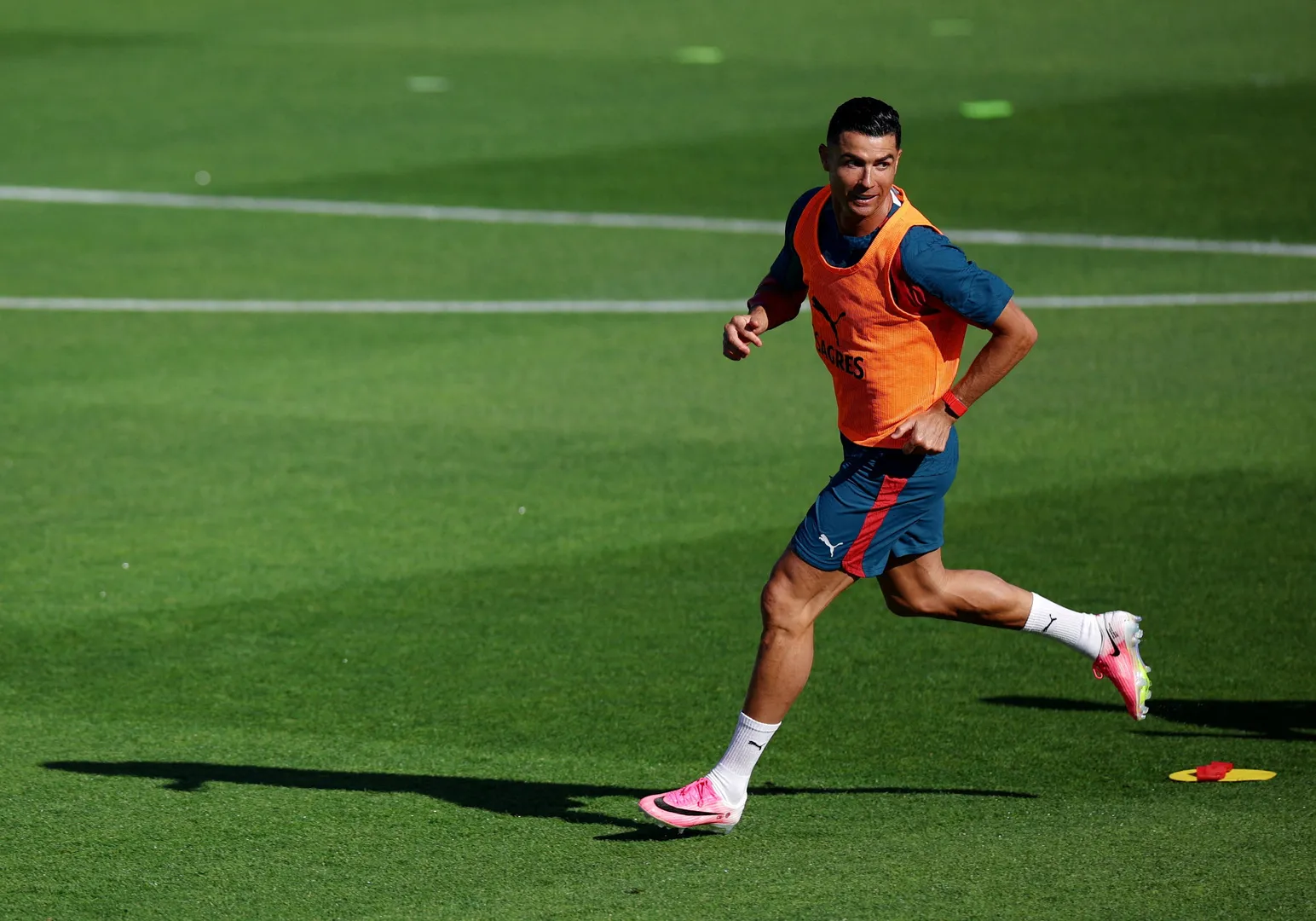
Toronto, Canada – The year was 2009, and a sculpted, spiky-haired, 24-year-old Ronaldo was greeted by hundreds of adoring fans in Toronto dying to catch a glimpse of the newly signed Real Madrid superstar as he graced the city with his presence for the first time.
Fast forward 17 years, and the visuals are almost identical, give or take a few differences.
Recommended Stories
list of 4 itemsend of list
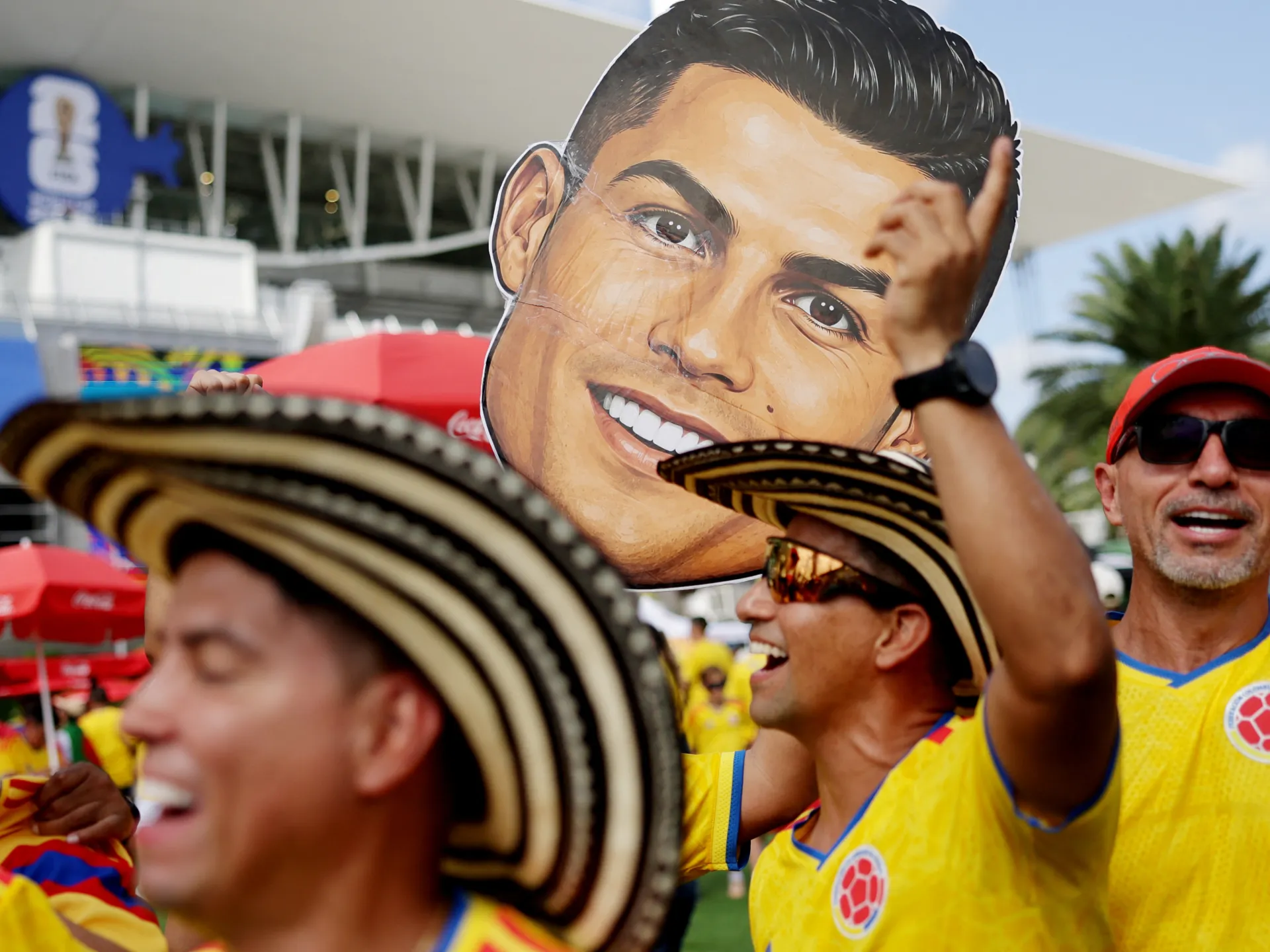
Hundreds of Toronto residents took to the streets on Wednesday, lining highways, thronging downtown intersections, climbing onto each other’s shoulders and peeking out of high-rise buildings, all to get a 10-second glimpse of Ronaldo passing by, as Portugal arrived in the city ahead of their World Cup round of 32 clash with Croatia.
The last time the football icon was in Toronto was August 2009 when Real Madrid played a friendly against Toronto FC, coincidentally at the same stadium where Portugal will take on Croatia on Thursday evening.
Wednesday being a public holiday increased the chances of fans catching a glimpse of the 41-year-old football legend at what is likely to be his last ever World Cup, and potentially last World Cup match if Portugal are knocked out of the tournament.
The city was buzzing with Ronaldo fever right from the minute Portugal landed at Pearson airport early Wednesday afternoon.
Biker groups lined Gardiner Expressway to escort the Portuguese team bus to the Delta Hotel, where hundreds of fans gathered to get a glimpse of Ronaldo as he exited the bus, and then again when the team headed to Centennial Park for their training session.
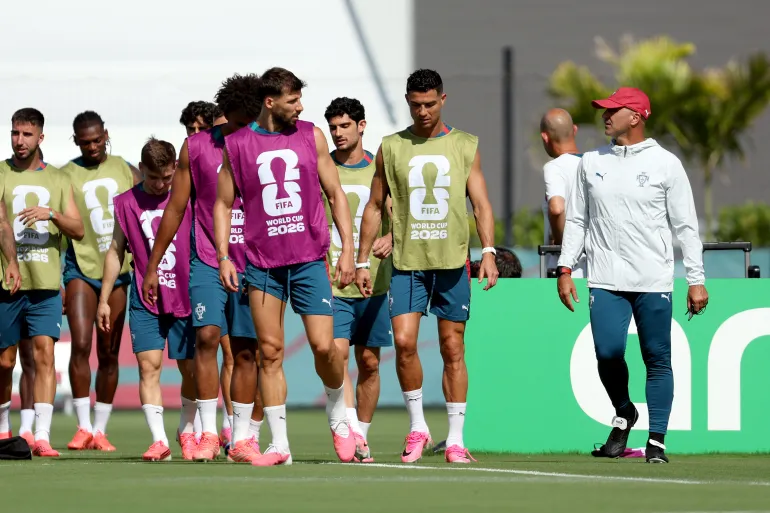
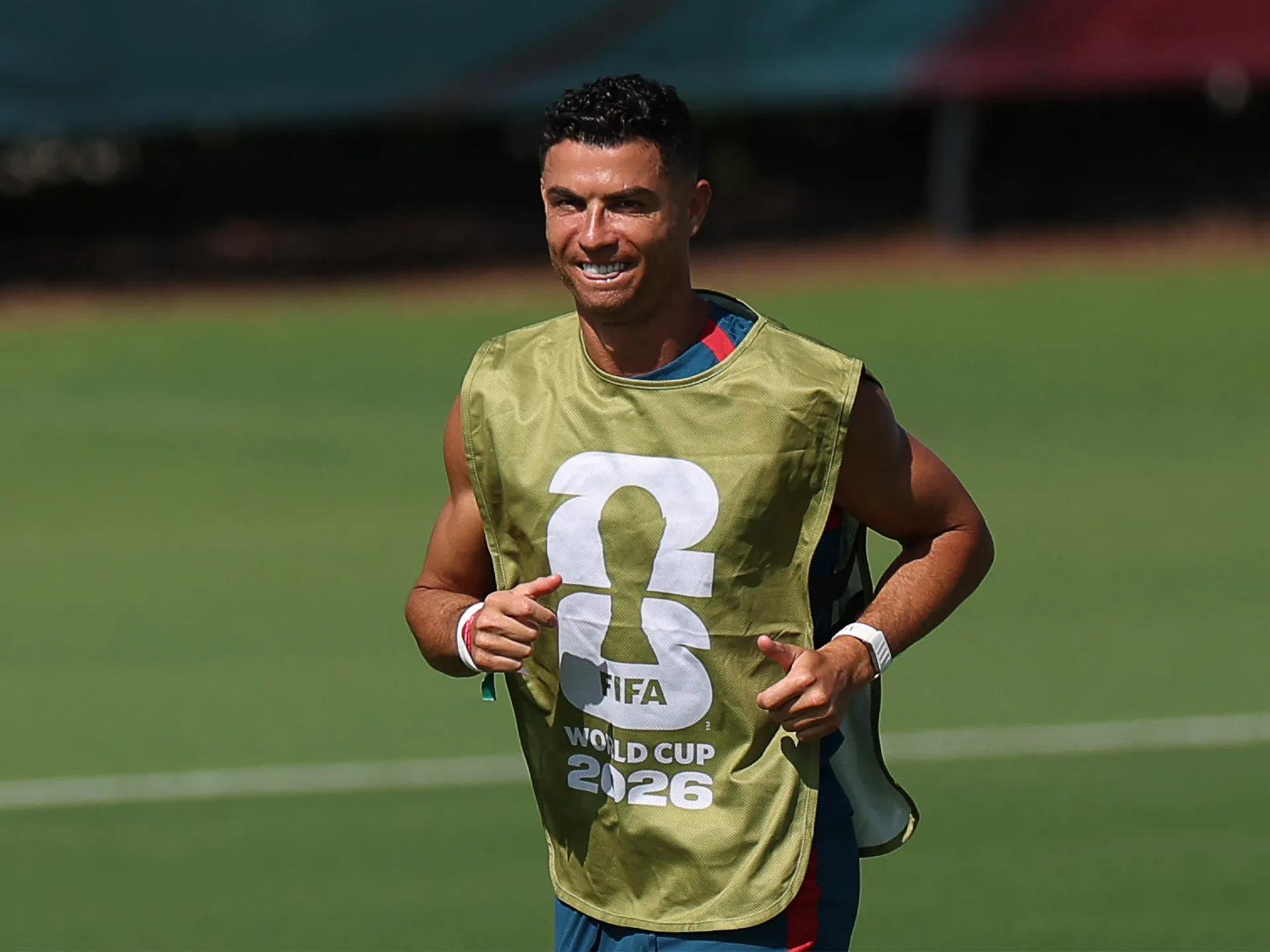
Even at the grounds in Etobicoke, dozens of starstruck fans sporting red #7 jerseys stood outside the field as Ronaldo and the Portugal team warmed up on what was supposedly the hottest day of the year in Canada.
The fan frenzy was valid; for most Portugal fans in the city, this was the closest they would get to seeing the one and only Cristiano Ronaldo in person.
Sky-high ticket prices for the match, some as ludicrous as $30,000 Canadian dollars ($21,000), were unaffordable to the average football fan.
Tickets to the sold-out game have averaged $2,500-3,500 Canadian dollars over the past week on resale platforms, even though Ontario laws forbid third-party sales above face value.
“I’m a dad and a husband, and I couldn’t justify spending that kind of money on a ticket no matter how much I want to see Portugal play in Toronto,” Joey, 33, told Al Jazeera, as he closed out his shift at Bairrada Churrasqueira on the fringe of Little Portugal in Toronto.
“But it still feels surreal that Portugal is playing here in Toronto, who would have ever thought that,” the restaurant worker beamed, as he flipped chairs onto the tables before mopping the floor.
Worlds collide
Joey, who declined to share his surname, was one of tens of thousands of Portuguese-Canadians who have called Toronto home for several decades now.
The first wave of immigrants arrived in the 1950s seeking better opportunities for themselves and their families. Just last year, the city inaugurated the Azores Parkette in the heart of Little Portugal to honour the 18 “pioneering men” who departed Sao Miguel, Azores, and landed on the shores of Halifax to build a new life.
So when Portugal take the field in Toronto Stadium on Thursday, it’ll be more than just a game for generations of hyphenated Canadians in the city; for them, it’s two worlds colliding in a once-in-a-lifetime moment.
For Shannon Medeiros, 46, the match holds even more significance. The football fanatic fell in love with the sport aged six, inspired by her father, who attended every game and coached her as she delved into the sport.
The game has been a crucial part of her life, and her family’s, since her father and his family arrived in Canada when he was 16 years old, in the 1950s.
Like many immigrants at the time, schooling had to be abandoned in favour of a job to help make ends meet for the family, which, in his case, arrived in Montreal with a single suitcase and lived in another family’s basement until they could afford a place of their own.
Football was the only non-negotiable, axiomatic staple in the Portuguese community that grew from a few hundred to more than 300,000 people.
“It’s something we do as a family now; that’s how much the game means to us,” said Medeiros, who now coaches her two sons in the sport the way her father did for her.
The storyline is almost identical to that of Stephen Eustaquio, Canada’s wonder boy who scored against South Africa to send his team to the World Cup round of 16 for the first time in history.
Canada’s Stephen Eustaquio celebrates after winning the 2026 World Cup round of 32 match against South Africa at the Los Angeles Stadium in Inglewood on June 28, 2026 [AFP]
The Ontario-born, partially Portuguese-raised football star was guided into the sport by his father and his Portuguese background for a love of football. The sport was a way for the community to come together and enjoy a shared sense of identity, as Canada welcomed dozens of ethnicities decade after decade.
“The one thing you’ll see in the Portuguese community is how proud we are – of our heritage, our culture, to wear the jersey, put a flag up,” Medeiros told Al Jazeera.
A walk through Little Portugal during the World Cup would show you just that; flags split diagonally with Canada and Portugal in each half, fluttering on porches or glued to bedroom windows, an omnipresent CN Tower needle peeking above the neighbourhood anywhere you stand.
Match predictions
Medeiros admitted that while the team has not been playing to their full potential at the tournament, they have a strong chance of winning against Croatia. She’ll see whether her prediction comes true or not as she watches the game with her father at his house.
Elsewhere in the city, fans without match tickets are heading to sports bars, match screenings and fan festivals to see whether Ronaldo will score his first knockout-round goal at a World Cup that saw an unimpressive start for the Portuguese captain.
“I think Portugal will win 2-1, or maybe 3-1. But don’t tell my girlfriend I said that,” Josh Madeiros grinned, as he waited for his drink at Garrafeira. The Portuguese-Canadian 35-year-old will be supporting his side away from his girlfriend, who is Croatian.
He thought long and hard before admitting that Portugal’s team has had a shaky run so far, and that there’s only so much Ronaldo can do as a player in his forties.
“But he’s still my guy, and he’s still the GOAT [greatest of all time].”
A ranking of Europe’s most underrated cities has named a historic spot that many Brits may not have even heard of, and visitors can explore Roman ruins, gothic monasteries, and a doll museum
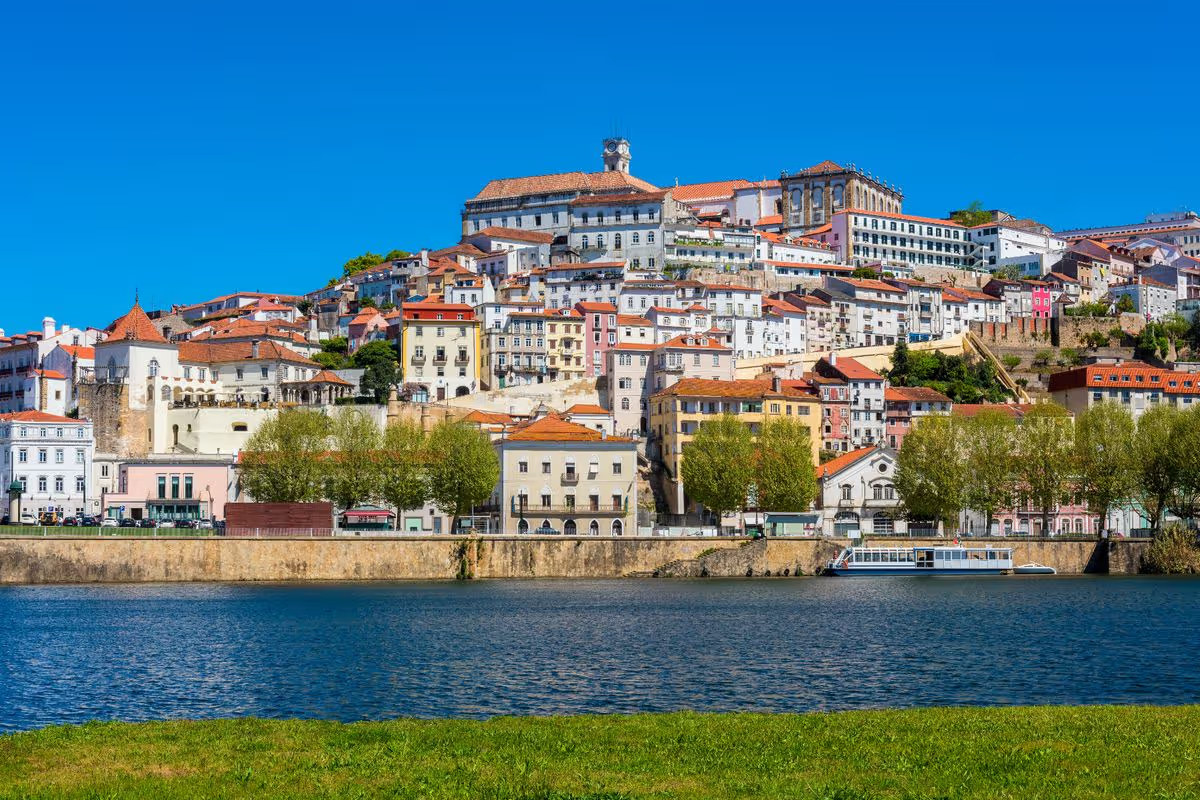
The riverfront city was once Portugal’s capital(Image: Getty Images)
Portugal has long been a major city break destination for Brits, and while most head to either Porto to explore its colourful, hilly streets, or Lisbon for a lively, cultural atmosphere, there’s one spot that gets overlooked.
For over a hundred years, Coimbra was Portugal’s capital, a thriving walled city that had monasteries, grand cathedrals, and a university that’s still operational today making it one of the world’s oldest. When the King moved the capital to Lisbon, it became a centre of Renaissance art, bringing French and Italian influences to the area and becoming a town where intellectuals flocked, inspired by the peaceful riverfront scenery.
Recently, Which? identified Coimbra as one of Europe’s underrated cities, noting: “It’s a historic, cultural and academic hub, with a Unesco-listed university complete with a gilded baroque library that’s open to the public for visits and tours.
There’s also a winding old town that, unlike Lisbon and Porto, isn’t bottlenecked with tourists in peak season — and you’ll also find plenty of atmospheric tascas for truly Portuguese lunches and dinners.”
Despite its close proximity to Lisbon and Porto, trains take 90 minutes and an hour, respectively.
It’s not a destination visited by many Brits. It’s perfect for a day trip from the Portuguese coast, although you may want to stay longer and soak up the authentic atmosphere among its sun-soaked streets.
Visit the ruins of Mosteiro de Santa Clara-a-Velha, a Gothic monastery that dates back to the 1300s, which has become a major archaeological site, and explore a museum full of treasures from ancient tombs.
Santa Cruz Church is another must-see in the town. The whitewashed church has incredible blue-tiled mosaic murals that cover entire walls, and a peaceful, if eerie, mausoleum that is the final resting place of Portugal’s first king.
National Museum Machado de Castro has artworks and sculptures from the Renaissance artists who once lived in this town and honed their skills.
Built on a set of Roman tunnels, the museum is housed in a serene 11th-century cloister where you can enjoy the peaceful atmosphere of its cool marble walls.
A short drive outside the city are a number of tiny Schist Villages, traditional mountain settlements that are being restored to capture the country’s heritage. There are 12 villages in the Lousã Mountain, and from Coimbra you can take a guided tour through the winding mountain roads to explore these areas where time stands still.
Popular stops include Cerdeira, once abandoned but now the home of an arts and crafts school, and Talasnal – famous for its rustic stone cottages and incredible views across the pine-covered. mountains. On the way back, visit Arouce Castle, a medieval fortress that overlooks a river beach. There are areas for swimming in the pure mountain waters, and waterfalls that add to the untamed scenery.
Have a story you want to share? Email us at webtravel@reachplc.com
Many Brits heading to the EU are dreading their journey through the airport due to the new European Entry/Exit System (EES), but many don’t realise there’s an app available to cut waiting times at certain destinations
The app could save you the hassle of using a European Union Entry/Exit System (EES) kiosk(Image: Justin TALLIS / AFP via Getty Images)
Peak holiday season is upon us, and the launch of the European Entry/Exit System (EES) is reportedly causing queues at destinations such as Spain, Greece, and France.
Local media in Spain has warned that Brits could face six-hour queues, and there have been reports of passengers missing flights, with airports blaming “additional processing requirements”. All non-EU visitors to the European Union, including Brits, are now required to have biometric information such as facial images and fingerprints taken on arrival, and must also use the machines on departure to help the EU flag overstays.
One of the reasons why Brits often face longer queues at the airport is that, while EU passport holders have their own lanes, Brits have to queue alongside other non-EU nationalities. But for those going to Portugal or Sweden this summer, there is a way to speed up the process.
An official (but not very well-known) app could potentially get you through the airport quicker. At the moment, the Travel to Europe app is only available for visitors to two EU countries, but it could be rolled out to other destinations in the future, according to its developers.
Brits heading to these countries can download the app on the App Store or Google Play – making sure you download the right app and not a third-party one.
Create a new journey by selecting the country you’re arriving in or departing from, this can be done up to 72 hours before your travels begin. You can then add a border crossing point and your estimated time of arrival.
Travellers can then scan the personal details page and chip of their passport, take a selfie to confirm their identity, and answer a few questions about their plans. Normally, these steps would be done at the EES kiosks, so by doing them on the app at home, you can save time at the airport.
Families travelling together can also add other passengers before submitting their journey. Once registered, you’ll get confirmation that your journey has been accepted. Then you simply need to follow the signs at the airport to make your way through security. The app developers are careful to point out that using the app doesn’t guarantee border entry, and that anyone passing through the airport can still be flagged for additional checks.
But for the majority of holidaymakers, this could cut down on the time they spend queuing and waiting to enjoy the Portuguese sunshine.
Reviews of the app have been mixed so far. One user said: “Pointless to have an app that supports only one country – I understand it is optional for Member States to incorporate the app into their systems, but it doesn’t mean this couldn’t have been arranged better.” But there were success stories, with one user saying: “I went to Stockholm…. long queues for UK passports. I had already used the app, and used the pre-registered lane. Two people in front of me. The whole process took about three minutes. Very impressed!!”
Around 2.4 million British tourists visit Portugal every year, making up the majority of the country’s tourism, although this is a fraction of the 19 million British visitors Spain saw in 2025. Overall, foreign tourists contribute €5.2 billion a year to the country’s economy (about £4.5 billion), with Brits as the biggest spenders followed by Germans.
Have a story you want to share? Email us at webtravel@reachplc.com
Colombia and Portugal played out a breathless 0-0 draw to a wall of sound at Miami Stadium, with both teams advancing to the last 32 of the 2026 FIFA World Cup as the top two in Group K.
The Colombians will rue their profligacy in front of goal on Saturday, but take encouragement from dominating quality European opposition for large periods as they head off to Kansas City as group winners to take on Ghana on Friday.
Recommended Stories
list of 4 itemsend of list
Portugal, who needed to win to top the group, go north to Toronto to play Croatia on Thursday, knowing they have not quite yet found a way to blend all the talent in their squad into an effective team.
The match started to a cacophony of noise from the massed ranks of yellow-shirted South Americans, and the decibel levels went up a notch when striker Jhon Cordoba headed the ball over the bar in the first minute.
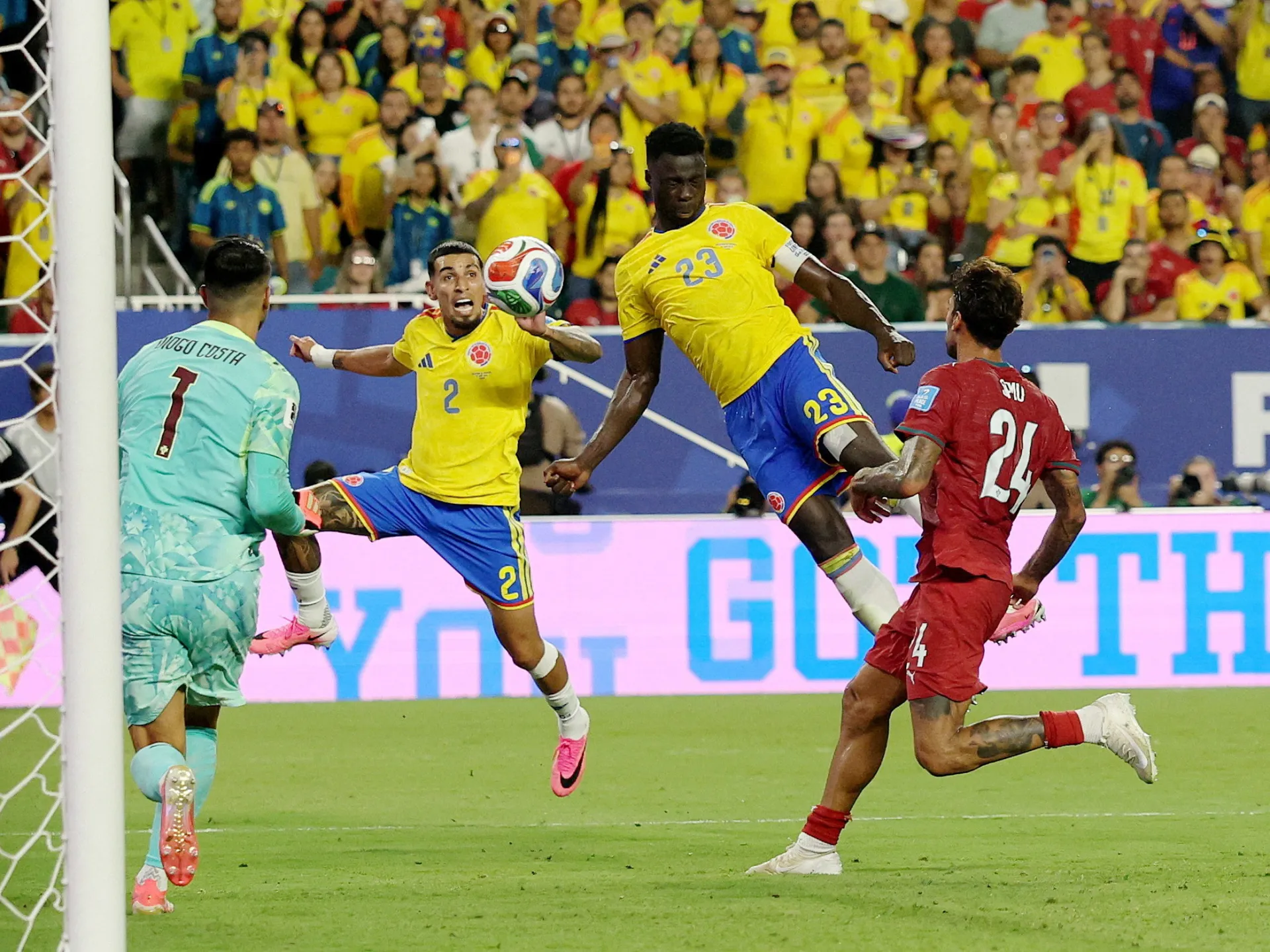
Jhon Arias caused Portugal problems every time he ran at them, and he set Cordoba free in the 17th minute, the big target man unleashing a rocket of a shot that keeper Diogo Costa did well to stop.
After a lovely flowing move five minutes later, winger Arias took the shot himself and screwed the ball towards the far corner of the net, only for Ruben Neves to arrive just in time to flick it off the line.
Colombia struggled to clear their lines cleanly sometimes, however, and it was this frailty that allowed Portugal their best chances towards the end of the first half.
Bruno Fernandes found himself free in front of goal in the 39th minute, with his shot bringing a fine point-blank save out of Camilo Vargas in the Colombia goal.
Three minutes before half-time, Joao Felix cleverly chested the ball over a defender and flashed an acrobatic volley over the bar.
Colombia pressed forward, looking for the goal their dominance deserved, and both Gustavo Puerta and playmaker James Rodriguez troubled the goalkeeper with shots before the break.
Portugal attacked more after the break, but it was Colombia who continued to carve out the best chances, with Arias setting up substitute Richard Rios for a shot that went wide.
Arias curled a shot at goal, which was well saved by Costa, and Puerta drilled another chance wide just before the hydration break.
A Rodriguez volley was deflected away from its target in the 73rd minute, just before he and Arias were substituted, but Colombia continued to tear forward at every opportunity.
Davinson Sanchez thought he had scored the winner with a far-post header a minute from time, but it was called back for a very tight offside after a VAR check.
Rafael Leao went close to winning it for Portugal in stoppage time with a shot that flashed across goal, before the referee finally called time on the entertaining match, played out in front of a crowd of 64,478 sweltering in the Miami evening heat.
Portugal’s totem Cristiano Ronaldo, booed every time he touched the ball and starved of service, had barely a sniff of a chance, his one shot on target a long-range free kick that went straight to the goalkeeper.
Wissa sends DR Congo into last-32 clash with England
In the group’s other game, Yoane Wissa scored twice as the Democratic Republic of the Congo beat Uzbekistan 3-1 and qualified for the last 32 of the World Cup for the first time in their history on Saturday.
They will meet England after registering their first-ever World Cup win.
Eldor Shomurodov’s lob over Lionel Mpasi gave Uzbekistan a perfect start in Atlanta.
But Newcastle striker Wissa levelled from the penalty spot, before Fiston Mayele’s goal sent the mainly Congolese crowd into a frenzy.
Wissa rounded off a historic night for the Africans with a fine strike in stoppage time for his third goal of the tournament.
Earlier on Saturday, Jude Bellingham dragged England through a stubborn Panama test, scoring and setting up Harry Kane in a 2-0 win that sent them into the World Cup round of 32 as Group L winners.
England were made to work for more than an hour in rainy New Jersey, before Bellingham broke the deadlock, crossing for Kane to head in his 11th World Cup goal, lifting him above Gary Lineker as England’s all-time leading scorer at the tournament.
Meanwhile, Nikola Vlasic headed in Luka Modric’s 83rd-minute corner to lift Croatia to a 2-1 victory over Ghana on Saturday and a second-place finish in World Cup Group L.
Vlasic’s perfect finish off the inside of the left post came 10 minutes after Derrick Luckassen had pulled Ghana level on his international debut, with half the time in between spent on a VAR review determining whether he was onside.
Petar Sucic scored early for Croatia, who needed only a draw to reach the last 32. Claiming the second-place spot guaranteed the 2022 third-place finishers a meeting with Portugal, the second-placed team in Group K, on Thursday in Toronto.
Jakob Davies, 25, suffered severe injuries after falling from a three-storey balcony during a stag do in Albufeira, Portugal, as his family launches a fundraiser to help him
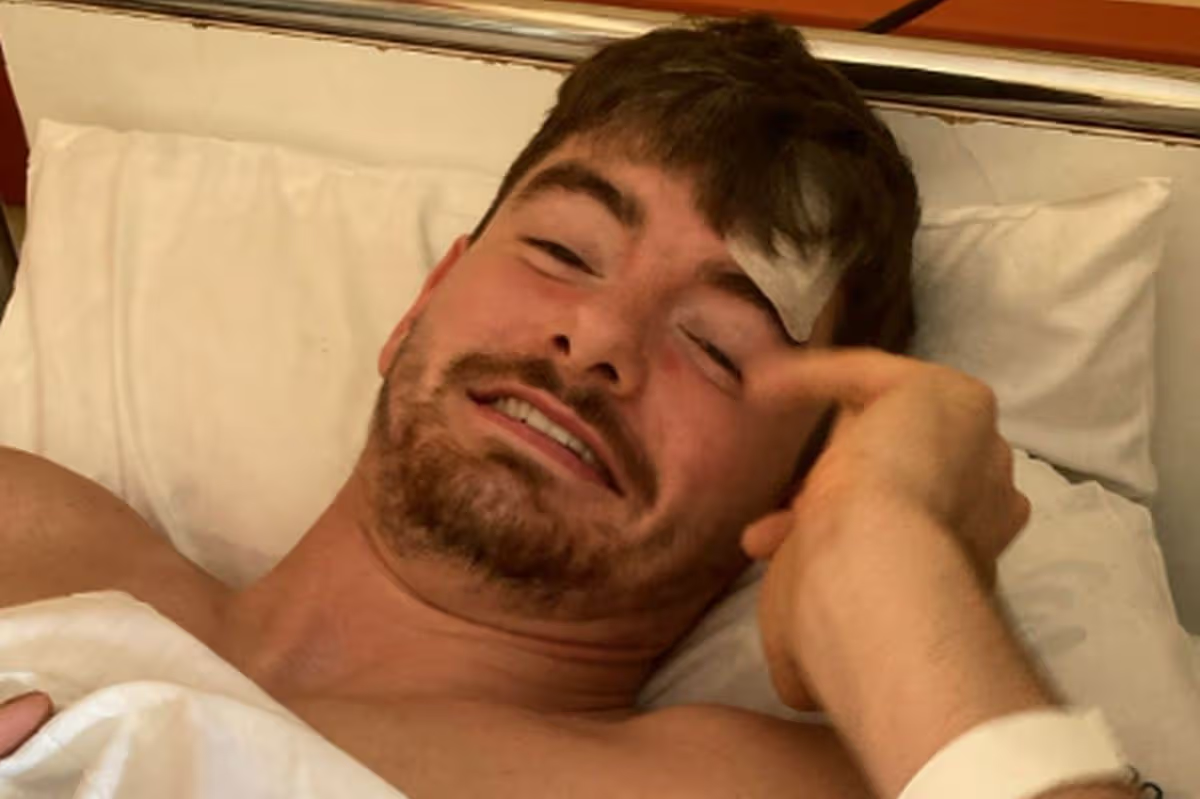
Jakob Davies remains in hospital after falling from a balcony in Portugal(Image: Kennedy News and Media)
The devastated family of a Brit who plunged from a three-storey balcony during a stag do in Portugal fear his travel insurance may not cover his mounting medical bills because he had been drinking.
Jakob Davies, 25, remains in hospital in Faro after suffering catastrophic injuries in a fall at a hotel in Albufeira earlier this month. His loved ones say they are still waiting to hear whether his insurer will pay out after tests showed alcohol in his system.
The factory worker, who is from Scarborough, North Yorkshire, had travelled to the Portuguese party hotspot with around 30 work colleagues for a stag weekend on June 4.
His mum, Claire Gerrard, fears the family could be left facing huge costs after doctors warned Jakob he may never walk again without urgent surgery.
The 51-year-old woman said: “He’s totally on his own. I need to know what’s going to happen to him. He was told if you don’t have this operation immediately then you won’t walk again.
“He does have travel insurance but because of the alcohol that he’s drunk it’s not looking like they will pay. We’ve contacted the insurance company and they wanted all the reports so I sent the reports.
“The doctor gave Jakob his alcohol levels with his bloods done and it did show alcohol in his system, which unfortunately they will not pay out.
“25 [years old] on a stag party he’s not going to have none is he? They’ve not said no yet, we’re still waiting on information. I think it should be made more clear to people, especially to youngsters. You’re going on holiday to a stag party and you can’t drink, they don’t listen, they just go and have a drink.”
Jakob had chosen to stay behind at the accommodation on June 5 to play football while the rest of the stag group headed out.
But when his friends returned later that day, they were alarmed to see fire engines, police cars and ambulances rushing towards their hotel.
Claire expained: “I think there were about 30 of them and it was somebody from work’s stag party. It’s all really, really vague, Jakob has no recollection of it whatsoever.
“He had been playing football with some other guys, his party were leaving and Jakob had said ‘I’m going to continue to play football’.
“I don’t even think he remembers playing football but that’s what he was doing. When the party was returning back to the hotel there were fire engines flying past and then the police came past and then the ambulances came past and had turned into their hotel so they thought ‘oh gosh something is going on’.
“When they got there Jacob was unconscious on the floor with severe head injuries and broken bones, it looked pretty horrific initially. When they got him in the ambulance, he had regained consciousness and he was speaking but he wasn’t aware of what had happened.”
Believed to have fallen from a three-storey balcony, Jakob was initially taken to a local hospital before being transferred to a larger hospital in Faro.
Doctors later discovered he had suffered a serious head injury, broken feet and ankles, as well as fractures to both his L1 and L4 vertebrae.
Recalling the moment she learned about the horror fall, the worried mum said: “I got a phone call at around 11am on Saturday morning [June 6] to say Jakob’s fallen from a three-storey balcony. My initial feelings from then on were absolute dread.”
As Jakob continues his recovery overseas, family and friends have launched a GoFundMe appeal to help cover medical expenses and the cost of bringing him back to the UK.
Travel insurance experts warn that some policies contain exclusions relating to alcohol or drug use, although terms and conditions vary between providers. Holidaymakers are urged to check the small print of their policies before travelling, particularly if they are planning to drink while abroad.
The 2026 World Cup will have 13 different kickoff times. You can use the Al Jazeera Sport widget to find out exactly when your team is playing in your local time.
Who: Colombia vs Portugal What: FIFA World Cup 2026 Group K match Where: Hard Rock Stadium, Miami When: Saturday, 7:30pm local time (23:30 GMT) How to follow: We’ll have all the build-up on Al Jazeera Sport from 20:30 GMT ahead of our live text commentary stream.
Recommended Stories
list of 4 itemsend of list
One of the biggest group games of the 2026 World Cup takes place in Miami on Saturday when Colombia face Portugal in a battle of Group K’s top two.
Colombia, powered by Luis Diaz and Daniel Munoz, have already booked their ticket to the round of 32 as the current table-toppers, while Cristiano Ronaldo-led Portugal, who are second, are also assured of a knockout berth.
Those standings could change after Saturday’s fixture at Hard Rock Stadium, where a capacity crowd is expected after tickets reportedly sold for thousands of dollars.
Al Jazeera tells you everything you need to know about Colombia vs Portugal:
Portugal expect ‘away’ atmosphere in Miami
Spearheaded by the larger-than-life presence of superstar Ronaldo, Portugal are a huge and popular draw globally – but for this match, Colombia will hold the spectator edge at Hard Rock Stadium.
With hundreds of thousands of Colombian Americans living in the Miami metropolitan area, the Colombian team has a partisan crowd behind them. In the lead-up, Portugal coach Roberto Martinez remarked that his side would be playing “away from home” while acknowledging the enormous hype around the final matchday for both teams.
Colombia vs Portugal is the most in-demand fixture of all 72 group-stage games, according to The Athletic, with five million ticket requests made in the first 24 hours of the Random Selection Draw in December.
“It means I had to buy tickets for my family in November,” Martinez quipped when asked about the fan dedication. “That’s what it means, because I knew it was going to be difficult to get tickets.”
“I think it’s fascinating. The passion of the game in a difficult moment in the world. Football still brings unity, it brings passion, it brings inspiration for the kids … So I hope football wins and inspiration of anyone that watches the game.”
While Colombia have reached the knockout stages with six points from two games, Portugal sit second on four points and are all but through. Finishing second could give them a tougher path in the knockout stage, with England or Croatia potential opponents.
Portugal train ahead of their game against Colombia, where they’ll be aiming to earn the top spot [Leonardo Fernandez/Getty Images via AFP]
Colombia coach warns team against Ronaldo, Vitinha
Colombia coach Nestor Lorenzo said his team will need “special tactical discipline” against Portugal, whom he considers one of the favourites to win the tournament. The Colombians need to avoid defeat to advance as group winners, but Lorenzo was taking nothing for granted against the No 5 side in the FIFA world rankings.
“We’ll try to maintain our style and our footballing identity,” he said.
“But without a doubt, we have to pay attention to the other characteristics and strengths [that Portugal] has. It’s a very well-coached team. They have a coach and players who are at the elite level of world football … and that shows in their game.”
Lorenzo also said Colombia will be wary of the threat posed by Ronaldo, who scored twice in the last match, and Vitinha, the defensive midfielder known for his ball control, work rate and playmaking abilities.
“Both Vitinha and Ronaldo are decisive players. One in the organisation of the game and the quality of his playmaking, and the other in finishing,” he added. “So we absolutely cannot leave them alone or neglect them. Hopefully, the team collective will be well-oiled.”
Colombia are set to feature in the World Cup knockouts for the first time since 2018, having failed to qualify for the 2022 World Cup in Qatar.
Wing-back Daniel Munoz has been a standout player in the Colombia squad, with two goals in two games [Ulises Ruiz/AFP]
Colombia vs Portugal prediction
Opta’s supercomputer has calculated a 48.9 percent probability of Portugal winning this fixture, while Colombia is assessed a 26 percent chance of victory. There is a 25.1 percent probability of the game ending in a draw.
Overall, Colombia are favourites to finish on top of Group G, with a 53.32 percent probability, according to Opta.
Colombia vs Portugal: Kickoff time, TV channel
Colombia: DSPORTS, RCN TELEVISION SA, CARACOL, DGO (6:30pm Colombia Standard Time)
Portugal: RTP 1, RTP Play, LiveModeTV, SPORT.TV5 (00:30am on Sunday, Western European Summer Time)
United Kingdom: BBC iPlayer, BBC One, Red Button 1 (00:30 am on Sunday, British Summer Time)
To check the TV listings for your country, head to FIFA’s TV listing schedule here.
What’s the scenario in Group K?
Colombia (six points) and Portugal (four points) are assured of a round of 32 berth each as the top two teams. The Democratic Republic of the Congo are third with one point, and Uzbekistan bottom with zero.
The top two teams from each of the 12 groups, along with the eight best third-placed teams, will proceed to the round of 32.
DR Congo have to beat Uzbekistan to stand a chance of advancing via the third-place team route.
Can Portugal finish on top of Group K?
Yes, Portugal can topple Colombia from first place in Group K if they beat the South Americans. Currently, they have a two-point difference.
If Portugal draw with Colombia or lose to them, Ronaldo’s side will remain second.
What’s the benefit of winning a group?
Group winners start their knockout campaign against a third-placed team from another group.
In this case, the Group G winner will face a third-placed team from Group D, E, I, J or L in the round of 32 in Kansas City on July 3.
Form guide
(Last five games, latest first)
Colombia: W-W-W-W-L
Portugal: W-D-W-W-W
Both teams have a solid record over the last five matches, with Portugal edging Colombia with an unbeaten streak over that period.
Portugal thrashed Uzbekistan 5-0 and were held to a 1-1 draw by DR Congo in the first game of the World Cup. They defeated Nigeria and Chile in pre-World Cup friendlies and beat the USA in a March friendly.
Colombia defeated DR Congo 1-0 and Uzbekistan 3-1 at the tournament. Before that, they beat Jordan and Costa Rica in June friendlies but lost to France in a March exhibition fixture.
Portugal have scored six goals across two matches at the tournament, including a double from Cristiano Ronaldo [Ronaldo Schemidt/AFP]
Colombia vs Portugal: Team news
No injuries have been reported by either Colombia or Portugal.
Our Mirror writer Georgia Reina discovers Portugal’s Alentejo region and its world-class food, wine and slow living
The unspoilt Portuguese region that’s home to incredible food, wine and history(Image: Calum Davidson 2011 Getty)
When you picture Portuguese getaways, you’re almost certainly thinking of city escapes in Lisbon or the golden sandy shores of the Algarve. However, if you’re after a holiday that combines sun-drenched heritage with a chilled-out, easygoing vibe — not to mention exceptional wine — the true gem lies an hour and a half inland.
You may not have come across Alentejo yet, but next year the region’s historic centre, the town of Évora, will claim the spotlight as the European Capital of Culture. It delivers the perfect small-town appeal with a rustic flavour.
Wandering its cobbled lanes, I instantly sensed it’s the lively sort of place where everyone appears to know each other, effortlessly swapping banter across open windows and sunlit squares.
There is a philosophy in Alentejo, an idea the locals embrace, called vagar. Literally meaning ‘to drift’, it’s the deeply rooted Portuguese practice of slow living.
Vagar is about taking things easy, relishing a leisurely lunch, enjoying a fine glass of red, and allowing the day to unfold without any frantic urgency. It became the spirit of our trip.
Where to stay
In the town centre, I stayed at the five-star M’ar De Ar Aqueduto, a contemporary design hotel set within a 16th-century palace. It has a captivating history, with a former life as a medical facility and monks residing just across the lane.
Its standout feature is the stunning garden pool, positioned directly beneath the soaring stone arches of the city’s renowned aqueduct. A short drive from town in Viana do Alentejo, Moagem Industrial Lodge is a masterclass in industrial-chic design.
Set within a converted historic grain mill, the property preserves its original machinery and rustic character while providing entirely modern comforts. An ideal place to embrace the region’s more relaxed rhythm.
The architecture of Évora is a tribute to its history, with treasures around every corner. The city is awash with brilliant white buildings designed to deflect the Iberian sun, adorned with striking yellow and blue (a traditional choice intended to repel evil spirits, though it apparently also works as a natural insecticide).
History effortlessly blends into contemporary life; nowhere more evident than at the Aqueduto da Água de Prata (Silver Water Aqueduct). This 12km wonder has homes, cafés, and shops cleverly tucked into the narrow spaces beneath its soaring stone arches.
At the city’s highest point sits the iconic 1st-century Roman Temple – formerly the ancient city centre. Yet Évora’s Roman heritage is also concealed right beneath your feet.
As we entered the grand, iron-framed City Hall, we uncovered the Roman bath complex – discovered during renovations in 1987 and beautifully preserved within the municipal building. But no visit is truly complete without experiencing Évora’s most bizarre attraction: the Chapel of Bones (Capela dos Ossos).
Constructed by 17th-century Franciscan monks, its walls and columns are carefully adorned with thousands of human skulls and shin bones. Standing there, taking it all in, was a powerful reminder of mortality I won’t ever forget.
Eat, drink, be merry
Évora’s culinary scene is renowned – local produce refined through generations of tradition. We began with an icon – doces conventuais (convent sweets).
Born from a 16th-century sugar boom originating in Brazil, inventive nuns blended sugar with egg yolks to create indulgent delicacies like Pão de Rala. On the savoury front, I don’t need to suggest a specific restaurant – the streets are packed with charming trattorias to choose from.
At virtually all of them, the highlight is pork – not just in main courses (succulent suckling pig), but even in puddings, where crispy, salty crackling is combined with sweetness – and it simply works. Complete your meal with Queijo de Évora, a sharp sheep’s milk cheese, or enjoy a glass of Marquês de Borba Late Harvest – now my go-to dessert wine.
What really places Évora and Alentejo on the international stage, though, is its wine. If you can schedule your trip around the Évora Wine Festival in late May, you’re in for an absolute delight (although tastings are on offer throughout the year).
The festival transforms the historic squares into vibrant celebrations with crowds enjoying rich, fruity reds and sunshine whites. During my tastings, I absolutely adored the Comenda Grande Rosé – a wonderfully dry, balanced wine with intense raspberry aromas and a crisp acidity that virtually demands to be enjoyed on a sun-drenched terrace.
The striking Quinta do Quetzal ‘Arte’ Red completely captivated me too, with its intricate blend of wild berries and rich spices, which complements pork dishes superbly. For a white, the lively Porta da Ravessa is pure Alentejo sunshine bottled, delivering an incredibly fresh, tropical burst of citrus that serves as the perfect local aperitif.
It is this remarkable, authentic viniculture that continues to cement the region’s standing as an absolute essential destination for food lovers and wine enthusiasts alike.
Beyond the city walls
Venturing beyond Évora for a day excursion, I’d suggest making the journey up to the medieval village of Monsaraz. Sitting high atop a hilltop overlooking the Spanish frontier, this ancient, walled museum-village appears frozen in time.
It boasts narrow, twisting lanes bordered by striking slate and whitewashed houses, all converging towards a magnificent 14th-century castle constructed by King Dinis. Strolling along its peaceful ramparts provides panoramic vistas across the golden Alentejo plains and the glistening waters of the Alqueva reservoir beneath – an ideal spot to embrace the purposeless wandering of Portuguese vagar at sunset.
The fluorescent green gaiters seemed a ridiculous suggestion, but prove a godsend as we plod across the sand. “I bet you’re glad I told you to get a pair of these bad boys now, aren’t you?”my friend Luke jokes. We’re marching across a wide, crescent-shaped, honeyed beach. The sun is high in the sky and slivers of light flicker through a thick sea fog, as 6ft waves crash and fizz, their white foam licking the towering limestone cliffs.
I’m in Portugal, in the west Algarve, with two friends, hiking part of the Rota Vicentina, or Fishermen’s Trail, a 140-mile (226km) trek that runs from Lagos to São Torpes in Alentejo. Traversing cliffs that lead to wild, remote beaches like this one is part of the trail’s calling card. As the name suggests, it was originally carved out by fishers to reach otherwise inaccessible fishing spots along the Atlantic Ocean. Now it’s part of the Rota Vicentina, a hiking and cycling route spanning 466 miles across Portugal.
Already, this corner of the Algarve feels a far cry from downtown Lagos, where we’d been woken up the night before by noisy tourists after one too many Super Bocks. Our official starting point is 25 minutes away in Salema – a fishing village set within the Vicentine Coast natural park.
Barriga beach, on the Atlantic coast near Vila do Bispo. Photograph: Jose Luis Alvarez Esteban/Alamy
The sedate seaside haven is perhaps how the rest of the Algarve was before mass tourism arrived in this part of the Iberian peninsula following the opening of Faro airport in the 1960s. More than 20 million tourists visited the Algarve last year, 5.7 million of them from the UK.
Visitors to Salema drift in and out like the tide, pottering along cobbled streets, past traditional blue-and-white fishers’ cottages, stopping to indulge in fresh seafood on the terraces of family-run restaurants overlooking the long, empty beach flanked by chalky cliffs.
Tempted to postpone the first day of hiking to idle away the hours, we instead polish off a load of pastéis de nata and a bica or two down at Pastelaria Solmar, then set off. For the first few miles, we wend along a relatively flat, clay-coloured coastal path, following the blue-and-green striped Fishermen’s Trail logo that should lead us to Sagres.
A street in Salema. Photograph: CMS Pic/Getty Images
Keeping the sea to the left (we’re heading north), it’s easy to navigate. Magical, too, with views stretching as far as the eye can see, across an Atlantic Ocean glinting in the summer sun. Occasionally, we have to scramble up or down a steep, rocky embankment. But the rewards, a series of serene beaches that seem to get better with every mile, make it worthwhile. Given the remote location, these pretty coves attract only the hardiest beach-goers, and the odd naturist.
Over the day’s almost 12-mile hike, we hardly see another soul. So, when we arrive at Sagres, we’re ready for some human interaction. The seafaring town is where slave trader Henry the Navigator spent the final years of his life. Nowadays, Sagres is better known for its enviable surf breaks.
“I’m ready for a Sagres in Sagres,” Luke says, as we drop our bags and freshen up at Alojamento Mareta, a modest two-bed apartment that hovers on a cliffside with a blushing garden and sea views (about £78 per night). We mooch around looking for somewhere for dinner and a cold beer.
Sagres doesn’t have any sense of coherent organisation; its scattering of cafes, restaurants and bars appear to have been sketched out by bored teenagers when the city planners were on holiday. Instead of joining a growing gaggle of surfers waiting for live music to start at Three Little Birds, we order piri-piri chicken and a glug of local wine from the family-run Cafe Conchinha and retire to bed.
Waking early, we zip down to the empty Mareta beach for a meditation session led by another friend, James, before plunging into the icy sea. As if the morning isn’t already wholesome enough, we head to the Laundry Lounge – a boho, wooden-clad laundrette-cum-brunch spot – for a 90-minute yoga session and some breakfast before getting back on the road.
‘Craggy cliffs bathed in a golden light’ …. the lighthouse at Cabo de São Vicente. Photograph: Allard1/Alamy
We make our way to Cabo de São Vicente, where a 19th-century lighthouse sits perilously on an isolated rocky headland whipped by the elements. Mainland Europe’s most southwesterly point was known as the “end of the world”. It’s not hard to understand why. There’s nothing but an endless melange of blue water and craggy cliffs bathed in a golden light. It’s little wonder that the Greeks and Romans believed it to be a sacred promontory.
Later, we cut inland across a pancake flat expanse of arid shrubland with only the odd purple thistle for colour. Then, after 12 miles or so, we arrive in Vila do Bispo, a dusty, eerily quiet town, like something from a spaghetti western. Low-rise, pastel-coloured houses seem worn by time and old dusty cars sit beneath purple wisteria on cobbled street corners.
Fish, hung out to dry on washing lines, flap around in the wind as we wander the streets looking for somewhere to eat. We stumble across Pisco, an unassuming restaurant with a cosy atmosphere – whitewashed walls hung with art and crammed with wine bottles – where the vegetarian menu has excellent Mediterranean dishes, sourdough pizzas and organic wines.
Charging back towards the coast the following morning, we arrive at perhaps the most picturesque part of the hike. On the cliffs above Praia da Pena Furada, a vast, windswept beach, we perch on the cliffside for a moment to admire tall sea stacks battered by waves, the wind whistling through them as gulls swoop like kites overhead. It feels more like Steinbeck’s California than the Algarve. But for the hissing of the sea, everything is silent.
We barely say a word to one another until we land at the impossibly long sandy beach of Bordeira near Carrapateira a few hours later. The atmosphere here couldn’t be more different. The beach is busy with Portuguese holidaymakers and surfers. It’s the perfect antidote to hiking fatigue, so we settle in for a well-deserved burger at the hillside beach bar Amadobar as low-fi rock drifts from the speakers and surfers paddle out to distant breakers.
The hike ended at Praia da Arrifana in the Aljezur area of the west coast. Photograph: GM/Getty Images
Our digs for the night, which we make our way to after sunset, are about 20 minutes from the beach. Carrapateira Lodge (about £52 per night) sits in the centre of a small, charming whitewashed town with a scattering of restaurants, bars, cafes and surf shops. We dine alfresco on the cobbles just off the main plaza at O Pontal, getting to work on plates of tender octopus, roasted salt cod and beef entrecote to sustain ourselves for tomorrow’s final push.
When we arrive at Arrifana, our final destination the following afternoon, we’re beat. The parish town is settled on the hillside in the Aljezur municipality. Like Carrapateira, it’s popular with surfers. It feels closer to the Algarve most visitors know in some ways, but it’s still relatively low key. A single lane road helter-skelters down to another postcard-worthy beach, where there’s a sprinkling of bars and restaurants. Shattered, we round off the trip watching sunset at Café Restaurante Sol E Mar, a no-frills bar that spills out on to the headland overlooking the beach, which is busier than others we’ve passed but not as crowded as other Algarve hotspots I’ve visited. No rowdy Britons in sight – except us three.
A “heat-dome” settling over western Europe could bring temperatures of up to 40C by Wednesday, with this latest UK heatwave expected to surpass the June record set in Hampshire in 1976
Milo Boyd Deputy Travel Editor & Commercial Writer and Sam Hall, Press Association
15:30, 23 Jun 2026
A heatdome has settled over much of Western Europe(Image: ARNAUD FINISTRE, AFP via Getty Images)
The UK Government has issued an ‘extreme’ travel warning for Brits heading to France, Spain and Portugal as a heatdome settles over western Europe.
The weather front is predicted to deliver temperatures approaching 40C by Wednesday, with this latest heatwave anticipated to eclipse the June record established in Hampshire in 1976.
Red heat alerts have been issued in France, Spain, and other nations across western and central Europe as heatwave conditions are forecast to intensify in the coming days.
More than half of France’s regions are currently under the harshest weather warning. Tragically, two children aged two and four were found dead in their family car in the town of Carpentras in the south of France, in an incident believed to be linked to the weather.
In a section on the Foreign Office’s website titled ‘extreme weather’, an update for France issued today reads: “Find out what you can do to prepare for and respond to extreme weather and natural hazards. In summer months, there is a risk of higher than normal temperatures in France. Check current weather forecasts and read about how to protect yourself on the Meteo France website.”
And the Portugal advice reads: “In Summer months, there is a risk of higher than normal temperatures in Portugal. Check current weather forecasts and read about how to protect yourself on the Portuguese Institute for Sea and Atmosphere website.”
Back in the UK, record high temperatures are forecast over the coming days.
Met Office spokesman Grahame Madge said: “The Met Office is flagging 39C as a headline maximum temperature on Thursday, most likely for somewhere in London or the South East. Forecast temperature values are indicative and are subject to a slight range either side.
“It is possible we could see temperatures higher than the 39C if the final values are at the upper end of our narrow range. It is important to remember that the temperature value is only one element of this extreme heatwave story. The other major factor is the high humidity which for many will make the intense heat even harder to endure.”
Throughout the night, temperatures remained above 20C at nine sites across England, registering what the Met Office classifies as a tropical night. Scorching temperatures gave way to thunderstorms and lightning strikes across England in the early hours of Tuesday morning.
Commuters also faced significant disruption across London’s transport network on Tuesday morning. The Elizabeth Line was hit by flooding caused by heavy rainfall, resulting in no service running between Heathrow Terminals 2 and 3 and Heathrow Terminal 4, Transport for London confirmed.
Passengers on the Mildmay Line also faced severe delays, with the line operating a reduced service due to the sweltering conditions. On the national rail network, soaring temperatures are also forecast to cause sagging overhead electric wires, buckled rails and lineside fires, with passengers urged to avoid non-essential travel and, if a journey is unavoidable, to ensure they have a bottle of water with them.
Avanti West Coast announced it intends to operate fewer services than normal between Tuesday and Thursday, warning that “there’s a risk of further disruption”.
Chiltern Railways has scrapped more than half its services across those three days “to ensure the safe operation of the railway”. The operator said: “We strongly advise you to avoid travelling if possible.”
The RAC revealed it is handling 10% more breakdowns than usual at this time of year and expects demand to “increase significantly as temperatures peak”.
The scorching weather is also set to cause considerable disruption for parents as schools shut or close early to shield children from the heat. Pupils have been told they may wear PE kit rather than full school uniform, which typically includes long trousers and blazers. A number of after-school clubs have also been called off.
THE thought of going on holiday alone may fill many with terror but if you’re struggling to find a travel companion, a solo travel specialist is the perfect solution.
Friendship Travel, which creates sociable breaks for solo travellers, offers trips across the globe, from snowboarding in France to safaris in Kenya, Nile cruises, walking tours, pottery-painting experiences and book-reading breaks.
Sign up for the Travel newsletter
Thank you!
Friendship Travel creates sociable breaks for solo travellersCredit: Friendship TravelBed down in one of the tranquil rooms at Casa RosaCredit: Friendship Travel
It’s only a two-and-a-half hour flight from Gatwick to Faro in Portugal, so I passed the time reading Plein Air Painting With Watercolours by Grahame Booth, our tutor for the week.
As I flipped through the glossy pages of stunning step-by-step landscapes, I wondered if I would be able to paint as well as he could. Spoiler alert: I would not.
I’d been nervous about travelling alone, but flying solo was so peaceful that the only time I missed having a companion was when I had to drag my 23kg suitcase (included in the trip) off the baggage carousel.
After a 20-minute transfer, I arrived at Casa Rosa, a pretty boutique hotel on a quiet side street near the market and harbour.
It has en-suite bedrooms, plunge pool, sauna, sun terrace, and fully equipped artists’ studio.
On the first night, all the guests were due to meet over dinner in the dining room.
I had my last moment of panic before I left my room that evening, picturing myself either being an immediate outcast or swallowed up by a group of misfits.
But I was wrong on both counts.
The art group watch a demoCredit: SuppliedThe fully equipped art studioCredit: Friendship Travel
There were ten of us, ranging in age from early 20s to mid-80s.
Eight women (including me), Jasper, a very posh elderly gentleman from Dublin, and Grahame, our tutor.
Over the wine and three-course meal (included in the price), we all bonded and shared our reasons for travelling solo.
Some, like Jasper and Kate — a cool, retired film producer from Florida who was travelling with her daughter Liz — were widowed and wanted to spend time with fellow art-lovers.
Others, like Oonagh, a glamorous ex-pat living in Portugal, and Pauline, an outgoing Irish woman who runs her own craft shop, had husbands at home who weren’t keen on painting.
Sue, one of the younger guests, runs art classes online and wanted to pick up new techniques.
It was a fun, chatty group, and as I crashed out in my enormous double bed at 10pm, sipping from the complimentary flask of herbal tea that had appeared on my bedside table, I felt I was among friends.
The week followed an easy routine.
Every morning we’d all meet at 8.30am and eat a buffet-style breakfast together at a long, sunny table outside on the terrace.
There were warm pastries, oats, local honey, cold meats and cheeses, fresh coffee and juice.
To give you an idea of the quality of the food, the jeans I wore flying over to Portugal wouldn’t button up for the journey home.
Then we’d gather up our art materials and Grahame would lead us to a variety of local beauty spots and attempt to teach us how to sketch and paint outdoors.
Kate’s painting of the hotel poolCredit: SuppliedFriendship Travel’s other activity holidays include pottery paintingCredit: Getty
He is a very funny teacher, who’d regularly offer down-to-earth advice like, “If you can’t draw cars, don’t!” or, “If it looks right when it’s wet, then it’s wrong”.
We all sat behind him, watching in awe as his brush rapidly covered his paper in sloshy, brisk marks that eventually became the bustling outdoor cafe, a calm church or the fish market.
At lunchtime we were left to our own devices and I took to escaping for a Sagres (the local beer) to boost my confidence for the afternoons, when we’d paint our own pictures.
We could either paint out on the streets — where passers-by would pause next to my sketchbook and shoot confused looks between my picture and the landscape I was failing to recreate — or upstairs at the hotel’s own studio.
The three-course dinner each night featured local dishes including quiches, pork, soups and barbecued fish.
The hotel happily catered to the vegetarians and gluten-free guests, as well.
On two nights we went out as a group to a restaurant, and treated locals to a medley of Les Mis songs as we walked back to the hotel.
There was lots of free time to go shopping. Olhao is famous for its hand-made cork, ceramics and mosaics, and one day we all took a boat trip over to Culatra Island.
On the last evening, Grahame organised a critique of everyone’s work.
My nerves returned and I expected him to either set fire to my sketchbook or suggest I book myself on to Friendship Travel’s other activity holidays (pottery painting, perhaps, or book reading), but he was shockingly positive.
And then we had a riotous and boozy last dinner together, with a talent show organised by Pauline.
It’s a week I’d gladly repeat.
The service from Friendship Travel was kind and personal, and I felt supported every minute of the trip.
Mind you, it was lovely to see my husband waiting for me in arrivals — so I could finally stop dragging my own case.
GO: CASA ROSA
GETTING/STAYING THERE: Friendship Travel runs its seven-night Portugal painting holidays in September and October this year and from April 2027.
Prices from £1,495pp include double room for single use at the Casa Rosa Boutique Hotel, buffet breakfast, four lunches and five dinners with wine as well as flights from various UK airports and transfers.
PERRIE Edwards is already booked and busy following her stunning wedding to Alex Oxlade-Chamberlain.
The former Little Mix songstress, 32, and her footballer husband tied the knot in an intimate ceremony less than a week ago after after nine years of dating.
Sign up for the Showbiz newsletter
Thank you!
Perrie Oxlade-Chamberlain is already back to work after her weddingCredit: Not known, clear with picture deskThe songstress was beaming as she performedCredit: Not known, clear with picture desk
But it appears Perrie is already getting back to work, and was pictured dressed up behind the scenes at the Isle of Wight Festival yesterday.
The singer got up on stage and performed for a buzzing crowd while wearing an all black skintight outfit.
Though she couldn’t help but take a moment to gush about her wedding to everyone, sharing how she is utterly “obsessed” with being able to call Alex her husband now.
Perrie and Alex jetted off to Portugal for their big day alongside friends and family.
She was performing at Isle of Wight Festival yesterdayCredit: Not known, clear with picture deskPerrie’s wedding to beau Alex was only days agoCredit: InstagramThe happy couple had been dating for nearly a decade before tying the knotCredit: InstagramPerrie debuted three gorgeous wedding dresses before jetting back to the UKCredit: Instagram
Insiders said the pair married in a low-key ceremony before hosting their closest family friends at the posh Parrilla Natural restaurant.
The pair said their vows in the Igreja Matriz de Estoi church in the village of Estoi in Faro, close to where they own a villa.
Perrie, who had six bridesmaids including her sister Caitlyn wore a long-sleeved, lace gown, while Alex looked smart in a tux.
Her bandmate Jade Thirlwall missed the celebrations as she was booked to perform at Primavera Sound Festival on the same day.
A source said: “Perrie and Alex’s wedding day could not have been more special.
“It was intimate and emotional.
“Perrie and Alex’s son Axel had a special role to play in the ceremony. It was adorable to see.
“She looked absolutely radiant and Alex didn’t stop smiling. It was a truly beautiful day.”
In the days after the wedding Perrie debuted two more wedding dresses in Portugal, including a gorgeous sparkly mini dress with a detachable jacket.
Former Little Mix bandmate Jesy Nelson is said to have not received an invitation.
IT’S NO lie that Brits love a European break but behaving badly could turn your trip into a holiday nightmare.
Across Europe, countries have their own rules relating to tourists – from banned beach items to strict curfews.
Sign up for the Travel newsletter
Thank you!
And if you want to avoid a hefty fine this summer, you’ll want to know what the rules are for each country.
France
A number of major cities in France and holiday hotspots ban drinking alcohol between 4pm and 8pm, including along the Paris riverbanks and the French Riviera.
When it comes to heading to the beach, make sure to not take any of it home with you as a souvenir.
Taking shells for example, is considered environmental theft and you could be fined €250 (£216.60) for doing this.
Swimming is always a fun activity, but men heading to the pool need to make sure you leave the swimming shorts at home.
Due to health and hygiene laws in the country, men in France must wear Speedos.
Some places ban drinking alcohol on the streetsCredit: Getty
Spain
Most cities in Spain have banned drinking alcohol on the streets, such as Madrid, Barcelona and Valencia.
Also don’t jump from your hotel balcony into a pool – you can get kicked out of the hotel and fined.
Across Spain, make sure to not smoke or vape on the terraces of bars or restaurants or at pools.
Make sure to not jump from a hotel room into a pool as you could get kicked outCredit: Alamy
But in Barcelona and popular Balearic and Canary Islands spots, smoking and vaping are banned across all beaches.
Fines for this range from €30 (£25.99) to €2,000 (£1,732.79).
In Barcelona, Malaga and Majorca, make sure not to walk through the streets in a bikini or swimming trunks. If you do, you could face a fine of up to €300 (£259.92).
Also when you are at the beach in Cullera, Calpe or Tenerife, don’t reserve a spot with a towel as you could have your belongings confiscated and be fined up to €3,000 (£2,599.18)
Portugal
In Albufeira, Portugal, there is a Code of Conduct in place for touristsCredit: Getty
In Portugal, there are some rules to be aware of when visiting.
Portable speakers are not allowed to be loud on beaches or you could be fined or it could be confiscated from you.
Fines vary between €200 (£173.28) and €4,000 (£3,465.58) for this.
Also in Albufeira, a Code of Conduct introduced last year is still in place for tourists this year.
The rules basically reinforce that visitors must act respectfully, with public nudity and drinking alcohol on the street banned.
Italy
There are a number of different rules across Italy you’ll need to follow.
In Florence, there are a number of streets where you can’t sit and eat outdoors.
The rule has been introduced to ease congestion.
In Italy, you cannot wear flip flops on the Cinque Terre hiking trailCredit: Getty
Also in Florence, e-scooters are banned in the city centre.
In Liguria, Portofino, over the summer, travellers who walk the cobbled streets either barefoot, in swimwear or topless can be fined.
You could also get fined between €50 (£43.32) to €2,500 (£2,165.99) if you are caught hiking Cinque Terre in flip flops.
Drinking alcohol in the streets is also banned with fines up to £2,568.
And make sure not to sit or lie down on a path, wall or park as this can also get you fined. Fines range from £22 to £433.
Over in Milan, you cannot smoke outdoors unless you are 10 metres away from other people. If caught breaking the rule, you could be fined between €40 (£34.66) to €240 (£207.93).
In Rome, you cannot drink out of a glass bottle on the streets after 10pm and all outdoor drinking is banned after midnight.
While in the city it is also worth being aware that when you visit the famous Spanish Steps, not to sit, eat or drink on them.
And in Venice, it is illegal to feed the pigeonsCredit: Getty
This is to protect the 18th century marble from damage and stains and if you are caught doing this, you could get a fine between €250 (£216.60) and €400 (£346.56).
And if you are visiting the Italian island of Sardinia, make sure you don’t dig a hole, build a sandcastle or take sand or shells from the beach as you could be fined up to €3,000 (£2,599.18).
Heading to Venice? Make sure you don’t feed the pigeons – it is illegal and you can be fined between €25 and €500.
Greece
In Greece, there are some different rules compared to other countries.
For example, at archaeological sites like the Acropolis and the Parthenon you cannot wear high heels.
If you are caught with high heels, you could be fined up to £760.
Drinking on the streets is also not allowed.
And if you are caught topless in public you could face a fine of up to £250.
Even though it may be tempting, make sure you don’t take pebbles from Greek beaches either as you could be slapped with a £771 fine.
It is also worth knowing that across Greece, sunbeds and umbrellas have been banned on 251 beaches and the beaches that do have sunbeds allowed, at least 70 per cent of the sand must be without sunbeds.
Joao Neves opens the scoring for Portugal with early goal, but Yoane Wissa equalises in first-half injury time.
Published On 17 Jun 202617 Jun 2026
Cristiano Ronaldo’s record-equalling sixth World Cup got off to a disappointing start as the Democratic Republic of the Congo (DR Congo) secured their first-ever point at the football finals, drawing 1-1 with Portugal in their Group K match.
Yoane Wissa’s header cancelled out Joao Neves’s early goal on Wednesday, and the African side – appearing in their first World Cup since 1974, when their country was known as Zaire – more than held their own.
Recommended Stories
list of 4 itemsend of list
Portugal’s Ronaldo, 41, was largely a peripheral figure throughout the match, failing to make the impact his great rival Lionel Messi had achieved on Tuesday in scoring a hat-trick against Algeria.
The DRC’s achievement was even greater, given that their preparations had been disrupted by the Ebola outbreak back in their country.
Some Portugal players were wearing wrist bands, given to them by their Prime Minister Luis Montenegro, in tribute to late teammate Diogo Jota, who was killed in a car crash last year.
Portugal got off to the perfect start, with Neves powering home a header from Pedro Neto’s cross in the sixth minute.
However, despite dominating possession, they lacked a cutting edge, and well into time added on in the first half, their opponents made them pay.
Wissa rose unmarked to head past Diogo Costa in the Portuguese goal, sparking wild celebrations on the pitch, the bench and among the Congolese fans in the stadium as the Newcastle forward registered his country’s first-ever goal at a World Cup.
Former Portuguese defensive bulwark Pepe, watching from the VIP seats, did not look impressed.
Bernardo Silva had started the day by joining Real Madrid on a free transfer, but he ended it by watching from the bench after coach Roberto Martinez took him off at half-time.
He was briefly off his feet celebrating when Joao Cancelo’s overhead kick hit the back of the net – only for it to be ruled out for offside.
The Congolese were matching the Portuguese, though, and 35-year-old veteran striker Cedric Bakambu shrugged aside Bruno Fernandes, but his shot came back off the near post.
Ronaldo finally had a chance to shine when presented with a chance by Francisco Conceicao’s pass. But he fluffed his lines, sending it wide of the post.
The same combination linked up again minutes later, with Conceicao – a far livelier presence than Silva had been – teeing up Ronaldo. But once again the result was the same, and the ball went wide.
Portugal thought they had at least got a corner, but when it was not given, Conceicao slammed the ball into the ground in frustration as his side failed to pick up three points in their opener.
FOOTBALL fans better strap in as there is a huge new attraction themed all around the sport landing in Europe.
Viva Mundo is a new football-inspired theme park in Santarém, Portugal, due to open in time for the next World Cup in 2030 – which will be hosted by Portugal, alongside Spain and Morocco.
Sign up for the Travel newsletter
Thank you!
A new football theme park is planned for EuropeCredit: YouTube/Viva MundoThe theme park called Viva Mundo, will be split into six main areasCredit: YouTube/Viva Mundo
The attraction won’t be themed around specific clubs but rather a love for the sport.
The theme park, which is expected to cost £389million, released a video this week showing potential rides and attractions that could feature at the park.
The video shows the park could include a Vegas-like sphere, a 4D cinema experience and even a water obstacle course.
Across Viva Mundo there will be 28 attractions in total.
Football fans can expect a fan zone, as well as 28 attractionsCredit: YouTube/Viva MundoAttractions include a dual rollercoaster where families can race alongside each otherCredit: YouTube/Viva MundoThere will also be a rollercoaster that launches riders at high speedCredit: YouTube/Viva Mundo
There will be rollercoasters including a dual rollercoaster, where families can race against each other and another that will launch riders at high speed.
Other rides will include a log flume and rapids as well as a drop tower.
According to Local Online, the theme park will be split up into six different areas – the entrance, the ‘Memory’, ‘Flavours’, ‘Fans’, the ‘Spectacle’ and ‘Football World’.
The Welcome Gate area will be where visitors enter the theme park, then Memory will be where they can visit a shop and museum, showcasing the sport’s history as well as iconic memorabilia from around the world.
Other attractions at the park include areas for younger kidsCredit: YouTube/Viva MundoAnd there could be a Vegas-like sphereCredit: YouTube/Viva Mundo
In the Flavours area, fans will be able to grab a bite to eat with several different restaurants with food from around the world.
As for the Fan Zone, the area will replicate the energy of a stadium on a match day, with virtual reality experiences for fans.
In the Spectacle area, fans can expect a 4,000 seat arena for live concerts and performances.
And last but not least will be Football World, located around a central lake and divided into sub-zones that include: Passion – a tribute neighbourhood; Glory – a area dedicated to football legends with trophies; and Fantasy – a playground-like area for younger fans.
The park is due to open in time for the 2030 FIFA World CupCredit: YouTube/Viva Mundo
And visitors won’t need to stay outside of the park as there will also be a 300-room themed hotel onsite.
The park is planned to open on April 29, 2030, which would be in time for the 2030 FIFA World Cup, which Portugal is due to co-host alongside Morocco and Spain.
The park will be 40 minutes from Lisbon and an hour and a half from Porto.
Santarem, where the theme park will be located, is a historic city worth exploring in its own right.
And it will be just 40 minutes from LisbonCredit: YouTube/Viva Mundo
Dubbed the ‘Gothic capital’of Portugal, the city boasts fascinating architecture as well as amazing views of the Tagus River.
One spot to not miss is the Portas do Sol Gardens, which is the city’s old castle.
The park expects to welcome between one and 1.5million visitors a year when open, according The Portugal News.
The Retirement Abroad Index 2026 has ranked 20 countries across five key areas including healthcare, cost of living and visa accessibility – and the results may surprise you.
The place you want to retire may be about to change(Image: Getty)
While you might be drawn to these sunny spots for a holiday, have you ever considered they could be the perfect place to spend your retirement?
As Brits approach retirement age, plenty contemplate purchasing a property in well-loved retirement havens such as Spain and France, but there are warmer, more affordable locations that could offer greater advantages, according to the latest figures.
The Expatriate Group, a specialist provider of international health insurance serving expats and retirees globally, has published The Retirement Abroad Index for 2026. The study assessed 20 countries, evaluating them across five crucial categories, including healthcare, visa accessibility, health insurance requirements, cost of living, and community and integration.
Drawing from these essential factors, it’s evident which destinations emerged as frontrunners for retirees and which have fallen in the rankings, with some surprising contenders.
Lee Gerry, director of Expatriate Group, said: “Retiring abroad has never been more achievable, but the decisions that matter most – healthcare access, visa routes, and the reality of day-to-day costs – are often the least well understood.”
“This index is designed to cut through the noise and give people an honest, data-led picture of where the real opportunities are.”
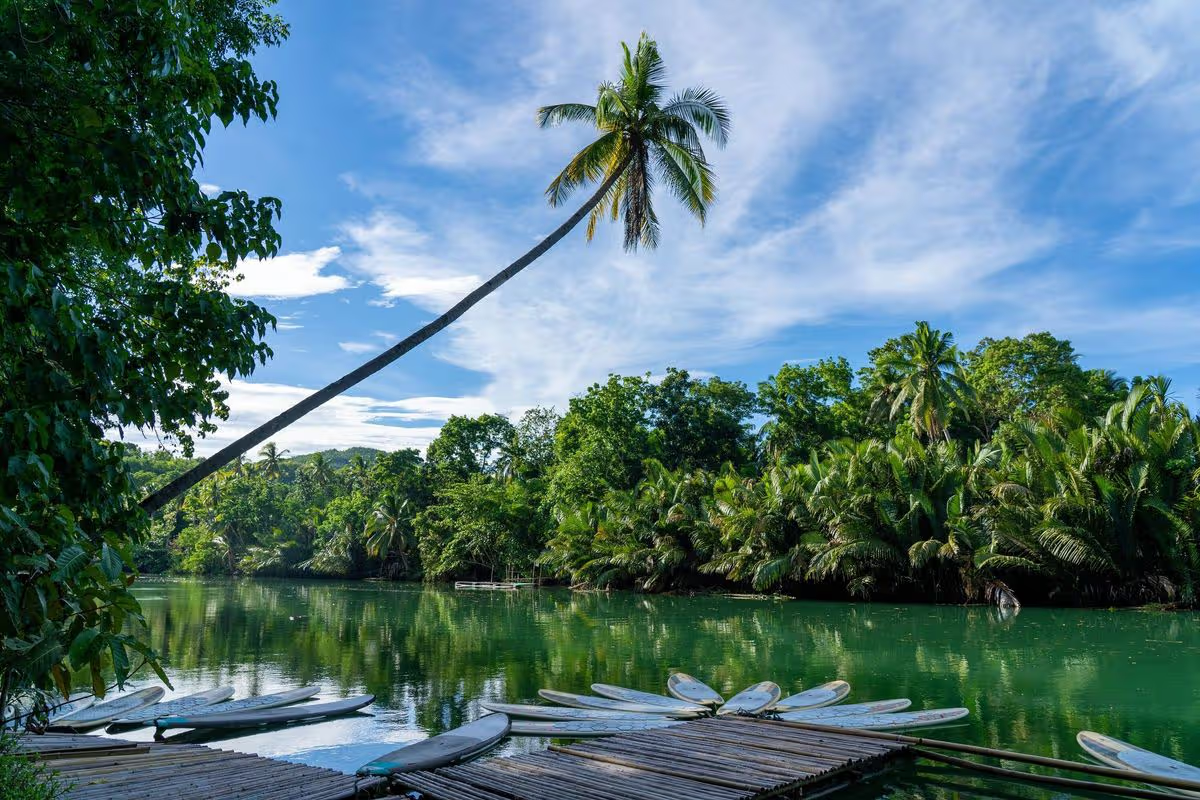
The top destination for retirement, according to the index, was the Philippines, with a Special Resident Retiree’s Visa that ranks among the most accessible globally. It requires a fixed deposit of roughly £11,000 for those receiving a pension.
What’s more, it achieved impressive marks for affordability and anticipated integration, which, combined with its tranquil beaches and stunning scenery, makes it an idyllic spot to enjoy your retirement years.
The second choice is perhaps less of a shock, as it’s certainly more familiar to Brits, though still not typically considered the top pick: Thailand.
The nation boasts several well-established and vibrant cities, each providing a flavour of its rich culture, but most prominently, Bangkok, Chiang Mai and Phuket all feature internationally recognised private hospital networks.
Thailand secured a perfect 20 out of 20 on the scoring index, excelling in the healthcare category alongside Spain and France. Regarding visas, their Non-Immigrant O-A Visa demands coverage of at least $100,000, approximately £74,000, per policy, per year, as a visa requirement.
The third country, which may surprise some retirees, is Colombia, offering one of the most straightforward retirement visa routes among the 20 destinations and, remarkably, achieving a cost of living score of 18 out of 20.
According to their findings, the report indicates a retired couple can generally enjoy a comfortable lifestyle in Medellín, the capital of Colombia, on roughly £1,000 to £1,500 per month. In contrast to most British cities, it boasts reliably warm weather and possesses a lively atmosphere that’s difficult to match elsewhere.
Portugal emerged as the first European nation to feature on the list as an ideal spot to spend your golden years, claiming fourth place. Joint fifth went to Sri Lanka and South Africa, while Malaysia and the UAE shared sixth position, before Mexico secured a solid seventh spot.
While Spain continues to be among the most favoured destinations for British retirees, it didn’t appear until eighth on the list, achieving 18 out of 20 for healthcare, though it was let down by the cost of living and visa complications.
It also shares eighth place with Indonesia, which is cherished for its relaxed way of life and renowned for its strong emphasis on wellness culture. Packed with stunning beaches and particularly attracting visitors to Bali, it has climbed to the top of countless people’s bucket lists as a must-visit destination.
Coming in at number nine is Panama, followed by Qatar. Panama has made headlines in recent years for its ‘Pensionado’ programme, which offers a generous range of discounts designed to make retirement far more affordable.
The scheme also requires retirees to demonstrate a lifetime income of just £738 or so per month, with an extra £184 for each dependant.
Due to several countries sharing identical scores, the top 10 is actually made up of 13 nations in total. These are:
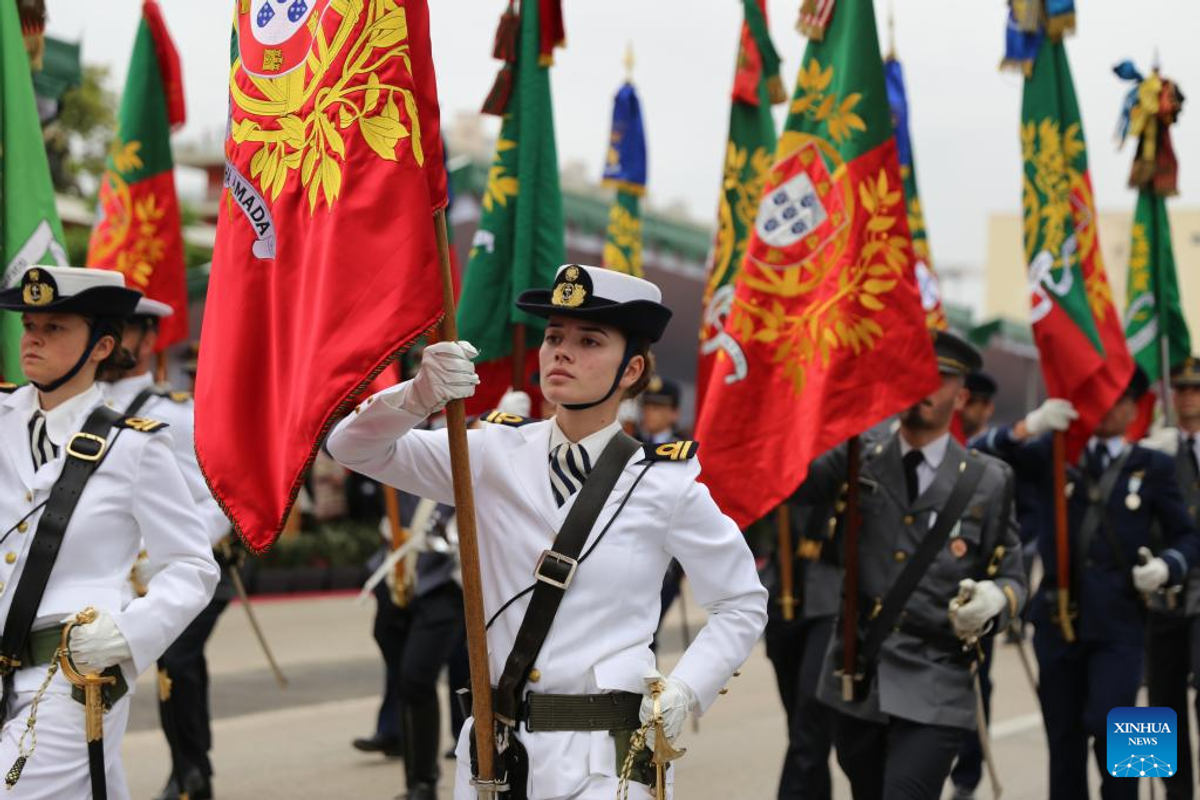
Camões wrote Os Lusíadas (The Lusiads), Portugal’s national epic celebrating the country’s history and achievements. While it is only officially celebrated in Portugal, Portuguese descendants across the world may also celebrate the holiday.
The Lusiads focuses on the Portuguese explorations in the 16th century, which greatly expanded the influence of Portugal. The poem is considered to be the most important piece of Portuguese literature and has become a symbol for the glory of the Portuguese nation.
Camões was a colourful character. He lost one eye fighting and was shipwrecked off the coast of present-day Vietnam. According to legend, during the shipwrecking, he kept his epic poem dry by swimming with one arm and keeping the other arm above water.
In the year that Camões died, Portugal lost its independence to Spain and began a period of rule by three generations of Spanish kings. It was over 60 years before the country regained its independence.
For such national days, it is common practice to use a date of birth to mark the national day, but since Camões’ date of birth was not known, the date of his death is celebrated instead.
Portugal Day began to be celebrated in 1880, decreed by King Luís I, who announced a national festival in honour of the 300th anniversary of the death of Luís de Camões.
A holidaymaker has shared her experience of visiting what she calls the real ‘paradise’ of Portugal many tourists ignore, where she discovered a hidden waterfall and gorgeous beaches
People were amazed to learn about the ‘hidden gem’ of Portugal (stock image)(Image: Getty Images)
Despite the UK being forecast for another warm and sunny summer, the allure of jetting off abroad to unwind on a sun-drenched beach in a foreign country can prove hard to resist.
Just a two-hour flight from the UK, Portugal has long been a firm favourite among British holidaymakers, particularly given its reliably sunny and warm climate for much of the year. While cities such as Porto and the capital Lisbon remain among the most popular spots for tourists, one traveller now claims to have uncovered the ‘paradise of Portugal’ that many visitors don’t even know exists.
Taking to TikTok, a user going by the name ‘Solo Traveling Joy’ shared her experience of visiting the destination, revealing she had discovered a ‘hidden waterfall’ complete with a natural swimming pool, nestled among breathtaking scenery.
“Portugal is so underrated. And most people stick to Lisbon or Porto, but completely miss out on the Algarve,” she wrote in the caption of her post.
Content cannot be displayed without consent
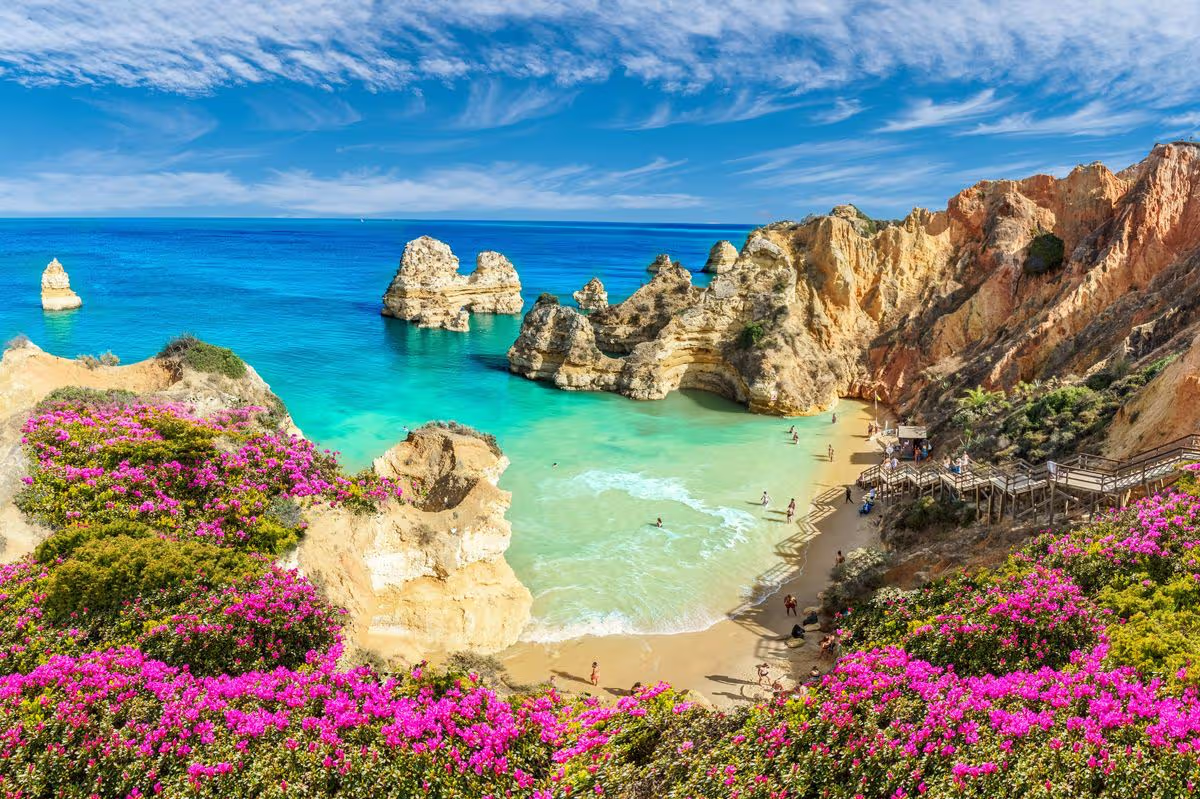
The Algarve is Portugal’s spectacular southernmost region, stretching for over 200 kilometres along the coast. Whether you’re a nature enthusiast, a beach lover, or simply seeking somewhere to kick back and recharge, the Algarve is unlikely to leave you disappointed.
Celebrated for its year-round sunshine, striking ochre cliffs and sweeping golden beaches, it stands as a premier European hotspot for beach breaks, world-class golf and freshly caught seafood, according to Visit Portugal.
If you’re considering a stay in the Algarve, there’s no shortage of choices. The most sought-after destinations, however, are Lagos in the west and Tavira in the east, both widely regarded as the region’s finest spots. Lagos boasts striking golden cliffs and a lively town atmosphere, whereas Tavira delivers historic, untouched Portuguese character.
The secluded waterfall she featured in the clip is Queda do Vigario, situated near the rural village of Alte, which lies just off the A2 motorway linking Lisbon and the Algarve.
“This was one of my favourite natural swimming pools… peaceful, hidden, and 100% worth the detour,” the woman wrote in the caption accompanying her post.
“Go in the morning when no one is there!” she advised.
Viewers were swiftly captivated by the woman’s footage, with many rushing to the comment section to share their reactions.
“This looks like a hidden gem,” one person wrote, while another user said: “Wow, thanks for the tip.”
Another person said: “Adding this to my Portugal list! Amazing shots.” Someone else shared: “Been here today was lush.”
Certain nations around the world are so wealthy that they wield enormous power over the global economy. When people think about the world’s biggest financial giants, two names typically come to mind straight away – the United States and China.
However, the next country is not located in Asia or North America. It’s situated in Europe, and its economy is substantially larger than most realise; it also boasts a greater GDP than the UK, Portugal and Greece combined.
Data from the World Population Review for 2025 shows that Germany is the richest country in Europe, with a GDP of $4.74trillion (£3.54trillion).
The UK comes second with $3.84trillion (£2.86trillion), while France is third with $3.21trillion (£2.53trillion), Italy fourth with $2.42trillion (£1.81trillion), and Russia fifth with $2.08trillion (£1.55trillion).
Lower in the table, Portugal sits 18th with $321.44billion (£241billion), and Greece 20th with $267.35billion (£200billion), which means Germany’s GDP exceeds that of the UK and both countries put together.
Germany’s wealth derives from a highly sophisticated and diverse economy. It holds the largest national economy in Europe and one of the most powerful on the entire planet. Germany is also a founding member of the EU and the eurozone, representing nearly a quarter of the whole euro-area economy.
The country is famous for its enormous export sector, standing as the world’s third-biggest exporter, having shipped $1.66trillion (£1.24trillion) worth of goods and services in 2024. It also achieved a trade surplus of $255billion (£191billion), among the largest anywhere in the world.
Its exports include vehicles, machinery, chemicals, electrical equipment, electronic products, pharmaceuticals and plastics, reports the Express.
Germany is likewise Europe’s leading manufacturing powerhouse, accounting for approximately one-third of the continent’s total industrial production.
Germany devotes considerable resources to research and development, allocating roughly 3.1% of its GDP to scientific and technological advancement, while also possessing one of the globe’s most comprehensive social security networks.
According to KPMG, Germany continues to be the world’s third-largest economy in 2026. “Exports of motor vehicles and vehicle parts, as well as chemical products, in particular, have made Germany the world’s third-largest exporting nation. At 70%, the service sector accounts for the largest share of the country’s gross domestic product (GDP).”
Portuguese star Cristiano Ronaldo hit the training pitch as he readies for his sixth World Cup appearance. Portugal will play Chile in a friendly, before heading to the US for their first World Cup match on June 18. Punters say Portugal is a dark-horse contender to take the title.