







WHAT do a former Tory councillor from Kent and a Wimbledon-supporting socialist have in common?
They are both sharing a beer with me on my “solos” group tour of Portugal.
Sign up for the Travel newsletter
Thank you!
The pretty city of Porto rises up above the River DouroCredit: GettyThirty minutes drive from the capital lies Sintra, another Unesco World Heritage SiteCredit: Getty
And the three of us are talking over the day’s activities with a Trump fan from the east coast of America.
Luckily, politics is off the menu.
Very much on the menu, however, is sardines, salted cod and the country’s speciality egg yolk pastries. But more on them later.
We are part of a 26-strong group on a dash around the southwestern-most territory of Europe, which is packed with old-world charm.
Our adventure, organised by solo tour specialist Just You, starts in Porto, where the steep hills that rise up from the River Douro are dotted higgledy-piggledy with colourful houses.
Author JK Rowling lived among the granite streets here before she was famous — and it is said the city’s gothic architecture, along with the traditional robes of its university students, inspired her world of Harry Potter.
At least one establishment, bookshop Livraria Lello, cashes in on the fact, charging entrance fees to see its elaborate interior and upstairs cafe where Rowling would drink her coffee.
Talking of elaborate, it doesn’t get much more so than the “Gold Church”, real name the Church of St Francis.
Designated a Unesco World Heritage site, its interior is dripping with carved wood covered in gold leaf, with the precious metal having been shipped over from Portugal’s former colony of Brazil.
It’s certainly dazzling, as is a trip down the Douro River to the vineyards, which supply grapes for that most Porto of products . . . port.
Can you get more Portuguese? Well, actually, my guide informs me that, historically, it was mostly grown here by the British.
The two countries have long been allies, with many Englishmen living in Portugal in the 1600s.
Back home in those days, the English liked wine but were always at war with the pesky French, meaning booze cruises across the Channel were often a no-no.
Instead, they turned to north Portugal and the Douro Valley to grow their own.
It will come as no surprise then that many of the port brands bear English names.
These include Taylor’s, Cockburn’s and Sandeman, and you can see lots of them emblazoned on the wine cellars that fill the hills of the city of Gaia, which is just across the narrow river from Porto.
The walled city of Obidos is perched on a hilltop and is completely enclosed by its fortificationsCredit: Refer to sourceAveiro is marketed as the ‘Venice of Portugal’Credit: Getty
By the way, white port (yes, that’s a thing) is tipped to be the next big thing in the cocktail market.
After time in Porto, Gaia and the Douro Valley, day four of my eight-day trip sees the group begin to wind south to capital Lisbon, but not before stops at Aveiro, Coimbra and Obidos.
Let’s take them one by one. Aveiro is marketed as the “Venice of Portugal”. OK, it has some canals, but a trip on a large, electric gondola just doesn’t feel as romantic.
A fellow traveller did remark on its Art Deco beauty, though.
Coimbra could maybe be the Oxford of Portugal, boasting the country’s oldest university, which dates back to 1290. Bats live in its library to eat book-destroying bugs.
A guided tour of the city, which was once the capital, will take you into the grand university building, which sits among former church schools in a street that was the widest in Europe until the 1800s.
You will also likely hear the story of Don Pedro and Donna Ines. I heard it twice and am still a little hazy on the details.
Based on truth, it is Portugal’s Romeo And Juliet tale, which involves the 14th-century prince Pedro digging up the five-year-dead corpse of his mistress Ines.
He then crowned her queen and made his courtiers kiss her hand. The things we do for love.
The walled city of Obidos continues with the historic buildings. Perched on a hilltop, the medieval settlement is completely enclosed by its fortifications. And its small size makes its stunning streets very manageable to navigate.
While there, it’s worth trying its cherry liqueur, called ginjinha, which is served in chocolate cups that you can eat afterwards.
The final days of the tour were spent in Lisbon, a city built on seven hills.
Chris Michael in the Portuguese city of CoimbraCredit: SuppliedTuck into the tasty pastry pastel de nataCredit: Getty
This may make exploring its small streets a challenge, but you can always hop on and off the quaint yellow trams.
The downtown area and main squares are flat enough and filled with impressive buildings despite the earthquake that devastated the area in 1755. A couple of miles out from the centre lies the Belem district.
Its Belem Tower is a small, picturesque fort which marks the transition from tall forts (for shooting arrows) to horizontal ones (for hosting canons).
And it does this by combining both aspects of those designs as it juts prettily into the Tagus river.
Thirty minutes drive from the capital lies Sintra, another Unesco World Heritage Site. With its microclimate making it cooler and wetter than Lisbon, it stays green all year round.
It also plays host to colourful palaces where past royalty would spend their summers hunting.
I’m sure they feasted well, too. And I didn’t do badly on that front, either. The Portuguese say they have 365 different recipes for cod (one for each day of the year).
It is often dried and salted, which they call bacalhau. I had bacalhau covered with onions and accompanied by wafer-thin fried potatoes.
Another national delicacy is pastel de nata, an egg custard tart pastry, often dusted with cinnamon.
Grabbing one with a coffee will only set you back a couple of euros for both the treat and the drink.
It’s the sort of thing you can do to while away the hours with new-found friends from the group of initial strangers on the tour.
Which, arguably, is the key factor of the holiday’s success. Do you like your travel companions? Are you cut out for solo travel?
Cards on the table, this was my first solos tour. I met people I liked and no one I disliked. Ages ranged from 40 to 95, though 85 per cent were retired.
Lots I spoke to had been using solo tour companies for many, many years.
For some it was their first time.
If you haven’t tried it before, all I can say is: You might like it, you might love it.
But you only live once (unless you’re Donna Ines) . . . and Portugal is well worth a visit.
GO: PORTUGAL
GETTING/STAYING THERE: Just You’s eight-day Picturesque Portugal escorted tour for solo travellers includes flights from London, overseas transfers, B&B in 3* and 4* hotels with a guaranteed twin or double room of your own, four dinners and welcome and farewell drinks, accompanied by a Just You holiday director and specialist local guide.
Multiple departure dates available, with prices starting from £2,169pp.
From popular beach resorts to bustling European cities, language experts reveal the holiday destinations that British tourists commonly mispronounce — plus how to say them correctly
This article contains affiliate links, we will receive a commission on any sales we generate from it. Learn more
The Cinque Terre is often mispronounced(Image: Getty)
Brits are passionate about their overseas holidays. One advantage of living in the UK is having Europe right on our doorstep – yet many people may be completely unaware of how to pronounce their chosen destination correctly.
Linguistic specialists at the learning app Preply have compiled a list of locations Brits most frequently mispronounce. If you’re arranging a trip to any of these spots, verify your pronunciation using Preply’s handy guide (below). Mastering the correct pronunciation of your dream destination could help you avoid embarrassment while you’re there, reports the Express.
Cannes, France
The pronunciation of this glamorous French resort continues to catch people out. Many Brits naturally pronounce the final “s” or insert an additional syllable, but it’s actually a quick single syllable “kan”.
Phuket, Thailand
This stunning island getaway is incredibly popular among British holidaymakers but remains consistently mispronounced. The spelling can be deceptive, but the proper pronunciation is much simpler, beginning with a soft “p” to create “poo-ket”.
Cinque Terre, Italy
Renowned for its pastel-coloured buildings and picturesque harbours, this beautiful Italian coastal stretch welcomes millions of visitors annually, and countless people are getting it wrong.
Don’t rely on English pronunciation rules; instead, follow Italian conventions, starting with “cheen-kweh” and finishing with a rolled “teh-rreh”.
Kraków, Poland
This Polish city is regularly mispronounced. The main error is overemphasising the “ow” ending, when it ought to be a gentler “kov”.
Ibiza, Spain
It may be among the UK’s most beloved party destinations, but that hasn’t protected it from mispronunciation. Numerous people continue to overpronounce the “z” when it should actually be a gentle “th” sound.
Lagos, Portugal
This Algarve holiday favourite is frequently mispronounced by visitors. English speakers tend to pronounce it phonetically, whereas in Portuguese, the ending features a gentler “sh” sound, creating “lah-gosh”.
Budapest, Hungary
Common mispronunciation: “Buda-pest”
Hungary’s capital presents difficulties due to its misleading spelling. The proper pronunciation replaces the hard “pest” with a gentler “pesht”.
Barcelona, Spain
Despite Barcelona being an exceptionally popular tourist destination, many continue to anglicise the name. In Spanish, the “c” is pronounced “th”.
Marylebone, London
Despite being on British home turf, many people still struggle to pronounce certain locations. Marylebone is among these places. Instead of pronouncing it phonetically, it’s shortened to “Mar-li-bone”.
Edinburgh, Scotland
Scotland’s capital represents a classic stumbling block for tourists, who frequently over-enunciate every letter while attempting to get it correct. In practice, locals adopt a considerably more casual approach, dropping the ending completely and keeping it brief and low-key: “Edin-bruh.”
Prestianni suspended for homophobic discriminatory conduct in Champions League match against Real Madrid in February.
Published On 24 Apr 202624 Apr 2026
Benfica’s Gianluca Prestianni has been handed a six-match suspension for discriminatory conduct that was deemed homophobic in a Champions League match against Real Madrid, UEFA announced.
Prestianni will be banned for two more matches after UEFA said on Friday that a further three-match suspension would be “subject to a probationary period of two years, starting from the date of the present decision”. He has already served a one-match provisional suspension.
Recommended Stories
list of 4 itemsend of list
The Argentinian winger was accused of directing a racist slur at Real Madrid forward Vinicius Jr during the Spanish side’s 1-0 Champions League playoff first-leg win in February.
The first leg was suspended for 11 minutes shortly after Vinicius gave Real the lead early in the second half.
Television footage showed Prestianni covering his mouth with his shirt repeatedly before making comments that Vinicius and nearby teammates interpreted as a racial slur against the 25-year-old.
Prestianni had denied the accusation that he had made a racist comment, saying Vinicius had misheard him. Real’s Aurelien Tchouameni said the Argentinian told him he did not call Vinicius a “monkey” but directed a homophobic comment at him.
UEFA also said they would request FIFA to extend the suspension worldwide.
The suspension includes the one-match provisional suspension Prestianni served during the second leg of their knockout playoff on February 25, which Real Madrid won 2-1 to advance.
Benfica said they had been notified about the sanction imposed on Prestianni.
“Of the three-match effective ban, one has already been served and the remaining two must be served in UEFA matches or Argentina national team matches in a FIFA context,” Benfica said.
Prestianni has played for Argentina only once, making his debut as a late substitute in a friendly game against Angola in November.
EasyJet’s general manager in Portugal has issued a warning over new government proposals the carrier says will artificially inflate prices
Robert Rowlands Deputy editor, money and lifestyle, content hub and Maria Ortega
10:29, 15 Apr 2026
(Image: f9photos via Getty Images)
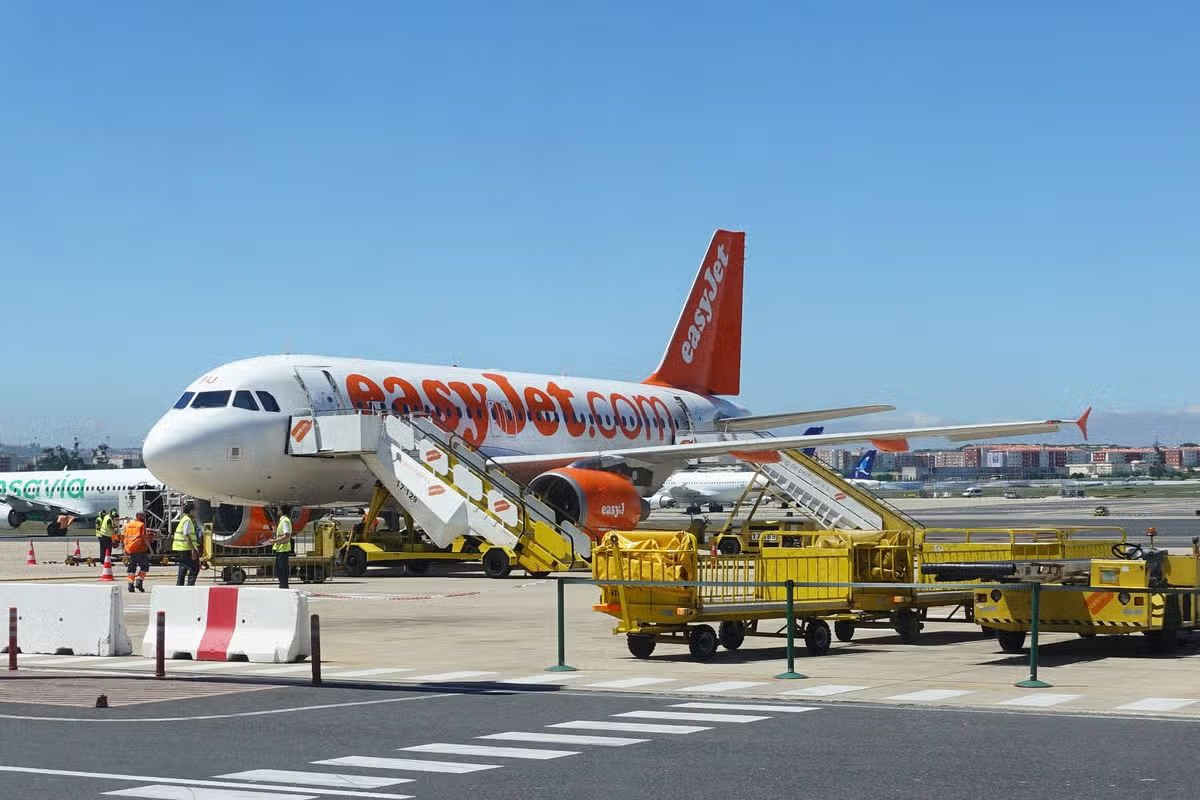
easyJet is weighing up plans to cut back operations in Portugal, according to reports emerging from the country. The airline’s general manager there has issued the warning amid a dispute over government proposals which easyJet claims will drive up costs for passengers.
José Lopes, easyJet’s general manager in Portugal, announced on Monday that the carrier may cut back its domestic services following the scrapping of caps on something called the social mobility allowance for air travel. This caps maximum fares for some local passengers – but the changes are set to affect the airline more widely.
“Removing the upper limit will artificially inflate prices,” José Lopes said. He argued that the measure will deliver “zero benefits” for island residents while helping to deter tourists, who makeup the bulk of passengers on domestic routes.
The airline says it will not return to operate Azores routes due to the changes. It had already confirmed its departure from the region from March 29, 2026, blaming a 35 per cent increase in airport fees and what it describes as government inaction.
The easyJet representative was addressing journalists at a press conference in Funchal, held in partnership with the Regional Secretariat for Tourism, to outline the company’s operations and long-term pledges in the Madeira archipelago, SIC Noticias reports. Portuguese media outlets report that at Porto Santo airport, the two existing routes to Lisbon and Porto will be retained, albeit with a reduction to Lisbon owing to constraints at that airport, he indicated.
He warned that if the measure to alter the social mobility subsidy regime – which would remove the maximum limits for air travel for residents of Madeira and the Azores – is implemented, there will be implications for Easyjet’s operations. “I hope that an analysis will be carried out and a way will be found to be more rational and less emotional in dealing with the matter,” he said.
When asked about the possibility of abandoning the route to Madeira, the official ruled out this scenario. Yet reports say he highlighted the possibility of “a reduction in market capacity.”
The changes were given the green light on Friday in the Assembly of the Republic, but have yet to come into force. The amendments stem from two initiatives to revise the legislation put forward by the Socialist Party and Chega.
What is the social mobility subsidy?
The social mobility subsidy set a maximum fare of €79 for residents and €59 for students travelling between Madeira and the mainland (round trip), with an overall cap of €400. In the Azores, residents travelling to the mainland pay no more than €119, while students are capped at €89, with a recently introduced maximum ceiling of €600.
The Portugal Post reports that Portugal Parliament’s recent decision to abolish price caps has placed island connectivity under serious threat, with easyJet warning of capacity reductions to Madeira and confirming it will not operate Azores routes under the new framework.
Ryanair has also revealed plans to cease all operations in the Azores on March 29, 2026, citing cost pressures.
Want a relaxed holiday in a place where you know kids will enjoy? TUI ranked the best spots for hassle-free family fun.
This article contains affiliate links, we will receive a commission on any sales we generate from it. Learn more
TUI ranked the best places to travel to with kids(Image: Getty Images)
Finding a place to travel where you can take kids and not worry about safe accommodation and fun activities can be difficult, but as of 2026, 86% of British parents agree that holidays are essential for family bonding, according to holiday giant TUI.
Taking into consideration factors such as where to keep children entertained while giving parents a chance to relax, reliable weather, open spaces and more, TUI ranked the top destinations in Europe that combine fun, sun, and convenience.
Here are the five best spots on the continent, according to the research.
5 – Barcelona, Spain
The well-known historical and architectural allures of Barcelona give way to family-friendly fun – as the city stands out with the highest number of TUI Musement excursions in the ranking (439). For those seeking a relaxed itinerary, the city also boasts 31 parks per 10 km².
The colourful Park Güell and the interactive CosmoCaixa Museum of Science are always hits with kids – and best paired with beach days along the Mediterranean for parents to enjoy.
4 – Catania, Italy
With a mean temperature of 26.7°C, Catania offers sunshine alongside rich history and cultural experiences – especially due to its location right next to Mount Etna, Europe’s most active volcano.
There, families can take excursions around the volcano and explore the deep roots of Catania’s lava caves and farms. When that’s done, it’s a great idea to head to the city’s bustling markets and grand piazzas to bask in the local culture or relax on the nearby beaches.
3 – Porto, Portugal
In third place is Porto, which TUI gives a score of 9.01/10. The city, located in the north of Portugal, is just a two-hour flight away, and is the perfect pick for families looking for simple, hassle-free fun.
Porto is easy to navigate, and offers 32 family-friendly hotels and 13 parks per 10 km². There, get ready to ride the historic Dom Luís I Bridge cable car or hop on a river cruise along the Douro.
To relax, enjoy beaches, riverside strolls, and vast parks.
2 – Naples, Italy
Naples scores 9.12/10, combining summer temperatures of 25.2°C and rich culture to be enjoyed by all ages.
Kids will have fun with authentic pizza-making immersive experiences and open spaces to explore with a good gelato in hand.
Time in the city is good enough, but from there you can set off to explore the ancient ruins of Pompeii, take a ferry to nearby islands, or stroll along the scenic seafront promenade.
1 – Lisbon, Portugal
The gold medal goes to Lisbon, crowned Europe’s most child-friendly city with a score of 9.16/10. The Portuguese capital has an average of 37 family-friendly hotels per 10 km², 17 parks and an entertainment score of 7.36/10.
Children are likely to love the Lisbon Oceanarium – one of Europe’s largest – and the beautiful trams that cross the city centre. After ticking those essential boxes, take time to explore riverside playgrounds and nearby beaches.
To get to Lisbon, flights depart from the main UK airports and take about 3 hours.
From mountain hikes and whale watching to wine tasting and gourmet dining – there’s no shortage of things to do in Madeira
This article contains affiliate links, we will receive a commission on any sales we generate from it. Learn more
Madeira is an island with so many adventures at your fingertips(Image: Juergen Sack via Getty Images)
It didn’t take us long to discover that Madeira is an island of striking contrasts. Towering mountains and plunging valleys, a vibrant city and unspoilt natural parks. Even the weather keeps you on your toes, shifting from overcast skies to dazzling sunshine in moments, thanks to the island’s many microclimates.
The capital, Funchal, is defined by its charming mosaic cobblestones in the cathedral quarter, winding restaurant-lined lanes in the old town, and a sweeping seafront promenade with steps leading down to the sea for those fancying a spontaneous swim.
During our walking tour of the city, we took in the elaborate gothic cathedral, indulged in sweet treats at the celebrated chocolatier Uaucacau, and stumbled upon exotic fruits we’d never encountered before at the central market – from banana passion fruit to monstera deliciosa, which apparently tastes remarkably similar to pineapple when fully ripened, reports OK!.
There’s no shortage of things to discover beyond the city either, as we found out when we ventured further afield around the island.
Madeira: an island built for adventure
Feeling energetic, we tackled the Vereda da Ponta de Sao Lourenço, a 7km round-trip hike leading to the most easterly tip of Madeira. The rocky trail demands a fair amount of stair-climbing, but the payoff is absolutely worth it – jaw-dropping panoramic views of the stunning coastline await. We’d strongly advise heading out early, as the path becomes considerably crowded from mid-morning onwards.
A jeep tour offers the finest way to explore the island’s north coast. Our itinerary took in beaches, waterfalls and a rum distillery where we sampled the local beverage Poncha Regional – a blend of rum, honey, lemon and orange juice. But the true standout moment came when venturing off-road into the verdant laurel forest, jolting along the muddy paths surrounded by tropical vegetation.
For our subsequent excursion, we headed to the harbour to embark on a whale-watching trip. We ended up considerably more drenched than anticipated as we raced across the ocean in our rib. While the rear seat might be the safest option for those prone to seasickness, it’s also where the majority of the spray appears to hit. We were, however, treated to the sight of a pod of bottlenose dolphins frolicking in the waves – and the tour guide graciously offered us a towel!
For a more tranquil afternoon we travelled to the spa at The Vine Hotel to experience its Red Wine Divine Bath. The 90-minute treatment features a gentle exfoliation using crushed grape seeds, a soak in a bubbling tub of red wine-infused water – with a glass of wine to savour for that additional touch of indulgence – and a full body massage to round off the blissful experience.
Discover the Madeira Wine Festival
The Madeira Wine Festival takes place from late August through to mid-September and offers a fantastic opportunity to experience the island at its liveliest. It’s a tribute to local wine-making heritage, featuring concerts and theatrical shows across multiple locations. We made our way to the Wine Lounge along Funchal’s waterfront, where live entertainment accompanied pop-up stands from 11 Madeiran wine makers, giving us the chance to try numerous varieties. We also dropped by Quinta do Furão for its yearly celebrations, which included a buffet lunch, wine sampling and the chance to tread grapes barefoot.
Naturally, you don’t have to wait for the festival to enjoy Madeira’s wines. During a guided experience and tasting at Blandy’s Wine Lodge in Funchal, we discovered the wine-making techniques and were amazed by the enormous 9,000-litre oak casks. We also took part in a vineyard visit at Quinta Das Malvas, where we discovered how they combine vines through grafting to shield them from illness and why roses play a crucial role in assessing vine wellbeing.
Where to eat: restaurant recommendations and regional specialities
There’s certainly no lack of upmarket dining establishments in Madeira. We began our culinary adventure at Akua, a seafood spot nestled down a quiet side street in Funchal, where the tuna tartare cones and jumbo tiger prawn proved to be the highlights. At Three House, we savoured the chef’s table experience, where every dish is crafted right before your eyes. We’d highly recommend the red snapper ceviche and tacos packed with the local delicacy, black scabbardfish. Make sure you head up to the rooftop bar afterwards for a cocktail (open Wednesday to Saturday).
For an upmarket dining experience with breathtaking views, Avista is an absolute must. The outdoor terrace gazing out over the ocean is truly stunning, and our scallops with lime risotto and crème brûlée dessert were simply divine.
At Audax, we treated ourselves to the tasting menu – five courses crafted by the chef to capture the traditional flavours of Madeira, reimagined with a contemporary flair. Every dish was strikingly presented and packed with flavour. Over at Design Centre Nini Andrade Silva, we were won over by the sophisticated monochrome interior, gourmet dishes made from locally sourced produce and spectacular sunset views.
Where to stay in Madeira
Pestana Quinta Perestrello is a charming 37-room hotel on the outskirts of Funchal, lovingly converted from a traditional manor house. Its modest size lends it a wonderfully homely atmosphere, complete with a snug reading room and a quaint garden pool. Guests can also take advantage of the two neighbouring Pestana properties, which boast larger pools, restaurants and a health club. Central Funchal is just a 15-minute stroll away.
For a more indulgent experience, Casa Velha is a five-star boutique hotel situated alongside the breathtaking Palheiro Gardens. Here, the décor is opulent, the grounds are magnificent and the ambience is one of pure serenity. The restaurant Oxalis specialises in regional dishes with a contemporary twist and merits a visit even if you’re not staying there, as do the Palheiro Gardens themselves, where hundreds of plant species from across the globe flourish and trees soar to heights of 46 metres.
Arrange your own island getaway
For further details on accommodation, dining options and activities, head to VisitMadeira. EasyJet and British Airways provide direct flights to Funchal from the UK.
Mauricio Pochettino said last month that he plans to take the U.S. national team to the semifinals of this summer’s World Cup. If that’s the case, he’d better buy tickets because there’s no way the Americans are getting to that game on the field.
In its two March friendlies, the U.S. was blitzed by Belgium 5-2 and Portugal 2-0. By way of comparison, Mexico played the same two teams, in reverse order, to draws.
But wait, it gets worse. Because from the smoldering ruins of that mess, Pochettino has less than two months to choose a roster for the World Cup, a tournament U.S. Soccer has been pointing to for eight years.
Yet the March friendlies raised more questions than they answered — and it’s too late to start over.
“Right now, it’s just not enough,” DaMarcus Beasley, a four-time World Cup player, told TNT Sports. “We want to see these players compet[ing] and creating chances and being hard to play against every single match. Right now, it’s not happening.”
Pochettino ran the March training camp like an audition rather than settling on a starting 11 and trying to win games. He experimented with Tim Weah at outside back, where he has played for his club teams, and tried unsuccessfully to shake Christian Pulisic out of a career-long scoreless streak by playing him as a striker.
But he seems unable to solve some of the core issues plaguing the team. The U.S., which hasn’t posted a clean sheet since September, has become an error-prone mess on defense, with Pochettino’s wide, attack-minded approach revealing a structural fragility that has left the Americans’ thin back line exposed.
Consider the two goals in the Portugal loss. The first came after a turnover at midfield that led to a lightning-quick counterattack and the second on a poorly defended corner in which the Americans kept seven players in the six-yard box, leaving João Félix all alone at the top of the penalty area.
Behind the defense, no one has stepped up to seize the starting job in goal. Matt Turner, so spectacular four years ago in Qatar, gave up as many goals as he made saves against Belgium. And while Matt Freese was markedly better against Portugal, that was just his 14th international start.
Those are just the lowlights of the myriad issues facing Pochettino’s team.
Pulisic, the talisman who was supposed to carry the U.S., has gone cold. He hasn’t scored for the U.S. since November 2024 and hasn’t scored for his club team, AC Milan, this year. So Pochettino used him as a No. 9 against Portugal, a role Pulisic has made clear he does not like.
Christian Pulisic, left, controls the ball during an international friendly against Portugal on March 31.
(Jared C. Tilton / Getty Images)
It didn’t work, with Pulisic extending his goal-less streak to 15 games for club and country.
Tyler Adams, the captain in Qatar, has been saddled by injury and hasn’t played for the national team since September; right back Sergiño Dest, who started all four games in Qatar, is also hurt; center back Tim Ream, at 38, suddenly looks his age; and Gio Reyna, who has been unable to win a starting job on three teams in two countries since Qatar, nonetheless keeps getting called to the national team with little affect.
In the middle of it all is Pochettino, the highest-paid coach in U.S. Soccer history, who, despite a stellar resume as a club coach, has failed to find a consistent winning formula on the international level. In its 18 months under Pochettino, the national team has gone 11-2-1 against teams outside the FIFA top 25 and just 2-7-1 against teams ranked 25th or higher, according to ESPN. It has also lost eight consecutive games to European rivals.
Guess which kinds of teams the U.S. will have to beat to get to the semifinals of the World Cup?
It wasn’t supposed to be this way, of course. After failing to qualify for the 2018 World Cup, the U.S. team was ripped down to its foundation and built anew. Interim manager Dave Sarachan was tasked with reconstructing a roster that had grown old and stagnant, and in his 12 months in charge he gave a record 23 players — including nine who made the team for the last World Cup — their international debuts. With an average age of 25, the squad in Qatar was the second-youngest World Cup team in U.S. history.
But Qatar was just a trial run. The real goal was to have a mature, experienced team ready for this summer when the World Cup would be played at home. A deep run could fuel the kind of transformation the 1994 tournament in the U.S. achieved.
Instead, the U.S. team has regressed.
“It feels like four years have gone down the drain,” said ESPN’s Herculez Gomez, another former World Cup player.
Fortunately, the U.S. was drawn into a soft group for the World Cup. And because the tournament’s expansion to 48 teams means just 16 countries will be eliminated in the first round, even a poorly built American team should advance.
But the semifinals? Not this team and not in this tournament. To do that the U.S. would have to be better than at least four teams on a list that includes England, France, Spain, Argentina, Germany, Morocco, Brazil and the Netherlands. We already know it’s not better than Belgium or Portugal.
It might not even win its group now that Turkey, a top 25 team which beat the U.S. 2-1 last June, has qualified. And a stumble early in the tournament would make the kind of deep run Pochettino promised that much more difficult.
“We are so close to the World Cup,” Pochettino said after the Portugal loss. “But I think we are intelligent enough to know what we need to do.”
Buy tickets was not supposed to be the answer.
⚽ You have read the latest installment of On Soccer with Kevin Baxter. The weekly column takes you behind the scenes and shines a spotlight on unique stories. Listen to Baxter on this week’s episode of the “Corner of the Galaxy” podcast.
In March, Bad Bunny performed his first-ever concert in Asia when he played in from of 2,300 fans in Tokyo as part of Spotify’s Billions Club Live series.
Starting April 8, a filmed version of that performance will be available on Spotify for the “Nuevayol” artist’s millions and millions of fans not in attendance.
The show, officially titled “Billions Club Live With Bad Bunny: A Concert Film,” was billed as a special stop in the Grammy-winning performer’s “Debí Tirar Más Fotos World Tour” — which kicked off with a November concert in the Dominican Republic and has since sold out stadiums across Latin America and Australia. He notably didn’t include dates in the United States as part of the tour.
Footage of the Japan concert swept social media, as it showed Bad Bunny doing a never-before-seen salsa rendition of his 2018 collaboration with Drake. He also notably sang his 2021 single “Yonaguni,” which features lyrics in Japanese.
Bad Bunny’s generational run looks to have no immediate end in sight, as he will kick off the European leg of his world tour with a May performance in Portugal before making stops in Spain, England, Sweden, France, Poland and Italy.
But the “Dakiti” artist’s newsworthy year hasn’t been limited to the music world.
In February, it was announced that Bad Bunny will star — alongside Academy Award-winning actor Javier Bardem and multiple-time nominees Edward Norton and Viggo Mortensen — in Puerto Rican rapper Residente’s directorial debut, “Porto Rico.” The film, which has yet to announce a release date, will explore the complicated colonial history of Puerto Rico through Western/historical drama storytelling devices.
FROM rooftop bars in South Africa to swimming pools in Marrakech and sundrenched terraces in Madrid – Sun Travel has found of the most affordable spots in the world’s best cities.
These 10 stays are the perfect places to rest your head while travelling around the world and they start from just £6 per night.
Sign up for the Travel newsletter
Thank you!
Never@Home Green Point in Cape Town has a rooftop poolCredit: UnknownThe Amsterdam hostel has a bar in a former lecture hallCredit: Unknown
Cape Town, South Africa
Cape Town is the sixth best city in the world according to Time Out.
It has beautiful beaches and buzzy neighbourhoods, all set against the backdrop of the enormous Table Mountain.
When it comes to affordable places to stay check out Never@Home Green Point near Cape Town Stadium.
Along with private rooms and shared ones (including female-only), the hostel has a rooftop swimming pool, bar and chill-out lounge.
A stay at Never@Home Green Point starts from £20 per night.
Amsterdam, The Netherlands
Amsterdam sits at number 34 in the list of the world’s best cities with pretty canals and gabled buildings.
There are plenty of attractions to explore as well as lots of busy bars and cafes to explore.
Anyone heading to the city should take a look at Generator Amsterdam which is inside a former university building overlooking Oosterpark.
One of its most impressive rooms is the bar inside a former lecture theatre.
A bed in one of the dorm rooms starts from £15 per night.
Edinburgh, United Kingdom
With its enormous hilltop castle, winding Royal Mile lined with plenty of shops and of course, pubs – Edinburgh has been announced as the third best city in the world.
It’s easy to walk about on foot and those brave enough should hike up to Arthur’s Seat.
When it comes to where to stay, consider the Castle Rock Hostel which is right next to Edinburgh Castle with easy access to the Old Town.
It has plenty of communal spaces and is a perfect budget stay for Edinburgh explorers – a night in one of the dorms at the Castle Rock Hostel starts from £15 per night.
Osaka, Japan
Travelling to Japan is on the rise, and while flights there are likely to be expensive, staying there doesn’t have to be.
Time Out, which named Osaka as the 39th best city in the world, also said it’s the “undisputed street food capital of Japan“.
When looking for a base to explore and fill your stomach with delicious takoyaki and yakitori, check out Hotel Toyo Hostel.
It’s basic but offers private rooms and is in the heart of the city with stays from £10 per night.
Kraków, Poland
Nicknamed the ‘jewel of the Baltics’, Kraków is said to be ‘fairytale-like’ with its colourful buildings and grand squares.
The pretty city is filled with pretty gardens, parks, and for beer fans, you can get a pint for as little as £1.50.
Any guest that checks into Greg & Tom Beer House Hostel gets free breakfast, dinner and there’s even free beer hour starting from 9pm.
The hostel is three-minutes from the Main Square and rooms start from £10 per night.
Generator Amsterdam has spacious rooms inside a former university buildingCredit: UnknownThis hostel in Marrakech has a pretty courtyard and a swimming poolCredit: Unknown
Marrakech, Morocco
The 24th world’s best city is Morocco’s vibrant Marrakech where you can haggle in busy souks, take in history at the medinas and stop in traditional tearooms.
To get into the spirit of Marrakech, all the while saving pennies, check into the Equity Point Marrakech.
It’s a unique spa hostel with a swimming pool and even offers hammam and massages to guests.
It also has a relaxing courtyard area and a rooftop bar with views across the city.
One visitor wrote in their review: “The Pool, rooftop terrace, and rooms are amazing. I wish we stayed longer and i would definitely recommend it to anyone who is visiting Marrakesh.”
A stay here starts from £8 per night.
Dublin, Ireland
Closer to home is vibrant Dublin a city known for its charm, old boozers, and friendly locals.
The hostel that has a mix of private rooms and shared dorms is near the Jameson Distillery and the famous Temple Bar.
Rooms start from £25 per night.
Lisbon, Portugal
Lisbon is hard to beat with the best of both worlds; coast and city.
Some of the most famous attractions include the Jerónimos Monastery, Belém Tower and with it being so hilly, taking the tram is a popular transport choice.
There are plenty of tascas too where you can dig into bacalhau (salted cod) and sip on sangria.
A stay here starts from £20 per night (a two-night minimum stay is required).
Buenos Aires, Argentina
There’s so much to do in the capital of Argentina from eating its world-class food to exploring the city’s vibrant culture.
Stewart Jackson, the Sun’s UK Digital Editor, who visited the city described it as a “brag-to-your-friendscity breakthat is achingly cool and, once you’re there, incredibly cheap.”
Cocktails can be picked up from £4 and a 30-minute taxi journey can be as little as £3.
Affordability doesn’t stop with places to stay either – First Stop Buenos Aires Hostel is a budget-friendly hostel in the heart of the city.
The hostel offers a variation of rooms – some are private with adjoining ensuites.
A one night stay starts from £20 per night.
Generator Madrid a huge rooftop terrace with a bar, sunloungers and hot tubsCredit: Unknown
Madrid, Spain
Food, nightlife, culture – and just over two hours from the UK, Madrid should be top of your list for a city break.
She said: “It feels more livable than other more tourist destinations, with an amazing food and drink scene.
“I mingled with the locals at Pez, where the only thing on the menu is huge sloppy pieces of tortilla chased with a cana (small beer) or tinto de verano for €2.50 (£2.16).”
Generator Madrid is just off of Gran Vía known as ‘Spanish Broadway’ and is a top pick thanks to its rooftop terrace with a bar, sunloungers and hot tubs.
The hostel holds social events too like yoga and DJ sessions and a night in one of the dorms starts from £6 per night.
A new ranking compares international tourist numbers to locals in European cities – and one tops the list with a staggering 16,250 visitors for every 100 residents
These destinations are the most crowded in Europe(Image: Alexander Spatari via Getty Images)
Summer is on the horizon, and folks are starting to map out their holiday plans. Being based in the UK, we’re fortunate to have some of the world’s most stunning destinations within easy reach, with iconic cities just a short flight away.
However, many of these sought-after spots are now swamped with tourists – in fact, some now host more visitors than locals. DiscoverCars.com has compiled a new ranking that contrasts the number of international tourists with the local population in European cities. Five of the top holiday hotspots now boast more tourists than residents.
Topping the list is Dubrovnik in Croatia. This breathtaking historical city gained even more fame after serving as the backdrop for King’s Landing in the HBO series Game of Thrones.
Last year, this fortified city welcomed 6.5 million tourists – an astounding figure compared to its 40,000 inhabitants. That equates to 16,250 tourists for every 100 locals.
Taking second place is Reykjavik in Iceland, reports the Express. This Arctic city attracted even more tourists than Dubrovnik, with 7.4 million visitors compared to its 140,000 residents, resulting in 5,286 tourists per every 100 locals.
The city is renowned for its Blue Lagoon thermal baths and, of course, the opportunity to witness the Northern Lights illuminating the sky.
Securing third place is the floating city of Venice in Italy. Arguably one of the most famous cities globally, Venice played host to 10.6 million tourists last year.
Compared to its population of 250,000, that’s a whopping 4,240 international visitors per 100 residents. The city is a hit with tourists for its stunning architecture and the opportunity to glide along its canal streets by gondola.
Switzerland’s Geneva secured fourth place on the list, welcoming 7.8 million tourists in 2025. With a local population of 200,000, this equates to 3,900 visitors per 100 residents.
Renowned for its breathtaking views of the Alps, Geneva serves as an excellent base for day trips into the mountains and exploring the picturesque villages scattered throughout them.
Porto in Portugal claimed fifth place. The city attracted seven million international tourists in 2025, against its population of 250,000.
With 2,800 tourists for every 100 residents, it’s a highly sought-after destination. The narrow streets are adorned with beautiful architecture and striking Portuguese tiles, providing a perfect backdrop for photos.
With the river slicing through the city, you can discover both sides of the city in a day – just remember to bring your walking shoes.
The Foreign Office has updated its travel advice for Brits heading to Portugal ahead of the school holidays, with warnings around new rules on how long you can stay
Brits heading to Portugal should take note of the fresh advice(Image: Getty Images)
The Foreign, Commonwealth and Development Office (FCDO) has issued advice for Brits travelling to Portugal.
To ensure that Brits are aware of any warnings, entry requirements, security, safety, or health risks before travelling to destinations across the globe, the Foreign Office is constantly updating its travel advice. The advice can change rapidly, or remain the same for months, but just last week, a change was made for those visiting Portugal.
In an update on Friday, 20 March, which is still current as of 25 March, the FCDO updated the entry requirements for Brits heading to the popular European destination, which offers sprawling beaches and vibrant cities. The government stated that if you’re staying for longer than 90 days, within a 180-day period, and need to extend in “exceptional circumstances”, you must take action.
The FCDO website stated: “If you’re visiting Portugal and need to extend your visa-free stay for exceptional reasons, such as a medical emergency, you must apply to AIMA using their contact form (access is only available to users in Portugal). If you’re in Portugal with a residence permit or long-stay visa, this does not count towards your 90-day visa-free limit.
“If you’re in Portugal with a residence permit or long-stay visa, this does not count towards your 90-day visa-free limit.”
As it stands, UK residents with a British passport can travel to Portugal without a visa for up to 90 days in any 180-day period. This applies if you are a tourist, visiting friends or family, attending a business meeting, cultural or sports events, or visiting for short-term studies or training.
This also applies to Brits visiting the Schengen area, which comprises 29 European countries, who can travel without a visa for up to 90 days in any 180-day period. Countries in the Schengen area include: Austria, Belgium, Bulgaria, Czechia, Croatia, Denmark, Estonia, Finland, France, Germany, Greece, Hungary, Iceland, Italy, Latvia, Lithuania, Liechtenstein, Luxembourg, Malta, Norway, the Netherlands, Poland, Portugal, Romania, Slovakia, Slovenia, Spain, Sweden and Switzerland.
However, the FCDO outlined: “If you’re travelling to other Schengen countries as well, make sure your whole visit is within the 90-day visa-free limit. Visits to Schengen countries in the 180 days before you travel count towards your 90 days. If you overstay the 90-day visa-free limit, you may be banned from entering Schengen countries for up to 3 years.”
Additionally, from 10 April 2026, the European Union’s (EU) new Entry/Exit System (EES) is expected to be fully rolled out. This means that when travelling into the Schengen area for short stays, you may be required to register your biometric details, such as fingerprints and a photo, which is done at the border on arrival for free.
Brits travelling to the Schengen area must also be aware of the passport requirements. The government states that the passport must:
Have a ‘date of issue’ less than 10 years before the date you arrive – if you renewed your passport before 1 October 2018, it may have a date of issue that is more than 10 years ago
Have an ‘expiry date’ at least 3 months after the day you plan to leave the Schengen area (the expiry date does not need to be within 10 years of the date of issue)
If your passport does not meet the requirements above, you may be denied entry to the country and turned away at the airport. You can renew or replace your passport online through the government website.
Brits are advised to renew or replace their passports as soon as possible, as processing can take around three weeks and sometimes longer during the peak travel season. For more information on Portugal’s entry requirements, visit the government’s foreign travel advice page.
Do you have a travel story to share? Email webtravel@reachplc.com
Rio Ferdinand and wife Kate have re-located to Portugal after fleeing their new home in DubaiThe couple re-located to the UAE last yearCredit: InstagramThey made the big move last year with their kids Cree, five, and Shae, two, and Rio’s 14-year-old daughter, Tia, from his first marriageCredit: InstagramIran previously launched a barrage of rockets at nations across the Middle EastCredit: AFP
In the terrifying situation, which is still ongoing, Iran vowed revenge for the US and Israel’s huge blitz on the regime.
Now the celebrity couple and their children Cree, five, and Shae, two, and Rio’s 14-year-old daughter, Tia, from his first marriage, have headed to their European retreat.
Former Manchester United player Rio has uploaded a snap showing him swigging a Super Bock beer in the surroundings of their Portugal home.
In his caption he referred to the weekend’s football scores and wrote: “That feeling when Liverpool + Chelsea drop points in the race for the top 4!
“Happy Saturday People!”
He sat against the white walled terrace of the stunning villa in the Algarve near Quinta do Lago, with bright sunshine and trees in the background.
Liverpool had lost at Brighton 2-1 while Chelsea suffered a 3-0 hammering at Everton.
Kate has not addressed the location change on her social media, with the most recent upload being a clip from her Blended podcast.
Previously, on her show, she had opened up on the family’s actions amid the missile strikes.
As the United Arab Emirate’s top holiday hot spot, Dubai has become a sought after travel destination for celebrities and influencers.
Kate previously told her fans they spent “a very scary night” sleeping in their basement.
“Thank you for all of your messages and sorry for the silence, I haven’t wanted to worry you all I just haven’t been able to find the words. We are safe,” she said on Instagram.
“The government are doing an amazing job of keeping it that way and despite my nerves I feel we are in very safe hands.”
She added: “We are hoping for a calmer evening tonight, last night was very scary. Although Cree and Shae loved it as they couldn’t believe we all got a sleepover in the basement.
“Thank you for all of your prayers, this whole experience is very eye-opening and I am praying for anyone affected. Lots of love to everyone.”
Rio’s sons Lorenz, 19, and Tate, 17, did not move over when they relocated from the UK last year to focus on their football careers.
Speaking on his show Rio Ferdinand Presents, the former Manchester United and England defender said: “Been a different week for me, not going to lie.
“Firstly, I’m in great condition this morning as the whole family did a workout.
“A bit like in Covid, the whole family is doing things we wouldn’t usually be doing together.
“Home-schooling a bit today.
“It’s frightening when you hear missiles, planes and fighter jets – I don’t know what it is – going above us, and you’re hearing big bombs, and what that is we don’t know as we don’t know the details of what they are.
“It’s telling your kids what it is and helping them navigate through this moment, which is important especially as the dad of the house.
“You want to try and remain calm and keep everybody as calm as possible.”
Ferdinand added: “I’ve got to be honest guys, it’s been a bit of a scary situation.”
Kate previously told how the family had been forced to sleep in the basementCredit: InstagramFormer footballer Rio also admitted he had been ‘scared’Credit: InstagramKate previously told how the kids loved their ‘fresh start’ in the UAECredit: Instagram
More than 2.5million Brits visited Portugal last year, and it could be even more popular in 2026 due to the Iran conflict
13:08, 20 Mar 2026Updated 13:08, 20 Mar 2026
Bookings to Portugal have surged since strikes on Iran began
The Foreign, Commonwealth and Development Office (FCDO) has issued updated travel guidance for those heading to Portugal. The update was released today (March 20).
Fresh information has been provided for individuals seeking to remain in Portugal beyond 90 days under exceptional circumstances. The updated guidance states: “If you’re visiting Portugal and need to extend your visa-free stay for exceptional reasons, such as a medical emergency, you must apply to AIMA using their contact form (access is only available to users in Portugal). If you’re in Portugal with a residence permit or long-stay visa, this does not count towards your 90-day visa-free limit.”
It adds: “If you’re in Portugal with a residence permit or long-stay visa, this does not count towards your 90-day visa-free limit.”
For British passport holders, visas aren’t required for short visits to EU nations or Schengen zone countries provided both conditions are met:
Your combined stay within the Schengen zone must not exceed 90 days within any 180-day period. The number of countries visited is irrelevant. The 180-day timeframe continuously ‘rolls over’, reports the Liverpool Echo.
EES
Since October 2025, the European Union has implemented the Entry/Exit System (EES), requiring travellers to provide fingerprints and photographs upon initial entry to or departure from the Schengen zone. It is scheduled to be fully operational by 10 April. However, the system has been plagued by teething problems, resulting in many travellers waiting for hours at airports. Because the system requires non-EU visitors – including Brits – to register their fingerprints and take a photo in person at the border, the additional registration time is already causing massive queues for non-European passengers at airports across the region.
It has caused such disruption that some locations have temporarily suspended its use. The European Commission has suggested that border authorities may pause the new system for up to six hours during peak travel times until September to help ease congestion.
More and more Brits are booking flights to Portugal as the conflict in the Middle East continues. Destinations like Cyprus, Turkey, Greece, Egypt, and Dubai are being viewed as increasingly risky, so travellers are opting for safer alternatives like Portugal and Spain.
Bookings to Portugal had increased by 42% over the two weeks to 13 March, according to Thomas Cook – the largest rise in any of the countries they arrange holidays to. It was followed by the Balearic Islands (40 per cent) and the Canary Islands (16 per cent).
TravelSupermarket shared data on online search interest, which it said demonstrates a “clear surge” for European and Atlantic destinations and away from the Middle East.