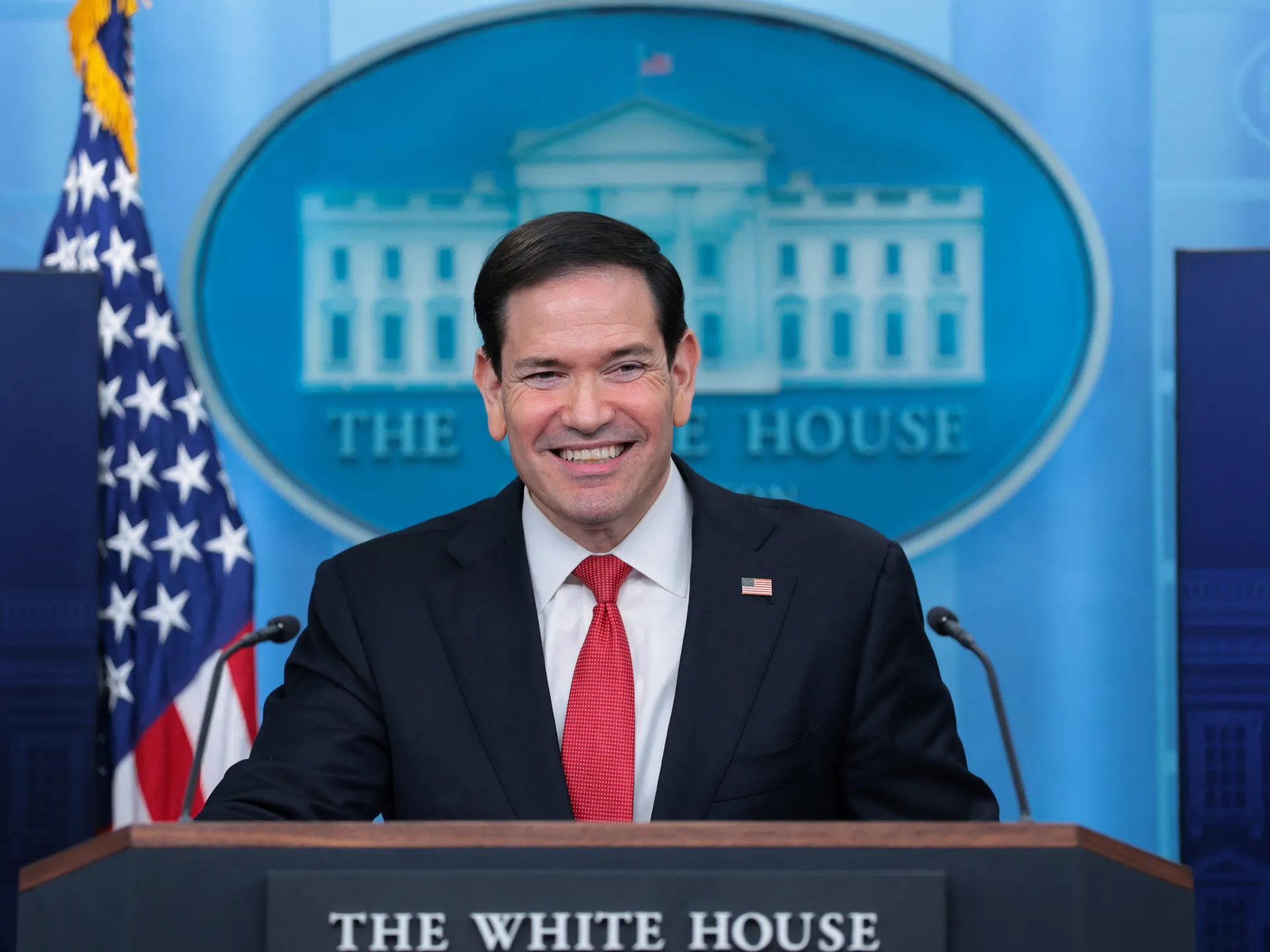
United States Secretary of State Marco Rubio told reporters on Tuesday that Operation Epic Fury – the US-Israeli strikes on Iran which commenced on February 28 and prompted a regional conflict – had concluded as its objectives had been achieved. Washington now prefers “the path of peace”, Rubio said.
On the same day, US President Donald Trump announced that the US military operation to escort stranded ships out of the Strait of Hormuz – “Project Freedom”, which was launched the day before – had been paused.
So, does this mean the US-Israel war on Iran is over?
What did Rubio say about Operation Epic Fury?
In a media briefing at the White House on Tuesday, Rubio told reporters that Operation Epic Fury was over.
“The Operation Epic Fury is concluded. We achieved the objectives of that operation,” Rubio said.
“We’re not cheering for an additional situation to occur. We would prefer the path of peace. What the president would prefer is a deal,” he said, referring to Pakistan’s efforts to arrange direct talks between Iran and the US.
The first round of these, in Islamabad last month, ended without a resolution. Both sides have submitted new proposals since then.
“The on-again, off-again talks with Iran, alongside Trump’s abrupt about turn on ‘Operation Freedom’ to guide vessels out of the Strait of Hormuz has created unwelcome frenzy in the Gulf,” Burcu Ozcelik, a senior research fellow for Middle East security at UK-based think tank Royal United Services Institute (RUSI), told Al Jazeera.
“It also reflects the highly fraught and almost frantic diplomatic backchannelling aimed to extract deep concessions from Tehran on the nuclear issue that will lock in commitments that exceed previous conditions, and which will convince the US to lift the blockade on Iranian ports and unlock sanctions relief – thereby effectively ending the war.”
Ozcelik explained that Iran, on the other hand, wants guarantees that this will be the end of the war, rather than just a pause.
What did Trump say about Project Freedom?
The same day, Trump told reporters that Project Freedom had been paused “based on the request” of Pakistan and other countries, and the “fact that Great Progress has been made towards a Complete and Final Agreement” with representatives of Iran.
Project Freedom was the US forces’ operation to escort stranded ships through the Strait of Hormuz that Trump announced the day before. It had appeared to signal a direct challenge to Iran’s closure of the strategic waterway, through which 20 percent of the world’s oil and liquefied natural gas (LNG) supplies are shipped in peacetime. Iran’s threats to attack ships in the strait have blockaded it since the US-Israel attacks on Iran began. Then, the US announcement of a naval blockade on Iranian ports added to the standoff around the strait.
After Trump announced Project Freedom, Iran said ships trying to use the strait without permission from the Islamic Revolutionary Guard Corps (IRGC) would be fired on, igniting fears of a return to war. His announcement triggered a war of words between the US and Iran, with claims and counterclaims about strikes continuing throughout the day.
First, Iran’s Fars agency claimed it had hit a US warship with drones after it ignored orders to turn back from the Strait of Hormuz. US Central Command (CENTCOM) denied a US ship had been struck, however, and instead claimed to have sunk at least six IRGC vessels. Iran denied that. Tehran then published a new map extending its claimed area of control over the strait into UAE waters, raising fears of a new regional confrontation.
The UAE accused Iran of launching strikes on its Fujairah port, the site of an important oil pipeline, which sparked a fire in an oil refinery.
On Tuesday, the US operation had been stopped, according to Trump.
“We have mutually agreed that, while the [US] Blockade will remain in full force and effect, Project Freedom (The Movement of Ships through the Strait of Hormuz) will be paused for a short period of time to see whether or not the Agreement can be finalized and signed,” he wrote on his Truth Social platform.
Iran has not immediately responded to this.
Shahram Akbarzadeh, a professor in Middle East and Central Asian politics at Australia’s Deakin University, told Al Jazeera that while it is difficult to determine exactly why Trump has paused Project Freedom, the pause comes against the backdrop of growing antiwar public opinion in the US.
“At the same time, Trump may be losing patience with the war; he says he has time to drag this out,” Akbarzadeh said.
“But in reality, Trump has a short attention span and needs to secure a win – soon. Pausing Project Freedom allows diplomacy to pick up pace, bringing US and Iran closer to a deal that Trump would label as a win.”
Is this the end of the war on Iran?
Not exactly. Akbarzadeh said pausing Project Freedom could serve as “the beginning of the end for the war”.
“We know that the Iranians are desperate for an end, so there is little chance of them resuming attacks on US Navy if Trump sends explicit signals that diplomacy has a green light,” he said.
However, he added, “The problem is that we have been here before. Earlier opportunities were squandered because Israel insisted that the US could get a better deal or because Trump misread the situation and expected the military option to grant him more concessions.”
What happens next?
It is difficult to predict this, but neither side appears to want a return to full-scale war, so both are likely to prioritise a diplomatic way out, Akbarzadeh said.
Still, “neither can afford to be seen as the loser,” he added. “They feel their public image needs to be preserved for their own respective domestic audience. This complicates negotiations and reaching a deal.”
Ozcelik said what happens next “will be determined by what the fractured leadership in Tehran commits to on the nuclear file.
“While it has rejected that talks involve curbs on Iran’s nuclear programme, this type of posturing has aimed to assuage domestic, hard-line and Iranian nationalists who are rattled by the US-Israel strikes and see nuclear issues from a nationalist, sovereign rights perspective.”
She predicted that the United Nations may soon issue a formal condemnation of Iran for unilaterally blockading the Strait of Hormuz.
“But the real pressure, mounting by the day, is the economic one – that shutting the strait is imposing punishing costs on Iran’s economic recovery prospects,” she said.
“Despite rhetoric on resilience and survival, the remaining Iranian leadership is undeniably concerned about the costs of the war. The possibility of renewed military strikes against Iranian critical infrastructure and the destabilising impacts these would inevitably have might be finally forcing Tehran’s hand,” Ozcelik concluded.
Tom Steyer is trying to sell himself to voters as an agent of change.
He has vowed to take on entrenched political and economic forces to create affordable housing, make the wealthy pay more in taxes, lower energy bills and protect the environment.
But perhaps the biggest change he is selling is his own.
The hedge-fund billionaire turned climate activist has faced criticism throughout his campaign for past investments in coal plants and private prisons, to name a few, that helped build his fortune and gave him the means to spend more than $150 million of his own money in his quest for the governor’s mansion.
Steyer’s prolific spending has blanketed the airwaves with television ads and helped propel him near the top of an unsettled gubernatorial field in the polls.
The 68-year-old San Franciscan has helped put many Democratic candidates in office as one of the party’s biggest political donors in the past two decades, but has never held public office himself.
He spent more than $340 million in the 2020 Democratic presidential primary, but dropped out after placing third in the primary in South Carolina, where he had invested heavily.
There is a long tradition of wealthy, self-funding candidates, and the results are mixed at best. Billionaire Michael Bloomberg spent more than $260 million to win three terms as New York City mayor. But he spent more than $1 billion on a 2020 presidential bid and lasted only four days longer in the race than Steyer. Two years later, real estate developer Rick Caruso spent more than $100 million in an effort to become Los Angeles mayor but lost handily to Karen Bass.
Hoping for a better result in his current race, Steyer has staked out a position as the most progressive candidate in the field — touting an endorsement from the Bernie Sanders-affiliated Our Revolution. He’s picked up other key endorsements, too, from the California Teachers Assn., California Nurses Assn. and numerous environmental groups.
But he faces the challenge of convincing enough liberal voters to support a billionaire with controversial past investments the same year a tax on billionaires, currently enjoying strong support, is poised to be on the November ballot.
“This election is about who you can trust to fight for you,” former Rep. Katie Porter said during an April 22 gubernatorial debate in San Francisco. “One candidate is a billionaire who got rich off polluters and ICE prisons and is now using that money to fund his election.”
Steyer said he understands the broad concerns about his wealth and is willing to vote for the billionaires’ tax in November.
“I know that people are skeptical of billionaires, and I’m skeptical of billionaires,” Steyer said Tuesday in an interview with The Times. “But if you look at this race, I’m the only progressive in the race. I’m the person who’s taking on the corporate special interests.”
He pointed to the millions spent by a super PAC supported by the real estate industry and Pacific Gas & Electric — which Steyer has pledged to break up to bring down utility costs — as evidence that he is the candidate most feared by moneyed interests in the state.
“The companies that are running up the costs are fighting like hell, because that’s how they make their money,” he said. “But somebody’s got to stand up to them.”
The departure of former Rep. Eric Swalwell from the race last month after sexual assault allegations doesn’t appear to have resulted in a major surge of support for Steyer. Rather, it is Xavier Becerra, the former Health and Human Services secretary, who seems to have gained momentum.
But veteran California pollster Mark Baldassare said that he hasn’t counted out Steyer yet.
Tom Steyer, in 2013, as he was campaigning against the Keystone XL oil pipeline.
(David Paul Morris / Bloomberg)
“It would be easy to say that he’s reached his peak, except for the fact that there are so many undecideds and Steyer has so many resources at his disposal,” said Baldassare, the statewide survey director for the Public Policy Institute of California.
Steyer has poured at least $875 million into federal and state political committees since 2010, according to an analysis conducted for The Times by OpenSecrets, and federal and state campaign finance records. That total includes the nearly half a billion dollars he has spent on his two races.
In 2013, Steyer left his investment firm and launched NextGen Climate, a progressive political action group geared toward addressing climate change. He has given nearly $270 million to a super PAC affiliated with the group, which was later renamed NextGen America.
The committee has spent tens of millions of dollars on campaigns opposing fossil fuel interests and supporting progressive candidates, though Steyer’s financial support for the group has decreased as he has run for office.
The billionaire also established his climate bona fides by opposing the Keystone XL pipeline during the Obama administration, which became a national proxy fight over climate policy, and by backing environmental ballot measures in California.
Among them was a $5-million investment in 2010’s “No on Prop. 23” campaign, which defeated a conservative effort to overturn California’s greenhouse gas emission reduction law.
Two years later, Steyer invested about $29.5 million in Proposition 39, a winning measure to recoup money from corporate tax breaks to help pay for clean energy projects.
Privileged upbringing and a ‘desire to compete’
Steyer’s unconventional path to politics began with a privileged upbringing on the Upper East Side of Manhattan. He studied at the elite Buckley School and Philips Exeter Academy before attending college at Yale University, where he captained the men’s soccer team and graduated in 1979.
After a brief stint on Wall Street, he got a master’s degree in business administration at Stanford University, where he met his future wife, Kat Taylor. They wed on the Stanford campus in 1986.
Steyer worked hard — very hard — at making money.
He was one of several “Wall Street Prodigies” featured in a Wall Street Journal profile from the same year he was married.
Steyer’s work began at 5 a.m. in the office and he seldom took days off — he fretted he wouldn’t have time for a honeymoon.
He eschewed the trappings of wealth — driving an eight-year-old Honda — motivated instead by a “desire to compete, excel and keep struggling to do better.”
Steyer began cutting political checks soon after, but his real emergence as a major political donor came during the 2004 presidential campaign, when he pledged to raise more than $100,000 for John Kerry’s campaign and was talked about as a potential political appointee at the U.S. Treasury Department in a Kerry administration.
Steyer hired Kerry to join his sustainable investment company Galvanize in 2024. Steyer stepped down from the company before entering the governor’s race.
The year 2004 was pivotal for another reason.
A group of students at his two alma maters, Yale and Stanford, along with those at a handful of other elite universities, began a campaign to pressure the endowments at their institutions to stop investing with Steyer’s hedge fund, Farallon Capital Management.
They cited concerns about some of the firm’s investments, including a coal burning plant in Indonesia and a joint venture between Farallon and Yale to pump out water from an aquifer in Colorado adjacent to the Great Sand Dunes National Park.
“Stated simply, we do not want our universities to profit from investments that harm other communities,” the students wrote in an open letter to Steyer. “We are concerned about the impact some of Farallon’s recent investments have had.”
Steyer told the students he appreciated “the importance of the issues that you raise,” but defended his firm’s work, saying that it acted “responsibly and ethically.”
Looking back on that time now, Steyer said it was a turning point.
“I think that experience really was a wake-up call to me,” he said. “It’s when I started to very seriously consider leaving Farallon. I really felt like if I was going to be the person with my values, I was going to have to leave and be independent and do what was right.”
Three years later, Steyer and his wife began their initial pivot to public service, opening a bank in Oakland that would cater to low-income customers
Tom Steyer, seeking the Democratic presidential nomination, greets people at an event in Des Moines, Iowa, in 2019.
(Scott Olson / Getty Images)
But this initial venture highlighted the inevitable collision course between Steyer’s burgeoning activism and his firm’s investments.
At an event that year with then-Gov. Arnold Schwarzenegger and Oakland Mayor Ron Dellums, Steyer and Taylor pledged $1 million in loans to support vulnerable people in Oakland facing foreclosure in the wake of the subprime mortgage crisis.
Left unsaid was the fact that Steyer’s firm had extensive financial ties to San Diego’s Accredited Home Lenders, one of the biggest subprime mortgage lenders in the country.
The transformation to climate activist
Steyer and his wife began writing bigger philanthropic checks and in 2010 took the Giving Pledge, promising to donate at least half of their wealth before they died.
In 2009, they gave $40 million to endow the TomKat Center for Sustainable Energy at Stanford, the first of several multimillion-dollar gifts to Stanford and Yale to support climate-focused ventures. They pledged $7 million to create the Steyer-Taylor Center for Energy Policy and Finance, also at Stanford, in 2010. It closed last year after its endowment came to an end.
And in 2011, the couple donated $25 million to Yale to help establish an Energy Sciences Institute focused on developing sustainable energy solutions.
But even as Steyer undertook his public transformation from investor to climate activist, his firm continued to make decisions out of step with his newfound commitment.
In 2011, for example, the firm purchased 1.8 million shares of BP, a year after the Deepwater Horizon oil spill, in which a BP-operated project dumped nearly 5 million barrels of oil into the Gulf of Mexico.
Steyer resigned from the firm at the end of 2012, though he still has millions of dollars invested in the firm .
Environmentalists have largely been willing to forgive Steyer’s past investments.
“There’s no question he’d be the most knowledgeable and committed climate advocate that’s ever held really high office in America,” climate activist and author Bill McKibben recently toldPolitico.
While the nonprofit California Environmental Voters hasendorsed both Katie Porter and Tom Steyer in the race, Steyer, in particular, has “taken on Big Oil dollar for dollar, toe to toe, and beaten them,” said Mary Creasman, the group’s chief executive.
“He has made this his career and his investment and his passion, so it’s authentic, and voters see that,” she said.
Leah Stokes, an associate professor of environmental politics at UC Santa Barbara, said she’s impressed by Steyer’s climate track record and progressive campaign platform, noting that he’s been an active presence in California’s climate movement for more than 15 years.
That includes not only his work on ballot initiatives and clean energy technology, but also his focus on biodiversity loss and carbon sequestration at his 1,800-acre TomKat Ranch in Pescadero, where researchers are studying regenerative agriculture.
But Steyer has also played a role in elevating climate into a national political issue — including in the early 2010s when it wasn’t a “politically hot topic,” Stokes said.
“He has been willing to spend an enormous amount of his personal money on elections on climate — whether it’s propositions, whether it’s himself running for president on basically a climate platform, whether it’s the Next Gen giant voter turnout campaign,” she said. “I think he has recognized … that politics is where we have to invest our time if we want to make a difference on the climate crisis.”
Despite concerns raised about Steyer’s early investments into fossil fuels through Farallon, Stokes said she’s more apt to criticize candidates who are taking money from oil companies today, such as Becerra, who accepted a $39,200 donation from Chevron for his gubernatorial campaign.
She was also heartened by the fact that Pacific Gas & Electric has funded a $10-million PAC opposing Steyer, because she said it indicates that he aims to hold utility companies accountable for skyrocketing electricity prices amid soaring profits.
“We could actually have a shot here at having somebody who cares about climate change, who wants to hold utilities accountable, who wants to hold big polluters accountable,” Stokes said. “That would just be transformative.”
Energy costs weigh heavily on voters
Steyer’s focus on climate issues and energy affordability could also be a strategic boon in the governor’s race.
Sixty percent of voters in the state see climate change as a major threat to the country and believe that the government is not doing enough to address it, according to polling from the Public Policy Institute of California.
“Californians connect the dots between what’s going on with extreme climate and wildfires and climate,” said Baldassare, the institute’s survey director.
Recent polling has also shown that voters are very concerned about energy affordability and rising utility costs, with 13% of Americans naming it as the most important financial problem facing their family — a 10-point increase from last year, according to an AprilGallup poll.
Overall, energy costs tied housing costs as the second-biggest concern following the high cost of living, the poll found.
In November, Democrats who campaigned heavily around energy affordabilityswept the field in key races in New Jersey, Virginia and Georgia. Residential electric prices increased nearly 11% between January 2025 and this February, according to the latest available data from the U.S. Energy Information Administration.
“Voters are supporting candidates who are leaning into these issues,” Creasman said.
Wieder reported from Washington and Smith from Los Angeles.
While the specter of la migra continues to haunt the city, far more crushing are problems that affect everyone — affordability, housing, traffic, pollution. Maybe Soto-Martínez and his colleagues should double down on fixing those things first and sell their message better to voters instead of picking up a new issue?
I know the first-term council member comes from a good place. His parents were formerly undocumented, just like my dad, and he has been a fierce advocate for immigrants going back to his labor organizing days. I have friends without legal status and others in the DACA program for people who came to the U.S. illegally as children. I think giving them, as well as green card holders and others with papers, a chance to participate in elections is a righteous idea.
But to paraphrase the Book of Ecclesiastes, there’s a time and a place for everything. In 2026, Angelenos should be focused on electing people and approving initiatives that will improve the city for everyone, not a narrow plank benefiting a slice of the population.
So I called up Soto-Martínez and challenged him to convince this doubting Tomás.
He hopes his proposal will reach the City Council later this month for a vote on whether to place it on the November ballot. If voters pass the measure, it goes back to the council to decide when — if ever — to enfranchise the immigrants.
The proposal, already vilified in conservative media, isn’t as radical as it seems. Noncitizens are already prohibited from voting in federal elections, but there’s a well-established history of their participation in local ones, including in Vermont and Maryland. They can already vote in L.A. neighborhood council elections, and in San Francisco school board elections if they have a child in the district.
Besides, L.A. has long led the way in weaving undocumented immigrants into the fabric of civic life.
This is a sanctuary city where Mayor Karen Bass has stood up to President Trump’s xenophobia. Where eight of the 15 council members are immigrants or the children of immigrants. Where LAUSD Supt. Alberto Carvalho — himself formerly undocumented — has striven to make local schools as welcoming as possible (Carvalho is on paid leave after the FBI raided his home and office earlier this year). Even the LAPD learned decades ago that it’s better to embrace undocumented immigrants than castigate them for their lack of legal status.
“If you’re contributing to this economy, you should have the right to decide who represents you,” Soto-Martínez told me.
Fair point. But isn’t thumbing our noses at Trump asking for more of what he has already inflicted on L.A., making life even more miserable for undocumented immigrants? Could he use the noncitizen voter rolls as a list of whom to deport? Besides, doesn’t extending the franchise to noncitizens give fuel to his crazy conspiracies about stolen elections?
“You always hear, ‘Don’t poke the bear, don’t instigate them,’ but that’s not how you deal with a bully,” Soto-Martínez replied. “They’re coming at us already. While they’re removing people’s right to vote in the Supreme Court, we’re expanding it. … And it has nothing to do with Trump. It’s about fairness.”
Tell that to Trump.
I mentioned that Santa Ana — a city far more Latino than Los Angeles, though not as liberal — decisively rejected a similar measure in 2024. Soto-Martínez’s fellow Democratic Socialist council members, Ysabel Jurado and Eunisses Hernández, have voiced their support for his measure. But I wonder whether the full council will move it along to voters in a year when some members, including Soto-Martínez, are running for reelection.
I couldn’t get a comment from Bass. Councilmember Nithya Raman, who’s running against her, said in a statement that Soto-Martínez’s push “is worth taking seriously” but that it’s “critical to getting this right, and we must not make decisions lightly or quickly.”
“We’re going to have to organize,” Soto-Martínez acknowledged. “But we live in a political moment where it’s the right conversation to have about what this city stands for.”
Avance Democratic Club President Nilza Serrano at Mariachi Plaza in Boyle Heights in 2022.
(Irfan Khan / Los Angeles Times)
He’s going to have to convince people like Nilza Serrano. She’s president of Avance, L.A. County’s largest Latino Democratic club, and heads the California Democratic Party’s Latino caucus. Serrano is no wokosa — she supported Rick Caruso in the last mayoral election and is now siding with Bass.
While Serrano thinks Soto-Martínez is on to something, she said that voting rights for noncitizens are a nonissue for the people she’s trying to get to the polls for the June primary and November general elections. The economy and Trump’s deportation deluge are more on their minds.
I asked if Soto-Martínez’s proposal would cheapen citizenship for people like her. Serrano and her family came here legally from Guatemala in the 1980s before becoming U.S. citizens, a process that took years.
“Not for me,” she replied. “But it’s hard to say for others. I’d have to do a little bit more research.”
“Isn’t San Francisco already doing it?” the Navy veteran cracked.
I thought Hernandez would go on an anti-liberal rant, but.…
“I believe there’s a strong argument,” he said, “that if someone has established residency and is a member of the community and suffered the consequences of whatever local policies will be enacted, they should have a say in who gets elected.”
Did the ghost of Joaquin Murrieta, California’s original avenging Latino, suddenly possess Hernandez? To make sure I was hearing right, I asked again if noncitizens voting in L.A. elections is a good thing.
How could he support that, as a Trump-voting Republican?!
“We have to be pragmatic,” he replied. He approves of noncitizens voting in L.A. neighborhood council elections, because that’s true local control.
He understands that allowing them to vote in municipal elections might come off as an insult to the memory of civil rights activists who lost their lives fighting for that right for Black Americans. But U.S. citizens are already taking it for granted, he noted — turnout in the November 2022 L.A. mayoral election was a pitiful 44%.
“Maybe noncitizens will appreciate voting more than citizens,” he said.
I’m still not fully convinced that Soto-Martínez’s push is wise right now, but I like that he’s being careful.
“We need to get in the weeds of this,” he said of the City Council’s deliberations, which he characterized as attempting to ensure maximum benefit and minimum fallout.
May 6 (UPI) — Republican voters in Indiana and Ohio largely backed Trump-aligned candidates Tuesday in primaries seen as tests of President Donald Trump‘s influence within the GOP.
Both states held their party primaries on Tuesday to decide candidates for hundreds of races for November’s midterm elections, but most eyes were on contests for the Indiana state Senate, where incumbent Republicans had rejected Trump’s redistricting push.
Indiana
Though too late to influence Indiana’s congressional map before the midterms, Trump endorsed challengers to incumbents who had opposed his effort to redraw the map to add Republican seats.
Trump’s influence within the GOP in the Hoosier State appeared strong: Of his seven endorsed challengers against Indiana Republican state senators who opposed his gerrymandering push, five appeared poised to win outright, one seemed to have lost and another was in a tight race.
“Big night for MAGA in Indiana,” Sen. Jim Banks, R-Ind., said in a social media statement, referring to the acronym for Trump’s far-right nationalist Make American Great Again movement.
“Proud to have helped elect more conservative Republicans to the Indiana State Senate.”
Nearly 90% of all Indiana precincts were reporting as of early Wednesday, according to the Indiana Election Division, but five of the seven Trump-backed candidates had already declared victory.
Those five are Trevor De Vries, Brian Schmutzler, Blake Fiechter, Tracey Powell and Michelle Davis.
“Thank you to every Hoosier who came out to vote today,” De Vries said in a social media post late Tuesday.
“And special thanks to President @DonaldTrump for his endorsement that helped seal the deal and showed Indianapolis what real Hoosiers wanted.
“We did it, Indiana! Time to get to work.”
De Vries beat incumbent Daniel Dernulc, state senator for District 1, in a landslide. According to the unofficial results, De Vries secured 75.1% of the vote to Dernulc’s 23.3%.
Schmutzler was poised to beat state Sen. Linda Rogers in a 55.8% to 44.2% split, Fiechter over state Sen. Travis Holdman 61.5% to 38.5%, Powell’s 64.7% led state Sen. Jim Buck’s 35.3% and Davis led state Sen. Greg Walker 58.8% to 41.2%.
Trump-endorsed Paula Copenhaver also declared victory in her race against Sen. Spencer Deery despite being in a virtual tie. According to unofficial state results, she was trailing Deery by three ballots.
“After all provisional ballots are counted, we will prevail and be declared the winner of this race,” she said on X.
“I want to thank President Donald Trump for his unwavering support and endorsement. President Trump is the leader of our party, and it showed clearly tonight in his victories across the state.”
The only Trump-endorsed candidate to lose was Brenda Wilson. State Sen. Greg Goode was poised to win with 53.6% of the vote to Wilson’s 36%, according to the unofficial results.
A sixth incumbent who stood against redistricting, Sen. Rich Niemeyer, also appeared poised to lose his seat to challenger Jay Starkey, who was not endorsed by Trump.
Ohio
In Ohio, the race to watch was on the GOP gubernatorial primary.
With incumbent Republican Gov. Mike DeWine barred by term limits from running again, Ohio’s governor’s mansion will have a new occupant.
Amy Acton and her running mate David Pepper ran unopposed in the Democratic primary for governor and lieutenant governor, respectively.
Republican voters in the state nominated Trump ally Vivek Ramaswamy for governor and Robert McColley for lieutenant governor in a landslide.
According to unofficial results from the Office of Ohio Secretary of State, the Ramaswamy-McColley ticket secured 82.47% of the vote compared to the 17.53% that Casey Putsch and Kimberly Georgeton received.
“I speak for Rob and myself here: We are in this because we believe that together — with the complementary skills that we bring to the table — we are the two people in this state who can work together as a team to lead Ohio back to our true potential,” he said Tuesday night during his victory speech.
“To our greatest heights to put more money in your pocket, to bring down those costs and to give your kids the world-class education that is the birthright of every Ohioan.”
Trump had endorsed Ramaswamy for governor.
“I know Vivek well, competed against him and he is something SPECIAL,” Trump said earlier Tuesday.
“Vivek Ramaswamy will be a GREAT Governor of Ohio.”
Ramaswamy gained national attention during the 2024 GOP presidential primary, running against Trump. Instead of attacking the former New York real estate mogul, Ramaswamy aligned himself with Trump’s America First movement, often praising him.
“Thank you, Mr. President!” Ramaswamy said in response to Trump’s endorsement.
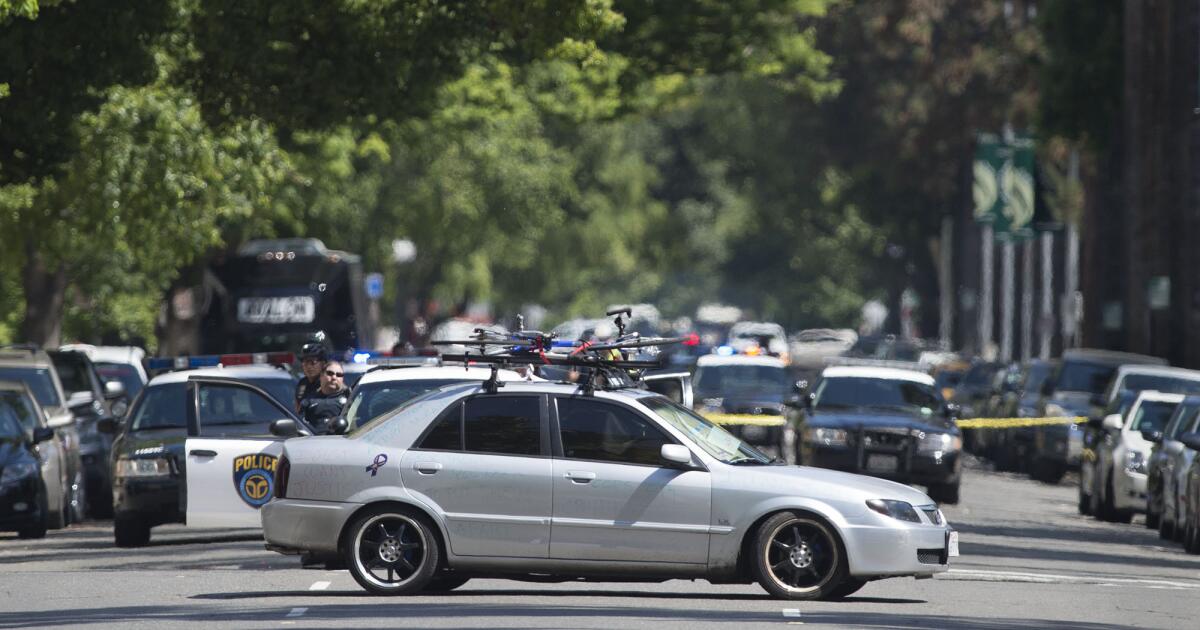
Reporting from Sacramento — The streets near the state Capitol emptied Monday after a man barricaded himself in his parked car near the building for more than two hours, prompting fears of a possible bomb attack.
Sacramento police and the California Highway Patrol cordoned off several city blocks as SWAT officers and hostage negotiators attempted to make contact with the man, who had scrawled “cops or criminals” and “I just want justice” on his Mazda sedan and plastered the car windows with paper signs.
He voluntarily surrendered without incident just over two hours after police were called to the scene at 1:47 p.m. The Sacramento Bee identified the man as Edgar Napoles-Rodriguez, 27, of Sacramento, though the suspect’s name has not yet been released by officials.
According to court records, the former roommate of Napoles-Rodriguez was granted a temporary restraining order against him last week. The roommate alleged in a legal filing with the Sacramento County Superior Court that Napoles-Rodriguez threatened her with a baseball bat and also threatened to burn down her house.
————
FOR THE RECORD
April 20, 11 a.m.: An earlier version of this post referred to Edgar Napoles-Rodriguez’s female former roommate as a man. It also misstated Napoles-Rodriguez’s age as 28; he is 27.
————
Law enforcement snipers were spotted on the roof of the Capitol during the standoff. A police robot was used when officers attempted to contact the suspect in his car, which was parked on L Street directly in front of the Capitol building. Before surrendering, the man exited the car and began shouting, “Want to shoot me? Shoot me!”
“He may have not had the best of intentions or be the clearest of mind,” said Officer Matthew McPhail, spokesman for the Sacramento Police Department.
The Capitol was not evacuated during the incident, but one entrance was closed.
The Assembly adjourned early Monday but was scheduled to vote on several big issues, including a ban on smoking on college campuses. It wrapped up the meeting abruptly before 3 p.m.
The Senate went through its full agenda as planned and wished Sen. Jerry Hill (D-San Rafael) a happy birthday before adjourning after 3 p.m. without any announcement of the security situation going on outside the building.
Asked about the situation, Claire Conlon, a spokeswoman for the Senate President Pro Tem Kevin de León said, “It’s our policy not to discuss Capitol security details.”
The state Capitol’s security has been ramped up considerably over the last decade.
The most significant incident came late on the night of Jan. 16, 2001, when a big-rig truck smashed into the south side of the historic building during a late-night legislative session on California’s energy crisis. The driver, a 37-year-old man with a history of prison time and mental health issues, slammed his tractor-trailer into the granite portico of the building, and it erupted in flames.
That, plus the terrorist attacks in New York City and Washington, D.C., that fall, sparked a slow but steady move toward increased security around the 142-year-old building.
Now, the perimeter is surrounded by barricades that rise up from the sidewalk, and all public visitors are routed through metal detectors and bag-scanning areas on the north and south sides of the building.
Times staff writers Liam Dillon and Patrick McGreevy contributed to this report.
Democrat Xavier Becerra’s rapid rise in California’s race for governor made him a ripe and constant target during a combative nationally televised debate Tuesday evening, his first real test in a high-stakes election that remains highly volatile.
Becerra was ripped throughout the two-hour CNN debate, primarily by his Democratic rivals, who accused him of dodging questions about his stance on single-payer healthcare, falling short as a Biden Cabinet secretary and pocketing a campaign donation from Chevron.
“I think everyone’s invoking my name. It’s nice to hear my name quite a bit,” said Becerra, who served as the U.S. secretary of Health and Human Services during the Biden administration. “I will tell you this: Distorting the facts in your quest to be governor is never good, but using Trump lies to try to damage your opponents is worse, and that’s what we see happening.”
As ballots land in California voters’ mailboxes, the state’s seven top gubernatorial candidates clashed over immigration, President Trump, tax policy, political temperament and a hodgepodge of scandals, mudslinging and other unsavory actions that have risen to the forefront of the hotly contested race.
The snarky, sometimes petulant exchanges reflect how unsettled the race to replace termed-out Gov. Gavin Newsom is, as well as California’s outsize economic and political gravitas on the national and international stage.
Shortly after the debate began, former Orange County Rep. Katie Porter chastised her fellow candidates for their unceasing attacks.
“I can’t believe [the] interrupting and bickering and name calling and shouting and disrespect for everyone up here who’s stepping into public service that anyone wants to talk about my temperament,” said the former Democratic Congress member from Irvine.
Here are the top takeaways from a two-hour debate that somehow seemed even longer:
Becerra takes his lumps
Beccera, who has surged in the weeks before the June 2 primary, faced a barrage of attacks from his Republican and Democratic rivals about his oversight of unaccompanied immigrant minors during his tenure at the Health and Human Services Department and his relationship with a longtime adviser who, along with other consultants, skimmed about $225,000 from one of Becerra’s dormant campaign accounts.
Becerra is not accused of wrongdoing and has been painted as a victim in the prosecutor’s court filings. Still, conservative commentator Steve Hilton, a Republican, suggested Becerra knew about the scheme, and former Los Angeles Mayor Antonio Villaraigosa, a Democrat, questioned why Becerra paid an unusually high fee to one of the consultants named in the indictment.
“It doesn’t pass the smell test,” Villaraigosa said.
Becerra also was accused of changing his position on single-payer healthcare, a top priority of liberal voters that aims to create a healthcare system run and funded by the federal government.
Though Becerra has long supported single-payer healthcare, he recently assured members of the California Medical Assn. — one of the most influential medical lobbyinggroups in California, which has endorsed him — that he would not support it as governor, according to a KQED report.
When asked directly about this, Becerra said “those reports were inaccurate. I continue to be for Medicare for all.”
Becerra sidestepped repeated questions from Porter about whether he supported a state-sponsored single-payer healthcare system in California, saying that he wants to cover “everyone with something like Medicare for all.”
“Covering everyone with something is not single-payer. It’s not even federal Medicare for all. But you won’t say whether you support California having its own state-run single-payer system,” Porter said.
Single-payer healthcare is a telling issue
Democratic billionaire Tom Steyer also has taken heat for changing his position on the issue. The hedge fund founder turned environmental warrior opposed single-payer healthcare during his 2020 presidential bid and now supports a statewide single-payer system called CalCare. He is endorsed by the California Nurses Assn., one of CalCare’s biggest supporters.
A recent analysis by UC researchers estimates CalCare would cost $731 billion to implement in 2027 — a price tag that’s $14 billion larger than all anticipated healthcare spending in California next year.
Villaraigosa said creating a state-sponsored single-payer healthcare system — with a price tag larger than the entire state budget — is a “pie in the sky” proposal. He said he considers healthcare a human right but said a system such as CalCare would require approval from the Trump administration — and that’s not going to happen.
“As a patient, it nearly killed me,” he said. “That’s another story we don’t have time for. As a policymaker, you end up with the worst patient satisfaction, costs that you can’t afford, taxes, sky-high to pay for it. It is a total disaster.”
Race remains a toss-up
The 2026 gubernatorial contest has been an undulating, unpredictable whirlwind. Unlike every governor’s race for more than a quarter of a century, there is no clear frontrunner, leading to a sprawling field of candidates with notable resumes but little recognition among California’s 23.1 million registered voters.
On Monday, the state Democratic Party released its latest voter survey, which found Hilton and Becerra tied at 18%, and Bianco with 14%. Steyer received the backing of 12%, while support for the other top Democrats in the race — Porter, San José Mayor Matt Mahan, Villaraigosa and State Supt. of Public Instruction Tony Thurmond — was in the single digits. Thurmond did not meet the polling threshold to qualify for Tuesday’s debate or an NBC/Telemundo face-off taking place on Wednesday.
Tuesday’s debate with the leading candidates took place at East Los Angeles College and was hosted by CNN, the first time national media has paid such attention to a California statewide contest since 2010.
Partisan divide on immigration
On the debate stage in Los Angeles, a city that was targeted by Trump administration immigration raids, Bianco criticized California’s sanctuary state laws, which prevent local law enforcement from assisting with federal immigration enforcement.
Villaraigosa defended the undocumented immigrants residing in California, saying they are vital to the economic success of the state. He also accused Bianco of not understanding how California’s sanctuary state policy works — with the former Los Angeles mayor telling him that California has turned over thousands of undocumented immigrants convicted of crimes to federal immigration officials.
“I want Mr. Villaraigosa to tell the mother of the 14-year-old in my county that is dead because of an illegal immigrant that had been deported three times because of DUIs that sanctuary state policy keeps us safe. I don’t think she’s going to agree with you,” Bianco said.
Democrats Porter, Steyer, Mahan and Becerra accused the Trump administration of “terrorizing” Latino communities and targeting people for deportation based on the color of their skin.
Steyer said he would prosecute ICE agents “and the people who send them,” including former Homeland Security Secretary Kristi Noem and Trump advisor Stephen Miller, for illegal racial profiling.
Agreement on need for housing
On the issue of housing, the candidates agreed that California has fallen short of providing enough homes to make the state affordable. Mahan, the mayor of San José, said he has reduced the city’s homeless population by making it easier to build ADUs in people’s backyards, and by reducing red tape for additional types of housing.
Villaraigosa said he built more market-rate, affordable and workforce housing when he was mayor of Los Angeles than anyone else on the stage.
Hilton pressed for building single-family homes in areas of the state with space, rather than forcing more housing into places where residents don’t want them.
Steyer said, “Californians can’t afford to live here,” and there has to be a greater conversation about building more housing, and faster. He also said that cities and counties “do not want new housing” because they can’t afford to pay the health and education costs associated with more residents, and he will solve that issue by closing tax loopholes for big businesses.
Still, housing, homelessness and affordability — top-of-mind issues for California voters — overall received scant attention during the debate, even though CNN debate moderators Kaitlan Collins and Los Angeles-native Elex Michaelson pressed the candidates on the state’s incessant problems with affordability.
Steyer did use the affordability issue to criticize Becerra, currently his greatest political threat, for taking a campaign contribution from Chevron.
“Being in bed with oil companies is a mistake,” Steyer said. “Xavier Becerra has taken the max amount of money from Chevron, and he has said they’re good guys that we need. The truth of the matter is the oil companies are ripping us off at the pump. They’re polluting our air and they’re burning up the climate.”
Becerra responded that it was “a rich response from a guy who made his billions investing in fossil fuels and oil companies, in coal companies.”
“Now he makes the billions, and he has spent more than every other candidate combined in this campaign, using those profits to now try to buy his seat in the governor’s office,” Becerra said.
Where they stand on the proposed billionaire tax
A notable area of policy disagreement among Democrats is a proposal to levy a one-time 5% tax on the wealth and assets of billionaires. Supporters of the measure say they have gathered enough signatures to qualify it for the November ballot.
If approved, the funds would mostly pay for healthcare cuts approved by the Trump administration last year.
Porter said that, although she wants to increase taxes on the state’s wealthiest residents, she doesn’t support the proposal because it is a “one-time tax” that won’t solve the state’s underlying budget issues.
“Yes to a progressive tax code, yes to the wealthy paying more, but this tax is about cheap political points,” Porter said.
Steyer said he would vote for the tax, but he agreed that state leaders ought to go further, including by taxing corporate interests more.
Bianco agreed with Porter that the billionaire tax is a bad idea.
Villaraigosa said California relies too much on the its wealthiest residents to fill state coffers, which leads to “feast and famine” in its budgets. He said businesses and high-earners are leaving the state, and that a plan to tax the wealthiest Americans needs to be enacted at the federal level.
Republican vs. Republican
The two Republicans on stage appeared content to spend their time blasting the Democrats rather than each other.
Bianco was asked if he thought that Republican voters could trust Hilton.
“You’ve called Hilton unethical and dishonest and said that he swindled his way into the Republican side,” Collins said, citing an article from the Atlantic.
“I would never use the word swindled, but the context — yes, I have said that,” Bianco said after some back-and-forth about the particulars of his criticisms. “Have Steve and I disagreed? Absolutely we have.”
He avoided directly criticizing Hilton but said he was the only person on the stage “that their entire existence in their job revolves around honesty, integrity.”
Hilton swerved, saying voters cannot keep voting for the same thing — Democratic leadership — if they want to see change in the state.”
Times staff writers Dakota Smith and Doug Smith contributed to this report.
One of the things journalism teaches you over and over again is that nothing ruins a good story quite like the facts.
Consider, for example, this week’s renewal of the chattering classes’ infatuation with the “tea party” movement, timed to coincide with the deadline to file federal income tax returns. The group is conventionally portrayed as a burgeoning populist expression of discontent that sprouted spontaneously from the grass-roots and cuts in new ways across sectional, class and gender lines.
Reams of analysis have proceeded from those assumptions, but like a great deal that’s based on anecdotal reporting, it turns out to be wrong. To their great credit, the New York Times and CBS undertook extensive, and expensive, polling that provides the first reliable look at the tea party supporters. Little that has been generally assumed survived the scrutiny.
As it turns out, fewer than 1 in 5 Americans “supports” the tea party movement in any respect, and just 4% of all adult Americans have contributed to it or attended one of its events or both. (On any given day, you probably could drum up twice as many people who think the Pentagon is hiding dead aliens in Area 51.)
Of the 18% of all adults who expressed support for the tea party, the overwhelming majority were white (89%), male (59%) Republicans over age 45 (75%) and significantly more affluent and better educated than the majority of Americans. One in five has an annual income greater than $100,000, and 37% have advanced degrees. More than 9 out of 10 think President Obama is pushing the country into “socialism.”
The survey also found that more than half of the tea party supporters say “the policies of the administration favor the poor, and 25% think that the administration favors blacks over whites — compared with 11% of the general public.”
If all this is beginning to have a familiar ring, it’s because you’ve met these guys before: They’re the “angry white males” we’ve been reading about since political strategist-turned-analyst Kevin Phillips first identified them as an electoral presence during Richard Nixon’s successful presidential campaign in 1968.
They share many qualities with other Americans. For example, while 96% of tea party supporters say they disapprove of the current Congress, 40% think their own representative does a good job, a sentiment shared by 46% of all adults, 73% of whom disapprove of the performance of Congress as a whole.
They aren’t, however, implacable foes of “big government” or even of taxes. More than half (52%) told the pollsters they think their own “income taxes this year are fair,” just 10% less than all American adults. Moreover, a majority told follow-up interviewers that, though they wanted “smaller government,” they didn’t want cuts in our largest social programs, Social Security and Medicare.
So much for the surge of a new anti-government populism.
What the movement really amounts to is old wine in new skins, a re-branding of the old-fashioned angry white male in a camera-ready package tailored to the demands of the 24-hour cable news cycle.
Let’s return to this week, for example: There’s nothing harder for TV to cover than a tax-filing deadline — no conflict, no action pictures. By staging rallies on April 15, and particularly in Washington, the tea party’s strategists made themselves and their speakers the center of cable news coverage. This was true despite the fact that, as the poll demonstrates, a majority of the movement’s supporters think their taxes are fair.
As regular readers of this column will recall, the public packaging of the tea party movement — and particularly events that win it TV airtime, like cross-country bus tours, rallies and ads — is mainly the product of California Republican political consultants, foremost among them the Sacramento-based firm of Russo Marsh and Rogers. That company has not only promoted the movement but also used it to raise money for a political action committee, Our Country Deserves Better, founded to oppose Obama during the general election. This week, Politico reported that, according to federal filings, the Our Country PAC has raised $2.7 million since launching the Tea Party Express bus tours.
“That fundraising success,” Politico wrote, “has also meant a brisk business for Russo Marsh.” The website found that Russo Marsh and a sister firm received $1.9 million of the $4.1 million in payments made by the PAC; some of those funds would have gone for TV airtime and to vendors.
It’s good to see that all the creeping socialism in the nation hasn’t silenced traditional voices, like those of the angry white male, nor wrung the profit motive from our politics.
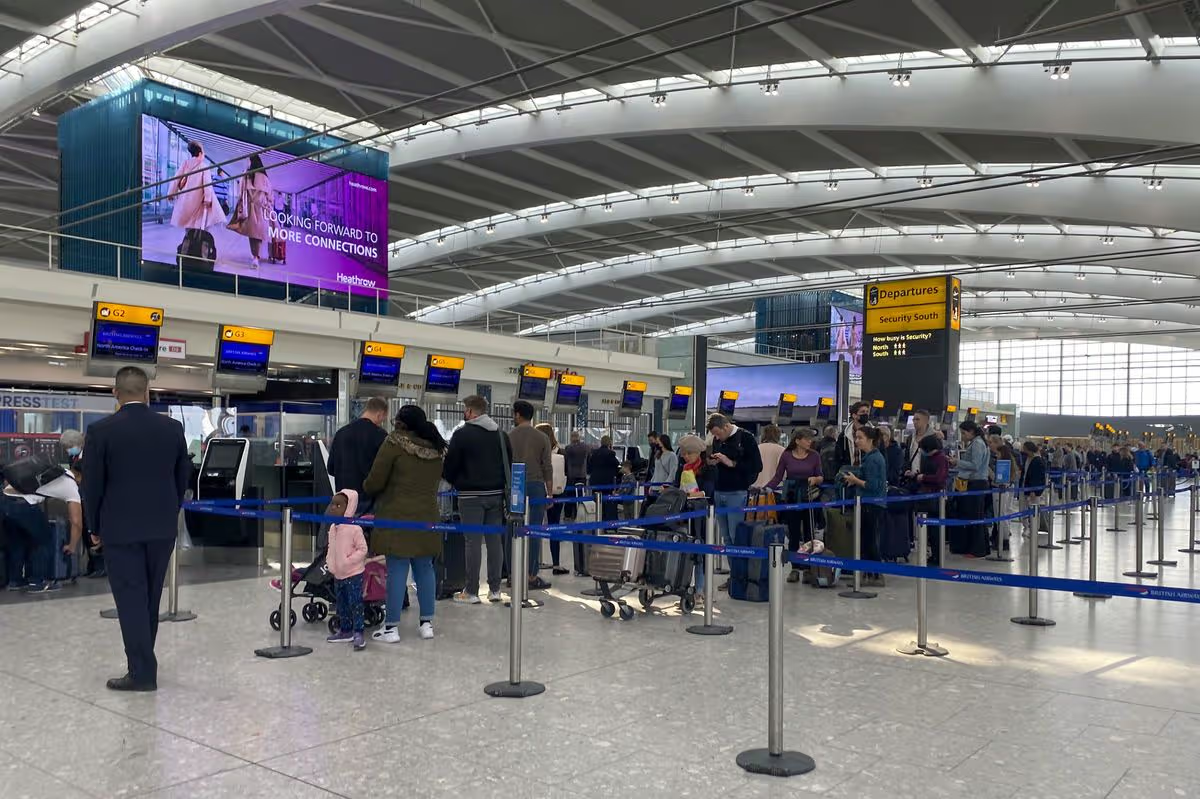
The Department for Transport has announced it is consulting on major changes for holidays
07:40, 06 May 2026Updated 07:41, 06 May 2026
Rules are being changed for flights this summer which could see people shifted onto different aircraft on the same day at totally different times with no penalty to the airline(Image: PA)
Concerns have been raised about potential changes which will mean the end of a ‘14-day rule’ this summer with flights being changed or cancelled at the last minute. The Department for Transport has announced it is consulting on major changes to holidays amid uncertainties about jet fuel supplies as the Middle East crisis continues with no end in sight.
With intense pressure on jet fuel widely tipped to cause travel problems this summer, the government announced over the weekend that airlines will be allowed to group passengers from different flights onto fewer planes. This means that at the last minute, people could be switched to a different flight.
The DfT says it will help cut the likelihood of last-minute flight cancellations this summer in the event of significant disruption due to ongoing global uncertainty caused by the Middle East conflict. It lets carriers such as Ryanair, easyJet, Jet2, British Airways, Wizz Air UK, and TUI, consolidate flights on routes where there are multiple trips to the same destination on the same day.
However, consumer experts said that currently, passengers are protected by a 14-day rule, and it’s ‘not fair’ for people to be shifted at the last minute to suit airlines without compensation. Rory Boland, Editor of Which? Travel said: “Millions of Britons will have already booked their flights for this summer, often paying over the odds for flights at peak times.
“Existing rules already allow airlines to move customers to new flights so long as they give them more than 14 days’ notice and offer the choice between a new flight or a refund. It’s only for cancellations within 14 days that compensation is payable, rightly.
“It’s not fair for the rules to now be bent in favour of airlines and potentially leave passengers holding the bill. Many passengers will understand that disruptions can occur and may be happy to travel a few hours or a day later, but for those on short trips or connecting flights it could mean the trip is no longer worthwhile.
Conservatives say it could see passengers “herded on to a different plane, at a time of the airline’s choosing”. The DfT says, however, that the measure is designed to give passengers “greater confidence” by helping airlines to lock in their schedules earlier.
Heidi Alexander, the transport secretary, adds: “There are no immediate supply issues, but we’re preparing now to give families long-term certainty and avoid unnecessary disruption at the departure gate this summer.
“This legislation will give airlines the tools to adjust flights in good time if they need to, which helps protect passengers and businesses.”
The Department for Transport said the measures would:
help move passengers onto similar services much earlier, helping avoid stressful delays at the airport
prevent running flights which have not sold a significant proportion of tickets
reduce wasted fuel from flying near-empty planes
Current rules
If your flight is cancelled by the airline, you have a legal right to a choice between being re-routed or a refund. If a flight is subject to a significant delay – at least 2 hours for short-haul, 3 hours for medium-haul and 4 hours for long-haul – passengers are entitled to care and assistance, including food, drink and overnight accommodation where necessary.
Rob Bishton, Chief Executive of the UK Civil Aviation Authority, said: “Passengers in the UK are well protected by some of the strongest rights in the world, offering reassurance if disruption does occur.
“Airlines have a duty to look after their passengers when they face disruption, and should offer a choice between a refund or alternative travel arrangements, including with another airline, if a flight is cancelled.
“Relaxing the rules around slots at airports will allow airlines more flexibility and so we expect them to give passengers as much notice as possible of cancellations during this period.”
If notified of changes to their flights by airlines, passengers are advised to speak to their airline, travel agent or tour operator in the first instance.
WASHINGTON — The electoral college vote certification was interrupted when supporters of President Trump stormed the Capitol in Washington on Wednesday, capturing the nation’s attention and threatening its democratic process.
The rioters, fueled by Trump’s baseless claims of election fraud, breached the building and ran freely through its historic halls before being forced out. The violence resulted in the death of one woman and an emergency district curfew that will last until Thursday morning. Here is how the situation unfolded:
Morning rally near the White House
(Swetha Kannan / Los Angeles Times)
10:53 a.m. Eastern Standard Time: Trump’s lawyer Rudolph W. Giuliani incites the crowd at the “Save America Rally,” saying, “Over the next 10 days, we get to see the machines are crooked, the ballots are fraudulent. And if we’re wrong, we will be made fools of. But if we’re right, a lot of them will go to jail. So … let’s have trial by combat. I am willing to stake my reputation.”
“Over the next 10 days, we get to see the machines that are crooked, the ballots that are fraudulent. And if we’re wrong, we will be made fools of. But if we’re right, and lot of them will go to jail. So — let’s have trial by combat” — Giuliani pic.twitter.com/QAYvnplCj7
Between 11:00 a.m. and 12:00 p.m.: Trump supporters continue to gather to protest Congress’ formal counting and certification of President-elect Joe Biden’s electoral college win over President Trump.
Pro-Trump supporters gather in the nations capital today to protest the ratification of President-elect Joe Biden’s Electoral college victory over President Donald Trump. pic.twitter.com/DuUn5rggzC
1:00 p.m.: As Trump speaks at the rally outside the White House, his supporters advance on the Capitol building.
1:02 p.m.: Vice President Mike Pence issues a letter saying he can’t block election results.
1:13 p.m.: Trump ends his speech at the rally with a call to march down Pennsylvania Avenue.
Trump closes with this: “We’re going to walk down Pennsylvania Ave … and we’re going to [try] to give our Republicans — the weak ones because the strong ones don’t need any of our help — we’re to try and get them kind of pride and boldness they need to take back our country” pic.twitter.com/dzGgoXD8FQ
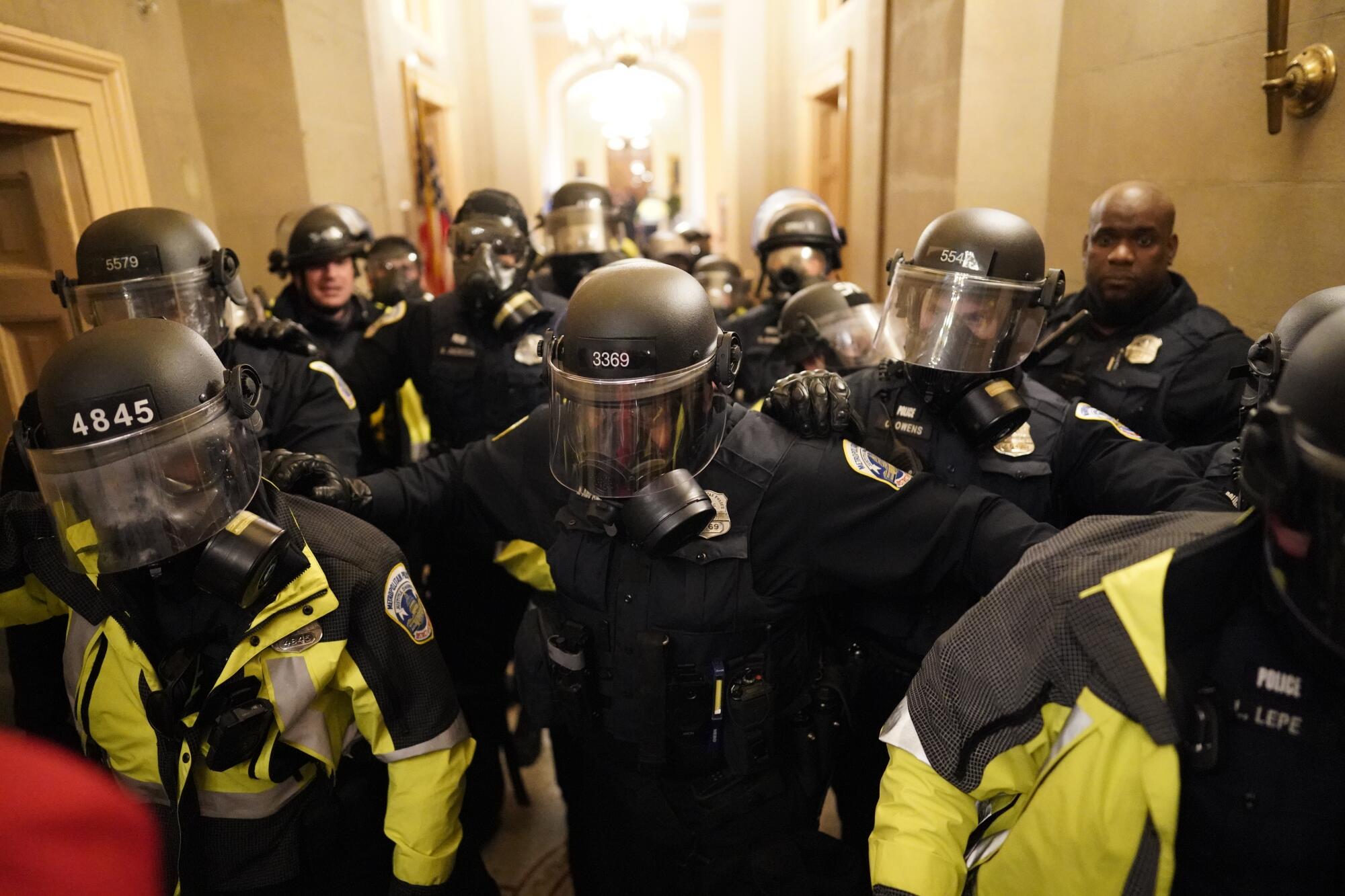
Police in riot gear clear a hallway inside the Capitol.
(Kent Nishimura / Los Angeles Times)
Around 1:20 p.m.: Mobs start to form outside the Capitol building, as Trump supporters try to break past police barriers.
2:13 p.m.: The Capitol is locked down, with no entry or exit.
NEW LOCKDOWN ORDER “All buildings within the Capitol Complex, Capitol: Due to an external security threat located on the West Front of the U.S. Capitol Building, no entry or exit is permitted at this time.” 1/2
2:16 p.m.: Rioters breach the Capitol building, while it is on lockdown.
Violence escalates
2:20 p.m.: Rioters bang on doors at the Capitol and break a window.
Capitol is on lockdown as protesters storm front entrance of the Capitol. They are banging on the door. They have broken the glass window. pic.twitter.com/3B8BBTkYmk
Here’s the scary moment when protesters initially got into the building from the first floor and made their way outside Senate chamber. pic.twitter.com/CfVIBsgywK
2:31 p.m.: D.C. Mayor Muriel Bowser announces curfew for 6 p.m. Wednesday to 6 a.m. Thursday.
2:47 p.m.: Guards draw their guns in the House chamber.
3:00 p.m.: Rioters storm in and cheer in the Capitol Rotunda.
3:03 p.m.: Rioters are on the Senate floor.
3:13 p.m.: Trump tweets asking for peace at the Capitol.
I am asking for everyone at the U.S. Capitol to remain peaceful. No violence! Remember, WE are the Party of Law & Order – respect the Law and our great men and women in Blue. Thank you!
Around 3:50 p.m.: An explosive device is reportedly found at the Republican National Committee building.
(Swetha Kannan/Los Angeles Times)
4:06 p.m.: President-elect Joe Biden makes a speech in Delaware, saying “our democracy is under unprecedented assault.”
President-elect Joe Biden called the violent protests on the U.S. Capitol “an assault on the most sacred of American undertakings: the doing of the people’s business.”
4:18 p.m.: Trump tweets a video repeating his false claims of election fraud and praising his supporters, although he encouraged them to go home. The tweet was later removed by Twitter.
“This claim of election fraud is disputed, and this Tweet can’t be replied to, Retweeted, or liked due to a risk of violence.” pic.twitter.com/vXcqvJ4Wek
For the third time in as many weeks, the leading candidates for California governor met on the debate stage Tuesday night.
The latest installment was a two-hour session, hosted and carried live from Monterey Park by CNN. The debate marked the first time the candidates appeared before a national audience and came as mail ballots have begun arriving in homes throughout the state.
Columnists Gustavo Arellano, Mark Z. Barabak and Anita Chabria took in all 120 minutes, absorbed every zinger — scripted and otherwise — and dutifully observed each parry and thrust. Here’s what they took away:
Arellano: Antonio Villaraigosa finally rises above his gubernatorial rivals. Is it too late?
I wrote my thoughts about this debate while writing my next columna on … something, stopping to pay attention only when issues in my bailiwick like immigration and the failure of the Democratic Party were the subject of discussion. The rest of the time, what the candidates said came off as one giant shout-fest straight out of the studios of the late, great Wally George, with everyone playing true to form.
Chad Bianco raged, Steve Hilton tried to mask his MAGA-ness with his British accent. Katie Porter scolded, Tom Steyer channeled Bernie. Xavier Becerra did his best impression of the old Bunsen character from “The Muppet Show.” Matt Mahan was just … there.
You know who sounded the best? Antonio Villaraigosa.
Anyone who really knows the former L.A. mayor has always seen him as Chicano Prince Hal, someone who doesn’t take himself as seriously as he should. His infidelities effectively killed his political career after his mayoral years; his consulting for the nutritional supplement company Herbalife made Villaraigosa a walking joke among too many Latinos I know.
He has spent the last decade effectively embodying Marlon Brando’s famous quote in “On the Waterfront”: He coulda been a contender. Even his gubernatorial run, announced way before many of his opponents, has mostly had the air of a has-been — that’s one of the reasons why Villaraigosa has polled so low through most of the race to the point he was excluded from many of the early debates.
But that hangdog Villaraigosa was nowhere to be seen tonight.
His wisecracks were kept to a minimum. He stayed mostly within his time limits and didn’t interrupt much. He hammered Hilton over his refusal to admit that President Trump lost the 2020 presidential election and his dismissal of undocumented immigrants.
Villaraigosa especially went hard on his forever frenemy Xavier Becerra on everything from his time as President Biden’s health secretary to how former staffers have been charged with stealing millions of dollars from his campaign funds. (Becerra has not been accused of any wrongdoing.)
When CNN co-moderator Elex Michaelson asked Villaraigosa if he would cancel California’s much-maligned high-speed rail project, the candidate’s emphatic “No” thundered down like a Lebron James dunk. He called out the waste on the multibillion-dollar project, said he revived L.A.’s subway to the sea, and spoke with a passionate gravitas that Becerra could only dream of doing.
“When I make a mistake, I’m accountable,” Villaraigosa said at the end of the debate. This sounded like a candidate who can win — and now he has a month to make a comeback worthy of his political mentor, the late, great Gloria Molina.
Four weeks to prove them wrong, Antonio.
Barabak: It was a no-hitter.
No startling breakthrough. No game-changing moment. No candidate so irresistibly charming he or she knocked the race akimbo and stamped themselves as the far-and-away front-runner in the slowly consolidating contest.
By now, the candidates are plowing well-furrowed ground.
To anyone who has watched each of the debates — and there may not be a great many of those viewers out there — it was all quite familiar.
What is new, and what may have been the draw for those just tuning in, is a sense the race is finally taking a coherent shape, with Xavier Becerra unexpectedly emerging as the candidate to beat.
A month ago, Eric Swalwell was a leading contender in the dozy contest and Becerra was an afterthought, being urged to quit for the sake of his dignity and the good of the Democratic Party. (Fears of a Democratic shutout in the June 2 primary have greatly receded.)
When Swalwell left the race and vacated his congressional seat amid allegations of sexual assault and other potentially illegal misconduct, it was widely assumed much of his support would move to either Steyer or Porter, the two other leading Democratic contenders.
But Becerra has been the clear-cut beneficiary and his new status was evident Tuesday night as he faced repeated attacks. He didn’t particularly dazzle, but that’s not his appeal. It’s his steadiness and seeming unflappability in a time of great upheaval and stress, and that was again evident.
With less than four weeks to election day — and voting already underway — time is waning for another dramatic shake-up like the one that took place between Swalwell’s implosion in April and Becerra’s surge in May.
It seems, however, as though little to nothing will change, with Becerra steadily gaining ground, Hilton consolidating GOP support and the remainder of the field looking for something — or someone — to drastically shake up the race one more time.
Chabria: I don’t know about a winner, but the debate definitely had a biggest loser: Bianco. The Riverside County sheriff, to his credit I guess, didn’t try for a hot second to hide who he really is — a conspiracy-loving immigration hardliner with ties to an extremist group.
Bianco sort-of said he was a member of the Oath Keepers, a far-right organization best known for some of its members participating in the Jan. 6, 2021, storming of the Capitol. He threw out election fraud theories, even suggesting state Atty. Gen. Rob Bonta could be involved. He made it clear that undocumented folks are breaking the law by existing in the state.
Maybe some MAGA voters will stick by that shtick, but I’m guessing independents and more moderate Republicans will find Hilton, the Trump-endorsed Republican, even more appealing after Bianco’s ragey ramblings. Hilton may well be sending his opponent a thank-you note and a bottle of bubbly for that performance.
As for winners, a couple of the Democrats had their moments. Porter spoke with clarity and force on issues including single-payer healthcare (she supports it) and resisting Trump’s immigration policies in this state of immigrants.
But she also directly addressed the criticism of her having a bad temper in a way that I think may haunt her.
As her male opponents bickered back and forth, taking swipes at each other, Porter said that given all the “shouting” and “disrespect” onstage, she was shocked that “anyone wants to talk about my temperament.” It’s a pushback she tried out earlier in the week with a new advertisement that sought to make a punchline out of the criticism.
I get her point and I don’t think a male candidate would face the same scrutiny for yelling at a staffer as she has, but also — what’s more unappealing to voters than an angry woman? A complaining one. That moment of resistance against the narrative may not land the way she intends with voters.
I agree with Gustavo that Villaraigosa had a good night, and that Steyer had Bernie energy — which may be good.
Steyer was the most lively and direct he’s been in a debate, landing a few punches and making points with clarity (far less wonky than he’s been in the past). He’s owning his far-left politics, and labeling himself the “change-maker.”
Steyer has been trailing Becerra in the polls, but Becerra again had a steady if less-than-thrilling appearance. For fed-up Democrats, Steyer may be looking better all the time.
SACRAMENTO — State elections officials warned voters Tuesday to send their mail-in ballots in early following changes at the U.S. Postal Service that has led to slower mail service throughout California.
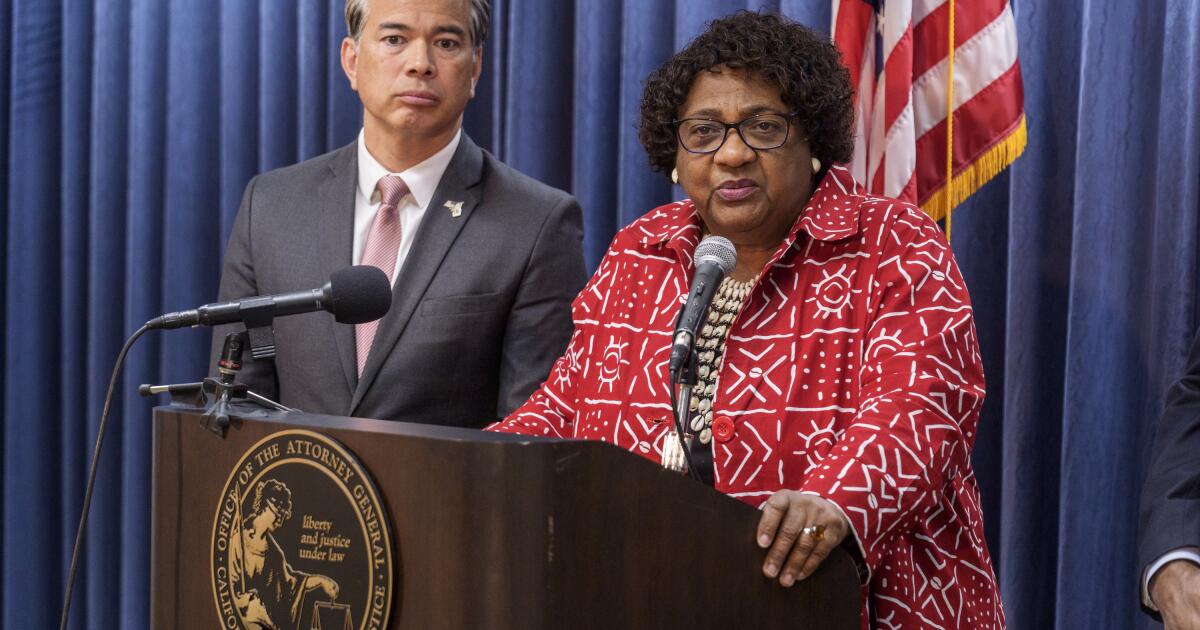
Atty. General Rob Bonta and Secretary of State Shirley Weber said vote-by-mail ballots should be put in the mail at least a week before the June 2 election.
The officials also cast skepticism about social media posts that urges Democrats to vote “late” and to rally around one candidate in order to ensure a Republican doesn’t win. The posts are similar in wording and have spread on Facebook in the last week.
Bonta said the posts, which were brought up by the Times at a news conference in Sacramento, could be “misinformation” or “disinformation” and “potentially unlawful.”
“Get your ballot in the mail at least a week early,” he said. “You want to make sure your vote is counted. And the misinformation that you’re referencing is the misinformation we’re trying to combat.”
Voters using the postal service to mail their ballot within a week of the election should go inside the post office and ask that their ballot be postmarked, or can drop off their ballot at a secure voter box, officials said.
The new guidance follows sweeping changes made at the United States Postal Services last year that has reduced the number of trips to pick up mail at post offices in mostly rural areas in the country, including California.
Rural counties saw some of the biggest increase in rejected ballots because they came in too late, The Times found.
The changes to the postal service are nationwide, but are particularly relevant in California because the vast majority of people vote in the state using mail-in ballots.
Voters who mail a ballot on election day, or even two days before, may not see their vote counted because it will arrive too late, Bonta told reporters.
“You want your vote to be counted, I want your vote to be counted,” Bonta said. “If you vote earlier, you maximize that possibility that it will.”
Vote-by-mail ballots are considered late if they are not postmarked on or ahead of election day or if the postmarked ballots do not arrive within seven days of the election.
Weber’s office also said it would look into a recent trend of social posts that urge California Democrats to “vote late” in the June 2 election.
The posts, which have appeared on Facebook and Instagram, are similar in wording, and tell Democrats to hold off from voting early to ensure that two Republican don’t make the two top spots, and to rally around one Democrat.
California’s primary election system allows the two candidates who received the most votes to advance to the November election, regardless of party.
With many Democrats crowding the ballot this year, some Democratic leaders have expressed concern fear that two Republicans — businessman Steve Hilton and Riverside County Sheriff Chad Bianco — will take the top two spots because Democratic voters will be splintered among the party’s top seven candidates.
The validity of the social media posts are under scrutiny.
One post on Facebook last week, for instance, purports to be written by historian Heather Cox Richardson. The post warned voters not to vote until after all the debates in California have concluded and the front-runner is clear.
Richardson told the Times she’s not connected to the post. “I didn’t write it and we can’t figure out who did,” she said in an email. “I haven’t— and won’t— take any position in a primary.”
The last statewide election in California was closely watched after the U.S. Department of Justice said would monitor polling sites in some California counties following a request by California Republican Party officials.
However, the election proceeded without any incident.
Gov. Gavin Newsom on Monday sent a letter to elections officials in the state’s 58 counties that highlighted recent legislation mandating that California ballots be counted within 13 days, instead of 30 days. Newsom thanked the elections staff for their work and urged a speedy vote count.
“We must acknowledge that the longer the voting count takes,” Newsom wrote, “the more mis- and disinformation spreads.”
WASHINGTON — Debris from the demolition of the White House East Wing that was dumped at a nearby public golf course has tested positive for lead, chromium and other toxic metals, the National Park Service said.
An interim report by a Virginia engineering firm says the toxic metals, along with PCBs, pesticides, petroleum byproducts and other chemicals were detected at levels above laboratory reporting limits in soil at the East Potomac Golf Links, a historic golf course that President Trump plans to renovate.
The park service began dumping debris from the East Wing onto the golf course in October, and more than 810,000 cubic feet of excavated soil had been transported to the site as of last month, the report by Jacobs Engineering Group Inc. said. The report was requested by the park service.
The nonprofit DC Preservation League has sued the Trump administration, arguing that the dumping was unlawful and possibly hazardous. The group also is challenging the Republican administration’s takeover of the golf course, about two miles southeast of the White House, and others in the city.
The suit is one of several legal battles challenging Trump’s extraordinary efforts to put his mark on public spaces in the nation’s capital, including renaming and shuttering the Kennedy Center and building a 250-foot-tall triumphal arch near the Lincoln Memorial.
At the end of last year, a separate group of preservationists filed a lawsuit seeking to prevent the administration from demolishing the East Wing so it could build a ballroom, a project slated to cost $400 million.
A spokesperson for the Interior Department, which oversees the park service, said in an email Tuesday that the soil removed from the White House “was tested multiple times by multiple parties, and this project passed all standards set by law.”
Although the agency does not comment on litigation, “this thorough process was followed to ensure the transfer was safe for the public,’’ the email said.
The Preservation League’s executive director, Rebecca Miller, said Tuesday that experts were still analyzing the engineering report. The group also is concerned about whether the Trump administration is complying with federal laws including the National Historic Preservation Act and the National Environmental Policy Act, she said.
Debris from the East Wing demolition is so prevalent that it causes golfers to detour around piles of it, Miller said. “If you Google you’ll see lots of photos of golfers walking past it,” she said in an interview.
The Trump administration’s plans to renovate the 105-year-old course to make it a professional-level course would permanently alter its historic character and layout, Miller said.
A federal judge told the government on Monday not to cut down more than 10 trees without first providing notice amid the legal dispute.
U.S. District Judge Ana Reyes said during a remote hearing that she wasn’t going to issue a temporary restraining order just yet, but she indicated she would take a harsh view of any major alterations made without prior notice.
Democracy Forward, a national legal organization that is co-representing the Preservation League, said in a press release that “further scrutiny will be required related to potential toxins that were dumped at East Potomac Park by the administration as part of the destruction of the East Wing of the White House.”
Test results released by the government “suggest the Defendants dumped a cocktail of contaminants — and despite indications of the refuse’s contents, they continued dumping it,” the group said.
Kevin Griess, the superintendent of the National Mall and Memorial Parks for the park service, said during Monday’s court hearing there was no immediate plan to begin tree removal but added that a safety assessment was underway.
Trump, an avid golfer, also plans on renovating a military golf course just outside Washington that has been used by past presidents going back decades.
In its statement, the Interior Department said it is “committed to continuing the relationships we have built with the local golf communities to ensure these courses are safe, beautiful, open, affordable, enjoyable, accessible, and world-class for people living in and visiting the greatest capital city in the world.”
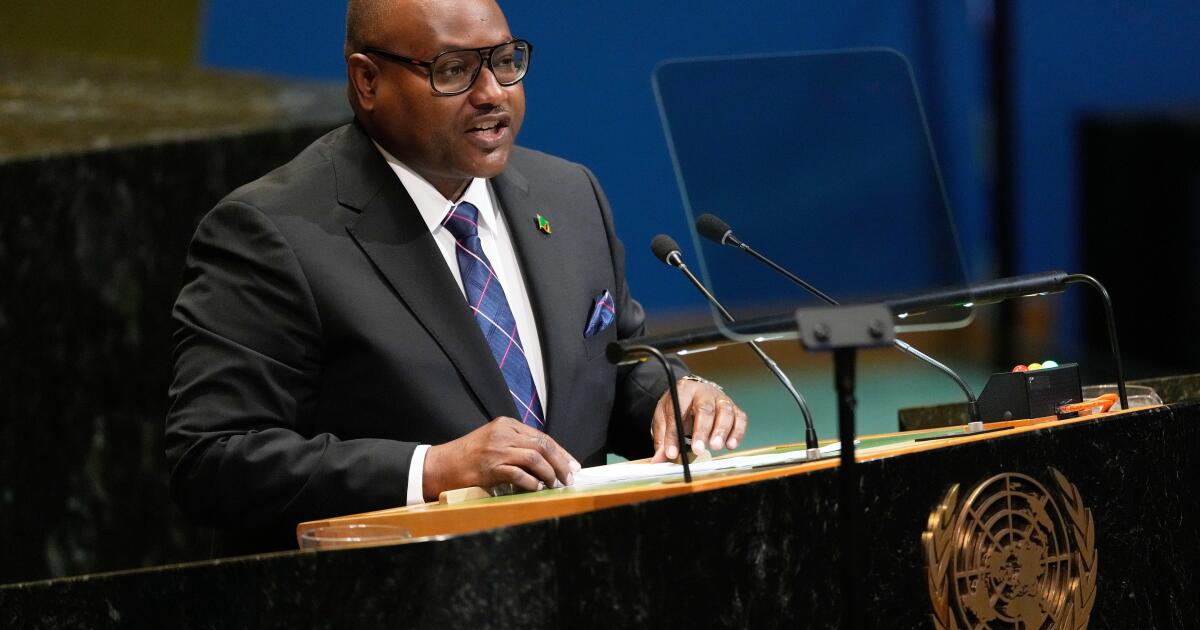
HARARE, Zimbabwe — Zambia is accusing the United States of tying a $2-billion deal for critical health assistance to access to the southern African nation’s rich mineral assets, and calling the outgoing U.S. ambassador’s allegations of corruption “mischievous” and “undiplomatic.”
The comments by Zambia’s foreign affairs minister, Mulambo Haimbe, on Monday brought into the open simmering tensions over President Trump’s “America First” strategy, which is reshaping aid to Africa into transactional agreements.
Some African leaders and health experts have criticized the new U.S. stance and its demands for sensitive health data in exchange for badly needed support for health systems strained by the Trump administration’s dismantling of foreign aid. Some say they would not receive access to health innovations like vaccines in return.
The U.S. is also seeking to challenge China, a dominant player in Zambia and much of Africa, whose minerals are critical to the green energy transition, including inputs for solar panels, electric vehicle batteries and energy storage systems.
Zambia says talks stalled over data-sharing demands
In a statement, Haimbe described the accusations of Zambian graft and negotiation inertia by outgoing U.S. ambassador Michael Gonzales as “mischievous” and “deeply regrettable, undiplomatic and inconsistent with the spirit of mutual respect.”
Haimbe also accused the U.S. of tying access to critical minerals to the conclusion of the health deal, which Gonzales earlier dismissed as “alarmist allegations” that he called “disgusting” and “absolutely and patently false.”
Negotiations have continued for months to conclude the deal, one of dozens the Trump administration is pursuing in some of the world’s most aid-dependent countries.
Gonzales in late April said Zambian leaders had “abdicated their responsibilities, letting the United States pay for healthcare while officials diverted government funds to their own pockets.” He said Zambian authorities had “ignored” U.S. overtures to conclude a new deal.
But Haimbe said negotiations had stalled over “unacceptable” data-sharing demands “in violation of our citizens’ right to privacy” and “the insistence on preferential treatment of U.S companies over Zambia’s critical minerals.”
Zambia “takes the view, first and foremost, that Zambians must have a say on how her critical minerals are used, and second that no one strategic partner is to be treated preferentially to others,” he said.
The U.S. Embassy did not immediately respond to a request for comment.
U.S. says its approach aims to reduce donor dependency
In their place, U.S. officials are negotiating country-by-country agreements that recast aid as a transaction, tying funding to conditions including commercial provisions, domestic financing commitments, disease surveillance, pathogen sharing and even religion.
Since late last year, the U.S. has signed agreements with about 30 countries, many in Africa. Washington says the approach is meant to reduce donor dependency, promote local ownership and safeguard American interests, including against an aggressive China that dominates trade in Africa but contributes less aid.
There has been pushback.
Ghana last week said it had rejected a proposed deal over provisions granting broad access to sensitive health data without safeguards. Zimbabwe walked away from a $367-million package over similar concerns. In Kenya, a $2.5- billion agreement signed in December has been put on hold after a court challenge arguing it violates data protection laws.
In Lesotho, draft U.S. proposals sought 25 years of access to health data and biological samples before local officials secured a shorter five-year deal.
Health experts say data would largely flow one way
Critics say the data-sharing demands tilt toward U.S. interests and warn the information-sharing would largely go in just one direction: toward Washington.
The new agreements aim to ensure the flow of disease surveillance data and biological samples, but through bilateral channels, after the U.S withdrew from the World Health Organization in January, said Asia Russell, executive director of advocacy group Health GAP.
Countries currently report disease outbreaks primarily through the WHO, which coordinates responses and is negotiating new frameworks on pathogen-sharing and equitable access to vaccines.
The U.S., now outside those talks, is pursuing direct access instead.
“[The U.S. wants] to understand what’s actually happening,” said Jen Kates, a senior vice president at the Washington-based nonprofit KFF. “But they are trying to do it in a very different way.”
Health advocates say this risks creating a parallel global health system. In Zimbabwe, a government spokesperson in February said the government terminated negotiations because the U.S. was not offering a “corresponding guarantee of access to any medical innovations — such as vaccines, diagnostics or treatments — that might result from that shared data.”
“That raises serious concerns about who benefits,” said Atilla Kisla of the Southern Africa Litigation Center.
Advocates point to the harsh experience of the COVID-19 pandemic, when African countries contributed data and samples but were largely last in line for vaccines.
Experts warn against health as a ‘bargaining chip’
The agreements with the U.S. are drawing criticism for closed-door negotiations and limited public scrutiny.
“Secrecy is at the center of this. That puts accountability for results at risk,” said Health GAP’s Russell. “It’s impossible to evaluate these deals properly without seeing the full terms. Part of what made PEPFAR successful was transparency. Now that’s been taken away.”
The deals also come with tighter financial conditions. Many include reduced funding compared to previous levels of U.S. assistance, while requiring countries to increase domestic health spending, with aid at risk if targets are not met.
“These are going to be very heavy lifts,” said KFF’s Kates. “Countries are already under strain.”
Critics say some agreements also advance U.S. commercial and political interests, blurring the line between aid and transactional diplomacy.
“When health becomes a bargaining chip, everyone becomes less safe,” Russell warned.
Mutsaka and Imray write for the Associated Press. Keketso Phakela in Maseru, Lesotho, contributed to this report.
Los Angeles County Dist. Atty. Nathan Hochman and the union that represents rank-and-file police officers offered a stinging rebuke of embattled City Atty. Hydee Feldstein Soto on Tuesday morning while endorsing one of her challengers in the upcoming election, county prosecutor John McKinney.
Hochman said he analyzed the field and decided the city attorney’s office “desperately needed” an experienced litigator like McKinney, who has been a prosecutor for 28 years and handled some of the city’s highest-profile trials.
“What we need in the L.A. city attorney’s office is someone who actually has courtroom experience, someone who understands how to win a trial,” Hochman said. “Someone who has actually not only talked the talk, but walked the walk.”
Hochman and leaders from the Los Angeles Police Protective League, the union which represents the majority of LAPD officers, stood shoulder to shoulder in endorsing McKinney. The league recently rescinded its endorsement of Feldstein Soto.
Feldstein Soto has been under fire for weeks, with her office accused of failing to properly inform other city officials about a hack of confidential files that saw 337,000 documents, videos and photographs leaked online. The documents amount to millions of pages, and appear to mostly come from civil lawsuits against the city that have been resolved in court. The files were not secured by a password, according to sources who spoke previously with The Times and requested anonymity because they were not authorized to discuss the ongoing investigation.
The city attorney’s office previously responded to questions from The Times by referring to a public report issued April 17, which said a preliminary investigation indicated that “the incident was contained to that third-party environment, and that no other City applications, systems, or department records were accessed or affected.”
While many of the documents dealt with relatively minor issues, others contained sensitive information about police officers. The Times used the leaked documents last month to reveal how the LAPD disciplined the officers who blew up a city block when they misjudged the weight of seized fireworks in South L.A. in 2021.
Sgt. Chris Wecker, vice president of the police union, said officers’ frustration with Feldstein Soto goes beyond the data breach. Wecker noted the city had paid out gargantuan sums in civil cases under Feldstein Soto’s administration, some of which the union believes she misplayed.
“Los Angeles has seen a dramatic rise in lawsuits, settlements and verdicts against the city costing taxpayers hundreds of millions of dollars,” he said. “The city attorney should not simply react to lawsuits after they’ve been filed. He must work proactively with city departments to identify legal risks before they turn into costly litigation.”
Feldstein Soto has also been accused of mismanaging her office and using the city’s prosecutorial powers for personal vendettas in multiple lawsuits, allegations she has repeatedly denied.
McKinney said he believes the city attorney’s office can do more work to reduce homelessness and criticized Feldstein Soto for her handling of an array of misdemeanor crimes including animal cruelty and trespassing. He said he is a proponent of “Broken Windows” policing — the idea that enforcing lesser laws will reduce felonies and deter criminals from committing worse crimes — and took a shot at Feldstein Soto’s handling of the data breach.
If such an incident happened under his watch, he said his “first call would be to the [Los Angeles Police] Department, the second to the FBI and the third to the people impacted.”
Feldstein Soto’s office has said senior LAPD officials and the city’s IT department were alerted as soon as the leak was discovered, and the FBI is investigating the matter.
Although it’s rare for the county district attorney to weigh in on the race for their city level counterpart — ex-Dist. Atty. George Gascón did not offer an endorsement in the 2022 contest which Feldstein Soto won — Hochman and McKinney are political allies who have aided each other before.
When Hochman emerged from a crowded 2024 primary field to challenge Gascón, McKinney endorsed him and functioned as a campaign surrogate.
Marissa Roy, a deputy attorney general with the California Department of Justice, is running to the left of the field and has the backing of the county’s Democratic party, the Democratic Socialists of America and her boss, California Atty. Gen. Rob Bonta. Roy has said she wants to turn the office into “the largest public interest law firm in the city,” targeting wage theft, tenant harassment and other issues impacting working-class Angelenos.
A call to Roy’s campaign was not immediately returned Tuesday.
Los Feliz attorney Aida Ashouri is also running.
The announcement from Hochman and the LAPD union could jump-start McKinney’s flagging campaign. He’s raised only $78,000 since entering the field, far less than either Roy or Feldstein Soto.
McKinney is relying on some of Hochman’s past campaign resources, hiring both the man who managed Hochman’s victory in the 2024 district attorney’s race and fundraiser Trey Kozacik, who operates the Pluvious Group.
McKinney, a registered Democrat, previously told The Times he would protect the city’s residents in court, “regardless of who’s in the White House.”
“I have been very, very disturbed by the activities of some federal law enforcement agencies that have come into Los Angeles and intentionally attempted to terrorize our people,” he said.
Times Staff Writers David Zahniser and Libor Jany contributed to this report.
ATLANTA — The Department of Justice is seeking the names of every person who worked in the 2020 election in Georgia’s Fulton County, a Democratic stronghold that Donald Trump has long accused of widespread voter fraud he falsely says cost him victory against Joe Biden in the state that year.
Lawyers for the county filed a motion on Monday night to quash a grand jury subpoena that asks for the names and personal contact information of county employees and volunteer poll workers. This latest action comes after the FBI in January went to a Fulton County elections warehouse and seized ballots and other documents from the 2020 election, which Georgia’s certified totals showed Trump lost in the state to Biden by 11,779 votes out of nearly 5 million cast. Trump, a Republican, still insists the election was stolen from him even though judges and his own attorney general concluded otherwise.
Monday’s court filing says the subpoena is meant to “target, harass and punish the President’s perceived political opponents.” The request is “grossly overbroad and untethered to any reasonable need,” the county’s lawyers argue. It “cannot yield any evidence that could result in a criminal prosecution,” they wrote, arguing that the statute of limitations on any federal crime related to the 2020 election has already expired.
The Justice Department did not immediately respond to an email seeking comment Tuesday.
County Board of Commissioners Chairman Robb Pitts, in an emailed statement, called the subpoena “yet another act of outrageous federal overreach designed to intimidate and chill participation in elections.”
“Let me be crystal clear. Fulton County will not be intimidated,” said Pitts, a Democrat who’s running for reelection.
Since the 2020 election, Trump “has obsessively propagated the debunked conspiracy theory that Fulton County ‘stole’ the 2020 election from him,” the county’s lawyers wrote. “And he has made it clear that he seeks retribution against those who refuse to indulge his baseless claims.”
Trump has already targeted individual poll workers like Ruby Freeman, who was attacked by him and his supporters after the election. Freeman, who’s Black, has said she was forced to flee her home after false claims of election fraud against her led to racist threats and strangers showing up at her home.
The grand jury subpoena, dated April 17, was served on the county’s director of elections on April 20, the county’s court filing says. It seeks the “name, position/function, residential and email addresses, and personal telephone number(s)” for thousands of election workers “ranging from county employees who assisted on election day, to bus drivers who operated a mobile voting location, to volunteers and temporary poll workers,” the filing says.
The subpoena “is a chilling escalation in the campaign to terrorize Fulton County election workers,” the county’s lawyers wrote, adding that threats arising from the current political environment have caused election workers to “fear for their physical safety.” That and other stresses “including the likelihood of being scapegoated by public officials” are causing election workers to leave their jobs “in unprecedented numbers,” they wrote.
The county’s lawyers note that the subpoena directs the county to provide the records not to the grand jury but to an out-of-state Justice Department lawyer or to the FBI agent who wrote the affidavit used for the seizure of the county’s 2020 ballots in January.
The January seizure of the ballots and other records from Fulton County was one in a string of moves by Trump’s administration to obtain past election records from critical swing states. The FBI in March used a subpoena to get records related to an audit of the 2020 presidential election in Maricopa County in Arizona. And the Justice Department in April demanded that Michigan’s Wayne County turn over its ballots from the 2024 election, which Trump won against Biden’s vice president, Kamala Harris.
The Justice Department is also fighting numerous states in court for access to voter data that includes sensitive personal information. Election officials, including some Republicans, have said handing over the information would violate state and federal privacy laws.
WASHINGTON — Senate Republicans have added $1 billion in White House security upgrades to legislation that would fund immigration enforcement agencies, a proposed boost for President Trump’s ballroom project after a man was charged with trying to assassinate him at the White House Correspondents’ Assn. dinner last week.
The GOP bill released late Monday would designate the money for the U.S. Secret Service for “security adjustments and upgrades” related to the ballroom project, which Trump and Republicans have been pushing since Cole Tomas Allen allegedly stormed the April 25 media dinner at the Washington Hilton with guns and knives. The legislation says the money would support enhancements to the ballroom project, “including above-ground and below-ground security features,” but also specifies that the money may not be used for non-security elements.
White House spokesperson Davis Ingle praised Republicans for including the money for the “long overdue” project, saying it would “provide the United States Secret Service with the resources they need to fully and completely harden the White House complex, in addition to the many other critical missions for the USSS.”
The money is part of a larger bill to pay for Immigration and Customs Enforcement and Border Patrol, as Democrats have been blocking funds for both agencies since mid-February. Congress passed bipartisan legislation to fund the rest of the Homeland Security Department on April 30 after a record-long shutdown, but Republicans are using a partisan budget maneuver to push through the ICE and Border Patrol dollars on their own. The House has not released its bill yet, but the Senate is expected to start voting on its version of the legislation next week.
It is unclear exactly how the $1 billion would be used, and the amount far exceeds the proposed $400 million for construction of the ballroom. The White House has said in court documents that the East Wing project would be “heavily fortified,” including bomb shelters, military installations and a medical facility underneath the ballroom. Trump has said it should include bulletproof glass and be able to repel drone attacks.
The National Trust for Historic Preservation has sued to block construction of the project, but a federal appeals court said last month that it can continue in the meantime.
The White House has said that private money would pay for the construction but public money would be used for security measures. Some Republicans have suggested that public money pay for all of it, arguing the security breach at the dinner shows the president needs a secure place to host events.
“It would be insane” to hold the dinner at a hotel again, said Republican Sen. Lindsey Graham of South Carolina, who introduced a bill to pay for the ballroom’s construction with Sen. Katie Britt, R-Ala.
Democrats have said they will oppose any efforts to pay for the ballroom.
“While Americans are struggling to make ends meet as a result of President Trump’s failed policies, Republicans are focused on providing tens of billions of dollars for the President’s vanity ballroom project and cruel mass deportation campaign,” said Illinois Sen. Dick Durbin, the top Democrat on the Senate Judiciary Committee, which oversees the U.S. Secret Service.
Jalonick writes for the Associated Press. AP writer Darlene Superville contributed to this report.
WASHINGTON — White House economists estimate that President Trump’s deals with pharmaceutical companies to drop some of their U.S. prescription drug prices to what they charge in other countries could save $529 billion over the next 10 years.
The analysis obtained by the Associated Press includes the first economy-wide projections behind a policy at the core of Trump’s pitch to voters going into November’s midterm elections for control of the House and Senate. Democratic lawmakers have been doubtful about the savings claimed by Trump and these new numbers are likely to trigger additional questions about the data.
Cost-of-living issues are at the forefront of voters’ concerns and higher energy prices tied to the Iran war have deepened the public’s anxiety. Trump has tried in part to address affordability concerns by focusing on his efforts to cut deals with companies so that the cost of prescription drugs in the U.S. would no longer be dramatically higher than in other affluent nations.
“Now you have the lowest drug prices anywhere in the world,” Trump said at a Friday rally before a crowd of seniors in Florida. “And that alone should win us the midterms.”
The analysis was done by administration officials for the White House Council of Economic Advisers. They also estimated that federal and state governments could save a combined $64.3 billion on Medicaid during the next decade because of what Trump calls his “most favored nation” policy on drug prices.
Few of the details of the deals struck by the Trump administration and 17 leading pharmaceutical companies have been made public, making it hard to independently verify the projected savings. The White House analysis sought to estimate the prospective savings as more medications come onto the market and fall under Trump’s framework — with one model in the report tallying the possible savings at $733 billion over a decade.
Trump and his Department of Health and Human Services have touted his drug-pricing deals as transformative and urged Congress to codify their principles into law. Democratic lawmakers have challenged the administration’s claims of savings. Senate Finance Committee Ranking Member Ron Wyden, D-Ore., and 17 Senate Democrats in April proposed a measure requiring the administration to disclose the terms of the agreements signed by pharmaceutical companies.
“If these deals are so great, why is the Trump administration afraid of showing them to the public?” Wyden said when announcing the measure. Health Secretary Robert F. Kennedy Jr. said his team would share details that didn’t include proprietary information or trade secrets.
The White House said it has not shared the text of the agreements because they include highly sensitive data that could move financial markets.
The potential savings estimated by the Trump administration would be substantial as Americans spent $467 billion on prescription drugs in 2024, according to the most recent government data available. The analysis is premised on the idea that foreign countries would also pay more for their prescription drugs, which would diversify drugmakers’ sources of revenue and preserve their ability to innovate with new treatments.
Outside economists have caveated that any savings might not flow directly to patients, many of whom already pay discounted prices for their drugs through their insurance coverage.
The Congressional Budget Office in October 2024 estimated that a plan similar to what Trump ended up adopting could reduce prescription drug prices by more than 5%, though the decrease “would probably diminish over time as manufacturers adjusted to the new policy by altering prices or distribution of drugs in other countries.”
The scope of the savings claimed by the Trump administration are likely to intensify the scrutiny by Democrats, who counter that any price reductions would be offset by higher costs for prescription drugs not covered by the “most favored nation” framework. One of their main critiques is that pharmaceutical companies have increased their profit margins while working with the administration.
In April, staff working for Sen. Bernie Sanders, I-Vt., released an analysis that looked at 15 of the companies that have agreed to this drug-pricing plan and found that their combined profits jumped 66% over the past year to $177 billion. The report noted that the tax cuts Trump signed into law last year “exempted or delayed many of the most expensive drugs” from price negotiations with Medicare.
The Trump administration has countered that they consider Sanders’ critique to be flawed, saying that it’s based on the list prices for pharmaceutical drugs instead of the actual price that patients pay.
West Bengal’s Trinamool Congress chief Mamata Banerjee has firmly rejected stepping down after her party’s defeat in assembly elections. PM Narendra Modi’s Bharatiya Janata Party swept West Bengal in elections Banerjee claims were directly interfered with.
The U.S. Department of Education opened an investigation Monday into Smith College, an all-women’s institution in Massachusetts, for admitting transgender women.
The probe by the department’s Office of Civil Rights will look at whether the college violated Title IX, a 1972 law forbidding discrimination based on sex in education.
The move is the latest by the Trump administration — whose rhetoric has frequently included attacks on trans people — to limit transgender rights in the U.S. The administration has said that Title IX prevents trans women from participating in women’s sports, suing several states and launching investigations into schools for not complying.
Smith College, a private liberal arts school founded in 1871, has admitted trans women since 2015, along with many other elite women’s colleges.
The school’s admission policies drew attention and sparked on-campus activism in 2013, when a trans high school senior was denied acceptance because her gender identity did not match the one on her financial aid forms.
Its website now says that “any applicants who self-identify as women; cis, trans, and nonbinary women” are eligible to apply to the school. Advocates have supported the shift over the years, saying that women’s colleges were founded to educate those marginalized because of their gender.
The number of women’s colleges in the U.S. has declined from more than 200 to just 30 as of fall of 2023, according to the Women’s College Coalition.
A college spokesperson did not immediately respond to an emailed request for comment.
According to the Department of Education in a news release, Title IX contains an exception that allows colleges to be all-male or all-female, but it only applies “on the basis of biological sex difference, not subjective gender identity.”
The investigation into Smith College stems from a complaint filed with the Office of Civil Rights in June 2025 by the conservative legal group Defending Education.
“DE and its members oppose, among other things, discrimination on the basis of sex in America’s K-12 schools and institutions of higher education,” the organization said in a news release.
During the Biden administration, new Title IX regulations were issued to prevent discrimination based on sexual orientation or gender identity. However, those were struck down by a federal judge in January 2025 who decided the rules had legal shortcomings.
WASHINGTON — The United States has launched a new military operation to ensure commercial shipping vessels can safely pass through the Strait of Hormuz, deploying scores of warships, fighter jets and drones to counter Iranian efforts that have threatened the narrow waterway that carries a fifth of the world’s oil.
At a news conference Tuesday at the Pentagon, Defense Secretary Pete Hegseth said the new initiative — dubbed “Project Freedom” — is a temporary and defensive operation meant to resume the flow of traffic through the international waterway as hostilities have continued in the region.
“We are not looking for a fight, but Iran cannot be allowed to block innocent countries and their goods from an international waterway,” Hegseth said, while calling Iran’s tactics “international extortion.”
The operation comes nearly a month after the United States reached a fragile ceasefire deal with Iran, a truce that Hegseth said remains in effect even though Tehran has continued to attack U.S. forces and commercial vessels.
“The ceasefire is not over,” Hegseth said.
Gen. Dan Caine, the chairman of the Joint Chiefs of Staff, said that since the ceasefire took effect, Iran has fired at commercial vessels nine times, seized two container ships and attacked U.S. forces more than 10 times. All of these instances, he said, are “below the threshold of restarting major combat operations at this point.”
Those attacks have left more than 1,550 vessels trapped in the Arabian Gulf, unable to transit, disrupting global trade and pushing energy markets toward crisis, with fuel prices climbing and shipping costs surging.
The new U.S. mission was cast as separate from the broader military campaign over Iran’s nuclear weapons program. As negotiations to denuclearize Iran continue, Caine said commercial vessels wanting to cross the strait will now “see, hear and frankly feel the U.S. combat power around them, on the sea, in the skies and on the radio.”
Two U.S. commercial vessels, escorted by Navy destroyers, have already moved through the Strait, Hegseth said.
“We know the Iranians are embarrassed by this fact,” Hegseth said. “They said they control the strait, they do not.”
Hegseth called the operation a “direct gift from the United States to the world,” aimed at resuming traffic through one of the world’s most vital waterways.
“To what remains of Iran’s forces: if you attack American troops or innocent commercial shipping, you will face overwhelming and devastating American firepower,” Hegseth said. “The president has been very clear about this.”
On Tuesday evening local time, the UAE’s defense ministry said in a statement on X that the country’s defensive systems “are actively engaging with missiles and UAV threats and that “sounds heard across the across the country are the result of ongoing engaging operations.”
Tuesday’s barrage marks the second consecutive day of attacks targeting the UAE since the U.S.-Iran ceasefire took hold on April 8. On Monday, the UAE said it engaged a total of 12 ballistic missiles, three cruise missiles and four drones launched from Iran.
Times staff writer Nabih Bulos, in Beirut, contributed to this report.
Federal Communications Commission Chairman Brendan Carr has shown an ability to make a lot of noise at the government agency known in recent years to be a little sleepy.
But his April 28 announcement that the Walt Disney Co.’s eight ABC TV stations will undergo an early review of their broadcast licenses is his loudest action yet taken on behalf of President Trump, who repeatedly threatened media outlets that he believes are critical of him.
Carr is calling for the review two years before any of the station licenses are up, citing the agency’s inquiry into Disney’s diversity, equity and inclusion policies and whether they violated federal anti-discrimination rules.
The timing of Carr’s move is raising eyebrows as it comes after First Lady Melania Trump’s call for the firing of ABC late-night host Jimmy Kimmel over his April 23 comedy bit on the White House correspondents’ dinner. A tuxedo-clad Kimmel called Melania Trump “beautiful,” saying she had “the glow of an expectant widow.”
The first lady’s remarks came after a man armed with a shotgun, handgun and several knives breached security at the Washington black-tie event on April 25. The suspect, Cole Tomas Allen of Torrance, was arrested and faces three criminal charges, including attempting to assassinate the president.
Kimmel’s gag became ammunition for right-wing commentators, who claim the left is stoking political violence.
The host said the joke was about the age difference between the 79-year-old president and his wife. Kimmel denied it was a call for violence and has continued to mock the president on his show.
Carr insisted at a Washington news conference last week that his demand for a review is not related to Kimmel’s remarks.
Although many are skeptical, Carr, who was at the April 25 dinner, told The Times there would be an action related to ABC coming soon. The conversation occurred hours before the shots were fired.
The investigation into Disney’s practices began in March 2025, part of a broader effort by the Trump administration to reverse DEI initiatives across private companies, federal agencies, universities and other organizations.
After the 2020 police killing of George Floyd in Minneapolis, which spurred the Black Lives Matter movement, companies such as Disney and NBC-owned Comcast aggressively promoted their diversity efforts.
But experts believe Carr is acting on ABC at the behest of Trump, as the chairman has often expressed support on social media whenever the president criticizes one of the broadcast TV news outlets.
“It might be the case that Disney can get some early relief by saying this should be dismissed because this is really a 1st Amendment issue,” said James Speta, a professor at the Northwestern University School of Law. “We all know what’s going on here — the administration doesn’t like the speech that’s coming out of the talent on the broadcasting airwaves.”
Disney is not commenting on Carr’s DEI investigation, but it earlier defended the record of its TV stations, which are ratings leaders in most markets. “We are confident that record demonstrates our continued qualifications as licensees under the Communications Act and the First Amendment and are prepared to show that through the appropriate legal channels,” the company said.
Here’s a primer on what to know and the challenges Disney may face.
Why are TV stations licensed by the government?
Government licensing regulates the spectrum allocated to broadcast channels, largely to prevent interference between TV signals. When renewals come up, the license holder must demonstrate that the station is serving the public interest by providing local news, program diversity and educational and informational shows for children. The procedure once occurred every three years, but deregulation efforts have extended that period to the current span of eight years.
When was the last time a TV station faced a significant license renewal challenge?
The most notable recent example was Fox Corp.’s Philadelphia station WTXF, which was up for a license renewal in October 2023. Activist groups filing the challenge said Fox was unfit to own the outlet after a judge ruled earlier that year that the company’s Fox News Channel had spread falsehoods about voter fraud in the 2020 election.
Fox News, which operates on cable and satellite and is therefore not subject to FCC control, has a different management team than the parent company’s local TV stations, which mostly cover their communities and do not typically present political commentary. The FCC rejected the renewal challenge in January 2025, noting that none of the false information on Fox News was heard on the Philadelphia station. WTXF was not cited in Dominion’s lawsuit.
Are there any other examples?
Yes. Other White House administrations have threatened to pull TV station licenses in response to negative news coverage. At the height of the Watergate scandal in the 1970s, Richard Nixon’s allies unsuccessfully attempted to challenge the TV licenses of three stations then owned by the Washington Post.
Has a company ever lost its broadcast license?
RKO General, a unit of the General Tire and Rubber Co., was the last company to lose broadcast TV station licenses in 1987, including Los Angeles outlet KHJ. The case was related to corporate malfeasance and not broadcast content on the stations.
The process to revoke the RKO licenses took seven years from the moment the FCC voted in favor of the move.
But isn’t this case different?
Yes. Although the rule Carr mentioned is legitimate, the FCC has rarely if ever acted on it, according to one veteran TV executive who was not authorized to speak publicly on the matter. If Disney or any other company was found to violate the nondiscrimination rule, they would in previous eras probably be subjected to a just a fine, not the denial of a license, which would be viewed by many as government censorship.
What happens in the event that ABC licenses are not renewed?
Nothing immediately, as the licenses are in effect through 2028 to 2032, depending on the outlet. If Disney had to sell the stations, the price would probably be depressed due to pressure to unload the properties.
But public communications attorney Andrew Jay Schwartzman told The Times last month that the bar for denying a renewal is high and any effort would be tied up in court on constitutional grounds.
“The law intentionally sets out a very steep burden for the FCC to deny a license renewal; the process takes many years, during which time the licensee continues to operate normally under ‘continuing operating authority,’” Schwartzman said.
The three liberals had known since October the conservative majority was preparing to elevate partisan power over racial fairness.
By retreating from part of the Voting Rights Act, the court’s opinion last week by Justice Samuel A. Alito will allow Republicans across the South to dismantle voting districts that favor Black Democrats.
Justice Elena Kagan, who first came to the court as a law clerk for Justice Thurgood Marshall, denounced the “demolition” of a historic civil rights law.
In dissent, she quoted Marshall’s warning that if all the voting districts in the South have white majorities, Black citizens will be left with a “right to cast meaningless ballots.”
But Alito and Chief Justice John G. Roberts joined the court 20 years ago believing the government may not make decisions based on race.
When faced with a redistricting case from Texas, Roberts described it as the “sordid business … [of] divvying us up by race.”
With President Trump’s three appointees on the court, the conservatives had a solid majority to change the law on race. Three years ago, they struck down college affirmative action policies.
Watching closely were states such as Alabama and Louisiana.
They had been sued by voting rights advocates, and both had been required to draw a second congressional district with a Black majority.
Their state attorneys appealed to the Supreme Court, arguing these race-based districts were unconstitutional.
Roberts said the Voting Rights Act as interpreted by past decisions suggests Alabama must draw a second congressional district that may well elect a Black candidate. The three liberals agreed entirely and Justice Brett M. Kavanaugh cast a tentative fifth vote.
Alito and Justice Clarence Thomas filed strong dissents, joined by Barrett and Justice Neil M. Gorsuch.
Last year, the justices agreed to decide a nearly identical appeal from Louisiana, and this time Roberts joined the conservative majority and assigned the opinion to Alito.
He argued the Voting Rights Act gave “minority voters” an equal right to vote but not a right to “elect a preferred candidate.”
The decision dealt a double blow to Black Democrats because an earlier 5-4 opinion by Roberts freed state lawmakers to draw voting districts for partisan advantage.
That ruling, combined with Wednesday’s decision, will bolster Republicans trying to maintain their narrow hold on Congress.
As if to highlight that point, the court’s six Republican appointees were guests of President Trump at Tuesday’s White House dinner for King Charles.
Just a few days before, Trump had slammed the court in another social media post.
“The Radical Left Democrats don’t need to ‘Pack the Court’. It’s already Packed,” he wrote. “Certain ‘Republican’ Justices have just gone weak, stupid, and bad.” They had struck down his sweeping tariffs, he said, “they probably will … rule against our Country on Birthright Citizenship.”
That didn’t stop him from inviting them to the White House, nor did the partisan appearances dissuade them from attending.
Alito is enjoying his moment of acclaim as the voice of the conservative legal movement.
In March, the Federalist Society held a day-long conference in Philadelphia to celebrate the “Jurisprudence of Justice Alito.”
He is the subject of two new books. One, by journalist Mollie Hemingway, calls him “the justice who reshaped the Supreme Court and restored the Constitution.”
The other, by author Peter S. Canellos, is “Revenge for the Sixties: Sam Alito and the Triumph of the Conservative Legal Movement.”
Alito attended Princeton during the Vietnam War and was put off “by very privileged people behaving irresponsibly,” as he later described his classmates.
He then went to the Yale Law School and, like Thomas, left with a lasting disdain for the left-leaning faculty and students.
Alito has a book of his own scheduled to be released in October. It is called “So Ordered: An Originalist’s View of the Constitution, the Court and Our Country.”
Last month, rumors and speculation had it that Alito and perhaps Thomas planned to retire this year so Trump and the Senate Republicans could quickly fill their seats.
At age 76, Alito is at the peak of his influence and has no interest in stepping down, and he and Thomas confirmed to news organizations they had no plans to retire this year.
For 20 years, Alito has cast reliably conservative votes at the Supreme Court and regularly argued for moving the law farther to the right.
Most famously, he wrote the court’s 5-4 opinion in the Dobbs case that overturned Roe vs. Wade and the constitutional right to abortion.
Roberts issued a partial dissent, arguing the court should uphold Mississippi’s 16-week limit on abortions and stop there.
Alito has called religion a “disfavored right,” and there too a change is underway.
In the decades before his arrival, the court had handed down steady rulings barring taxpayer funds for religious schools or religious ceremonies or symbols in public schools or city parks.
Then, the court viewed these official “endorsements” of religion as violations of the 1st Amendment’s ban on an “establishment” of religion or the principle of church-state separation.
Those decisions have faded into the background, however.
Instead, Alito, Roberts and the four other conservatives see today’s threat as one of discrimination against religion, not official favoritism for religion.
They ruled church schools and their students may not be denied state aid because of religion. Similarly, Catholic charities and other religious groups may not be excluded from publicly funded programs because they refuse to accept same-sex parents, the justices said.
They upheld a football coach’s right to pray on the field. And they ruled for a wedding cake maker in Colorado and other business owners who refused to serve same-sex couples in violation of a state civil rights law.
Religious liberty has now replaced separation of church and state as the winning formula at the Supreme Court.
The next test on that front may come from Louisiana, which calls for the posting of the Ten Commandments in public school classes.
In the past, the court had ruled such religious displays violated the 1st Amendment, but it is not clear that the current majority will agree.
The court’s oral arguments for this term ended last week. Many of them were dominated by questions from liberal Justices Sonia Sotomayor and Ketanji Brown Jackson.
A statistical tally by Adam Feldman for Scotusblog found that Jackson, the newest justice, had spoken twice as many words as the most talkative of the conservative justices.
Her arrival shifted the “center of verbal energy” to the liberal side, Feldman wrote. While Jackson “sits in a class of her own,” Sotomayor also presses the argument on the liberal side.
The court now has about eight weeks to hand down the decisions in 35 remaining cases. Usually, May and June can be a trying time because of intense disagreements over the opinions in close cases.
But for the liberal justices, it also may be a time mostly for writing dissents.