
Powell Won’t Run in 1996; He Cites Lack of ‘a Calling’ : Presidency: General tells of worries about privacy and lack of passion for political wars. He says for first time he’s a Republican and rejects accepting No. 2 spot on the ticket.
WASHINGTON — Retired Gen. Colin L. Powell, citing concerns about his privacy and a lack of passion for political combat, on Wednesday proclaimed that he would not run for President in 1996.
For the first time, Powell declared that he was a Republican. And he seemed clearly to leave open the possibility of seeking political office in the future. But he categorically ruled out accepting the vice presidential nomination next year.
In a dramatic afternoon press conference in suburban Washington, Powell, 58, said that entering the political arena “requires a calling that I do not yet hear. And for me to pretend otherwise would not be honest to myself, it would not be honest to the American people.”
“And therefore I cannot go forward,” he said. “I will not be a candidate for President or for any other elective office in 1996.”
Powell’s wife, Alma, stood at his side as he ended months of suspense about his political intentions and disappointed millions of potential supporters. His adult children, Michael, Linda and Annemarie, looked on in the packed hotel ballroom where Powell delivered his fateful verdict.
“I have spent long hours talking with my wife and children, the most important people in my life, about the impact an entry into political life would have on us,” Powell said. “It would require sacrifices and changes in our lives that would be difficult for us to make at this time.”
With the September publication of his best-selling memoirs, “My American Journey,” Powell had become a four-star American icon, the repository of the hopes of millions who dreamed that he could bind up the nation’s racial and political wounds.
But in the end, that task proved too great even for the charismatic general, who braved unfriendly fire in Vietnam and survived the ordeals of bureaucratic combat in four presidential administrations.
Powell said Wednesday he hoped he could help restore civility to American political dialogue and a “sense of shame in our society.” He also said he hoped to bring blacks back into the party by broadening the GOP’s appeal and humanizing its attempts to reform social welfare programs.
“While we’re sending out block grants, while we’re dismantling programs that have not completely satisfied everything we hoped of them, we have to concern ourselves about those who may be cut loose, and we have to be prepared to help them,” Powell said. Over the past months, “I didn’t sense there was enough consideration of that.”
“I will continue to speak out forcefully in the future on the issues of the day, as I have been doing in recent weeks,” Powell said. “I believe I can help the party of Lincoln move once again close to the spirit of Lincoln.”
But–for now–he said he would do so from outside the realm of electoral politics.
Powell largely came to his decision over the weekend and formalized it in a meeting Monday night with two of his closest friends, former Pentagon official Richard L. Armitage and former White House Chief of Staff Kenneth M. Duberstein. With a third aide, retired Col. Bill Smullen, joining in by phone, the three men sat in Powell’s formal office on the ground floor of his McLean, Va., mansion, a room dominated by his Medal of Freedom and three framed photographs of the presidents he has served–Ronald Reagan, George Bush and Bill Clinton.
Alma Powell joined the group about halfway through the 2 1/2-hour meeting, Armitage said in an interview Wednesday.
“By then, the decision was primarily made,” Armitage said. “Over these past weeks, he was up and down, he agonized. He’d go out and meet with crowds and they’d fire him up. Then he’d get back home and wonder, ‘Do I have the necessary fire in the stomach to be worthy of support of these people?’ And he found he did not,” Armitage said.
As it became clear that Powell would not run, the meeting moved quickly to a discussion of the logistics of the announcement. The four discussed various drafts of a statement, then decided that Powell should speak solely in his own words. On Wednesday afternoon, he did just that, speaking largely without reference to the note cards he had carried with him.
He had looked “deep into my own soul” before deciding not to run, Powell said, and had found that he could not summon up the “commitment and passion” he felt every day in his 35 years as a soldier.
Powell also pointedly refused to endorse any of the Republican candidates, or even the party’s eventual nominee. He answered a curt “yes” to the question of whether there were candidates in the current crop of GOP hopefuls who were unacceptable to him.
A close friend said later that Powell was referring specifically to Patrick J. Buchanan, who has harshly criticized Powell’s stands on social issues.
Powell’s decision reopens a presidential contest that had been largely frozen for the last two months as he flirted with running.
Within an hour of Powell’s announcement, House Speaker Newt Gingrich (R-Ga.) said that the former general’s withdrawal made it more likely that he would enter the race. Gingrich said he would think about it over the next several weeks and make a decision after the current federal budget deliberations are finished but before the Dec. 15 deadline for entering New Hampshire’s primary.
Powell’s withdrawal was particularly welcome news at the White House and at the headquarters of GOP presidential front-runner Sen. Bob Dole. In a statement, Dole praised Powell’s “outstanding character and leadership” and expressed pleasure that he had joined the Republican Party.
At the White House, aides showed unusual discipline in not admitting that they felt a huge sense of relief at not having to face Clinton’s worst nightmare–a black, centrist, Republican military hero–in the general election next year.
“Everyone wants some hook to say there was a sigh of relief at the White House–but you’ll have to do it on your own,” said White House Press Secretary Mike McCurry.
He added that Clinton “understands the decision to run for President of the United States is one of the most difficult decisions any human can make. He respects the general and respects the general’s right to make that decision.”
Powell met with the press for 40 minutes at the Ramada Plaza hotel in Alexandria, Va., a few miles down the George Washington Parkway from the Pentagon, where Powell made history by becoming the first African American and youngest chairman of the Joint Chiefs of Staff.
His appearance was marked by the good humor, military carriage and unshakable poise he displayed in private meetings with presidents, kings and prime ministers and in public briefings on the American military operations he directed.
He expressed gratitude to the thousands of citizens who urged him to run. “It says more about America than it says about me. In one generation, we have moved from denying a black man service at a lunch counter to elevating one to the highest military office in the nation and to being a serious contender for the presidency,” he said.
Powell drew laughs when asked whether his wife shared his enthusiasm for the Republican Party. “Next!” he boomed. He also fended off a question about whether he had been bothered by published reports that his wife was under treatment for depression.
“It is not a family secret,” he said. “It is very easily controlled with proper medication, just as my blood pressure is sometimes under control with proper medication.”
For her part, Alma Powell made clear her concerns about her husband’s safety should he become a candidate. She and the general denied that fears of assassination were a factor in his decision not to run, but the final call was not made until Monday night, the day slain Israeli Prime Minister Yitzhak Rabin was buried in Jerusalem.
Had he been elected, Powell said, his priorities in office would have been: “Show leadership. Be a conciliator. Move the government forward toward less government. . . . Try to inspire people. And try to restore a sense of family, restore a sense of shame in our society, help bring more civility into our society.”
Powell said he regretted the disappointment he caused those who enthusiastically promoted his candidacy.
“I am deeply, deeply appreciative of that support, I’m deeply appreciative of the time and talent and energy you put into it. I’m sorry I disappointed you, but I hope you will see that in the next phase of my life I will continue to serve the country in a way that will justify the kind of inspiration and enthusiasm and support you sent my way this time around,” Powell said, addressing the several dozen supporters who attended the press conference and millions more watching on television.
He said he understood the “down and dirty” of American politics and said they were a proper test of a potential leader. He said he was not afraid of that “test of fire,” but that he was not yet ready to face it.
Among those watching on television were about half a dozen disheartened volunteers at the draft-Powell headquarters in the Crenshaw district in Los Angeles. The group, which had just opened the office last week, vowed to launch an effort to change Powell’s mind. Through letters, phone calls and other means, they hope to persuade the retired general “to report for duty as a candidate for the presidency,” said Powell backer Ron Weekly.
Times staff writers Sam Fulwood III in Washington and Erin Texeira in Los Angeles contributed to this story.
* LOCAL REACTION: General’s Orange County kin pleased with his decision. A17
Medicare Secrecy Inquiry Is Silenced
WASHINGTON — House Republicans on Thursday shut down an inquiry by Democrats into whether the Bush administration acted illegally or inappropriately last year when it withheld from Congress its estimates of the true cost of the Medicare prescription drug bill.
At issue are allegations that then-Medicare Administrator Thomas A. Scully threatened to fire his top actuary if he gave lawmakers his analyses showing the costs would be much higher than administration officials were saying publicly.
Thursday’s conclusion of a Ways and Means Committee hearing all but ensured that two individuals central to the controversy — Scully and White House aide Doug Badger — would not testify before Congress.
Separately, the Health and Human Services Department is conducting an internal investigation into the matter, and Democratic lawmakers have requested civil and criminal inquiries.
Democrats on the Ways and Means Committee had asked Scully and Badger to answer questions about when President Bush and top-ranking officials were told that internal estimates of the Medicare bill’s cost were more than one-third higher than the $400 billion Bush had set aside, and why those analyses had not been shared with lawmakers.
But White House Counsel Alberto R. Gonzales, in a letter to committee Chairman Bill Thomas (R-Bakersfield), cited “long-standing White House policy” against having White House staff members testify before Congress as the reason Badger would not appear.
And Scully, now a private consultant, said in a letter to Thomas that he was unable to appear before the committee because “unfortunately, for the past ten days I have been traveling.”
Committee Democrats rejected both explanations. In the case of Badger, they said at least 45 high-ranking Clinton administration officials had testified before Congress; in the case of Scully, they offered to let him appear at a later time. But Republicans quashed the Democrats’ attempts to subpoena the men.
Republican committee members accused the Democrats of trying to capitalize on the controversy, which erupted last month when Medicare actuary Richard S. Foster told reporters that Scully had threatened to fire him if he responded to Democratic requests for analyses of the pending legislation.
Thomas, the committee chairman, said that although he was willing to use “whatever tools are necessary to get to the bottom of a violation of law,” he was not willing to issue subpoenas to Badger and Scully “to satisfy someone’s whim or curiosity.”
As for preliminary estimates by Foster indicating that the Medicare bill could cost as much as $551 billion over 10 years, Thomas said the information “probably would not have enlightened Congress as much as confused Congress.” Thomas chaired the House-Senate conference committee that completed the legislation.
In January, the Bush administration revised the estimated cost of the Medicare overhaul to $534 billion.
Democrats, who noted the original Medicare bill passed the House in June by one vote, charged that a broader constitutional issue was at stake: How far can the executive branch go in withholding information from Congress that could affect the outcome of a vote?
In November, a narrowly divided Congress passed the Medicare bill, which created a new prescription drug benefit and gave private insurers and drug companies billions of dollars to lure seniors and the disabled into managed care plans.
Several conservative Republicans, who were concerned about the bill’s projected $400-billion cost, voted for the legislation only after high-pressure lobbying by Bush and Health and Human Services Secretary Tommy G. Thompson.
“The main issue is who knew about the actuarial figure, and why wasn’t it disclosed in a timely fashion?” said Rep. Sander M. Levin (D-Mich.). “There was a cover-up of this information and we want to know how high the cover-up went.”
Procedural maneuvering and partisan wrangling dominated much of Thursday’s hearing, which was more than half over before its two witnesses began their testimony.
Jeff Flick, regional administrator of the Centers for Medicare and Medicaid Services in San Francisco, confirmed that while serving as Scully’s special assistant he composed an e-mail to Foster that reiterated Scully’s insistence that Foster withhold information requested by Rep. Pete Stark (D-Hayward).
“The administrator emphasized that if Rick does not adhere to these instructions, it is outright insubordination and insubordination carries serious consequences,” Flick said, adding that Scully’s “actual language may have been more colorful.”
Scully, who has denied threatening to fire Foster, acknowledged in his letter to Thomas that “there is no question whatsoever that I made it very clear to Mr. Foster, both directly and indirectly, that I, as his supervisor, would decide when he would communicate with Congress.”
Leslie M. Norwalk, acting deputy administrator of the Centers for Medicare and Medicaid Services, told committee members that she had advised an anguished Foster that although his office was not legally required to share information with Congress, the office was subject to Scully’s authority.
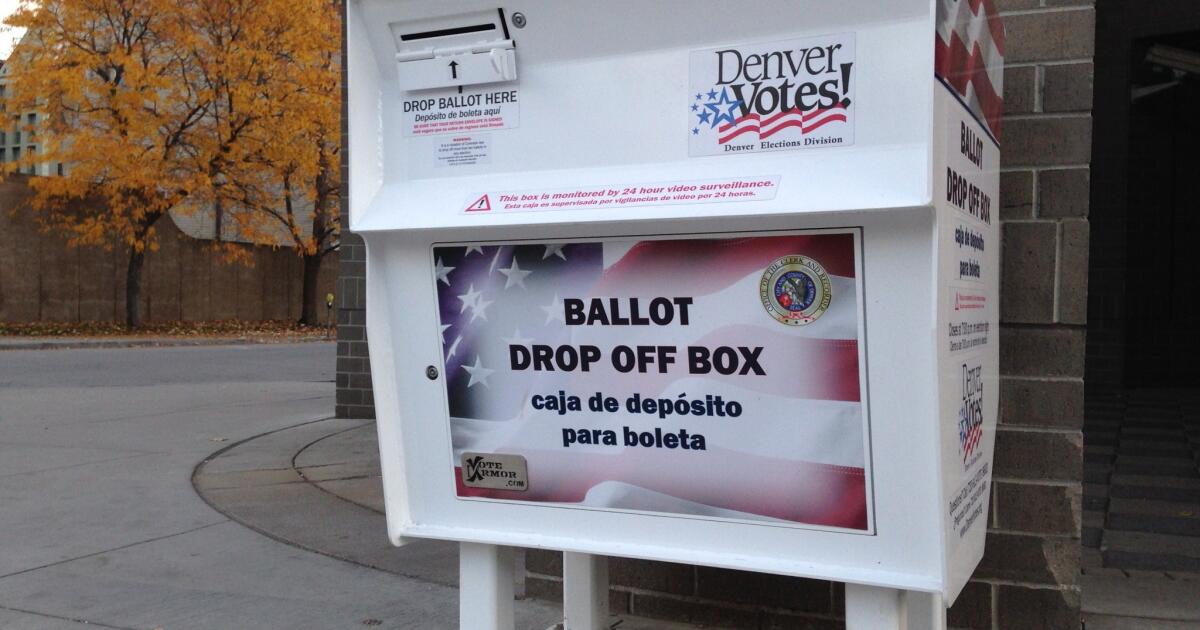
Coronavirus threatens the November election. Can vote by mail save it?
WASHINGTON — As states scramble to postpone presidential primaries, election workers abandon their posts and voters worry about the risk of contagion in crowded polling places, the question of how the nation is going to pull off a general election in November has generated increasing anxiety.
Some states are much better prepared than others.
In a significant swath of the nation, however, most voters still lack the one viable option for casting ballots that doesn’t put their health at risk in a time of pandemic: voting by mail.
Now the decades-long push by advocates and many lawmakers to make that alternative universally available has gained new momentum amid a public health crisis. Backers are racing to overcome longstanding political barriers so that states that have resisted can start confronting the huge logistical challenges involved in a quick shift away from in-person voting.
“Ohio, Louisiana, Georgia and other states are showing that without vote-by-mail, states might not be able to hold elections at all,” Sen. Ron Wyden (D-Ore.) said in an email, referring to states that have postponed scheduled primaries. He and Sen. Amy Klobuchar (D-Minn.) are rallying colleagues behind their bill that would require all states to allow citizens to vote absentee.
“I understand that standing up a new election system will be a heavy lift, but in the face of this pandemic, vote by mail is the best choice we have to keep our democracy running,” Wyden said.
Casting ballots by mail — or at drop-off locations on and before election day — is a familiar habit in the West. California has allowed any adult citizen who cares to vote absentee to do so for years. Washington, Oregon and Colorado have already moved over to 100% mail or drop-off voting, with California headed in that direction.
Deeply Republican states like Utah also allow anyone to vote absentee.
Yet in 16 states concentrated mostly in the Northeast and the South, voters are expected to show up on election day unless they can claim one of a set of excuses for an absentee ballot.
Some states have been reluctant to meddle with a tradition of civic engagement on election day. More recently, states governed by Republicans have resisted a change after President Trump repeatedly — and falsely — suggested that reforms that bring down barriers to ballot access had led to widespread voter fraud by Democrats.
The rapidly spreading pandemic has some rethinking their rules. Connecticut, for example, has temporarily changed its restrictions to make concerns about the virus a valid excuse for anyone who wants to vote absentee.
But in some states, election officials are powerless to act without changes in state law or a mandate from Congress, which has the power to set rules for federal elections.
“We need emergency action now,” said Richard L. Hasen, an election law scholar at UC Irvine who advocates a temporary federal requirement that every voter in America have access to a mail-in ballot for the 2020 election.
“We cannot postpone the election because there are places under lockdown. We need to have a Plan B ready.”
Election experts stress that putting off the general election until things settle down is not an option. The Constitution does not allow a president to serve beyond four years without reelection. But some officials still see a conspiracy.
“No elected official or journalist should use a potential health concern to advance his or her own political agenda,” Alabama Secretary of State John H. Merrill said last week after a local columnist charged the state’s absentee voting restrictions invite an election-day meltdown. The state Legislature there has repeatedly rejected proposals for universal vote by mail.
A proposal passed by lawmakers in New Hampshire was vetoed in September by Republican Gov. Chris Sununu, who warned it would erode the state’s standing as a role model of civic engagement.
“Even if people agree this is an emergency and we may need to do this, it’s hard to just wash out of your mind thoughts you have had your entire life,” Charles Stewart III, a political science professor at MIT who focuses on voting, said of skeptical elections officials.
A voter survey he conducted recently found Democrats were far more heavily in favor of universal mail voting than were Republicans. The irony, he said, is that it was GOP public officials who played a key role a couple of decades ago in seeding the movement toward voting by mail.
These days, however, the pressure on election officials is coming mostly from Democrats, who are watching in dismay as their primary election has been disrupted in nearly half a dozen states.
Democratic National Committee Chairman Tom Perez on Tuesday implored states that have not yet held their primaries to embrace voting by mail instead of postponing their elections to a later date.
By the fall, the coronavirus crisis could have passed — or it could just be getting a second wind. In 1918, the deadly influenza pandemic that hit in the final year of World War I first appeared in the winter, subsided in the summer, then roared back in the fall, disrupting that year’s presidential campaign.
The consequences of giving voters no alternative in November but to show up at polls could be dramatic in states that continue to resist. Most poll workers are over age 60, putting them at high risk if COVID-19 is still spreading. Many may just decide not to show up, as was the case in some of the primaries held this week.
The need to sanitize machines after every voter, possibly take the temperature of voters as they enter polling places and enforce social distancing — which could lead to historically long delays in both voting and tallying votes. That, in turn, could shake voter confidence in the integrity of the election.
“Are we going to say to people they can’t vote because they have a 100-degree temperature?” said Paul Gronke, director of the Early Voting Information Center at Reed College in Portland, Ore. “I think about all the complexities involved in trying to make polling places safe for people to cast ballots, and I get very nervous.”
Until this election cycle, Gronke had been reluctant to champion a federal mandate giving all voters access to absentee ballots, worrying it would be too heavy-handed. The outbreak has changed his thinking.
“We are in an emergency,” he said.
The prospects for the Wyden bill are uncertain. There are not yet any GOP co-sponsors for the proposal, which the senator has pushed in some fashion since 2006. But even if the Senate balks, election experts are hopeful more states will aim to expand mail-in voting for November on their own.
Time is fast running out. The logistical issues involved with shifting millions of voters over to mail-in ballots are monumental. Even many states that already encourage all residents to mail or drop off their ballots will probably struggle with the deluge, said Wendy Weiser, director of the Democracy Program at the Brennan Center for Justice at NYU School of Law.
“There is a huge amount that needs to be done to prepare for this,” Weiser said. She pointed to everything from the lack of vendors equipped to print so many ballots, to a potential shortage of the specific paper needed, to all the new equipment states would need to count and sort the votes.
There are other components for states to wrestle with: safeguards to ensure ballots are properly collected, finding and training large numbers of workers for what could prove a complicated undertaking, and putting in place backstops to avoid system malfunctions and clerical errors that can turn election day into a mess.
Even if the Wyden bill stalls again, lawmakers still may put money in the stimulus legislation moving through Congress to help states confront these logistical hurdles. Especially when the alternative could be a lot of Americans excluded from the ballot box come November.
“We don’t have flexibility on when this election is,” said Weiser. “There will be a very large number of people who will not be able to vote in person. It won’t be safe for them to do so. They need to have this option.”
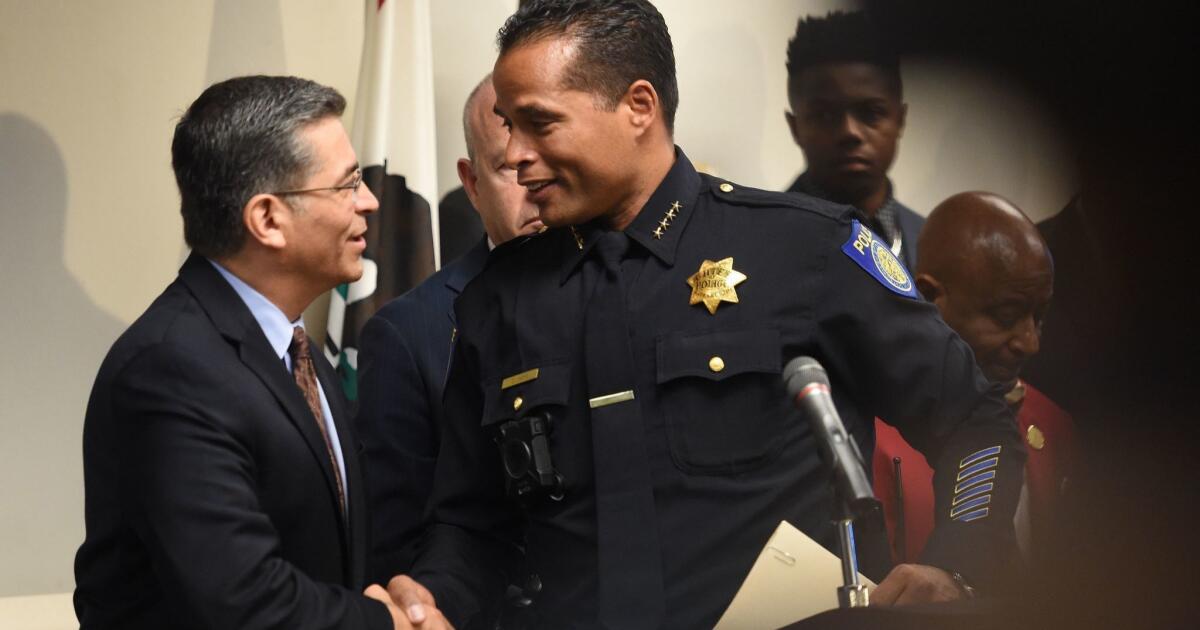
Cautious on police reform, Becerra risks losing progressives — and his political future
Reporting from Sacramento — Few California Democrats have garnered more praise from the party’s various constituencies than Atty. Gen. Xavier Becerra, who has led the state’s charge against the administration of President Trump with 47 lawsuits on issues including immigration and healthcare.
But in recent months, Becerra has come under criticism from progressives and civil rights leaders for his reticence to support legislative checks on police use of force. That blowback could have ramifications for an ambitious politician who seems primed for ever-higher offices.
On Tuesday, Becerra announced that his office would not seek criminal charges against two Sacramento police officers involved in the fatal shooting of Stephon Clark, an unarmed African American man.
While that decision was not unexpected, it built on another recent controversy in which Becerra was sued by civil rights groups for not releasing use-of-force records. He later outraged many progressive allies by threatening legal action over police misconduct records he said were improperly released to the media.
Becerra has long walked a line of presenting himself as both a civil rights defender and a friend of law enforcement. But has also disappointed some supporters for not taking a stand in support of legislation that would toughen use-of-force rules as well as a proposal that the state Department of Justice routinely provide independent investigation of police shootings.
“A Democratic attorney general, in particular, is kind of torn between two worlds — the law enforcement entities and officials with which he or she must work and build credibility with, and Democratic constituencies that are highly suspicious of, if not downright hostile to, law enforcement,” said Garry South, a Democratic political consultant.
“Becerra is now caught between these two constituencies in a pretty public way,” said South, who managed Gov. Gray Davis’ 1998 and 2002 campaigns that portrayed Davis as a law-and-order Democrat. Sen. Kamala Harris faced the same pressures when she was attorney general, South said.
Capitol watchers see Becerra as a possible contender some day for higher office, including governor or U.S. senator if one of those jobs opens up.
But Becerra risks alienating key voters by his handling of the Clark case and his refusal to take a position on legislation making it easier to prosecute police officers, said the Rev. Shane Harris, a civil rights activist who has long served as a delegate for the California Democratic Party.
“He needs to realize that if he wants to be governor someday, he is going to need black votes and brown votes,” said Harris, president of the People’s Alliance for Justice. “If he has any aspirations, they just went out the window for now. This right here really took him backwards when it comes to the black vote in the state of California.”
Harris said Becerra could regain ground with minority voters by supporting tough reform legislation and embracing calls for the attorney general’s office to independently investigate all fatal police shootings.
Then-Gov. Jerry Brown appointed Becerra as attorney general in 2017 after he served 12 terms in Congress — a perch that provided little opportunity to be involved in state discussions of law enforcement oversight. Many activists did not know where he would stand on policing matters.
He won election last year with strong support from police groups, including big campaign checks from the California Statewide Law Enforcement Assn. political action committee, the California Correctional Peace Officers Assn., the Los Angeles Police Protective League, the Assn. of Orange County Deputy Sheriffs PAC, the Long Beach Police Officers Assn. and the Oakland Police Officers Assn. PAC.
Becerra is too close to the law enforcement community, said Melina Abdullah, a professor of Pan-African Studies at Cal State L.A. and a member of the Black Lives Matter movement.
“I think the complete unwillingness of the attorney general to intervene in the murders of black people by law enforcement — even under the most extreme circumstances, like Stephon Clark — demonstrates either a completely failed moral compass or a shameful submission to political cowardice,” Abdullah said.
On Tuesday, Becerra defended his actions in police use-of-force cases as “by the book” and based on the evidence.
He resisted the idea that his office should routinely “parachute in,” as he calls it, and investigate officer-involved shootings that are now reviewed by prosecutors in each of the state’s 58 counties.
“I don’t have the capacity and the resources to try to take over the work of 58 different D.A.s in this one shop,” Becerra said.
He said local prosecutors are “far closer” to what is going on in their communities.
He said he knows the African American community feels hurt by the shooting of Clark, but added “I think there is a lot of hurt in the Police Department too, because they are under a microscope and two of their fellow officers are now under a microscope.”
The attorney general’s actions on law enforcement issues have frustrated some people who supported his election last year, including civil rights attorney John Burris, who represented Rodney King in his civil rights lawsuit against the Los Angeles Police Department.
“I’m disappointed,” Burris said after Becerra’s announcement in the Stephon Clark case. “I supported him wholeheartedly [during the election]. I think I had higher hopes for him in the beginning.”
Burris said he has asked Becerra in the last few years to look at other police shootings and the attorney general has always sided with the local district attorneys in not pursuing action against officers.
“At the end of the day, the attorney general is law enforcement, and they have to work with law enforcement throughout the state,” Burris said. “That’s what makes it very difficult for him and others to be very critical of the local police unless the evidence is overwhelming.”
The Clark decision was not the only action that concerned some Becerra allies.
Becerra is under criticism from groups including the First Amendment Coalition, which sued him last month after he refused to release records related to investigations of shootings or confirmed cases of sexual assault by officers.
The lawsuit alleges that Becerra is required to turn over the documents by a law — SB 1421 — that was approved last year. Police unions have sued to keep records from being released.
The ACLU of Southern California is “very disappointed” that Becerra is refusing to make public records ordered released by the state Legislature, said Melanie Ochoa, a staff attorney for the group.
“It is unfortunate that the state’s top cop is sending a message that it is OK for agencies to deny the public access to information about serious police misconduct and uses of deadly force — particularly when we already have numerous courts that have decided that agencies must release this information,” Ochoa said.
Becerra’s actions on the release of records are defended by Robert Harris, a director with the Los Angeles Police Protective League.
Harris praised Becerra for withholding such records in the Justice Department’s possession while court cases deciding whether the law applied to investigations of incidents that occurred before this year were pending.
“I think that’s an appropriate decision until we have a definitive answer,” Harris said.
Becerra defended his actions on the release of police misconduct records, citing privacy laws.
“My progressive values are still there,” Becerra told The Times.
“If I have your Social Security numbers, and there’s a good chance I do in one of my databases … you would not want me to disclose it lightly,” Becerra added. “My job is to protect that privacy.”
In January, in response to a group of journalists in Berkeley, the state’s Commission on Peace Officer Standards and Training released a list of 12,000 names of police officers and job applicants who had been convicted of crimes.
Becerra later said the state office made a mistake in releasing the names to reporters for the Investigative Reporting Program at the UC Berkeley Graduate School of Journalism.
In a letter, he told the reporters to destroy the records, arguing that possession of the data was a criminal offense.
Becerra said this week that his letter to Berkeley was part of due diligence to enforce the law.
“Someone needs to ask the folks that are in possession of information that they are unauthorized to possess or use, what don’t they understand about the law that says, ‘You are in possession of information that you shouldn’t have.’ It’s like stolen property,” he said.
The attorney general also finds himself in the center of a storm of controversy over possible legislative measures to reduce excessive force.
Becerra refused Tuesday to take a position on pending legislation by Assemblywoman Shirley Weber (D-San Diego) that would make it easier to criminally prosecute law enforcement officers who kill civilians.
Police unions and chiefs are supporting a separate measure that would instead focus on internal department policies and training.
Becerra said he has withheld taking a position on the two use-of-force bills because he has not read them yet and he wanted to first complete the investigation into the Clark shooting, which he wanted to be seen as independent and fair.
“I have not gone through the bills to the point of making decisions,” Becerra told reporters at a news conference on the Clark shooting.
“I will get involved because it’s important,” he said. “I don’t intend to be AWOL when it comes to the discussion of how we write this new chapter.”
Coverage of California politics »
Twitter: @mcgreevy99
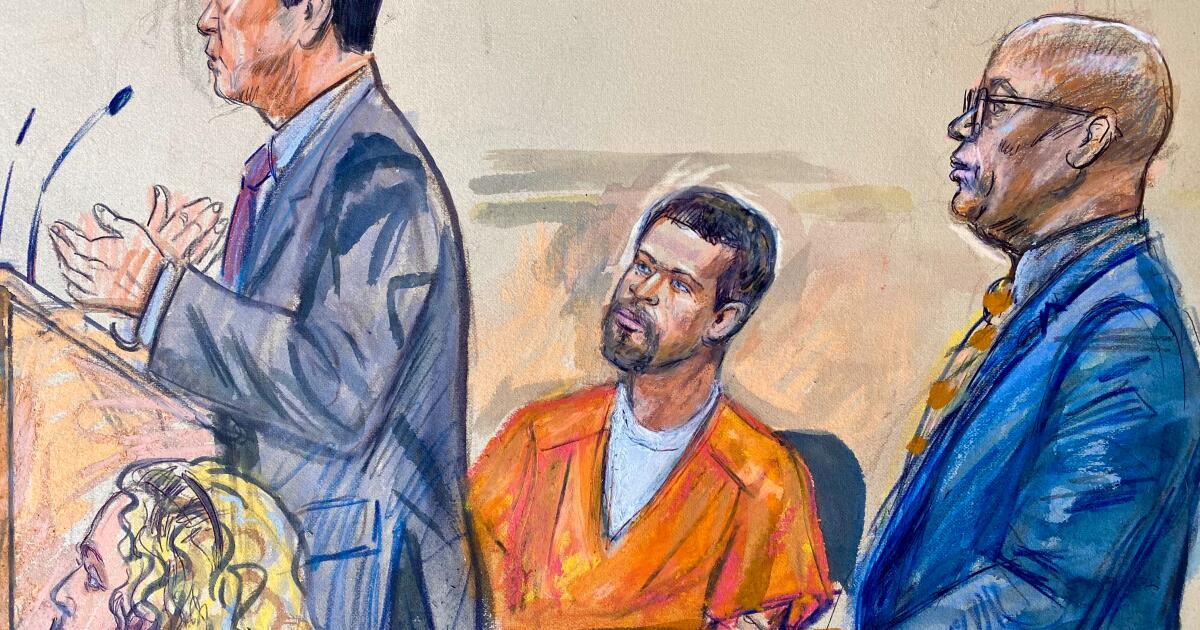
Judge asks why jail placed suspect in White House correspondents’ dinner attack on suicide watch
WASHINGTON — A federal magistrate judge on Monday pressed a jail official to explain why a man charged with trying to storm the White House Correspondents’ Assn. dinner and attempting to kill President Trump was placed on restrictive suicide watch after his arrest.
Officials at the city jail in Washington removed Cole Tomas Allen from its designated “suicide status” over the weekend after his attorneys complained that he had been unnecessarily confined in a padded room with constant lighting, repeatedly strip-searched and placed in restraints outside his cell.
But the relaxed conditions didn’t satisfy U.S. Magistrate Judge Zia Faruqui’s concerns that Allen may have received disparate, punitive treatment in violation of his due process rights. Faruqui noted that the D.C. jail routinely houses convicted killers and others charged with violent crimes without placing them on 24-hour lockdown.
“It could drive a person crazy to be in that situation,” he said.
Faruqui apologized to Allen over his confinement conditions. In response to a news report on that apology, U.S. Atty. Jeanine Pirro criticized him in a social media post that said Faruqui “believes a defendant armed to the teeth and attempting to assassinate the president is entitled to preferential treatment in his confinement compared to every other defendant.”
Allen’s lawyers said he wasn’t showing any suicidal risk factors after his arrest. But a jail psychiatrist evaluated him and initially concluded that he posed a suicide risk, according to Tony Towns, acting general counsel for the city’s corrections department.
“Every case is different, your honor,” Towns said.
Allen was moved into protective custody after the jail lifted the suicide prevention measures. His attorneys didn’t object to his new confinement status. They had asked the magistrate to cancel Monday’s hearing, but Faruqui forged ahead with it due to his “grave concerns” about Allen’s treatment in jail.
Allen was injured but was not shot during the April 25 attack at the Washington Hilton, which disrupted one of the highest-profile annual events in the nation’s capital.
Allen was armed with guns and knives when he ran through a security checkpoint and pointed his weapon at a Secret Service agent, who fired back five times, authorities said. Pirro has said that Allen fired a shot that struck the agent’s bullet-resistant vest.
Allen later told FBI agents that he didn’t expect to survive the attack, which could help explain why he was deemed to be a possible suicide risk, said Justice Department prosecutor Jocelyn Ballantine.
Allen, 31, of Torrance, is charged with attempted assassination of the president and two additional firearms counts. He faces up to life in prison if convicted of the assassination count alone.
Defense attorney Eugene Ohm said Allen was prohibited from having anything in his cell. He asked for a Bible and a visit from a chaplain but hasn’t received either, according to Ohm.
Kunzelman writes for the Associated Press.

Secret Service says suspect fired weapon on National Mall, bystander injured
WASHINGTON — The Secret Service says a suspect who opened fire Monday on the National Mall did so after being confronted by officers.
Secret Service Deputy Director Matt Quinn said officers returned fire. A bystander was struck by the suspect, Quinn said.
Quinn said the motorcade of Vice President JD Vance transited through the area not long before the shooting, but there was no indication it was the target.
The incident happened Monday afternoon around 15th Street and Independence Avenue near the Washington Monument.
The Secret Service encouraged people to avoid the area as emergency crews responded to the shooting not far from the White House, where President Trump was holding a small-business event.
The White House was briefly locked down as authorities investigated the incident. The Secret Service ushered journalists who were outside into the briefing room, and Trump continued his event without interruption.
Vito Maggiolo, spokesman for the D.C. Fire and EMS Department, said emergency units took an adult male to a hospital and were treating what appeared to be a teenage male for minor injuries. He referred other questions to the police department.
The incident drew a large police presence, coming just over a week after a gunman tried to storm the White House Correspondents’ Assn. dinner with guns and knives. Cole Tomas Allen has been charged in that incident, in which a Secret Service officer was wounded.

Judge in dispute over Washington golf course tells Trump officials not to cut trees without notice
WASHINGTON — A federal judge told the U.S. government Monday not to cut down more than 10 trees without first providing notice amid a legal dispute at a historic Washington golf course that President Trump plans to renovate.
U.S. District Judge Ana Reyes said during a remote hearing that she wasn’t going to issue a temporary restraining order just yet in the case brought by the DC Preservation League. She also told the National Park Service that it should first discuss any plans with government lawyers if it was going to cut down more than 10 trees.
Monday’s hearing came after the plaintiff’s emergency petition seeking to stop work at the course, citing news reports that major renovations were to begin Monday.
Kevin Griess, the superintendent of the National Mall and Memorial Parks for the Park Service, said during the hearing there was no plan to begin such work Monday but added that a safety assessment was underway.
Reyes told the parties she didn’t want to play the role of the “Parks and Rec” department, an allusion to the sitcom, but said she also didn’t want trees being bulldozed.
“I’m no Amy Poehler,” she said referring to the show’s star.
At one point during Monday’s hearing, the judge said she was made aware that closure signs had been put up at the site, which led to Griess’ asking someone to check. He later reported that there were no such signs. Reyes asked that if any such signs were found that the government’s attorney be told.
The complaint filed against the Department of the Interior argues that the Trump administration’s reconstruction of East Potomac Park, including the East Potomac Golf Course, would violate the congressional act that created the park in 1897. The roughly 130-year-old act established the park for the “recreation and the pleasure of the people.” The course itself opened in 1919.
Trump, an avid golfer, also plans on renovating a military golf course just outside Washington that has been used by past presidents going back decades.
Ex-NYC Mayor Rudy Giuliani recovering from pneumonia, breathing on his own
May 4 (UPI) — Former New York City Mayor Rudy Giuliani is breathing on his own and recovering from pneumonia in Florida after he was hospitalized over the weekend.
Giuliani was hospitalized with the infection on Sunday where he was in critical but stable condition because of difficulty breathing but has improved over the last 24 hours, his spokesman said on Monday afternoon.
The mayor’s spokesman, Ted Goodman, said that he remains in critical but stable condition but he has improved markedly since his hospitalization, is now breathing on his own and has his family by his side.
On Sunday, Goodman had said that Giuliani was hospitalized but had not reported why he was in the hospital, nor did he offer any details.
“Mayor Rudy Giuliani is recovering from pneumonia,” Goodman said in a post on X.
Giuliani, he said, “is the ultimate fighter — as he has demonstrated throughout his life — and he is winning the battle. His family deeply appreciated the outpouring of love and support … Please keep the prayers coming.”
Goodman said that Giuliani was diagnosed with restrictive airway disease after the days he spent in lower Manhattan breathing dust-filled air after the destruction of the World Trade Center by terrorists on Sept. 11, 2001, which included asbestos that had been used in the construction of the buildings in the 1970s.
The condition, according to Johns Hopkins Medicine, is a decrease in the total volume of air the lungs can hold because of a decrease in the organs’ elasticity or issues linked to chest wall expansion when a person inhales.
Pneumonia can be caused by bacteria, viruses and other pathogens that can enter the lungs while breathing and, depending on the overall health of the person, can be deadly.
Pneumonia is a respiratory infection and, helped by the Sept. 11-linked condition, it overwhelmed his body and required mechanical ventilation in order to stabilize his overall condition.
“He is now breathing on his own, with his family and primary medical provider at his side,” Goodman said.

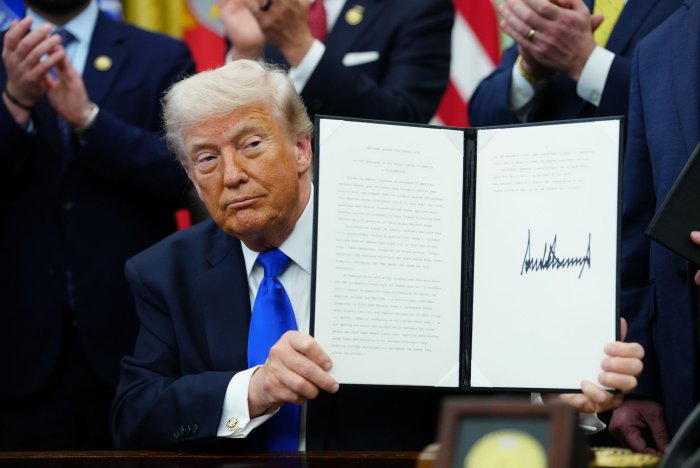
President Donald Trump signs a series of executive orders in the Oval Office of the White House on Thursday. Trump signed an order to expand workers’ access to retirement accounts. Trump also signed legislation ending a 75-day partial shutdown of the Department of Homeland Security after the House voted in favor of funding. Photo by Aaron Schwartz/UPI | License Photo

Fresh attacks in the Gulf spark fears of renewed war with Iran
BEIRUT — Confusion reigned on Monday over the fate of a fragile ceasefire between the United States and Iran after a wave of fresh strikes on the United Arab Emirates and Oman, along with reports of attacks on ships in the Strait of Hormuz, undermined confidence in the truce.
The drone and missile strikes, the first since a ceasefire halted fighting in early April, come after the Trump administration launched a wide-scale naval operation on Monday to “guide” stranded maritime vessels out of the vital waterway.
But fears over a return to war have driven another surge in oil prices, pushing them above $114 per barrel — levels not seen since the ceasefire nearly a month ago. Hundreds of cargo ships from dozens of countries remain stuck in the Gulf. And strikes in Dubai have raised concerns about further disruptions to international air travel at one of the world’s busiest airports.
Iran’s state-run news agency, IRNA, said the new U.S. operation was part of President Trump’s “delirium,” after the Islamic Revolutionary Guard Corps warned that passage through the strait required prior approval from Tehran.
“We warn that any foreign armed force, especially the invading American army, will be attacked if they attempt to approach and enter the Strait of Hormuz,” said Maj. Gen. Ali Abdollahi, according to a statement reported by the Iranian state-run Mehr News Agency on Monday.
The operation, which Trump over the weekend dubbed “Project Freedom,” is supported by 15,000 U.S. servicemen and 100 aircraft, according to U.S. Central Command. Their aim is to deny Tehran control over the strait, a narrow, 21-mile-wide passageway through which a fifth of global energy supplies flows.
On Monday, Trump vowed Iran’s forces will be “blown off the face of the Earth” if they attempt to disrupt Project Freedom.
“We have more weapons and ammunition at a much higher grade than we had before,” Trump was quoted as saying in an interview with Fox News.
“We have the best equipment. We have stuff all over the world. We have these bases all over the world. They’re all stocked up with equipment. We can use all of that stuff, and we will, if we need it.”
Iran blocked traffic through the strait soon after the United States and Israel launched their campaign on the country. Last month, days after a ceasefire between Washington and Tehran came into effect, the United States enforced its own naval blockade on Iranian ports in a bid to pressure Iran to make concessions in stalled negotiations.
On Monday, Central Command said in a statement that two American-flagged merchant ships were able to successfully transit the strait, while Central Command head Adm. Brad Cooper said the U.S. military sank six Iranian boats and intercepted missiles and drones targeting civilian vessels.
“We have defeated each and every one of those threats through the clinical application of defensive munitions,” he said.
“Project Freedom is a defensive operation, and we have deployed anti-ballistic missile destroyers,” he added. “Ships in the Gulf waters belong to 87 countries, and we urge ships to cross the strait.”
IRIB, Iran’s state-run broadcaster, quoted a senior Iranian military official who denied Cooper’s claim of sunk Iranian boats. The IRGC said in a statement on the messaging app Telegram that claims of commercial vessels or tankers traversing the strait were “baseless and completely false.”
Though Cooper did not clarify if the ceasefire between Washington and Tehran was now over, a raft of attacks throughout Monday spiked fears that the war would restart, spurring sharp price increases in already-jittery energy markets.
The UAE said a fire broke out and three Indian nationals were injured in the Fujairah Oil Industry Zone, a key export hub for the country, after what it described as an Iranian drone attack.
It also accused Iran of targeting a tanker linked to the country’s state oil company Abu Dhabi National Oil Company in the Strait of Hormuz, while the country’s defense ministry also reported four cruise missiles launched from Iran, saying that it intercepted three of them while the fourth fell in the sea.
“These attacks constitute a dangerous escalation and an unacceptable transgression,” said a statement from the UAE’s foreign ministry, adding that it “reserves its full and legitimate right to respond to these attacks.”
Elsewhere, two foreign workers were injured in an attack on a residential building in the Omani coastal province of Bukha, according to a statement from an unnamed security source quoted by the state-run Oman News Agency. Authorities were investigating the incident but did not elaborate on the perpetrator.
The U.K.’s Maritime Trade Operations Center reported on Monday that a commercial vessel was on fire off the coast of the UAE, while a South Korean bulk carrier ship said it suffered an explosion and a fire in its engine room and the cause was being investigated.
Bulos reported from Beirut, Wilner from Washington.

Attacking the Death Star Isn’t Enough to Build the New Republic
Four months have passed since US Starfighters breached the Fuerte Tiuna Death Star, captured Darth Maduro and celebrations broke out all around the galaxy. Venewoks in the diaspora embraced a renewed sense that victory, this time, might be permanent. But back in the country, the Empire has managed to reorganize and adapt to the demands of Viceroy Trump and leading members of the Trade Federation. Darth Delcy, albeit disdained by many, is becoming stronger. The rebellion yearns for the return of Master Machado, who isn’t getting the Viceroy’s authorization to negotiate a proper matchup with Darth Delcy and subsequent terms of surrender.
It’s more evident by the minute that Darth Delcy’s plan is to avert the creation of the New Republic by giving the Empire a technocratic, trade-friendly outlook. The path between defeating Darth Maduro and dismantling the Empire has turned out to be treacherous. Master Machado has tried to reassert her leadership by visiting foreign galaxies, but can’t find a breakthrough with the Viceroy.
Delcykrats are trying to conduct a swift takeover of the layered system Darth Maduro inherited from the Emperor. Madurokis are being neutralized or quietly assigned to minor planets, as is the case of Grand Moff Padrino in Agraria. Grand Admiral González López and Envoy Plasencia, old friends of Darth Delcy, are making strides, one within the Imperial High Command, the other across intergalactic diplomacy. Grand Vizier Jorge, Darth Delcy’s cunning brother, is running the senate and recasting the new imperial order through the language of old Scarlet propaganda.
The new imperial order
In Carascant, to keep the Scarlet Coalition from fragmenting, Darth Delcy tries to keep the echo of Stormtrooper boots and official dismissals contained within Imperial Offices. She still has to contend with Diosdado the Hutt, whose power lies in coercion and galactic hunting squads. More than 450 rebellion prisoners, many captured on the Hutt’s orders, are still in Imperial detention centers.
Viceroy Trump looks unwilling to press the ruling Delcykrats as long as he gets unrestricted access to on-demand resources such as kyber crystals and beskar steel. As Darth Delcy’s power and appeal before the Trade Federation has grown, she has terminated initial gestures of reconciliation that were initially needed for appeasement. A new Death Star is in the works, and to build a superior weapon for durable rule, Darth Delcy knows time is her most valuable asset.
Chief Envoy Rubio has reassured Master Machado that the galaxy first needs to stabilize and revive its economy before any transition can take place. Lately, however, the envoys that visit Carascant have said nothing about Republican reform, and a great deal about kyber crystals and the resumption of intergalactic travel.
The Empire does not need either Darth Maduro or Darth Delcy to prevail. It only needs the New Republic project to fail.
Master Machado has also witnessed how the regime restricts the activity of allies like Han Guanipa and Lando Armas, dropping threats every now and then. In the domestic senate, separatist opponents led by Count Capriles have failed to influence Imperial policy. A series of looming Imperial appointments, and the November referendum on Viceroy Trump, can determine Master Machados’ chances to a great extent.
Aligning the interests of the victors of the November referendum with those of the New Republic will be a challenge for rebel aides Mon Meda and Pedro Organa. They won’t just need to keep a level of coordination with allies of growing importance, but to safeguard Master Machado’s position before Viceroy Trump while keeping the new hope alive.
The struggle for Republican foundations
In the coming weeks, the Scarlet Coalition will be forced to appoint a new InterGalactic Banking Board (IGBB) and, even sooner, fill roughly two-thirds of the Imperial High Court. The figures chosen to lead these bodies could prove decisive in shaping the fate of Darth Delcy’s emerging Death Star project. A competent IGBB will be essential for the stabilization phase, key to aligning both the Trade Federation and the Galactic Senate behind the prospect of Venezuela’s economic rebound.
At the same time, a genuinely independent Imperial High Court could become the first meaningful check on Imperial power. The courts are also expected to oversee the Council of Electoral Battles, still controlled by Madurokis whom Darth Delcy has left untouched to avoid triggering her pending matchup with Master Machado. These two institutions will be critical to the third phase that Chief Envoy Rubio is purportedly pursuing, and might determine the success of Viceroy Trump’s plan after capturing Darth Maduro. Control over courts and the Battles Council will determine whether the final electoral contest—backed by the Trade Federation—can take place on credible terms.
The Rebel struggle will gradually shift toward navigating a far more intricate web of factions within a fragmented Trade Federation.
But Darth Delcy is expected to attempt cosmetic reshuffles rather than a transformative change of Imperial personnel. One unresolved question is whether forces aligned with Master Machado, such as national support and diplomatic pressure, will be enough to force a true transfer of power, or whether the Empire will once again adapt without changing.
The near future provides an opportunity for the new order to strengthen. The Trade Federation’s influence over Darth Delcy depends on Viceroy Trump’s grip on power, which will face its biggest challenge in the November referendum. The unchecked power the Viceroy currently has allows him to circumvent any criticism over Carascant. But change in the Trade Federation’s balance of power could make bipartisan support essential for the future of the New Republic.
The Trade Federation’s reckoning
Competing views in the Trade Federation on how to advance with the Empire’s transition will give more time and less scrutiny to Darth Delcy’s actions. It also provides an opportunity for Imperial Envoy Plasencia to bolster views which are more aligned with the Empire. For the Rebellion, the fallout from Viceroy Trump’s eroding grip on power hinges entirely on the alliances Master Machado has tried to forge.
These alliances will likely be essential to maintain pressure and decisively advance the New Republic’s agenda. Nonetheless, Viceroy Trump’s polarizing grip on the narrative has created deep seated resistance amongst potential allies. The struggle will gradually shift away from merely managing and appeasing Viceroy Trump and his Envoys, and toward navigating a far more intricate web of factions within a fragmented Trade Federation.
When Darth Maduro was defeated but no New Republic was allowed to emerge, the Empire did not dissolve, it adapted. Its new faces and colors are not signs of weakness but mechanisms of survival, designed to delay or prevent the formation of a New Republic. “Permanent victory” is an illusion. The Empire does not need either Darth Maduro or Darth Delcy to prevail. It only needs the New Republic project to fail.
What follows for Master Machado and the Rebellion is therefore not a triumphant return, but a sequence of calculated risks. The next chapter will depend on whether Master Machado returns as the leader of a Rebellion or as the effective architect of a New Republic. The Empire is determined to prevent her return or neutralize her immediately. If she returns solely as a symbol of resistance, Imperial forces will seek to frame her as a destabilizing threat to Viceroy Trump’s plan, increasing the risk of escalation against her.
If, however, her return becomes the centerpiece of a multilateral New Republic project backed by the Trade Federation, it would directly undermine Darth Delcy’s strategy. In that scenario, any move against Master Machado would signal to Viceroy Trump that Delcy cannot control the coalition she leads. At the same time, Master Machado’s movement can position itself as a more credible alternative for institutional reconstruction.
This shift, from diplomatic cover during resistance to an instrument of internal legitimacy, opens a narrow but meaningful window for the New Republic’s success.
The past 12o days show that Venewoks have not yet earned their Endor moment. As in the Star Wars movies, dismantling an Empire and building a New Republic will take a long and arduous journey. Normally the credits would unroll now, but the crisis continues and Darth Delcy’s intentions are crystal clear.

Supreme Court puts hold on ruling that would block mailing of abortion pills
WASHINGTON — The Supreme Court took a first step on Monday to consider anti-abortion challenges to medication that has been commonly used to end early pregnancies for 25 years.
The justices moved quickly to put on hold an appeals court ruling that would block the mailing of abortion pills nationwide. Justice Samuel A. Alito issued a temporary “administrative stay” until May 11.
Three years ago, the court blocked a similar challenge to abortion pills, ruling that anti-abortion doctors had no grounds to sue over medication they did not use or prescribe.
Last year, Louisiana’s state lawyers sued and argued their state ban on abortions is thwarted if women can receive abortion pills through the mail after consulting a doctor online.
They questioned the federal regulation that permits doctors to prescribe the medication without seeing patients in person.
On Friday evening, the conservative U.S. 5th Circuit Court of Appeals in New Orleans jolted abortion rights advocates, first by ruling this claim is likely to succeed and then by putting their order into effect immediately.
Judge Kyle Duncan, a President Trump appointee, said the Food and Drug Administration had “failed to adequately study whether remotely prescribing mifepristone is safe.”
Moreover, women may suffer “irreparable harm” if these mail-order prescriptions are allowed to continue, he said.
If upheld, the order would go far beyond Louisiana and make it illegal for women in California and other states to obtain the pills through a pharmacy or by mail if they did not see a doctor first.
The legal dispute may put the Trump administration in an uncomfortable spot. In response to the abortion critics, the FDA agreed to review the safety of prescribing these commonly used pills without a required trip to a doctor’s office.
Its review is not likely to be completed until after the November elections.
The 5th Circuit judges said they were not prepared to wait for the outcome of that review.
On Saturday, two makers of mifepristone — Danco Laboratories and GenBioPro — filed emergency appeals asking the justices to block the 5th Circuit’s order.
“Never before has a federal court” rejected a long-standing drug approval by the FDA, they said, and restricted its distribution based on claims the agency had rejected.
The justices asked for a response from Louisiana by Thursday.
Mifepristone was approved in 2000 as a safe and effective way to an early pregnancy. It is typically used in combination with a second drug — misoprostol — which is not affected by the court’s decision.
If mifepristone becomes unavailable, women may use misoprostol alone, abortion rights advocates say.
In recent years, the majority of abortions in this country result from the use of medication.
Alito is responsible for emergency appeals from the 5th Circuit, and Monday’s order does not signal what the court will decide.
“This ruling is not final — keep watching,” said Nancy Northup, president of the Center for Reproductive Rights. “Getting abortion pills through telehealth has been a lifeline for women since Roe v. Wade was overturned. Louisiana’s attempt to restrict access is political and not based in science or medicine. Americans deserve access to this critical drug that has been FDA approved for 25 years.”
Carol Tobias, president of National Right to Life, agreed the court’s order did not resolve anything.
“It is a temporary procedural step that leaves unresolved the very real concerns about the safety of these drugs and the decision under the Biden administration’s FDA to recklessly remove longstanding safeguards,” she said.
California Atty. Gen. Rob Bonta joined with 21 other state attorneys in urging the court to block the 5th Circuit’s decision.
“Telehealth has made it easier for women — especially in rural, low-income, and underserved communities — to access mifepristone and obtain reproductive health care,” he said. “We should be guided by science, not politics. The in-person dispensing requirement was eliminated because it was medically unnecessary, and there is still no basis for reinstating it.”
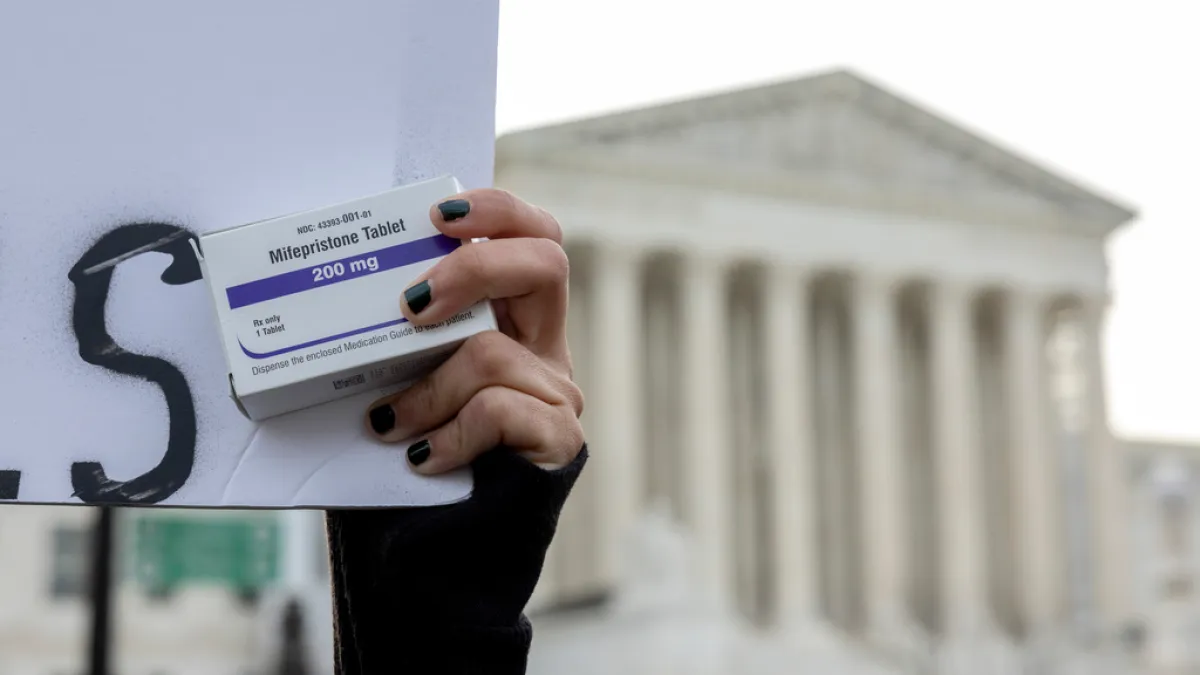
US Supreme Court temporarily lifts ban on abortion pill mail delivery | Health News
The United States Supreme Court has temporarily reinstated a rule allowing an abortion pill to be prescribed through telemedicine and dispensed through the mail, lifting a judicial ban that narrowed access to the medication nationwide.
Justice Samuel Alito issued an interim order on Monday, pausing for one week a decision by the New Orleans-based 5th US Circuit Court of Appeals to reimpose an older federal rule requiring an in-person clinician visit to receive mifepristone.
Recommended Stories
list of 3 itemsend of list
The 5th Circuit acted in a challenge to the rule by the Republican-led state of Louisiana.
The Supreme Court’s action, called an “administrative stay”, gives the justices more time to review emergency requests by two manufacturers of mifepristone to ensure that the drug can be provided via telehealth and the mail while the legal challenge plays out.
Alito ordered Louisiana to respond to the drugmakers’ requests by Thursday and indicated that the administrative stay would expire on May 11. The court would be expected to extend the interim stay or formally decide the requests by that time.
Alito, one of the nine-member court’s six conservative justices, acted because he is designated by the court to oversee emergency matters that arise in a group of states that includes Louisiana.
The case puts the contentious issue of abortion back in front of the justices, who must confront another effort by abortion opponents to scale back access to mifepristone, with the November US congressional elections looming.
The court in 2024 unanimously rejected an initial bid by anti-abortion groups and doctors to roll back Food and Drug Administration (FDA) regulations that had eased access to the drug, ruling that these plaintiffs lacked the necessary legal standing to pursue the challenge.
Mifepristone, given FDA regulatory approval in 2000, is taken with another drug called misoprostol to perform medication abortions, a method that now accounts for more than 60 percent of all abortions in the US.
The ongoing battles over abortion rights follow the court’s 2022 ruling that overturned its 1973 Roe v Wade precedent that had legalised abortion nationwide.
That ruling has prompted 13 states to enact near-total bans on the procedure, while several others have sharply restricted access.
Louisiana sued the FDA last year, claiming that a rule adopted during the administration of former US President Joe Biden, a Democrat – a rule that eased access to mifepristone by eliminating the in-person dispensing requirement – is illegal and undermines the state’s abortion ban.
The pill’s manufacturer, Danco Laboratories, and GenBioPro, which makes a generic version, intervened in the litigation to defend the 2023 regulation. The administration of current US President Donald Trump, a Republican, cited an ongoing review of safety regulations concerning mifepristone and opposed the state’s challenge.
In April, US Judge David Joseph in Lafayette, Louisiana, declined to block the regulation but agreed with the administration to put the case on hold pending the review. The 5th Circuit blocked the rule on May 1.
The legal and political fight over access to mifepristone has dominated the debate over abortion in the US over the past few years.
The American Civil Liberties Union (ACLU) called the top court’s decision on Monday a “positive short-term development”.
“The Supreme Court needs to put an end to this baseless attack on our reproductive freedom, once and for all,” Julia Kaye, senior lawyer for the Reproductive Freedom Project of the ACLU, said in a statement.
Since the Supreme Court revoked the right to abortion in 2022, Democrats have been seizing on the unpopularity of bans on the procedure and emphasising the issue in their electoral platforms.
Chuck Schumer, the top Democrat in the Senate, welcomed the top court’s decision on Monday, but said, “This fight is just beginning.”
“We will stop at nothing to prevent the Republicans from putting a national abortion ban into effect,” Schumer wrote on X.
On Monday, Republican Senator Josh Hawley cited disputed findings on the health risks associated with mifepristone, urging lawmakers to act.
“Now it’s time for Congress to ban it completely for use in abortion,” he said in a social media post.

As U.S. plans fewer troops in Germany, Europe sees need for bigger role within NATO
YEREVAN, Armenia — European leaders on Monday said President Trump’s surprise decision to pull thousands of U.S. troops out of Germany is just the latest signal that Europe must take more responsibility for its security.
The Pentagon announced last week it would pull some 5,000 troops out of Germany, but Trump told reporters on Saturday the U.S. plans on “cutting a lot further.”
Trump offered no reason for the move, which blindsided NATO. But his decision came amid an escalating dispute with German Chancellor Friedrich Merz, who said the U.S. has been humiliated by Iran in talks to end the war it launched with Israel on Feb. 28. Trump has also expressed anger over European allies’ reluctance to get involved in the conflict.
European leaders meeting at a summit in Yerevan, Armenia, sought to both downplay the impact of 5,000 fewer troops in Germany while acknowledging that it provides a useful nudge for the continent to step up its role within NATO.
“I do not see those figures as dramatic, but I think they should be handled in a harmonious way inside the framework of NATO,” said Norwegian Prime Minister Jonas Gahr Støre.
British Prime Minister Keir Starmer said “there needs to be a stronger European element in NATO, I have no doubt about that.”
Tensions within NATO have mounted since the second Trump administration came into office last year warning that European allies would have to defend themselves and Ukraine in the future. Talks on ending the war there, now in its fourth year, have bogged down as the U.S. focuses on Iran.
Taken by surprise
The European Union’s foreign policy chief, Kaja Kallas, said the timing of Trump’s announcement came as a surprise, even though there has been “talk about withdrawal of U.S. troops for a long time from Europe.”
Asked whether she believes Trump is trying to punish Merz, Kallas said: “I don’t see into the head of President Trump, so he has to explain it himself.”
Merz did not attend the European Political Community summit in Yerevan, which included about 30 European leaders, plus Canadian Prime Minister Mark Carney.
At a military exercise in northern Germany, the country’s defense minister, Boris Pistorius, said Berlin has not yet received “official confirmation of when and how this is supposed to happen, on what scale.” The reduction of U.S. troops “would not put into question NATO’s deterrence capability,” he added.
European countries and Canada have increased defense spending and military recruitment efforts over the last year in response to Trump’s threats.
NATO seeks clarity
NATO Secretary-General Mark Rutte also played down the significance of fewer U.S. troops in Germany, while acknowledging U.S. “disappointment” about the level of European support for the Iran war.
France and the U.K. have given U.S. forces limited use of bases on their territories to attack Iran. Spain has outright denied U.S. forces the use of its airspace and bases.
Rutte, who has championed Trump’s leadership at NATO despite the U.S. president’s criticism of a majority of the allies, said: “I would say the Europeans have heard a message.”
European allies and Canada have known since early last year that Trump would pull some troops out of Europe — and some were pulled out of Romania in October — but U.S. officials had pledged to coordinate any moves with NATO allies to avoid creating a security vacuum.
NATO spokesperson Allison Hart said over the weekend that officials at the 32-nation military alliance “are working with the U.S. to understand the details of their decision on force posture in Germany.”
Iran and trade trouble
With the ceasefire between the U.S. and Iran looking shakier, Rutte said European nations “have decided to pre-position assets, key assets, close to the theater for the next phase.” He provided no further details.
European leaders have insisted their countries would not help police the Strait of Hormuz, a key energy trade route, until the war is over.
“If the United States is ready to reopen Hormuz, that’s great. That’s what we’ve been asking for since the beginning,” said French President Emmanuel Macron. But he underlined that Europeans are not ready to get involved in any operation “that does not seem clear.”
Carlson and Cook write for the Associated Press. Cook reported from Brussels. AP writer Geir Moulson in Berlin contributed to this report.

US releases Touska container ship crew: Why it matters | US-Israel war on Iran News
The United States has transferred 22 crew members from the Iranian container ship, the Touska, to Pakistan, in what Islamabad describes as a “confidence-building measure” during tension in the Strait of Hormuz.
US Central Command (CENTCOM) spokesman, Captain Tim Hawkins, said the crew had been handed over for repatriation. Pakistan’s foreign ministry confirmed the transfer, saying the sailors would be returned to Iranian authorities.
Recommended Stories
list of 4 itemsend of list
The Touska was seized by US forces in the Gulf of Oman in the early hours of April 20, in what Tehran described as an act of “piracy”, after the US declared a naval blockade of Iranian ports. Iran had effectively closed the Strait of Hormuz following the start of the US-Israeli war on Iran.
On Monday, tensions continued to escalate in and around the Strait of Hormuz.
First, US President Donald Trump announced that US naval ships would help guide stranded vessels through the strait in an operation he dubbed “Project Freedom”.
Iran issued a new map of the strait with new boundaries further to the east, and warned shipping not to attempt to pass without coordinating with the Islamic Revolutionary Guard Corps (IRGC).
Then, state media reported that two Iranian missiles struck a US naval vessel near Jask Island in the strait after ignoring warnings from the IRGC to turn back. Washington denied any attack.
Amid continued interceptions and seizures of vessels by both sides, questions remain over whether the two countries can de-escalate and reach a broader peace agreement. Pakistan has been central to these efforts, seeking to keep diplomatic channels open, but talks hosted in Islamabad last month ended without a breakthrough.
Iran’s foreign ministry says it is reviewing Washington’s response to its 14-point proposal aimed at ending the conflict sent via Pakistan on Friday. As Pakistan continues to mediate, Trump previously described Tehran’s offer as “unacceptable”.
What happened to the Touska?
The Iran-flagged Touska was seized by US forces in the Gulf of Oman, close to the Strait of Hormuz, on April 20 after Washington accused the crew of failing to comply with the US naval blockade on Iranian ports. Shortly after midnight local time in Iran, CENTCOM said the USS Spruance fired its 5-inch (127mm) deck gun at the vessel’s engine room, disabling it.
According to the US military, the ship was attempting to transit the Strait of Hormuz en route to Iran’s main commercial port, Bandar Abbas.
The Touska, a small container ship operated by the sanctioned Islamic Republic of Iran Shipping Lines (IRISL), was boarded near Iran’s Chabahar port. US Marines from the 31st Marine Expeditionary Unit captured the vessel after what CENTCOM said were repeated warnings over six hours.
Video released by the US military showed Marines descending from helicopters launched from the USS Tripoli and securing the Tusk.
Iran condemned the capture as a violation of international law and an act of “piracy“, before demanding the immediate release of the vessel and its crew.
What does the release of the Touska’s crew mean, diplomatically?
Pakistan has positioned itself as a mediator between Washington and Tehran, and is now framing the transfer of the Touska crew as a step towards de-escalation of tensions. In a statement, the Pakistani foreign ministry said the move reflected a “confidence-building measure” and reaffirmed its commitment to facilitating dialogue.
US and Iranian delegations met in Islamabad last month for their first talks since 1979. Although negotiations ended without a deal, they marked a rare moment of direct engagement.
Pakistan has since coordinated with regional powers, including Saudi Arabia, Turkiye, Qatar and Egypt, while maintaining close communications with China, in an effort to build broader support for de-escalation.
In a call with Iran’s Foreign Minister, Seyed Abbas Araghchi, on Monday, Pakistan’s Deputy Prime Minister, Ishaq Dar, reiterated that diplomacy remains the only viable path to stability. Tehran, in turn, acknowledged Islamabad’s mediation efforts.

Will this de-escalate tensions in the Strait of Hormuz?
There are not many signs that it will.
Indeed, tensions in the Strait of Hormuz have continued to increase despite the release of the crew members.
Most notably, Iran’s Revolutionary Guard published a new map on Monday outlining what it claims is an expanded zone of control in the waterway, stretching from Iranian and Omani territory to include the territorial waters of the United Arab Emirates as well.
Analysts say this new claim exceeds internationally recognised boundaries. The UAE has accused Iran of launching drones at an oil tanker linked to Abu Dhabi’s national energy company, while Washington has dismissed Iranian reports of an attack on a US warship as false.
Military analyst Alexandru Hudisteanu, a maritime security expert who served 13 years in the Romanian navy, told Al Jazeera on Monday that the conflicting claims reflect a broader test of resolve. “Any attempt to open the strait will likely be met with resistance from Iran,” he said, adding that Tehran views control of Hormuz as its primary leverage in negotiations.
Hudisteanu warned that the situation carries a high risk of miscalculation, with both sides continuing to operate in close proximity. For Iran, the Strait of Hormuz is the “only leverage” it has for peace negotiations, Hudisteanu said.
Iranian analyst Foad Izadi argued that the ceasefire effectively collapsed when the US imposed its blockade, which he described as “an act of war”. He added that the targeting and seizure of ships along the Strait of Hormuz further undermined any notion of a truce.
“Attacking an Iranian ship’s engine is an act of war as well,” he added, despite the release of the Touska’s crew signalling some short-term goodwill between the US and Iran.

What to know about the U.S. military presence in Europe as Trump seeks to draw down troops
WASHINGTON — President Trump’s vow to shrink America’s military deployment in Germany has put a new spotlight on the U.S. role in Europe.
There are usually 80,000 to 100,000 troops on the continent, with more than 36,000 in Germany. The Pentagon announced Friday that it would remove 5,000 troops from Germany, and Trump said the next day that he would go “a lot further” than that.
The U.S. military presence is a legacy of World War II, when Americans helped stabilize and rebuild Europe, and the Cold War, when the troops served as a bulwark against Soviet expansion. More recently, the deployment has played a key role supporting operations in the Arctic, Africa and the Middle East including the current conflict with Iran.
But Trump has broken with years of bipartisan consensus, criticizing European allies in NATO and following through on threats to reduce the U.S. commitment to the continent’s security. The recent announcement comes after escalating tensions with German Chancellor Friedrich Merz, who last week said the U.S. was being “humiliated” by Iran and accused Washington of lacking a clear strategy.
Here’s a look at America’s current deployment in Europe and how it could change.
What to know about the U.S. defense posture in Europe
The U.S. European Command, created in 1947 and known as EUCOM, is one of 11 combat commands within the Defense Department, and covers some 50 countries and territories.
In addition to more than 36,000 troops in Germany, Italy hosts more than 12,000 and there’s another 10,000 in the United Kingdom, according to Pentagon numbers from December.
The Pentagon has offered few details about which troops or operations would be affected in the drawdown announced Friday.
The U.S. increased its European deployment after Russia launched its full-scale war on Ukraine four years ago. NATO allies like Germany have expected for over a year that these troops would be the first to leave.
European deployment has global role
Aside from its role as a deterrent to Russia, the U.S. military presence in Europe helps Washington project power across the globe.
U.S. Gen. Alexus Grynkewich, who is the commander in Europe of both U.S. and NATO forces, reinforced the benefits of a strong footprint on the continent to the Senate Armed Services Committee in March.
“It is having capabilities in Europe, munitions in Europe that allow us to help U.S. Africa Command to target terrorists in Africa, or to help U.S. Central Command as they execute Operation Epic Fury,” he told lawmakers, referring to the Iran war. “The distances are shorter, it’s less expensive and it’s much easier to project power.”
Germany hosts the headquarters of the U.S. European and Africa commands, Ramstein Air Base and a medical center in Landstuhl, where casualties from the wars in Afghanistan and Iraq were treated. U.S. nuclear weapons are also stationed in the country.
The U.S. has approximately 100 nuclear bombs deployed to bases in Europe that would be delivered by aircraft, according to a March estimate from the Federation of American Scientists. The group’s report said the bombs are at bases in Belgium, Germany, Italy, the Netherlands and Turkey, while it’s possible they’re also at a base in the United Kingdom.
A call to move U.S. forces further east in Europe
Even before Trump’s comment Saturday to reporters, Republican leaders of both armed services committees in Congress expressed concern about the Pentagon plan, warning a premature drawdown in Europe would send “the wrong signal to Vladimir Putin” as the Russian president continues his war in Ukraine.
Sen. Roger Wicker of Mississippi and Rep. Mike Rogers of Alabama said troops should be shifted to bases in Eastern Europe rather than withdrawn.
The lawmakers also said allies have made “substantial investments to host U.S. troops.”
Wicker and Rogers said the Pentagon, following its announcement Friday, has also decided to cancel the planned deployment to Germany of one of the U.S. Army’s long-range fires battalions, which operate ground-launched missile systems.
Trump’s vision: DIY defense in Europe
As part of its National Defense Strategy announced in January — a sweeping document laying out a vision on everything from deterring China to defending against cyberattacks to disrupting Iran’s nuclear ambitions — the administration said Europe must do more for its own defense.
While “we are and will remain engaged in Europe, we must — and will — prioritize defending the U.S. Homeland and deterring China,” it said.
Among other things, the document noted that Europe’s economic power, while shrinking in relative terms globally, remains significant, and said that Germany’s economy alone “dwarfs that of Russia.”
“Fortunately, our NATO allies are substantially more powerful than Russia — it is not even close,” it said, noting a recent commitment among NATO allies to raise national defense spending to 5% of GDP in total, a push led by Trump.
What Germany has been doing to beef up its forces
Germany has moved to modernize its long-neglected military, or Bundeswehr, since Russia’s invasion of Ukraine in 2022. That year, it set up a $117 billion special fund to boost Bundeswehr, much of which has been committed to procuring new equipment.
Late last year, Merz’s government announced plans to raise the number of military personnel to 260,000, up from about 180,000. In 2001, when Germany still had conscription, the headcount was 300,000 — more than a third of them conscripts.
Berlin says it will also need around 200,000 reservists, more than double the current figure.
Defense Minister Boris Pistorius, in comments to German news agency dpa after the Pentagon’s drawdown plan was announced Friday, acknowledged that Europe must take more responsibility for its own security — and said the Bundeswehr is growing, military equipment is being procured more quickly, and infrastructure is being developed.
Keaten and Finley write for the Associated Press. Keaten reported from Geneva.
Kamala Harris endorses L.A. Mayor Karen Bass for reelection
Former Vice President Kamala Harris endorsed Los Angeles Mayor Karen Bass for reelection on Monday.
“Mayor Karen Bass is the leader Los Angeles needs right now. She has done what so many said couldn’t be done — the first ever two-year decline in homelessness, reducing crime to levels this city hasn’t seen since the 1960s, and refusing to back down when the federal government came after our neighbors,” Harris said in a statement. “She has my full support for re-election.”
The endorsement comes as ballots have begun arriving in Californians’ mailboxes at a critical moment in the race to lead the nation’s second-largest city. Although Bass leads in polls, she is viewed unfavorably by many Angelenos for her perceived lack of leadership in the aftermath of the devastating Palisades fire.
A quarter of voters supported Bass in a March poll by the UC Berkeley Institute of Governmental Studies that was co-sponsored by The Times. City Councilmember Nithya Raman had the backing of 17%, and conservative reality TV star Spencer Pratt had 14%. A quarter of voters were undecided.
Though Bass led the other prominent mayoral candidates, political strategists say the numbers are troubling for the incumbent because she is facing off against lesser-known rivals and because 56% viewed her unfavorably. And Pratt and Raman had raised more money than Bass this year through April 18, according to fundraising disclosures filed with the city’s Ethics Commission. However, Bass had nearly $2.3 million in the bank because she started fundraising for reelection two years ago.
Though Bass and Harris were rivals to be selected as presidential nominee Joe Biden’s running mate in 2020, the two Democrats have known each other for more than two decades and have a long shared history. Bass was sworn in by Harris as the 43rd mayor of Los Angeles in 2022. Two years later, at the Democratic National Convention where Harris became the party’s presidential nominee, Bass spoke about working with her more than a decade ago on youth homelessness and fixing the child welfare system when Bass led the California Assembly and Harris was a state prosecutor.
Harris also endorsed Rob Bonta for reelection as state attorney general, Malia Cohen for reelection as state controller and Lt. Gov. Eleni Kounalakis for state treasurer. Here’s a look at those races and the rest on the ballot.
Column: California isn’t so cutting-edge when it comes to electing governors
SACRAMENTO — Across America, 53 women have served as state governors. But not one in California. What gives? Aren’t we supposed to be enlightened out here in this cutting-edge state?
In fact, 14 women currently are governors in all sorts of states — north, south, flyover and Pacific coast. Big, midsize and small. Red, blue and purple.
We stand out with a huge black mark.
Voters have a chance to erase the ugly spot this year with Katie Porter in position to possibly be elected California’s first female governor.
Don’t get me wrong. I’m not saying Porter should be elected just because she’s a woman.
What I’m saying is that this is an opportunity to elect a perfectly qualified woman. If a male opponent is considered better suited for the job, fine. But first, let’s give her a good hard look and listen to her ideas. Maybe she’s too liberal — or not liberal enough. Perhaps too feisty and brusque than some unfairly find acceptable in a woman.
Independent polling shows that Porter basically isn’t getting any more support from women voters than she is from men.
I queried my best source on such matters: my daughter, Karen Skelton, a longtime political operative who has served stints in the Clinton and Biden White Houses. Why aren’t more women rallying around Porter?
“There was a time when women were excited to support women just because they were women, fueled by the historic prospect of electing ‘the first,’” she said. “But if anything has been proven in the last two presidential elections where women ran, it’s that identity politics does not work….
“It has to be more than her identity as a woman to get her elected.”
Yep. In my view, Democrat Hillary Clinton wasn’t very likable in 2016 and ran a lousy campaign. In 2024, Vice President Kamala Harris also lacked popularity. And she was dealt a losing hand by aging President Biden when he took too long to step aside.
Harris, a former U.S. senator with a long history of electoral success in California, would have been the heavy favorite to become the state’s first female governor if she had run. But she declined, opting for a possible third presidential bid in 2028.
Porter, 52, is a UC Irvine consumer law professor and former Orange County congresswoman who increased her statewide name familiarity by running unsuccessfully for the Senate in 2024.
Running for governor, she has been forthright and specific on what she’d try to achieve in Sacramento. She’d probably shake up the place.
One goal that should appeal to young families is free childcare. How’d she pay for that, I asked.
“Well, how do we afford public schools, roads, everything else, right?” the single mother of three answered, implying it’s about priorities. “The reason we don’t fund childcare, but we do fund other things, is because we expect women and mothers to do childcare for free or for pennies.”
She was scurrying along leading the Democrat pack last fall until tripping over two videos that displayed a hot temper.
In one, she threatened to walk out of a TV interview when a female reporter repeatedly asked how she expected to gain the votes of President Trump’s supporters. An irritated Porter said she didn’t need their votes, and she was right — but also rude.
In the other video — an oldie — then-Rep. Porter was shown yelling at a young female aide to “get out of my f— shot” during a videoconference with a Cabinet secretary.
Porter says she apologized to the staffer that day and they worked together for years afterward. And following a recent televised debate, Porter says, the former aide texted her congratulations and added that if she still lived in California, she’d vote for her.
The TV reporter, Julie Watts of CBS, was a moderator of a campaign debate last week and tossed some prickly questions at Porter and the other candidates.
“I was very calm and answered all the questions,” Porter notes. “I showed people I can do better” than the TV interview she has apologized for many times.
Porter has never completely recovered from the harmful videos. But she’s running close to two other Democrats — billionaire Tom Steyer and former U.S. Health and Human Services Secretary Xavier Becerra — in the June 2 primary.
“If a man had done the same thing, we wouldn’t be talking about it,” asserts Valerie McGinty, founder and president of Fund Her, an organization dedicated to electing women.
Several women agreed.
Assemblymember Cottie Petrie-Norris (D-Irvine), who has endorsed Porter, points to the late beloved, oft-profane legislative leader John Burton of San Francisco as an example of a double standard.
“Not a woman in American politics could get away with titling their autobiography ‘I Yell Because I Care,’” she says. On the book’s jacket cover, Burton is pictured speaking to a crowd with two raised middle fingers.
“People expect women to be strong but not too harsh,” Petrie-Norris says.
OK, but why do women get elected governor in other states, but not in California?
Mindy Romero, director of the Center for Inclusive Democracy at USC, says the vast amounts of money and human resources needed to win in humongous California make it especially difficult for women. They usually haven’t been included in the political pipeline long enough, she says, to build a hefty donor base, acquire elective office experience and gain statewide name recognition.
Three women have dropped out of the current race because they weren’t gaining ground. But it’s hard to argue it was because of any gender hurdles.
Previously, three women won their party nominations for governor but lost in November: Democrats Dianne Feinstein and Kathleen Brown in 1990 and 1994, respectively, and Republican Meg Whitman in 2010. None lost because of any double standard. It just wasn’t their year politically.
But California has elected three female U.S. senators — Democrats Feinstein, Barbara Boxer and Harris.
And nearly half the state Legislative seats are held by women.
It’s conceivable this year that California finally enters the 20th century — let alone the 21st — by electing our first female governor.
What else you should be reading
The must-read: Coded messages, ‘red boxing’ and other allegations in California’s testy race for governor
Money (That’s what I want): Billionaire-tax backers say they have enough signatures to qualify for ballot
The L.A. Times Special: Voter guide to the 2026 California primary election
Until next week,
George Skelton
—
Was this newsletter forwarded to you? Sign up here to get it in your inbox.

‘Hegemonic power’: How Modi’s BJP won India’s Bengal for the first time | Elections
New Delhi, India – Seema Das, a househelp in New Delhi, took on a two-day journey to reach her village in India’s West Bengal state, changing trains to make sure she got home in time to vote in provincial elections.
Das had previously always voted for the All India Trinamool Congress (TMC) party under Chief Minister Mamata Banerjee, a centrist political force that has been in power in the eastern Indian state since 2011. But this time, she said, her mother-in-law had convinced her that “Didi” – a nickname for Banerjee, which translates to elder sister in Bangla – “favours Muslims”.
Das, a Hindu, added: “Didi has lost the track and only appeases Muslims to stay in power.”
That’s an accusation that Prime Minister Narendra Modi’s Hindu majoritarian Bharatiya Janata Party has long levelled against the TMC, which emphasises religious pluralism and the protection of minority rights. But for 15 years, Banerjee and her party have ruled the state of more than 90 million people, even as the BJP gained ground in a state where it had traditionally been a marginal player.
On Monday, that changed. Modi’s party won West Bengal. Early results from elections to the state’s legislature – which were held in April, but votes were counted on May 4 – show that Modi’s well-oiled election machinery is poised to deliver a thumping majority for the BJP in a state that its ideological founder was from, but that it has never won before. By 4:30pm India time, the BJP had won or was leading in 200 out of the state’s 294 seats, where its previous best performance was 77 seats in 2021. Banerjee’s TMC, meanwhile, was leading or had won just 87 seats.
The West Bengal elections were among five whose results were declared on Monday. In the southern state of Tamil Nadu, actor C Joseph Vijay threw up a surprise, defeating dominant parties to win with his upstart TVK party; in its neighbouring state of Kerala, the Congress party – the largest national opposition party – beat a coalition of left parties. A BJP-led alliance won the self-administered territory of Puducherry, once a French colony. And in the northeastern state of Assam, Modi’s party returned to power with a sweeping majority.
Yet it is the outcome in West Bengal that analysts say is by far the most consequential of the results that were declared on Monday, with the BJP walking the trails of religious polarisation and leveraging underlying anti-incumbency to win, experts told Al Jazeera.

Inside Banerjee’s bastion in East
Banerjee founded the TMC in 1998, breaking with the Congress party, disillusioned with its refusal to frontally take on a coalition of communist parties that had ruled West Bengal since 1977.
Rising from a humble background, the lawyer-turned-student-activist-turned-politician finally defeated the communists to win the state in 2011. Since Modi became prime minister of India in 2014, she emerged as a key challenger to the BJP – framing her politics, especially her defence of Bengal’s Muslims, as an act of opposition to Hindu majoritarianism.
She also launched a series of women-centric welfare schemes and pushed back against controversial land acquisition projects sought by big industry.
“There is visible support for Mamta and she remains popular, but there is anti-incumbency against the TMC machinery, and people were not happy with their interference in everyday life,” said Rahul Verma, an election observer who teaches politics at the Shiv Nadar University in Chennai.
He added that the BJP also ran a better-managed campaign this time, noting that he is not “shocked” by the results. “It was a difficult election for the BJP, but not impossible.”
To Verma, “there was a corridor available to them [in West Bengal], and one can now say everything aligned in a way to produce this outcome for them.”
Verma emphasised that “without serious anti-incumbency, West Bengal would not have gotten this kind of result.”
Nearly 68.2 million people voted in the election, or about 92.93 percent, a record high for the state.
Banerjee’s party failed to “offer anything new to the voters and to beat strong anti-incumbency sentiments against it”, said Praveen Rai, a political analyst at the Centre for the Study of Developing Societies, in New Delhi.
“The party system had turned hostile towards the people who did not subscribe to their ideology,” he argued, adding that “the TMC failed to read the growing resentment against economic deprivation and aspirational needs of the common people.”
Rai added that the loss in West Bengal also weakens Banerjee’s hopes of emerging as a national challenger for Modi’s job.
But the implications of the result extend beyond Banerjee, he said. The BJP’s win, and the TMC’s dramatic defeat, would “decrease the political capital of [all] the parties opposed to [Modi]”.
That’s a major shift from two years ago. In the 2024 national elections, Modi’s party had fallen short of a majority, leaving it reliant on allies’ support for survival. The election wins on Monday “offset the electoral setback” suffered in the national vote, Rai said.
“It substantially increases the national standing of Modi’s leadership and extends the hegemonic power of the party [BJP] to govern India,” Rai told Al Jazeera.

‘BJP ran on Hindu-Muslim polarisation’
Neelanjan Sircar, a senior fellow at the Centre for Policy Research in New Delhi, who travelled across West Bengal before the polls, told Al Jazeera that his team identified “a big urban-rural gap among voters’ preferences”.
“We found urban men are very polarised,” he added. “In Bengal, the Muslim population is disproportionately rural, and given the levels of polarisation, the result ended up in a big difference for the BJP.”
Historically, election analysts have argued that due to the BJP’s Hindu majoritarian politics, the party did not stand a chance of winning West Bengal. More than a quarter of the state’s population is Muslim. “That has, of course, not turned out to be true, something we did pick during our research,” Sircar said.
The BJP has not shied from projecting itself as the party of Hindu voters.
Suvendu Adhikari, leader of the BJP in the state and potential chief minister candidate, said, “There has been a Hindu consolidation [of votes].”
He claimed, however, that many Muslims also did not vote for Banerjee’s TMC like earlier, and got swayed towards the BJP. It is impossible to verify the claim until the Election Commission of India (ECI) has released details of the vote count, expected in the next few days.
“I want to thank every Hindu Sanatani who cast their votes in favour of the BJP,” Adhikari said, referring to Banerjee’s TMC as a “pro-Muslim party”. Sanatan Dharma is an endonym for Hinduism.
For the BJP, the win in West Bengal is also deeply symbolic: Shyama Prasad Mukherjee, who founded the Bharatiya Jana Sangh – the forerunner of the BJP – in 1951, was from the state.
Al Jazeera reached out to TMC spokespersons but has not received any response.

Pre-poll voter revision in spotlight
Before the polling in West Bengal, the ECI carried out a so-called revision of its electoral rolls through a Special Intensive Revision (SIR), which authorities have conducted in more than a dozen states so far.
The exercise in West Bengal controversially removed more than nine million people – nearly 12 percent of the state’s 76 million voters – from the voting list, snatching their right to cast a ballot in the elections.
Nearly six million of them were declared absentee or deceased, while the remaining three million were unable to vote because no special tribunals could hear their cases in the short timeframe available before the elections.
Banerjee’s TMC and other opposition parties in several states have called out the discrepancies in the revision of the voter list, accusing the ECI of siding with Modi’s BJP. Right activists and observers believe that the exercise disproportionately disenfranchised Muslims before the election.
Banerjee also appeared before India’s Supreme Court, challenging the “opaque, hasty, and unconstitutional” revision process. The top court did not restore the voting rights of millions affected but directed the ECI to publish a list of affected voters.
“Once the question of whether ‘I should be on the voter list’ became the dominant question for vulnerable populations, it’s not politics as usual,” said Sircar. “The level of polarisation that the voter revision caused is something that people outside the state do not really grasp.”
The Modi government also deployed 2,400 companies of paramilitary troops to West Bengal for the elections – a record for such provincial votes. The federal government claimed this was to assist election officials in carrying out the exercise without fear of political violence.
But the TMC and other opposition parties argued that the forces served to intimidate – or influence – voters.
“The heavy presence of security forces could have also created a favourable situation for the BJP,” argued Verma, of Shiv Nadar University. “Those who might be fence sitters and might have been afraid of TMC’s machinery on the ground were moved by this.
“There is no doubt that the trust level between opposition parties in India and the Election Commission of India is very low,” added Verma.
However, the analysts who spoke with Al Jazeera, including Sircar and Verma, agreed that the voter revision exercise alone could not have delivered such a decisive victory for the BJP – and that it reflects several other factors, including anti-incumbency and religious polarisation.
Still, analysts said, Banerjee will likely not go out without a fight.
In her first reaction to the vote counting, Banerjee addressed her party workers in a video statement, calling all workers and leaders not to leave vote-counting booths until the last ballots are counted.
“It’s a total forceful use of central forces to oppress the Trinamool Congress everywhere, breaking offices, and forcibly occupying them,” she said. “We are with you. Don’t be afraid. We will fight like the cubs of a tiger.”
Those aren’t empty warnings, Sircar said. “We are definitely in for drama.”

Reagan Ranch has transformed into a spawning ground for young conservatives
One by one, chatty teenagers in jeans walked across the stone patio that Ronald Reagan built by hand to ring the bell at the former president’s coastal mountain ranch. Nancy Reagan tugged on that same rope decades ago to call her husband home for lunch when he was out horseback riding or working in the stable.
On a bright fall day, the Virginia-based Young America’s Foundation shuttled in nearly 100 teenagers from 46 different states for a three-day conference at Rancho del Cielo, hoping to summon Reagan’s spirit.
They were not there for a history lesson.
Instead, YAF leaders gave the high school students gathered at the late president’s properties modern-day pointers on what it means to be a Republican, and tips for fending off what the group views as the other side’s indoctrination.
The foundation promotes itself as a political counterweight to the liberal thought that its supporters say courses through American colleges, and spends millions every year to fund YAF clubs and seed conservative activism on campus.
The Young America’s Foundation, born in the politically turbulent late 1960s, has become one of the most preeminent, influential and controversial forces in the nation’s conservative youth movement, backed by $65 million in assets largely underwritten by the wealthiest of the modern-era hard right.
Though a force in the conservative movement for decades, the foundation’s aggressive and confrontational tactics have become a beacon of right-wing empowerment during the rise of President Trump. Rancho del Cielo has allowed the foundation’s reach to transcend generations, aided in large part by growing reverence for Reagan among young Republicans.
The nonprofit works to keep alive bedrock conservative principles by teaching them to students around the country, and boasts 400 chapters at high schools and colleges, including 70 in California. Its alumni include U.S. Atty. Gen. Jeff Sessions and Trump administration policy advisor Stephen Miller, who is from Los Angeles.
“Professors tend to be more liberal,” said Burt Folsom, a frequent speaker at the conferences and a history professor at Hillsdale College in Michigan. “Often government is an employer of professors, and they tend to see government in a very favorable light — as the solution to problems.”
The high school students here broke into small groups and scribbled lists of what they considered true conservative ideals on white boards. One circle made quick work of its task: a strong national defense, Christian values, limited government, anti-abortion, informed patriotism and capitalism.
When a few students suggested adding “constitutional rights,” the foundation’s Spencer Brown encouraged them to think more broadly.
“A lot of people, particularly liberals, think government is the one who gives them rights — as opposed to God-given rights,” Brown explained.
Afterward, when the groups gathered to compare their lists, foundation President Ron Robinson told the students that the words they use to express their conservative beliefs are essential. For instance, he said, instead of saying they support “capitalism,” it would be better to use the phrase “free enterprise” or “entrepreneurship.” “Capitalism,” Robinson said, is disparaged by leftists and does not poll well.
“The terminology battle is very important,” he added.
Robinson also told students that Social Security was a Ponzi scheme and narrated a slide show on media bias against conservatives, showing them Time and Newsweek magazine covers with headlines disparaging Trump and other Republicans.
It was just one of the many dire warnings the students received. They were urged to stand up for their beliefs and challenge the liberal point of view of their instructors — all part of a more unyielding, confrontational approach that’s much more intense than was seen in Reagan’s political era.
Top, August 1985 photo of President Ronald Reagan and wife, Nancy, talk to the news media on their ranch northwest of Santa Barbara. Right, 1982 photo of President Reagan and his wife Nancy take a ride at their ranch in Santa Barbara. Left, May 1992 photo former President Ronald Reagan, left, and former Soviet leader Mikhail Gorbachev talk during a Gorbachev’s visit to Reagan’s ranch California. (Associated Press)
The theme of political persecution ran through the weekend: by the media, college professors and high school teachers, Facebook and Twitter, and fellow students. Talks were held at both the ranch and its conference center, a mission-style building in Santa Barbara that’s about a 40-minute drive from the mountain estate.
Early in the conference, when students took turns introducing themselves, many said they were ostracized at school for their conservative beliefs, sharing stories of their experiences.
Caleb Walzak, a 16-year-old sophomore from Savannah, Ga., said he felt out of sync with the rest of his classmates.
“If you say anything that goes against any of their opinions at all, you are shunned from all social interaction whatsoever. Basically your life is ruined,” Walzak said. “Stuff that they believe in is not what America is. Conservative is what American really is.”
Greg Wolf of Santa Clarita, who joined his son Chapman during the weekend conference, sent two of his boys to Young America’s Foundation conferences while they were in high school.
Wolf, whose son Grant is active in the Young America’s Foundation chapter at Southern Methodist University in Dallas, says the program offers students lessons that are sorely lacking in school and popular culture, such as personal responsibility, limited government and self-reliance.
“We can see the culture moving away from American values,” said Greg Wolf, 56, who works in the entertainment industry.
Sarah Dowless, a senior from Wakefield, Va., said a feeling of political isolation is one of the reasons why she has attended six Young America’s Foundation conferences.
“I go to a school for the arts. It’s a great place, but it’s very liberal,” said Dowless, 16. She aspires to be a free-market economist.
“When I come here, I get to be around people on the same side.”
With its 688 acres of oak and manzanita trees and riding trails hidden in the Santa Ynez Mountains, Reagan’s ranch was a sanctuary from the pressures of the White House. There the former president cobbled together the ranch’s split-rail fence, bagged snakes slithering across the grounds, split firewood and took long horseback rides. The century-old, 1,200-square-foot adobe ranch house hosted world leaders, including Mikhail Gorbachev and Queen Elizabeth, as well as the Reagan family’s Thanksgiving dinners.
While on a walking tour of the ranch, Marco Singletary, a soft-spoken high school senior from Joliet, Ill., said his interest in Reagan is what led him to the foundation conference in Santa Barbara. One of his high school teachers saw him reading “The Reagan Diaries” and suggested he look into the Young America’s Foundation.
Singletary, 17, said he gets along fine with his liberal friends, mostly because they don’t talk about politics. He also avoids speaking up in his economics and American history classes, he said, since he’d be inviting trouble.
“You’re literally wasting your breath. People just go based on what they see on Twitter,” he said. “Things have gotten so extreme that the middle ground is too far for either side.”
In recent years, the foundation has drawn attention for its sponsorship of a highly charged circuit of conservative speakers at universities across the country, setting off protests from Cal State Los Angeles to the University of Buffalo. Foundation officials cite the uproar as evidence of “triggered” liberals suppressing speech.
Last April, the foundation helped line up Ann Coulter to speak about immigration at UC Berkeley, the birthplace of the free-speech movement. The resulting outcry by university officials prompted Coulter to cancel her appearance.
Ben Shapiro one of the foundation’s stars on the college campus speaking circuit, has also been consistently targeted by student protesters, including at Berkeley over the summer.
High school students take a tour of the Reagan Ranch in the Santa Ynez Mountains. The Young America’s Foundation holds a three day conference for high school students in Santa Barbara that steeps them in conservative philosophy and empowerment in the memory of former U.S. President Ronald Reagan. (Marcus Yam / Los Angeles Times)
The foundation, which bought the ranch from the Reagans in 1998, sees it as a cathedral of conservatism, where the former president’s legacy is preserved and future generations are trained in free-market capitalism, individual liberty and the faith-based tenets of the American right.
But the message has changed since Reagan’s day, and the mission isn’t just being carried out at Rancho del Cielo. The foundation has drawn heated criticism for its speaker circuit at college campuses around the country, enlisting conservative provocateurs such as Coulter, Dinesh D’Souza and author Robert Spencer of Jihad Watch, a website that has often been accused of Islamophobia.
Robert Spencer, director of Jihad Watch, speaks to high school students at the Young America’s Foundation high school conference at the Reagan Ranch Center in Santa Barbara in September.
At the Reagan conference center, Spencer told the students that the Koran teaches Muslims to “kill nonbelievers,” and warned that they will be shunned as Islamophobes at school and in the media if they criticized the religious text as the genesis of Islamic terrorism.
The foundation expanded in size and influence over the last two decades after two other activist conservative groups merged into the nonprofit organization: the late William F. Buckley’s Young Americans for Freedom, a cadre of dedicated college-age students once known as the shock troops of the Republican Party, and the right-leaning National Journalism Center.
Fueling the Young America’s Foundation are its prominent backers — and its stuffed war chest. The foundation reported assets of more than $65 million in 2015 and received over $34 million in contributions and grants that year, according to IRS records. It spent more than $21 million that year on conferences, salaries, speakers, fundraising and other costs associated with the foundation and ranch.
The foundation also paid Stephen K. Bannon, ousted Trump political strategist and former head of far-right website Breitbart News, more than $500,000 between 2010 and 2012 to produce three films, including two documentaries on the Reagan Ranch.
Donors over the years have included Amway billionaires Richard and Helen DeVos, the in-laws of U.S. Secretary of Education Betsy DeVos, as well as conservative billionaires Charles and David Koch. Fullerton orthodontist Robert Ruhe, who died in 2013, bequeathed $16 million to the Young America’s Foundation.
Reagan himself became a major supporter of the foundation while still in the White House. When Young America’s Foundation took over the ranch in the late 1990s, the former first lady expressed delight over how it would be used.
“We hope that our ranch will be a spark for many bright young Americans in the years ahead,” Nancy Reagan said.
Twitter: @philwillon
UPDATES:
9 a.m.: This article was updated with additional details on the Young America’s Foundation conference.
This article was originally published Jan. 17 at 12:05 a.m.

Supreme Court: Cheerleader can’t be punished for social posts
WASHINGTON — The Supreme Court on Wednesday gave students their biggest free speech victory in decades, ruling that a disappointed high school cheerleader could not be punished for a social media post on Snapchat that included profane words.
In an 8-1 decision, the justices said a Pennsylvania school district violated the 1st Amendment when it suspended Brandi Levy from the cheerleading team in response to her post.
The court in an opinion by Justice Stephen G. Breyer said her words may have offended school officials, but they did not otherwise disrupt the school. And he said courts should be skeptical of efforts to discipline students for what they say or post on their own free time.
“It might be tempting to dismiss B. L.’s words as unworthy of the robust 1st Amendment protections discussed herein. But sometimes it is necessary to protect the superfluous in order to preserve the necessary,” he wrote in Mahanoy School District vs. B.L.
Only Justice Clarence Thomas dissented and said he does not believe students and children have such protected rights.
American Civil Liberties Union lawyers who represented Levy welcomed the outcome.
“Protecting young people’s free speech rights when they are outside of school is vital, and this is a huge victory for the free speech rights of millions of students who attend our nation’s public schools,” said David Cole, legal director of the ACLU.
The incident in this case occurred in May 2017, when Levy was in ninth grade. She graduated in 2020 and is now a freshman in college.
“The school went too far, and I’m glad that the Supreme Court agrees,” Levy said in a statement. “I was frustrated. I was 14 years old, and I expressed my frustration the way teenagers do today. Young people need to have the ability to express themselves without worrying about being punished when they get to school. I never could have imagined that one simple snap would turn into a Supreme Court case, but I’m proud that my family and I advocated for the rights of millions of public school students.”
Her case posed a question that has divided courts in recent decades. Are students entirely free to say what they wish on social media — even if it includes vulgar, harassing or racist comments — or can they be disciplined by school officials?
During the Vietnam War, the Supreme Court ruled in 1969 that students retained their free speech rights when they went to school, so long as their protests did not cause “substantial disruptions” there. But that landmark ruling in Tinker v. Des Moines has provided little guidance for how to view a student’s posts on social media.
Breyer’s opinion did not set a clear rule or say students are always protected for what they post. But he said those from “off-campus will normally fall within the zone of parental, rather than school-related, responsibility. …When it comes to political or religious speech that occurs outside school or a school program or activity, the school will have a heavy burden to justify intervention.”
The case began when Levy learned she had been passed over for the varsity cheerleading team.
On a Saturday afternoon, she took a photo of herself and a friend with their middle fingers raised and posted it on Snapchat. She included a caption repeating the F-word for “school … softball … cheer … everything.”
The post could be seen by 250 of her friends, including other cheerleaders, and they in turn showed it to the two cheerleading coaches for Mahanoy High School in central Pennsylvania.
They decided she had violated team rules that required showing “respect” to others and avoiding “foul language,” and they suspended her for the year from the junior varsity squad.
She and her parents appealed the decision to school officials and the school board. And when that failed, they sued in federal court, alleging a violation of her 1st Amendment right to the freedom of speech.
A federal judge ruled for Levy, who said her Saturday afternoon posting did not disrupt her school. The U.S. 3rd Circuit Court of Appeals in Philadelphia agreed and ruled the school’s authority did not extend to off-campus speech.
NATO chief says Europeans have ‘gotten the message’ from Trump on defence | European Union News
The US president has accused some NATO countries of not doing enough to support the US-Israel war on Iran.

Published On 4 May 2026
NATO Secretary-General Mark Rutte says European leaders have “gotten the message” after United States President Donald Trump announced plans to withdraw 5,000 soldiers from Germany.
Trump has grown increasingly frustrated with NATO allies, accusing them of not doing enough to support the US-Israel war on Iran. Speaking on Monday, Rutte acknowledged “disappointment from the US side”.
Recommended Stories
list of 3 itemsend of list
“European leaders have gotten the message. They heard the message loud and clear,” Rutte said before a European Political Community meeting in Armenia.
“Europeans are stepping up, a bigger role for Europe and a stronger NATO,” he added.
The Pentagon announced the troop withdrawal from Germany on Friday, days after German Chancellor Friedrich Merz said Iran was humiliating the US during the negotiations aimed at ending the war.
The European Union’s top diplomat, Kaja Kallas, called the announcement’s timing a “surprise”.
“I think it shows that we have to really strengthen the European pillar in NATO, and we have to really do more,” Kallas said while stressing that “American troops are not in Europe only for protecting European interests but also American interests.”
Over the weekend, NATO spokesperson Allison Hart said officials in the 32-nation military alliance “are working with the US to understand the details of their decision on force posture in Germany”.
‘Dangerous military intervention’
European criticism of the war on Iran has mounted in recent weeks as the conflict sends shockwaves through the global economy due to the continued disruption to shipping in the Strait of Hormuz.
Last week, Merz compared the war to previous military quagmires, such as the US invasions of Iraq and Afghanistan.
“It is, at the moment, a pretty tangled situation,” he said. “And it is costing us a great deal of money. This conflict, this war against Iran, has a direct impact on our economic output.”
Spain has refused to let the US launch attacks on Iran from its airspace or military bases. Prime Minister Pedro Sanchez has condemned the war as “unjustified” and a “dangerous military intervention” outside the realm of international law.
In response, Trump called Spain “terrible” and threatened to end all trade ties.
Despite this, Rutte said “more and more” European nations were now pre-positioning assets such as minehunters and minesweepers close to the Gulf to be ready for the “next phase” in the war.
He provided no details, and European nations have previously insisted they would not help to police the Strait of Hormuz until the war is over.
Increased defence spending
Many European countries have committed to ramping up defence spending in the face of fears over Trump’s commitment to NATO and Russia’s assault on Ukraine – a push underscored by several leaders in the Armenian capital.
“Europeans are taking their destiny into their own hands, increasing their defence and security spending, and building their own common solutions,” French President Emmanuel Macron said.
“We have to step up our military capabilities to be able to defend and protect ourselves,” European Commission President Ursula von der Leyen told reporters.