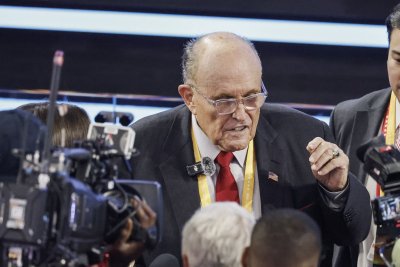
1 of 3 | Former New York Mayor Rudy Giuliani is interviewed on the floor of the 2024 Republican National Convention at Fiserv Forum in Milwaukee, Wis., on July 16, 2024. Giuliani has been hospitalized in critical condition, his spokesman said Sunday. File Photo by Tannen Maury/UPI | License Photo
May 3 (UPI) — Former New York Mayor Rudy Giuliani has been hospitalized and is in critical condition, his spokesman said Sunday.
Giuliani “is currently in the hospital, where he remains in critical but stable condition,” Ted Goodman said in a statement.
“Mayor Giuliani is a fighter who has faced every challenge in his life with unwavering strength, and he’s fighting with that same strength now. We do ask that you join us in prayer for America’s Mayor Rudy Giuliani.”
Goodman did not say why Giuliani, 81, was hospitalized.
The former mayor’s condition was also noted by President Donald Trump, who wrote on his Truth Social platform, “True Warrior, and the Best Mayor in the History of New York City, BY FAR.”
Trump also took the occasion to praise his political ally and former lawyer, who served as one of the key figures in the president’s baseless campaign attacking the results of his 2020 election loss to Joe Biden as “rigged.”
“They cheated on the Elections, fabricated hundreds of stories, did anything possible to destroy our Nation, and now, look at Rudy. So sad!” Trump wrote.
Trump in November pardoned Giuliani and 76 others tied to his efforts to overturn the 2020 election, including participation in what has become known as the fake electors scheme. The strategy involved the creation of false slates of pro-Trump electors in every battleground state that he lost to Biden, including Georgia.
The former mayor’s championing of Trump’s claims also resulted in his own financial troubles.
In September, he reached a confidential settlement with Dominion Voting Systems, which had filed a $1.3 billion defamation lawsuit against him for his allegations the company rigged the 2020 presidential election.
Giuliani was previously disbarred as a lawyer in New York and Washington, D.C.
NEW YORK — Maine just sent a blunt message to the Democratic Party’s national leaders.
Democratic Gov. Janet Mills was forced to abandon her U.S. Senate campaign last week, unable to generate sufficient fundraising or enthusiasm to compete against Graham Platner, an oyster farmer who has never served in elected office. The announcement marked a stinging defeat for Senate Democratic leader Chuck Schumer, who recruited Mills to lead the party’s decades-long quest to defeat Republican Sen. Susan Collins.
The swift eclipse of a two-term governor by a political neophyte highlighted a stark reality that has begun to take hold at a pivotal moment — Democratic voters are rejecting their party’s establishment and embracing new risks, even as their confidence grows that a blue wave is coming in November’s midterm elections.
Sometimes Democratic voters seem almost as angry at their own party’s aging, entrenched leadership as they are at President Trump.
“Rank-and-file Democrats don’t want the Democratic Party as we know it,” said Ezra Levin, co-founder of the Democratic resistance group Indivisible. “Rank-and-file Democrats want fighters.”
Local chapters of the group Indivisible, as well as Vermont Sen. Bernie Sanders, an independent who caucuses with Democrats, and other leaders from the party’s progressive wing had already lined up behind Platner, who is now almost certain to be the Democratic nominee in one of the party’s best Senate pickup opportunities in the nation.
Platner on Friday said he would continue to speak out against his party’s leadership, including Schumer (D-N.Y.), although he acknowledged that the two spoke privately the night before.
“The fact that we’ve been able to do all of this without the help of the establishment, it puts us in such an amazing position,” Platner said on MS NOW’s “Morning Joe.” “My criticisms of the party leadership, my criticisms of the party, they have not changed, and I’ve been very vocal about that since the beginning. But we will absolutely take the help that we can get.”
Republicans, meanwhile, are giddy — and some moderate Democratic strategists are worried — that the anti-establishment shift may undermine the Democratic Party’s effort to win back control of Congress in November.
“Chuck Schumer has officially lost the first battle in his proxy war with Bernie Sanders,” said Bernadette Breslin, spokesperson for the Senate Republicans’ campaign arm. “As Sanders hits the campaign trail to prop up progressives in messy Democrat primaries in Michigan and Minnesota, Schumer’s chances of getting his preferred candidates through look grim.”
Beyond Maine
Maine is far from alone.
Prominent anti-establishment clashes are playing out in high-profile Senate races in Michigan, Minnesota and Iowa, along with House races in several states.
Sanders, the country’s highest-profile democratic socialist, continues to promote Platner and other critics of the Democratic Party’s national leadership. The Vermont senator planned to campaign over the weekend in Detroit with Michigan Senate candidate Abdul El-Sayed, who is running in a three-way Senate primary against Rep. Haley Stevens and state Sen. Mallory McMorrow.
“There’s a desire to turn the page on the old guard,” Sanders’ political advisor Faiz Shakir said. “It’s not even just the Democratic electorate. There’s a populist mood in this country. You’d have to be blind not to see it.”
Indeed, McMorrow is actively working to remind voters that she would not support Schumer as Democrats’ Senate leader if given the chance.
“Frankly, I was the first person in this country to say no,” McMorrow said in a video she posted Thursday on social media. “It is a different moment. This is no longer a Republican Party we’re dealing with, it is a MAGA party that has been taken over by Trump loyalists. … You need to respond in a very different way.”
Veteran Democratic strategists like Lis Smith, who works with candidates across the country, tied the anti-establishment shift to the party’s painful losses in 2024, after President Biden abandoned his reelection bid and Vice President Kamala Harris went on to lose to Trump.
“After 2024, voters are sick of the gerontocracy, sick of the status quo, and Chuck Schumer has completely misread that,” Smith said.
Moderates are worried
Privately, Schumer’s allies downplay the impact of the anti-establishment backlash.
The Democratic leader’s preferred Senate picks in North Carolina, Ohio and Alaska haven’t faced the same challenges as Mills did in Maine. The four states represent the party’s most likely path to a majority in the chamber, which has 53 Republicans, 45 Democrats and two independents who caucus with the Democrats.
Mills is the oldest of the candidates and, at 78, would have been the oldest freshman senator in history. She promised to serve one term if elected. Platner is 41.
Schumer’s team is unwilling to make any apologies for backing Mills over Platner.
“Leader Schumer’s North Star is taking back the Senate,” Schumer spokesperson Allison Biasotti said. “When no one thought a Senate majority was possible just a year ago, he made it a reality by recruiting great candidates across the country and laying out an agenda for lower costs and better lives for Americans.”
Some in the Democratic Party’s moderate wing are worried.
Matt Bennett, co-founder of the center-left group Third Way, said that Platner’s emergence in Maine “without a doubt” will make it harder for Democrats to defeat Collins in November. He warns that it could be the same elsewhere if Democratic primary voters rally behind anti-establishment candidates.
“Our message is if you would like to beat Donald Trump’s Republicans, you better nominate people who can win,” Bennett said.
BATON ROUGE, La. — Louisiana Republicans eliminated an elected position days before an exonerated man who overwhelmingly won the New Orleans-based clerk seat was set to take office.
Republican Gov. Jeff Landry on Thursday quietly signed into law legislation abolishing the long-standing Orleans Parish clerk of criminal court position, according to Louisiana Secretary of State spokesperson Trey Williams.
Republicans say wiping away the office is a consolidation effort meant to make the local judicial system more efficient and cut costs. But Democrats condemn the change as government overreach, arguing that it infringes on a predominantly Black parish’s decision at the polls.
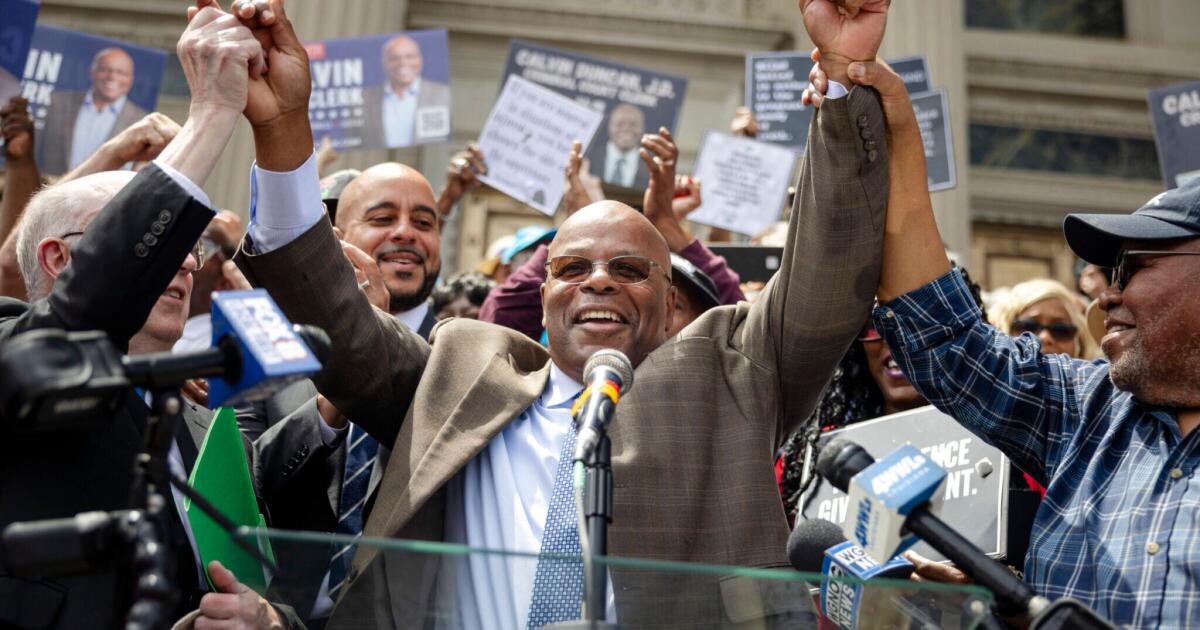
Calvin Duncan, who spent nearly 30 years behind bars for a crime he did not commit, easily won election to the criminal court clerk position in November, beating the incumbent and earning more than two-thirds of the vote. He had been set to take office Monday and has asked a federal judge to allow him to take office as scheduled.
“It’s a sad thing to see the state government repeating what happened to Black public officials during Reconstruction,” Duncan said. “They will do what they do, and I will do whatever I have to do to vindicate the voters of New Orleans and make sure that what happened to me never happens to anybody else.”
Landry did not immediately respond to requests for comment.
Duncan, a Democrat whose murder conviction was vacated in 2021 after evidence emerged that police officers lied in court, has vowed to help fix the system that once failed him.
Duncan, 63, and his supporters say he is being targeted by the most powerful Republicans in the state, including those who have denied his innocence, even though Duncan’s name is listed on the National Registry of Exonerations.
“We’re doing something because powerful people don’t like him,” Rep. Mandie Landry, a New Orleans Democrat, told lawmakers during a legislative committee hearing in April. Landry, who is not related to the governor, described the Republican efforts as “atrocious” and worries what they could mean for other elected positions in the state.
Law consolidates two court clerk positions
Republicans say the legislation consolidates the civil and criminal court clerks’ offices in Orleans Parish, putting it in line with all other parishes in the state, which have a single clerk’s office. The civil clerk position would remain and absorb the criminal clerk’s role.
Eliminating the clerk position saves the state about $27,000 and the city $233,000, according to the office of the legislative auditor, which added that the long-term costs of consolidation are “unknown.” The legislation also shifts about $1.17 million in state expenditures to the parish. The civil and criminal court clerks have separate physical offices and different case management systems.
The governor told the Associated Press that eliminating Duncan’s elected office was about improving government efficiency and “cleaning up a system in Orleans Parish that has been plagued by dysfunction and corruption for years.”
The consolidation is part of a broader GOP effort during the ongoing legislative session to overhaul the judiciary in New Orleans — including bills that propose abolishing several other elected judicial positions in the parish. However, those jobs would be eliminated further down the line, allowing officials to serve out their terms.
The bill’s Republican author, Sen. Jay Morris, who represents a district several hours from New Orleans, said the goal was to implement the clerk consolidation before Duncan takes office, preventing him from starting a four-year term. Morris acknowledged that he expects lawsuits to be filed because of this law but believes the change to be constitutional.
“It’s unfortunate for Mr. Duncan, I concede that,” Morris told lawmakers in April. “He seems very nice, but we don’t make policy around here for just one person.”
Concerns of disenfranchisement
Although conversations have revolved around Duncan, many also raise concerns about how the change potentially could disenfranchise voters — a heightened worry in a deeply red state that has been central to efforts to weaken the Voting Rights Act, including the case at issue in a landmark Supreme Court ruling last week. Orleans Parish is a Democratic hub with a predominantly Black electorate.
“Mr. Duncan was elected by 68% of the vote in a city that’s majority African American. This is the will of the people, and what your bill attempts to do is usurp the will of the people,” Rep. Edmond Jordan, a Democrat, told Morris.
Well before the legislation reached the governor’s desk, Duncan said he could see the writing on the wall. Ahead of the outcome, Duncan’s advocates held a ceremonial swearing-in for him. Hundreds of people gathered on the steps of the Orleans Parish criminal courthouse to support him.
Duncan told lawmakers that along the campaign trail last year, he spoke with many people who told him they typically abstain from voting in elections. “Now, this bill tells people exactly what they had believed — that their vote doesn’t count,” he said.
Cline and Brook write for the Associated Press and reported from Baton Rouge, La., and New Orleans, respectively.
JACKSON, Miss. — At 16, Edward Blackmon Jr. was arrested during a demonstration for voting rights in his Mississippi hometown. He was loaded with schoolmates into a truck once used to haul chickens and left in the summer heat before spending three nights in an overcrowded jail cell without a bed.
It was a moment that set him on a path to become a civil rights lawyer and one of the first Black lawmakers elected in the state since Reconstruction.
Blackmon was part of a generation of Black Americans across the South who fought in courtrooms and in the streets to dismantle barriers to voting and achieve political representation in a region scarred by the legacy of slavery and its aftermath.
One of the crown jewels of that struggle, the Voting Rights Act, was hollowed out by a Supreme Court ruling last week. The court’s conservative majority said states should not rely on racial demographics when drawing congressional districts, a ruling that opened the door to transforming how political power is distributed and making it harder for minorities to get elected.
The majority opinion described racism as a problem of the past. Others saw the decision as another example of its resurgence — “a defibrillator to the heart of Jim Crow,” as one Louisiana politician put it.
Blackmon’s son, Bradford, a 37-year-old state senator in Mississippi, said how the political lines are drawn “shapes who has a real chance before anyone ever votes.”
“It’s just sad that we made progress and then they are always trying to roll it back when it shows that minorities are making more progress than I would guess that those in charge think that they’re allowed to make,” he said.
The elder Blackmon, now 78, said he was resigned to the reality that the fight of his youth is not over.
“It’s just another cycle — an ongoing struggle without a foreseeable ending,” he said.
A legacy at risk
The case, involving a challenge to Louisiana’s congressional map, clarified how the Voting Rights Act can be used to contest district lines that may weaken the voting power of Black residents.
For many Black Americans, the decision was a death knell for a cherished pillar of the Civil Rights Movement. Before the Voting Rights Act of 1965, Black voters in the Deep South had no guarantee of equal access to the ballot. Within a year of its passage, more than 250,000 Black Americans had gained the right to vote. By 2024, nearly 22 million Black voters were registered nationwide, according to the U.S. Census Bureau.
The United States is now witnessing the unraveling of nearly a century of organizing, civil disobedience and personal sacrifice by ordinary people who helped build Black political power to heights unseen since Reconstruction. Veterans of the voting rights movement — people who confronted police violence alongside John Lewis on the 1965 “Bloody Sunday” march in Selma, Ala., or rallied with the Rev. Martin Luther King Jr. — are seeing those hard-won victories stripped away from their descendants.
“I’m the first generation of Americans born with equal rights,” said Jonathan Jackson, a Democratic congressman from Illinois who is the 60-year-old son of the Rev. Jesse Jackson, the late civil rights leader. He said the idea that his children could grow up with fewer protections was “surreal and devastating.”
For Charles Mauldin, who was beaten by law enforcement as a teenager on Bloody Sunday, the ruling reflects a skirmish that was never as settled as some hoped.
“I’m disappointed but not surprised,” said Mauldin, 78, of Birmingham, Ala. “They’ve been chipping away at the 1965 Voting Rights Act for the last 60 years.”
Who holds power now
In Louisiana, younger Black politicians say the high court’s ruling could reshape not just who wins elections, but whether candidates can compete at all, particularly in down-ballot races that often serve as steppingstones to higher office.
Davante Lewis, a 34-year-old Democrat who serves on the state’s utility regulatory board, said he expects districts could be redrawn in ways that make it harder for candidates like him to win.
“They can target my communities … to ensure that I can’t get to an elected office,” said Lewis, one of several plaintiffs in the Louisiana gerrymandering case that went to the Supreme Court.
Jamie Davis, a Black farmer in northeast Louisiana and a Democratic candidate for U.S. Senate, said the decision risks discouraging voters already skeptical that their voices matter.
“I want to be optimistic, but how can you be optimistic when voter turnout in the past election cycles has been really low?” Davis said.
Tennessee is among the states bracing for new redistricting efforts. State Rep. Justin Pearson, who represents Memphis and is running for Congress, said people who struggled to pass the Voting Rights Act are “shocked and devastated that they’re having to relitigate the same fights that they fought 60 years ago.”
But he also predicted that efforts to reduce Black representation could “reinvigorate a civil rights movement in the South that demands equal representation, that demands fairness, that demands justice and equality.”
Supporters of the Supreme Court ruling said it reinforces a race-neutral approach to redistricting, and they say political lines should not be drawn primarily based on race.
Democratic Mississippi state Rep. Bryant Clark said that view ignores how race and party align in the state. In Mississippi, where most Black voters are Democrats and most white voters are Republicans, he said the two are often indistinguishable.
“It’s just a roundabout way to basically legalize racially discriminatory redistricting in the state,” Clark said.
In 1967, his father, Robert Clark Jr., became the first Black lawmaker elected to the Mississippi Legislature since Reconstruction.
With Black residents making up about 38% of Mississippi’s population, Edward Blackmon Jr. said the current maps allow Black voters to elect candidates in some districts while keeping Republican majorities intact across much of the state.
He said lawmakers have little incentive to change that balance because moving Black voters into more districts would make those seats less reliably conservative and force candidates to compete for a broader electorate.
“Where do you think the population goes? They don’t just disappear,” Blackmon said. “What incumbent wants that type of district right now?”
Fight continues
Blackmon was raised in Canton, “when Jim Crow was in full bloom.”
Black children attended separate schools, and during cotton-picking season, classes let out early as rickety trucks with wooden sides arrived to take students to the fields, where they spent hours working.
At home, he watched those inequalities play out in quieter ways.
His father, a World War II veteran who left the sharecropping farm where Blackmon’s grandfather had worked, struggled to find steady work in Mississippi after returning from military service and becoming involved in civil rights organizing. He eventually left for New York to make a living — part of a generation of Black veterans who faced barriers to jobs and opportunities their white counterparts received.
Blackmon remembers sitting nearby as his father and other community leaders gathered on the porch, talking late into the night about forming a local NAACP chapter.
“It was embedded in my memory and experience that it was worth the struggle,” he said.
When the Voting Rights Act passed, it did not immediately change those realities. In places like Canton, federal officials set up registration tables on downtown streets so Black residents could sign up to vote without facing harassment or intimidation from local authorities.
In the years that followed, Blackmon and other lawyers used the law to challenge at-large election systems that prevented Black communities from electing candidates of their choice. Cities and counties were forced to redraw maps into single-member districts.
When those districts still diluted Black voting strength, activists returned to court.
“Without the Voting Rights Act, Mississippi would look so much different than it looks now,” Blackmon said.
Willingham, Brook, Bates and Amy write for the Associated Press and reported from Boston, New Orleans, Jackson and Atlanta, respectively. AP writers Kristin Hall and Travis Loller in Nashville and Safiyah Riddle and Kim Chandler in Montgomery, Ala., contributed to this report.
The United States on Sunday responded to Iran’s latest proposal to end the U.S.-Isreali war there, which has led to tankers like the pictured Indian-flagged carrier unable to transit the Strait of Hormuz. File Photo by Divyakant Solanki/EPA
May 3 (UPI) — Iran said on Sunday that it is reviewing the United States’ response to its most recent peace proposal, a 14-point plan that was reviewed by President Donald Trump on Saturday night.
The response was delivered to Iranian negotiators on Sunday, Iranian state media outlets PressTV and Tasnim reported, with officials clarifying some reports on the plan they said have been incorrect.
The 14-point plan is entirely focused on bringing an end to the two-month-old conflict, with no provisions about nuclear materials or other weapons, Esmaeil Baghaei, spokesperson for Iran’s foreign ministry, said in an interview.
When asked about Iran’s new plan on Saturday, Trump expressed doubt that it would meet U.S. requirements but said that he would be reviewing its exact language last night.
“The plan we have presented is centered on ending the war,” Baghaei said. “There are absolutely no details regarding the country’s nuclear issues in this proposal.”
The basics of Iran’s proposal are focused on ending hostilities and then opening a 30-day period for intense negotiation of other issues, including the withdrawal of U.S. military forces from areas around the country, lifting the U.S. naval blockade and ending the war on all fronts, including in Lebanon, Tasnim reported.
But Baghaei said that reports of a suspension of nuclear activities or U.S.-Iran cooperation on clearing mines from the Strait of Hormuz are not true.
“These are among the things that I believe are fabricated by the imagination of some media outlets,” Baghaei said. “We are not currently engaged in any negotiations over the nuclear issue and decisions about the future will be made in due course.”
Iranian officials said that the U.S. proposal had included a two-month cease-fire, which Iran countered with a 30-day period to resolve issues and to actually end the war.
President Donald Trump signs a series of executive orders in the Oval Office of the White House on Thursday. Trump signed an order to expand workers’ access to retirement accounts. Trump also signed legislation ending a 75-day partial shutdown of the Department of Homeland Security after the House voted in favor of funding. Photo by Aaron Schwartz/UPI | License Photo
A shrinking number of seats will determine control of the U.S. House after Republicans and Democrats spent much of the last year redrawing congressional maps to erase swing districts.
Even before Florida’s Legislature approved a new Republican-leaning map last week, just 16 seats were listed as “tossups” by the Cook Political Report, the nonpartisan newsletter that serves as an unofficial electoral scorekeeper. Another 16 districts are listed as leaning toward Democrats or Republicans, with the outcome all but predetermined for more than 400 seats.
This could make for the fewest competitive seats since political analyst Charlie Cook first published his race ratings in 1984. That means even if historical trends and current events favor Democrats heading into November, they’re likely to fall short of the 41 districts they picked up in the 2018 midterms during the first Trump administration.
“There aren’t really 40 seats on the board potentially right now just because of redistricting and that polarization,” said Carrie Dann, managing editor of the Cook Political Report.
That reality allows the two political parties to concentrate their resources. The Democratic House campaign operation lists 44 Republican districts in play, and the GOP equivalent is aiding 17 challengers hoping to unseat Democratic incumbents.
Those numbers can change after primary elections, but one Republican operative familiar with the party’s plans said the total number of contested seats is about half of what those the parties fought over in the last midterm election in 2022.
Republicans say the smaller map favors them. Before the most recent spate of map changes, only three Republican House members were elected in districts that Democrat Kamala Harris won in 2024 — compared with 13 Democrats defending seats that Donald Trump won.
Zach Parkinson, a spokesman for the Republican National Committee, said his party has better campaign infrastructure in place.
“Part of that right now is financial, but part of it is also we’re all very synced up with the president, the White House,” Parkinson said. “Everyone on our side institutionally is rowing in the same direction.”
But Democrats note that Republican efforts to aggressively gerrymander districts in Texas and Florida could leave them even more vulnerable if Democrats leverage the same kind of voter enthusiasm they did in 2018, when they won enough seats to take back the House majority.
John Bisognano, president of the National Democratic Redistricting Committee, said congressional districts in Texas and Florida were already designed to favor Republicans.
“So what you need to do in order to create a deeper gerrymander is make more Republican seats competitive,” he said. “As the Democratic advantage grows, the likelihood and opportunity for dummymanders increases.”
A dummymander happens when one party gerrymanders so aggressively that it spreads its majority too thin — making its seats more vulnerable if the other party performs better than expected.
Florida Democratic Party Chairwoman Nikki Fried said that’s what Republicans did in her state last week when the Legislature pushed through a new map that GOP Gov. Ron DeSantis said will yield his party four more seats.
“I am not actually worried,” Fried said. “All of my congressional members will be reelected. They’re strong in their communities and I feel very bullish about their possibilities.”
Democrats have been overperforming in off-year and special elections by an average of 17 points over Trump’s margin of victory in 2024, and Fried said that trend suggests Democrats could pick up nine seats in Florida alone.
That seems unlikely. A Cook Political Report poll of its 36 most competitive districts as of April 6 — which Trump won by an average of 2 points in 2024 — found a six-point Democratic advantage.
Neither party has been able to solidify much of an advantage through mid-decade redistricting. What started with Republicans in Texas was countered by Democrats in California. Republicans could pick up two more seats from new maps in Missouri and North Carolina. Virginia’s new map could give Democrats as many as four more seats, a move matched by Republicans in Florida.
And it’s not over yet. The Supreme Court’s decision Wednesday limiting the use of the Voting Rights Act to create majority-Black or majority-Hispanic districts has unlocked the potential for Republicans to pick up seats in Louisiana and Tennessee.
It comes as the UK Government today, Sunday, May 3, introduced a rule change allowing airlines to group passengers from different flights together
Robert Rowlands Deputy editor, money and lifestyle, content hub
15:54, 03 May 2026
(Image: NurPhoto, NurPhoto via Getty Images)
Wizz Air has issued an update to passengers this Sunday afternoon confirming its flight plans. The airline’s latest statement follows new official measures unveiled today, Sunday, May 3, by the Government.
The Government has brought in a temporary rule change permitting airlines to consolidate passengers from different flights onto fewer aircraft as part of efforts to conserve fuel. This follows warnings of a potential jet fuel shortage ahead of the busy holiday season if the Strait of Hormuz remains closed.
Asked this morning whether holidaymakers travelling abroad are likely to encounter difficulties this summer, Ms Alexander told Sky News’ Sunday Morning With Trevor Phillips: “I’ve spent every week of the last two months in close contact with airlines and airports.
“On Thursday of this week, airlines told me very clearly that they have good visibility over the next six to eight weeks of jet fuel supply. There is no current disruption to jet fuel supplies.
“We are, for example, importing more jet fuel from America. We have asked the refineries in the UK to maximise their production. We’ve got four refineries here, refineries in West Africa are also producing more.”
She continued: “The last thing I want is for people to turn up at a departure gate and have last minute cancellations. I am confident, sat here today on the basis of the information that I have available to me, that the majority of people who are travelling this summer will have a similar experience to that which they had last year.”
Her comments come as airlines worldwide take action in response to soaring jet fuel prices. These have been triggered by Iran’s effective closure of the Strait of Hormuz, blocking off one of the world’s crucial routes for jet fuel distribution to other countries.
Lufthansa recently revealed plans to axe 20,000 flights as it scales back capacity to cope with jet fuel shortages. UK carriers have also issued statements in a bid to put customers’ minds at ease.
Among them, Jet2 confirmed it will not impose surcharges on any existing flight or holiday bookings to offset rising costs, such as those for jet fuel. Now Wizz Air has released a fresh statement following the government’s latest proposals.
Speaking today, an airline spokesman said: “Wizz Air acknowledges today’s announcement by the UK government and would like to reassure customers that its operations remain fully stable and unaffected.
“The airline confirms that it plans continue to operate its full summer schedule, flying passengers safely and reliably to their destinations across its extensive network. Wizz Air is working closely with its partners to ensure seamless operations throughout the peak travel season.
“Customers can book with confidence on Wizz Air’s wide selection of routes from more than half a dozen airports across the UK, connecting travellers to popular destinations across Europe and beyond.”
New government rules amid jet fuel shortage fears
The Government’s airline rule change could result in passengers being switched from their originally booked service to a comparable one in order to cut down on wasted fuel from aircraft that haven’t sold out and may otherwise have been cancelled.
Consumer group Which? has hit out at the move, arguing that rules should not be “bent in favour of airlines”. Shadow transport secretary Richard Holden warned that families could find themselves “herded on to a different plane, at a time of the airline’s choosing”.
“The honest message is that Britain is exposed to fuel supply risks that a properly energy-secure country would not face,” he added. Green Party leader Zack Polanski has called for private jets to be grounded in a bid to conserve fuel.
“While ordinary people pay the price, the super rich are simply getting in their private jets at will – wasting huge amounts of jet fuel on unnecessary trips,” he said.
ST. LOUIS — Still smarting from their election loss and scornful of their departing leaders, ranking Republicans met Thursday to select a new party chairman, eyeing five candidates who stress unity but whose links to opposing factions and presidential hopefuls mirror the party’s deep clefts.
On the surface, the three-day meeting of the 165-member Republican National Committee to pick a new leader opened Thursday with a collegial sense of purpose: All five men seeking the post are conservatives who talk of renewing the party at the grass-roots level and loosening ties to the Washington Establishment that called the shots for 12 years.
But the mounting heat produced by this campaign has burnished the differences between the candidates and exposed hints of their ties to the forces buffeting the party–presidential aspirants, religious and anti-abortion elements, even the tattered remains of George Bush’s reelection apparatus.
Party veterans say none of the five–retiring Missouri Gov. John Ashcroft, Mississippi lawyer and political consultant Haley Barbour, Republican Congressional Committee Co-Chairman L. Spencer Abraham, former Army Secretary Howard H. (Bo) Calloway and Oregon party Chairman Craig L. Berkman–appear to have enough support to muster a first-ballot victory this afternoon.
Party regulars described Barbour and Abraham as the perceived front-runners, with Ashcroft, who gained national exposure last fall as a Bush campaign speaker, not far behind. But arriving committee members said up to 40% of the voting members appeared uncommitted.
Committed or not, some of the arriving committee members projected a prickly impatience with the soothing promises made by consultants and cellular phone-wielding floor whips. After 12 years of taking orders from Administration officials, some party officials gleefully flexed their independence.
Outside one reception, a Midwestern committeeman poked a startled staffer in the chest and huffed: “You’re beginning to sound exactly like the dolts we had to endure for the last four years.”
Karen Hughes, the executive director of the Texas Republican Party, said a “strong anti-Washington Establishment” mood pervades the gathering. “I think the deciding factor in the vote is who the members believe will allow them to be part of the process,” she said. “You don’t mind being a rubber stamp body when you win. But when you lose . . . .”
As they lobbied near well-stocked buffet tables in Hyatt Regency hotel hospitality suites and in secluded speeches in spare meeting rooms, the five contestants tried to capitalize on that sense of frustration. They echoed a growing cadre of party regulars who think that Bush’s presidential campaign was fatally flawed by the party’s failure to project a “big tent” image to a diverse nation.
“The sense that the party needs to be inclusionary is playing pretty well here,” said Eddie Mahe, a Republican political consultant who flew in from Washington to lobby for Calloway.
That yearning for a broader, more tolerant Republican Party masks a fear among many stalwarts that they are in danger of a grass-roots takeover by the religious right.
Mary Alice Lair, a national committeewoman from the small southeast Kansas town of Piqua, worries about the “new people,” her hushed description of Christian right volunteers who have swelled party membership rolls in her Republican precinct.
“We need to find ways to show the new people that we’re OK and to teach them how to operate as one group,” Lair said. “We need a chairman who can show the precincts how to organize properly.”
But even as candidates talked earnestly about tinkering with the grass roots, listening to regulars outside the Washington Beltway and turning a deaf ear to well-heeled consultants, they were relying on time-tested Capitol contacts and imported consultants to sway uncommitted members.
And, as they promised a turn in the party’s fortunes by welcoming all of its embittered factions, the five candidates were busy attacking each other for their links to future presidential contenders as varied as former Vice President Dan Quayle and Texas Sen. Phil Gramm, to Christian fundamentalist leaders like Pat Robertson and even to CBS News.
Abraham, a Michigan Republican leader, is selling himself as a leading candidate for change based on his roles in revitalizing his state’s party, in paring consultants’ costs and, as chairman of the congressional campaign committee, in funneling more money last year to Republican House candidates. But his opponents have attacked him for being openly supported by Quayle, who employed him as an aide.
Barbour, one of the earliest to announce his candidacy, has been criticized for his close ties to Gramm–thought to be a presidential possibility–and for representing CBS News against the Bush Administration in a battle over a cable TV bill last year.
Ashcroft has emphasized his recent role as a party spokesman in his bid to do similar work as party chairman. But it is Ashcroft’s very influence that may have prevented him from gaining an edge. His prominence in drafting the party’s platform last year has hurt him, some moderates say. And, like Abraham, he is burdened by his links to some of the powerful influences aiding him. Current RNC Chairman Richard N. Bond is said to favor him, as are a number of influential Christian right figures impressed with his strong anti-abortion stance. That kind of backing hurts the former governor as much as it aids him, party regulars said.
Calloway, who runs a political action committee founded by Rep. Newt Gingrich (R-Ga.), is beloved by many committee members. But he is believed to be a long shot because, at 67, “he’s just too old,” one Abraham backer said.
Berkman, an Oregon moderate who prefers that the party move away from its anti-abortion and anti-gay-rights planks, is said to be limited by his regional support.
For the next week or so, in homes all over California, ballots will be arriving for the June 2 primary.
Since 2020, a ballot has been mailed to every active registered voter in the state — more than 23 million, by last count. The time to choose is drawing nigh.
In addition to the race for governor, Californians will vote in contests for seven other statewide offices, the Board of Equalization — which oversees the property tax system — and a great many congressional, legislative and local races, including the primary for Los Angeles mayor.
What’s a voter to do?
If you’ve waited your entire life for a candidate like Republican Chad Bianco, the Riverside County sheriff running for governor, or you’ve been jonesing to cast a gubernatorial ballot for Democrat Katie Porter from the moment she whipped out her famous whiteboard, the choice is easy. Fill out that ballot and toss it in the mail, stat! No postage needed.
“Don’t mess around,” said Paul Maslin, a veteran Democratic campaign strategist. (His candidate for governor, Betty Yee, quit the race late last month, so he’s a neutral observer at this point.)
“If you have pretty good inkling what you want to do,” Maslin urged, “vote.”
But if, like many, you’re not wed to a particular candidate, what then? If you’re worried about mailing in your ballot and then having some awful, Eric Swalwell-like revelations surface, or if you fret about wasting your vote by supporting someone who drops out before June 2, then what?
There are no do-overs in a California election. Once you’ve cast your ballot, you’ve made your choice. That’s it, however sorry you may be.
Which is why Republican strategist Rob Stutzman, who’s worked in California politics for decades, urged voters not to mail their ballot too soon. Like Maslin, he’s unaffiliated with any of the gubernatorial campaigns.
“It’s a slow-developing race,” Stutzman said of the contest for governor, the marquee attraction on the June ballot. “These are still relatively little-known candidates. There’s going to be a lot more campaigning to go in the weeks ahead. [So] unless you feel really strongly about somebody, I’d hang on to that ballot and see what happens over the next several weeks.”
Then again, with all the talk of clamping down on mail-in ballots and concerns about processing delays by a stretched-thin Postal Service, is there a danger of waiting too long to vote? What if your ballot arrives past the deadline to be tallied?
In March, the U.S. Supreme Court strongly signaled a likelihood it would require mail ballots to be received by election day if they are to be counted as legal. As it stands, California accepts mail-in ballots that were cast before the end of election day, so long as they arrive no later than seven days after.
The court seems unlikely to issue its ruling before the June primary — but that’s not guaranteed.
So is there a sweet spot, somewhere between voting in haste and having your ballot go to waste?
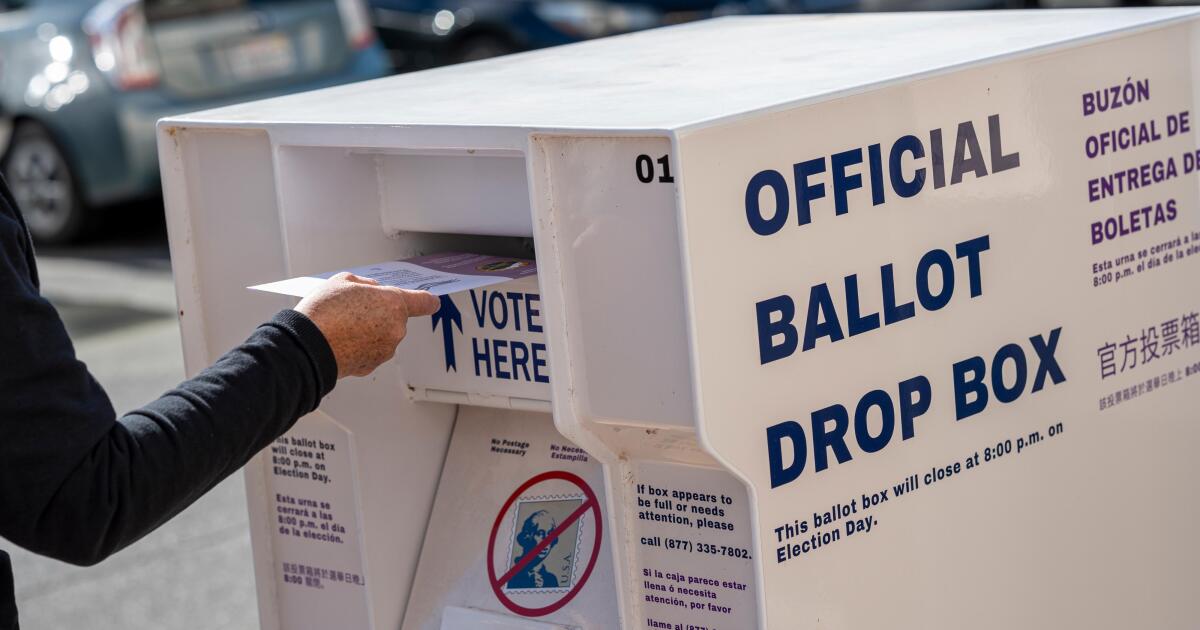
The Official Voter Information Guide, produced by California’s secretary of state, urges those voting by mail to “return your ballot … as soon as you receive it.”
But Kim Alexander, head of the nonpartisan California Voter Foundation, falls into the wait-a-bit camp. “Don’t vote too early,” she counseled, “because this is a very dynamic election.”
Once you’ve made up your mind, her best advice is to mail your ballot at least a full week before election day, which is May 26, to ensure it arrives on time to be processed and counted. If someone wants to drop their ballot off in person, either at a vote center or secure drop box, Alexander suggests doing so by May 30, which is three days before the election.
“The good news,” she said, “is that under a new state law … all county election offices will be open at least six hours on Saturday, May 30, for voters to come vote in person or to turn in their vote-by-mail ballots.”
Voting in person is an option right up until 8 p.m. on election day, even if you received a ballot in the mail. That applies everywhere in California, save for three sparsely populated, rural counties — Alpine, Plumas and Sierra — which conduct their elections entirely by mail. Bring your unused vote-by-mail ballot to your local polling place and swap it for a polling-place ballot you can use instead.
For procrastinators or those wanting to wait until election day to mail their ballot, they run the risk that it won’t be postmarked until after June 2. That means it won’t be counted, regardless of when it arrives at their county elections office.
“Voters who want to hold out as long as possible … ought to be planning to turn their ballot into a drop box or a voting site and not use the mail at all,” Alexander said.
Her suggestion is to find other ways to mark the occasion.
“Help somebody else go and vote,” Alexander suggested, “or volunteer to help with an organization” running a get-out-the-vote operation.
“If you want to help election officials get ahead on the vote count” — a source of repeated upset as the country awaits California’s lagging results — “you can be part of the solution by getting your own ballot in just a little bit earlier.”
All of which sound like fine ideas. That way you can celebrate election day and make sure your ballot isn’t cast for naught.
SACRAMENTO — One of Gavin Newsom’s top goals as he winds down his final year as California governor is to leave the state with a balanced budget.
After years of the state spending more money than it brings in, it’s Newsom’s last opportunity to fix a chronic deficit or dump the problem on the next governor.
How far he goes to solve the state’s structural spending imbalance will define his legacy as a steward of trillions in taxpayer dollars. As a potential candidate for president in 2028, he could also have a political incentive to do as little as possible.
“Any cuts you make are going to cause people to scream,” said Darry Sragow, a veteran Democratic strategist. “Any increases in taxes are going to cause people to scream and in terms of what’s best for a presidential run, it would be nice if people weren’t screaming.”
As California’s 40th governor, Newsom expanded publicly funded healthcare to income-eligible undocumented immigrants, increased state-subsidized child-care slots and provided free meals for schoolchildren among a wishlist of progressive wins since he took office in 2019.
His achievements have helped struggling Californians live in an increasingly unaffordable state and given him bona fides to tout to voters if he launches a bid for the White House.
But the state could never afford to pay for existing services and the new programs that Newsom and Democratic lawmakers enacted, according to an analysis of ongoing state spending since before the pandemic released by the Legislative Analyst’s Office last week.
Spending from the state’s principal operating fund has grown about $100 billion since Newsom’s first full fiscal year in office in 2019-20, mostly due to the growing cost of existing programs that he inherited. State spending has outpaced California’s strong revenue growth by about 10%, creating a perennial budget shortfall — a structural deficit — that Newsom and the Democratic-led Legislature solve with largely temporary fixes each year.
Instead of making across-the-board program cuts or raising taxes to align spending with revenue, Democrats have tapped into reserves designed to preserve social services for the state’s most disadvantaged communities during economic downturns.
While the California economy remains stable and state revenue has increased, Newsom and lawmakers have taken $12.2 billion from the rainy day fund. Democrats have borrowed $28 billion more from other state funds to cover their spending in recent years, according to the LAO.
“Taken together, these trends raise serious concerns about the state’s fiscal sustainability,” Legislative Analyst Gabriel Petek wrote in a review of Newsom’s January budget proposal.
Fiscal watchdogs have warned that the spending trends will leave California in a precarious position if the stock market tanks and tax receipts bottom out.
Personal income taxes are driving higher-than-expected revenue now, which analysts attribute to an artificial intelligence boom on Wall Street, and suggest the state could have no deficit in the upcoming year. In January, the Newsom administration anticipated significant operating deficits in the years ahead: $27 billion in 2027-28, $22 billion in 2028-29 and $23 billion in 2029-30.
“This issue is really whether they’re going to take seriously the structural deficit that is several years in the making now, where the spending has outpaced revenue, and to address that, they’re going to either have to make some fairly deep cuts or raise revenue and or both,” said former state Controller Betty Yee, who worked as a budget aide under Gov. Gray Davis and recently dropped her own campaign for governor. “But they have to be real. I think resorting to these one-time solutions has really exacerbated the problem.”
H.D. Palmer, a spokesperson for the California Department of Finance, said the governor is looking to solve the budget problem with more than a temporary fix.
“Although he is still finalizing his proposal that he’ll put forth to the Legislature, as he has said, he wants those solutions to be durable, and he wants them to have an impact beyond a single fiscal year,” Palmer said.
To stabilize California’s budget, Democrats will probably have to raise taxes or fees to generate new revenue and cut programs, according to the LAO. At least 40 cents for every dollar in revenue is dedicated to education under the state Constitution, requiring policymakers to find between $30 billion and $60 billion annually in additional revenue to cover projected shortfalls in 2027-28 and beyond if relying on new taxes alone.
President Trump’s cuts to healthcare are adding to the problem.
HR 1 will add $1.4 billion in state costs to the general fund. Newsom’s January budget proposal did not include a plan to help millions of low-income Californians who are expected to lose access to healthcare under the federal cuts.
To temper those cuts in California, other groups proposed a new tax on billionaires that appears poised to qualify for the November ballot.
Spearheaded by Service Employees International Union-United Healthcare Workers West, the initiative would apply a one-time 5% tax on taxpayers with assets exceeding $1 billion. If approved by voters, the tax would generate roughly $100 billion, which would fund healthcare programs.
The measure has divided unions and Democrats at the state Capitol.
Newsom has criticized the initiative, citing concerns that increasing taxes on the wealthy will have the opposite intended effect and drive the highest earners out of California. Under a progressive tax structure, the state budget is dependent on income taxes paid by the ultra-rich on earnings largely from capital gains.
Larry Page and Sergey Brin, the co-founders of Google, have already purchased residences in Florida, along with others looking to escape the tax if it goes through in November. Billionaires launched their own ballot measure campaign to undercut the tax proposal.
State lawmakers are also considering avenues to raise revenue, which include repealing a “water’s edge” tax break. Under the change, multinational companies would no longer be allowed to shield the income of their foreign subsidiaries from state taxes. California loses about $3 billion in revenue from the tax break each year.
In its budget plan released in April, the state Senate proposed a new fee on the largest corporations in the state to provide $5 billion to $8 billion annually for Medi-Cal.
The upper house said 42% of Medi-Cal enrollees are full-time workers who are not enrolled in their company’s healthcare plan because their wages are low enough to qualify for state-subsidized healthcare. As a result, corporations aren’t paying for healthcare for many of their employees and instead taxpayers are picking up the bill through Medi-Cal.
SEIU California, the powerful state union council representing over 700,000 workers, endorsed the plan. The union said Trump’s tax policy will reduce corporate taxes by $900 billion, while 3 million Californians lose healthcare.
“In this urgent moment, California’s workers need to see our leaders show us what they’re made of,” said Tia Orr, executive director of SEIU California. “The Senate is showing the courage to demand corporations pay their fair share, rather than making working people pay with their lives.”
The change is being described as a more politically palatable “fee” and not a tax.
“We explored multiple revenue options, and this was the one that felt more narrow, it felt more focused, and it also felt like it was directly going for the subsidy that’s being lost because of the Trump HR 1 cuts,” said Senate President Pro Tem Monique Limón (D-Goleta), who leads the upper house of the Legislature.
Limón said her caucus believes it’s important to address potential revenue streams because of the depth of federal healthcare reductions.
“If we don’t address the structural deficit, we are looking at severe cuts,” she said. “You are looking at people without health insurance. You are looking at hospitals closing down. You are looking at medical providers not being able to take more patients. You are looking at our emergency rooms over capacity, with not enough medical providers. I mean, you’re looking at a place that’s really, really, really difficult, and we feel like we have to, at least, look at what are viable options that are conditional on these cuts coming.”
Newsom has not commented publicly on the Senate’s plan. As governor, he’s been reluctant to embrace new taxes and fees.
Newsom could reject all the proposals for new taxes or fees and continue what he’s done before: take advantage of higher-than-expected tax collections, shift funds around, delay program implementation and borrow money to knock the deficit down to zero, or forecast a surplus, for his last budget year that begins July 1.
If he doesn’t take on California’s larger budget imbalance, then the problem would be the next governor’s to solve. A stock market crash, or economic recession, could force his successor to make drastic cuts across the board with limited reserves to support programs.
Kicking the can again would cement Newsom’s fiscal legacy as a governor who championed bold headline-making policies that bolstered the safety net for low-income Californians, but who failed to provide a solution to pay for his agenda.
“Not only has he not come up with a plan, he has pretended we don’t need one,” said Patrick Murphy, a professor of public affairs at the University of San Francisco.
Newsom’s interest in running for president could seemingly discourage him from slashing the budget and raising attention to the state’s financial woes, Sragow said. Newsom is setting himself up as a potential front-runner for his party. He has said he remains undecided about officially launching a 2028 campaign.
As a Democrat from California, his opponents would automatically label him as financially irresponsible and tax-happy. Calling out the massive budget problem on the horizon, raising taxes and making painful cuts will give them ammunition.
“There’s a long list of things that he’s going to be charged with, and this is likely to be one more,” Sragow said. “But I guess the question is, is he going to be charged with a political misdemeanor or a political felony?”
Former state Sen. Steve Glazer said Newsom is standing on political quicksand either way. State budget projections are based on assumptions about the future that often don’t bear out, leaving his choices exposed to criticism that he went too far, didn’t do enough, and everything in between.
“Whatever the governor decides to do in his May revise and in his final budget, it’s fraught with political risks, because it can be manipulated so easily by all sides,” Glazer said.
If Newsom ignores the spending problem, his successor could blame him for California’s financial woes when they take office in January and provide their own outlook of the state’s fiscal future. At the time, Newsom could be trying to convince America to make him the nation’s next president.
Murphy said Newsom has championed major policies and been reluctant to back off them later when revenue doesn’t pencil out.
In terms of spending, he’s governed similarly to the men who led California before him, with the exception of Jerry Brown, who cut programs to reduce a deficit he inherited in his second stint in the governor’s office and left Newsom with a surplus.
“It’s not all that different than most of the governors have done, which is finding it very hard to say no and finding it very hard to take on a tough choice of going to the ballot to ask for more money or raise taxes,” Murphy said.
Deukmejian left a budget disaster for his successor, Gov. Pete Wilson. Deukmejian publicly claimed he passed a balanced budget in his final year and blamed an economic downturn for the problems Wilson encountered.
When Wilson announced a record $13-billion budget deficit early in his first year in office in 1991, he said the Persian Gulf War, an economic downturn and natural disasters added to a structural deficit in the budget.
The Legislature and Deukmejian, Wilson said, had “papered over” the problem.
Before authorities charged him with attempting to assassinate President Trump and top administration officials in a brazen attack at the Washington Hilton, Cole Tomas Allen lived what those who knew him described as a quiet, simple existence.
He worked as a tutor and enjoyed video games, manga and riding his blue scooter. Acquaintances said Allen rarely talked about his political views through much of his adult life.
But on social media, he appears to have expressed concerns about the morality of U.S. policy, particularly its role in the wars in Ukraine and Iran.
Now, those who crossed paths with him are struggling to square the accusations against him with the man they knew as an unassuming student, gamer and teacher.
Allen grew up in a middle-class, suburban part of Torrance, one of four siblings who would each go on to study at reputable universities.
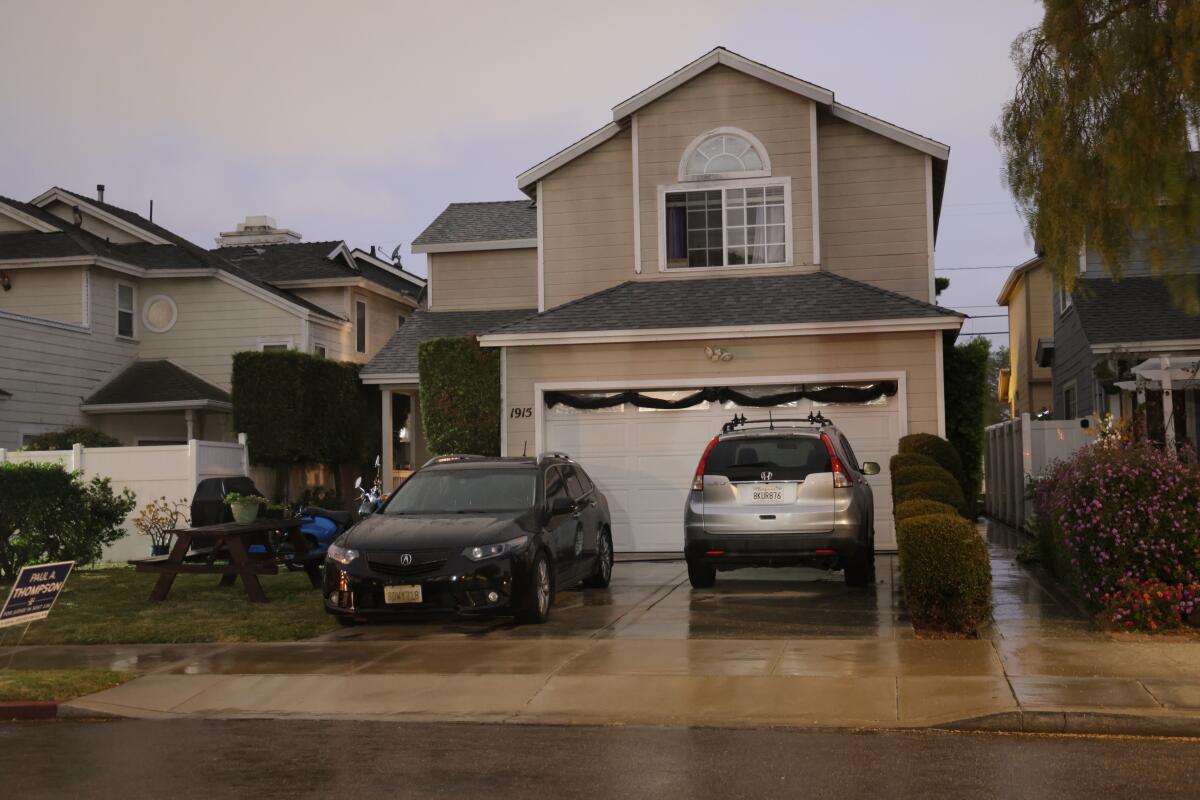
His parents were both teachers and “really solid members of their community,” according to Paul Thompson, a Los Angeles County prosecutor who lives next door to the family’s two-story house. Allen’s father knew many people on the block of single-family homes by their first names, Thompson said, and the suspect’s mother once saved Thompson’s dog when it ran into the road.
As a high school junior, Allen led Pacific Lutheran’s volleyball team in a three-set win over Junipero Serra High School. He was homeschooled, but was allowed via a special program to take a class at Pacific Lutheran in Gardena and to play for its respected squad, according to the private school’s principal.
Allen was “a godly person” who never cursed or shared his political views at the time, a former teammate told The Times, but he was also “very competitive.”
That drive extended to academics. After finishing his homeschooling, he was accepted into Caltech, one of the best universities in the nation for aspiring engineers like Allen.
He joined the Caltech Christian Fellowship, taking on a leadership role in which he organized Bible discussions, as well as the fencing team and the Nerf Club. He interned at the Jet Propulsion Laboratory in La Cañada Flintridge for three months.
In 2016, he was part of a five-person team that won an annual robotics and design competition in which teams built robots to play in soccer matches at Caltech. Allen was a teaching assistant at the Pasadena school, where he graduated with a mechanical engineering degree the following year.
Elizabeth Terlinden met Allen through the Caltech Christian Fellowship, where she was co-president during the 2014-15 school year.
“Quiet guy, kind of nondescript, generally polite, got good grades,” she told The Times, describing her impression of Allen. “Christian definitely, but that’s because I interacted with him primarily in that context.”
Michael D’Asaro, who coached fencing at Caltech around the time Allen was in college, said that he didn’t remember Allen but that generally none of the students attended practice regularly.
“Those kids were more interested in studying than sports, as you can imagine,” he said in a text message. “They would spend days and nights in the lab.”
After Caltech, Allen went on to work as a mechanical engineer for a South Pasadena firm called IJK Controls.
Kevin Baragona said he and Allen worked together “making stabilized gimbals for Hollywood” at IJK for about six months.
Baragona, who left IJK in January 2018 to found the company DeepAI, said in an interview via FaceTime from rural China that Allen seemed “kind of tired, unmotivated, like he didn’t want to really work hard, and maybe depressed.”
Baragona said that Allen was mainly interested in video games, and that Allen even showed him a couple of games he had made or was working on.
Allen was at IJK for less than a year and a half, according to his LinkedIn profile, which states that he worked as a self-employed “Indie Game Developer” from September 2018 to March 2020.
In 2019, he registered a trademark for an esoteric video game called “Bohrdom,” a “hybrid of a bullet hell and a racing game” based on atomic theory, in which electrons and protons compete. “Bohrdom” languished on the Steam gaming platform. Three other projects Allen detailed in his professional bio remained unfinished.
Then, in March 2020, he took a job as a tutor at C2 Education. In December 2024, he was named teacher of the year at the test preparation and tutoring company in a Spanish-tiled Torrance shopping center. People who knew him through his work there described him in interviews as intelligent and professional.
In May 2025, Allen received a master’s degree from Cal State Dominguez Hills in Carson, six miles from his parents’ home in Torrance.
Bin Tang, a professor in the university’s computer science department, described Allen as a “very good student. … Soft-spoken, very polite, a good fellow.”
“I am very shocked to see the news,” he told the Associated Press.
Joaquin Miranda knew he recognized the photo circulating online of a man posing in a graduation gown at Cal State Dominguez Hills, but he couldn’t quite place it. So on Monday, the 48-year-old showed the picture to his 13-year-old daughter, who told him it was of Allen, “my tutor guy,” who had tutored her in English at C2.
“She can’t believe it, because he was very nice, very professional and a very cool guy,” Miranda said of his daughter. “So yeah, it’s crazy.”
The Torrance home connected to Cole Tomas Allen.
(Robbin Goddard / Los Angeles Times)
At the heart of the case against Allen is a document federal authorities allege he sent family members.
The writer of the document apologized to his parents, colleagues and others before laying out his “rules of engagement” — guests, hotel security and staff and other people not in elected office or government were “not targets.” The author says he was targeting top Trump administration officials because he was “no longer willing to permit a pedophile, rapist, and traitor to coat my hands with his crimes.”
If the document was indeed written by Allen, Baragona said it would represent a fundamental change from the person he knew when they were making gimbals together at IJK Controls.
“It’s kind of sad, really,” Baragona said of the transformation Allen’s worldview apparently underwent in recent years. “It’s tragic and sad.”
The document was signed “Cole ‘coldForce’ ‘Friendly Federal Assassin’ Allen,” echoing the usernames the FBI in a court filing said Allen used online.
Federal authorities have not identified the specific accounts, but The Times found multiple similarly named social media profiles likely used by Allen, with close variations of the same distinctive username, @coldForce3000, that Allen used on a chess account created with his confirmed email addresses. The accounts have been taken down, but much of their contents remain accessible on the Internet Archive.
Across more than 5,000 posts extending from 2021 to days before last weekend’s White House Correspondents’ Assn. dinner, where the attack attributed to him took place, Allen’s social media history shows that what started as a singular immersion into the online gaming world became consumed in condemnation of Trump, his administration and war. The rhetoric was often harsh — likening the president to a mob boss or calling him a sociopath — but did not espouse violence.
A sketch of Cole Tomas Allen in court.
(Dana Verkouteren / Associated Press)
For years, SoCal Twitter user @CForce3000, under the name “coldForce,” posted almost exclusively about gaming, and “Super Smash Bros. Ultimate” in particular, the same fighting game Allen played competitively as an online brawler.
The account changed abruptly the day after Russia’s April 2023 missile attack on Slovyansk, in eastern Ukraine. Eleven people, including a toddler, died in the shelling of a residential building. The feed from @CForce3000 carried images of the bloodshed.
Subsequent Ukraine-related posts followed, along with pleas for donations to buy jeeps, equipment and supplies for combatants in the country. By early 2024, the account had broadened to domestic concerns, including opinions on student activism at Columbia University in solidarity with Palestinians in Gaza.
“Everyone makes mistakes in college,” @CForce3000 wrote in May 2024, criticizing the activists, who risked expulsion. “Burning down your parents’ life accomplishments and your own future to demonstrably degrade the image of your (presumably) recent cause is not really one I’d recommend,” the user posted, “like, my parents woulda *buried* me if i picked this as a ‘hill to die on.’”
For the next year, @CForce3000 shared hundreds of posts from sources as diverse as Rep. Ted Lieu (D-Torrance), Republican former Rep. Liz Cheney of Wyoming and former Ukrainian diplomat Maria Drutska. The account became a repeater of condemnations by Trump critics calling the president an ally of Russia and decrying his failure to support Ukraine and his involvement with late sex offender Jeffrey Epstein.
In November 2024, @CForce3000 announced the account was migrating to BlueSky, saying of X, “I don’t think there’s much reason to be on here anymore.” In early 2025 on BlueSky, coldForce chose an avatar plucked from the anime series “Gintama”: the heroine Kagura in her berserk state, insane with rage.
“Hi! I’m a random Californian guy with posts about American politics, support for Ukraine, and observations of small creatures,” read the new coldForce account bio. “I choose my own battlefields. Not through my blood, but with my heart. I stand on the battlefield to protect what I want.”
The BlueSky user continued to forward requests for donations to equip Ukrainian troops. It decried federal immigration raids and posted about a toddler who nearly died at an Immigration and Customs Enforcement detention facility in Texas. In reposting a feed that called Elon Musk a white supremacist, coldForce mused that the Tesla CEO and X owner was a “genius with effective(?) autism” struggling to understand humanity.
The rhetoric sharpened this spring when Trump began posting threats to bomb Iran, saying that “a whole civilization will die tonight.” On BlueSky, coldForce shared posts from Democratic pundits and leaders, including in Congress, who called for Trump’s impeachment, and those who described the president as “deranged” and “a sociopathic mob boss.”
Cole Allen reportedly purchased a handgun at CAP Tactical Firearms in Lawndale.
(Eric Thayer / Los Angeles Times)
“Trump must be removed from office. He has no capacity to do the job, and he’s destroying the US and the world with incoherent flailing,” read an April 12 message by Minnesota liberal activist Will Stancil that coldForce reposted. “He thinks he can bully and blackmail the whole world and will start WW3 or nuke someone eventually. He absolutely cannot [be] allowed to continue.”
To these, coldForce added:
“If we can call for russians to oppose putin, we can and must oppose trump no less.”
On April 6, federal authorities say Allen used his phone to search “white house correspondents dinner 2026” and booked a room at the Washington Hilton.
Allen allegedly traveled by train across the country from California, arriving in Washington, D.C., on April 23 and checking into his room at the Washington Hilton, where the White House correspondents’ dinner was scheduled two nights later.
At 8:03 p.m. April 25, he snapped a mirror selfie in his hotel room, according to a pretrial detention memo filed by prosecutors Wednesday. He looked into the camera, eyebrows raised with a hint of a smile. Allen wore a black dress shirt and slacks, a red tie tucked into his pants and a small leather bag prosecutors say was filled with ammunition. He also allegedly wore a shoulder holster and knife in his waistband.
At 8:27 p.m., he pulled up a live feed of Trump en route to the event. Minutes later, as the president sat on an open stage during the fete, Allen allegedly ran through a magnetometer and past Secret Service agents toward the ballroom before firing at least one shotgun round in the direction of the stairs leading down to the ballroom, the memo said.
Secret Service agents respond during the White House correspondents’ dinner.
(Tom Brenner / Associated Press)
A Secret Service officer saw him and fired five shots — all of which missed him — and Allen fell to the ground and was arrested before he could reach the event space. The Department of Justice has said it is investigating whether Allen fired the round that hit one of the agents in the chest; the agent avoided major injuries because he was wearing a bulletproof vest.
People who knew Allen before he was accused of attempting to gun down American leaders told The Times that they never would have thought he was capable of such a violent act.
Terlinden, of the Caltech Christian Fellowship, said she and Allen once got into a heated argument over how to spend the group’s charity money. He advocated for sending toys to children abroad through an organization that was explicitly Christian, whereas Terlinden pushed to feed the homeless locally, which she thought was more pragmatic.
“I think he said it’s not about helping people, it’s about showing the love of Christ,” she recalled. “After I talked about efficiency and helping people.”
She left the room and didn’t return.
“Part of the reason I’m bringing that up is to demonstrate that that’s the most scandalous incident I could come up with,” Terlinden said. “We were arguing over whether we should send toys to poor children or feed homeless people — that’s the big tea.”
Reflecting on the allegations, she said she wondered whether Allen was “acting out of perceived moral duty. … In a twisted way, there is a sense of, you know, standing up for people that can’t defend themselves.”
May 2 (UPI) — Spirit Airlines closed Saturday morning, with no options for those already booked on the airline.
“Unfortunately, despite the company’s efforts, the recent material increase in oil prices and other pressures on the business have significantly impacted Spirit’s financial outlook,” the airline said in a statement. “With no additional funding available to the company, Spirit had no choice but to begin this wind-down.”
All flights are canceled, and passengers shouldn’t go to the airport, Spirit said. Those who booked directly with the company will get refunds, but others should reach out to their travel agent or booking site, the company said.
The company reported around 17,000 employees as of the shutdown.
“We’ve activated our airline partners to ensure passengers are not stranded, communities maintain route access, fares do not skyrocket, and Spirit’s workforce is connected to new job opportunities,” Secretary of Transportation Sean Duffy said in a statement.
United, Delta, JetBlue and Southwest are all capping ticket prices for Spirit customers who now need to rebook cancelled flights, Duffy’s statement said. But those prices will only be available for 72 hours.
Last week, President Donald Trump said the government could buy the airline, and it has been working on a $500 million rescue plan that would give the government a large ownership stake. But the company couldn’t get support between bondholders and the government for the deal.
Trump told reporters at the White House Friday that an announcement about Spirit was coming within the next couple of days.
“I guess we’re looking at it. If we could do it, we’d do it, but only if it’s a good deal,” Trump said about a bailout plan. “But if we can’t make a good deal – no institution’s been able to do it. I said I’d like to save the jobs. … I would say we’re driving a tough deal, but it’s one of those things. We will do it or we won’t.”
Spirit CEO Dave Davis explained the shutdown.
“The sudden and sustained rise in fuel prices in recent weeks ultimately has left us with no alternative but to pursue an orderly wind-down of the company,” Davis said in a statement. “Sustaining the business required hundreds of millions of additional dollars of liquidity that Spirit simply does not have and could not procure. This is tremendously disappointing and not the outcome any of us wanted.”
Spirit customer Angela Moreno told NBC News that she was planning to fly from Fort Lauderdale to Nashville for a wedding Saturday.
“The whole family is going there from different states, so it’s very shocking,” she said. “There’s many people who cannot attend the wedding as of now.”
She said she’s struggling to find replacement tickets.
“They’re refunding the tickets, but the only tickets right now are $600,” she said. “I hope the best for those people who really needed that flight.”
Henry Hartevelt, airline industry analyst at Atmosphere Research Group, told The Washington Post that Spirit was struggling long before the war. Bad business decisions, overexpansion and loss of focus caused its internal issues, and increased competition from other budget airlines added to its woes.
Spirit’s core demographic earns less than $80,000 per year, and those customers took the brunt of the inflation hit during the COVID-19 pandemic, he added.
“So [there’s] no single cause of Spirit’s demise, but Spirit has been teeter-tottering on the verge of shutting down for a long time,” Harteveldt told The Post. “It’s very unfortunate. More than [17,000] people may lose their jobs if it does shut down, and we lose an airline and a source of price competition.”