politics

What are US proposals to end war, and will Iran agree to them? | US-Israel war on Iran News

Iran said on Wednesday that it was reviewing a United States peace proposal that sources said would formally end the war, while leaving unresolved the key US demands that Iran suspend its nuclear programme and reopen the Strait of Hormuz.

An Iranian Foreign Ministry spokesperson quoted by Iran’s ISNA news agency said on Wednesday that Tehran would convey its response. US President Donald Trump said he believed Iran wanted an agreement.

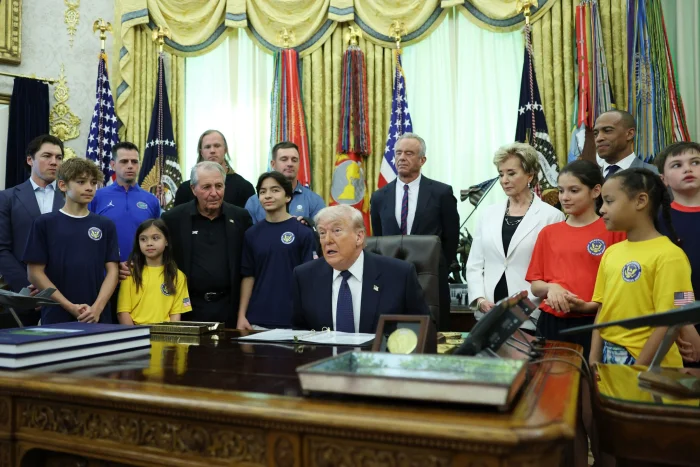
“They want to make a deal. We’ve had very good talks over the last 24 hours, and it’s very possible that we’ll make a deal,” Trump told reporters in the Oval Office on Wednesday.

A day before, Trump paused “Project Freedom” to reopen the blockaded strait, citing progress in peace talks. The de facto blockade of the waterway threatens to cause a global recession. Iran has been pressing to keep Hormuz under its control, through which a fifth of global oil and gas supply passes.

Here is more about the US proposal to end the war, and how experts think Iran would respond.

What is the latest US proposal to end the Iran war?

US media outlet Axios said the two sides were “getting close” to an agreement on a 14-point document. Under the memorandum, Iran would agree not to develop a nuclear weapon and halt enrichment of uranium for at least 12 years, it said.

The US would lift sanctions and release billions of dollars in frozen Iranian assets, and both sides, which have imposed competing blockades in the Strait of Hormuz, would reopen the critical waterway within 30 days of signing.

Iran has been under US sanctions for decades, and the lifting of some sanctions under the 2015 nuclear agreement was reversed after Trump walked out of the landmark deal signed under his predecessor, President Barack Obama. Billions of dollars of Iranian assets remain frozen in foreign banks due to the sanctions.

It is unclear how this memorandum differs from a 14-point plan proposed by Iran last week.

The Reuters news agency reported on Thursday, citing a source briefed on the mediation, that the US negotiations were being led by Trump’s envoy Steve Witkoff and son-in-law Jared Kushner. If both sides agreed on the preliminary deal, that would start the clock on 30 days of detailed negotiations to reach a full agreement.

The full agreement would end the competing US and Iranian blockades on the strait, lift US sanctions and release frozen Iranian funds. It would also include certain curbs on Iran’s nuclear programme, which was allowed by the United Nations nuclear watchdog.

While the sources said the memorandum would not initially require concessions from either side, they did not mention several key demands Washington has made in the past, which Iran has rejected, such as curbs on Iran’s missile programme and an end to its support for armed proxy groups in the Middle East.

The sources also made no mention of Iran’s existing stockpile of more than 400kg (900lb) of near-weapons-grade uranium.

Israeli Prime Minister Benjamin Netanyahu, Trump’s ally, said on Wednesday the two leaders agreed that all enriched uranium must be removed from Iran to prevent it from developing a nuclear bomb.

The US and Israel bombed Iranian nuclear sites last June during the 12-day war, after which Trump claimed that Tehran’s nuclear programme was obliterated. A significant portion of Iran’s enriched uranium stockpile remains buried inside the bombed nuclear sites.

Tehran denies wanting to acquire a nuclear weapon. It insists its programme is for civilian purposes as allowed within its position as a signatory to the non-proliferation treaty.

ISFAHAN, IRAN - MARCH 30: A worker walks inside of an uranium conversion facility March 30, 2005 just outside the city of Isfahan, about 254 miles (410 kilometers), south of capital Tehran, Iran. The cities of Isfahan and Natanz in central Iran are home to the heart of Iran's nuclear program. The facility in Isfahan makes hexaflouride gas, which is then enriched by feeding it into centrifuges at a facility in Natanz, Iran. Iran's President Mohammad Khatami and the head of Iran's Atomic Energy Organisation Gholamreza Aghazadeh is scheduled to visit the facilities. (Photo by Getty Images)
A worker walks inside of an uranium conversion facility on March 30, 2005 just outside the city of Isfahan, about 254 miles (410 kilometers), south of capital Tehran, Iran. President wants Iran to end its nuclear programme [File: Getty Images]

Could Iran agree to this proposal?

Iran has yet to formally respond to the latest US proposal. However, Iranian leaders have pushed back against it.

Iranian lawmaker Ebrahim Rezaee, a spokesperson for the parliament’s powerful foreign policy and national security committee, described the text as “more of an American wish-list than a reality”.

Iran’s Parliament Speaker Mohammad Bagher Ghalibaf appeared to mock reports that the two sides were close, writing on social media in English that “Operation Trust Me Bro failed.”

Al Jazeera’s Resul Serdar Atas, reporting from Tehran, said on Thursday that Iran is still reviewing the US proposal, after which a response is expected to be given to the Pakistani mediators later today.

The Pakistani Ministry of Foreign Affairs said on Thursday that it welcomes the news of a potential agreement between Iran and the US, adding that it will not disclose additional information at this stage.

“As mediators, we will not lose the trust of both parties by revealing details,” it said in a statement quoted by Al Jazeera Arabic.

Atas said, “Iranians are saying that, at this stage, they’re not negotiating their nuclear programme; it’s only about ending the war on all fronts.”

He added that Tehran wants direct guarantees from the UN Security Council, a lifting of sanctions and the reopening of the Strait of Hormuz.

“If that is achieved, in a second phase, they’re ready to discuss their nuclear programme.”

Al Jazeera’s Almigdad Alruhaid reported from Tehran on Tuesday that Iran has set “a very firm red line” on the nuclear file. “The nuclear enrichment programme is non-negotiable,” he said.

According to former US Assistant Secretary of State Mark Kimmitt, Trump’s reported demand that Iran halt all uranium enrichment is unrealistic and unlikely to be accepted by Tehran.

“If there is anything the Iranians are going to insist upon in these negotiations, it is their right to enrich uranium to the 3.67 percent level, which is allowed under nuclear non-proliferation treaties,” he told Al Jazeera.

Kimmitt added that even the 2015 nuclear deal permitted Iran to continue enrichment. Iran boosted its enrichment up to 60 percent after Trump withdrew from the deal in 2018, during his first term.

However, Kimmitt postulated that Trump might want Iran’s existing stockpile of enriched uranium outside of Iran. He added that Iran might either agree to move the enriched uranium outside the country or dilute it down to a non-enriched state.

Alruhaid, the Al Jazeera correspondent, however, said Iran is resisting handing over its existing stockpile of enriched uranium.

Iran is believed to have about 440kg (970lb) of uranium enriched to 60 percent. A 90 percent threshold of enriched uranium is needed to produce a nuclear weapon.

Al Jazeera’s Alruhaid said “the sovereignty on the Strait of Hormuz is becoming one of the main issues on the negotiating table.

“We are seeing the Iranians are tightening their control. They are setting new protocol, new mechanism for controlling that strategic chokepoint for each vessel that is to pass through.”

The US allies in the Gulf, who faced the brunt of Iranian retaliatory strikes, have been pushing for the restoration of navigation in the strait without any conditions. Iran carried out attacks on the Gulf nations, mainly targeting US military assets, after the US and Israel launched attacks on it on February 28.

Trump has repeatedly played up the prospect of an agreement that would end the war, so far without success. The two sides remain at odds over a variety of difficult issues, such as Iran’s nuclear ambitions and its control of the Strait of Hormuz.

A Pakistani source and another source briefed on the mediation told Reuters that an agreement was close on a one-page memorandum that would formally end the conflict, the agency reported on Thursday.

This agreement would kick off discussions to unblock shipping through the strait, lift US sanctions on Iran and set curbs on Iran’s nuclear programme, the sources said.

Al Jazeera, however, could not confirm the veracity of the reports.
Source link

Contributor: Which Democrat could repair the damage Trump did?

Democrats have a huge opportunity to make a huge difference. But whether they’ll grab it is a huge question.

In 2020, I wrote that voters were “weary, anxious and looking for salve” after President Trump’s first term. I said then that the experienced, reassuring Joe Biden fit the moment. Now I fear that if Democrats nominate a similar presidential candidate in 2028, one who wins yet doesn’t act with alacrity on democracy preservation and helping Americans live better lives, a fed-up electorate will once again turn them out as ineffectual.

Who can or should lead the party at a time like this?

I’m not alone in hoping for a tough and confrontational 2028 nominee, someone who is aggressive, persistent and, when necessary, as ruthless as the forces on the opposite side. This person also must have the energy to undertake the mammoth task of repairing the institutional wreckage of Trumpism. Which suggests Democrats should be checking out younger nominees.

Fortunately, newer generations of leaders are emerging. Those who “get it,” in my view, include Sen. Jon Ossoff of Georgia, Rep. Alexandria Ocasio-Cortez of New York and Sen. Chris Murphy of Connecticut.

Obviously any Democrat will be better than anyone from Trump’s team or orbit, including JD Vance, Donald Trump Jr. or Marco Rubio. The issue facing Democrats is whether moderate or policy wonkish people such as former Transportation Secretary Pete Buttigieg, Kentucky Gov. Andy Beshear or Pennsylvania Gov. Josh Shapiro would be the democracy warriors this moment demands. Repairing a crucial interstate bridge with lightning speed is a great thing and, sometimes, so is outreach to Republicans and Fox News. But would they prioritize thinking big and fighting hard for the fundamental changes we need?

Where would centrist former CIA officer Abigail Spanberger, the new Virginia governor, land on this scale? Even after coming around to supporting new House maps that will net four seats for her party? Gov. Gavin Newsom of California, who began his podcast by inviting MAGA guests, championed a referendum on five new Democratic seats in his state and led his party to a redistricting triumph. Where would he land? Would he prioritize outreach to Republicans or the battle to assure a “no kings” future for America? The need for structural changes in our outdated institutions is glaringly obvious. Who will run to repair this country? Who can be trusted to follow through? Because the solutions are out there, staring us in the face:

Checks on presidential pardon power. A larger, term-limited Supreme Court bound to an enforceable ethics code. A national law requiring independent redistricting commissions or, better yet, multi-member districts with proportional representation. A voting rights law that sets minimum standards for mail voting, early voting and voter IDs. Anti-corruption laws that prevent profiteering by presidents and their allies. Explicit limits on presidential construction and alterations to federal properties. A stronger “impoundment” act with sharp teeth to make sure future presidents spend taxpayer money constitutionally, as Congress intends, instead of any way they want. D.C. and Puerto Rico statehood to start rebalancing a Congress and electoral college that have shortchanged urban America since the late 19th century.

It’s a long list, and there’s no guarantee that today’s Supreme Court would allow any of it. But realizing some of these goals will take decades; we can’t be discouraged by temporary impediments such as the current lineup of justices. The work on all of it should start ASAP — next year in the next Congress if Democrats are running one or both chambers. And at some point, we’ll have a different high court.

I can already hear the protests: What about affordability? That’s the best part: Trump has done so many things to make life more expensive that simply reversing them would have immediate impact. Stop the Iran war; reopen the Strait of Hormuz; aim to restore the Obama-era agreement that kept Iran’s nuclear ambitions in check; end the Trump tariffs; stop shrinking labor forces in agriculture, healthcare, construction and other industries by ending detentions and deportations of noncriminals; reverse last year’s tax breaks for elites and restore the money for Medicaid and health insurance premium subsidies; and kill off the Versailles-level Trump ballroom that he now wants to fund with taxpayer dollars (initially $400 million, now $1 billion).

Then Democrats could revisit some of their own affordability priorities, including the expanded child tax credit that significantly reduced child poverty, new ways to put housing within reach of more people and national paid family leave. They could also crack down on military spending that is pointless in the modern era and refocus on cheap and effective equipment such as drones like Ukraine is using to strike inside Russia.

As it happens, a stark indicator of the political tides came as I was writing this. Maine Gov. Janet Mills suddenly dropped out of the Democratic Senate primary race against Graham Platner. It was a lightning bolt, given her establishment support after being recruited by Senate Minority Leader Chuck Schumer. But in a way it was inevitable.

Mills is 78. If she had gone on to win the primary and defeat GOP Sen. Susan Collins, she would have been sworn in at age 79. Platner is 41, an oyster farmer and military veteran with a compelling, relatable persona. Though he has a controversial past, Mills’ negative ads did nothing to dent his appeal. Polls showed him winning the primary vote against Mills, sometimes by 2 to 1, and with a consistent general-election edge against Collins as well.

Platner told Jon Stewart last week that the party leadership establishment had largely ignored him. His message to them? “You should be curious, because I’m polling 40 points ahead.” By the next morning, Mills was out, and the establishment — Schumer and New York Sen. Kirsten Gillibrand, chair of the Senate campaign committee — said they’d work with Platner to flip the seat.

The midterm races are sending Democrats clues. They should take them seriously.

Jill Lawrence is a journalist and the author of “The Art of the Political Deal: How Congress Beat the Odds and Broke Through Gridlock.” Bluesky: @jilldlawrence

Source link

U.S.-Vietnam trade talks risk strategic misstep in Indo-Pacific balance

A series of meetings will help determine whether the United States and Vietnam can preserve a trade relationship that has become central to supply chain resilience, U.S. business interests and Vietnam’s continued economic ascent. File Photo by Luong Thailinh/EPA

May 7 (UPI) — As Washington and Hanoi enter a dense stretch of trade diplomacy, the coming weeks will test whether one of the Indo-Pacific’s most pragmatic economic partnerships can sustain its momentum or become entangled in the very frictions it has worked to avoid.

A series of meetings — including Section 301 hearings on industrial capacity from Tuesday to Friday this week, forced labor discussions April 28 to May 1 and bilateral consultations next Monday and Tuesday, arrives at a pivotal juncture.

They will help determine whether the United States and Vietnam can preserve a trade relationship that has become central to supply chain resilience, U.S. business interests and Vietnam’s continued economic ascent.

At its core, the U.S.-Vietnam Comprehensive Strategic Partnership is grounded not in diplomacy alone, but also in economic logic.

Partnership built on complementarity

Over the past decade, Vietnam has emerged as one of the fastest-growing U.S. trading partners, driven by a convergence of structural interests. As American firms diversify production beyond China, Vietnam has become a preferred destination, offering cost competitiveness, political stability and deepening integration into global value chains.

U.S. data show Vietnam ran a $123.5 billion trade surplus with the United States last year — the fourth-largest imbalance after China, the European Union and Mexico. It is a figure that has drawn increasing scrutiny in Washington even as it reflects the depth of bilateral trade integration.

From electronics to apparel and consumer goods, Vietnam-based production is often embedded within supply chains designed and financed by U.S. and allied firms. American companies benefit from lower production costs and diversified risk, while Vietnamese exports sustain growth and employment at home.

Disrupting this ecosystem through blunt trade measures risks undermining the very businesses Washington seeks to protect.

Hanoi has consistently signaled a willingness to engage. It has approached trade tensions not with confrontation, but with negotiation — a posture that stands in contrast to more adversarial economic relationships. The upcoming consultations should reinforce that cooperative trajectory, not derail it.

Rethinking “overcapacity”

The debate over “overcapacity” has become a central issue in U.S. trade discussions, with concerns that the term is being applied broadly across different economic models.

In Vietnam’s case, officials and industry observers note that production growth is largely driven by market-based investment and global supply chain shifts rather than state-directed industrial surpluses.

“Vietnam’s overcapacity is much different from China’s,” said Murray Hiebert, head of research for Bower Group Asia. “China’s factories are producing huge surpluses that it dumps onto the world’s markets below market prices. Instead, Vietnam relies on foreign investment companies to produce for export.”

He noted that Vietnam’s export engine is overwhelmingly foreign-driven, with multinational firms, particularly from the United States and South Korea, accounting for roughly 80% of outbound shipments, while domestic producers contribute only about one-fifth.

“Vietnam’s economy is largely a manufacturing platform for foreign companies,” Hiebert said. “U.S. policymakers need to understand Vietnam did not create overcapacity by subsidizing manufacturing, but by courting foreign investors who used Vietnam as a low-cost base to serve global markets.”

Vietnam’s manufacturing expansion has been shaped by global supply chain realignment, accelerated by U.S.-China trade tensions and pandemic-era disruptions, rather than by state-led efforts to flood international markets. Many of the factories operating in Vietnam were relocated or expanded by multinational firms seeking to maintain access to U.S. consumers.

To conflate this model with subsidy-driven overproduction risks misdiagnosing the issue and penalizing a partner that has facilitated, rather than distorted, market outcomes.

Labor reforms and supply chain progress

Concerns over labor practices and supply chain integrity remain part of the policy conversation, particularly in the context of ongoing forced labor discussions. But these concerns should be weighed against Vietnam’s steady, if incremental, progress.

In recent years, Hanoi has undertaken significant labor reforms aligned with the International Labor Organization, including updates to its labor code, expanded worker representation rights and enhanced compliance mechanisms.

Vietnam has also prioritized traceability and transparency across key export sectors. From fisheries to manufacturing, authorities have invested in monitoring systems, strengthened inspections and improved regulatory oversight — steps aimed at meeting the expectations of international partners and markets.

This is an evolving process, not a completed one. But the trajectory is clear: Vietnam is moving toward higher standards, not retreating from them.

The case for market economy recognition

Another unresolved issue, Vietnam’s designation as a non-market economy under U.S. trade law, has become increasingly difficult to justify.

Vietnam operates within the framework of the World Trade Organization and has been recognized as a market economy by more than 70 countries. Its private sector has expanded rapidly, its regulatory environment continues to evolve and its integration into global markets is deepening.

Maintaining Vietnam’s current non-market economy designation under U.S. trade law has raised concerns among policymakers and business groups, who say it could affect the application of trade remedies and investor confidence. The issue comes as Washington seeks to expand economic partnerships across the Indo-Pacific.

Avoiding unintended consequences

Intellectual property has emerged as a new point of tension in U.S.-Vietnam trade relations. Ambassador Jamieson Greer, the U.S. trade representative, has designated Vietnam as a “Priority Foreign Country” — its most serious classification — in its latest intellectual property rights report, opening the door to a potential Section 301 investigation within 30 days.

The designation, the first of its kind in more than a decade, reflects ongoing U.S. concerns over Vietnam’s intellectual property protections and could affect the trajectory of current trade negotiations.

Sweeping trade measures designed to address structural concerns could disrupt supply chains, raise costs for American businesses and consumers, and weaken a partnership that has delivered measurable benefits. In an already fragile global economy, such outcomes would be counterproductive.

Vietnam’s own incentives align with stability. Its growth depends on open markets, foreign investment and compliance with international standards. That alignment should be viewed as a strategic asset.

Washington should avoid applying a China-centric lens to Vietnam’s trade profile, said Dan Harris, a partner at the law firm Harris Sliwoski. Treating Vietnam as an “overcapacity” case without clear evidence risks penalizing U.S. firms that relocated production there in line with Washington’s own push to reduce reliance on China and strengthen supply chain resilience.

“We will end up punishing the companies that did what we asked,” Harris warned.

He added that the broader strategic context matters: Vietnam’s long history of conflict and mistrust with China sets it apart from Beijing, even as it emerges as an increasingly important U.S. partner in the Indo-Pacific.

But the implications of Washington’s trade posture toward Hanoi extend far beyond economics. Vietnam’s export-driven growth, fueled primarily by multinational investment rather than state subsidies, has quietly elevated the country into a strategic linchpin in the Indo-Pacific.

A stable and prosperous Vietnam not only supports supply chain diversification, but also reinforces the rules-based order in the South China Sea.

Economic resilience in Vietnam is not peripheral to U.S. strategy. It is foundational to maintaining balance in contested Indo-Pacific waters. Trade policy cannot be divorced from strategic reality: A weakened Vietnamese economy would do more than disrupt production flows. It could undercut one of the region’s most important counterweights to China’s expanding maritime presence.

Balancing trade and security alignments

Rising risks of policy missteps could carry strategic costs. Analysts warn that overly punitive U.S. trade measures, particularly those misreading Vietnam’s market-driven model, may push Hanoi toward alternative economic alignments, reshaping regional supply chains and weakening U.S. influence in an increasingly competitive Indo-Pacific.

U.S. policymakers are weighing more targeted, cooperative measures in managing trade concerns with Vietnam, including a bilateral supply chain monitoring mechanism, expanded data-sharing on industrial capacity and the potential creation of a standing U.S.-Vietnam trade and standards working group.

The approach aims to address regulatory and transparency issues while maintaining stability in the broader economic partnership.

The challenge for Washington is alignment – translating economic logic into strategic necessity. That means recognizing Vietnam not as a trade problem to be managed, but rather as a partner whose economic trajectory is increasingly central to the region’s stability and security.

Beyond trade flows and investment figures, the U.S.-Vietnam economic relationship carries broader strategic significance. It reinforces a rules-based framework in the Indo-Pacific and supports cooperation across sectors ranging from technology to maritime security.

Any escalation in trade tensions between the United States and Vietnam could disrupt commercial ties and place broader strategic cooperation at risk, as both sides seek to sustain recent gains in economic and security engagement.

James Borton is a non-resident senior fellow at Johns Hopkins SAIS Foreign Policy Institute and the author of Harvesting the Waves: How Blue Parks Shape Policy, Politics, and Peacebuilding in the South China Sea. Borton is the editor-in-chief of the South China Sea NewsWire. The views and opinions expressed in this commentary are solely those of the author.

Source link

California under pressure — again — as redistricting wars escalate

When the U.S. Supreme Court sharply curtailed a key provision of the Voting Rights Act last week, Democrats in Washington had a message: The rules of redistricting have changed, and California — the nation’s biggest blue bastion — may have a further role to play.

Rep. Alexandria Ocasio-Cortez (D-N.Y.) said Democrats should “play by the same set of rules” as Republicans. House Minority Leader Hakeem Jeffries (D-N.Y.) vowed to fight in “the Deep South and all over the country.” And Rep. Terri Sewell, an Alabama Democrat, was blunt: “I’ll take 52 seats from California, I sure would. And 17 seats from Illinois.”

The calls for action came as Republican governors in Louisiana, Alabama, Mississipppi and Tennessee called special legislative sessions to redraw congressional maps ahead of this year’s midterm elections. Florida has also approved new maps that could give the GOP four more seats in the House, and President Trump urged other Republican states to follow suit.

The Republican response has intensified the pressure on Democrats to act, including those in California — where the ruling could upend not just congressional maps, but also legislative and local races.

“We can’t allow this national gerrymandering effort of Republicans to go unanswered,” said Rep. Robert Garcia (D-Long Beach). “If Republicans go for it, I think we have to leave all options on the table.”

For now, California’s response is far from settled.

A woman with brown hair, wearing glasses and a dark jacket, gestures while speaking before a microphone

Rep. Sydney Kamlager-Dove (D-Los Angeles) cautioned against “accelerating a race to the bottom.”

(J. Scott Applewhite / Associated Press)

The chair of the California Democratic Party said there are no current plans to redraw maps — just months after voters approved a constitutional amendment authorizing a mid-decade redistricting backed by Gov. Gavin Newsom.

The Democratic consultant who drew the state’s current congressional district boundaries says an all-blue map, while possible to create, would probably hurt Democrats more than help them in the long run. And some of the state’s congressional Democrats are worried the impulse to match Republican partisan efforts would be bad for the American electorate.

“Rather than accelerating a race to the bottom, the next step is to dial it down because you can reach a point of no return,” said Rep. Sydney Kamlager-Dove (D-Los Angeles), one of the state’s most prominent Black lawmakers. “And that’s where we’re headed.”

What California decides — and when — will matter at the national level. With 52 congressional seats, no state has more to offer Democrats in a redistricting war. But experts, lawmakers and party officials say the path forward is more complicated than the calls from Washington suggest.

California could see 48 blue seats, out of 52

That’s in part because California already acted. In 2025, voters approved Proposition 50, which drew new congressional district lines designed to favor Democrats for the 2026, 2028 and 2030 elections. The new maps, which could yield as many as 48 Democratic seats out of 52, are already in effect, and voters have begun receiving their mail-in ballots.

Going farther is not currently on the table — at least not yet.

“We have yet to fully win the seats in the map that was drawn in 2025. It seems a step too far to say we’re going to go back to the drawing board and redraw the map,” said Rusty Hicks, the chair of the California Democratic Party.

Hicks said it doesn’t mean the issue could not become part of a future discussion, but he said Democrats in other states should not look past what California has already done.

“We’re trying to pick up 48 of them. How much more do you want us to pick up? You want us to make it 52 blue? Well, you all should get into the fight,” Hicks said. “You all should pick up some seats. Let’s all do this together, because California cannot do it alone, it will take the rest of the country.”

Others are not convinced the most aggressive option makes the strategic sense in California.

Paul Mitchell, the Democratic redistricting consultant who drew California’s Proposition 50 congressional maps, said the push for a 52-0 delegation reflects a fundamental misunderstanding of how a partisan map would perform in the state over time.

“A 52-to-zero map would have the potential of backfiring,” Mitchell said. “In 2026, we could pick up 52 seats. But then in 2028 or 2030 — a bad year for Democrats, let’s say — Democrats lose 11 of those seats. You’ve drawn these districts so demonically to a Democratic advantage in a good year that in a bad Democratic year, they don’t have the ability to withstand the challenge.”

Ruling could jeopardize state’s voting rights law

The political debate over congressional maps has so far dominated the conversation in Washington. But legal scholars and redistricting experts say the ruling could also have consequences in California’s city hall, school board and county supervisor races.

The justices’ ruling, decided by the court’s conservative majority, says states cannot consider race to create majority-minority electoral districts while allowing them take partisan interests into account.

“A purely partisan map is actually more defensible now than one drawn with racial considerations,” said Rick Hasen, an election law professor at UCLA. “It turns the world on its head.”

The ruling now puts at risk any district drawn at any level of government that relied on the Voting Rights Act to justify its boundaries, Hasen said.

And in California, that uncertainty extends to districts drawn under the state Voting Rights Act, which extends protections for minority voters beyond the federal law, he said. The state law was not directly at issue in the Supreme Court ruling, but Hasen argues the court’s reasoning could provide new legal grounds to challenge the state law as potentially unconstitutional.

Cities including Santa Monica and Palmdale have faced lawsuits alleging their at-large City Council elections diluted the Latino vote. Palmdale settled its case and agreed to switch to district-based elections; Santa Monica’s case is ongoing. Hasen argued that the cities, as well as other bodies, such as school boards, could now return to court to challenge whether district maps drawn as a result of the California Voting Rights Act are unconstitutional.

“That has not been tested yet,” he said, but he fears the same arguments made to challenge the federal Voting Rights Act could be made against the state law.

At the state level, Republican strategist Matt Rexroad sees the ruling affecting the California Legislature as well. He argues the boundaries drawn for the state Assembly and Senate districts are racial gerrymanders.

“Those legislative lines, I would argue, are unconstitutional,” Rexroad said. “And those lines are probably going to change by 2028.”

But Rexroad’s biggest concern goes beyond any single set of maps: It is the future of California’s independent redistricting commission, the nonpartisan body he has spent years defending.

A threat to independent redistricting

Rexroad sees a scenario in which the national political environment gives California Democrats little incentive to return the map-making power to the commission. If Republican states continue to aggressively redraw maps, Democrats will have another justification to keep power in the Legislature’s hands, the same argument made to pass Proposition 50, he said.

“I don’t think the California redistricting commission has ever been in greater jeopardy than it is right now,” he said.

J. Morgan Kousser, a historian who has testified as an expert witness in voting rights cases for 47 years, said California’s commitment to the commission may depend on how aggressive Republican states act in redistricting.

“If we go back to an all-white South in Congress, California may not go back to a fairness standard,” Kousser said. “It may not disarm. It may rearm.”

Mitchell, the redistricting consultant, said that he hopes California and other states choose the path of disarmament and that there is a national push for independent commissions in every state.

“This isn’t good for anybody,” he said. “This was all basically a nerd war over lines that didn’t actually improve any districts anywhere.”

Source link

Phone Ad Blamed on Staff of Becerra

U.S. Rep. Xavier Becerra’s mayoral campaign not only produced a scandalous telephone ad in the Los Angeles mayoral race but later erased the message after it had prompted an investigation, Dist. Atty. Steve Cooley said Wednesday.

Although the actions did not constitute a crime, the district attorney’s report could spell political trouble for both Becerra and Los Angeles Councilman Nick Pacheco, a Becerra supporter connected to the telephone bank that issued the calls.

In the prerecorded telephone calls made days before the April 10 election, a woman posing as county Supervisor Gloria Molina attacked former Assembly Speaker Antonio Villaraigosa and his record on crime.

Although Becerra said he had no involvement in the calls, Molina said Wednesday that she felt “personally abused and personally hurt by Xavier Becerra and his campaign.”

Molina told reporters that the congressman could not hide behind his aides and that, even if he did not personally authorize them, had to accept responsibility for the calls.

Molina’s strong statements could hurt Becerra, who has benefited from her support and enjoyed a squeaky-clean image.

“There’s no way to see this in a positive light,” said Arturo Vargas, executive director of the National Assn. of Latino Elected and Appointed Officials and a longtime friend of Becerra. “I can’t imagine him knowing. On the other hand, he is the candidate and he is ultimately responsible for the actions of his campaign.”

Late Wednesday, Becerra said he had offered an apology to Molina and Villaraigosa. In a two-page statement issued from his attorney’s office, the congressman said his campaign staff had long denied involvement in the calls.

Becerra said he had told his staff not to engage in negative campaigning. “I can’t express how disappointing and frustrating it is to now learn that those instructions and responsibilities may have been ignored in this case,” he said.

Pacheco, a rising force at City Hall, also found himself entangled in the scandal. The nonprofit organization that he co-founded, Cal Inc., leased its telephone bank to La Colectiva, which made the controversial calls. And one of his top aides was a pivotal figure in the inquiry.

The calls targeted rival mayoral candidate Villaraigosa just days before the April election, in which he finished first out of six major candidates. He is now in a runoff with City Atty. James K. Hahn; Becerra finished fifth with 6% of the vote.

In the calls, made to 80,000 voters, a woman identifying herself as “Gloria Marina” declared: “Please don’t hang up. This is an emergency call.” She then made allegations about Villaraigosa’s record on crime.

One day after the calls began, Molina asked Cooley to investigate them. Seven weeks later, the district attorney said that even though his office found no crime committed, it was important for the public to know what happened.

“Although those responsible for this reprehensible conduct will not face criminal prosecution, this office remains hopeful that the court of popular opinion will rule that this type of underhand political ‘dirty tricksterism’ will not be tolerated,” Cooley wrote in a letter to Molina.

A detailed report on the investigation combined with other information obtained by The Times shows that investigators first interviewed people at La Colectiva on April 2, two days after the calls were made.

“After . . . it became clear that investigators from this office were focusing on La Colectiva,” the report says, Floyd Monserratt, a top aide to Pacheco who was working as a volunteer for La Colectiva, became concerned and spoke with Becerra campaign manager Paige Richardson. At that point, the report adds, Richardson told Monserratt to change the recorded call. During the switch, the “Marina” recording was erased.

Over the course of the probe, investigators found themselves stymied by some of the Becerra campaign’s top officials, prosecutors said.

Monserratt initially denied any knowledge of the controversial calls.

Several days later, Cooley said, investigators tried to reach Monserratt but were unsuccessful until an attorney representing him contacted the district attorney’s office. But on May 1, under oath, Monserratt explained La Colectiva’s role in making the controversial calls.

Richardson also failed to cooperate with authorities’ efforts to get to the source of the phone calls, the report says. As early as April 5, a district attorney’s investigator spoke to Richardson at the campaign’s headquarters, where she denied any knowledge of the calls, according to Cooley’s office. Last weekend, Richardson refused to speak to an investigator who flew to her New Mexico home.

By then, prosecutors had interviewed two other members of the Becerra campaign who said Richardson had given them a script for the call. One, press deputy Allyson Laughlin, said she believed it was “inappropriate” to record the call because as press deputy “her voice was so recognizable,” the district attorney’s report says.

Richardson then asked Veronica Del Rico, a scheduling aide, to record the announcement, prosecutors said. Stephen Mansfield, an attorney for Del Rico, said his client was a low-level employee who was presented a script by her superiors. She asked whether the call would be ethical, legal and accurate before recording it, he said.

The prosecutors’ report also says Richardson and deputy campaign manager Scott Nunnery made the decision to have the caller identify herself as “Gloria Marina.”

“Ms. Richardson and Mr. Nunnery laughed at the idea, and Ms. Richardson said something like, ‘It would be a slap in her face since she just endorsed Villaraigosa,’ ” the report states.

Richardson’s attorney has denied that she originated the recorded call. Nunnery did not return calls for comment.

“The D.A.’s report is inaccurate in many respects,” Richardson’s attorney, Fred Woocher, said in a statement Wednesday. “At this point, however, she sees no value in pointing her finger elsewhere or in spreading the blame.”

On Tuesday, Becerra said in a statement that he had just learned the district attorney’s investigation was focusing on La Colectiva. On Wednesday, in a more detailed statement, he said he had heard “rumors” of the connection weeks ago and asked his campaign attorney to look into it.

Becerra said his attorney reported back that all staffers denied involvement.

Cooley took issue with the notion that the congressman only recently become aware of the focus on La Colectiva. Indeed, Cooley said that, although his office only recently contacted Becerra, there was no doubt the congressman’s campaign was under scrutiny.

“After all, we had been interviewing his campaign staffers for several weeks,” Cooley said. He also disputed Pacheco’s claim that the councilman was instrumental in finding out who was behind the calls.

“That is not an accurate representation,” Cooley told reporters. “He surfaced only because we contacted him last Friday.”

In a letter dated Tuesday to the district attorney, Pacheco said he encouraged Monserratt to share what he knew of the calls with prosecutors.

“That assertion would be inconsistent with our investigation and the statements of Mr. Monserratt,” Cooley said. Adding that Pacheco could have done more to let investigators know about the calls, the district attorney said: “One would think that Nick would have known his information would be helpful.”

Pacheco said he was “stunned” that Cooley told reporters he failed to quickly disclose his knowledge of the calls. “All I can tell you is I was hearing secondhand stories,” Pacheco said. “I’m stunned a prosecutor would want an investigation started with secondhand rumors.”

*

Times staff writers Tina Daunt and Matea Gold contributed to this story.

Source link

California county discovers trove of unopened ballots in locked box

The Humboldt County Office of Elections made an unnerving discovery Monday: a stack of 596 sealed ballots from the most recent election left at the bottom of a locked voting drop box.

The uncounted ballots would not have affected the outcome of the November statewide special election for Proposition 50, the county office said in a news release Wednesday. However, officials said they’re working hard to have all the votes legally counted.

The office discovered that the ballots were uncounted because of a staff error. When workers checked the drop box, there was a miscommunication about whether it had been fully emptied, the office said.

“That outcome is unacceptable and runs counter to the core of what this office stands for,” Juan Pablo Cervantes, county clerk-recorder and registrar of voters, said in a statement. “While the mistake occurred after an election worker did not follow proper procedures, the responsibility for what happened ultimately sits with me.”

After the ballots were discovered, elections staff confirmed that the sealed ballots had not been tampered with, and they worked with the California secretary of state to determine next steps. Under California law, the ballots should have been counted before the election was certified on Dec. 5 and destroyed six months later.

The Office of Elections said it had altered its protocols to ensure such a mistake does not take place again, implementing a new “lock out, tag out” procedure to ensure each drop box is empty and secured before election results are finalized.

“I promise you that we are taking this seriously,” Cervantes said. “We will strengthen our processes and continue pushing toward the standard our community expects and deserves.”

The discovery comes as California continues to be under a microscope for allegations of voter fraud.

Within minutes of polls opening for California’s special election in November, President Trump took to Truth Social to claim that the Proposition 50 vote — which redrew several congressional districts to favor Democratic candidates — was rigged.

“The Unconstitutional Redistricting Vote in California is a GIANT SCAM in that the entire process, in particular the Voting itself, is RIGGED,” Trump wrote.

When asked later that day to explain Trump’s claims on how the election was allegedly rigged, White House Press Secretary Karoline Leavitt said California has “a universal mail-in voting system, which we know is ripe for fraud.” She also accused the state of counting ballots from undocumented immigrants.

Elections officials and Democratic leaders including Gov. Gavin Newsom decried those claims as baseless. “The bottom line is California elections have been validated by the courts,” California Secretary of State Shirley Weber said in a November statement.

More recently, Republican gubernatorial candidate Chad Bianco has drawn scrutiny for using his position as Riverside County sheriff to seize some 650,000 ballots in the county to determine whether they were fraudulently counted. Critics decried the move as another attempt by Republican election deniers to disenfranchise voters.

Humboldt County, which encompasses 4,052 square miles of rural California below the Oregon border, has largely avoided election-related turmoil in recent years. In 2008, however, Humboldt election officials discovered that software they used to tally votes had failed to count 197 ballots from one precinct.

More recently, nearby Shasta County has become a hotbed of election denialism and MAGA politics, with its Board of Supervisors voting in 2023 to end the use of Dominion Voting Systems machines in favor of pursuing a hand-counting system.

Times staff writers Hailey Branson-Potts, Jenny Jarvie and Ana Ceballos contributed to this report.

Source link

FBI searches Virginia Senate leader’s office as part of corruption probe, AP source says

The FBI searched the Virginia state Senate leader’s office on Wednesday as part of a corruption investigation, a person familiar with the matter said. Federal agents also were seen at the senator’s nearby cannabis business.

The search at Virginia Sen. L. Louise Lucas’s district office in Portsmouth comes after the Democrat helped lead the state’s recent redistricting effort.

The FBI said only that it was conducting a court-authorized search warrant in Portsmouth. The person who confirmed the FBI’s search was not authorized to discuss an ongoing investigation by name and spoke to the Associated Press on condition of anonymity.

Besides the search at Lucas’ office, agents in FBI T-shirts also went into the nearby Cannabis Outlet, which she opened in 2021. Several entrances to its cannabis store parking lot were blocked by unmarked vehicles with flashing blue lights.

Lucas — a prominent backer of legalizing marijuana — has said the store sells legal hemp and CBD products. It has drawn scrutiny from local media amid allegations that some products were mislabeled.

Virginia has legalized pot possession, but retail sales of recreational marijuana remain illegal in the state.

A message seeking comment was left Wednesday on a cellphone for Lucas, who has been a state senator for 34 years.

State House Speaker Don Scott said he was deeply concerned by the FBI search.

“Right now, there is far more theatrics and speculation than actual information available to the public,” Scott, a Democrat, said in a statement, adding that more facts were needed “before anyone rushes to political conclusions.”

Gov. Abigail Spanberger declined to comment. Some other Virginia Democrats were quick to note that the search comes as the FBI and Justice Department have opened a spate of politically charged investigations into perceived adversaries of President Trump.

The context “must be acknowledged,” U.S. Rep. Bobby Scott said in a social media post.

Last week, the Justice Department charged former FBI Director James Comey with making a threatening Instagram post against Trump, an accusation that Comey — who for nearly a decade has drawn the president’s ire — has denied. A separate mortgage fraud case, ultimately dismissed by a court, targeted Democratic New York Atty. Gen. Letitia James, who had brought a major civil fraud lawsuit against Trump and his business.

The FBI and Justice Department have also provoked concerns among Democrats about ongoing election-related investigations, including the seizure by agents of ballots and other information from Fulton County, Ga.

Lucas has been a vocal leader of Virginia’s redistricting effort, which voters approved last month. A sign urging people to “vote yes” to “stop the MAGA power grab” still hung Wednesday on a fence separating her office’s parking lot from the parking for the cannabis shop.

Amid a national, state-by-state partisan redistricting fight kicked off by Trump’s desire to aid his fellow Republicans, Virginia voters OK’d a Democrat-backed constitutional amendment authorizing new U.S. House districts. The plan could help the party win up to four additional seats.

“We are not going to let anyone tilt the system without a response,” Lucas said after the vote. Trump, meanwhile, denounced the results.

The state Supreme Court let the referendum proceed but has yet to rule whether the effort is legal. The court is considering an appeal of a lower-court judge’s ruling that the amendment is invalid because lawmakers violated procedural requirements.

Voting districts typically are redrawn once a decade, after each census. But Trump last year urged Texas Republicans to redraw House districts to give the GOP an edge in the midterms. California Democrats reciprocated, and redistricting efforts soon cascaded across states.

Lucas, 82, has been a figure in Virginia politics since the 1980s, when she became the first Black woman elected to a City Council seat in her native Portsmouth. She now is the first woman and first African American to serve as the body’s president pro tempore.

Earlier in life, she was the Norfolk Naval Shipyard’s first female shipfitter, according to her biography in the state library. The job entails making, installing and repairing sometimes enormous metal assemblies for vessels.

In recent years, she has been the chief executive of a Portsmouth business that runs residences, day programs and transportation for intellectually disabled adults.

Tucker, Breed and Peltz write for the Associated Press. AP writers Dylan Lovan in Louisville, Ky.; Jake Offenhartz in New York; and Claudia Lauder in Philadelphia contributed to this report.

Source link

City Council moves to limit traffic stops; LAPD policy not changing

The Los Angeles City Council on Wednesday voted in favor of new restrictions on so-called “pretextual” traffic stops, signaling a growing impatience with the Police Commission’s failure to rein in a controversial LAPD tactic that critics say enables racial discrimination.

The vote requests that the department’s all-civilian watchdog adopt new guidelines similar to San Francisco, which bars police officers from pulling people over for broken taillights and other minor equipment violations unless there is a safety threat.

“Board of Police Commissioners: Get this done; we’re watching, no excuses,” said Councilmember Imelda Padilla, who shared stories of her late father being stopped by police with no explanation. “This is what this generation wants.”

If the new policy were adopted, LAPD officers would be prohibited from stopping motorists, bicyclists or pedestrians for minor violations “except in cases where the violation poses a significant and imminent safety risk.”

The unanimous vote followed sometimes emotional testimony at a City Council meeting from Angelenos about how their lives had been shaken by discriminatory traffic stops and searches.

Several speakers pointed to a growing body of research showing that minor stops disproportionately affect Black and brown motorists and do little to combat violent crime while eroding public trust. In recent years, there have been several high-profile traffic stops that resulted in officers or drivers being killed.

The current LAPD policy, in place since 2022, requires officers to record themselves on their body-worn cameras stating the reasons for suspecting a more serious crime had occurred when making a stop for a minor infraction.

The measure passed Wednesday stops short of a categorical ban that some have sought, but was still met with cautious optimism by traffic safety reformers.

“It helps place the city of Los Angeles on a path of ending racial profiling by LAPD,” said Chauncee Smith, of Catalyst California, a group that advocates for racial justice.

Smith’s group recently released a report that said such stops have continued to disproportionately affect Black and Latino drivers.

Smith said the new policy advanced by the City Council represents “a more formal, explicit prohibition,” adding that he hopes the Police Commission will ultimately give officers even less discretion in deciding when to make stops.

In a brief statement after the vote, Mayor Karen Bass thanked Harris-Dawson for his “leadership and dedication in moving this updated policy forward.”

“I will work closely with the Police Commission and Chief [Jim] McDonnell to implement it and to provide officers with appropriate training,” Bass said.

Any changes to the policy will probably draw strong challenges from within the LAPD and the Los Angeles Police Protective League, the powerful union that represents the city’s rank-and-file officers.

McDonnell has publicly defended the stops as an essential law enforcement tool in the department’s fight against guns, gangs and drugs. He and some transportation safety advocates have argued that persistent traffic deaths — road fatalities have in recent years outpaced the number of homicides — indicate the city needs to crack down harder on reckless driving.

The proposed change comes against the backdrop of a broader effort by city leaders to wrest greater oversight of the LAPD from the Police Commission. A spokesperson for the civilian body said it would evaluate how to proceed.

“The Board intends to place this item on a forthcoming agenda to enable a full and transparent discussion of the Department’s pretextual stop policy, which will include the recommendations from the City Council,” the statement said.

McDonnell did not respond to a request for comment.

The vote was the latest move in a broader push to remove police officers from traffic enforcement. Some advocates have argued that more punitive approaches that prioritize arrests and traffic citations do little to keep city streets safe; instead, they argue the city should invest in unarmed civilian workers and speed bumps, roundabouts and other street modifications that could help curb unsafe driving.

Adrienna Wong, a senior attorney with the American Civil Liberties Union, said Wednesday’s vote showed city leaders taking action on an issue that was personal to them.

“I think what you saw today in council was the council members have lived experiences and are hearing from their constituents and are voting to represent their constituents in a way that the Police Commission has not,” she said.

Source link

Two winners, one loser in tonight’s L.A. mayor’s debate

Karen Bass, Spencer Pratt and Nithya Raman each came into tonight’s mayoral debate with goals for what may be their only time together on stage.

As the incumbent mayor, Bass had to weather blows from her challengers while trying to sell voters on her fitness for another term, despite a disastrous 2025.

As a reality TV star with no political experience, Pratt needed to show that he could offer substance instead of just AI fanboy videos and the name-calling — “Karen Basura” — he has indulged in on social media.

Raman’s task was perhaps the hardest. As a city councilmember whose two previous campaigns were backed by the local Democratic Socialists of America chapter, she needed to convince Pratt-curious voters that she’s more conservative than Bass. Yet for others, she needed to appear liberal enough to peel away support from the mayor and come out as a progressive lioness to excite Democrats in a year where GOP candidates like Pratt have to answer for the disaster that is President Trump’s second term.

Only one of the three failed.

At times, Raman was tongue-tied trying to answer simple questions. Moderators kept telling her she was going over her time. Answering a yes/no question about whether noncitizens should be allowed to vote in city elections, the councilmember went on and on, until the moderator cut her off.

While Raman offered some policy plans, she also played a card straight out of Trump’s arsenal. She claimed that Pratt and Bass were teaming up against her — an unlikely scenario that drew laughs from the audience. She got more and more frustrated, to the point that when Bass was allowed time for a rebuttal, she dejectedly proclaimed, “I haven’t been offered that in a lot of this debate.”

Raman, who had endorsed Bass’ reelection before throwing her hat in at the last minute, came off as inexperienced, touchy and unprepared.

The line of the night was Pratt dismissing Raman as a “random councilmember” — which is how the L.A. political world responded to her entry into the race. She was so upset about Pratt’s remark that she continued to whine about it to a KNBC reporter after the debate.

What’s shocking about Raman’s flop is that she should know how important it is to project well to a television audience, given that her husband is a screenwriter. Her tone was flat, when she needed to be passionate.

No one had to remind Pratt of that. He was parrying tough questions on a big stage for the first time, facing an audience who knew him only as the Angry L.A. White Guy he has reveled in playing.

He mostly succeeded.

At his best, Pratt came off as a boisterous bro with enough charm to call himself “humble” without coming off as obnoxious. He dominated the flow of conversation without coming off as commandeering, even interrupting Raman at times to let Bass speak. At one point, he even said “Sorry” when he had taken up too much time and the moderators cut him off.

He was light on specifics, other than saying he was going to do better than the others and that he would prioritize public safety above all. Instead, he was the one person on stage who used anecdotes to sell himself, citing conversations about abused animals, downtown workers too afraid to eat outside and film producers hiring local gang members to keep their shoots safe.

As a TV personality-turned-influencer, Pratt knows that storytelling is far more effective than drowning the audience in statistics, as Bass and Raman did.

But the bad Pratt flared up at times. He earned a reprimand from KNBC anchor and debate co-moderator Colleen Williams when he called the mayor an “incredible liar.” Affecting high-pitched voices to mock Bass and Raman came off as juvenile and possibly sexist. And when it came to last summer’s federal immigration raids that terrorized Southern California, Pratt appeared flummoxed when Bass pointed out that 70% of those arrested didn’t have criminal records — a use of stats that hit.

Bass was also who she had to be — measured, forceful and raring to defend her record, without coming off as defensive. She wasn’t exactly inspirational, but she didn’t have to be. The city’s powerful labor unions have backed her, along with much of the Democratic establishment.

Raman and Pratt are right in deeming Bass the old guard of a beat-up city — but the old guard didn’t get there without knowing how to win.

Source link

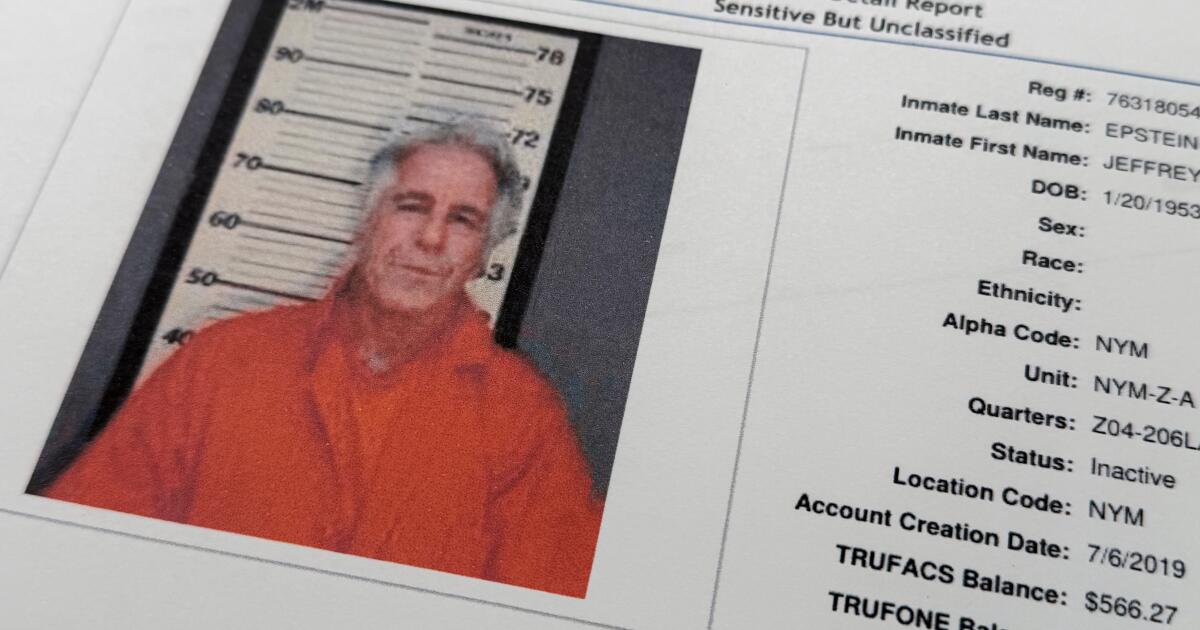
Purported Jeffrey Epstein suicide note had echoes of messages he had sent earlier

A federal judge in New York unsealed a suicide note Wednesday purportedly written by Jeffrey Epstein in July, 2019, before a failed suicide attempt soon after he had been taken into federal custody on sex trafficking charges.

The disgraced financier would ultimately die weeks later in the same New York facility in what was ruled a suicide.

While the note’s authenticity has not been established, it contains an apparent reference to a line from a 1931 Little Rascals film that Epstein had used in at least two email messages, according to the trove of Epstein documents released by the U.S. Department of Justice this year in response to the bipartisan Epstein Files Transparency Act.

In the short handwritten note released Wednesday, Epstein allegedly wrote, “They investigated me for month — Found nuthing!!!”

The note concludes, “Whatcha want me to do — Burst out cryin!! No Fun – Not Worth It!!”

It was a phrase Epstein had used before.

In a September, 2016, email to his brother, Mark, he wrote, “whtchoo want me toodo — bust out crying” in response to news that their cousin had become a grandfather.

And in another message the following year to his childhood friend Terry Kafka, Epstein wrote, “Whatcha want me todo/bust out cryin,” in response to a message from Kafka about being nostalgic

Epstein’s brother and Kafka did not immediately responded to requests for comment.

The line is an apparent reference to a 1931 Little Rascals short film “Little Daddy,” in which the character Stymie says, “Well, what do you want me to do, bust out crying?” when another character says that it will be their last breakfast together.

The note emerged from the court records of Epstein’s onetime cellmate Nicholas Tartaglione, a former police officer who is serving four consecutive life sentences for a 2016 quadruple murder.

It was released in response to a request by the New York Times.

The note itself was not included in the millions of pages released by the Justice Department.

In 2020, “60 Minutes” disclosed a note Epstein reportedly wrote days before his August, 2019, death that included complaints about his conditions and similarly concluded with the phrase “No fun!!!”

Journalist Katie Phang sued acting Atty. Gen. Todd Blanche for allegedly failing to comply with the requirements of the Epstein files law passed last year, which required that the documents be released in their entirety within 30 days, with reasoning provided for any documents not released.

The department released the files after the deadline passed and has faced criticism for removing or not releasing some documents and simultaneously failing to redact the names of numerous Epstein victims while redacting the names of some of Epstein’s friends and associates.

Source link

Calderon to Persist in Efforts to Curb Speaker’s Power

Although he lost his bid to become Speaker of the California Assembly, Charles Calderon (D-Alhambra) said he will persist in efforts to curb the powers of that office and to reform the legislative system even if it means working for passage of a Republican-sponsored initiative.

Assemblyman Willie Brown (D-San Francisco) won an unprecedented fifth term as Speaker on Monday, turning back the challenge of a coalition of Republicans and five dissident Democrats, including Calderon. Brown got 40 votes in the 80-member Assembly while Calderon received 34.

Calderon, a 38-year-old attorney, shook hands with Brown after losing the election but said that act did not signal an end to his challenge to Brown’s leadership. All it meant, he said, is that “I’m not a bad loser.”

It was nearly a year ago that Calderon and four other Assembly Democrats rebelled against Brown and formed what the press dubbed “The Gang of Five.” They began working with Republicans to pass legislation Brown opposed and called for reforms to weaken the Speaker’s power.

Gained Support

Brown not only survived the challenge but picked up additional allies in November’s elections.

Nevertheless, Calderon said he considers the Gang of Five effort successful because it has brought legislative reform to the forefront.

He noted that even Brown has said he will support changes in the way the Assembly is run and has appointed a committee headed by Assemblyman John Burton (D-San Francisco) to make recommendations. Calderon said he is skeptical about Brown’s support for reform and in a letter to Burton termed the committee’s preliminary proposals “a clever and skilled rubber-stamping procedure that in reality further concentrates power in the Speaker and his friends.”

Calderon said he is optimistic about the prospects for legislative reform, however, because Democrats apart from the Gang of Five are demanding it.

If the Legislature does not produce meaningful reform, he said, he will support Assembly Minority Leader Ross Johnson’s proposal to reform the Legislature through the initiative process.

In an interview in his Montebello office last month, Calderon said that by putting legislative reform at the top of his agenda, he is responding to the desires of voters in his district.

‘Don’t Give Up’

“Everyone says, ‘Don’t give up. Keep fighting.’ That’s what people want. They don’t want to elect people to go up to Sacramento to lay down for an office. They want people to go up and raise hell for the right reasons.”

Calderon compared the way the Assembly works now to what he saw of the Communist Party when he visited the Soviet Union in a cultural exchange program in 1985.

“The way the Speaker runs the Assembly has many similarities to how the Communist Party works,” Calderon said.

“In the Soviet Union, the only means of upward mobility is through participation and advancement in the Communist Party,” he said. Those who are loyal, do as they are told and don’t challenge those above them move up, he said.

“That’s exactly the way the Assembly works. If you don’t challenge the Speaker, don’t vote against him, don’t embarrass him and do as you’re told, why, then you’ll move up in the Assembly hierarchy.”

Susan Jetton, Speaker Brown’s press secretary, dismissed Calderon’s assertion that the Assembly operates like Soviet politics. Brown, she said, “has never, never said that people have to agree with him.” But Jetton added, Brown has told lawmakers that if they want to chair committees they should support his direction “on procedural matters.”

For example, she said, in the last legislative session Brown appointed Republican Assemblyman Larry Stirling of San Diego as chairman of the Public Safety Committee, even though the liberal Brown often disagreed with the conservative Stirling.

When told that Calderon is continuing to assail Brown’s policies, she said: “I’m sorry Chuck is doing this. The Speaker began the day after the election and has continued . . . to bury the hatchet and say ‘let’s work together.’ ”

Calderon rose to the post of majority whip under Brown and was a member of the powerful Ways and Means Committee. He authored major bills opening California to interstate banking, requiring environmental testing near landfills, and regulating firms that help consumers obtain credit.

Calderon said that even before he joined the Gang of Five, Brown “perceived me as a threat to him and constantly attempted to co-opt me by handing me more titles and assignments, more public praise and that kind of thing. When he realized he wasn’t making any difference, he took the opposite tack and tried to take everything away.”

Fall From Power

Calderon’s allies in the Gang of Five, Gerald Eaves of Rialto, Rusty Areieas of Los Banos, Steve Peace of Chula Vista and Gary Condit of Ceres, all held leadership positions or seats on influential committees before they began challenging Brown’s leadership. Last spring Brown referred to them as “just the most outrageous collection of ungrateful people I’ve ever met.”

All five lost their leadership positions and choice committee assignments.

In addition, Brown dismissed six members of Calderon’s staff and moved him to a smaller office earlier this year. Calderon no longer has any committee assignments, and said he sometimes has been denied the customary legislative per diem of $87 for attending legislative hearings and reimbursement for travel to Sacramento.

Calderon said Brown “arbitrarily approves or denies legislative per diem depending on the way he feels.” A spokeswoman for Brown said he rejects claims that fail to comply with Assembly rules, but does not act arbitrarily.

Speaks as Moderate

Calderon said Brown and other Democratic leaders have increasingly focused on a liberal agenda that excludes moderates such as himself.

“If ‘60s liberalism continues to dominate the leadership of the Democratic Party, then I think the party is doomed,” Calderon said.

“It used to be there was room for everybody in the Democratic Party. The reality is that there is no room for you if you are a moderate or a middle-of-the-road Democrat.”

However Calderon said he does not intend to leave the party. “I have been a Democrat all my life,” he said. “I will always be a Democrat. My mother was a Democrat . . . my father . . . my grandparents, and I will die a Democrat but I won’t sit back and be a silent Democrat.”

Some critics have questioned whether Calderon is moderate and a reformer, or is just maneuvering for power.

Critical Memo

Before Monday’s vote on the speakership, Assemblyman Richard E. Floyd (D-Hawthorne), a Brown loyalist, circulated a 28-page memo titled “The Two Faces of Charles Calderon.” The memo accused Calderon of ducking issues, saying he has one of the highest rates of not voting in the Assembly. The memo also accused Calderon of hypocrisy in advocating a ban on transfer of campaign funds, and then transferring thousands of dollars to political allies. It also noted that he has urged a limit on the number of bills a legislator can introduce but has introduced more than most of his colleagues, although he has had a low percentage enacted.

Calderon said he does not know whether the charge that he votes on fewer bills than other members is true, but he sometimes abstains when he approves the general thrust of a bill but dislikes specific provisions. As to his position on transfer of funds, Calderon said he has supported reform of campaign financing, including Prop. 68 last June, but until reforms take effect he will operate within existing rules, helping allies when that is permitted.

The assemblyman said he does not regard the number of bills introduced and passed to be a measure of effectiveness.

Diffusing Power

Calderon has called for a number of reforms in the Assembly, many of them aimed at sharing power now concentrated with the Speaker. For example, in place of the present system in which the Speaker controls committee assignments, Calderon would have the entire Assembly elect the Rules Committee, which would make other committee assignments. He also would give each member a budget allotment, outside the control of the Speaker.

“We’ve got to diffuse the power of the Speaker by setting up a checks and balances system in the House and by taking away the Speaker’s power to punish members in a personal and political way.

“We need to do away with this punishment and reward system,” he said. “As long as there is this punishment and reward system, members are going to be either seduced or intimidated from representing their own districts.”

One Brown ally, Assemblyman Burt Margolin (D-Los Angeles) said he hopes Calderon will make peace with the Democratic leadership.

GOP Links

“I’m hopeful he’ll return as a fully functioning member of the Democratic caucus and leave behind the alliance with Republicans,” he said.

Margolin said he has repeatedly stressed the following point in conversations with Calderon during the past year:

“Whatever our internal differences, they are best resolved within the Democratic caucus and when you invite Republicans into the discussion what follows is not in the best interest of the Democratic Party . . . because they (the Republicans) clearly have a focused self-interest.”

In an interview on Tuesday, Assemblyman Richard Mountjoy (R-Monrovia) said that Calderon’s future remains bright, despite Monday’s vote.

“I think he’s got a good future here,” Mountjoy said. “I just don’t believe Willie will be around here a long time. I’m not sure if he will become Speaker. That’s not out of the realm of possibility. But even if he’s not Speaker, certainly he will have a key position in the house once Willie moves on and I don’t think Willie will be here forever.”

Calderon, who lives in Whittier, was reelected to his fourth term in November without Republican opposition. He represents a district that contains Alhambra, Montebello, Monterey Park, Pico Rivera, South El Monte and part of Whittier.

Times staff writer Mark Gladstone in Sacramento contributed to this story.

Source link

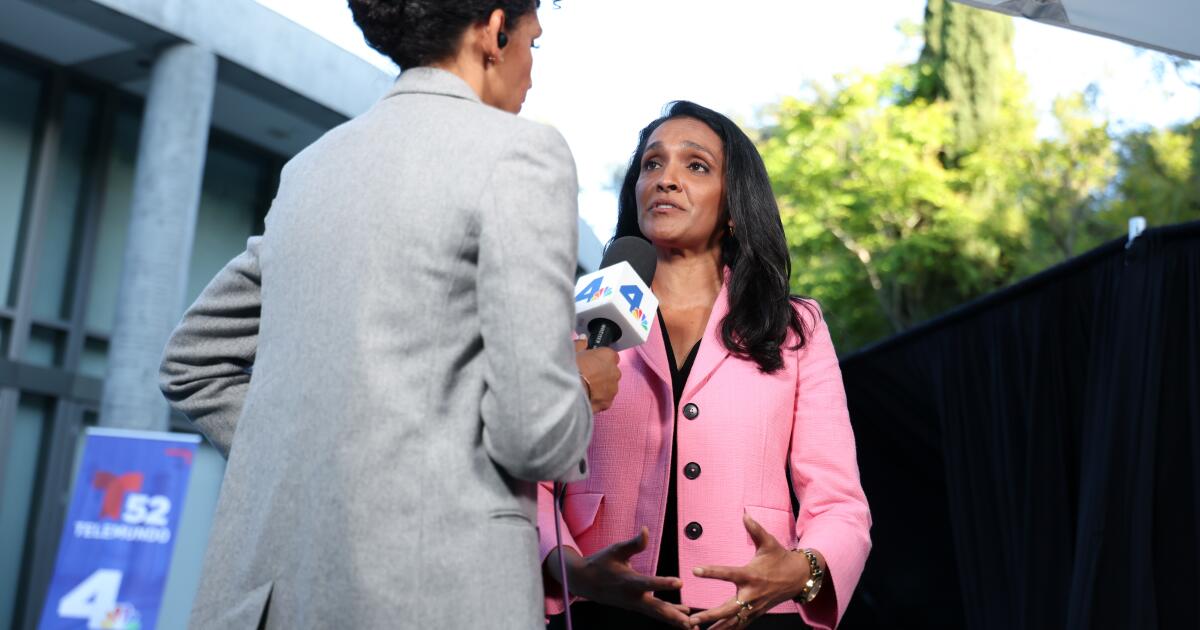
How to watch the Los Angeles mayoral debate

Three of the leading candidates for Los Angeles mayor — incumbent Karen Bass, Councilmember Nithya Raman and reality television personality Spencer Pratt — will share the stage for a debate Wednesday evening.

The hour-long forum, broadcast on NBC4 and Telemundo 52, will be held at the Skirball Cultural Center in Brentwood starting at 5 p.m.

The debate will also air online at nbcla.com and telemundo52.com and be available via streaming channels on platforms like Amazon Fire TV, Roku and Samsung TV Plus.

Voters have already been mailed their ballots for the June 2 primary election, which can be returned by mail or at designated drop box locations. In-person voting is already open at the county’s Registrar-Recorder/County Clerk’s office in Norwalk, and will expand to county Vote Centers starting May 23.

Wednesday’s debate will be moderated by anchor Colleen Williams and political reporter Conan Nolan of KNBC-TV, and anchor Enrique Chiabra of Telemundo 52. The debate is held in partnership with Loyola Marymount University and the Skirball Cultural Center.

A gubernatorial debate will follow at 7 p.m.

Source link

FBI raids business of Virginia state Sen. L. Louise Lucas who led redistricting efforts

May 6 (UPI) — The FBI raided the offices of and a cannabis business co-owned by L. Louise Lucas on Wednesday in Portsmouth, Va.

Lucas is a Virginia state senator, president pro tempore of the state Senate and a vocal leader of Virginia redistricting efforts.

Officials told The Washington Post that the investigation has to do with corruption and bribery allegations involving the business. Lucas was not arrested, and an FBI spokesperson said the investigation was ongoing.

Democrats called in question the motivation behind the raid; Lucas has often criticized President Donald Trump and was instrumental in the successful Virginia referendum in April to redraw the state’s congressional maps. However, The Washington Post, NBC News and The New York Times reported that sources familiar with the case claimed the investigation was opened during the Biden administration and has to do with the marijuana dispensary.

Rep. Robert C. “Bobby” Scott, D-Va., said that the raid “occurs in the broader context of President Trump’s repeated abuse of the Department of Justice to target his perceived political opponents.”

Don Scott, speaker of the Virginia House of Delegates, emphasized that Lucas has not been charged with anything.

“I am deeply concerned by today’s raid,” he said, WAVY-TV reported. “Given the politicization of this administration — an FBI led by Kash Patel and a Justice Department led by President Donald Trump’s former personal attorney — I think people should take this with a grain of salt and allow the facts to come out before jumping to conclusions,” he said.

Scott said he spoke with Lucas after the search, The New York Times reported.

“She basically said, ‘They’re not going to find anything there and I didn’t do anything wrong,’ ” he said. “She’s very upset and she’s very angry and she won’t back down.”

Lucas was elected to the Virginia General Assembly in 1991.

Source link

What’s behind the secessionist movement in the Canadian province Alberta? | Politics News

Secessionists in the western Canadian province of Alberta recently announced that they have gathered enough signatures to launch a referendum on independence from the rest of the country.

Leading secessionists said that they formally submitted about 300,000 signatures to election authorities earlier this week, far more than the 178,000 required for the province to consider a referendum.

Recommended Stories

list of 3 itemsend of list

“This day is historic in Alberta history,” secessionist leader Mitch Sylvestre said.

“It’s the first step to the next step — we’ve gotten by Round 3, and now we’re in the Stanley Cup final,” he added, referring to a hockey championship tournament.

Even if a vote were in favour of independence, an uncertain and protracted process would follow, including possible legal challenges and negotiations with the federal government.

But the possibility of a referendum has brought renewed attention to Alberta’s longstanding frustrations with federal power in Canada and calls for greater autonomy.

What is driving Alberta’s secessionist movement? What are the prospects of success for the referendum, and what could it mean for Canadian politics? Here’s what you need to know.

Separatist leader Mitch Sylvestre speaks to reporters as he leads a rally in front of the Elections Alberta headquarters in Edmonton, Canada, on May 4, 2026, as they submit boxes of signatures in the hope of triggering an independence referendum.
Secessionist leader Mitch Sylvestre speaks to reporters as he leads a rally in front of the Elections Alberta headquarters in Edmonton, Canada, on May 4, 2026 [Henry Marken/AFP]

How many signatures were collected?

Alberta secessionists said on Monday that they had submitted nearly 302,000 signatures, more than the 178,000 required to qualify for referendum consideration.

Alberta Premier Danielle Smith has said she would move forward with the vote if the petition gathered enough signatures, although she does not support independence from Canada herself.

What would the referendum ask voters?

If the proposed measure makes it to the ballot, it would ask voters: “Do you agree that the Province of Alberta should cease to be a part of Canada to become an independent state?”

Does this guarantee a referendum, and could Alberta actually separate from Canada?

Meeting the signature requirement does not in itself guarantee that a referendum will take place.

Elections Alberta, the province’s electoral authority, still needs to verify the petitioners’ names, a process that has been stalled by a court ruling.

Indigenous groups have also filed a legal challenge, stating that separation would be a violation of their treaty rights.

There are also questions about whether the referendum will gather sufficient support among voters to pass. Polls have shown that about 30 percent of residents would support such a measure.

What’s behind Alberta’s bid for separatism?

While secession has never been so close to a vote in Alberta, pro-independence sentiment has been part of the province’s political culture — home to about 5 million people — for decades.

That sentiment is driven largely by the feeling of many in Alberta that the province is distinct — culturally, economically, and politically — from the rest of Canada.

The oil-rich western province has long expressed frustration with political decision-making in Ottawa, the Canadian capital, despite what it sees as its outsized economic contribution to the national economy through its massive fossil fuel industry.

Environmental regulations and efforts to address climate change have become another flashpoint, with secessionist leaders depicting Alberta’s primary industry as hamstrung by regulatory decisions made by bureaucrats with little understanding of the province.

“We’re not like the rest of Canada,” secessionist leader Sylvestre told the news service AFP. “We’re 100 percent conservative. We’re being ruled by Liberals who don’t think like us.”

“They’re trying to shut down our industry,” he added.

FILE PHOTO: Oil pumpjacks operating in a farmer’s field near Calgary, Alberta, Canada, November 26, 2025. REUTERS/Todd Korol/File Photo
Oil pumpjacks operating in a farmer’s field near Calgary, Alberta, Canada, on November 26, 2025 [File: Todd Korol/Reuters]

Have any other provinces considered separating from Canada?

Alberta is not the only region with a complicated relationship with the rest of Canada.

The French-speaking province of Quebec is home to a decades-old nationalist movement that has pushed to separate from Canada, rooted in a desire to recognise Quebec’s distinct linguistic and cultural identity.

The popularity of that movement has ebbed, with a March poll finding Quebecois secessionism at its lowest level of support since voters narrowly rejected a referendum in 1995. Still, the secessionist Parti Quebecois political party is polling high in advance of a provincial election set for later this year.

Has the push for independence attracted criticism?

As with all independence movements, the province’s bid for separation from the rest of Canada has become a source of passionate disagreement.

“It stands for something that most of us Albertans and Canadians don’t stand for,” Thomas Lukaszuk, the province’s former deputy premier and a strong supporter of federalist identity, told AFP. “It’s a form of treason.”

Expressions of support from the administration of United States President Donald Trump, who has angered Canadians by suggesting that the country should become a US state, have also sparked criticism that the secessionist movement is undermining Canadian unity.

Asked about the possibility of independence in January, US Treasury Secretary Scott Bessent said that Alberta would be a “natural partner” for the US.

“Alberta has a wealth of natural resources, but they won’t let them build a pipeline to the Pacific,” Bessent told a US right-wing commentator. “I think we should let them come down into the US, and Alberta is a natural partner for the US. They have great resources. The Albertans are very independent people.”

“The separatists are not elected members. They’re just citizens of Canada residing in Alberta, and they actually formed delegations and are received by the highest levels of US administration,” Lukaszuk said. “That must be very empowering to them.”

Regardless of whether the proposed ballot measure succeeds, the development is likely to serve as a shot in the arm for the province’s secessionist forces.

“I think this is going to be a permanent change in our political culture,” independent historian and supporter of independence Michael Wagner told AFP, adding that the movement “is not going to just disappear”.

What happens next?

A provincewide ballot could take place as soon as October, as part of a larger referendum on several questions relating to constitutional issues and other matters, such as immigration, scheduled for October 19.

Justice Shaina Leonard issued a monthlong stay on the certification of the independence petition on April 10, following a legal challenge from several First Nations groups who say separation would violate treaty rights.

That ruling did not bar the gathering of signatures, and a decision on legal challenges from Alberta First Nations is expected later this week. A decision in favour of the First Nations challengers could render the process academic.

Source link

Merger costs add up as Warner Bros. Discovery posts $2.9-billion quarterly loss

Warner Bros. Discovery’s impending sale has rattled Hollywood — and the company’s balance sheet as the auction’s high costs increasingly come into focus.

The New York-based media company released its first-quarter earnings Wednesday, which included a $2.9 billion loss. That amount includes $1.3 billion in restructuring expenses, including updated valuations for Warner’s declining linear cable television networks.

Contributing to the net loss was the $2.8 billion termination fee paid to Netflix in late February when the streaming giant bowed out of the bidding for Warner. The auction winner, Paramount Skydance, covered the payment to Netflix but Warner still must carry the obligation on its balance sheet in case the Paramount takeover falls apart. Should that happen, Warner would have to reimburse Paramount.

Warner also spent another $100 million to run the auction and prepare for the upcoming transaction, according to its regulatory filing.

“As we prepare for our next chapter, our focus remains on executing our key strategic priorities: scaling HBO Max globally, returning our Studios to industry leadership, and optimizing our Global Linear Networks,” Warner Bros. Discovery leaders said Wednesday in a letter to shareholders.

Warner generated $8.9 billion in revenue, a 3% decline from the same quarter one year ago, excluding the effect of foreign exchange rate fluctuations.

Its streaming services, including HBO Max, notched milestones in the quarter and 9% revenue growth to $2.9 billion. The company launched HBO Max in Germany, Italy, Britain and Ireland during the quarter.

Advertising revenue for streaming was up 20% compared to the first quarter of 2025.

The streaming unit posted a 17% increase to $438 million in adjusted earnings before interest, taxes, depreciation and amortization (EBITDA).

Warner’s studios, primarily its TV business, had a strong quarter.

Studios revenue rose 31% to $3.1 billion, compared to the prior year quarter.

Television revenue soared 58% (excluding exchange rate fluctuations) due to increased program licensing fees to support the launch of HBO Max in international markets. Those launches also propelled the movie studio, which saw revenue increase 21%.

Video games revenue declined 30% because of lower library revenues.

Adjusted EBITDA for the studios grew $516 million (158%) to $775 million compared to the prior year quarter.

The company’s vast linear television networks saw revenue fall 9% to $4.4 billion compared to the prior year period.

TV distribution revenue tumbled 8% largely due to a 10% decrease in domestic linear pay TV subscribers.

The company also felt the loss of its NBA contract for its TNT channel, which NBC picked up. Advertising revenue fell 12%. “The absence of the NBA negatively impacted the year-over-year growth rate,” Warner said.

As the costs of the merger with Paramount come into clearer focus, the opposition has grown louder.

More than 4,000 artists and entertainment industry workers, including Bryan Cranston, Noah Wyle, Kristen Stewart and Jane Fonda, have signed an open letter warning about the dangers of the merger with Paramount. “This transaction would further consolidate an already concentrated media landscape, reducing competition at a moment when our industries — and the audiences we serve — can least afford it,” according to the letter.

“The result will be fewer opportunities for creators, fewer jobs across the production ecosystem, higher costs, and less choice for audiences in the United States and around the world.”

Adjusted EBITDA for the television networks fell 10% to $1.6 billion, compared to the prior year quarter.

Warner ended the quarter with $3.3 billion in cash on hand and $33.4 billion of gross debt.

Source link

How Trump’s immigration crackdown is affecting everyday Americans, according to a new AP-NORC poll

Most U.S. adults say the United States is no longer a great place for immigrants, according to a new AP-NORC poll, as about one-third of Americans report knowing someone impacted by the Trump administration’s aggressive immigration enforcement.

A new survey from The Associated Press-NORC Center for Public Affairs Research of more than 2,500 U.S. adults finds about 6 in 10 say the country used to be a great place for immigrants but is not anymore. About one-third of U.S. adults — and more than half of Hispanic adults — say that over the last year they, or someone they know, have started carrying proof of their immigration status or U.S. citizenship, been detained or deported, changed travel plans, or significantly changed routines, such as avoiding work, school or leaving the house, because of their immigration status.

The poll comes as the Supreme Court is considering whether the Trump administration should be allowed to restrict birthright citizenship, as well as following months of sweeping immigration enforcement and mass deportations of immigrants.

Missouri retiree Reid Gibson, an independent, is furious about the Trump administration’s treatment of immigrants. He hopes America eventually becomes more welcoming to immigrants again, but he worries “it may take many years to reverse the damage that the Trump administration has inflicted” with its policies.

The poll finds that many Americans know someone who has been affected by Trump’s approach. That includes Gibson’s stepdaughter, who he says started carrying her passport because of concerns that her darker skin would make her a target in immigration crackdowns.

“It’s just plain wrong,” Gibson, 72, added. “This is not a good country for immigrants anymore.”

Americans’ personal connections to immigration enforcement

Many U.S. adults have adapted their lives to heightened immigration enforcement over the last year, as Trump increased detentions and sought to conduct the largest deportation operation in American history.

Democrats are more likely than independents or Republicans to know someone affected, and those with a personal connection are more likely to say the U.S. is no longer a great place for immigrants.

Kathy Bailey, a 79-year-old Illinois Democrat, has seen the administration’s immigration policies seep into the small-town swim class she regularly attends. She said two women in the class — both naturalized U.S. citizens — have begun carrying their passports when they leave home. Bailey says one of the women, who is from Latin America, has been especially worried about sticking out in an overwhelmingly white community.

“She’s an American citizen now, but she’s so scared that she has to carry her passport,” said Bailey. “She’s just another sweet old grandmother swimming at 5 in the morning.”

About 6 in 10 Hispanic adults say they or someone they know has been impacted by immigration enforcement in this way, much higher than among Black or white adults.

“This is terrible for these women!” Bailey said. “I’m just stunned at what we are coming to.”

Most believe the U.S. used to be a great place for immigrants

Nick Grivas, a 40-year-old from Massachusetts, said his own grandfather’s immigration to the U.S. from Greece has made him feel the impact of the president’s policies. It’s part of why he believes the U.S. stopped being a promising place for people seeking a new life.

“We can see how we’re treating children and the children of the immigrants, and we’re not viewing them as potential future Americans,” Grivas said.

Roughly 3 in 10 U.S. adults say the U.S. is a great place for immigrants, according to the poll, while about 1 in 10 say it never was. The belief that America is no longer great for immigrants is more common among Democrats and independents, as well as among those born outside the U.S.

Grivas, a Democrat, worries that federal policies against immigration could stunt the country by discouraging new arrivals from investing in their local communities, especially if they don’t believe they will be allowed to remain.

“You’re less willing to commit to the project if you don’t think that you’re gonna be able to stay,” he said.

Most support birthright citizenship, but also hold nuanced views

The Supreme Court recently heard arguments in President Trump’s efforts to restrict birthright citizenship by declaring that children born to parents who are in the country illegally or temporarily are not American citizens.

About two-thirds of U.S. adults in the poll say automatic citizenship should be granted to all children born in the country, a view that most Democrats and independents back. Republicans are more doubtful: just 44% support birthright citizenship. The poll also shows that some people are conflicted, saying in general that they support birthright citizenship but also that they oppose it in some specific circumstances.

Among those who object to automatic citizenship is Linda Steele, a 70-year-old from Florida, who believes that only children born to American citizens should be granted citizenship. Steele, a Republican, does not believe foreigners living legally in the U.S. — whether for work or other reasons — should be able to have a child who automatically becomes a U.S. citizen.

“That shouldn’t be allowed,” she said. “They’re just here visiting or going to school.”

When asked about some specific circumstances, about 6 in 10 U.S. adults say they support birthright citizenship for children born to parents on legal U.S. tourist visas, while only about half support it for those born to parents who are in the country illegally. An even higher share, 75%, support automatic citizenship for children born in the U.S. to parents who are in the country legally on work visas, with much of that increased support coming from Republicans saying this was an acceptable situation.

Kevin Craig, a 57-year-old from Wilmington, North Carolina, does not believe citizenship should be automatically granted. Craig, who leans conservative, believes there should be “at least some opportunity for intervention by a human being who can make some sort of a judgment.”

But he added: “I think my personal opinion is that I can’t think of a situation where it would not be granted.”

Sanders, Sullivan and Catalini write for the Associated Press. Sullivan reported from Minneapolis. Catalini reported from Morrisville, Pa. The AP-NORC poll of 2,596 adults was conducted April 16-20 using a sample drawn from NORC’s probability-based AmeriSpeak Panel, which is designed to be representative of the U.S. population. The margin of sampling error for adults overall is plus or minus 2.6 percentage points.

Source link

Lutnick will appear before a House panel to answer for his changing story on Epstein

Commerce Secretary Howard Lutnick is appearing Wednesday before a House committee investigating sex offender Jeffrey Epstein as lawmakers seek answers for Lutnick’s contact with him in the years after Epstein’s 2008 conviction for soliciting prostitution from an underage girl.

Lutnick, a member of President Trump’s Cabinet, is the latest powerful political figure to appear before the House Oversight Committee. He has previously given contradictory statements about his relationship with Epstein, but he says he has done nothing wrong and welcomes the closed-door interview with lawmakers.

Still, the transcribed interview presented a test of how much scrutiny lawmakers will apply to powerful men who kept company with Epstein even after it was known that he had solicited prostitution from an underage girl. Trump’s Republican administration has tried unsuccessfully for more than a year to move past the issue.

Lutnick is the highest-ranked official in the Trump administration, besides Trump himself, to be named in the case files on Epstein. Trump has consistently denied any knowledge of Epstein’s crimes and has said he ended their relationship years ago.

Several Democrats have called for Lutnick to resign, and a few Republicans, including Rep. Nancy Mace of South Carolina, have said he should at least testify before the Oversight panel.

Lutnick has downplayed his ties to Epstein, who was once his neighbor in New York City. Under questioning from Democrats during an unrelated hearing earlier this year, he described their contact as a handful of emails and a pair of meetings in 2011 and 2012.

But that admission came after he had previously claimed on a podcast last year that he had decided to “never be in the room” with Epstein following a 2005 tour of Epstein’s home that disturbed Lutnick and his wife.

In 2008, Epstein pleaded guilty to state sex offense charges in Florida, including soliciting prostitution from an underage girl.

“I did not have any relationship with him. I barely had anything to do with him,” Lutnick told senators in February when he was asked about Epstein during a subcommittee hearing of the Senate Appropriations Committee.

But Lutnick, who was previously the head of brokerage and investment bank Cantor Fitzgerald, actually had an hourlong engagement at Epstein’s home in 2011. His family then visited Epstein’s infamous private island in 2012 for lunch.

The federal release of case files on Epstein also showed that the two had kept in contact through email. Lutnick in 2018 emailed Epstein about a proposed expansion of a museum in their neighborhood that would have blocked the view from their homes. Epstein also gave $50,000 to a 2017 dinner honoring Lutnick, while Lutnick invited Epstein to a 2015 fundraiser for Hillary Clinton. In 2013, they both invested in the same business venture.

The White House has continued to express support for Lutnick, who was one of the biggest boosters of Trump’s sweeping tariffs strategy. He has been close to Trump for years and helped fundraise for his 2020 and 2024 campaigns.

The House Oversight Committee is also scheduled to hear testimony on May 29 from Pam Bondi, who was pushed out from her job as attorney general last month.

Epstein died in a New York jail cell in 2019 while awaiting trial on sex trafficking charges.

Groves writes for the Associated Press.

Source link

Trump’s Indiana wins show his power over GOP with more primaries and redistricting debates ahead

Five months ago, President Trump was stinging from one of the first political defeats of his second term as Republican state senators defied him on redistricting in Indiana. Now he has proved he can still punish wayward party members after he endorsed a slate of challengers who defeated almost every one of those lawmakers he wanted to dislodge.

The results will likely bolster Trump’s confidence heading into upcoming Republican primaries where he wants to help oust more incumbents, including U.S Sen. Bill Cassidy of Louisiana and U.S. Rep. Thomas Massie of Kentucky.

Indiana’s primary also ratchets up the pressure on Republican lawmakers in other states to move aggressively to redraw congressional district boundaries before the November elections. Alabama and Tennessee have already begun special sessions that could limit Black voters’ strength in Democratic-leaning districts, and some of Trump’s allies in South Carolina want to follow suit.

State Sen. Linda Rogers, one of the Indiana lawmakers who voted against redistricting and lost her seat Tuesday, said the outcome “will probably discourage others in other states.”

“If someone is going to ask you to take a tough vote, you may think twice about your conscience and what’s best for your community and instead what’s best for you and your career,” she said.

Redistricting efforts began last year, when Trump saw an opportunity to give Republicans an additional edge, but they were supercharged last week when the U.S. Supreme Court gutted a provision of the Voting Rights Act that influenced how political lines are drawn.

Trump’s success in Indiana, aided by more than $8.3 million in campaign cash in races that usually see very little spending, reaffirmed the president’s continued strength within a Republican Party that he has dominated for a decade, despite his inevitable slide toward lame-duck status and his sagging poll numbers.

“Historic night for Indiana as Republicans stood with me and President Trump to nominate some great America First conservatives,” Gov. Mike Braun, R-Ind., posted on social media. “I look forward to winning big in November and serving Hoosiers with this team in the statehouse!”

Trump backed primary challenges against seven Republican state senators who rejected his redistricting plan in December. Five of the president’s candidates won, and another race remained too close to call.

Trump was relatively restrained on social media about the voting. He shared a series of photos celebrating the victories of candidates he endorsed in Indiana and Ohio, which also held primaries Tuesday. But he otherwise passed on boasting or renewing his attacks on Massie or Cassidy.

Massie has been among the members of Congress who frustrated the president by pressing for release of the Jeffrey Epstein case files. Cassidy was among the Republican senators who voted to convict Trump on 2021 impeachment charges after the Jan. 6 riot.

James Blair, one of Trump’s top political advisers, was more direct, posting an image from the movie “Gladiator” depicting Russell Crowe’s ancient Roman character Maximus exulting after a combat victory.

Rogers, the Indiana state senator, faced almost $670,000 in television advertising against her, funded by political action committees associated with Braun and U.S. Sen. Jim Banks, R-Ind.

She said she did not regret her vote against redistricting.

“It would have been easy for me to hit that ‘yes’ button,” she said. “To hear the number of people who asked me not to, then the number of people who thanked me, would mean I wasn’t representing them.”

Louisiana’s primary, in which Trump has endorsed U.S. Rep. Julie Letlow over Cassidy, is set for May 16. Kentucky, where Trump has endorsed Massie’s challenger, retired Navy SEAL Ed Gallrein, will hold its primary May 19.

Beaumont and Barrow write for the Associated Press.

Source link

Howard Lutnick to testify to Oversight Committee on Epstein ties

May 6 (UPI) — Commerce Secretary Howard Lutnick is scheduled to testify Wednesday before the House Oversight Committee on his ties to Jeffrey Epstein.

The testimony is voluntary and behind closed doors. Lutnick is one of many people called before the committee to explain their ties to the late sex offender and financier.

“The Secretary looks forward to addressing any questions on the record when he testifies voluntarily before the Oversight Committee,” a spokesperson for the Commerce Department told CBS News. “He looks forward to putting to rest the inaccurate and baseless claims in the media designed to distract from his historic work underway at the Commerce Department.”

Lutnick has not been accused of any wrongdoing tied to Epstein.

Lutnick and Epstein were next-door neighbors in New York. He has said his interactions with Epstein were minimal, but earlier this month, he told a congressional committee that he had visited Epstein’s island, Little St. James in the U.S. Virgin Islands, with his family.

“We had lunch on the island, that is true, for an hour,” Lutnick told lawmakers. “Then we left with all of my children, with my nannies and my wife all together. We were on family vacation. We were not apart. To suggest there was anything untoward about that in 2012, I don’t recall why we did it. But we did.”

Epstein was convicted of solicitation involving a minor in 2008.

A photo of Lutnick and Epstein that appears to be on Little St. James with three other men was in the files released earlier this year.

Lutnick and Epstein also invested together in a now-shuttered advertising agency, Adfin, working together as late as 2014.

Lutnick previously claimed that he cut contact with Epstein in 2005

In October, Lutnick said on a podcast that he and his wife, Allison, visited Epstein’s New York townhouse in 2005, NBC News reported.

He said he saw a massage table in the middle of a room filled with candles. Lutnick said Epstein told him he had massages “every day” and got “weirdly close” to say, “The right kind of massage.”

“In the six to eight steps it takes to get from his house to my house, my wife and I decided that I will never be in the room with that disgusting person ever again,” Lutnick said.

“I was never in the room with him socially, for business, or even philanthropy,” he added. “If that guy was there, I wasn’t going, because he’s gross.”

The panel will likely question Lutnick’s credibility, Matt Dallek, a historian and political management professor at George Washington University, told NBC

“It’s risky business for him to go before Congress and testify about Epstein,” Dallek said. “Because lo and behold, he visited the island with his kids.”

Dallek said Trump will pay attention to Lutnick’s performance.

“If Lutnick comes off as wishy-washy or ineffective, Trump could sour on him,” Dallek said. “Especially if he wants a fall guy for the economy.”

President Donald Trump speaks before signing a proclamation inside the Oval Office at The White House on Tuesday. The memorandum is set to restore the Presidential Fitness Test Award, a competitive school-based fitness program last seen under the Obama administration. Photo by Tom Brenner/UPI | License Photo

Source link

South Carolina joins Southern redistricting push after U.S. Supreme Court ruling on minority districts

An election-year redistricting movement has spread to South Carolina as Republicans attempt to redraw majority-Black congressional districts that have suddenly become susceptible because of a U.S. Supreme Court ruling upending protections for minority voters.

Urged on by President Trump, South Carolina Republicans are attempting to redraw a district long held by a Black Democratic lawmaker in their quest for a clean sweep of the state’s seven congressional seats.

Lawmakers already are meeting in special sessions in Alabama and Tennessee in a bid to change their U.S. House districts. And Louisiana lawmakers are making plans for new congressional districts after the Supreme Court last week struck down the state’s current map.

The stakes are high for minority voters who stand to lose their preferred representatives and for any Republican lawmakers reluctant to follow Trump’s wishes. In Republican primary elections Tuesday, Trump-endorsed challengers defeated at least five of the seven Indiana state lawmakers targeted by Trump’s allies for refusing to support a congressional redistricting effort last year.

The Supreme Court’s recent ruling said Louisiana relied too heavily on race when creating a second Black-majority House district as it attempted to comply with the Voting Rights Act. The ruling significantly altered a decades-old understanding of the law, giving Republicans grounds to try to eliminate majority-Black districts that have elected Democrats.

The ruling revved up an already intense national redistricting battle ahead of a November midterm election that will determine control of the closely divided House.

Since Trump prodded Texas to redraw its U.S. House districts last year, a total of eight states have adopted new congressional districts. From that, Republicans think they could gain as many as 13 seats while Democrats think they could gain up to 10 seats. But some of the new districts could be competitive in November, meaning the parties may not get all they sought.

South Carolina to test its will for redistricting

Democratic U.S. Rep. Jim Clyburn has represented South Carolina’s 6th Congressional District since it was redrawn to favor minority voters in 1992. He’s running for an 18th term. But it could get harder for him to win reelection if Republicans redraw his district.

Leaders in the state House and Senate said a redistricting effort needs to start with a two-thirds vote in each chamber. The issue could come up as soon as Wednesday. But if only a few Republicans aren’t on board, it can’t succeed.

Senate Majority Leader Shane Massey has warned that redistricting could backfire because of thin political margins, resulting in a second Democrat in the U.S. House. Massey told reporters Tuesday that he had a cordial conversation with Trump about redistricting, each laying out their concerns.

The state’s primaries are June 9 and early voting starts in three weeks.

Alabama looks at setting a new primary

The state House on Wednesday could debate legislation that would allow Alabama to hold a special congressional primary, if the Supreme Court clears the way for the state to change its U.S. House districts.

In light of the court’s ruling on Louisiana’s districts, Alabama officials have asked courts to set aside a judicial order to use a U.S. House map that includes two districts with a substantial number of Black voters. Republicans instead want to use a map passed in 2023 by the Legislature that could help the GOP win at least one of those two seats currently held by Democrats.

Alabama’s primaries are scheduled for May 19. If the Supreme Court grants the state’s request after or too close to the primary, the legislation under consideration would ignore the results of that primary and direct the governor to schedule a new primary under the revised districts.

Democrats denounced the legislation as a Republican power grab that harkens back to the state’s shameful history of denying Black residents equal rights and representation.

Republicans are “working to secure an electoral victory by taking Alabama back to the Jim Crow era, and we won’t go back,” Democratic U.S. Rep. Terri Sewell told a crowd gathered outside the Alabama Statehouse.

Tennessee plan targets Memphis district

Republican Gov. Bill Lee called Tennessee lawmakers into a special session to consider a plan urged by Trump that could break up the state’s lone Democratic-held U.S. House district, centered on the majority-Black city of Memphis. Republicans didn’t say much about the plan Tuesday.

But as the state Senate began work Tuesday, shouts of “shame, shame, shame” could be heard inside the chamber from protesters gathered in the hallways. On the chamber floor, state Sen. Raumesh Akbari, a Black Democrat from Memphis, called the redistricting “an act of hate.”

Martin Luther King III sent a letter to Tennessee legislative leaders expressing “grave concern” about the plan to divide Memphis, saying the move could undermine the work for voting rights carried out by his father, Martin Luther King Jr.

The candidate qualifying period in Tennessee ended in March, and the primary election is scheduled for Aug. 6.

Thousands had already voted in Louisiana

After last week’s Supreme Court decision, Republican Gov. Mike Landry postponed the state’s May 16 congressional primary to allow time for lawmakers to approve new U.S. House districts. State Sen. Caleb Kleinpeter, a Republican, said a redistricting committee he leads plans to hold a public hearing Friday.

Louisiana voters had already sent in more than 41,000 absentee ballots by last Thursday, when Landry suspended the House primaries, according to the Secretary of State’s Office. That’s about a third of all the absentee ballots sent out to voters. Around 19,000 were from registered Democrats, 17,000 from registered Republicans and the remainder belonged to neither party.

Democrats and civil rights groups have filed several lawsuits challenging the suspension of Louisiana’s congressional primary.

Collins, Loller, Chandler and Lieb write for the Associated Press. Chandler reported from Montgomery, Ala., Loller from Nashville and Lieb from Jefferson City, Mo. AP writer Jack Brook contributed to this report from New Orleans.

Source link

While ICE cracked down on L.A. protests, Marines were told to use force as ‘last resort’

Before being deployed to Los Angeles during anti-ICE protests last summer, U.S. Marines were given 12 rules for engaging with protesters, and Rule 1 was clear: Force “of any kind” was allowed only as a last resort.

If force were used, the rule stated, it “should be the minimum necessary to accomplish the mission.”

That detail is among 178 pages of federal documents released by the Marine Corps to the nonprofit watchdog group American Oversight through the Freedom of Information Act and shared exclusively with The Times.

The documents paint a thorough picture of how Marines prepared to deploy in Southern California, where they stood alongside National Guard members and agents with the Department of Homeland Security.

The documents also illuminate a glaring contrast between the training of Marines and that of immigration agents, who have been accused repeatedly of using unnecessary force against peaceful protesters, bystanders and immigrants during enforcement operations.

“Ironically, I would’ve felt much safer with Marine engagement than with DHS because of the depth of training,” said Ryan Schwank, a former instructor for Immigration and Customs Enforcement recruits at the ICE Academy within the Federal Law Enforcement Training Center in Georgia.

Schwank is a whistleblower who resigned in February after revealing that the Trump administration had slashed immigration officer training. After reviewing the documents obtained by American Oversight, he said the training given to Marines on crowd control was “significantly more in-depth and longer than training given to an ICE officer, even under the best of circumstances.”

A ICE agent walks through tear gas that was fired to push protesters back

An ICE agent walks through tear gas that was fired to push protesters back during a raid on Atlantic Boulevard in the city of Bell on June 20, 2025.

(Genaro Molina / Los Angeles Times)

The Department of Homeland Security did not respond to questions and instead pointed to a February news release that said training has not been cut back and that new hires receive additional training after leaving the academy.

“ICE law enforcement officers are trained to use the minimum amount of force necessary to resolve dangerous situations to prioritize the safety of the public and our officers,” said Lauren Bis, a department spokesperson. “Officers are highly trained in de-escalation tactics and regularly receive ongoing use of force training.”

Schwank noted that the Marines and ICE officers came to Southern California with different objectives: As protectors of people and property, the Marines had a more limited, reactive mission, while ICE officers were charged with making arrests, a confrontational role.

“We’re giving [ICE officers] less training on it and fewer refreshers than the Marines are getting and yet we’re putting them in a situation where they’re taking the more confrontational actions to where they’re more likely to have to make split-second decisions,” Schwank said.

For most of history, he added, ICE agents detained people who were already in the custody of another law enforcement agency. He said ICE was never meant to act as riot police.

“The real fundamental problem isn’t ICE agents using force,” Schwank said. “It’s ICE agents using force in an environment they are not trained for.”

The training of Marines, and the lead-up to their deployment, is outlined in the documents reviewed by The Times.

On June 6, a commanding general emailed other generals to say that “national-level leadership” had directed Marines to assume an “alert posture” and be ready to support the Los Angeles Police Department, Los Angeles County Sheriff’s Department and ICE officers who were already responding to civil unrest in downtown Los Angeles.

The Marines would safeguard federal facilities and thus “protect lives and property through the restoration of civil order,” the email said.

The Trump administration directed 4,200 California National Guard soldiers and 700 Marines to Southern California starting June 7.

Marines push back anti-ICE protesters in front of the Federal Building

Marines push back anti-ICE protesters in front of the Federal Building during a “No Kings Day” in downtown Los Angeles last June.

(Carlin Stiehl / Los Angeles Times)

First, though, they needed to be trained.

The five-day course reviewed use-of-force policies, less-lethal weapons and handling of civil disturbances.

Overall, the 12 rules emphasized safety, urging Marines to be reasonable, to de-escalate tensions and to avoid confrontations with individuals who posed no threat.

Marines could use non-deadly force, if necessary, to control a situation or protect themselves or other federal personnel, and deadly force “only when all lesser means have failed.”

“Exercise due regard for the safety of innocent bystanders when using any type of force,” the rules state.

Schwank said there is no equivalent to the Marines course at Homeland Security. When he left the academy in February, he said, “there was no crowd control training, period.”

Crowd control was briefly added to the curriculum in 2021 for experienced law enforcement officers, he said, but it was later removed. ICE recruits may also have gotten lessons on crowd control after leaving the academy and joining their respective field offices, he said.

When Schwank left the agency, a six-hour class called “Public Order Public Safety” was in development for the 2026 curriculum, according to documents he provided to Congress. Homeland Security did not respond when asked if the class had started.

“I wouldn’t assume that any of the ICE officers on scene in L.A. had received any sort of actual crowd control class,” Schwank said. “They might have gotten a one-to-two-hour PowerPoint slideshow, but that would’ve been it.”

Marine Col. Beth R. Smith confirmed that the entire 2nd Battalion 7th Marines received academic and practical training before deploying to Los Angeles.

Managing civil disturbances has been an issue for Homeland Security since at least 2021, according to an audit conducted by the agency’s internal watchdog review of a 2020 deployment to Portland, Ore.

That year, President Trump mobilized federal power against the protests that spilled into Portland streets after the murder of George Floyd by a Minneapolis police officer. Trump sent 755 Homeland Security agents to defend federal property in what would come to be seen as a dry run for much larger operations of his second term.

Two vehicles, one in flames

A protester damages a Waymo vehicle at Los Angeles Street and Arcadia Street in L.A. on June 8, 2025.

(Robert Gauthier / Los Angeles Times)

Nested on rooftops, agents launched chemical weapons against protesters. Ground forces fired less-lethal rounds at point-blank range and forced participants into unmarked vans without explanation.

The audit by the Homeland Security inspector general found that only seven of 63 officers reviewed had received any level of riot and crowd control training. Some officers told investigators that they needed additional training, and many “questioned their involvement in the operation” due to the lack of preparation.

”Without the necessary policies, training, and equipment, DHS will continue to face challenges securing Federal facilities during periods of civil disturbance that could result in injury, death, and liability,” the audit concluded.

As of spring 2025, Homeland Security records show, the department had not corrected the training failures flagged in the audit years earlier.

Schwank agreed that the concerns raised in the inspector general’s report were never addressed.

Liz Hempowicz, deputy executive director of American Oversight, said the Marine Corps’ emphasis on de-escalation and on using force only as a last resort stands in stark contrast to what happened on the ground in Los Angeles with immigration agents.

The practices outlined in the documents “differ from positions taken by senior DHS leadership, whose separate internal communications revealed a mindset that appeared far more encouraging of violence,” she said.

Internal Homeland Security emails also obtained by American Oversight revealed that the agency’s lead attorney said federal agents in Los Angeles should have “just started hitting the rioters and arresting everyone that couldn’t get away.”

“These records underscore that the difference between disciplined restraint and unnecessary harm can come down to the tone set at the top — and when that tone shifts toward hostility, the human cost can be devastating,” Hempowicz said.

Jennifer Kavanagh, director of military analysis at Defense Priorities, a military research group, said that for Homeland Security, the issue is partly a training deficiency and partly a cultural shift against agent accountability.

“Trump talks about ‘the enemy within’ — this is what he’s talking about,” she said. “To some at DHS, the enemy within is all immigrants, it’s cartels — it’s also groups that are protesting the government.”

Conversely, the Marines’ documents emphasized personal liability and responsibility. For example, one page said that “if you either use more force than is necessary, or respond with DEADLY-force to a NON-deadly threat — You will likely lose your right to self-defense, and you will be viewed, under the law, as the ‘Aggressor.’”

Marines were told to immediately report anyone violating the 12 rules of engagement.

The high level of training for Marines shows that command considered the optics of military personnel harming or even killing civilians, Kavanagh said. But just because the deployment worked out last year doesn’t make it a good idea in the long run, she said.

Kavanagh, alongside Gov. Gavin Newsom, Mayor Karen Bass, and LAPD Chief Jim McDonnell, opposed the military deployments to Los Angeles last year, maintaining that Marines are trained for foreign combat, not domestic crowd control.

“I see these deployments as a recipe for disaster,” she said.

Schwank said ICE’s training touches on personal liability but not in as much depth. Last fall, Stephen Miller, Trump’s deputy chief of staff, said ICE officers “have federal immunity in the conduct of your duties, and anybody who lays a hand on you or tries to stop you or tries to obstruct you is committing a felony.”

On the ground in Los Angeles, ICE agents and other local law enforcement fired a range of less-lethal weapons at protesters, such as pepper balls, hard foam rounds or canisters delivering flash-bang grenades and tear gas.

At a June 12 protest, a federal agent shoved freelance journalist Anna Sophia Moltke to the ground, causing sprains on her left arm and leg and deep scrapes to her hip and knee that have since scarred. She was carrying a camera, she said, and wore clear press credentials and a helmet that said “PRESS.”

“I remember distinctly there being no violence at all until police and ICE showed up,” she said. “We saw them firing rubber bullets into the crowd. People started running away. I was halfway turned around when they started rushing the crowd, and a tall, 6-foot-4 masked man used both hands to push me onto the concrete.”

Moltke said she recalled a large group of protesters gathered near the Marines stationed at the northern end of the detention center, just before police and ICE swept through and forced her to the ground. To her knowledge, she said the Marines remained at their post and didn’t participate in street skirmishes.

Source link

Contributor: Xavier Becerra shows that his loyalty lies with fossil fuels

In June 2017, with President Trump newly installed in office for the first time, one of the biggest battles with the administration was about oil. He’d just named the chief executive of Exxon Mobil, Rex Tillerson, as his secretary of State, even though great reporting — in this newspaper among others — had recently shown that the company knew all about, and lied all about, climate change as far back as the 1980s.

Back east, the attorneys general of New York and Massachusetts were trying to take the oil giant on, initiating investigations of the company to try to hold it accountable. Environmental advocates and consumer groups were pressing hard for California Atty. Gen. Kamala Harris to join in, and she seemed to be considering it. Then she left the office to assume her new U.S. Senate seat, and the decision fell to her replacement, Xavier Becerra — now a leading candidate for California governor.

As I wrote in these pages at the time, it was a great test for him, and a great curiosity that he was staying silent, “since the rest of Sacramento is hard at work dealing with climate change.” I was not the only one who noticed. Seventy thousand Californians signed petitions demanding action. Eight California representatives in Congress — including Jared Huffman and Ted Lieu — sent him a letter demanding a “vigorous” inquiry and pointing out that it was particularly important because the newly elected Trump administration was clearly favoring the oil industry. “California has led the world in responding to the dangers of climate change, and we know that it will continue to do so,” they wrote. “You now have a leading role in that effort.” But ultimately Becerra did not have a leading role, or indeed any role at all: He punted, as this editorial page pointed out. What Sen. Ted Cruz (R-Texas) is now trying to do by statuteimmunize the big oil companies from prosecution for climate liability — Becerra accomplished by sheer silence.

In the years since, of course, California has paid a huge price for our inaction on climate. Just looking at wildfire, there were of course the great blazes that Los Angeles County will never forget in 2025, but also the 2020 August Complex fire in Humboldt and Mendocino counties, the 2021 Dixie fire up north, the 2017 conflagration across Napa and Sonoma counties, the 2017 Thomas fire in Ventura and Santa Barbara counties, the 2018 Camp fire that devastated Paradise — the list goes sadly on and on and on.

Meanwhile, Big Oil and its friends at Big Utility have racked up huge profits, and Californians have faced ever higher bills. An unhobbled oil industry played a huge role in reelecting Trump in 2024 and in taking us to war with Iran.

And through it all, during his years as attorney general, Becerra did little or nothing to help. As I said all those years ago, it’s a mystery why, though I fear the mystery gets clearer with each campaign funding filing over his long career. As California’s top prosecutor, he took big donations from oil industry giants such as Chevron, and also from energy companies Sempra and Southern California Edison. As a member of Congress, he took larger checks from Pacific Gas and Electric and Edison International.

This time around, as he seeks the governor’s office, Chevron has maxed out its contributions to his campaign, the first time they’ve found a gubernatorial candidate to back in a decade. Meanwhile, across the country, leading progressives have signed a pledge refusing fossil fuel donations. Another gubernatorial contender, Katie Porter, is among them. Needless to say, Becerra is not.

The California chapters of Third Act — a group of Americans over 60 that I helped found — canvassed their members last month and issued an endorsement of Tom Steyer, on the grounds that he had worked hard over the years to address energy and climate issues. Instead of taking money from Big Oil, he’s given money, time and counsel to those of us volunteering in the fight against the industry. In fact, I think that whether one is most concerned about lowering utility bills with clean energy or protecting California’s forests, beaches and insurance rates from the global warming threat, he’d be the most climate-conscious elected official in America.

But Third Act was also founded to help protect our democracy. And that means disconnecting public policy from campaign donations. We need leaders who will do the right thing for us, not for their donors. Steyer has called on Becerra to return his donations from Big Oil. That would be a start, but it doesn’t really make up for the wasted decade we’ll never get back.

Bill McKibben is the founder of Third Act and the author, most recently, of “Here Comes the Sun: A Last Chance for the Climate, a Fresh Chance for Our Civilization.”

Source link