Police are charging professional golfer Tiger Woods with driving under the influence for a second time after he rolled his Land Rover SUV near his Florida home.
Donald Trump touted the US-Israel war on Iran as “bold” and “historic,” telling a Saudi investment conference that the Middle East will soon be free from Iranian “nuclear blackmail.”
Weekly insights and analysis on the latest developments in military technology, strategy, and foreign policy.
With its facilities in the Middle East frequently targeted by Iranian missiles and drones, U.S. Central Command is looking for better ways to protect its troops and capabilities. This week, the command and its subordinate units put out two calls for information from companies that can design and provide hardened infrastructure, including underground facilities, as well as shelters. The need for hardened shelters is something that The War Zone has been raising for years, especially when it pertains to aircraft.
The attacks have been so intense that they’ve forced “many American troops to relocate to hotels and office spaces throughout the region,” The New York Times reported on Thursday, citing military personnel and American officials. “So now much of the land-based military is, in essence, fighting the war while working remotely, with the exception of fighter pilots and crews operating and maintaining warplanes and conducting strikes.”
You can see video from one of those Iranian attacks, on the U.S. Navy base in Bahrain, below.
The troop relocations spurred Iran’s powerful Speaker of the Parliament Mohamed Bagher Ghalibaf to mock the U.S. war effort in a post on X.
How can the US, which can’t even protect its own soldiers at its bases in the region and instead leaves them stashed away in hotels and parks, protect them on our soil?
— محمدباقر قالیباف | MB Ghalibaf (@mb_ghalibaf) March 27, 2026
On Wednesday, U.S. Air Forces Central (AFCENT) put out a call for vendors who are able to help bolster force protection at Al Udeid Air Base in Qatar, the largest American military installation in the Middle East. Like many other bases in the region, it has come under frequent attack from Iran. AFCENT is seeking information from companies able to plan and design “a hardened, underground, secure, Combat Center Building…and squadron operations buildings supporting a variety of airframe and missions to include, but not limited to, bombers, fighters, and unmanned aircraft systems for intelligence, surveillance, and reconnaissance (ISR).”
The sources sought solicitation, which could lead to a sole-source contract award, states that the plan may also seek construction of additional facilities, including administrative offices, command and control facilities, operational readiness and life support facilities for specialized personnel, elevators, and a parking garage. However, there is a long lead time for this project, even if it gets approved. A contract solicitation won’t be issued until April 2027, with the award anticipated in January 2028.
CENTCOM is looking for companies who can design a hardened, underground sheltered command center at Al Udeid. (U.S. Air Force photo by Senior Airman Sarah Williams) Senior Airman Sarah Williams
The underground shelter plan for Al Udeid is part of Strategic Master Plan 2040 (SMP2040), “a portfolio of over 170 Qatar-funded projects worth $10 billion that will be carried out from the first quarter of 2026 until 2040,” according to AFCENT. “Most of the projects are designed and will be constructed by Qatar with a few being U.S.-designed and constructed.”
It is unclear whether the new shelter project was spurred by current events, but a Feb. 3 AFCENT release on SMP2040 makes no mention of such structures. That fact that the plan will take years to come to fruition also raises questions about why it had not been unveiled sooner, given that Al Udeid has long been known to be a target of potential Iranian attacks. It is also not publicly known whether the proposed Combat Center Building at Al Udeid will replace or augment the current Combined Air Operations Center (CAOC) that serves as a command and control headquarters for U.S. and allied aircraft operating across the Middle East. We’ve reached out to AFCENT for clarification, but they deferred us to CENTCOM, which declined comment.
Attacks on and damage to Al Udeid from Iranian missiles can be seen below.
This satellite imagery is noteworthy. It appears to show at least two precise impact points on a large bunker used by U.S. forces at Al Udeid Air Base in Qatar 🇶🇦, located at 25°06’45.71″N 51°20’43.17″E.
In a more immediate request, CENTCOM is looking for vendors capable of providing “prefabricated, transportable, hardened shelter systems designed to protect personnel from blast and fragmentation threats,” according to a sources sought posting on Monday. “All proposed solutions must be deliverable to the Aqaba Air Cargo Terminal at King Hussein International Airport in Aqaba, Jordan.”
Unlike the Al Udeid plan, CENTCOM is looking for a quick turnaround on these shelters, asking that vendors submit “three potential delivery options reflecting estimated timelines of 3 days, 15 days, and 30 days.”
“Responses shall include a comprehensive description of the materials used in fabrication, including composition, structural design, and any reinforcement features,” according to the solicitation. “Vendors must also clearly identify the protection level of each proposed bunker, including the highest level of threat (e.g., blast force, fragmentation, or ballistic impact) the system is designed to withstand.”
The total quantity of these shelters is currently unknown and vendors are being asked to provide pricing structures “that reflect any available economies of scale.” The timeline for this project is unclear. Responses are due today, but there is no contract award deadline listed in the solicitation. CENTCOM declined our request for details, citing operational security concerns.
“Vendors are requested to submit three potential delivery options reflecting estimated timelines of 3 days, 15 days, and 30 days.”
“The USG’s review of documentation priorities are delivery timeline first, followed by protection level of the bunker systems.”
The most recent incident took place earlier this month when Barksdale Air Force Base in Louisiana experienced waves of drone incursions. The base is home of B-52 Stratofortress bombers and nuclear weapons storage facilities, and is a key part of the airborne leg of America’s nuclear triad.
I have spent a good part of my career just getting people to believe this was actually happening. Now we are here. With 15 drones, you can lose roughly 1/4 of the B-52 force as it sits idle on the ground. This was always the most concerning scenario. Time to move to hardening.… https://t.co/bBgE5taas9
One of the biggest concerns we have raised over the years is the lack of shelters at the massive and highly strategic Andersen Air Force Base on the island of Guam. The base, a key location for U.S. power projection in the Pacific, will be a prime target for Chinese long-range missiles in the event of a war.
Friday morning, retired Air Force Lt. Gen. David Deptula, now dean of the Mitchell Institute, concurred with our concerns about the lack of shelters and other hardened infrastructure.
“It absolutely has been needed and I made that case back when [Al Udeid] was being built,” Deptula told us. “But it’s all about money. That, along with not hardening aircraft shelters in Guam.
Deputla added that he tried to get hardened shelters built in Guam back when he was Director of Air and Space Operations for Pacific Air Forces more than 20 years ago.
“We were passed over due to other priorities at the time,” he explained.
As for the concept for hardened infrastructure at Al Udeid, Deptula said he was not aware of the plan, “but it is too little too late for this war.”
The reluctance about hardened shelters may be starting to change. Last year, the U.S. Army Corps of Engineers (USACE) announced anti-drone updates to the Modular Protective System-Overhead Cover (MPS-OHC). MPS-OHC was originally developed during the Global War on Terror era in response to indirect fire threats like artillery shells, rockets, and mortar rounds that U.S. forces were facing in Afghanistan and Iraq. The modular shelters, while still hardened, could provide a more temporary and cost-effective way to protect aircraft, other equipment and personnel from drones.
A Modular Protective System-Overhead Cover. (US Army Corps of Engineers)
Meanwhile, weeks before Epic Fury was launched, the Pentagon released new guidelines for hardening civilian and military facilities in the homeland from the growing threat from small drones that The War Zone has long warned about. These concerns have been spurred by years of incursions over U.S. bases and critical facilities and were hammered home by Ukraine’s 2025 near-field attack, dubbed Operation Spider Web, that wiped out a large number of Russia’s bombers with concealed arrays of drones stashed near airbases.
Epic Fury, of course, presents a different threat as U.S. bases get hit by ballistic missiles and large drones like Shahed-136s, in addition to first-person view (FPV) drones. Regardless, this conflict has once again highlighted the need to find better ways of protecting American troops and assets.
Weekly insights and analysis on the latest developments in military technology, strategy, and foreign policy.
Welcome to Bunker Talk. This is a weekend open discussion post for the best commenting crew on the net, in which we can chat about all the stuff that went on this week that we didn’t cover. We can also talk about the stuff we did or whatever else grabs your interest. In other words, it’s an off-topic thread.
This week’s second caption reads:
A field medical laboratory belonging to the 512th Field Hospital sits inside an old Soviet-era bunker as part of Exercise Dynamic Employment of Forces to Europe for NATO Deterrence and Enhanced Readiness (DEFENDER) 2025, Vepriai Rocket Base, Lithuania, May 12, 2025. During Swift Response, the initial phase of DEFENDER 25, the Defense Health Agency’s Force Health Protection team is providing essential support and expertise to U.S. Army medical providers assigned to the 512th Field Hospital, 519th Hospital Center, 30th Medical Brigade, and 68th Theater Medical Command. As part of DHA’s Operational Medical Systems Program Management Office, FHP works with combatant commands and regulatory experts across the globe to rapidly provide a treatment, diagnostic, or preventive medical countermeasure against high-consequence threats to the Warfighter when a Food and Drug Administration-approved product is not available. (Defense Health Agency Photo by T. T. Parish/Released)
Also, a reminder:
Prime Directives!
If you want to talk politics, do so respectfully and know that there’s always somebody that isn’t going to agree with you.
If you have political differences, hash it out respectfully, stick to the facts, and no childish name-calling or personal attacks of any kind. If you can’t handle yourself in that manner, then please, discuss virtually anything else.
No drive-by garbage political memes. No conspiracy theory rants. Links to crackpot sites will be axed, too. Trolling and shitposting will not be tolerated. No obsessive behavior about other users. Just don’t interact with folks you don’t like.
Do not be a sucker and feed trolls! That’s as much on you as on them. Use the mute button if you don’t like what you see.
So unless you have something of quality to say, know how to treat people with respect, understand that everyone isn’t going to subscribe to your exact same worldview, and have come to terms with the reality that there is no perfect solution when it comes to moderation of a community like this, it’s probably best to just move on.
Finally, as always, report offenders, please. This doesn’t mean reporting people who don’t share your political views, but we really need your help in this regard.
Tehran, Iran – Heavily armed state forces continue to control Iran’s streets, despite the United States and Israel launching more strikes and preparing for a potential ground attack, as the nearly one-month war proceeds with no clear end point on the horizon
Checkpoints, roadblocks and patrols, some manned by masked forces wielding assault rifles and machine guns mounted on pick-up trucks, have become a common sight in Tehran.
Recommended Stories
list of 4 itemsend of list
Many of the checkpoints, operated by the paramilitary Basij force of the Islamic Revolutionary Guard Corps (IRGC), police or plainclothes forces, have been targeted by deadly drone strikes over the past two weeks. They are, therefore, often on the move, or positioned on highways, in tunnels, and under bridges.
“I counted 40 cars moving through my neighbourhood late last night while honking, flashing their blinkers, waving flags and escorting a pick-up truck that had massive speakers fitted at the back and somebody shouting religious slogans from inside,” a resident of western Tehran told Al Jazeera on Friday, asking to remain anonymous for security reasons.
He said local residents have been invited from the loudspeakers on multiple occasions to join gatherings at the neighbourhood’s mosque to denounce the US and Israel and express support for the theocratic establishment that has been in power since Iran’s 1979 Islamic revolution.
Such state-backed gatherings are taking place in numerous mosques, as well as city squares and streets. But they come as the US and Israel urge Iranians to stay in their homes and wait for a “clear signal” to take to the streets and overthrow the Islamic Republic.
For their part, Iranian state television and other state-affiliated media outlets have encouraged supporters to maintain control on the streets, and have been increasingly releasing footage of armed pro-state people, including women, carrying guns.
Rahim Nadali, the IRGC’s deputy for cultural affairs in Tehran, claimed on state television on Wednesday night that people of all ages have expressed readiness to join intelligence and security patrols and checkpoints.
“We have brought the age limit [down] to over 12 years. So now, children aged 12 or 13 years are going to participate in this space,” he said.
‘Sinking feeling in your gut’
A series of new air raids landed across Iran on Friday afternoon, hitting a civilian nuclear site, as well as power posts and production lines for steel and other industrial factories, according to Iranian authorities.
Washington has also deployed thousands more soldiers to the region while signalling that an attempt to occupy one or more islands on Iran’s southern shores may be imminent.
Iranian officials have promised to retaliate strongly if that happens, including by striking critical infrastructure across the region.
Javad Mogoei, a prominent IRGC-linked media personality, released a video from the island of Qeshm earlier this week, suggesting that the IRGC could launch missiles and drones at Iranian islands if they were occupied by the US.
Despite that potential for even further escalation, and while numerous areas in Tehran have been struck by bombs dropped from Israeli and US warplanes, the city continues to function as people try to practise a semblance of a normal life.
Some people visit friends and loved ones indoors, while others go on daytime walks to hold a routine or work out at gyms that are open for limited hours.
“It looks like the war will last for weeks, if not months, so we can’t afford to get drowned in all the anxieties and fears that come with it,” said another resident of the capital, who had sought safety in one of Iran’s northern provinces earlier in the war, but returned last week.
“But you still can’t help but get that sinking feeling in your gut for a moment, not knowing whether you will be next when you hear the jets flying over,” he said.
Another resident, a woman who lives in the more affluent northern areas of Tehran where multiple senior officials have been assassinated in residential buildings since the start of the war, said she finds herself worried.
“My mind sometimes automatically goes back to the concern that some official might be living in an adjacent alley or a nearby home, and my family could become collateral,” she said, adding that she has only been outside her home three times over the past month to buy essentials or visit immediate family.
Iranian authorities have said nearly 2,000 people have been killed since February 28 by US and Israeli attacks, and a large number of residential units, hospitals, schools and civilian vehicles have been affected.
Economy under strain
More businesses are expected to reopen when the country’s official working week starts on Saturday, following the holidays for Nowruz, the Persian New Year.
But the internet has been completely blocked to the civilian population for nearly a month, the longest recorded shutdown in Iran. The internet shutdown has tormented the country’s more than 90 million population and further squeezed an economy plagued by an inflation rate of about 70 percent.
State media released footage of President Masoud Pezeshkian personally visiting a hypermarket in Tehran on Friday to make sure that all essential goods are available to the population, and ensure that vendors refrain from jacking up prices or engaging in hoarding.
The government also continues to hand out a small cash subsidy, which it began doing after nationwide protests initially driven by the country’s economic situation in January.
The United Nations and international human rights groups say many thousands of protesters were killed by state forces, mostly on the nights of January 8 and 9, amid another total internet shutdown, but the Iranian government blames “terrorists” and “rioters” backed by the US and Israel for the unrest.
Iranian authorities have warned that anyone who takes to the streets to protest the establishment during the ongoing war will be treated as an “enemy”. They have also announced multiple war and protest-related executions, many hundreds of arrests over security charges, and confiscation of assets belonging to Iranians found to be dissidents inside or outside the country.
Iran’s judiciary announced asset seizures on Thursday for Ali Sharifi Zarchi, a former professor of bioinformatics and artificial intelligence at Iran’s top institution of higher education, the Sharif University of Technology.
He was found by authorities to have “transformed into an anti-Iran element and supporter of the Zionist regime”, in reference to Israel, due to his tweets and interviews in recent months in opposition to the Islamic Republic while based outside the country.
“The modest belongings you confiscated were the result of 25 years of teaching adolescents and young people, and of striving for Iran. They are a small sacrifice for even a single smile from the families of the children and youths whom you unjustly massacred” during nationwide protests in January 2026, late 2022 and early 2023, and November 2019, Sharifi Zarchi said in a post on X in response.
An off-duty Metropolitan Police officer was among a group filmed confronting Al Jazeera journalists reporting on a suspected arson attack in north London, the force has confirmed. The incident is raising questions about press freedom.
United States Secretary of State Marco Rubio has offered wide-ranging remarks upon his departure from the latest Group of Seven (G7) ministers’ meeting in France, denouncing Iran’s continued chokehold on the Strait of Hormuz as well as settler violence in the occupied West Bank.
Standing on an airport tarmac on Friday, Rubio fielded questions from journalists about reports that Iran plans to implement a tolling system in the strait, a vital waterway for the world’s oil supply.
Recommended Stories
list of 3 itemsend of list
Rubio used the topic to double down on pressure for countries to participate in securing the Strait of Hormuz, a demand US President Donald Trump has repeatedly made.
“One of the immediate challenges we’re going to face is in Iran, when they decide that they want to set up a tolling system in the Strait of Hormuz,” Rubio said.
“Not only is this illegal, it’s unacceptable. It’s dangerous for the world, and it’s important that the world have a plan to confront it. The United States is prepared to be a part of that plan. We don’t have to lead that plan, but we are happy to be a part of it.”
He called on the G7 members — among them, Japan, Canada, France, the United Kingdom, Italy, Germany and the European Union — as well as countries in Asia to “contribute greatly to that effort”.
Rubio calls toll plan ‘unacceptable’
The Strait of Hormuz is a key artery for the global transport of oil and natural gas, and prior to the start of the US and Israel’s war against Iran on February 28, an average of 20 million barrels of oil per day passed through the waterway.
That amounted to roughly 20 percent of the world’s liquid petroleum supply.
But since the outbreak of war, Iran has pledged to close the Strait of Hormuz, which borders its shores. The threat of attacks has ground most of the local tanker traffic to a standstill, though a few vessels, some linked to Iran or China, have been allowed to pass through.
Media reports suggest that Iran is setting up a “tollbooth system” that would require passing ships to put in a request through Iran’s armed forces, the Islamic Revolutionary Guard Corps (IRGC). There would also be a fee to secure passage.
“ They want to make it permanent. That’s unacceptable. The whole world should be outraged by it,” Rubio said on Friday.
He added that he conveyed a warning about the polling scheme to his colleagues at the G7.
“All we’ve said is, ‘You guys need to do something about it. We’ll help you, but you guys are going to need to be ready to do something about it,’” Rubio said.
“Because when this conflict and when this operation ends, if the Iranians decide, ‘Well, now we control the Strait of Hormuz and you can only go through here if you pay us and if we allow you to, that’s not only is it illegal under international law and maritime law. It’s unacceptable, and that can’t be allowed to exist.”
The Trump administration, however, has struggled to rally allies and world powers to join the US in its offensive against Iran.
Legal experts have criticised the initial strikes against Iran as an unprovoked act of aggression, though the Trump administration has cited a range of rationales for launching the attack, including the prospect that Iran may develop a nuclear weapon.
Many of the US allies in Europe have maintained that they would limit their involvement to defensive actions. Trump, meanwhile, has accused members of the NATO alliance of being “cowards”, adding in a social media post, “We will REMEMBER.”
In a statement following the G7 meeting, member countries reiterated their stance that there should be an “immediate cessation of attacks against civilians and civilian infrastructure”.
They also underscored the “absolute necessity to permanently restore safe and toll-free freedom of navigation in the Strait of Hormuz”. But the statement fell short of pledging any resources or aid to the US and Israeli war effort.
Achieving goals ‘without any ground troops’?
It is unclear when the war might end. On Saturday, it reaches its one-month anniversary, having stretched for four weeks.
Rubio on Friday echoed Trump’s assessment that the war was going as planned and that the US was achieving its objectives, including to destroy Iran’s navy, missile stockpiles and uranium enrichment programme.
“ We are ahead of schedule on most of them, and we can achieve them without any ground troops, without any,” he said, addressing an oft-raised concern about the prospect of US troops being deployed to Iran.
Rubio also briefly addressed the increasing levels of Israeli settler violence against Palestinians in the occupied West Bank.
On March 19, the United Nations estimated that more than 1,000 Palestinians have been killed in the West Bank since Israel began its genocidal war in Gaza in October 2023. The international body underscored that a quarter of the victims were youths.
“ Well, we’re concerned about that, and we’ve expressed it. And I think there’s concern in the Israeli government about it, as well,” Rubio responded, adding that it was a “topic we follow very closely”.
He suggested that the Israeli government may take action to stop the violence, though critics argue that Israel has largely turned a blind eye to settler violence.
“Maybe they’re settlers, maybe they’re just street thugs, but they’ve attacked security forces, Israelis, as well. So, I think you’ll see the government going to do something about it,” Rubio said.
Upon taking office for a second term in January 2025, President Trump also moved to cancel sanctions against Israeli settlers accused of grave abuses in the West Bank.
Iranian football players laid backpacks on a football pitch in Turkey to pay tribute to the children killed in a US-Israeli strike on Minab elementary school last month. The tribute came ahead of a friendly match against Nigeria.
Ramirez is among the advocates who say children are suffering under the uncertainty and widespread detentions taking place in El Salvador.
In 2025, El Salvador had the highest incarceration rate in the world, with approximately 1.7 percent of its population in prison — roughly twice the rate of the next highest country, Cuba.
According to human rights organisations such as MOVIR, El Salvador’s youth are among the most seriously impacted by the downstream effects of mass incarceration, especially when their caregivers are imprisoned.
“There is a very grave situation with children,” said Ramirez. “There are many children who have been left without their parents, so those who used to provide for their basic needs are not there any more.”
As a result, experts say the affected children are experiencing psychological issues.
“Anxiety issues in these children have increased,” said a psychologist with Azul Originario, a nonprofit youth organisation based in San Salvador.
The psychologist often works with children whose parents have been abducted. She asked to remain anonymous for fear of reprisals, as NGO workers and critical voices have been intimidated, surveilled and, in some cases, arrested under El Salvador’s state of exception.
Rosalina González, 59, protests for the release of her sons Jonathan and Mario, who were arrested under the state of emergency on February 19, 2025 [Euan Wallace/Al Jazeera]
“Sometimes they don’t want to do any physical activity or any studying,” she said.
“They don’t want to spend time with other children or go outside. They’re afraid of authorities, because some of them experienced the authorities taking their parents away.”
At a recent demonstration near San Salvador’s Cuscatlan Park, several families echoed those observations.
Among them was Fatima Gomez, 47, whose adult son was arrested in 2022. He left behind two daughters, ages 10 and three.
With their mother working full-time, Gomez has been taking care of the children. But she has noticed the eldest daughter seems traumatised.
“When she sees soldiers and police, she starts crying and runs inside,” Gomez said of the 10-year-old. “She says they are going to take all of us, too.”
Gomez had gathered with a crowd of men and women to demand the release of their loved ones.
Clutched in Gomez’s hands is a blue printed poster, emblazoned with her son’s face and a single word: “innocent”.
It flutters in a rush of wind from the passing traffic.
Displaced Lebanese families ‘living in constant fear’ under Israeli bombardment, warns UN Refugee Agency official.
Lebanon faces the threat of a “humanitarian catastrophe”, the United Nations Refugee Agency (UNHCR) has warned, as Israel expands its weeks-long bombardment and ground invasion of the country.
UNHCR’s Lebanon representative Karolina Lindholm Billing said on Friday that Israeli strikes and forced displacement orders have affected people living across the country – from southern Lebanon to the Bekaa Valley, the capital Beirut, and further north.
Recommended Stories
list of 3 itemsend of list
More than 1.2 million people have been forced from their homes since Israel’s intensified attacks against its northern neighbour began in early March, according to UN figures.
“The situation remains extremely worrying and the risk of a humanitarian catastrophe … is real,” Lindholm Billing told reporters during a briefing in Geneva.
She noted that, as displacement numbers continue to rise, Lebanon’s already overstretched shelter system is struggling to meet families’ needs.
“Just last week, there were strikes that hit central Beirut, including in densely populated neighbourhoods … where many people had tried to find safety in collective shelters,” Lindholm Billing said.
“The families are … living in constant fear, and the psychological toll, particularly on children, will last far beyond this current escalation.”
Israel launched intensified attacks across Lebanon after Hezbollah fired rockets towards Israeli territory following the February 28 assassination of Iranian Supreme Leader Ayatollah Ali Khamenei in the US-Israel war on Iran.
The Israeli military has carried out aerial and ground attacks across the country while issuing mass forced displacement orders for residents of the country’s south, as well as several suburbs of Beirut.
On Friday afternoon, the Israeli military said it had begun a wave of air strikes on Beirut. It also issued more forced displacement orders for several areas in the city’s southern suburbs, including the neighbourhoods of Haret Hreik and Burj al-Barajneh.
Hezbollah has continued to fire rockets into northern Israel and confront Israeli troops in southern Lebanon, with leader Naim Qassem stressing this week that the group had no plans to stop fighting “an enemy that occupies land and continues daily aggression”.
Israeli Prime Minister Benjamin Netanyahu also announced plans to expand the country’s ground invasion in southern Lebanon, saying the military would create “a larger buffer zone” in Lebanese territory.
Rights groups have condemned the expanded operation and warned that preventing Lebanese civilians from returning to their homes in the south may amount to the war crime of forced displacement.
“Israel’s tactics of mass expulsion in Lebanon raise serious risks of forced displacement,” Human Rights Watch said on Thursday. “Forced displacement and collective punishment are war crimes.”
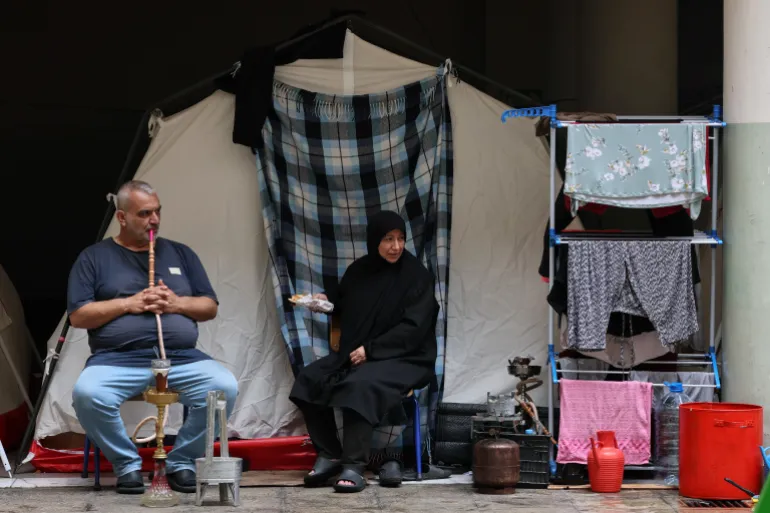
Displaced residents sit outside a tent in a local school in Beirut after fleeing their homes in southern Lebanon, on March 27, 2026 [Wael Hamzeh/EPA]
The Israeli military’s destruction of civilian homes and several bridges linking southern Lebanon to the rest of the country has also fuelled concerns that Israel is trying to isolate the area.
During Friday’s news briefing, UNHCR’s Lindholm Billing noted that the destruction of the bridges has made accessing southern Lebanon “increasingly difficult”.
“The destruction of key bridges in the south has cut off entire districts … isolating over 150,000 people and severely limiting humanitarian access with essential items to reach them,” she said.
Reporting from Tyre in southern Lebanon on Friday afternoon, Al Jazeera’s Obaida Hitto also stressed that Israel’s forced evacuation orders are “causing a lot of panic” among residents.
“Evacuation orders are happening in areas that were previously thought to be safe,” he said, adding that the destruction and damage to bridges over the Litani River in the south has made the prospect of finding safety more difficult.
“This is putting the government in Beirut in a very difficult situation to try and respond to the humanitarian crisis quickly growing in the south of the country,” Hitto said.
Weekly insights and analysis on the latest developments in military technology, strategy, and foreign policy.
The U.S. Navy has unveiled a “marketplace” model for acquiring future fleets of uncrewed surface vessels (USV), which could be owned and/or operated by the service or contractors. The Navy is applying this approach first to the procurement of medium-sized designs, or MUSVs, which could be configured for a variety of missions with the help of containerized payloads. The new strategy, which supplants the Modular Surface Attack Craft (MASC) plan laid out just last year, and aims to cut down on lengthy prototyping requirements, is the latest in a series of Navy efforts to try to speed up the fielding of new USV capabilities at scale.
“The character of warfare is changing rapidly. The Department of the Navy is adapting its acquisition system to deliver capability to our warfighters faster,” Secretary of the Navy John Phelan wrote in a post on X this morning, marking the official roll-out of the new USV acquisition plan. “We are harnessing the talent and ingenuity of the American tech sector by launching a market competition for the Medium Unmanned Surface Vessel (MUSV) Family of Systems. This new approach will leverage private investment and accelerate the delivery of real capabilities to the Fleet. We will reward the companies who are able to deliver capability at the speed of relevance.”
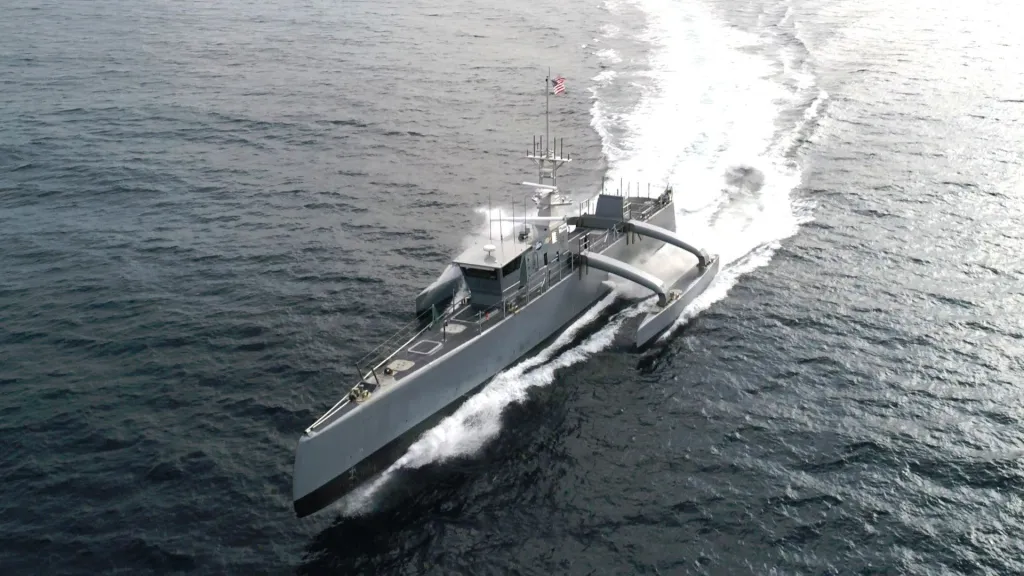
The Sea Hunter seen here is an MUSV-type design that the US Navy has been experimenting with for years now already. USN
“Our goal is to create a regular, recurring marketplace, not just for the MUSV, but for other classes of vessels, as well, over time, designed to match the growing demand for unmanned systems across a range of missions,” Rebecca Gassler, the Navy’s first-ever Portfolio Acquisition Executive for Robotic and Autonomous Systems (PAE RAS), also told TWZ and other outlets during a press call today. “This model that we’ve posted rewards demonstrated performance at sea, not just development, and is not another prototyping award. And it creates a direct path from what’s demonstrated on the water to putting those vessels into the fleet.”
The use of “marketplace” here should not be confused with how the U.S. Army is also now using that term to describe an actual online storefront-style system for ordering small uncrewed aerial systems. “I don’t know how many customers other than PAE RAS there are right now that actually have the funding to go buy or lease an MUSV,” Gassler said in response to a question about whether any kind of comparison between the two might be appropriate.
The Navy also posted a contracting notice regarding what it is now calling the Medium Unmanned Surface Vessel (MUSV) Family of Systems (FoS) program, specifically, online today. Potential offers only have another three weeks or so to submit proposals that involve designs that can be ‘on the water’ by the end of September, underscoring the service’s interest in already highly mature capabilities.
In terms of the actual uncrewed vessels the Navy is seeking through this effort, threshold requirements include a range of at least “2500 nm [nautical miles] at 25 knots while carrying a 25 MT [metric ton] load on the payload deck in NATO STANAG 4194 Sea State 4.” Per this NATO standard, Sea State 4 is characterized by wind speeds of 17 to 21 knots and wave heights between four and eight feet.
The MUSVs also need to be able to carry forty-foot equivalent units (FEU) containerized payloads and to refuel at sea at a rate of “2,000 gallons per minute of fuel through deck connections,” according to the contracting notice. We’ll come back to what might be in those payloads later on.
The Navy also wants designs that are “capable of fully autonomous operations both day and night in varying weather conditions complying with COLREGs [Convention on the International Regulations for Preventing Collisions at Sea], can prescribe keep out and keep in zones, and perform pre-defined behaviors,” per the notice. They also have to be “capable of restricting all Radio Frequency (RF) emissions when commanded while continuing to autonomously operate, perception system for autonomy has a passive mode with no RF emissions.”
The full list of threshold requirements from the MUSV FoS contracting notice released today. USN
In addition, the Navy has outlined a number of desired attributes, including “interfaces between C2, Perception, Machinery Control System, and Autonomy Control System software and hardware systems [that] conform to an open architecture standard with Interface Control Documents (ICD)” and an overall “autonomous system solution [that] enables integration with third party applications, modular upgrades, and component-level interoperability.” The service is also interested in the ability of the MUSV to monitor “health and status and autonomously reports conditions to the offboard C2 station, providing situational awareness of the condition of the vessel to the operator.”
“Vessel can execute 5 days of pre-planned maneuvers without communication connection” and “vessel provides emergency stop functionality to the offboard operator,” defined as “the rapid shutdown of propulsion engines putting the USV into a drift,” are also on the desired attributes list. There are production and operational aspects the Navy is also interested in, such as the ability of a selected contractor to supply between five and 10 operational MUSVs by the end of Fiscal Year 2027 and designs that can be “nested five abeam when moored.”
The complete list of desired attributes for the MUSV FoS from today’s contracting notice. USN
“We believe a number of them [potential offers] will test on production representative, but not full production[-ready designs,] or they’ll test in [sic] surrogate boats, so that we can see the autonomy that they’re bringing, even if it’s not the full production vessel,” Gassler noted today. So, acceptance of a finalized design will include a requirement “to do the full endurance test again, and any additional mission profiles that we have gotten from the Fleet, we will test at the time. And then we will do a full regression test on the autonomy now that it has been connected into the production boat controls.”
Overall, many of the stated threshold requirements for the MUSV FoS are similar, if not identical, to what the Navy had previously outlined for the initial baseline MASC design. The MASC plan was a three-tier approach that also included larger and smaller types, all of which would be configurable for different missions using containerized systems.
At the same time, the new strategy laid out today “is a replacement for MASC, absolutely,” PAE RAS Gassler stressed. MASC “was tailored towards a very specific mission and a very specific ask from the Fleet, [and a] very specific quantity. And we have a much wider variety of requirements for these vessels and missions that they need to accomplish as part of the Golden fleet. And so this is a replacement for that.”
“So, I won’t talk about specifically what mission we’re going after now that kind of gets out of the unclassified realm, but know that we are looking at specific mission profiles,” Gassler added. “For example, some require more complexity in their autonomy features than others, and so when we put these vessels through their tests, those tests will be a superset of those requirements such that we understand they will meet each of those missions.”
“Honestly, inside you could have a sensor, you could have repair equipment for ships,” she also said, speaking more generally about containerized payloads. “You could have any number of payloads inside those, and you basically are able to just swap them on.”
It should be noted here that the Navy did say its initial focus for MASC was on Intelligence, Surveillance, Reconnaissance, and Targeting (IRS&T), Counter-ISR&T, and Information Operations missions. At the same time, the three-tier approach and focus on containerized systems had certainly pointed to additional missions, including surface-to-surface strike and electronic warfare, down the line. The Navy already has a containerized launcher capable of firing SM-6 multi-purpose missiles and Tomahawk land-attack cruise missiles that it has been working to field on crewed ships, as well as in a ground-based configuration. The Navy has test-fired that launcher from an optionally crewed ship in the past.
See the game-changing, cross-domain, cross-service concepts the Strategic Capabilities Office and @USNavy are rapidly developing: an SM-6 launched from a modular launcher off of USV Ranger. Such innovation drives the future of joint capabilities. #DoDInnovatespic.twitter.com/yCG57lFcNW
“As we look across how the Golden Fleet capability, or the Golden Fleet concept, has matured, and we look across where we could use these vessels as part of CNO’s [Chief of Naval Operations Adm. Daryl Caudle] tailored offsets and tailored forces, we bring ourselves to realize there’s a number of missions that we could immediately use these vessels for,” Gassler said. “That is, that is part of the strategy now, is that we will now have a scalable way to procure vessels that meet specific mission profiles.”
Adm. Caudle publicly announced that the Navy would be moving toward a more flexible deployment model using tailored force packages at the Surface Navy Association’s (SNA) annual conference in January. At that same event, he also laid out a new “Hedge Strategy” to try to better maximize Navy resources through a major overhaul of how existing forces are utilized and how new capabilities are acquired and fielded. You can read more about all of this here.
Last week, Caudle also rolled out another new initiative, the Containerized Capability Campaign Plan, which puts new emphasis on containerized weapons and other capabilities, specifically, as a means to help the Navy achieve these broader goals.
Chief of Naval Operations Adm. Daryl Caudle. USN
Perhaps the biggest change the Navy is hoping to see with its USV marketplace strategy is in the processes through which it acquires and fields USVs. This reflects a broader push by the service to shake up how it buys vessels, crewed and uncrewed, to try to avoid the kinds of serious setbacks that have plagued Navy shipbuilding programs in recent years.
From what Gassler said today, the MASC program had been progressing along largely traditional lines, with plans to issue contracts to multiple vendors for a prototyping phase ahead of choosing one or more designs for production. She made clear that the new strategy aims to skip the prototyping phase to the fullest extent possible.
“Industry has leaned forward and has built boats or has built the technology already,” leading to the assessment that “we no longer needed to go through the prototyping phase,” she said. “So this will allow us to test the capability on water and go straight into production. And that will save us approximately on the order of a year, and we will get capability to the fleets faster.”
The Sea Hunter MUSV seen during early testing. DARPA
“What we want to do is capitalize on that investment. So the marketplace will look for several things,” she added. Beyond the “technical design that meets the specifications,” the Navy is also “looking for a variety of business models. So in this case, the [MUSV FoS] solicitation asks for what does a government-owned, government-operated model look like, types of data, rights, things like that, as well as a contractor-owned, contractor-operated model.”
Then there’s “manufacturing readiness. When we go through a normal development program, you don’t consider that until much further into the life cycle of development. Here we’re considering it up front,” she continued. “So we’ll be looking at your staffing, the supply chain, and whether you’ve got any fragility in the supply chain. We’ll be looking at facilities and capacity. So if you say you can produce X number of boats per year, can we really see that in the laydown of your facility, or that of those who you’ve partnered with.”
Gassler says that vendors that successfully complete the on-water test requirements will receive a fixed-price payment as a “reward” to help foster competition. The Navy will then have the option of entering into a production or leasing agreement for the design in question.
With all this being said, as mentioned, this is not the first time the Navy has attempted to accelerate the acquisition and fielding of USV capabilities, especially when it comes to larger types. The service already has a number of smaller USVs with speed boat and jet ski-type designs in service today.
When it was rolled out last year, MASC was presented as finally offering a path forward after more than a decade of prototyping and experimentation efforts that have yet to lead to meaningful operational capabilities. As a prime example of how things have progressed previously, in January, the Navy triumphantly declared its intention to employ two MUSV-type vessels it has in inventory now – Sea Hunter and Seahawk – operationally. Sea Hunter has been sailing since 2016. The Navy acquired Seahawk in 2021.
Sea Hawk and Sea Hunter Participate in Unmanned Systems Exercise
With MASC, the Navy had also hoped to leverage those prior investments, including work that had been led by the Defense Advanced Research Projects Agency (DARPA) and the Defense Innovation Unit (DIU). DARPA’s ongoing No Manning Required Ship (NOMARS) program, which the Navy is also involved in, continues to be particularly relevant in terms of the new operational and production concepts it is seeking to prove out. The NOMARS test ship, the USX-1 Defiant, was designed to be a lower-cost and readily producible design capable of operating without humans ever being on board, as you can read more about here.
USX-1 Defiant At-Sea Overview – No Manning Required Ship (NOMARS)
“All of this comes as USVs have now long been seen as a key way for the Navy to bolster its surface fleets. Distributed fleets of USVs configured for strike and ISR missions, and capable of operating independently or in groups, as well as together with crewed warships, open a door to significant new operational possibilities. Members of the MASC family could also help reduce risks to crewed assets. Modular designs that can be readily configured and reconfigured for different missions using containerized payloads also present targeting challenges for opponents.“
The Navy is clearly hoping that it has found the right formula with its new marketplace strategy to finally get larger and more capable USVs into service.
Israel’s Chief of Staff Lieutenant General Eyal Zamir issued a stark warning to the country’s cabinet this week: unless urgent measures are taken, the Israeli army is on the brink of collapse.
According to a report by Israel’s Channel 13 on Thursday, Zamir told ministers that he was “raising 10 red flags”, urging the government to move quickly on long-delayed legislation to alleviate the strain on its “exhausted” military.
The army has been overseeing what rights groups and the United Nations have determined is a genocide in Gaza, the de facto annexation of the occupied West Bank and numerous incursions into Lebanon and Syria.
Addressing ministers, Zamir stressed the need for a “conscription law, a reserve duty law, and a law to extend mandatory service”, adding that without these measures, “before long, the [Israeli military] will not be ready for its routine missions and the reserve system will not last”.
Israeli Prime Minister Benjamin Netanyahu has since said that plans will be made to extend mandatory military service. However, this is not the first time the alarm has been raised that the military is straining under the pressure of repeated operations, which have seen it involved in the killings of tens of thousands of civilians across the Middle East.
The first came as early as June 2024, just eight months into the genocidal war on Gaza, when France24 reported on shortfalls in troop numbers, exhaustion and a lack of supplies.
That situation has only worsened since.
So, how large was the army before October 2023, how active has it been and how has the current era of unprecedented regional aggression sapped the military’s reserves? Here is what we know.
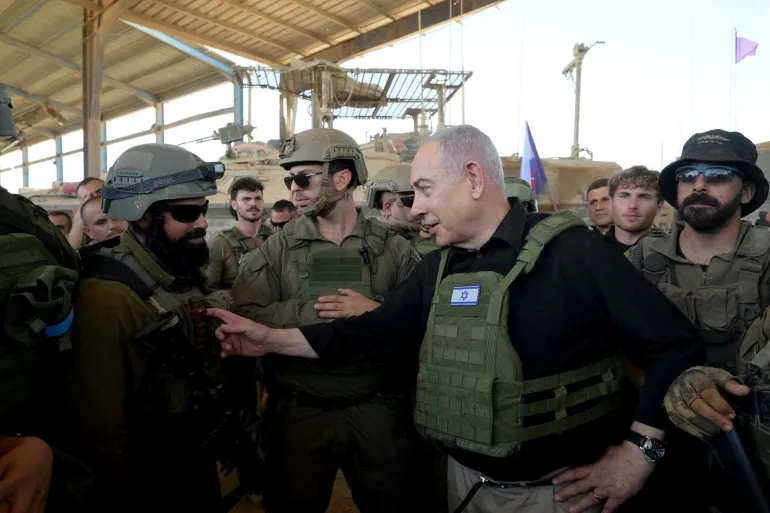
Israeli Prime Minister Benjamin Netanyahu visits Israeli soldiers in Rafah, in the southern Gaza Strip, in this handout picture from July 18, 2024 [File: Avi Ohayon/GPO/Handout via Reuters]
How suited is the Israeli army to its country’s forever wars?
Not very.
Launched in 1948, the idea of an Israeli military made up of a relatively small standing army backed by a large reserve corps of mobilised citizenry was the plan from the outset in order to instil a narrative of social cohesion, national identity and shared responsibility within the new country’s populace. Reservists would move between civilian life and military service to achieve this.
Before the war on Gaza began on October 7, 2023, Israel’s standing army numbered just 100,000. This was immediately bolstered by calling up 300,000 reservists, pulling Israel’s “citizen soldiers” from their jobs and families to take part in the bombardment and ground invasion of Gaza in response to the Hamas-led assault on southern Israel.
Ultimately, this means that the majority of troops serving are reservists rather than career soldiers.
Where are Israeli troops now?
On March 1, the day after US-Israeli strikes on Iran began, Israel announced the mobilisation of another 100,000 reserve soldiers.
That was in addition to 50,000 reservists currently on duty as a result of the Gaza war.
At the time, military sources said the additional troops would bolster existing positions along the border with Lebanon, its frontier and occupied positions within Syria, as well as in the Gaza Strip and the occupied West Bank.
Additionally, Israel’s Home Front Command called up 20,000 reservists, primarily for search and rescue operations, with reinforcements also deployed to the Israeli Air Force, Navy and Intelligence Directorate.
Israel has since deployed “thousands” of those troops to take part in its invasion of southern Lebanon, which it resumed in response to rocket fire from Iranian ally Hezbollah on March 3.
Addressing the same security cabinet meeting as Zamir, Central Command chief Major General Avi Bluth told ministers that government policies in the occupied West Bank were also placing increasing pressure on the military’s already stretched manpower.
According to the report, Bluth told ministers that over the past year, the government has approved the construction of multiple illegal settlements in the Jordan Valley and elsewhere in the West Bank as part of a wider operation characterised by rights groups and more than 20 countries as Israel’s “effective annexation” of the occupied Palestinian territory.
Bluth added: “This is your policy, but it requires security and a full protection package, because the reality on the ground has completely changed – and that requires manpower.”
Are Israeli troops exhausted?
According to many of the army’s own members, particularly reservists, they are.
Speaking to the Ynet News outlet, which is typically supportive of Netanyahu and his ruling Likud party, one reservist told the newspaper in December of his decision not to report for duty.
“We have battles to fight at home,” he said, explaining his decision. “There are guys on the team who were fired from their jobs, others whose families are barely staying afloat, or who have been dragging out their studies for a very long time. This is a problem, a complexity that is hard to describe.”
Resentment of the apparent exemption offered to members of Israel’s ultra-religious Haredim community, whose refusal to enlist for service is often overlooked by politicians, is also growing, Israeli media reports.
Responding to Zamir’s comments to the security cabinet, Israel’s opposition leader, Yair Lapid, took to Twitter to address the government directly.
“The government must stop the cowardice, immediately halt all budgets to the Haredi draft dodgers,” he said of the extensive social benefits many in Israel’s ultra religious community rely upon. “Send the military police after the deserters, draft the Haredim without hesitation,” he said.
“The warning has been given. It’s on your heads. It’s in your hands. You cannot continue to abandon Israel’s security, in wartime, for petty politics.”
As the United States-Israeli war on Iran enters its fourth week this weekend, pressure on oil and gas markets continues to mount due to severe disruption to shipping traffic through the Strait of Hormuz as well as attacks on and around key energy facilities in the Gulf.
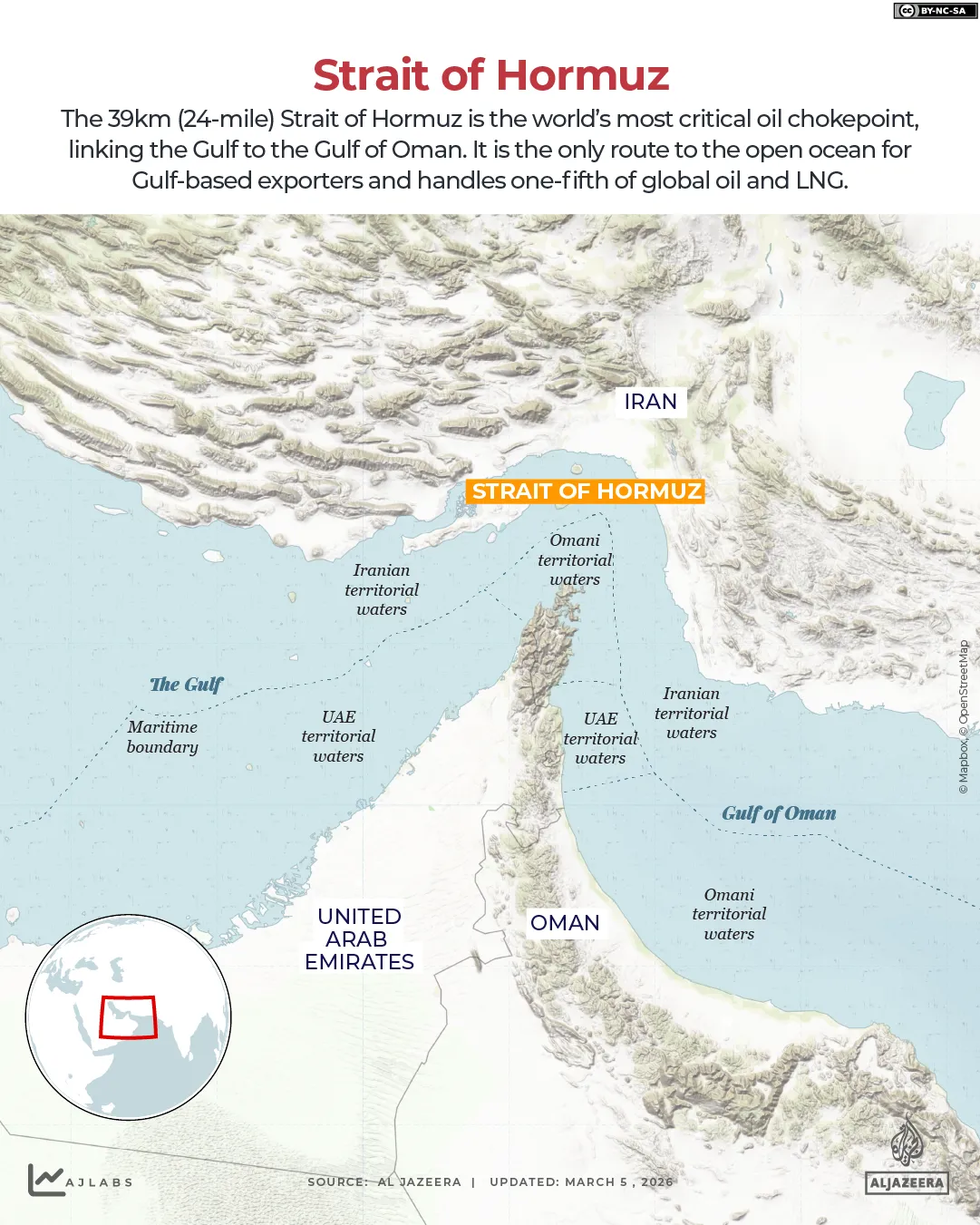
In peacetime, 20 percent of the world’s oil and gas is shipped from producers in the Gulf through the Strait of Hormuz – the only route to the open ocean – including 20 million barrels of oil per day.
To bridge the shortage its closure has caused, countries in the Middle East are exploring alternative routes to get energy exports out.
In this explainer, we look at three major pipelines in the Middle East that producers may be pinning their hopes on, and whether they can fill the gap.
What has happened in the Strait of Hormuz?
On March 2 – two days after the US and Israel began strikes on Iran – Ebrahim Jabari, a senior adviser to the commander-in-chief of Iran’s Islamic Revolutionary Guard Corps (IRGC), announced that the strait was “closed”. If any vessels tried to pass through, he said, the IRGC and the navy would “set those ships ablaze”. Since then, traffic through the strait has plunged by more than 95 percent.
Iranian officials have most recently stated that the strait is not completely closed – except to ships belonging to the US, Israel and those who collaborate with them – but have also laid down new ground rules. Any vessel must secure Tehran’s approval to transit through the narrow waterway.
As a result, over the past fortnight, countries have been scrambling to do deals with Iran to secure safe passage and a few, mostly Indian, Pakistani and Chinese-flagged tankers have been allowed to pass.
On Thursday, Malaysian Prime Minister Anwar Ibrahim thanked Tehran for granting Malaysian vessels “early clearance” through the strait.
Meanwhile, about 2,000 ships flying the flags of other nations are stuck on either side of the strait.
(Al Jazeera)
Which oil pipelines could serve as alternate routes?
The only alternative to shipping oil is piping it across land or under the sea. Three oil pipelines could work as ways around the Strait of Hormuz, including:
Saudi Arabia’s East-West Pipeline
The East-West pipeline is also known as the Petroline and is operated by Saudi oil giant Aramco. Aramco is one of the world’s largest companies, with a market capitalisation exceeding $1.7 trillion and annual revenues of $480bn. The oil giant controls 12 percent of global oil production, with a capacity of more than 12 million bpd.
It is a 1,200km (745-mile) pipeline which runs from the Abqaiq oil processing centre close to the Gulf in Saudi Arabia to the Yanbu port on the Red Sea, on the other side of the country.
However, the pipeline does not have the capacity to fully make up for the Hormuz closure.
In 2024, about 20 million barrels per day (bpd) passed through the Strait of Hormuz, according to data from the United Nations. Crude oil and condensate made up 14 million bpd of this, while petroleum was the remaining 6 million bpd.
The East-West pipeline has the capacity of transporting up to 7 million bpd. On March 10, Aramco said about 5 million bpd could be made available for exports, while the rest could supply local refineries.
Since the US-Israeli war on Iran began at the end of February, Saudi Arabia has ramped up its oil flow through this pipeline. In January and February, an average of 770,000 bpd flowed through the pipeline, according to data from Kpler, a data and analytics company. By Tuesday this week, this had increased to an average of 2.9 million bpd.
However, using the Saudi pipeline still carries a risk.
The Houthis, an Iran-backed Yemeni armed group whose attacks on ships in the Red Sea caused global shipping chaos during Israel’s genocidal war in Gaza from 2023 to 2025, could target the Bab al-Mandeb Strait, which connects the Red Sea to the Gulf of Aden, and the Indian Ocean beyond.
An unnamed Houthi leader told the Reuters news agency that the Houthis remain ready to attack the Red Sea again in solidarity with Tehran, the agency reported on Thursday.
“We stand fully militarily ready with all options. As for other details having to do with determining zero hour they are left to leadership and we are monitoring and following up with the developments and will know when is the suitable time to move,” the Houthi leader said.
The Bab al-Mandeb is the southern outlet of the Red Sea, situated between Yemen on the Arabian Peninsula and Djibouti and Eritrea on the African coast.
It is one of the world’s most important routes for global seaborne commodity shipments, particularly crude oil and fuel from the Gulf bound for the Mediterranean via the Suez Canal or the SUMED pipeline on Egypt’s Red Sea coast, as well as commodities bound for Asia, including Russian oil.
The Bab al-Mandeb is 29km (18 miles) wide at its narrowest point, limiting traffic to two channels for inbound and outbound shipments.
Iran could open a new front in the Bab al-Mandeb Strait if attacks are carried out on Iranian territory or its islands, Iran’s semiofficial Tasnim cited an unnamed Iranian military source as saying on Wednesday.
(Al Jazeera)
UAE’s Abu Dhabi Crude Oil Pipeline
The Abu Dhabi Crude Oil Pipeline is also called the ADCOP or the Habshan-Fujairah pipeline.
The 380km pipeline runs from Habshan, an oil and gasfield in the southwestern area of Abu Dhabi, United Arab Emirates, to the port of Fujairah on the Gulf of Oman.
The pipeline, which became operational in 2012, has a capacity of about 1.5 million barrels per day (bpd). It is unclear how much is now being transported through the pipeline.
However, oil exports from Fujairah do appear to have risen in the past month despite the closure of the strait, averaging 1.62 million bpd in March compared with 1.17 million bpd in February, according to Kpler analyst Johannes Rauball, who spoke to Reuters.
Iraq-Turkiye Crude Oil Pipeline
The Iraq-Turkiye Crude Oil Pipeline, also called the Kirkuk-Ceyhan Pipeline, links Iraq to the Mediterranean coast of Turkiye.
The pipeline, which has the capacity of 1.6 million bpd, currently carries about 200,000bpd.
Iraq is among the top five global producers of oil and is the second largest within the Organization of the Petroleum Exporting Countries (OPEC), exceeding 4 million bpd.
Can these pipelines replace the Strait of Hormuz?
No. While these pipelines can take on some of the capacity of Hormuz, their combined capacity is only about 9 million bpd, compared with about 20 million bpd for the strait.
Additionally, these pipelines are land-based and within the range of Iranian missiles and drones, which makes them just as vulnerable to attacks and damage in the ongoing conflict as ships travelling through the strait. Throughout the war, energy infrastructure all over the Gulf has suffered strikes.
Are there other options?
Theoretically, oil can be transported on trucks, but this is costly, slow and inefficient.
A standard truck can carry anywhere between 100 to 700 barrels per day, depending on the number of trips. Hundreds of thousands of barrels would be needed to meet needs, requiring thousands of trucks, which could also be targeted in strikes.
Union members scuffled with reporters and then banned the media entirely from the Communications Workers of America convention floor in a dispute springing from NBC’s labor troubles. Three Democratic presidential hopefuls–Massachusetts Gov. Michael S. Dukakis, Sen. Paul Simon of Illinois and civil rights activist Jesse Jackson–addressed the Miami Beach convention despite the controversy. The media ban by the union, which represents nearly 700,000 workers in the telecommunications and publishing industries and in the public sector, stemmed from a federal court order demanding that the union permit NBC into the convention hall if it allowed any reporters.
The meeting held in Washington, DC reviewed the ‘close strategic cooperation’ between Doha and Washington, Qatar’s foreign ministry said.
Published On 27 Mar 202627 Mar 2026
Qatar’s prime minister has held talks with senior US officials in Washington, DC, amid the ongoing US-Israeli war on Iran and fallout across the Gulf.
Sheikh Mohammed bin Abdulrahman bin Jassim Al Thani, who also serves as Qatar’s foreign minister, met US Vice President JD Vance and US Secretary Scott Bessent, Qatar’s Ministry of Foreign Affairs said on Friday.
Recommended Stories
list of 4 itemsend of list
They reviewed ways to strengthen the “close strategic cooperation” between Doha and Washington, “especially the defence partnership in light of the conditions the region is experiencing”, the ministry said.
Both sides stressed “ensuring the sustainability of energy supplies and maintaining the continued flow of liquefied natural gas from the State of Qatar to global markets”, in a way that “supports global energy security”, it added.
Vance hailed the “robust strategic partnership”, praising Qatar’s “active role in promoting regional stability and enhancing global energy security”.
The Gulf has been in a state of heightened tension since February 28, when the US-Israeli war on Iran began, which has killed more than 3,000 people across the region, a vast majority of them in Iran and Lebanon.
Tehran has since launched drone and missile attacks aimed at Israel, as well as Jordan, Iraq, and Gulf states. Iran insists it is targeting US assets in the Gulf, but the region’s leaders have urged Iran to cease attacks as they endanger civilians.
The war has created an unprecedented global energy crisis as Iran has effectively closed off the Strait of Hormuz, through which one-fifth of the world’s oil passes.
Meeting with Hegseth
On Thursday, Sheikh Mohammed also held a meeting in Washington with US Secretary of Defense Pete Hegseth, the Foreign Ministry said.
“The meeting took place in Washington on Thursday and focused on ways to support and develop defence and security collaboration amid regional challenges,” it added.
“Both sides stressed the importance of continued coordination and consultation on regional issues to promote security and stability locally and internationally.”
On Wednesday, the Qatari Cabinet renewed its condemnation of Iranian attacks on Qatar and its neighbours, calling for an immediate halt.
He was on the bench for the Freeway Series finale at Dodger Stadium earlier this week, when manager Dave Roberts came over to check in and give Rojas the news.
“I didn’t know if ‘Thank you’ was the right thing to say because it’s something I earned,” Rojas recounted before the Dodgers’ 8-2 win Thursday against the Diamondbacks. “It’s not something that I asked for as a favor. So I was just kind of speechless.”
Rojas embraced Roberts.
“It was a gift to myself because of all the hard work and the preparation I put in throughout my whole career,” Rojas said. “This way is the best way possible because I got up to the big leagues as a utility defensive replacement who can play shortstop but couldn’t really hit much.”
Rojas, who intends to retire after this year, wrapped up his final opening day as a starter.
Opening day is a celebration across baseball. But the Dodgers made it a full production. The pregame program Thursday included roster-introduction pyrotechnics, along with a stage and blue carpet set up in center field.
From Bill Plaschke: There were fireworks, there was a flyover, there was Will Ferrell screaming and Keith Williams Jr. crooning and four months of cheers unleashed by fans wearing championship belts and howling grins.
But the real stars of Thursday’s Dodger opening day show never made a sound.
They arrived silently at the end of the pregame ceremony, carefully held by two of the men who helped win them, lifted high for all those who so passionately longed for them.
They were the last two Commissioner’s Trophies, the back-to-back World Series championship trophies, the two symbols of the Dodgers domination held side by side in the afternoon sun.
Man, it was beautiful. Goodness, how they sparkled. Incredible, how they glowed.
It was almost as if they were powered by some electrical force, some sort of championship current running between them, lighting them up with a blinding power curated by the battered fingers of the two veterans who touched them.
Get the latest on L.A.’s teams in the daily Sports Report newsletter.
By continuing, you agree to our Terms of Service, which include arbitration and a class action waiver. You agree that we and our third-party vendors may collect and use your information, including through cookies, pixels and similar technologies, for the purposes set forth in our Privacy Policy such as personalizing your experience and ads.
Mike Trout homers as Angels win
Mike Trout homered to launch what he hopes will be a bounce-back year, leading the Angels to a season-opening 3-0 win over the Houston Astros on Thursday.
Trout also walked three times and played center field for the first time since April 2024. The three-time MVP played 130 games last season, his most since 2019 because of various injuries.
Making his franchise-record 14th opening day start, the 34-year-old Trout broke a scoreless tie in the seventh inning when he sent a 96-mph fastball from reliever AJ Blubaugh (0-1) 403 feet onto the train tracks in left center. It was his fifth opening day homer, also a club record.
The Angels ended an eight-game road losing streak in season openers, starting 1-0 on the road for the first time since 2013.
From Marisa Ingemi: The UCLA women’s basketball team hasn’t lost a game in 120 days. In that time, the Bruins have outscored opponents by a total of 806 points and just one other school — Connecticut — has gone without a loss during the same stretch.
Yet somehow, the No. 1 seed in the Sacramento 2 region of the NCAA tournament hasn’t captured the same momentum and praise as the other three top seeds who have muscled their way into the Sweet 16.
UCLA (33-1) will play No. 4 Minnesota (24-8) at 4:30 p.m. Friday in Sacramento. The game will air on ESPN. Entering the matchup, is UCLA’s less dominant NCAA tournament run a cause for concern? Or is a win a win when it comes to March?
“Each game is going to present different adversity points,” UCLA coach Cori Close said. “And I think that we don’t look at it as getting back to something. We look at it as everything is a learning opportunity. ‘What does that teach us? How does that make us better? What kinds of things do we need to tighten up?’”
Darcy Kuemper made 19 saves for his third shutout of the season and 39th of his career to lead the Kings to a 4-0 victory over the Vancouver Canucks on Thursday night.
Mikael Granlund capped off his hat trick scoring on the power play with one second remaining in overtime on Thursday night to give the Ducks a 3-2 victory over the Calgary Flames.
Granlund has seven goals during a four-game goal streak that has him up to 19 on the season as the Ducks extended their winning streak to four games.
The Pacific Division-leading Ducks opened the night with a five-point cushion on the Edmonton Oilers and a six-point lead on the Vegas Golden Knights.
Eligibility for women’s competition will be determined by a one-time mandatory genetics test, according to the IOC. The test requires screening through saliva, a cheek swab or a blood sample.
No transgender woman competed at the 2024 Paris Summer Games, and it is unclear if any trans women currently compete at an Olympic level. Weightlifter Laurel Hubbard of New Zealand was the last to do so, competing in the 2021 Tokyo Olympics without winning a medal.
The new eligibility policy is not retroactive and does not apply to recreational sports programs. The IOC said in a statement that it “protects fairness, safety and integrity in the female category.”
“Eligibility for any female category event at the Olympic Games or any other IOC event, including individual and team sports, is now limited to biological females.”
1939 — Oregon beats Ohio State 46-33 in the NCAA’s first national basketball tournament.
1942 — Joe Louis knocks out Abe Simon in the sixth round at Madison Square Garden to retain his world heavyweight title.
1945 — Oklahoma A&M beats New York University 49-45 for the NCAA basketball championship.
1951 — Bill Spivey scores 22 points to lead Kentucky to a 68-58 win over Kansas State for the NCAA basketball title.
1960 — The Boston Celtics score a then NBA Finals record 76 points in the first half a 140-122 win over the St. Louis Hawks. Tom Heinsohn (24), Bill Sharman (23), Frank Ramsey (22) and Bob Cousy (20) each score 20-or-more points to win the series opener.
1971 — UCLA beats Villanova 68-62 for its fifth NCAA basketball title.
1978 — Jack Givens scores 41 points to lead Kentucky to a 94-88 victory over Duke for the NCAA basketball title.
1983 — Larry Holmes wins a unanimous 12-round decision over Lucien Rodriguez to retain his world heavyweight title in his hometown of Scranton, Pa.
2005 — Annika Sorenstam shoots a final-round 68 to finish at 15-under to win the Nabisco Championship by eight shots over Rosie Jones. It’s he 59th victory of the Swedish star’s LPGA Tour career — and her eighth major championship win.
2010 — Long shot Al Shemali wins the $5 million Dubai Duty Free, pulling away from a crowded field to pull off a surprisingly easy win in the Dubai World Cup. Al Shemali, at 40-1, starts slow then duels it out with Bankable before taking the lead for good.
2011 — Jamie Skeen scores 26 points as Virginia Commonwealth delivers the biggest upset of the NCAA tournament, a 71-61 win over No. 1 seed Kansas in the Southwest Regional final.
2014 — The Philadelphia 76ers tie the NBA record for futility with their 26th straight loss, falling 120-98 to the Houston Rockets. Philadelphia matches the 2010-11 Cleveland Cavaliers for the NBA’s worst skid.
2017 — UConn’s women’s basketball team advance to its 10th consecutive Final Four with a 90-52 victory against Oregon. The victory moves coach Geno Auriemma past Pat Summitt for the most NCAA tournament victories at 113.
Compiled by the Associated Press
Until next time…
That concludes today’s newsletter. If you have any feedback, ideas for improvement or things you’d like to see, email me at houston.mitchell@latimes.com. To get this newsletter in your inbox, click here.
France’s sports minister has called the International Olympic Committee’s decision to introduce genetic testing for women’s events a “step backwards”, warning it raises major ethical, legal and scientific concerns, while US President Donald Trump praised the IOC’s new policy.
France “takes note” of the decision to require athletes to undergo testing based on the SRY gene, but opposes any broad use of genetic screening, Marina Ferrari said in a statement on Friday.
Recommended Stories
list of 4 itemsend of list
“On behalf of the French government, I wish to express our deep concern regarding this decision,” she said. “We oppose a generalisation of genetic testing that raises numerous ethical, legal and medical questions, particularly in light of French bioethics legislation.”
The IOC said on Thursday that only biological female athletes would be eligible for women’s events from the Los Angeles 2028 Olympics onwards, following a one-time gene test designed to identify male sex development. The move essentially bars transgender athletes from competing in the female category.
The rule is in line with an executive order by Trump from February 2025 that banned transgender athletes from competing in girls’ and women’s sports.
“Congratulations to the International Olympic Committee on their decision to ban Men from Women’s Sports,” Trump said late on Thursday on the Truth Social platform.
“This is only happening because of my powerful Executive Order, standing up for Women and Girls!”
However, Ferrari said that: “These tests, introduced in 1967, were discontinued in 1999 due to strong reservations within the scientific community regarding their relevance. France regrets this step backwards.”
She added that the policy risked undermining equality by specifically targeting women.
“This decision raises major concerns, as it specifically targets women by introducing a distinction that undermines the principle of equality,” she said.
Ferrari also warned that the approach failed to reflect biological diversity, particularly among intersex individuals.
“It defines the female sex without taking into account the biological specificities of intersex individuals, whose sexual characteristics present natural variations, leading to a reductive and potentially stigmatising approach,” she said.
New Zealand’s Olympic Committee said on Friday that the IOC policy would bring greater “clarity” and “fairness” to future Games.
New Zealand weightlifter Laurel Hubbard became the first openly transgender woman to compete in the Olympics at Tokyo in 2021.
NZOC chief executive Nicki Nicol said the organisation recognised the “extensive consultation and expert input that has informed this policy”, particularly from athletes.
She said it would bring “greater clarity, consistency and fairness to eligibility for the female category at the Olympic level”.
“This is a complex and sensitive area that directly affects people, not just policy,” she added.
After competing in 2021, Hubbard, who failed in all of her lifting attempts in Tokyo, said she was aware of the controversy surrounding her participation.
Friday’s NZOC comments did not refer to Hubbard, who has kept a very low profile since her games appearance.
Also reacting to Thursday’s IOC announcement, Australian Olympic Committee president Ian Chesterman said the IOC had comprehensively investigated what he called a “complex issue”.
“Without doubt, this is a challenging and complex subject, and at the AOC we approach it with empathy and understanding.”
He added: “This decision provides clarity for elite female athletes who compete at the highest level and demonstrates a commitment to fairness, safety and integrity in Olympic competition, all of which are fundamental principles of the Olympic Movement.
“As the IOC has stated, at the highest level of sport, the smallest margins can determine outcomes, and clarity around eligibility is critical for female athletes to continue to compete on a level playing field.”
Austrian officials highlight addiction and ill-health while advocating for stricter age restrictions.
Published On 27 Mar 202627 Mar 2026
Austria plans to ban children under 14 from using social media, with an official saying certain online sites are addictive and making young people “sick”.
“Austria is introducing a compulsory minimum age of 14 for the use of social media platforms,” conservative junior minister for digitisation, Alexander Proll, told a joint news conference on Friday.
Recommended Stories
list of 3 itemsend of list
Proell added that draft legislation would be drawn up by June. Cabinet members from Austria’s two other governing parties were also in attendance.
“We will decisively protect children and young people in future from the negative effects of social media,” Vice Chancellor Andreas Babler of the Social Democrats said.
“We will no longer stand by and watch while these platforms make our children addicted and often also sick … The risks associated with this use were ignored for long enough, and now it is time to act,” he added.
Babler said the government would not list individual platforms the ban would apply to, but would decide based on how addictive their algorithms are and whether they include content such as “sexualised violence”.
The announcement comes days after a Los Angeles jury found Alphabet’s Google and Meta liable for $6m in damages in a landmark social media addiction lawsuit.
The case involved a 20-year-old woman who said she became addicted to the apps at a young age due to their platform design. Meta says it plans to appeal the decision.
Also on Friday, the United Kingdom advised parents of children under five to limit screen time to a maximum of one hour per day.
Similar to Austria, other nations in Europe and elsewhere have banned the use of social media for children.
In January, the French parliament voted in favour of banning children aged below 15 from social media, amid growing concerns about online bullying and mental health risks.
Countries including the UK, Denmark, Spain and Greece are also studying a ban.
The European Parliament has called for the European Union to set minimum ages for children to access social media, although it is up to member states to impose age limits.
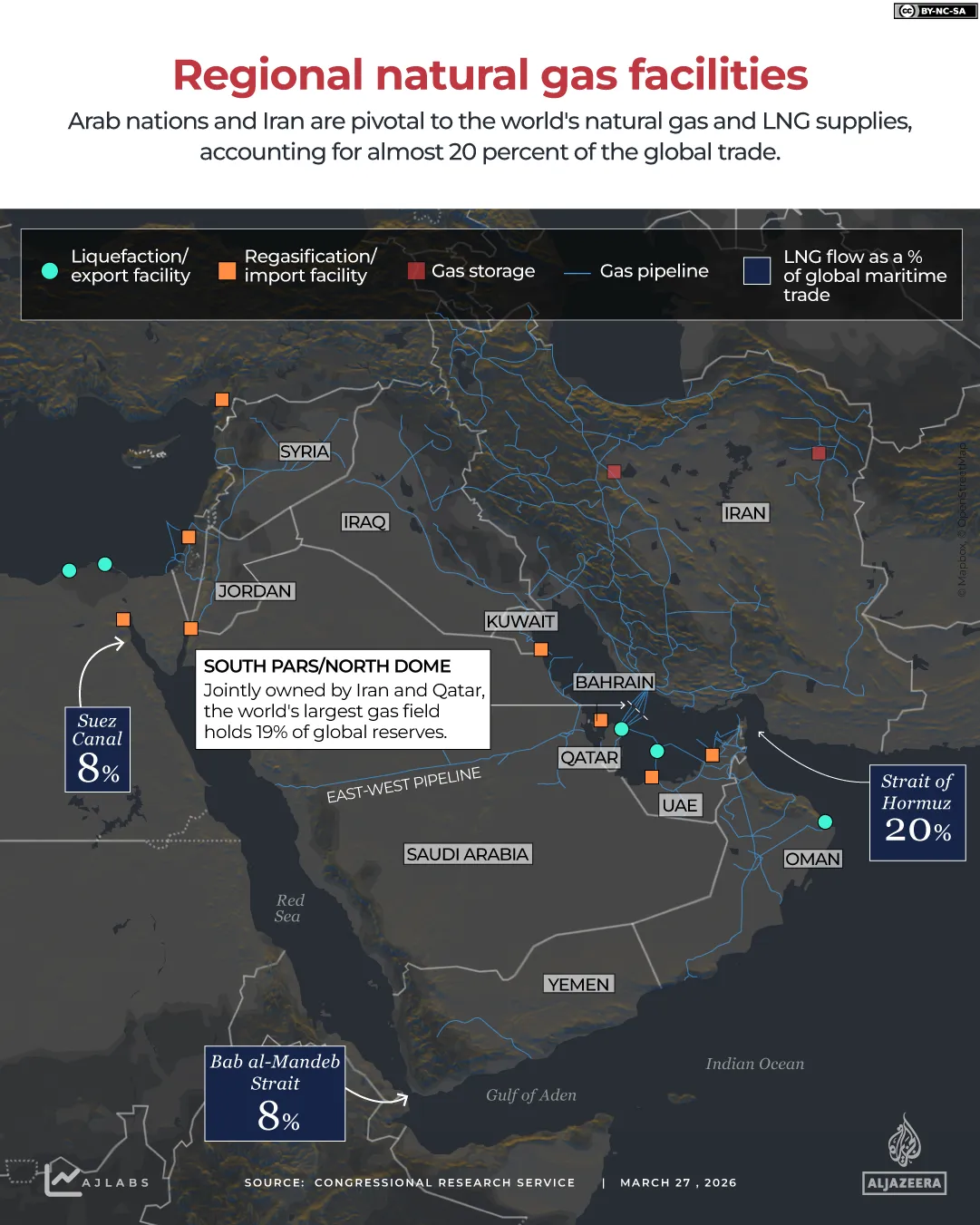
The United States-Israeli war on Iran has hit critical liquified natural gas (LNG) supplies in the Gulf, triggering the most severe disruptions in recent years to the global energy market.
Shipping through the critical Strait of Hormuz, which accounts for 27 percent of the world’s maritime oil trade and 20 percent of LNG, has been brought to a near standstill, with oil-producing nations such as Saudi Arabia rerouting oil through alternative pipelines and Qatar halting LNG production.
Recommended Stories
list of 4 itemsend of list
Natural gas makes up about a quarter of global energy consumption, raising concerns about how much the disruption to LNG will affect those most reliant on gas.
What is LNG?
Natural gas is formed over millions of years from decomposed organic matter subjected to intense heat and pressure beneath the Earth’s surface.
LNG is natural gas cooled to -162 degrees Celsius, known as cryogenic processing, shrinking it to a 600th of its gaseous volume.
In its liquid state, LNG is colourless, odourless and non-flammable, making it safe and efficient to transport across vast distances.
Composition and purification
Before liquefaction, the gas is purified through water-based solvents and molecular sieve beds to remove impurities including carbon dioxide, hydrogen sulphide, water and mercury.
Heavier hydrocarbons are then separated from methane and ethane through fractionation, and stored, used or sold as byproducts. The result is a fuel typically composed of 85 to 95 percent methane, with small amounts of ethane, propane, butane and nitrogen.
Storage and transport
LNG is stored in large insulated tanks without the need for high-pressure infrastructure. It is then pumped onto double-hulled carriers and shipped to terminals around the world.
Regasification
At its destination, LNG is heated using seawater or a warm water bath until it vaporises, a process known as regasification, before being moved through pipelines for consumption. It is sometimes blended with nitrogen or propane to ensure compatibility with local gas networks.
What is it used for?
Once LNG is returned to a gaseous state at import terminals, it is dispersed through pipelines for use in homes, businesses and industries around the world.
Residential uses include cooking, heating and generating electricity. In many parts of the world, LNG also supports hot water systems in homes and heating for commercial buildings.
It is used for power generation broadly, offering a comparatively low-carbon alternative to coal and oil.
In industry, it is used for fertilisers, plastics, paints and medicines. It is also used in transport to fuel heavy-duty vehicles and ships.
A man walks through a mustard field during the spring season on the outskirts of Srinagar, the summer capital of Indian-administered Kashmir, on March 24, 2026 [Farooq Khan/EPA]
Gulf nations export close to half the world’s traded urea – commonly used in fertilisers globally, leaving international agriculture deeply vulnerable to any interruption in the LNG shipping lane through the Strait of Hormuz.
The disruption has already forced fertiliser producers across the region to suspend or reduce operations, since natural gas is both the primary feedstock and the fuel that powers the manufacturing process.
A picture of QatarEnergy’s operating facilities on March 3, 2026, in Ras Laffan Industrial City, Qatar. QatarEnergy announced a complete halt to liquefied natural gas (LNG) production at its Ras Laffan and Mesaieed facilities on March 2, 2026, after Iranian attacks targeted energy facilities [Getty Images]
QatarEnergy’s decision to halt gas production following attacks on its LNG infrastructure brought the world’s single largest urea plant to a standstill. In addition, the Omani port of Salalah on the Arabian Sea has been closed, which holds an ammonia storage terminal. The port was hit in a drone attack on March 11.
What are the by-products?
While LNG is primarily valued as an energy source, the processing and liquefaction of natural gas yield a range of by-products with industrial and medical applications.
The most notable by-product is helium, which is extracted during cryogenic processing at LNG facilities using distillation to separate the concentrations of helium from the gas.
Global helium production is estimated to be about 180 million cubic metres annually. The disruption to LNG facilities in Qatar means some 5.2 million cubic metres of helium is taken out of the market each month, accounting for about a third of global monthly production.
Helium is used primarily as a cooling agent for superconducting magnets in MRI and CT scanners, with the average MRI machine needing about 1,700 litres of liquid helium, and some older MRIs needing replenishment every two to three years.
A brain-scanning MRI machine is seen in Pittsburgh, United States, on November 26, 2014 [File: Keith Srakocic/AP]
Helium is also critical to the data centre industry, where it is used to conduct heat away from silicon, preventing parts of semiconductors from being damaged.
The natural gas value chain generates petrochemical derivatives that also form feedstock for manufactured goods.
For example, ethane and propane are cracked to produce ethylene and propylene, which are materials used in plastics such as IV bags, syringes and other medical-grade plastics.
Which countries supply LNG?
According to the International Gas Union (IGU) 2025 World LNG Report, some 411.24 million tonnes (mt) of LNG were traded in 2024.
The largest exporter of LNG is the United States, which in 2024 exported a total of 88.4mt, followed by Australia (81mt), Qatar (77.2mt), Russia (33.5mt) and Malaysia (27.7mt).
Together, the top five countries account for more than three-quarters of global supply.
Which countries import it?
China was the largest importer of LNG with 78.6mt imported in 2024, followed by Japan (67.7mt), South Korea (47.1mt), India (26.1mt) and Taiwan (21.8mt). The top five importers accounted for nearly 59 percent of all global LNG imports in 2024.
South Asian nations such as Pakistan and Bangladesh are also at high risk from the current conflict.
Motorists queue to refuel their motorcycles at a petrol station amid concerns over supplies amid the United States-Israeli conflict with Iran, in Dhaka, Bangladesh, on March 15, 2026 [Mohammad Ponir Hossain/Reuters]
Pakistan’s primary energy source is natural gas, which accounts for 28 percent of electricity generation for the country of more than 250 million people.
In Bangladesh, with a population of about 176 million, gas accounts for half of all electricity generation.
Qatar and the United Arab Emirates supply about 99 percent of Pakistan’s LNG imports and 72 percent of Bangladesh’s, according to trade intelligence firm Kpler.
Earlier in the month, Pakistan introduced emergency measures to tackle the energy shock, including moving to a four-day workweek for government employees and announcing spring holidays for schools from March 16 to the end of the month.
As a precautionary measure, the Bangladeshi government has also reduced gas supplies. Bangladesh is seeking nearly $2bn in loans from international lenders in a bid to fund energy inputs and keep prices stable.
Some petroleum gas tankers heading to India have managed to pass through the Strait of Hormuz despite the conflict — at least one Pakistani tanker has crossed the strait, too. In India, where 5 percent of electricity generation comes from gas, they are now relying more on coal as LNG disruptions continue. India gets about half of its LNG from the Gulf.
On March 9, an Indian government order redirected natural gas and regasified LNG to priority sectors, with curtailments affecting consumers and the petrochemical industry, according to S&P Global.

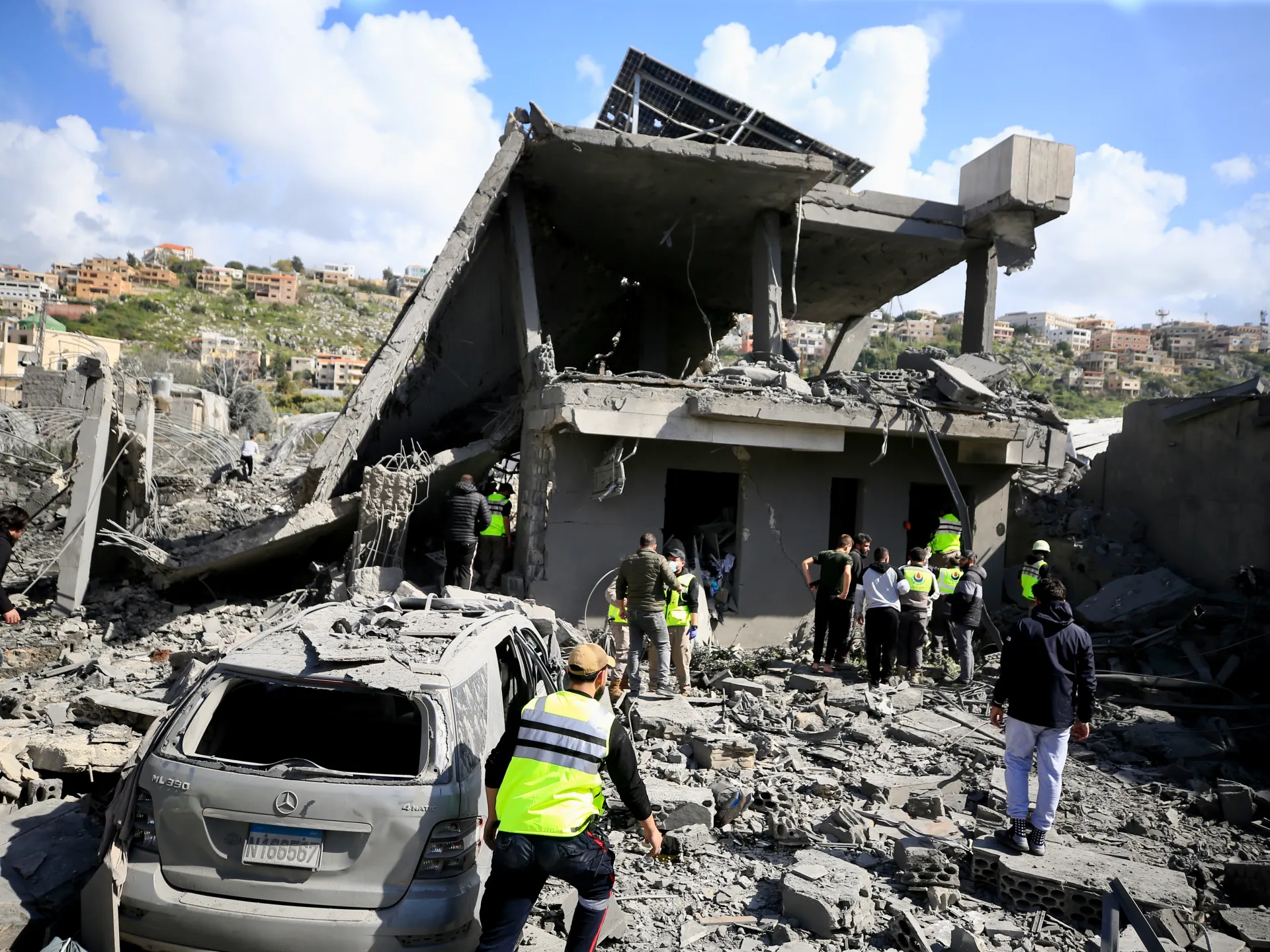
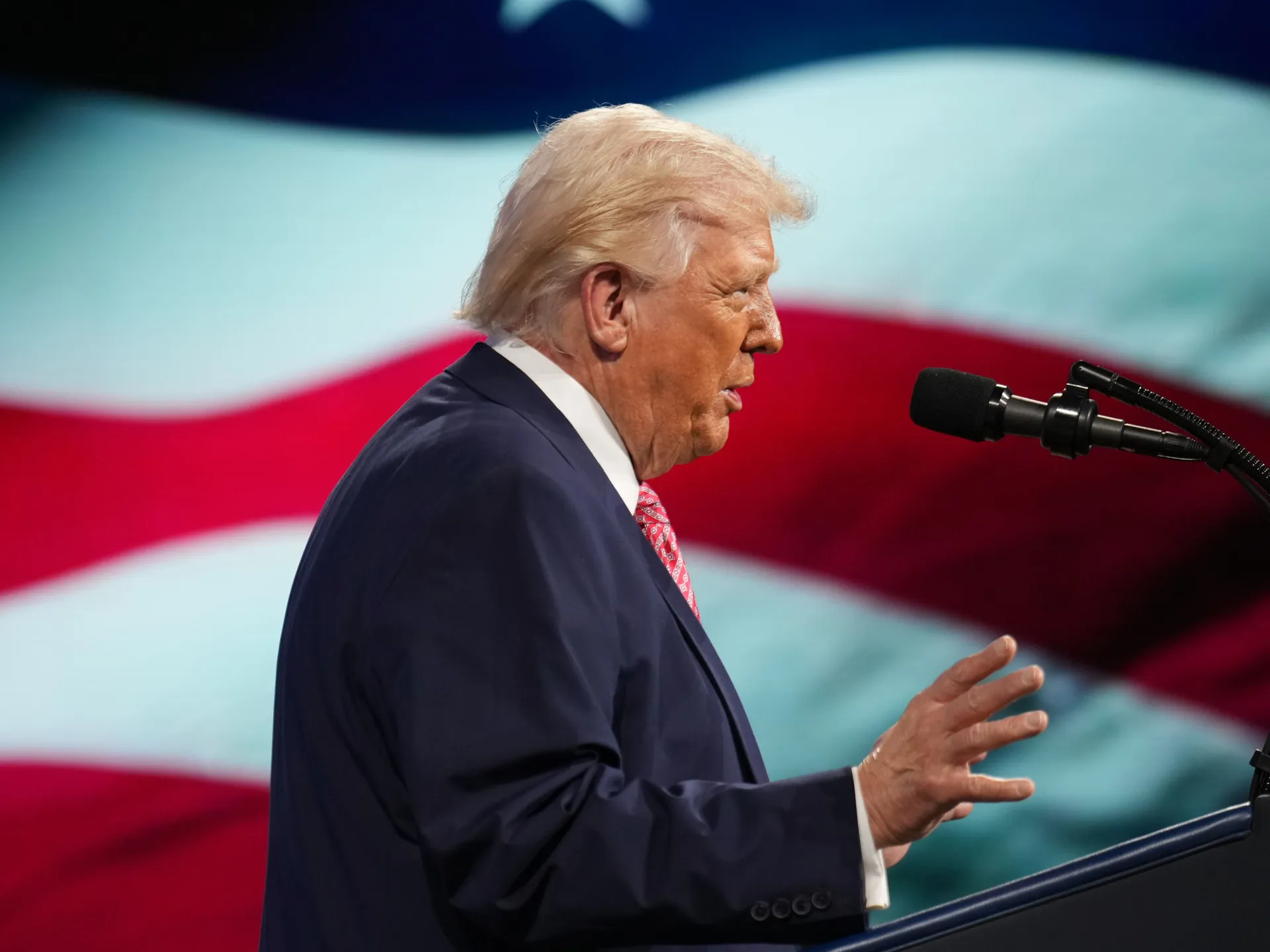
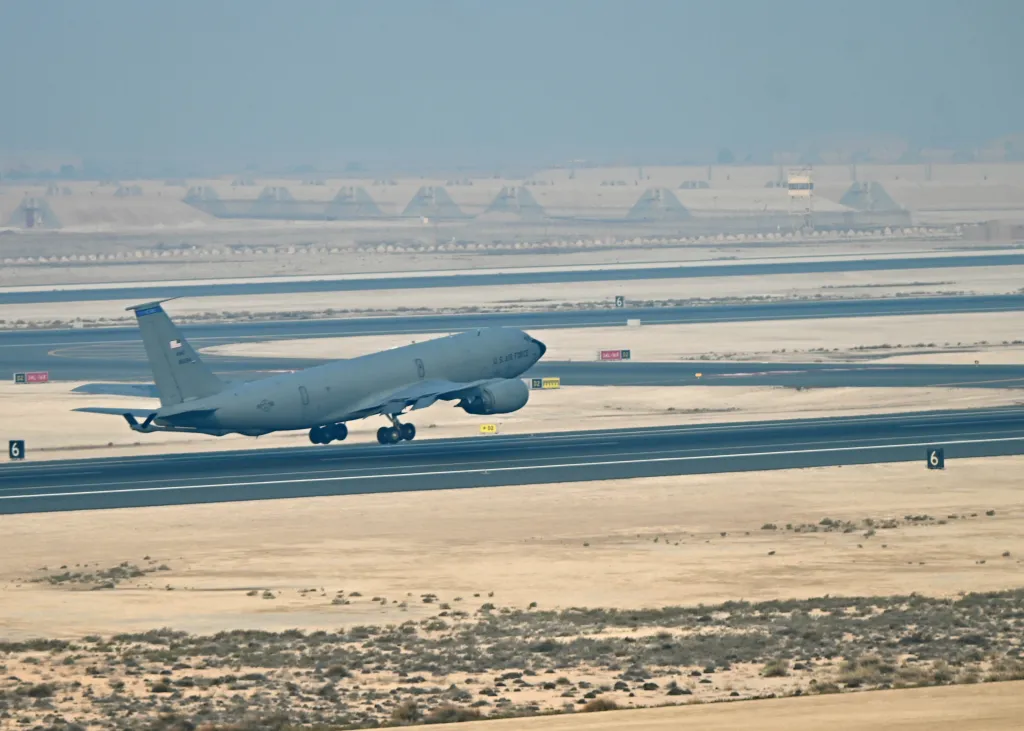


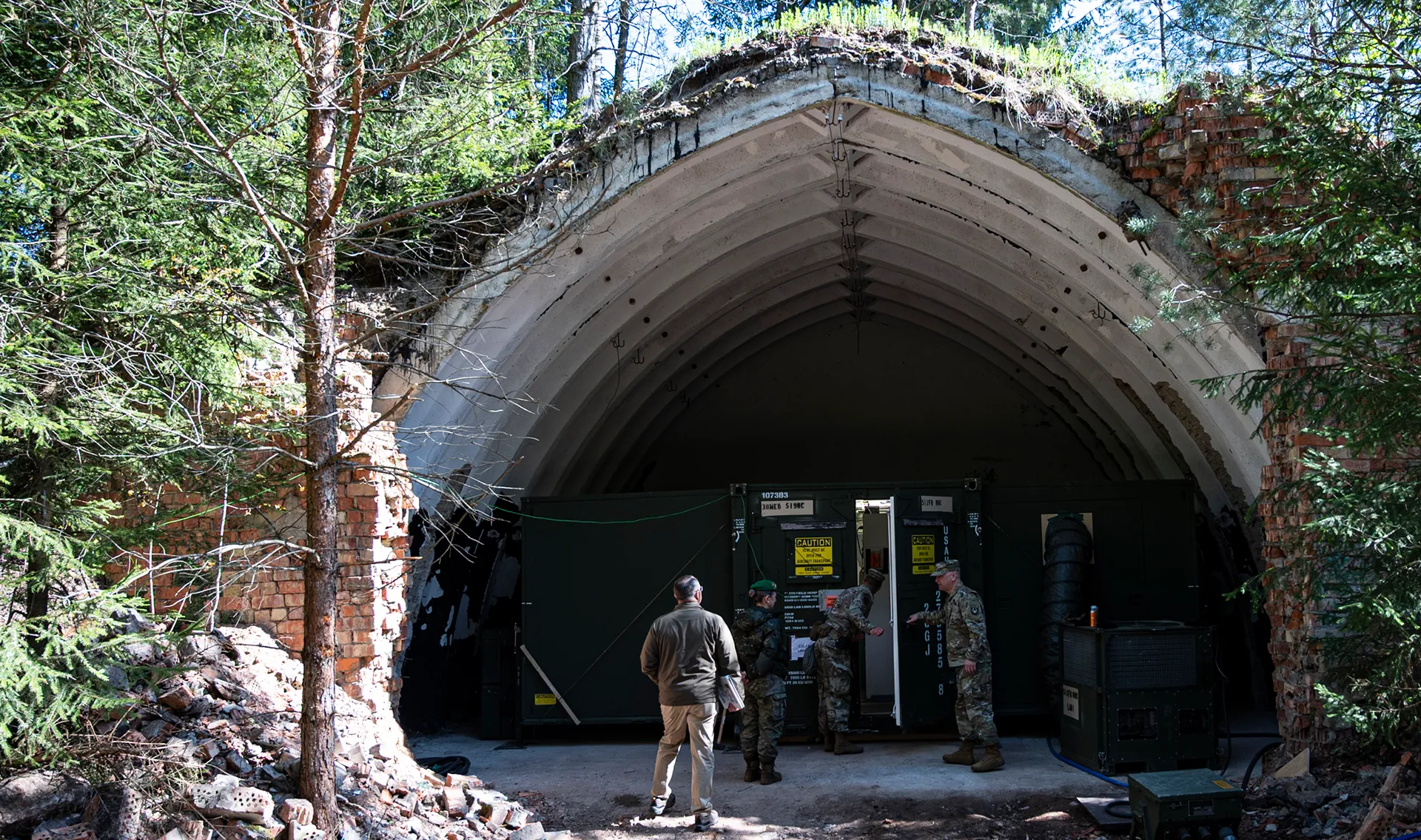

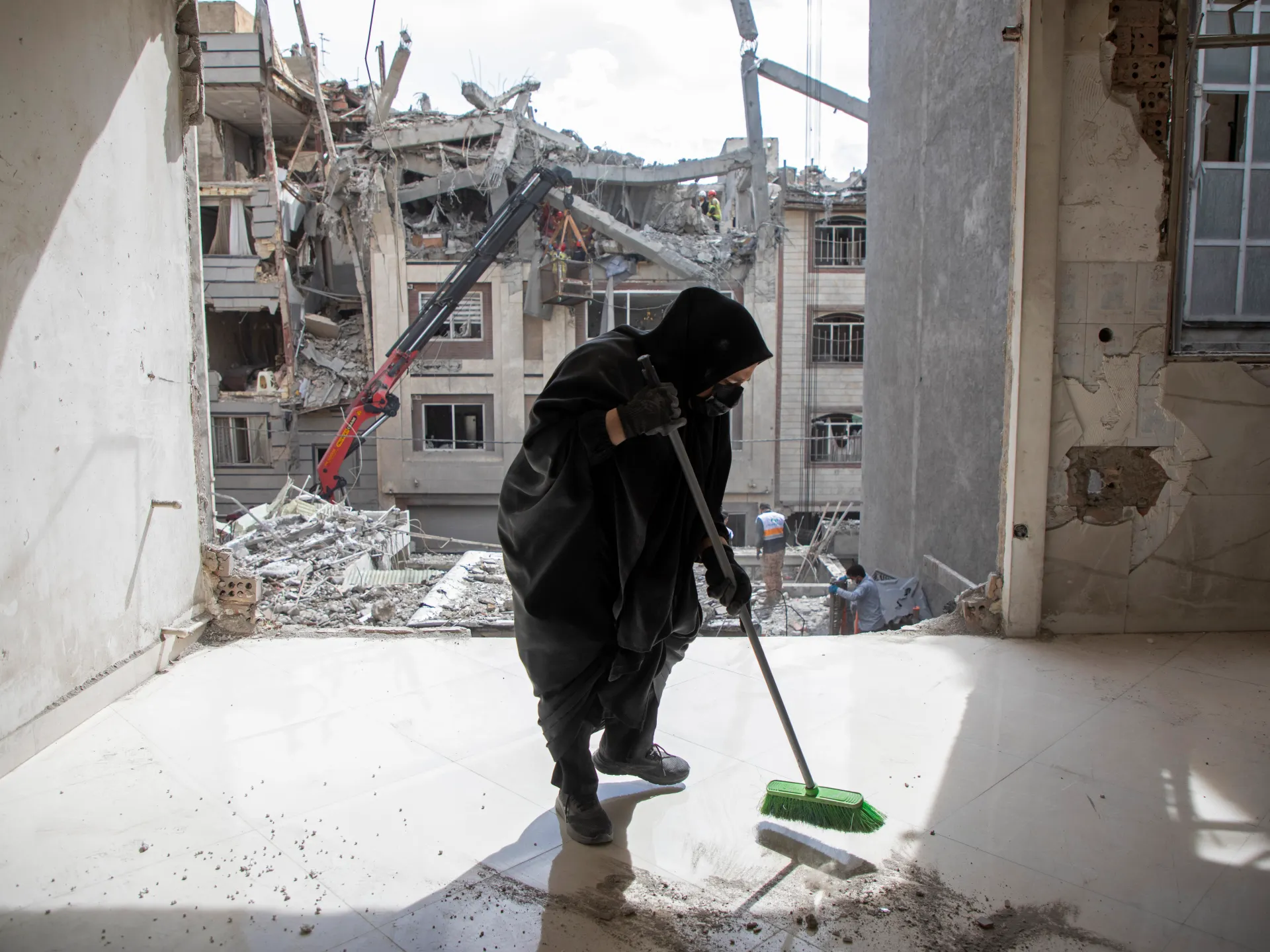
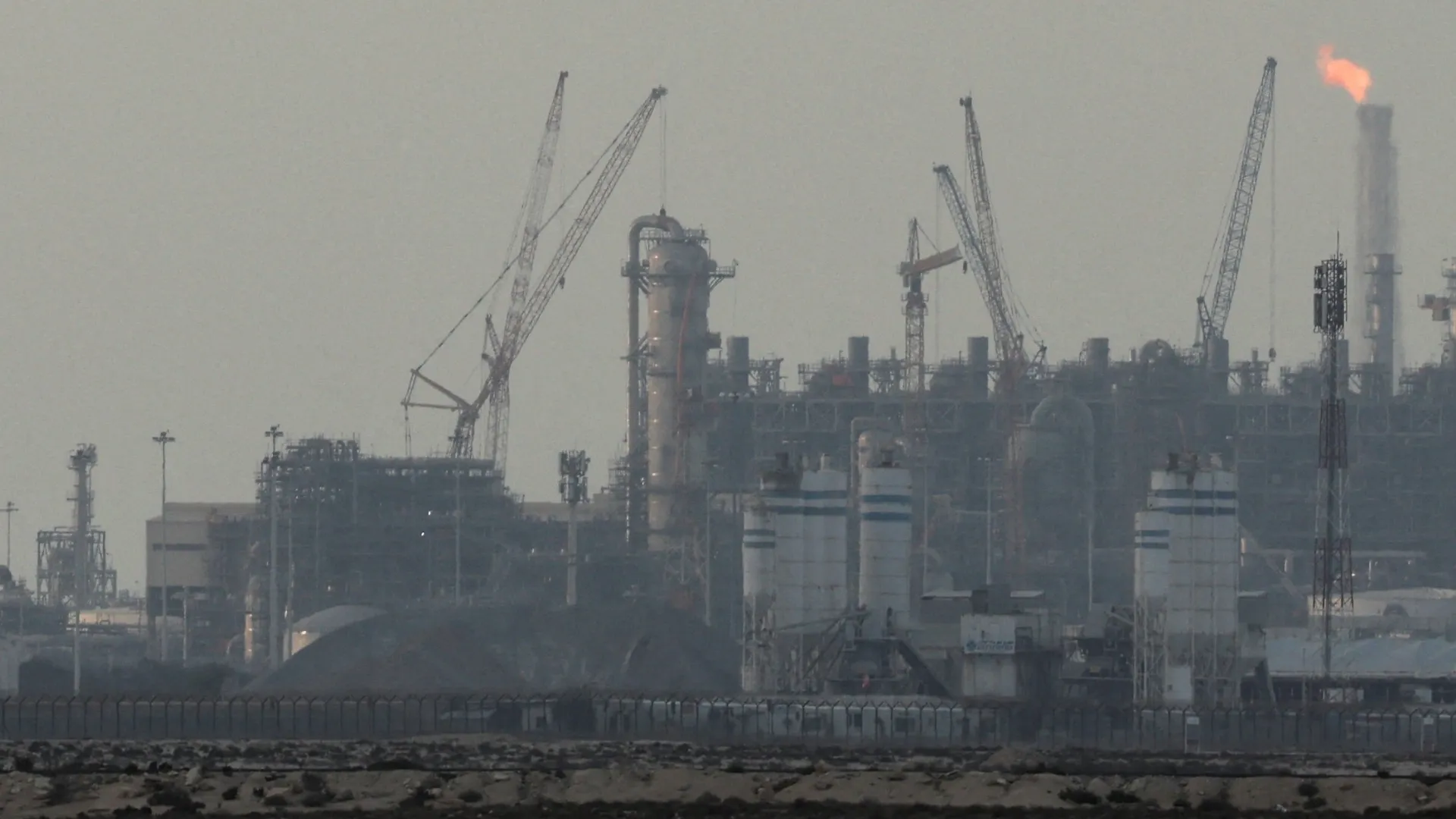

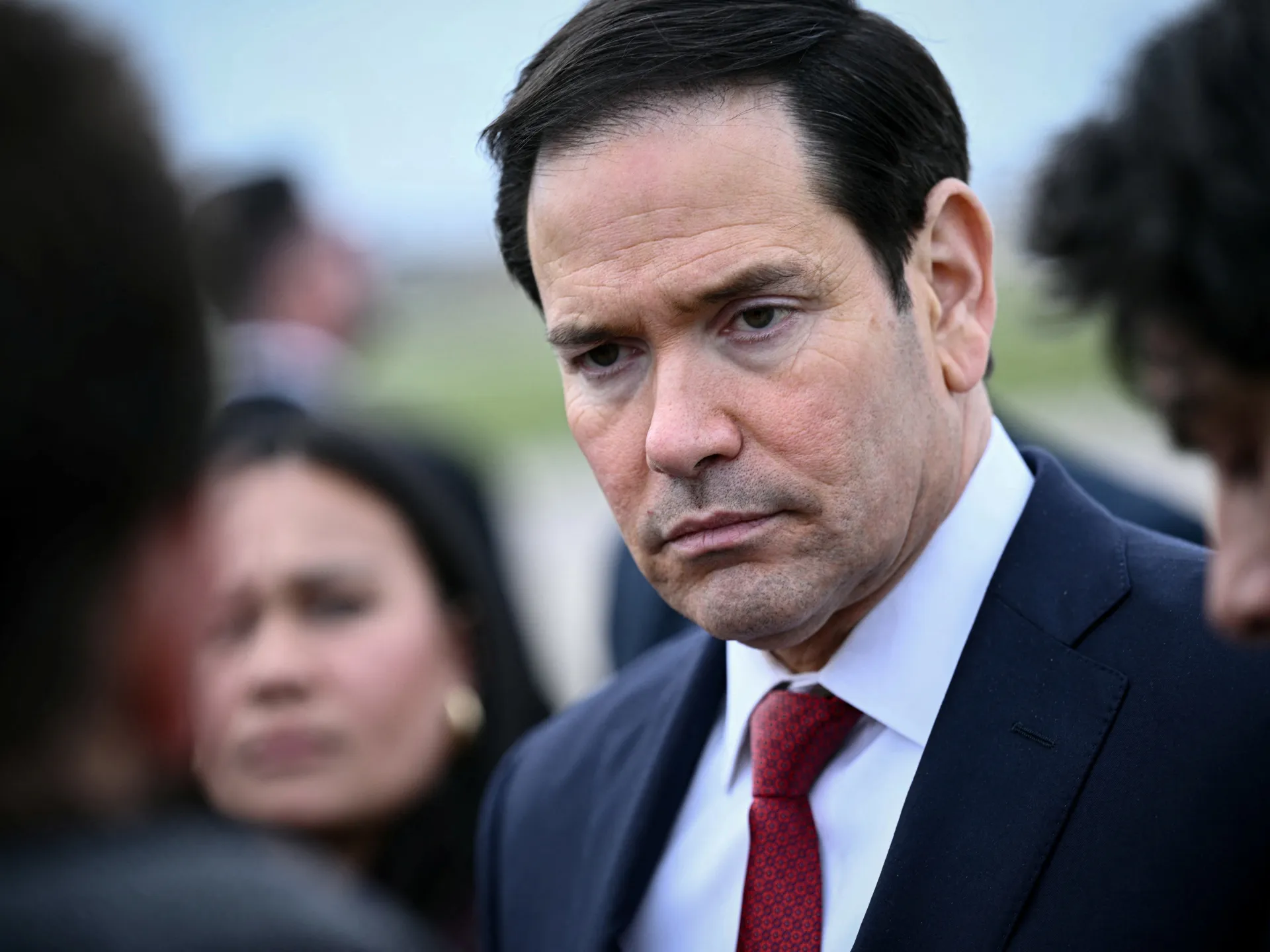


![Rosalina González, 59, mother of Jonathan and Mario, who were detained under the state of exception on February 19, 2025, during ademonstration on March 8 2026 in San Salvador, El Salvador [Euan Wallace/ Al Jazeera]](https://i0.wp.com/occasionaldigest.com/wp-content/uploads/2026/03/DSC00090-3-1774485050.jpg?w=640&ssl=1)