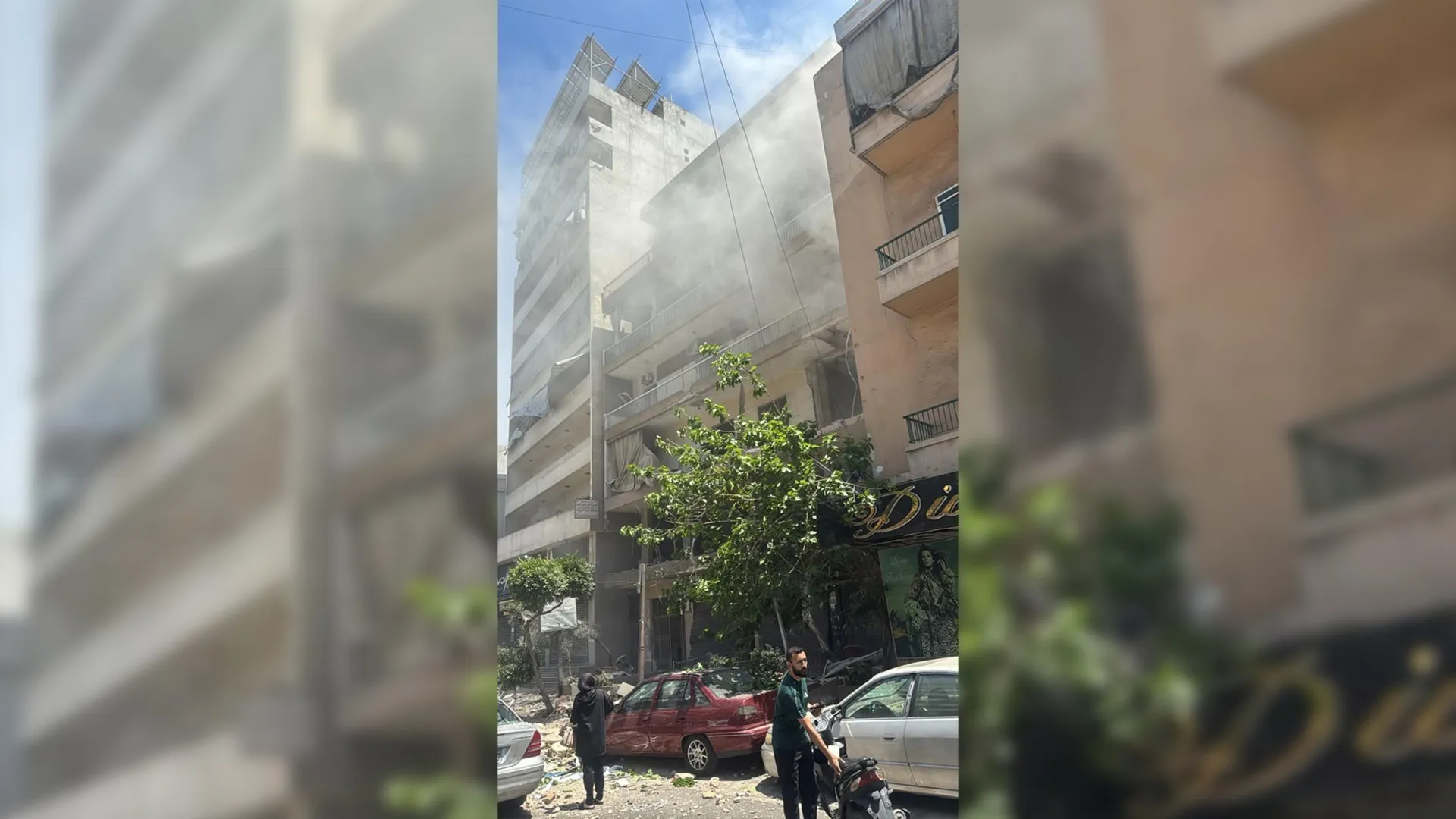
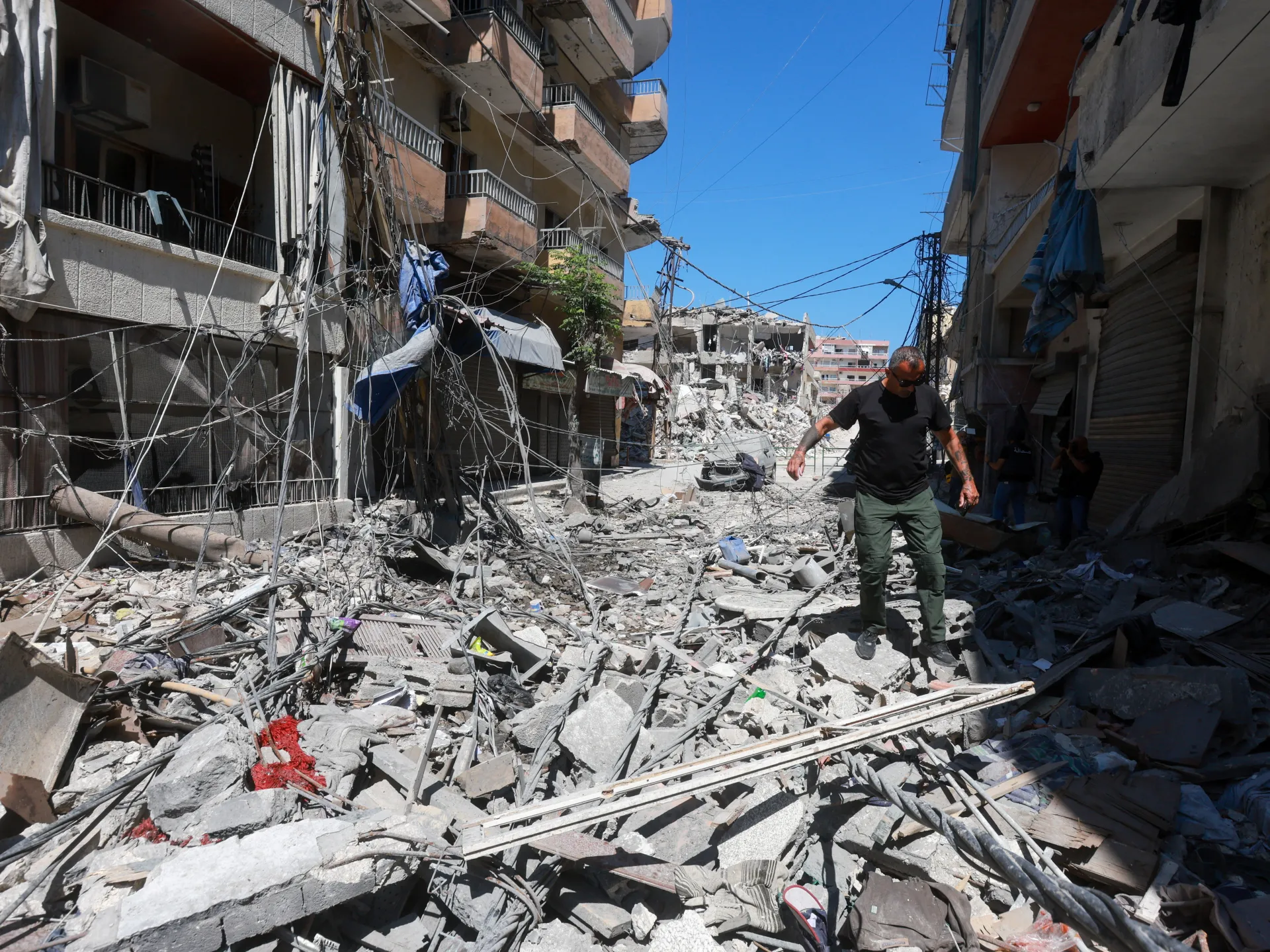
Israel has bombed the southern suburbs of Beirut, saying it targeted Hezbollah ‘infrastructure’ in response to cross-border fire. The strikes come as Israel continues to violate a supposed ceasefire with incursions and daily bombardment in southern Lebanon. Trump has said a deal to end the war on Iran will be signed on Sunday.
Vinicius Junior scored a brilliant goal to dig Brazil out of trouble after Ismael Saibari had put Morocco ahead.
A moment of magic from Vinicius Junior salvaged Brazil a point against Morocco in New Jersey, as the five-time World Champions made a shaky start to the tournament.
Ismael Saibari ran through to give Morocco a 21st-minute lead with a clever scoop in the Group C opener on Saturday, but a solo effort from Vinicius ensured the points were shared in this much-anticipated group match.
Recommended Stories
list of 4 itemsend of list
Here are the biggest takeaways from the 1-1 draw at New York New Jersey Stadium.
Brazil coach Carlo Ancelotti at half time [Jeenah Moon/Reuters]
Brazil make a slow start
Brazil are chasing a record sixth World Cup title, 24 years after last lifting the trophy, but this performance suggests there is a lot of work to be done by Carlo Ancelotti’s side.
They showed signs of nerves during the early stages of the game and struggled to cope with a lively Morocco attack.
A fifth-placed finish in South American qualifying underlined the scale of the challenge facing Ancelotti, and this performance has done little to ease concerns about the quality of the Brazil squad.
A number of their players struggled to cope with the intensity of the Moroccan team, with midfielder Casemiro subbed off at half-time after a difficult opening 45 minutes in the heat.
The World Cup final is a long way off in New Jersey, but Brazil will have to vastly improve if they are to have any hope of making it.
Morocco look like the real deal
The Atlas Lions stunned the world of football in 2022 as they made it all the way to the semifinals in Qatar.
Four years later, Morocco have the chance to show that it was not a one-off run to the last four and they are the real deal.
Judging by their performance in New Jersey on Saturday, the North African nation are truly a force to be reckoned with.
They arrived in North America as African Cup of Nations champions, after being retrospectively awarded the title following a controversial final defeat to Senegal, and they continued their strong form with a commanding performance against Brazil, playing with a high level of confidence and plenty of attacking threat.
Morocco appear set for another strong tournament showing.
Vinicius Junior showed his importance to Brazil with a brilliant solo goal in the first half [Jewel Samad/AFP]
Vinicius shows his top quality
If Brazil are to make it to the latter stages of this tournament, they will rely heavily on Vinicius to provide goals and assists in North America.
The Real Madrid man has consistently scored for his club this season, including 16 goals in La Liga and five in the Champions League, and it now appears that he is bringing this form to the world stage.
With Brazil struggling in the first half, Vinicius received the ball from Bruno Guimaraes on the left side of the area before cutting back onto his right foot and hammering into the far corner past Yassine Bounou.
It was the kind of magic moment that he regularly produces for Real Madrid, and the Selecao will be looking for more individual brilliance in their coming games.
Neymar injury hangs over Brazil
The Neymar soap opera is set to dominate another tournament for Brazil, with the 34-year-old on the sidelines for yet another major tournament match.
Brazil’s all-time record goalscorer is still recovering from a calf injury, having not played for his country since 2023.
He was dramatically recalled to the national squad, despite not featuring in Ancelotti’s plans during the Italian’s year in charge, but he remains under scrutiny over his fitness and form following years of injury trouble and an underwhelming spell back at Santos.
It is unclear exactly when Neymar will be fit enough to return to first-team action, but judging by the media’s focus on him during Saturday’s match, this saga is set to dominate discussion around Brazil.
Brazil’s Neymar Jr reacts after the match in New Jersey [Caean Couto/Reuters]
Draw leaves Group C wide open
Brazil and Morocco are the clear heavyweights in their group, but Saturday’s draw in New Jersey has left Group C somewhat in the balance.
Scotland currently sit top of the table after a 1-0 victory over Haiti in Boston, and they will now be eyeing the chance to reach the knockout stages for the first time in their history.
Morocco and Brazil remain heavy favourites to finish in the top two automatic qualification spots, but Scotland know that any points in their final two group games will almost certainly book their spot in the round of 32.
Qatar has earned its first-ever FIFA World Cup point in dramatic fashion against Switzerland. An injury time own goal put Qatar level with the Swiss in San Francisco. Al Jazeera’s Paul Rhys was there.
Asian Cup holders Qatar level in injury time to draw 1-1 with Switzerland in World Cup 2026 opening game.
Published On 13 Jun 202613 Jun 2026
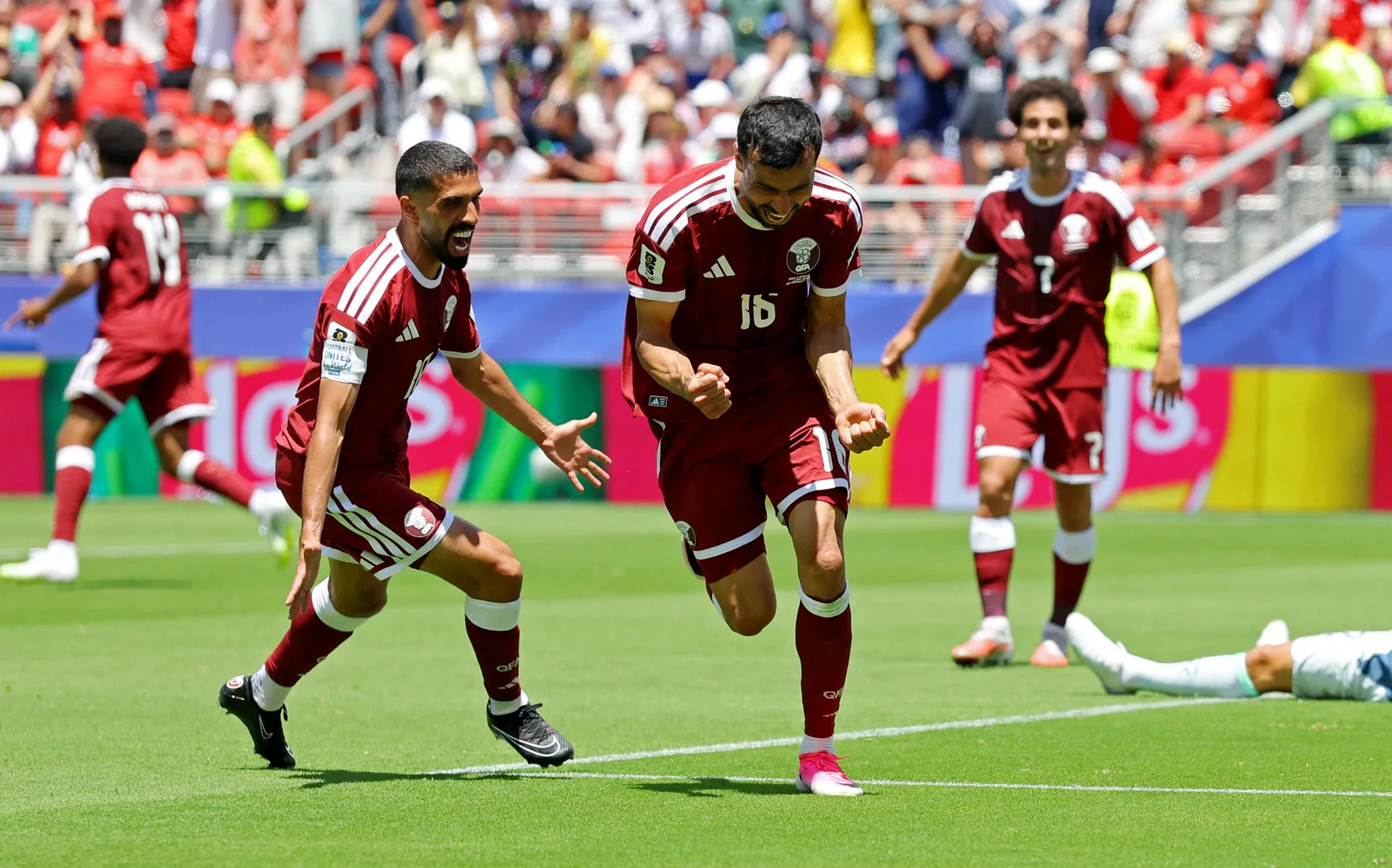
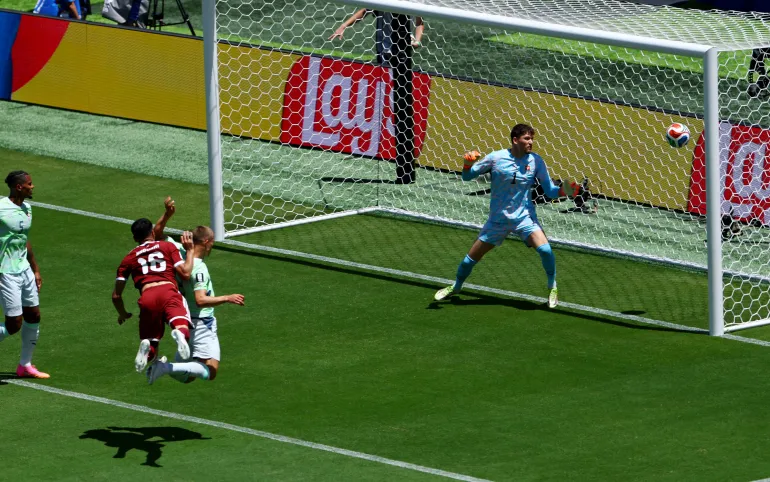
Boualem Khoukhi scored an equalising goal on a header in the fourth minute of stoppage time, and Qatar spoiled a dominant day by Switzerland in a 1-1 draw in Group B of the World Cup.
Several of the Qatari players fell to the ground on Saturday in celebration of the late goal, as others ran to each other to embrace.
Recommended Stories
list of 4 itemsend of list
Breel Embolo scored for Switzerland from the penalty spot in the first half just over a week after being cleared to enter the US following a visa delay, but the Swiss failed to capitalise on multiple other scoring chances.
In the 13th minute, Embolo was fouled by Qatar goalkeeper Mahmoud Abunada, who received a yellow card on the play. Abunada lay face down and appeared motionless for a couple of minutes before he began to move his legs and was able to stand up again.
When Embolo calmly sent his penalty into the upper left corner in the 17th minute, it sent the red-clad Swiss fans into a dancing frenzy in the stands of San Francisco Bay Area Stadium.
The 29-year-old forward applied for an urgent visa at the United States embassy in Bern on June 3, one day after he was denied boarding the team’s flight to travel for his third World Cup because of a 2018 criminal conviction that was only finalised in April.
Switzerland dominated the possession game on an unseasonably warm June afternoon — with sprinklers running during a first-half break.
Qatar’s Boualem Khoukhi scores their first goal past Switzerland’s Gregor Kobel [Eloisa Lopez/Reuters]
There were thousands of empty seats scattered throughout Levi’s Stadium, home of the NFL’s San Francisco 49ers. Brazil and Colombia drew 70,971 two years ago in a group match at the Copa America. The stadium in Santa Clara staged the Super Bowl only four months ago.
Switzerland goalkeeper Gregor Kobel made a save in the second minute after Edmilson Junior got through the defence for a one-on-one. Kobel corralled the ball again in the 90th on a close-range attempt by Ahmed Alaaeldin.
Switzerland is hoping to advance further than its round-of-16 showing four years ago before losing 6-1 to Portugal — when Goncalo Ramos delivered an improbable hat-trick playing in place of benched star Cristiano Ronaldo. The loss prompted Switzerland midfielder Xherdan Shaqiri to apologize the the fans.
The Swiss used consistency and experience to go unbeaten through qualifying against Sweden, Kosovo and Slovenia. Coach Murat Yakin’s team produced four wins and two draws to secure its sixth straight World Cup appearance and hasn’t missed one since 2002, but the team has never gotten beyond the quarterfinals.
Qatar, led by Spanish coach Julen Lopetegui, had to qualify through a playoff in November — beating the United Arab Emirates and Oman — after missing an opportunity from its group stage of Asian qualifying.
The Gulf state country became the first host nation to lose all of its group matches four years ago. It lost to Senegal, Ecuador and the Netherlands in the 2022 tournament, scoring its lone goal in a 3-1 loss to Senegal.
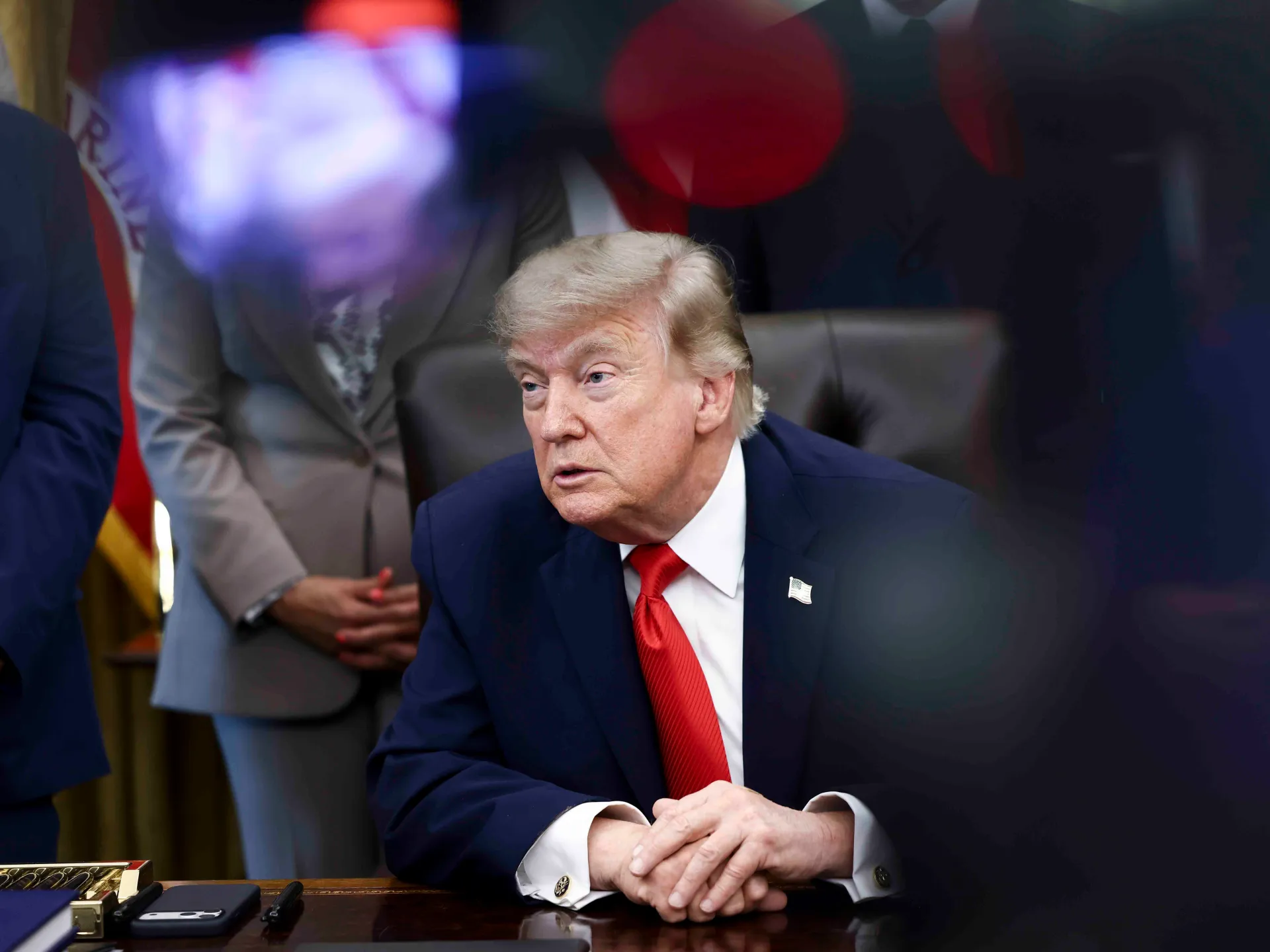
United States President Donald Trump has said an initial agreement to end the US-Israeli war with Iran is “scheduled to get signed tomorrow”.
But that announcement, made on Trump’s Truth Social account on Saturday, contradicts an earlier statement by Iranian Ministry of Foreign Affairs spokesman Esmaeil Baghaei.
Recommended Stories
list of 3 itemsend of list
In remarks carried by Iran’s IRNA news agency, Baghaei said a memorandum of understanding would not be signed on Sunday and that negotiators are not planning to travel immediately to Geneva, Switzerland, in preparation for such an event.
According to Baghaei, a signing could happen “in the coming days”.
Hours later, Trump wrote, “The Deal is scheduled to get signed tomorrow, and immediately after it is signed, the Hormuz Strait is OPEN TO ALL.” Sunday marks Trump’s 80th birthday.
In recent days, Iran and the US have repeatedly contradicted each other when describing the details of the anticipated agreement, even as both sides have broadly signalled that a deal was closer than ever before.
Still, no terms have been officially released, with US and Iranian officials on Friday stressing that the agreement had not been finalised.
Beyond opening the Strait of Hormuz, Trump said in Saturday’s post that the agreement would be a “A WALL TO NO NUCLEAR WEAPON!” and that “no money would exchange hands”.
Trump also maintained that “at the appropriate time, when all is calm, we will go in and get the Nuclear Dust”, referring to Iran’s stockpile of enriched uranium.
But speaking on Iran’s Press TV on Friday, Iranian Foreign Minister Abbas Araghchi said the initial memorandum of understanding would only be a launch point for negotiations about the future of Iran’s nuclear programme.
He added that the signing would result in an immediate pause in fighting, but that Iran and Oman would continue to administer the Strait of Hormuz.
The issue of lifting foreign sanctions against Iran and unfreezing the country’s assets would be discussed following the signing of the memorandum of understanding, Araghchi said.
From threats to diplomacy
The latest flurry of diplomacy came after the US and Iran traded strikes for two days this week, threatening to end a pause in fighting that has persisted since April 8.
The US and Israel launched the war on Iran on February 28, amid ongoing indirect talks on the future of Iran’s nuclear programme.
The US and Israel had also launched a 12-day war on Iran in 2025, during another round of nuclear talks.
Iranian officials have said that deep distrust towards the US has slowed the progress towards creating a lasting agreement to bring the current war to an end.
Trump, meanwhile, has repeatedly pledged to reach a deal that would surpass the 2015 Joint Comprehensive Plan of Action (JCPOA), struck under his Democratic rival, former President Barack Obama.
That agreement, from which Trump unilaterally withdrew in 2018, saw Tehran agree to limit its nuclear programme and allow for international inspections in exchange for sanctions relief.
For years, Iran has maintained that it is building a nuclear programme for civilian use only and is not seeking a nuclear weapon.
In his post on Truth Social, Trump again pledged that any deal reached would be more stringent than the JCPOA.
“Our relationship with Iran is a much different and better one than previous Administrations have had,” he said.
“Hopefully, this process will all work out quickly, easily, and smoothly,” he added.
“If it doesn’t, we have the ultimate alternative, hopefully never to be used again!” he wrote, without elaborating on what his threat meant.
Animal lovers in Gaza are resorting to desperate measures to keep their pets alive and healthy. Only two pet clinics are still operating, and critical veterinary supplies and animal food are running low. Vets are warning animal deaths will rise unless supplies arrive soon.
Israeli attack reportedly kills one person in central Gaza’s Bureij camp, as a disabled Palestinian is shot in the West Bank.
Published On 13 Jun 202613 Jun 2026
Israeli forces have carried out a deadly attack in a refugee camp in central Gaza, according to Palestinian media reports, as casualties continue to mount in the enclave despite a “ceasefire” declared months ago.
The Israeli drone attack in the Bureij camp on Saturday killed one person and injured two others, reported the Wafa news agency.
The Palestinian Information Center identified the person killed as Muawiya al-Aydi, a local municipality worker.
Further north, a separate Israeli attack injured a person at a gathering in Gaza City’s Tuffah neighbourhood, according to Wafa.
Despite a ceasefire technically in effect since October, Israel’s military has regularly attacked Gaza, over half of which is under Israeli military control in defiance of the ceasefire’s terms.
According to Gaza’s Health Ministry, at least two Palestinians have been killed and 11 injured in Israeli attacks on the enclave in the past 48 hours.
The ministry said 983 people have been killed and 3,122 injured in Israeli attacks since the ceasefire was declared.
Hamas has accused Israel of repeatedly violating the agreement through its continued attacks and by shifting the so-called “Yellow Line” that demarcates Israeli-controlled areas in Gaza.
“Israeli actions reflect its unwillingness to implement the ceasefire agreement and aim to blow up the negotiation track and thwart the efforts being made, while continuing escalation to serve political and electoral considerations,” said Hamas spokesman Hazem Qassem on Friday.
Disabled Palestinian shot, injured in West Bank
Israeli troops also carried out a series of violent raids in the occupied West Bank on Saturday, part of a pattern of near-daily operations since the Hamas-led attacks on Israel on October 7, 2023.
According to Wafa, Israeli forces deployed stun grenades and tear gas during two separate incidents near Bethlehem, causing numerous injuries: one during a raid on the Dheisheh refugee camp and the other while blocking access to the Solomon’s Pools reservoirs.
A disabled Palestinian man was also shot and injured in the town of Duma, near Hebron.
Wafa said Israeli forces shot the man, while Israeli media cited Israeli police as saying an Israeli settler was responsible. According to Israeli police, the settler felt threatened by the man who was carrying a rock.
Other Israeli settlers attacked Palestinians and vandalised property near Bethlehem, including assaulting Palestinian electrical workers and stealing water pipes, said Wafa.
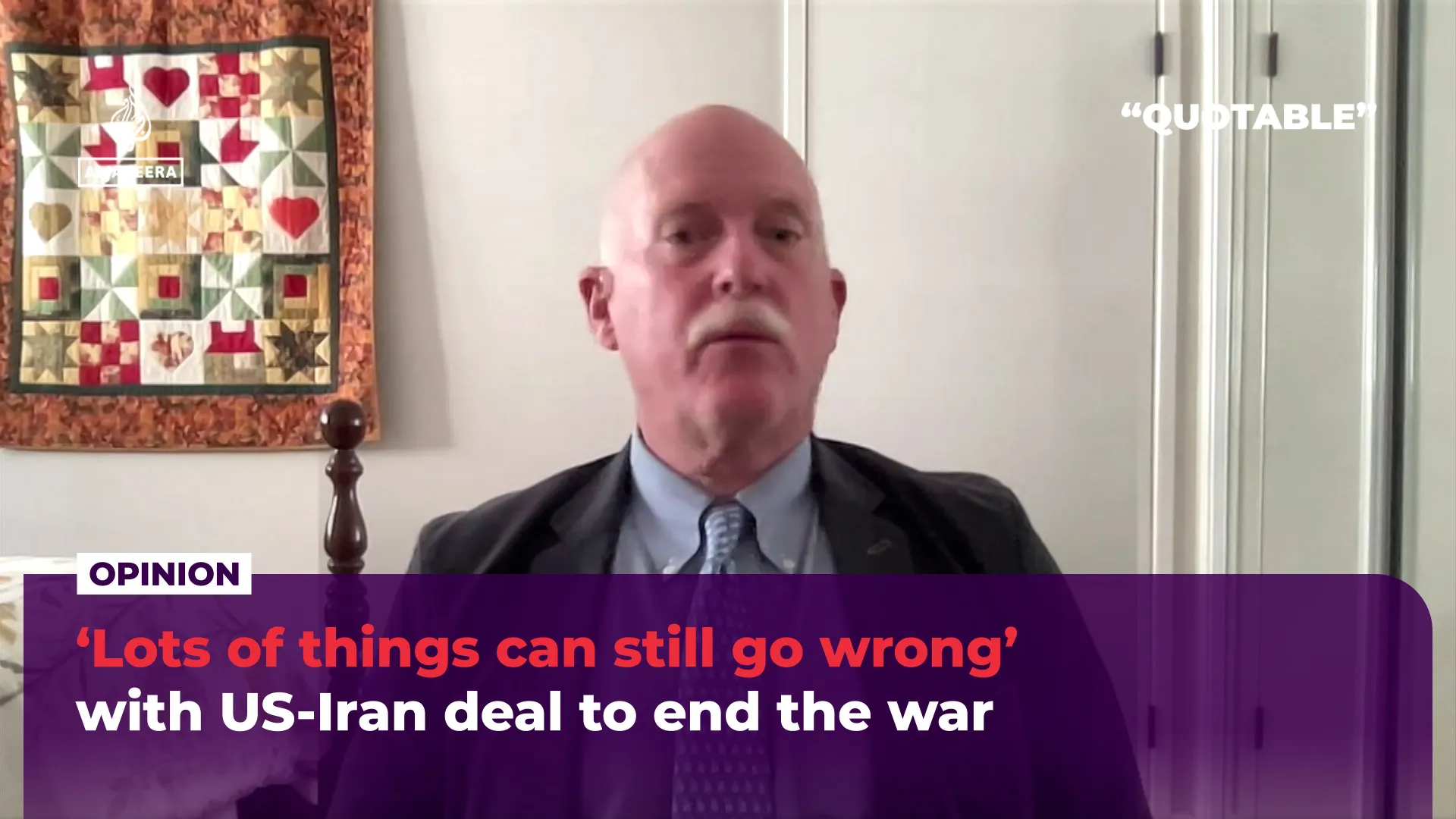
Henry Ensher, a former US ambassador, says the US–Iran agreement is not a final settlement but only the start of a process, with many ways it could still go wrong.
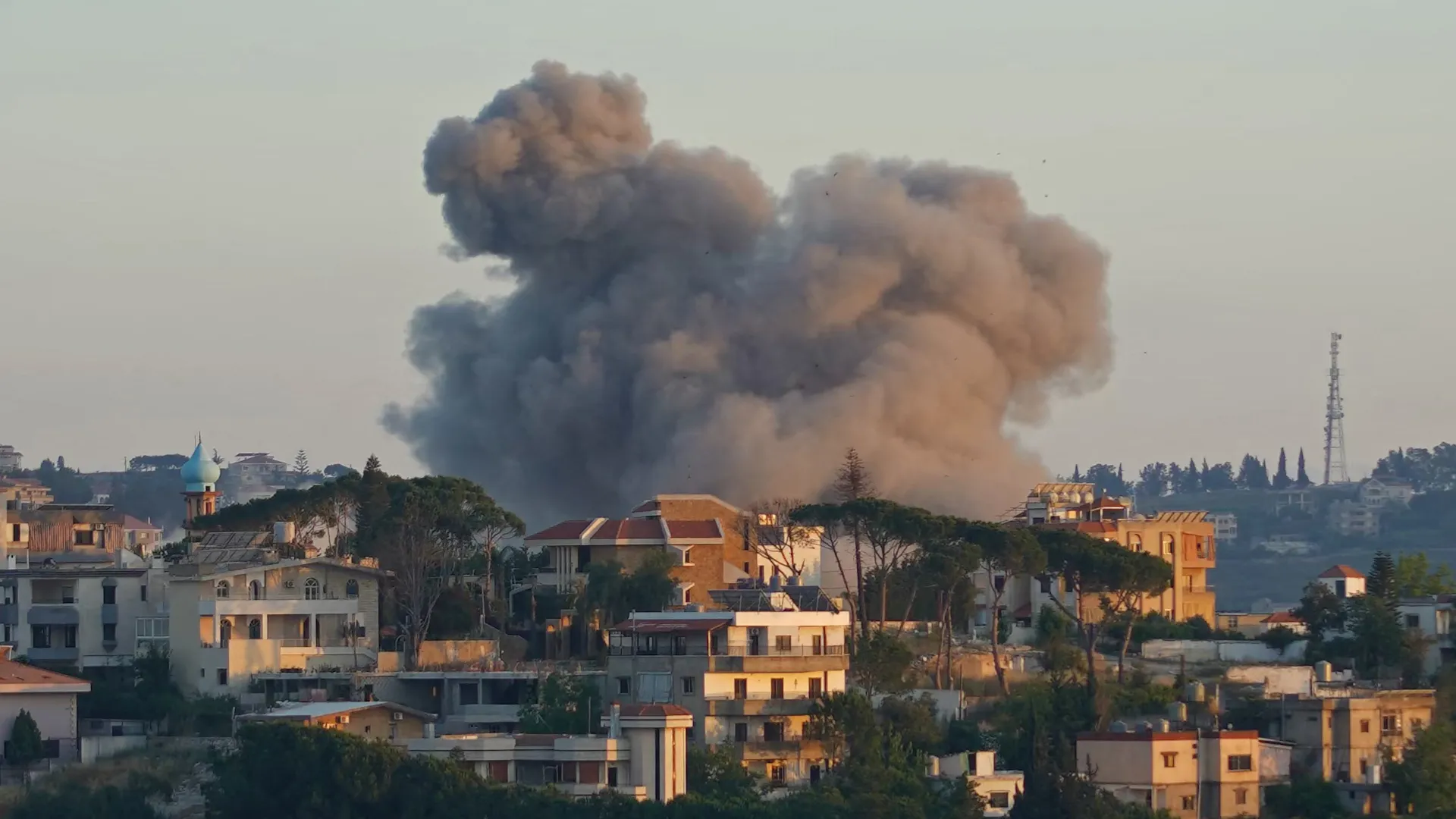
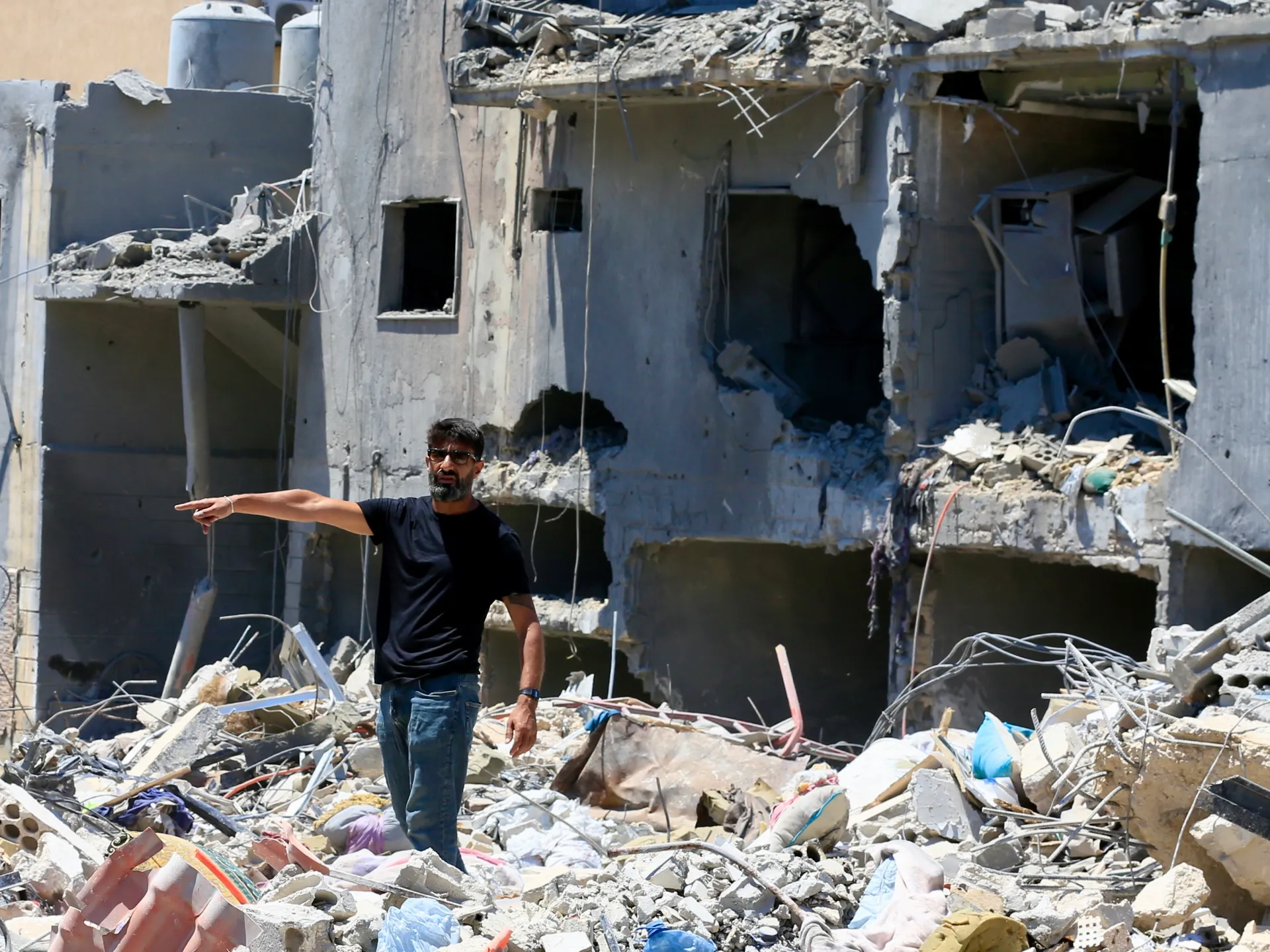
Israel has continued to attack Lebanon, despite Iran saying it was included in a potential memorandum of understanding with the US. Fresh forced displacement orders were issued on Saturday morning, following Israeli bombardment throughout Friday night on towns and villages in the south.
The World Cup continues on Saturday, with Brazil beginning their campaign and three more group-stage matches taking place across North America.
Brazil take on Morocco in the day’s biggest match, while Qatar face Switzerland, Haiti meet Scotland and Australia play Turkiye as more teams get their tournaments under way.
Recommended Stories
list of 4 itemsend of list
Away from the football, there has been plenty to talk about. Donald Trump skipped the United States’ opener, former Canadian Prime Minister Justin Trudeau was at the US game instead of Canada’s, and Ghana midfielder Thomas Partey will miss his team’s first match after Canada denied his visa application.
In Peru, police made headlines after carrying out a drug raid dressed as World Cup mascots.
Here is what to know:
What’s the World Cup schedule on June 13?
Qatar take on Switzerland at BC Place in Vancouver, with kickoff scheduled for 12pm local time (19:00 GMT).
The day’s action concludes with Haiti meeting Scotland at AT&T Stadium in Arlington, Texas. Kickoff is set for 8pm local time (01:00 GMT on June 14).
Australia and Turkiye then get Group D under way at Lumen Field in Seattle, with kickoff at 9pm local time (04:00 GMT on June 14).
What do the predictions say for Brazil vs Morocco?
Brazil and Morocco have only faced each other once before at a World Cup, with Brazil winning their 1998 group-stage meeting. Morocco got their revenge in a 2-1 friendly win in 2023.
Brazil have won seven of their eight World Cup matches against African opponents, with their only defeat coming against Cameroon in 2022.
The five-time champions have not lifted the trophy since 2002. Since then, they have usually exited in the quarterfinals, apart from their run to the 2014 semifinals.
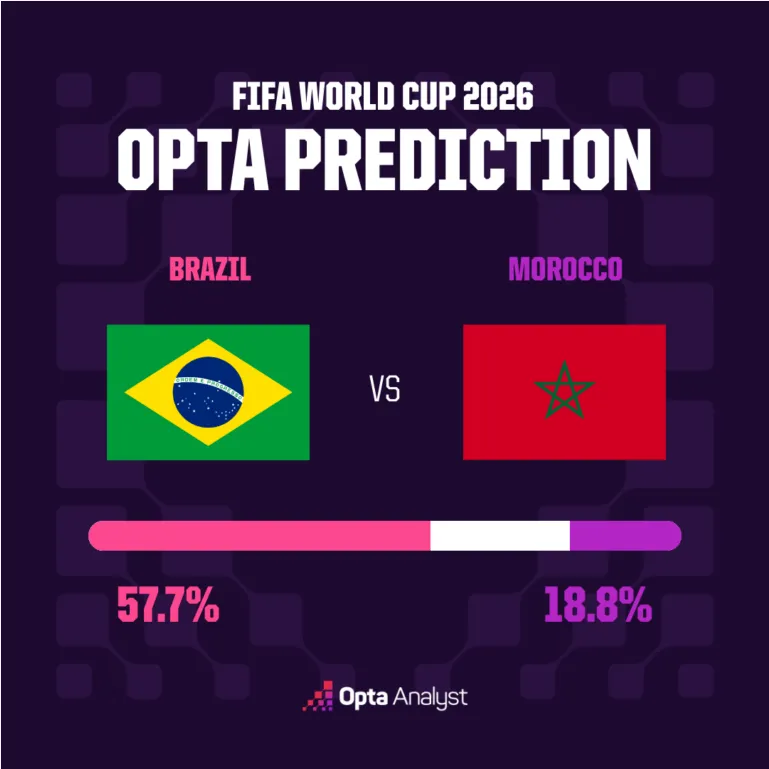
Opta’s 25,000 simulations give Brazil a 57.7 percent chance of winning. A draw happened in 23.5 percent of the projections, while Morocco won in 18.8 percent.
The winner could put themselves in a strong position to top Group C.
What do the predictions say for Qatar vs Switzerland?
Qatar and Switzerland have met only once before, with Qatar claiming a 1-0 friendly win in 2018 thanks to a late goal from Akram Afif. Afif is among nine players from that squad still in Qatar’s 2026 World Cup team, while Switzerland have seven survivors from that defeat, including Granit Xhaka and Remo Freuler.
Opta’s 25,000 simulations make Switzerland the clear favourites in this Group B clash, giving them a 76.0 percent chance of victory. Qatar won just 9.1 percent of the projections, while 14.9 percent ended in a draw.
A point would likely be considered a positive result for the Gulf side.
What do the predictions say for Australia vs Turkiye?
Australia and Turkiye have met only twice before, with Turkiye winning both friendlies in 2004. Turkiye have also won all four of their previous World Cup matches against Asian opponents.
Opta’s 10,000 simulations give Turkiye a 55.3 percent chance of victory, compared with 20.5 percent for Australia and 24.1 percent for a draw.
Neither side has a strong record in World Cup openers, however. Turkiye have lost both of their previous first matches, while Australia have lost five of their six opening games.
What do the predictions say for Haiti vs Scotland?
Haiti and Scotland have never faced each other before, making this one of several first-time matchups at the expanded 48-team World Cup. It will also be Haiti’s first-ever game against a team from the British Isles.
Opta’s 25,000 simulations make Scotland clear favourites, giving them a 59.0 percent chance of victory. Haiti won 19.2 percent of the projections, while 21.8 percent ended in a draw.
Haiti vs Scotland
What else is shaping the World Cup?
The football has only just started, but the World Cup is already making headlines away from the pitch, too.
Trump did not attend the US World Cup opener
The US president did not attend the US men’s national team’s World Cup opener against Paraguay in Los Angeles.
His absence drew attention because Trump has recently attended several high-profile sporting events, including Game 3 of the NBA Finals earlier this week. He is also expected to host a UFC event at the White House on Sunday.
A White House official said Trump instead plans to attend the World Cup final on July 19 at MetLife Stadium in East Rutherford, New Jersey.
The US president called into a USMNT team meeting with some words of support via Andrew Giuliani, the White House’s World Cup task force CEO.
Partey denied entry into Canada
Ghana midfielder Thomas Partey will miss his country’s World Cup opener against Panama after Canada denied his visa application while he awaits trial in the United Kingdom on multiple rape charges, which he denies.
FIFA confirmed on Friday that the 32-year-old would not be permitted to travel from Ghana’s base camp in Smithfield, Rhode Island, to Toronto for Wednesday’s match.
“His visa application has been refused by the Canadian government,” FIFA said in a statement.
“FIFA is not involved in the immigration processes of host countries, including the adjudication of visas. As with previous FIFA events, the host government ultimately determines who receives a visa and is admitted into the country.”
Trudeau attends the US’s World Cup
As Canada and the US kicked off their World Cup campaigns on the same day, former Canadian Prime Minister Justin Trudeau was in California rather than Toronto.
The 54-year-old did not attend Canada’s 1-1 draw with Bosnia and Herzegovina at BMO Field. Instead, he was at SoFi Stadium in Inglewood alongside pop singer Katy Perry, who performed during the pre-match opening ceremony before the US faced Paraguay.
Peruvian officers use World Cup mascot costumes in Lima drug bust
Peruvian police have gone viral after carrying out a drug raid in Lima dressed as World Cup mascots.
Video shared by police showed officers dressed as World Cup mascots breaking through a metal gate with a battering ram before entering the property.
Once inside, they arrested a suspected drug dealer and recovered weapons and bags of what authorities believe were narcotics.
The World Cup may be decided on the pitch, but another competition is already under way off it: Which host city has the best food?
In a report for Al Jazeera, Lou Browne travelled across North America to find out what fans can expect beyond the stadiums.
In Mexico City, taco vendors are hoping the tournament brings more customers. “Well, now the World Cup is coming, and we hope we’ll get customers,” a tortilla cook at El Califa de Leon told Al Jazeera. “I imagine there will be a lot of people, foreigners or locals.”
Philadelphia is proudly backing its famous Philly cheesesteak. Locals say visitors should learn how to order properly. “You want to tell them what kind of cheese you want,” Anthony Rossi, a cook at Geno’s Steaks, explained. “And you say if you want onions, which is ‘wit’ or ‘wit-out’ … Keep it simple.”
Across the border, Toronto is making the case for poutine, the Canadian dish of fries topped with gravy and cheese curds. “Poutine is the … not the best … dish, but poutine is from Canada,” said Lisa Deni, a French tourist.
In Kansas City, barbecue is a point of pride. “This is really good,” diner Camilla Thomas said. “We’ve been enjoying coming here. and bringing people from out of town here and giving them a little taste of Kansas City.”
And in Miami, locals insist the Cuban sandwich is a must-try. “The Cuban sandwich, croquetas, and cafecito are really the way to go,” said Daniel Figueredo, cofounder of Sanguich. “The Cuban sandwich really is the thing you have to have when you come to Miami.”
For fans travelling across North America this summer, the hardest choice may not be picking the World Cup winner, but deciding which host city serves the best food.
The Israeli military has ordered residents of 20 Lebanese towns and villages to leave their homes immediately.
By Al Jazeera Staff and Reuters
Published On 13 Jun 202613 Jun 2026
Israeli air raids across southern Lebanon have killed one person as attacks continue despite a United States-brokered “ceasefire”.
Lebanon’s National News Agency (NNA) reported that the person was killed in an Israeli air raid in the municipality of Maarakeh, in the Tyre district of southern Lebanon.
Recommended Stories
list of 4 itemsend of list
Al Jazeera’s Heidi Pett, reporting from Beirut, said that over the course of Friday and into the evening, there were continued Israeli air attacks on towns and villages that are well north of what the Israelis call the “Yellow Line” – the part of southern Lebanon that they have been seeking to control and to occupy.
The attacks come after an announcement by Pakistani Prime Minister Shehbaz Sharif on Friday that the United States and Iran have agreed on the wording of an agreement aimed at ending their war, and that mediators were working with both sides to finalise a deal.
Iranian media report the initial agreement would declare an end to the war “on all fronts, including Lebanon”.
This has led to fears that Israel’s actions in Lebanon could scupper a deal, since Israel is not a party to the negotiations between the US and Iran, and its leaders have said they do not plan to withdraw from Lebanon.
The attacks also come amid a supposed ceasefire, agreed between Israeli and Lebanese officials earlier this month, that would require a “complete cessation” of fire by Hezbollah, yet the fighting continues.
The next round of talks between the two countries is expected on June 22, with a view towards reaching a comprehensive agreement.
Israel issues forced displacement orders, demolishes homes
Israeli attacks at dawn have demolished homes and government buildings in southern Lebanon’s Bint Jbeil, the country’s NNA reports.
The Israeli military also ordered residents of 20 Lebanese towns and villages to leave their homes immediately and move “north of the Zahrani River”.
The forced displacement orders apply to Deir al-Zahrani, al-Namirieh, al-Sharquieh, al-Dewayr, Harouf, Habboush, Kfarjoz, Zibdine (Nabatieh), Nabatieh al-Tahta, Nabatieh al-Fawqa, Kfar Rouman, Al-Mahmoudieh, Sajed (Jezzine), Reihan, Aaramta, Kfarchouba, Mlki, Al-Lawiza (Jezzine), Jarjouh and Arab Salim.
On Saturday, the Israeli military said an air raid alert had been activated in the northern town of Metula due to the “infiltration of a hostile aircraft” from Lebanon, but did not name the armed group Hezbollah.
The United Arab Emirates has agreed to unlock billions of dollars for Iran, pursuing a tactical shift after weeks of Iranian attacks on the wealthy Gulf Arab state amid its ongoing war with the United States and Israel, four sources told the Reuters news agency.
The report on the move coincided with the final stages of broader negotiations between Tehran and Washington to end the war. Diplomats say those talks involve the release of tens of billions of dollars in Iranian oil revenues frozen in foreign banks under US sanctions.
Recommended Stories
list of 3 itemsend of list
Two regional sources told Reuters that the UAE had agreed to release a total of $10bn, more than $3bn of which had already been delivered.
Two other sources with knowledge of the arrangement put the total funds involved at $20bn, adding that the move had been agreed in return for a halt to Iranian attacks on the UAE.
One of the sources with knowledge of the arrangement also said a first tranche of $3bn had already been made available.
Reuters could not establish whether the funds earmarked for the transfers belong to the UAE or originate in long-blocked Iranian accounts in the UAE banking system, or elsewhere.
But a UAE official, asked to comment on the transfer, said the country was trying to ease tension and foster peace.
“The UAE’s foreign policy is guided by promoting de-escalation and reducing tensions across the region, while advancing lasting peace and stability,” the official said.
“The UAE supports efforts, including those undertaken by the United States, to protect the peoples of the region from the repercussions of conflict.”
The White House did not immediately respond to Reuters’s request for comment on the move.
‘Red line’ workaround
Earlier on Friday, Vice President JD Vance said that frozen funds would not immediately be released to Iran upon signing a deal with the US.
He said the potential deal is structured to ensure that economic benefits would flow to Tehran if it meets its obligations.
There was no immediate response from Iranian authorities to a Reuters request for comment on the move.
None of the sources cited by Reuters would agree to be identified due to the sensitivity of the matter.
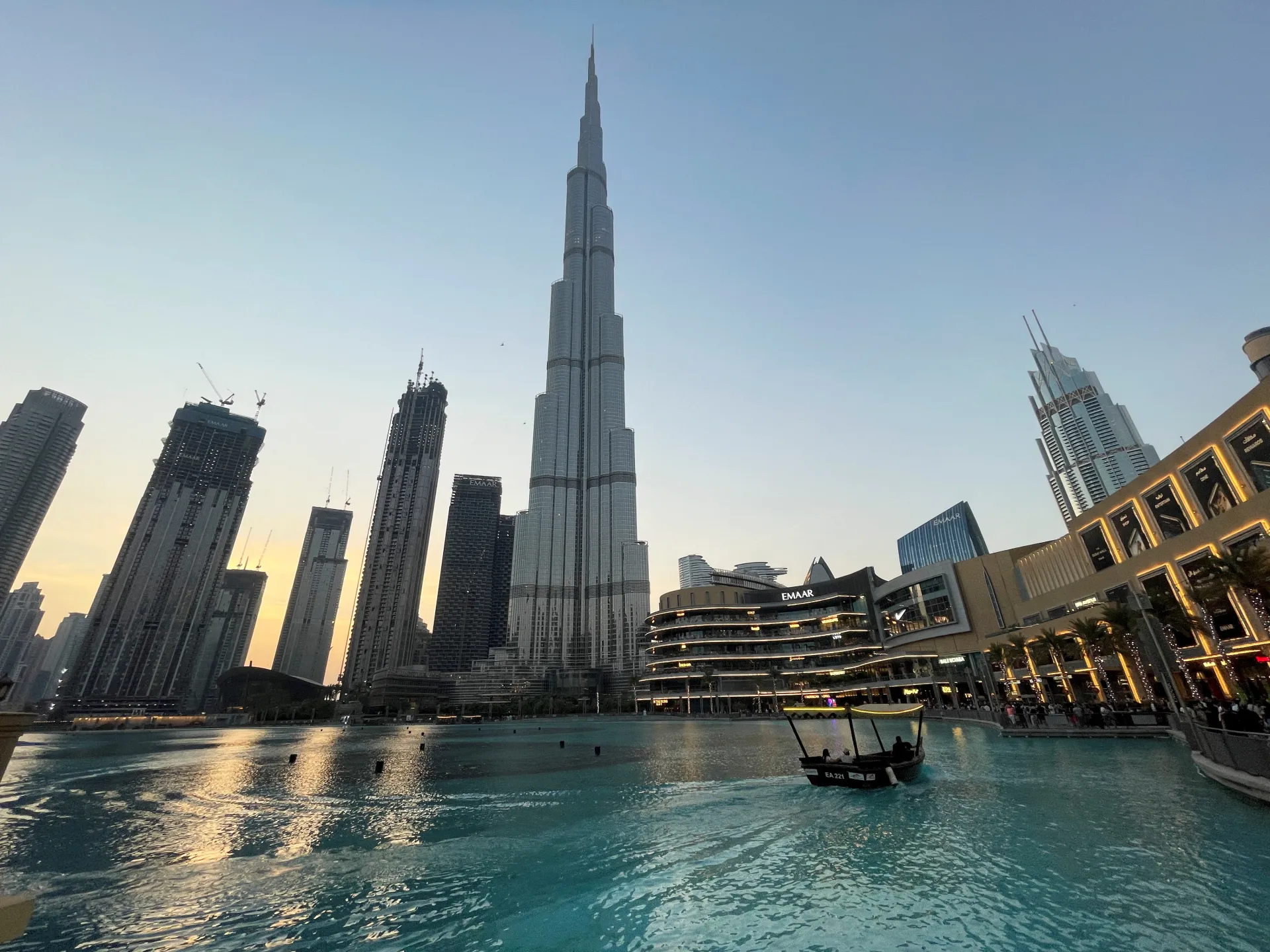
The arrangement signals a striking pivot from the open animosity of UAE-Iran relations through much of the war, when Iranian attacks emptied Dubai’s hotels, drove some expatriates to flee and shook the reputation for safety that is central to the country’s position as a premier business hub.
One of the sources with knowledge of the arrangement said the move offered a way to help solve the conflict between the US and Iran without either side crossing its red line. Iran can claim it extracted compensation for war damages. Washington can insist it paid nothing.
Abu Dhabi, meanwhile, obtains its own security and protects Dubai’s hub status, while framing the move as an investment in rebuilding regional trust.
The other source with knowledge of the arrangement said that in return for the disbursement, Iran would halt missile and drone attacks on the UAE, and there would be a rebuilding of bilateral ties, including intelligence sharing and economic cooperation.
The source added that Iran had approached at least two other Gulf Arab countries to make a similar arrangement.
The last known direct attack by Iran on the UAE was more than a month ago – a May 4 strike on the Gulf state’s Fujairah port on the Gulf of Oman.
The first source with knowledge of the arrangement said talks had started several weeks ago but quickened pace when officials of Iran’s powerful Revolutionary Guard visited Abu Dhabi last week to meet Sheikh Tahnoun bin Zayed al Nahyan, the UAE’s national security adviser and deputy ruler of Abu Dhabi, and stayed at his guest house.
That trip was followed by a visit by UAE officials to Tehran to negotiate the details of the mechanism.
Frozen funds
Dubai’s banks have long held substantial Iranian-linked deposits, much of them now immobilised under US sanctions that police the global dollar-clearing system and expose any foreign bank dealing with blacklisted Iranian entities to being cut off from the US financial network.
On April 11, a senior Iranian source told Reuters that the US had agreed to release Iranian frozen assets held in Qatar and other foreign banks, although a US official swiftly denied the assertion.
The source, who declined to be named due to the sensitivity of the matter, said that unfreezing the assets was “directly linked to ensuring safe passage through the Strait of Hormuz”, a key issue in talks aimed at ending the conflict.
As Washington and Tehran move towards a long-term ceasefire agreement, Gulf states will likely look for new long-term security solutions when a war in their region – which they did not start – finally ends.
It comes as United States President Donald Trump cancelled new strikes on Iran saying that a deal with Tehran was imminent, and that a “time” and “place” for signing would soon be announced.
Recommended Stories
list of 4 itemsend of list
In Tehran, officials appeared more cautious with one senior Iranian official telling Al Jazeera that the government was still reviewing a proposed Memorandum of Understanding with Washington.
Subsequent comments by Pakistan Prime Minister Shehbaz Sharif point to a deal being made, and what follows in the coming days could have important implications for collective regional security.
Attacks on the Gulf
The United States operates military facilities in at least 19 locations across the MENA region, including permanent bases in Bahrain, Egypt, Iraq, Jordan, Kuwait, Qatar, Saudi Arabia and the United Arab Emirates, according to the Council on Foreign Relations. Between 40,000 and 50,000 US troops were stationed across the region before the war on Iran started.
This US-Gulf nexus appeared to insulate states from conflicts engulfing other parts of the region, but over the past four months, Gulf states hosting US military facilities have been targeted by Iran.
“If there is a way to describe the prevailing security model in the region since the 1980s, the concept of security partnerships best encapsulates it,” said Mahjoub Al-Zuwairi, an academic and expert on Middle East politics.
“The countries of the region have chosen to align their security with broad international alliances. For decades, this model has provided a reasonable deterrent and logistical and intelligence depth that is difficult to replace.”
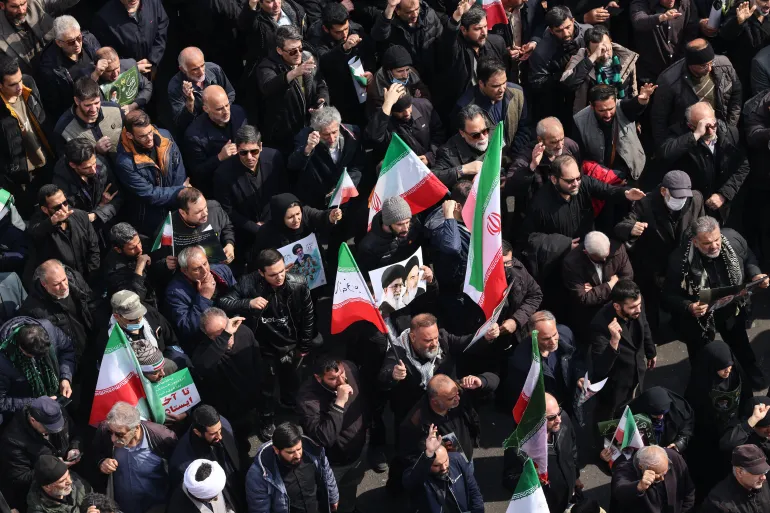
Iranians in Tehran at the funerals of Iran’s Revolutionary Guards Corps (IRGC) commanders, army officers and others killed in the early days of the United States and Israeli strikes on Iran, March 11, 2026 [AFP]
A security umbrella with holes
The war on Iran has exposed a paradox – while Iranian officials have repeatedly referred to their Gulf neighbours as “brothers”, they have also repeatedly targeted them during the war.
Despite the protestations of Gulf states that no attacks on Iran were launched from their soil, they have been repeatedly targeted.
“Just the war itself has pierced that sense of security, the US security umbrella is moribund at worst, or ineffective at best,” Simon Mabon, professor of international relations at Lancaster University, told Al Jazeera.
“They’ve long relied on it for their own security. Yet the presence of US forces on their territory directly meant they became targets. They can’t escape their geography [and] despite the tensions, despite the hostilities, despite the attacks, Iran isn’t going away. They have to find a way of dealing with this reality.”
The economic cost of war
The closure of the Strait of Hormuz has proven be a setback for some Gulf states working to diversify their energy-reliant economies towards tourism, services and finance, but not all have been affected equally.
Saudi Arabia was able to redirect some oil exports through its East-West pipeline to the Red Sea, while Oman – whose main ports are outside the Strait of Hormuz – has also benefited from rising energy prices.
The UAE, Bahrain, Kuwait and Qatar have been more heavily affected due to their dependence on the waterway for their energy exports, but the war has encouraged new thinking on long-standing security and economic arrangements.
“There are new pipelines being set up, but the capacity of these alternatives is infinitely smaller than the Strait itself,” said Mabon. “It will take enormous investment and years of development before they can come close to replacing it.”
Moving closer to Iran?
One possible lesson from the conflict is that Gulf states may seek engagement with Iran rather than confrontation, something that Gulf states had already made some groundwork on before the US-Israel war began.
Al-Zuwairi says that the conflict could revive plans for MENA-led regional security arrangements, as envisioned in the 2019 Hormuz Peace Initiative, which proposed a Gulf security framework involving Iran, Iraq and the six GCC states.
But the distrust fostered since then – notably Tehran’s strikes on its Gulf neighbours – would make such a formation unlikely in the near future.
“The recent war has opened the door wide to reconsidering the Gulf security system with its neighbours,” Al-Zuwairi said.
“How can Tehran propose a non-aggression pact while raining missiles on neighbouring cities? The initiative appears theoretically sound but practically bankrupt unless Iranian behaviour changes.”
Looking beyond Washington?
The solution for the Gulf could be a hybrid arrangement where ties with Washington are maintained, but other regional and domestic options are explored, including greater investment in local defence industries.
A possible blueprint for this could be the mutual defence agreement between Saudi Arabia and Pakistan last September, stating that an attack on one country would be considered an attack on both.
Yet previous instances when Gulf states felt abandoned by the US have led to divergent responses, with the UAE and Bahrain deepening ties with Israel, but a new paradigm means that a more collective action to the issue of security might be considered.
“The war has demonstrated that every guarantor, no matter how many banners it flies, primarily protects its own interests,” said Al-Zuwairi.
“The region ends up paying the price for a war it did not choose … The security of the Gulf will not be created in Washington … It will be created when Gulf countries recognise that they must build it themselves, because when fires start, it is always those closest to the flames who pay the price.”
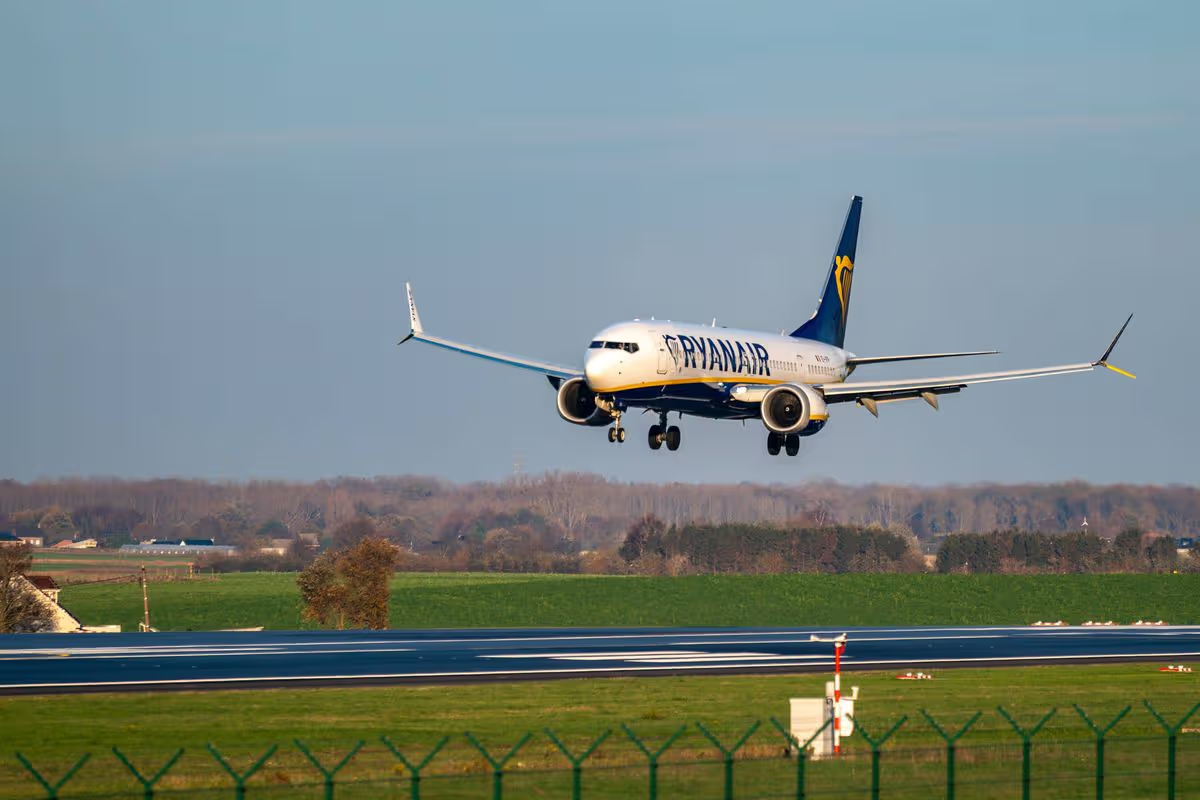
Ryanair is threatening to withdraw five aircraft and cancel 20 routes
The move could happen as early as this winter(Image: Michael Mulkens via Getty Images)
A major Ryanair move could impact millions of passengers, with 20 routes axed and around 150 jobs lost.
The budget airline could withdraw planes from its Charleroi base as soon as this winter if Belgium goes ahead with plans to double its tax on airline tickets. “But we are not going to completely close the Charleroi base,” said Ryanair CEO Michael O’Leary during a press visit to the company’s headquarters in Dublin. The federal government is looking to double the airfare tax on flights exceeding 500 kilometres from next year, pushing it up from 5 to 10 euros.
This would bring the levy in line with that applied to short-haul flights, although the tax on these is also set to rise to 11 euros. Finance Minister Jan Jambon made clear this week that he has no plans to reverse the decision.
As a result, Ryanair would remove five of its 19 aircraft currently operating out of Charleroi from this winter. Twenty routes would be scrapped, 15 at Charleroi and five at Zaventem representing a loss of two million passengers per year, Mr O’Leary confirmed.
Ryanair warns that scaling back its Charleroi operations would also put approximately 150 jobs at risk, though affected pilots and cabin crew, many of whom are foreign nationals, would be offered positions at alternative bases. However, “we want to grow in Belgium,” Mr O’Leary said.
“Ryanair aims to increase passenger numbers from 208 million in 2025 to 300 million in the coming years. We want to achieve some of this growth at Charleroi and Zaventem, but for that to happen, the tax on airline tickets must be eliminated, and airport fees must be reduced.”
According to Ryanair’s chief executive, if the tax on airline tickets is not raised, no aircraft will be withdrawn from Charleroi Airport and the situation will remain unchanged. Should the tax be scrapped entirely, it would open the door to further expansion across Belgium.
Ryanair has put forward a growth strategy projecting almost 50% more passengers in Belgium by 2030, pushing the total to 16 million. The Irish carrier would then reopen its base at Brussels Airport, a hub it continues to operate from but where it no longer stations any aircraft, and would even weigh up flights to and from Liège.
This ambitious expansion plan will only come to fruition, however, if all of Ryanair’s demands are met, most notably a loosening of restrictions on night flights in Brussels. On the flip side, any hike in the airline ticket tax would result in a scaling back of operations.
The closure of the Charleroi base isn’t under consideration, though. “Normally, we would never close Charleroi,” said O’Leary. “We’re not going to threaten to close Charleroi. It’s one of our largest bases, and we’ve invested a lot of time and effort in developing this airport over the last thirty years. But in the long term, we could reduce the base to, say, 10 aircraft.”
O’Leary also touched on the soaring cost of aviation fuel, a result of the conflict in the Middle East. The airline has locked in 80% of its fuel requirements until next March at an average cost of $67 per barrel, while the current rate stands at $100 or above.
“We aren’t hedging for the following period yet, as we anticipate prices falling in the coming months. But we could be wrong. If prices haven’t fallen by September, we’ll start to worry.”
With consumer uncertainty prevailing, O’Leary doesn’t expect any fare rises this summer. “Fares should remain stable. We need to incentivise people to travel by offering slightly lower prices” than the 3% to 5% increase that had been forecast.
Trump cancels planned Iran attacks, saying talks are close as Tehran reviews a proposed US deal.
Published On 12 Jun 202612 Jun 2026
United States President Donald Trump said he had cancelled a third straight night of planned attacks on Iran, saying talks with Tehran were close to producing a deal.
The announcement marked a dramatic turnaround. Just hours earlier, Trump warned that Iran would be hit “very hard” and threatened to target Kharg Island and other oil facilities.
Reporting from Tehran, Al Jazeera’s correspondent said a senior Iranian official confirmed that a proposed memorandum of understanding with the US was being considered by Iran’s top leadership.
Here is what has happened:
In Iran
Trump calls off planned Iran attacks: Hours after warning that Iran would be hit “very hard” and threatening attacks on Kharg Island and other oil facilities, Trump said he had cancelled the planned strikes, claiming negotiations had reached a breakthrough. In a Truth Social post, Trump said discussions had been elevated to Iran’s top leadership and that the “final points” of an agreement had been approved by all parties involved, including the US and several regional allies.
Tehran says the sacrifices of war were worth it: Reporting from Tehran, Al Jazeera’s Mohamed Vall said many Iranians would be relieved to see the conflict end after months of hardship and loss. But the government is also trying to sell a potential deal as a victory, telling people that “it is worth the suffering” because Iran could come out of the war “in much stronger shape”, with the possibility of sanctions being lifted and assets being unfrozen.
In the US
Expert says Trump used an ‘escalate to de-escalate’ strategy: Richard Weitz, an international security expert at the NATO Defense College, told Al Jazeera that Trump’s threats to intensify the conflict may have been aimed at forcing a diplomatic breakthrough. The strategy, he said, is to “threaten to escalate” a conflict “in order to force an end to it”. However, Weitz cautioned that “we still have a bit of uncertainty over what precisely was agreed and how it will be implemented.”
Trump has tried to hold Netanyahu back in recent weeks: Reporting from Washington, DC, Al Jazeera’s Kimberly Halkett said Donald Trump and Israeli Prime Minister Benjamin Netanyahu have long had “a shared desire to limit Iran’s nuclear programme” and ensure Tehran never obtains a nuclear weapon. But she said there was a “growing concern” within the White House that Netanyahu could “derail efforts in the diplomatic realm”, with Trump increasingly trying to restrain the Israeli leader and, in the US president’s words, “allow time for diplomacy”.
In Lebanon
Hezbollah says it carried out 24 attacks on Israeli forces: The Lebanese armed group said it launched a series of drone, missile and rocket attacks on Israeli soldiers, armoured vehicles and military positions across southern Lebanon and the Bekaa Valley between Wednesday and Thursday. Hezbollah said it repeatedly struck troop concentrations near Tayr Harfa, while also attacking Israeli forces in Naqoura, al-Qaouzah, Rashaf, Qantara, Zawtar al-Sharqiyah and Yohmor al-Shaqif.
Both Amnesty International and Oxfam released reports this week documenting a rise in state-backed Israeli settler violence across the occupied West Bank over the past three years. What’s driving the escalation? Al Jazeera’s Marah Rayan breaks it down.
Israel continues to expand settlements in the occupied territory, which are illegal under international law.
Published On 11 Jun 202611 Jun 2026
The Israeli government has allocated a first tranche of an expected $388m in new funds for the construction of settlements in the occupied West Bank.
The anti-settlement group Peace Now reported on Thursday that the government had allocated 152 million shekels ($51m) to prepare construction plans for 69 illegal settlements and outposts in the occupied West Bank.
Recommended Stories
list of 3 itemsend of list
The cabinet later reportedly postponed a decision about a 1-billion-shekel ($338m) allocation. That proposal, if passed, would mark one of the largest expansions of illegal Israeli settlements in decades.
“The government decided to postpone the decision [on the 1-billion-shekel allocation] and refer it to the Security Cabinet which is expected to convene on Sunday,” Peace Now wrote.
Under the yet-to-be-approved plan, construction for the settlements, including infrastructure and public buildings, would begin despite necessary planning protocols not having been carried out in accord with Israeli law.
Peace Now accused the government of intending to bypass planning and construction regulations.
“October 7 proved that the right-wing approach has failed: the conflict cannot be ‘managed,’ and the Palestinians cannot be ‘defeated’,” the group said in a statement.
“Israel must reach a political solution and diplomatic agreement, but instead the government is only sinking us deeper into the mire and condemning us to many more years of bloody conflict.”
Israel has come under growing condemnation for expanding settlements in the occupied West Bank, which are illegal under international law.
On Tuesday, the United Kingdom, Australia, New Zealand, Canada, France and Norway imposed sanctions on networks involved in financing, enabling and carrying out settler violence against Palestinians.
According to Peace Now, the current Israeli government has approved 103 settlements since it took office in December 2022. From that figure, 51 are entirely new settlements.
On Wednesday, Amnesty International published a report accusing the Israeli government of playing a central role in what it describes as the ethnic cleansing of Palestinians in the occupied West Bank. The report described the government’s actions as “integral”.
At least 117 villages in the West Bank have been subject to either complete or partial displacement due to settler attacks, according to the United Nations Office for the Coordination of Humanitarian Affairs (OCHA).
Amnesty also condemned the upcoming “Great Israeli Real Estate Event”, which is due to take place in London on Sunday.
The event, which has also been held in the United States and Canada, promotes the sale of properties in the occupied West Bank, which campaigners say is in violation of international law.
The Washington institution cut its global growth forecast by 0.4 percentage points to 2.5 percent, citing surging energy prices, inflation and borrowing costs.
Published On 11 Jun 202611 Jun 2026
The conflict in the Middle East is set to bring global economic growth to its slowest since the COVID-19 pandemic, the World Bank has warned.
In its latest Global Economic Prospects report, published on Thursday, the Washington-based institution cut its global growth forecast for 2026 to 2.5 percent from the 2.9 percent it had predicted in January, citing surging energy prices, rising inflation and higher borrowing costs.
Recommended Stories
list of 3 itemsend of list
The report highlights the significant economic costs of the conflict, which is at risk of flaring up again, as the fragile ceasefire between the United States and Iran is tested on both sides.
The analysis warns that the outlook could decline further if supply disruptions worsen. Iran’s closure of the Strait of Hormuz – a vital passageway for oil and gas transit – in response to the hostilities launched by the US and Israel has put huge stress upon global energy and other supply chains.
The World Bank estimates that Brent crude prices — the international oil benchmark — will average $94 a barrel this year, 36 percent above last year’s average. Fertiliser prices are forecast to increase significantly this year, with knock-on effects for food prices.
Overall, the closure of the strategic waterway will help to push global inflation to 4 percent this year, a substantial increase from last year’s rate of 3.3 percent.
However, the World Bank cautions that global growth could plummet to as low as 1.3 percent this year, should energy supply disruptions worsen, with inflation pushing to 4.4 percent.
The World Bank report also cautions that developing countries are on the front line of the potential impact.
In its report, the institution has downgraded its growth forecasts for two-thirds of countries since January. Global growth is expected to improve to 2.8 percent in 2027, but will remain 0.4 percentage points below the average during the 2010s, during which the world economy was recovering from the global financial crisis.
Excluding China and India, the report worries that developing countries have made little progress towards narrowing their per capita income gap with wealthy nations over the past decade.
“Developing countries have faced a series of challenges over the last decade,” said Ajay Banga, president of the World Bank Group. “The impact differs by country, but the basic test is the same: protect people and preserve stability today, without giving up on growth and jobs tomorrow.”
The World Bank is pledging to assist any developing country experiencing the economic fallout of the Middle East conflict. The organisation says it has set aside up to $60bn to help. It added that if the conflict persists, it can increase its support to $100bn.
Four activists from the Palestine Action group face sentencing in the United Kingdom as “terrorists” on Friday, despite only being convicted by a jury of other criminal charges.
Palestine Action was formally proscribed as a “terrorist” organisation in the UK last July.
Last month, four of six activists on trial were convicted at Woolwich Crown Court in London of criminal damage during a 2024 raid on a factory in Filton, Bristol, operated by Israeli defence firm Elbit. One of the defendants was also found guilty of striking a police officer with a sledgehammer.
The possibility that the judge will rule that the offences have a “terrorist connection” for sentencing purposes has prompted protests.
What is Palestine Action?
The protest group Palestine Action, launched in July 2020, describes itself as a movement “committed to ending global participation in Israel’s genocidal and apartheid regime”.
It seeks to use “disruptive tactics” to target “corporate enablers” and companies involved in the manufacture of weapons for Israel, such as Israel-based Elbit Systems, Italian aerospace company Leonardo, French multinational Thales and Teledyne from the United States. The group has targeted British facilities linked to those companies.
The UK parliament voted in favour of proscribing the group on July 2, 2025, classifying it as a “terrorist” organisation, and bringing it into the same category as armed groups such as al-Qaeda and ISIL (ISIS). The proscription came days after its activists sneaked into an air force base in southern England.
Critics decried the move by MPs, arguing that while members of the group have caused damage to property, they have not committed violent acts that amount to terrorism.
What were they convicted of?
In August 2024, Palestine Action activists raided a factory in Filton near Bristol in southwest England, operated by Israeli arms manufacturer Elbit Systems. They entered the site and caused extensive damage in an attempt to disrupt the production of weapons and drone components they say would be used by Israel in Gaza.
The raid, which prosecutors said caused about one million pounds ($1.36m) of damage, happened 10 months into Israel’s genocidal war on Gaza that began in October 2023.
Last month, jurors at Woolwich Crown Court convicted Charlotte Head, 30, Samuel Corner, 23, Leona Kamio, 30, and Fatema Zainab Rajwani, 21, of criminal damage. The four activists have become known as “the Filton 4”.
Corner was also found guilty of striking a police officer with a sledgehammer and convicted of inflicting grievous bodily harm.
Two other Palestine Action activists, Zoe Rogers, 22, and Jordan Devlin, 31, were found not guilty.
The verdict followed an earlier trial, at which all six defendants were acquitted of aggravated burglary, while the jury was unable to reach verdicts for the criminal damage charges.
Each of the defendants gave evidence, admitting that they damaged Israeli military drones and equipment inside Elbit’s research and development facility in Filton – in order to “save lives in Palestine”, according to a statement by their lawyers.
What would a terrorism sentencing mean?
The jury was not told that, if they convicted, the four could be sentenced under terrorism laws. Criminal damage is not usually a terrorism offence, but in England and Wales judges can decide to treat an offence as having a “terrorist connection” at sentencing, even when the charge itself is not a terrorism offence.
If the court decides there was a terrorism connection, the activists would have to serve their entire sentences in prison, unless they have already completed at least two‑thirds of the sentence and a parole board decides they can be released.
Conversely, non-terrorist prisoners usually serve about 40 percent of their sentence in custody and are released early, but under conditions and supervision, sometimes called licence conditions. If they break those conditions, they can be sent back to prison to finish their sentence.
Additionally, if the activists are sentenced in this way, they can be recorded as “terrorists” for the rest of their lives, would be required to register new mobile devices, email addresses and bank accounts with the police for their lifetime, and face being returned to prison if they breach their licence conditions or reoffend.
What has the reaction to all this been?
On Wednesday, a group of more than 50 lawyers and law professors published an open letter denouncing plans to sentence the four Palestine Action members as terrorists.
The letter highlights that damage to property has been a recurring feature of protest campaigns from the Suffragettes who fought for women to have the right to vote, to environmental protest group Extinction Rebellion.
“It has never previously even been suggested that those taking such action should be treated as terrorists. Blurring the distinction between principled direct action and terrorism is the hallmark of authoritarian regimes,” the open letter stated.
The letter has been signed by law professors from universities in the UK, the Netherlands, Norway and Canada as well as by dozens of practising barristers and solicitors.
According to local news reports, a protest is expected at Woolwich Crown Court on Friday against the potential judgement.
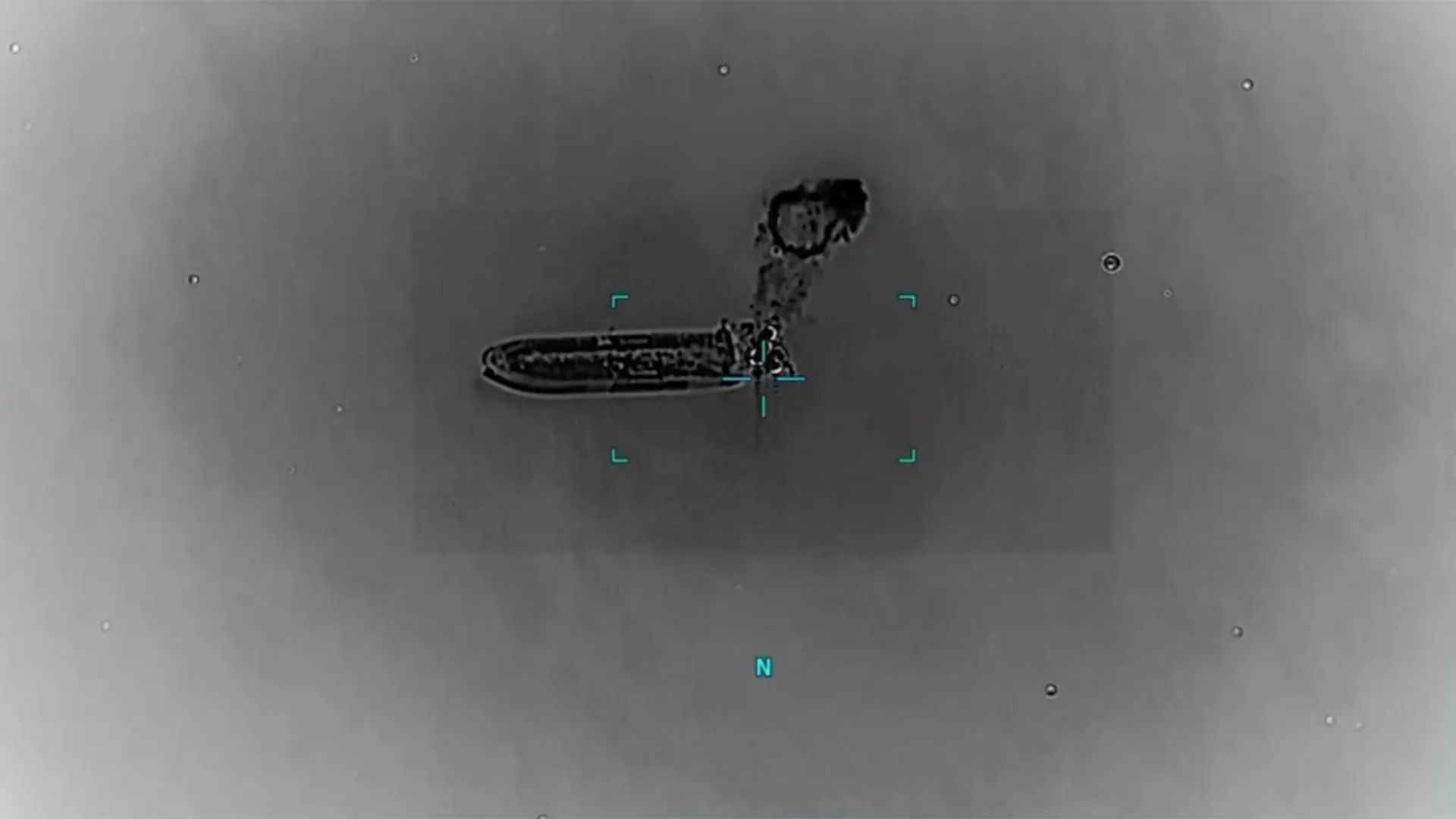
A US strike on an oil tanker accused of transporting Iranian oil has killed three Indian sailors. It was the second attack in three days on a ship carrying crew members from India.