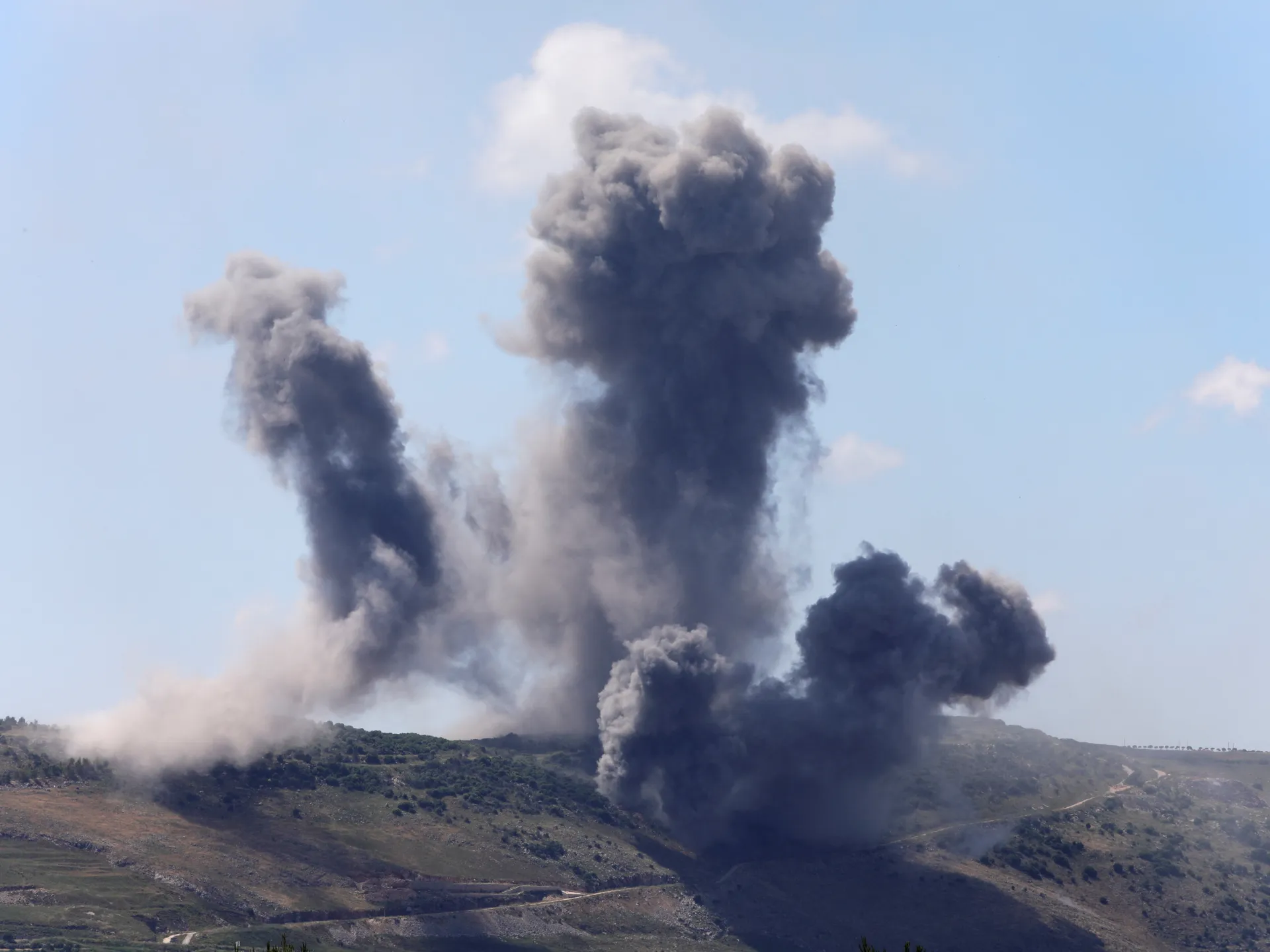
A drone attack on a joint French-Kurdish base in northern Iraq has killed one French soldier and wounded several others. Iran-aligned armed groups have been carrying out attacks against US and coalition forces in the region.
Gulf countries, including Qatar, Bahrain and Kuwait, have declared force majeure on gas exports following the United States-Israel war on Iran, now in its third week, and the disruptions to shipping through the Strait of Hormuz, as Tehran has retaliated across the region, targeting US assets.
QatarEnergy was among the first to halt production, shutting down gas liquefaction on March 2 and sending ripples through global energy markets. Kuwait Petroleum Corporation and Bahrain’s Bapco Energies followed days later, while India invoked emergency measures to redirect gas supplies to priority sectors.
Oil prices also soared to more $100 a barrel as war intensified and uncertainty grew over energy shipments through one of the world’s most critical maritime chokepoints.
Here’s what we know about force majeure and what Gulf countries invoking it means for global oil and gas markets.
What is force majeure?
Force majeure, from the French meaning “superior force”, is a clause in contracts that allows a party to be excused from its obligations when an event beyond its control prevents performance.
This legal move can allow a party to suspend its obligations temporarily, be released from them partially or fully, or adjust them to reflect the new circumstances.
Why are Gulf countries invoking force majeure?
Companies in Qatar, Kuwait and Bahrain have invoked it following severe disruptions to shipping through the Strait of Hormuz caused by US-Israeli military strikes against Iran that started on February 28.
Following these attacks, a commander in Iran’s Islamic Revolutionary Guard Corps (IRGC) said on March 2 that the Strait of Hormuz was closed and warned that any vessel attempting to pass through would be attacked, a statement echoed by Iran’s new supreme leader, Mojtaba Khamenei, on Thursday.
As a result, Gulf companies started invoking force majeure, in order “to avoid paying damages or other financial penalties under their contracts”, Ilias Bantekas, a professor of transnational law at Hamad bin Khalifa University in Qatar, told Al Jazeera.
“These companies are most likely unable to fulfil their obligations, for example, to deliver shipments of oil and gas to other countries, or for shippers to transport them across the Arabian Gulf,” he said.
Does war automatically qualify as force majeure?
No. For war to qualify as force majeure, it must either be covered by the contract or actually prevent one or both parties from performing their obligations.
Companies and states typically include force majeure clauses that define which events qualify, meaning that when force majeure is invoked, the parties rely on provisions they previously agreed upon.
“War can always be foreseen, but perhaps not at the level at which it is being waged right now,” Bantekas said, adding that under general contract provisions, ships carrying goods are usually expected to find another route, “even if it is more costly to them”.
“What we could never have foreseen is that the Strait of Hormuz could be closed to shipping altogether, even if Iran were attacked in the brutal way it is now. I think that, on its own, could be sufficient to constitute a force majeure event,” he said.
“However, only a court would have the authority to make a definitive determination as to whether this kind of war, under these particular circumstances, amounts to force majeure,” he added.
Will LNG and oil markets be affected?
Yes. QatarEnergy’s declaration of force majeure alone has already significantly disrupted the global LNG market, as Qatar accounts for nearly 20% of global supply.
Gas prices soared immediately following the country’s halt of gas production, and global gas markets are expected to experience shortages for weeks, if not longer.
“The lack of visibility over the likely duration of force majeure, and of the broader military conflict, is injecting extreme uncertainty into global oil, gas and LNG prices,” Seb Kennedy, global gas and LNG analyst, told Al Jazeera.
“Prices will necessarily keep rising as volumes are withheld from the market, until price pain triggers demand destruction in price-sensitive areas of the economy,” he noted.
Which other countries have invoked force majeure?
On Tuesday, India invoked force majeure to redirect gas supplies from non-priority sectors to key users after disruptions to liquefied natural gas shipments through the Strait of Hormuz, according to a government notification.
But India’s measures are a “domestic demand-management response”, Kennedy said, as its government is relocating its limited gas supplies internally “to protect critical sectors such as households, small businesses, power generation and city gas distribution”.
(Al Jazeera)
Kennedy said the move reflects the difficult choices facing LNG-dependent economies, where governments may prioritise households and power generation over industrial users.
This prioritisation of LNG for domestic use “highlights the tough choices facing LNG-dependent countries”, he noted.
Aside from India, Omani trading house OQ also declared force majeure to a customer in Bangladesh after the Qatari supply was halted.
How will this affect US and European markets?
US LNG exporters are likely to benefit from the disruption. Analysis by Energy Flux estimates that US LNG exporters could generate about $4bn in windfall profits in the first month of the disruption alone.
If the situation persists, “US LNG windfall profits could reach $33bn above the pre-Iran average within four months. Over eight months, that figure rises to $108bn,” says Kennedy.
(Al Jazeera)
These gains largely come at the expense of European consumers, Kennedy notes, as Europe is the main destination for US LNG and remains heavily reliant on those supplies to refill gas storage and ensure winter supply security.
European stock markets fell last week, while the region’s natural gas prices rose sharply again.
What does this mean for Asian markets?
Major Asian economies such as India, China and South Korea rely heavily on imported LNG.
On the other hand, Southeast Asia alone has significant fossil fuel resources, but the region still depends heavily on imported oil and gas, much of which is transported through the Strait of Hormuz.
“Wealthier buyers such as Japan and South Korea can generally outbid others to secure cargoes during periods of extreme scarcity,” Kennedy said, noting that price-sensitive importers, especially in South and Southeast Asia, tend to be “forced out of the market” whenever prices soar, “leading to demand destruction, fuel switching, or industrial curtailment”.
“In that sense, the crisis does not hit all LNG importers equally: It becomes a contest of balance sheets as much as a question of physical supply.”
Can force majeure be challenged?
If a force majeure clause is written in the contract, then it stands because the parties have consented to it.
Contrary to that, if it has not been written in the contract, then any unforeseen event would potentially be open to legal challenge, and it becomes a matter of convincing the courts that the event could never have been foreseen and that it makes obligations on one of the parties impossible to perform.
“However, in the present circumstances, the stronger parties – the ones waiting for deliveries of oil and gas elsewhere in the world – may actually be harming themselves if they refuse to accept force majeure,” Bantekas said.
“Doing business with Gulf countries could become more difficult in the future, and premiums would likely rise significantly. So, I do not think they will be taking these matters to court,” he noted.
Heavy Israeli strikes have hit Tehran, Iran, as its allies launch attacks across Gulf states, and shipping through the Strait of Hormuz has been severely disrupted, sending global oil prices soaring.
Meanwhile, political pressure is mounting in Washington as the conflict spreads across the region.
Recommended Stories
list of 1 itemend of list
Here is what we know about what has been happening in the past 24 hours:
In Iran
Supreme leader speaks: Appointed last week following the assassination of his father, Iran’s new Supreme Leader Mojtaba Khamenei has issued his first statement, warning that attacks on Israel and US military assets and infrastructure in the Middle East will continue unless bases hosting US forces in the region are closed.
Heavy strikes on Tehran: The Israeli military has launched a new “extensive wave” of air attacks on Iran’s capital, Tehran, leaving the city covered in thick smoke on Friday morning.
Strait of Hormuz closure and surging oil prices: The Strait of Hormuz, which connects the Gulf to the Gulf of Oman, is closed, causing Brent crude oil prices to surge past $100 per barrel. The strait, which falls into the territorial waters of Iran and Oman, is the only waterway to the open sea available to oil and gas producers in the Gulf. Iran has stated that the strait is under Iranian control and US-and Israel-linked ships are banned. Other vessels must receive Iranian permission to pass.
Civilian casualties: Iran’s ambassador to the United Nations, Amir Saeid Iravani, said at least 1,348 civilians have been killed, with victims ranging in age from eight months to 88 years old.
A navy vessel is seen sailing in the Strait of Hormuz [Sahar Al Attar/AFP]
In Gulf countries
Regional retaliation and attacks: Iran has launched waves of drones and missiles towards Gulf countries that host US military assets and troops, and has targeted oil tankers and facilities.
Bahrain: The nation has reported intercepting 114 missiles and 190 drones since the war began on February 28.
Saudi Arabia: The country intercepted 10 drones over its eastern region and later destroyed an additional 28 drones that breached its airspace.
Attacks on the UAE: The country has strongly condemned Iranian strikes on the region, and said they have hit Dubai International Airport and some hotels.
Evacuations: Australia has ordered all “non-essential” officials to leave the United Arab Emirates and Israel, and urged its citizens to evacuate the Middle East while it is still safe to do so
Qatar’s response: Qatar’s airspace is officially closed, but Qatar Airways has scheduled more than 140 special flights to help repatriate stranded residents and citizens.
Qatar has strongly rejected Israeli media claims that it intentionally paused liquefied natural gas (LNG) production to manipulate US energy prices; officials clarified that the suspension was actually forced by an Iranian drone attack.
A view of the damaged part of the Dubai Creek Harbour tower after it was hit by an Iranian drone attack in Dubai, United Arab Emirates [EPA]
In the US
Trump claims war moving ‘rapidly’: US President Donald Trump told reporters the war against Iran was moving “very rapidly”.
“It’s doing very well, our military is unsurpassed,” he said at the White House, not directly responding to the latest comments from Iran’s new supreme leader.
Domestic opposition: More than 250 US organisations have signed a letter calling on Congress to halt funding for the war. They argue the $11.3bn spent in the first six days of the conflict is diverting crucial funds from urgent domestic needs, such as food benefits.
No ‘need’ for ground troops in Iran: US Senator Lindsey Graham has played down the possibility of US troops being deployed to Iran, but suggested the war could continue for some time. “I don’t see this conflict ending today,” the Republican senator told reporters in Washington, DC.
In Israel
New missile wave launched at Israel: The Israeli military said early on Friday that Iran had fired a new barrage of missiles towards Israel, and instructed people in affected areas to head to shelters.
Israel strikes Basij force: Israel’s military said it had struck checkpoints set up in Tehran by the Basij force of Iran’s Revolutionary Guards as part of efforts to undermine control by the authorities.
Regime change: Israeli Prime Minister Benjamin Netanyahu said Israel can create conditions for regime change, but it is up to Iran’s people to take to the streets. He also said Israel is aiming to stop Iran from moving nuclear and ballistic projects underground.
In Lebanon, Iraq
Downed US aircraft: A US KC-135 refuelling aircraft crashed in western Iraq. While the Islamic Resistance in Iraq claimed it shot the aircraft down using air defence systems, US Central Command (CENTCOM) stated the aircraft went down in “friendly airspace” and was not the result of hostile fire.
Iraqi port closures: Iraq has shut its port operations after an Indian crew member was killed during an attack on a US-owned oil tanker in Iraqi waters.
Six French soldiers hurt: A drone attack wounded six French soldiers in Erbil, in Iraq’s autonomous Kurdish region, President Emmanuel Macron said on Thursday.
Deadly attacks in southern Lebanon: Israeli bombardments continue on southern towns and villages. A strike on the village of Arki, near Sidon, killed nine people, including five children.
Mounting death toll and mass displacement: Lebanese officials have reported that at least 687 people have been killed in Israeli attacks on Lebanon since last Monday, including 98 children. The intense bombardments have displaced an estimated 700,000 to 750,000 people from their homes.
Occupied East Jerusalem – Basema Dabash sheds tears daily for the home she and her husband, Raed, were forced to demolish in Sur Baher, in the south of occupied East Jerusalem.
For years, the couple lived under the spectre of losing their home, ever since the Israeli authorities issued a demolition order in 2014. In January of this year, the eviction notice came. And then, on February 12, the family were forced to demolish their home. If they didn’t, they would have been forced to pay the municipality to carry out the demolition.
Recommended Stories
list of 3 itemsend of list
“We were forced to start demolishing the house ourselves to avoid the municipality’s demolition fees, which can reach 100,000 shekels [$32,000],” Basema, 51, said. “We started by breaking down the inside of the house and sent the municipality photos to confirm that we had begun the demolition, but they demanded that we demolish it from the outside as soon as possible.”
The family soon completed the demolition of the two houses where eight people, including three children, lived. However, this didn’t waive the fine of 45,000 shekels ($14,600), which will continue to be paid in instalments until 2029.
‘Self-demolition’ haunts Palestinians living in East Jerusalem, which has been controlled by Israel since 1967, and illegally merged with West Jerusalem under one Israeli-run administration.
The choice between self-demolition and paying a further fee to the municipality is a simple one – the vast majority of Palestinians can’t afford to pay the exorbitant amount, and resort to demolishing their own homes, despite the immense pain and profound psychological impact it causes.
‘How did we come to this?’
Basema’s troubles started in 2014, when she received a building violation notice from the Israeli municipality in Jerusalem for the building she and her husband shared with their married son, Mohammed, and his family. They appealed at the time to an Israeli court in an attempt to freeze the demolition order.
For more than a decade, the family was forced to pay accumulated fines in an attempt to keep their home. Then, on January 28, they received an eviction notice, giving them a deadline to vacate the house and have it demolished.
The house slated for demolition was 45 square metres (485sq feet), an extension Basema had added to her existing 45-square-metre home. She had also built a similar-sized residence for her married son on top of the extension. The demolition order targeted both the extension and her son’s residence.
The Dabash family tried to obtain a building permit for the house several times, but their requests were rejected by Israel. Despite this, the municipality fines Palestinians and demolishes their homes under the pretext of lacking permits.
“We chose to demolish our own house not only to avoid the fine, but also because the municipal crews show no mercy to anything around the house and deliberately vandalise the entire area under the pretext of demolition, breaking trees and causing extensive damage that we could have done without,” Basema said.
Basema, along with her husband and one of her sons, Abdelaziz, now lives in what remains of their home. Mohammed has also moved in with them, while his wife and children live in her family’s home. The demolition has thus scattered her son’s family, who haven’t yet been able to find a small house to rent due to the high cost of housing.
The family also incurred significant expenses removing the rubble and redesigning the older section of the house to accommodate everyone, not to mention the psychological toll, which has been devastating.
“I stand to wash the dishes and find my tears falling on their own. How did we come to this? Why are we being subjected to this injustice? The house has become cramped and barely fits us. My grandchildren visit us and then cry bitterly when they leave for their grandfather’s house because we have no space,” Basema said sadly.
Increased demolitions
As illegal Israeli settlements continue to expand in East Jerusalem and the occupied West Bank, with building permits easily obtained, Palestinians say the double standards are obvious.
Human Rights Watch has found that Israeli authorities make it “virtually impossible for Palestinians to obtain building permits”, and the Israeli human rights organisation B’Tselem said planning policies in East Jerusalem make it “very difficult for residents to obtain building permits”.
Marouf al-Rifai, spokesperson for the Palestinian Authority’s Jerusalem Governorate, told Al Jazeera that 15 self-demolitions were carried out last February, five in January, and 104 in December.
Demolitions, in general, escalated to unprecedented levels after October 2023, when Israel’s genocidal war on Gaza began. Al-Rifai said that 400 demolitions were carried out in 2025 in East Jerusalem and its surrounding area, either by municipal crews or by homeowners themselves. Prior to that, the number of demolitions had reached a maximum of 180 per year.
The United Nations has reported that demolitions in 2025 displaced 1,500 Palestinians.
“Even the method of carrying out demolitions changed after the war on Gaza,” al-Rifai said. “Previously, demolitions were only carried out after exhausting all legal avenues and giving residents the opportunity to appeal to the courts and freeze the demolitions.”
But Israeli authorities have taken a more punitive position since demolition policy fell under the influence of far-right Israeli National Security Minister Itamar Ben-Gvir, who began pushing for Israeli army bulldozers to carry out demolitions without even notifying the homeowners, al-Rifai said.
In addition, the Palestinian Authority official said, demolition notices for Palestinian homes in Jerusalem increased from 25,000 before the war to 35,000. The town of Silwan alone has received 7,000 demolition notices since 1967.
Fakhri Abu Diab, a member of the Committee for the Defence of al-Bustan Neighborhood in East Jerusalem, told Al Jazeera that self-demolition is a double punishment and pain for the homeowner after the effort and hardship involved in building the house.
“Israel’s goal is to break the morale of the Palestinians and to brainwash them into becoming tools for implementing its plans to demolish homes. When we demolish our own homes, it’s as if we are demolishing a part of our own body,” he explained.
Israel can only demolish a limited number of Palestinian homes annually due to logistical, financial, budgetary, and logistical constraints. Demolition by Palestinians multiplies the number of homes demolished, thus turning the victim into a “demolition contractor”, as he put it.
“I refused to demolish my house myself because of the negative consequences that I and my family would have to live with for the rest of our lives, and the Israeli bulldozers demolished it. If I had done it myself, it would have remained a nightmare that would haunt me.”
Saqr Qunbur says he has already received a total of $26,000 in fines for building his house, and so can’t afford to pay more for Israeli crews to demolish it [Ahmad Jalajel/Al Jazeera]
No alternative
But the cost of a demolition carried out by Israeli municipal crews ranges between 80,000 and 120,000 shekels ($26,000-$39,000).
Saqr Qunbur couldn’t pay that, and was forced instead, on December 26, to demolish his 100-square-metre (1,076sq-foot) house in Jabal al-Mukabber under the pretext of lacking a permit. He had built it in 2013 and was immediately issued a building violation notice.
Saqr told Al Jazeera that he had lived in the house with his wife and four-year-old child. Since building the house, he has received a total of 80,000 shekels ($26,000) in fines that he’s still paying despite his home being demolished.
Saqr had nowhere to live after being forced to demolish his house, so his neighbour gave him a dilapidated room to live in while he found a place to rent.
“My child has been suffering psychologically since we demolished the house. Every day he asks me why I demolished it, and I don’t know what to tell him. I say it’s so I can build him a better house, but deep down I know I won’t even be able to rent a suitable place,” he explained with anguish.
Saqr chose to demolish his house himself after he says an Israeli officer threatened him, saying, “Demolish it, or I’ll demolish it over your head”. He also wanted to avoid the humiliation that accompanies demolitions carried out by Israel, where police sometimes fire live ammunition and tear gas at family members and carry out assaults, as documented by human rights groups.
“I developed diabetes and high blood pressure after my house was demolished. The doctor said it was due to anger and grief. This is an occupation that wants to expel us from our land, and we want to stay,” he concluded.
Energy markets remain on tenterhooks as the prospect of prolonged war in the Middle East grows.
Published On 13 Mar 202613 Mar 2026
Share
Oil prices have again risen above $100 per barrel as energy markets see little relief amid the biggest disruption to global energy supplies in a generation.
Brent crude, the international benchmark, surged more than 9 percent on Thursday as traders weighed the prospect of weeks, or even months, of turmoil in energy markets as the United States and Israel wage war on Iran.
Recommended Stories
list of 4 itemsend of list
Brent futures, which are traded outside of regular market hours, were priced at $101.13 as of 03:00 GMT.
Asian stock markets, including exchanges in Tokyo, Seoul and Hong Kong, opened sharply lower on Friday, following steep losses on Wall Street overnight.
The latest surge in oil prices came after Iran’s Supreme Leader Mojtaba Khamenei pledged to maintain the effective closure of the Strait of Hormuz, which normally transports about one-fifth of global oil supplies.
In a statement read out on his behalf on Iranian state television, Khamenei described Tehran’s threats against shipping in the waterway as a “lever” that “must continue to be used”.
US President Donald Trump struck a similarly defiant tone on Thursday, posting on Truth Social that stopping Iran from getting nuclear weapons was of “far greater interest and importance” than rising oil prices.
‘Lack of tangible goals in this war’
Traffic through the strait has effectively ground to a halt due to Iranian threats, with only a handful of vessels passing through each day, many of them claiming links to China, Iran’s key economic partner.
According to the United Kingdom Maritime Trade Operations (UKMTO) centre, no more than five ships have passed through the waterway each day since the US and Israel launched joint strikes on Iran on February 28, compared with an average of 138 daily transits before the war. At least 16 commercial vessels have been attacked in the region since the start of the conflict, according to the UKMTO.
Tehran has claimed responsibility for several of the attacks, including a strike on Wednesday that crippled a Thai-flagged vessel off the coast of Oman.
Efforts to bring calm to the market have so far done little to tame prices, which are up nearly 40 percent compared with before the start of the war.
The International Energy Agency’s (IEA) announcement on Wednesday that member countries would release 400 million barrels of oil from emergency stockpiles drew a tepid response among traders eyeing a daily shortfall in global supplies estimated at 15-20 million barrels.
The US Department of the Treasury’s issuance on Thursday of a temporary licence authorising countries to purchase sanctioned Russian oil that has been stranded at sea also failed to move the market, with Brent crude staying above $100 a barrel after the Treasury announcement.
“The key problem is a lack of tangible goals in this war,” said Adi Imsirovic, an energy security expert at the University of Oxford.
“It makes it hard for oil traders to see the light at the end of the tunnel,” he said.
Trump has repeatedly floated the possibility of using the US Navy to escort commercial shipping through the strait, but the Pentagon has yet to conduct such operations amid concerns about the risks posed by Iranian attacks in the narrow waterway.
In an interview with CNBC on Thursday, US Energy Secretary Chris Wright said that Washington was “not ready” to provide navy escorts but that such operations could begin by the end of the month.
“It’ll happen relatively soon but it can’t happen now,” Wright said.
The Israeli military has dropped charges against five soldiers, whose alleged sexual abuse of a Palestinian detainee was caught on camera. The video caused international outrage but also led to protests in support of the soldiers in Israel.
ideo from northern Israel captured the moment an Iranian missile impacted in a residential area early Friday morning. The aftermath shows a fire and scattered debris next to damaged vehicles and buildings.
Protesters in Athens have marched to the US Embassy to condemn the US-Israeli attacks on Iran, joining protests held worldwide over the escalating conflict.
Israeli Prime Minister Benjamin Netanyahu said several Iranian nuclear scientists were killed in Israeli strikes. He also said a “new path of freedom” for Iran was approaching and told Iranians the country’s future ultimately depends on them.
Iran’s UN ambassador Amir Saeid Iravani said Tehran will not close the Strait of Hormuz and remains committed to freedom of navigation. His remarks came after Supreme Leader Mojtaba Khamenei said the waterway would remain closed to pressure Iran’s enemies.
The United States military is “not ready” to accompany oil ships through the Strait of Hormuz, a top official in President Donald Trump’s administration says as Iran continues to block the strategic waterway.
US Energy Secretary Chris Wright told the CNBC business news channel on Thursday that the markets are experiencing a “short-term disruption”, predicting that the war would go on for “weeks, not months”.
Recommended Stories
list of 3 itemsend of list
Despite Trump’s repeated threats, Iran has largely succeeded in shutting down the strait, which links the Gulf to the Indian Ocean. The closure has sent oil prices soaring.
Wright described the effects of the crisis as “short-term pain for long-term gain”, arguing that the US is “destroying” Iran’s ability to threaten the energy market.
Last week, Trump suggested that the US Navy would escort ships through the Gulf, but Wright said on Thursday that the move “can’t happen now”.
“We’re simply not ready. All of our military assets right now are focused on destroying Iran’s offensive capabilities and the manufacturing industry that supplies their offensive capabilities,” the energy secretary said.
“We don’t want this to be a brush-off for a year or two. We want to permanently destroy their ability to build missiles, to build roads, to have a nuclear programme.”
His comments came as Iran’s new supreme leader, Mojtaba Khamenei, affirmed in his first public comment since being selected to succeed his assassinated father, Ali Khamenei, that the Strait of Hormuz should remain closed during the war.
“The will of the people is to continue effective and deterrent defence,” Khamenei said in a written statement. “The tactic of closing the Strait of Hormuz must also continue to be used.”
The Iranian military has said it would “welcome” the US Navy escorting oil ships, suggesting it is prepared to strike US forces in the narrow waterway.
On Wednesday, three commercial vessels were attacked near the strait.
Wright announced earlier this week on social media that the US Navy had escorted an oil ship through the strait, then quickly deleted the post. The White House subsequently confirmed that the claim was not true.
It is not clear why the statement was released and then retracted.
Assurances by US officials that Washington would open the strait have temporarily calmed markets, only for prices to spike again.
The price of a barrel of oil peaked at about $120 on Sunday, up from about $70 before the US and Israel launched the war on February 28. It has been yo-yoing between $80 and $100 for the past few days.
In addition to the marine blockade, Iran has targeted oil installations across the Gulf.
As one of the world’s largest oil producers, the US is largely self-sufficient. But possible shortages in Asia and Europe have put a strain on prices globally.
According to data from the American Automobile Association, the average price of one gallon (3.78 litres) of petrol in the US is now $3.60, up from $2.94 last month.
Rising energy prices could fuel inflation and affect the cost of basic goods, including food.
But Trump suggested on Thursday that the US is benefitting from skyrocketing oil prices.
“The United States is the largest Oil Producer in the World, by far, so when oil prices go up, we make a lot of money,” the US president wrote in a social media post.
“BUT, of far greater interest and importance to me, as President, is stopping an evil Empire, Iran, from having Nuclear Weapons, and destroying the Middle East and, indeed, the World.”
Iran denies seeking a nuclear weapon, and Trump reiterated for months before the current conflict that US strikes against Iranian facilities in June had “obliterated” the country’s nuclear programme.
Iranian President Masoud Pezeshkian has laid out terms for ending the war with the United States and Israel in what analysts say is a possible sign of de-escalation from Tehran as the US-Israel war on Iran entered its 13th day on Thursday.
In a post on Wednesday on social site X, Pezeshkian said he had spoken to his counterparts in Russia and Pakistan, and that he had confirmed “Iran’s commitment to peace”.
Recommended Stories
list of 4 itemsend of list
“The only way to end this war – ignited by the Zionist regime & US – is recognizing Iran’s legitimate rights, payment of reparations, and firm int’l guarantees against future aggression,” Pezeshkian wrote.
This is a rare posture from Tehran, which has maintained a defiant stance and initially rejected any possibility of negotiations or a ceasefire when war broke out nearly two weeks ago.
Pezeshkian’s statement comes as pressure mounts on the US to halt what has become a very costly mission. Analysts say speculation from Washington that Iran would quickly submit after the killing of Supreme Leader Ayatollah Ali Khamenei were misguided.
Tehran is likely going to determine the end of this war, not the US or Israel, because of its ability to inflict economic pain broadly, they say.
Amid a military pummelling by the US and Israel, Iran has launched heavy retaliatory strikes at US assets and other critical infrastructure in Gulf countries, upsetting global supplies. It has also adopted what analysts call “asymmetric” tactics – such as disrupting the critical Strait of Hormuz and threatening US banking-linked entities – to inflict as much economic pain on the region and wider world as it can.
This is what we know about Pezeshkian’s stance and what the pressures are on both sides to draw the conflict to a close, quickly.
A building lies in ruins after a strike, amid the US-Israeli conflict with Iran, in Tehran, Iran, on March 12, 2026 [Majid Asgaripour/WANA (West Asia News Agency) via Reuters]
What has the war cost so far?
Economically, both sides have weaponised energy. Israel first targeted Iran’s oil facilities in Tehran on March 8, prompting an outcry from global health experts over the potential risk of air and water pollution.
Iran has, meanwhile, tightened its chokehold on the Strait of Hormuz shipping route – the only route to open sea for oil producers in the Gulf – with its military promising on Wednesday that it has the capabilities to wage a long war that could “destroy” the world economy.
Attacks on ships in the strait, through which about 20 percent of global oil and gas traffic normally passes, have effectively closed the route.
Oil prices rocketed above $100 per barrel late last week, up from around $65 before the war, with ordinary buyers feeling the increases at pumps in the US, Europe and parts of Africa.
On Wednesday, Iran upped the ante, saying it would not allow “a litre of oil” to pass through the strait and warned the world to expect a $200-per-barrel price tag.
“We don’t know how quickly it’ll revert back,” Freya Beamish, chief economist at GlobalData TS Lombard, told Al Jazeera. “We do think it’ll revert back to $80 in due course, but the ball is to some degree in Iran’s court,” she said, adding that because Iran needs oil revenue, the price hikes are expected to be time-limited.
The International Energy Agency agreed on Wednesday to release 400 million barrels from the emergency reserves of several member states but it is not yet clear what impact that will have, nor how quickly this quantity of oil can be released.
Tehran has also been accused of directly attacking oil facilities in neighbouring countries this week. Iraq shut all its oil port operations on Thursday after explosive-laden Iranian “drone” boats appeared to have attacked two fuel tankers in Iraqi waters, setting them ablaze and killing one crew member.
A drone was filmed striking Oman’s Salalah oil port on Wednesday, although Tehran has denied involvement.
What are Iranian officials saying about ending the war?
There has been conflicting messaging from the Iranian leadership.
Iran’s elite army unit and parallel armed force, the Islamic Revolutionary Guard Corps (IRGC), continues to show defiance, issuing threats and launching attacks on Israel and US military assets and infrastructure in neighbouring Gulf countries.
However, the political leadership has appeared more inclined towards diplomacy, analysts say. On Wednesday, President Pezeshkian said that ending the war would take the US and Israel recognising Iran’s rights, paying Iran reparations – although it’s unclear how much is being asked for – and providing strong guarantees that a future war will not be waged.
In a video recording last week, he also apologised to neighbouring countries for the strikes and promised that Iran would stop hitting its neighbours as long as they do not allow the US to launch attacks from their territory.
“I personally apologise to the neighbouring countries that were affected by Iran’s actions,” the president said, adding that Tehran was not looking for confrontations with its neighbours.
However, it is not known how much sway the political leadership has over the IRGC. Hours after the president’s apology last week, air defence sirens went off in Saudi Arabia, Qatar, the UAE and Bahrain, as strikes continued on the Gulf.
So, what is Iran’s actual position?
“Iran wants to go to the end to make sure that the United States and Israel never attack Iran again … so this has to be the final battle,” Al Jazeera’s Resul Serdar Atas explained.
Indeed, the IRGC sees this as an existential war, but the timing of Pezeshkian’s statement about ending the conflict also shows Tehran is pressured economically, politically and militarily, Zeidon Alkinani of Qatar’s Georgetown University told Al Jazeera.
“These differences and divisions [between IRGC and political leaders] always existed even prior to this war but we may notice it now more, given the fact that the IRGC believes that it has the right to take the front seat in leading this regional war, which is why a lot of the statements and positions are contradicting with the official ones from Pezeshkian,” he said.
The IRGC reports directly to Iran’s Supreme National Security Council (SNSC) and not to the country’s political leadership. That council is led by Ali Larijani, a top politician and close aide to the late supreme leader, Ali Khamenei, who analysts describe as a “hardliner”.
In a post on X on Tuesday, Larijani responded to threats from Trump about attacks on the Strait of Hormuz, saying: “Iranian people do not fear your hollow threats; for those greater than you have failed to erase it … So beware lest you be the ones to vanish.”
The newly elected supreme leader, Mojtaba Khamenei, was once in the IRGC and was put forward by the unit as the next ayatollah after his father was killed on the first day of the war, analysts say. He is thus not expected to follow the reformist, diplomatic ideals of President Pezeshkian and other political leaders which his father managed to marry with the IRGC militarised stance, they say.
Mojtaba Khamenei, son of Iran’s late Supreme Leader Ayatollah Ali Khamenei, attends a gathering in Tehran on March 2, 2016. Iran marked the appointment of Ayatollah Mojtaba Khamenei to replace his father as its supreme leader with a barrage of missiles against Israel and the Gulf states [File: Rouhollah Vahdati/ISNA via AFP]
What do the US and Israel say about ending the war?
There have also been conflicting messages from the Trump administration and Israel regarding when the war mission on Iran, codenamed Operation Epic Fury, is likely to end.
Trump told US publication Axios on Wednesday that the war on Iran would end “soon” because there’s “practically nothing left to target”.
“Anytime I want it to end, it will end,” he added. He had said earlier on Monday that “we’re way ahead of our schedule” and that the US had achieved its goals, even as speculation mounts about a possible US ground mission.
On the other hand, Israel’s Defence Minister Israel Katz said on Wednesday that the war would go on “without any time limit, for as long as necessary, until we achieve all the objectives and decisively win the campaign”.
Analysts say Trump’s stance that the conflict will be quick reflects increasing pressure on his administration ahead of upcoming mid-term elections in November.
Trump’s advisers privately told him this week to find a quick end to the war and avoid political backlash, according to reporting by The Wall Street Journal. That came as polls from Quinnipiac University and The Washington Post suggested that most Americans are opposed to the war in Iran.
In his 2024 presidential campaign, Trump promised to lower prices, and inflation had stabilised at 2.4 percent ahead of the war, according to government data released on Wednesday. Analysts speculate the conflict will likely push it back up.
The US spent more than $11.3bn in the first six days of the war, Pentagon officials told lawmakers in a classified briefing on Tuesday, Reuters reported this week – nearly $2bn a day.
The Washington-based think tank, Center for Strategic and International Studies (CSIS), estimated that the war cost Washington $3.7bn in its first 100 hours alone, or nearly $900m a day, largely due to its expenditure on costly munitions.
“It’s quite ironic that [Trump] chose a war that would make affordability worse, not better,” Rebecca Christie, a senior fellow at the Bruegel think tank, told Al Jazeera’s Counting the Cost.
“Every time the US loses even one object, air defence or a plane or something like that, that represents an awful lot of money that could have been used on some of these issues that have an impact on people’s day-to-day lives in the United States.”
Multiple explosions have been reported across Iran’s capital, Tehran, and other cities as United States-Israeli attacks and Iranian retaliation continue.
As the conflict saw its 13th day on Thursday, Iran’s representative to the United Nations, Amir Saeid Iravani, said at least 1,348 civilians have been killed.
The humanitarian toll continues to mount with more than 17,000 injured in Iran since the US and Israel launched their war on February 28. UNICEF described the situation as “catastrophic”, noting that more than 1,100 children have been reported injured or killed.
The Office of the UN High Commissioner for Refugees (UNHCR) estimated that up to 3.2 million people have been displaced within Iran since the conflict began. “This figure is likely to continue rising as hostilities persist, marking a worrying escalation in humanitarian needs,” UNHCR said in a statement.
Meanwhile, in Lebanon, Israeli attacks since March 2 have killed at least 687 people, including 98 children, according to Information Minister Paul Morcos.
United Nations refugee agency says forced displacement likely to increase as US and Israel continue deadly strikes across Iran.
Published On 12 Mar 202612 Mar 2026
Share
More than three million people have been displaced in Iran since the United States and Israel launched a war against the country late last month, the United Nations says, as concerns mount over a worsening humanitarian crisis.
The UN High Commissioner for Refugees (UNHCR) said on Thursday that as many as 3.2 million people – representing between 600,000 and one million Iranian households – have been forcibly displaced since the war began on February 28.
Recommended Stories
list of 3 itemsend of list
“Most of them are reportedly fleeing from Tehran and other major urban areas towards the north of the country and rural areas to seek safety,” UNHCR official Ayaki Ito said in a statement.
“This figure is likely to continue rising as hostilities persist, marking a worrying escalation in humanitarian needs.”
The US and Israeli militaries have continued to bombard Iran despite mounting international condemnation and calls for de-escalation.
More than 1,300 people have been killed in US-Israeli attacks across the country to date, according to the latest figures from Iranian officials.
While the US and Israel have said they are targeting Iranian leaders as well as military and nuclear infrastructure, Iran says thousands of civilian sites, such as schools and hospitals, have been attacked.
Iran’s Deputy Health Minister Ali Jafarian told Al Jazeera on Thursday that medical teams have been responding to a growing number of casualties as strikes on urban areas have intensified in recent days.
“Most of these people are civilians,” Jafarian said, adding that more than 30 hospitals and health facilities have been damaged due to the attacks.
On Thursday, explosions were heard in several parts of the capital, Tehran, and other Iranian cities as the strikes continued.
Al Jazeera’s Tohid Asadi said rescuers were digging through mounds of rubble as several multistorey apartment buildings were heavily damaged in recent attacks on a hard-hit eastern neighbourhood of Tehran.
“We saw bodies taken out [of the rubble] … and the situation was far beyond what I can call disastrous,” Asadi said.
Iran has responded to the US-Israeli assault by launching a barrage of missiles and drones at US bases and other sites in countries across the wider Middle East region.
It has also shut down the Strait of Hormuz, a critical Gulf waterway through which about one-fifth of the world’s oil transits, raising serious concerns of disruptions to global energy supplies.
Despite United States President Donald Trump’s repeated declarations of victory in the US-Israeli war on Iran, Tehran’s retaliatory strikes on Israel and US military assets in the region have continued, upending global financial and energy markets.
“We’ve had two decades to study defeats of the US military to our immediate east and west. We’ve incorporated lessons accordingly,” Iranian Foreign Minister Seyed Abbas Araghchi wrote in a post on X on March 1, the day after US and Israeli strikes on Tehran killed Iran’s Supreme Leader Ayatollah Ali Khamenei and other senior Iranian officials.
Recommended Stories
list of 3 itemsend of list
“Bombings in our capital have no impact on our ability to conduct war,” he wrote.
According to analysts, Iran has made use of “asymmetric” warfare tactics while striking the US and Israel. So, are Tehran’s war tactics working?
Here’s what we know:
What is ‘asymmetric’ warfare?
When the balance of capabilities is unequal in a conflict – as it is in relation to weapons in this one – the weaker party can turn to unconventional methods of warfare, John Phillips, a British safety, security and risk adviser and a former military chief instructor, told Al Jazeera.
This is known as “asymmetric” warfare.
This can include the use of guerrilla tactics, terrorism, cyberattacks, use of proxies and other indirect tools, Phillips said, in order “to offset conventional inferiority, avoid the enemy’s strengths, and exploit vulnerabilities in political will, logistics, and legal or ethical constraints”.
“Iran is conventionally weaker than the US and Israel, but relatively strong compared to many neighbours,” he said.
“What makes Iran distinctive is not that it uses these methods at all, but that they sit at the centre of its grand strategy rather than at its margins.”
Why is Iran using asymmetric warfare?
In the ongoing war between Iran and the US-Israel, Washington and Tel Aviv have been using expensive missiles and drones to attack Iran and to intercept missiles Iran has fired back. The Patriot and THAAD defence systems, for example, which launch interceptors to take out incoming drones and missiles, can cost millions of dollars for each missile they fire. This compares with the $20,000-$35,000 cost of each Iranian Shahed drone.
As a result, the US has reportedly spent $2bn a day in its war on Iran and there are fears it could run out of interceptor missiles altogether if the war goes on for more than a few weeks.
It is therefore in Iran’s interests to focus on holding out against strikes and protecting its own weapons supplies while it does so, military experts say.
However, Phillips explained that precision strikes and sabotage by Israel and the US have demonstrated that Iran is not able to fully shield its missile, drone and nuclear‑related assets, while sanctions and domestic pressures have limited its capacity to sustain a very high‑tempo confrontation.
“As a result, Iran’s asymmetric approach is best understood as an effective ‘survival and leverage’ mechanism that produces a chronic, costly ‘shadow war’, rather than a path to decisive regional hegemony or victory,” he said.
Iran began using asymmetric warfare techniques following the 1979 Iranian revolution, which overthrew Shah Mohammad Reza Pahlavi.
“Instead of trying to match high‑end aircraft, precision munitions, or blue‑water fleets, [Iran] has built a ‘forward deterrence’ posture that operates in the grey zone between war and peace,” Phillips said.
“This is backed by large inventories of ballistic and cruise missiles, mass‑produced drones [often handed to proxies], cyber-operations, and a posture of underground, dispersed and hardened facilities that make preemption difficult and preserve some retaliatory capability.”
What asymmetric tactics has Iran been using?
Enemy depletion tactics
Since US-Israeli strikes on Iran began on February 28, Tehran has launched a wave of ballistic missiles targeting Israel and US military bases across the Gulf region.
Using a mix of short and medium-range ballistic missiles, as well as drone swarms through this defence system, Iran aims to deplete Israeli and US interceptor stockpiles.
Economic warfare
Iran has shut down the Strait of Hormuz through which about 20 percent of global oil and gas supplies are shipped. Linking the Gulf to the Gulf of Oman, the strait is the only waterway to the open ocean available to Gulf oil producers.
On Thursday, Iran attacked fuel tankers in Iraqi waters. Instability in and around the Strait of Hormuz drove Brent crude oil prices past $100 a barrel last week, with wild swings ongoing, prompting fears of a global energy crisis.
Iran has also targeted civilian infrastructure like airports and desalination plants which are crucial for water supply in the region, and it has launched drones targeting oil depots.
(Al Jazeera)
War on global finance
Meanwhile, on Wednesday this week, Iran’s Islamic Revolutionary Guard Corps (IRGC) threatened to attack “economic centres and banks” with links to United States and Israeli entities in the Gulf region after what it claimed was an attack on an Iranian bank, with the war in its 12th day.
Since then, many banks like Citibank and HSBC in Qatar, have begun shutting, further threatening global financial stability.
Top technology companies such as Google, Microsoft, Palantir, IBM, Nvidia and Oracle, as well as the listed offices and infrastructure for cloud-based services, are also located in several Israeli cities and in some Gulf countries, which Iran has also threatened to attack.
Use of proxies
Iran has aimed to keep the much more powerful US military and its allies off balance through proxies in Iraq, Lebanon and Yemen. Hezbollah in Lebanon, for example, has fired missiles and drones into northern Israel since March 2 as part of Iran’s retaliatory strikes.
“At the core of this [asymmetric] approach is a network of proxies and partners – Hezbollah in Lebanon, Shia militias in Iraq, groups in Syria, Hamas and Palestinian Islamic Jihad in Gaza and the Houthis in Yemen – which receive weapons, training, funding and ideological guidance from Iran,” Phillips said.
These actors allow Tehran to threaten Israeli and US forces, as well as regional shipping lanes, on multiple fronts, “often with a degree of deniability and at a fraction of the cost of deploying its own regular forces”, Phillips noted.
‘Mosaic’ defence system
Iran has organised its defensive structure into multiple regional and semi-independent layers instead of concentrating power in a single command chain that could be paralysed by a decapitation strike. This concept is most closely associated with the formation of the parallel military force, the Islamic Revolutionary Guard Corps (IRGC), particularly under former commander Mohammad Ali Jafari, who led the force from 2007 to 2019.
The doctrine has two central aims: to make Iran’s command system difficult to dismantle by force, and to make the battlefield itself harder to resolve quickly by turning Iran into a layered arena of regular defence, irregular warfare, local mobilisation and long-term attrition.
What damage have these tactics done to the US and Israel?
Iran’s asymmetrical playbook has made the war more expensive for the US. It has been forced to spend money on replacing stockpiles of expensive missiles like Tomahawks and defensive systems such as Patriot and THAAD interceptors.
According to the Center for Strategic and International Studies (CSIS), the first 100 hours alone of Operation Epic Fury – the codename for the US-Israeli assault on Iran – cost the US approximately $3.7bn, mostly unbudgeted. Israel, already reeling from the economic strain of its prolonged wars in Gaza and Lebanon, faces mounting domestic pressure as daily sirens force millions into bunkers.
While the Pentagon has not yet announced an official estimate for the cost of the war, late last week, two congressional sources told US broadcaster MS NOW that the war is costing the United States an estimated $1bn a day.
A day later, Politico reported that US Republicans on Capitol Hill privately fear the Pentagon is spending close to $2bn a day on the war.
Meanwhile, officials from President Donald Trump’s administration estimated during a congressional briefing this week that the first six days of the war on Iran had cost the US at least $11.3bn, a source familiar with the matter told the Reuters news agency.
Reporting from Washington, DC, following the publication of the CSIS analysis last week, Al Jazeera’s Rosiland Jordan said the Pentagon had put together a $50bn supplemental budget request in order to replace Tomahawk and Patriot missiles and THAAD interceptors already used in the first week of the war, along with other equipment that had been damaged or worn out so far.
Are Iran’s tactics working?
To a certain extent, they are.
According to a report by The Soufan Center, the “pattern of Iranian counterattacks suggests a layered operational approach designed to generate pressure on Gulf states, create regional disruption on land, sea, and air, while simultaneously attempting to exhaust US and allied defensive resources”.
“Tehran appears to be fighting a war of endurance: prolong the conflict, expand the economic battlefield, make the costs increasingly prohibitive, ration advanced capabilities, and impose steady human and financial costs on its adversaries. All with the hope that political tolerance erodes faster in Jerusalem and Washington than in Tehran,” the report noted.
This may be working. Questions about the cost of the war are already causing a political headache for the Trump administration in Washington.
Congress’s House Minority Leader Hakeem Jeffries told reporters at a Capitol Hill news conference last week that President Donald Trump is “plunging America into another endless conflict in the Middle East” and “spending billions of dollars to bomb Iran”.
“But they can’t find a dime to make it more affordable for the American people to go see a doctor when they need one,” he said. “Can’t find a dime to make it easier for Americans who are working hard to purchase their first home. And they can’t find a dime to lower the grocery bills of the American people.”
Trump won the presidency in 2024 largely on the back of a promise to handle the rising cost of living and he faces mid-term elections this year. It is likely that the cost of the war will not play well with voters, analysts say.
In Israel, opposition politician Yair Golan has also criticised his government’s economic management of the war.
In a post on X on Sunday, he wrote: “The war with Iran has been planned for months. The fact that the Israeli government has not prepared an orderly economic plan to support citizens during the war period is a disgrace.
“The serving and working public should not be the one footing the bill for the war out of its own pocket while billions of shekels go to the evading and non-working sector,” he said, adding that the opposition will soon replace the government.
Ali Vaez, director of the Iran Project at the International Crisis Group, told Al Jazeera that at a fraction of the cost – and despite a significant technological gap – Iran has demonstrated an ability to hold the global economy at risk, to pressure Washington into “blinking first”.
“A steady stream of inexpensive drones and limited missile strikes can disrupt the thriving economies of Israel and the Gulf, sending shockwaves through energy markets and ultimately translating into higher prices at American gas stations,” he said.
Phillips, the British safety, security and risk adviser, said the strategy has worked in important but limited ways.
“It has helped the Islamic republic survive intense sanctions, clandestine campaigns and periodic strikes while maintaining a credible ability to hit US bases, Israeli territory and Gulf infrastructure, which in turn raises the political and military cost of any attempt at regime-change war,” he said.
“Iran’s reach – stretching from Lebanon and Syria to Iraq and Yemen – allows it to shape crises, quickly raise the stakes of local conflicts, and force adversaries to devote substantial resources to missile defence, counter‑UAV systems, naval protection and regional coalition management,” he noted.
“However, there are clear constraints and growing problems. Key proxies such as Hezbollah and various militias have suffered leadership and infrastructure losses; the network has become more fragmented and sometimes less controllable, increasing the risk of unwanted escalation even as its coherence as an instrument of policy erodes,” he added.
Al Jazeera’s Tohid Asadi shows the aftermath of US-Israeli airstrikes on a residential neighbourhood in Iran, where rescue teams have been searching for survivors among the rubble.
One the UK’s biggest tour operators has suspended its profit guidance after revealing impact of Middle East war on bookings
09:50, 12 Mar 2026Updated 15:06, 12 Mar 2026
On the Beach says Egypt is among the normally popular destinations where demand has been hit(Image: Getty Images)
Spooked Brits are putting their holiday plans on hold because of the Middle East crisis.
Leading holiday firm On the Beach revealed a “significant” drop in demand from British families to Turkey, Greece, Cyprus, and Egypt. “The timing of when the conflict will end and the shape of recovery in demand to these destinations are unknown,” it said.
At the same time, there are are warnings that the cost of a summer getaways could jump after a spike in jet fuel prices. It comes as many UK families would be booking sunshine trips for the Easter holidays.
The scale of the hit to bookings was enough for On the Beach to suspend its full year profit guidance. Boss Shaun Morton said: “Following the onset of the conflict in the Middle East, our operational teams have been working round the clock to support directly impacted customers in resort and to enable a return home as soon as possible.”
The fall-out from the Iran war has already seen fuel prices jump and the cost of fixed rate mortgages rise. Industry experts Moneyfacts said the average two-year fixed rate mortgage had risen again, from 5.01% 5.04%. The average five-year fixed deal went up from 5.09% to 5.13%.
It came as oil prices remained at around $100 on Thursday – as two tankers were ablaze in Iraqi waters after what appeared to be Iranian strikes.
The latest wave of attacks on oil and transport facilities across the Middle East came as Iran warned the world should be ready for oil to hit $200 a barrel.
The conflict has spread across the region and prompted the International Energy Agency to recommended releasing 400 million barrels from reserves to dampen one of the worst oil shocks since the 1970s, the biggest such intervention in history.
Iran has made clear it intends to impose a prolonged economic shock.
Oil prices, which shot up earlier in the week to nearly $120 a barrel before retreating, jumped almost 10% back above $100 amid renewed fears about supply disruption.
Iranian explosive-laden boats appear to have attacked two fuel tankers in Iraqi waters setting them ablaze and killing one crew member.
Chris Beauchamp, chief market analyst at IG, said: “Overnight attacks on shipping off Iran are the stuff of nightmares for investors, confirming that one of the world’s key waterways is closed to shipping and resulting in a fresh surge in oil prices.”
US President Donald Trump claimed the IEA decision “will substantially reduce oil prices as we end this threat to America and the world.”
So far there has been no sign that ships can safely sail through the Strait of Hormuz, the now-blockaded channel along the Iranian coast that serves as a conduit for around a fifth of the world’s oil.
An Iranian military spokesperson said the Strait was “undoubtedly” under Iran’s control.
The Foreign Office has advised against travel to certain countries.
Mia O’Hare Senior Spare Time Reporter and Courtney Eales
09:31, 12 Mar 2026
There’s advice for anyone going to Egypt(Image: murat4art via Getty Images)
At the start of this month, the UK Government issued guidance advising British citizens in Bahrain, Israel, Kuwait, Lebanon, Palestine, Qatar and United Arab Emirates to register their whereabouts. The Foreign, Commonwealth and Development Office (FCDO) is then able to send them direct updates.
There are roughly 300,000 British nationals in the region, of which over 170,000 have registered their presence with the FCDO. The Foreign Office has been revising its travel guidance for Middle Eastern countries and those in the vicinity, as the ongoing conflict continues to cause significant disruption.
The Government stated it is in discussions with commercial operators and regional countries regarding the arrangement of additional flights, as regional airspace has now partially reopened.
One of the most recent updates from the UK Foreign Office relates to entry into Egypt from Jordan.
Guidance stated: “Ferry services operate between Aqaba, Jordan and Taba Heights and Nuweiba in Egypt. Contact ferry operators directly for schedules and availability. Please check travel advice for Jordan for the latest on exit requirements.
“If your stay in Sinai will exceed 15 days, or you are planning to travel in Egypt beyond the Sinai Peninsula, including to fly from mainland airports, for example Cairo or Hurghada, you will need an entry visa”, reports the Liverpool Echo.
The statement continued: “If entering at Taba Heights, this costs 35 US dollars. If entering at Nuweiba, this costs 30 US dollars. Visas can be purchased at the port terminals. Travellers should obtain USD in cash before travelling given payments are often required in cash.”
Currently, the Foreign Office advises against all but essential travel to certain regions of Egypt. Ignoring advice from the Foreign, Commonwealth and Development Office could invalidate your travel insurance.
There is an increased risk of regional tension which could result in travel disruption and other unforeseen consequences. The Foreign Office stated: “British nationals should take sensible precautions, considering their own individual circumstances.”
These precautions include:
Subscribing to FCDO Travel Advice email alerts.
Keeping an eye on local and international media for the latest updates.
Signing up to local information alerts/resources and following the instructions of the local authorities.
Avoiding areas surrounding security or military facilities.
The Foreign Office strongly advises against all travel within a 20km radius of the Egypt-Libya border, with the exception of the town of El Salloum, where it recommends only essential travel.
Active military operations targeting criminal activity are ongoing in this area.
It recommends against all travel to North Sinai Governate owing to ongoing criminal activity and terrorist attacks targeting police and security forces that have led to fatalities.
The complete list of areas the FCDO advises against travelling to can be found here.
Lawmakers express concerns as Trump officials project $50bn more may be needed for Iran war funding.
Published On 12 Mar 202612 Mar 2026
Share
Officials from President Donald Trump’s administration have estimated during a congressional briefing this week that the first six days of the war on Iran had cost the United States at least $11.3bn, a source familiar with the matter told the Reuters news agency.
That figure, from a closed-door briefing for senators on Tuesday, did not include the entire cost of the war, but was provided to lawmakers as they have clamoured for more information about the cost.
Recommended Stories
list of 3 itemsend of list
Several congressional aides have said they expect the White House to soon submit a request to Congress for additional funding for the war. Some officials have said the request could be for $50bn, while others have said that estimate seems low.
The administration has not provided a public assessment of the cost of the conflict or a clear idea of its expected duration. Trump said during a trip to Kentucky on Wednesday that “we won” the war but that the US would stay in the fight to finish the job.
The $11.3bn figure was first reported on Wednesday by The New York Times.
The human cost
The US-Israeli war on Iran has so far killed about 2,000 people, mostly Iranians and Lebanese, as the conflict has spread across the Middle East, with Iranian retaliatory strikes on neighbouring countries hosting US assets, sending energy prices soaring.
The United Nations children’s agency (UNICEF) says the “intensifying conflict” has killed or wounded 1,100 children, creating a “catastrophic” situation for millions of children across the Middle East.
About 800,000 people have already been displaced in Lebanon by relentless Israeli bombardment.
Administration officials also have told lawmakers that $5.6bn of munitions were used during the first two days of strikes.
Members of Congress, who may soon have to approve additional funding for the war, have expressed concern that the conflict will deplete US military stocks at a time when the defence industry was already struggling to keep up with demand.
Democratic lawmakers have demanded public testimony under oath from administration officials about the Republican president’s plans for the war, including how long it might last and what his plans are for Iran once the fighting has stopped.
Trump on Wednesday said the war with Iran may end “soon” because there is “practically nothing left” for the US military to bomb. He did not provide any evidence for that claim.
Gaza City, the Gaza Strip – Shortly before the call to sunset prayer, Islam Dardouna stretches her hand towards a pot hanging over a makeshift stove fashioned from a battered metal can, with scraps of paper and pieces of wood feeding the fire beneath it.
Then she pauses. She turns her face away from the rising tongues of smoke. Her face stained with a thin layer of soot and her clothes steeped in the lingering smell of fumes, she takes a deep breath but does not immediately lift the lid.
Recommended Stories
list of 3 itemsend of list
In her right hand, Dardouna holds an asthma inhaler as though it were a ladle or tongs. With her other hand, she tries to prepare food for her three children.
“I can no longer tolerate the fire at all,” the 34-year-old says in a strained voice as she raises the inhaler to her mouth.
“We heat water on it, cook on it … everything. It completely destroyed my health,” she said, pointing to her chest.
Islam Dardouna suffers from respiratory problems that have worsened significantly due to constant exposure to wood smoke, and relies regularly on asthma inhalers [Abdelhakim Abu Riash/ Al Jazeera]
Dardouna has been displaced from Jabalia in northern Gaza since the start of Israel’s genocidal war against Palestinians in the territory in October 2023.
She now lives with her husband – 37-year-old Muath Dardouna – and their children in Sheikh Ajleen, west of Gaza City.
A year and a half ago, their home was destroyed. Since then, the family has moved from place to place until they eventually settled in this camp alongside other displaced families.
Everything changed after the war began. But for Dardouna, having to cook daily over an open fire in the face of cooking gas and fuel ranks among the worst.
“Our entire life now is a struggle, searching for wood and things we never imagined we would need one day,” she says. “There is no cooking gas and no gas cylinders. We lost all of that during displacement.”
What makes the situation even harder is that she suffers from asthma and chronic chest allergies, conditions she says began during Israel’s 2008 war on Gaza when she inhaled the smoke of a phosphorus bomb that dropped on her house. Her situation improved over the years, but has dramatically worsened during the current war.
“I developed airway obstruction, and recently there were masses found in my lungs,” said Dardouna, who in January was hospitalised for six days after suffering from oxygen shortage.
“The doctors prescribed an oxygen cylinder for me,” she says, quietly. “But unfortunately, I cannot afford it.”
A prolonged shortage
Like so many others across Gaza, Dardouna is struggling amid a prolonged shortage of cooking gas and fuel that has persisted since the start of the war.
Supplies have remained severely limited even after a “ceasefire” came into effect in October that included provisions allowing the entry of fuel and essential goods into the territory.
However, the quantities that have entered since then remain far below the population’s actual needs, according to official sources in Gaza and United Nations agencies.
The UN Office for the Coordination of Humanitarian Affairs says the availability of cooking gas in Gaza remains “critically constrained”, with the limited quantities entering the territory covering less than three percent of what is required.
As a result, many families have been forced to rely on alternative and often hazardous cooking methods.
UN data indicates that about 54.5 percent of households rely on firewood for cooking, roughly 43 percent burn waste or plastic, and only around 1.5 percent are able to cook with gas.
Humanitarian groups warn that such unsafe alternatives endanger people’s health and the environment due to prolonged exposure to smoke and toxic fumes produced by burning plastic and other waste.
Amid these conditions, cooking over open fires made from wood, scrap materials or plastic has become a daily reality across displacement camps and neighbourhoods throughout Gaza.
The crisis has intensified during the Muslim holy month Ramadan, when families must prepare both suhoor meals before their daily fast and iftar meals afterwards.
Firewood has become expensive, requiring a daily budget. Lighting the fire before dawn is also often difficult due to the lack of lighting and unfavourable weather conditions, so the family often skips the pre-dawn meal entirely.
“Today, for example, it’s raining and windy. I couldn’t light the fire,” said Darduna’s husband, Muath, who is also helping out with the daily cooking.
“Even when we break our fast, we wish we could drink a cup of tea or coffee afterwards, but we can’t, because lighting the fire again is another struggle.”
A former psychosocial support worker for children, Muath says it pains him to see his children fasting without suhoor.
“Every detail of our lives is literally suffering,” he says. “Fetching water is suffering. Cooking is suffering. Even going to the bathroom is suffering. We are truly exhausted,” he added.
“Our lives are covered in soot,” Muath says, pointing to the black smoke stains left by the fire.
Soot and smoke stains left by wood fires cover the hands of Islam Dardouna and many other women forced to cook over open fires since the war on Gaza began in October 2023 [Abdelhakim Abu Riash/ Al Jazeera]
He describes gas as “one of our dreams”, recalling how “it felt like Eid day” when the family got a gas cylinder a few months ago. “But we don’t even have the stove to use it, and many families are like us,” he said.
“We are living on the edge of nothing. Displacement and war stripped us of everything,” he adds. “We are willing to live with the simplest rights in tents. But there is no heating, no gas, no lighting. It feels like we are living in open graves on Earth.”
Serious implications
In a statement on Wednesday, the General Petroleum Authority in Gaza warned of the “catastrophic and dangerous consequences of the continued halt in cooking gas supplies” to the territory, stressing that the crisis “directly affects the lives of more than two million residents” amid already dire humanitarian conditions.
The authority said Gaza had already been facing a shortfall of about 70 percent of its actual gas needs compared with the quantities that entered after the “ceasefire” announcement.
It added that the “complete suspension of gas supplies places the Gaza Strip before a looming disaster that threatens food and health security”, particularly during Ramadan.
The authority also said that preventing gas from entering the enclave constitutes a “clear violation of the ceasefire understandings”, calling on mediators and international actors to intervene urgently to ensure the regular flow of cooking gas into Gaza.
Across Gaza, many families now rely on ready-made meals from aid distributions and charity kitchens because of economic collapse and the difficulty of cooking.
“Even when food arrives ready hours before iftar,” Muath says, “heating it becomes another problem.”
The frustration of daily survival pushes Muath to the brink.
“As a father now, I cannot even provide the most basic things,” he says. “Imagine my son simply wants a cup of tea … even a little wind can stop me from making it.”
‘The fire suffocates you’
In a nearby tent, Amani Aed al-Bashleqi, 26, sits watching food being cooked over an open fire for iftar while her husband stirs the pot.
She said cooking on fire makes food taste “flavourless” – not because the taste changes, but because “exhaustion and suffering have become part of every bite”.
“We start cooking early so we can finish by iftar, and after breaking the fast, my husband and I are completely exhausted and covered in soot.”
At times, Amani Aed al-Bashleqi says she cannot boil water for her baby’s milk because lighting the fire is difficult and not always possible [Abdelhakim Abu Riash/ Al Jazeera]
Like Dardouna, al-Bashleqi says the smoke causes severe headaches and health problems.
“The fire suffocates you. All the women in the camp suffer health problems from cooking on fire,” she says. “But we have no choice.”
She has a seven-month-old baby, and her biggest worry is boiling water for his milk.
“Sometimes I boil water and keep it in a borrowed thermos, but I don’t always have one,” she says. “And sometimes when he wakes up at night, I mix the milk with water without boiling it, even though I know that’s not healthy. But what can I do?”
Nearby, Iman Junaid, 34, displaced from Jabalia to western Gaza City, sits with her husband Jihad, 36, in front of the fire preparing food.
Junaid blows on the flames while she pushes an empty plastic oil bottle under the fire.
Behind them, bags full of plastic bottles are piled up. The family collected them to fuel the fire because cooking gas has been unavailable for months.
A mother of six, Junaid says she knows the health dangers of burning plastic, but has “no other choice”.
Iman Junaid and her husband Jihad rely on empty plastic bottles to fuel their cooking fire because they cannot afford the rising price of firewood [Abdelhakim Abu Riash/Al Jazeera]
“My little daughter is one year old, and her chest always hurts because she inhales the smoke,” she says. “Our life is collecting and burning plastic and nylon.”
“With the price of wood rising, we now wish we could even find wood. Gas has become almost impossible … we’ve forgotten it.”
She said there were many promises that gas would enter Gaza after the “ceasefire”, but “nothing happened”.
For Dardounah, the solution is not simply bringing cooking gas into Gaza. “What we need is for life to become possible again,” she says.
“Let gas enter. Let goods enter at reasonable prices. Let there be basic necessities for a normal life.”
Israeli journalist and writer, Gideon Levy, says that regime change in Iran is unlikely and the decision to end the war ultimately rests with US President Trump, not Israel.