
Airline and travel company has contacted all passengers with holidays booked to inform them of a change to when booking documents are sent out amid Middle East conflict concerns
Jet2 has changed when it sends out travel documents, it has told customers(Image: Getty Images)
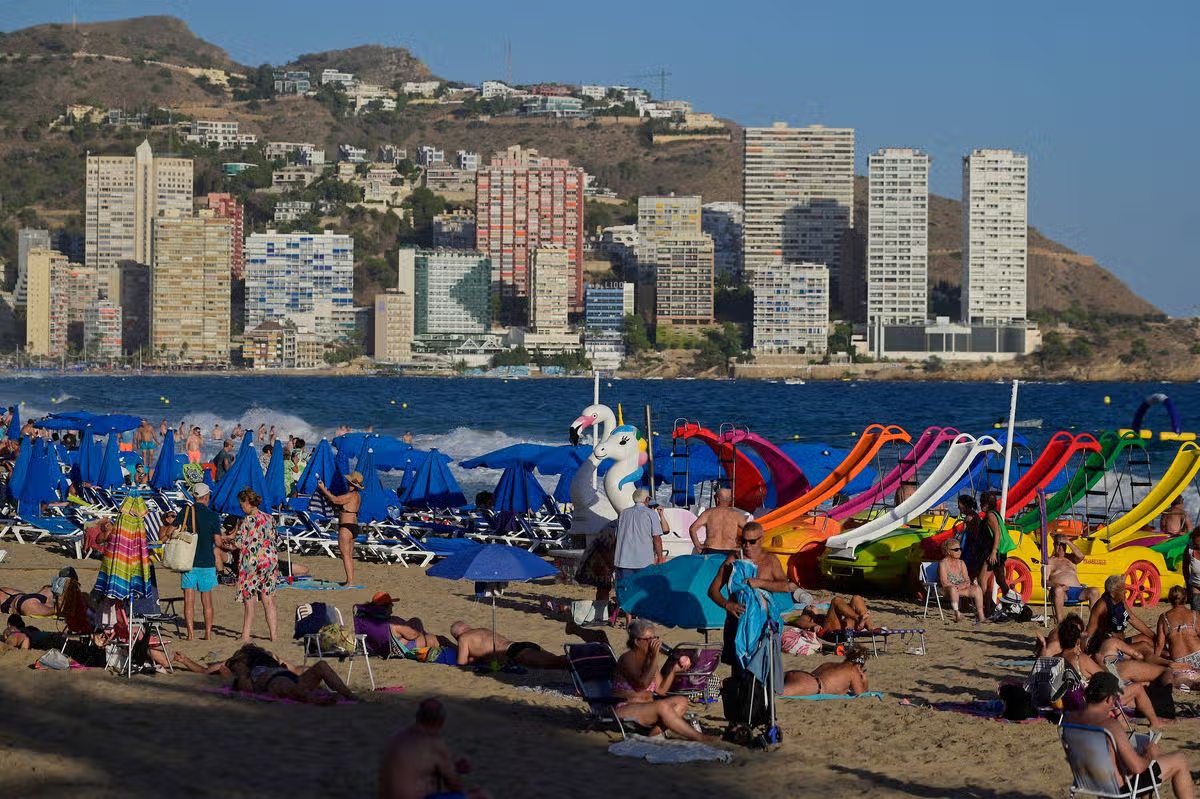
All Jet2 passengers with holidays booked have been contacted by the operator regarding an important change. Thousands of travellers have received emails notifying them that their holiday documents will be arriving later than originally expected.
This has raised alarm bells among some customers who fear it could be a scam – particularly as Jet2 has recently been warning about numerous fake social media accounts being created in an attempt to defraud passengers.
One passenger wrote on X: “@jet2tweets Hi, I’ve just received this email apparently from Jet2 saying I will now get my holiday documents 14 days before my holiday departure instead of 28, is this true or is it still 28, I’ve a feeling this was a spam email though.”
Another passenger added: “I had the same email. Flying on 25 May with jet2,” A traveller added: “Ive just had the same email !”
The email says: “Just so you know, following a change to when we send out the documents for your holiday, you’ll now receive your documents 14 days before departure, rather than 28 days as stated on your original booking confirmation. You don’t need to contact us or take any action – you’ll recveive your documents 14 days before you travel. Have a lovely holiday!”
Responding on X, Jet2 confirmed it was a genuine message and explained: “Hi there, thanks for reaching out. Yes we can confirm that you will receive your documents 14 days before departure. Should you require any further assistance, then please feel free to send us a DM. “
The shift towards holidaymakers securing their travel documents closer to their departure dates comes amid growing uncertainty sparked by the Middle East conflict. Last week, Fatih Birol, executive director of the International Energy Agency (IEA), warned there could be flight cancellations “soon” if oil supplies remain restricted by the Iran war.
The head of the world’s energy watchdog also cautioned that Europe has only six weeks’ supply of jet fuel because of the Middle East conflict. Iran continues to have a stranglehold on tankers passing through the Strait of Hormuz and has fired at several over the weekend.
Worried holidaymakers have been flooding Jet2’s social media channels with their concerns. One wrote: “@jet2tweets Hi there – we are looking to go away for a week to Malaga in June and want to know how concerned we should be about the reporting of lack of airport fuel and what happens to our holiday should something like this happen and impact our holiday. Can you help…?|”
Another posted: “Are holidays going ahead as usual? We’ve booked an all inclusive 10 day to Crete in June. I’m worried about jet fuel prices.” While a further traveller asked: “You guys aren’t planning on last-minute flight cancellations due to potential jet fuel shortages, are you? Family holiday booked in May, FYI” Jet2 responded: “Hi all, flights are planned to go ahead as normal. If anything were to change regarding your booking, we would be sure to reach out to you directly to make you aware and discuss the options available to you. Thanks”
Meanwhile, Javier Gándara, easyJet’s CEO for Spain and Portugal, spoke at the reopening of the airline’s base in Palma, Mallorca, where he gave his assessment of the current fuel supply situation: “What the producers and airports are telling us is that there won’t be any supply problems for the next three or four weeks.
“Beyond that, it’s difficult to see. In Spain, we are in a comparatively better situation than neighbouring countries for two reasons. Firstly, because of all the crude oil that is imported and then refined here, only 11% comes from the Middle East, which is the percentage affected by the closure of the Strait of Hormuz; the remaining 89% comes from elsewhere.”
He went on to warn: “No one will be immune to potential supply problems. Ships that leave and pass through the Strait of Hormuz and come to Europe take an average of 45 days, and they have already been practically out of service for two months. It will take time to recover all of that. It’s difficult to know what will happen, so we’ll react as we go.”
Sparked by the Iran war and the effective closure of the Strait of Hormuz, oil is no longer flowing out of the Middle East as it did earlier this year, which is having a major impact on the aviation industry
A jet fuel shortage is looming in Europe(Image: Getty Images)
Holidaymakers face soaring flight prices and more expensive package breaks even if they’ve already booked because of the looming shortage of jet fuel.
Sparked by the Iran War and the effective closure of the Strait of Hormuz, oil is no longer flowing out of the Middle East as it did earlier this year. Supplies of jet fuel built up by European countries have been severely depleted.
In general, some European countries hold several months’ worth of jet fuel inventory at a time, according to an IEA report released last week. “Every passing day that the Strait of Hormuz remains shut, Europe is edging closer to supply shortages,” said Amaar Khan, head of European jet fuel pricing at Argus Media. “The Strait accounts for around 40% of Europe’s jet fuel imports, but no jet fuel has passed the Strait since the war broke out.”
There are four main ways that the jet fuel shortage could impact British holidaymakers: rising flight prices, extra fees, cancelled flights and package break surcharges. We’ve explained each one below.
Jet fuel — a refined kerosene-based oil product — is airlines’ biggest cost, making up about 30% of overall expenses, according to the International Air Transport Association. And jet fuel prices have roughly doubled since the war began. Shortages could start next.
Already, a number of airlines have started bumping up the cost of tickets.
Just last week, it emerged that Virgin Atlantic had increased some flight costs with an extra £50 fuel surcharge on economy-class tickets, while premium economy fares are climbing by £180 and business class by £360.
Air France and KLM fares are also going up. They are likely to cost an additional €50, bringing the fuel surcharge to €100 (£86.98) on top of the standard fare. Meanwhile, flights to the United States, Canada and Mexico could increase by €70 (£60.89), and an economy round trip could cost an extra €10 (£8.70).
If you’ve already got your flights booked, you don’t need to worry. You are not going to be asked retrospectively to pay extra on your air fare. Once you have paid, the airline will not come after you for any more cash – unless the government hikes aviation fees, which they don’t appear poised to do.
Extra fees
Many passengers will have booked their flights months in advance, before the US and Israel attacked Iran and fuel prices started rising. Because airlines can’t bump up fares that’re already booked but for which they’re now making less money, they have started looking for other ways to make a bit of extra cash.
American Airlines has said it would hike checked baggage fees by $10 (£7.40) each for the first and second checked bags and by $150 (£111) for the third checked bag on domestic and short-haul international flights. Southwest Airlines has said it will hike checked baggage fees by $10 for the first and second bags, raising costs to $45 (£33) for the first bag and $55 (£40) for the second.
As passengers often add extra luggage just before they fly, these rises could impact passengers who booked flights before the invasion.
No major European airlines have made similar changes.
Cancelled flights
Last week, International Energy Agency Director Fatih Birol said Europe has “maybe six weeks” of remaining jet fuel supplies and said the global economy faces its “largest energy crisis.”
Many major airlines have already cancelled flights because of the fuel price rises and falling demand, and more are likely to do so.
Swedish flag carrier SAS has said it would cancel 1,000 flights in April because of high oil and jet fuel prices, after cancelling a “couple hundred” flights in March. United Airlines said that five per cent of flights would be cancelled in the second and third quarters of 2026, while Dutch airline KLM has cancelled 160 flights for the coming month.
Other airlines, such as BA, have suspended whole routes to parts of the Middle East due to the conflict, while Virgin Atlantic announced earlier this month that it would be permanently scrapping its London flight to Riyadh from April.
Under UK law, if your flight is cancelled more than 14 days before it is due to depart, you are not entitled to compensation. However, your airline does have to offer you a full refund or help you find an alternative flight.
In the latter case, it’s up to you whether to fly as soon as possible after the cancelled flight, or at a later date that suits you. Although most airlines will book you onto another of their flights to the same destination, if an alternative airline is flying there significantly sooner or other suitable modes of transport are available, then you may have the right to be booked onto that alternative transport instead. You can discuss this with your airline.
Given that airfares may be significantly higher than when you booked, opting for an alternative flight rather than taking a refund may work out in your favour.
Extra package break costs
A largely overlooked clause in package holiday terms and conditions could result in the price of a package holiday increasing by hundreds of pounds – even after you’ve already made your booking and payment.
An article by Which? drew attention to the obscure clause found within Package Travel Regulations. It reveals that UK holiday companies can impose an additional charge of up to 8% on a package holiday price, without being required to provide a free cancellation option, under three specific circumstances.
These circumstances include: a destination introducing additional taxes or other charges, a significant shift in currency exchange rates, or a rise in the price of fuel or power. Given the ongoing Middle East conflict, fuel costs have been rising noticeably, which means there’s potential for package holiday operators to invoke this rule for Brits who’ve already booked their holidays should these expenses continue climbing.
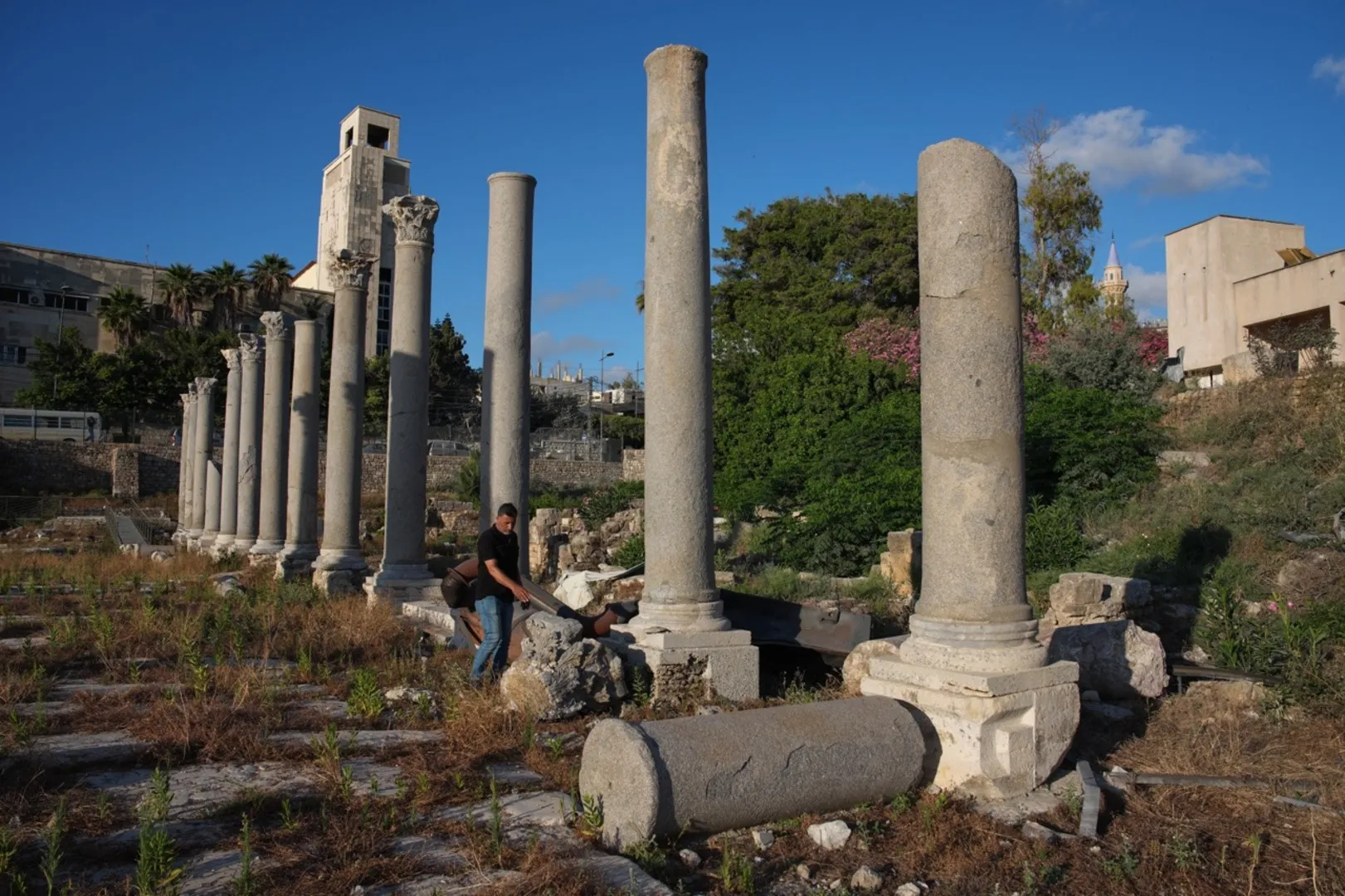
US band The Strokes used their Coachella set to showcase the US-Israeli destruction of universities in Gaza and Iran, including Gaza’s al-Israa University.
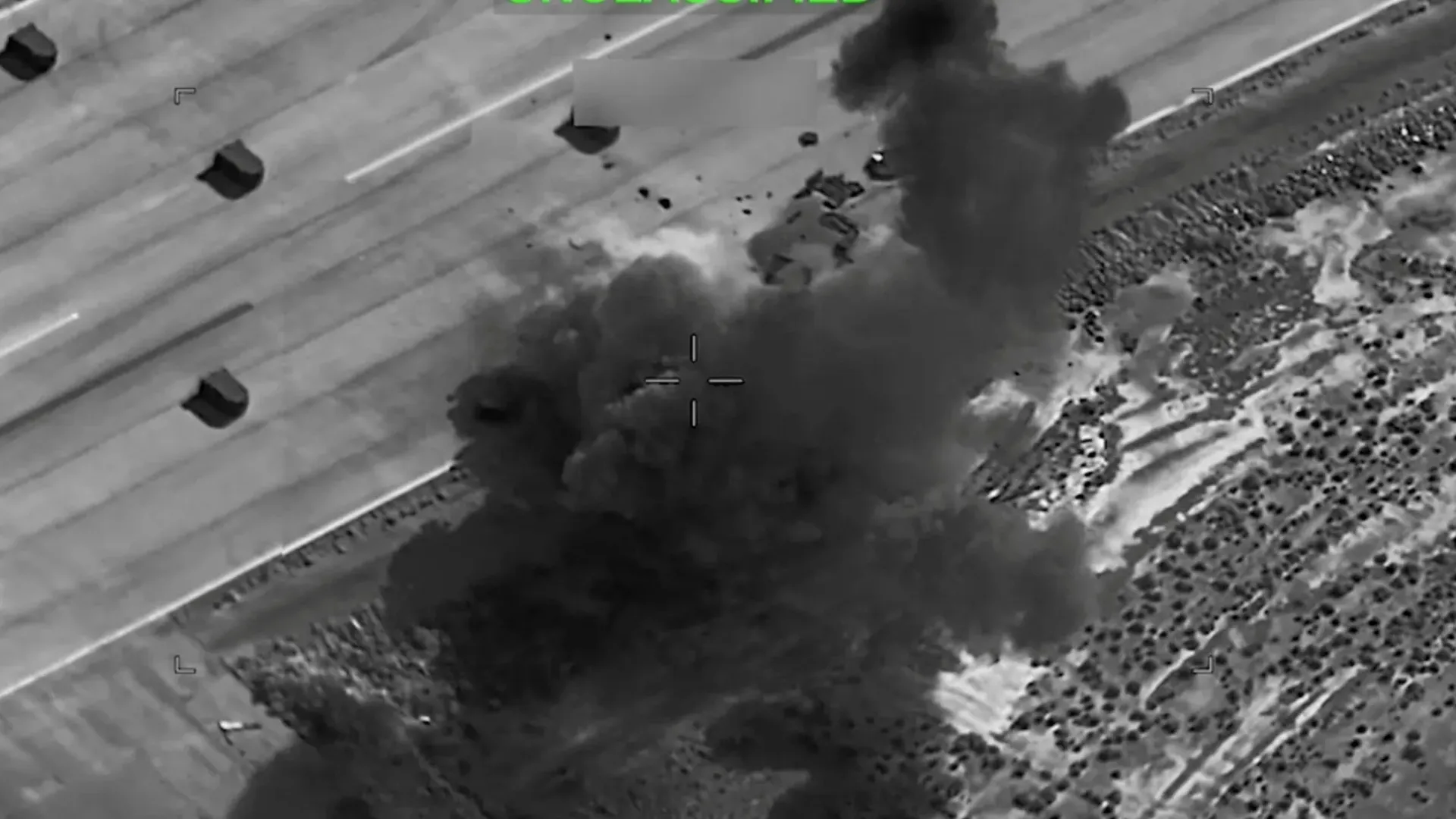
New video from the US military is said to show an operation by its forces to seize an Iranian-flagged ship which attempted to bypass the US blockade of Iranian ports. The US says the cargo ship Touska was linked to a sanctioned company, while Iran condemned the move as ‘piracy’ and a violation of the ceasefire.
Islamabad, Pakistan – Pakistan is gearing up to host the second round of talks between the United States and Iran aimed at ending their war, but rising tensions in recent hours have cast uncertainty over Tehran’s participation, as the deadline nears for the end of the two-week ceasefire.
Unlike the first round of talks held in Islamabad on April 11, the upcoming negotiations could last for multiple days until a temporary deal – mediators are calling it a memorandum of understanding – is signed, effectively extending the ceasefire, sources close to these efforts have told Al Jazeera. If the MoU is agreed, it would give negotiators a longer window – even up to 60 days – to secure a longer peace deal.
Recommended Stories
list of 4 itemsend of list
But all of that hinges on the participation of Iran, which – as of Monday morning – has not confirmed that it will be sending its negotiators to Islamabad. That follows a rapid escalation in tensions over the past 24 hours.
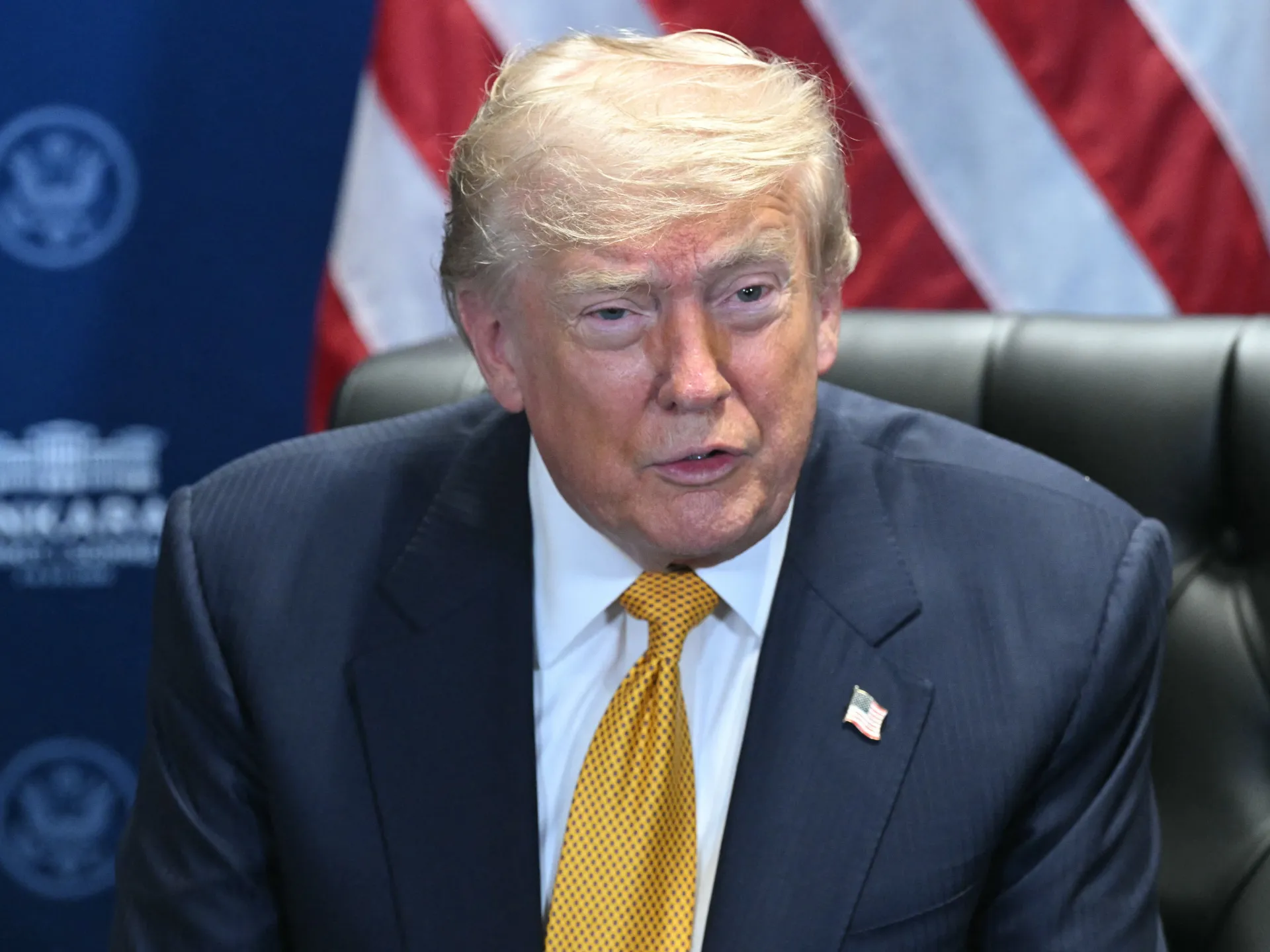
US President Donald Trump announced on Sunday that his representatives were heading to Pakistan for a second round of negotiations with Iran, as a fragile ceasefire, due to expire on Wednesday, edges towards its deadline. But Trump accompanied his announcement with a revival of earlier pre-ceasefire threats to bomb Iran’s energy and power facilities.
“My Representatives are going to Islamabad, Pakistan. They will be there tomorrow evening, for Negotiations,” Trump wrote on Truth Social. He accused Iran of a “Total Violation of our Ceasefire Agreement” after Iranian gunboats fired on vessels in the Strait of Hormuz on Saturday, hitting ships including a French vessel and a British freighter.
“We’re offering a very fair and reasonable DEAL, and I hope they take it because, if they don’t, the United States is going to knock out every single Power Plant, and every single Bridge, in Iran,” Trump wrote. “NO MORE MR. NICE GUY!”
The tensions did not ease overnight. In the early hours of Monday, Trump announced on Truth Social that the US Navy guided missile destroyer USS Spruance had intercepted an Iranian-flagged cargo ship, the Touska, nearly 900 feet (274 metres) long, in the Gulf of Oman after its crew refused to heed warnings to stop.
“Our Navy ship stopped them right in their tracks by blowing a hole in the engine room,” Trump wrote. US Marines have now taken charge of the vessel, which Trump alleged was under US Treasury sanctions for prior illegal activity.
Iran has described the seizure of the ship as “piracy”.
The Serena Hotel is scheduled to host the anticipated next round of talks between the US and Iran. [Sohail Shahzad/EPA]
Pakistan’s preparations
Amid those military and social media exchanges between Iran and the United States, Pakistan has been busy getting ready to host talks that it – as the principal mediator between Washington and Tehran – hopes will yield a deal to end the war, now into its eighth week.
Islamabad’s Marriott Hotel asked guests to vacate by Sunday afternoon. The Serena Hotel, just a few kilometres away and the venue for the first round of talks a week earlier, soon issued the same order and stopped taking reservations.
Roads into the Red Zone, the capital’s most heavily fortified area, were sealed. The district houses key government buildings, including the National Assembly, foreign embassies and both five-star hotels. Thousands of additional police and paramilitary personnel arrived from across the country.
Barbed wire and barricades lined the streets, and most access routes were shut.
But even before Trump’s latest threat to blow up Iranian energy and power facilities, and the subsequent hijacking of the Iranian ship, Tehran was unclear about whether it would join the talks.
Minutes before Trump’s Truth Social message, Iran’s ambassador to Pakistan, Reza Amiri Moghadam wrote on his social media that violations of international law, the continuation of the US naval blockade of the Strait of Hormuz, threats of further strikes, and what he described as unreasonable demands could not be reconciled with a genuine pursuit of peace.
“As long as the naval blockade remains, faultlines remain,” he added.
The negotiators: The US and Iranian teams
Trump first said on Sunday that Vice President JD Vance, who had led the US team in the first round of Islamabad talks, would not visit the Pakistani capital this time around, because of security concerns.
But White House Press Secretary Karoline Leavitt later said that Vance would join the US delegation, alongside special envoy Steve Witkoff and Trump’s son-in-law, Jared Kushner, the same team that led the first round.
Flight tracking data showed at least four US government aircraft carrying communications equipment and motorcade support landed on Sunday at PAF Base Nur Khan in Rawalpindi, the primary VIP entry point for Islamabad.
However, by late night, sources close to mediators told Al Jazeera that it was once again unclear whether Vance would travel to Islamabad on Monday. They said that the US might now send Witkoff and Kushner to Islamabad first, and if the talks actually happen, Vance might join them.
Amid Iranian hesitation over whether to join the Islamabad talks, Pakistani Prime Minister Shehbaz Sharif spoke with Iranian President Masoud Pezeshkian. The call lasted about 45 minutes, the Pakistan PM’s office said.
Sharif briefed Pezeshkian on his recent visits to Saudi Arabia, Qatar and Turkiye, where he met with their leaders, describing those engagements as helpful in “building consensus in support of a sustained process of dialogue and diplomacy”.
But by early Monday morning, Trump’s revived threats and the capture of the Iranian cargo ship have left the prospects of talks in Islamabad even more on edge than before.
Iran pushes back
Tehran pushed back sharply against Trump’s flurry of social media posts on Sunday.
Iran’s state news agency IRNA said reports of a second round of talks in Islamabad were “not correct”, and blamed the lack of progress on what it described as American “greed”, unreasonable demands, shifting positions and “continuous contradictions”.
According to IRNA, the naval blockade – imposed by Trump last Monday, two days after the first round of Islamabad talks – violated the ceasefire understanding and had “so far prevented progress in negotiations”.
It added that “no clear prospect for productive negotiations is foreseen” under current conditions and dismissed US statements on talks as “a media game”, aimed at pressuring Iran through a “blame game”.
A satellite image shows shipping movement in the Strait of Hormuz on April 17, 2026, in Space. [Handout/ European Union/Copernicus Sentinel via Reuters]
In a post on X, foreign ministry spokesman Esmaeil Baghaei went further, describing the US naval blockade as “unlawful and criminal” and saying it amounted to “war crime and crime against humanity”.
Despite the public denials, Iranian sources earlier on Sunday indicated a delegation was expected in Pakistan on Tuesday. It could include Parliamentary Speaker Mohammad Bagher Ghalibaf, who led Tehran’s team in the first round, and Foreign Minister Abbas Araghchi, who had joined him then.
Pakistan’s foreign ministry said Araghchi and his Pakistani counterpart Ishaq Dar spoke by phone on Sunday and discussed “the need for continued dialogue and engagement as essential to resolving the current issues as soon as possible”.
Analysts say the gap between Iran’s public stance and private signalling reflects a deliberate strategy.
“This gap reflects a dual-track negotiation strategy,” Seyed Mojtaba Jalalzadeh, an international relations analyst based in Tehran, told Al Jazeera. “At the public level, Iran maintains a hardline position to preserve domestic legitimacy and increase its leverage; at the non-public level, by dispatching a team to Islamabad, it signals that it has not abandoned diplomacy but is instead testing its conditions.”
Fahd Humayun, an assistant professor of political science at Tufts University, agreed.
“When warring parties come to the table to negotiate, they come with the understanding that there is occasionally a gap between public posturing and private positions,” he told Al Jazeera. “My sense is that they will pick up from where they left off, rather than getting too caught up in the rhetoric that has emerged since”.
That divergence extends to the pace of negotiations.
Washington has pushed for a rapid resolution, with Trump repeatedly declaring the war “close to over” even as fighting continues. Tehran, by contrast, has shown little inclination to be rushed.
A diplomat in Islamabad, who has followed the talks closely, described the contrast.
“The previous round of talks is a great example. It appeared as if the Americans brought a stop-watch, whereas the Iranians came armed with a calendar,” the diplomat said on condition of anonymity.
What is achievable?
Officials do not expect a final deal this week.
The immediate goal is likely to be a ceasefire extension, with both sides in Islamabad working towards a limited understanding.
Pakistani officials expressed cautious optimism, saying the process was moving in a positive direction while stressing that a final agreement would require sustained engagement and compromise.
Unlike the first round, talks could run for several days, with the aim of agreeing on a framework for broader negotiations in the coming weeks and months.
Pakistan’s Prime Minister Shehbaz Sharif with Iranian Parliament Speaker Mohammad Bagher Ghalibaf before anticipated peace talks in Islamabad, April 11, 2026. [Handout/Office of the Iranian Parliament Speaker via Reuters]
Humayun cautioned against viewing the first round as a failure.
“I wouldn’t characterise the first round as having failed, that assumes expectations of resolving the most difficult issues early on, which is unlikely in talks of this nature where the issues are so complex,” he said.
For this round, a ceasefire extension would be “a meaningful outcome in itself”, while both sides would likely be “probing for any shifts or flexibility in positions since they last spoke”.
It is that movement, he added, that would allow both sides to “politically sanction an extension of the ceasefire”.
“A ceasefire extension could represent the most minimal form of agreement achievable in this round,” Jalalzadeh said, adding that the deal Washington seeks is “far broader in scope and is rooted in a history stretching back 47 years”.
Iran’s Deputy Foreign Minister Saeed Khatibzadeh, speaking on the sidelines of the Antalya Diplomacy Forum in Turkiye over the weekend, said “significant progress” had been made in the previous round but stressed that a framework must be agreed upon before talks could advance.
He described US demands on Iran’s nuclear programme as “maximalist”.
Ghalibaf was more direct. “There are many gaps and some fundamental points remain,” he said in televised remarks on Saturday night. “We are still far from the final discussion”.
The core sticking points, Iran’s nuclear programme and control of the Strait of Hormuz, remain unresolved since the first round, held on April 11, which lasted 21 hours and ended without agreement.
A separate Israel-Lebanon ceasefire is now in place, removing one of Tehran’s stated conditions for talks.
But Jalalzadeh said the ceasefire fell well short of satisfying Iran’s demands. “The current Israel-Lebanon ceasefire is temporary, fragile, and incomplete,” he told Al Jazeera, noting that Hezbollah – Tehran’s most powerful regional ally – was absent from the agreement, which the Lebanese government negotiated with Israel.
“This ceasefire is a tactical palliative, not a substitute for Iran’s strategic demand,” he said, adding that Tehran’s insistence on Lebanon being part of any broader deal, rather than handled through a separate arrangement, remained unchanged.
Humayun said Iran would want the Israel-Lebanon truce to hold and ideally include “some form of assurance against violations”.
US Vice President JD Vance with Pakistan’s Prime Minister Shehbaz Sharif for talks about Iran in Islamabad, April 11, 2026. [Jacquelyn Martin/Pool via Reuters]
The broader question, he said, is “whether Iran can secure at least some degree of US pressure on Israel to adhere to the ceasefire and to refrain from further escalation”.
The Sharif-Pezeshkian call capped an intensive week of Pakistani diplomacy.
Field Marshal Asim Munir travelled to Tehran last Wednesday, carrying what officials described as a new message from Washington.
Iranian Ambassador Reza Amiri Moghadam said last week in Islamabad that Tehran would “do talks in Pakistan and nowhere else, because we trust Pakistan”.
Analysts say Pakistan’s value as a mediator lies in the rare credibility it holds with both sides.
Humayun said that even if this round produces no breakthrough, it would not necessarily erode trust in Islamabad.
“All parties understand how difficult these issues are and that, without Pakistan’s facilitation, they may not have reached this point at all,” he said.
Jalalzadeh offered a more cautious assessment, saying Pakistan’s role ultimately depends on results.
“If this round also fails, its standing as an effective mediator will be weakened, even if it continues to function as a minimal communication channel,” he said.
Still, he noted, Islamabad has already distinguished itself among countries that have attempted mediation, filling a gap left by others and establishing itself as a credible host.
Trump, however, insisted a deal would come regardless.
“It will happen. One way or another. The nice way or the hard way,” he told ABC News. “You can quote me.”
Islamabad talks in limbo as Tehran says it will retaliate after US marines capture an Iranian-flagged ship near the Strait of Hormuz.
Published On 20 Apr 202620 Apr 2026
Donald Trump announced on Sunday that a second round of US-Iran talks is to be held in Pakistan on Monday – but Tehran has not confirmed participation, two days before a ceasefire deal expires.
The capture by US Marines of an Iranian-flagged container ship near the Strait of Hormuz on Sunday has further clouded the Islamabad talks, as Tehran has pledged to retaliate.
Recommended Stories
list of 4 itemsend of list
The attack came hours after President Trump announced he is sending a team to Islamabad for talks, while once again threatening to knock out Iran’s power plants and bridges if there is no deal. The ceasefire, which ended more than a month of war, expires on Wednesday.
Pakistan’s Prime Minister, Shehbaz Sharif, spoke on Sunday with Iranian President, Masoud Pezeshkian, as he reaffirmed his government’s readiness to mediate the conflict.
Here is what we know:
In Iran
Iran’s top joint military command, Khatam al-Anbiya, accused the US of violating the ceasefire by shooting at an Iranian ship in the Gulf of Oman and vowed to retaliate.
President Trump posted on Truth Social on Sunday that US Marines captured a vessel that tried to get past the American blockade on Iranian ports, adding that US forces stopped the ship by blowing a hole in its engine room.
Iran executed two men convicted of cooperating with Israel’s Mossad intelligence service and planning attacks inside the country, the judiciary’s news outlet Mizan reported on Sunday.
French shipping company, CMA CGM, confirmed on Sunday that “warning shots” were fired at one of its ships in the Strait of Hormuz on Saturday.
Iran’s armed forces turned back two tankers attempting to transit the Strait of Hormuz on Sunday after issuing warnings. The semi-official Tasnim news agency said that was a result of the continuing US maritime blockade on Iran.
International flights from Mashhad airport in northeast Iran will resume on Monday, the civil aviation authority said.
War diplomacy
Iranian state media reported that Tehran had rejected new peace talks, citing the ongoing blockade, threatening rhetoric, and Washington’s shifting positions and “excessive demands.”
Iranian state media reported on Sunday that Tehran was not planning to take part in talks with the United States, hours after Trump said he was dispatching negotiators to Islamabad.
The US president posted on Truth Social on Sunday that representatives are going to Islamabad “tomorrow night” for Iran negotiations. “We’re offering a very fair and reasonable deal, and I hope they take it because, if they don’t, the United States is going to knock out every single power plant, and every single bridge, in Iran,” Trump wrote.
Pakistan’s Prime Minister Sharif said on Sunday that he spoke with Iran’s President Masoud Pezeshkian about the conflict in the Gulf. Sharif posted on X that he shared insights with Pezeshkian regarding his recent conversations with the leaders of Saudi Arabia, Qatar and Turkiye.
“I appreciated Iran’s engagement, including its high-level delegation to Islamabad for the historic talks, and recent discussions with Field Marshal Syed Asim Munir in Tehran,” Sharif said.
Turkiye’s Foreign Minister, Hakan Fidan, said on Sunday he was “optimistic” that a two-week ceasefire between Iran and the United States, which expires on Wednesday, would be extended, allowing more time for talks between the sides. Vice President JD Vance led the US delegation for the first round of talks in Islamabad. They ended without a deal [Jacquelyn Martin/Pool/AP Photo]
In the US
Trump said on Sunday that the guided-missile destroyer, USS Spruance, fired on and seized the Iranian-flagged cargo ship, Touska, in the Gulf of Oman, and US Marines were “seeing what’s on board!”
The US president said Iran has committed a “serious violation” of the ceasefire but still thinks he can get a peace deal, ABC News reporter Jonathan Karl posted on X on Sunday. Trump added that a peace deal “will happen. One way or another”.
In Israel
Argentine President Javier Milei, has reaffirmed his country’s support for the campaign against Iran, citing his government’s earlier decision to designate the Iranian Revolutionary Guards as a “terrorist organisation”.
Milei, who is visiting Israel for the third time since taking office, declared on Sunday that the joint US-Israel war against Iran was the “right thing to do”, as he signed on to the so-called Isaac Accords aimed at deepening bilateral ties between Israel and Latin American countries.
In Lebanon
The Israeli military on Monday warned residents in southern Lebanon not to move south of a specified line of villages or approach areas near the Litani River, saying its forces remain deployed in the area during a ceasefire due to what it described as continued Hezbollah activity.
The Israeli army also said it had determined that an image circulating on social media showing a soldier in south Lebanon hitting a statue of Jesus Christ is authentic and depicts one of its troops.
The viral photo of the Israeli soldier hitting the Jesus statue with a sledgehammer has sparked outrage.
French President Emmanuel Macron is due to meet Lebanese Prime Minister Nawaf Salam in Paris on Tuesday. The announcement follows the killing of a French peacekeeper in Lebanon during the fragile 10-day ceasefire between Israel and Iran-backed militant group Hezbollah.
Israel’s Defence Minister Israel Katz said the military will use “full force” in Lebanon – even during the ongoing ceasefire – should Israeli troops face any threat from Hezbollah.
Lebanon’s military said it has reopened a road and bridge between Nabatieh and Khardali, which were damaged by Israeli strikes in the south.
Oil prices rise
Oil prices surged on Monday following the re-escalation of hostilities in the Middle East war However, lingering hopes that a deal to end the seven-week crisis continued to support equities, despite Tehran saying it was not planning to attend peace talks.
The country has chosen to abandon the new biometric security measures over concerns about queue chaos and flights taking off without passengers
07:21, 20 Apr 2026Updated 07:45, 20 Apr 2026
The new entry and exit system (EES) has led to huge delays for passengers, with some missing flights(Image: Getty)
Greece has suspended EU fingerprint and facial scans for British holidaymakers. The country has chosen to abandon the new biometric security measures over concerns about queue chaos sweeping across the continent. Queues have been hitting the country with four hours reported in many destinations, including Greece.
All travellers from the UK and other non-EU countries are supposed to be photographed and fingerprinted at EU airports and border crossings under the new entry and exit system (EES) introduced by Brussels.
Holidaymakers have been cautioned that the new security measure, which is now fully operational, could trigger airport delays of up to four hours. Eleni Skarveli, director of the Greek National Tourism Organisation in the UK, stressed that the decision would “ensure a smoother and more efficient arrival experience in Greece” and would “significantly reduce waiting times” while alleviating congestion at airports.
The EES is intended to replace manual passport stamping and better monitor the 90-day visa-free limit, but its introduction has caused havoc at some of Europe’s busiest airports.
A statement on the website of the Greek Embassy and posts on official social media channels said: “Update for British passport holders travelling to Greece. “In the framework of the implementation of the Entry/Exit System, as of 10 April 2026, British passport holders are exempt from biometric registration at Greek border crossing points.”
There was no further detail of how long the exemption would last, and FCDO travel advice for Greece has not been updated.
“Abta has been warning destinations and the (European) Commission for some time about the need for proactive steps to be taken to avoid delays, including the full use of contingency measures to stand down biometric checks at busier times, and adequate staffing especially at peak times.”
A total of 122 passengers were reportedly unable to board the flight from Milan Linate to Manchester on Sunday because of delays at passport desks caused by the ramp up of the EU’s Entry Exist System (EES).The 11am departure was held for 59 minutes before departing with the majority of seats empty.
One of the affected easyJet passengers, Kiera, 17, from Oldham, Greater Manchester, said she and her boyfriend arrived at Milan Linate airport at 7.30am on Sunday. She told the BBC: “We got to Border Control and it was a massive queue of people. I wasn’t feeling great anyway because I think I’d got food poisoning.
“At about 10.50am they brought some water over for people, and when we got to the front of the queue someone asked us if we were going to Manchester, and told us our flight had just gone.”
Vicky Chapman, 26, from Wirral, Merseyside, was booked on the flight with her family, including her five-year-old son.
She told the Liverpool Echo they arrived at the airport “with more than enough time” but were “refused entry through passport control”.
She continued: “We were then told that we are a ‘no show’ on our flight because we did not get to the gate on time, even though passport control had issues and they would not let us through.
“We were passed from pillar to post for three hours and no-one helped us. “It was so hot in the airport, people were vomiting, people were almost passing out.
“We’re being told that Tuesday is the earliest we can get back, and that we have to fly to Gatwick. We’ve had to pay out of pocket for an Airbnb.”
An easyJet spokesman said: “Due to delays in EES processing by border authorities, some passengers departing from Milan Linate on Sunday experienced very long waiting times at passport control.
“We held flight EJU5420 from Milan to Manchester for nearly an hour to give passengers extra time but it had to then depart due to crew reaching their safety regulated operating hours.
“Customers who missed the flight have been offered a free flight transfer.
“We continue to urge border authorities to ensure they make full and effective use of the permitted flexibilities, for as long as needed while EES is implemented, to avoid these unacceptable border delays for our customers.
“While this is outside of our control, we are sorry for any inconvenience caused.”
Of the 156 passengers reportedly booked on the return flight to Manchester, just 34 made it on board – leaving a staggering 122 stranded in Italy. EasyJet subsequently issued an apology over the incident.
At three of the UK’s “juxtaposed” border controls in Dover, Folkestone and London St Pancras, the pricey EES kiosks remain unconnected to the French police aux frontières IT system. These issues are not expected to be resolved until September, according to the Independent.
Greece is heavily dependent on British tourism, particularly at its bustling island hotspots such as Corfu, Crete and Rhodes, which can welcome upwards of 2,000 UK passengers daily during peak season.
The decision by Athens is widely regarded as a move to offer reassurance to British holidaymakers, and could encourage other Mediterranean nations to follow its lead. Greece is yet to confirm an end date. for its EES exemption for British travellers.
Holidaymakers are already considering switching their summer holiday plans this year, according to travel industry experts.
“Because of the war in the Middle East, Europe is seeing a big increase in interest as a holiday destination this year,” an ABTA spokesman said.
ABTA added that Greece was anticipated to be the fifth most-visited destination by Britons this summer, trailing behind Spain, France, Italy and the USA.
The spokesman said: “I think it’s too early to say what this change might mean for the number of people visiting, particularly as decisions on where to go are based on a number of factors.”
It’s thought travellers now weighing up a continental break may pivot towards Greece to sidestep potential headaches caused by the new scheme. “Greece for me this summer then, was thinking of Tenerife, but no way I’m putting up with those queues and chaos,” one man posted on X.
Another person added: “I work in the travel industry, already had customers worried about this new system believe me, Greece will benefit from this stand!” While a third chimed in: “Perfect – off to the Greek islands this summer – common sense prevails!”
Social media users condemn Western silence on attacks on religious symbols and sites by Israeli soldiers and settlers.
Published On 19 Apr 202619 Apr 2026
A viral photograph showing an Israeli soldier hitting a statue of Jesus Christ in southern Lebanon with a sledgehammer has sparked outrage.
In a statement on Monday, the Israeli military confirmed the authenticity of the image that was widely shared online, garnering more than 5 million views on X.
It said that following an initial review, it was determined that the photograph showed an Israeli soldier “operating in southern Lebanon”, where Israel last month launched a ground invasion in conjunction with aerial bombardment amid its joint war with the United States on Iran.
The military added that an investigation had been opened and that “appropriate measures will be taken against those involved in accordance with the findings”.
Commenting on social media, Ayman Odeh, a Palestinian member of the Israeli parliament, wrote pointedly: “We’ll wait to hear the police spokesperson claim that ‘the soldier felt threatened by Jesus’.”
Ahmad Tibi, another Palestinian member of the Knesset, wrote on Facebook that those who blow up mosques and churches in Gaza and spit on Christian clergy in Jerusalem without punishment are not afraid to destroy a statue of Jesus Christ and publish it.
“Perhaps these racists have also learned from Donald Trump to insult Jesus Christ and insult Pope Leo?” he asked, referring to the US president’s recent controversies, including his now-deleted AI-generated image that portrayed him as a Jesus-like figure and his feud with the head of the Roman Catholic Church, who has criticised the war on Iran.
Several activists, academics and writers also criticised the desecration of the statue, which was located on the outskirts of the village of Debl in southern Lebanon, near the border with Israel.
Social media users also condemned the international silence following attacks by Israeli soldiers and settlers against religious sites and symbols.
“When the Western world remains silent, racists go further,” said Tibi.
Israeli forces repeatedly attacked religious sites, including mosques and churches, during Israel’s genocidal war on Gaza. In the occupied West Bank, meanwhile, settlers vandalised or attacked 45 mosques last year, according to the Palestinian Authority’s Ministry of Religious Affairs.
Separately, the Religious Freedom Data Center (RFDC) documented at least 201 incidents of violence against Christians, primarily committed by Orthodox Jews targeting international clergy or individuals displaying Christian symbols, between January 2024 and September 2025.
The majority of these incidents, which included multiple forms of harassment, including spitting, verbal abuse, vandalism and assaults, took place in Jerusalem’s Old City, located in occupied East Jerusalem.
A photo of an Israeli soldier smashing a statue of Jesus Christ with a sledgehammer in southern Lebanon has sparked widespread condemnation. Israeli officials confirmed the image is genuine and ‘promised to investigate’.
Brent crude rises more than 7 percent as Washington and Tehran offer conflicting accounts on ceasefire negotiations.
Published On 20 Apr 202620 Apr 2026
Oil prices have risen sharply following attacks on commercial vessels in the Strait of Hormuz and conflicting messages about the prospect of renewed negotiations between the United States and Iran.
Brent crude futures, the primary benchmark for global prices, jumped more than 7 percent in Asia on Monday as the outlook for peace between Washington and Tehran darkened.
Recommended Stories
list of 4 itemsend of list
Prices eased somewhat later in the morning, with the benchmark at $94.69 a barrel as of 02:05 GMT, up from just under $90.40 on Friday.
The latest price surge came after US President Donald Trump said US forces seized an Iranian-flagged cargo vessel that had attempted to evade the US blockade of Iran’s ports.
Trump’s announcement followed reports by the United Kingdom Maritime Trade Operations (UKMTO) Centre over the weekend that two vessels came under attack while transiting the strait.
Iranian gunboats fired on a tanker, while an “unknown projectile” struck a container ship, according to the UKMTO.
After declaring the strait “completely open” on Friday, Tehran reversed course less than 24 hours later, citing the ongoing US blockade.
Earlier on Sunday, Trump said that a US delegation would travel to Pakistan on Monday to hold a second round of ceasefire talks with Iranian officials.
Iranian state news outlet IRNA later reported that Tehran would not participate in the talks, citing the US blockade and Washington’s “excessive demands” and “unrealistic expectations”.
A two-week ceasefire between Washington and Tehran is set to expire on Wednesday if the sides cannot agree on an extension.
An initial round of talks held in Islamabad earlier this month broke down without any agreement between the sides.
Iran’s effective closure of the strait, which usually carries about one-fifth of global oil and natural gas supplies, has driven a surge in fuel prices worldwide, forcing governments to tap emergency supplies and roll out energy-saving measures.
Nineteen vessels crossed the strait on Saturday, up from 10 the previous day, but far below the historical average of 138 daily transits, according to the UKMTO.
Asia’s main stock markets opened higher on Monday despite the dimming prospects of de-escalation.
Japan’s Nikkei 225 rose more than 1 percent in morning trading, while South Korea’s KOSPI gained about 1.3 percent.
Hong Kong’s Hang Seng Index rose about 0.5 percent, while the SSE Composite Index in Shanghai gained more than 0.4 percent.
US Central Command has published a video said to show a guided-missile destroyer firing at an Iranian-flagged cargo ship near the Strait of Hormuz. The USS Spruance fired several rounds into the Touska’s engine room for ‘violating the US blockade’, before marines boarded it.
Israel and the US have been at war with Iran since February 28th. The impact of the conflict has become global and all sides have suffered casualties, but it wasn’t always this way.
Al Jazeera’s Ruby Zaman explains how Iran and Israel once had a very different kind of relationship.
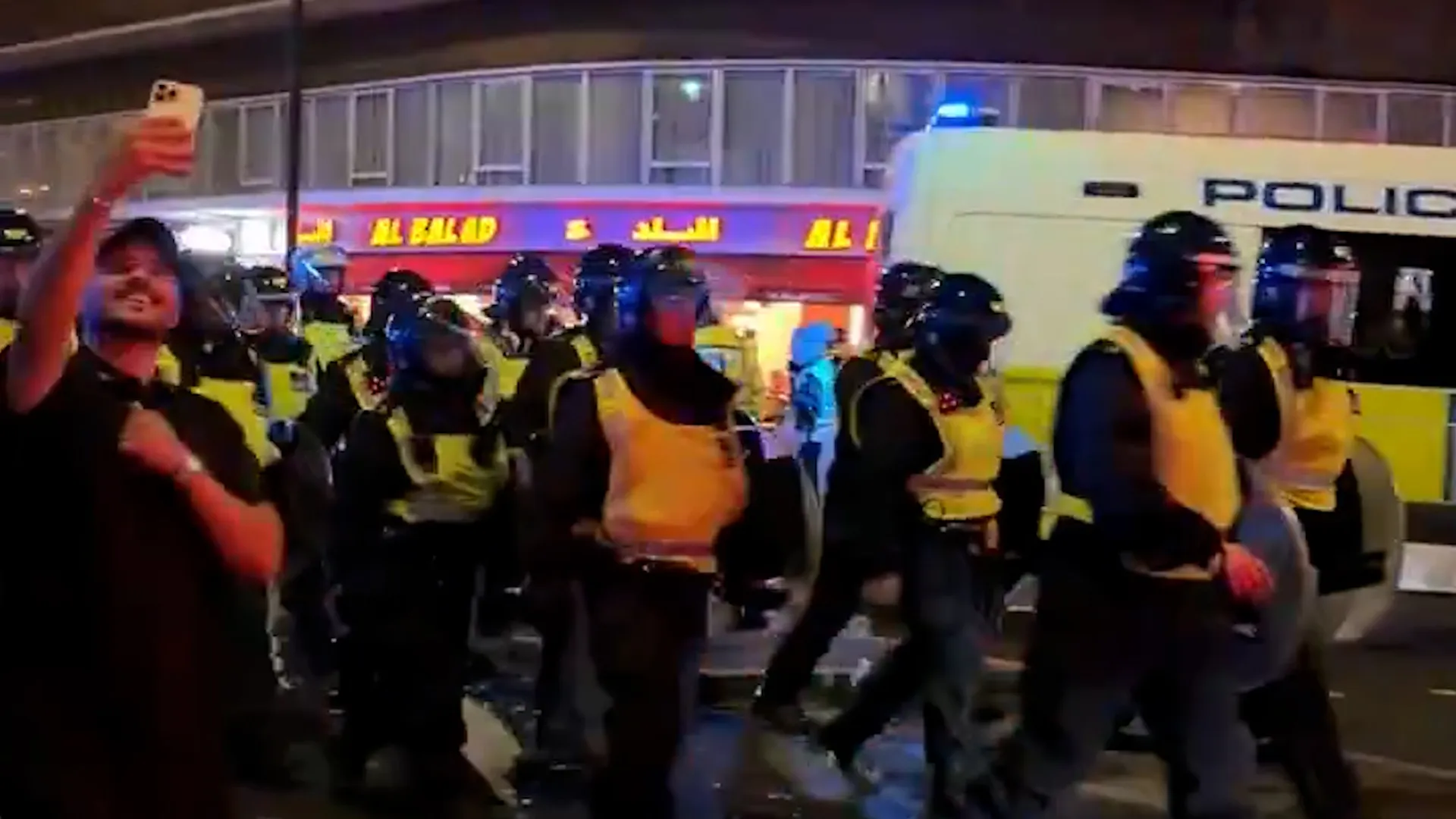
Hundreds of far-right “Britain First” supporters marched in the streets of Manchester to celebrate Saint George, seemingly not realising the patron saint of England has a special connection to Palestine. Al Jazeera’s Nils Adler and Nida Ibrahim explain.
Mukalla, Yemen – The Yemeni government’s measures to curb the devaluation of the Yemeni riyal have finally borne fruit, but they have created another problem: A severe liquidity crunch.
The government’s central bank, based in the southern city of Aden, has shut down unauthorised exchange firms it says were involved in currency speculation, centralised internal remittances under a controlled system, and formed a committee to oversee imports and provide traders with hard currency.
Recommended Stories
list of 3 itemsend of list
These measures have helped curb the riyal’s freefall, from about 2,900 to the United States dollar months ago to about 1,500 today, a move that was initially welcomed. But the gains have been short-lived, as public frustration has grown over a worsening shortage of cash in riyals.
People across government-controlled cities such as Aden, Taiz, Mukalla and others have said they are facing an unprecedented shortage of Yemeni riyals in the market. Many, particularly those holding US dollars or Saudi riyals, said local banks and exchange firms are refusing to convert foreign currency, or are limiting daily exchanges to as little as 50 Saudi riyals per person, citing a shortage of local cash.
This has left many Yemenis unable to access cash or use their savings in hard currency at a time of mounting economic pressure, paralysing businesses and giving rise to a black market where traders exchange foreign currency at more unfavourable rates to the customer.
Businesses grind to a halt
Mohammed Omer, who runs a small grocery shop in Mukalla, said he has spent hours crisscrossing the city’s exchange firms trying to convert a few hundred Saudi riyals he received from customers. “I’ve gone from one exchange to another, and they refuse to exchange more than 50 riyals,” said Omer, a man in his early 50s with a salt-and-pepper goatee. “It’s a waste of time and effort – I’ve had to close my shop.”
Yemen has endured an economic meltdown for more than a decade, stemming from a war between the Saudi-backed government and the Iran-aligned Houthis that has killed thousands and displaced millions.
Alongside the fighting on the battlefield, the warring sides have targeted each other’s main sources of revenue, leaving both the Houthis and the government strapped for cash, struggling to pay public-sector salaries and fund basic services in areas under their control.
At a board meeting in March, the Central Bank in Aden said it was aware of the cash shortage and had approved several unspecified “short- and long-term” measures to address the problem, noting that it is pursuing “conservative precautionary policies” to stabilise the riyal and curb inflationary pressures.
Government employees have also complained that the cash-strapped Yemeni government is paying salaries in low-denomination banknotes – mainly 100 riyals – forcing them to carry their wages in bags.
Munif Ali, a government employee in Lahj, took to Facebook to express his frustration, posting a video of himself sitting beside large, tightly packed bundles of 100- and 200-riyal notes that he said he received from the central bank. Munif, like many Yemenis on social media, said traders are refusing to accept large quantities of low-value notes. “Merchants are refusing to recognise this,” Munif said, referring to the stacks of 100- and 200-riyal notes in front of him. “Legal action should be taken against them.”
People who have kept their savings in Saudi riyals, the de facto currency in parts of Yemen, as well as Yemeni expatriates who send remittances in hard currency to their families, and soldiers paid in Saudi riyals, are among those most affected by the cash shortage.
Finding workarounds
To cope with cash shortages and the refusal of exchange firms to convert hard currency, Yemenis have adopted a range of workarounds. Some rely on trusted shopkeepers who allow delayed payments, while others exchange foreign currency at local groceries or supermarkets, often at lower, unfavourable rates. Banks and exchange firms have also introduced online money transfers, which have helped ease the crisis for some.
In rural areas, where internet access is limited and exchange shops are scarce, the problem is even more acute.
Saleh Omer, a resident of the Dawan district in Hadramout, told Al Jazeera that he received a remittance of 1,300 Saudi riyals sent from Saudi Arabia. But the exchange firm that handed him the money refused to convert it into Yemeni riyals, citing a lack of cash, and advised him to try nearby shops.
With the official exchange rate at about 410 riyals to the Saudi riyal, a shopkeeper agreed – after repeated appeals – to exchange only 500 riyals, and at a lower rate of 400. “I nearly begged the shopkeeper to exchange 500 riyals,” Saleh said. To convert the remaining 800 riyals, he added, he would have to return another day and go from one shop to another. “We are suffering greatly just to convert Saudi riyals into Yemeni riyals.”
Connections matter
Well-connected individuals are often better positioned than others to navigate the cash shortage, with some relying on personal contacts at banks and exchange firms to access cash. Khaled Omer, who runs a travel agency in Mukalla, said most of his business transactions are conducted in Saudi riyals or US dollars. But when he needs Yemeni riyals to pay employees or cover utilities, he turns to a trusted contact at a local exchange firm. “We work with a money exchange trader when we need riyals to pay salaries or meet basic expenses,” Khaled told Al Jazeera. “Exchange companies say they are facing a liquidity crunch.”
On social media, Yemenis say some patients have been denied medication as health facilities refuse to accept payment in Saudi riyals, while exchange firms decline to convert the currency into Yemeni riyals.
In Taiz, Hesham al-Samaan said a local hospital refused to accept Saudi riyals from a relative of a patient, forcing him to roam the city in search of someone to exchange the money to pay for treatment. “Is there any justice for the people, oh government? Will anyone hold accountable those who refuse to exchange currency and exploit people’s needs?” al-Samaan wrote in a Facebook post that drew dozens of comments from others reporting similar experiences, including being denied medical services because they did not have local currency.
For traders who import goods from Saudi Arabia, the cash crisis has become something of a blessing in disguise, as Saudi riyals are increasingly available at discounted rates. A clothing trader in Mukalla told Al Jazeera that he accepts payments in both Yemeni riyals and Saudi riyals, partly to attract customers and partly to secure the foreign currency he needs for his business. “As a businessman who sells goods in Yemeni riyals, I benefit from the cash shortage,” he said on condition of anonymity. “Exchange companies that need local currency I hold sell me Saudi riyals at lower rates.”
Top negotiator Mohammad Bagher Ghalibaf says US naval blockade of Iran’s ports is ‘a clumsy and ignorant decision’.
Published On 18 Apr 202618 Apr 2026
Iran’s Islamic Revolutionary Guard Corps Navy (IRGC) says the Strait of Hormuz is closed and that any ship that attempts to pass through the waterway will be targeted, a dramatic reversal less than 24 hours after the critical shipping lane was reopened.
In a statement carried by Iran’s Student News Agency, the IRGC navy said on Saturday the strait will be closed until the United States lifts its naval blockade on Iranian vessels and ports. It said the blockade was a violation of the ongoing ceasefire agreement in the US-Israel war on Iran.
Recommended Stories
list of 4 itemsend of list
“We warn that no vessel of any kind should move from its anchorage in the Persian Gulf and the Sea of Oman, and approaching the Strait of Hormuz will be considered cooperation with the enemy, and the offending vessel will be targeted,” it said.
Mohammad Bagher Ghalibaf, Iran’s parliament speaker and a senior negotiator in talks between Washington and Tehran on ending the war, said in a television interview that “the Strait of Hormuz is under the control of the Islamic Republic”.
“The Americans have been declaring a blockade for several days now. This is a clumsy and ignorant decision,” he added.
The reassertion of control came just hours after Iran had briefly reopened the strait, in line with a 10-day ceasefire between Israel and Lebanon. Oil prices dropped on global markets after Iranian Foreign Minister Abbas Araghchi said on Friday that the waterway was “completely open for all commercial vessels.”
More than a dozen commercial ships passed through the waterway before the IRGC reversed course.
Iranian gunboats reportedly fired on two commercial ships on Saturday, according to United Kingdom Maritime Trade Operations (UKMTO). India’s Ministry of External Affairs also said that two Indian-flagged ships were involved in a “shooting incident” in the strait.
Some merchant vessels in the region received radio messages from the IRGC Navy, warning that no ships were being allowed through the strait.
US President Donald Trump said Tehran could not blackmail Washington by closing the waterway and warned that he would put an end to the ceasefire if a deal before its expiry on Wednesday is not reached. Trump added that the naval blockade would “remain in full force”.
Iranian Supreme Leader Mojtaba Khamenei, meanwhile, said the navy was ready to inflict “new bitter defeats” on its enemies.
‘Two competing blockades’
Al Jazeera correspondent Zein Basravi said that Iran and the US are back where they were the previous day.
“Less than 24 hours ago, world leaders were praising what they thought was a breakthrough in this conflict, hoping Iran was signalling a confidence-building measure by opening the Strait of Hormuz, potentially leading to a ceasefire deal and a permanent end to the war,” he said.
“As disappointed as people may be, this isn’t entirely surprising. What we’re seeing now is a return to square one,” he added, saying there are now “two competing blockades in place”.
Al Jazeera’s Ali Hashem, reporting from Tehran, said Iran was using the strait to send a message.
“It’s clear that Iran is dealing with a situation in which they are not sure what’s on the table. So the Strait of Hormuz is once again the only space for engagement, even if it’s a negative engagement. And it’s the space where they are sending and conveying messages to the Americans, showing their leverage,” he said.
Redi Tlhabi speaks to economist Mariana Mazzucato on the Iran war’s economic fallout and who’s really paying the price.
The world is reckoning with the biggest oil supply disruption in history, one that has sent energy prices soaring, rattled stock markets and exposed the deep vulnerabilities of economies still hooked on fossil fuels. While millions face higher fuel and energy bills, top oil and gas companies are reportedly profiting about $30m per hour since the war began.
This week on UpFront, Redi Tlhabi speaks with renowned economist Mariana Mazzucato about what a genuine green industrial strategy looks like, why the World Bank has fallen short, and how her concept of the “common good economy” offers a new compass for governments navigating crises.
Tehran, Iran – United States President Donald Trump’s announcements about securing major concessions from Tehran have riled supporters of the Iranian establishment, prompting rejections and clarifications from the authorities.
Several current and former senior officials, state media and the Islamic Republic’s hardcore backers expressed anger, frustration, and confusion after the US leader made a series of claims, with days left on a two-week ceasefire reached on April 8.
Recommended Stories
list of 4 itemsend of list
Trump on Friday said Iran and the US would jointly dig up the enriched uranium buried under the rubble of bombed Iranian nuclear sites, and transfer it to the US. He claimed Iran had agreed to stop enriching uranium on its soil.
He also said the Strait of Hormuz had been opened and would never be closed again, while the US naval blockade of Iran’s ports remained in place, and sea mines were removed or were in the process of being removed.
Trump also emphasised that Iran would not receive billions of dollars of its own frozen assets abroad due to US sanctions, and that the 10-day ceasefire between Israel and Lebanon was completely unrelated to Iran.
Amid Pakistan’s ongoing efforts to mediate another round of negotiations, Iran’s Parliament Speaker Mohammad Bagher Ghalibaf, who led the Iranian delegation to the Islamabad talks earlier this month, rejected all of Trump’s claims.
“With these lies, they did not win the war, and they certainly will not get anywhere in negotiations either,” he posted on X early on Saturday.
By Saturday noon, the Khatam al-Anbiya Central Headquarters of the Islamic Revolutionary Guard Corps (IRGC) released a statement, saying the Strait of Hormuz is once again heavily restricted and under “strict management” of the armed forces. It cited continued “acts of piracy and maritime theft under the so-called label of a blockade” by Washington as the reason.
‘Haze of confusion’
In the hours it took between Trump’s flurry of announcements on Friday and official responses from Iranian authorities, supporters of the establishment voiced serious concerns about any major concessions.
“Is there no Muslim out there to talk to the people a bit about what is happening?!” Ezzatollah Zarghami, a former state television chief and current member of the Supreme Cyberspace Council that controls the heavily restricted internet in Iran, wrote on X.
Alireza Zakani, the hardline mayor of Tehran, said if any of Trump’s claims are true, then the Iranian establishment must beware “not to gift the vile enemy in negotiations what it failed to achieve in the field”.
A fan account on X for Saeed Jalili, an ultrahardline member of the Supreme National Security Council who has opposed any deals with the US for decades, said “dissent” may be at play. It said Supreme Leader Mojtaba Khamenei, who has not been seen or heard from outside of several written statements attributed to him, must release a voice or video message to confirm what is happening.
Jalili’s main account distanced itself from the comment, saying the fan account – which was subsequently deleted – was a sign of “infiltration” by enemies of Iran who were trying to sow discord.
Iranian state media released another written statement attributed to Khamenei on Saturday to mark Army Day, but made no mention of the political drama unfolding hours earlier, or the negotiations with the US.
The dissonance was clearly on display on state television and other state-linked media on Friday, especially those affiliated with the IRGC.
Multiple state television hosts and analysts harshly attacked Foreign Minister Abbas Araghchi because he tweeted on Friday that the Strait of Hormuz was “declared completely open for the remaining period of ceasefire, on the coordinated route as already announced by Ports and Maritime Organisation”.
One of the hosts demanded Araghchi must immediately clarify. Another said the top diplomat’s tweet was in English, and since the Iranian people do not have access to X due to the state-imposed near-total internet shutdown for seven weeks, the message was not directed at the people.
With a huge Hezbollah flag in the background, a furious presenter on state television’s Channel 3 claimed that Araghchi was somehow “the representative of the people of Lebanon, Yemen and Iraq” because they are a part of Iran’s “axis of resistance” of armed forces, so he should demand concessions on their behalf from Trump.
Morteza Mahmoudvand, a representative for Tehran in the Iranian parliament, went as far as saying Araghchi would have been impeached had it not been for “the excuse of war”.
The Fars and Tasnim news sites, which are affiliated with the IRGC, also heavily criticised Araghchi and called for further explanations on Friday evening, with Fars arguing that “Iranian society was plunged into a haze of confusion.”
Armed supporters in the streets
Critical comments from supporters of the Iranian government also flooded social media, including local messaging applications and the comments section of state-run sites.
“We took to the streets every night with clear demands, but you shook hands with the killer of our supreme leader and handed our strait to the Zionists,” one user wrote on Friday in the local app Baleh, in reference to Israel.
“After all these years of sanctions and war and costs imposed on the people, if you are to give up the uranium and the strait, then why did you play with the people’s livelihoods and the blood of the martyrs for so long?” another user wrote.
A large number of analysts and media personalities, including Hossein Shariatmadar, the head of the Kayhan newspaper, who was appointed by late Supreme Leader Ayatollah Ali Khamenei, also voiced criticism and demanded answers on Fars and other outlets.
Regardless of whether there will be more mediated negotiations in Pakistan or whether the war will continue, Iran continues to encourage and arm backers to take to the streets to maintain control.
State media on Friday aired footage of more armed convoys moving through the streets of Tehran while waving the flags of Lebanon’s Hezbollah, Iraq’s Hashd al-Shaabi and other groups. The video below shows women and children crewing heavy machineguns mounted on the back of pick-up trucks during a rally in downtown Tehran.
With no end in sight to the state-imposed internet shutdown that has wiped out millions of jobs in Iran, in addition to steel factories and other infrastructure that were destroyed, the Iranian economy continues to suffer.
The timing of the back-and-forth between Trump and the Iranian officials meant that oil prices dropped before Western markets closed on Friday, and the Iranian currency experienced more volatility.
The rial was priced at about 1.46 million against the US dollar on Saturday morning, the first day of the working week in Iran. But it shot back up to about 1.51 million after the IRGC announced the repeated closure of the Strait of Hormuz.
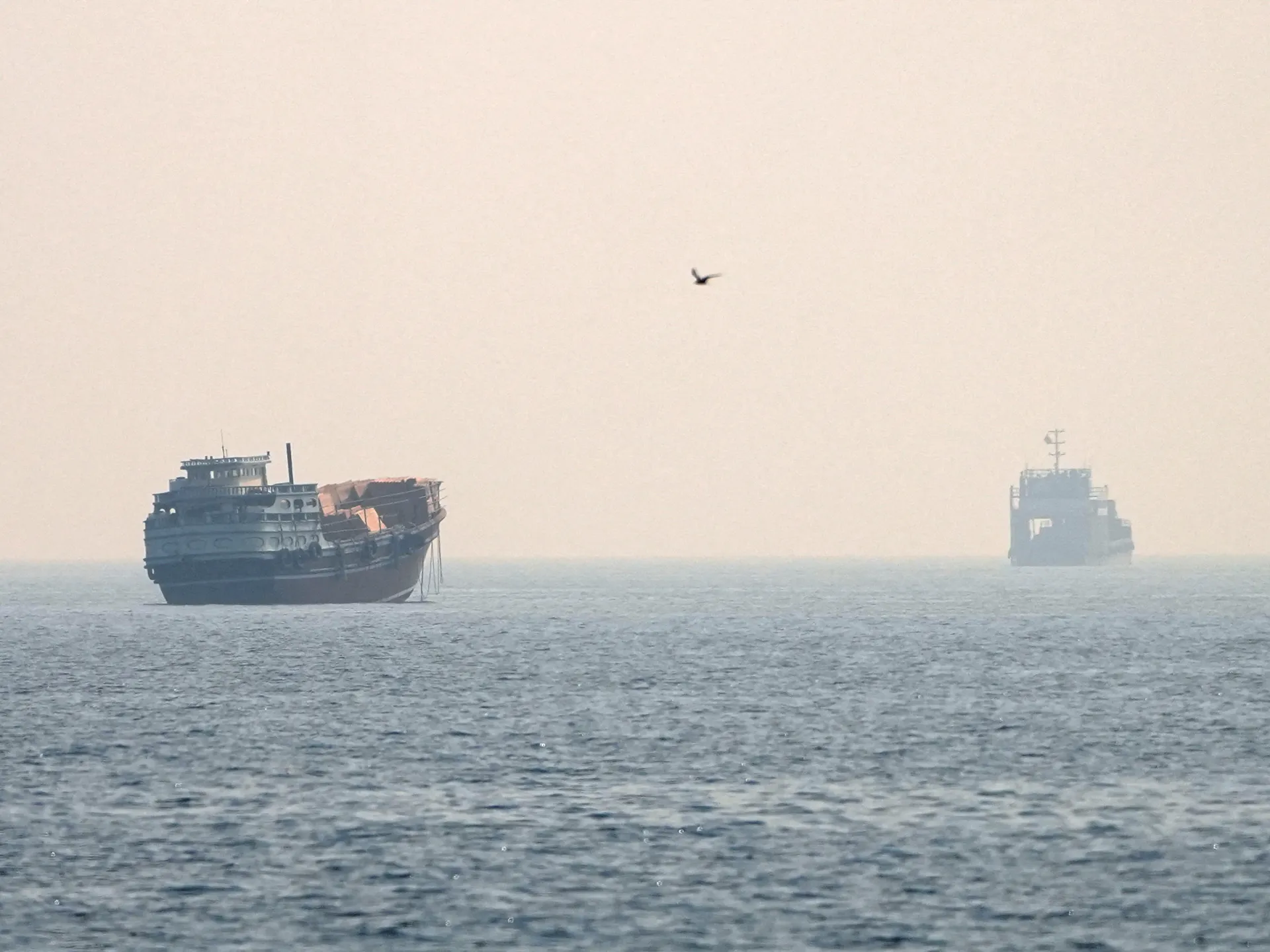
A maritime agency reported that a tanker was fired on by gunboats in the Strait of Hormuz. The United Kingdom Maritime Trade Operations agency says it received a report of a tanker being fired upon by what it said were two gunboats linked to Iran’s Revolutionary Guard Corps. The vessel and its crew were reported safe.