

Iran

US intel chief Gabbard says Iran was not rebuilding enrichment prior to war | US-Israel war on Iran News

Washington, DC – Tulsi Gabbard, the director of US National Intelligence, said that the United States intelligence community had assessed that Iran was not rebuilding its nuclear enrichment capabilities following US and Israeli attacks last year.

The revelation on Wednesday appeared to undercut one of President Donald Trump’s key justifications for joining Israel in launching the latest war against Iran.

Recommended Stories

list of 3 itemsend of list

Trump and his top officials have repeatedly cited Iran’s nuclear ambitions as one of the main reasons for abandoning ongoing diplomatic talks in favour of military action.

“As a result of Operation Midnight Hammer,” Gabbard said in written testimony to the Senate intelligence committee, referencing the June 2025 US strikes on Iran’s nuclear facilities, “Iran’s nuclear enrichment program was obliterated”.

“There have been no efforts since then to try to rebuild their enrichment capability,” Gabbard said in the written testimony.

Notably, Gabbard did not read that portion of her testimony, which was provided to members of the committee, during her publicly televised oral testimony. When pressed on why she omitted the portion, Gabbard said simply that she did not have enough time. She did not deny the assessment.

“You chose to omit the parts that contradict Trump,” Senator Mark Warner, a Democrat, responded.

Trump has repeatedly said the June 2025 attacks, which came at the end of a 12-day war between Israel and Iran, had “obliterated” Iran’s nuclear capacity, even as he warned that Iran’s alleged nuclear ambitions presented an immediate threat to the US.

Tehran has for years denied it is seeking a nuclear weapon. Nuclear and arms monitors have maintained that even if Tehran were seeking a nuclear weapon, it did not represent a short- or medium-term threat.

The foreign minister of Oman, who had mediated the latest round of US-Iran indirect nuclear talks ahead of the war, has refuted Trump officials’ claims that the most recent negotiations were not yielding any progress.

The Guardian newspaper also reported this week that the United Kingdom’s national security adviser, Jonathan Powell, had attended the final session of talks and assessed that the Iranian position did not justify an immediate rush to war, citing sources familiar with the situation.

The administration has not settled on any single justification for launching the war, also pointing to Iran’s ballistic capabilities, its potential threat to Israel and US forces in the Middle East, and the totality of the Iranian government’s actions since the 1979 Islamic Revolution.

The concept of an “imminent threat” is significant in determining the legality of Trump’s decision to strike a sovereign country under international law.

It is also significant for US domestic law, under which presidents can commit the military only in instances of immediate self-defence. Only Congress can officially declare war or authorise extended military campaigns.

Iran’s government ‘intact but largely degraded’

The White House said earlier this week that Iran’s ballistic missile capacity was “functionally destroyed”, with the Iranian navy “effectively destroyed” and the US and Israel dominating the country’s airspace.

Experts have assessed that Iran still maintains the military capacity to inflict significant damage in the region, and it has continued to wield its military influence over the Strait of Hormuz.

Gabbard, meanwhile, offered a more sober assessment than the White House, saying that despite the killings of Iranian supreme leader Ayatollah Ali Khamenei, top military officials, and most recently the head of the Supreme National Security Council, Ali Larijani and the intelligence minister, Esmail Khatib, “the regime in Iran ⁠appears to be intact but largely degraded by Operation Epic Fury”.

“Even so, Iran and its proxies remain capable of and continue to attack US and allied interests in ⁠the Middle East. If a hostile regime survives, it will seek to begin a years-long effort to rebuild its missiles and UAV [drone] forces,” she said.

Gabbard also listed Iran, alongside Russia, China, North Korea and Pakistan, as among the countries “researching and developing an array of novel, advanced, or traditional missile delivery systems, with nuclear and conventional payloads, that put our homeland within range”.

The Washington, DC-based Arms Control Association has said that US intelligence as of 2025 had said it may take Iran until 2035 or longer to develop a missile capable of hitting the US, if it did indeed seek to do so.

High-profile resignation

Gabbard spoke a day after a top official in her agency, Joe Kent, the director of the US National Counterterrorism Center, resigned in opposition to Trump’s war with Iran.

In his resignation, Kent said that Iran “posed no imminent threat” to the US and that Trump’s decision to enter the war went against his “America First” pledges.

Kent is the first high-profile member of the Trump administration to step down in response to the war.

Gabbard herself had previously been a vocal opponent to indefinite military engagement in the Middle East and war with Iran. A former member of the US House of Representatives from Hawaii, she left the Democratic Party and supported Trump, in part, due to his anti-war vows.

However, in a post on X on Tuesday, Gabbard defended Trump’s decision to go to war.

“As our Commander in Chief, he is responsible for determining what is and is not an imminent threat, and whether or not to take action he deems necessary to protect the safety and security of our troops, the American people and our country,” she said.

She said her agency’s role was to funnel US intelligence to Trump.

“After carefully reviewing all the information before him, President Trump concluded that the terrorist Islamist regime in Iran posed an imminent threat and he took action based on that conclusion,” she said.

Source link

Fed holds interest rates steady amid Iran war, poor inflation report

March 18 (UPI) — The Federal Reserve announced that it is leaving its benchmark interest rate untouched Wednesday in its first Federal Open Market Committee statement since the start of the war with Iran.

The Fed’s benchmark interest rate remains at a 3.5% and 3.75% range as the committee held on to its projection of at least one rate cut coming this year.

“Available indicators suggest that economic activity has been expanding at a solid pace,” the FOMC statement said. “Job gains have remained low and the unemployment rate has been little changed in recent months. Inflation remains somewhat elevated.”

As for the war in Iran, the statement said its impact on the U.S. economy is “uncertain.”

The Fed continues to pursue monetary policies it believes will bring the rate of inflation down to 2%. In its statement it said it is “committed to supporting maximum employment,” in pursuit of its target.

Economic reports that inform the Fed’s decision have indicated pressures from inflation remain and economic growth has slowed.

Wednesday’s announcement comes on the heels of a producer price index report earlier in the day that showed the largest increase to the index for final demand goods since August 2023.

Last week, the U.S. Bureau of Labor Statistics reported that nonfarm payrolls fell by 92,000 in February. The unemployment rate increased to 4.4%.

These reports have economists and traders cooling on the potential for interest rate cuts. Eugenio Aleman, chief economist at Raymond James, said in a statement that the wholesale inflation report on Wednesday, “likely reinforces a hold decision.”

Data from the producer price index report predates the beginning of the war with Iran.

President Donald Trump receives a bowl of shamrocks from Irish Taoiseach Micheal Martin to celebrate St. Patrick’s Day at the White House on Tuesday. Photo by Yuri Gripas/UPI | License Photo

Source link

How Los Angeles’s Iranian diaspora is confronting the US war on Iran | US-Israel war on Iran News

Concerns over US involvement

The war has reignited a debate within the Iranian diaspora about what role the US should play in Iran’s future.

This question is more than a distant geopolitical issue for Iranians in Los Angeles.

Many residents explained that their family histories had been shaped by US involvement in the region, whether it was through US support for Iran’s fallen monarchy or through the US decision to back Iraq’s invasion of Iran in 1980.

Aida Ashouri, a human rights lawyer who is running to be Los Angeles city attorney, was among those publicly condemning the latest US campaign in Iran at the city hall protest on February 28.

“This is a US imperialist war, and we have to make that clear,” she said. “Call a spade a spade. This war is not to liberate the women of Iran or the people of Iran.”

Ashouri was born during the Iran-Iraq war in the 1980s. Her hometown, Isfahan, was also bombed in June last year during the US and Israel’s 12-day war with Iran.

For Ashouri, it was telling that the US and Israel once again launched the first strike in the current conflict. For many legal experts, that made the conflict an unprovoked war of aggression, in violation of international law.

“A war implies two sides are actively engaged, but Iran has done nothing to be involved,” Ashouri said.

“This is a unilateral military invasion, an aggression of the United States and Israel. They are the ones with the power to end it by stopping the bombing.”

She and other protesters drew parallels between the current Iran war and the US-led wars in Iraq and Afghanistan, launched in 2003 and 2001, respectively.

“I lived through the shadow of the war on terror, all the propaganda talking points,” said Shany Ebadi, an Iranian American antiwar organiser with the ANSWER Coalition. “What the Trump administration is saying reminds me a lot of the Iraq war.”

As someone who follows the news closely, Ebadi remembers feeling alarm when the first strikes were launched in February.

“When I got the breaking news notification of the initial attack, my whole body felt paralysed. I felt anger and frustration,” she said.

She and Ashouri both said they fear the military operation in Iran could spark a regional war that might further destabilise not just Iran, but the entire Middle East.

“I fear that war will repeat the disasters seen in Palestine, Iraq, Libya, and Afghanistan,” Ashouri said, listing countries targeted in the US’s “war on terror” over the past two and a half decades.

The question of whether bombs can pave the way to freedom in Iran is a simple one for Ashouri and her fellow antiwar activists. The answer, they say, is simply no.

Source link

Oil surges to $110 a barrel after Israel strikes Iran’s energy facilities

Published on Updated

Brent crude oil prices reached $110 a barrel on Wednesday afternoon, after Iranian state media reported that part of the South Pars gas field, the largest plant in Iran, and the Asaluyeh oil facility were struck by Israel.


ADVERTISEMENT


ADVERTISEMENT

Moreover, the US oil benchmark WTI also rose and is trading at $98 a barrel at the time of writing.

In response to the latest Israeli attacks, the IRGC announced that some Gulf energy sites are once again “legitimate targets”.

The prospect of escalation and prolongation of the conflict in the Middle East, resulting in further destruction of energy infrastructure, and consequently disruption to global markets, has sent oil prices higher once again.

The climb occurs despite other positive news that would normally have a dampening effect on energy markets.

Saudi Arabia confirmed on Wednesday that its biggest oil refinery, Ras Tanura, restarted operations on 13 March.

Additionally, the Trump administration officially announced a 60-day waiver of the Jones Act, a century-old maritime law that restricts the movement of cargo between US ports to vessels that are American-built, American-owned, American-flagged and crewed.

However, in the face of increased tensions and more attacks on oil infrastructure, these potentially mitigating developments have not had any effect in taming prices.

Trump administration confirms Jones Act waiver

The White House Press Secretary, Karoline Leavitt, confirmed the Trump administration’s decision to issue a 60-day waiver of the Jones Act.

The measure lifts the restriction on the movement of cargo between US ports, allowing foreign tankers temporarily and cheaply to transport vital resources such as oil, gas and fertilisers along the US coastline.

In a post on X on Wednesday, Leavitt explained that the decision is “just another step to mitigate the short-term disruptions to the oil market as the US military continues meeting the objectives of Operation Epic Fury.”

The last Jones Act waiver was issued in October 2022 for a tanker supplying Puerto Rico after Hurricane Fiona.

Before that, the Biden administration temporarily eased the law in 2021 for refiner Valero Energy, after a cyberattack crippled a major East Coast fuel pipeline.

Trump renews pressure on allies to secure the Strait of Hormuz

In a separate development, US President Donald Trump has renewed pressure on allies to join a naval escort mission in order to secure the Strait of Hormuz and normalise the circulation of vessels in the region.

In a post on Truth Social, President Trump argued that allied countries need to use the Strait of Hormuz while the US does not, and warned that they could be left managing it on their own in the aftermath of the war.

Since President Trump’s original request, no firm commitments have emerged, but on Monday, the Wall Street Journal reported that the White House plans to announce as early as this week that multiple countries have agreed to join the escort mission.

The report also stated that officials are still deliberating whether such an operation would start before or after the war ends.

After meeting in Brussels, EU foreign ministers discussed extending the bloc’s Aspides naval mission to the Strait of Hormuz, but ultimately declined to participate.

Source link

Trump’s failed strong-arming of allies on Iran shows that pressure is losing its effect

We’ve long had your back, now it’s our turn. That is how the famously transactional President Trump is framing his demands that allies help him with the Iran war. He wants to call in IOUs for decades of U.S. security guarantees.

The string of refusals indicates his stock of European goodwill is low. He has put allies through the wringer since returning to the White House, bullying them over tariffs, Greenland and other issues, and disparaging the sacrifices their soldiers made alongside U.S. troops in Afghanistan.

Now he’s demanding — not just requesting — that they send warships to help the U.S. unblock the Strait of Hormuz, through which a fifth of the world’s traded oil passes — essentially mop up behind the conflagration that he and Israel ignited in the Middle East.

The reply has been a “global raspberry.”

That’s how a veteran French defense analyst, François Heisbourg, described allied responses.

No close ally has come forward with immediate help. Britain is flat-out refusing to be drawn into the war. France says the fighting would have to die down first. Others are non-committal. China, which is not an ally but was also asked to help, is ignoring Trump’s call.

“This is not Europe’s war. We didn’t start the war. We were not consulted,” European Union foreign policy chief Kaja Kallas said Tuesday.

Trump’s frustration with the ‘Rolls-Royce of allies’

Trump has singled out the refusal from the United Kingdom. Prime Minister Keir Starmer cultivated ties with Trump and reached an early trade deal with the administration, but is now among allies who refuse to join a regional war with no clear endgame.

The U.K. “was sort of considered the Rolls-Royce of allies,” Trump said Monday, adding that he’d asked for British minesweeping ships.

“I was not happy with the U.K,” Trump said. “They should be involved enthusiastically. We’ve been protecting these countries for years.”

Starmer said Britain “will not be drawn into the wider war” and that British troops require the backing of international law and “a proper thought-through plan” — suggesting those were not in place.

He initially refused to let U.S. bombers attack Iran from British bases before accepting their use for strikes on Iran’s ballistic missile program.

Retired Lt. Gen. Ben Hodges, former commanding general of the U.S. Army in Europe, said allies are “looking at the United States in a way that they never have before. And this is bad for the United States.”

Having previously appeased Trump, some European leaders are “starting to realize that there’s no benefit or value in using flattery,” he said.

European leaders say it’s not their war

Going to war without consulting allies was in keeping with Trump’s America-first outlook.

“My attitude is: We don’t need anybody. We’re the strongest nation in the world,” he said Monday.

But failing to get an international mandate, as the U.S. did before intervening in the 1990 Gulf War, is boomeranging.

“It is not our war; we did not start it,” German Defense Minister Boris Pistorius said. “We want diplomatic solutions and a swift end to the conflict. Sending more warships to the region will certainly not contribute to that.”

French President Emmanuel Macron envisions possible naval escorts in the Strait of Hormuz — but only once fighting has died down.

“France didn’t choose this war. We’re not taking part,” he said.

After bruising tariff battles with Trump last year, the first months of 2026 have further strained alliances. Trump’s renewed pressure for U.S. control of Greenland, including a tariff threat against eight European nations, and his false assertion that allied troops avoided front-line fighting in the Afghanistan War, upset partners in the NATO military alliance.

“Allies, or at least the Europeans, aren’t willing to be at the beck and call of a demand from Donald Trump,” said Sylvie Bermann, a French former ambassador to China, the U.K. and Russia.

“And even in asking for a helping hand, he is doing so in a brutal manner, saying: ‘You’re useless, we’re the strongest, we don’t need you, but come,’” she said.

A dangerous mission

Retired naval officers say that unblocking the Strait of Hormuz with military escorts while the war rages and without Iran’s consent would be dangerous.

France, which has rushed its Charles de Gaulle aircraft carrier to the Mediterranean, is working with other countries to prepare such a mission once the air war has subsided. French military spokesman Col. Guillaume Vernet said any escorting would be conditional on talks with Iran, and Macron has publicized two calls in eight days with Iranian President Masoud Pezeshkian.

That has won points with Trump.

“On a scale of zero to 10, I’d say he’s been an eight,” Trump said Monday. “Not perfect, but it’s France. We don’t expect perfect.”

But he’s fuming at other allies.

“We will protect them, but they will do nothing for us, in particular, in a time of need,” Trump said Tuesday.

Trump has leverage, including in Ukraine

Allies in Europe and Asia need oil, gas and other products from the Middle East to flow again. That gives Trump some leverage.

Allies also know from experience that resisting Trump carries risks of retaliation.

“It really could be anything. Are the Europeans prepared for that?” asked Ed Arnold, a former British army officer and now a researcher at the Royal United Services Institute, a London think tank.

European allies need Trump’s continued blessing for U.S. weaponry, intelligence, and other support for Ukraine, as well as financial pressure on Russia. The U.S. has started to chip away at some sanctions on Moscow by temporarily allowing shipments of Russian oil to ease shortages stemming from the Iran war. Allies also want him to reengage in talks to end the war.

“That was what kept European leaders quiet for a lot of last year in the face of the rhetoric and actions,” said Amanda Sloat, a former U.S. national security adviser who now teaches at Spain’s IE University.

“It is also the thing that is making them a little bit nervous now.”

Leicester and Burrows write for the Associated Press. Burrows reported from London. AP journalists Jill Lawless in London, Lorne Cook in Brussels, Suman Naishadham in Madrid, Geir Moulson and Kirsten Grieshaber in Berlin, Simina Mistreanu in Taipei, Taiwan, and Mari Yamaguchi in Tokyo contributed to this report.

Source link

Japan’s leader heads to Washington for a visit complicated by the Iran war fallout

Japanese Prime Minister Sanae Takaichi is traveling Wednesday to the United States for what she expects to be a “very difficult” meeting with President Trump after he called on Japan and other allies to send warships to secure the Strait of Hormuz.

The three-day visit to Washington was originally expected to focus on trade and strengthening the U.S.-Japanese alliance as China’s influence grows in Asia. It is now expected to be overshadowed by the war the United States and Israel launched against Iran on Feb. 28.

”I think the U.S. visit will be a very difficult one, but I will do everything to maximize our national interest and to protect the daily lives of the people when the situation changes daily,” Takaichi told parliament on Wednesday, hours before her departure.

Takaichi held her first meeting with Trump in October in Tokyo, days after becoming Japan’s first female prime minister. A hard-line conservative, Takaichi is a protege of former leader Shinzo Abe, who developed a close friendship with Trump.

Her initial plan was to focus largely on China and strengthen the Japan-U.S. alliance ahead of Trump ‘s highly anticipated diplomatic trip to China that had been planned for months. The White House announced Tuesday that it is being delayed due to the war in the Middle East.

Takaichi will be in the hot seat figuring out what best to offer to Trump. Experts say showing commitment and progress in investment deals is key to a successful summit.

Japanese officials say the two sides will work to deepen cooperation in regional security, critical minerals, energy and dealing with China.

No plan to send warship to the Strait of Hormuz

A key U.S. ally in Asia, Japan has carefully avoided clear support for the U.S.-Israel strikes on Iran or a decision over a warship deployment. That’s mainly because of Japan’s constitutional constraints but also due to a legal question over the U.S. action and strong public opinion against it.

She told parliament that Japan hopes to see a de-escalation of the war, which has disrupted deliveries of oil and gas that Japan is highly dependent on.

“Without early de-escalation of the situation, our economy will be in trouble,” she said. “Early de-escalation is important for both the U.S. and global economy.”

Japan also hopes to secure its traditional ties with Iran, where most of Japanese oil imports come from.

Takaichi and her ministers have denied that Washington officially requested Japanese warships sent to the Strait of Hormuz. Trump on X asked a number of countries, including Japan, to volunteer. He then said he no longer needs them, complaining about a lack of enthusiasm.

That takes some pressure off Takaichi.

“We have no plans to send warships right now,” Takaichi told the parliamentary session Wednesday. A dispatch for survey and intelligence missions are possible but only after a ceasefire, she said. Some Japanese experts have commented that minesweeping would be a mission that the country could carry out when hostilities end.

“I will clearly explain what we can do and cannot do based on the Japanese law,” Takaichi said. “I’m sure (Trump) is fully aware of the Japanese law.”

China and security

Takaichi wants to discuss China’s security and economic coercion and ensure the U.S. commitment in the Indo-Pacific region, especially as some U.S. troops stationed in Japan are being shifted to the Middle East — a change seen by Japan as a potential risk for Asia as China’s clout grows.

Takaichi plans to reassure Trump of Japan’s military buildup, emphasizing the acceleration of long-range missile deployment to enhance offensive capabilities. This breaks from Japan’s postwar self-defense-only principle and reflects closer alignment with the U.S.

At the summit, Takaichi is expected to convey Japan’s interest in joining America’s “ Golden Dome “ multi-billion dollar, multi-layered missile defense system.

Japan considers China a growing security threat and has pushed a military buildup on southwestern islands near the East China Sea.

Takaichi has pledged to revise Japan’s security and defense policy by December and seeks to further bolster Japan’s military with unmanned combative weapons and long-range missiles.

Her government is to scrap a lethal arms exports ban in the coming weeks to promote Japan’s defense industry and cooperation with the United States and other friendly nations.

Oil in Alaska, rare earths in Japan

A resource-poor nation, Japan is seeking to diversify oil suppliers and is finalizing a Japanese investment for increased oil production in Alaska and stockpiles in Japan, according to media reports. A Japanese investment in small modular reactors and natural gas in the U.S. is also a possibility.

If agreed, the projects would be part of a $550 billion investment package that Japan pledged in October. In February, the two sides announced Japan’s commitment to the $36 billion first batch of projects — a natural gas plant in Ohio, a U.S. Gulf Coast crude oil export facility and a synthetic diamond manufacturing site — whose progress is also to be disccused with Trump.

Japan reportedly plans to propose a joint development of rare earths discovered in undersea soil around the remote Japanese island of Minamitorishima as part of the investment package.

Diplomatic and trade disputes have escalated further since Takaichi’s comment that any Chinese military action against Taiwan could be grounds for a Japanese military response.

Yamaguchi writes for the Associated Press.

Source link

Travel expert Simon Calder warning for anyone with Dubai, UAE or Bahrain flights booked

He has just returned from the UAE with crucial advice

A travel expert has issued a warning to individuals with flights booked to or from the Middle East. The alert comes as tensions continue in the area, with Israel and the US maintaining their strikes on Iran which commenced over a fortnight ago.

Iran continues to hit back with drone and missile attacks on several neighbouring and nearby nations. This resulted in Dubai, a major hub for international travel and home to the world’s busiest airport, temporarily closing its airspace for the second time in 48 hours due to strikes in the vicinity.

Simon Calder, a journalist with the Independent, has just returned from the United Arab Emirates. He provided an update on the current situation for those flying to or from the Middle East, including passengers transiting through the region en route to other destinations.

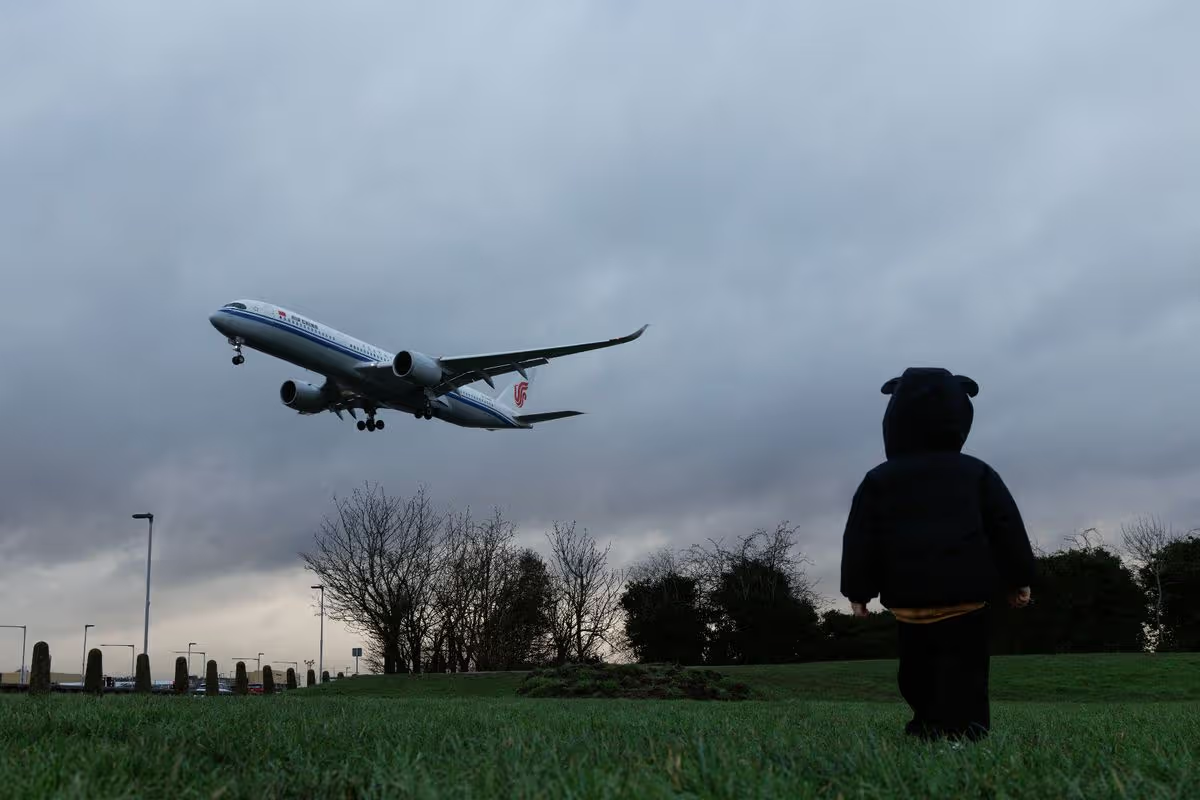
He stated: “I’ve just arrived at London Heathrow Terminal 4 after a fairly normal flight from Abu Dhabi on Etihad. What wasn’t normal was just how quiet it was when I arrived. Terminal 4, the main hub for the Middle East from London, is frankly a bit of a ghost town. Many of the flights that you would normally expect to see multiple departures on Qatar Airways to Doha and on Etihad to Abu Dhabi are not flying, and there’s also, for instance, Gulf Air based in Bahrain who are not going there.

Content cannot be displayed without consent

“Having said that, there’s perhaps more flights than you might expect, given that, for example, Qatar and the UAE are on the Foreign Office no-go list. There’s a departure this evening to Abu Dhabi on Etihad and one a little later on Qatar Airways overnight to Doha. As well as that, El Al is going out to Tel Aviv. Now, you might have heard that the airspace in Israel is closed; well, it kind of is, but if you’ve got permission, and El Al certainly has, then you can go in.

“And finally, Gulf Air is flying from here later on today, but not to the normal destination of Bahrain. Instead, it’s going to Dammam, which is very close by in Saudi Arabia, from where passengers can travel to that island quite happily over the causeway. But bear in mind that the UAE, Qatar, Kuwait, and Bahrain are all on the Foreign Office no-go list. If you choose to ignore that advice, then it’s likely your travel insurance will not be valid.

READ MORE: Travel expert issues holiday ‘rise’ warning as jet fuel price surges 70 per centREAD MORE: Simon Calder issues update for anyone flying with Emirates, Etihad or Qatar Airways

Unsurprisingly, the conflict has impacted international travel in numerous ways. Not only have passenger numbers and flights passing through the Middle East declined dramatically, but neighbouring countries favoured by Brits seeking spring sunshine, including Cyprus and Turkey, have also experienced a fall in visitor numbers.

Conversely, nations to the west boasting milder weather, including Spain and Portugal, have witnessed a surge in reservations – as has the Caribbean. The situation has not only left thousands of British holidaymakers stuck in the Middle East, but many are also anxious about their upcoming travel arrangements.

The Association of British Insurers attempted to address these worries with the following statement when questioned about whether insurance will cover the cancellation of a trip to the Middle East due to concerns over the conflict.

It stated: “As the situation evolves, we can understand why people may be reconsidering their future plans to travel to the region. If you wish to cancel your trip, contact your airline, accommodation provider or tour operator in the first instance. They may be able to rebook parts of your trip or offer a refund.

“Travel insurance may not cover cancellations linked to the conflict, depending on your policy’s terms, any war exclusions, and when you bought it. Policies differ, and insurers may take different approaches, so it’s important to check with your insurer to understand what’s covered.”

Source link

Israel says it killed Iranian intelligence chief Khatib | US-Israel war on Iran

NewsFeed

Israel’s Defence Minister Israel Katz said an overnight strike killed Iran’s Intelligence Minister Esmail Khatib. There has been no confirmation from Iran but Katz says Israel’s military is authorised to target senior Iranian officials without additional approval from the government.

Source link

How Iran defied Trump threats to emerge as Strait of Hormuz gatekeeper | US-Israel war on Iran News

As United States President Donald Trump tries to build a coalition of navies willing to open the Strait of Hormuz, some countries are negotiating safe passage directly with Iran, underscoring a new de facto reality, analysts say: Regardless of military results, Tehran is calling the shots on who gets to use the world’s most important energy waterway.

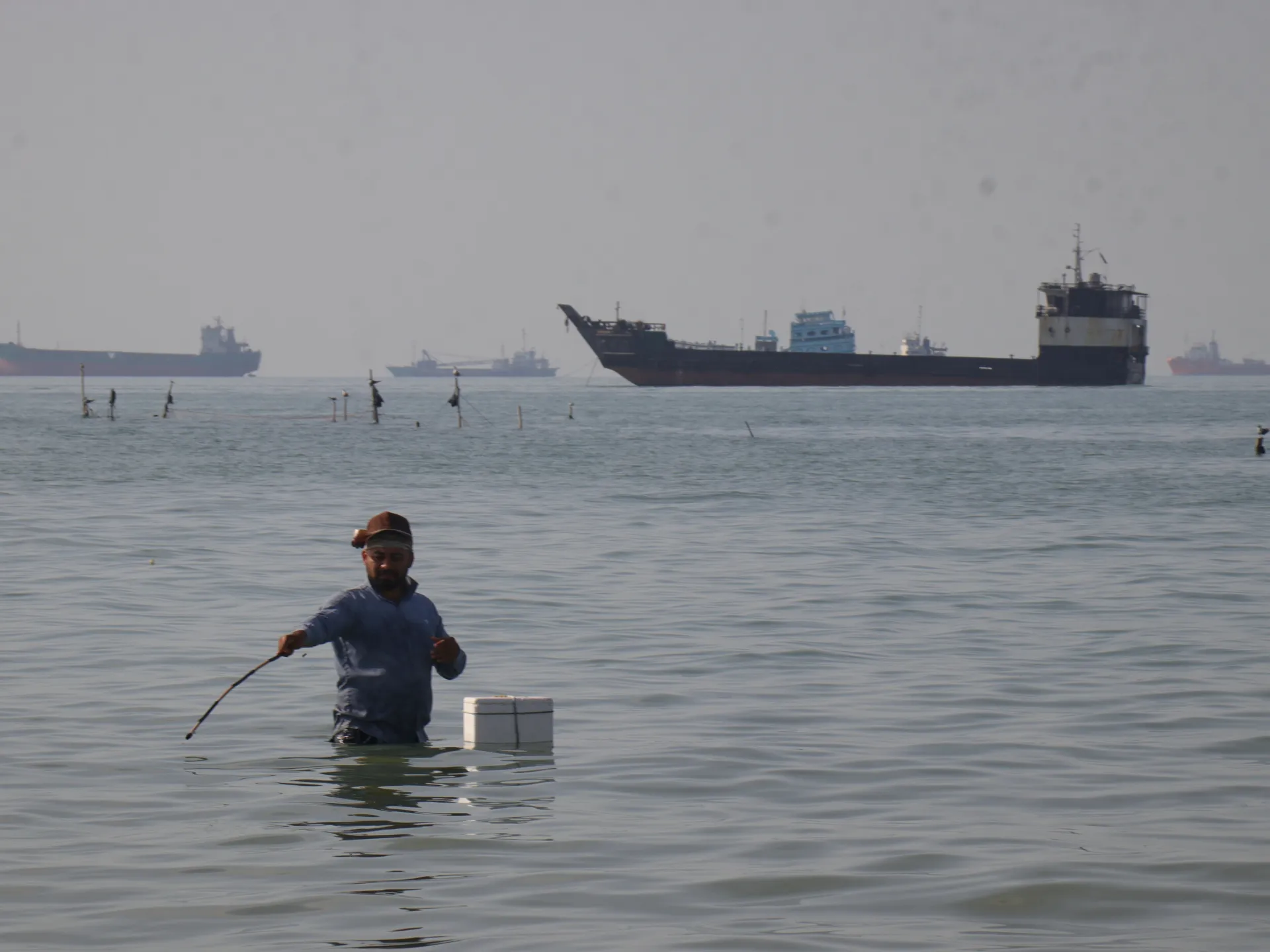
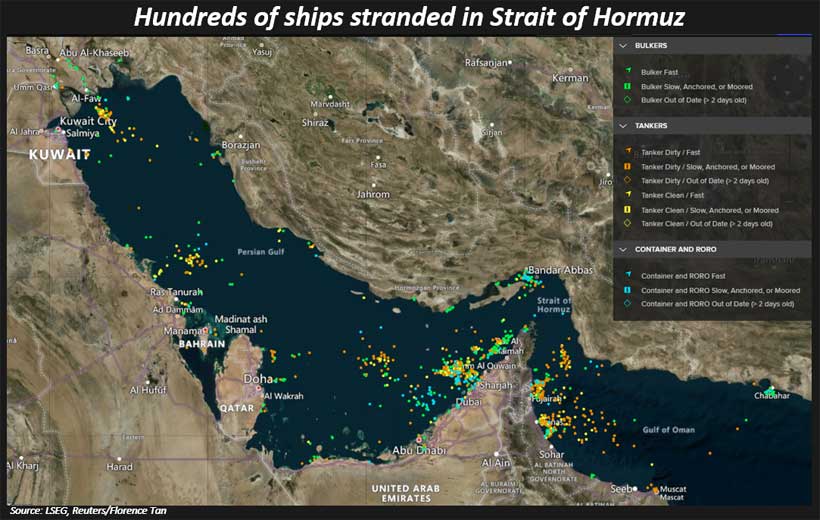
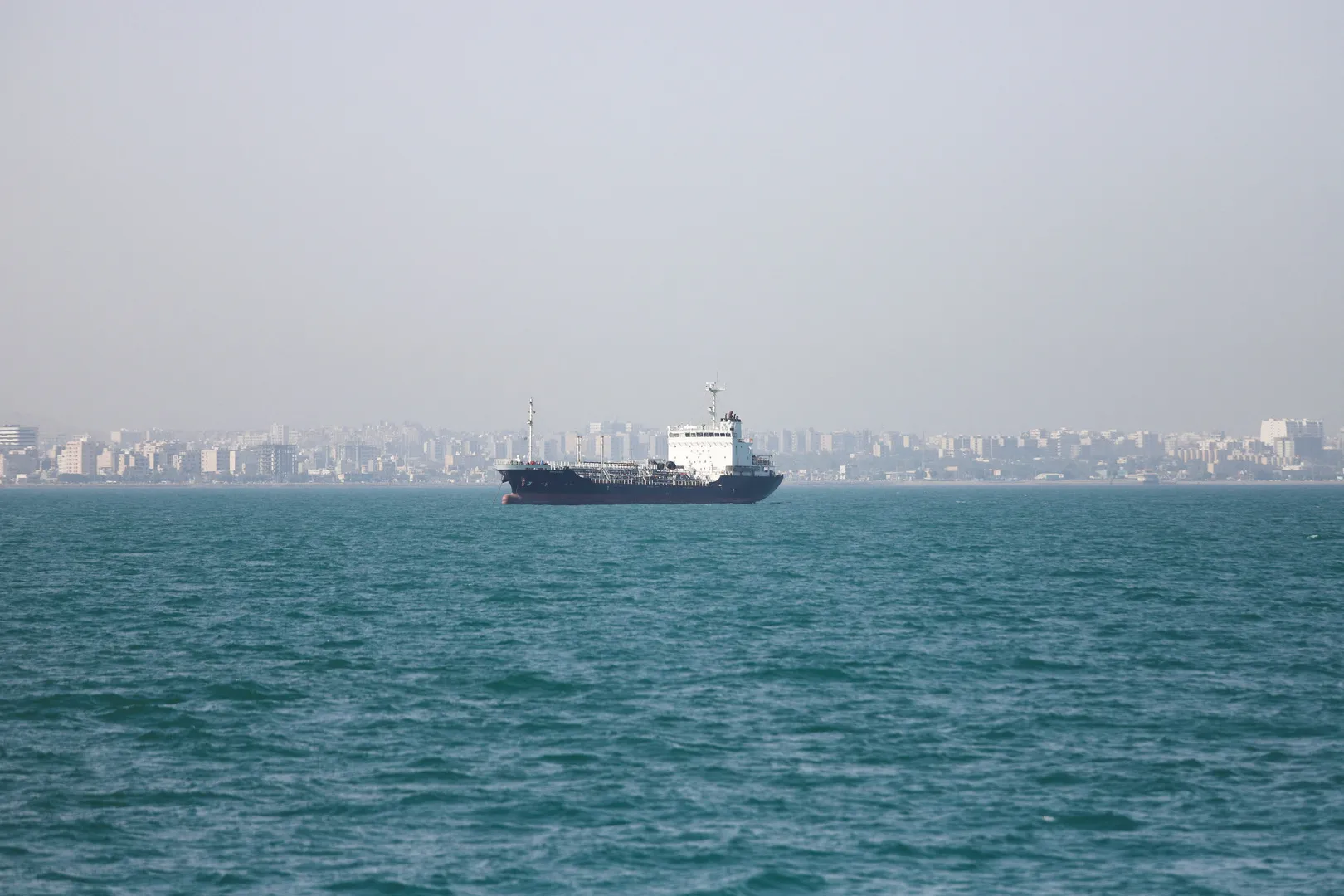
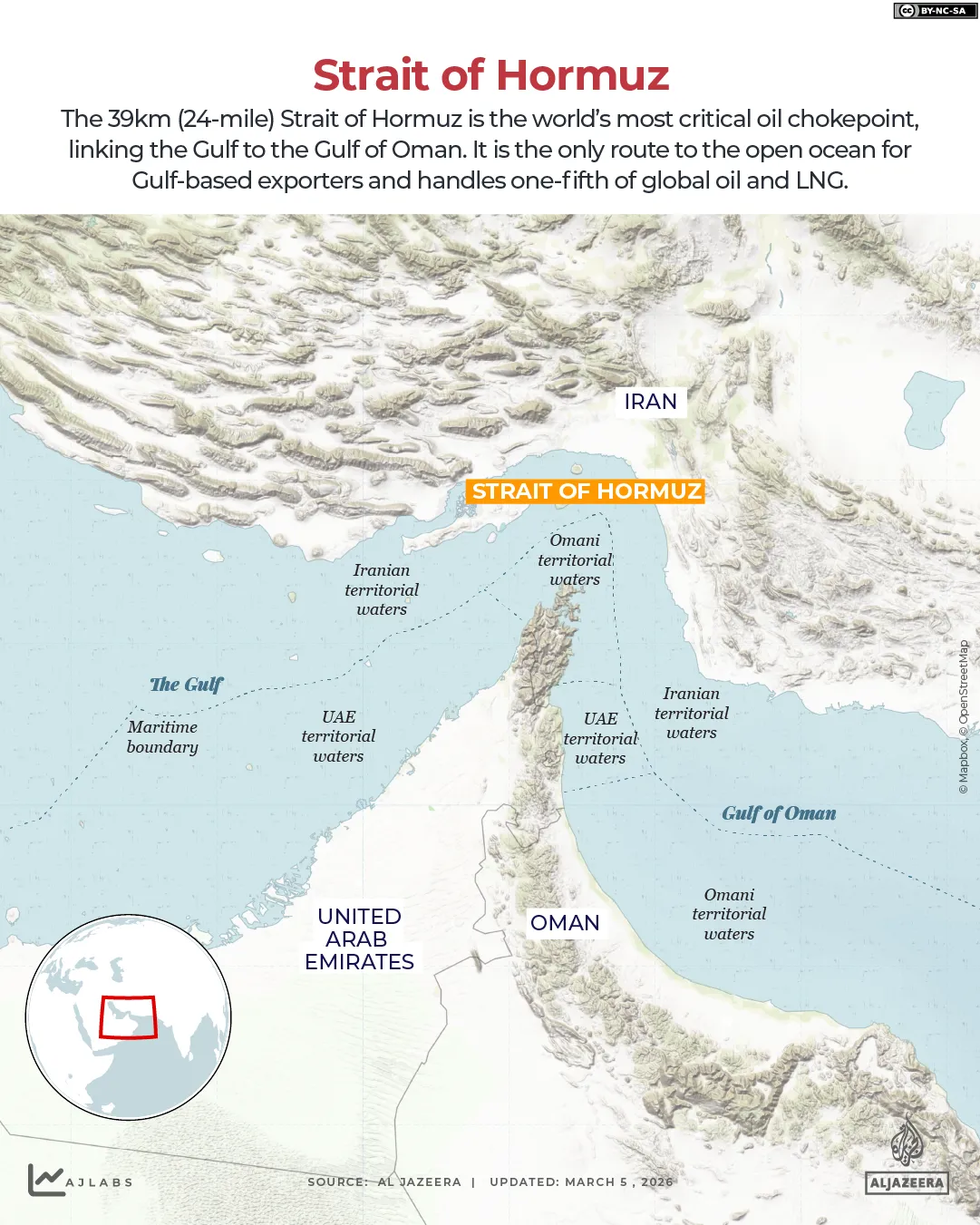
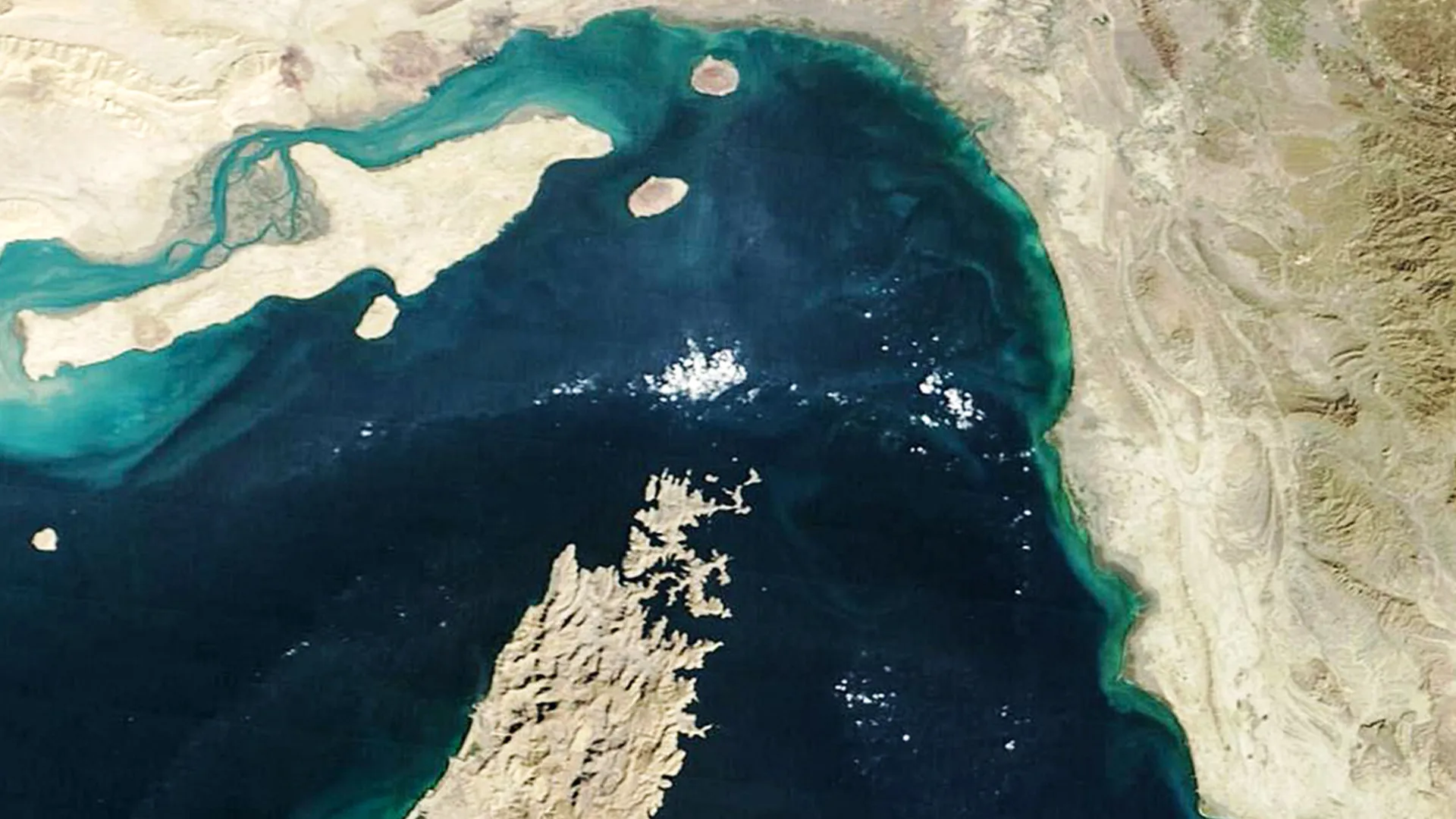
After US-Israeli strikes on Iran began on February 28 and killed Supreme Leader Ali Khamenei, the Iranian military leadership responded by focusing on its most potent form of leverage – Iran’s geography. The country controls the northern shore of the Strait of Hormuz, through which 20 percent of global crude oil and natural gas supplies pass. It is 33km (20 miles) wide at its narrowest point, so any naval force that wants to cross it becomes easy prey for Iranian attacks coming from the mainland.

Recommended Stories

list of 3 itemsend of list

Considering insurance companies’ low appetite for risk, it took relatively few attacks on vessels in the strait – or just the threat of them – to undermine market confidence and send insurance premiums shooting up, causing a near paralysis in maritime traffic. About 20 vessels have been attacked since the start of the war.

“Iran has effectively proven that it dictates the terms of passage through the strait. They have now shown they are the gatekeeper of this important chokepoint. This will elevate the status of Iran in the geography of the Gulf,” said Andreas Krieg, an associate professor in Security Studies at King’s College London and a fellow at King’s Institute of Middle Eastern Studies. This will be the new reality for the foreseeable future, he added.

Meanwhile, crude prices have risen above $100 a barrel, more than 20 percent higher than pre-war prices, forcing countries to make the biggest releases of emergency reserves in history. Gas prices have risen by more than 40 percent since the war began.

Trump initially floated the idea of ordering the US Navy to escort vessels through the waterway. He then appealed to some countries to send warships and warned NATO members they would face “a very bad” future if these allies failed to help in opening the strait. But the appeal was either turned down or received noncommittal responses. Japan said it had no plans to deploy naval vessels. Australia ruled out sending ships. The United Kingdom said it would not be drawn into the wider war. Germany sent a clear message: “This is not our war”.

Others decided to take action – but not of the kind that Trump asked for. On Saturday, two India-flagged gas tankers passed through the strait after days of negotiations between New Delhi and Tehran, including a phone call between Indian Prime Minister Narendra Modi and Iranian President Masoud Pezeshkian. Ships from Pakistan, Turkiye and China also have transited through the Strait of Hormuz. The Financial Times has reported that Italy and France have also reached out to Iran for deals although Italian authorities have rejected making such an overture.

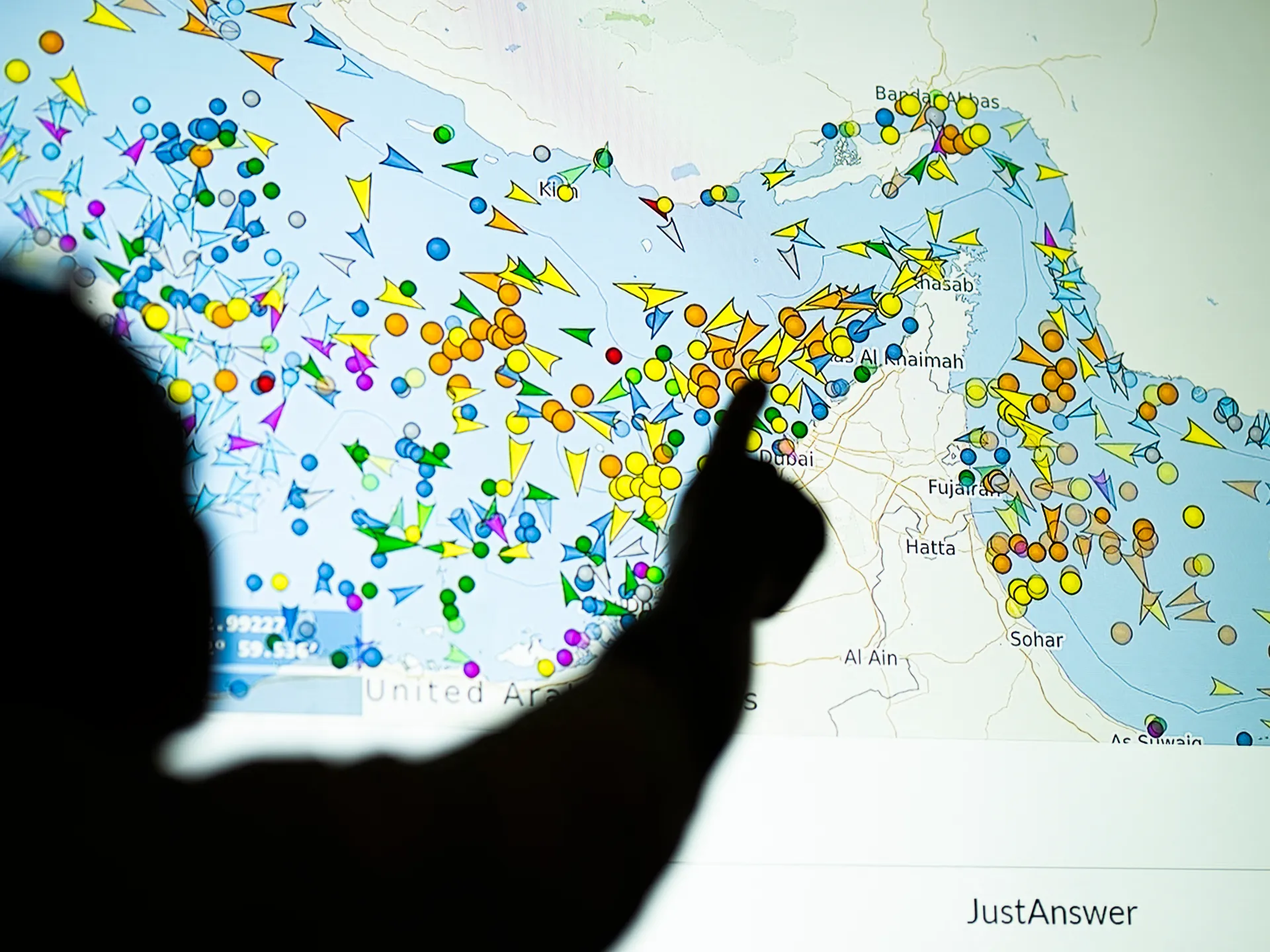
Meanwhile, Windward, a maritime intelligence tracking group, said that while traffic in the strait on Tuesday remained 97 percent below average, a growing number of ships have been passing through Iran’s territorial waters, suggesting that Tehran is allowing “permission-based transit”.

‘It is up to us to decide’

There is a precedent for US naval forces to escort convoys through the strait dating back to the Iran-Iraq War in the 1980s. But today’s scenario is different, experts said. Back then, the US, while it was backing Iraqi leader Saddam Hussein, was not a direct party to the conflict. Iran was still in a post-revolutionary process of consolidating power, and its Islamic Revolutionary Guard Corps was nowhere near as organised as it is today.

Today, Iran has drones that its factories are capable of producing on a large scale and has been using them. Iranian forces could also use small boats to assault tankers, deploy mines and engage in other guerrilla-style tactics. While there are conflicting reports on whether Iran has placed mines in the strait, experts said it would be a counterproductive move for Tehran because it would disrupt the passage for any ships – Iranian vessels included – and it would take away from Tehran the power to choose who may pass.

Iranian officials are aware of their geographic advantage. “This is up to our military to decide,” Iranian Foreign Minister Abbas Araghchi said on Sunday, referring to who will be allowed to use the strait.

Pro-government figures increasingly frame the Strait of Hormuz as a strategic bargaining tool beyond the war itself, suggesting the waterway could be used to extract compensation, sanctions relief or broader economic concessions after the war, Hamidreza Azizi, an expert on Iran and visiting fellow with the German Institute for International and Security Affairs, commented on X.

Recent attacks seem to suggest that Iran wants to increase its pressure on the energy market.

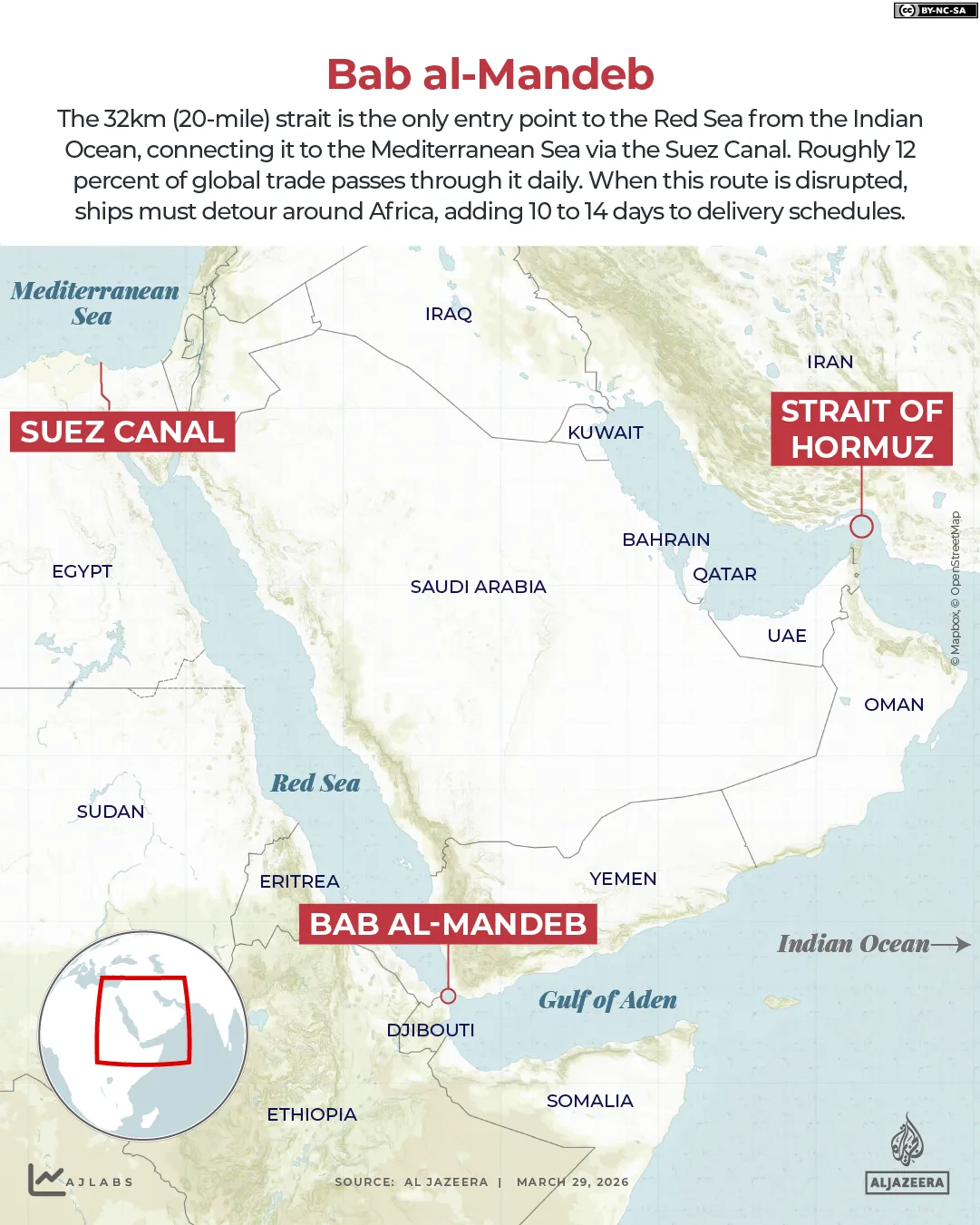
On Tuesday, a drone attack caused a fire at the port of Fujairah, the United Arab Emirates’s only crude export terminal. It is located outside the eastern entrance of the Strait of Hormuz, allowing its exports to circumvent it. The Iran-backed Houthis in Yemen could also further squeeze oil prices by disrupting the Bab al-Mandeb strait. That would force the US to operate across multiple maritime theatres. So far, the Houthis have not carried out such attacks, but this month, they said they were ready to strike at any ‌moment.

Still, the US is focused on applying maximum pressure on Tehran and forcing it to open the Strait of Hormuz. The US Central Command, the US military’s combat command responsible for operations in the Middle East, said early on Wednesday that its forces had used 2,270kg (5,000lb) bunker-busting munitions against antiship missile sites along Iran’s coastline near the Strait of Hormuz.

Trump has also ordered amphibious ships carrying thousands of US Marines to move to the Middle East, and some experts believe the US might try to seize Kharg Island, a tiny piece of land in the northern Gulf where 90 percent of Iranian crude oil is exported from. The US has already bombed what it said were military sites on the island.

Such an operation, however, might do little to force Iran into opening the Strait of Hormuz, Krieg said. The island is 500km 310 miles) from the strait, and should the US take control of it, it would expose US Marines to Iranian fire. Should Iran see its key terminal being seized, it could also opt to mine the strait outright, having fewer reasons to allow some vessels to pass through.

“The issue with the Strait of Hormuz is really not a military one. … It’s a market issue, and confidence cannot be restored by the military. Confidence can be restored through diplomacy only,” Krieg said.

Source link

Israel bombs central Beirut, killing 6, strafes south, east Lebanon | US-Israel war on Iran News

Wave of Israeli air attacks launched as ground offensive widens in south where Hezbollah are fighting Israeli forces.

Israel has attacked a building in Bashoura, a neighbourhood in the heart of Beirut, Lebanon’s National News Agency (NNA) reported, with a blast and smoke rising over the area shortly after Israel issued an evacuation threat for the site.

The attack was part of a deadly wave of Israeli strikes across Lebanon that killed at least 20 people and wounded 24 on Wednesday, according to the country’s Ministry of Public Health, with raids stretching from the capital through southern and eastern parts of the country, a devastating front in the wider United States-Israel war against Iran embroiling the region.

Recommended Stories

list of 2 itemsend of list

At least six people were killed in the air strikes in Beirut, with dozens injured.

Al Jazeera’s correspondent in Beirut, Zeina Khodr, reported that intense Israeli attacks hit multiple regions across Lebanon, including central Beirut, overnight.

Speaking from in front of a 15-storey building struck in one of the attacks, Khodr said its lower floors had been targeted a week earlier. In the early hours, however, the structure was completely demolished, with the Israeli army claiming Hezbollah had stored cash there.

“You can see the widespread damage across this whole neighbourhood,” Khodr said.

Israel’s military said it had launched what it described as limited ground operations in southern Lebanon, issuing evacuation threats for residents of four towns near the Zahrani River and the Tyre area, warning them to head north immediately.

Lebanon’s NNA also reported strikes on Tyre and the nearby area of Al-Burj Al-Shamali in the pre-dawn hours.

At least four people were killed in an Israeli attack that targeted four houses in the town of Sahmar in eastern Lebanon’s Bekaa Valley.

The intensifying assault has now killed at least 912 people in Lebanon, including 111 children, and wounded more than 2,200 since Israel launched its offensive on March 2, according to Lebanese Health Ministry figures.

More than one million people have been forced from their homes. The United Nations warned on Tuesday that Israeli attacks on residential buildings and civilian infrastructure may constitute war crimes under international humanitarian law.

A spokesperson for the UN human rights office said that deliberately targeting civilians or civilian objects “amounts to a war crime”, adding that Israel’s sweeping displacement orders for southern Lebanon may themselves violate international law.

Khodr said that Hezbollah’s secretary general, Naim Qassem, last night laid down conditions for the war to end, including Israel stopping attacks, displaced people being permitted to return to their homes, those detained over the last two years by Israel being released and the Israeli army withdrawing.

Across southern Lebanon, Khodr said Hezbollah was “still present in the area, trying to repel the Israeli army’s advance”, adding that Hezbollah’s aim was not just territorial control of the region, but preventing Israel from gaining new positions in the country.

The conflict was ignited on February 28 when US and Israeli forces assassinated Iranian Supreme Leader Ali Khamenei in Tehran, prompting Hezbollah to launch rockets into northern Israel on March 2.

Israel has since killed more than 2,000 people across Iran and Lebanon in its attacks.

German Chancellor Friedrich Merz, a staunch Israeli ally, added his voice to growing international concern, warning that Israel’s ground offensive in Lebanon was an “error” that risked worsening what he described as an already dire humanitarian situation.

Source link

Full list of all 69 countries the Foreign Office warns against travelling to

The Foreign Office has updated travel advice for countries including UAE and Pakistan over the weekend, with 69 nations now carrying various levels of travel warnings

The UK Foreign Office has recently updated travel advice for countries including the United Arab Emirates (UAE) and Pakistan over the weekend. The Foreign Office (officially known as the UK Foreign, Commonwealth and Development Office (FCDO)) regularly updates travel guidance for the nation’s citizens and states that “with commercial flights resuming to the UK from United Arab Emirates (UAE), we are pausing our ‘register your interest in flights from UAE’ scheme”.

However, the UAE is still among the countries that the UK Government advises people should only travel to if essential. It is one of 69 countries with a travel warning attached to it for UK citizens, reports the Liverpool Echo.

Typically, the Foreign Office categorises its warnings into three classifications:

  • The Foreign Office advises against all travel to a country: this is its highest warning level
  • The Foreign Office advises against all travel to parts of a country.
  • The Foreign Office advises against all but essential travel to a country or parts of a country.

Countries where the Foreign Office recommends against all travel

This is the Foreign Office’s highest warning level, effectively telling UK citizens not to travel to these countries under any circumstances. There are 14 countries where the Foreign Office recommends against all travel.

You can see more detail on these countries here. They are:

  1. Afghanistan, where British nationals face an elevated risk of detention.
  2. Belarus, where “you face a significant risk of arrest if you have at any time engaged in any activity now considered illegal by the Belarusian regime”.
  3. Burkina Faso, owing to “the threat of terrorist attacks and terrorist kidnap, and the unstable political situation in the country”.
  4. Haiti, owing to a volatile security situation.
  5. Iran, because of the ongoing Iran War. The FCDO warns: “If you are a British national already in Iran, either resident or visitor, carefully consider your presence there and the risks you take by staying. British and British-Iranian dual nationals are at significant risk of arrest, questioning or detention. Having a British passport or connections to the UK can be reason enough for the Iranian authorities to detain you.”
  6. Iraq, due to recent escalation in regional conflict. The FCDO warns: “There is significant risk of further escalation, and events are fast-moving and unpredictable.”
  7. Israel, due to the escalation in conflict in the region which poses significant security risks and has led to travel disruption.
  8. Mali, owing to unpredictable security conditions.
  9. Niger, owing to the increase in reported terrorist and criminal kidnappings of foreign nationals.
  10. Palestine, owing to the ongoing conflict between Israel and Hamas.
  11. Russia, owing to a heightened risk of British nationals being detained in Russia and the dangers and threats stemming from its continued invasion of Ukraine.
  12. South Sudan, owing to the danger of armed conflict and criminal activity.
  13. Syria, owing to uncertain security circumstances and the risk of terrorist incidents.
  14. Yemen, owing to the devastation caused by an ongoing civil war and humanitarian catastrophes.

Countries to which the Foreign Office advises against all travel to certain areas

The 36 countries to which the Foreign Office advises against all travel to certain areas are:

  • Algeria: FCDO advises against travel to within 30km of Algeria’s borders with Libya, Mauritania, Mali, Niger and Tunisia.
  • Armenia: FCDO advises against all travel to within 5km of the entire eastern border between Armenia and Azerbaijan, owing to tensions between the two countries Azerbaijan: The FCDO advises against all travel within 5km of the border with Armenia.
  • Benin: The FCDO advises against all travel to border regions near Niger and Burkina Faso.
  • Burundi: The FCDO advises against all travel to a region where there is a rebel group and the risk of possible armed incursions from the Democratic Republic of the Congo (DRC).
  • Cameroon: The FCDO advises against travel to borders with Nigeria, Chad and the CAR.
  • Central African Republic: The FCDO advises against all travel to the entirety of the Central African Republic, excluding the capital, Bangui.
  • Chad: The FCDO advises against all travel to the northern provinces of Chad, among other regions.
  • Congo: The FCDO advises against all travel within 50km of the Republic of Congo-Central African Republic border.
  • Côte d’Ivoire: The FCDO advises against all travel within 40km of the borders with Burkina Faso and Mali.
  • Democratic Republic of the Congo: The FCDO advises against all travel within 50km of most of its northern and eastern border.
  • Djibouti: The FCDO advises against all travel to the Djibouti-Eritrea border.
  • Egypt: The FCDO advises against all travel within 20km of the Egypt-Libya border and the border with Israel and Gaza.
  • Eritrea: The FCDO advises against all travel within 25km of all of Eritrea’s land borders.
  • Ethiopia: The FCDO advises against all travel to anywhere near borders with Eritrea, Somalia, South Sudan, Kenya and Somalia.
  • Georgia: FCDO recommends against all travel to the Russian occupied territories of South Ossetia and Abkhazia.
  • India: FCDO recommends against all travel within 10km of the India-Pakistan border and the Union Territory of Jammu and Kashmir.
  • Indonesia: FCDO recommends against all travel to a number of volcanoes in Indonesia.
  • Jordan: FCDO recommends against all travel to within 3km of the border with Syria.
  • Kenya: FCDO recommends against all travel to the Kenya-Somalia border and northern parts of the east coast.
  • Lebanon: FCDO recommends against all travel to the vast majority of Lebanon.
  • Libya: FCDO recommends against all travel to Libya except for the cities of Benghazi and Misrata.
  • Mauritania: FCDO recommends against all travel to the eastern half of the country.
  • Moldova: FCDO recommends against all travel to Transnistria, a region bordering Ukraine.
  • Myanmar (Burma): FCDO recommends against all travel to most of Myanmar.
  • Nigeria: FCDO recommends against all travel to large parts of north-west and north-east Nigeria.
  • Pakistan: FCDO recommends against all travel to within 10 miles of the border between Pakistan and Afghanistan and some other areas.
  • Philippines: FCDO recommends against all travel to western and central Mindanao and the Sulu archipelago.
  • Saudi Arabia: FCDO recommends against all travel to within 10km of the border with Yemen.
  • Somalia: FCDO recommends against all travel to the vast majority of Somalia.
  • Sudan: FCDO recommends against all travel to the vast majority of Sudan Togo: The FCDO advises against all travel within 30km of the border with Burkina Faso.
  • Tunisia: The FCDO advises against all travel to parts of its border with Libya and Algeria.
  • Turkey: The FCDO advises against all travel within 10km of the border with Syria.
  • Ukraine: The FCDO advises against all travel to the vast majority of Ukraine.
  • Venezuela: The FCDO advises against all travel within 80km (50 miles) of the border with Colombia, within 40km (25 miles) of the border with Brazil and within 40km (25 miles) of the border with Guyana as well as some central areas.

Countries to which the Foreign Office advises against all but essential travel

The 19 nations to which the FCDO recommends against all but essential travel are listed below. The advisories may apply to either the entire country or specific regions within a country.

  • Cambodia: FCDO advises against all but essential travel to within 20km from the land border with Thailand.
  • Colombia: FCDO advises against all but essential travel to several parts of Colombia including the borders with Venezuela, Panama and Ecuador, and central Colombia.
  • Cuba: FCDO advises against all but essential travel to Cuba.
  • Ecuador: FCDO advises against all but essential travel to several parts of Ecuador, where a 30-day state of emergency was renewed on February 28 due to internal disturbance and armed violence.
  • Ghana: FCDO advises against all but essential travel to the Upper East region of Ghana.
  • Guatemala: FCDO advises against all but essential travel to within 5km of the Mexican border from the Pacific Coast up to and including the Gracias a Dios crossing, as well as to to the towns of Santa Ana Huista, San Antonio Huista and La Democracia.
  • Kosovo: FCDO advises against all but essential travel to a section of northern Kosovo.
  • Kuwait: FCDO advises against all but essential travel to Kuwait because of the escalating conflict in the Middle East.
  • Laos: FCDO advises against all but essential travel to Xaisomboun Province, where there are intermittent attacks on infrastructure and armed clashes with anti-government groups.
  • Malaysia: FCDO advises against all but essential travel to all islands and dive sites off the coast of eastern Sabah from Sandakan to Tawau, including Lankayan Island, due to the threat of kidnapping.
  • Mexico: FCDO advises against all but essential travel to multiple cities and regions in Mexico because of escalating violence due to conflict between drug cartels and government forces.
  • North Korea: FCDO advises against all but essential travel to North Korea, because “the level of tension on the Korean Peninsula remains high” even if “daily life in the capital city, Pyongyang, may appear calm”.
  • Papua New Guinea: FCDO advises against all but essential travel to certain provinces due to the high risk of tribal fighting.
  • Peru: FCDO advises against all but essential travel to areas near the border Colombia and elsewhere. There is a state of emergency in Peru.
  • Qatar: FCDO advises against all but essential travel to Qatar because of the conflict in the Middle East.
  • Rwanda: FCDO advises against all but essential travel to a section of the border with the Democratic Republic of Congo (DRC).
  • Tanzania: FCDO advises against all but essential travel to a section of the Tanzanian border with Mozambique, due to attacks by groups linked with Islamic extremism.
  • Thailand: FCDO advises against all but essential travel to parts of the south near the Thailand-Malaysia border and all but essential travel to within 20km of the land border with Cambodia.
  • United Arab Emirates: FCDO advises against all but essential travel to the UAE, which includes Dubai and Abu Dhabi, because of the conflict in the Middle East.

Source link

Iran fires missiles, drones across Gulf, region remains in war crosshairs | US-Israel war on Iran News

Qatar, UAE, Kuwait and Saudi Arabia report new blasts, interceptions, with war edging to 3-week mark.

Iran has fired missiles and drones at several Gulf Arab nations, which have sought to intercept them, in a now-daily fallout from the United States-Israel war launched on Iran nearly three weeks ago that has engulfed the Middle East with deaths, destruction, assassinations, and an energy crisis spreading far beyond the region.

Early Tuesday, Qatar’s Ministry of Defence said its armed forces intercepted a missile attack against the country.

Recommended Stories

list of 4 itemsend of list

The Kuwait National Guard said it shot down an unmanned aircraft at dawn. The statement came hours after the Kuwaiti army said it was intercepting hostile missile and drone attacks.

The UAE, Saudi Arabia and Bahrain have also reported intercepting missiles and drones in recent hours.

Saudi Arabia’s Ministry of Defense reported the interception and destruction of a drone in the Eastern Region.

Earlier Tuesday, the UAE Ministry of Defence said the country’s air defences were “currently responding to incoming missile and drone threats from Iran”. The announcement came four hours after another reported attack from Iran. Later, a loud bang was heard in Dubai as authorities said air defences were dealing with a missile threat.

Al Jazeera’s Zein Basravi, reporting from Dubai, said, “The UAE has been the hardest hit by Iran’s retaliation. For instance, there have been 3000 different projectiles – missiles and drones – fired at GCC countries by Iran in terms of its retaliation. More than half, well over half, have targeted places in the UAE. Overnight was no different … Multiple explosions heard throughout the city.

“That glow of defensive weapons and interceptions in the night skies, something that has become all too familiar, not just in Dubai, but in cities across the GCC. Once again seen over the skies here.

“Dubai’s media office confirming that they were the result of air defence interception operations,” he added.

There have been several deaths in the Gulf nations, where an economic effect is also being acutely felt since the war began.

Gulf economies bear brunt of Iran war

The economies of the Gulf are suffering some of the worst damage.

Iran has launched continuous attacks on Gulf states since the onset of the conflict on February 28, arguing that it is attacking military bases used by the US for the war. Gulf nations have rejected Tehran’s claims, insisting the attacks on them are unjustified.

The Iranian strikes have upended energy production and inflicted major disruption to tourism and travel, putting the region at risk of some of the most severe economic harm since the 1990-1991 Gulf War.

After nearly three weeks of war, the economic effect on the region has already been substantial.

Middle Eastern oil producers’ daily output declined from 21 million barrels to 14 million barrels after a little more than a week of conflict as they deal with the closure of the Strait of Hormuz, according to Rystad Energy.

Source link

In blow to Tehran, Iran’s top security official killed in Israeli airstrike

Iran’s top security official, Ali Larijani, has been killed in an Israeli airstrike, a move that represents a palpable hit to an Iranian leadership that has shown little interest in compromise after almost three weeks of war with the U.S. and Israel.

Killing Larijani, who led Iran as de facto wartime leader after Supreme Leader Ayatollah Ali Khamenei died on the first day of the war, eliminates a veteran official seen as the consummate insider despite not having the religious credentials for the Islamic Republic’s highest offices. Israel, in an announcement Tuesday, said the attack occurred the night before.

For all his bellicose comments since the war began, Larijani was also seen as a pragmatist, and observers say his death might strengthen the resolve of what’s left of Iran’s leadership, rather than induce a willingness to compromise.

His post as secretary of Iran’s Supreme National Security Council gave Larijani control of the country’s top security body, where he tasked government forces with subduing anti-regime protests in January. Thousands of Iranians were killed.

Also killed in the Israeli strikes was Gen. Gholamreza Soleimani, the head of the Basij, the volunteer auxiliary wing of the Islamic Revolutionary Guard Corps and an integral part of the state’s ability to keep order.

“Larijani and the Basij commander were eliminated overnight and joined the head of the annihilation program, Khamenei, and all the eliminated members of the axis of evil, in the depths of hell,” Israeli Defense Minister Israel Katz said in a statement Tuesday.

Israeli officials have employed “axis of evil” to refer to Iran and its allies, including the militant groups Hamas and Hezbollah.

Larijani had served as parliamentary speaker for 12 years and became the point man on nuclear negotiations as well as relations with allies such as China and Russia. He often acted as the government’s representative in the media.

Iranian officials confirmed that Larijani and Soleimani had been killed. They said Larijani’s son, the head of his office and several guards were also killed in the strikes.

Soon after Katz’s announcement, Iranian authorities released an undated note said to have been written by Larijani in which he honored Iranian sailors killed in a U.S. attack. The image of the note was also posted to Larijani’s account on X.

There was no explanation why the note was released and whether it is signified Larijani was still alive.

“We are undermining this regime in the hope of giving the Iranian people an opportunity to remove it,” said Israeli Prime Minister Benjamin Netanyahu.

Netanyahu and President Trump have repeatedly called on ordinary Iranians to topple the government.

Though assassinating Larijani counts as yet another intelligence coup for Israel and the U.S., both may come to regret the loss of a figure who, despite his defiant rhetoric since the war began Feb. 28, was considered by some analysts as a realist.

His killing adds to the evisceration of Iran’s upper echelons, raising the question of who is left to negotiate an end to the war, or have enough influence to make Iran’s deep state accept compromise.

Some observers say that’s the point.

“Why did the Israelis take out Larijani in this moment? Because Netanyahu is focused on blocking Trump’s pathways for a ceasefire and follow-up negotiations with Iran,” said Ellie Geranmayeh, a senior policy fellow at the European Council for Foreign Relations, adding that “Larijani would have been the man to get that job done.”

Khamenei’s assassination, Geranmayeh said, had already empowered more hard-line figures in government, and Larijani’s death “could act as an accelerator to that path.”

“Israel seems to be turning its attention to targeting those that could push for a political solution to the current crisis,” she said.

Larijani’s death would add to the murkiness surrounding Iran’s leadership. After Khamenei was killed and it remained unclear who would replace him, Trump added to the uncertainty by saying that the country’s new leader would need his approval, but also that the U.S. had killed many of the leaders whom he would have deemed acceptable.

After Khamenei’s son, Mojtaba Khamenei, was named the new supreme leader, Trump expressed his displeasure but repeatedly dodged questions about what the transition under the younger Khamenei would mean for the U.S. war effort.

After the elder Khamenei’s death, Larijani emerged as a high-profile voice for Iran, saying that Trump must “pay the price” for the U.S. strikes on the country.

In response, Trump acted as if he didn’t know who Larijani was.

“I have no idea what he’s talking about, who he is. I couldn’t care less,” Trump told CBS News.

Benjamin Radd, a political scientist and senior fellow at the UCLA Burkle Center for International Relations, said Larijani was perceived to be “the last of the competent bunch” within the Iranian leadership — an intellectual who had a complex understanding of the geopolitical reality on the ground, who had negotiated with the U.S. in the past, and who was “adept at maneuvering” all the various parts of the Iranian power structure.

Radd said Larijani “lost that mantle of being the pragmatist” when he strongly backed the deadly January crackdown on protesters, for which he was “more responsible than anyone else.”

He “absolutely was responsible for a tremendous amount of carnage and death and destruction,” Radd said.

And yet, with his death, “all of that diplomatic, institutional experience” that he did have “is gone” from the Iranian leadership, Radd said.

Those left in power, he said, are “generally not the sharpest people, they’re not the people who understand the subtleties of diplomacy, of what negotiating with the U.S. is like.”

Bulos reported from Beirut and Rector from Colorado.

Source link

Araghchi: Iran’s system holds despite targeted leaders | US-Israel war on Iran

NewsFeed

Iran’s foreign minister is pushing back after the killings of top officials Ali Larijani and Basij commander Gholamreza Soleimani. Abbas Araghchi says the Islamic Republic is built to withstand shocks, insisting that no single figure, no matter how powerful, can destabilise the system.

Source link

Trump’s counterterrorism chief quits over Iran war

Joe Kent, the director of the National Counterterrorism Center, abruptly resigned Tuesday, becoming the most senior national security official to break publicly with the Trump administration over its military campaign against Iran.

In a statement posted on social media, Kent said he “cannot in good conscience” continue serving in the administration, contending that Iran had “posed no imminent threat to our nation” and that the United States had been drawn into the conflict through “pressure from Israel and its powerful American lobby.”

“I cannot support sending the next generation off to fight and die in a war that serves no benefit to the American people nor justifies the cost of American lives,” Kent wrote in a letter addressed to President Trump. “I pray that you will reflect upon what we are doing in Iran, and who we are doing it for.”

Trump, speaking in the Oval Office, dismissed Kent’s concerns, telling reporters that he had long believed the counterterrorism director — whom he nominated to the post in February 2025 — was “very weak on security.” The president insisted that Iran has been a threat to the U.S. “for a long time,” and said that it was a “good thing” Kent is leaving.

The resignation came at an uncertain moment for the administration. The war, which has repeatedly been sold to Americans as “short term” and contained, is now in its third week, with fraying alliances, renewed missile and drone fire on gulf Arab nations from Iran, new Israeli strikes on Iran and Lebanon, mounting casualties and no clear exit strategy.

“If we left right now it would take 10 years for them to rebuild,” Trump told reporters. “We’re not ready to leave yet, but we’ll be leaving in the near future. We’ll be leaving pretty much in the very near future.”

The uncertainty was compounded Tuesday by Israel’s killing of Ali Larijani, the head of Iran’s Supreme National Security Council, as well as Gholamreza Soleimani, the head of the Basij, Iran’s militia force.

Trump made reference to the Iranian officials killed without naming them, saying one was “their actual top” and the other was responsible for the killing of 32,000 Iranian protesters in recent weeks.

“It’s an evil group,” he said.

Effect of Larijani’s killing

Iranian officials confirmed the deaths of Larijani and Soleimani via state media Tuesday. In addition to killing the Basij leader, Israel reported striking more than 10 Basij posts, part of an effort to destroy the Islamic Republic’s ability to contain internal unrest and protests.

Benjamin Radd, a political scientist and senior fellow at the UCLA Burkle Center for International Relations, said Larijani’s killing would greatly diminish the Iranian diplomatic and institutional experience, as he was perceived to be “the last of the competent bunch” in power.

Those remaining in power are “generally not the sharpest people, they’re not the people who understand the subtleties of diplomacy, of what negotiating with the U.S. is like,” which clears a path for “a country run by a military junta” comprising Islamic Revolutionary Guard Corps leaders, Radd said.

“We’re really going to be moving more toward a military-style dictatorship — behind a clerical robe, if you will,” he said.

The battlefield developments have done little to reassure Washington’s closest allies, most of which have declined to join the fight despite Trump’s recent pleas to allied nations to send warships to help reopen the Strait of Hormuz, a crucial oil route that has been threatened by Iran’s war efforts.

In a social media post Tuesday, Trump said the United States had been informed by most of its allies in the North Atlantic Treaty Organization that they “don’t want to get involved” in the expanding Middle East war — and he claimed the American military no longer needs or wants their help.

“In fact, speaking as President of the United States of America, by far the Most Powerful Country Anywhere in the World, WE DO NOT NEED THE HELP OF ANYONE!” Trump wrote.

Trump cannot unilaterally remove the U.S. from NATO. In 2023, Sens. Tim Kaine (D-Va.) and Marco Rubio (R-Fla.) — who is now Trump’s secretary of State — successfully pushed a measure barring any president from removing the U.S. from the treaty organization without approval from the Senate or an act of Congress.

“The Senate should maintain oversight on whether or not our nation withdraws from NATO. We must ensure we are protecting our national interests and protecting the security of our democratic allies,” Rubio said at the time.

Some experts viewed Trump’s latest remarks about not needing NATO allies as a result of him having misplayed his hand at the start of the conflict with Iran, which has attempted to widen the war by targeting Gulf Cooperation Council nations in the region.

When Trump started demanding that many other nations join the U.S. in the war effort, or at least in safeguarding the Strait of Hormuz, it was “an attempt on Trump’s side to widen the war the other way,” Radd said, based in part on the fact that other nations, including China and in Europe, are much more reliant on oil from the region than the U.S.

However, it was a “clumsy” move by Trump given his alienation of NATO allies in the past, including during a major speech in Davos, Switzerland, in January, in which the president was “basically shaming and criticizing NATO and European states,” Radd said.

Calling on allies to “step up” after ridiculing them was “ham-handed,” Radd said.

Intelligence official’s departure

In Washington, Kent’s resignation exposed new divisions over the administration’s handling of the war.

On Capitol Hill, House Speaker Mike Johnson (R-La.) told reporters that he did not know where Kent was “getting his information” to conclude that Iran posed no imminent threat to the U.S. He said Trump administration officials in classified briefings have asserted that “they had exquisite intelligence and they understood that this was a serious moment for us.”

“The president felt that he had to strike first to prevent mass casualties,” Johnson said.

Several Democrats called on Kent to appear before Congress and tell the American people more about why the administration dragged the U.S. into war in Iran.

“If even officials like Joe Kent do not believe Iran posed an imminent threat, why are we sending more Americans to die in this war?” Rep. Ro Khanna (D-Fremont) wrote on X.

White House Press Secretary Karoline Leavitt said Kent’s letter contained “many false claims,” including that Iran posed no imminent threat to the U.S.

“This is the same false claim that Democrats and some in the liberal media have been repeating over and over,” Leavitt wrote on X. “As President Trump has clearly and explicitly stated, he had strong and compelling evidence that Iran was going to attack the United States first.”

She said that evidence, which has never been detailed publicly, “was compiled from many sources and factors,” and that Trump “would never make the decision to deploy military assets against a foreign adversary in a vacuum.”

Leavitt then repeated past justifications for the attack, including that Iran sponsors terrorism abroad and that it was building out its missile capabilities as “a shield” for protection as it continued to develop nuclear capabilities.

The press secretary previously said that Trump had a “feeling” that Iran was going to attack the U.S. or its assets. The president has alleged, without evidence, that Iran was within weeks of having a nuclear weapon.

Leavitt said the added assertion by Kent that Trump decided to attack Iran “based on the influence of others, even foreign countries, is both insulting and laughable.”

Kent, a former political candidate with connections to right-wing extremists, was confirmed in July as head of the National Counterterrorism Center, which analyzes and detects terrorist threats. Before joining the Trump administration, Kent ran two unsuccessful campaigns for Congress in Washington state. He also served in the military, serving 11 deployments as a Green Beret, followed by work at the CIA.

Democrats strongly opposed Kent’s confirmation in the Senate, in part because they were concerned about his ties to far-right figures and promotion of conspiracy theories. During his 2022 congressional campaign, Kent paid Graham Jorgensen, a member of the far-right military group the Proud Boys, for consulting work. He also worked closely with Joey Gibson, the founder of the Christian nationalist group Patriot Prayer, and attracted support from a variety of far-right figures.

During his Senate confirmation hearing, Kent refused to distance himself from a conspiracy theory that federal agents instigated the Jan. 6, 2021, attack at the U.S. Capitol, as well as false claims that Trump, a Republican, won the 2020 election over Democrat Joe Biden.

Democrats grilled Kent on his participation in a group chat on Signal where Trump’s national security team discussed sensitive military plans.

Republicans, meanwhile, were drawn to Kent’s experience in the military and intelligence.

Sen. Tom Cotton (R-Ark.), the GOP chair of the Intelligence Committee, said in a floor speech that Kent had “dedicated his career to fighting terrorism and keeping Americans safe.” On Tuesday, Cotton said that he disagreed with Kent’s “misguided assessment” on Iran.

“Iran’s vast missile arsenal and support for terrorism posed a grave and growing threat to America. Indeed, the ayatollahs have maimed and killed thousands of Americans,” Cotton said. “President Trump recognized this threat and made the right call to eliminate it.”

Other conservatives — including former Rep. Marjorie Taylor Greene and commentator Candace Owens — called Kent an “American hero.”

Ilan Goldenberg, a former Biden administration official who dealt with the Middle East, wrote on X that while he disagrees with the Iran war, Kent claiming that Israel pressured Trump into the conflict is “ugly stuff that plays on the worst antisemitic tropes.”

“Donald Trump is the President of the United States and he is the one ultimately responsible for sending American troops into harms way,” he said.

Source link

Over 200 Ukrainian military experts in Gulf region to counter Iran’s drones | US-Israel war on Iran News

Ukrainian President Zelenskyy says Moscow and Tehran are ‘brothers in hatred’; claims Iran’s drones ‘contain Russian components’.

More than 200 Ukrainian military experts are in the Gulf region and wider Middle East helping governments in their defence against Iran’s drone attacks, Ukraine’s President Volodymyr Zelenskyy has said.

In an address to dozens of members of the United Kingdom Parliament in London on Tuesday, the Ukrainian leader said 201 Ukrainian anti-drone experts are in the region and another 34 “are ready to deploy”.

Recommended Stories

list of 4 itemsend of list

“These are military experts, experts who know how to help, how to defend against Shahed drones,” Zelenskyy said in his speech, referring to the Iranian-designed “kamikaze” drones that Russia has been using in its war against Ukraine since 2022.

“Our teams are already in the Emirates, Qatar, Saudi Arabia, and on the way to Kuwait,” the Ukrainian leader said.

“We are working with several other countries – agreements are already in place. We do not want this terror of the Iranian regime against its neighbours to succeed,” he said.

Last week, the Ukrainian leader said military teams had been sent to several Gulf states and Jordan.

Zelenskyy, who met with UK Prime Minister Keir Starmer and NATO chief Mark Rutte earlier on Tuesday, said Russia had received the Shahed-136 drones from the Iranians, who had “taught Russia how to launch them and gave it the technology to produce them”.

INTERACTIVE - SHAHED 136 drone


“Russia then upgraded them. And now we have clear evidence that Iranian Shaheds used in the region contain Russian components,” Zelenskyy said, describing the drones as designed for “low-cost destruction of expensive critical infrastructure”.

“So what is happening around Iran today is not a faraway war for us, because of the cooperation between Russia and Iran,” he said.

“The regimes in Russia and Iran are brothers in hatred, and that is why they are brothers in weapons. And we want regimes built on hatred to never win – in anything,” he added.

The Ukrainian leader then addressed his country’s newly developed prowess in drone warfare and manufacturing, claiming that 90 percent of Russian losses on the front lines in Ukraine are being “caused by our drones”.

Ukraine has moved on from making sea and aerial drones to producing interceptors that target drones, he said, adding that Ukraine is capable of producing at least 2,000 interceptors per day – half of which are required for its own defence and the remainder available for use by Kyiv’s allies.

“If a Shahed needs to be stopped in the Emirates – we can do it. If it needs to be stopped in Europe or the United Kingdom – we can do it. It is a matter of technology, investment, and cooperation,” he said.

While Ukraine has become one of the world’s leading producers of sophisticated, battlefield-proven drone interceptors, US President Donald Trump has said he does not need Ukraine’s help with countering Tehran’s drones targeting military targets in the Middle East.

After meeting with Zelenskyy at 10 Downing Street, Starmer said Russian President Vladimir Putin “can’t be the one who benefits from the conflict in Iran, whether that’s oil prices or the dropping of sanctions”.

During Zelenskyy’s visit on Tuesday, London and Kyiv signed a deal on a “defence partnership”, which is said to combine “Ukraine’s expertise and the UK’s industrial base to manufacture and supply drones and innovative capabilities”.

Source link

Trump delays trip to China to focus on Iran

President Donald Trump and China’s President Xi Jinping arrive at a state dinner at the Great Hall of the People in Beijing in 2017. Trump announced Tuesday that he is delaying his planned trip to visit Xi. File Photo Thomas Peter/EPA

March 17 (UPI) — President Donald Trump told reporters Tuesday that he has delayed his trip to China for “five or six weeks” to focus on the war against Iran.

Trump told the Financial Times Sunday that he would postpone the trip if Chinese President Xi Jinping wouldn’t help secure the Strait of Hormuz.

“It’s only appropriate that people who are the beneficiaries of the Strait will help to make sure that nothing bad happens there,” Trump said. He said that 90% of China’s oil comes from the Middle East.

“We’re resetting the meeting, and it looks like it’ll take place in about five weeks,” Trump said. “We’re working with China. They were fine with it.”

The trip was scheduled for March 31 to April 2 and focused on trade.

Treasury Secretary Scott Bessent said Monday that “we will see whether the visit takes place as scheduled,” adding that if the trip were delayed, “it wouldn’t be delayed because the president’s demanded that China police the Straits of Hormuz,” NBC News reported.

After Bessent’s comments, White House press secretary Karoline Leavitt told Fox News that the president’s “utmost responsibility right now as commander in chief is to ensure the continued success of Operation Epic Fury, as he’s doing 24/7 here at the White House and here at home.”

Official Chinese customs data show that in 2025, China got less than half of its oil from the Middle East. Russia supplied just under one-fifth of China’s oil, and sanctioned Iranian oil accounted for 11.5 %.

President Donald Trump meets with Taoiseach of Ireland Micheal Martin in the Oval Office of the White House on Tuesday. They will both attend a Friends of Ireland luncheon on Capitol Hill for St. Patrick’s Day. Photo by Yuri Gripas/UPI | License Photo

Source link

FIFA rejects Iran’s request to move World Cup matches from US to Mexico | World Cup 2026 News

The 2026 World Cup matches will be played as per schedule announced last year, the football organisation says.

The world’s top football organisation, FIFA, has said the 2026 World Cup matches will take place per the schedule announced last year, shutting down Iran’s hopes of having its matches moved from the United States to Mexico due to the ongoing US-Israeli war on Iran.

“FIFA is in regular contact with all participating member associations, including Iran, to discuss planning for the FIFA World Cup 2026,” the organisation’s statement said. “FIFA is looking forward to all participating teams competing as per the match schedule announced on 6 December 2025.”

Recommended Stories

list of 3 itemsend of list

Following the outbreak of the war on February 28, Iran’s participation in the games has been cast in doubt.

Last week, US President Donald Trump said Iran was welcome to come to his country for its matches, but added: “I really don’t believe it is appropriate that they be there, for their own life and safety.”

In response to Trump’s comments, Iran’s football team said in a post on social media that “no one can exclude Iran’s national team from the World Cup”.

More recently, on Monday, Iranian football chief Mehdi Taj said on social media that “when Trump has explicitly stated that he cannot ensure the security of the Iranian national team, we will certainly not travel to America”.

“We are currently negotiating with FIFA to hold Iran’s matches in the World Cup in Mexico,” Taj said.

Iran’s Ambassador to Mexico Abolfazl Pasandideh also condemned on Monday Washington’s “lack of cooperation regarding visa issuance and the provisions of logistical support” for the Iranian delegation.

The 2026 World Cup is set to be played in three countries for the first time ever: the US, Mexico and Canada.

The first game is scheduled for June 11, and will be played between South Africa and Mexico.

But when asked if Mexico could host Iran’s games, Mexican President Claudia Sheinbaum said on Tuesday that the country was prepared to host its first-round matches.

“Mexico maintains diplomatic relations with every country in the world, therefore, we will wait to see what FIFA decides,” Sheinbaum said.

Iran was the second Asian team, after Japan, to qualify for the World Cup, securing its place almost a year ago after topping its qualifying group.

They are currently scheduled to play New Zealand and Belgium in Los Angeles, and Egypt in Seattle.

Source link

Trump says it’s a ‘good thing’ counterterrorism director resigned over Iran | Nuclear Energy

NewsFeed

US President Donald Trump has reacted to the resignation of the US National Counterterrorism Centre’s director, Joe Kent, saying that he couldn’t work with somebody who didn’t believe Iran was a threat. Trump also said his decision to bomb Iran avoided a ‘nuclear holocaust’.

Source link