Donald Trump

Trump vs. Powell: Interest rates, investigation and a replacement

April 22 (UPI) — Federal Reserve Chairman Jerome Powell‘s term is nearing its end and President Donald Trump is pushing for his replacement but an investigation into Powell may hold up the appointment of a new chair.

The Justice Department opened an investigation into Powell over the renovation of the Marriner S. Eccles Federal Reserve Board Building in Washington, D.C., which Trump claims has exceeded $3 billion. The renovation was not the beginning of Trump’s feud with Powell but it has added to his effort to oust the chairman before the end of his term.

Powell’s term as chairman of the Federal Reserve will end in May but he will remain on the Board of Governors until January 2028.

Typically when a Fed chair’s term ends, they resign. However, Powell said he plans to stay put until a replacement is appointed.

At least one lawmaker, Sen. Thom Tillis, R-N.C., said he would not vote on a new chairman until the investigation into Powell is over.

The Justice Department alleges that Powell made false or misleading statements to Congress about the cost of the renovation project at the Federal Reserve headquarters during his testimony to the House Committee on Financial Services in June.

Powell’s testimony was part of his semiannual report to Congress on monetary policy.

Following the hearing, Rep. Anna Paulina Luna, R-Fla., submitted a request to then-Attorney General Pam Bondi for Powell to be investigated for perjury and making false statements. Luna said that Powell denied there would be “luxury features” included in the renovations, including a “VIP dining room, premium marble, water features and a roof terrace garden.”

Luna added that Powell “falsely claimed that the Eccles building ‘never had’ a serious renovation.” She notes that the building underwent renovations in 1999 and 2003.

“These are not minor misstatements,” Luna said. “Chairman Powell knowingly misled both Congress and executive branch officials about the true nature of a taxpayer-funded project. Lying under oath is a serious offense — especially from someone tasked with overseeing our monetary system and public trust.”

No charges have been formally filed against Powell. The challenge the Justice Department faces in convicting Powell of perjury or false statements is in proving that he willfully, knowingly made statements he knew to be false at the time.

Powell, who was Trump’s nominee for chairman in 2017, has said that the investigation into him and the Federal Reserve renovation is “pretext” to punish him for not following Trump’s direction to lower interest rates.

“No one, certainly not the chair of the Federal Reserve, is above the law, but this unprecedented action should be seen in the broader context of the administration’s threats and ongoing pressure,” Powell said in a video message in January. “This is about whether the Feed will be able to continue to set interest rates based on evidence and economic conditions — or whether instead monetary policy will be directed by political pressure or intimidation.”

Last month, federal prosecutor George A. Massucco-LaTaif told Chief U.S. District Judge James E. Boasberg that the Justice Department does not know of any evidence that a crime has been committed in the Federal Reserve renovation project.

“We do not know at this time,” Massucco-LaTaif said. “However, there are 1.2 billion reasons for us to look into it.”

The fissure between Powell and Trump began and has continued over the Federal Reserve’s decision to maintain elevated interest rates in response to inflation. Trump has repeatedly called on the Federal Reserve to lower interest rates, saying the United States should “have the lowest interest rate in the world.”

All along the Federal Reserve continues to hold an elevated interest rate, currently between 3.5% and 3.75%, in an effort to tame inflation. Its target rate of inflation is 2% on an annual basis.

Economic markers from the U.S. Bureau of Labor statistics show the rate of inflation remains at about 3%.

Trump has nominated Kevin Warsh to succeed Powell. Warsh served on the Fed’s board for five years after being appointed by President George W. Bush in 2006.

“I have known Kevin for a long period of time, and have no doubt that he will go down as one of the great Fed chairmen, maybe the best,” Trump posted on social media in January. “On top of everything else, he is ‘central casting,’ and he will never let you down.”

Warsh faced his first hearing on the path toward confirmation on Tuesday when he testified before the Senate Banking Committee. Questions by senators centered on the Federal Reserve’s independence, something Trump’s influence has called into question.

If appointed, Warsh would be the wealthiest person to lead the Federal Reserve.

Presidents have butted heads with the Federal Reserve throughout its history, as monetary policy can reflect on how the U.S. population views the president’s performance. A president has never tried to fire the chairman of the Federal Reserve.

The Federal Reserve is a non-partisan, independent agency made up of a board of governors posted in Washington, D.C., and 12 regional banks located across the United States.

Independence is key to the Federal Reserve’s function, keeping it from choosing policy based on the political goals of those occupying the White House and other branches of government.

Trump has not attempted to fire Powell yet but he did attempt to fire Fed board Gov. Lisa Cook. The attempt was unsuccessful as the U.S. Supreme Court intervened in October and ruled that she can remain at her post on an interim basis, at least for 2026.

The president does have some authority over choosing or designating a new Federal Reserve chair, Peter Shane, a constitutional law scholar in residence at NYU Law School, told UPI. However, a president must demonstrate a good reason for doing so.

There are two mechanisms in place that are meant to protect the independence of the Federal Reserve and its chair from political influence.

First, there is Supreme Court precedent. In 1935, the high court made a ruling in the landmark case Humphrey’s Executor vs. the United States. In this case, the court ruled that President Franklin D. Roosevelt could not fire the commissioner of the Federal Trade Commission, another independent agency, without cause.

The ruling affirmed that the authority to remove the head of any independent agency falls to Congress.

Second, there is the Federal Reserve Act. President Woodrow Wilson signed the Federal Reserve Act of 1913 to decentralize the control over monetary policy in the United States. This established the Federal Reserve and set its independence as a foundational feature of its existence.

The Federal Reserve Act makes the Federal Reserve independent in setting monetary policy without the influence of the president or Congress.

Congress has the ability to change the Federal Reserve Act. It did so in 1977 with the Federal Reserve Reform Act.

This amendment, signed into law by President Jimmy Carter, codified the objectives of the agency and established a requirement for the board of governors to report to Congress in hearings twice a year. It also added the requirement of Senate confirmation hearings for the chairman and vice chairman of the board of governors.

Last year, Rep. Thomas Massie, R-Ky., introduced the Federal Reserve Board Abolition Act, calling for the board of governors of the Federal Reserve and all Federal Reserve banks to be abolished.

“Americans have suffered under crippling inflation and the Federal Reserve is to blame,” Massie said in a statement.

Since being introduced in March 2025 the bill has not progressed beyond being referred to the House Committee on Financial Services.

FBI Director Kash Patel speaks during a press conference at Department of Justice Headquarters on Tuesday. The Trump Administration announced charges against the Southern Poverty Law Center, which the government alleges funneled over $3 million toward white supremacist and extremists groups. Photo by Bonnie Cash/UPI | License Photo

Source link

Fed chair nominee Warsh rejects ‘Trump sock puppet’ label at Senate hearing

Kevin Warsh, the man nominated to lead the Federal Reserve, the world’s most important financial institution, told the US Senate Banking Committee on Tuesday that he had made no secret agreements with the White House over interest rate policy, defending his professional integrity.


ADVERTISEMENT


ADVERTISEMENT

He said he would act independently if confirmed to succeed Jerome Powell, despite continued public pressure from US President Donald Trump for lower borrowing costs.

The question of that independence was put sharply to him during the hearing, when Republican Senator John Kennedy asked whether he would be Trump’s “human sock puppet”. Warsh replied: “Absolutely not.”

His comments came amid broader concerns on Capitol Hill about the future direction of the central bank, with lawmakers divided over his past record and approach to monetary policy.

Warsh insisted that the President had never asked him to commit to any specific interest rate path and said he would not have agreed to such a request.

The hearing highlighted the significant pressure facing the Federal Reserve as it maintains its independence while addressing inflation, which remains at 3.3%.

Just hours before the session began, US President Donald Trump stated in a CNBC interview that he would be disappointed if Warsh did not immediately implement rate cuts.

This current friction suggests that the White House may struggle to secure the necessary votes to confirm Warsh before Powell’s term as Fed Chair expires on 15 May.

Democratic opposition and Republican dissent

Democratic senators were particularly vocal in their scepticism, accusing Warsh of shifting his economic stance to suit the political climate.

US Senator Elizabeth Warren labelled the nominee a “sock puppet”, suggesting his installation would facilitate an “illegal takeover” of the institution.

Critics also pointed to his historical record, alleging that he favoured higher rates during Democratic administrations but has become more dovish under Republican leadership.

US Senator Ruben Gallego cited reporting from the Wall Street Journal (WSJ), which claimed the President had previously urged Warsh to reduce borrowing costs. Warsh responded by stating that such reports were based on inaccurate sources and reiterated that the independence of the Fed is “essential” for economic stability.

Despite Trump’s backing, the nomination also faces a critical roadblock within the Republican Party.

US Senator Thom Tillis, a Republican from North Carolina, reiterated his refusal to support Warsh as long as a Department of Justice investigation into Jerome Powell continues.

The probe, led by Assistant US Attorney Jeannine Pirro, is examining whether Powell committed perjury during testimony last year regarding the budget of a Federal Reserve building renovation project.

Tillis and other Republican colleagues have expressed their support for Powell, arguing that the investigation is meritless. According to Tillis, he will not vote for a successor until the “investigation is dropped,” a stance that effectively freezes the nomination in a closely divided committee.

Federal prosecutors have reportedly continued their efforts to access Fed records as recently as last week, even after a judge previously found no evidence to support the charges.

Legal and ethical hurdles

The proceedings also delved into Warsh’s personal financial interests and the logistical challenges of a potential leadership transition.

US Senator Elizabeth Warren raised questions about the nominee’s investments in private entities, including SpaceX and Polymarket, noting that the specific size of these holdings had not been fully disclosed to the public.

Warsh defended his position by stating that the Office of Government Ethics has already approved his plan to divest all assets within 90 days of his confirmation.

Compounding the uncertainty is the unique situation involving Jerome Powell.

Unlike most departing Chairs, Powell has indicated he intends to remain on the Federal Reserve’s governing board until his separate term ends in 2028, or until the perjury investigation is concluded.

This could create an awkward power dynamic where the former Chair sits alongside his successor, a scenario not seen in Washington since the late 1940s.

While US President Donald Trump has threatened to remove Powell from the board entirely, legal experts suggest such a move would be difficult, particularly given recent US Supreme Court precedents relating to the protection of Fed governors from political dismissal.

Source link

Iran’s gunboat fires on container ship off Oman coast | US-Israel war on Iran News

The IRGC says the aggression came in response to what it described as the US seizure of an Iranian commercial vessel.

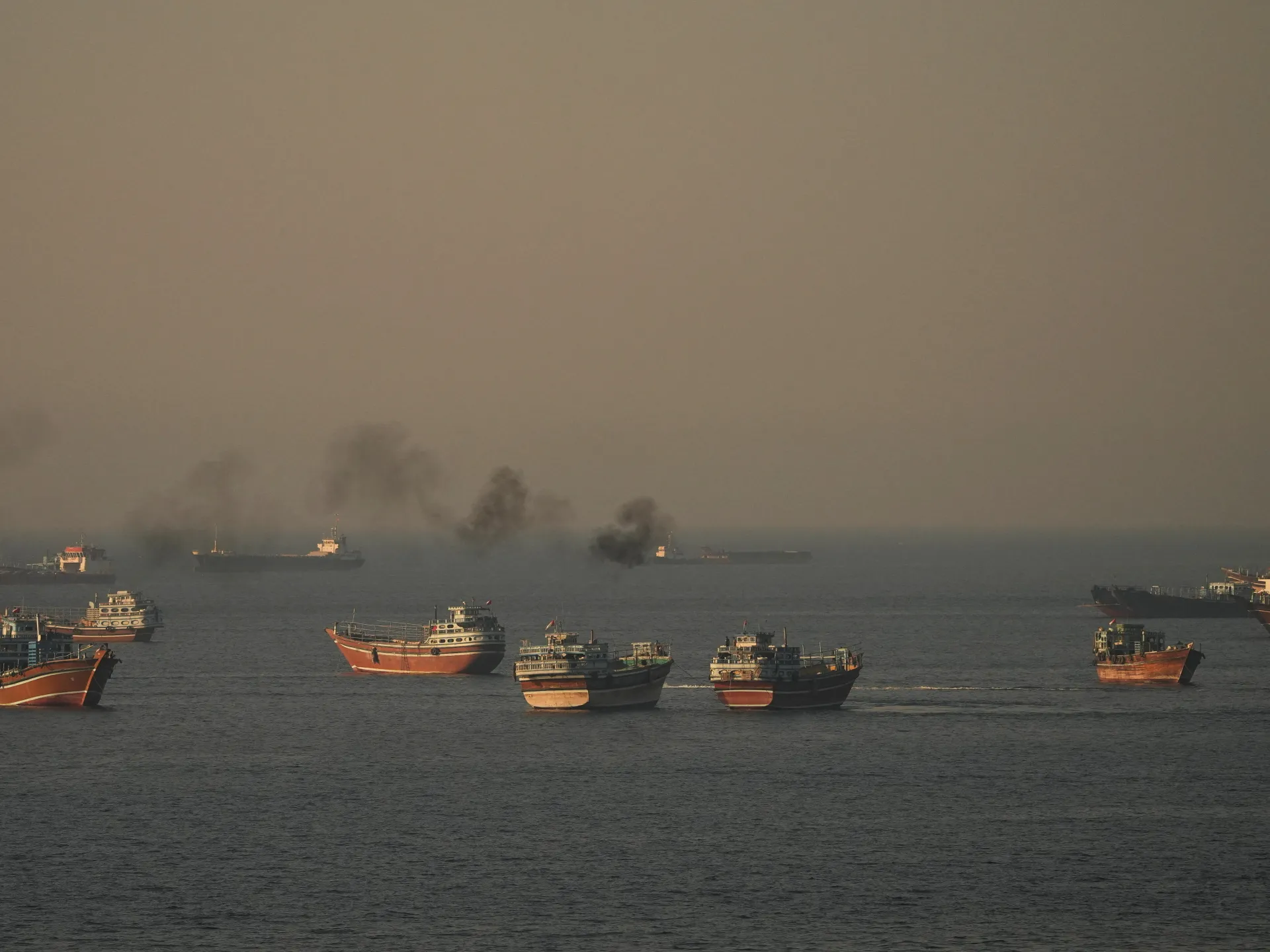
An Iranian gunboat has fired on a container vessel near the coast of Oman, according to a British maritime monitoring agency, in an incident that occurred hours after United States President Donald Trump said he would extend a ceasefire with Iran.

The United Kingdom Maritime Trade Operations (UKMTO) centre said on Wednesday that the ship’s captain reported that the vessel had been approached by a vessel of Iran’s Islamic Revolutionary Guard Corps (IRGC) before shots were fired.

Recommended Stories

list of 4 itemsend of list

It “has caused heavy damage to the bridge. No fires or environmental impact reported,” the agency added. No casualties were reported, and all crew members were said to be safe.

British maritime security firm Vanguard Tech said the ship was sailing under a Liberian flag and had been informed it had permission to pass through the Strait of Hormuz, one of the world’s most strategically important waterways.

Iranian news agency Tasnim, however, said the vessel had ignored warnings issued by Iran’s armed forces.

The incident followed a warning from the IRGC’s Khatam al-Anbiya Central Headquarters after what it described as the US seizure of an Iranian commercial ship in the Sea of Oman, the IRNA news agency reported.

It accused Washington of violating the ceasefire and carrying out “armed piracy” after allegedly firing on the Iranian vessel and disabling its navigation systems.

Trump extends ceasefire

Trump earlier announced he would delay a planned military attack on Iran after requests from Pakistan’s army chief Asim Munir and Prime Minister Shehbaz Sharif.

Writing on Truth Social, Trump said the decision was made because Iran’s government was “seriously fractured” and needed time to present a unified position.

“We have been asked to hold our Attack on the Country of Iran until such time as their leaders and representatives can come up with a unified proposal,” he wrote.

He added, however, that the US naval blockade of the Strait of Hormuz would remain in place and said the military had been ordered to stay “ready and able”.

The announcement marked a shift from comments made a day earlier, when Trump said it was “highly unlikely” he would extend the truce beyond Tuesday.

‘Positive and negative signals’ from Tehran

Al Jazeera’s Tohid Asadi, reporting from Tehran, said Iranian officials were sending mixed messages over the ceasefire and the prospects for negotiations.

“Tehran is saying they won’t negotiate under imposed terms and conditions … when we compare the initial 10-point and 15-point proposals by the Iranians and Americans, we can understand that the two sides are poles apart,” he said.

“The atmosphere is also clouded by this mistrust in Tehran towards the United States, as well as the simultaneous military rhetoric related to a potential failed negotiation … It is a warning that another round of confrontation may be ahead.”

He said Iran still viewed the Strait of Hormuz as a key source of leverage in any talks.

“It’s trying to exercise authority over the ships and vessels transiting this strategically significant chokepoint,” he said.

Asadi added that Iranian officials framed their regional position as based on mutual security. “Iranians are saying that the basis of their foreign policy behaviour, particularly when it comes to Israel, is security for all versus security for none,” he said.

Source link

Pro-Palestine legal aid requests stay high in 2025 amid US campus pressure | Donald Trump News

Washington, DC – Requests for legal support related to pro-Palestine advocacy remained high in the United States last year, as President Donald Trump threatened activists and universities with penalties.

In an annual report released on Tuesday, Palestine Legal, an organisation that “supports the movement for Palestinian freedom in the US”, said it received 1,131 queries for legal support in 2025.

Recommended Stories

list of 3 itemsend of list

The figure is below the record 2,184 requests the group received in 2024, when pro-Palestine protests swept US campuses — and were regularly met with crackdowns from both school administrators and law enforcement.

Despite universities enacting new restrictions on protests across the country, the figures from 2025 show that pro-Palestine advocacy has persisted, according to Dima Khalidi, the executive director of Palestine Legal.

“Our 2025 year-end report shows that while universities have largely cowered and caved to coercive pressure from the Trump administration and its pro-Israel supporters, student activists for Palestinian and collective freedom remain a model of moral conviction and courage,” Khalidi said.

“Even when facing punitive consequences for speaking out, they are holding the line of dissent against injustice from the US to Palestine, because they understand the cost of surrender for all of us.”

Palestine Legal said that the “overwhelming majority of requests” for legal support came from university students and faculty in 2025, but a growing number, 122, were categorised as “immigration and border-related”.

The group received 851 requests from people or organisations targeted for their Palestine-related advocacy, as well as 280 more asking for legal guidance on conducting advocacy.

Despite the drop from 2024, the rate of complaints last year remained 300 percent higher than in 2022, the year before Israel began its genocidal war in Gaza on October 7, 2023.

Since then, at least 72,560 Palestinians have been killed in Gaza.

Pressure campaigns

In 2024, Trump campaigned for a second term in the White House in part on a pledge to crack down on the pro-Palestinian protest movement, which sought to shine a light on the human rights abuses unfolding during the war.

He has framed such protests as anti-Semitic, and since his inauguration in 2025, he has led a campaign to penalise schools that played host to pro-Palestinian activism.

To date, five universities have struck deals with Trump after he threatened to withhold billions in federal funding. They include Columbia University, where a pro-Palestine encampment and resulting police crackdown drew international attention.

Columbia eventually reached a $200m settlement with the Trump administration and moved to make several policy changes it said were aimed at combatting anti-Semitism.

Rights groups have condemned such policies as conflating pro-Palestine advocacy with anti-Jewish sentiment. They also warn that Trump’s actions risk dampening free speech, a protected right under the First Amendment of the US Constitution.

All told, nearly 80 of the students who took part in Columbia’s protests faced serious academic discipline, including expulsions, suspensions, and degree revocations, as of July 2025.

Meanwhile, the Trump administration used immigration enforcement to target pro-Palestine protesters and advocates, including scholars like Rumeysa Ozturk, Mohsen Mahdawi, Badar Khan Suri and Mahmoud Khalil.

To date, the deportation proceedings against Ozturk, who was in the US on a student visa, and Mahdawi, a US permanent resident detained at his citizenship hearing, have been abandoned.

Ozturk has since voluntarily returned to her native Turkiye after completing her doctoral studies at Tufts University.

The government is still proceeding with deportation efforts against Khan Suri, a Georgetown University researcher, and Mahmoud Khalil, a Columbia University graduate and permanent US resident.

Separately, the Federal Bureau of Investigation (FBI) raided five homes connected to pro-Palestine activists at the University of Michigan in April 2025, sparking outrage. Federal authorities seized properties, but no arrests were made.

Despite the restrictive climate across the country, Palestine Legal hailed a string of legal victories in 2025 that upheld the right to pro-Palestinian protest.

Last August, for instance, a federal court dismissed a complaint that sought to penalise UNRWA USA, a non-profit that supports the United Nations Relief and Works Agency for Palestine Refugees (UNRWA), under the Antiterrorism Act of 1990.

A separate lawsuit launched by Palestine Legal and the Council on American-Islamic Relations (CAIR) charged that the University of Maryland had tread on the free speech rights of students by banning Students for Justice in Palestine (UMD SJP). That case resulted in a $100,000 settlement.

Meanwhile, federal judges have sided with Harvard University and the University of California, Los Angeles (UCLA), in their challenges to the Trump administration’s defunding efforts.

“The fights that Palestine Legal and our partners have waged affirm that the Trump administration, universities, and Israel advocacy groups cannot, without consequence, run roughshod over growing demands to respect and protect Palestinian rights,” Palestine Legal said at the conclusion of its report.

“The developments throughout 2025 made crystal clear that if we allow our right to stand for Palestinian freedom to be trampled, all of our fundamental rights will be in jeopardy in the face of an authoritarian slide.”

Source link

Trump’s US Fed nominee Warsh vows independence, says he’s no ‘sock puppet’ | Banks News

Kevin Warsh, United States President Donald Trump’s pick to lead the Federal Reserve, has addressed concerns about his independence pending his appointment to the bank amid fears that Trump could sway his decisions on monetary policy.

On Tuesday, Warsh — who served on the central bank’s Board of Governors from 2006 to 2011 — faced waves of criticism during a confirmation hearing of the Senate Banking Committee where Democrats voiced concerns about the Fed’s independence should he be appointed to lead the organisation.

Recommended Stories

list of 4 itemsend of list

Senator Elizabeth Warren of Massachusetts, the ranking Democrat on the committee, questioned Warsh’s independence, alleging that he would be a “sock puppet” for Trump, concerns he pushed back against and addressed in his opening testimony.

“I do not believe the operational independence of monetary policy is particularly threatened when elected officials — presidents, senators, or members of the House — state their views on interest rates,” Warsh said.

“Monetary policy independence is essential. Monetary policymakers must act in the nation’s interest . . . their decisions the product of analytic rigour, meaningful deliberation, and unclouded decision-making.”

Warsh, 56, also called for “regime change” at the US central bank, including a new approach for controlling inflation and a communications overhaul that may discourage his colleagues from saying too much about the direction of monetary policy.

Warsh blamed the central bank for an inflation surge after it slashed interest rates to nearly zero in the wake of the COVID-19 pandemic, a move that continues to hurt US households.

Concerned by the implications of artificial intelligence for jobs – expected to increase productivity – and prices, he said he would move quickly to see if new data tools could provide better insight on inflation, and would also discourage policymakers from saying too much about where interest rates might be heading.

“What the Fed needs are reforms to its frameworks and reforms to its communications,” the former Fed governor said. “Too many Fed officials opine about where interest rates should be … That is quite unhelpful.”

Warsh has also long been an advocate for shrinking the Fed’s $6.7 trillion balance sheet. In the Tuesday hearing, he said any such plans would take time and must be publicly discussed well in advance.

Jai Kedia, a research fellow at the Center for Monetary and Financial Alternatives at the libertarian Cato Institute, told Al Jazeera that there were many “encouraging” signs in Warsh’s candidacy.

“Warsh is presenting himself as a regime change candidate at a time when the Fed needs serious reform,” Kedia noted. “Particularly encouraging was his understanding of the negative effects of QE and his focus on reducing the balance sheet. He also correctly criticised mission creep and acknowledged that the Fed did better when it kept its focus on the dual mandate [of keeping inflation at 2 percent and increasing employment].”

Quantitative easing or QE is an unconventional monetary policy under which a central bank lowers interest rates, among other measures, to boost the economy, a step taken by central banks in several developed countries during the pandemic.

Warsh’s private investments, at well over $100m, are also under scrutiny. Among them are two holdings in the Juggernaut Fund LP, apparently part of his work advising for the Duquesne Family Office, the private investment firm of Stanley Druckenmiller.

Warsh’s nearly 70-page financial disclosure also showed that his other holdings include investments in Elon Musk’s SpaceX and the prediction trading platform Polymarket.

“I agreed to divest virtually all of my financial assets, the large majority of which will be divested” before taking office, Warsh said without giving any details.


Warsh noted that selling his holdings comes with challenges. He said that when that process is completed, he would have “virtually no financial assets” and “we’ll be sitting in something like cash”.

Warren, however, questioned him about the divestment plan. “Do we have any way to verify that, in fact, these sales will occur if we have no idea what’s in them?” she asked.

Political hurdles

The hearing quickly turned contentious, and the pace of Warsh’s confirmation process through the Senate remained in doubt.

He would not directly say that Trump lost the 2020 election – a statement of fact that Senator Warren said was a litmus test of Warsh’s independence from the Republican president who nominated him for the top Fed job.

Yet even amidst the focus on independence, Warsh needs 13 votes to clear the 24-member Senate Banking Committee.

North Carolina Senator Thom Tillis said he would vote against Trump’s nominee and join Democrats, which would create a 12–12 split. The committee has 13 Republican members and 11 Democrats.

Tillis said he would not vote for any Trump nominee until an investigation into current Fed Governor Jerome Powell, whose term ends May 15, is either concluded or called off. Last month, federal prosecutors said they found no evidence of wrongdoing. But Jeanine Pirro, the US Attorney for the District of Columbia, has not indicated that the investigation will be dropped.

Tillis said on Tuesday that he would support Warsh’s nomination once the probe into Powell is dropped.

“Today’s confirmation hearing underscored that Warsh is aiming for independence with guardrails,” noted Selma Hepp, chief Economist of Cotality, a market analytics company. “He rejected being a political ‘sock puppet’ and argued the Fed protects its autonomy by ‘staying in its lane.’ He offered no pre-commitment on rates, while emphasising inflation discipline, a large balance sheet, and a desire for clearer Fed communication.”

Noel Dixon, senior macro strategist at State Street, said that with Warsh, the US would have a “dovish-leaning Fed”.

“When a senator asked him if he would lower rates to 1 percent – I guess Trump had indicated that he would like to have rates below 2 percent – Warsh didn’t really say no to that,” Dixon noted. “He didn’t say that it would increase prices. He kind of leaned on it and said there would be a lagged effect, and he was just very noncommittal to that. So it’s almost like – just reading between the lines – he’s giving himself space to maintain possible justification for rate cuts by the end of the year.”

Trump has continued to pressure the central bank.

On Tuesday, he said he would be “disappointed” if the Fed did not lower interest rates.

Tuesday’s remarks follow comments in December, when the US president said he would not appoint anyone to lead the central bank unless they agreed with him.

“The public needs to know whether Mr. Warsh will have the courage of his convictions or if he’s willing to compromise his independence and accommodate more Wall Street deregulation,” Graham Steele, an academic fellow at the Rock Center for Corporate Governance at Stanford University, told Al Jazeera in an email.

Warsh has praised the administration for its push for increased bank deregulation. In a November 2025 op-ed for the Wall Street Journal, Warsh claimed that Trump’s “deregulatory agenda” is “the most significant since President Ronald Reagan’s”.

Source link

Vance’s trip to Pakistan for Iran talks delayed; Trump expects bombing or ‘great deal’

April 21 (UPI) — Uncertainty over Iran peace talks put Vice President JD Vance’s trip to Pakistan on hold Tuesday, as Iranian officials were silent on whether they intend to take part in the talks at all.

The New York Times reported that talks could, however, restart at any time. Officials in Tehran were divided on whether to take part in negotiations while the United States held firm on its embargo on ports in Iran, Axios reported.

President Donald Trump said earlier in the day that he expects to reach a deal with Iran in negotiations to end the war on Tuesday, but if no deal is made, he is prepared to resume bombing.

The two-week cease-fire Trump agreed to is set to expire on Wednesday, with the Strait of Hormuz remaining a centerpiece to the conflict between the United States and Iran.

“What I think is that we’re going to end up with a great deal,” Trump said in an interview on CNBC on Tuesday. “I think they have no choice. We’ve taken out their navy. We’ve taken out their air force. We’ve taken out their leaders, frankly. It is regime change, no matter what you want to call it. Which is not something I said I was going to do but I’ve done, indirectly maybe, but I’ve done it.”

Trump said the United States’ blockade of the Strait of Hormuz has been a “tremendous success,” adding that “we totally control the strait.”

The president added that he does not want to extend the cease-fire, noting that negotiations will take place near the time the two-week cease-fire ends.

If a deal is not agreed to on Tuesday and Wednesday, Trump said, “I expect to be bombing,” and “we are raring to go.”

“We’re totally loaded up. We have so much of everything; much more powerful than it was four or five weeks ago,” Trump said. “We caught a ship yesterday that had some things on it, which wasn’t very nice. A gift from China perhaps, I don’t know.”

Trump claimed that Iran has executed 42,000 protesters in the last two months, a number that has not been verified, though former Iranian Supreme Leader Ayatollah Ali Khamenei said thousands were killed earlier this year.

On social media, Trump shared a post saying the Islamic Republic is “preparing to hang eight women.” Trump called on Iranian leaders to release the women.

“I would greatly appreciate the release of these women,” Trump wrote. “I am sure that they will respect the fact that you did so. Please do them no harm! Would be a great start to our negotiations!”

Secretary of Health and Human Services Robert F. Kennedy, Jr. speaks during a House Appropriations Subcommittee on Labor, Health and Human Services, Education, and Related Agencies hearing on the budget for the Department of Health and Human Services in the Rayburn House Office Building near the U.S. Capitol on Thursday. Photo by Bonnie Cash/UPI | License Photo

Source link

Flu vaccine no longer mandatory for soldiers, says US military chief | Military News

Pete Hegseth says the decision is based on the principle of ‘medical autonomy’ and criticises the mandate as ‘overreaching’.

United States Defense Secretary Pete Hegseth has said that the flu vaccine will no longer be obligatory for members of the country’s military, the latest step under President Donald Trump to shift vaccine policy in the federal government.

Hegseth said in a video shared on social media on Tuesday that the decision was based on principles of “medical autonomy” and religious freedom.

Recommended Stories

list of 3 itemsend of list

“We’re seizing this moment to discard any absurd, overreaching mandates that only weaken our warfighting capabilities. In this case, this includes the universal flu vaccine and the mandate behind it,” said Hegseth.

“The notion that a flu vaccine must be mandatory for every service member, everywhere, in every circumstance at all times is just overly broad and not rational.”

The Trump administration has framed vaccine refusal as a matter of personal moral and religious principle, rolling back some policies meant to safeguard against preventable diseases.

Hegseth’s directive allows various military services to request that the mandate be kept in place, giving them a window of 15 days to do so.

The announcement comes after what health officials described as a particularly severe flu season when infections surged in the US. Public health experts have recommended that everyone aged six months or older get an annual flu vaccine.

The second Trump administration has reflected some of the backlash to public health guidelines and mandates that were implemented during the COVID-19 pandemic.

Hegseth himself has called that period an “era of betrayal” for the country’s armed forces. More than 8,400 members of the military were ejected for failure to abide by a 2021 mandate to take the COVID-19 vaccine.

The Trump administration has also rolled back vaccine recommendations in other areas, announcing earlier this year that it would not recommend flu shots and other forms of vaccines for all children. A lawsuit was filed challenging that effort, and the policy was temporarily blocked by a federal judge as the legal challenge plays out.

Source link

Virginia voting on new congressional map drawn by Democrats

April 21 (UPI) — Voters are heading to the polls in Virginia on Tuesday to vote on a new congressional map drawn by state lawmakers.

Polls are open until 7 p.m. EST., with nearly 1.4 million early ballots already cast on a constitutional amendment to change the congressional map. The result of Tuesday’s vote could have significant implications for the midterm elections in November.

If the map, drawn by Democratic lawmakers, is approved by voters, Democrats would be favored to win 10 of the state’s 11 congressional districts. Democrats currently hold six of the state’s 11 congressional seats and Republicans hold five.

Virginia is just the latest state to weigh redrawing its congressional map mid-decade after Texas approved a map that will favor Republicans last year. Four Republican-led states have approved new congressional maps.

Democrats and Republicans outside of the state have lent their voices to campaigns for and against Virginia’s redistricting plan. President Donald Trump and House Speaker Mike Johnson, R-La., voiced their opposition to the plan, with Trump calling it “unfair.”

House Minority Leader Hakeem Jeffries, D-N.Y., has joined Virginia lawmakers Sen. Mark Warner and Sen. Tim Kaine at rallies to support redistricting. Former President Barack Obama has also been involved, appearing in ad campaigns calling on voters to vote “yes.”

“We’re giving Virginians a chance to vote — which Republican states have not done — about whether they want to have a congressional delegation that will stand up against Donald Trump’s tyranny if he tries to interfere with our elections,” Kaine said in an appearance on Fox News on Sunday.

The Virginia Supreme Court allowed Tuesday’s election to move forward but may still weigh in on whether the new congressional map is legal or not.

Secretary of Health and Human Services Robert F. Kennedy, Jr. speaks during a House Appropriations Subcommittee on Labor, Health and Human Services, Education, and Related Agencies hearing on the budget for the Department of Health and Human Services in the Rayburn House Office Building near the U.S. Capitol on Thursday. Photo by Bonnie Cash/UPI | License Photo

Source link

Global markets on edge as investors await outcome of US-Iran negotiations

Published on Updated

Oil prices edged slightly higher, European indices traded flat, while Asian markets surged on Tuesday morning as investors monitored potential US-Iran negotiations and the final 48 hours of the current ceasefire.


ADVERTISEMENT


ADVERTISEMENT

At the time of writing, US benchmark crude was up 8.5% from last Friday’s low to around $86.3 a barrel, while Brent crude, the international standard, was around 9.5% higher at roughly $94.5 a barrel.

As for European markets, the Euro Stoxx 50 and the broader pan-European Stoxx 600 were trading within a 0.2% range.

The UK’s FTSE 100, Germany’s DAX 30, France’s CAC 40 and Italy’s FTSE MIB were all similarly trading within a 0.3% range.

On Wall Street, US futures were also all trading within a 0.3% range with the tech-heavy Nasdaq leading. The S&P 500 closed marginally lower by 0.2% on Monday at 7109 points.

Despite US representatives, including special envoy Steve Witkoff and senior adviser Jared Kushner, travelling to Islamabad as part of renewed efforts to secure an agreement, no concrete progress on US-Iran negotiations has been announced.

The Strait of Hormuz remains closed and the current ceasefire ends on Wednesday keeping markets in a state of uncertainty.

US President Donald Trump has asserted that the deal currently being negotiated will be better than the Joint Comprehensive Plan of Action (JCPOA), which was signed by US President Barack Obama in 2015 and from which Trump withdrew in 2018.

Latest on US-Iran negotiations

Following the arrival of US representatives to Islamabad there has been no developments on the negotiations with Iran.

Even though US President Donald Trump confidently declared that there is a historic deal in the works, public statements from major Iranian figures seem to indicate otherwise.

Mohammad Ghalibaf, the speaker of Iran’s parliament and the person previously heading the talks with the US, made sweeping declarations via X on Monday stating that the country will “not accept negotiations under the shadow of threats” and “has prepared to reveal new cards on the battlefield”.

Previously, other Iranian representatives have also described US demands as “excessive”.

For the time being, markets eagerly await developments and are highly sensitive to any headlines about the situation.

Associated British Foods and Primark demerger

Although European markets are trading flat, major news in the retail consumer sector has come out of the UK.

Associated British Foods (ABF) is poised to announce the outcome this week of a strategic review into demerging its fast-fashion retail arm Primark, from its diversified food business.

The conglomerate, controlled by the billionaire Weston family, has been working with advisers from Rothschild & Co to assess whether the split would maximise long-term shareholder value.

Analysts argue the move makes sense because of the limited operational synergies between the two divisions: the food arm generates steady cash flows from brands such as Twinings, Patak’s, Jordans cereals and Allied Bakeries, while Primark has pursued aggressive international expansion in a fiercely competitive retail sector.

The decision comes as ABF faces tough trading conditions, with the group warning in January of flat annual sales and declining profits, further pressured by rising costs and the fallout from the Iran conflict, including potential increases in petrochemical prices.

Source link

Technofacism? Why Palantir’s pro-West ‘manifesto’ has critics alarmed | Technology News

The US tech giant Palantir Technologies has posted what it terms a summary of Palantir CEO Alex Karp and head of corporate affairs Nicholas Zamiska’s book, The Technological Republic, on social media.

Many of the positions articulated in the book go far beyond what would normally be expected of a tech company: calling for the introduction of national service, the “moral” duty of technology companies to participate in defence, the necessity for hard power if what it calls free and democratic powers are to prevail, and an embrace of religion in public life.

Recommended Stories

list of 4 itemsend of list

The publication of what appears to be a 22-point manifesto comes at a critical time for Palantir, which faces global criticism for its support of US President Donald Trump’s controversial immigration crackdown and its backing of the Israeli military’s actions in Gaza and the occupied West Bank.

Many have expressed alarm at the book’s emphasis on cultural hierarchies and what it calls “regressive” cultures.

Eliot Higgins, the founder of the online investigations platform Bellingcat, sarcastically pointed out how “completely normal” it was for a tech company to post what he said was a manifesto attacking democratic norms. “It’s also worth being clear about who’s doing the arguing,” Higgins added. “Palantir sells operational software to defence, intelligence, immigration & police agencies. These 22 points aren’t philosophy floating in space, they’re the public ideology of a company whose revenue depends on the politics it’s advocating.”

So, what is Palantir, why is it so controversial, and why has it posted the “manifesto” now?

What does the book say?

As well as referring to the hard power needed to replace the “soaring rhetoric” previously used to defend “free and democratic societies”, the book rails against what it calls the “psychologization of modern politics”, which appears to criticise anyone the authors feel has become too emotionally invested in their political representatives and identity.

The call for people to care less about politics appears to critics as a way of deflecting from Palantir’s own controversial political positions and its openness to working with government policies that clamp down on liberty. Worryingly for some is also the book’s emphasis on what it calls the technology sector’s “obligation to participate in the defence of the nation”, and on the supposed inevitability of developing AI weapons.

Among other points, the writers appear to defend billionaires, such as Elon Musk, whose achievements, they say, are not met with “curiosity or genuine interest” but are instead dismissed by those who “snicker” at the South African-born businessman. Musk was heavily criticised for his role as the head of DOGE, or the US Department for Government Efficiency, which scrapped several government agencies without much regard for the roles those agencies played, or the legal and political process necessary to shut such agencies down.

Palantir’s post concludes by criticising “the shallow temptation of a vacant and hollow pluralism”. It argues that an unthinking commitment to inclusivity and pluralism “glosses over the fact that certain cultures and indeed subcultures… have produced wonders. Others have proven middling, and worse, regressive and harmful”.

How have people reacted?

Not well.

Mark Coeckelbergh, a Belgian philosopher of technology who teaches at the University of Vienna, described Palantir’s messaging as an “example of technofascism”, while Greek economist and former Finance Minister Yanis Varoufakis said Palantir had effectively signalled a willingness “to add to nuclear Armageddon the AI-driven threat to humanity’s existence”.

Posting on social media, Arnaud Bertrand, the entrepreneur and geopolitical commentator, claimed that Palantir had revealed a dangerous “ideological agenda”.

“They’re effectively saying ‘our tools aren’t meant to serve your foreign policy. They’re meant to enforce ours’,” he wrote.

What is Palantir?

Palantir Technologies is widely regarded as one of the world’s most influential data analytics firms, securing major contracts with governments, militaries and global corporations.

Founded in 2003 by Alex Karp and Peter Thiel, with support from In-Q-Tel, the CIA’s venture capital arm, it built its early business on post-9/11 intelligence work and has since expanded internationally, with contracts across Europe, the Middle East, and beyond.

While retaining his shares in Palantir, Thiel is understood to no longer play an active role in its day-to-day operations. Karp has positioned himself as the public face of the company.

Under Karp’s leadership, Palantir has drawn heavily on the expertise of former members of Israel’s cyber-intelligence unit, 8200. After the company announced a “strategic partnership” with Israel in January 2024, its involvement in Gaza and the occupied West Bank expanded considerably. Using a mix of intercepted communications, satellite material and other digital data sources, Palantir began integrating these inputs to help produce targeting databases – effectively, “kill lists” – for the Israeli military.

It has also cultivated close ties with US security agencies, particularly during the Trump administration, of which Thiel has been an enthusiastic backer, and has also worked with Israel in its occupation of the West Bank and genocide in Gaza.

According to its critics, including the rights group Amnesty International, “Palantir has a track record of flagrantly disregarding international law and standards, both in the violations of the human rights of migrants in the United States, to which it risks contributing to, and its ongoing supply of artificial intelligence (AI) products and services to the Israeli military and intelligence services that are linked to Israel’s ongoing genocide in Gaza.”

FILE - In this Wednesday, May 15, 2019, file photo, Palantir CEO Alex Karp arrives for the Tech for Good summit in Paris. Seventeen years after it was born with the help of CIA seed money, Palantir Technologies is finally going public. (AP Photo/Thibault Camus, File)
CEO Alex Karp founded Palantir with Peter Thiel, with investment from the CIA, in 2003 [File: Thibault Camus/AP Photo]

What exactly has Palantir been accused of in Israel and the US?

Palantir Technologies has faced criticism across the world for its enabling of government surveillance and military systems in the US and Israel.

In the US, it has been accused of supporting immigration enforcement and policing tools that aggregate vast personal datasets, including medical information, enabling profiling and raising due process and privacy concerns. In Israel, critics allege that its AI and data platforms have been used in military operations in Gaza, potentially contributing to the targeting decisions that have underpinned Israel’s genocide there.

Responding to questions from Al Jazeera earlier this year, a spokesperson for Palantir said, “As a company, Palantir does support Israel. We’ve chosen to support them because of the appalling events of October 7th. And more broadly, we’ve chosen to support them because we believe in supporting the West and its allies – and Israel is an important ally of the West.” The spokesman was referring to the Hamas-led October 7, 2023, attack on Israel, after which Israel launched its genocidal war on Gaza.

Why post the ‘manifesto’ now?

Palantir’s politics and alarm over its influence are growing and gaining traction across much of the West.

As well as concern among US Democrats, politicians in Germany, Ireland, and in the European Parliament have criticised the tech giant, whose products, according to one German lawmaker and cyber security expert, have fallen short of security standards across the bloc.

In the UK, the row over the National Health Service’s adoption of Palantir technology has led to some of the fiercest criticism yet. MPs calling for the UK to take advantage of an early break in the tech giant’s 330 million-pound ($446.4m) contract with the health service labelled Palantir “dreadful” and “shameful” in a debate last week, after which even the government conceded that it was “no fan” of the US company’s politics.

Louis Mosley, the head of Palantir Technologies UK, defended the company by arguing that it had no interest in patient data and existed only as a tool to better manage health service resources.

Source link

Cuba confirms talks with US officials, wants end to Trump’s energy blockade | Donald Trump News

A Cuban Foreign Ministry official said the exchange with Washington was ‘respectful and professional’ and devoid of threats.

The Cuban government has confirmed that it held recent talks in Havana with officials from the United States, as tensions remain high between the two countries over Washington’s energy blockade of the Caribbean country.

Alejandro Garcia del Toro, deputy director general in charge of US affairs at the Cuban Ministry of Foreign Affairs, said on Monday that the US delegation included assistant secretaries of state, and the Cuban delegation included representatives at the level of deputy foreign minister.

Recommended Stories

list of 4 itemsend of list

Garcia de Toro said that the US delegation did not issue any threats or deadlines as had been reported by some US media outlets.

“The entire exchange was conducted with respect and professionalism,” he said.

In comments reported by Cuba’s Communist Party newspaper Granma, Garcia del Toro emphasised that ending the three-month-old US oil blockade was “a top priority” for the Cuban government in the talks, and accused Washington of “blackmail” for threatening countries that export oil to Cuba with tariffs.

“This act of economic coercion is an unjustified punishment for the entire Cuban population,” he said.

“It is also a form of global blackmail against sovereign states, which have every right to export fuel to Cuba, in accordance with the principles of free trade,” he added.

US news outlet Axios reported on Friday that officials from US President Donald Trump’s administration held multiple meetings in Havana on April 10, including with Raul Guillermo Rodriguez Castro, grandson of former President Raul Castro. The meetings marked the first time that American diplomats had flown into Cuba since 2016 in a new diplomatic push.

According to reports, US officials laid out several conditions for negotiations with Cuba to continue, including the release of prominent political prisoners, an end to political repression, and liberalising the island’s ailing economy.

The Reuters news agency said that US proposals for Cuba also include allowing Elon Musk’s Starlink internet terminals into the country and providing compensation for Americans and US corporations for assets confiscated by Cuba after the 1959 revolution. Washington is also concerned about the influence of foreign powers on the island, a US official told the news agency.

Trump has hinted at military intervention in Cuba and warned of tariffs on any country that sells or supplies oil to Cuba. The fuel blockade has aggravated Cuba’s economic and energy crisis, leading to warnings of a humanitarian disaster.

Cubans have also braced for a possible attack following Trump’s repeated warnings that the country will be “next” after his war on Iran and the US military’s abduction of Venezuela’s President Nicolas Maduro in January.

Last week, Cuban President Miguel Diaz-Canel said that his country was prepared to fight if the US carried through on its threats.

The leaders of Mexico, Spain and Brazil on Saturday voiced concern over the “dramatic situation” in Cuba and urged “sincere and respectful dialogue”.

German Chancellor Friedrich Merz said on Monday there was no evident justification for the US to attack Cuba.

“The ability to defend oneself does not mean the right to intervene militarily in other states when their political systems do not match what others might have in mind,” he said.

Source link

Trump’s Labor Secretary Lori Chavez-DeRemer latest to leave administration | Donald Trump News

Chavez-DeRemer is the third high-profile female official to leave the Trump administration after recent departures of Kristi Noem and Pam Bondi.

US Secretary of Labour Lori Chavez-DeRemer will be leaving her post in the administration of President Donald Trump, the White House has said.

Chavez-DeRemer is the third woman to leave the Trump administration since March, when the president fired Homeland Security Secretary Kristi Noem in the wake of federal immigration raids in Minnesota that led to the deaths of two protesters. Trump also ousted Attorney General Pam Bondi earlier this month.

Recommended Stories

list of 4 itemsend of list

Chavez-DeRemer has done a “phenomenal job” protecting American workers and is set to “take a position in the private sector”, White House Director of Communications Steven Cheung said in a post on X late on Monday, announcing the labour secretary’s departure.

“Keith Sonderling will take on the role of Acting Secretary of Labor,” Cheung added, referring to the current deputy labour secretary.

While Cheung did not give a reason for Chavez-DeRemer’s departure, the New York Post reported in January that she was under investigation for “pursuing an ‘inappropriate’ relationship with a subordinate” and drinking in her office during the work day.

Al Jazeera was unable to independently verify the allegations.

From the beginning of her tenure, Chavez-DeRemer had some notable differences with other members of Trump’s inner circle.

She had voiced support for the pro-union Protecting the Right to Organize Act (PRO Act), earning support for her nomination from some Democrats.

Her appointment was also seen as favoured by Sean O’Brien, the president of the International Brotherhood of Teamsters, who notably spoke in support of Trump’s re-election campaign at the Republican National Convention in July 2024.

However, as the labour secretary, Chavez-DeRemer’s positions have more closely aligned with the Trump administration’s overall anti-regulatory policies, according to US media outlets. During her tenure as secretary, the Labor Department stalled on responding to calls for limits on silica exposure from Appalachian coal miners suffering from the occupational black lung disease.

Chavez-DeRemer is not the first top official to leave the Labor Department during Trump’s second term.

In August 2025, Trump fired the director of the Bureau of Labor Statistics (BLS), Erika McEntarfer, who was appointed by previous President Joe Biden, after a report showed that hiring had slowed in July and was worse in May and June than had previously been reported.

Chavez-DeRemer had supported the president’s move at the time.

“I support the President’s decision to replace Biden’s Commissioner and ensure the American People can trust the important and influential data coming from BLS,” Chavez-DeRemer said in a post on X following McEntarfer’s removal.

Source link

Outcry grows over Israeli soldier smashing Jesus statue in Lebanon | Israel attacks Lebanon News

A photo of an Israeli soldier smashing a statue of Jesus Christ in Lebanon has sparked outrage in the United States, adding to the anger Israel is facing, including from parts of US President Donald Trump’s base.

Although the incident is only one among a broad range of atrocities that Israel is accused of committing in the region in recent years, it garnered condemnations across the world and prompted a response from Israel’s Prime Minister Benjamin Netanyahu.

In the US, where support for Israel was once unchallenged – especially in right-wing circles that purport to espouse Christian values – the desecration of the Christian religious symbol added fuel to the criticism that the Israeli government is facing from some Republicans.

“You would never know it by consuming American corporate media, but this kind of incident is not rare,” said right-wing commentator Tucker Carlson, a former Trump ally.

“The Israeli government has permitted its soldiers to behave like barbarians for decades, all while sucking up generous funding from the United States. The only difference between now and the past is that social media has exposed Israel’s behavior for the world to see,” Carlson wrote in his newsletter on Monday.

‘Horrific’

Former Republican Congresswoman Marjorie Taylor Greene – who fell out with Trump over his hawkish foreign policy – highlighted that Israel receives billions of dollars in US military aid annually.

“‘Our greatest ally’ that takes billions of our tax dollars and weapons every year,” she wrote in a comment on X in response to the photo showing an Israeli soldier taking a sledgehammer to the head of the statue of Jesus.

Matt Gaetz, another former Republican congressman and Trump ally, said, “Horrific”.

For his part, independent journalist Glenn Greenwald mocked how Christian Zionists may defend Israel over smashing the statue.

“Christian Zionists: This Israeli soldier was absolutely justified in smashing the head of the Jesus Christ statue because Hezbollah and Hamas were hiding inside. We owe him our gratitude,” Greenwald wrote on X.

The anger echoed growing scepticism of the close alliance with Israel in Trump’s “Make America Great Again” (MAGA) constituency.

Trump is already facing pressure over joining Israel in starting a war against Iran, which sent oil prices soaring. Earlier on Monday, the US president addressed and denied claims that Netanyahu dragged the US into the conflict.

Support for Israel in the US is at a historic low, recent public opinion polls show.

While Israel still enjoys near-unanimous Republican support in Congress, that consensus is starting to fray, with dissent being expressed by the likes of Carlson, in part due to prolonged wars in the Middle East and attacks on Christians.

Israel says it will investigate

The desecration of the statue, which took place near the town of Debl in south Lebanon, according to local reports, prompted an unusually swift response from the highest level of the Israeli government.

“I condemn the act in the strongest terms. Military authorities are conducting a criminal probe of the matter and will take appropriately harsh disciplinary action against the offender,” Netanyahu said in a statement on Sunday.

Israel rarely holds its soldiers accountable for well-documented abuses in Gaza, the occupied West Bank and Lebanon, including sexual violence.

Netanyahu, who has been evading an arrest warrant by the International Criminal Court (ICC) over war crimes charges in Gaza since 2024, went on to argue that Israel treats Christians better than any other country in the region.

“While Christians are being slaughtered in Syria and Lebanon by Muslims, the Christian population in Israel thrives unlike elsewhere in the Middle East,” the Israeli prime minister claimed.

“Israel is the only country in the region that the Christian population and standard of living is growing.”

Lebanon has the largest per capita Christian population in the Middle East, and its president is a Maronite Catholic.

Israeli Foreign Minister Gideon Saar joined Netanyahu in denouncing the desecration of the statue, saying that it is “entirely contrary” to Israeli values.

But while Israel’s supporters tried to portray smashing the statue as an isolated mistake by one soldier, the incident reflects a pattern of Israeli attacks against houses of worship, including churches.

In 2024, Israeli troops filmed a mock wedding between two soldiers at a church in Deir Mimas in Lebanon and vandalised the building.

An Israeli tank demolished a statue of Saint George in the southern Lebanese village of Yaroun last year, as well.

Israel has bombed Palestinian churches several times in Gaza since the start of its genocidal war in the enclave, including an attack that killed at least 18 people in 2023.

Israel destroyed more than 1,000 mosques and three churches in Gaza during the war, according to local officials.

Catholic leaders respond

The Assembly of Catholic Ordinaries of the Holy Land denounced the attack on the statue on Monday.

“This act constitutes a grave affront to the Christian faith and adds to other reported incidents of desecration of Christian symbols by [Israeli] soldiers in southern Lebanon,” it said in a statement.

“It further reveals a disturbing failure in moral and human formation, wherein even the most elementary reverence for the sacred and for the dignity of others has been gravely compromised.”

The incident came as Israeli soldiers pushed to completely destroy homes and civilian infrastructure in dozens of Lebanese villages in order to prevent residents from returning to them.

“The outrage shouldn’t be about a destroyed statue of Jesus – abhorrent as that is,” Palestinian pastor Munther Isaac wrote in a social media post on Monday.

“The real outrage is the targeting of civilians, the assault on human dignity, the devastation in Gaza and Lebanon. War is evil. We need Accountability.”

The Council on American-Islamic Relations (CAIR) called on Trump and Congress to intervene and end Israeli violations after the destruction of the statue.

“For years, our government has ignored and enabled persistent Israeli attacks on churches and Christians in Lebanon, Gaza, and elsewhere,” CAIR said.

“Our message to American public officials is simple: If you continue sending more weapons and provide political cover for Israel’s rogue actions, you own what you see in this picture.”

Source link

Brazil’s Lula warns of global disorder, calls for U.N. reform

Brazilian President Luiz Inacio Lula da Silva speaks during a media tour at the Hanover Fair 2026 Hanover, Germany, on Monday. Photo by Hannibal Hanschke/EPA

April 20 (UPI) — Brazilian President Luiz Inácio Lula da Silva has warned about the deterioration of the international order and the paralysis of the United Nations in a message published on X.

He urged strengthening multilateralism while on an official visit to Germany, where he also promoted the trade agreement between the European Union and Mercosur.

“It is useless to have one’s house in order in a world that is in disorder. The prevalence of force over law is the greatest threat to international peace and security,” Lula wrote in a message that addresses multiple global conflict hotspots.

Lulu expressed concern over “the risks of a new conflict in Iran” and a possible escalation in Lebanon, as well as the situation in Palestine, where he said that “the survival of the Palestinian state and its people remains under threat.”

He also mentioned the war in Ukraine, noting that “the long-awaited peace remains distant.”

In his message, Lula criticized the lack of international action.

“Between the actions of those who provoke wars and the silence of those who prefer to remain quiet, the United Nations is once again paralyzed,” he said. He added that Brazil and Germany have defended for decades a reform of the Security Council that restores its legitimacy.

“Revitalized multilateralism is the only path to restore diplomacy and cooperation as tools for peace and sustainable development,” he said, and concluded with a broader call: “Humanity must recover the idea that peace is morally necessary and politically possible.”

The message aligns with a series of recent statements by the Brazilian leader on the global order and the role of major powers.

In an interview published Thursday by the Spanish newspaper El País, Lula criticized U.S. President Donald Trump over his rhetoric toward other countries and questioned the use of threats in foreign policy.

“Trump does not have the right to wake up in the morning and threaten a country,” Lula said, also calling for greater responsibility from international leaders to preserve peace.

In the same interview, he defended dialogue as the main diplomatic tool and warned about the risk of global escalation.

“I do not want a war with the United States. I decided to be very patient,” he said, explaining that his government prioritizes negotiation and national interests over ideological differences.

He also questioned the use of tariffs by Washington and said that the arguments to apply measures against Brazil “were not true.”

Lulu already has raised the need to reform international institutions.

“The time has come to redefine the United Nations to give it credibility,” he said, in line with his most recent call on social media.

In Germany, Lulu participated in the opening of the Hannover Industrial Fair alongside Chancellor Friedrich Merz.

Both leaders highlighted the free-trade agreement between the European Union and Mercosur, whose provisional entry into force is scheduled for May 1.

Merz said the agreement “will make all participating economies stronger, more independent and more resilient.” Lula, for his part, presented it as an alternative to unilateralism.

“Mercosur and the European Union chose cooperation,” he said, adding that increased trade will boost employment and investment in both regions.


Source link

‘Israel never talked me into the war with Iran,’ Trump says | US-Israel war on Iran News

Donald Trump has denied being dragged into war with Iran by Israel, as the United States president faces increasing criticism over the conflict, including from segments of his own base.

“Israel never talked me into the war with Iran, the results of Oct. 7th, added to my lifelong opinion that IRAN CAN NEVER HAVE A NUCLEAR WEAPON, did,” Trump wrote in a social media post on Monday.

Recommended Stories

list of 3 itemsend of list

There is no public evidence linking Iran directly to Hamas’s October 7, 2023 attack against Israel. Trump’s own intelligence chief Tulsi Gabbard also testified to Congress in March that Iran is not building a nuclear weapon.

For eight months prior to the war, Trump had been saying repeatedly that the June 2025 US strikes on Iranian facilities “obliterated” the country’s nuclear programme.

Many of Trump’s critics have argued that Iran did not pose an imminent threat to the US, and that the war only advances the interests of Israel at the expense of the safety and prosperity of Americans.

Iran responded to the joint US-Israeli strikes – which killed the country’s Supreme Leader Ali Khamenei, other top officials and hundreds of civilians on February 28 – by blocking the Strait of Hormuz, sending oil prices soaring.

In the US, energy costs have skyrocketed, fuelling inflation. The price of one gallon (3.8 liters) of petrol has remained over $4 – up from less than $3 before the war, more than a week after the truce between Washington and Tehran came into effect.

A recent poll by NBC News suggested that two-thirds of Americans disapprove of Trump’s handling of the war.

With dissatisfaction growing, many of the president’s critics have pointed to Israel as the real power behind the war – portraying Trump as a weak leader following Israeli Prime Minister Benjamin Netanyahu.

“He entered a war – got pulled into it by Bibi Netanyahu, let’s be clear about that – entered a war that the American people do not want,” Kamala Harris, Trump’s 2024 Democratic opponent, said last week.

Harris served as vice president in the Joe Biden administration, which provided diplomatic and military support for Israel’s genocidal war on Gaza for more than two years.

During the 2024 campaign, Trump presented himself as the “peace” candidate, promising to end wars that were started under the Biden administration.

Trump’s National Security Strategy, released last year, also said that Washington would pivot its foreign policy and military resources from the Middle East to the Western Hemisphere.

But Netanyahu, who has visited Trump in the US six times in one year, has continued to push for a hardline against Iran. The most vocal supporters of the war in Washington have also been Israel’s closest allies.

On Monday, Trump renewed his attacks on the mainstream media for its coverage of the war with Iran.

“I watch and read the FAKE NEWS Pundits and Polls in total disbelief. 90% of what they say are lies and made-up stories, and the polls are rigged, much as the 2020 Presidential Election was rigged,” the US president wrote.

He also touted his policies in Venezuela, where the country has remained stable and become more friendly to Washington after US forces abducted President Nicolas Maduro in January.

In Iran, however, the US-Israeli strikes led to the closure of Hormuz and sustained Iranian attacks across the region for nearly six weeks.

The conflict is now paused, and further talks between US and Iranian officials could take place in Pakistan this week. But both sides have threatened to renew the fighting if a deal is not reached.

“Just like the results in Venezuela, which the media doesn’t like talking about, the results in Iran will be amazing – And if Iran’s new leaders (Regime Change!) are smart, Iran can have a great and prosperous future!” Trump wrote.

Source link

U.S. kills three in latest military strike on a suspected drug boat

April 20 (UPI) — The U.S. military announced late Sunday that it has killed three men in its latest strike targeting a suspected drug-smuggling boat in the Caribbean.

Seventeen people have been killed in six strikes the U.S. Southern Command has carried out in little over a week, marking one of the deadliest publicly announced stretches of the Trump administration’s monthslong anti-drug smuggling operation.

As in previous strike announcements, SOUTHCOM released little information.

The attack occurred Sunday, targeting a boat operated by a designated terrorist organization in the Caribbean, SOUTHCOM said in a statement, without naming the organization or providing evidence.

“Intelligence confirmed the vessel was transiting along known narco-trafficking routes in the Caribbean and was engaged in narco-trafficking operations,” it said.

A 12-second, black-and-white clip of the strike posted to SOUTHCOM’s social media shows a boat moving across the ocean before disappearing in a large fiery explosion.

Since the first strike on Sept. 2, the U.S. military has killed at least 180 people, according to UPI’s tally of publicly released data. Fifty-five boats have been destroyed in the more than 50 strikes.

President Donald Trump argues that the use of deadly military force is warranted as the United States is in “armed conflict” with the 10 drug cartels and gangs he has designated as terrorist organizations since returning to the White House in January 2025.

The operation comes as the Trump administration seeks to expand its influence in the Western Hemisphere, including by using its military to dismantle what Trump has called “narco-terrorist networks.”

The strikes have been repeatedly condemned and their legality questioned by Democrats, rights groups, critics and United Nations experts, who accuse the Trump administration of violating international and maritime law over the use of the military to conduct law enforcement drug operations.

Last month, Ben Saul, the United Nations’ special rapporteur on counter-terrorism and human rights, lambasted the Trump administration over “its phony war on so-called narco-terrorism.”

“These serial extrajudicial killings gravely violate the right to life, which applies extraterritorially,” he said on March 13.

“The attacks were not in national self-defense, since the vessels were not engaged in any armed attack on the U.S. Drug trafficking is crime, not war.”

On Wednesday, the same day the U.S. military killed three people in a strike in the eastern Pacific, a group of Democrats, led by Rep. John Larson of Connecticut, filed six articles of impeachment against Defense Secretary Pete Hegseth, with one of the articles accusing him of violating the law of armed conflict over the strikes.

Larson accused Hegseth of abusing his position by ordering “our armed forces to strike boats in the Caribbean,” he said in a statement.


Source link

Canadian PM Mark Carney calls close trade ties to U.S. a ‘weakness’

April 19 (UPI) — Citing steep tariffs imposed by U.S. President Donald Trump, Canadian Prime Minister Mark Carney said Sunday his country’s historically close trade and economic ties to the United States have become a “weakness.”

In a video statement posted to YouTube, the Canadian leader asserted the United States has “fundamentally changed its approach to trade, raising its tariffs to levels last seen during the Great Depression.”

This has meant that “many of our former strengths, based on our close ties to America, have become our weaknesses — weaknesses that we must correct.”

Carney’s comments as Trump’s trade war with Canada has disrupted decades of cross border cooperation, triggered in part by a broad 10% tariff slapped by Washington onto all goods not excluded under the Canada-US-Mexico free trade agreement known as CUSMA.

Significantly higher U.S. levies have also been imposed on key strategic sectors, including a 50% tariff on Canadian products that are almost entirely made of steel, aluminum or copper, and a 25% tariff on products that are “largely” made of those metals.

Many types of Canadian heavy equipment also face a 15% tariff upon entry into the United States.

Ottawa says the effect of these measures has been profound, “displacing workers, disrupting supply chains, forcing companies to rethink where they source their materials and products, and causing uncertainty that is curbing investment.”

Although Canada still has the best deal of any U.S. trading partner in an era when Trump has used the threat of tariffs and against both allies and adversaries for strategic and political ends, “we cannot rely on our most important trade relationship as we once did. We must build our strength at home,” Carney said.

“Workers in our industries most affected by U.S. tariffs in autos and steel and lumber are under threat,” he added. “Businesses are holding back investments restrained by the pall of uncertainty that’s hanging over all of us.”

Triggered by the U.S. trade actions and Trump’s oft-repeated desire to annex Canada as the “51st state,” Carney’s Liberal Party government in January made a milestone deal with China to lower some of the tariffs imposed by one another on some of their trade goods.

Under that pact, China lowered its tariffs on Canadian agricultural products, while Canada slashed its tariffs on up to 49,000 electric vehicles that are made in China.

The deal was denounced by Trump, who threatened to impose a 100% tariff on all Canadian goods sent to the United States in response.

“China will eat Canada alive, completely devour it, including the destruction of their businesses, social fabric and general way of life,” the U.S. president asserted.

But Carney on Sunday again defended his expansion of trade away from the United States, saying, “We will attract new investment so we can build more for ourselves, striking new partnerships abroad so we can sell into new markets.

“It’s about taking back control of our security, our borders and our future.”

President Donald Trump meets with Canadian Prime Minister Mark Carney in the Oval Office of the White House in Washington on October 7, 2025. Photo by Shawn Thew/UPI | License Photo

Source link

US forces attack and seize Iranian ship Touska near Strait of Hormuz | US-Israel war on Iran

NewsFeed

US Central Command has published a video said to show a guided-missile destroyer firing at an Iranian-flagged cargo ship near the Strait of Hormuz. The USS Spruance fired several rounds into the Touska’s engine room for ‘violating the US blockade’, before marines boarded it.

Source link

Tariff refund portal to go live on Monday

April 19 (UPI) — U.S. Customs and Border Protection is expected to launch a website on Monday to process refund requests for some Trump administration tariffs, although there are limits to which ones will be processed.

The first phase of tariff refunds comes after the Supreme Court ruled in February that President Donald Trump could not use the International Emergency Economic Powers Act (IEEPA) to generate revenue by imposing tariffs.

Although Trump decided to use Section 122 of the Trade Act of 1974 to justify new tariffs after the Court’s decision, the administration still is required to refund duties collected under the now-nullified tariffs.

CBP has estimated that it owes about $166 billion in refunds, with the agency’s announcement of phase 1 expected to take care of the vast majority of expected claims, NPR reported.

The website is specifically aimed at letting businesses request refunds, and experts have said that consumers are unlikely to be affected by the refunds, CBS News reported.

“[The Consolidated Administration and Processing of Entries] is being deployed in phases, and CBP will launch the first phase of CAPE on April 20,” the agency said in an update last week.

“Phase 1 is limited to certain unliquidated entries and certain entries within 80 days of liquidation,” the agency said.

The refunds are linked to lawsuits filed in December by Costco and other companies — more than 50 companies brought filed suit for refunds — asking for duties to be returned to them if the Supreme Court ruled against the administration.

In March, CBP raised concern in court that it could not immediately handle refunding the duties based on 53 million entries from 330,000 importers who had paid tariffs as of March 4.

Secretary of Health and Human Services Robert F. Kennedy, Jr. speaks during a House Appropriations Subcommittee on Labor, Health and Human Services, Education, and Related Agencies hearing on the budget for the Department of Health and Human Services in the Rayburn House Office Building near the U.S. Capitol on Thursday. Photo by Bonnie Cash/UPI | License Photo

Source link

Iran blocks Strait of Hormuz, fires on commercial ships

The Strait of Hormuz is closed again, this time by Iran. Two ships have reported being fired on in the strait Saturday. File Photo by Divyakant Solanki/EPA

April 18 (UPI) — Just one day after the Strait of Hormuz was declared open, Iran has blocked the passage again, citing “breach of promise” by the United States, and has begun firing on commercial ships.

Iran accused the United States of “banditry and piracy under the guise of a so-called blockade.”

“Until the United States ends its interference with the full freedom of movement for vessels traveling to and from Iran, the status of the Strait of Hormuz will remain under intense control and in its previous state,” Iran’s semiofficial Fars media said on X.

On Friday, Iranian Foreign Minister Seyed Abbas Araghchi said the Strait of Hormuz was open after a cease-fire in Lebanon.

But by Saturday morning, that had changed. President Donald Trump said the United States would continue blocking Iranian ships.

Gunboats fired on a tanker in the strait Saturday morning, CNN reported the United Kingdom Maritime Traffic Organization said.

The UKMTO said a tanker captain reported that it was “being approached by 2 [Islamic Revolutionary Guard Corps] gun boats,” about 20 nautical miles off the coast of Oman.

The captain said there had been no radio warning before the ship was fired on.

“Tanker and crew are reported safe,” UKMTO posted.

Just hours later, a container ship was hit by “unknown projectile which caused damage to some of the containers” about 25 nautical miles off the coast of Oman, CNN reported the UKMTO said. In the second event, the UKMTO did not say who was responsible for the attack. No fires or environmental damage have been reported.

Trump reported Saturday that talks between Iran and the United States were continuing but that “Iran got a little cute,” CNN reported.

“We have very good conversations going on,” Trump said. “They got a little cute, as they have been doing for 47 years.”

“They wanted to close up the strait again, as they’ve been doing for years. They can’t blackmail us,” the president said.

“We’re talking to them, and you know, we’re taking a tough stand. They killed a lot of people. A lot of our people have been killed,” Trump said.

On Friday, Trump told CBS News in a phone interview that Iran had “agreed to everything.”

He said that the United States would remove Iran’s enriched uranium but would not involve ground troops.

“No. No troops,” he said. “We’ll go down and get it with them, and then we’ll take it. We’ll be getting it together because by that time, we’ll have an agreement and there’s no need for fighting when there’s an agreement. Nice right? That’s better. We would have done it the other way if we had to.”

“Our people, together with the Iranians, are going to work together to go get it. And then we’ll take it to the United States,” he said.

But hours later, a spokesperson for Iran’s foreign ministry said in a statement, “Enriched uranium is as sacred to us as Iranian soil and will not be transferred anywhere under any circumstances. … Transferring uranium to the United States has not been an option.”

Source link

Iran reasserts control of Hormuz Strait as Trump warns against ‘blackmail’ | US-Israel war on Iran News

Top negotiator Mohammad Bagher Ghalibaf says US naval blockade of Iran’s ports is ‘a clumsy and ignorant decision’.

Iran’s Islamic Revolutionary Guard Corps Navy (IRGC) says the Strait of Hormuz is closed and that any ship that attempts to pass through the waterway will be targeted, a dramatic reversal less than 24 hours after the critical shipping lane was reopened.

In a statement carried by Iran’s Student News Agency, the IRGC navy said on Saturday the strait will be closed until the United States lifts its naval blockade on Iranian vessels and ports. It said the blockade was a violation of the ongoing ceasefire agreement in the US-Israel war on Iran.

Recommended Stories

list of 4 itemsend of list

“We warn that no vessel of any kind should move from its anchorage in the Persian Gulf and the Sea of Oman, and approaching the Strait of Hormuz will be considered cooperation with the enemy, and the offending vessel will be targeted,” it said.

Mohammad Bagher Ghalibaf, Iran’s parliament speaker and a senior negotiator in talks between Washington and Tehran on ending the war, said in a television interview that “the Strait of Hormuz is under the control of the Islamic Republic”.

“The Americans have been declaring a blockade for several days now. This is a clumsy and ignorant decision,” he added.

The reassertion of control came just hours after Iran had briefly reopened the strait, in line with a 10-day ceasefire between Israel and Lebanon. Oil prices dropped on global markets after Iranian Foreign Minister Abbas Araghchi said on Friday that the waterway was “completely open for all commercial vessels.”

More than a dozen commercial ships passed through the waterway before the IRGC reversed course.

Iranian gunboats reportedly fired on two commercial ships on Saturday, according to United Kingdom Maritime Trade Operations (UKMTO). India’s Ministry of External Affairs also said that two Indian-flagged ships were involved in a “shooting incident” in the strait.

Some merchant vessels in the region received radio messages from the IRGC Navy, warning that no ships were being allowed through the strait.

US President Donald Trump said Tehran could not blackmail Washington by closing the waterway and warned that he would put an end to the ceasefire if a deal before its expiry on Wednesday is not reached. Trump added that the naval blockade would “remain in full force”.

Iranian Supreme Leader Mojtaba Khamenei, meanwhile, said the navy was ready to inflict “new bitter defeats” on its enemies.

‘Two competing blockades’

Al Jazeera correspondent Zein Basravi said that Iran and the US are back where they were the previous day.

“Less than 24 hours ago, world leaders were praising what they thought was a breakthrough in this conflict, hoping Iran was signalling a confidence-building measure by opening the Strait of Hormuz, potentially leading to a ceasefire deal and a permanent end to the war,” he said.

“As disappointed as people may be, this isn’t entirely surprising. What we’re seeing now is a return to square one,” he added, saying there are now “two competing blockades in place”.

Al Jazeera’s Ali Hashem, reporting from Tehran, said Iran was using the strait to send a message.

“It’s clear that Iran is dealing with a situation in which they are not sure what’s on the table. So the Strait of Hormuz is once again the only space for engagement, even if it’s a negative engagement. And it’s the space where they are sending and conveying messages to the Americans, showing their leverage,” he said.

Source link