US and Iranian negotiators have reached a memorandum of understanding on a proposed 60-day ceasefire extension, according to US sources, but the deal still requires President Donald Trump’s approval.
A top US official says Oman should know that Washington ‘will aggressively target’ actors that facilitate tolls in waterway.
Published On 28 May 202628 May 2026
The United States has warned that it would “aggressively” impose sanctions on Oman if it helps Iran establish a tolling system in the Strait of Hormuz, intensifying President Donald Trump’s threats against the Gulf ally.
US Treasury Secretary Scott Bessent said on Thursday that Washington will “not tolerate” either country imposing fees on commercial ships in the strategic waterway.
Recommended Stories
list of 3 itemsend of list
“Oman, in particular, should know that the US Treasury will aggressively target any actors involved — directly or indirectly — in facilitating tolls for the Strait and any willing partners will be penalized,” Bessent said in a social media post.
“All nations should reject outright any efforts by Iran to disrupt the free flow of commerce. Tehran’s days of terrorizing the region and the world are over.”
The statement comes less than 24 hours after President Trump threatened to bomb Oman, a key US ally known for its neutrality and mediation efforts in regional crises, including the war between the US and Iran.
While Iran has suggested that the governments in Tehran and Muscat could jointly manage the Hormuz Strait, Oman has not said that it is seeking control over the waterway, parts of which flow through its territory.
It is not clear what is driving Washington’s recent posture toward Oman. It is highly unusual for the US to threaten sanctions and military action against a close security and economic partner.
Since the US and Israel started bombing Iran without direct provocation on February 28, Iran has closed the strait and claimed sovereignty over it.
Around 20 percent of the world’s oil flowed through Hormuz before the conflict, so the Iranian blockade has put a major strain on energy supplies, sending prices soaring.
The US and Iran have been indirectly negotiating to reach an agreement for a comprehensive end to the war, and control over the Hormuz Strait has emerged as a major point of disagreement.
Trump has stressed that the strait must be a free passageway.
When asked whether he would accept joint Iranian-Omani control over the strait in the short term, the US president told reporters on Wednesday: “Nobody is going to control it. It’s international waters, and Oman will behave just like everybody else, or we will have to blow them up.”
Ali Bagheri, deputy secretary of Iran’s Supreme National Security Council, said on Thursday that Tehran will not allow Hormuz to be a source of insecurity for the country.
“The powers that have used this passage against Iran’s security must be held accountable,” he was quoted as saying by Iran’s public television.
Bagheri added that Iran seeks to “establish a just order that negates hegemony and domination and strengthens trust and cooperation” in the region.
On Wednesday, the US Department of War confirmed it had awarded Dell Federal Systems, the government-focused unit of Dell Technologies, a five-year, $9.7 billion (€8.3bn) contract to supply the Pentagon.
ADVERTISEMENT
ADVERTISEMENT
As part of the Core Enterprise Technology Agreement (CETA), a Pentagon-wide Microsoft licensing and software procurement framework, the company will provide and manage Microsoft software licences, cloud subscriptions and on-premises software licensing across the US military, intelligence agencies and the US Coast Guard.
Dell Technologies’ shares were up around 5% in pre-market to $320 due to the announcement after closing Wednesday’s session at roughly $305.
The company is set to report its earnings for the first quarter of this year on Thursday, with analysts from Zacks Investment Research forecasting revenues of approximately $35 billion (€30bn), representing annual growth of about 50%.
According to US DoW Chief Information Officer Kirsten Davies, who briefed reporters at the Pentagon, the CETA is expected to save the department roughly $422 million (€360.9mn) annually by consolidating fragmented technology budgets from across the military services into a single purchasing structure.
The contract was granted less than three weeks after US President Donald Trump stood at a White House event and urged Americans to “go out and buy a Dell. They’re great.”
Davies and acting US Navy Chief Information Officer Barry Tanner were both clear that the award followed a competitive process.
“The vendors were all evaluated based on competition, comparison to GSA schedule pricing and overall chain of value to the department,” Tanner noted.
Dell holds a long-standing commercial partnership with Microsoft and is one of its major buyers of Windows licences. Nonetheless, the contract arrives at the culmination of a period of visible alignment between CEO Michael Dell and the Trump administration.
In December 2025, Dell and his wife Susan appeared alongside Trump at the White House to announce a $6.25 billion (€5.3bn) donation to “Trump Accounts,” a tax-advantaged investment programme for children created under the “One Big Beautiful Bill”.
The pledge will provide $250 (€214) to roughly 25 million American children aged 10 and under from households with a median income below $150,000 (€129,000) and was described by Invest America, the nonprofit organisation spearheading the initiative, as the largest ever private commitment devoted to American children.
Michael Dell also sits on Trump’s Council of Advisors on Science and Technology, informing public policy regarding the economy, public health, national security, energy and emerging technologies.
The convergence of public presidential endorsements and subsequent federal contract awards is attracting scrutiny beyond Dell.
Financial disclosures released this month by the US Office of Government Ethics showed that investment accounts associated with President Donald Trump held Dell Technologies shares during the first quarter of 2026. The disclosures indicate some purchases were made before Trump publicly praised the company at a White House event.
The Trump Organisation has said the accounts are managed independently by third-party financial institutions and that neither Trump nor his family directs individual trades.
Last week, responding to questions about Trump’s financial disclosures at a White House briefing, Vice President JD Vance said the president’s investments are handled by independent wealth advisers and rejected suggestions that Trump personally directs individual stock trades. “He’s not making these stock trades himself,” Vance said.
Commentators and ethics critics have also pointed to trading activity involving companies such as Intel and Palantir, whose shares have at times moved sharply following public comments by Trump or announcements linked to government technology spending.
The Pentagon has said Dell’s selection followed a competitive procurement process.
Even so, the timing of the award alongside Trump’s public praise of the company and financial disclosures showing investments linked to Dell is likely to draw renewed scrutiny from ethics observers and political critics.
May 28 (UPI) — The U.S. Treasury announced late Wednesday that it has sanctioned an Iranian entity, newly created to oversee and manage the Strait of Hormuz, as the Trump administration seeks to force Tehran to relinquish control over the vital energy trade route.
The strait has been an issue of contention between the United States and Iran, which are locked in negotiations to end the war.
Iran restricted navigation of the strait after the United States and Israel attacked the country in late February, igniting the war. Washington responded by imposing a military blockade of Iran’s ports, cutting it off from maritime trade.
Since imposing the restrictions, Iran has been adamant about maintaining control of the route, through which about one-fifth of the world’s energy trade flows. The Trump administration has repeatedly threatened that there will be free navigation of the strait again, one way or another.
The Treasury sanctioned the PGSA on Wednesday, accusing it of being an attempt by Iran’s Islamic Revolutionary Guard Corps to monetize the international waterway.
Treasury Secretary Scott Bessent described the mechanism in a statement as the Iranian military’s “latest attempt to extort global maritime trade.”
Bessent said the Wednesday blacklisting was part of Economic Fury, the Treasury’s rebranding of President Donald Trump‘s maximum pressure campaign of sanctions and other trade measures from his first administration seeking to coerce a new nuclear weapons deal from Iran.
The United States has been tightening its financial vise on Iran since 2018 when Trump first imposed sanctions on Tehran after unilaterally withdrawing the United States from a multinational Obama-era nuclear accord aimed at preventing Iran from securing a nuclear weapon.
Trump reimposed the campaign following his return to the White House in early 2025. It was renamed following the start of the military operation Epic Fury that began Feb. 28.
Treasury officials said Wednesday that through the maximum pressure campaign, the Trump administration has denied Iran access to tens of billions of dollars’ worth of revenue.
The sanctions generally prohibit those named from accessing the U.S. financial system and bar U.S. persons and companies from doing business with them. They also expose foreign financial institutions that knowingly facilitate significant transactions for those sanctioned to potential secondary sanctions.
Sen. Tom Cotton, a Republican from Arkansas, had over the weekend called on Bessent to sanction the PGSA, stating the United States “must ensure every actor enabling the terrorist Iranian regime is held accountable.”
“I support the use of existing authorities to impose sanctions on the PGSA, its officers and any foreign entity that pays, processes or facilitates tolls to Iran for passage through the Strait of Hormuz,” he said in a statement.
Iran has rejected the notion that it is running a toll. Iranian Foreign Ministry Spokesperson Esmaeil Baqaei has said that Iran charges fees to cover costs associated with navigational services and environmental protection measures.
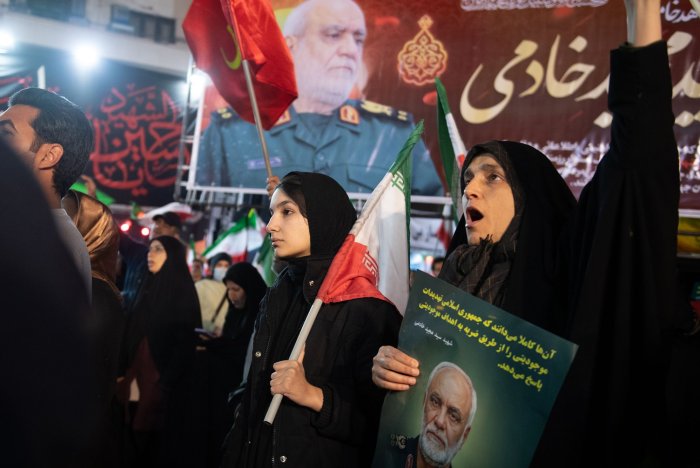
Iranians rally after a ceasefire announcement at Enqhelab Square, in Tehran on April 8, 2026. Photo by Behnam Tofighi/UPI | License Photo
The US has leveraged threats to extract major concessions from Caracas, with Claver-Carone allegedly playing a key role. (Archive)
A mastermind of Trump’s hardline Latin American policies, Mauricio Claver-Carone no longer serves in the administration. But according to well-placed sources, he’s “picking who can operate” in Venezuela, controlling access to the government, and creating conflicts of interest.
Speaking with reporters on May 21, US Secretary of State Marco Rubio announced that Venezuelan President Delcy Rodriguez was on her way to New Delhi to discuss energy issues, and that he would be in India as well.
“This is an important trip, I’m glad we’re able to do it,” Rubio chirped after explaining the trio of nations would discuss how to increase Venezuelan oil sales to India.
His statement — and his announcement of Rodriguez’s trip before she had — perfectly illustrated Washington’s newfound dynamic with the Venezuelan government. Following over twenty years of hostile relations with Venezuela’s socialist-oriented leadership, the US Secretary of State was apparently so intimately involved with day to day affairs in Caracas that he was claiming responsibility for Rodriguez’s international itinerary.
In fact, according to an insider who enjoys close contacts within both the Venezuelan and US governments, Rubio’s influence over Rodriguez is said to be traced to one “gatekeeper”: former Trump Latin America envoy Mauricio Claver-Carone. “Mauricio [Claver-Carone] is picking who can operate and Delcy [Rodriguez] is taking instructions,” the source told The Grayzone.
A former senior US official with access to leadership in both Caracas and Washington offered the same assessment, remarking to The Grayzone, “Mauricio’s calling the shots on private sector economic positions, and if anyone wants in, they have to go to him.”
Hand-selected by former National Security Advisor John Bolton to serve as his Latin America charge during Trump’s first term, Claver-Carone no longer occupies an official governmental role. Instead, he has leveraged his legacy in the public sector to establish a Miami-based investment firm called the Lara Fund which could become a key player in the MAGA financial feeding frenzy in Caracas.
Described by the New York Times as the “architect of Trump’s tough Latin America policies,” Claver-Carone is a Cuban-American regime change zealot who once engaged in fisticuffs with Cuban diplomats as a young man. During Trump’s first term, he unleashed a financial “flamethrower” on Cuba, issuing scores of new sanctions that unraveled the Obama-era normalization policy and plunged the island back into economic misery.
Claver-Carone has similarly masterminded many of the policies that define Trump’s relationship with Venezuela, from its recognition of the previously unknown Juan Guaido as the country’s “interim president” to the deportation of hundreds of Venezuelan migrants from the US to El Salvador’s maximum security CECOT prison. Many of those migrants had been prompted to journey to the US by the economically crushing sanctions unleashed at Claver-Carone’s direction.
The Grayzone’s sources described the Trump veteran as the architect of the military invasion that saw Maduro spirited away to a federal penitentiary and installed Rodriguez as president following a stand-down by Venezuelan security forces.
“If he was in charge of implementing the kinetic side, maybe [Rodriguez] thinks she has to listen to him on finance,” the Venezuela insider said of Claver-Carone.
A report this January by investigative journalist Aram Roston described Claver-Carone as a “key backer” of Rodriguez following Maduro’s abduction, and cited sources who claimed he exercised decisive influence over Venezuela policy despite having left the administration.
Claver-Carone is now said to be at the heart of the most sensitive and consequential task Venezuela faces: the restructuring of its $170 billion in defaulted sovereign debt. Forced from several previous positions by corruption scandals and rancorous clashes, an operative with no official governmental position appears to be shaping the economic contours of Project Venezuela.
“He’s got a lock on everything”
This May, the US Treasury Department authorized Caracas to hire a financial advisor to assist with the herculean task of restructuring its debt. The Venezuelan government selected Centerview Partners, a top-drawer investment and financial advisory firm based in New York City.
According to the former US senior official, Claver-Carone’s romantic partner and business colleague, Jessica Bedoya, boarded a private jet to Caracas soon after the big announcement, arriving with a top advisor from Centerview. It was her second trip to the Venezuelan capital, they said, after visiting in February to discuss financial matters.
Claver-Carone did not respond to calls to his personal phone from The Grayzone, or to detailed questions sent by text and email.
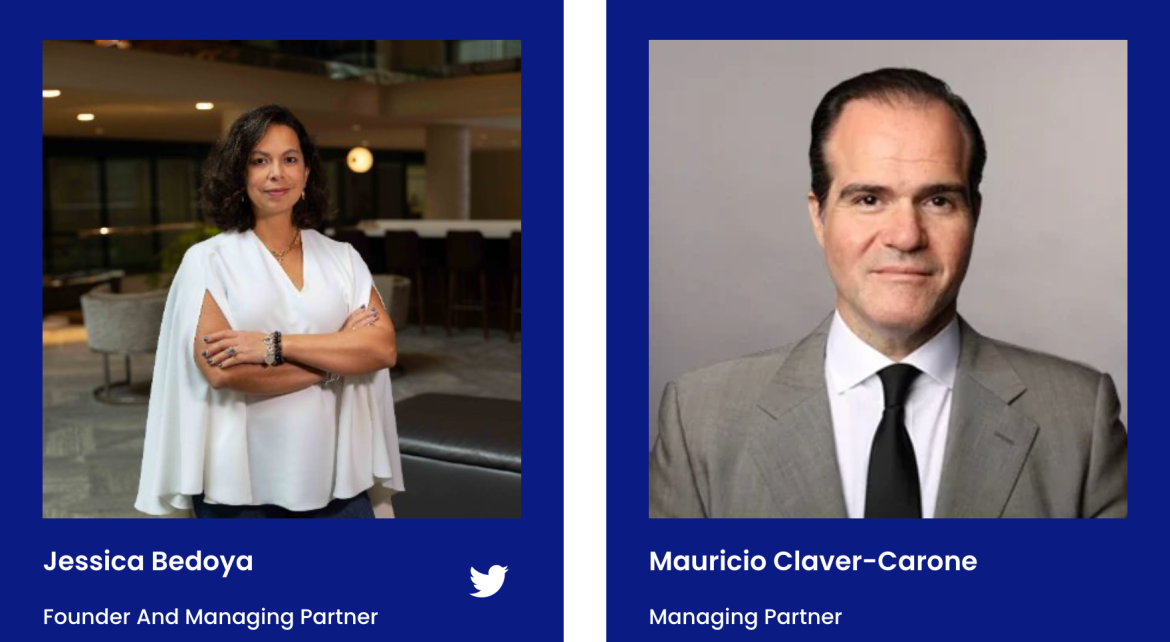
His partner, Bedoya, is the founder of the Lara Fund investment firm where he serves as managing partner. Her bio notes that she has also worked in the CIA and National Security Council.
Jessica Bedoya and Mauricio Claver-Carone’s headshots, as featured on Lara Fund’s webpage
Some insiders worry that her reported presence in the Venezuelan capital, together with Claver-Carone’s outsized influence, could represent a conflict of interest, allowing them to steer debt restructuring agreements to their own personal benefit.
“Now he’s got a lock on everything,” the Venezuela insider said of Claver-Carone. “He could say to anyone who wants to work in Venezuela, I’m the guy. I have the keys. If you want to play ball, invest with me.”
The former US official said Claver-Carone was raising capital for his Lara Fund while he served as a special government employee at the State Department. While Bedoya was running the firm, they said Claver-Carone was leveraging his position inside the Trump administration to pitch potential investors.
“Arbitrary and authoritarian actions that showed him to be a real thug”
When Trump appointed Claver-Carone to serve as the first American president of the Inter-American Development Bank (IDB) in 2020, he hired Bedoya as his chief-of-staff. The couple’s secret romance at the bank triggered an embarrassing ethics investigation after a hand-written contract was discovered showing they had agreed to pursue “absolute happiness,” and included a clause with punishments including “candle wax and a naughty box” if either party breached the deal.
An independent probe ordered by the IDB discovered that Claver-Carone had increased his paramour’s salary by 40% – a $133,000 reward in less than a year. Investigators also found that the couple had racked up expenses on an IDB credit card during romantic getaways.
Claver-Carone refused to participate in the investigation while accusing its authors of “fabrications.” In the end, IDB governors voted unanimously in favor of his firing. The US government endorsed their decision.
“President Claver-Carone’s refusal to fully cooperate with the investigation, and his creation of a climate of fear of retaliation among staff and borrowing countries, has forfeited the confidence of the bank’s staff and shareholders and necessitates a change in leadership,” they wrote.
The Argentine governor of IDB, Guillermo Francos, delivered a similarly harsh assessment of Claver-Carone’s tenure. “Claver was a disaster for several reasons,” Francos remarked in 2022. “For having an inappropriate relationship, for having disproportionately increased the salary of this inappropriate relationship, for having lied, and for these arbitrary and authoritarian actions that showed him to be a real thug.”
When Claver-Carone returned to the second Trump administration, it was not long before his proclivity for conflict jeopardized his position.
Throughout 2025, Claver-Carone’s spiteful attitude reportedly complicated Trump administration attempts to prop up a key right-wing ally in South America, Argentine President Javier Milei. Milei’s chief of staff happened to be Guillermo Francos – the former IDB governor whom Claver-Carone held personally responsible for outing his secret relationship with Bedoya. According to the Argentine paper Clarin, Claver-Carone attempted to retaliate by unsuccessfully pressuring Milei to fire Francos. He then attempted to undermine a major IMF loan package to Argentina by demanding the country first sever its credit line from China. This was met with an apparent rebuke from Treasury Secretary Scott Bessent, who visited Buenos Aires to express confidence in the IMF loan just weeks after Argentina’s central bank extended its credit line from Beijing.
The following month, in May 2025, Claver-Carone announced he was leaving the State Department to return to his Lara Fund. His departure gave the appearance that he had been forced out of his job. However, he maintained his clout through his direct line to Rubio.
The former US official told The Grayzone that Claver-Carone is now angling to become a Cuban American version of Jared Kushner, the Trump son-in-law who has leveraged his proximity to the president and role as Middle East negotiator to rake in billions from Israel and several Gulf monarchies despite having no official government title. To do so, he has allegedly inserted himself into the byzantine process of restructuring Venezuela’s debt.
When the Trump administration announced that Venezuela could hire a financial advisor to assist with its sovereign debt, Rodriguez initially planned a public bidding process for the coveted position. But then, according to the ex-US official, Claver-Carone issued support for Centerview, leading to the firm’s selection. (Opposition bloggers have speculated that Centerview was chosen because one of its partners, Matthieu Pigasse, is a self-described “pro-market socialist” who previously worked on deals with Maduro and Venezuela’s state owned PDVSA oil company.)
In recent weeks, according to sources, Claver-Carone has attempted to undermine financial advisors who had been working with the Venezuelan government to restructure its debt since 2014.
They said that when Claver-Carone’s partner, Bedoya, arrived in Caracas this month, allegedly on a private jet with Pigasse, she began pushing to remove the advisory mandate from David Syed, a seasoned French lawyer who had advised Caracas on debt-related issues for over a decade, and is considered incorruptible.
“The effort to push [Syed] out created a lot of tension,” remarked the Venezuela insider. “You can’t understand debt restructuring by parachuting in without his knowledge.”
Syed did not respond to The Grayzone’s request for comment. Hamouda Chekir, another Centerview partner who works on Venezuela’s debt, did not respond to calls and text messages sent to his personal phone.
Scandal-stained firms as vehicles for extracting profit from Venezuela
Just before leaving the State Department in May 2025, Claver-Carone convinced Rubio not to renew a sanctions waiver that allowed Chevron to sell Venezuelan oil in the US market. In doing so, he eliminated a mechanism which was explicitly designed to promote transparency and prevent local officials from skimming cash.
This January, after abducting Maduro, the Trump administration granted confidential licenses to a pair of notoriously corrupt trading houses, Vitol and Trafigura, to export Venezuelan oil. The deal came months after Trump’s re-election campaign received a whopping $6 million donation from a senior trader at Vitol.
Robert Bachmann, an analyst at the Swiss watchdog Public Eye, told the Washington Post at the time, “Trump is taking advantage of firms that know how to circumvent regulation.”
Both companies had been caught engaging in a series of elaborate bribery schemes across Latin America and Africa. In 2020, the Department of Justice (DOJ) forced Vitol to pay a $135 million penalty for bribing officials for licenses in Mexico, Ecuador and Brazil. Trafigura paid a similarly staggering fine in 2024 for a lucrative bribery scheme in Brazil. In the US, Vitol was rung up by the California Attorney General for manipulating spot market prices of oil.
But almost as soon as the Trump administration entered office, it neutered the DOJ corrupt foreign practices division charged with enforcing the judgments against Trafigura and Vitol on the grounds that it was “impeding America’s national security objectives.”
Now, the profits these scandal-stained firms generate through oil sales abroad – including to Israel – are channeled back into a US-run account with little public oversight. A percentage of sales is then delivered back to the Venezuelan government. Where the rest goes is anybody’s guess.
“The Venezuelans are the owners of the oil, and we know nothing. There is no transparency,” said José Guerra, an economist aligned with the Venezuelan opposition, complained to the Washington Post about the Trafigura and Vitol licensing agreements.
Trump, for his part, has essentially admitted Venezuelan oil profits are channeled into a slush fund for his international rampage. “We’ve taken out so much oil in Venezuela, we’ve paid for the cost of the war [with Iran] about 25 times over,” the president boasted during a May 23 campaign rally. While the president’s claim was absurd, as Venezuela is currently exporting only about one million barrels of oil a month – hardly enough to cover a full day of warfare – it revealed his avaricious attitude toward the entire operation.
Among certain Venezuelan opposition activists, Claver-Carone has become a figure of contempt who is partially blamed for Trump’s declaration that their de facto leader, the coup plotter and Nobel Peace Prize winner Maria Corina Machado, “doesn’t have the support within, or the respect within, the country.”
The Trump administration’s embrace of Delcy Rodriguez, and the Venezuelan president’s faithful compliance with Washington’s financial schemes, have prompted some top Democrats to adopt Machado as a partisan cudgel. This January, Chris Murphy, a ranking Democrat on the Senate Foreign Relations Committee, praised the opposition leader as “impressive” following a meeting on Capitol Hill, while taking a nasty swipe at Rodriguez. Machado “reminded us that Trump replaced Maduro with Maduro’s head of torture,” Murphy proclaimed.
We held a bipartisan meeting with Maria Corina Machado, the opposition leader in Venezuela.
Machado is impressive, and is walking a fine line – standing up for her country while trying to placate Trump. She reminded us that Trump replaced Maduro with Maduro’s head of torture. pic.twitter.com/WsamMv5eG7
If the Democrats take Congress after this year’s midterm elections, the Trump administration’s dealings in Venezuela will face intense scrutiny from the House Oversight Committee. Bipartisan pressure will then build for fresh elections to usher in a new government. “Delcy Rodríguez is a terrible person,” the regime change-obsessed Florida Republican Sen. Rick Scott told the Wall Street Journal this month. “We’ve got to have an election soon.”
In the meantime, a flock of MAGA-aligned financial vultures has swooped into Caracas to feast on the petro-state’s post-Maduro carcass. Donald Trump Jr. is said to be hunting for opportunities in the capital for his 1789 Capital fund, while a startup backed by pro-Trump tech oligarchs Peter Thiel and Palmer Luckey, Erebor Bank, just struck a lucrative deal to reconnect Venezuela’s central bank to the global economy. In the midst of this frenzy, a figure with no government title, Claver-Carone, appears to be establishing the new pecking order.
The views expressed in this article are the author’s own and do not necessarily reflect those of the Venezuelanalysis editorial staff.
May 28 (UPI) — The U.S. military attacked Iran, Tehran confirmed early Thursday, as Iran announced retaliatory strikes of its own.
Iran targeted a U.S. air base at about 4:50 a.m. local time in response to the U.S. military striking presumed Iranian military assets near Bandar Abbas Airport in southern Iran.
“This response is a serious warning so that the enemy knows aggression will not go unanswered, and that in the event of a repeat, our response will be more decisive and the responsibility and consequences will lie with the aggressor,” Iran’s Islamic Revolutionary Guard Corps said in a statement carried by Iranian state media.
The air base targeted and whether it sustained damage were not known. The U.S. military has yet to comment.
The announcement came as the Kuwait Army said its air defenses were confronting “hostile missile and drone attacks.” While the United States maintains a significant military presence in Kuwait, it was not immediately clear whether those attacks were related to the U.S.-Iran exchange.
Explosions were heard near Bandar Abbas, Iranian state news agency Tasnim reported earlier Thursday.
Citing an unidentified military source, the news agency said the U.S. attack followed the Iranian Navy firing shots toward a U.S. oil tanker that had turned off its radar system and intended to pass through the Strait of Hormuz.
The oil tanker reportedly ended its attempt to transit the vital energy maritime trade route.
Iran has been enforcing has been restricting access through the Strait of Hormuz since the start of the war, permitting only certain vessels through. The United States responded with a military blockade of Iran’s ports, cutting it off from sea-based trade.
The two sides have been in talks since a fragile cease-fire was agreed to last month, with Thursday’s U.S. strikes on Iran the second time it has attacked the country so far this week.
On Monday, the U.S. military attacked southern Iran, describing the strikes as “self-defensive” in nature.
The Trump administration has repeatedly stated that it intends to secure free navigation of the Strait of Hormuz, one way or another, though it would prefer to do so through diplomacy.
Iran’s control of Hormuz is reportedly one of its conditions in negotiations on ending the war. In response to reports carried by Iranian state media that Iran and Oman, which border either side of the Strait of Hormuz, are in talks over control of the choke point, President Donald Trump said the transit route will be open to all countries and under no government’s control.
“It’s international waters. Nobody’s going to control it. We’re going to watch over it. We’ll watch over it, but nobody’s going to control it. That’s part of the negotiation that we’re having,” he told reporters during a Cabinet meeting on Wednesday.
“And Oman will behave just like everybody else or we’ll have to blow them up. They understand that. They’ll be fine.”
Muslims perform Eid al-Adha prayers at sunrise in Cairo, Egypt, on May 27, 2026. Photo by Ismael Mohamad/UPI | License Photo
A massive $166 billion in corporate tariff refunds sounds nice, but could take years to process.
The U.S. Supreme Court’s ruling invalidating the Trump administration’s tariffs was a positive outcome for companies, but refunds may take years to materialize.
The Supreme Court decided in February that the U.S. Customs and Border Protection (CBP) agency illegally collected $166 billion from 300,000 importers. Logically, companies should get refunds, but lawyers don’t expect a smooth process. Importers should be prepared to wait for one year, even 18 months, according to TD Securities.
The federal agency set up an online portal called the Automated Commercial Environment to handle refunds. Once the agency accepts a company’s claim, it issues refunds within 60 to 90 days.
That’s the short-term optimistic resolution, but history shows a lot of things could go wrong. In 1998, the Supreme Court announced that the government had to return $750 million in fees collected between 1993 and 1998. It took years to get done.
The CBP is set up to collect money quickly—but it doesn’t easily send it back. Companies must document a proper claim on the new portal. Some small business owners don’t understand the complex customs terminology, while others can’t even log in to the new portal due to technical glitches. Let’s say that the agency and the company don’t agree about the amount of the refund. The importer must submit new documentation and begin a second review process. Companies could even be forced to go to court.
CFOs should be ready for a long, fastidious process. The financial expert should set up a cross-functional task force—including tax, accounting, procurement, and supply chain experts—to review the data and audit all the company’s entries. When the time comes, the task force will be able to answer any CBP question.
The online portal created by the CBP agency focuses on importers, but they are not alone. Consumers could also say that they were overcharged because of the tariffs. The federal government ignores them, but some states don’t. Taking matters into his own hands, Illinois Democrat Governor JB Pritzker, in a letter to the Trump administration posted on soicial media, demanded an $8.7 billion refund—that’s $1,700 for each Illinois household affected.
The Trump administration has sought to pressure international officials who scrutinise reported abuses by Israeli forces.
Published On 28 May 202628 May 2026
The United States government has returned UN human rights expert Francesca Albanese to a list of sanctioned individuals after a judge had granted a temporary injunction against the designation.
On Wednesday, an update appeared on the US Treasury Department’s Office of Foreign Assets Control (OFAC) website, indicating that Albanese had been added to the agency’s list of Specially Designated Nationals (SDN), without offering further details.
Recommended Stories
list of 3 itemsend of list
Albanese serves as the UN’s special rapporteur on the occupied Palestinian territory, and her criticism of Israeli policies has made her a target under US President Donald Trump.
In July 2025, Secretary of State Marco Rubio issued a statement announcing sanctions against Albanese, accusing her of “lawfare” and “biased and malicious activities” against Israel.
He also cited her recommendation that the International Criminal Court (ICC) should issue arrest warrants against Israeli Prime Minister Benjamin Netanyahu and former Minister of Defence Yoav Gallant, which it ultimately did in November 2024.
The announcement was one in a series of actions the Trump administration has taken against critics it sees as hostile to US and Israeli interests.
The sanctions barred Albanese from entering the US and froze her assets in the country. They also prevented any US-based entity from doing business with her.
Albanese, an Italian citizen, has close ties to the US: Her daughter is a US citizen, and the family maintains a residence in the country.
In February, members of Albanese’s family filed a lawsuit on her behalf, stating that the sanctions had disrupted her life, even preventing her from accessing her bank account.
The lawsuit also accused the Trump administration of trying to intimidate those who speak out against Israeli rights abuses.
Albanese has been vocal in her assessment that Israel has committed genocide in Gaza, a view echoed by leading human rights experts around the world. More than 75,000 Palestinians have been killed in the territory since 2023, when Israel launched its genocidal war on the Strip.
Albanese is not alone in facing economic penalties for her work. Since taking office for a second term, Trump is estimated to have issued sanctions against nine ICC judges, as well as prosecutors for the court.
The judges and prosecutors were reportedly involved in probes into abuses by US and Israeli forces.
Legal experts have condemned the sanctions as an assault on international law and an effort to shield the US and its allies from scrutiny.
On May 13, US District Judge Richard Leon, an appointee of former President George W Bush, ruled in favour of the Albanese family’s lawsuit, granting a temporary injunction against the sanctions.
Leon found that the Trump administration had used the penalties to curtail Albanese’s constitutionally protected speech. He also stated that Albanese could not be blamed for the ICC’s actions.
“It is undisputed that her recommendations have no binding effect on the ICC’s actions,” Leon wrote. “They are nothing more than her opinion.”
As a result of the ruling, Albanese was removed from the sanctions list this month.
But the Trump administration appealed Leon’s order. It also said it would restore her to the sanctions list as soon as it was able, though it is unclear what prompted Wednesday’s change.