Donald Trump

What’s Iran’s war strategy and what risks does it pose? | US-Israel war on Iran

US-Israeli attacks have triggered global economic shocks.

Iran has kept up attacks on neighbouring Gulf states and Israel, despite intense US and Israeli bombing, with senior Iranian figures assassinated.

The Strait of Hormuz remains effectively closed – limiting the transit of vital energy supplies.

So what’s Iran’s strategy, and what are its options?

Presenter: Nick Clark

Guests:

Foad Izadi – Professor in the Faculty of World Studies, University of Tehran

Mehran Kamrava – Professor at Georgetown University in Qatar and director of the Iranian Studies Unit, Arab Center for Research and Policy Studies

Elijah Magnier – Military and political analyst who specialises in wars in the Middle East

Source link

Memo: Classified documents at Mar-a-Lago related to Trump’s business

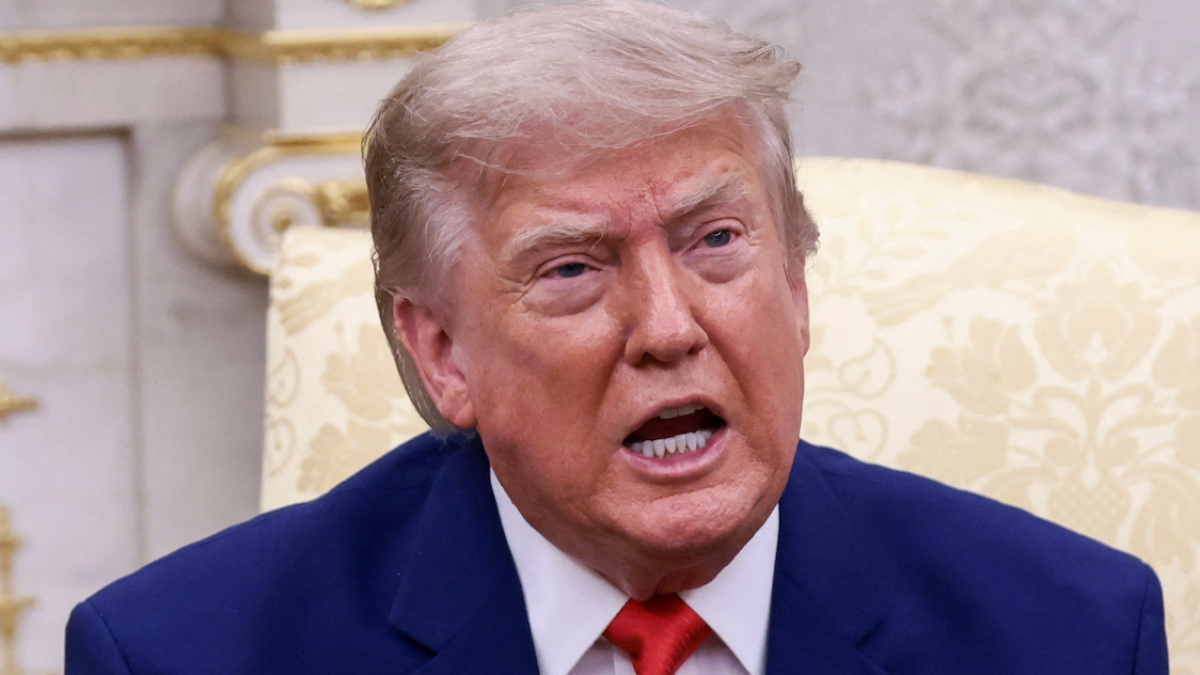
1 of 4 | President Donald Trump speaks in the Oval Office of the White House in Washington, D.C., on Tuesday. A Justice Department disclosure sent to members of Congress shows Trump had classified documents related to his personal business dealings stored at Mar-a-Lago after he left the presidency. File Photo by Graeme Sloan/UPI | License Photo

March 25 (UPI) — A 2023 Justice Department disclosure to Congress revealed that President Donald Trump had documents so secretive that only six people had received copies among classified documents he kept at his Mar-a-Lago estate in Florida after he left office.

The disclosure was part of former special counsel Jack Smith’s report on his investigation into Trump, which has not been made public. Elements of the report, though, were distributed to the House and Senate judiciary committees and subsequently made public this week as part of their own probes.

The disclosure detailed the types of documents Trump took with him to his home in Palm Beach after leaving office in 2020. Smith was appointed by former President Joe Biden to investigate the mishandled classified documents, resulting in 41 criminal counts against Trump. Trump-appointed U.S. District Judge Aileen Cannon dismissed the case in 2024 and recently ruled that Smith’s full report can’t be released publicly.

Rep. Jamie Raskin, D-Md., the ranking member of the House Judiciary Committee, sent a letter to Attorney General Pam Bondi on Tuesday questioning why the Justice Department is “fighting tooth and nail to gag Special Counsel Jack Smith and bury his report.” He said the Justice Department’s disclosure sent to the committee earlier this month included “cherry-picked” documents related to the investigation.

“You have, quite amazingly, missed the fact that some of the documents you provided include damning evidence about your boss’s conduct and may well violate the gag order your DOJ and Donald Trump demanded from Judge Aileen Cannon,” the letter read.

Raskin’s letter said that the Justice Department disclosure included information that Trump held documents at Mar-a-Lago that only six people in the government had access to and that other documents related to his business interests.

The disclosure also indicated that White House chief of staff Susie Wiles — then the CEO of Trump’s super PAC — said she observed Trump showing off a classified map to fellow passengers on his private plane.

“This glimpse into the trove of evidence behind the coverup release a president of the United States who may have sold out our national security to enrich himself,” Raskin wrote.

First lady Melania Trump speaks during the Fostering the Future Together Global Coalition Summit roundtable event in the East Room of the White House on Wednesday. Photo by Bonnie Cash/UPI | License Photo

Source link

Reports: Pentagon to send paratroopers to the Middle East

U.S. Army Paratroopers from the 82nd Airborne Division arrive at Ali Al..Salem Air Base, Kuwait, in January 2020. It was reported Tuesday that the Pentagon was to send a contingent of paratroopers from the division to the Middle East. File Photo by Tech. Sgt. Daniel Martinez/U.S. Air Force/UPI

March 25 (UPI) — The Pentagon has ordered paratroopers to the Middle East, as President Donald Trump pursues a diplomatic solution to the war with Iran while declining to rule out the possibility of launching ground operations, according to reports.

The contingent of paratroops to be deployed are from the Army’s 82nd Airborne Division, out of Fort Bragg, N.C., and will include Maj. Gen. Brandon Tegtmeier, the division commander, The New York Times, CNN and CBS News reported, citing unidentified sources.

The soldiers are specifically members of the 82nd Division’s Immediate Response Force, The Times, CNN and The Washington Post reported. According to the U.S. Army, the Immediate Response Force is its only division capable of beginning an airborne assault operation anywhere in the world within 18 hours of receiving orders.

Rep. Jason Crow, a Democrat from Colorado and a former paratrooper with the 82nd Airborne, lambasted Trump over the announcement Tuesday night.

“These paratroopers, and the American people, deserve better,” he said in a statement. “We must protect our service members and stop spending billions of dollars a day fighting overseas wars of choice, especially as folks back home can’t afford gas, groceries or healthcare.”

The announcement comes as Iran’s claimed closure of the Strait of Hormuz, through which flows about 20% of the world’s oil supplies, has seen energy prices surge and nations scrambling to mitigate the effects on their economies.

It was unclear exactly how many the paratroops would be deployed or where they would be sent, but their deployment could give Trump a rapid-response force in the region, while representing an escalation in the conflict.

Earlier this month, U.S. Central Command said it had struck more than 90 military targets on the Kharg Island, a key location in Iran’s ability to enforce its maritime blockade, including naval mine storage facilities, missile storage bunkers and other military sites.

Trump described the strike as “one of the most powerful bombing raids in the History of the Middle East, and totally obliterated every MILITARY target in Iran’s crown jewel, Kharg Island.”

“For reasons of decency, I have chosen NOT to wipe out the Oil infrastructure on the Island,” he wrote on his Truth Social platform. “However, should Iran, or anyone else, do anything to interfere with the Free and Safe Passage of Ships through the Strait of Hormuz, I will immediately reconsider this decision.”

Trump on Saturday had given Iran a 48-hour ultimatum to open the strait or the U.S. military would “obliterate” its power plants, to which Iran’s parliament speaker, Mohammad Bagher Ghalibaf, responded that if the American president makes good on his threat, critical and energy infrastructure and oil facilities would be “irreversibly destroyed.”

On Monday, Trump announced that he had extended the ultimatum five days after having what he called “very good and productive conversations” on a solution to the war with Iran.

Trump said Tuesday that negotiations with Iran were underway and that the Iranians “want to make a deal.”

The extent of the negotiations was unclear.

Source link

Senate Republicans again block Democrats’ effort to stop Trump’s Iran war

March 25 (UPI) — Republican senators have again backed President Donald Trump‘s war against Iran, blocking a Democratic-led effort to curb his ability to wage war without congressional approval.

The Senate voted 53-47, mostly along party lines, on Tuesday evening to block Democrats’ war powers resolution, the third time Senate Republicans have blocked a resolution to require the removal of U.S. forces from hostilities against Iran unless Congress authorizes them.

Sen. Rand Paul of Kentucky was the only Republican to vote in favor of the motion with his Democratic colleagues, while Sen. John Fetterman of Pennsylvania was the only Democrat to vote against it with the GOP lawmakers.

Since the war began on Feb. 28, when the United States and Israel attacked Iran, Democratic lawmakers have argued the war is unconstitutional because only Congress has the power to declare war, while Republicans contend Trump is within his authority as commander in chief to defend the country.

Sen. Chris Murphy of Connecticut said he forced the vote Tuesday to have debate on Trump’s war in Iran.

“This is increasingly important because this war is spiraling out of control,” he said in a video posted to social media ahead of heading into the Senate.

“The cost of plastic just doubled, prices at the pump are sky high, the Strait of Hormuz is still shut down, new wars are breaking out in the region, we’ve had a dozen Americans killed, $2 billion being spent a day and for what!”

From the floor, Senate Minority Leader Chuck Schumer, D-N.Y., called on Republicans to vote in favor of the resolution, saying it was time for the war to come to an end.

“The war is expanding, and the Senate has an obligation to step in,” he said.

“I say to my Republican colleagues: if there was ever a time to stand up for the authority of the Senate, stand up for the powers given to us through the Constitution, the time is now.”

Sen. Jim Risch of Idaho, who has repeatedly argued against the war powers resolution, took to the floor again on Tuesday to say the Democrats were going to receive the same negative result as they had the two previous times.

Iran started the war, he said, pointing to the Iran hostage crisis of 1979 and stating that the Islamic regime has since killed thousands of Americans.

“The president of the United States said, ‘We have had enough.’ He had very good reasons to pull the trigger at the time that he did and… The fact of the matter is, we are in conflict,” he said, stating the Senate needs to back the Americans fighting in the war and their president.

“We all know this isn’t going to go on very long, but it needs to be done.”

The vote was held less than a week after Democrats used the war powers resolution to force a vote on Wednesday on a similar motion, which Republicans blocked in the same 53-47 outcome. Both Paul and Fetterman voted against their parties.

Source link

What we know about the US’s 15-point plan Iran proposal | US-Israel war on Iran

NewsFeed

US media is reporting the Trump administration has proposed a temporary ceasefire and a 15-point plan to end the war on Iran. The reports emerge as Trump claims the US is already talking to Iranian officials – a claim Iran has vehemently denied.

Source link

Pakistan proposes hosting U.S.-Iran negotiations in Islamabad

March 24 (UPI) — Pakistani officials said Tuesday they’re prepared to host negotiations between the United States and Iran, with in-person meetings possibly set to take place in Islamabad.

Pakistani Foreign Ministry spokesman Tahir Andrabi told Al Jazeera that Pakistan would be willing to play a part in the talks “if the parties desire.”

The government “has consistently advocated for dialogue and diplomacy to promote peace and stability in the region,” Andrabi said.

Pakistani Prime Minister Shehbaz Sharif confirmed the offer, saying he’s ready to “facilitate meaningful and conclusive talks.”

Unnamed Pakistani sources told The Guardian that Vice President JD Vance would potentially serve as chief U.S. negotiator if such talks went forward. Iranian officials have said they will not speak with President Donald Trump‘s pre-war negotiators, Middle East envoy Steve Witkoff and adviser Jared Kushner.

Witkoff and Kushner met with Iranian officials in the month leading up to the war in an attempt to reach a deal to limit Iran’s nuclear program. The talks were unfruitful and Trump ordered the launch of attacks on Iran on Feb. 28 alongside Israel.

In nearly a month, the war has killed more than 2,000 people and displaced millions of others, NBC News reported.

Trump said Monday that he hopes there will be an agreement with Iran amid renewed talks, which Iranian state-run media have denied has taken place. The U.S. president said he’s holding off on strikes on Iran’s energy infrastructure for five days after “very good and productive conversations.”

President Donald Trump presents the Commander in Chief’s Trophy to the Navy Midshipmen football team during a ceremony in the East Room of the White House on Friday. The award is presented annually to the winner of the football competition between the Navy, Air Force and Army. Navy has won the trophy back to back years and 13 times over the last 23 years. Photo by Bonnie Cash/UPI | License Photo

Source link

Transparency in war spending lacks as Pentagon asks for $200 billion

March 24 (UPI) — Secretary of Defense Pete Hegseth plans to request $200 billion in funding from Congress as the cost of the United States’ war with Iran grows.

The request comes on top of an already record-setting Pentagon budget passed by Congress last year. Transparency over how funds are being spent continues to dwindle, experts told UPI.

As of March 15, 16 days into the war, it had cost the United States about $12 billion, Kevin Hassett, director of the National Economic Council, said in an interview on Face the Nation.

Linda Bilmes, a Harvard Kennedy School professor and former assistant secretary and chief financial officer of the U.S. Department of Commerce under the Clinton administration, told UPI the reported cost is “just the very tip of the huge iceberg.”

“The $11 billion or whatever it is that they’re quoting is just the immediate operational spend in terms of munitions and fuel and such in the first couple weeks,” Bilmes said. “That doesn’t cover any kind of medium-term expenditures around reset, repair, resupply, replenishment of weapons and systems and munitions and so forth, which is a much bigger number.”

“We’ve probably spent at least $40 billion if you bring into account already everything that has been spent and the fact that it needs to be restocked in the inventory,” Bilmes said.

There are also longer-term costs yet to come, such as the lifetime disability benefits that some 50,000 U.S. troops stationed in the Middle East will be eligible to receive.

“The vast majority of them have been exposed to toxins, contamination from oil fumes, formaldehyde, benzine, all of these things that are in the air,” Bilmes said.

In a 2011 study, Bilmes estimated that the U.S. Department of Veterans Affairs would pay up to $1 trillion in benefits to veterans of the wars in Iraq and Afghanistan in the subsequent 30 to 40 years. In 2021, that estimate increased to $2.5 trillion as the war in Afghanistan continued until August of that year.

During a press briefing last week, Hegseth said the $200 billion request to Congress would be to “ensure that our ammunition is refilled and not just refilled but above and beyond.”

“That’s like the [gross domestic product] of Hungary, the GDP of New Zealand. Medium-sized countries have GDPs the size of just this increase,” Bilmes said. “That’s $1,500 for every household in America.”

The cost of war continues to increase for U.S. taxpayers. The U.S. military is using some advanced weapons technologies, such as AI-powered systems in combat for the first time in the Iran war. Defense contractors are preparing to increase their production of weapons for the United States four times over, President Donald Trump said following a meeting with several earlier this month.

“They have agreed to quadruple production of the ‘Exquisite Class’ weaponry in that we want to reach, as rapidly as possible, the highest levels of quantity,” Trump posted on social media on March 6. “Expansion began three months prior to the meeting and plants and production of many of these weapons are already underway.”

Trump did not clarify which companies were a part of the meeting, nor did he define what “exquisite class weaponry” is.

Bill Hartung, senior research fellow at the Quincy Institute for Responsible Statecraft, told UPI it is becoming increasingly challenging to analyze defense spending as the Pentagon has become less transparent.

Hartung’s research focuses on the arms industry and the U.S. military budget. He is the former director of the Arms and Security Program and the Center for International Policy and co-director of its Sustainable Defense Task Force.

When the United States began sending defense aid to Ukraine in 2022, the government would periodically report what weapons it was sending and the types of training missions it was involved in. That is yet to take place for the war in Iran.

“In this war, really other than a leak, they really haven’t put out much in the way of justification or what exactly is being spent,” Hartung said. “They haven’t put out even a detailed budget this year the way they normally would. Normally an administration that’s been in power a while puts it out in early February. Now, we’re kind of flying blind as to what it’s exactly all going to.”

Transparency has waned from the Pentagon over the course of years. Funding put toward defense in last year’s budget reconciliation was marked in broad categories, rather than a more detailed, itemized budget.

Hartung said it was not the “normal budget process” and that hearings over the Pentagon’s budget lacked the same level of substance and oversight of years passed.

In July, the Office of the Under Secretary of Defense published its budget request for program acquisitions for the 2026 fiscal year. It requested $179.1 billion dedicated to research, development, test and evaluation of major weapon systems, $205.2 billion for procurement and $961.7 billion for total Department of Defense research and procurement. This accounts for about 40% of the department’s total funding.

The reconciliation bill passed by Congress added $150 billion in new defense spending, increasing the department’s total budget to more than $1 trillion.

Among the biggest expenditures approved by Congress were more than $25 billion for munitions and supply chain resiliency, $24 billion for integrated air and missile defense, $29 billion for shipbuilding, and $14 billion for enhancing resources for nuclear forces.

About $10 million was approved for department oversight.

The longer the war continues, the greater the cost will be to the United States. Then comes the matter of reconstruction.

The United States has historically been involved in reconstruction efforts following wars it was engaged in, including World War II and the Iraq and Afghanistan wars.

The U.S. government spent about $141 billion on reconstruction in Afghanistan between 2002 and 2021, the U.S. Government Accountability Office reported.

The war with Iran has spread beyond its borders already. As of Monday, Fatih Birol, head of the International Energy Agency, said that at least 40 energy sites have been damaged in the war, including sites belonging to U.S. allies.

Whether and to what extent the United States would be involved in reconstruction efforts in Iran and among affected allies is another variable that will not be known until the fighting stops.

Beyond the budget implications is the human cost of war. Hartung said, depending on the decision to put U.S. troops on the ground in Iran, the toll paid by service members could be larger yet. At least 13 U.S. troops have already been killed in action.

The Iran Health Ministry reported earlier this month that more than 1,200 civilians have been killed. Among them are at least 165 people killed in a strike on an elementary school for girls in Minab, Iraq. Many of the victims in the school bombing were children.

A preliminary investigation by the U.S. military has found that the United States is likely responsible for the deadly strike on the school by a Tomahawk missile on Feb. 28. The United States is the only country involved in the war that uses Tomahawk missiles.

The cost of the operation that killed the victims at the elementary school likely exceeds $1 million. A Tomahawk missile costs about $2 million.

“It could have been a million or two to hit that one target,” Hartung said. “They do have a small drone-like system they’ve been using that’s like $35,000 each but I don’t know exactly what they used. A cruise missile’s $2 million but then some of the other bombs could be a few hundred thousand but it’s remarkable how much even one strike can cost. Some of the planes are thousands or tens of thousands an hour.”

Unlike the Vietnam and Korean War and those that preceded them, the United States does not pay for its modern war efforts by raising taxes. Instead, it incurs an ever-growing debt that now accounts for about 17% of the government’s budget in fiscal year 2026.

Bilmes is writing about the changing approach to funding war in her upcoming book The Ghost Budget: Paying for America’s Wars. It is due to be released in the fall.

“We’ve borrowed every penny that has been spent right now. We’re just adding to the debt,” Bilmes said.

As the United States takes on more debt to fund a growing defense budget, it has also cut taxes, reducing revenues.

“Arguably, our approach to this, in engaging in another war of choice, is positioning us closer to another major economic crisis,” Bilmes said.

President Donald Trump presents the Commander in Chief’s Trophy to the Navy Midshipmen football team during a ceremony in the East Room of the White House on Friday. The award is presented annually to the winner of the football competition between the Navy, Air Force and Army. Navy has won the trophy back to back years and 13 times over the last 23 years. Photo by Bonnie Cash/UPI | License Photo

Source link

Pentagon unveils new reporter restrictions following court loss

March 24 (UPI) — The Department of Defense has announced new restrictions on reporters, including removing their office space from the Pentagon, after a judge last week struck down a Trump administration policy that threatened journalists’ credentials for obtaining unauthorized information.

Under the new policy announced Monday, reporters will be required to work from new office space outside the Pentagon but in an annex facility on its grounds. It also requires credentialed journalists to be escorted by Department of Defense personnel at all times within the Pentagon.

The announcement comes after the Defense Department announced a new policy in October that required all journalists with access to the Pentagon to sign a form acknowledging they could have their credentials revoked for collecting unauthorized information. Most Pentagon reporters declined and surrendered their credentials.

The New York Times then sued the administration of President Donald Trump. On Saturday, a federal court judge ruled in the paper’s favor, stating the policy was unconstitutional and ordered the Pentagon to reinstate the credentials of seven journalists with The Times.

The Pentagon intends to appeal the decisions, and in the interim announced the new policy shuttering the Correspondents’ Corridor and mandating journalist escorts, which Sean Parnell, assistant to the Defense secretary, said in a statement was in compliance with the court’s order.

“The Department always complies with court orders but disagrees with the decision and is pursuing an appeal,” he said.

A spokesperson with The Times quickly repsonded to the new policy, saying “We will be going back to court.”

“The new policy does not comply with the judge’s order,” Charlie Stadtlander, the Times spokesperson, said in a statement.

“It continues to impose unconstitutional restrictions on the press.”

The Trump administration has repeatedly taken actions that critics say are aimed at influencing its media coverage, including the October memorandum, restricting access to outlets over editorial decisions and seizing control of the White House press pool.

Journalists and free speech organizations were quick to crticize the policy, with the National Press Club calling the closure of the Correspondents’ Corridor an effort to undermine independent reporting of the Pentagon while it is fighting a war with Iran.

“At a time when the United States is engaged in active military conflict, the public depends on journalists being able to observe, report and ask questions freely,” NPC President Mark Schoeff said in a statement.

“Independent reporting on the U.S. military is not optional. It is essential to accountability, transparency and public trust. Any policy that curtails that access should concern everyone who values a free and informed society.”

The Pentagon Press Association said it was consulting with its legal counsel, according to a statement obtained by Axios.

“Press freedom is guaranteed by the U.S. Constitution and an informed public is vital to democracy,” the organization said.

“At such a critical time, we ask why the Pentagon is choosing to restrict vital press freedoms that help inform all Americans.”

Source link

California sheriff seizes ballots from 2025 special election

March 23 (UPI) — A sheriff in Riverside, Calif., has seized more than 650,000 ballots from a 2025 state election that allowed the state to redistrict to gain five congressional seats.

Sheriff Chad Bianco, who is running for California governor, said Friday that he is investigating allegations by an activist group that alleged the reported tallies don’t match the ballots.

“This investigation is simple,” he said at a press conference. “Physically count the ballots and compare that result with the total votes reported.”

The election Bianco is investigating is the special election for Proposition 50, asking voters for endorsement to redraw the congressional districts in response to other Republican-led states, like Texas, redrawing their districts to pick up seats.

Californians voted to redistrict, and it was not a close election: 7.4 million in favor to 4.1 million.

A group called Riverside Election Integrity Team called for the investigation saying its examination of records shows about 45,000 more ballots were counted than received, Bianco said.

Local election officials said those allegations were based on a misunderstanding of how ballots are officially counted, the Palm Springs Desert Sun reported.

“County election staff follow detailed procedures established by state and federal law to protect the integrity of the vote and to ensure that every eligible ballot is processed and counted in accordance with those legal requirements,” Riverside County Executive Officer Jeff Van Wagenen said in a statement.

Bianco seized the ballots with two warrants signed by a judge. California Attorney General Rob Bonta sent Bianco a letter March 6 alleging, “my office has serious concerns as to whether probable cause existed to support the issuance of the warrants and whether your office presented the magistrate with all material evidence as required by law.”

Bonta also alleged that Bianco’s office is not qualified to count ballots and the investigation “sets a dangerous precedent and will only sow distrust in our elections.”

Bianco replied: “A judge approved the warrant, so Bonta’s opinion means absolutely nothing.”

Bianco also said Friday that he would give the investigation to a judge-appointed special master.

Democrats and Republicans in the state have said the investigation is baseless.

“It looks to me like it’s a politically motivated effort,” Jon Fleischman, former executive director of the California Republican Party, told The New York Times. “It’s awfully coincidental that he would be taking this high-profile and extreme of an action literally two months before he’s facing a statewide election.”

California Secretary of State Shirley Weber, a Democrat, said Bianco’s claims are not supported by the evidence.

“The Riverside County Sheriff’s Office has taken actions based on allegations that lack credible evidence and risk undermining public confidence in our elections,” Weber said in a statement on Friday.

“Investigations into election processes must be conducted by those with the appropriate legal authority and subject matter expertise. Similar claims raised in other states by individuals without election administration experience have been thoroughly reviewed and debunked.”

Antonio Villaraigosa, a Democrat running for governor, said Bianco is trying to gain national exposure.

“What we’re seeing from Chad Bianco is a dangerous abuse of power and no different from what we’re seeing from Donald Trump and the extreme Republican efforts to disenfranchise voters nationally,” Villaraigosa said in a statement.

“Seizing hundreds of thousands of ballots without credible evidence is an attack on the very foundation of our democracy. If you’re willing to undermine free and fair elections for MAGA stardom, you have no business holding public office.”

Source link

Trump refuses end to DHS shutdown until SAVE Act passes

March 23 (UPI) — President Donald Trump on Sunday said there will be no end to the partial government shutdown until Congress passes the Safeguard American Voter Eligibility Act.

“I don’t think we should make any deal with the Crazy, Country Destroying, Radical Left Democrats unless, and until, they Vote with Republicans to pass ‘THE SAVE AMERICA ACT,'” Trump posted on Truth Social.

“It is far more important than anything else we are doing in the Senate, and that includes giving these same terrible people, the Dems (who are to blame for this mess!), a Five Billion Dollar cut in ICE [Immigration and Customs Enforcement] funding, a deal which, even when disguised as something else, is unacceptable to me and the American people – UNLESS it includes their approval of Voter I.D., (with picture!), Citizenship to Vote, No Mail-In Voting (with exceptions), All Paper Ballots, No Men In Women’s Sports, and No Transgender MUTILIZATION of our precious children,” he added.

Trump also wrote that Thune should “clearly identify” the Republicans who are not supporting the bill and said they were, “Voting against AMERICA.”

“They will never be elected again! In other words, lump everything together as one, and VOTE!!! Kill the Filibuster, and stay in D.C. for Easter, if necessary,” he said.

Lawmakers have not supported abandoning the supermajority needed to end debate.

The DHS, which includes the Transportation Security Administration, shut down on Feb. 14 because Congress couldn’t agree on a funding bill for the department. Democrats don’t want to fund it until guardrails are put on the agency, and Republicans haven’t agreed to Democrats’ demands.

Because of this, TSA workers have been working without pay for more than a month. Some are quitting or taking days off work, creating long lines at airports.

Congress is scheduled to leave Washington in a few days for a recess. If there’s no deal, the partial shutdown could last two months. It would be the longest shutdown of a federal agency.

The Senate is considering staying in session to resolve the shutdown, but House Republicans say they won’t change plans, Politico reported that three anonymous sources said.

The House will likely vote again Thursday.

Trump told NewsNation Sunday that Democrats were going to fold after he said he would send Immigration and Customs Enforcement agents to help TSA agents.

But Sen. Lisa Murkowsky, R-Alaska, doesn’t agree that plan is appropriate.

“This is not the answer for what we need to do. We need to figure out how we get DHS funded. My preference, of course, is to get all of DHS funded, get it done and behind us. But I think we all need to be looking to see if there are any [other] avenues that can gain support. We got to figure it out before [the end of] next week,” The Hill reported she said.

Source link

Trump postpones strikes on Iranian infrastructure, hopes for deal

March 23 (UPI) — President Donald Trump said Monday that the United States will postpone its military strikes on Iranian energy infrastructure amid talk of a resolution but Iranian state media denies such talks have taken place.

The president told CNBC’s Joe Kernen that the United States is “very intent on making a deal with Iran.” Earlier Monday he posted on social media that he will hold off on strikes on Iran’s energy infrastructure for five days because the United States and Iran have had “very good and productive conversations” about a resolution to end hostilities in the Middle East.

Trump said the positive talks with Iran took place “over the last two days” following his threat to target Iran’s energy infrastructure on Friday.

“Based on the tenor and tone of these in depth, detailed and constructive conversations, which will continue throughout the week, I have instructed the Department of War to postpone any and all military strikes against Iranian power plants and energy infrastructure for a five day period, subject to the success of the ongoing meetings and discussions,” Trump posted.

Iranian state media disputed Trump’s claim of conversations about a drawdown of fighting, citing an unnamed “senior security official.”

“There has been no negotiation and there is no negotiation and with this kind of psychological warfare, neither the Strait of Hormuz will return to its pre-war conditions nor will there be peace in the energy markets,” Iranian state media posted on Telegram, citing an unnamed source.

The unnamed source told the media outlet that Trump has backed down on his threat to target energy infrastructure. Trump had warned that he would target power plants and infrastructure if Iran did not fully open the Strait of Hormuz within 48 hours.

Transportation of oil on the Strait of Hormuz has largely halted since the United States and Israel launched strikes on Iran on Feb. 28. Iranian officials urged that they will continue to threaten vessels on the strait as long as hostilities continue, leveraging the economic impact of doing so.

The global oil market continues to respond to activity on the Strait of Hormuz and the ongoing war, with the price per barrel exceeding $100 at different points in the past week.

President Donald Trump presents the Commander in Chief’s Trophy to the Navy Midshipmen football team during a ceremony in the East Room of the White House on Friday. The award is presented annually to the winner of the football competition between the Navy, Air Force and Army. Navy has won the trophy back to back years and 13 times over the last 23 years. Photo by Bonnie Cash/UPI | License Photo

Source link

Senate Republicans advance Markwayne Mullin’s nomination to lead DHS

March 23 (UPI) — Senate Republicans have advanced the nomination of Sen. Markwayne Mullin for secretary of the Department of Homeland Security, paving the way for his confirmation as early as Monday evening.

The Senate voted 54-37 Sunday afternoon to invoke cloture, clearing a procedural hurdle permitting a final vote on his confirmation.

The vote was mostly along party lines, with Democratic Sens. John Fetterman of Pennsylvania and Martin Heinrich of New Mexico joining their Republican colleagues in approving the motion.

Nine lawmakers, including eight Democrats, did not vote, including GOP Sen. Rand Paul of Kentucky, chair of the Homeland Security and Governmental Affairs Committee, who has been vocally opposed to Mullin’s confirmation.

Paul was the only Republican to vote against the Oklahoma senator when his committee voted last week to advance his nomination to the full Senate.

The Senate is expected to vote on his confirmation Monday night.

President Donald Trump nominated Mullin after firing Kristi Noem following months of controversy over her leadership of the department, especially after the fatal shootings of two U.S. citizens by federal immigration officers in Minneapolis and a $220 million advertising contract.

Fetterman was among those who called for Noem’s firing, and said he was supportive of Mullin to lead the DHS.

He has said he approached Mullin’s confirmation “with an open mind.”

“My AYE is rooted in a strong committed, constructive working relationship with Senator Mullin for our nation’s security,” he said.

Following Sunday’s vote, Heinrich issued a statement, similarly addressing the Oklahoma senator as “a friend” with whom he shares “a very honest and constructive working relationship.”

“We often disagree and when we do, we work to find whatever common ground we share,” he said.

“I have also seen first-hand that Markwayne is not someone who can simply be bullied into changing his views, and I look forward to having a secretary who doesn’t take their orders from Stephen Miller.”

Miller is Trump’s far-right Homeland Security adviser.

Mullin is likely to be confirmed by the GOP-controlled Senate, despite opposition from Paul, who voted against him during last week’s committee hearing and did not vote on Sunday.

Paul confronted Mullin during the committee hearing over reportedly calling him “a freaking snake.” He also accused Mullin of lying when he told a reporter he had told Paul that he “completely” understood why a man had attacked him in late 2017, breaking five of his ribs.

“You got a chance today. You can either continue to lie or you can correct the record,” Paul said in his opening statement.

“You have never had the courage to look me in the eye and tell me that the assault was justified, so today, you’ll have your chance.”

When it was Mullin’s turn to give his opening statement he began by addressing Paul’s comments, stating that he had made the remarks while Paul was in the same room and that it was due to his behavior of seemingly going against hardline Republican policies.

“As far as my terms of a snake in the grass, I worked to try to fix problems. I’ve worked with many people in this room. It seems like you fight Republicans more than you work with us.”

President Donald Trump presents the Commander in Chief’s Trophy to the Navy Midshipmen football team during a ceremony in the East Room of the White House on Friday. The award is presented annually to the winner of the football competition between the Navy, Air Force and Army. Navy has won the trophy back to back years and 13 times over the last 23 years. Photo by Bonnie Cash/UPI | License Photo

Source link

Markets tumble as oil prices climb over $100 on Middle East conflict fears

Asian stock markets saw major declines on Monday as gold futures dropped 8% and crude oil prices continued to climb amid heightened uncertainty in the Middle East.


ADVERTISEMENT


ADVERTISEMENT

As the effective closure of the Strait of Hormuz continues to choke global supply, benchmark US crude rose above $100 a barrel on Monday morning in Europe.

Brent crude, the international standard, went up to more than $113 a barrel. The price of Brent crude has zigzagged lately from about $70 per barrel before the war began to as high as $119.50.

European stock indexes opened with losses, with the FTSE in London losing 1.5%, the CAC-40 in Paris being down by 1.6%, and the DAX in Frankfurt dropping by 2% at the opening.

Earlier on Monday, the International Energy Agency warned that the global economy faces a “major, major threat” because of the Iran war and that at least 40 energy assets across nine countries were damaged.

Meanwhile, the de-escalation of the conflict is nowhere near in sight.

Trump warned over the weekend that the US would “obliterate” Iran’s power plants if it does not fully open the Strait of Hormuz within 48 hours, prompting Tehran to say it would respond to any such strike with attacks on US and Israeli energy and infrastructure assets in the region.

“Trump’s ultimatum and Iran’s retaliatory warnings point to a widening conflict that keeps energy disruption and market volatility elevated, with no clear off-ramp in sight,” said Ng Jing Wen, analyst at Mizuho Bank in Singapore.

In Europe, the benchmark natural gas futures were trading above €60 per MWh at the market open.

This follows last week’s gains as escalating threats to Middle Eastern energy facilities heightened fears of deeper supply disruptions.

In Asia, stock markets were also significantly impacted by the uncertainty around the Middle East crisis, with Japan’s benchmark Nikkei 225 dropping 3.5%. In Taiwan, the Taiex shed 2.5%, South Korea’s Kospi dropped 6.5%, Hong Kong’s Hang Seng slipped 3.8% and the Shanghai Composite declined 3.6%.

Higher oil prices, which also shook stock markets on Friday, dashed hopes for a possible upcoming cut in interest rates by the Federal Reserve, analysts said. Before the war, traders were betting that the Fed would cut rates at least twice this year. Central banks in Europe, Japan and the United Kingdom also recently held their interest rates steady.

The S&P 500 fell 1.5% Friday to close its fourth straight losing week, its longest such streak in a year.

The Dow Jones Industrial Average dropped 443 points, or 1%, and the Nasdaq Composite tumbled 2%.

On Wall Street, roughly three out of every four stocks in the S&P 500 fell on Friday.

Stocks of smaller companies, which can feel the pinch of higher interest rates more than their bigger rivals, led the way lower. The Russell 2000 index of smaller stocks fell a market-leading 2.3%.

In the bond market, the yield on the 10-year Treasury finished last week with a jump to 4.38% Friday from 4.25% late Thursday and from just 3.97% before the war started.

The two-year Treasury yield, which more closely tracks expectations for what the Fed might do, rose to 3.88% from 3.79%.

In currency trading, the US dollar rose to 159.53 Japanese yen from 159.22 yen. The euro cost $1.1526, down from $1.1571.

Source link

White House border czar Tom Homan confirms ICE deployment to airports Monday

March 23 (UPI) — President Donald Trump‘s border czar Tom Homan has confirmed that Immigration and Customs Enforcement agents will be deployed to U.S. airports starting Monday, despite strong opposition from unions and Democrats.

Homan told CNN’s State of the Union on Sunday that he was working on the plan’s execution with acting ICE Director Todd Lyons and Transportation Security Administration Administrator Ha Nguyen McNeill.

“So, we’ll put together a plan today and we’ll execute it tomorrow,” he said.

On Sunday, Trump threatened to send ICE agents to U.S. airports over a protracted fight with Democrats over Department of Homeland Security funding.

Funding for DHS lapsed Jan. 31 after Congress failed to pass legislation to keep the department open, with Democrats are demanding reforms in response to federal immigration agents deploying aggressive tactics during the Trump administration’s immigration crackdown.

The partial shutdown is affecting the TSA, which is under the DHS. Airports are reporting long lines and congestion due to a shortage in TSA staff, who haven’t been paid since DHS funding ran out.

Trump threatened on his Truth Social platform that ICE will perform security at airports where they will arrest undocumented migrants, raising questions about whether the agents are being sent only to relieve pressure on TSA or to carry out immigration enforcement at major travel hubs.

Homan on Sunday sought to frame the move as a way to alleviate congestion and move long lines of travelers though security.

Asked if ICE had the specialized training to inspect bags and passengers, Homan said he doesn’t expect the immigration agents to be ‘looking at an X-ray machine, because we’re not trained in that.”

“But there are certain parts of security that TSA is doing that we can move them from those jobs, and put them in the specialized jobs to help those lines,” he said, adding that discussions with the TSA concerning what security roles ICE agents would perform were ongoing.

“We will have a plan by the end of today … what airports we’re staring with and where we’re sending them,” he said, suggesting that the worst affected airport will be given priority.

“So it’s a work in progress, but we will be at airports tomorrow helping TSA move those lines along.”

He also confirmed that ICE agents will perform immigration enforcement at the airport, underscoring that their deployment is mainly to aid TSA.

Republicans have attempted to characterize the shutdown as Democrats prioritizing undocumented immigrants over airport security, while the Democrats have blamed Republicans for blocking more than half a dozen attempts to pass legislation to fund the TSA, including on Saturday. The GOP lawmakers say they want to fund the entirety of the DHS.

“Instead of sending ICE agents to harass travelers at airports, why don’t Republicans get their act together and agree to pay TSA workers like we’ve asked them to SEVEN TIMES now?” Senate Minority Leader Chuck Schumer, D-N.Y., said in a statement on X on Sunday.

Vice President JD Vance accused Schumer of continuing “to hold TSA funding hostage.”

“Thankfully, ICE will bring sanity to our airports starting tomorrow, but it’s far past time for Democrats to fund DHS,” he said.

Following Homan’s interview, Rep. Dan Goldman, D-N.Y., accused the Trump administration of using ICE “to strike fear and terror on our airports.”

“Mr. President, it’s pretty simple: if you want TSA agents to get paid (as they should), then pass the Democrats’ bill to fund TSA,” he said on X. “No need for your out-of-control paramilitary to do yet another thing they aren’t trained to do.”

Hartsfield-Jackson Atlanta International Airport has been informed it is among those where ICE agents will be deployed Monday, Atlanta Mayor Andre Dickens said in a statement.

The agents will report to the TSA and will be assigned to line management and crowd control within domestic terminals, he said, adding that federal officials have indicated that they are not intended to conduct immigration enforcement activities.

“Our administration remains hopeful the Federal Government can soon find a way to fully fund TSA and pay their employees to resume standard operations at Hartsfield-Jackson Atlanta International Airport — and all airpots we connect to,” he said.

The deployment of ICE agents is also being lambasted by the American Federation of Government Employees, the largest government worker union in the United States.

It accused the Trump administration of sending ICE agents to do the jobs of the more than 50,000 TSA employees who have worked without pay for more than five weeks.

It also expressed worry that the ICE agents will be undertrained for what they may be required to do, arguing that stationing them at security checkpoints will create security risks.

“Our members at TSA have been showing up every day, without a paycheck, because they believe in the mission of keeping the flying public safe,” AFGE National President Everett Kelley said in a statement.

“They deserve to be paid, not replaced by untrained, armed agents who have shown how dangerous they can be.”

The leaders of several flight attendant unions also criticized the Trump administration on Sunday for using the TSA and frontline security officers “as pawns in this dangerous game,” stating that the DHS can use its billions of dollars in discretionary funding to pay them.

“This latest threat of ICE invasion at the airports is another distraction from solutions that protect Americans,” the Association of Flight Attendants-CWA, the Association of Professional Flight Attendants, International Brotherhood of Teamsters Local 135 and the International Association of Machinists and Aerospace Workers said in a joint statement.

Source link

The Trump Corollary: Imperialist Offensive and the Assault on Venezuela

Trump gathered loyal Latin American allies for a “Shield of the Americas” summit. (Archive)

The “Trump Corollary” to the Monroe Doctrine is a central feature of U.S. strategy designed to secure hegemony and limit Chinese and Russian influence in Latin America and the Caribbean. It does not, however, represent a decisive shift in Washington’s relations with the region. Although the corollary does not make this explicit in its formal statement, in practice it makes more evident what liberal rhetoric has long sought to mask: military and covert interventions aimed at preserving U.S. domination in the Western Hemisphere, undermining progressive movements and governments, and backing right-wing regimes. In this sense, it abandons even the pretense of respect for international law and human rights. In what follows we argue that the Trump Corollary constitutes not only an ideological and imperialist offensive against decolonial and multipolar currents in Latin America, but also a strategic project whose assault on Venezuela has broader geopolitical implications.

The ideological backdrop

Although Washington’s unrestrained militarism, which enjoys bipartisan support, is indeed cause for alarm, the erosion of even the pretense of commitment to liberal-democratic values, human rights, and international law did not begin with the Trump administration. The live-streamed Israeli genocide in Gaza, enabled and backed by the Biden administration, has made this difficult to deny. Moreover, it highlights how the U.S.-European axis has normalized impunity for systematic violence against non-combatants. This erosion of even its own professed liberal values has helped consolidate a political climate in which the Trump administration could intensify its offensives against Venezuela and Cuba and pursue a war of aggression against Iran.

This normalization of necropolitics can be better understood through the ideological logic used to justify it. We can make sense of this logic by distinguishing between two different tendencies within Western Eurocentric modernity. On the one hand is the myth of European supremacy, what Enrique Dussel calls the “developmentalist fallacy,” which has been used to justify colonization, with its racial hierarchy, since the invasion of Amerindia in 1492. On the other is a rational, emancipatory current rooted in ideas of community, equality, and liberty. As critical historians have shown, these emancipatory traditions did not originate solely in Europe; they were also present among some Indigenous peoples, such as the Haudenosaunee Confederacy, whose Great Law of Peace established participatory forms of government centuries before European contact. Historically, these ideals were never extended fully to colonized peoples, nor to people of color within the metropole. This contradiction persists. Washington’s recent rhetoric justifying attacks on Venezuela, Cuba, and Iran expresses the colonial, violent side of modernity while discarding its emancipatory, humanist dimensions.

Civilizational rhetoric and the objectives of the Trump Corollary

It is this myth of European supremacy, often expressed with religious fervor even when stripped of its humanist facade, that serves as the ideological justification for the offensives launched this year. This worldview was crystallized in a speech delivered by Secretary of State Marco Rubio at the 62nd Munich Security Conference on February 14, 2026. That speech anticipated the inauguration in Miami, on March 7, of Shield of the Americas, a new U.S. partnership with right-wing allies in Latin America and the Caribbean, to be led by former Secretary of DHS Kristi Noem. Rubio, in effect, called for a rejection of historical accountability, stating:

We do not want our allies to be shackled by guilt and shame. We want allies who are proud of their culture and of their heritage, who understand that we are heirs to the same great and noble civilization, and who, together with us, are willing and able to defend it. . . . The great Western empires had entered into terminal decline, accelerated by godless communist revolutions and by anti-colonial uprisings that would transform the world and drape the red hammer and sickle across vast swaths of the map in the years to come.

This rhetoric illustrates Rubio’s disdain for anti-colonial struggles that commenced not with the Cold War and communism, but at the very start of the European invasions of Amerindia. Indeed, the “guilt and shame” surrounding the subjugation and exploitation of Indigenous peoples was expressed as early as the sixteenth century, when Bartolomé de Las Casas documented and denounced the tortures inflicted upon them in the name of a European civilizing mission. The same civilizational appeal surfaced again at the Miami summit, where Secretary of Defense Pete Hegseth called upon members of the Shield to defend their shared cultures and, in particular, “Western Christian civilization.” By casting anti-colonialism as an insidious force, Rubio’s rhetoric functions to blunt decolonial critiques of the Trump Corollary.

Despite Washington’s zeal for exporting Western ideals, decolonizing currents in Latin America’s political, economic, social, and cultural life have taken deep root. Since the 1960s, Marxism, along with liberation theology, liberation philosophy, and Indigenous struggles for self-governance, have helped articulate ethical and political critiques of colonial domination, racial hierarchy, and dependent forms of development from the perspective of the Global South. Indigenous cosmovisions and the philosophy of buen vivir have influenced constitutional and political life in the region and beyond. For example, the United Nations now recognizes the concept of the rights of nature as central to sustainable development. The recognition of the rights of Mother Earth has also been incorporated into the constitutions of both Bolivia and Ecuador, and the plurality of Indigenous and Afro-descendent nationalities is recognized in several Latin American constitutions.

The Trump Corollary emerges in direct opposition to these decolonial currents. It seeks to restore U.S. primacy over the hemisphere’s governance and resources by curtailing the region’s expanding commercial and diplomatic ties with China, Russia, and other non-Western partners. To advance this agenda, Washington has worked to destabilize or overthrow progressive governments while favoring right-wing administrations more aligned with its interests, in some cases through intimidation, electoral interference, or direct military intervention. Much like the Alliance for Progress, Operation Condor, and the invasion of Panama before it, this latest evolution of the Monroe Doctrine invokes the pretext of security to reassert Washington’s influence over hemispheric political and economic life while limiting the region’s turn toward greater autonomy. Yet that effort confronts a regional reality that Washington cannot easily reverse. Trade relations transcend political divisions in Latin America and the Caribbean. And in South America, China has become the principal trading partner for much of the subregion. This complicates Washington’s efforts to rein in Latin America’s turn toward multipolarity. China’s Third Policy Paper on Latin America and the Caribbean presents the region as an “essential force” in the move toward a multipolar world and economic globalization, and describes the bilateral relationship in terms of equality, mutual benefit, openness, and shared well-being. This stated approach stands in clear contrast to the Trump Corollary’s posture of coercion, Western supremacy, and geopolitical subordination. It is, in part, this regional turn toward multipolarity that the assault on Venezuela seeks to counter.

Venezuela: The central case

The violent reality of the Trump Corollary has been most clearly revealed in Venezuela. Washington’s campaign of deadly strikes against maritime vessels in the Caribbean, a series of extrajudicial killings that claimed the lives of more than 145 people, served as a prelude to the January 3 surprise aerial assault on Caracas, named Operation Absolute Resolve. The maritime victims included people from nations such as Colombia, Saint Lucia, Trinidad and Tobago, and Venezuela who were targeted without public evidence of narco-trafficking or due process. Operation Absolute Resolve itself claimed the lives of more than 120 people, including civilians and security forces, and culminated in the kidnapping of President Nicolás Maduro and First Lady Cilia Flores. In Venezuela, the Trump Corollary deploys military force, coercive diplomacy, and control over strategic resources. It also deals a blow to the Bolivarian cause by making an example of a state that has stood as the leading force of regional independence and integration for more than two decades.

Rather than moving, in the short term, to dismantle Chavista institutions, as many Venezuelan opposition hard-liners in Miami and Madrid expected, the Trump administration in the aftermath of Operation Absolute Resolve instead has resorted to “deal-making” with Acting President Delcy Rodríguez. The recognition of interim president Delcy Rodríguez as “the sole Head of State” of Venezuela might be part of an effort by the Trump administration to strip President Nicolás Maduro and First Lady Cilia Flores of the presidential immunity to which they are entitled. Despite Trump’s praise for a supposedly mutually beneficial relationship with the Chavista government, this is not a win-win situation. Acting President Rodríguez is attempting to balance Washington’s demands for unfettered access to the country’s natural resources with Venezuela’s own economic interests and the long-term survival of the Bolivarian Revolution. That coercive political context also affects the economic arrangements now taking shape in Venezuela.

As new economic agreements are being “negotiated,” major Venezuelan state assets previously frozen, seized, or placed beyond Caracas’s control remain unrecovered. Prior to Operation Absolute Resolve, the U.S. seized Venezuelan aircraft and targeted ships carrying Venezuelan oil that U.S. authorities said were involved in sanctions evasion. The most egregious case is that of Citgo, Venezuela’s most valuable foreign asset. Caracas has already lost real control over it, and U.S. courts are now overseeing proceedings that could permanently strip Venezuela of ownership to pay creditors.

More recently, a series of Trump administration officials have gone to Caracas to press for greater U.S. influence over Venezuela’s oil industry. They have also “negotiated” with the Chavista government to bring about legal reforms that will facilitate U.S. investment in the extraction of critical minerals and other natural resources. According to Venezuela Analysis (02/20/26), “The Trump administration is forcing all royalty, tax, and dividend payments from Venezuelan oil production [to] be paid into accounts managed by Washington.” For Venezuelan critics of U.S. intervention, these arrangements may result in a significant transfer of national wealth under pressure. Other observers argue that renewed investment could bring Venezuela badly needed revenues. In any case, there is no doubt that these economic arrangements are being carried out in a coercive context.

Regional extensions of the corollary

The offensive against Venezuela did not occur in isolation. It was soon followed by a strangling energy embargo on Cuba designed to provoke a humanitarian crisis to bring about “regime change.” After more than sixty-six years of U.S. embargo against Cuba, this latest escalation is intended not only to destabilize and isolate the island but also to shatter the morale of the forces of resistance throughout the region. At the same time, it has galvanized worldwide solidarity, despite the betrayals of governments that have succumbed to U.S. pressure to expel Cuban doctors and dismantle other forms of Cuban internationalist assistance. Meanwhile, the administration has been pressuring Mexico with the specter of unilateral military strikes against drug cartels, signaling a disregard for Mexico’s repeated insistence on its own sovereignty. In Colombia, Washington antagonized President Gustavo Petro with politically charged drug-trafficking allegations and threats of military intervention, a confrontational posture that later gave way to rapprochement after Petro met with Trump at the White House. In Honduras, the U.S. intervened to back the presidency of the right-wing candidate Nasry “Tito” Asfura who won the presidential election in December 2025 and took office on January 27.

The latest example of this interventionist regional posture was the U.S.-Ecuadorian military operation launched on March 3, which conducted bombings near the Colombian border in northeastern Ecuador, ostensibly aimed at narco-terrorists and illegal mining. In Ecuador, as in Peru, small-scale artisanal mining is often practiced within Indigenous communities living near mineral deposits and employs methods with a far lighter environmental impact than industrial-scale extraction. Whatever its stated purpose, the operation may have the effect of displacing artisanal mining and opening mineral-rich territory to large North American transnational corporations. In brief, by convening twelve compliant right-wing regional leaders in Miami, the Shield of the Americas summit serves to institutionalize Washington’s renewed drive toward regional hegemony. But the significance of this offensive is not only regional.

Geopolitical implications

The Trump Corollary has geopolitical importance because the recent offensive to consolidate U.S. hegemony in the Americas has served as a strategic prelude to the U.S.-Israeli war against Iran. The offensive in Venezuela not only stops Venezuelan crude from reaching Cuba, thereby sharpening the knife of the subsequent energy embargo, but also secures strategic leverage over the largest oil reserves in the world ahead of Iran’s restrictions on passage through the Strait of Hormuz. In this sense, Venezuela is not peripheral to the wider conflict, but central to it. This does not, however, mean that the Trump administration ever had a clear, coherent rationale for starting this war of aggression against Iran.

The ever-shifting rationale for the war was at first framed in terms of protecting demonstrators in Iran, then became an effort to overthrow the government, and has now dissolved into incoherence, with no consistent justification offered at all. In any case, the war may also carry broader geopolitical implications, insofar as prolonged disruption in Gulf oil exports would place pressure on China, whose energy needs depend heavily on Middle Eastern crude shipments. It is also beginning to generate visible political strains within NATO, as doubts about the direction of the war grow in Europe, with Spain as the clearest example. It has likewise raised concerns among some U.S. allies in the Gulf about the wisdom of continuing to host major U.S. bases.

Taken together, the shifting rationale for the war, the U.S.-Israeli callous disregard for civilian life and infrastructure, its mounting economic costs, and the danger that the conflict could spiral out of control and raise the specter of the possible deployment of nuclear weapons suggest that the decision to wage war on Iran was a profound miscalculation, one harmful not only to Iran and the wider region, but also to the people of the U.S. and the global economy. It also exhibits in stark relief the same colonial ideology that underlies the Trump Corollary. For these reasons, opposition to the war, as well as to the Trump Corollary, is growing both at home and abroad.

William Camacaro is a Venezuelan-American  National Co-Coordinator in the Alliance for Global Justice. He was a co-founder of the Bolivarian Circle of New York “Alberto Lovera” and Senior Analyst for the Council on Hemispheric Affairs (COHA). He holds a Master’s Degree of Fine Arts and a Master’s Degree in Latin American Literature from City University of New York. William has published in the Monthly Review, Counterpunch, COHA, the Afro-America Magazine, Ecology, Orinoco Tribune and other venues. He has organized delegations to Ecuador, Bolivia and Venezuela. He has been a long-time activist for social justice in the United States, such as organizing protests against police brutality in NYC, for the independence of Puerto Rico, and for the freedom of political prisoners. William has also been a leader in defense of progressive governments and social movements in Latin America.

Frederick B. Mills, Ph.D., is professor of philosophy and a member of the Philosophy of Liberation Association and the American Philosophical Association. He has received awards for excellence in teaching and international outreach from Bowie State University. Mills has published articles on philosophy of mind, ethics and public policy, Descartes, Spinoza, Kant, Sartre, Merleau-Ponty, Mario Bencastro, Enrique Dussel as well as political analysis on contemporary Latin American politics. He has contributed articles to Counterpunch, the Council on Hemispheric Affairs, and other independent media.

The views expressed in this article are the author’s own and do not necessarily reflect those of the Venezuelanalysis editorial staff.

Source: Orinoco Tribune

Source link

U.S. President Donald Trump vows to ‘obliterate’ Iran’s power plants

March 22 (UPI) — U.S. President Donald Trump is threatening to obliterate Iran’s power plants if it doesn’t re-open the Strait of Hormuz and allow oil tankers through.

“If Iran doesn’t FULLY OPEN, WITHOUT THREAT, the Strait of Hormuz, within 48 HOURS from this exact point in time, the United States of America will hit and obliterate their various POWER PLANTS, STARTING WITH THE BIGGEST ONE FIRST!” Trump posted on Truth Social Saturday night.

CNN quoted Iran’s Parliament Speaker Mohammad ⁠Baqer Qalibaf as saying that if Trump carries out this plan, Iran will retaliate by attacking infrastructure and energy facilities throughout the Middle East, driving up the prices for oil even further than they have been for the past three weeks.

The New York Times said about 175 people were injured Sunday morning in Iranian missile attacks on Arad and Dimona, residential neighborhoods in southern Israel.

The locations are near Israel’s biggest nuclear research and reactor center.

Last week, Trump asked members of NATO, whose countries depend on the oil transported through the Strait of Hormuz, to help re-open and police the essential trade route between Iran and Oman.

Britain, Canada, France, Germany, Italy, the Netherlands and Japan responded with a statement of support that said, “We express our readiness to contribute to appropriate efforts to ensure safe passage through the Strait.”

Iran closed the waterway Feb. 28 after the United States and Israel tried to destroy Iran’s nuclear program and long-range missile manufacturing facilities.

An Iranian flag stands amid the destruction in Enghelab Square following the attacks carried out by the United States and Israel on Tehran, Iran, on March 4, 2026. Photo by Nahal Farzaneh/UPI | License Photo

Source link

Trump’s changing messages on Iran war: What does it say about US strategy? | Explainer News

As the United States-Israeli war on Iran enters its fourth week, the conflict seems to have escalated beyond President Donald Trump’s control.

The Iranian government has been able to endure the killings of its top political and military leaders and has launched retaliatory attacks on Israel and Gulf countries despite weeks of air strikes.

Recommended Stories

list of 4 itemsend of list

Tehran has also been able to impose a de facto blockade of the Strait of Hormuz, a narrow waterway through which a fifth of the world’s oil and liquefied natural gas supplies pass, sending oil prices soaring. Analysts said the conflict risks unleashing a global recession. And that has put pressure on Trump, prompting his administration to allow the sale of sanctioned Russian oil to try to ease the energy crisis and pressure allies to police the strait, so far unsuccessfully.

Trump’s response in how to deal with the situation has been anything but coherent.

On Saturday, Trump upped the ante, issuing a threat to “obliterate” Iran’s power plants if Tehran does not reopen the Strait of Hormuz within 48 hours. This came a day after he said the US was “winding down” its military operations in Iran.

Analysts said Trump launched the war without a clear goal and misjudged how Tehran would respond. The conflict has expanded across the Middle East.

So is Trump looking to exit the war – or escalate it?

Donald Trump at a cabinet meeting in late January, with Marco Rubio and Pete Hegseth
From left, US Secretary of State Marco Rubio, President Donald Trump and Defense Secretary Pete Hegseth attend a cabinet meeting at the White House [File: Evan Vucci/AP]

Trump’s mixed messaging on the Iran war

Here’s a brief look at the changing statements from Washington:

Is the war winding up or widening?

While one statement from Trump signalled that the US is considering “winding down” the war on Iran, another one indicated that the conflict would widen in the coming days.

On Saturday, Trump posted on his Truth Social platform that Washington was “very close to meeting our objectives as we consider winding down our great Military efforts in the Middle East with respect to the Terrorist Regime of Iran”.

Trump listed the goals of the war as: completely degrading Iran’s missile capability, destroying its defence industrial base, eliminating the Iranian navy and air force, never allowing Iran to get even close to having nuclear weapons, protecting Middle Eastern allies, and guarding and policing the Strait of Hormuz.

Both Trump and Israeli Prime Minister Benjamin Netanyahu have claimed repeatedly in the past few days that Iranian military capabilities have been “completely destroyed” even as Tehran continues to retaliate against Israel and strike countries in the region.

US military officials said they have carried out heavy bombardments of Iran’s coast, including with bunker buster bombs, but still have not been able to limit Tehran’s capacity to disrupt the Strait of Hormuz.

On Saturday, Trump said the US “has blown Iran off of the map” and insisted that he has “met my own goals … and weeks ahead of schedule!” He also reiterated that Iran’s “leadership is gone, their navy and air force are dead, they have absolutely no defense, and they want to make a deal”.

Iranian leaders have consistently denied reaching out to the US with a ceasefire offer.

Just an hour later, Trump returned to his Truth Social platform with a warning for Iran.

“If Iran doesn’t FULLY OPEN, WITHOUT THREAT, the Strait of Hormuz, within 48 HOURS from this exact point in time, the United States of America will hit and obliterate their various POWER PLANTS, STARTING WITH THE BIGGEST ONE FIRST!” Trump wrote.

Iran has since responded by saying it will hit energy sites across the Middle East if its power facilities are targeted. It has already fired hundreds of missiles and drones on Gulf countries, targeting US assets as well as energy facilities.

Between Trump’s claims to be “winding down” operations and upping the ante later, his administration announced it is sending three more warships to the Middle East with about 2,500 additional Marines.

The US military said about 50,000 military personnel are already deployed for the war against Iran.

INTERACTIVE - Iran at a glance - March 5, 2026-1772714072
(Al Jazeera)

When will the war on Iran end?

That has been among the foremost questions posed to US officials, including Trump, since the war on Iran was launched on February 28.

The next day, Trump told the Daily Mail that “it will be four weeks or so. It’s always been about a four-week process.” A day later, Trump said at the White House: “We projected four to five weeks, but we have capability to go far longer than that.”

On March 8, Defense Secretary Pete Hegseth told the CBS TV network’s 60 Minutes programme: “This is only just the beginning.” The next day, the US president told the same channel that he thinks “the war is very complete, pretty much.” And the US military operation was “way ahead of schedule”.

Then, on March 9, Trump said one could say the war is “both complete and just beginning”. Later the same day, the president said: “We’ve already won in many ways, but we haven’t won enough” and promised to go further and harsher against Iran.

On March 11, Trump said: “We don’t want to leave early, do we? We’ve got to finish the job.”

Why did US and Israel launch strikes on Iran?

Responses to this question are perhaps the most telling about US posturing in the war against Iran.

On March 2, Hegseth said the attacks were aimed at ending “47 long years” of war by “the expansionist and Islamist regime in Tehran” and were launched because Iran refused to negotiate with the US.

Hours later, Marco Rubio, the secretary of state, told reporters the US knew Israel was about to strike Iran, adding that the Trump administration believed the US needed to launch a pre-emptive strike before Iran’s retaliation potentially targeted US forces. “We went proactively in a defensive way to prevent them from inflicting higher damage,” he said.

This sparked a massive row in Washington with critics saying Israel had forced the US into war with Iran. Soon Trump rebutted his top diplomat, saying: “They [Iran] were going to attack. If we didn’t do it, they were going to attack first. … So if anything, I might have forced Israel’s hand.”

The next day, the White House press secretary, Karoline Leavitt, concluded that Trump just had a “good feeling” that Iran would strike so Washington attacked Tehran.

The launch of the war came as Washington and Tehran were scheduled to meet for another round of talks that were started late last year. Before the war, their Omani mediator said a deal was “within reach”.

The US and Israeli assertion that Tehran was on the verge of making a nuclear bomb has not been backed up by the United Nations nuclear watchdog. Last week, US Director of National Intelligence Tulsi Gabbard also told Congress that Iran was not in a position to make an atomic bomb.

Some analysts said the Trump administration was convinced to go to war by Netanyahu, who has been seeking US military intervention in Iran for decades. They said Trump was buoyed by a swift US military operation in Venezuela and did not think through Iran’s strengths before going into the war. In January, the US military abducted President Nicolas Maduro in a military operation in Caracas that took two and a half hours.

trump
US President Donald Trump, left, greets Israeli Prime Minister Benjamin Netanyahu at the White House on September 29, 2025, on the fourth of his six visits to the US during Trump’s second term, which began in January 2025 [Alex Brandon/AP]

What does the conflicting messaging mean for US strategy?

Analysts said the moving goalposts in the Iran war show the policy limits of the current Trump administration as well as its strategy, to some extent, of keeping off-ramps available.

Zeidon Alkinani, a Middle East analyst at the Arab Perspectives Institute, told Al Jazeera that in the earlier days of the hostilities, there appeared to be clearer targets and limited objectives.

“There now seems to be a more chaotic reaction,” he said. He described the attacks as increasingly reciprocal, suggesting strikes on oil or energy facilities could prompt further escalation.

Last week, Iran attacked energy facilities in Qatar and caused “significant damage”, knocking out  17 percent of Qatar’s liquefied natural gas (LNG) export capacity. Qatar produces 20 percent of global LNG supplies. Iran said the attack was in retaliation for Israeli attacks on a gas plant.

Paolo von Schirach, president of the Global Policy Institute, told Al Jazeera that Trump changes his mind “very quickly” and it is hard to predict what his next step could be in the war on Iran.

The analyst said it was unclear to him what “tools” Trump has to end the war.

“We look at his message saying the war is winding down. OK, good. Things are quiet. Maybe there is an off-ramp somehow. But now he says that if the Iranians don’t open the Strait of Hormuz, then we [the US] are going to unleash hell and what have you,” von Schirach noted.

“It is not quite clear to me what he wants and what the tools are to accomplish this.”

Von Schirach added that it would be difficult to predict whether the US could force Iran into submission, given its size and population. Using as a reference Iraq, where 150,000 American soldiers were deployed during the Second Gulf War, the analyst predicted that the US might need as many as half a million soldiers if Trump “wants to take over Iran”.

Source link

White House releases AI laws framework to prevent state laws

The White House Friday released a legislative framework for artificial intelligence. File Photo by Fazry Ismail/EPA

March 20 (UPI) — The White House released a new legislative framework for artificial intelligence creating a federal policy to prevent states from making their own laws about it.

“The Administration recognizes that some Americans feel uncertain about how this transformative technology will affect issues they care about, like their children’s wellbeing or their monthly electricity bill,” a White House press release said. “These issues, along with other emerging AI policy considerations, require strong federal leadership to ensure the public’s trust in how AI is developed and used in their daily lives.”

The framework lists six areas where legislation is needed: protecting children and empowering parents, “to give parents tools such as account controls to protect their children’s privacy and manage their device use”; safeguarding and strengthening American communities, “through economic growth and energy dominance”; respecting intellectual property rights and supporting creators, by “enabling AI to thrive while ensuring creativity continues propelling our country’s greatness”; preventing censorship and protecting free speech, “AI cannot become a vehicle for government to dictate right and wrong-think”; enabling innovation and ensuring American AI dominance, by “calling on Congress to take steps to remove outdated or unnecessary barriers to innovation”; and educating Americans and developing an AI-ready workforce, by “encouraging Congress to further workforce development and skills training programs.”

President Donald Trump‘s administration has embraced AI. But in December, he signed an executive order for a single national regulatory standard on the industry.

He posted on Truth Social in early December: “There must be only One Rulebook if we are going to continue to lead in AI. We are beating ALL COUNTRIES at this point in the race, but that won’t last long if we are going to have 50 States, many of them bad actors, involved in RULES and the APPROVAL PROCESS.”

He then described the consequences if states all create laws.

“THERE CAN BE NO DOUBT ABOUT THIS! AI WILL BE DESTROYED IN ITS INFANCY! I will be doing a ONE RULE Executive Order this week,” he wrote. “You can’t expect a company to get 50 Approvals every time they want to do something. THAT WILL NEVER WORK!”

The press release said the administration wants to work with Congress to create a bill in the coming months that follows the framework.

Lawmakers in New York, California and other states have worked to enact their own state-level regulations, which AI industry leaders oppose.

They argue that a “patchwork” of laws would stifle innovation and give other competitors like China an advantage.

Michael Kratsios, director of the White House Office of Science and Technology Policy, in a Friday press release, said, ″The White House’s national AI legislative framework will unleash American ingenuity to win the global AI race, delivering breakthroughs that create jobs, lower costs, and improve lives for Americans across the country.”

It does so while reining in challenges, he added.

“At the same time, it tackles real concerns head-on — protecting our children online, shielding families from higher energy costs, respecting creators’ rights, and supporting American workers — so every citizen can trust and benefit from this incredible technology,” Kratsios said.

President Donald Trump presents the Commander in Chief’s Trophy to the Navy Midshipmen football team during a ceremony in the East Room of the White House on Friday. The award is presented annually to the winner of the football competition between the Navy, Air Force and Army. Navy has won the trophy back to back years and 13 times over the last 23 years. Photo by Bonnie Cash/UPI | License Photo

Source link

Former FBI Director Robert Mueller dies

Robert S. Mueller III, the FBI director who transformed the nation’s premier law enforcement agency into a terrorism-fighting force after the Sept. 11, 2001, attacks and later became special counsel in charge of investigating ties between Russia and Donald Trump’s presidential campaign, has died. He was 81.

“With deep sadness, we are sharing the news that Bob passed away” on Friday night, his family said in a statement Saturday. “His family asks that their privacy be respected.”

President Trump, responding on social media, said: “Robert Mueller just died. Good, I’m glad he’s dead.” He added: “He can no longer hurt innocent people!”

At the FBI, Mueller set about almost immediately overhauling the bureau’s mission to meet the law enforcement needs of the 21st century, beginning his 12-year tenure just one week before the Sept. 11 attacks and serving across presidents of both political parties. He was nominated by Republican President George W. Bush.

The cataclysmic event instantaneously switched the bureau’s top priority from solving domestic crime to preventing terrorism, a shift that imposed an almost impossibly difficult standard on Mueller and the rest of the federal government: Preventing 99 out of 100 terrorist plots wasn’t good enough.

Later, he was special counsel in the Justice Department’s investigation into whether Russia’s attempts to help Trump’s 2016 presidential campaign amounted to illegal cooperation to sway the outcome.

Mueller was a patrician Princeton graduate and Vietnam veteran who walked away from a lucrative midcareer job to stay in public service, and his old-school, buttoned-down style made him an anachronism during a social-media-saturated era.

In a statement, former President Obama called Mueller “one of the finest directors in the history of the FBI” who saved “countless lives” after transforming the bureau. “But it was his relentless commitment to the rule of law and his unwavering belief in our bedrock values that made him one of the most respected public servants of our time,” Obama added.

The FBI did not immediately respond to a request seeking comment. The FBI Agents Assn., a nonprofit advocacy group representing current and former agency employees, lauded Mueller for his “commitment to public service and to the FBI’s mission.“

Investigator of a sitting president

The second-longest-serving director in FBI history, behind only J. Edgar Hoover, Mueller held the job until 2013 after agreeing to Obama’s request to stay on beyond his 10-year term.

After several years in private law practice, Mueller was asked by Deputy Atty. Gen. Rod Rosenstein to return to public service as special counsel in the Trump-Russia inquiry.

Mueller’s stern visage and taciturn demeanor matched the seriousness of the mission, as his team spent nearly two years quietly conducting one of the most consequential, and divisive, investigations in Justice Department history. He held no news conferences and made no public appearances during the investigation, remaining quiet despite attacks from Trump and his supporters and creating an aura of mystery around his work.

All told, Mueller brought criminal charges against six of the president’s associates, including his campaign chairman and first national security advisor.

His 448-page report released in April 2019 identified substantial contacts between the Trump campaign and Russia but did not allege a criminal conspiracy. He laid out damaging details about Trump’s efforts to seize control of the investigation, and even shut it down, though he declined to decide whether Trump had broken the law, in part because of Justice Department policy barring the indictment of a sitting president.

In perhaps the most memorable language of the report, Mueller pointedly noted: “If we had confidence after a thorough investigation of the facts that the president clearly did not commit obstruction of justice, we would so state. Based on the facts and the applicable legal standards, we are unable to reach that judgment.”

The nebulous conclusion did not deliver the knockout punch to the administration that some Trump opponents had hoped for, nor did it trigger a sustained push by House Democrats to impeach the president — though he was later tried and acquitted on impeachment charges related to pressuring Ukraine for campaign dirt on Joe Biden and Trump’s role in the Jan. 6 riot and insurrection.

The outcome of the Mueller investigation also left room for Atty. Gen. William Barr to insert his own views. He and his team made their own determination that Trump did not obstruct justice, and he and Mueller privately tangled over a four-page summary letter from Barr that Mueller argued did not adequately capture his report’s damaging conclusion.

Mueller deflated Democrats during a highly anticipated congressional hearing on his report when he offered terse, one-word answers and appeared hesitant at times in his testimony. Frequently, he seemed to waver on details of his investigation. It was hardly the commanding performance many had expected from Mueller, who had a towering reputation in Washington.

Over the next months, Barr made clear his own disagreements with the foundations of the Russia investigation, moving to dismiss a false-statements prosecution that Mueller had brought against former national security advisor Michael Flynn, even though that investigation ended in a guilty plea.

Mueller’s tenure as special counsel was the capstone of a career spent in government.

A transformation at the FBI

His time as FBI director was defined by the Sept. 11 attacks and their aftermath, as the agency — granted broad new surveillance and national security powers — scrambled to confront an ascendant Al Qaeda, interrupt plots and take terrorists off the street before they could act.

It was a new model of policing for an FBI that had long been accustomed to investigating crimes that had already occurred.

When he became FBI director, “I had expected to focus on areas familiar to me as a prosecutor: drug cases, white-collar criminal cases and violent crime,” Mueller told a group of lawyers in October 2012.

Instead, “we had to focus on long-term, strategic change. We had to enhance our intelligence capabilities and upgrade our technology. We had to build upon strong partnerships and forge new friendships, both here at home and abroad.”

In response, the FBI shifted 2,000 of the total 5,000 agents in the bureau’s criminal programs to national security.

In hindsight, the transformation was a success. At the time, there were problems, and Mueller said as much. In a speech near the end of his tenure, he recalled “those days when we were under attack by the media and being clobbered by Congress; when the attorney general was not at all happy with me.”

Among the issues: The Justice Department’s inspector general found that the FBI circumvented the law to obtain thousands of phone call records for terrorism investigations.

Mueller decided that the FBI would not take part in abusive interrogation techniques of suspected terrorists, but the policy was not effectively communicated down the line for nearly two years.

In an effort to move the FBI into a paperless environment, the bureau spent more than $600 million on two computer systems — one that was 2½ years overdue and a predecessor that was only partly completed and had to be scrapped after consultants declared it obsolete and riddled with problems.

For the nation’s top law enforcement agency, it was a rocky trip through rough terrain.

But there were many successes as well, including thwarted terrorism plots and headline-making criminal cases like the one against corporate fraudster Bernie Madoff. The Republican also cultivated an apolitical reputation on the job, nearly quitting in a clash with the Bush administration over a surveillance program that he and his successor, James B. Comey, considered unlawful.

He famously stood alongside Comey, then deputy attorney general, during a dramatic 2004 hospital standoff over federal wiretapping rules. The two men planted themselves at the bedside of the ailing Atty. Gen. John Ashcroft to block Bush administration officials from making an end run to get Ashcroft’s permission to reauthorize a secret no-warrant wiretapping program.

In an extraordinary vote of confidence, Congress, at the Obama administration’s request, approved a two-year extension for Mueller to remain at his post beyond its 10-year term.

A Marine who served in Vietnam

Mueller was born in New York City and grew up in a well-to-do suburb of Philadelphia.

He received a bachelor’s degree from Princeton University and a master’s degree in international relations from New York University. He then joined the Marines, serving three years as an officer during the Vietnam War. He led a rifle platoon and was awarded a Bronze Star, Purple Heart and two Navy Commendation Medals. After his military service, Mueller earned a law degree from the University of Virginia.

Mueller became a federal prosecutor and relished the work of handling criminal cases. He rose quickly through the ranks in U.S. attorneys’ offices in San Francisco and Boston from 1976 to 1988. Later, as head of the Justice Department’s criminal division in Washington, he oversaw a range of high-profile prosecutions that chalked up victories against targets as varied as Panamanian dictator Manuel Noriega and New York crime boss John Gotti.

In a midcareer switch that shocked colleagues, Mueller left a job at a prestigious Boston law firm to join the homicide division of the U.S. attorney’s office in the nation’s capital. There, he immersed himself as a senior litigator in a bulging caseload of unsolved drug-related homicides in a city rife with violence.

Mueller was driven by a career-long passion for the painstaking work of building successful criminal cases. Even as head of the FBI, he would dig into the details of investigations, some of them major cases but others less so, sometimes surprising agents who suddenly found themselves on the phone with the director.

“The management books will tell you that as the head of an organization, you should focus on the vision,” Mueller once said. But “for me there were and are today those areas where one needs to be substantially personally involved,” especially in regard to “the terrorist threat and the need to know and understand that threat to its roots.”

Two terrorist attacks occurred toward the end of Mueller’s watch: the Boston Marathon bombing and the Ft. Hood shootings in Texas. Both weighed heavily on him, he acknowledged in an interview two weeks before his departure.

“You sit down with victims’ families, you see the pain they go through, and you always wonder whether there isn’t something more” that could have been done, he said.

Tucker writes for the Associated Press. AP writer Nicolas Riccardi in Denver contributed to this report.

Source link

DOJ files suit against Harvard for failing to protect Jewish students

The President Donald Trump administration has filed suit against Harvard University, claiming it didn’t protect Jewish Students during protests against Israel starving Palestinians. File Photo CJ Gunther/EPA

March 20 (UPI) — The U.S. Justice Department sued Harvard University on Friday, accusing the Ivy League school of failing to protect Jewish students in the wake of the war in Israel and Gaza.

Filed in Boston, the lawsuit said Harvard allowed a “hostile education environment” for Jewish students who were physically assaulted and harassed. Protests sparked at Harvard and other U.S. college campuses after the start of the Oct. 7, 2023, war.

“The United States cannot and will not tolerate these failures and brings this action to compel Harvard to comply with Title VI, and to recover billions of dollars of taxpayer subsidies to a discriminatory institution,” the lawsuit read, referencing a federal law banning discrimination based on race, color or national origin in programs receiving federal funds.

Harvard denied the allegations laid out in the lawsuit, saying it has taken steps to embrace and respect Jewish and Israeli students on campus.

“Harvard has taken substantive, proactive steps to address the root causes of anti-Semitism and actively enforces anti-harassment and anti-discrimination rules and policies on campus,” a statement from the school said.

“We also have enhanced training and education on anti-Semitism for students, faculty and staff, and launched programs to promote civil dialogue and respectful disagreement inside and outside the classroom.

“Harvard’s efforts demonstrate the very opposite of deliberate indifference.”

The administration has actively targeted Harvard since President Donald Trump took office in 2025. Trump’s official grievance against the university is that he claims the school failed to protect Jewish students during protests against Israel during the war that began in 2023.

In February, the Justice Department sued Harvard for failing to hand over admissions documents for an investigation about whether the admission process discriminates against white people. Earlier in February, Secretary of Defense Pete Hegseth announced that the Pentagon would end its academic partnership with Harvard over what he called a “woke” institution that is not welcoming to the U.S. military.

On Feb. 3, Trump said he was now seeking $1 billion in damages from Harvard but didn’t explain why.

“We are now seeking One Billion Dollars in damages, and want nothing further to do, into the future, with Harvard University,” Trump said on Truth Social.

On Dec. 19, the administration filed an appeal against a judge who blocked his order to cut funding by $2 billion.

President Donald Trump presents the Commander in Chief’s Trophy to the Navy Midshipmen football team during a ceremony in the East Room of the White House on Friday. The award is presented annually to the winner of the football competition between the Navy, Air Force and Army. Navy has won the trophy back to back years and 13 times over the last 23 years. Photo by Bonnie Cash/UPI | License Photo

Source link

Trump issues 48-hour Hormuz Strait ultimatum, threatens Iran power plants | US-Israel war on Iran News

Tehran responds to Trump’s threat by saying all US energy infrastructure in the region will be targeted if Iran is attacked.

United States President Donald Trump has threatened to attack Iran’s power plants if freedom of navigation is not fully restored at the Strait of Hormuz within 48 hours, a dramatic escalation as the US-Israeli war on Iran continues for a fourth week.

The statement on Saturday came as Trump faces increasing pressure to secure the vital waterway that Iran has promised to keep closed to “enemy ships”, leading to soaring oil prices and plunging stock markets.

“If Iran doesn’t FULLY OPEN, WITHOUT THREAT, the Strait of Hormuz, within 48 HOURS from this exact point in time, the United States of America will hit and obliterate their various POWER PLANTS, STARTING WITH THE BIGGEST ONE FIRST,” Trump, who is in his Florida home for the weekend, wrote on Truth Social at 23:44 GMT.

He did not specify which plant he was referring to as the biggest.

Following Trump’s threat, the Iranian army said it would target all energy infrastructure belonging to the US in the region if Iran’s fuel and energy infrastructure were attacked.

Trump’s escalatory comments came barely a day after he talked about “winding down” the war that he launched alongside Israeli Prime Minister Benjamin Netanyahu on February 28, when the US and Iran were engaged in nuclear negotiations.

In a social media post on Friday, Trump said the US was “getting very close to meeting our objectives as we consider winding down our great Military efforts in the Middle East”.

Key waterway

Shipping traffic through the Strait of Hormuz, where a fifth of the world’s oil and gas passes through during peacetime, has virtually ground to a halt since the early days of the war.

Iran has said the Strait of Hormuz is open to all except the US and its allies, with Minister of Foreign Affairs Abbas Araghchi saying last week that he had been “approached by a number of countries” seeking safe passage for their vessels.

“This is up to our military to decide,” he told the US television network CBS, adding that a group of ships from “different countries” had been allowed to pass, without providing details.

The head of US Central Command, Admiral Brad Cooper, asserted on Saturday that Iran’s ability to attack vessels on the strait had been “degraded” after US fighter jets dropped 5,000-pound (about 2,300kg) bombs on an underground Iranian coastal facility storing antiship cruise missiles and mobile launchers earlier this week.

The strike also destroyed “intelligence support sites and missile radar relays” used to monitor ship movements, Cooper said.

Reporting from Washington, DC, Al Jazeera’s Manuel Rapalo said there seemed to be a “gap between what the White House appears to want in the Strait of Hormuz and what the US military says they have already accomplished”.

“It is interesting, to say at the very least, to hear Trump talking about a major escalation, given the fact that we’ve been hearing throughout the course of the day how much damage the US has done, supposedly, to Iran’s ability to target oil tankers and vessels navigating through the strait.”

Source link

‘They want to colonise us’: Brazil’s Lula warns of foreign interference | Politics News

Brazilian President Luiz Inacio Lula da Silva has criticised what he called the return of a colonial approach towards developing nations during a summit in Colombia.

But while Lula did not mention United States President Donald Trump in his remarks, he gestured at actions undertaken by the Trump administration, including the January 3 abduction of Venezuelan leader Nicolas Maduro and the fuel blockade in Cuba.

Recommended Stories

list of 3 itemsend of list

“It’s not possible for someone to think that they own other countries,” Lula said, in an apparent reference to US policy.

“What are they doing with Cuba now? What did they do with Venezuela? Is that democratic?”

Lula delivered his remarks at Saturday’s summit for the Community of Latin American and Caribbean States (CELAC), which featured a high-level forum with delegates from Africa.

He told delegates that their countries had already experienced being plundered for gold, silver, diamonds and minerals.

“After taking everything we had, now they want to own the critical minerals and rare earths that we have,” Lula said, without specifying who “they” might be. “They want to colonise us again.”

The left-wing Brazilian president also criticised the ongoing war launched by the US and Israel against Iran.

He drew a parallel between that conflict, which began on February 28, and the US-led Iraq war, which began in 2003 on the pretext of eliminating “weapons of mass destruction”.

“Iran has been invaded under the pretext that Iran was building a nuclear bomb,” Lula said, before pivoting to the US campaign in Iraq, which resulted in the overthrow of Iraqi leader Saddam Hussein.

“Where are Saddam Hussein’s chemical weapons?” Lula asked. “Where are they? Who found them?”

A history of intervention

Washington’s history of intervention in Latin America goes back more than 200 years to when then-President James Monroe claimed the hemisphere as part of the US sphere of influence.

While large-scale, overt US involvement in the region mostly petered out after the Cold War, Trump has rekindled the legacy.

Since assuming office last year, Trump has launched boat strikes against alleged drug traffickers in the Caribbean, ordered a naval blockade on Venezuelan oil exports, and gotten involved in electoral politics in Honduras and Argentina.

Trump imposed a 50 percent tariff on Brazilian goods last year, citing the trial against the country’s former president, Jair Bolsonaro, as a motive. The US has also shown keen interest in Brazil’s rare earth deposits.

Then, on January 3, US forces abducted and imprisoned Venezuelan leader Nicolas Maduro, flying him to New York to face drug and weapons charges.

While such actions have thrilled right-wing leaders across the continent, they have raised fears among left-wing politicians, who have voiced grave concerns over what they see as US bullying.

“We cannot allow anyone to interfere and violate the territorial integrity of each country,” Lula said Saturday.

Frustration with the UN

Lula, who has said he will run for a fourth, nonconsecutive term in Brazil’s upcoming October elections, also criticised the United Nations for its inability to stop multiple conflicts around the world.

“What we are witnessing is the total and absolute failure of the United Nations,” he said, pointing to the situations in Gaza, Ukraine and Iran.

He called, once again, for reform of the UN Security Council, which is mandated with ensuring international peace and security. But it has failed to stop major conflicts because of the veto power of its five permanent members: China, France, Russia, the United Kingdom and the United States.

There have been decades of efforts to reform the Security Council. But they have all been unsuccessful.

Colombian President Gustavo Petro, whom the US Drug Enforcement Administration has designated a “priority target”, echoed Lula’s condemnation of the UN.

The body “is acting in impotence, and that is not what it was created for. It was created after World War II precisely to prevent wars. And yet, what we have today is war,” Petro said at the summit.

But the world needs the UN to provide climate solutions and curb global warming, Petro said.

“The more serious humanity’s problems become, the fewer tools we have for collective action. And that path leads only to barbarism.”

Relatively few presidents and prime ministers from Latin America and the Caribbean attended the summit in Colombia, a sign of the continent’s deep divisions.

Those present included the presidents of Brazil, Uruguay, Burundi and Colombia, as well as the prime ministers of Guyana and Saint Vincent and the Grenadines, along with deputy ministers, foreign ministers and ambassadors.

Source link