A lower court blocked the mail-in ballot restrictions, ruling Trump lacked authority to change state election rules.
Published On 27 Jul 202627 Jul 2026
The administration of United States President Donald Trump has asked the Supreme Court to allow it to move ahead with sweeping restrictions on mail-in voting ahead of November’s midterm elections, as it continues its push to reshape how federal elections are run.
In an emergency filing on Monday, the Justice Department asked the country’s highest court to pause a lower court ruling that blocked parts of Trump’s March executive order in 23 Democratic-led states and Washington, DC. The pause would remain in effect as the legal challenges play out, per the request.
Recommended Stories
list of 4 itemsend of list
The executive order directed federal agencies to help create state lists of eligible voters and required the US Postal Service to deliver mail ballots only to people on those lists. It also instructed the Justice Department to prioritise investigations into election officials accused of issuing ballots to ineligible voters.
US District Judge Indira Talwani blocked the order in June, ruling that Trump lacked the authority to unilaterally change how states administer federal elections. She noted that under the Constitution, states oversee voter-eligibility requirements.
Over the weekend, the First US Circuit Court of Appeals declined to pause that ruling, prompting the administration to take the issue to the Supreme Court.
In its request to the top court, the administration argued that the order amounted to “general policy guidance” rather than a directive dictating how states should administer elections.
Solicitor General John Sauer wrote: “The injunction is especially indefensible because the agencies are still deliberating over how (if at all) to implement the Order, yet the district court preemptively decided that whatever the agencies may choose to do will necessarily be unlawful.”
He urged the Supreme Court to act quickly as the new policy would have to be in place by August to be effective by the midterm election in November.
Trump has long claimed, without evidence, that widespread voter fraud undermined the 2020 presidential election and has repeatedly questioned the security of mail-in voting, despite studies showing that such fraud is rare.
He has promised to end the widespread use of mail ballots before the midterms, which will determine which party takes control of the US House of Representatives and Senate.
Voting rights advocates say restricting mail-in voting could disproportionately affect Democratic voters, who have historically been more likely than Republicans to cast their ballots by mail.
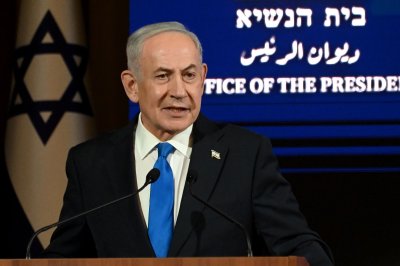
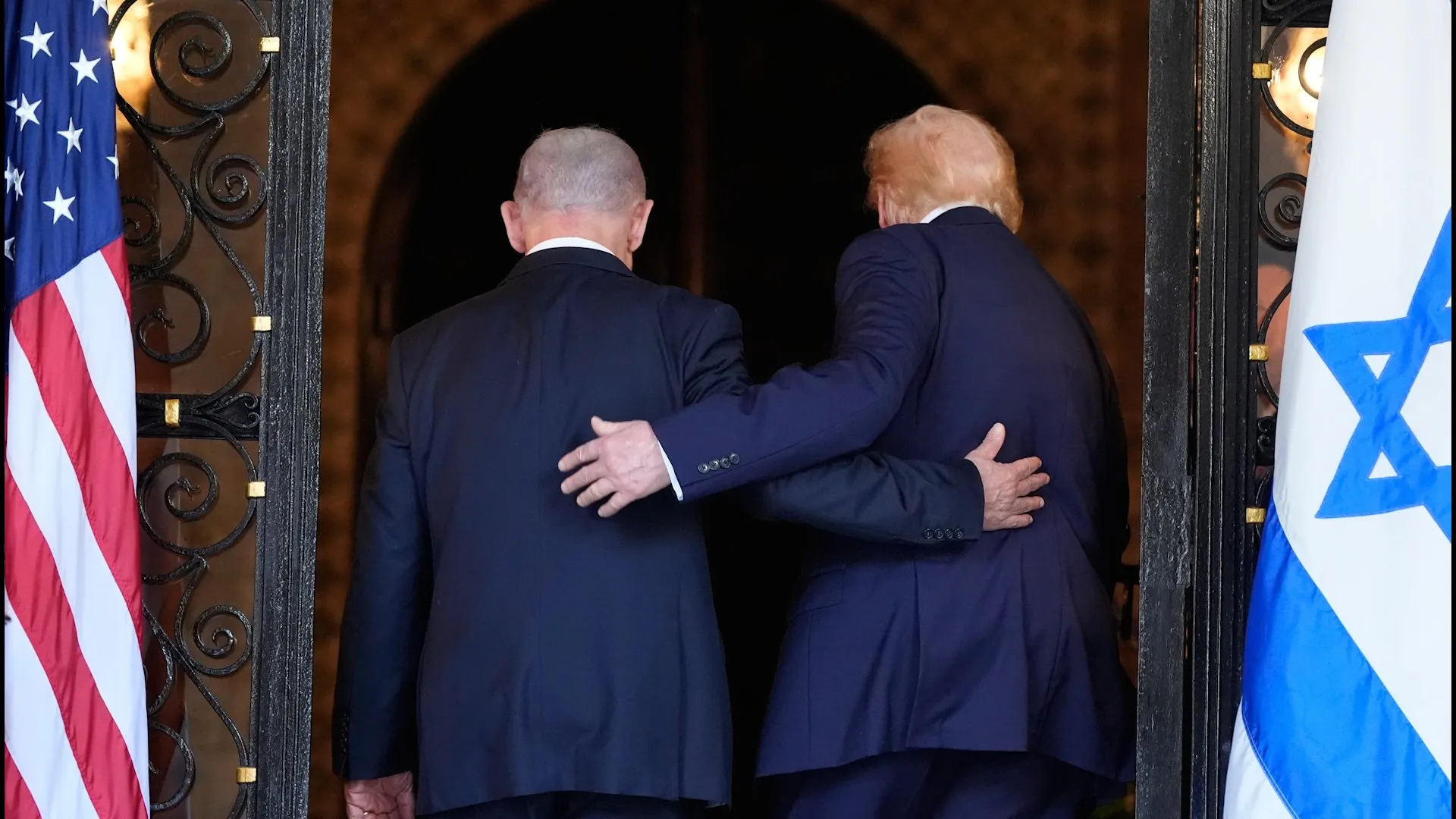
July 27 (UPI) — Israeli Prime Minister Benjamin Netanyahu was on his way to Washington, D.C., on Monday for his eighth meeting with President Donald Trump since he returned to the White House last year.
The war in Iran will be the key topic Trump and Netanyahu are expected to discuss when they meet at the White House this week. It will be their first meeting since the war began. The two leaders have expressed differing opinions about peace agreements in recent weeks.
“In these complex times, you need to act with both great determination and great wisdom,” Netanyahu said in a video statement Monday. “We will discuss all the issues on the agenda, primarily Iran. Of course, our goal is to protect our security and also to expand the circle of peace around us.”
Fighting between the United States and Iran resumed over the past two weeks after a preliminary peace agreement between both sides fell apart. The U.S. military said it paused strikes on Iran over the weekend after a series of daily attacks.
Iran’s military said it is also halting strikes against the United States as long as the United States holds off.
It is a politically significant time for both Netanyahu and Trump. On Oct. 27, Israel’s legislative election will include all 120 seats in the Knesset, determining who will lead the government. The prime minister will be determined in consultation between the Israeli president and the Knesset, through a series of coalition formations.
Meanwhile, Trump’s focus politically is on the midterm elections in November. The elections will determine the political makeup on Capitol Hill and Trump’s path toward advancing his agenda in the final two years of his term.
Nearly four years after being extradited to the United States for a drug-trafficking trial, former Honduran President Juan Orlando Hernandez returned home after a pardon by US President Donald Trump at the end of last year.
Trump claimed the trial was a “set up” orchestrated by former President Joe Biden’s administration.
Hernandez still faces corruption charges in Honduras but returned on Sunday after an arrest warrant against him was cancelled.
Human rights activists and lawyers fear a trial on home soil, where his party holds the presidency, would be a sham.
So why did Trump pardon and release the former president of Honduras despite abducting and arresting Venezuela’s Nicolas Maduro on drug and gun charges in January?
Former Honduran President Juan Orlando Hernandez is greeted by family and friends after arriving at his home in Tegucigalpa following his return to Honduras on July 26, 2026 [Leonel Estrada/Reuters]
Why did Hernandez return to Honduras?
Hernandez was able to return after being pardoned by Trump, released from a US prison and then having an arrest warrant against him suspended last month.
He arrived at Palmerola International Airport, where he was greeted by his family and supporters of his National Party.
Hernandez led his country from 2014 to 2022, during which, according to US prosecutors, he once boasted he would “shove the drugs right up the noses of the gringos”, referring to Americans.
Shortly after leaving office, he was extradited to the US, where he was found guilty by a federal jury and sentenced to 45 years in prison for involvement in a scheme to export cocaine to the US.
Prosecutors described the scheme as “one of the largest and most violent drug trafficking conspiracies in the world”. He was convicted of accepting millions of dollars in bribes from violent drug-trafficking organisations over 18 years, which he was alleged to have used to fuel his rise in politics.
“During his political career, Hernandez abused his powerful positions and authority in Honduras to facilitate the importation of over 400 tons of cocaine into the US,” the US Department of Justice said after he was sentenced last year.
During his trial, Hernandez denied taking bribes from drug dealers, arguing he in fact cracked down on the narcotics trade and citing his administration’s cooperation with the US military.
“I cannot deny the profound emotion and joy I feel in my heart to be returning home,” Hernandez wrote on social media earlier this month, saying he was counting down the days to see his family.
“It wasn’t easy. The process has been extremely difficult … and what I experienced in prison, I truly wouldn’t wish on anyone,” he added.
Hernandez is expected to appear in court on August 3 to face the Honduran corruption charges.
Hernandez shakes hands with US President Donald Trump on September 25, 2019, in New York during the signing of an agreement under which Honduras would accept more asylum seekers heading to the US [Handout/Honduran Presidential Palace via Reuters]
Why did Trump pardon him?
Under the US Constitution, a president may offer two types of clemency for federal crimes: pardons, which forgive defendants their federal charges and restore their civil liberties, and commutations, which reduce people’s punishment without addressing their convictions.
Hernandez was pardoned by Trump in December. The US president said Hernandez had not received a fair trial and had been “set up” by the Biden administration.
Trump added that Hernandez was “treated very harshly and unfairly”.
At the same time, Trump also threw his weight behind right-wing candidate Nasry “Tito” Asfura, a member of Hernandez’s party. He ran in November’s presidential election and was declared the winner a month later in the close race after delays and allegations of fraud. He took office in January.
A Pandora Papers corruption investigation also accused Hernandez of diverting nearly $11m in state funds to political campaigns from 2010 to 2013.
Venezuelan President Nicolas Maduro and his wife, Cilia Flores, are moved out of a helicopter and into a New York courthouse on January 5, 2026, for an initial appearance to face US federal charges including ‘narcoterrorism’, conspiracy, drug trafficking and money laundering shortly after US forces abducted them from Caracas [Adam Gray/Reuters]
Why a pardon for some but jail for others?
The Trump administration has faced criticism at home for pardoning the Honduran leader while at the same time abducting former President Maduro of Venezuela and his wife, Cilia Flores, in January on similar charges.
Maduro and Flores were seized in Caracas by the US military and flown to New York, where he is facing a range of guns and drugs charges and accusations of being a “narcoterrorist”.
At the time of Maduro’s abduction and since then, the Trump administration has targeted small boats in the Caribbean and eastern Pacific that it claims, without providing evidence, are involved in drug trafficking. More than 220 people have been killed in more than 60 such strikes on small boats in what many lawyers and activists have deemed extrajudicial killings.
Since taking office for a second term in January 2025, Trump has ordered more than 1,800 acts of clemency benefitting a range of personalities, including cryptocurrency billionaires, disgraced politicians and hundreds of political allies.
Some of the most controversial beneficiaries are supporters of his Make America Great Again (MAGA) movement, including hundreds of rioters who attacked the US Capitol on January 6, 2021, in a bid to prevent the certification of Biden’s electoral victory over Trump two months earlier.
Legal experts have argued that while the president’s clemency power is broad, using it for allegedly corrupt purposes, such as to protect political allies or obstruct justice, could form the basis for impeachment proceedings.
US constitutional expert Bruce Fein told Al Jazeera that the US Constitution’s framers “understood the abuse of the pardon power to shelter political or personal friends to constitute an impeachable high crime and misdemeanour justifying the removal of the president through the impeachment process”.
“If Democrats gain control of Congress in the midterm elections, Trump will be in impeachment jeopardy for pardoning Hernandez,” Fein said, referring to elections in November.
ICE officer under review for alleged mental health struggles, violent behavior amid deadly shooting case in Maine.
Published On 26 Jul 202626 Jul 2026
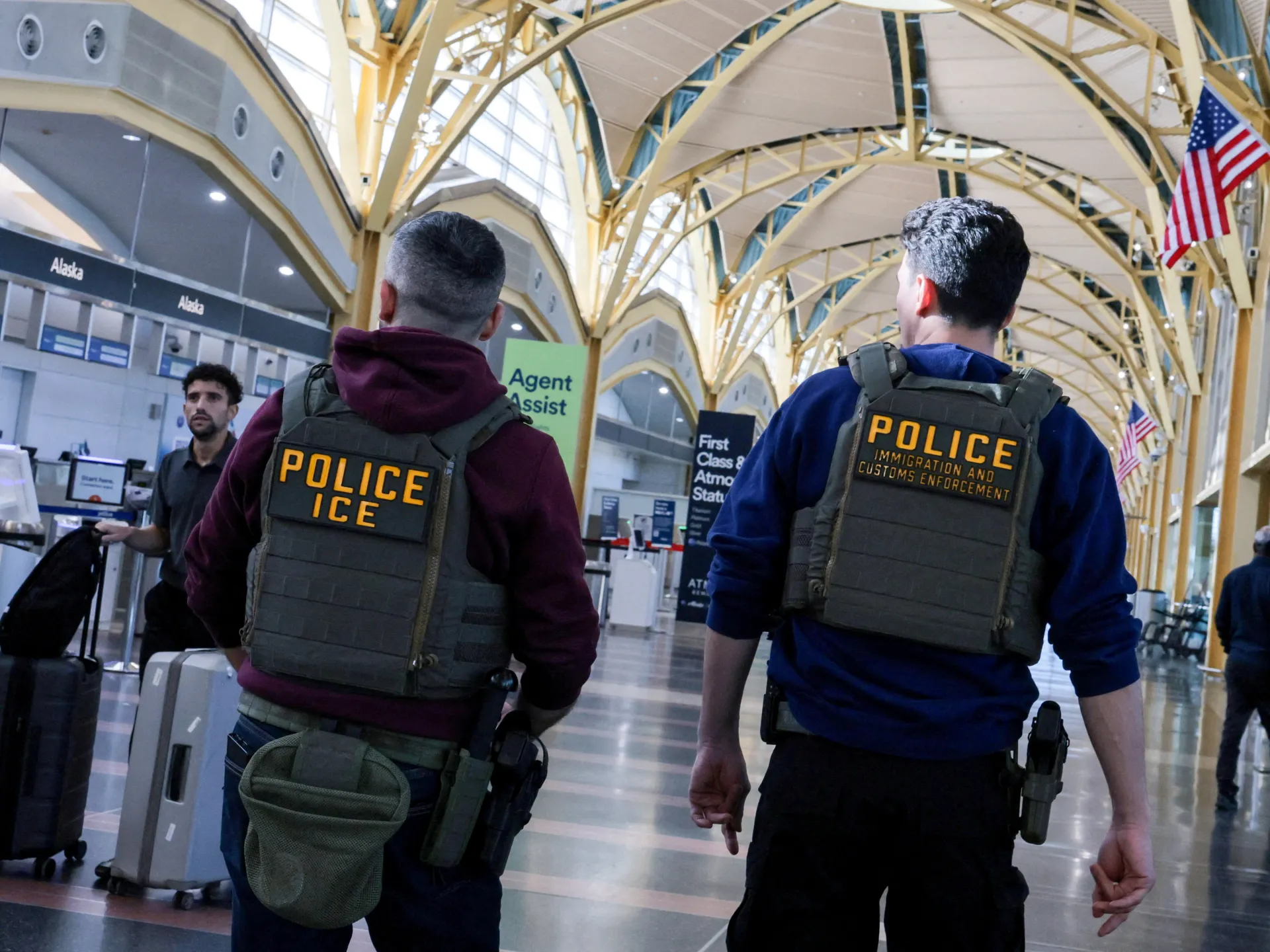
United States President Donald Trump’s border czar says the vetting of an immigration officer involved in the deadly shooting of a Colombian native in Maine is under internal review after the officer’s relatives revealed to The Associated Press that he had a history of serious mental health struggles and violent behaviour.
Tom Homan said on Sunday that if the allegations against the Immigration and Customs Enforcement (ICE) officer are true, “I don’t think he should ever have cleared vetting.”
Recommended Stories
list of 3 itemsend of list
“There’s several things under review,” Homan said on CNN about the officer, Army veteran David Brouillette. “The training is under review. I know this specific case, as far as the vetting, is under review by the internal affairs section.”
Questions about the Department of Homeland Security’s (DHS) rush to hire, train and deploy thousands of new ICE officers to carry out Trump’s immigration crackdown have come into stark focus after back-to-back deadly shootings of immigrants in Maine and Houston.
Homeland Security Secretary Markwayne Mullin ordered a pause in vehicle stops after the Maine shooting, but Trump almost immediately reversed course and insisted the stops resume as a necessary tool in his campaign to round up and deport immigrants without current legal status.
DHS did not immediately respond on Sunday to a request for comment about the internal review.
ICE mandates body cameras during vehicle stops
Homan said that “changes have been made” and that acting ICE director David Venturella has issued a new directive that body cameras must be in use if officers make a vehicle stop.
“Right now, on all vehicle stops, there’s at least one body camera on site to record the entire event,” he said.
He said Venturella “sent an instruction out that he wants at least one body camera on those vehicle stops, so we have everything on video”.
It is unclear if the steps the department is taking will be enough to quell the concerns coming from certain Congress lawmakers over DHS training and tactics as it tries to reach Trump’s mass deportation goals.
Lawmakers push for answers
Lawmakers from both parties have raised concerns.
Democrats pressed ICE officials during a closed-door briefing for the House of Representatives Homeland Security Committee last week, leaving some with more questions than answers.
Lawmakers were told during the briefing that there have been 56 complaints of excessive force against ICE officers – 32 were cleared, and one was referred for disciplinary action.
No discipline had yet been handed out, the lawmakers said they were told. The rest of the incidents are still under investigation.
Meanwhile, Republican Senator Susan Collins of Maine, chair of the powerful Senate Appropriations Committee, has pushed for the use of body cameras and ensured funding for the effort. She had said it was “extremely unfortunate” that the officer involved in the shooting in her home state was not using a camera.
July 26 (UPI) — After nearly two weeks of nightly bombing, the United States and Iran entered their second day of no new attacks Sunday, U.S. defense officials said.
Pentagon officials told CNN that U.S. attacks on Iran were “on a hold” after 13 consecutive nights of bombing the country. U.S. allies in the war on Iran have also reported no new strikes out of Tehran.
Iranian army spokesman Mohammad Akraminia confirmed the pause by his country in a statement carried by The Guardian.
“These [U.S.] attacks continued until two nights ago, but over the past two nights the Americans have stopped their attacks,” he said. “Our strategy has essentially been retaliatory, we have also halted our retaliatory operations.”
U.S. officials told The New York Times that President Donald Trump had delayed his plans to escalate fighting if talks didn’t continue. They said he was motivated by dwindling stockpiles of missile interceptors.
Iranian officials, meanwhile, have portrayed the U.S. pause on strategic fatigue, CNN reported.
Amid the lull in violence, Iran’s foreign ministry said there had been some movement in negotiations regarding the control of the Strait of Hormuz. Tehran had essentially closed the strait to traffic after the United States and Israel began its strikes on Iran on Feb. 28.
The action put strain on the world’s energy markets because about one-fifth of the world’s oil transits the strait. The resulting spike on oil and gas prices has put strain on the Trump administration to end the war.
In lawsuit filed Friday, plaintiffs charged that U.S. Trade Representative Jamieson Greer “failed to provide a reasoned, record-based explanation for its determinations” in a applying a fresh round of sweeping tariffs. File Photo by Bonnie Cash/UPI | License Photo
July 25 (UPI) — President Donald Trump‘s latest round of sweeping tariffs was hit with a lawsuit on Friday, just hours after going into effect.
Two small businesses challenged the newest levies, which apply 10% to 12.5% tariffs to more than 80 countries, justified under a provision to prevent goods made with forced labor from being imported.
The lawsuit was filed by a spice company in New York, Burlap and Barrel, and a California watch store, Collective Horology.
They are represented by the Liberty Justice Center, a legal nonprofit that won a Supreme Court case against the president’s previous round of tariffs.
Since the loss in court earlier this year, Trump has explored other legal authorities to support his tariffs and bypass congressional approval.
“Forced labor is morally indefensible, but an important objective does not give the government permission to ignore the law,” said Sara Albrecht, CEO of the Liberty Justice Center, in a statement. “The administration allowed one global tariff to expire and immediately replaced it with another under a different statute. Changing the statute doesn’t change the law. Every tariff authority has limits, and every administration must respect them.”
In the lawsuit, plaintiffs said the U.S. Trade Representative “failed to provide a reasoned, record-based explanation for its determinations.”
“This is the third time the administration has attempted to impose its global tariff policy without following the statutory limits,” said Jeffrey Schwab, senior counsel and director of litigation at the Liberty Justice Center, in a statement.
“Section 301 is a targeted, country-specific and practice-specific remedial authority,” Schwab added. “It is not a freestanding authorization to tax substantially all imports from substantially all countries at preestablished rates.”
July 25 (UPI) — A federal appeals court ruled that the Trump administration cannot implement tighter rules for mail-in voting in the mid-term elections this November.
The ruling, handed down by the First U.S. Circuit of Appeals on Saturday, will prevent his administration from creating a list of eligible voters and from requiring the U.S. Postal Service to refuse to deliver ballots to people who are not on the list, The Hill and Bloomberg News reported.
The three-judge panel rejected the administration’s appeal of lower court rulings in late June and early July that an executive order issued in April to expand the federal government’s role in managing elections could not be put into effect.
The April 1 executive order was condemned by critics at the time as an attempt by President Donald Trump and the administration to interfere with the mid-term elections, and led to 23 states and the District of Columbia to file suit to stop it.
The appeals court said in its ruling that the federal government failed to make its case for lifting the federal government’s injunction, which was partially based on the lower court preventing the executive order from going into effect.
“To be sure, the injunction prevents the federal Defendants from enforcing the EO in the Plaintiff states’ upcoming primary and general federal elections in September and November,” the judges wrote.
Trump, who continues to falsely claim that he won the 2020 election, signed the order under the guise of election integrity based on his also false claims of widespread voter fraud.
The fraud allegations center on ineligible people casting mail-in ballots, of which Trump and his administration have not shown happened in significant numbers during the 2020 election.
The order directs the Department of Homeland Security to build a state citizenship list based on federal date, to send the lists to state elections officials to verify mail-in ballots go to eligible voters and for the USPS not to send out absentee or mail-in ballots to people who do not appear on the lists.
White House Press Secretary Karoline Leavitt speaks during a press briefing in the James S. Brady Press Briefing Room at the White House on Thursday. Photo by Samuel Corum/UPI | License Photo
July 25 (UPI) — President Donald Trump said Friday that he’s ready to continue talks with Iran or escalate fighting, but an Iranian general said it’s ready to fight.
Trump met with top advisors and cabinet members on Friday to make a decision on whether to escalate attacks on Iran, The New York Times reported. Friday night, no attacks on Iran from the United States or on U.S. military sites were reported after 13 straight nights of fighting.
The White House hasn’t said if the president decided what to do, but Trump said the military is ready for a heavier attack if Iran doesn’t want to resume talks.”Look, we’re locked and loaded,” Trump told reporters on Friday. “We’re ready to go, but we’re talking to them, so maybe there will be, maybe there won’t be a tipping point. Maybe they will cry uncle, or maybe they’ll just give up, or maybe they’ll just go into a cave and hide.”
He told reporters that Iran is getting more serious about talks to end the fighting.
“We are talking to them. I think they’re getting more and more serious as the days go by, for maybe the obvious reason, but we are talking to them right now,” Trump said Friday.
He said that Iran would “love to make a deal” but he didn’t “think they’re ready to.”
But an Iranian general pushed back Saturday, even suggesting that Tehran welcomed a ground invasion by American troops.
“Our war with the enemy is a war of attrition, one that will not end,” the official whom Iranian media named General Asadi said Saturday, CNN reported. “We ask God that the ground forces of the aggressor American army find themselves in a position where we can engage them on the ground.”
In an interview with Axios on Thursday, Trump said he was considering a “massive attack” on Iran.
“Bigger than ever before. I am close to making a decision. We are all set for it,” he said. But he said that decision would have consequences, and he hadn’t decided on it yet.
He told Axios that the Iranians “want to negotiate” but aren’t ready to make a deal.
“They haven’t received enough pain yet,” he said.
Two regional sources with knowledge of mediation efforts told Axios that Iranian leadership hasn’t accepted the latest proposal.
One of the sources said, “We are trying, but the Iranians are not being helpful.”
White House Press Secretary Karoline Leavitt speaks during a press briefing in the James S. Brady Press Briefing Room at the White House on Thursday. Photo by Samuel Corum/UPI | License Photo
Tehran, Iran – A public rift has emerged between Iran’s government and state television over how to portray the state of war and negotiations with the United States, as mediators try to nudge both countries towards diplomacy.
The Government Information Council on Friday accused state broadcaster IRIB of “censorship” after parts of a speech by President Masoud Pezeshkian earlier in the week were not shown to the public.
The broadcaster, whose head is appointed by the supreme leader, issued a response on Saturday rejecting the government’s “accusations and improper attributions”, and emphasised that it has a duty to prevent “an incorrect and unreal suggestion of duality in the country’s leadership pillars”.
In his speech, Pezeshkian had pointed out that after last year’s 12-day war with Israel, former Supreme Leader Ayatollah Ali Khamenei publicly said there would be no negotiations with Washington – but privately had given his approval.
“We went to the dear leader, explained the situation, and asked him what to do since he had said the ‘no war, no peace’ conditions are bad for the country,” the president said. “He ordered us to go negotiate. We started the talks based on his order.”
The government said in its statement the move to cut that section of the speech was part of a series of “unusual actions” taken by state television concerning recent comments made by the heads of the government, parliament and judiciary.
It pointed out that earlier this month, a part of the parliament speaker and chief negotiator Mohammad Bagher Ghalibaf’s interview with state television dealing with negotiations had also been cut. The government council added that a part of a speech earlier this week by judiciary head Gholam-Hossein Mohseni-Ejei was not aired either, in which he expressed backing for the president.
Foreign Minister Abbas Araghchi has also separately criticised IRIB, saying during an interview with a state-linked outlet released on Saturday that he “fought with a sword” in wartime interviews with US media such as Fox, CNN and others. The chief diplomat said he expected state television to show how Iran’s case was being strongly presented to US audiences and policymakers, but only one or two subtitles from the interviews ended up going on air.
Araghchi also rejected a notion raised by hardliners that the now-suspended memorandum of understanding signed with the US last month was “imposed” on new Supreme Leader Mojtaba Khamenei, as some hardliners have claimed. He characterised it as the best possible agreement under the circumstances.
In its own statement, the government blamed the actions on “a political faction within” state television, in an apparent reference to the Paydari Front of ultrahardliners, and said their actions could serve to undermine national security and social cohesion.
IRIB, in a statement published by its public relations department, countered that broadcasting the president’s segment would have propagated an appearance of division.
Both sides accused each other of undermining the decree issued last week by Mojtaba Khamenei to reach a “sacred unity” in face of military, economic and diplomatic pressure by the US.
Mohammad Mirzaei, a member of parliament and spokesperson of a committee tasked with exerting oversight on IRIB, said on Saturday that directors of the state broadcaster have been warned about the necessity to display different viewpoints and to act as a “sign of national unity”.
Conservative journalist Mohammad Mohajeri told local media that the broadcaster is now at its most expensive and least effective. Reformist activist Mohammad-Sadegh Javadi-Hesar described the deeper problem as “one government being installed and another government called IRIB operating against it”.
Reformist Entekhab news outlet reported, citing an unnamed source, that Pezeshkian sharply reprimanded IRIB chief Peyman Jebeli at a cabinet meeting after the row over the negotiations. Jebeli, who was appointed by Ali Khamenei in 2021, was media deputy at the Supreme National Security Council when Saeed Jalili, the only council member said to have voted against an interim deal with the US last month, was its secretary.
Hardline lawmaker Meysam Zohourian said the president has threatened to cut state television’s budget, but the administration has not confirmed this.
As the public sparring unfolded, mediators from Oman were in Tehran on Friday to discuss the management of the Strait of Hormuz, a vital waterway whose control has become a central point of contention between the US and Iran.
US President Donald Trump argued on Friday the war was going “extremely well” and that Israeli Prime Minister Benjamin Netanyahu will visit Washington in the coming days.
He said the two sides continued to talk through mediators, but that he did not expect any agreement soon.
The US president also refused to answer whether realising his threat of systematically attacking power plants and bridges in Iran in case of a war escalation would constitute war crimes.
Mohammad Bagher Zolghadr, the secretary of Iran’s Supreme National Security Council, on Saturday responded by saying missile and drone launches across the region will continue “until the full surrender of the enemy” and avenging the blood of civilians killed during the war.
Houthi military spokesman Yahya Saree delivers a televised statement in Sanaa, Yemen, Saturday. Yemen’s Houthis claimed to have launched missile and drone attacks against facilities belonging to Aramco, Saudi Arabia’s state-run oil company, in retaliation for Saudi airstrikes on the Yemeni port city of Hodeida. Photo by Yahya Arhab/EPA
July 25 (UPI) — The Iran-backed Houthi rebels in Yemen announced Saturday that they had attacked Saudi Arabia with missiles and drones in retaliation for Saudi attacks on Hodeida, Yemen.
Houthi Brig. Gen. Yahya Saree, the group’s spokesperson, posted on X that the Houthis launched two military operations “in response to this blatant and criminal aggression” from Saudi Arabia.
“The first targeted sensitive Aramco-affiliated facilities in Jizan with dozens of ballistic missiles and drones,” he said. “And the second operation targeted sensitive Aramco-affiliated facilities in Yanbu with a number of ballistic and cruise missiles and drones.”
Aramco is the Saudi Arabian state-owned oil company.
“Both operations successfully achieved their objectives thanks to Allah Almighty, with accurate and direct strikes,” Saree said.
But the Saudis claim that the attacks were intercepted by air defense systems operated by Greek military units.
It’s the latest escalation between the two countries. On Wednesday, the Houthis claimed responsibility for two attacks on Saudi oil tankers in the Red Sea with missiles and drones. They have said they have blocked the Bab al-Mandab Strait. That strait is on the other side of the Arabian Peninsula from the Strait of Hormuz. It’s the gateway between the Arabian Sea and the Red Sea, and blockades of both straits would cut off Saudi Arabian ships entirely.
The Saudis and the Houthis have been in an effective cease-fire since 2022. But tensions recently flared when the Houthis accused the Saudis of striking the airport in Yemen’s capital Sanaa. The spat came from a dispute when an Iranian plane had tried to land at the airport.
Saudi Arabia on Friday hit the Houthi-held port city of Hodeida with strikes, the Saudi-led coalition in Yemen said. The attacks were in response to the Houthi hits on oil tankers.
“The Saudi enemy’s targeting of civilian facilities in Hodeida and Kamaran Island constitutes a dangerous escalation,” the Houthis’ Ansarollah media posted on Telegram.
“We affirm that these recent crimes will not go unanswered,” the post said.
Al Masirah television, which is run by the Houthis, said Saturday that the strikes from Saudi Arabia targeted facilities that belong to the state telecommunications corporation and Kamaran Island. It said one worker in Hodeida was injured, and a woman was injured on the island, Deutsche Welle reported.
The Saudis said they would do whatever is necessary to protect their ships. They warned the Houthis that if they continued “hostile acts, then there will be no hesitation in responding.”
On Thursday, President Donald Trump said his administration would “hold Iran responsible” for any Houthi attacks on ships, The Hill reported.
“Please let this TRUTH serve to represent that if they do this again, the U.S. will hold Iran responsible, in that the Houthis are a Surrogate and/or Proxy of Iran, and major military punishment will be inflicted upon Iran and, of course, the Houthis, themselves, who I am very disappointed with in that they have, until now, acted very professionally and smart,” Trump said in a Truth Social post.
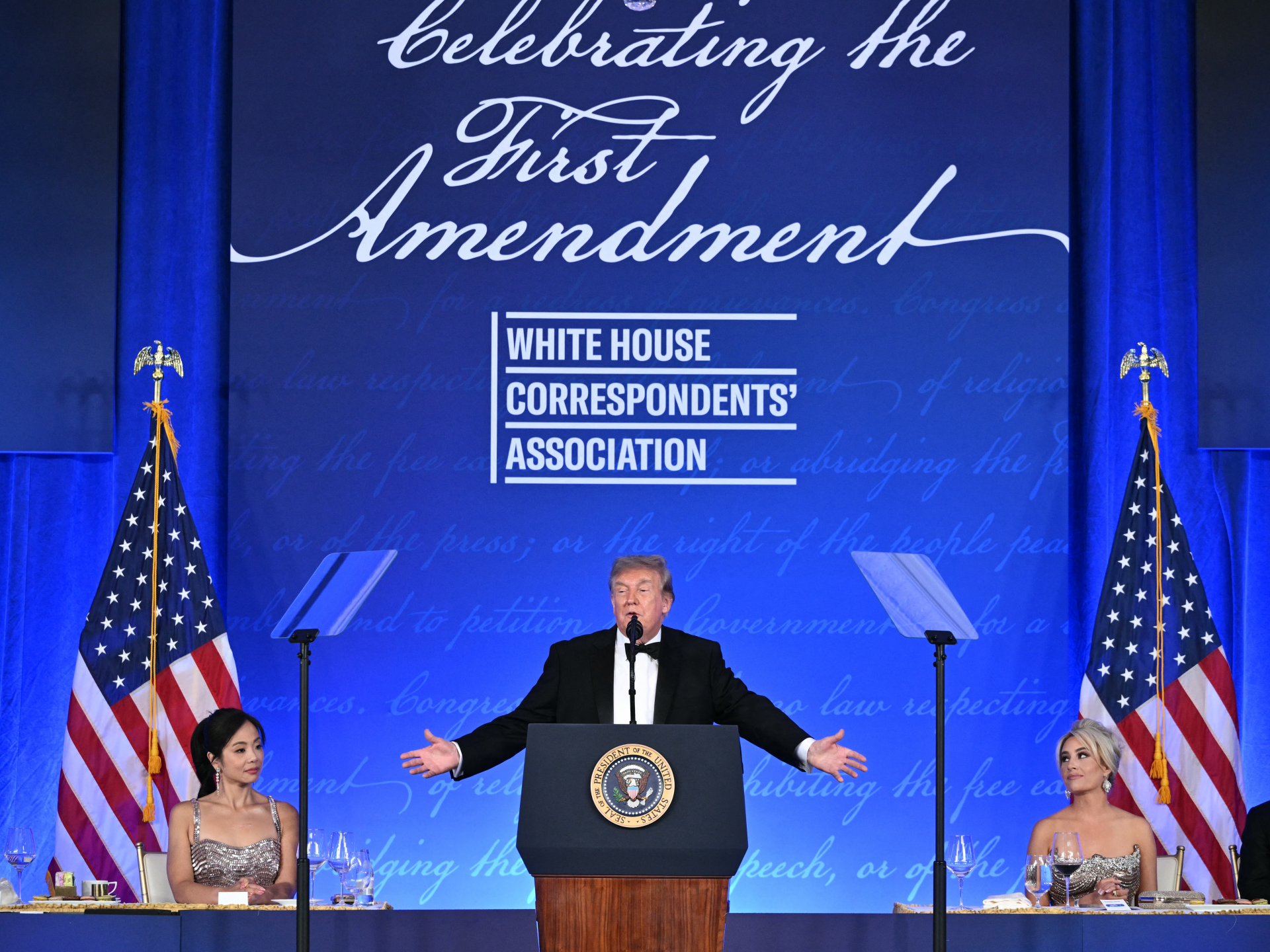
During the White House Correspondents’ Association dinner, US President Donald Trump joked about running for a fourth term, despite the Constitution barring it. The event, which celebrates press freedom and honours journalism, came three months after the first was cancelled by a shooting.
United States President Donald Trump returned to the White House Correspondents’ Association dinner, three months after a gunman upended the event.
“As I said three months ago, the show must go on,” Trump said at the start of his speech on Friday, after a lengthy awards ceremony, during which several journalists, including CNN’s Wolf Blitzer, spoke.
Recommended Stories
list of 3 itemsend of list
The annual – and perennially controversial – event had originally been held in April, but it was swiftly derailed after a gunman attempted to storm the proceedings in an alleged effort to assassinate Trump.
“Just like my presidency, the second time is always better and the third time will be better yet,” Trump quipped, before raising his hands at the crowd and saying, “I’m only kidding.”
The US president is limited to two terms by the Constitution, but Trump has been facetiously floating the idea of running for a third time.
The rescheduled dinner took place in the ballroom of the Waldorf Astoria hotel, with a guest list of 700 people, much smaller compared with April’s botched gathering.
“It was an assault on our democracy itself; it was a very serious situation,” Trump said of the alleged assassination attempt.
He lauded some of his aides, including Pete Hegseth, Steve Miller and Tom Holman, for showing “bravery” during the incident.
“They were standing on tables, when most of you were under the tables,” he said.
Alleged gunman Cole Tomas Allen had stormed a security gate at the gala venue, the Washington Hilton, armed with guns and knives. He was accused by prosecutors of shooting and injuring a Secret Service officer before he was stopped.
Allen is facing federal charges of attempting to assassinate the president.
“Many people yelled, ‘Get down. Get down,’ which caused Nicki Minaj to start twerking,” Trump said on Friday.
As journalists in attendance forced a muted laugh, Trump added: “She’s the only one who knew what that meant.”
Trump later used the event to rebuke political opponents, presenting his attacks as jokes. He called Democratic California Governor Gavin Newsom “newscum”, questioned Congresswoman Ilhan Omar’s intelligence, and pretended that someone in the audience was calling Illinois Governor JB Pritzker a “fat pig” to appear that he was not uttering the insult himself.
The US president also called top Democratic Senator Chuck Schumer “Palestinian” as an insult.
Earlier in the evening, Trump entered the ballroom to polite applause.
“This is the largest gathering of people with Trump derangement syndrome,” he said, referring to journalists.
The US president has had a historically caustic relationship with the dinner, but this year, he touted the celebration this year, calling it a “very good thing” and a “HOT ticket”.
White House Correspondents’ Association president Weijia Jiang of CBS News, which was acquired by pro-Israel investor David Ellison last year, thanked Trump for his support, and for showing up for the second time in three months.
“Tonight our message is this: We are back,” she said. “We will not be intimidated. We refuse to let an act of violence have the final word.”
Trump’s enthused attendance represented a sea change from his first term, beginning in 2017, when the newly elected president declared the soiree “dead” and declined to attend over the next four years.
Beyond Trump, the White House Correspondents’ Dinner has long been a lightning rod for criticism among media professionals, with some journalists arguing that reporters should not be chummy with the politicians they cover. Calls for the dinner to be abandoned entirely only grew after the April incident.
July 24 (UPI) — President Donald Trump on Friday ordered the Smithsonian’s National Museum of American History to add signage warning visitors about “ideological” views in some of its displays.
Trump issued an executive order to add the signs based on a review of the Smithsonian’s American History museum that he directed to search for ideological views related to social justice and “radical” changes to society.
The report, issued on July 4, ripped the museum for what the Trump administration claimed is practicing “extreme political activism” in its exhibits and the language it uses in them.
The report was the subject of a contentious House subcommittee meeting on Thursday, which followed Republican members of the House alleging the Smithsonian of misusing federal funds and promoting a “divisive, politically [biased] revisions of American history.”
Trump’s order directs the Department of the Interior to bear the cost of signs and changes to exhibits throughout the museum.
“The report demonstrates that the Smithsonian leadership does not present American history as a shared national inheritance to be taught and celebrated, but instead views American history as a ‘prime tool’ to advance the ideas of social justice and the radical transformation of society,” Trump said in the executive order.
White House Press Secretary Karoline Leavitt speaks during a press briefing in the James S. Brady Press Briefing Room at the White House on Thursday. Photo by Samuel Corum/UPI | License Photo
The delay, filed in court on Friday, can cost Paramount $1.7bn in fees if the deal is not closed by next June.
Published On 24 Jul 202624 Jul 2026
Paramount Skydance has agreed to pause its $110bn acquisition of Warner Bros Discovery until after a federal judge rules on states’ challenge to the deal, according to court papers.
The delay, filed in court on Friday, could cost Paramount Skydance about $7m a day in fees it agreed to pay Warner Bros shareholders if the merger does not close by September 30.
Recommended Stories
list of 4 itemsend of list
“We look forward to proving our case at trial,” Paramount’s spokesperson said.
Twelve states, led by California, sued on July 13, arguing the deal would “extinguish competition” in Hollywood and lead to fewer choices for consumers, particularly moviegoers and cable customers. Paramount has called the states’ claims meritless and pledged to “vigorously defend” its merger.
“Halting this merger while our case proceeds is a critical victory in our efforts to uphold the law and protect the film and television industries,” said New York Attorney General Letitia James, who is suing to block the deal.
Friday’s move arrives just days after US District Judge Araceli Martinez-Olguin granted a temporary restraining order requested by the states to freeze the transaction for several weeks.
The companies agreed to pause the deal until five days after the judge rules on the merits of the case, or June 1, 2027, whichever comes first. Paramount could owe as much as $1.7bn in ticking fees to Warner Bros shareholders if the deal is delayed until then.
Similar merger challenges have taken an average of eight months for a judge to rule, a review of recent cases by the Reuters news agency has found.
There have also been concerns over a media stranglehold as the merger would have brought CNN, currently owned by Warner Bros, under the umbrella of Paramount. The latter already owns CBS, which has seen a fair amount of turmoil amid allegations of bias in favour of US President Donald Trump under the leadership of CEO David Ellison, whose father, tech billionaire Larry Ellison, is a Trump ally.
July 23 (UPI) — A Senate committee delayed a vote on the Trump administration’s Centers for Disease Control and Prevention director nominee, Erica Schwartz, because enough members were not present.
Sen. Lisa Murkowski, R-Alaska, was absent from the Senate Committee on Health, Education, Labor and Pensions meeting on Thursday because of a family emergency, which led committee chair Bill Cassidy, R-La., to postpone the vote, Politico reported.
Cassidy also said Thursday that he decided to vote for Schwartz because of a “good faith action” the CDC reportedly made to its website earlier in the day.
The action included changing language on its website about the lack of an association between vaccines and autism, which had been ordered changed by Health and Human Services Secretary Robert F. Kennedy Jr. last year.
Cassidy asked detailed questions during her nomination hearing about vaccines and how the agency, which has had a full-time director for just one month since President Donald Trump re-entered the White House, would restore confidence in its public health mission, The Hill reported.
“I’m confident that she knows what she’s doing and will stand against those who do not,” Cassidy said during the meeting.
“If confirmed, I look forward to working with Dr. Schwartz to protect children’s health and regain trust in the CDC,” he said.
“There’s more to do to repair the damage that has been done to the U.S. public health response, but this is a start,” the Louisiana Republican added.
Even with Cassidy deciding to vote for Schwartz, Republicans on the committee would have needed a Democrat or Sen. Bernie Sanders, I-Vt., who caucuses with the Democrats, to vote in favor.
Sanders ended that possibility when he expressed respect for Schwartz’s career but said that he was concerned she would not be able to hold off some of the controversial changes Kennedy has either proposed or forced on the agency.
“I will be voting against Dr. Schwartz because we need people in this country who are going to stand up, protect the American people and I don’t think you can see that right now with Secretary Kennedy in his position,” Sanders said.
The HELP committee’s next executive session is scheduled for July 30, which is also the next time it will consider nominations, making it the next opportunity for Schwartz’s nomination to come up for a vote.
The committee also put off a vote on Sean Kaufman, who is nominated to lead the Administration for Strategic Preparedness and Response, because Republicans did not have enough votes to forward the nomination to the full Senate.
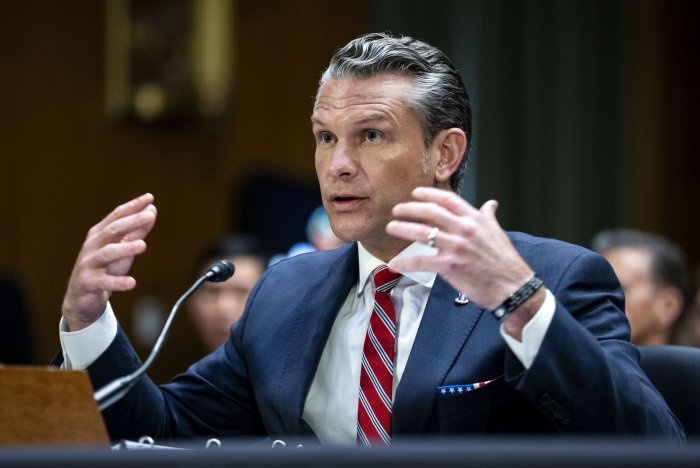
Secretary of Defense Pete Hegseth speaks during a Senate Appropriations Committee hearing on President Donald Trump’s June 24 supplemental funding request at the U.S. Capitol on Tuesday. Photo by Bonnie Cash/UPI | License Photo
Cargo vessels are seen at one end of the Strait of Hormuz near the coast of Dibba Al Fujairah, United Arab Emirates, on Tuesday. President Donald Trump said Thursday that vessels damaged transiting the strait would be paid from frozen Iranian assets. Photo by EPA
July 24 (UPI) — The United States and Iran traded attacks Thursday night and Friday morning, as President Donald Trump announced that damage inflicted by Iran on ships transiting the Strait of Hormuz would be paid with U.S.-held Iranian assets.
U.S. Central Command said its latest wave of attacks, which were completed at 9 p.m. EDT Thursday, lasted for about two hours, 15 minutes, during which its forces hit Iranian military command centers, drone storage facilities, communications networks, coastal surveillance sites and maritime capabilities.
State-run Islamic Republic of Iran Broadcasting reported explosions early Friday local time across the country, with strikes in Ahvaz, Bandar Abbas, Omidiyeh, Qeshm and Andimeshk. Officials in Bandar Abbas reported that two people were injured.
Explosions were also reported by the IRIB in southern Khorramabad.
The Iranian Army announced retaliatory drone strikes on U.S. bases in Jordan and Bahrain.
Bahrain’s Ministry of Interior said sirens were sounding. It urged residents to remain calm and seek shelter.
The United States has been hitting Iran for nearly a fortnight as it seeks to regain freedom of navigation of the Strait of Hormuz, a vital energy route that Iranian forces have tried to seize amid the war by attacking commercial tankers that try to transit it.
Maritime traffic freely flowed through the Hormuz until the United States and Israel attacked Iran in late February. Iran responded with its maritime blockade of the chokepoint, causing gas prices to spike and threatening nations with an energy crisis.
Mid-June, the United States and Iran signed a memorandum of understanding to lay foundations to end the war, but fighting resumed earlier this month over a dispute over what the agreement meant for control of the strait. Iran says the agreement recognizes its authority over Hormuz transit. Washington says Tehran committed to freedom of navigation.
CENTCOM said Thursday, as it has after the completion of each new wave of attacks, that it was seeking to further degrade Iran’s ability to attack vessels transiting the Hormuz.
“Commercial vessels continue to free navigate the strait with U.S. military support.”
Late Thursday, President Donald Trump announced online that damage ships incur while traveling the Strait of Hormuz would be paid by for with the hundreds of millions of dollars in Iranian assets that the United States has frozen via sanctions.
“These damages may be very substantial but, nevertheless, this is the fair and equitable thing to do,” he said in a statement.
Iranian Foreign Minister Seyed Abbas Araghchi lashed out in response online, warning the international community that “Seizing another nation’s assets to pay for unrelated future claims is an incendiary precedent.”
“Those who celebrate or profit from such funds should remember: once governments normalize confiscation, no one’s assets are safe,” he said in a statement.
July 24 (UPI) — A federal court has allowed Tennessee to use a new congressional map that eliminates the state’s only majority-Black district in November’s midterm elections, rejecting a challenge from civil and voting rights advocates.
The three-judge panel on Thursday denied a motion filed by Black Memphis voters for a preliminary injunction against implementing the map, ruling they lacked evidence of racial motivation for the map’s unorthodox mid-decade redistricting, which could be explained by a political motivation.
“The road to a reliably 9-0 map runs through Memphis. Thus, political motivations readily explain the map’s dilutive effects,” the panel, which consisted of two Trump appointees and one Obama appointee, wrote in its decision.
With the ruling, Tennessee may use the map in next month’s primaries.
November’s midterms have been of increasing concern for President Donald Trump, who has repeatedly voiced worries about impeachment proceedings and investigations if Republicans lose the House to Democrats, and has pushed GOP-led states to redraw their congressional maps to create additional Republican-favored districts.
Texas was the first last summer to agree to Trump’s request, sparking a gerrymandering arms race, with at least 10 states have redrawn their maps. All but Democrat-led California and North Carolina, which has a Democratic governor, are Republican-led.
Tennessee’s GOP-majority legislature passed its redistricting map to eliminate the one Democrat-held seat in May, a week after the Supreme Court issued a controversial decision that weakened a key part of the Voting Rights Act, by greatly limiting the use of race in drawing electoral districts.
The three Black Memphis voters, along with the Black Clergy Collaborative of Memphis, the Memphis A. Philip Randolph Institute and the Equity Alliance sued days later, alleging that the new map unlawfully discriminates against Black Memphis voters by dismantling a district where they had long been able to meaningfully participate in the political process.
In its ruling Thursday, the court said that the plaintiffs had to show that the map redraw was racially motivated, which they failed to do.
“The map’s effects — breaking Black Memphians into three separate congressional districts — are readily explainable by political motivations,” the court said.
“It’s no secret (supported by Plaintiffs’ own statements) that city voters prefer Democratic candidates and that rural voters prefer Republican candidates. So, it makes sense that Tennessee’s legislature would split Memphis into thirds when attempting to create a map that favors Republican candidates. And it’s no surprise that the resulting map would also split the Black population of Memphis into thirds.”
Amber Sherman, a plaintiff in the case, said the court’s decision further disenfranchises Black voters in Memphis.
“It’s painful to know we’ll head into another election under a map that was designed to weaken the Black voters in Memphis,” she said in a statement.
“We deserve the same opportunity to shape our future as anyone else.”
A $1.15 trillion US defence bill passed by the House includes plans to expand military cooperation with Israel through joint work on missile defence, drones and AI. Critics warn the move could deepen ties amid growing political divisions over aid to Israel.
Al Jazeera’s Tohid Asadi reports from Tehran as the US launches strikes for the 13th consecutive night. Iranian leaders are warning further attacks could lead to retaliation targeting Gulf nations.