crash

Nancy Pelosi’s husband likely to face hit-and-run charge after California crash

Paul Pelosi, left, husband of former House Speaker Nancy Pelosi, was allegedly hit a parked car and kept driving in Napa Valley, Calif., on Saturday, later telling police that he knew he hit something but kept driving until his car was no longer operable. File Photo by Christine Chew/UPI | License Photo

July 4 (UPI) — Paul Pelosi, former House Speaker Nancy Pelosi‘s husband, is expected to face charges after he hit a parked car in Napa County, Calif., on Saturday.

Pelosi allegedly hit an unoccupied, parked car, with Napa County Sheriff’s Office deputies later finding his brown convertible parked behind a California Highway Patrol Vehicle and partially blocking a road, KCRA and NBC News reported.

Pelosi has previously been found guilty for driving under the influence, but the sheriff’s office said that an alcohol test did not find alcohol in his system.

“The witness provided deputies with the direction the suspect vehicle was last seen traveling,” police said.

“A short time later, deputies observed a vehicle parked behind a brown convertible car,” which had “significant damage” and was “consistent with the recent crash,” police said.

Because DUI is not suspected, Pelosi, 86, was not arrested after the crash, which the sheriff’s office said is common for a misdemeanor accident.

“Pelosi admitted to hitting something, but said he did not know what he had hit, so he kept driving,” police said.

“He drove until his car became disabled and was no longer able to continue driving,” they said.

Pelosi apologized to the owner of the parked car and said that he would take responsibility for the damage to the vehicle, a family spokesperson said.

News anchors are seen outside the Supreme Court of the United States as the court releases their final opinions before summer recess on Tuesday. The court upheld birthright citizenship and also state laws banning transgender women and girls from playing on school athletic teams. Photo by Bonnie Cash/UPI | License Photo

Source link

China: Skyscraper crash pilot wrote about ‘ending his life’ in diary

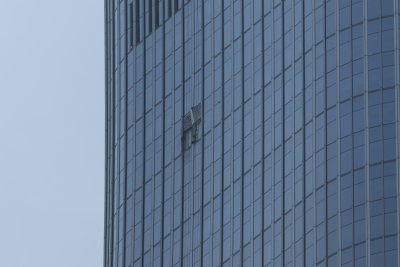
Damage is shown on the facade of Citic Tower, also known as China Zun, in Beijing on June 27. The pilot died in the accident, and authorities said the crash was intentional. Photo by Jessica Lee/EPA

July 2 (UPI) — The pilot of a small plane that crashed into Beijing’s tallest building was a 66-year-old man who was suffering from “chronic insomnia and anxiety” and wrote about “ending his life” in his diary, authorities said Thursday.

The man died in the June 26 crash and wounded 13 others in the 109-story Citic Tower.

The pilot was identified as Liu and was a divorced freelancer who lived alone in Beijing, the Chaoyang district government said in a statement.

“The comprehensive investigation concluded that this was a case of endangering public safety caused by personal reasons,” the statement said.

One of the injured people has been discharged from the hospital, officials said.

Liu had taken off from an airport in the Pinggu district. That day he had flown accompanied and solo flights, the Chaoyang government’s statement said.

“During his solo flight, he deviated from the designated area and lost contact with the airport, subsequently colliding with the high-rise building and dying at the scene,” the statement said.

Liu obtained his sport pilot’s license in 2021 and private pilot’s license in 2024.

The plane was a two-seat, single-engine Aurora SA60L manufactured by Chinese company Sunward Aircraft, according to Flightradar24. It’s designed for touring, aerial photography and recreational aviation.

All references to the crash, video and images were scrubbed from social media in China. The state media, whose headquarters is across the street from the tower, didn’t report anything about the crash until the following day.

Chinese authorities often attribute random acts of violence to people seeking “revenge on society,” offering little information on the exact motive.

If you or someone you know is struggling with suicidal thoughts, help is available 24/7. Call or text the 988 Suicide & Crisis Lifeline for free, confidential support. Globally, the International Association for Suicide Prevention has contact information for crisis centers around the world.

Source link

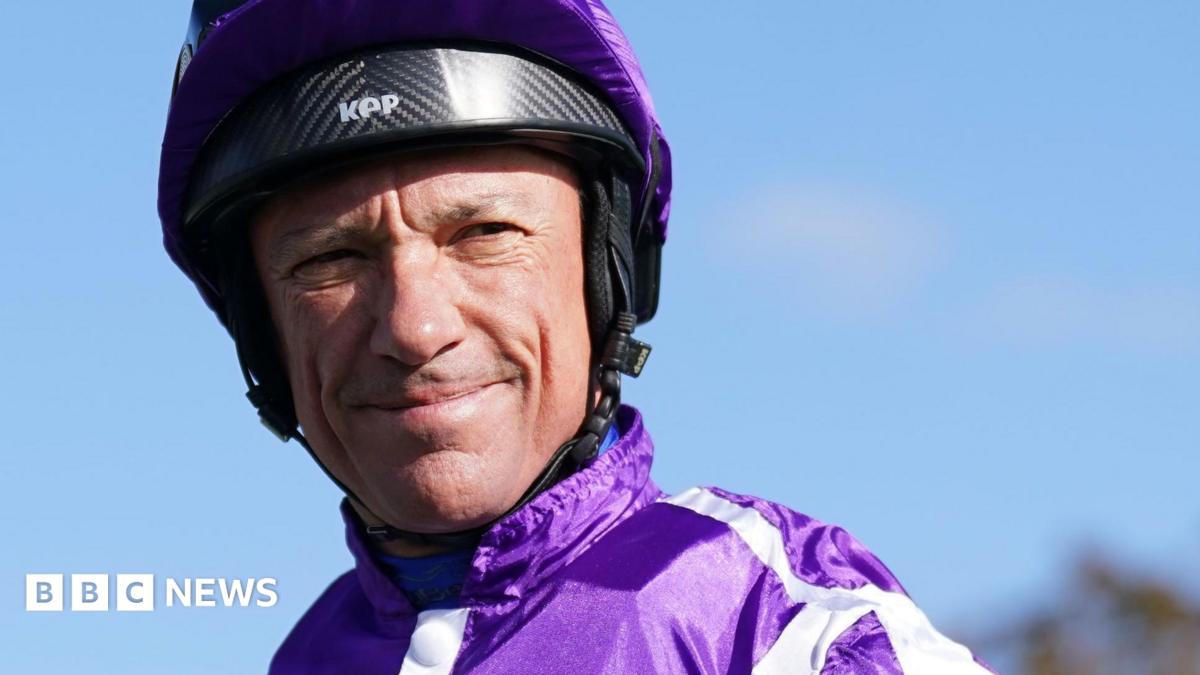
Frankie Dettori seriously injured in Newmarket car crash

Jockey Frankie Dettori suffered several broken ribs and a broken thumb after being involved in a car crash, his management has said.

A spokesperson for H Talent Management confirmed the collision happened on Wednesday evening near Newmarket in Suffolk.

Another vehicle struck the rear passenger side of the car the 55-year-old was driving, causing it to spin and flip, they said.

Dettori’s injuries were still being assessed as he remained in hospital for further scans and observation.

More stories from Suffolk

“Frankie would like to thank the emergency services who attended the scene, together with the doctors, nurses and wider medical team caring for him,” said H Talent Management.

“His focus is now on resting and recovering. H Talent Management respectfully asks that Frankie’s privacy is respected at this time.

“No further comment will be made until there is a meaningful update.”

Dettori has not ridden in Britain since October 2023 when he won the Champion Stakes on King of Steel at Ascot.

But he was due to return to the saddle in the Leger Legends race at Doncaster during the St Leger Festival in September.

H Talent Management referred to Wednesday’s crash as an “accident”.

The collision is believed to have happened just over the border in Cambridgeshire and the county’s police force confirmed it was called to a collision on the A1304 London Road near Six Mile Bottom at about 19:00 BST.

A spokesperson for the force added that there were no arrests.

The East of England Ambulance Service said two patients were taken to Addenbrooke’s Hospital for “further assessment and treatment”.

Do you have a story suggestion for Suffolk? Contact us below.

Source link

The AI boom propping up markets could trigger the next crash, central banks warn

In its Annual Economic Report, published on Sunday, the Bank for International Settlements (BIS), known as the central bank for central banks, warned that the enormous spending on AI is accumulating financial vulnerabilities that could amplify any future shock and spread from markets into the wider economy.


ADVERTISEMENT


ADVERTISEMENT

Presenting the findings, BIS general manager Pablo Hernández de Cos said the message was one of “urgency”, with policymakers urged to act before any reversal makes the eventual adjustment more painful.

At the core of the warning is the scale of the spending, despite massive investment having supported global growth over the past year.

The five largest “hyperscalers”, the technology giants racing to build AI infrastructure, are on track to commit more than $1 trillion (€878bn) to AI-related investment across 2025 and 2026, a pace that is outstripping their earnings and free cash flow and pushing some to borrow heavily to keep up.

The BIS suggests this race is fuelled by a belief that only a handful of dominant players will ultimately prevail, encouraging firms to pour money into projects whose returns remain deeply uncertain.

Echoes of past manias

The report sets today’s AI boom against a long historical lineage, from the canal mania of the 1830s and Britain’s railway mania of the 1840s to the electrification of the 1920s and the dotcom bubble.

Each began with a genuine technological breakthrough that attracted more capital than commercial returns could justify, the BIS notes, with each episode ending “with an eventual reversal in investment, inducing economy-wide recessions”.

Compounding the danger are stretched share prices and opaque financing.

The BIS highlights the spread of “circular financing”, in which chipmakers and cloud giants take equity stakes in AI labs that then commit to buying their chips and computing power, effectively recycling money back to the original investors as revenue.

Much of the funding now flows through hedge funds and private credit vehicles that face lighter scrutiny than banks.

According to Zhang Tao, the BIS chief representative for Asia and the Pacific, that reliance on non-bank channels means an AI downturn could unwind into a sharper, faster crash than a traditional banking crisis.

The hidden costs of data centres

Beyond financial markets, critics argue the true cost of the AI build-out is being obscured in plain sight.

A central concern, examined by the Wall Street Journal, is how the technology giants account for their data centres.

By assuming the expensive equipment inside them will stay useful for longer, firms can spread its cost over more years, lowering the depreciation charged against profits in any given period and making earnings look healthier than the underlying cash burn implies.

However, the specialist chips at the heart of these facilities may become obsolete far faster than those extended schedules assume, leaving a gap between reported profits and economic reality, as well as a balance sheet more exposed than it appears should demand disappoint or a sizable need to replace hardware arise.

The physical scale is staggering.

Columbia University economist Stijn Van Nieuwerburgh estimates the build-out could cost in the region of $8 trillion (€7tn) over the next six years, financed in part through the kind of off-balance-sheet arrangements the BIS flagged.

The costs are also no longer confined to corporate accounts.

Some economists now warn of a so-called “third wave” of inflation, after the pandemic and tariffs, driven this time by the AI build-out. As chip manufacturers prioritise high-margin parts for AI servers, the resulting squeeze on memory and storage has rippled out to consumer electronics.

For example, Apple raised prices on its MacBooks, iPads and other devices last week, citing an “extraordinary surge in demand for memory and storage” and saying it had “never seen a component price increase this much, this quickly”.

The company’s shares fell around 6%, their worst day in over a year, as Microsoft, Nintendo and Sony have also made similar moves.

Beyond hidden costs and inflationary pressures, where the strain may spread furthest is raw power.

Goldman Sachs expects data centres to account for nearly half of the growth in US electricity demand by 2030, with consumer power prices forecast to rise around 6% a year through 2026 and 2027.

The BIS itself notes that the build-out’s hunger for electricity is already pressuring prices and input costs, with potential spillovers to inflation, though it stresses, as do many economists, that AI could yet prove disinflationary if its promised productivity gains eventually arrive.

Source link

Skydiving plane crash kills 11 in northeastern France | Newsfeed

NewsFeed

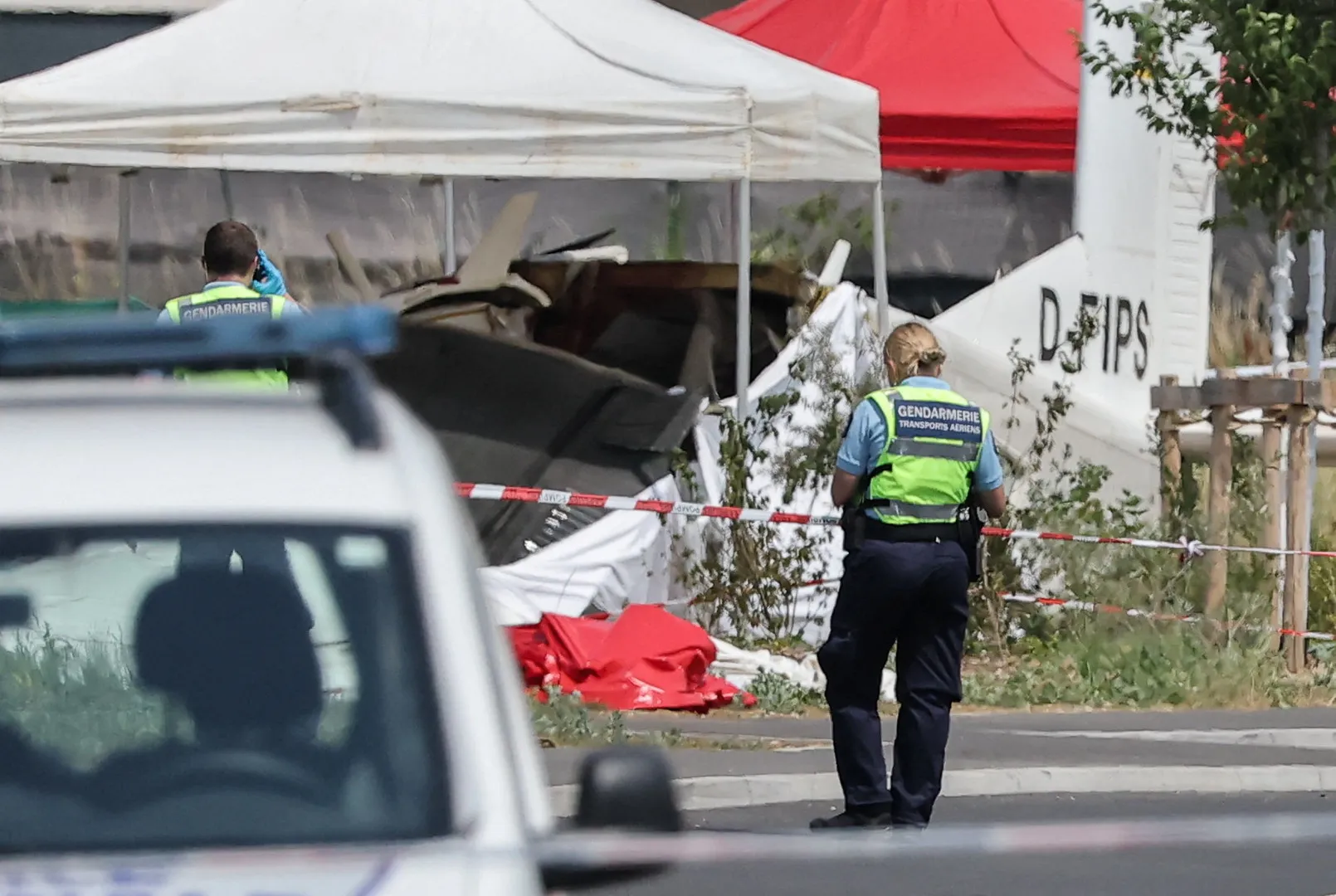
11 people were killed when a plane belonging to a parachuting school crashed in Tomblaine, France. The victims included the pilot, five student parachutists, and five instructors. Some victims’ families were present near the airport and witnessed the crash.

Source link

Austrian Grand Prix: George Russell steals pole from Charles Leclerc after Max Verstappen crash

Mercedes driver George Russell controversially stole pole position at the Austrian Grand Prix from Ferrari’s Charles Leclerc with the last lap of the session.

The result came amid late drama as Russell set his lap, beating Leclerc and Lewis Hamilton, despite passing yellow flags for a crash by Red Bull’s Max Verstappen at the penultimate corner.

Russell’s team-mate Kimi Antonelli, who was running just ahead of the Briton, also passed the Verstappen incident, but did not improve his time and will line up fourth.

McLaren’s Lando Norris and Oscar Piastri were sixth and seventh behind Verstappen, who kept fifth despite his crash.

Russell insisted he had slowed sufficiently for the Verstappen incident, and claimed there was just a single yellow flag showing, rather than the double waved yellows which might have been expected for such a situation.

“I had a big lift,” Russell said. “I went into the corner 0.5secs up and I came out 0.25secs up. It was great to get that lap.

“I just spoke with Toto [Wolff, team principal] and he said everything is fine with the yellow flag. Big 100m lift before the corner. So that’s good to hear.”

The late drama was caused by a big crash for Verstappen, who lost control going into the high-speed downhill right-hander and spun across the gravel into the barrier.

Source link

Authorities acknowledge Beijing plane crash; pilot dead, 13 hurt

Damage is seen on the facade of Citic Tower Zun in Beijing, China, Saturday. Witnesses say a small plane crashed into Beijing’s tallest tower on Friday. Photo by Jessica Lee/EPA

June 27 (UPI) — The local authorities acknowledged the plane crash that hit Beijing’s tallest building Friday, saying the pilot died and 13 people were injured.

A short statement on WeChat from the local Chaoyang District government said only the pilot was on the plane and was killed in the crash. The statement said 13 people in the building and on the ground were injured. They didn’t identify the pilot or a motive.

The statement said, a “single-engine double-seat light sports aircraft collided with a high-rise building in flight.” It said the incident is being investigated. It didn’t name the building and only called it a skyscraper near the East Third Ring Road.

All references to the crash, video and images were scrubbed from social media in China. The state media, whose headquarters is across the street from the 109-story Citic Tower, hasn’t reported anything about the crash.

It’s not known if the crash was intentional.

Beijing airspace is tightly controlled, and even drones are mostly banned within the city. It’s not clear how the pilot got around the tight controls.

FL360Aero.com, an aviation news site, posted images and video on X from the scene, showing a plane’s tail lying on the sidewalk. The post estimated that it hit around the 65th floor of the building.

Flightradar24 posted on X flight data that appeared to show a deviated flight path for the plane after it took off from Shifosi airport in Beijing’s eastern Pinggu district.

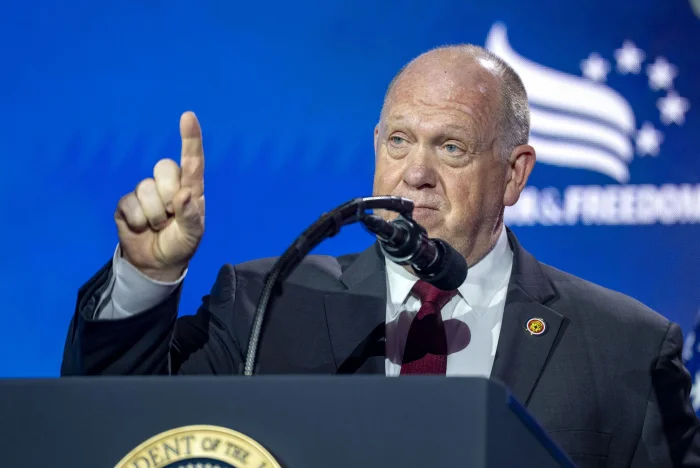
White House Border Czar Tom Homan speaks during the Faith and Freedom Coalition 2026 Road to Majority Policy Conference at the Washington Hilton on Friday. Photo by Bonnie Cash/UPI | License Photo

Source link

Newsom blesses Uber ballot truce; car crash lawsuit fight continues

Gov. Gavin Newsom signed a law Thursday to crack down on inflated profits stemming from car crash lawsuits, blessing a hard-fought compromise between Uber and the state’s trial attorneys that averts a November showdown between two of California’s most powerful and moneyed lobbying forces.

The deal, the fruit of months of negotiations, takes aim at the lucrative way doctors can charge for procedures on patients referred to them by personal injury lawyers.

If a law firm has a client who was hurt in a car accident, the lawyer will often send them to a doctor who will perform surgery on a “lien” basis, meaning the doctor will be paid from money that comes from a lawsuit settlement rather than through insurance.

Uber contends this arrangement has created an incentive for doctors and attorneys to collude to dramatically inflate medical bills. The more expensive the bill, they say, the bigger the resulting payout.

The law, SB 623, caps how much these doctors can charge when their patient is involved in a lawsuit against a ride-share company, which are frequent targets of litigation due to their top-of-the-line insurance policies. The new law will also require Uber to ramp up background checks of its drivers.

“We’re going to have a much safer state both for medical patients and passengers in Ubers,” said Nicholas Rowley, a prominent Texas attorney who helped bankroll the fight and took a leading role in the negotiations.

The law only applies to cases that involve ride-share accidents that take place after Jan. 1, 2027.

“This legislation puts meaningful guardrails in place to better protect accident victims, increase transparency and accountability in the medical lien system and strengthen safety,” said Ramona Prieto, Uber’s head of public policy for the Western U.S., in a statement.

For months, Uber and lawyers from across the state poured tens of millions into dueling ballot measures that threatened to devastate the profits of whichever side lost.

Uber fired the first shot with a ballot measure that sought to cap how much attorneys can earn in lawsuits involving auto accidents. The company argued attorneys were swindling their own clients, inflating medical bills of car crash victims to increase the value of the settlement and then pocketing a hefty chunk of the payouts.

The state’s trial attorneys countered that the fee cap would make small or difficult cases a money-losing endeavor and block scores of accident victims from the courts. They shot back with their own ballot measure that would increase legal liability for ride-share companies if a passenger or driver is sexually assaulted while on a ride, seizing on investigative reporting that highlighted assaults in Ubers.

“They were waiting for us to blink and we didn’t,” said Douglas Saeltzer, the head of the Consumer Attorneys of California, the lawyer trade group that pushed for the measure against Uber. “Their starting place, I don’t believe, was in the interest of protecting victims — it was in the interest of protecting Uber.”

With the passage of Thursday’s law, both sides have agreed to pull their respective measures from the November ballot, halting campaigns that had both parties amassing tens of millions in funding and blanketing the airwaves with ads.

“Now we can stop seeing all the commercials,” said Assemblymember Blanca Pancheo (D-Downey) at a Tuesday hearing.

The law, put forward by Assemblymember Diane Papan (D-San Mateo) and Sen. Thomas Umberg (D-Santa Ana), also caps the amount that can be earned by third-party investors who buy out a doctor’s lien in a personal injury case. These companies will purchase a doctor’s stake in the case at a reduced rate, then pocket a share of the payout if the case settles.

“Private equity and hedge funds buy them at a steep discount, then turn around and collect the full inflated amount,” Saeltzer said at a Tuesday hearing on the bill. “That’s money flowing to Wall Street investors, not patients.”

The law will require annual background checks for ride-share drivers and expand the list of offenses that disqualify someone from the job.

In addition to the ballot battle, has Uber sued two of LA’s most well-known personal injury firms — the Law Offices of Jacob Emrani and Downtown L.A. Law Group — accusing them of inflating medical bills and forcing clients to undergo needless and expensive surgeries to inflate the value of the claim. The firms asked the judge to dismiss the case Wednesday, arguing Uber had failed to prove fraud. Both firms have vehemently denied wrongdoing.

The lawsuit, filed last year, has put the plaintiff lawyers in the unusual position of playing defense. Listening in the audience at Wednesday’s hearings were the partners of Downtown L.A. Law Group and Jacob Emrani.

“Let’s be clear about what this Uber case really is,” said John Hueston, outside counsel for Emrani. “It’s brought by a $150 billion dollar company … to intimidate the plaintiff’s bar, exhaust its resources and chill the suits that hold Uber accountable.”

Michael Huston, one of the lawyers who represents Uber, countered that the case is “not an attack on the plaintiff’s bar.”

“We have brought suit against the two in this state … that are engaged in naked fraud,” he said.

Source link

Family sues Tesla for wrongful death in Autopilot crash in Texas, US | Elon Musk News

Lawsuit claims Tesla’s Autopilot shortcomings led to fatal crash; family seeks $1m in damages and punitive measures.

The family of a Texas woman who was killed has filed a lawsuit against Tesla after a driver using a Model 3’s automated driving assistance system crashed into a suburban Houston home last week.

The complaint, filed on Tuesday, argues that Tesla should be held liable for the wrongful death of 76-year-old Martha Avila. The family alleges that the automaker, led by Elon Musk, failed to adequately warn drivers about alleged defects in its Autopilot and Full Self-Driving systems.

Recommended Stories

list of 4 itemsend of list

Avila’s daughter, Jennifer Barbour, and her husband, Justin Barbour, said the Model 3’s driver, Michael Butler, told law enforcement he engaged Autopilot before ploughing through the front wall of Avila’s home in Katy, Texas, the United States, on June 19, pinning her before she succumbed to her injuries at a nearby hospital, according to the complaint.

Video obtained by KHOU – Houston’s CBS affiliate — shows the car travelling at top speed over the front lawn of Avila’s home in the Houston suburb before slamming into the front room.

The driver told the Harris County Sheriff’s Office that he was using the technology at the time of the accident. The driver in the incident was not under the influence of alcohol and is cooperating with authorities.

Butler is also a defendant in the Barbours’ lawsuit. It is unclear whether he has a lawyer.

Musk, the world’s richest person, posted on X on Monday night: “FSD drives slowly through neighbourhood streets and this was a high-speed crash!”

Ashok Elluswamy, vice president of AI software at Tesla, posted on X in response, saying that “the driver manually overrode self-driving by pressing the accelerator all the way to 100% of the accel pedal in this residential area.”

The lawsuit filed in a Harris County, Texas, state court seeks more than $1m in damages, and punitive damages reflecting Tesla’s alleged “reckless disregard for a substantial risk of severe bodily injury”.

The National Highway Traffic Safety Administration (NHTSA) has been investigating the crash.

Since 2016, the NHTSA has opened nearly 50 special investigations of Tesla crashes believed to involve advanced driver assistance systems. About two dozen deaths were reported.

In March, the NHTSA escalated its probe into 3.2 million Teslas equipped with Full Self-Driving, on concern the system may fail to detect or warn drivers in poor visibility. In 2023, Tesla recalled about two million vehicles, nearly all of its electric vehicles on US roads, to better ensure that drivers pay attention when using Autopilot.

Tesla has said Autopilot enables vehicles to steer, accelerate and brake within their lanes, while Full Self-Driving lets vehicles obey traffic signals and change lanes.

The carmaker has also said both technologies require “fully attentive” drivers whose hands are on the wheel.

The incident comes as the Musk-owned company is rolling out robotaxis using automated software in several US cities this year and plans to invite Tesla owners across the country to put their cars into the fleet using the same system.

Source link

Four Coast Guard members injured in Alaska helicopter crash

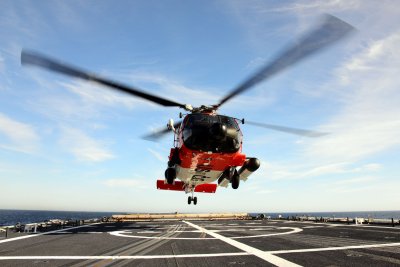
A Coast Guard MH-60 Jayhawk helicopter, like the one seen here, crashed in Alaska on Monday with four people on board. File Photo by Petty Officer 3rd Class Connie Terrell/U.S. Coast Guard/UPI

June 23 (UPI) — All four Coast Guard members aboard a helicopter that crashed in Alaska sustained only minor injuries, the maritime law enforcement agency said.

The Coast Guard MH-60 Jayhawk helicopter crashed Monday morning during a training flight near Harbor Mountain, Sitka, Alaska, the Coast Guard said in a statement.

The first reports of the crash were received at the Arctic District command center shortly after 10 a.m. local time, officials said.

Deployed responders reached the aircraft at about 11 a.m. local time, the Coast Guard said, and were able to transport the helicopter’s four occupants to Mt. Edgecumbe Medical Center.

U.S. Coast Guard Arctic later Monday said that the four Coast Guard members involved in the crash sustained only minor injuries.

“We are incredibly relieved our crew members survived with only minor injuries,” Rear Adm. Bob Little, commander of the Coast Guard’s Arctic District, said in a statement.

“We are grateful for the swift response by the Sitka Fire and Rescue, who assisted us during this critical time.”

In response to the crash, Coast Guard Air Station Kodiak will be repositioning a helicopter and crews to Coast Guard Air Station Sitka to maintain operational readiness in the Southeastern Alaska region, officials said.

The crash is under investigation.

Source link

Driver dies in England train crash, 9 still critical

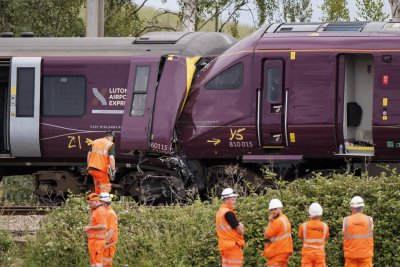
Investigators and police officers work at the scene where two East Midlands Railway trains collided near Bedford, Britain, Friday. A train driver has died and at least 80 people have been injured in the crash. According to the ambulance service 33 of the injured are in a serious condition. Nine are still critical as of Saturday morning. Photo by Tolga Akmen/EPA

June 20 (UPI) — A train driver is dead and nine people are still in critical condition after two passenger trains collided in England.

About 80 people were injured in the crash Friday evening. As of Saturday morning, 28 were still hospitalized after a moving train crashed into a stopped train on the tracks in Bedford, England, north of London.

The National Union of Rail, Maritime and Transport Workers said it was “devastated to learn that a train driver and former RMT rep has tragically died,” The Times of London reported.

Eddie Dempsey, RMT general secretary, wrote on X: “The thoughts of RMT are with their family, friends, colleagues and the ASLEF trade union at this awful time.”

The trains collided in Bedford, one from Corby and the other from Nottingham en route to London St. Pancras.

One passenger told The Times that the scene was “carnage.”

“We had to walk through farmers’ fields to get to an A-road,” he said. “There is a huge emergency service presence and loads of air ambulances.”

Another unidentified passenger told the times that it looked like an explosion.

“The front carriage collided into the front of another one, and when I got up I saw all of the chairs everywhere and it felt like I’d been in a bomb explosion. When I got up I saw people with bloodied faces and people’s legs looked broken, and there was smoke everywhere,” the passenger said.

Passenger Pete Knapp added that he saw smoke in the cabin.

“There was a moment of being flung into the chair in front, and then I saw smoke. People were crying, screaming, people were so scared and confused,” Knapp said.

A helicopter arrived within about 5 or 10 minutes, he added. Emergency services had to cut through a hedge with shears to reach the area, and he said passengers were triaged into different groups based on their injuries.

“I was triaged by some paramedics and they said that I had a muscular damage to my back and the gouges on my shins, they hadn’t broken my legs so hopefully they will heal over time. I’m extremely grateful for that because so many people in that carriage I was in had their legs broken, and there was blood everywhere and people crying and screaming.”

Source link

A founder of Ubisoft, maker of ‘Assassin’s Creed,’ killed in plane crash

A founder of global gaming company Ubisoft, maker of “Assassin’s Creed,” was killed in a plane crash in western France, authorities said Saturday.

Claude Guillemot, co-founder of the company and president of the Guillemot Foundation, died in an accident, Ubisoft said in a statement to the Associated Press. It did not elaborate.

A Cessna plane carrying Guillemot and one other person crashed Friday evening in a field just before landing at La Baule Airport on the Atlantic coast, a La Baule airport official said. The official spoke on condition of anonymity because they were not authorized to be publicly named.

Local media said both people aboard were killed.

Guillemot and four brothers founded Ubisoft in 1986. In addition to the popular “Assassin’s Creed” franchise, Ubisoft’s games include “Just Dance,” and the “Rayman” and Tom Clancy game franchises.

Charlton writes for the Associated Press.

Source link

Brit badly injured in horror Australia motorhome crash

The 28-year-old was on a six-week trip when she was involved in an accident in the motorhome she had hired

A Brit’s dream holiday turned into a nightmare after a horror motorhome crash left her unable to walk. Emma Blood, 28, was travelling in Western Australia when the collision left her trapped, seriously injured and facing a year-long recovery.

The hospitality worker from Milton Keynes had travelled to Australia on March 19, 2026, with plans to spend six weeks exploring. Inspired by stories from other travellers, she teamed up with three women she had met through a travel group and hired a motorhome to travel around and live in while exploring the region.

Just nine days into the trip, on March 29, Emma and the three women were travelling towards Margaret River when she lost control of the motorhome, due to slipping on the Western Australia mud roads, and crashed into a tree. Two passengers suffered minor injuries, but Emma was trapped from the waist down in the wreckage and had to be cut free by firefighters.

She was then airlifted to Perth Trauma Hospital, where she spent 10 days before flying back to the UK to continue her recovery. She said: “There are still a lot of blank spaces in my memory, I’m not sure whether I lost consciousness or whether it’s just a trauma response.

“I recall the moment of impact, when the vehicle struck a tree on the driver’s side where I was sitting. The force of the crash pushed everything forward, and I ended up trapped from the waist down.”

While the other passengers escaped with relatively minor injuries, Emma suffered devastating damage to her leg. One passenger required stitches to her face, and another was left with a bruised finger, but Emma faced a far more serious outcome.

Emergency services were alerted after her phone automatically contacted them following the collision. Upon arrival, a fire crew had to cut Emma free before she was airlifted to Perth Trauma Hospital.

Doctors discovered she had broken her femur in three places. She underwent emergency surgery lasting around six hours, during which surgeons inserted an intramedullary nail – a metal rod fixed inside the bone with six screws to stabilise the fractures.

Emma said: “I remember being in and out of consciousness, having scans and being moved around the hospital. It felt like something out of 24 Hours in A&E or Casualty, being rushed about.

“One of the most difficult moments was definitely standing for the first time after surgery. It was terrifying because I had no control over my leg, at first they thought there could be spinal injuries but it turned out to be okay.”

Complications continued when doctors discovered her haemoglobin levels had dropped dangerously low, resulting in a blood transfusion several days later. Emma spent 10 days in the hospital in Australia before her father flew out to help bring her home.

She said: “I couldn’t have travelled back on my own, I needed someone with me the whole way. If my dad hadn’t come to pick me up, I would have had someone to take me who I didn’t know.”

After arriving back in the UK on April 8, she was admitted to Milton Keynes Hospital for around another week before continuing her recovery at home.

In the early stages of recovery, Emma could not move her injured leg without using a strap around her foot and required assistance with everyday tasks, including showering.

She said: “It felt like I had lost all independence. I have been told a full recovery could take up to a year, but I am making great progress.

“My older brother is helping me, he’s a sports physiotherapist and thanks to him I progressed from a walking frame to two crutches, and now I only rely on one.”

She spends time in the gym every day, rebuilding strength and mobility and recently celebrated a major milestone by getting back behind the wheel of a car.

She said: “Driving again was huge for me, both physically and mentally. Although the accident cut short my dream trip, I will go back to finish it.

“There is still a lot of trauma attached to what happened, but for now, I am going to focus on getting back to my full health and independence.”

Source link

B-52 Involved In Tragic Crash Was Heading Out On Radar Test Sortie

There are so many questions to be answered about what led to yesterday’s fatal mishap involving a B-52H bomber at Edwards Air Force Base. The crash was tragic on a level the base, which sits at the center of America’s flight testing ecosystem, has not experienced, at least to our knowledge, for 75 years. The human impact here is just hard to quantify at this time. At the same time, there will be a major developmental impact, too, especially when it comes to work that is being done to modernize the B-52. This is a constellation of programs that are seen as vital to U.S. national security, and are also already running far behind schedule and over budget.

At this time, we do know that the aircraft in question was being used to support the Radar Modernization Program (RMP), and its loss will have ramifications for that effort. The RMP has already suffered years of delays and major cost growth, the latter of which triggered a deep, legally mandated review. However, in the past year, the U.S. Air Force has been talking more positively about progress on this critical upgrade, as well as other parts of a larger B-52 modernization effort that have faced their own hurdles.

“It was a B-52 that was on initial takeoff, supporting the Radar Modernization Program,” Air Force Col. James Hayes, Deputy Commander of the 412th Test Wing at Edwards, said at a brief press conference yesterday. “It was a local test sortie. It took off, and immediately after takeoff, crashed and burst into flames.”

The 412th is the main unit at Edwards. As noted, the base serves as the Air Force’s main test and evaluation hub.

“After reviewing the footage of the crash, it was deemed that this was an unrecoverable crash and unsurvivable,” Col. Hayes added. The B-52 had “a mixed crew of military, government civilians, and government contractors supporting this test mission.”

“Right now, our thoughts and prayers are with the families of those that lost their loved ones,” he also stressed. “This is a tragedy.”

When reached by TWZ for comment today, Boeing reiterated a brief statement it made yesterday that confirmed two of its employees died in the crash. The company’s full statement is as follows:

“We extend our deepest condolences to the loved ones of the eight crew members who lost their lives in the B-52 crash at Edwards Air Force Base, California. It is with great sadness that we confirm two Boeing employees were among those on board. We are in contact with their families and are offering support.”

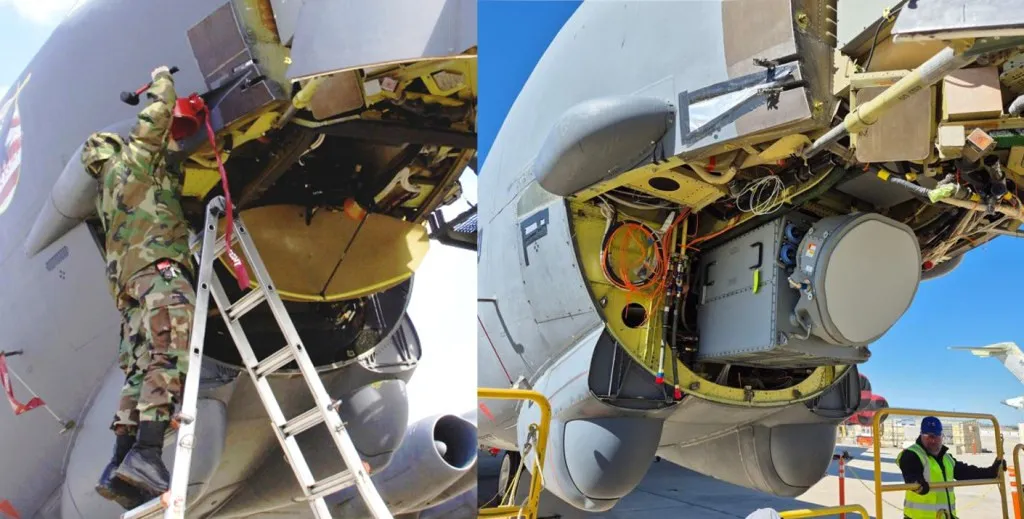
Boeing, the original manufacturer of the B-52, is serving as the prime integrator for the RMP. Raytheon is supplying the new AN/APQ-188 active electronically-scanned array (AESA) radar, which is derived primarily from the AN/APG-79. In the United States, versions of the AN/APG-79 are in service today on U.S. Navy F/A-18E/F Super Hornets and all EA-18G Growlers, as well as U.S. Marine Corps F/A-18A-D Hornets. The AN/APG-82 used on Air Force F-15E Strike Eagles and F-15EX Eagle IIs also builds on the AN/APG-79. The AN/APQ-188 will replace the mechanically-scanned AN/APQ-166 found on B-52s today.

A side-by-side look at the existing AN/APQ-166 radar on a B-52, at left, and the new AN/APQ-188 integrated onto one of the bombers, at right. USAF

The RMP is one of many major upgrades planned for the Air Force’s entire fleet of 76 B-52s in the coming years. The bombers are also set to get all-new engines, improved communication suites, and more. The changes will be so substantial inside and out that the designation of the bombers will switch from B-52H to B-52J in the process.

B-52 Future Stratofortress: The Upgrades That Will Transform The B-52H Into The B-52J thumbnail

B-52 Future Stratofortress: The Upgrades That Will Transform The B-52H Into The B-52J


“It is too early to tell,” a U.S. Air Force official told TWZ today when asked about potential impacts to the RMP.

We have also reached out to Raytheon.

The publicly stated plan for the RMP has called for the integration of the AN/APQ-188 radar onto two B-52s to support initial testing. Modification of those bombers began in Fiscal Year 2023, and the first example with the new radar touched down at Edwards in December 2025. Air Force budget documents say the second radar test B-52 is expected to be ready some time in Fiscal Year 2026, which began on October 1, 2025. Whether that milestone has already been reached is unclear.

The first B-52 equipped with the new AN/APQ-188 radar arrives at Edwards in December 2025. USAF

It is also not known how many AN/APQ-188s may be available at all at present. “The remaining test-phase radars are expected to be delivered through the summer of 2024,” Raytheon said in a press release back in 2023.

As noted, the RMP has already suffered significant delays. Under the original program schedule, flight testing was expected to start in 2024. The initial goal was for AN/APQ-188-equipped B-52s to begin flying operational sorties in 2027. As it stands now, the Engineering and Manufacturing Development (EMD) phase of the program is expected to run into the middle of 2029, with initial operational capability then coming in 2030.

These delays have also come along with substantial cost growth. In 2021, the estimated price tag for development of the AN/APQ-188 and integration of those radars onto the Air Force’s full fleet of 76 B-52s was pegged at nearly $2.4 billion, according to the Government Accountability Office (GAO). By 2023, the RMP’s costs had risen by 12.6 percent, per GAO. The program was eventually subjected to an extensive legally required review of its requirements and cost targets, which led to a scaling back of planned capabilities, at least initially.

“Part of what we did to control cost is to work at what are the main things that we need on this radar? As you may recall, we’re buying a radar that is largely a F-18 Hornet radar with some small modifications. We did that intentionally because that is what was on the market at the time,” Air Force Lt. Gen. Andrew Gebara, Deputy Chief of Staff for Strategic Deterrence and Nuclear Integration, explained in August 2025. “It would actually cost us more if we asked [a contractor] to design the new radar.”

An AN/APG-79 radar installed on an F/A-18 Hornet. Raytheon

Gebara’s remarks came during a virtual talk hosted by the Air & Space Forces Association’s Mitchell Institute for Aerospace Studies.

“Having said that, it doesn’t mean that we need everything on that radar that the Hornet had on it,” he continued. “We have a certain number of minimum things that we need to do to be able to do our B-52 mission. And so part of the cost saving [review] was looking at what are those things, to make sure that we’re prioritizing precious dollars on things that we need.”

Gebara said at that time that the revised RMP plan still kept the door open for “opportunities for growth in the future, if it comes to that.”

The AN/APQ-188 is still set to provide essential new capabilities, in part just by being a more modern AESA design. As TWZ has written in the past:

“In general, AESA radars offer greater range, fidelity, and resistance to countermeasures, as well as the ability to provide better overall general situational awareness, compared to mechanically scanned types. Increasingly advanced AESAs bring additional capabilities, including electronic warfare and communications support.”

“For the B-52, any new multi-mode AESA will improve the bomber’s target acquisition and identification capabilities, including when used together with targeting pods available for the bombers now. New radars for the bombers will also be helpful when it comes to guiding networked weapons over long distances to their targets and could provide a secondary ground moving target indicator (GMTI) and synthetic aperture radar surveillance capabilities. The radar upgrade could help defend B-52s from air-to-air threats, including through improved detection of incoming hostile aircraft.”

A B-52 bomber with its nose open for maintenance. USAF

“Boeing has already looked at some schedule improvement that we’ve seen,” Air Force Gen. Dale White, the service’s Direct Reporting Portfolio Manager for Critical Major Weapon Systems, also told TWZ and others more recently at a roundtable at the Air & Space Forces Association’s (AFA) annual Warfare Symposium in February. White was speaking at the time collectively about progress on the RMP and the Commercial Engine Replacement Program (CERP) for the B-52 fleet.

At that time, Gen. White also highlighted how the relatively small size of the B-52 fleet, combined with the operational demands placed on it, had created additional challenges for modernizing the bombers. The B-52s are in high demand to support conventional combat operations, as underscored by their heavy use in the recent conflict with Iran. A portion of the fleet is also a key element of the air leg of America’s nuclear deterrent triad, which imposes additional hard operational requirements for available aircraft.

“The challenge with B-52 that I think everybody forgets, it’s such a small fleet that has such a tremendous requirement in terms of readiness,” White said. “You’ve got to have a certain number on the ramp. That’s a requirement.”

With the B-52 fleet expected to fly into the 2050s, it is extremely likely that the Air Force will move to regenerate a bomber from storage to replace the one lost yesterday, just to meet general operational demands. That is typically a weeks-long process, at best, for an aircraft of this type and size.

Since 2015, the Air Force has returned two other B-52s to service to make up for losses. One of these aircraft replaced a B-52 that crashed and burned at Andersen Air Force Base on Guam in 2016. The other one took the place of a bomber that was totaled on the ground when an electrical fire broke out during routine maintenance at Barksdale Air Force Base in Louisiana in 2015. Thankfully, there were no fatalities in either of those mishaps.

A B-52H bomber nicknamed “Wise Guy” seen at Tinker Air Force Base in Oklahoma in the process of being regenerated to service back in 2020. USAF

With CERP and the other modernization efforts underway, there is high demand for resources to support B-52 test and evaluation work overall. This is reflected in a nearly tenfold year-over-year increase in the planned budgeting for B-52 test aircraft asset support at Edwards. The Air Force received just over $1.5 million to help pay for “the test aircraft, manpower, Bomber Modular Data Acquisition System (BMDAS), and facilities at the Air Force Test Center” in Fiscal Year 2026, according to official budget documents. The service is now seeking nearly $11 million in this same line item for the next fiscal cycle.

In the meantime, as mentioned, the Air Force has rightfully made clear that its immediate priorities following yesterday’s B-52 crash are engaging with the families of those who perished and working on the investigation, which could take months to complete. Edwards has also at least shut down flight operations today, primarily due to the state of the runway following the mishap.

The full scale and scope of the impacts to the RMP from yesterday’s loss remain to be seen.

Contact the author: joe@twz.com

Joseph is TWZ’s Deputy Editor, helping to oversee the site’s highly experienced and dedicated team, while also writing informative and impactful defense and national security content. He lives right in the thick of it in the Washington, D.C. area.


Source link

Eight believed dead in B-52 crash at Edwards Air Force Base

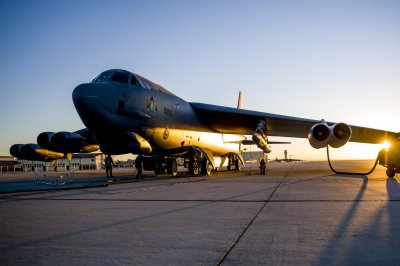
A B-52 Stratofortress assigned to the 419th Flight Test Squadron undergoes pre-flight procedures at Edwards Air Force Base in California in 2020. A B-52 Stratofortress crashed shortly after taking off from the base on Monday. Air Force File Photo by Giancarlo Casem

June 15 (UPI) — California’s Edwards Air Force Base said eight crew members are believed dead following the Monday crash of a B-52 Stratofortress.

The base confirmed the B-52 Stratofortress, which was carrying a crew of eight, crashed shortly after takeoff at 11:20 a.m. Monday morning.

“Initial indications are that the crash was not survivable,” the base said in a release posted to X.

Emergency response personnel were on scene working to account for all eight crew members.

“Our thoughts and prayers are with the families and unit members at this time,” the post said.

The airfield was closed following the crash and all incoming aircraft were diverted.

“All non-commercial visitor passes have been suspended until further notice to allow the installation to focus entirely on emergency response operations,” the base said in an earlier post.

Video captured nearby the base shows a plume of black smoke rising over the Mohave Desert.

Edwards Air Force Base, located about 100 miles north of Los Angeles, frequently hosts test flights for new and experimental Air Force and NASA aircraft.

The base said more information on the crash will be provided as it becomes available.


Source link

Oliver Tree, musician and Santa Cruz native, dies in helicopter crash

Oliver Tree, a genre-defying singer-songwriter and Santa Cruz native, was one of six people killed when two helicopters collided Sunday morning in Brazil, according to the Associated Press. He was 32.

Tree, a quirky artist known for his highly theatrical music videos and crisp bowl cut, had been traveling through South America as a part of his world tour. CNN Brazil reported Argentinian YouTuber Gaspar Prim, also known as Gaspi, was among those killed in the crash.

The mid-air collision occurred in Rio de Janeiro, with one of the helicopters landing in the parking lot of a car dealership, the AP reports. Local authorities have launched an investigation into the cause of the crash.

Tree, born Oliver Tree Nickell, broke out in the electronic music world first performing as, simply, Tree. He released an e.p., “Demons,” in 2013, which included a cover of Radiohead’s “Karma Police.” He later attended CalArts north of Los Angeles, and signed to Atlantic Records for his major-label debut e.p. “Alien Boy” in 2018.

To find his distinct look, he told the Santa Cruz Sentinel that “I was making a statement with it. Everybody’s trying to look so beautiful and sexy nowadays. It was my way of rebelling against that. So, I tried to make myself look as silly and ridiculous as possible.”

Tree was an instant hit on the festival circuit for his outlandish stage productions and outsider charisma, performing at Lollapalooza, Coachella and Outside Lands. He collaborated with Skrillex, David Guetta and Zeds Dead, and was fiercely protective of his meticulously weird visual identity and video concepts, telling Rolling Stone that “That’s kind of my signature. The people who do f- with me know me because of my videos..Music is my day job but my real dream is to be making feature films.

He released his major label debut LP, “Ugly Is Beautiful,” in 2020. His hit song “Life Goes On” and collaboration “Miss You” with German DJ Robin Schulz earned him international recognition and climbed onto the Billboard Hot 100. He released four full length albums as Oliver Tree, most recently April’s independent LP “Love You Madly Hate You Badly.”

Tree had performed in Buenos Aires on June 4.

From July to October, he had shows scheduled throughout Europe, Australia and China. This year, he performed at the Coachella Valley Music and Arts Festival this year as a special guest of electronic producer Subtronics. In one of his last social media posts, he made a point to spotlight an upcoming show on Aug. 9 in his hometown at the Quarry Amphitheater at UC Santa Cruz.

“I can’t believe Oliver is gone,” Schulz posted on Instagram. “You were such a lovely soul and a one of a kind character. Working with you on ‘Miss You’ was an honor. My deepest condolences to his family, friends and everyone who loved him.”


Source link

5 killed in Indian Air Force cargo plane crash during training

Five people died Saturday when an Indian Air Force cargo plane crashed during training. Image courtesy of UPI

June 13 (UPI) — Five Indian Air Force personnel are dead after a transport plane crashed during training in Assam, officials said Saturday.

“The Indian Air Force deeply regrets the loss of five personnel in the An-32 accident at Jorhat, Assam. Sqn Ldr Prashant Singh, Flt Lt Shubham Kumar, Sgt Jitendra Sharma, Agniveervayu Khemaram Kumawat and Agniveervayu Danish Alam made the supreme sacrifice in the line of duty. IAF extends its deepest condolences to the bereaved families and stands firmly with them in this hour of grief,” the Indian Air Force posted on X.

Assam is in the northeastern part of the country.

“Crash site management and initial enquiries are on at this time,” the Air Force said. It added that an investigation to find the cause of the crash is underway.

India’s air force operates a fleet of about 105 AN-32 aircraft, Al Jazeera reported.

President Donald Trump speaks to reporters about restoring commercial fishing access to areas of the Pacific during a signing ceremony in the Oval Office of the White House on Thursday. Photo by Jim Lo Scalzo/UPI | License Photo

Source link

France-Germany jet plans crash: Can Europe end reliance on US for security? | Military

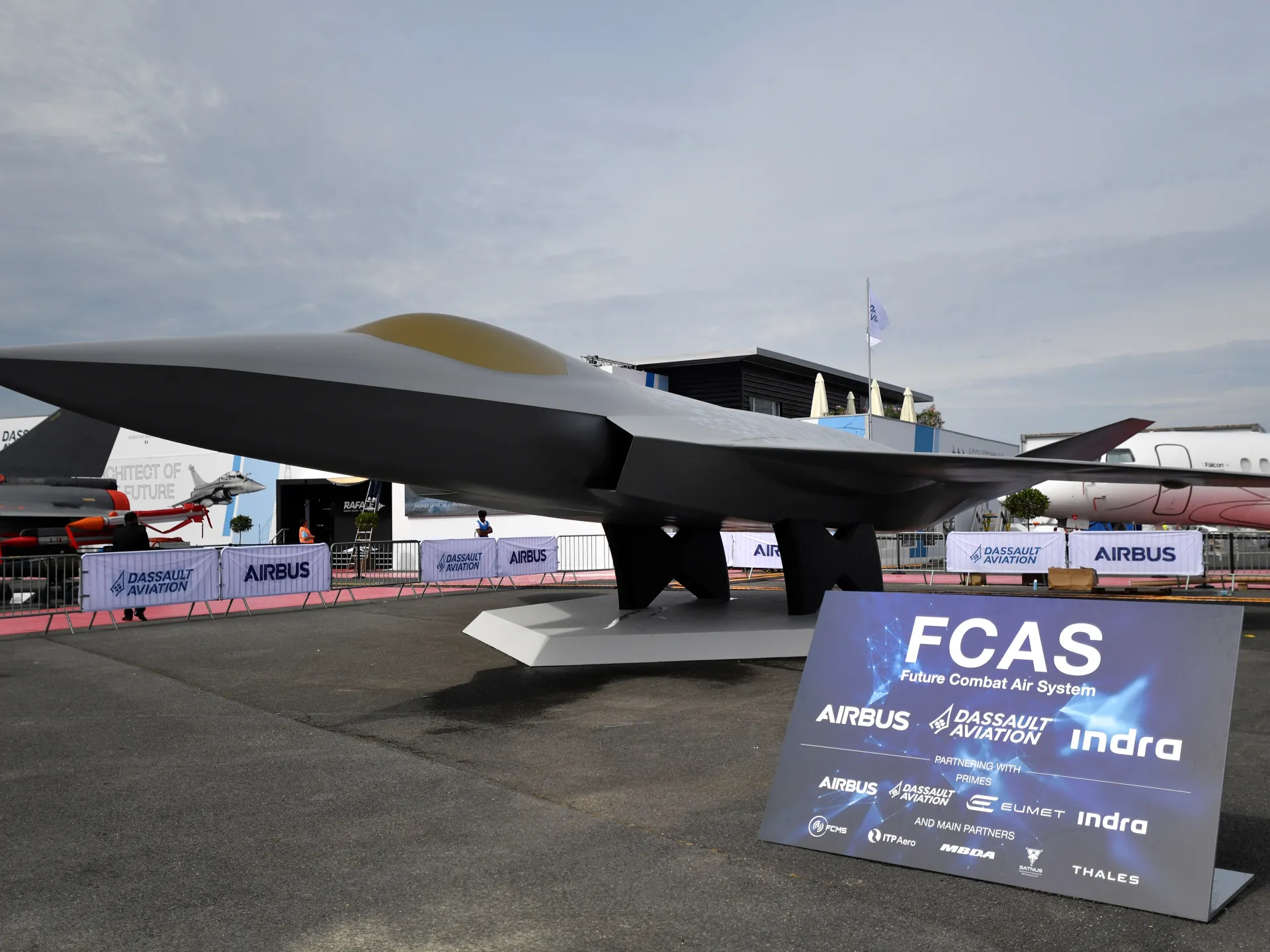
France and Germany have announced this week that they are ditching a landmark project to jointly develop a sixth-generation fighter jet.

French President Emmanuel Macron confirmed on Monday that the project is being terminated, in what is being seen as a major blow to efforts to boost defence cooperation between European Union states, a key issue amid uncertainty cast by United States President Donald Trump over the readiness of the US to help defend its NATO allies.

Recommended Stories

list of 4 itemsend of list

Trump’s disdain for Europe’s reliance on the US has been building for years.

Since 2019, the US president has been flirting with the idea of obtaining Greenland.

His remarks about his desire for the island, a self-governing territory which is part of the Kingdom of Denmark, built to a crescendo at the start of this year, with European leaders signalling their displeasure with the idea and Trump even threatening additional trade tariffs on those countries standing in his way.

Both Denmark and Greenland have repeatedly stated that the island is not for sale.

At one point, before Trump backed down after agreeing to a “framework of a future deal” on Greenland during a January meeting with NATO’s Mark Rutte in Davos, it seemed as if the US might even try to take the island by force – a notion that would have been inconceivable before the era of Donald Trump.

The threat of military action set off alarm bells in European capitals.

In addition to all this, Trump has withdrawn much of the US’s support for Ukraine and has consistently berated his European NATO partners for not spending enough on their own defence for years, outright urging them to reduce their reliance on the US for military protection.

More recently, Europe’s refusal to join the US-Israeli war on Iran, which began with strikes on Tehran on February 28, has further irked the US president and deepened concerns that a widening transatlantic rift could weaken the continent’s security and embolden Russia.

Until this week, a counterweight to these burgeoning concerns was in hand – the Future Combat Air System (FCAS) project, a landmark pact to jointly develop a next-generation fighter jet involving France, Germany and Spain.

But disagreements over whether France’s Dassault Aviation, or Airbus, which also represents Germany and Spain, should take the lead on the project have ultimately led to its collapse.

Analysts, however, say all hope is not lost: despite the dissolution of the bellwether venture, Europeans can indeed become strategically autonomous, they say – but the road there runs through shared military integration, rather than shared political aspiration.

The FCAS hoopla does “highlight the limitation of Europe’s defence industrial landscape, where national needs sometimes clash with the broader goal of defence integration”, Giuseppe Spatafora, a policy analyst at the European Union Institute for Security Studies, told Al Jazeera.

“But we also shouldn’t overestimate its impact.”

Setback, not collapse

According to Jamie Shea, a retired NATO official and associate fellow with the International Security Programme at Chatham House, FCAS’s dissolution is certainly a setback – but does not spell the collapse of European defence integration in its entirety.

“It was the type of high-tech, innovative and future-oriented programme that Europeans need to be able to achieve successfully if they are to become strategically autonomous and break their dependence on the US for major weapons systems,” Shea told Al Jazeera.

It had been hoped that FCAS would move the needle forward, particularly in the areas of artificial intelligence (AI), space, data fusion, and the manned and autonomous systems interface space, he said.

Others would have additionally joined the project as it gained momentum, as Spain did, he added, potentially creating a domino effect in next-generation defence technologies across the continent.

But, crucially, Spatafora said, the project dates back to 2017 – a different era, before Russia’s full-scale war on Ukraine and before Trump’s return to the White House.

“Nowadays, the project might be designed differently to reflect the scenario,” he said.

“But it doesn’t affect the broader trend in Europe towards reducing dependencies on US military systems and strengthening its own defence capabilities.”

France and Germany will continue with some components of FCAS, such as its “combat cloud” feature, which will increase Europe’s cyber command-and-control capabilities, said Spatafora.

Airbus and a number of other German companies are also seeking to continue the programme in other areas, particularly software architecture and drone technology, Shea said.

“So there may be benefits for European defence and its defence technology base even if a manned fighter aircraft is not built,” said Shea.

Furthermore, there are “scores” of other joint defence projects being launched in Europe at the moment, even if they are not quite as ambitious as FCAS, he added.

Guntram Wolff, a senior fellow at the European think tank Bruegel, similarly urged against alarmism.

“I would not interpret this decision overly negatively,” Wolff told Al Jazeera.

“FCAS was a very complicated project and its military relevance may well be overstated at a moment of increasing importance of cheap autonomous systems. In part, the decision also reflects a reassessment of whether the high cost was really warranted.”

Europe, meanwhile, has other strengths it can build on, the analysts said.

The continent is strong in shipbuilding, submarines, short-range missiles and air defence – with systems like the German IRIS-T and the French-Italian SAMP/T – and has demonstrated it can build capable fighter jets, such as the Eurofighter Typhoon, Tornado and Gripen programmes have shown, Shea said.

Lessons and challenges

Europe’s main problem is underinvestment and the difficulty it has in scaling up to the level of mass production that modern warfare demands, said Shea.

This issue was brought into sharp focus this week when the UK’s secretary of state for defence dramatically resigned from government over defence funding.

He simply cannot keep the country safe on what he has been given to spend, he said. In his resignation letter to the prime minister, he wrote: “You have been unable and the Treasury has been unwilling to commit the resources that the nation needs to defend the country at this time of rising threats,” he wrote.

Ultimately, European nations are going to have to come together if they have any hope of matching US military might in the future, analysts say.

“It is the challenge of integrating all systems and all domains into a single battlefield management space where the US is in advance of the Europeans,” Shea said.

“Drones, which Russia and Ukraine are producing in the millions, are a case in point. Even the US suffers from weapons shortages as we have seen in the Iran war,” the former NATO official added.

Spatafora echoed the idea that the Russia-Ukraine war has lessons to offer the rest of Europe.

“The lesson of the war in Ukraine is that, in order to deter and defend itself properly, Europe needs cheap, mass-produced capabilities,” he said.

FCAS was about a very expensive capability, “so it was not really the key need for Europe’s deterrence today”, the analyst said.

The more pressing question that FCAS raises is how European nations will coordinate large projects which single countries cannot produce on their own and which could clash with the interests of numerous national industries. This is the conundrum which will likely shape the design of future EU instruments to support cooperative defence projects, said Spatafora.

Another challenge facing the continent is that major platforms like aircraft, ships or land warfare vehicles can take decades to develop, and contracts signed today will yield equipment that will not be on the battlefield before 2040, Shea said.

Europe will need to upgrade its current capabilities – recent upgrades to the Eurofighter jet and the Leopard tank are examples he cited – and look for gap-fillers elsewhere.

Spatafora argues that the FCAS collapse should not push European countries back towards reliance on American systems – or at least not more than they already have.

“The Trump administration’s approach and the depletion of stock after the Iran war have significantly reduced the reliability of US supplies,” he said.

The reliability of US guarantees, he added, depends on other assets – long-range missiles, forward-deployed troops, command-and-control infrastructure – “rather than on a next-generation fighter jet”, the analyst added.

‘Military requirements’ over ‘political ambition’

The FCAS failure is certainly good news for Russia, Shea said, “and also for the US, which will hope to sell Europe even more F-35s and maintain Europe’s traditional dependency on US military equipment”.

A rebound from the collapsed project, therefore, he argued, is necessary. But that is already in the works, analysts say, as Europe is already turning away from US dependability.

They point to the high likelihood of renewed interest in the UK-Italy-Japan Global Combat Air Programme (GCAP) for a sixth-generation stealth fighter jet, in European Space Agency military space capabilities, and in EU defence financing mechanisms like the Security Action for Europe (SAFE).

Joint ventures with Ukraine, which, under fire from Russia for four years, has mastered mass production of drone technology and AI, should also help keep Europe up to speed in key areas, Shea added.

“The US has proven to be unreliable, or simply unable to remain committed to Europe, and the defence budgets are growing,” Spatfora said.

Washington will continue to remain relevant for certain capabilities – nuclear deterrence above all – but over time, European countries will seek to develop more and more on their own.

The ultimate lesson of FCAS, however, Shea argued, is that defence integration “has to be driven by military requirements rather than political ambition”.

Cooperation between France and Germany has always been difficult, he said – they have large defence companies “that do not want to play second fiddle to the other”, he said.

A more promising model, he said, is the joint UK-Norway agreement to produce a new destroyer-class warship, with BAE Systems as the main contractor and smaller Norwegian companies participating.

“Both countries operate in the North Atlantic and the Baltic Sea and share exactly the same concept of what the ship should be,” explained Shea.

“So it is this model of bottom-up, natural cooperation rather than top-down political cooperation that Europe needs to pursue.”
Source link

A year after Air India crash killed 260: Do we know what happened? | Aviation News

Friday marks one year since a deadly Air India Boeing crash, which killed 260 people in a densely populated suburb of the city of Ahmedabad in India’s western state of Gujarat.

Families of those killed gathered at the site on Friday to mark the anniversary of the disaster, but they are still waiting for answers about what caused the plane to come down shortly after takeoff from the nearby airport.

Indian authorities are expected to issue an interim report in the coming days, another source of frustration for the victims’ relatives, who had been hoping for a definitive finding and a final disclosure. Media reports, citing unnamed sources, suggest that Indian investigators will delay issuing a final report into the crash, citing the need to complete an analysis of the plane’s engines.

Under international aviation rules, a final report is due “if possible” within a year of an accident. If an investigation goes on for longer, an interim statement should be issued on each anniversary.

What happened to the Air India plane?

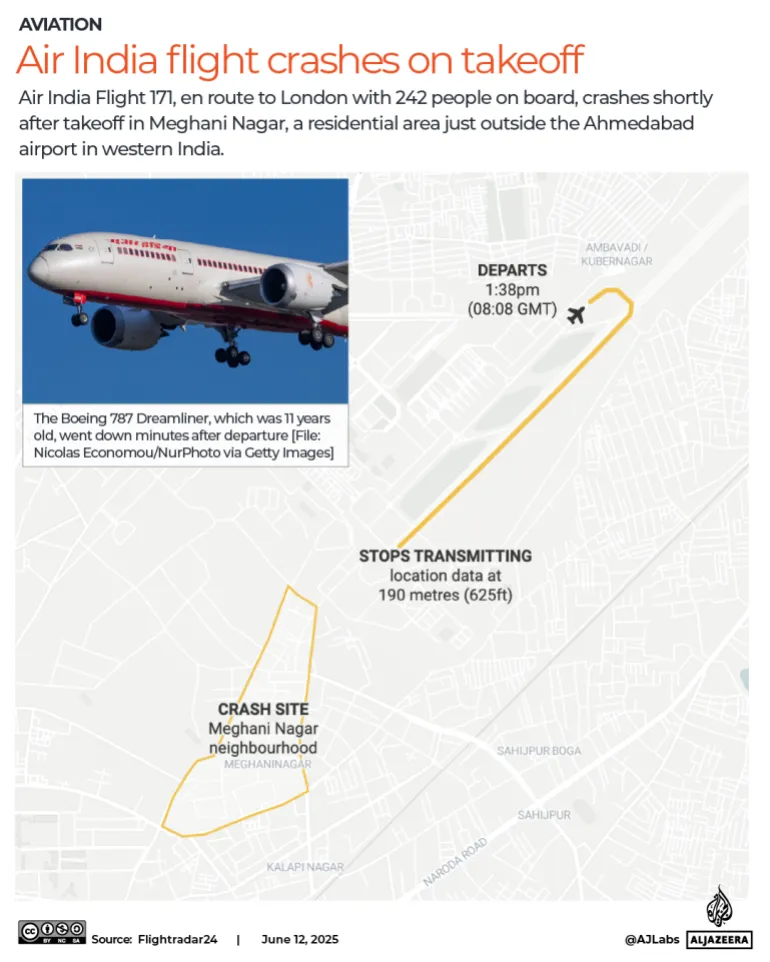
Flight AI171, an Air India Boeing 787 Dreamliner plane which had taken off only moments before, en route to London Gatwick, crashed into a medical college hostel in the residential area of Meghani Nagar, close to the international airport on the edge of India’s western city of Ahmedabad.

According to flight tracking website Flightradar24, the plane’s final signal was received seconds after takeoff at 1:38pm local time (08:08 GMT). It had reached an altitude of 625 feet (190 metres) before crashing back to the ground outside the airport.

The plane had issued a mayday alert to air traffic control just before all communications from the aircraft ceased.

INTERACTIVE - Air India flight crash-1749728651
(Al Jazeera)

How many people died in the crash?

Of the 242 people on board, all except one passenger were killed. These included 169 Indian nationals and 52 British nationals. A total of 260 people died, as 19 people on the ground close to the crash site were also killed. Another 67 people near the site were injured.

The sole survivor on board the plane, Vishwash Kumar Ramesh, is a British national whose brother was killed in the crash.

On Thursday, Ramesh’s representative, Sanjiv Patel, told the UK’s Guardian newspaper that Air India had paid £21,500 ($28,800) in compensation to Ramesh to help support his wife and their five-year-old son. It is not clear whether similar payments have been made to other families.

Relatives of the victims are meeting on Friday at a conference organised by lawyers, along with aviation and air safety experts, in Ahmedabad. They are due to hold a candlelight vigil after sunset.

Officials inspect the site of an airplane crash near Sardar Vallabhbhai Patel International Airport in Ahmedabad, Gujarat, western India, 13 June 2025. [Rajat Gupta/EPA-EFE/
Officials inspect the site of the crash near Sardar Vallabhbhai Patel International Airport in Ahmedabad, Gujarat, western India, on June 13, 2025. Air India flight AI171, bound for London, carrying 242 passengers and crew members, crashed minutes after takeoff in the Meghani Nagar area of Ahmedabad [Rajat Gupta/EPA]

What have preliminary reports shown?

This was the world’s first airliner crash involving a 787 Dreamliner, a Boeing model that has been in service since 2011.

In accordance with international aviation law, India’s Aircraft Accident Investigation Bureau (AAIB) published a preliminary report one month after the disaster.

That 15-page document said the fuel supply to the jet’s engines had been cut off moments before the crash, raising questions about possible pilot error.

It also published a conversation between the captain and his copilot about the fuel supply being cut off – two brief sentences that prompted theories of pilot suicide.

The report was met with strong criticism.

It did not state why the fuel switches were turned off – whether it was the fault of a pilot, or a result of a malfunction.

The preliminary report did not make any safety recommendations to Boeing or engine maker GE Aerospace, suggesting no technical issues had been discovered.

The crash also hit Air India at a sensitive stage of its post-privatisation turnaround, which has been slowed by supply-chain snags, an airspace ban imposed by Pakistan on Indian carriers and, more recently, the US-Israeli war on Iran.

What’s the latest on the investigation?

Under international rules, a final report is due “if possible” within a year of an accident, but sometimes investigations take longer. If it cannot be completed, therefore, an interim statement should be issued on each anniversary. With investigations continuing, the AAIB is expected to issue only an interim report at this stage.

The Federation of Indian Pilots union has been pushing for investigators to seek more technical data about the plane from Boeing and Air India to allow for a “rebuttal of the pilot suicide theory being explored by the AAIB”.

“It [an interim report only] will cause more speculation and more misunderstanding,” Charanvir Randhawa, the union’s president, told reporters at a packed news conference in Ahmedabad ahead of the anniversary of the crash.

“We have requested the Indian government and India’s Aircraft Accident Investigation Bureau (AAIB) not to come out with any interim report.”

A cockpit recording of dialogue between the two pilots of the Air India 787 before it crashed supported the view that the captain cut the flow of fuel to its engines, according to US officials’ early assessment reported by Reuters last year.

But the AAIB said at the time it was “too early to reach any definite conclusions”.

Investigators conducted engine testing in April and visited France last month as part of their analysis of the engine management unit, a source told Reuters on the condition of anonymity, as the information is not public.

On Thursday, Bloomberg also reported that the final report into the crash can be expected within three months, once studies of the engines, which had been sent to the US for examination, are concluded.

The captain’s father has asked India’s top court to order an independent investigation that examines possible causes other than deliberate pilot action – a cause that has been suspected in some other fatal crashes and was confirmed in the case of Germanwings Flight 9525, which crashed into the French Alps in 2015, killing all 150 people on board.

Source link

U.S. says it has launched strikes against Iran following crash of Army Apache helicopter

The U.S. military said Tuesday it has begun strikes against Iran following the crash of a U.S. Army Apache helicopter off the coast of Oman that President Trump blamed on the Islamic Republic.

In a statement posted to social media, U.S. Central Command said the strikes would be “a proportional response to unjustified Iranian aggression.” It comes after Trump blamed Iran for downing the helicopter and vowed that the U.S. would respond.

Iranian state media reported that explosions were heard on an Iranian island in the Strait of Hormuz.

Trump had blamed Iran for shooting down a helicopter close to the Strait of Hormuz and said the United States must respond. Iran’s top diplomat said foreign military forces near the country’s territory “are at constant risk.”

The Apache helicopter that crashed went down after colliding with an Iranian drone, according to a U.S. official, who spoke on condition of anonymity to discuss an ongoing investigation.

It wasn’t clear whether the collision was intentional, and official statements only said the crash is under investigation. CNN, CBS News and other outlets earlier reported the Iranian drone collision.

Trump said Iran shot down the aircraft while it was on patrol over the Strait of Hormuz and declared that the U.S. “must, of necessity, respond to this attack,” in a post to social media.

The U.S. military later announced that it had begun strikes against Iran.

In the first known operation of its kind by the American military, a drone boat rescued the two aviators who were aboard the Apache attack helicopter when it went down near the critical shipping lane that Iran has effectively closed during its war with the U.S. and Israel.

Trump said in a social media post that military officials told him “the Iranians shot down one of our highly sophisticated Apache Helicopters.” Both service members “are safe and uninjured,” he added.

“Nevertheless, the United States must, of necessity, respond to this attack,” Trump wrote.

A woman walks past a mural depicting a U.S. aircraft carrier under missile attack

A woman walks past a mural depicting a U.S. aircraft carrier under missile attack in downtown Tehran, Iran on Monday.

(Vahid Salemi / Associated Press)

Soon after Trump made his accusation, Iranian Foreign Minister Seyed Abbas Araghchi said in a social media post that the strait is “thousands of miles away from U.S. shores.”

“Foreign forces in proximity to our territory are at constant risk on account of their own human errors, plain accidents, or potentially being caught in crossfire,” Araghchi wrote. “To reduce risk, best solution is for them to leave.”

The downing of the helicopter further strained a two-month ceasefire a day after Iran and Israel exchanged fire for the first time since the fragile truce took effect. Iranian state television said Tuesday that the Israeli attacks killed at least two members of the country’s air-defense units.

Since the U.S. and Israel began striking Iran on Feb. 28, the war has shaken the global economy, driven up energy prices around the world and made many basics, including food, more expensive.

Officials have been unable to turn the April ceasefire into a deal to permanently end the conflict, particularly as Israel intensifies and expands its military campaign in Lebanon against the Iranian-backed militia Hezbollah.

Army crew members picked up by drone boat

The Army aviators were rescued at 3:30 a.m. local time Tuesday, about two hours after their helicopter went down during a patrol off the coast of Oman, U.S. Central Command said.

The U.S. service members were spotted and picked up by a drone boat that took them to another location on the water, where they were picked up by a helicopter, said Capt. Tim Hawkins, a spokesman for U.S. Central Command. Hawkins initially said the drone took the two to shore, and he did not elaborate on the updated timeline.

It was the first known drone rescue at sea by the U.S. military, Hawkins said.

AH-64 Apache helicopters have been a key asset for the American military as it enforces a blockade on Iranian crude oil shipments and tankers, seeking to pressure Tehran into a deal. The helicopters have also been used by the United Arab Emirates to shoot down Iranian drones.

The drone used to perform the rescue was a 24-foot vessel called a Corsair, Hawkins said. It’s manufactured by Saronic Technologies.

The drone was assigned to the Navy’s Task Force 59, established in 2021 as the Navy’s first uncrewed and artificial intelligence unit that focuses on maritime security in the Middle East, including the Strait of Hormuz and the Suez Canal.

Trump insists an Iran deal is coming

Before he accused Iran of downing the U.S. helicopter, Trump had expressed renewed optimism over negotiations with Iran.

“We have a good chance” of signing a deal in “two or three days,” Trump said late Monday. But he did not provide any details on why there was reason for new optimism. In the two months since the U.S. and Iran agreed to an initial ceasefire, Trump has repeatedly predicted that a deal is near.

“We’re very close to having a very, very good, strong, powerful deal,” the president said.

Mediators, led predominantly by Pakistan, have been trying for weeks to get a deal across the line. However, both Iran and the U.S. have taken hard-line positions.

The U.S. wants to see Iran give up its stockpile of highly enriched uranium, which is believed to be entombed in the aftermath of American airstrikes that happened during the 12-day war in 2025. But Iran is refusing that and demanding relief from sanctions. It also wants the release of frozen assets even before a final agreement is in place, something rejected by Trump.

Before Trump’s comments on negotiations, Qalibaf said Monday that Trump’s remarks so far on a possible deal “contradicted the agreed-upon sections,” showing that the U.S. is “neither seeking a ceasefire nor dialogue.”

The continued fighting between Israel and Hezbollah is still a top Iranian priority as well. Lebanon’s army chief, Gen. Rodolphe Haykal, traveled to Pakistan on Tuesday. There, he met Pakistan’s army chief, Field Marshal Asim Munir, who has been a key figure in the Iran-U.S. talks.

Haykal’s visit comes as Lebanon’s government takes an increasingly hard line on Hezbollah but remains unable to disarm the powerful militia. Hezbollah thanked Iran on Tuesday for attacking Israel “in defense of our Lebanese people,” suggesting that Lebanon’s government should take this opportunity to improve relations with Tehran.

Israel issues a warning for Tyre, Lebanon

Meanwhile, the Israeli military issued an evacuation warning for Lebanon’s southern port city of Tyre, including the Christian quarter, which has so far been spared from airstrikes on the city.

Last week, Israel warned the Christian neighborhoods in Tyre that it believed Hezbollah members were among them. Many Lebanese Shiite Muslims fled to those areas as Israeli strikes hammered the Mediterranean coastal area over the past two weeks.

After last week’s warning, the Lebanese army deployed to the Christian district of Tyre in an effort to prevent Israeli attacks there and to show that Hezbollah has no armed presence in the area. But Avichay Adraee, the Israeli military’s Arabic-language spokesperson, posted on X on Monday that the Israeli military “will have to act against their terrorist activities in the neighborhood soon.”

Gambrell, Superville and Toropin write for the Associated Press. Superville and Toropin reported from Washington. AP writers Michelle L. Price in New York, Will Weissert in Washington, Bassem Mroue in Beirut, Munir Ahmed in Islamabad and Russ Bynum in Savannah, Ga., contributed to this report.

Source link

European ghost village abandoned for 40 years after tragic plane crash

This once charming village has been abandoned since a tragic accident decades ago.

Just a stone’s throw from one of the world’s most bustling capital cities lies a town that has been eerily silent for four decades, deserted by all those who once made it their home. Goussainville-Vieux Pays sits roughly half an hour’s drive north of Paris, and once upon a time, it was the picture of a quintessential French village.

Yet as the world moved on, a cruel twist of fate consigned Goussainville-Vieux Pays to history. The beginning of the end for this charming French settlement was the scene of a harrowing disaster

In 1973, a Russian aircraft had been performing aerobatic manoeuvres at the Paris Airshow when it stalled at low altitude and came crashing down.

The plane plummeted into the village, claiming 14 lives – including six crew members .

The wreckage obliterated 15 homes and the local school.

In the wake of the devastating incident, the village desperately tried to rebuild, but fate dealt another cruel blow.

The very next year, in 1974, Charles de Gaulle Airport opened its doors, placing Goussainville squarely beneath the flight path of one of Europe’s busiest airports.

The relentless roar of overhead aircraft proved not only an unbearable disruption for local residents, but served as a constant and harrowing reminder of the tragedy that had torn through their community just a year before, reports the Express.

Most villagers simply upped and left, many without even bothering to sell their properties.

The airport was subsequently compelled to purchase more than 100 of the deserted homes and pledged to maintain them.

Sadly, those houses have since been left to crumble.

Among the most arresting sights in this abandoned village are the crumbling remains of a sprawling old manor house, set within an overgrown and neglected garden.

Graffiti has spread across the settlement, and nowadays its only genuine signs of life are inquisitive tourists arriving to catch a glimpse of the village that time forgot.

Source link

When did the Mackenzie Shirilla crash happen?

True crime fans are eager to learn more about the case explored in Netflix’s The Crash

Netflix fans are still hooked on the chilling case of Mackenzie Shirilla.

The inmate’s story is explored in viral documentary The Crash, which takes viewers through the tragedy that put Mackenzie behind bars.

Mackenzie was just 17 years old when she crashed her car into a brick wall at 100mph. Passengers Dominic Russo, 20, and Davion Flanagan, 19, sadly died at the scene. The driver survived, but she was left seriously injured.

What originally seemed like a devastating accident, though, soon turned into a murder investigation.

During a trial in 2023, prosecutors argued that Mackenzie intentionally crashed the car, ultimately killing her then-boyfriend Dominic and their friend Davion.

The teenager was later found guilty on all counts and received two 15-to-life sentences with the possibility parole.

While the documentary offers an in-depth look at the case and trial, fans have been left wondering when exactly the crime took place.

When did the Mackenzie Shirilla crash happen?

Mackenzie crashed her vehicle into a brick wall in the early hours of July 31, 2022.

Her bench trial, which means a trial ruled by a judge instead of a jury, took place a year later. She was found guilty on all counts on August 14, 2023 and later handed two consecutive 15-year sentences. She will not be eligible for parole until 2037.

The documentary explores Mackenzie’s relationship with the victims, as well as her wider friendship circle. Viewers also hear from her loved ones as they try to paint a picture of the days leading up to the tragedy.

Get Netflix free with Sky

This article contains affiliate links, we will receive a commission on any sales we generate from it. Learn more
Content Image

£5.99

£0

Sky

Get the deal here

Sky is giving away a free Netflix subscription with its new Sky Stream TV bundles, including the £15 Essential TV plan.

This lets members watch live and on-demand TV content without a satellite dish or aerial and includes hit shows like Stranger Things and The Last of Us.

Netflix’s synospsis states: “A car carrying three young adults slams into a brick building at 100 miles per hour in Strongsville, Ohio, leaving two lives lost and one sole survivor. The driver, 17-year-old Mackenzie Shirilla, was driving her boyfriend, Dom, and his friend, Davion, home from a party when the unthinkable happened.

“But as detectives comb through the wreckage, what first appears to be a tragic accident begins to look like a calculated crime scene. The Crash takes a deep dive into the volatile relationship at the centre, examining the shifting narratives of that fateful night to explore where a fatal mistake ends and cold-blooded murder begins.”
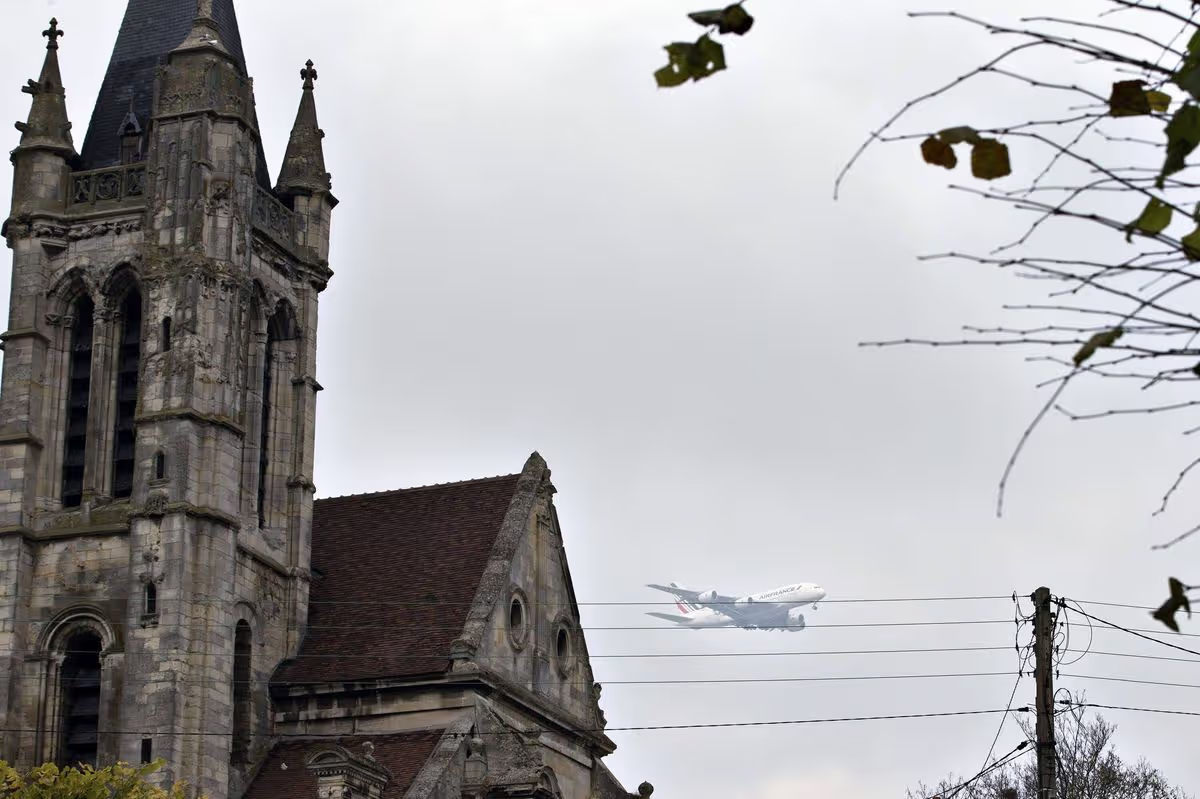
The Crash is streaming on Netflix

Source link