The statistics are sobering — so sobering that Defense Department officials refuse to confirm, deny or discuss them.
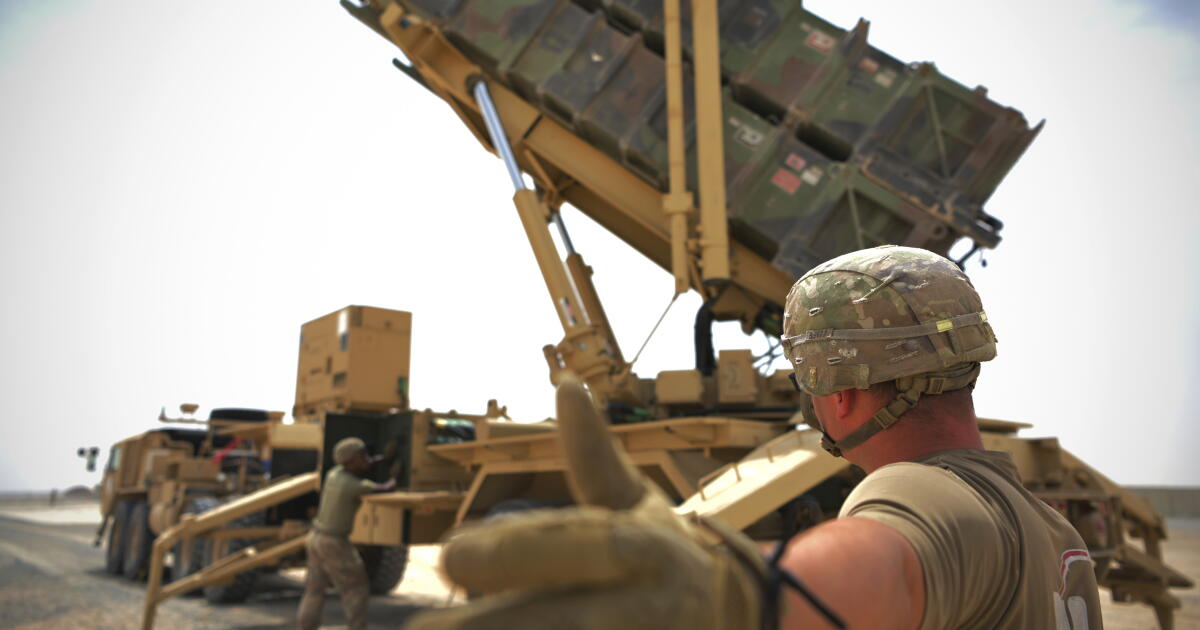
From Feb. 28 through July, the first five months of the war with Iraq, U.S. forces burned through almost 60% of the nation’s advanced defensive missiles — the Patriot and THAAD interceptors that protect American troops.
When the war began, the Pentagon had almost 2,800 Patriot and THAAD missiles in its worldwide inventory, according to a study by the Center for Strategic and International Studies, an independent think tank. By the end of July, that number had dropped to about 1,100, CSIS reported. Almost two-thirds of the Patriots and almost 40% of the longer-range THAAD were gone.
“This is a generational annihilation of our theater missile defense capability,” said Tom Karako, director of CSIS’s Missile Defense Project. “There’s no way you can look at this and not see it’s a setback.”
The White House and the Pentagon have not challenged the CSIS figures, although they have issued sweeping denials that any shortage exists.
“We have far more munitions than anyone in the world, and far more than we need,” President Trump said in July.
That’s true, but misleading. The U.S. military still holds vast inventories of short-range offensive missiles. But the sophisticated defensive missiles that protect U.S. troops no longer are abundant — as even Trump has acknowledged.
“We have certain types of munitions [of which] we have unlimited, virtual unlimited supply,” he said last month. “We have others where it’s a little bit tighter.”
The result is a squeeze that has prompted U.S. commanders to husband Patriot and THAAD interceptors as scarce assets.
For much of August, when a frayed de facto ceasefire was in effect, U.S. forces did not respond with high-end missiles when Iran attacked oil tankers in the Strait of Hormuz.
But when Iran launched rockets against U.S. bases in Jordan last week, Patriots reportedly were used to knock the incoming missiles down. (The Pentagon has declined to confirm or deny those reports.)
The U.S. weapons arsenal “no longer has the capacity to deter a Chinese attack against Taiwan,” the Council on Foreign Relations warned in a report last month. Defense planners share the same concern over a potential Russian assault on the Baltic states.
The conservative Heritage Foundation has forecast that the Pentagon’s inventory of missiles would run out “within the first week of a Taiwan conflict.”
In Europe, a U.S. defense official told the Associated Press last month that the shortfall was “beyond critical.” If Russia attacked a NATO country, the official said, U.S. forces in the area would “take punch after punch in the mouth.”
The core question is whether the United States has so few missiles that it cannot credibly deter China or Russia from attacking their neighbors.
“You’ve got to be strong enough to send a clear message that our enemies should not try anything because we’re a credible force,” said Leon Panetta, President Obama’s former defense secretary. “Now we’re losing a lot of that credibility — and that’s dangerous.”
Knowing that U.S. forces have been left without thousands of weapons needed to deter conflict, Karako said, could in itself be provocative. “It could tempt an aggressor to do something, knowing that we have fewer [missiles] to thwart them.”
The obvious remedy is to build more interceptors — a process Trump and Defense Secretary Pete Hegseth ordered even before the war began. But ramping up missile production won’t immediately replenish the stockpile.
Before the Iran war, defense contractors were producing only about 620 Patriots and 96 THAAD each year — fewer than half the number expended during a few weeks this spring.
At current production rates, it will take at least three years to return the Patriot inventory to its prewar level, and at least four years for THAAD, CSIS reported.
Defense experts warn that the stocks need to be even larger than they were before the war to credibly deter China or Russia.
Mark Cancian, a retired Marine colonel and principal author of the CSIS estimates, says most analysts believe it will take years after replenishing the stocks expended in the Persian Gulf to build a credible deterrent against China.
The Pentagon has enough munitions, both offensive and defensive, to continue fighting the campaign against Iran, he added — but some of those less-sophisticated weapons can be used only at shorter ranges, which means placing more troops in harm’s way.
Cancian said the CSIS figures were based on publicly available Pentagon budget and acquisition documents, updated in some cases from recent press reports — but not from leaks of classified information.
The roots of the missile shortage began long before the war with Iran. Trump and Hegseth are not the only ones to blame, although their belief that Iran would quickly capitulate appears to have been a major factor.
Nor did former President Biden cause the shortage, as Trump has claimed Biden gave several hundred Patriots to Ukraine, but the shortfall is far larger than that.
The underlying problem, defense experts say, is that the United States designed its missile defense programs for a world in which only a few major powers like China and Russia posed serious threats.
But the landscape of military technology has changed. Missiles and drones have become cheaper and easier to acquire, and countries like Iran can strike targets at great distances without making a huge investment in weaponry.
That’s a transformational change — and the Pentagon has been behind the curve, argues Michael C. Horowitz, a senior fellow at the Council on Foreign Relations. “This is the kind of situation in which great-power militaries like the United States struggle,” he said.
So the Trump administration faces several challenges. It needs to replenish its depleted stores of advanced defensive missiles — a process that has only just begun, and which Congress has not yet funded. Meanwhile, Horowitz and others argue, it also needs to build less expensive missile and drone systems to fill the multiyear gap before Patriot and THAAD inventories can be restored.
The Pentagon has begun that process, deploying several relatively inexpensive anti-drone missile systems.
Trump’s One Big Beautiful Bill Act last year included $7.7 billion for low-cost missile and drone programs, but 13 months later, more than 90% of the money remains unspent, Horowitz said.
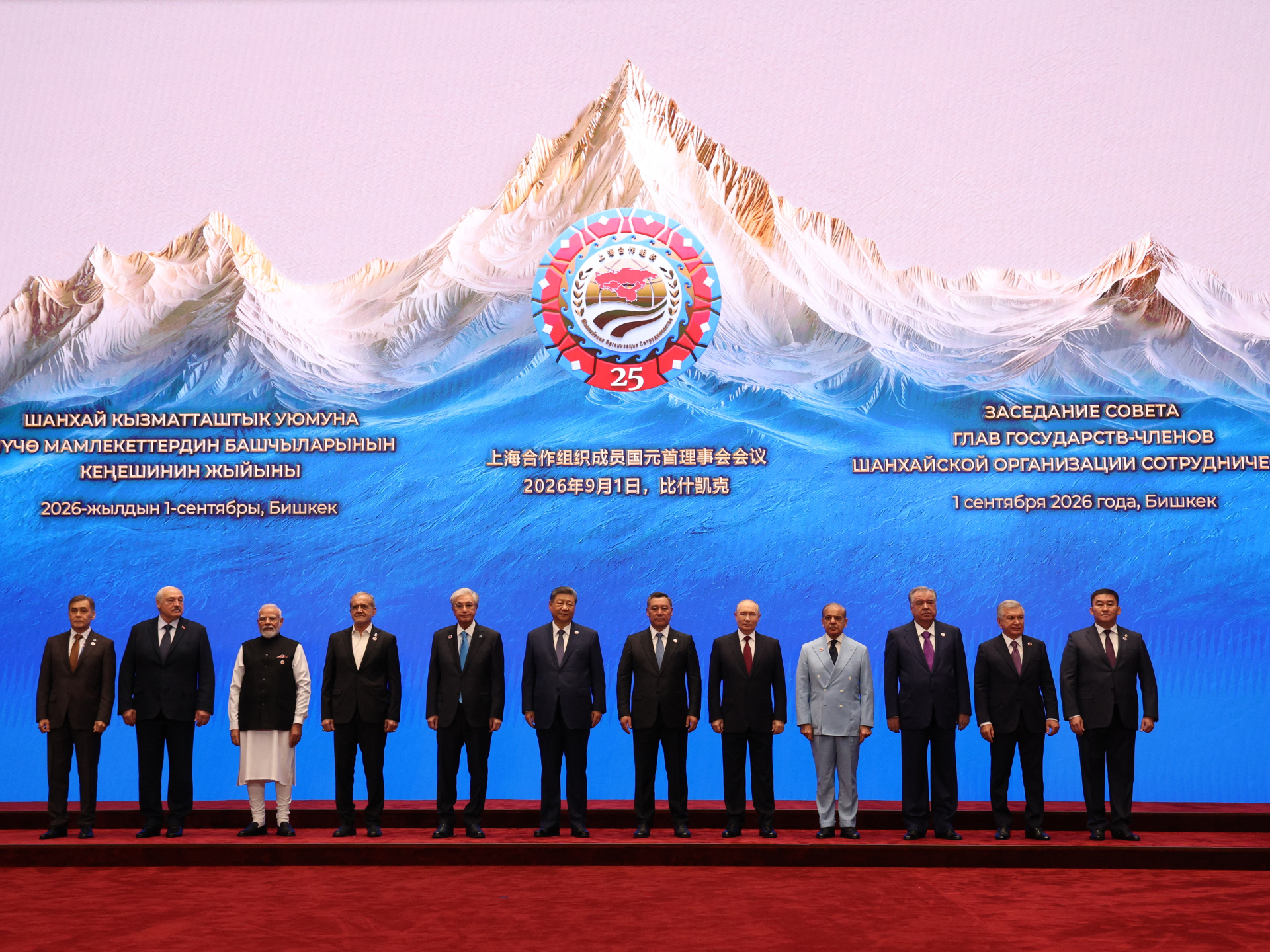
At the Shanghai Cooperation Organisation (SCO) summit in Bishkek this week, Iranian President Masoud Pezeshkian received precisely the kind of political support he had hoped for. The SCO condemned the military attacks against Iran, described them as violations of international law and the UN Charter, reaffirmed Iranian sovereignty and territorial integrity, and called for the conflict to be resolved through political and diplomatic means.
But the organisation did not offer to defend Iran. That distinction between political solidarity and collective defence is important. It tells us something not only about the Iranian experience with the SCO, but about the international order that is emerging around it.
For years, discussions about multipolarity have often suggested that the US-led international system would gradually be challenged by an alternative bloc centred around China, Russia and organisations such as BRICS and the SCO. From the perspective of middle powers, joining both institutions seemed to fit neatly into this transformation. Integration into non-Western organisations was supposed to make them less vulnerable to Western isolation and pressure.
The US-Israeli war on Iran has made clear that none of these alternative relationships can produce a security guarantee comparable to those provided by formal military alliances. The lesson is not that multipolarity has failed middle powers. It is that the emerging multipolar order may work differently from what many expected.
Rather than replacing one alliance system with another, it is producing an increasingly dense network of overlapping partnerships in which states gain diplomatic and economic options without necessarily acquiring new security guarantees.
For middle powers, this may be one of the defining characteristics of the emerging order: more room for manoeuvre, but less certainty about who will stand beside them when their security is threatened.
Turkiye provides a particularly revealing example. It has been a member of NATO for more than seven decades and remains embedded in the Western security architecture. Yet Ankara has increasingly demonstrated that alliance membership does not require automatic political alignment with Washington. Turkiye has maintained relations with Russia despite the war in Ukraine, expanded its engagement with China and participated in the SCO as a dialogue partner. At the same time, its differences with the US and Israel over the future regional order in the Middle East have become increasingly visible.
This does not mean Turkiye is abandoning NATO or moving into a Chinese- or Russian-led bloc. Quite the opposite. Ankara’s strategy depends precisely on avoiding such a binary choice. Its NATO membership provides security benefits that the SCO could not replicate. Its relationships with Russia, China, Iran, the Gulf states and other regional actors, meanwhile, expand its diplomatic and economic options.
Brazil represents another good example. Unlike Turkiye, Brazil is not bound to the US through a formal military alliance. But it has traditionally operated within a US-dominated hemisphere where Washington has expected considerable political alignment from regional governments.
Brazil’s refusal to join the US-led Americas Counter-Cartel Coalition (ACCC), together with its positions on the Iran war and other recent international crises, reflects its reluctance to accept that regional proximity should translate into automatic strategic alignment.
Yet Brazil is not simply switching sides. Its participation in BRICS, its extensive economic relationship with China and its calls for reform of the international system coexist with important political and economic relations with the US and Europe. Brasília’s objective is not to exchange dependence on Washington for dependence on Beijing, but to preserve the ability to cooperate with both, and disagree with either.
This may be one of the most consequential opportunities that multipolarity offers middle powers. The rise of alternative centres of economic and political influence reduces the cost of saying no. For decades, weaker states often confronted a difficult choice when facing pressure from a dominant power: comply, resist and risk isolation, or seek protection from a rival bloc.
The proliferation of partners and institutions complicates that calculation. A government that disagrees with Washington may deepen relations with Beijing without becoming a Chinese ally. A state dependent on China economically may strengthen security ties with the US without fully aligning with Washington. Membership in BRICS does not prevent cooperation with Western institutions, just as membership in a US-led security framework does not necessarily preclude engagement with China or Russia.
India has made this logic almost an organising principle of its foreign policy. New Delhi participates in the Quad with the US, Japan and Australia while simultaneously belonging to both BRICS and the SCO. At Bishkek, India supported the SCO declaration defending Iranian sovereignty while Prime Minister Narendra Modi also stressed to Pezeshkian the importance of preserving freedom of navigation and commerce through the Strait of Hormuz.
The Gulf Cooperation Council member states are pursuing their own version of this diversification. Saudi Arabia, Qatar and the United Arab Emirates, for example, continue to depend heavily on their relationships with the US for security, while simultaneously expanding economic and diplomatic ties with China, India and other Asian powers and participating in new regional and international arrangements.
None appears eager to replace Washington with Beijing. They want relationships with both. This suggests that the most significant consequence of multipolarity for middle and smaller powers may not be the emergence of a new bloc to which they can attach themselves. It may be the declining necessity of attaching themselves exclusively to any bloc at all.
But greater autonomy comes with a cost. The same flexible arrangements that allow states to avoid choosing sides also provide fewer guarantees when crises become existential. BRICS does not have an Article 5. Neither does the SCO, which explicitly defines itself as a non-military organisation.
Strategic partnerships can provide weapons, investment, diplomatic backing and political support without obligating partners to go to war for one another.
The emerging international system is therefore unlikely to resemble a simple transition from a US-led order to a Chinese-led one, or even a confrontation between two clearly defined blocs. The older alliance system is not disappearing.
NATO remains central to European and Turkish security, while US security relationships remain indispensable across much of Asia and the Gulf. What is emerging alongside it is another layer, a more fluid landscape of overlapping institutions, selective partnerships and transactional relationships.
Multipolarity, in other words, may not require states to choose a new camp. That gives middle and smaller powers greater agency. But it also places greater responsibility for their own security upon them. The world they are entering may offer more partners, more bargaining power and more freedom to say no. What it may offer less frequently is certainty about who will say yes when they ask for protection.
The views expressed in this article are the author’s own and do not necessarily reflect Al Jazeera’s editorial stance.
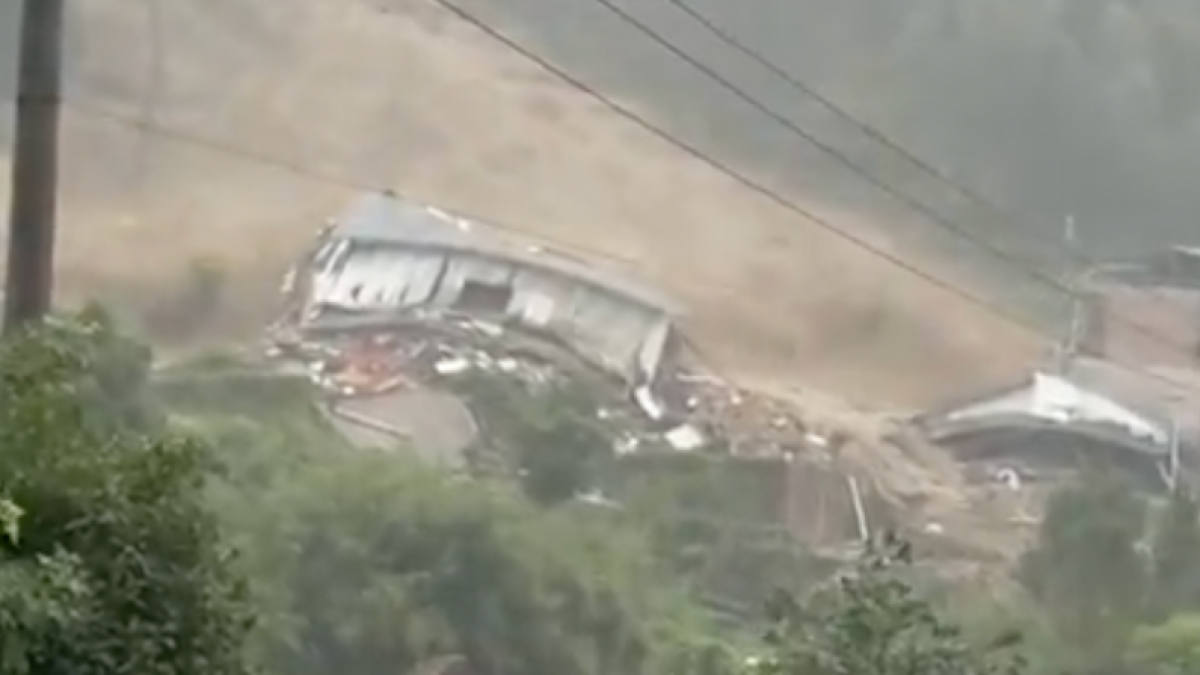
A mudslide triggered by days of heavy rain in Jiangxi province, eastern China, has killed one person and left 11 missing. Rescue teams have pulled three people from the rubble as authorities warn of continued flood risks.
US sanctions Turkish bank over alleged IRGC ties, accusing it of facilitating millions in transactions for Iran.
Published On 5 Sep 20265 Sep 2026
The United States Treasury Department has imposed sanctions on a Turkish bank and its subsidiaries over alleged ties to Iran, as Washington seeks to economically isolate Tehran.
The Treasury Department accused Golden Global Yatirim Bankasi Anonim Sirketi (Golden Global Bank) on Friday of facilitating “tens of millions of dollars’ worth of transactions for the Islamic Revolutionary Guard Corps-Qods Force” and providing the Iranian government with banking access to move its funds internationally.
Recommended Stories
list of 4 itemsend of list
Washington alleged the bank “was established for the purpose of enabling Iran’s rahbar network [shadow banking system] to transfer oil revenues from China to Turkey” using gold and cash.
Golden Global Bank responded on Friday, saying it fulfilled all local and international banking compliance rules and would take legal action against the US-imposed sanctions.
There are no transactions conducted by Golden Global Bank that could substantiate the claims made by the US, the bank said in a news release.
“We will exercise all our rights of objection and legal recourse in the most effective manner and will take the necessary actions at the earliest against these allegations and the decision,” the Turkish bank added.
“Financial institutions continue to find out the hard way that we are serious about Operation Economic Outcast,” said Secretary of the Treasury Scott Bessent in a statement published by the department on Friday.
The sanctions place the bank and its two subsidiaries on the US Office of Foreign Assets Control (OFAC)’s Specially Designated Nationals list, cutting off access to the US financial system.
The bank said individuals and entities named in the OFAC decision “have never been and are not currently customers” of Golden Global.
US Ambassador to Turkiye Tom Barrack said on Saturday that it would be a mistake for Turkish officials “to read [the US’s] narrow measure as a judgement upon Turkiye”.
“The health of the Turkish financial system is not in question; the conduct of one institution was,” Barrack said on X.
Last week, the US took steps towards severing the UAE operations of Egypt’s second-largest bank from financial access after accusing it of processing transactions for companies linked to Iran’s shadow-banking system.
Bessent said on Tuesday on the sidelines of a G20 summit that Washington would likely announce a bank sanction this week and another next week, as it ramps up its economic campaign against Tehran.
China is buying ninety percent of Iran’s oil exports, settling transactions in renminbi, and hiding the rest beneath layers of shell companies. This is not defiance. It is a demonstration, conducted in plain sight, of exactly how far American economic reach actually extends.
Scott Bessent promised, when he launched Operation Economic Outcast last week, that no one would be above the reach of US sanctions. China’s foreign ministry responded by saying Beijing would do everything necessary to safeguard its own rights and interests. That exchange, watched by the rest of the world, is not really about Iran. It is about whether the threat of American secondary sanctions can force a country that has already fought several trade wars with Washington to a standstill into changing its economic behaviour. The answer, which China has been demonstrating methodically for months, is no.
How China Made Itself Immune to US Secondary Sanctions
The architecture of Chinese-Iranian trade has been specifically designed to sit outside dollar-system jurisdiction. Chinese banks and companies that buy Iranian oil settle transactions in renminbi or through barter arrangements, making them effectively immune to American extraterritorial authority. The handful of Chinese entities that still touch dollar-denominated transactions do so through shell companies that can be discarded and replaced faster than Washington can identify and sanction them. The result is the regulatory whack-a-mole problem that American Treasury officials privately acknowledge, eliminate one entity, and three more appear in its place, each more obscured than the last.
Washington could escalate by sanctioning major Chinese banks and companies that have no Iran ties at all, using them as leverage to pressure Beijing to rein in those that do. That option exists on paper. In practice, it would constitute a declaration of economic war against China’s financial system at a moment when the US economy is already strained by six months of conflict with Iran, oil prices are elevated, and midterm elections are eight weeks away. The Trump administration knows this, which is why Bessent’s ultimatum came with no major Chinese institution on the sanctions list. The threat was real. The enforcement mechanism was not.
Stay ahead of the geopolitical week.
MD Briefing delivers expert analysis across five global fronts — the Indo-Pacific, energy, geoeconomics, European security, and the Middle East — every Monday morning. Free.
What a US Victory in Iran Would Cost Beijing
China sources roughly forty percent of its oil imports from the Gulf, with Iran accounting for ten percent of that total. If the US wins this war convincingly, meaning Iran’s government collapses or capitulates and Washington reinstalls itself as the dominant security guarantor across the Gulf, the energy architecture that China has spent two decades building becomes dependent on American goodwill. Every barrel of Gulf oil that China buys would effectively pass through a security framework Washington controls.
The regional knock-on effects compound that problem. The Mecca pact between Saudi Arabia, Turkey and Pakistan, the SCO’s deepening trade and financial architecture, the China-brokered Saudi-Iran normalisation of 2023: all of these represent years of Chinese diplomatic investment in a Middle East that is gradually reducing its security dependence on the United States. An Iranian defeat that pushes regional states back under the American umbrella undoes that investment at a stroke. From Beijing’s perspective, the cost of buying Iranian oil at a discount and absorbing American secondary sanctions is considerably lower than the cost of losing the regional influence that Iran’s survival helps sustain.
Neither Ally Nor Bystander
The SCO summit in Bishkek last week illustrated Beijing’s position with more precision than any official statement. Xi met Putin and Modi bilaterally. Iran’s President Pezeshkian attended the summit and held consultations at foreign minister level. He was not invited to Beijing. He did not get a Xi bilateral. That calibrated distance is deliberate, and it reflects a Chinese calculation that is more sophisticated than either alliance or abandonment.
Beijing does not want Iran to lose. It also does not want Iran to win so completely that Tehran’s regional hegemony destabilises the Gulf relationships China has been cultivating. The Chinese position, buying Iranian oil, refusing to arm Iran, keeping diplomatic engagement at arm’s length, is designed to keep Iran functional without making China responsible for Iranian behaviour. It is the foreign policy equivalent of keeping a fire burning without touching it.
Xi’s scheduled visit to Washington later this month, coming directly after the Bishkek summit, reinforces this reading. Beijing is simultaneously demonstrating to Iran that it has economic backing and demonstrating to Washington that it has strategic restraint. Both demonstrations serve Chinese interests. Neither requires China to choose a side.
Five Things Worth Watching
Whether Xi’s Washington visit produces any concrete understanding on Iran-related secondary sanctions. If the two sides agree on a framework that gives China cover to quietly reduce Iranian oil purchases over time, the sanctions architecture gains traction it currently lacks. If the summit produces only standard language about constructive competition, Operation Economic Outcast’s China problem remains unresolved.
The SCO Development Bank’s progress toward implementation. If the bank moves from agreement to operational institution in the coming months, it creates dollar-independent financing infrastructure that makes secondary sanctions significantly less effective not just for China-Iran trade but for the broader Eurasian trade network the SCO is building.
Whether any Chinese entity on the August sanctions list is large enough that its designation produces real disruption rather than being absorbed and routed around. The signal from August’s first wave was that Washington sanctioned deliberately small targets. The size and visibility of the next wave’s targets will tell you how seriously Washington is willing to press China.
India’s position on renminbi settlement for its own Iranian oil purchases. If Delhi follows Beijing’s approach and expands non-dollar settlement for energy trade, the secondary sanctions architecture faces a second major exemption that Washington is even less able to address given how carefully it has been courting India.
Iran’s currency trajectory. The rial has hit record lows despite Chinese oil purchases continuing. If the currency continues to deteriorate even with Chinese demand stable, it suggests Operation Economic Outcast is landing on Iran’s non-oil economy in ways that the Chinese lifeline cannot fully offset which changes the pressure calculus regardless of whether Beijing complies.
The Bottom Line
Washington designed Operation Economic Outcast to isolate Iran. What it has demonstrated is the outer boundary of American economic jurisdiction in a world where China has spent a decade building the infrastructure to sit outside it. Renminbi settlement, dark fleet shipping, teapot refineries, shell company networks, these are not improvised workarounds. They are a parallel financial architecture, constructed precisely for this contingency, and it works well enough to keep Iranian oil flowing at volumes Washington cannot stop.
The deeper problem for the Trump administration is not that China is defying its sanctions. It is that China is proving, transaction by transaction, that the sanctions cannot be enforced against a country of sufficient size and sufficient preparation. That demonstration has an audience well beyond Beijing and Tehran. Every country currently watching whether to comply with American secondary sanctions is learning the same lesson: the reach of US economic power has a ceiling, and China has found it.
China has long been a rare partner to Iran, with the economic heft to blunt the United States’ efforts to strangle the Iranian economy.
Yet even as China opposes US President Donald Trump’s latest pressure campaign, few observers expect it to go much further than the modest economic links it has thus far forged with Iran to shield it.
Recommended Stories
list of 4 itemsend of list
While China opposes the Trump administration’s military attacks and sanctions against Iran, Beijing’s relationship with Tehran is just one consideration in a foreign policy that seeks to balance relations with numerous countries, including the US and the Gulf states, limiting its appetite to prop up the Iranian leadership at any cost, analysts say.
“China, with broader global interests, can only actively promote de-escalation of the US-Iran conflict, and cannot and will not engage in fierce confrontation with the US for Iran’s sake,” said Hongda Fan, director of the China-Middle East Center at Shaoxing University in China.
“Ultimately, the US-Iran conflict must be resolved by the two countries themselves,” Fan said.
China and Iran share substantial trade links, particularly in energy, and a mutual suspicion of US dominance, but their relationship is heavily lopsided, with Tehran depending on Beijing far more than vice versa.
That asymmetry in ties was on full display this week at the annual gathering of the Shanghai Cooperation Organisation, a 10-member bloc widely seen as a counterbalance to US hegemony, where Chinese President Xi Jinping joined more than a dozen non-Western leaders, including Iranian President Masoud Pezeshkian.
While Iranian state media reported that Pezeshkian held a “brief meeting” with Xi on the sidelines of the summit in Bishkek, Kyrgyzstan, Chinese outlets made no mention of the encounter.
Xi immediately followed his attendance at the summit with his first visit to Egypt in a decade on Tuesday, using the visit to call on countries in the Middle East to oppose “external interference” and reiterate his calls for a diplomatic resolution to the Iran war.
As Iran’s top trade partner, China has taken up to 90 percent of Iranian oil exports since the US and Israel launched their war in late February.
Iranian crude, however, accounts for only about 2 percent of China’s overall energy mix.
While China’s oil purchases have been an economic lifeline for Tehran, Chinese importers have not been immune to fears of exposure to US sanctions.
China’s major state-owned refiners such as Sinopec and PetroChina have shunned Iranian oil for years, leaving the trade to independent “teapot” refiners with minimal links to the dollar-based global financial system.
Though the Trump administration has imposed sanctions on these “teapot” refiners and a limited number of China- and Hong Kong-based firms and individuals, it has yet to target major Chinese banks accused of facilitating Iranian oil purchases.
The Trump administration has hinted at targeting China’s financial system as part of its ramped-up sanctions campaign, dubbed “Operation Economic Outcast”, though analysts are sceptical that Washington will risk provoking Beijing’s ire as the sides seek to lower the temperature in their trade war before a scheduled summit between Xi and Trump on September 24.
“The legitimate question is why third countries should be expected to adopt Washington’s unilateral economic policy towards another sovereign state,” said Zichen Wang, deputy secretary-general of the Center for China and Globalization (CCG) think tank in Beijing.
“That does not, however, mean that Beijing will provide Tehran with a blank cheque,” Wang said.
“China is likely to continue opposing US secondary sanctions politically and to defend what it considers legitimate Chinese commercial interests. But past behaviour also shows that major Chinese banks and state-owned companies are highly conscious of sanctions exposure.”
Rhetoric versus reality
Even as Beijing and Tehran have forged closer ties, their relations have for years been marked by a substantial gap between rhetoric and reality.
While China pledged to invest up to $400bn in Iran over 25 years as part of a “comprehensive strategic partnership agreement” signed in 2021, few projects have materialised amid what analysts say is Chinese firms’ reluctance to navigate sanctions and the opaque Iranian bureaucracy.
In 2023, Iran’s then deputy economy minister, Ali Fekri, complained that he was “not satisfied” with China’s level of investment since the agreement, saying it had only amounted to about $185m.
“Iranian experts often blame their government for not doing enough to attract Chinese investors or not pushing Chinese companies to share more technology,” said Andrea Ghiselli, head of research at the ChinaMed Project.
“However, the reality is that there is no point for Chinese companies to give up their ties with the international financial system to expand their business in Iran,” Ghiselli said.
“It is much easier and more profitable to trade and invest elsewhere. Iran’s own domestic physical and bank infrastructure is also an obstacle.”
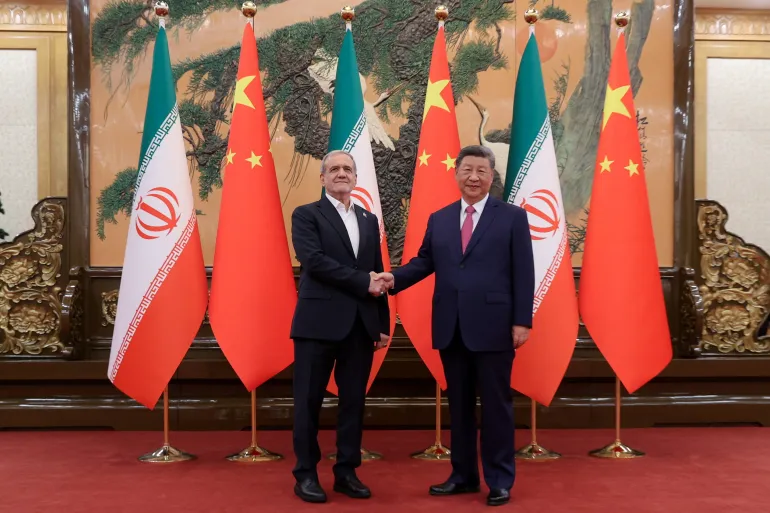
Iranian President Masoud Pezeshkian and Chinese President Xi Jinping shake hands as they meet in Beijing, China, on September 2, 2025 [Iran’s presidential website/Handout via Reuters]
Meanwhile, the most tangible measure of China’s economic support, purchases of Iranian oil, has been dwindling amid the US blockade of Iranian ports.
Iranian crude exports via the Strait of Hormuz, mostly bound for China, fell from an estimated 1.85 million barrels per day (bpd) in March-April to just 240,000bpd in August, according to data from ship-tracking platform Kpler, though millions more barrels shipped before the blockade are still at sea.
In an interview with CNBC on Monday, US Treasury Secretary Scott Bessent said “only” about 30 million barrels of Iranian oil remained on the water and Chinese remittances to Iran were “going to run out”.
Kpler last month estimated that about 80 million barrels were in on-water shortage, enough to provide revenues to Tehran for up to six months.
“For China, Iran is valuable – but replaceable across many dimensions. Iranian oil matters, but China can obtain energy from Saudi Arabia, Russia, Iraq, the UAE, and numerous other suppliers,” said Mordechai Chaziza, an expert on China’s Middle East policy who lectures at Ashkelon Academic College in Israel.
“Iran offers geopolitical access, but China possesses relationships throughout the region. Iran supports China’s multipolar agenda, but so do many other states.”
China’s support for Iran is also not risk-free for Beijing, given its important relationships with Iranian rivals such as Saudi Arabia and the United Arab Emirates, Chaziza said.
“Saudi Arabia and the UAE are major energy and commercial partners.
“Gulf stability is vital because China obtains roughly half of its crude imports from the Middle East,” he added.
The “ideal outcome” for Beijing, Chaziza said, would be “a stable, sovereign, economically connected, and internationally non-Western” Iran, but not one “whose confrontation with Washington, Israel, or the Gulf monarchies forces China to choose sides”.
Wang, at the CCG, said that while Beijing appears determined to defend Chinese commercial interests, it is unlikely to sacrifice its broader interests in the region or elsewhere.
Beijing’s warning that it is ready to take countermeasures against unilateral sanctions is “not the same thing as promising to underwrite the Iranian economy”, Wang added.
For China, Iran is seen more as a customer than an ally, said Kerri Bitsoff, a former senior official at the US Treasury’s Office of Foreign Assets Control.
“I don’t think this is the alliance some people think it is, even though there’s real support. I think of a more like a customer relationship that Iran can’t walk away from,” Bitsoff said.
“And it was good for China – they got cheap oil, they got a US tied up in the Middle East, but I think that only lasts up until the point where it threatens China’s other interests,” she added.
Torrential rain triggered severe flooding across parts of eastern China, rushing down streets and sweeping away vehicles. One weather station recorded more than half a metre of rain as authorities raised the emergency response to the highest level.
Beijing must deliver “concrete results” by October or face “harsher measures”, EU Trade Commissioner Maroš Šefčovič has warned in an exclusive interview with Euronews, as Brussels sets an October deadline to rein in China’s record trade surplus with the bloc.
ADVERTISEMENT
ADVERTISEMENT
With talks already underway, Šefčovič said the stakes go well beyond trade, with the future of European industry at play. The next two weeks are set to be crucial, with a video call between the EU’s trade chief and his Chinese counterpart, Wang Wentao, planned for mid-September, as both sides work towards the October deadline.
“This is super political,” he told Euronews, stressing that European leaders want to see results by October. Earlier this week, Commission President Ursula von der Leyen told a business forum in France that dialogue only works if it brings results.
If dialogue does not deliver results, the EU could resort to defensive instruments.
While Šefčovič did not go into detail about what retaliatory measures could look like, he said Brussels is looking to finalise a “diversification instrument” designed with China in mind. He also said the EU is now far more united in its objectives for the negotiations.
“They [EU27] want to see the direction of travel. They want to even have a concept for the solution of this issue, a pilot scheme,” Šefčovič said.
“I’m trying to do it through these negotiations, but they have to bring us very concrete results. Otherwise, of course, there will be a strong political movement to push for, I would say, harsher measures.”
Šefčovič will travel to China in October, ahead of an EU leaders’ summit in Brussels where the issue is expected to be high on the agenda.
All EU countries now run a trade deficit with China.
On the verge of a trade war
Brussels and Beijing have been on the verge of a trade war in recent months following the Commission’s introduction of several measures restricting Chinese companies’ access to the EU market and threats of retaliation from China.
A group of EU officials were in Beijing in recent days, as first reported by Euronews, to push forward the talks. They are expected to return to Europe on Thursday for a debrief.
Despite the sensitive discussions with Beijing, the Commission has already launched several probes into Chinese products over the summer over alleged unfair trade practices. Von der Leyen said the investigations were being stepped up “significantly”.
As pressure mounts ahead of the October deadline, Šefčovič said securing better access for European companies in China would not happen overnight, but stressed that the outline of a deal would be needed to move into a second phase of implementation talks.
“It’s an issue which would require clearly more time than until October,” Šefčovič said. “But what I think it’s very important for us to have by October [is] some kind of proof of concept.”
He added that EU leaders expect the Commission to bring solutions to rebalance the trade relationship, particularly in areas considered “sensitive”, such as “cars, medical devices, agri-food products”.
“We have now unprecedented intensity of our negotiations. I think we never talked to our Chinese counterparts as frequently, as intensely than right now.”
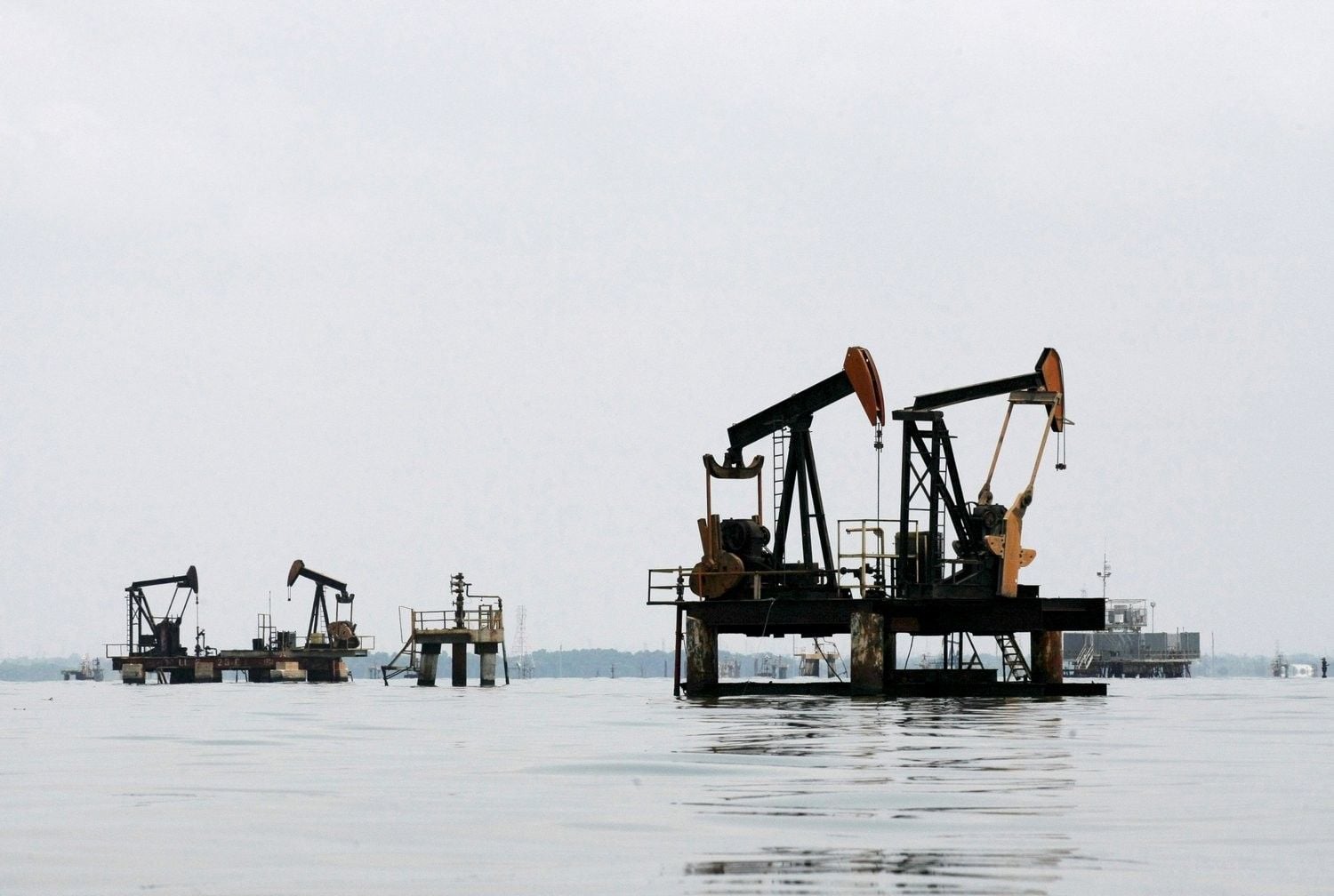
NABEP will operate several light and medium crude oilfields in Lake Maracaibo. (Reuters)
Caracas, September 1, 2026 (venezuelanalysis.com) – The Chinese government has called for its “legitimate rights and interests” in Venezuela to be protected following reports that joint ventures involving Chinese firms are set to be displaced by a US-backed corporation.
“China-Venezuela cooperation is protected by international law and the laws of both countries. China’s legitimate rights and interests in Venezuela must be guaranteed,” foreign ministry spokesman Guo Jiakun said in a press conference on Tuesday.
Guo added that the economic and trade relations between nations “should follow the principles of equality and mutual benefit.”
Beijing’s warning came in the wake of an announced US-Venezuela oil deal that Venezuelan Acting President Delcy Rodríguez termed “historic” and US President Donald Trump called “the biggest in history.”
Under the joint plan, Washington-backed North American Blue Energy Partners (NABEP) is set to receive long-term concessions to develop 17 oilfields, holding 65 billion barrels of proven crude reserves, in the Caribbean nation. The projects are split between light- and medium-crude fields in western Venezuela and extra-heavy crude ventures in the eastern Orinoco Oil Belt.
According to Reuters, five of the oilfields to be handed over to NABEP are joint initiatives with Chinese companies, including state-owned CNPC and Hong Kong-registered China Concord Petroleum. In 2025, China Concord installed a drill rig in Lake Maracaibo in what was the first major infrastructure investment in western Venezuela in many years.
Another project in the agreement is believed to be run by a joint venture between Venezuela’s state oil company PDVSA and a Russian enterprise.
NABEP is owned by Venezuelan oil mogul Alejandro Betancourt and has expanded its presence in the Venezuelan oil industry in recent years. Its current oil output is around 200,000 barrels per day (bpd). Betancourt has faced multiple international embezzlement and money laundering investigations but has never been formally charged, with US officials reportedly lobbying Swiss authorities not to bring criminal charges against the Venezuelan businessman.
In a statement posted on Monday, Betancourt said Venezuela is “blessed with an abundance of natural resources” that would be “unleash[ed] to the great benefit of both Venezuelans and Americans.”
The Trump White House published a “fact sheet” on Monday, claiming that the deal “secures US energy dominance for the next century.”
The administration stated that the Department of War’s Office of Strategic Capital (OSC) will receive a 35 percent stake in NABEP at no cost. The State Department will be given the right to purchase 20 percent of NABEP’s output at cost and hold the right of first refusal for the remaining 80 percent.
Washington will also have the final say on NABEP’s board of directors and the company will be subject to US laws and government audits. The document also pledged that the Betancourt-owned company will invest “up to $100 billion” in the oilfields.
The White House went on to explain that the concessions will conform to Venezuela’s reformed Hydrocarbon Law, which was “adopted with US support” and vastly expanded benefits for private corporations. Washington has exerted significant control over the Venezuelan oil industry since its January 3 military operation, issuing sanctions waivers for select companies while the US Treasury manages crude export revenues.
The Trump administration hailed NABEP’s takeover of oilfields previously run by Russian and Chinese companies as a triumph for the Monroe Doctrine, “ensuring American dominance in our hemisphere is never again questioned.”
The US factsheet insisted that the oil concessions will last 100 years, contradicting Rodríguez, who said the agreement is for 25 years. Venezuela’s acting president vowed that the accords would usher in a new era of “welfare and prosperity.”
According to Rodríguez, the initiative has a 1.5 million bpd target and Venezuela will collect an estimated US $19 per barrel extracted, a figure significantly below the benchmarks established under the prior hydrocarbon legislation enacted by former President Hugo Chávez.
The US-Venezuela deal has drawn widespread scrutiny over its lack of transparency and the unfavorable terms for Caracas, with popular movements rallying against “neocolonialism and imperialist attacks.”
For its part, the Venezuelan National Assembly approved a resolution on Tuesday endorsing the “binational energy accords.” The proposal was backed by the United Socialist Party (PSUV) and allies as well as some opposition deputies.
National Assembly President Jorge Rodríguez, the acting president’s brother, reiterated the government’s argument that “oil underground serves no purpose” and promised that crude production will reach “levels never seen before.”
US Energy Secretary Chris Wright landed in Venezuela on Tuesday night ahead of a scheduled press conference with Acting President Rodríguez on Wednesday. The Trump official, the Venezuelan government, and NABEP are expected to formally sign agreements at the ceremony.
Alongside the White House deal, several multinational corporations, including US-based Chevron and GE Vernova, India’s state-owned ONGC, and Italy’s Eni, are expected to ink contracts with Caracas in the coming days.
Some companies are slated to update existing agreements in accordance with reformed legislation, while others are set to enter into new deals in the South American country. According to Reuters, Chevron will expand its presence in the Orinoco Oil Belt while also securing access to light crude in Monagas State.
Leaders of the Shanghai Cooperation Organisation (SCO), including Chinese President Xi Jinping, his Russian counterpart, Vladimir Putin, and Indian Prime Minister Narendra Modi, are set to gather in Kyrgyzstan’s capital Bishkek for an annual summit.
Iranian President Masoud Pezeshkian is also attending the summit, which marks 25 years of its existence.
Recommended Stories
list of 3 itemsend of list
The two-day summit, starting on Monday, comes at a time when the world is grappling with the aftermath of the US-Israel war on Iran, which has upended global energy and financial markets, and the ongoing Russia-Ukraine war.
So, what will be the main agenda of the summit, and will the SCO leaders try to use the gathering to push for a multipolar world and Global South cooperation on trade and security issues, as United States President Donald Trump’s unilateral foreign policy has eroded the global rules-based order?
Here’s what we know:
Who is attending the SCO summit and where is it being held?
This year’s summit is taking place in Bishkek under the motto: Together for Sustainable Peace, Development and Prosperity.
Xi, Putin and Modi will be joined by the Iranian president and leaders of Pakistan, Uzbekistan, Belarus, Kazakhstan, among others.
Turkish President Recep Tayyip Erdogan, United Nations Secretary-General Antonio Guterres and the Association of Southeast Asian Nations (ASEAN) Secretary-General Kao Kim Hourn are also expected to attend the summit.
William Yang, senior analyst for Northeast Asia at the International Crisis Group, noted that the ongoing wars are putting more strain on the rules-based international order, and against this backdrop, the summit serves as an important occasion for several of the world’s rising great powers, including China and India, to elevate their global influence and deepen their engagement and cooperation with other countries in the Global South.
“For years, SCO has been viewed as one of the avenues for China to promote the multipolar world order and form its own bloc with other developing countries. Despite its narrow scope of cooperation at the beginning, SCO member states have sought to expand the scope of their mandate and the number of member states,” Yang told Al Jazeera.
Amid the ongoing conflicts in the Middle East and Europe, Yang said, “China could use this year’s summit to present itself as a great power that advocates for a peaceful resolution of the conflicts, thereby sharpening the contrast with the US.”
“However, these efforts are likely to be limited to rhetoric rather than any substantive proposal for conflict resolution,” he said.
Alicia Garcia-Herrero, chief economist for Asia Pacific at French investment bank Natixis, said the summit is particularly significant because it marks the grouping’s 25th anniversary and offers the first chance to turn last year’s Tianjin strategy, which called for a multipolar world order that fosters mutually beneficial international cooperation, into action. Last year’s summit took place in China’s Tianjin region.
“Putting Modi, Putin and Xi in the same room, with India-China border talks still live and a scheduled Modi-Putin bilateral, is a visible test of how far the recent thaw goes and how Eurasia wants to organise security, connectivity and trade without defaulting to Western institutions,” she told Al Jazeera, referring to the recent India-China talks amid the warming up of New Delhi-Beijing ties.
What is the SCO?
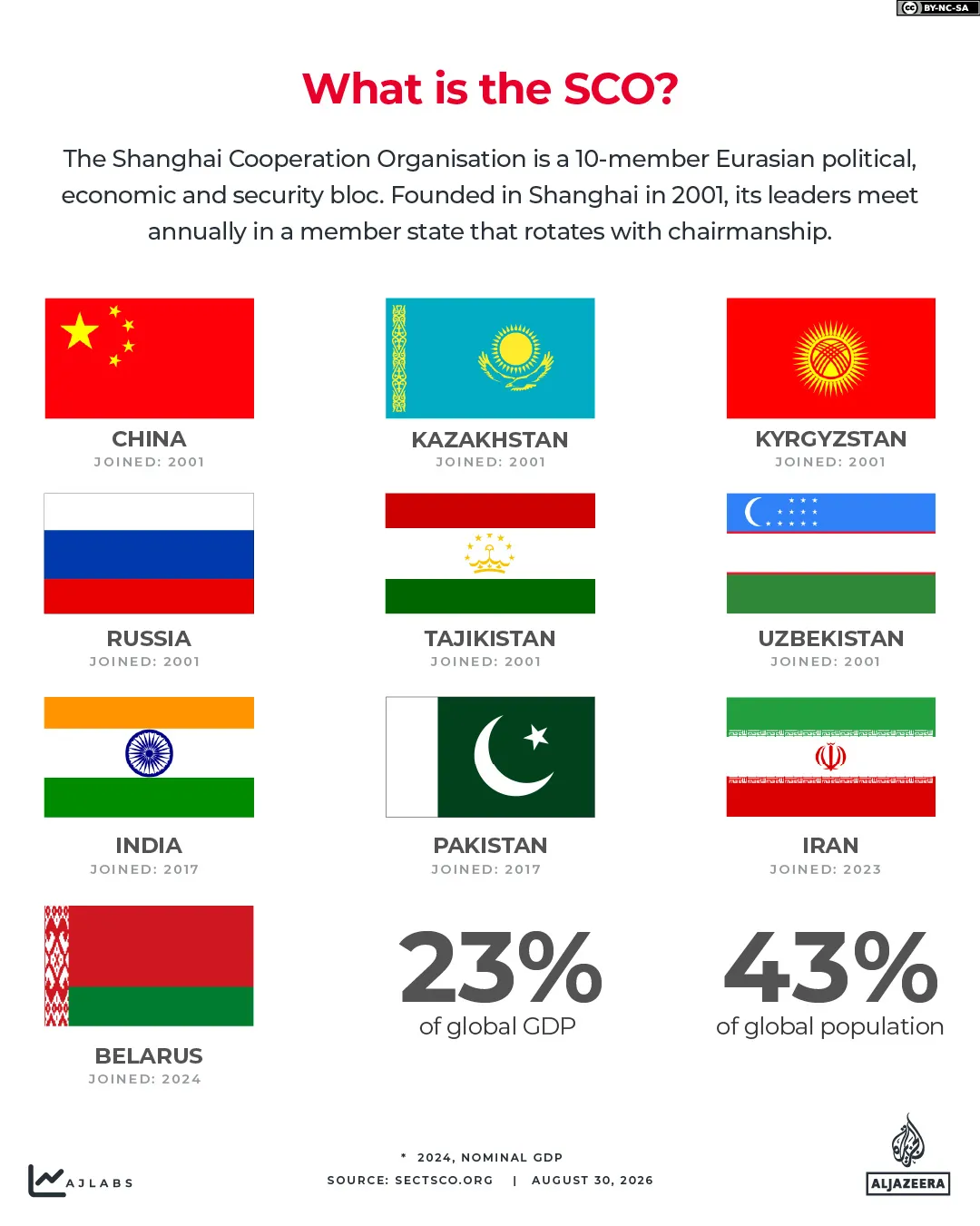
The SCO started in 1996 as a security bloc, dubbed the “Shanghai Five”. It was formed by China, Russia, Kazakhstan, Kyrgyzstan and Tajikistan to settle their border disputes following the end of the Cold War and the collapse of the Soviet Union.
But in June 2001, the grouping evolved into the SCO, and expanded to include Uzbekistan, with headquarters in Beijing. In 2017, the bloc expanded to include India and Pakistan. Iran and Belarus were also added as full members in 2023 and 2024, respectively.
In addition, the organisation has 14 key dialogue partners, including Saudi Arabia, Qatar, Egypt, Turkiye, Myanmar, Sri Lanka and Cambodia.
SCO member states account for 43 percent of the world’s population and 23 percent – or almost a quarter – of the global economy.
Analysts have pointed out that while the SCO emerged with a focus on regional security, the expansion of its mandate to include trade and other Global South concerns means it is difficult to understand what sets the grouping apart from other Global South organisations like the BRICS, which is an acronym derived from the initials of the founding member countries, Brazil, Russia, India, China and South Africa.
Alejandro Reyes, adjunct professor in the department of politics and public administration at the University of Hong Kong, said the SCO has grown into a “counterbalance” to the US-led Asia Pacific alliance aimed at countering China’s rise. India is part of both groupings. “Interestingly, India is part of the SCO, and the US appears to have dropped the Indo-Pacific nomenclature,” he said.
Reyes emphasised that “the SCO is not a coherent anti-US, anti-Western alliance”. “It is better understood as a forum in which countries with very different interests can demonstrate that they have alternatives and strategic room for manoeuvre – agency in this more volatile geopolitical order, dominated by China and the US. It is less an anti-American alliance than a venue for countries hedging against and hinging away from American power,” he told Al Jazeera.
“The significance this year is that current US policies, especially with regard to Iran and continuing US tariff and sanctions action, may be making that hedging more attractive and necessary,” he added.
What is on this year’s agenda?
The US-Israel war on Iran, the Russia-Ukraine war and the economic and social situation in Afghanistan are key issues leaders are expected to discuss this year, according to the SCO Secretariat.
Relations between India and China – Asia’s two major economies – are also expected to be discussed. Last year, Beijing and New Delhi began a rapprochement after five years of tensions over a 2020 deadly border skirmish. Trump’s tariff war on Indian goods last year forced New Delhi to mend ties with Beijing. For the first time since 2018, Modi visited China last year for the SCO summit.
Border tensions between India and Pakistan also persist, and the issue is expected to be discussed at this summit.
Manoj Kewalramani, chairperson of Bengaluru-based think tank Takshashila Institution’s Geostrategy Programme, told Al Jazeera that apart from the traditional security agenda, this year’s summit might include any forward movement on issues of economic integration or financial cooperation architecture.
“In Tianjin, we had the agreement on establishing the SCO Development Bank,” Kewalramani said.
“The Kyrgyz leadership has said that its priority will be to move the needle on the bank, the SCO Development Fund and SCO Investment Fund,” he said, adding that while talks have reportedly been taking place in this direction, there is no clarity on whether any agreements will be announced at this year’s summit.
According to the SCO Secretariat, economic connectivity will be a key topic the group will discuss as the US and Israel’s war on Iran continues to paralyse key maritime routes like the Strait of Hormuz, which has upended global supply chains, the energy market and financial markets.
The group is expected to discuss new trade and transport corridors, such as the 7,200km (4,474-mile) International North-South Transport Corridor, which links the Russian port city of St Petersburg with India’s financial capital, Mumbai, through Iran and ports on the Gulf.
Herrero pointed out that with Modi and Putin scheduled to hold a bilateral meeting, discussions on the Northern Sea Route, which runs through the Arctic coast, are also expected. China last month announced a new shipping route through the Arctic Ocean, aimed at easing global trade amid the blockade of the Strait of Hormuz and attacks in the Bab al-Mandeb in the Red Sea, which will pass through the Northern Sea Route.
According to Indian media reports, Moscow and New Delhi could negotiate the use of the Northern Sea Route by India as the crisis in West Asia continues to affect trade routes.
The SCO will also seek to establish a network of Silk Road stations to support international freight traffic across Eurasia.
Can the SCO agree on all issues?
The Eurasian grouping has often been unable to agree on global geopolitical issues.
For instance, Russia has been able to get most SCO members to align with its interests when it comes to its war in Ukraine, but India has attempted to play a more balanced role – seeking peace and stronger ties with Ukraine, while also buying record levels of oil from Russia.
But this year, Ukraine is expected to feature in discussions, with Turkiye’s Erdogan and Russia’s Putin holding bilateral talks on the matter, according to a Kremlin aide. Europe’s deadliest war since World War II is in its fifth year.
Yury Ushakov, Putin’s foreign policy adviser, said the meeting would take place on the sidelines of the SCO summit.
“There are many issues to discuss. Of course, these include the situation in the Black Sea and the Ukraine issue in general,” he told reporters, referring to the rise in attacks in the Black Sea.
In this photo provided by Kyrgyzstan’s Prime Minister Press Office, Indian Prime Minister Narendra Modi stands on the an aircraft boarding stairs upon his arrival at an international airport outside Bishkek, Kyrgyzstan, on Sunday, August 30, 2026 [Handout/Ergesh Zhusubaiv/Kyrgyzstan’s Presidential Press Office via AP]
The SCO has, however, taken a more collective position on the US-Israel war on Iran and Israel’s genocidal actions in Palestine.
In March, the SCO condemned the US-Israel war on Iran. “The SCO member states considered the use of force as unacceptable and advocate for the resolution of existing differences exclusively by peaceful means, based on dialogue, mutual respect, and taking into account the legitimate interests of all parties, in accordance with the norms of international law and the principles of the UN Charter,” it said in a statement.
India, which has strong ties with Israel, had refused to endorse an SCO joint statement condemning Israel for its attack on Iran in June 2025.
Iranian President Pezeshkian is also scheduled to meet Putin on the sidelines of the summit, according to Iran’s official IRNA news agency. Russia is a close ally of Iran and the two countries cooperate on defence issues. China has emerged as Iran’s biggest economic lifeline as it buys more than 80 percent of its crude oil. Moscow and Beijing have also lent diplomatic cover to Tehran at the UN.
Frictions also exist on how the group views border tensions between India and Pakistan. New Delhi has repeatedly called on the organisation to condemn “cross-border terrorism”, for which it blames Islamabad, a close economic and defence ally of China.
Last July, India demanded that the grouping condemn the April 2025 attack by armed men in Indian-administered Kashmir, in which 26 people were killed. Pakistan has also blamed India for armed attacks inside its territory.
During the Tianjin summit, the bloc condemned “terror” attacks in both India and Pakistan, taking a more balanced position on the issue.
What are Russia, China and India going to gain at the summit?
Reyes from the University of Hong Kong pointed out that all eyes will also be on Russia, China and India.
“For China, the SCO is partly about institution-building. Beijing wants to demonstrate that it can convene a large part of Eurasia around an agenda of security, connectivity, trade and development, while promoting a more multipolar, agentic international order. It also reinforces China’s increasingly important economic position in Central Asia, a strategically key region of the Eurasia landmass,” he said.
“For Russia, the summit is an opportunity to show that it is not isolated internationally. Maintaining strong relationships with China, India, Iran and Central Asia is economically and diplomatically important, given the Ukraine war and Western and other sanctions. But Moscow also has an interest in preserving its own influence in Eurasia rather than simply becoming more and more dependent on China.
“India is in an intriguing position. Modi’s participation is not an indication that India is joining the China-Russia axis, such as it is. India itself describes its SCO priorities as ‘security, connectivity and opportunity’. That is much more consistent with India’s longstanding pursuit of strategic autonomy – its agency amid the great-power rivalry,” Reyes explained.
He added that New Delhi wants “access and influence in Central Asia, continued relations with Russia [from which it buys the bulk of its defence equipment], and a mechanism for managing its difficult but gradually stabilising relationship with China”.
“At the same time, New Delhi maintains important relations with Washington, including through the Quad security arrangement.
“So China and Russia may see the SCO partly as an instrument for building a less US-dominated international order. India, meanwhile, sees it more as one of several overlapping platforms through which it can maximise its own agency.”
What does all this mean to the US?
As part of his unilateral foreign policy vision, Trump has undermined the Western-led international order and lashed out at Global South blocs, such as BRICS, which he sees as a threat to the US’s economic dominance. He has called the grouping “anti-American”.
However, Kewalramani noted that the Trump administration has continued some of its predecessors’ approaches and deepened engagement with countries in the region where this year’s SCO is being hosted, especially with the C5 or Central Asian countries of Kazakhstan, Kyrgyzstan, Tajikistan, Turkmenistan and Uzbekistan.
“Joe Biden had established a leader-level meeting mechanism with C5 countries in 2023. Trump also hosted them in DC in November 2025. [US Secretary of State] Marco Rubio and subsequently Trump are expected to visit the region later [this] year. Kazakhstan has announced accession to the Abraham Accords, becoming the first Central Asian state to join [the Trump-led diplomatic efforts to cajole Muslim countries to recognise Israel]. The US has been engaged with the region on critical minerals and other business deals,” he said.
“In other words, C5 members are also adopting a diversified diplomatic approach, seeking to balance China and Russia’s dominance,” he noted.
“But the fact that you are witnessing these countries meeting with far more purpose to think about alternative financial and energy architectures is a reflection of the limitations of the US’s disruptive foreign policy,” Kewalramani added.
Herrero said for the US, the SCO summit is a reminder that countries like India will keep practising strategic autonomy: it will sit in the Quad and buy US defence equipment while also talking to Moscow and Beijing in a China-heavy forum.
The Quad or Quadrilateral Security Dialogue was established by India, Japan, Australia and the US in 2007 to counter China’s growing influence in the Asia Pacific region. Over the past quarter-century, India has grown closer to the US and its allies, amid shared concerns over Beijing’s rise.
Reyes warned that Washington should be careful not to read the SCO as a consolidated anti-US coalition, even though China, Russia and Iran are members.
“The differences among China, Russia and India are far too substantial to substantiate that label. The more important message is that American economic and geopolitical pressure can sometimes produce convergence among countries that otherwise might disagree with one another more,” he said.
“The SCO’s criticism of unilateral economic measures is significant in that respect. China and Russia explicitly want a less US-dominated international order. India does not necessarily share that objective, but it does want a world in which Washington cannot dictate its foreign-policy choices.”
Washington has recently stepped up efforts to economically pressure Tehran amid the deadlocked truce talks.
Published On 31 Aug 202631 Aug 2026
Washington plans to impose sanctions on another bank this week as it steps up its campaign to economically isolate Tehran amid the deadlocked truce talks, the US Treasury chief has said.
In an interview with The Associated Press news agency on Sunday, Treasury Secretary Scott Bessent declined to name the bank to be targeted by sanctions.
Recommended Stories
list of 3 itemsend of list
The announcement comes just days after Washington said it would cut off the United Arab Emirates’s operations of Basque Misr from the US financial system after accusing Egypt’s second-biggest bank of doing business with the Iranian government.
“This is going to be financial violence if we have to,” Bessent told AP on Sunday. “We are showing people that we know who you are, you know who you are, and this has got to stop.”
In an interview with the Reuters news agency, Bessent said the next step may be cutting off an institution entirely from the dollar-based financial system.
“You’re going to see a lot more of these every week,” he said on Sunday, ahead of a Group of 20 finance leaders meeting in Asheville, North Carolina. “We’re starting with the banks, and we’re telling the banks it’s not OK to have Iranian money and to aid the regime.”
The US has stepped up efforts to economically pressure Tehran to submit to Washington’s demands, a campaign dubbed “Operation Economic Outcast”, amid the stalled truce talks between both parties.
Last week, the Treasury Department imposed new sanctions on nearly 60 individuals and entities that Washington accused of being part of networks helping Iran generate oil revenue, procure weapons and conduct cyber-operations.
Iran, however, has rejected the latest US sanctions, with Minister of Finance and Economic Affairs Ali Madanizadeh saying they will fail.
Violence in the conflict resumed on Sunday, the first time since late July, with Iran launching missiles at two US bases in Jordan following a US attack on Larak Island in southern Iran.
Cooperation against Iran
Bessent is preparing to host the meeting of the G20’s finance leaders, where he will huddle individually with his counterparts from the world’s major and developing economies to encourage cooperation against Iran.
The US Treasury chief also told AP that he would speak to his Chinese counterparts at the meeting and “all options are on the table” in terms of sanctioning Beijing for its continued trade with Tehran.
But he rejected the idea that the US was reluctant to confront China, calling it “a completely false narrative that the media picked up on”.
He insisted that Beijing and Washington agreed on the need to reopen the Strait of Hormuz and prevent Iran from developing a nuclear weapon.