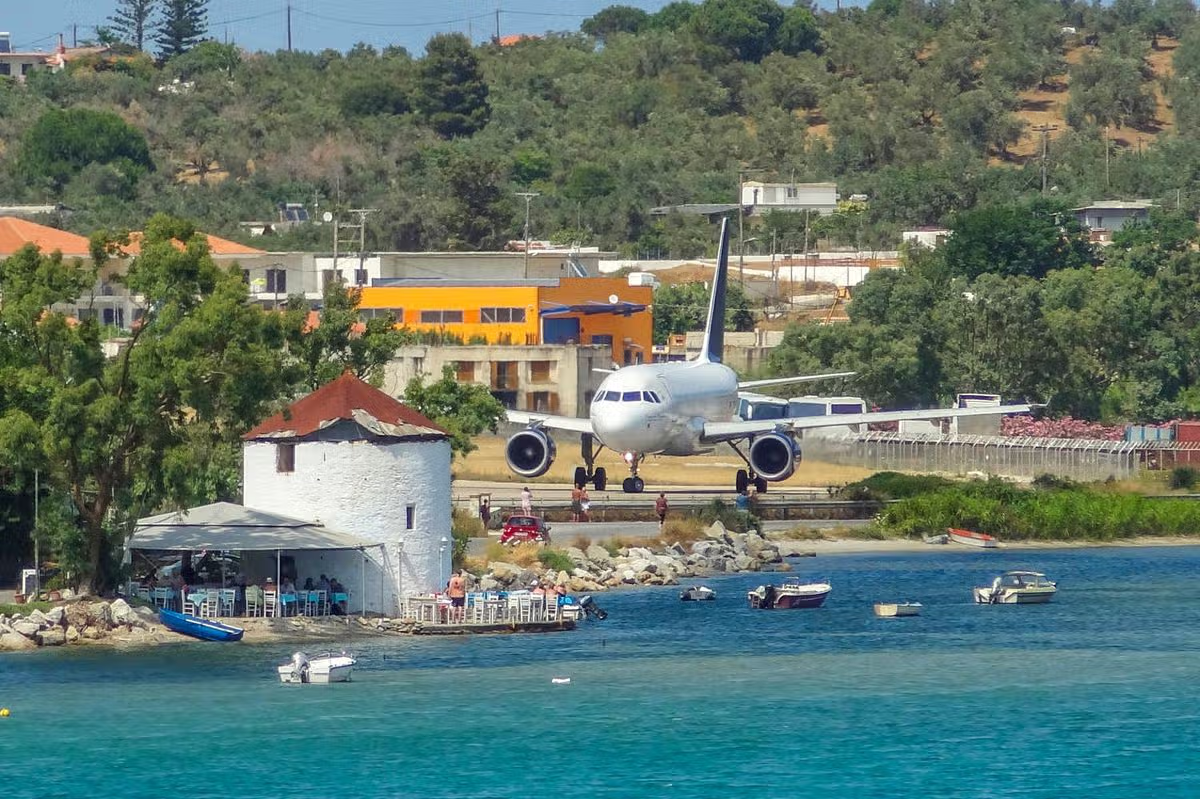
Crete welcomed approximately 6.6 million visitors last year, with British tourists averaging 8.1-night stays — but the Mirror has discovered the hidden gems of the island away from the beaches…
Crete’s beaches and coves are delightful
Goats bleat and their bells clang as they amble through the steep hillside shrubs, pausing to graze on wild thyme beneath a cloudless Cretan sky. I peer in the other direction and see the Aegean Sea sparkle, with waves kissing the rugged coastline.
Beaches are within a stone’s throw to my left – a northerly direction – yet I can pick my way to the right – to the south – and wander through grassland and hills to explore a trove of history. Crete, the largest and most populous island of Greece, offers that fascinating beauty – coasts and mountains in one spectacle.
It makes for a great holiday. The island is defined by rugged mountains, fertile valleys and endless olive groves. I made my home near Mochlos, a fishing village in the northeast of the island, which meant I could spend a couple of hours splashing in the sea at the beach in the mornings before exploring the history and nature inland in the afternoons.
The hills are dotted with historical attractions, including Toplou Monastery. Founded in the 14th century, it is still functioning. The monks there make wine and treat me to a splendid tasting session.
Crete’s history stretches back far beyond classical Greece. Archaeological evidence suggests people have lived here for more than 130,000 years, making it one of Europe’s oldest inhabited regions.
Tourism arrived in earnest during the late 1960s and early 1970s, when artists such as Joni Mitchell and Cat Stevens helped put the island on the map. While modern tourism has transformed parts of the coastline, much of Crete retains its timeless character.
And I enjoyed this charm along the north coast. One afternoon, I travelled west along the coast, hopped on a little boat and spent a short while on Spinalonga. This island, maintained as a fortress for centuries under Venetian rule, became a leper colony in the early 20th century. It has been uninhabited since 1962, and is now the second-most visited tourist site in Crete.
Head to Archanes, a town with roots stretching back some 5,000 years to the Minoan civilisation. The cobbled streets there are particularly beguiling. There is not a tourist in sight and barely an English voice to be heard. It feels as though little has changed for centuries.
But the atmosphere there and across the rural charms of northern Crete feels wonderfully authentic. Elderly locals in padded jackets sip beer, smoke cigarettes and play backgammon as the afternoon drifts by.
Venture into most of these rural towns and villages, and you’ll see colorful houses draped in bougainvillea. It is stunning to discover such genuine slices of Cretan life in a region that attracts so many visitors.
But this agricultural heritage is one of Crete’s greatest treasures — and the tourism helps protect and sustain it. This glorious island has indeed struck a chord between the modern sun-kissed holiday trap and the quaint traditional charm.
Book it
Rooms at Ella Rocrita start from approx. £184 per night, depending on season.
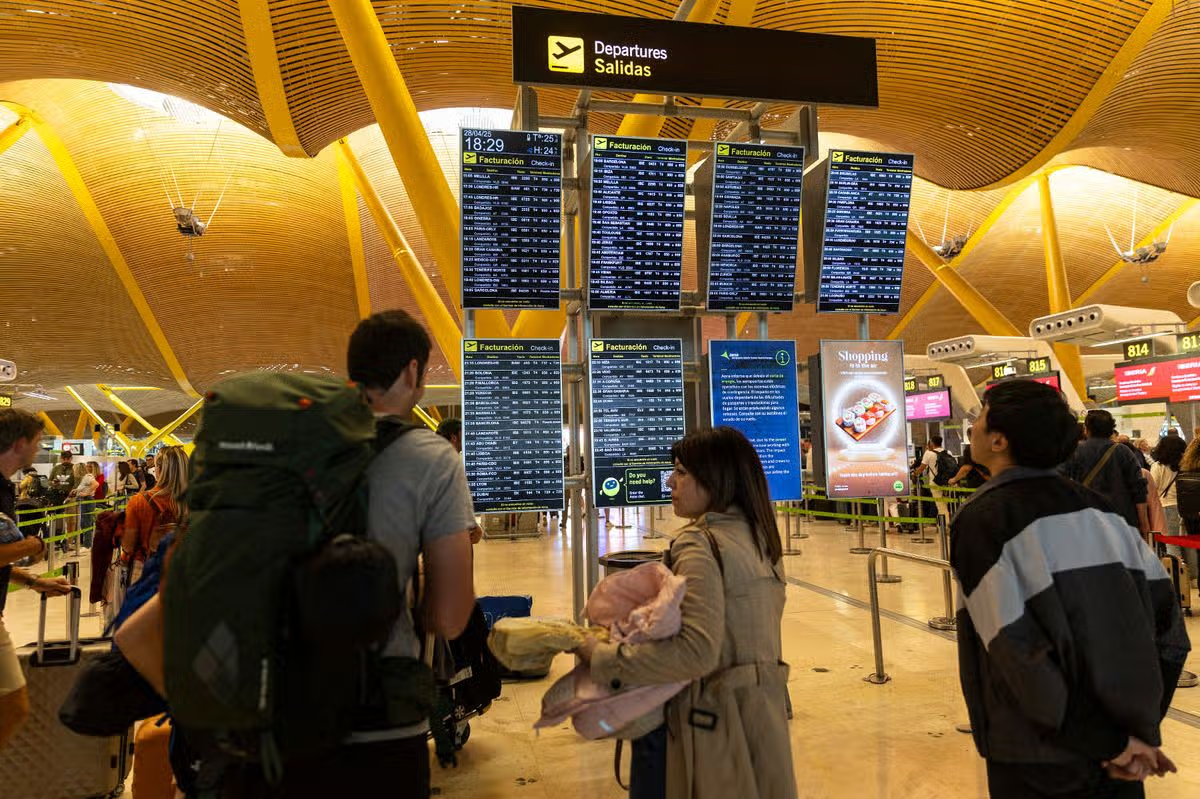
Many Brits heading to the EU are dreading their journey through the airport due to the new European Entry/Exit System (EES), but many don’t realise there’s an app available to cut waiting times at certain destinations
The app could save you the hassle of using a European Union Entry/Exit System (EES) kiosk(Image: Justin TALLIS / AFP via Getty Images)
Peak holiday season is upon us, and the launch of the European Entry/Exit System (EES) is reportedly causing queues at destinations such as Spain, Greece, and France.
Local media in Spain has warned that Brits could face six-hour queues, and there have been reports of passengers missing flights, with airports blaming “additional processing requirements”. All non-EU visitors to the European Union, including Brits, are now required to have biometric information such as facial images and fingerprints taken on arrival, and must also use the machines on departure to help the EU flag overstays.
One of the reasons why Brits often face longer queues at the airport is that, while EU passport holders have their own lanes, Brits have to queue alongside other non-EU nationalities. But for those going to Portugal or Sweden this summer, there is a way to speed up the process.
An official (but not very well-known) app could potentially get you through the airport quicker. At the moment, the Travel to Europe app is only available for visitors to two EU countries, but it could be rolled out to other destinations in the future, according to its developers.
Brits heading to these countries can download the app on the App Store or Google Play – making sure you download the right app and not a third-party one.
Create a new journey by selecting the country you’re arriving in or departing from, this can be done up to 72 hours before your travels begin. You can then add a border crossing point and your estimated time of arrival.
Travellers can then scan the personal details page and chip of their passport, take a selfie to confirm their identity, and answer a few questions about their plans. Normally, these steps would be done at the EES kiosks, so by doing them on the app at home, you can save time at the airport.
Families travelling together can also add other passengers before submitting their journey. Once registered, you’ll get confirmation that your journey has been accepted. Then you simply need to follow the signs at the airport to make your way through security. The app developers are careful to point out that using the app doesn’t guarantee border entry, and that anyone passing through the airport can still be flagged for additional checks.
But for the majority of holidaymakers, this could cut down on the time they spend queuing and waiting to enjoy the Portuguese sunshine.
Reviews of the app have been mixed so far. One user said: “Pointless to have an app that supports only one country – I understand it is optional for Member States to incorporate the app into their systems, but it doesn’t mean this couldn’t have been arranged better.” But there were success stories, with one user saying: “I went to Stockholm…. long queues for UK passports. I had already used the app, and used the pre-registered lane. Two people in front of me. The whole process took about three minutes. Very impressed!!”
Around 2.4 million British tourists visit Portugal every year, making up the majority of the country’s tourism, although this is a fraction of the 19 million British visitors Spain saw in 2025. Overall, foreign tourists contribute €5.2 billion a year to the country’s economy (about £4.5 billion), with Brits as the biggest spenders followed by Germans.
Have a story you want to share? Email us at webtravel@reachplc.com
A FRESH warning has been issued over a major travel item that many of us now use, that actually poses a huge threat when flying.
Over the past couple of years, power banks have caused several issues across a number of flights.
Sign up for the Travel newsletter
Thank you!
A new warning has been made to travellers about heading on a flight with a power bank this summerCredit: Alamy
In response, airlines have introduced new measures that specify the type of power bank you can or cannot take onboard.
As the school summer holidays approach, travellers are now being reminded to carry these items in their hand luggage.
Power banks contain lithium batteries, which according to the Civil Aviation Authority (CAA), pose a huge risk to aircraft, with more and more devices being found in hold luggage over the past year.
The aviation body also said that the average person now takes four different lithium-powered devices on a flight.
However, they are prone to overheating, especially if they are defective and this can cause a fire.
The CAA states: “Passenger awareness remains low – over a third (36 per cent) of travellers are unaware of the dangers of packing batteries in checked baggage, even though 92 per cent fly with a mobile phone, 55 per cent with a laptop and 49 per cent with a power bank – suggesting hundreds of batteries could be incorrectly packed on a typical flight.”
While some airlines have responded to the increased use of lithium batteries by carrying containment bags – such as Virgin Atlantic and Wizz Air – they still pose the biggest risk of fire to flights.
And it’s not just power banks that have lithium batteries though and they aren’t anything new – you’ll also find them in your laptop, mobile and smart watch.
Over the past couple of years, power banks have caused a number of incidents on flightsCredit: Alamy
When an incident regarding a lithium battery occurs in the cabin, cabin crew can handle it more easily.
However, if the issue is in the hold it is a trickier problem to solve.
According to the CAA, there are around two lithium battery incidents every week.
And these incidents can cause delays as well as the plane diverting.
The rules to be aware of include taking items such as your mobile phone, vapes and power banks on board in the cabin.
If you are taking power banks, you are allowed a maximum of two and you cannot charge them during the flight.
Laptops must be switched off if they are in hold bags.
As part of its new campaign ‘Pack right, Safe flight’, the CAA added that travellers should “choose reputable suppliers and brands when buying devices and spare batteries” and that “batteries that show signs of damage, overheating, or swelling should not be used and should never be carried on an aircraft”.
Passengers need to be aware of airlines’ rules on power banksCredit: Getty
Giancarlo Buono, Director of Aviation Safety at the UK Civil Aviation Authority said: “Flying is by far the safest way to travel, and we want to keep it that way.
“Pack right for a safe flight, and that means don’t put your batteries in your checked bag. Take them into the cabin with you.
“This simple tip will make your flight safer for you, and the other passengers you’re flying with.”
Here are the rules on batteries for some of the major airlines:
British Airways
British Airways allows each passenger to carry two power banks with themCredit: Getty
You can take up to 15 battery-operated Personal Electronic Devices (PEDs) that contain lithium batteries such as laptops, tablets, smartphones, cameras, music players, smart baggage tags (e.g. Apple AirTag) onboard.
If in hand luggage, they must be switched off or placed in flight safe mode.
If in checked luggage, they must be completely switched off – not in sleep or hibernation mode.
You can only carry up to two power banks per person and they must be in the cabin in either the seat pocket or in a bag under the seat in front of you and they cannot exceed 100Wh.
Ryanair
All electronic devices must be carried in the cabin on Ryanair flightsCredit: PA
Electronic devices and spare lithium batteries must be carried in the cabin only.
Each passenger can carry up to 15 electronic devices for personal use in the cabin “including but not limited to: smartphones, tablets, laptops, cameras, handheld gaming consoles, headphones”.
Each passenger can only carry up to two power banks and these are included in the overall limit of 20 spare lithium batteries – which cannot exceed 100Wh.
Ryanair adds: “Spare lithium batteries and power banks must be carried on the passenger’s person or in the under-seat cabin bag stowed under the seat in front.
“Power banks and spare lithium batteries must not be placed in cabin baggage stored in the overhead lockers.“
Power banks cannot be recharged when onboard or during the flight.
EasyJet
Power banks cannot be used onboard an easyJet flightCredit: AFP
EasyJet has a limit of 15 electronic devices per passenger, which must be 12V or less and 100Wh or less.
When it comes to power banks, Wh ratings cannot exceed 160Wh for lithium batteries, and only two can be carried per passenger.
EasyJet states: “Power banks are prohibited from use on easyJet aircraft and must not be used to charge other devices.
“Power banks must be carried in carry-on baggage only, and it is recommended that power banks are carried where they can be monitore, d i.e. on your person.”
Virgin Atlantic
Power banks cannot be charged when onboard Virgin Atlantic flightsCredit: Alamy
For Virgin Atlantic, you can travel with up to five spare batteries and/or power banks, depending on their watt-hour (Wh) rating.
All batteries and power banks must be able to fit inside the airline’s onboard Fire Containment Bag, which measures 37×28×10cm.
The airline states: “Please keep them in an accessible place during your flight — not in the overhead locker.
“Power banks cannot be plugged into your seat’s power supply at any time.
“Power banks cannot be used to charge other devices while onboard.
“Batteries and power banks must be under 100Wh.”
Wizz Air
Wizz Air only allows one power bank per passengerCredit: Alamy
For Wizz Air, power banks cannot be used during any phase of the flight, and they are not allowed in checked luggage.
Each traveller is limited to a maximum of 20 spare batteries, including a maximum of one power bank, which cannot exceed 100Wh.
The airline states: “Power banks and e-cigarettes should be carried where they can be monitored, i.e. on the person.”
The US Federal Aviation Administration recorded 644 lithium battery fires onboard flights in the past 20 years, with the global figure stretching into the thousands
EasyJet pilot and head of flight operations at the Civil Aviation Authority, Glenn Bradley(Image: Supplied)
A pilot has urged passengers not to pack an electrical item in their luggage, to avoid potentially disastrous consequences.
Eleven days ago, passengers aboard a British Airways Boeing 787-9 Dreamliner flying from London Heathrow Airport to Harry Reid International Airport in Las Vegas noticed an acrid smell.
A blaze had broken out in the cabin, triggered – it would later become clear – by a lithium battery. The fire scorched the inside of the jet before crew could extinguish it. Clark County Fire Department responders rushed to meet the singed plane on the tarmac.
The fire was one of 644 such incidents on planes recorded by the US Federal Aviation Administration in the past 20 years, with the global figure stretching into the thousands.
Other incidents are much scarier.
Do you have a story to share? Email webtravel@reachplc.com
On January 28 last year, 176 passengers were evacuated from Air Busan Flight 391 when a battery blaze completely destroyed the plane as it taxied for take-off at Gimhae International Airport. Three were injured.
Lithium batteries are used six times more now than in 2020, raising the risk of fire with them. They can ignite due to a process called thermal runaway, where a damaged or short-circuited cell rapidly generates heat. This creates a chain reaction that releases extreme heat, and can be triggered by being crushed and overcharged.
Many of us know of the dangers of lithium batteries on flights and that items containing them such as phones, power banks and vapes must only be stored in hand luggage. However, it’s easy to let less obvious gadgets slip into hold luggage, according to easyJet pilot and head of flight operations at the Civil Aviation Authority (CAA), Glenn Bradley.
“The batteries are in everything, including portable fans. Lithium batteries in the hold are the most dangerous thing,” Glenn explained.
While flight attendants are trained to put out cabin fires, accessing luggage in the hold is impossible during a flight, which is why the prospect of a lithium battery fire is taken extremely seriously.
“We all carry about four of these batteries when we fly, so on a plane there could be a thousand. The fact is, they don’t explode on a daily basis, but if they do, we want to be able to manage them,” he added.
If a passenger realises they’ve left a battery-containing item in their hold luggage, they should immediately tell crew.
When that happened on a UK-bound easyJet flight in May, it was diverted to Rome. The captain judged the power bank charging in a passenger’s luggage to be too dangerous to ignore.
Glenn spoke with the Mirror as part of a CAA safety campaign. Passengers are urged to “pack right for a safe flight” by taking their batteries in the cabin with them.
Passengers should:
Take items like mobile phones, vapes and power banks on board with you.
Never charge a power bank on a flight.
Turn off laptops completely if they’re going to be put in check-in bags.
Getting it wrong could lead to your bags being removed from the flight, causing significant delays or, even worse, result in a fire that may be impossible to contain.
Giancarlo Buono, director of aviation safety at the CAA, said: “Flying is by far the safest way to travel and we want to keep it that way. Pack right for a safe flight, and that means don’t put your batteries in your checked bag. Take them into the cabin with you. This simple tip will make your flight safer for you, and the other passengers you’re flying with.”
CAA figures show reports of overheating or malfunctioning passenger devices nearly doubled between 2024 and 2025, following a 98% year-on-year increase. Cases of lithium battery-powered devices being incorrectly packed in checked baggage also rose by 91% in 2025.
THERE’S enough going on this summer with EES checks and extreme heat – and your passport could cause problems as well.
Affecting millions, we’ve explained the two things you need to check before your next holiday.
Sign up for the Travel newsletter
Thank you!
Don’t get caught out by these two passport rules this summerCredit: Getty
Expiry Dates
You might think that expiry dates have been spoken about enough – but it is still catching people out.
Old rules let passports have more than 10 years on them, but these rules have since been scrapped.
To find the true expiry date, you need to check the start date rather than the expiry listed in the passport.
If your passport was issued in April 2016, but has an expiry of December 2026, your passport is out of date as it’s over 10 years old. The REAL expiry date is actually April 2026.
Colette and her two children were unable to fly from the UK to Copenhagen
Colette Bjorn-Alderson has lived in the UK for 28 years, but was trying to return to the UK with her two young children – both of which only had Danish passports.
She told The Times that she felt “unwelcome in my own country” after being turned away from the flight.
She added that her only two options were getting a new UK passport from Denmark – which can take three months – or the certificates, which can take up to eight weeks.
NEW passport rules that came into force earlier this year are STILL catching people out, with one mum recently left stranded abroad.
Brits who are dual national passport holders – thought to be as many as 1.2million – can no longer use their foreign passport to enter the country.
Sign up for the Travel newsletter
Thank you!
The new travel rules came into force in February of this yearCredit: Alamy
Since February 25, the change in rules meant that anyone with dual nationality has to use a valid British passport when arriving into the UK.
Anyone without this must instead have a certificate of entitlement, which costs £589.
Passengers trying to enter the country by plane, ferry or train without either of these risks being banned from travelling.
One British woman was recently caught out when she was trying to travel from Copenhagen to Manchester with her two children, only to be stopped from boarding her flight.
Colette Bjorn-Alderson, who has lived in the UK for 28 years, had been in the Danish country since April, but was returning to the UK with her six-week old and 23-month old for a friend’s wedding.
However, her two children only had Danish passports which meant they didn’t have valid travel documents for returning to the UK.
She told The Times that she felt “unwelcome in my own country” after being turned away from the flight.
Colette sent photocopies of her documents to the Home Office – but ultimately the decision was made that the family could not fly.
Not only has she been left £1,000 out of pocket, she said the only way to get UK passports for them while in Denmark can take up to three months, while the certificates take eight weeks.
She added: “It was a nightmare. I’ve cried a lot.”
Dual nationality passport holders must have a valid UK passport or certificateCredit: Alamy
A “heat-dome” settling over western Europe could bring temperatures of up to 40C by Wednesday, with this latest UK heatwave expected to surpass the June record set in Hampshire in 1976
Milo Boyd Deputy Travel Editor & Commercial Writer and Sam Hall, Press Association
15:30, 23 Jun 2026
A heatdome has settled over much of Western Europe(Image: ARNAUD FINISTRE, AFP via Getty Images)
The UK Government has issued an ‘extreme’ travel warning for Brits heading to France, Spain and Portugal as a heatdome settles over western Europe.
The weather front is predicted to deliver temperatures approaching 40C by Wednesday, with this latest heatwave anticipated to eclipse the June record established in Hampshire in 1976.
Red heat alerts have been issued in France, Spain, and other nations across western and central Europe as heatwave conditions are forecast to intensify in the coming days.
More than half of France’s regions are currently under the harshest weather warning. Tragically, two children aged two and four were found dead in their family car in the town of Carpentras in the south of France, in an incident believed to be linked to the weather.
In a section on the Foreign Office’s website titled ‘extreme weather’, an update for France issued today reads: “Find out what you can do to prepare for and respond to extreme weather and natural hazards. In summer months, there is a risk of higher than normal temperatures in France. Check current weather forecasts and read about how to protect yourself on the Meteo France website.”
And the Portugal advice reads: “In Summer months, there is a risk of higher than normal temperatures in Portugal. Check current weather forecasts and read about how to protect yourself on the Portuguese Institute for Sea and Atmosphere website.”
Back in the UK, record high temperatures are forecast over the coming days.
Met Office spokesman Grahame Madge said: “The Met Office is flagging 39C as a headline maximum temperature on Thursday, most likely for somewhere in London or the South East. Forecast temperature values are indicative and are subject to a slight range either side.
“It is possible we could see temperatures higher than the 39C if the final values are at the upper end of our narrow range. It is important to remember that the temperature value is only one element of this extreme heatwave story. The other major factor is the high humidity which for many will make the intense heat even harder to endure.”
Throughout the night, temperatures remained above 20C at nine sites across England, registering what the Met Office classifies as a tropical night. Scorching temperatures gave way to thunderstorms and lightning strikes across England in the early hours of Tuesday morning.
Commuters also faced significant disruption across London’s transport network on Tuesday morning. The Elizabeth Line was hit by flooding caused by heavy rainfall, resulting in no service running between Heathrow Terminals 2 and 3 and Heathrow Terminal 4, Transport for London confirmed.
Passengers on the Mildmay Line also faced severe delays, with the line operating a reduced service due to the sweltering conditions. On the national rail network, soaring temperatures are also forecast to cause sagging overhead electric wires, buckled rails and lineside fires, with passengers urged to avoid non-essential travel and, if a journey is unavoidable, to ensure they have a bottle of water with them.
Avanti West Coast announced it intends to operate fewer services than normal between Tuesday and Thursday, warning that “there’s a risk of further disruption”.
Chiltern Railways has scrapped more than half its services across those three days “to ensure the safe operation of the railway”. The operator said: “We strongly advise you to avoid travelling if possible.”
The RAC revealed it is handling 10% more breakdowns than usual at this time of year and expects demand to “increase significantly as temperatures peak”.
The scorching weather is also set to cause considerable disruption for parents as schools shut or close early to shield children from the heat. Pupils have been told they may wear PE kit rather than full school uniform, which typically includes long trousers and blazers. A number of after-school clubs have also been called off.
TOURISTS may face fees for rinsing off at a popular Spanish beach holiday resort.
A controversial smart meter has been installed at beach showers, upsetting both locals and visitors.
Sign up for the Travel newsletter
Thank you!
Matalascanas Beach is currently trialling a smart meter on its public showerCredit: SolarpixBeach-goers can opt to use coins or their mobile phone to pay for a shower, which lasts less than one minuteCredit: Solarpix
The smart shower is currently being trialled at Matalascanas Beach at Costa de Luz in south-west Spain.
While it is currently free to use, the plan is for users to be charged via a QR code or they can pay with cash.
The meter accepts two types of coins, with “no change given”, or beach-goers can use their mobile phones to scan the code and pay online.
This initiative has been promoted by two local engineers as a water-saving scheme.
However, claims that the set-up could cost a family-of-four around £3.50 to quickly wash off the sand on their bodies, has caused a stir.
The smart shower has been installed by the four-star On Hotel Oceanfront, which is understood to be the only shower in operation along the entire 2.6 mile-long beach.
It has already been met with backlash from residents, with many pointing out the issues with the set-up.
“Great idea. You have to get your mobile out and when you go to shower where do you leave it?” asked one person.
Another said: “I understand that water is important but I think this is terrible. Do you have to shower with your mobile in your hand?”
Commenting on an online discussion over the proposed charges, one social media user said: “Little by little, we normalize paying for everything.”
“By next year there will be parking metres, paid showers, and in a few years they’ll charge us for stepping on the sand – private beaches, like in other European countries,” they added.
Another person said: “This year the trial to find out how much they’re going to get, and next year they charge everyone.”
Almonte Council, the local authority covering the beach, has not confirmed how long the free trial period will last.
The estimated cost of a shower lasting less than a minute has been put at around €1 (85 p).
It comes after several beaches on the eastern end of the Costa del Sol decided to shut their showers last summer, with only foot washes remaining open.
However, the situation is expected to be much better this summer following a winter of heavy rain.
Rincon de la Victoria Council announced last month it would be opening its beach showers as normal this year.
One particular route was also named the least punctual with the airline, as Birmingham to the Greek party hotspot of Zante had an average delay of 46 minutes
An airline loved by Brits has been rated one of the worst for punctuality (stock)(Image: Maria Korneeva via Getty Images)
A popular airline amongst British holidaymakers has been ranked among the worst for punctuality — and it isn’t easyJet, Ryanair, BA or Jet2. Budget carriers easyJet and Ryanair occasionally face criticism from passengers for a whole host of reasons, yet timekeeping doesn’t appear to be one of their shortcomings.
An airline that also offers package holidays widely favoured by Brits has apparently earned a reputation for poor punctuality.
TUI Airways has landed fifth on a list of the five worst airlines for UK flight delays, with Civil Aviation Authority (CAA) data revealing an average delay of 20 minutes and 24 seconds last year.
One particular route was singled out as the least punctual of all — Birmingham to the Greek party island of Zante — with an average hold-up of 46 minutes. Operating out of more than 20 UK airports, the carrier is owned by TUI Group.
Aage Dunhaupt, from TUI Group, told the Mail that “minimising delays remains a top priority”, noting that TUI Airways runs flights “wherever possible, even if they are delayed, rather than cancelling them”.
He said: “If we were to follow broader industry practices of cancelling flights more readily, our punctuality ranking would improve significantly. However, this would come at the expense of our customers.”
Air India was ranked the worst performer for the second year running, with average delays exceeding 36 minutes, while Scandinavian Airlines topped the table as the most punctual, averaging a mere eight minutes.
Taking second spot for the poorest performance was Blue Islands, which ceased trading at the end of last year, followed by TAP Air Portugal and Saudia.
On a more positive note, average delays have fallen from 18 minutes, 18 seconds in 2024 to 14 minutes, 48 seconds.
A spokesperson for trade body Airlines UK told ITV: “The vast majority of UK airline flights depart on time and CAA data shows customer satisfaction levels are at an all-time high.
“Most delays are the result of issues that are entirely outside airline control, such as adverse weather, forced reductions in the number of planes that are able to land and take off each hour, and industrial action.”
They added: “When these delays do occur, airlines work hard to support customers and get them where they need to be as quickly as possible.”
This follows a flight attendant revealing her top five “basic” habits she “absolutely loves” to see passengers doing. Taking to TikTok, she started by saying: “When you take your headphones out as I walk up to your row.
“Instant respect. You see me. I see you. We’re already besties.”
Her other habits were paying attention during announcements, offering a smile and a sincere thank you, keeping shoes on, and not treating the plane like your living room.
She added: “It’s really that simple. Kindness + awareness + basic hygiene = elite passenger status.”
The Foreign Office has issued travel advice warning UK holidaymakers
Millions of Brits head to Italy each year(Image: Janoka82 via Getty Images)
British holidaymakers are being warned that they risk being slapped with a 500 euro fine when visiting one of the most sought-after destinations in Europe.
Millions of Brits are set to head overseas during the summer months, desperate for some sun, a change of scenery, as well as a well-deserved rest. The Foreign Commonwealth and Development Office (FCDO), the Government’s foreign affairs department, plays a key role in keeping UK citizens informed when travelling abroad – offering travel guidance covering more than 220 countries and territories across the globe.
In its travel advice for Italy, the FCDO cautions that “some Italian towns and cities have specific laws, and you could be fined for breaking them”. This, the FCDO noted, can include activities such as eating and drinking near major churches, historic monuments and public buildings.
It is also against the law to enter or bathe in public fountains across numerous towns and cities, including Florence and Rome, or to swim in the canals of Venice. The island of Capri is enormously popular with tourists and can be accessed by ferry from both Naples and Sorrento.
The stunning island nestled off Italy’s Amalfi Coast is celebrated for its Mediterranean charm and rich ancient heritage. However, visitors are being made aware that bringing any disposable plastic items onto the island – such as bags, cutlery, plates, cups, food packaging, trays and straws – is strictly prohibited.
Should you be caught doing so, you could face a penalty of up to 500 euros. Additional FCDO guidance regarding Italy adds: “Illegal traders operate on the streets of all major Italian cities. It is illegal to buy items from unlicensed street traders. If you do, you could be stopped by the local police and fined.
“It’s illegal to remove sand, shells or pebbles from coastal areas in Italy. You could face a large fine for doing so. It’s also illegal to collect various species of flowers, plants and herbs from mountain and wooded areas. For more information, check with the regional authorities of the area you’re visiting.”
Travel industry specialists regularly caution that holidaymakers risk being refused boarding(Image: SolStock via Getty Images)
Millions of Brits planning a summer break are being told to observe a vital passport “3-week rule” following a new alert from His Majesty’s Passport Office.
The government body says that holidaymakers should allow a minimum of three weeks for their passport application to be handled and has cautioned that certain cases may take longer if further checks are needed. The reminder arrives as families gear up to travel abroad during the busy holiday period, when demand for passport renewals typically surges.
In a message to travellers, His Majesty’s Passport Office said: “Sun, sea & stress-free travel. Apply early – UK passports usually arrive within 3 weeks (longer if checks needed).”
Official guidance confirms that standard passport applications lodged in the UK are normally processed within three weeks from when the Passport Office receives the necessary documents. Nevertheless, officials emphasise that not every application can be completed within that window.
Government guidance states: “You’ll usually get your passport within 3 weeks. It may take longer than 3 weeks if we need more information, or we need to interview you. We’ll tell you this within 3 weeks.”
The Passport Office is also cautioning Brits against booking holidays before their new passport has been delivered. Its guidance states: “Do not book travel until you have a valid passport – your new passport will not have the same number as your old one.”
The guidance is especially important for travellers whose passport is set to run out before a planned journey.
Following Britain’s exit from the European Union, numerous European countries now insist that British passports must have been issued in the last 10 years and retain at least three months’ validity on the date of leaving the nation you’re visiting.
Travel industry specialists regularly caution that holidaymakers risk being refused boarding if their passport fails to satisfy their destination’s entry criteria.
Britons requiring a passport with greater urgency might be eligible to utilise the Passport Office’s premium services, such as the Online Premium and One Week Fast Track alternatives, though these come at a higher cost than the conventional application route.
Passport applications can be lodged online or via a paper form obtainable from Post Office branches, although paper submissions incur an extra charge.
Those who have already submitted their application can monitor its progress using the Government’s online passport tracking service.
Content cannot be displayed without consent
Passport processing times.
The standard UK passport application service generally takes up to three weeks for completion. For individuals needing a passport more swiftly, the One Week Fast Track service aims to deliver a passport within seven days.
Travellers who need a passport straight away can opt for the Online Premium service, which provides a same-day appointment and passport collection. The Passport Office confirms that processing times only commence once all required documents have been received, which means any hold-ups in providing paperwork can prolong the total time needed to obtain a new passport. Further information is available here.
The mayor of Venice is proposing an increase to the city’s controversial tourist entry fee, which could see the charge rise to as much as €50 (around £43) in a bid to tackle overtourism.
12:04, 20 Jun 2026Updated 12:04, 20 Jun 2026
A European city wants to hike its entry fee(Image: Getty)
In 2024, Venice made history as the first tourist destination to impose an entry fee, initially set at €5, approximately $4.30, on busy days spanning April to July. Additional days were subsequently added to the scheme, with the charge for last-minute visitors later rising to €10, roughly £8.60.
Mr Venturini is now pushing to raise the entry fee to as much as €50. This, he argues, will “discourage people further from coming to Venice at certain times of the year”.
Speaking to Corriere della Sera, he said: “If today it ranges from €5 to €10, my proposal is to increase it to €30 to €50.”
Critics of the initiative however claim it has made minimal impact on tourist numbers. Most visitors reportedly view it as “relatively insignificant” when weighed against the cost of a single glass of wine or a pint, reports The Telegraph.
Venice has continuously grappled with the challenge of overtourism. This comes as the city’s population has plummeted from approximately 170,000 in 1950 to roughly 48,000 today.
Visitors to Venice consistently exceed the number of locals. However, there were concerns that a hefty entrance charge might put off tourists who were deemed less affluent.
Former city mayor Massimo Cacciari went so far as to describe the fee as “barbarous”. He said: “There is no other city in Italy or Europe where you have to enter with a ticket, as though it was a museum.
“It is barbarous, uncivilised and, in my opinion, against the constitution. It is simply obscene. I thought that Venturini would be more intelligent than his predecessor and would scrap the fee.”
One business owner, however, has urged for the charge to be increased even more substantially. Jewellery shop proprietor Setrak Tokatzian suggests the city ought to be introducing a €100 levy on visitors.
Tourism expert Doug Lansky, recognised as ReThinkingTourism online, reckons the €5 charge would be unlikely to put anyone off. In a YouTube video he said: “I predicted that €5 wouldn’t have any effect.
“I mean, €5 isn’t enough to get me to choose one dinner entre over another at a restaurant, I’ve paid that much for a cappucino or a bottle of water at a concert.”
The island is now reachable from 19 airports across the United Kingdom, with flights available for as little as £45. Travellers swapping grey British skies for the 17-mile long destination can look forward to temperatures of around 32C throughout the summer months.
On arrival, Angela couldn’t help but observe that the “blue wink of the Mediterranean is a constant presence” around Malta. Boasting bustling shops, baroque facades, and 17th century watchtowers, Angela says the town “scores highly” for the “views alone”.
She does, however, note that Sliema may not be the ideal destination for a traditional beach holiday, with “rocky bays and outcrops” rather than the sweeping sandy shores some tourists might prefer, reports the Express.
The island does have some sandy beaches to offer. Ramla Beach, which translates as red sand, is regarded as one of the island’s most stunning stretches of coastline, with its rolling sands and crystal-blue waters.
Nestled at the foot of a lush valley and surrounded by rugged hills, Ramla Beach holds blue flag status and provides a wonderful opportunity for snorkelling, diving, or simply unwinding in the sun. The Bugibba Perched Beach, situated in the northern part of the island, is an artificial beach that has become a firm favourite amongst visitors.
Once a jagged rocky outcrop, the beach has been transformed and now boasts an array of cafes, along with all the usual amenities including sunbeds and parasols, perfect for a spot of sunbathing.
Those seeking a more culturally enriching experience can venture to Malta’s capital, Valletta, which was granted UNESCO World Heritage status in 1980. UNESCO describes the city as “inextricably linked to the history of the military and charitable Order of St John of Jerusalem”.
The city is home to an impressive 320 ancient monuments within just 55ha, cementing its status as one of the most historically dense destinations on the planet. The island also boasts a collection of ancient temples, with the gantija Temples tracing their origins back to 3,600 BC.
Nestled within the Gozitan countryside, the temples are so vast that local legend once held that they were built by giants.
Eager to uncover more history, Angela made her way to Mdina, a fortified city with a heritage stretching back approximately 4,000 years. This hilltop settlement served as the island’s capital until 1530.
Dubbed the “Silent City,” its cobbled streets feel like being “transported back in time,” according to Visit Malta. The tourism website adds: “Oozing of luxury and nobility, Mdina offers visitors a most discreet insight that only a few people can experience and witness during their lifetime.”
Malta’s cobbled streets and stunning vistas have also caught the eye of Hollywood.
Blockbusters including Game of Thrones, Troy, Gladiator, and Assassin’s Creed are amongst the major productions to have used the island as a filming location.
Having explored the island herself, Angela found it “grew on her,” despite the volume of tourists. She concluded: “Given the weather, the scenery, the heritage, and the sheer breadth of things to do, Malta looks set to continue having its ‘moment’ for some time yet.”
Brits who find themselves stranded in Europe due to a cancelled flights could soon have new rights to claim back travel replacement costs, amid a shake-up of the EU’s air travel rules
08:22, 19 Jun 2026Updated 08:22, 19 Jun 2026
Passengers whose flights are cancelled could have the option to arrange their own transport(Image: Getty Images)
Cancelled flights could soon come with a more costly penalty for airlines, as a landmark air passenger rights agreement was reached between the EU Council and the European Parliament in good news for holidaymakers.
The ruling means that Brits who find themselves stranded in Europe due to their flight being cancelled could soon claim back replacement travel costs worth up to four times the price of their original ticket. It comes amid a raft of changes around airline charges for cabin bags and family seating, which could see Brits getting a fairer deal when they visit destinations such as Spain, Greece, Italy, Portugal, or France.
The law states that, after a flight cancellation, “if an airline fails to offer rerouting within three hours, passengers may organise their own rerouting and claim reimbursement of up to 400% of the original ticket price.” According to AirAdvisor, which specialise in claims for disrupted flights and mishandled baggage, this means passengers will no longer need to wait around for the airline to sort out a journey home for them.
AirAdvisor also said in a statement that this rerouting reimbursement will be separate from the standard compensation that some passengers are entitled to for cancelled flights. It explained: “The Council statement confirms that even when a passenger is rerouted, “airlines remain responsible for compensation for delays at arrival.”
This means passengers could potentially reclaim the cost of replacement flights, as well as claiming for standard cancellation compensation, which can be up to £350 per passenger for a UK to Spain flight, and higher for long-haul journeys.
“However, the standard compensation would still depend on the usual qualifying conditions, including whether the disruption was within the airline’s control. If extraordinary circumstances apply, airlines may not be required to pay financial compensation,” the statement continued.
EU rights aren’t based on nationality, but rather the route and the airline operating the flight. So even post-Brexit, Brits are protected on journeys departing from an EU airport to the UK, or any flights from the UK to the EU that are operated by an EU airline. For example, Brits taking a Ryanair flight from Malaga to the EU would be covered by the legislation.
However, flights from the UK to the EU on non-EU airlines wouldn’t be covered. So, the outbound leg of a London to Madrid flight on a carrier such as British Airways would not follow these rules because it is arriving in the EU from a non-EU country on a non-EU airline.
The UK has its own UK261 framework, which includes the Right to Care for journeys delayed over two hours, but it’s not known whether this legislation will be updated in light of the changes in the EU.
Anton Radchenko, aviation lawyer and CEO of AirAdvisor, said: “For the passengers who are genuinely in trouble, the ones standing at a desk in a European airport being told the next available flight is days away, this is the change that actually matters. A reimbursement cap of up to four times the original ticket price could make a real difference to families who suddenly have to buy last-minute flights home, and it is a part of the reform I would want every British holidaymaker to know about.”
He added: “The importance of this rule is that it gives people a clearer point at which they can act. The harder part, as with every passenger right, will be making sure travellers know it exists before they are stuck at the airport, rather than finding out months later.
“My practical advice to any traveller is straightforward. If your covered flight is cancelled, give the airline its three-hour window to offer a suitable reroute, and then keep everything: your original booking, the cancellation notice, proof of what the airline offered or failed to offer, and every receipt for the travel you arrange yourself.
“In my experience, the passengers who successfully recover what they are owed are almost always the ones who documented the situation as it happened, not the ones who tried to piece it back together weeks later. A right is only ever as useful as the evidence you keep to support it.”
Have a story you want to share? Email us at webtravel@reachplc.com
The Foreign Office has lifted its warning against travelling to the United Arab Emirates including Dubai and Abu Dhabi
14:16, 18 Jun 2026Updated 14:55, 18 Jun 2026
(Image: Getty Images/arabianEye)
The Foreign Office has lifted its travel ban to the United Arab Emirates.
The FCDO has had a warning against all but essential travel to the UAE in place since March, due to the Middle East war, but today (Thursday 18th June), it updated its advice and no longer warns against travel to the region. It has also issued updates for 14 countries including Cyprus and Turkey.
However, the government body still has a stark warning in place for Brits. As part of an update on ‘regional tensions’ it warns:
“The US and Iran have announced a memorandum of understanding in relation to the conflict in the Middle East. The situation remains unpredictable and attacks could resume at short notice.
“Should hostilities resume, British nationals should:
read If you’re affected by a crisis abroad – GOV.UK. This includes guidance on “how to prepare for a crisis” with suggestions on what you might include in your emergency supplies and “what to do in a crisis”
monitor local and international media for the latest information
stay away from areas around security or military facilities
keep your departure plans under review, and ensure your travel documents are up to date
if you are advised to take shelter, stay indoors or find the nearest safe building or designated shelter. An interior stairwell or a room with as few external walls or windows as possible may provide additional protection. The greatest risk is from falling debris caused by intercepts, and you are safest inside a secure structure
“Before the 8 April ceasefire, the Iranian regime had stated its intention to target locations in the Gulf associated with the US and Israel. This included US or Israeli-linked organisations, businesses, facilities and institutions. Iran has previously targeted civilian infrastructure across the region such as ports, hotels, roads, bridges, energy facilities, oil production sites, water systems, and airports.”
BRITS are jetting away in record numbers, but landing abroad to a shock mobile phone bill can instantly ruin your holiday vibe.
Thankfully, savvy travelers are dumping traditional setups for a clever digital alternative powered by Swiss tech pioneer Yesim.
Sign up for the Travel newsletter
Thank you!
eSIMs make staying connected while abroad easy aaaffordable
Yesim eSIM – claim exclusive 15% discount with code: GETYESIM15
Why is traditional roaming outdated?
Ever since Brexit, major UK mobile providers have reintroduced painful daily fees just to use your standard phone data in Europe.
Big networks like EE and Vodafone hit travellers with charges up to £2.75 a day, which easily scales up to nearly £100 for a family holiday in Spain.
Worse still, traditional roaming ties your phone to a single local network provider, meaning your data speeds will completely tank if that specific partner has weak signal.
You also face the terrifying risk of automatic out-of-bundle charges if you accidentally slip past your hidden data allowance while streaming or video calling.
What are travel eSIMs and how do they work?
An eSIM is a clever digital microchip already baked directly into modern iPhones, Samsung Galaxies, and Google Pixel devices.
While the physical chip is built into your phone, a travel eSIM is a dedicated service that lets you download a cheap, temporary data profile over the air.
You simply install the profile at home while having a cuppa, and the internet connection automatically kicks in the very second your flight lands abroad.
Best of all, your primary UK SIM card stays completely active in parallel, meaning you can still receive emergency calls and crucial banking verification texts on your usual number.
What is Yesim, and how does it work?
Swiss tech brand Yesim is an industry pioneer making mobile connectivity a seamless, budget-friendly digital service.
Operating for seven years with over 800 partner operators, Yesim provide unstoppable coverage across 200 world destinations.
However, two terms are often confused in the market, and understanding the difference matters.
What is an eSIM?
An eSIM is simply the hardware: a microchip built into modern smartphones that allows profiles to be downloaded remotely, but it doesn’t guarantee lower prices or reliable connections abroad.
What is a travel eSIM?
A Travel eSIM, however, is the complete service ecosystem built around that chip.
It provides an app for choosing plans, 24/7 customer support, automatic connection to the strongest network, and transparent, fixed pricing.
That service layer is what you are actually paying for.
Why choose Yesim?
Yesim delivers that exact ecosystem, offering tailored data options for every holiday style, backed by multi-lingual support with a rapid six-minute average response time.
First-time users can even test the network with a 500MB trial plan for just £0.45.
To get started, check your phone’s compatibility on their website and install the profile via the app.
Sun readers can score an exclusive 15% discount right now by using the promo code GETYESIM15 – claim here
Why you should consider a travel eSim for your next trip?
Unlike network providers that lock you into one signal, travel eSIMs like Yesim seamlessly switch in the background to whatever local network is strongest.
They offer total cash predictability by forcing you to look at the exact data limit, pricing, and expiry period before you spend a single penny.
Whether you need a quick 5GB chunk for a week in Turkey, or a Global Package (80+ countries) or Global Plus Package (140+ countries) for backpacking across South America, you choose a plan tailored perfectly to your trip.
For trips with unpredictable routes, the Pay & Fly plan offers a flexible pay-as-you-go model available in more than 170 countries.
You can even safely use your smartphone as a personal hotspot to share the internet with your tablet, laptop, or the rest of the family.
The Yesim app utilises switchless connection technology to automatically connect to the strongest network from over 800 partner operators globally.
The brand’s Multiple eSIMs feature allows you to manage connectivity for several devices from a single account.
The main app owner can share eSIM profiles with family members or colleagues without needing to install the app on every device.
The Retirement Abroad Index 2026 has ranked 20 countries across five key areas including healthcare, cost of living and visa accessibility – and the results may surprise you.
The place you want to retire may be about to change(Image: Getty)
While you might be drawn to these sunny spots for a holiday, have you ever considered they could be the perfect place to spend your retirement?
As Brits approach retirement age, plenty contemplate purchasing a property in well-loved retirement havens such as Spain and France, but there are warmer, more affordable locations that could offer greater advantages, according to the latest figures.
The Expatriate Group, a specialist provider of international health insurance serving expats and retirees globally, has published The Retirement Abroad Index for 2026. The study assessed 20 countries, evaluating them across five crucial categories, including healthcare, visa accessibility, health insurance requirements, cost of living, and community and integration.
Drawing from these essential factors, it’s evident which destinations emerged as frontrunners for retirees and which have fallen in the rankings, with some surprising contenders.
Lee Gerry, director of Expatriate Group, said: “Retiring abroad has never been more achievable, but the decisions that matter most – healthcare access, visa routes, and the reality of day-to-day costs – are often the least well understood.”
“This index is designed to cut through the noise and give people an honest, data-led picture of where the real opportunities are.”
The top destination for retirement, according to the index, was the Philippines, with a Special Resident Retiree’s Visa that ranks among the most accessible globally. It requires a fixed deposit of roughly £11,000 for those receiving a pension.
What’s more, it achieved impressive marks for affordability and anticipated integration, which, combined with its tranquil beaches and stunning scenery, makes it an idyllic spot to enjoy your retirement years.
The second choice is perhaps less of a shock, as it’s certainly more familiar to Brits, though still not typically considered the top pick: Thailand.
The nation boasts several well-established and vibrant cities, each providing a flavour of its rich culture, but most prominently, Bangkok, Chiang Mai and Phuket all feature internationally recognised private hospital networks.
Thailand secured a perfect 20 out of 20 on the scoring index, excelling in the healthcare category alongside Spain and France. Regarding visas, their Non-Immigrant O-A Visa demands coverage of at least $100,000, approximately £74,000, per policy, per year, as a visa requirement.
The third country, which may surprise some retirees, is Colombia, offering one of the most straightforward retirement visa routes among the 20 destinations and, remarkably, achieving a cost of living score of 18 out of 20.
According to their findings, the report indicates a retired couple can generally enjoy a comfortable lifestyle in Medellín, the capital of Colombia, on roughly £1,000 to £1,500 per month. In contrast to most British cities, it boasts reliably warm weather and possesses a lively atmosphere that’s difficult to match elsewhere.
Portugal emerged as the first European nation to feature on the list as an ideal spot to spend your golden years, claiming fourth place. Joint fifth went to Sri Lanka and South Africa, while Malaysia and the UAE shared sixth position, before Mexico secured a solid seventh spot.
While Spain continues to be among the most favoured destinations for British retirees, it didn’t appear until eighth on the list, achieving 18 out of 20 for healthcare, though it was let down by the cost of living and visa complications.
It also shares eighth place with Indonesia, which is cherished for its relaxed way of life and renowned for its strong emphasis on wellness culture. Packed with stunning beaches and particularly attracting visitors to Bali, it has climbed to the top of countless people’s bucket lists as a must-visit destination.
Coming in at number nine is Panama, followed by Qatar. Panama has made headlines in recent years for its ‘Pensionado’ programme, which offers a generous range of discounts designed to make retirement far more affordable.
The scheme also requires retirees to demonstrate a lifetime income of just £738 or so per month, with an extra £184 for each dependant.
Due to several countries sharing identical scores, the top 10 is actually made up of 13 nations in total. These are:
OUR Spotlight On column gives you the lowdown on what to see and do in some of the most popular holiday destinations – as well as some lesser-known areas.
This week we’re shining a spotlight light on Kotor Bay in Montenegro, one of Europe’s most spectacular yet underrated seaside escapes.
Sign up for the Travel newsletter
Thank you!
Here’s everything you need to know about a trip to Kotor Bay this summerCredit: Alamy
The Sun’s Deputy Travel Editor Kara Godfrey recently visited Montenegro.
She said: “The country’s coastal resorts are all stunning, sitting on the turquoise waters.
“But Kotor Bay is a must visit – even if just for a quick stroll around the town.
“One of the most unusual spots is the Kotor Cats Museum, based on the many animals that roam the streets.”
Kotor Old Town is the bay’s beating heart, with cobbled alleys, Venetian palaces and fortress walls.
Then a short walk along the waterfront towards Dobrota takes you past a public lido, stone swimming platforms and little cafés right on the water – a calm stretch that’s also one of the safest spots in the bay for an easy sea swim.
A short hop around the bay, Perast is impossibly picturesque, with its baroque houses and tiny islets.
From the harbour, small boats take about ten minutes to reach Our Lady of the Rocks, the postcard-pretty church sitting on its own artificial island.
The historic Ladder of Kotor rises directly behind the Old Town – a zig-zag mule trail with big views the higher you go.
Or head further inland to Lovcen National Park, where the road climbs towards the Njego Mausoleum and its 360-degree mountain panorama.
The Vrmac Ridge trail, between Kotor and neighbouring Tivat Bay, is another great option, an old military road with superb views over both sides of the coast.
Tour operator Untravelled Paths can fix up guided trips taking in everything from honey farms to white water rafting on the Tara river.
Tivat is a great jumping off point for other coastal townsCredit: Alamy
This unique winery ages its bottles underwater for a flavour like nothing on land. Bottles are lowered roughly 20 metres to the seabed in metal cages and left to age for about a year.
Travellers can join a guided dive to racks of barnacle-covered bottles on the seabed, then sample the results back on shore.
BEST VIEW
The bar Monte 1350 crowns the upper station of the new Kotor-Lovcen cable car, its terrace looking straight down over the bay and out towards the Adriatic.
Visitors can sip a cold drink while watching the sunlight shift across the bay or stay to catch the sunset.
RATED RESTAURANT
Galion is Kotor’s standout dining spot, with one of the most romantic waterfront settings in Montenegro.
The glass-walled restaurant juts out over the water, giving diners views of the bay while they enjoy fresh seafood and local wines.
Perfect for a special evening without the hefty prices of other Med hotspots.
Perast town is a peaceful escape from the other busier townsCredit: Alamy
BEST BAR
Evergreen Jazz Club is a cosy, dimly-lit spot with exposed brick walls and live music ranging from acoustic sets and blues to Balkan fusion.
Its great-value drinks are enjoyed by friendly locals and travellers.
HOTEL PICK
Klinci Village Resort on Lustica peninsula is a peaceful spot with rustic charm, sea views and Montenegrin hospitality, with rooms from around £80 per night.
For something more budget-friendly, Hotel Vardar in Kotor offers comfortable rooms and a prime location near the Old Town from around £60 per night.
British holidaymakers heading to Greece this summer are being urged to do four things before they set off to help interactions with local people go smoothly…
14:12, 13 Jun 2026Updated 14:12, 13 Jun 2026
You need to do these four things before going to Greece (stock image)(Image: Freeartist via Getty Images)
Planning a getaway to Greece this summer? Brits have been cautioned against travelling if they haven’t done this crucial thing.
With numerous new rules and regulations being introduced, including EES (entry-exit systems) and QR codes that can be scanned to streamline procedures in different countries, it can be tricky to work out what you’re required to do before setting off. We’re all aware it’s vital to stick to baggage weight limits to dodge any additional charges, and that arriving with sufficient time to clear airport security is essential.
However, Dimitri has cautioned that before landing in Greece, it’s also crucial to familiarise yourself with four phrases that will help you get by and feel more at ease, while showing locals you’ve put in some effort. He said: “Don’t come to Greece this summer if you don’t know these four expressions.”
1. Kalimera/Καλημρα: Good morning
This is used to greet someone in the morning or daytime. You should stress the second syllable, pronouncing it “KA-lee-ME-ra”.
2. Kalispera/Καλησπρα: Good evening
This is the correct greeting from the late afternoon into the evening. It is pronounced “KA-lee-SPE-ra”.
3. Efharirsto/Ευχαριστ: Thank you
Used to express gratitude. It is pronounced approximately as “ef-ha-ri-STO”, with a soft guttural ‘h’ sound represented by ‘χ’.
4. Parakalo/Παρακαλ: You’re welcome
This phrase serves as a courteous reply to “thank you,” and is equally handy when offering something to someone. It is pronounced “pa-ra-ka-LO”.
Content cannot be displayed without consent
Master all of the above, and, while fluency in Greek may still be out of reach, you’ll come across as someone who has genuinely made the effort to connect with locals in their native tongue. What’s more, it’ll help put you at ease too.
Dimitri added: “A friendly tone and a smile make these phrases more natural and appreciated.”
In the comments, one user wrote: “Having lived in Greece its great to see this and yes, learning the language is a plus. I’d add to those who may feel nervous in doing so, just do it.”
Another chimed in: “I learned these whilst in Greece! The locals were so friendly and kind and loved that we wanted to speak with them in their language.”
One joker suggested that simply saying the word “gyro,” would suffice – referring to the much-loved Greek street food made from seasoned meat cooked on a vertical rotisserie, then carved and served wrapped in a warm, grilled flatbread such as pitta.
Meanwhile, another enthused: “Greece is my favourite country would love more than anything to learn the language!!”
Will you be learning any Greek before you go this summer? Let us know in the comments…
Four out of five Brits surveyed didn’t know this passport rule, and even more surprisingly, a huge number don’t know the expiry date of their passport, which could leave them facing a last-minute panic
A shocking 80% of Brits did not know this passport rule(Image: Getty Images)
Holidaymakers are being urged by travel insurance specialists to check their passport details ahead of the busy summer season, as a survey showed a huge percentage of Brits were unaware of a basic passport rule.
The research, carried out by Saga Travel Insurance showed that many Brits didn’t know basic rules around passport validity, entry requirements, and travel regulations post-Brexit. Worryingly, 7% of the people surveyed had previously been denied entry to a country because they didn’t have enough time on their passport to cover the trip.
Saga surveyed 500 people, and found that four out of five (80%) were not aware that different countries have different passport validity requirements, while 50% mistakenly thought that every country requires a passport to have six months remaining before travel.
The travel insurance provider also highlighted that half of the Brits surveyed “are still not confident they understand the visa and travel requirements for visiting Europe after Brexit.” 16% didn’t know when their passport is due to expire, while 8% currently had expired passports gathering dust in a drawer.
One mum recently was left £700 out of pocket after getting caught out by passport rules for a holiday to Greece, meaning she couldn’t board her flight with her husband and children.
Michelle Cooper, Director of Travel Insurance at Saga, said: “Nobody should have their holidays ruined because of a simple passport error. A few quick checks can help people avoid unnecessary stress, unexpected costs and disruption at the airport.”
She added: “It’s important to check the specific rules of the country you’re travelling to so that you know how long you need remaining on your passport. Some destinations require three months remaining on your passport, while others require six months.”
For example, Brits heading to EU destinations such as Spain, Italy or Greece will need a passport that’s valid for at least three months after the date you plan to leave the Schengen area, and it must also be less than 10 years old on the day you enter. While Turkey’s validity requirements are at least 150 days after the date you arrive, countries such Australia simply ask that your passport is valid for the duration of your visit.
Michelle also reminded holidaymakers of the 10-year rule which continues to catch Brits out: “EU and Schengen countries require passports to be less than 10 years old on the day of entry. While all new passports last exactly ten years, passports issued before 2018 remain valid for 10 years and nine months. If you have an older passport, make sure you check both the issue date and expiry date before travelling to avoid problems at the border.”
Michelle also urged frequent flyers to check they have enough blank passport pages when they travel, saying: “People can sometimes focus entirely on expiry dates and forget to check how many blank pages they have left, but some destinations can refuse entry if there isn’t enough room for official stamps or visa documentation.
“If you’re a frequent traveller, you should regularly check how many blank pages you have remaining in your passport before booking a trip. You might also benefit from purchasing a passport with additional blank pages.”, she suggested.
Have a story you want to share? Email us at webtravel@reachplc.com
The UK’s only direct flight to a destination known as the ‘pink city’ has been launched by Wizz Air, and flights start from £45.99 with no visa required for Brits
The ‘pink city’ is said to be an undiscovered destination(Image: Getty Images)
Wizz Air has launched the UK’s only direct flight to a walkable destination dubbed the ‘pink city’, which has ditched visa requirements for Brits.
In an exciting addition for the budget airline, holidaymakers can now jet off from London Luton Airport to Yerevan, with flights starting from just £45.99. The Wizz Air route launched on Tuesday, 9 June and is the only direct flight available from the UK to Armenia.
Flights will operate from London Luton to Yerevan, Armenia, twice a week on Mondays and Fridays throughout the year. The direct route takes just over five hours, and after that time, travellers will be rewarded with the dramatic landscapes of mountains and historic architecture in a destination known as the ‘Pink City’.
The city earned its moniker due to the rose-hued stone that characterises its buildings, in addition to its tree-lined boulevards and lively public squares. There are historic monasteries, museums, galleries and markets, along with a thriving café culture.
On the UK’s first direct route to Armenia, Wizz Air pilot, Tom Copestake, exclusively told the Mirror: “I’m really excited about landing in Yerevan, Armenia. It’s a new destination for us, but it’s surrounded by big mountains, and it’ll be an interesting experience to fly around there.”
Adding to the appeal of a trip to Armenia in Asia, British holidaymakers can visit without a visa for up to 180 days a year. Whereas a list of Asian countries still requires Brits to obtain a visa at an additional cost.
Following the new flights, Yvonne Moynihan, Managing Director of Wizz Air UK, said: “Today [9 June] marks an exciting moment for Wizz Air as we launch the UK’s only direct route to Armenia, opening up a destination that remains largely undiscovered by British travellers. At Wizz Air, we’re committed to making travel more accessible and helping our customers explore beyond the obvious. Yerevan is a city rich in history, culture and character, offering an incredible experience for travellers looking for something different, all at an affordable price.
“The response to our Let’s Get Lost campaign showed there is real appetite among travellers to step outside their comfort zones and discover destinations they may never have previously considered. We’re proud to be making Armenia more accessible than ever before and can’t wait to welcome more passengers on board as they experience everything this remarkable country has to offer.”
Alberto Martin, Chief Executive Officer at London Luton Airport, said: “We are delighted to welcome Wizz Air’s new service to Yerevan, marking the UK’s first direct link to Armenia and further strengthening London Luton Airport’s increasingly diverse route network. This exciting new destination in the South Caucasus is a unique city that offers a fascinating cultural scene of contrasts to suit all tastes.
“As well as reinforcing our long-standing partnership with Wizz Air, the addition of Yerevan to our departure boards signals our commitment to offer even greater choice as part of our simple and friendly passenger experience.”
Do you have a travel story to share? Email webtravel@reachplc.com
BRITS heading to Spain need to be aware of a new rule update that could get them banned from entering the country.
Currently, Brits visiting Spain need to show they have a certain amount of money in their bank at the border.
Sign up for the Travel newsletter
Thank you!
Brits could be refused entry to Spain under updated rulesCredit: Alamy
However, an upgrade to this rule means all travellers from non-EU countries must be able to prove they now have at least €1,098.90 (£948.12).
For longer trips, the figure will rise in line with how many days you are in the country for, working out to around an extra €121.10 (£104.48) per day.
For example, if you intend to stay in Spain for 10 days, you will need to prove you have €1,220 (£1,052.79) in funds.
Brits can prove they have the money in several ways including having the cash, presenting debit or credit cards accompanied by bank statements, showing cheques or providing a letter of credit.
However, it is worth noting that screenshots of online bank statements are not accepted.
The money must be shown in euros or the equivalent amount in your own currency, so for Brits, this would be in pounds.
Brits heading to Spain must prove they have sufficient funds for their tripCredit: Alamy
Despite the requirement not being new, the amount tourists need to prove has been updated to be in line with 10 per cent of Spain’s minimum wage, which recently increased.
The rule was first introduced in 2021, at the end of the Brexit transition period.
Brexit meant that Brits became “third-country nationals” and therefore have to follow the rules for entering the EU when travelling to European countries.
Similar proof-of-funds requirements are in place across all Schengen countries.
The amounts do vary though – for example, in France, travellers must be able to prove they have €65 (£56.08) per day, yet in Latvia, the figure drops to €14 (£12.08) per day.
Even though proof-of-funds can be enforced by border officers in Spain, checks are not usually carried out on every traveller entering the country.
If they don’t, border force officers can refuse them entryCredit: PA
But if a border force officer asks you to prove your funds and you do not have the amount needed, then they can refuse you entry into Spain.
Advice from the UK Foreign Office states: “Make sure that you have access to enough money to cover all of your costs when travelling abroad, including unforeseen costs, e.g. medical care.
“To avoid getting into financial difficulties abroad, you should take prepaid travel cards, traveller’s cheques, local currency, credit and bank cards with you.
“Check what you can use in the country you are visiting and ensure you have enough money.
“Make a note of how to stop any credit cards or traveller’s cheques being used if lost or stolen, and of traveller’s cheque numbers.
“[And] get comprehensive travel insurance, ensure it provides you with adequate financial cover for your personal needs, and check for any exclusions.
“If you don’t have adequate travel insurance, you will need to pay any costs you are charged.”