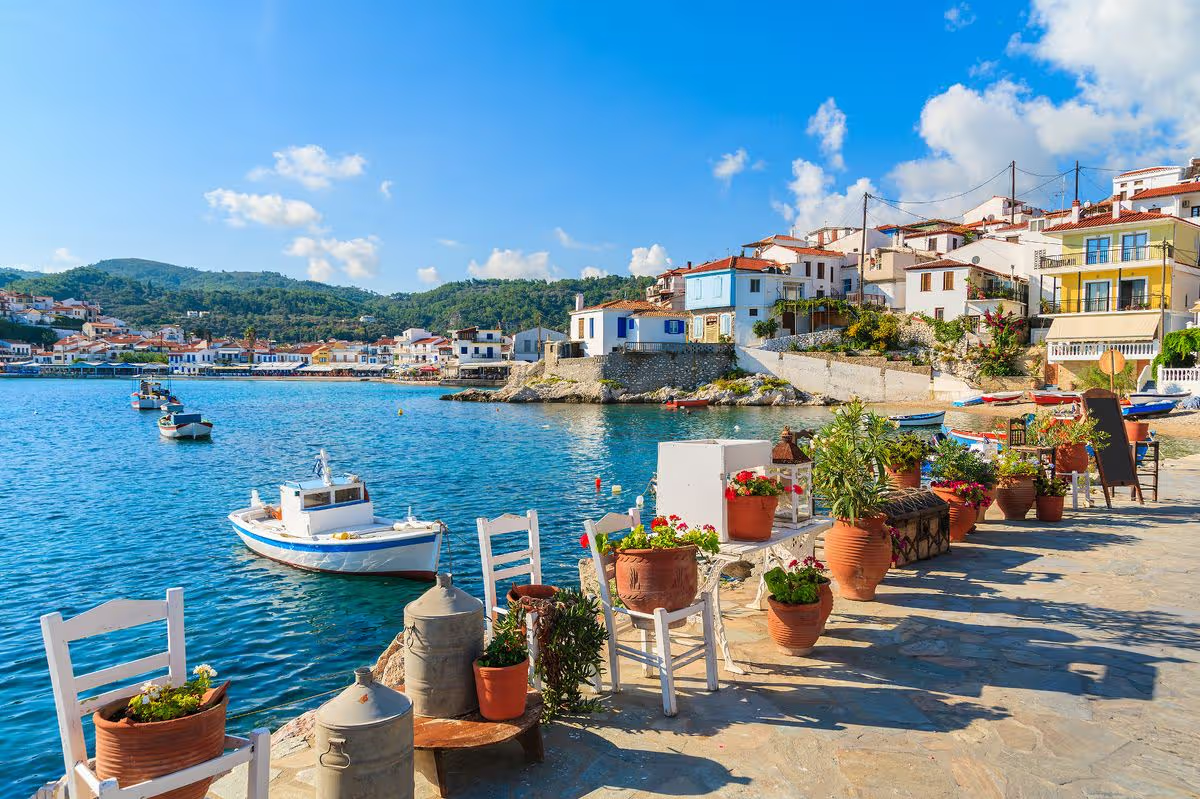
Ruben Chorlton-Owen says lots of people are being caught out and paying a heavy price for it
Ruben Chorlton-Owen gave the advice for anyone heading to Tenerife(Image: Jam Press)
A British traveller is warning anyone heading to Tenerife this half-term to watch out for several “tourist traps” that ensnare visitors every year. Ruben Chorlton-Owen frequently posts his travel advice and tips with his 105,000 followers on Instagram (@rube).
The 24-year-old, from Abersoch, North Wales, has recently been to the popular Canary Island destination. However, while there, he noticed a few things that raised concerns. And now, he is alerting people to several common “tourist traps” that catch holidaymakers out annually, as detailed in a video amassing more than 8,000 views.
If you find yourself requiring a pharmacy, watch out for “fake” establishments selling the same product at inflated prices. He said: “They’re real shops, but they have the same LED signage (as a pharmacy) but in blue colour (rather than green).
“So it’s not entirely illegal and many tourists fall for it. People later find out the product hasn’t worked as it’s not an actual medical product.
“It’s important to find a proper ‘farmacia’ that sells actual drugs to help with any pains or issues. Fake ones also don’t really have a lot in there and also heavily charge way too much for things like sun cream or paracetamol. They’re just tourist shops really.” He also advised Brits to be careful about how they withdraw money once they arrive.
“Make sure you try and get your cash before you come here,” Ruben told creatorzine.com. “Because the local currency exchanges or these ATMs will charge you a high markup and you’ll be getting a very bad deal for your money.”
While he praises the destination for being “affordable” and “friendly”, there are still risks to be mindful of. He said: “Make sure you use the licensed taxis.
“Not only are they genuine, but they’re also much more affordable than the Uber app. And you’ll also get charged four times the price that it should be.”
Ruben also issued a stark warning for anyone heading back to their accommodation late at night or after a day of drinking in the sun. He recommends giving a wide berth to any shabby-looking areas and narrow alleyways. He said: “It’s full of pickpockets.
“It can be quite dangerous, so just make sure you stay vigilant and you’re not having too much – or use the licensed taxi to get home when it’s late at night.”
And for those fancying a cold beer or cocktail on the beach, Ruben suggests thinking twice, as it could land you with a whopping fine. He said: “If you do like to drink, make sure you don’t do it down the beach. The fines are now a minimum of €750 to €3,000.
“Make sure you just stick to the bars, your hotel room, your Airbnb. Don’t be taking any glass bottles at all down the beach, it really isn’t worth the risk.”
THE American city of Philadelphia may be known as the home of brotherly love – but loves a good fight.
Its name combines the ancient Greek words philos, which translates as love or friendship, and adelphos, meaning brother, because founding father William Penn envisaged it as a haven of tolerance and peace.
Sign up for the Travel newsletter
Thank you!
The American city of Philadelphia is where the American Declaration of Independence was signed in 1776Credit: Sean PavoneAs you step inside Independence Hall you are transported back 250 yearsCredit: Lucio Rossi
But the US state of Pennsylvania’s largest city is also, of course, where the Rocky movies were filmed — and everywhere homage is paid to cinema’s most famous boxer.
Philly also has another claim to fame, though, as the place where the American Declaration of Independence was signed in 1776 — and this year marks the 250th anniversary of that treaty. So there is plenty to explore.
Our base was the Loews Philadelphia hotel, a 20-minuite drive from the airport and just yards from the City Hall — topped by a 37ft statue of William Penn.
The hotel is also handy for many a fine restaurant and bar — including the historic McGillin’s Old Ale House bar and restaurant.
The beer taps here have been pumping out ale since 1860 and the kitchen cooks up the city’s most famous dish — Philly cheesesteak.
This feast was the perfect introduction to my stay in town — layers of finely cut beef and sauteed onions shaped into a long roll and drenched in melted cheese.
Just forget that your arteries are closing as you eat it — and enjoy.
We did.
The Philly cheesesteak is the city’s most famous dishCredit: Refer to sourceThe historic McGillin’s Old Ale House bar and restaurantCredit: Photo by K. Huff for PHLCVB
Less than a 20-minute walk from here is Independence Hall, where that treaty was born.
Before entering, do swing by the Liberty Bell, just opposite, which rang out as America’s founding fathers, also including George Washington, finalised America’s break from mother country Great Britain.
Sadly, the 3ft-high bronze bell, which weighs nearly a ton, no longer rings out due to a crack that opened up in the 19th Century.
But on special occasions, it is tapped with a mallet.
Bell ticked off, as you step inside Independence Hall you are transported back 250 years, with history all around you.
It is free to enter but tickets at busy hours are limited so make sure you book your time slot well in advance.
Number one attraction is the room where the Declaration of Independence was signed, as well as the US Constitution 11 years later.
For a spot of culture, not far from Independence Hall is the Barnes Foundation — possibly the greatest art museum that, er, no one has ever heard of.
The Liberty Bell, which rang out as America’s founding fathers finalised America’s break from mother country Great BritainCredit: SeanPavonePhoto – stock.adobe.comPennsylvania’s largest city is where the Rocky movies were filmed, featuring Sylvester StalloneCredit: Rex
And then just a 15-minute walk up the road is the place for your must-have Philly holiday snap — next to the Rocky statue.
This 8ft 6in bronze tribute of Rocky Balbao stands at the foot of the 72 steps up to the Museum of Art which the underdog slugger played by Sylvester Stallone famously ran up as part of his gruelling big-fight training.
If all the sightseeing leaves you working up an appetite, there are plenty of fabulous eating places to choose from.
One such is the Reading Terminal Market, which is home to more than 75 stalls selling every food delicacy you can possibly imagine — and then some.
Or, for a proper sit-down feast, the Gran Caffe L’Aquila is a good bet — and particularly renowned for its award-winning gelatos.
I called it posh ice cream — and got a glare.
If, on the other hand, you want to find out what the locals really eat, book on to a Streats of Philly Food Tour and open your eyes, and mouth, to no end of tasty treats.
There are several tours to choose from, many led by chef Jacquie who grew up in the area and seemingly knows everyone in town.
I opted for the Italian Market tour and, over the course of two and a half hours, sampled fare including pork sandwiches, local cheeses and cannolis.
But do just remember not to eat anything before you go — the helpings were so generous that, after I later made for the airport to return home, I had to practically roll on to the plane.
GO: PHILADELPHIA
GETTING THERE: British Airways flies from London Heathrow to Philadelphia, with fares from £648 return. See britishairways.com.
OUT & ABOUT: Admission to Independence Hall is free but tickets must be booked in advance, from the National Parks Service. Check out nps.gov.
Entry to the Barnes Foundation art museum (barnesfoundation.org) is 30 dollars per adult, five dollars for under- 18s. Chef Jacquie’s food tour is 99 dollars (streatsofphillyfoodtours.com).
Nearly half of Brits say the cost of living has put them off going abroad in 2026, with many choosing to holiday at home instead.
Millions of Brits are choosing to holiday close to home this year(Image: Getty Images)
More than 25 million adults are giving foreign holidays a miss this year – with many choosing staycations to sidestep the stress of airports, travel disruption and worries over fuel shortages.
A survey of 2,000 Brits revealed that almost half (48%) have no plans to travel abroad in 2026, with the cost of living (33%) cited as the most common reason. Others are opting to explore Great Britain, saying they want to see more of the country, support the local economy, and avoid the risk of getting stuck abroad.
Over a third (34%) said concerns over fuel shortages have impacted their holiday plans this year. But despite this, 22% are perfectly happy that they haven’t booked an overseas trip, with 19% saying it isn’t worthwhile in the current climate.
Instead, 46% say there are plenty of fantastic destinations right on their doorstep. The Lake District, Devon and Cornwall rank amongst the most sought-after spots for a getaway in the coming months.
Research commissioned by National Rail found that 36% of staycationers plan to travel on holiday by train.
For many, it’s about more than simply getting from A to B. Picturesque views, the chance to spend time doing things they enjoy – such as reading – and the feeling that the holiday starts the moment the journey begins are all cited as key reasons train travel appeals to so many.
What’s more, the research suggests rail journeys can help people discover new places, with travellers saying they feel inspired to visit locations they pass through on the train.
Rail industry data showed a 10% increase in ticket sales between April and mid-May for summer travel to Britain’s most popular coastal destinations.
Sarah Apps for National Rail, said: “We’re seeing a real shift in how people are thinking about their summer holidays this year – with more looking to discover just how rewarding a Great British break can be.
“From breathtaking coastlines to vibrant cities and a peaceful countryside, there’s an incredible variety of destinations easily accessible by train.
“It’s great to see so many embracing the chance to discover places that feel a world away, without having to travel too far from home.”
The research also found that 35% see staycations as a better way to connect with friends and family, compared to just 9% who said the same about holidays abroad. A third believe staycations are ideal for creating nostalgic memories, while 22% say nothing beats a classic British summer.
Sarah Apps added: “Staycations can feel like a real home away from home, while giving people more time to connect with the people who matter most.
“Whether it’s discovering somewhere new or rediscovering an old favourite, it’s about making the most of the experience from start to finish.
“Travelling by train means your holiday can begin the moment you step on board – giving you time back to spend exactly as you choose. On the train you can relax with a good book, watch your favourite show, or chat and play games with family and friends.”
BRITS are not confident in identifying some of the UK’s most famous landmarks – including Hadrian’s Wall, the White Cliffs of Dover and the Angel of the North.
A poll of 2,000 adults found 59 per cent struggled to name well-known sites across our native country, compared to 41 per cent who identified them correctly.
Sign up for the Travel newsletter
Thank you!
A survey of 2,000 adults found that a majority of Brits struggle to name well-known sites across the UKOnly 18 per cent of those polled said they could correctly recognise the White Cliffs of DoverCredit: makasana
While 94 per cent could correctly recognise the Statue of Liberty in New York, 36 per cent were not able to name iconic landmarks closer to home, such as Hadrian’s Wall or St Paul’s Cathedral (35 per cent).
Angel of The North (20 per cent) and the White Cliffs of Dover (18 per cent) were also among those left unidentified.
However, 62 per cent admitted they want to learn more about British landmarks and local history.
The research was commissioned by Travelzoo, which is celebrating all the great places to see in the UK.
The club for travel enthusiasts has teamed up with TV personality and keen explorer, Julia Bradbury, who said: “I have been lucky enough to visit almost every corner and coastline of our amazing country.
“From rugged peaks to gently rolling hills, fairy tale villages and vibrant cities.
“We have so much diversity packed into our island, I can’t imagine ever being bored exploring it, and I encourage others to discover the incredible places right on their doorstep too.”
The study also found cost was the biggest barrier to exploring local landmarks (43 per cent), followed by lack of time (34 per cent) and transport logistics (30 per cent).
Three in 10 (31 per cent) believe people are more likely to visit international attractions over UK landmarks.
When asked to place landmarks geographically, 38 per cent were unsure where Stonehenge was located, whereas 66 per cent could not correctly identify the region for Hadrian’s Wall, and 33 per cent struggled with Giant’s Causeway.
More than four in 10 respondents who had children (43 per cent) did not think their child could correctly name well-known UK landmarks off the top of their head.
Parents believed their children would be more likely to recognise the Statue of Liberty (74 per cent) and the Eiffel Tower (75 per cent) over Stonehenge (63 per cent) and The Angel of The North (42 per cent).
In addition, 81 per cent believe children need to learn more about UK landmarks and local heritage.
More than a third (34 per cent) said they would not know where to begin when it comes to exploring what is on their doorstep.
Almost three in 10 (29 per cent) believe they have visited more countries outside of the UK than they have counties across the country.
That may be set to change, as a fifth said they are planning to spend more time holidaying in the UK this year compared to previous years.
Ease and reduced stress compared with travelling abroad was cited as the main driver behind choosing a UK trip this year (27 per cent), followed by shorter travel times (25 per cent) and cheaper to stay in the country (22 per cent).
The coast topped the list of staycation destinations, chosen by 61 per cent, according to the OnePoll.com figures.
As a nation, Brits are willing to travel for short-break destinations, with journeys averaging almost four hours for a one to three-night getaway.
Cat Jordan, for Travelzoo, said: “These findings show there’s a real appetite to connect with what’s on our doorstep, but many people don’t always know where to start.
“In a country with so much to discover, it’s easy to overlook just how much is at our fingertips.
“With so much history, coastline, and culture spread across the UK, you don’t need a passport for it to feel like a proper break.”
New research shows where and when will be most dangerous for motorists this Bank Holiday weekend
12:59, 19 May 2026Updated 13:00, 19 May 2026
Millions of Brits will take to the roads this Bank Holiday weekend
Most motorists reckon the roads are at their most treacherous during rush hour, when traffic is bumper-to-bumper and congestion is at its peak. But with millions of Britons set to hit the road this Bank Holiday weekend, fresh research suggests the greatest danger may lurk when the roads seem at their emptiest.
Fresh analysis by Confused.com appears to reveal the single most hazardous hour to drive in the UK, with motorists being urged to steer clear of this time slot where possible over the bank holiday weekend. Drawing on Department for Transport (DfT) traffic flow and collision data, Confused.com has developed an interactive Safety Index to work out the probability of being caught up in an accident relative to the volume of vehicles on the road.
Rhydian Jones, Confused.com car insurance expert, explains why the emptiest roads can often prove the most perilous, identifies the riskiest and safest times to drive in the UK, and offers guidance on how motorists can use Confused.com’s new Safety Index tool to plan safer journeys during the bank holiday exodus.
Whether you’re heading off for a long weekend away, popping to see relatives or making your way home after a day out, understanding when collision risk peaks could help you sidestep the most dangerous times to be behind the wheel.
Why Quiet Roads Can Be More Dangerous
It appears to defy logic. Fewer vehicles should surely mean fewer crashes. But experts suggest that emptier roads often encourage more reckless driving behaviour. Almost 1 in 3 motorists (29%) acknowledge they break speed limits at least from time to time, while more than 1 in 4 (27%) admit they’re more inclined to speed when traffic is lighter. Factor in poor visibility, driver fatigue and the heightened chance of encountering drink-drivers, and the hazard increases dramatically.
“Road safety relies on more than just how many cars are on the road. It depends on how conditions evolve through the day, and our analysis makes that pattern unmistakably clear. The late afternoon sees the highest number of collisions because the roads are busy. But when we look at the risk per vehicle, it’s the late-night and early-morning hours that are proportionately the most dangerous. That’s when visibility drops, fatigue sets in and roads are quiet enough that drivers may take more risks.
We know journeys become longer, traffic becomes heavier, and weather conditions get tougher. Our research shows many drivers already feel nervous, especially at night or in unfamiliar areas, and nearly a third admit to speeding when the roads look quiet. Our interactive ‘Safety Index’ tool can help drivers make informed decisions about when they travel, reducing risk and helping them stay safer behind the wheel.” Rhydian Jones, Confused.com car insurance expert.
The analysis found that the hours with the highest collision risk relative to traffic volume are:
Sunday: 3am to 4am
Saturday: 2am to 3am
Friday: 11pm to midnight
Monday: 1am to 2am
Tuesday to Thursday: midnight to 1am
These findings suggest that the greatest danger is not necessarily when roads are busiest, but when drivers are most tired and conditions are less forgiving.
The Safest Times to Drive
By contrast, the safest times to drive are generally in the early morning. Weekdays between 5am and 7am were found to carry the lowest risk, with Wednesday 5am to 6am ranking as the safest hour of the entire week.
On weekends, the safest time shifts slightly later, with 9am to 10am emerging as the lowest-risk period. Experts believe these times are safer because traffic tends to be more predictable and speeds are generally lower.
Over Half of Drivers Have Witnessed or Experienced a Crash
The study also found that road accidents are a common experience for UK motorists.
60% of drivers have either been involved in or witnessed a road accident.
33% say the incident happened in the afternoon.
39% say they have become more cautious and aware of other drivers afterwards.
19% say they felt more nervous behind the wheel.
The emotional impact of accidents can have a lasting effect on confidence and driving behaviour.
The Driving Situations That Make People Most Nervous
The research revealed that many drivers feel uneasy in certain conditions:
26% feel most nervous on inner-city roads.
32% worry about encountering drivers under the influence of alcohol or drugs at night or on weekends.
More than 1 in 3 (37%) actively avoid driving at night.
50% avoid driving in poor weather.
41% leave earlier to avoid feeling rushed.
The UK Areas with the Most Collisions
When looking at total collisions rather than risk per vehicle, the busiest crash period is 5pm to 6pm, coinciding with school pick-ups and the evening commute.
During this hour, the councils with the highest number of reported collisions were:
Kent – 265
Surrey – 215
Essex – 205
Nationally, there were 100,927 injury collisions recorded by police and logged by the Department for Transport over the last year.
Why This Hour Is So Dangerous
Several factors combine to make this the most hazardous hour of the week:
Drivers may be returning home after late nights out.
Fatigue is at its peak.
Reduced traffic can encourage speeding.
Visibility is poor.
There is a greater risk of drink-driving.
The result is a period where even a small mistake can have serious consequences.
In a bid to help motorists gain a clearer picture of road risks, Confused.com has unveiled an interactive Safety Index tool that highlights the safest and most dangerous times to drive on each day of the week.
By cross-referencing traffic volumes with collision statistics, the tool enables drivers to pinpoint lower-risk windows and make better-informed choices about when to set off.
For anyone considering a bank holiday road trip or a late-night drive home, the message couldn’t be more straightforward: quiet roads don’t necessarily mean safer roads.
Health experts are urging Brits to ensure they are “up-to-date” with their vaccines
Travel experts warned that cases of a contagious illness are rising worldwide(Image: Getty)
Brits planning a summer getaway have been urged to ensure they are “up-to-date” with their vaccinations. The warning follows an “increase” in measles cases globally, including across parts of Europe and Asia.
Measles is a highly infectious viral infection that triggers cold-like symptoms, red eyes, and a characteristic blotchy rash. In severe instances, it can result in serious complications such as meningitis and seizures, and can be fatal.
In guidance published on the Travel Health Pro website, experts highlighted that the disease has risen in numerous countries. They said: “The summer holidays provide opportunity to explore different countries, head off for a city break, have a beach holiday or take the children to visit friends and family overseas.
“Good preparation and planning ahead helps ensure a safe and enjoyable trip. Travellers should be up to date with routine vaccination courses and boosters as recommended in the UK.
“These vaccinations include, for example measles-mumps-rubella (MMR). Measles is a risk in many countries, and there has been an increase in measles cases and outbreaks reported worldwide, including in parts of Africa, Asia, Europe, and the Americas, including Canada and the United States.” Data from the European Centre for Disease Prevention and Control revealed that a total of 3,607 measles cases were reported by 30 EU/EEA member states in the year following 1 April 2025.
Breaking down the figures further, it stated: “Of 3,029 individuals (84.0 per cent of all cases) with a known age and vaccination status, 2 369 (78.2 per cent) were unvaccinated, 320 (10.6 per cent) were vaccinated with one dose of a measles-containing vaccine, 301 (9.9 per cent) were vaccinated with two or more doses, and 32 (1.1 per cent) were vaccinated with an unknown number of doses.
“During the 12-month period, five deaths (case fatality rate (CFR): 0.139 per cent) attributable to measles were reported to ECDC by France (three), Netherlands (one) and Romania (one).”
Meanwhile, a report by the World Health Organisation (WHO) and United Nations Children’s Fund (UNICEF) discovered that measles cases in Europe reached their highest level in 2024 since 1997. A total of 127,350 measles cases were recorded in the European Region in 2024, double the figure reported for 2023 and the highest number since 1997.
Children under five made up more than 40 per cent of reported cases in the Region – covering 53 countries across Europe and Central Asia. Over half of the reported cases necessitated hospitalisation. A total of 38 deaths have been documented, according to preliminary data received as of 6 March 2025. The resurgence has been linked to falling vaccination rates. Dr Hans P Kluge, WHO regional director for Europe, warned: “Measles is back, and it’s a wake-up call. Without high vaccination rates, there is no health security. As we shape our new regional health strategy for Europe and Central Asia, we cannot afford to lose ground.
“Every country must step up efforts to reach under-vaccinated communities. The measles virus never rests-and neither can we.”
Measles cases are also on the rise across the UK. Figures from the UK Health Security Agency (UKHSA) revealed that in 2024, there were 2,911 laboratory-confirmed measles cases in England – the highest annual total recorded since 2012. In 2025, there were a total of 959 laboratory-confirmed measles cases. Data for 2023 to 2025 and historical data are available.
Between 1 January 2026 and 11 May 2026, there have been 542 laboratory-confirmed measles cases reported in England, an increase of 65 cases since the last report on 27 April 2026.
Symptoms
The virus transmits very quickly. Initial symptoms typically resemble those of a common cold, with a distinctive rash emerging several days afterwards.
The first symptoms of measles can include:
A high temperature
A runny or blocked nose
Sneezing
A cough
Red, sore, watery eyes
The rash initially appears on the face and behind the ears, subsequently spreading across the entire body. Occasionally, the spots associated with the measles rash become raised and merge, creating blotchy patches. These are typically not itchy.
The NHS cautions that measles can trigger severe complications should it migrate to other bodily areas, particularly the lungs or brain. Potential consequences include pneumonia, meningitis, loss of vision, and convulsions. In the most serious instances, the disease can be life-threatening.
How to prevent the spread
Measles is spread when an infected person breathes, coughs or sneezes. You’re infectious from when you first have symptoms (around four days before the rash appears) until four days after you get the rash.
The NHS advises that to curb the transmission of the infection, individuals must remain absent from educational institutions or workplaces for a minimum of four days following the emergence of the rash. According to its website, the guidance states: “Stay off nursery, school or work for at least four days from when the rash first appears. Also try to avoid close contact with babies and anyone who is pregnant or has a weakened immune system.”
However, the initial step if you or your child develops measles is to arrange an urgent consultation with your GP. The NHS advises: “Measles can spread to others easily. Call your GP surgery before you go in.
“They may suggest talking over the phone or arrange for you to come to a part of the surgery where you’re separated from others. You can also call 111 or get help from 111 online.”
After seeing a GP, there are things you can do to help ease the symptoms and reduce the risk of spreading the infection. It can help to:
Rest and drink plenty of fluids, such as water, to avoid dehydration
Give your child paracetamol for children or ibuprofen for children if they’re distressed or uncomfortable – check the packaging or leaflet to make sure the medicine is suitable for your child, or speak to a pharmacist or GP if you’re not sure
Adults can take paracetamol or ibuprofen for a high temperature
Use cotton wool soaked in water that has been boiled and allowed to cool to gently remove any crusts from your or your child’s eyes
The NHS also recommends you:
Open windows and doors to help reduce the risk of measles spreading – only open the top window or use safety catches if you have young children
Wash your hands often with soap and warm water
Use tissues when you cough or sneeze and throw them in the bin immediately after using them
Do not share cutlery, cups, towels, clothes, or bedding
Vaccination
Having the MMRV or MMR vaccine is the “best way” to prevent measles. The NHS says: “Both vaccines also protect you from mumps and rubella, and the MMRV vaccine also protects you from chickenpox.
“The MMRV vaccine is offered to all young children in the UK. The MMR vaccine is recommended for adults and older children if they were not vaccinated when they were younger.”
Ask at your GP surgery if you’re not sure you or your child has had either of these vaccines. Your GP can vaccinate you for free on the NHS.
Holidaymakers may also be fined(Image: amoklv via Getty Images)
With warmer weather finally on the horizon, many Brits are turning their attention to the summer months and making holiday plans.
Spain continues to be the top choice for British tourists, with millions flocking to the European country each year, keen to bask in the sun, relax on its shores and enjoy the cuisine. When travelling overseas, it’s essential to get clued up on any local laws or rules you’ll be expected to follow while you’re there. And if Spain is in your sights this year, there’s one rule you may not know about.
The Foreign, Commonwealth and Development Office (FCDO) regularly provides travel advice for Brits visiting more than 220 countries and territories around the world. In its comprehensive guidance for Spain, the FCDO specifically highlights balconies.
While balconies are ideal for providing a vista and giving guests somewhere to relax outdoors, holidaymakers are required to behave responsibly. FCDO guidance for Spain warns: “Hotels and other establishments will evict you if you behave dangerously on balconies. You could also get a fine.”
Those travelling to Spain are also cautioned that they must present ID if asked by a police officer. The FCDO adds: “This includes the Guardia Civil and national, regional and local police forces.
“The police have the right to hold you at a police station until they have confirmed your identity. Ignoring direct requests of a police officer can be considered as ‘disobedience’, which is a criminal offence.”
The Foreign, Commonwealth and Development Office (FCDO) has issued a warning to UK tourists
The FCDO issued an update about its travel advice for a certain country(Image: Getty)
The Foreign Office has warned Brits against “all travel” to a particular country due to “risks and threats”. Travellers are advised to avoid Russia entirely owing to the ongoing invasion of Ukraine.
In an update published on its website on May 5 and reconfirmed on May 14, the Foreign, Commonwealth and Development Office (FCDO) stated it “advises against all travel to Russia”.
It said: “FCDO advises against all travel to Russia due to the risks and threats from its continuing invasion of Ukraine.” These include:
Security incidents, such as drone attacks, and Russian air defence activity
Lack of flights to return to the UK
Limited ability for the UK government to provide support
The FCDO added: “There is an increased risk of British nationals being detained in Russia, including if the Russian authorities suspect you of engaging in or supporting activities against Russian law, even if activities took place outside Russia.
“Russia has a track record of targeting foreign nationals and holding them in detention as leverage over other countries. FCDO’s ability to assist you in these circumstances is extremely limited.
“There is also a high likelihood terrorists will try to carry out attacks, including in major cities.”
On its safety and security page, the FCDO noted that terrorist attacks have occurred across Moscow, St Petersburg and other Russian cities in recent years. This includes an attack at Crocus City Concert Hall in Krasnogorsk near Moscow in 2024 in which 145 people were killed.
Limited UK government support
While the British Embassy in Moscow and British Consulate in Ekaterinburg remain operational, the FCDO cautioned that the situation “could change at short notice”.
“In-person UK government support in Russia is limited,” it stated. “It is very limited in parts of Russia because of the security situation and the size of the country, particularly in the North Caucasus.”
Should you find yourself in Russia requiring assistance, you can ring the FCDO’s 24-hour helpline on +7 495 956 7200 and select the option for consular services for British nationals. Alternatively, you can contact the Russian emergency services on 112.
It’s also crucial to be aware that your travel insurance may be rendered void if you travel against FCDO guidance. For further details, visit the FCDO website here.
The Greek Embassy said “As of April 10, 2026, British passport holders are exempt from biometric registration at Greek border crossing points.”
This was backed by the director of the Greek National Tourism Organisation in the UK, who said Brits will “no longer need to undergo additional EES biometric procedures, ensuring a smoother and more efficient arrival experience in Greece”.
However, in a u-turn, officials have now said that Brits will not be exempt and will have to follow the new EES rules.
The Greek Foreign Ministry said they have not received any information that “specific nationalities are temporarily exempt from the relevant procedure,” according to local media.
Instead, the rules will only be temporarily paused if there are high volumes of passengers at once, caused by a number of planes landing at the same time.
This won’t just affect Brits, but any non-EU nationals that have to go via the biometric scanners.
And queues have already started to cause problems – one passenger told local media it took “nearly two and a half hours to get through [passport control] in Athens” while island airports like Zante were facing similar wait times.
One source warned it was “just the beginning,” with summer seeing as many as 15,000 passenger a day travel through Athens, the busiest airport in Greece.
Huge queues have already been reported across Athens and Zante ahead fo summerCredit: Alamy
If you want to try and avoid the chaos, make sure your plane doesn’t land between 12pm and 2pm, they warned, as that’s when a huge number enter Athens at one point.
Portugal is also another country struggling with huge queues, with one expert saying a family waiting more than six hours because of the EES waits.
It was hoped that both Portugal and Italy would suspend the EES rules until after summer, but they have also echoed Greece in saying this would only be during busy passenger periods.
THERE’S nothing worse than coming home from holiday to be hit with massive data roaming charges from your mobile provider.
As thousands of Brits head off on their summer hols, many are still being caught out by unexpected data roaming fees.
Sign up for the Travel newsletter
Thank you!
Don’t forget to install an eSIM before you travel – Holafly eSIMs cover 200+ destinationsCredit: Getty
Get 5% off Holafly eSIMs with discount code THESUNHOLA5
It’s easy to slip into ‘holiday mode’ abroad and fire off a WhatsApp message or check Google Maps, forgetting that every click is racking up a massive bill behind the scenes.
And even if you have a roaming pass from your mobile provider, the monthly cost can be eye-watering – and that’s if they cover your destination at all.
Thankfully, an eSIM from Holafly can help you avoid those unexpected fees.
The eSIMs start from just £2.99 and offer unlimited data – so no need to keep checking if you’ve nearly hit your data limit.
Plus, Sun readers can bag an extra 5% off an eSIM by using the coupon code THESUNHOLA5.
The code also gets you 10% off monthly plans. These are great if you’re a regular traveller, as they offer you unlimited data globally from £38.95 a month.
Once you buy your eSIM, it arrives via email and WhatsApp instantly.
You simply scan the QR code, or if you’re on iOS 17.4+, you can install it in one simple tap.
It’s easy-peasy and keeps your regular SIM (and WhatsApp number) active, so you won’t miss any messages from home.
It’s easy to forget which apps are eating away at your data when you are abroadCredit: Getty
And if you’re wondering whether Holafly covers the destination you’re headed to? It’s pretty likely that they do.
The eSIM company have expanded the amount of places they cover to over 200 destinations worldwide.
Whether you’re hitting European hotspots like Spain, France, and Italy, or going long-haul to the USA, Canada, Australia and beyond, you can stay online from the moment you land.
Other providers slap you with fair usage limits that can soon run out – but Holafly offers unlimited data.
There are no hidden fees, so don’t expect any unexpected charges or texts telling you you’ve gone over the limit.
Get 5% off Holafly eSIMs with discount code THESUNHOLA5
How to get your discounted Holafly eSIM
Getting set up with Holafly is incredibly simple, all you’ll need to do is:
Many Brits are concerned that the new EU Entry/Exit system (EES) could put a dampener on their holidays, but an obscure clause could mean that the system is paused at the busiest times
Brits will need to use the EES systems when holidaying abroad this summer (Image: Lucy North/PA Wire)
Summer 2026 is shaping up to be uncertain for holidaymakers. A combination of the jet fuel issues and new requirements for Brits entering the European Union (EU), means many travellers are braced for delays, cancellations, or long airport queues.
But a little-known clause in the EES rules could become a lifeline for Brits heading to Europe this summer, and it could be invoked if the queues at European airports become too long.
Some countries are already taking their own measures to tackle the chaos caused by EES. Greece has switched from using EES back to manual passport stamping to ensure a smoother entry system. While reports that Italy and Portugal may follow suit have been shut down by Brussels.
However, there are exemptions built into the EES system that could be invoked in “exceptional circumstances” and these could potentially come into play if the new procedures overwhelm EU airports.
A parliamentary briefing notes that the European Commission “referred to the possibility” that EU countries could “suspend EES operations potentially for a further 150 days after the 10 April implementation date.”
This suspension can be for periods of up to six hours in “exceptional circumstances where there are excessive waiting times”, the document went on to say.
This means that up until July 9, some borders would have the power to suspend EES for up to six hours a day.
“Member States should use that possibility only when such suspension is strictly necessary and for the shortest period possible. In the case of partial suspension, the registration of biometric data in the EES should be suspended. In the case of full suspension, no data should be recorded in the EES,” the legislation adds.
Since the implementation of the new system, there have been mixed reports on its efficiency. Some have claimed that it’s made the process of getting through the airport tougher for Brits. Holidaymakers have reported long lines, blaming slow software and machines going down, while others have claimed it’s made little difference in times getting through the airport.
While this visa waiver system was set to cost €7, just over £6, the fee has now been set at €20, about £17.37, almost three times the original cost. All travellers aged between 18-70 will need to apply before they travel once the new system is launched.
Have a story you want to share? Email us at webtravel@reachplc.com
IF you’re looking for an all-inclusive, sunny week away with a price tag that feels like a typo, we’ve got you covered.
Egypt has seen a fall in tourism due to the Iran war – despite it not being affected by the conflict.
Sign up for the Travel newsletter
Thank you!
In response, tour operators are dropping prices of all-inclusive holidays – with some savings racking up to over £2,000.
Egypt is a top pick when it comes to budget-friendly holidays, offering high-end feel hotels with private beaches for very affordable prices.
Despite the rock bottom prices, these deals feature everything from sprawling resorts with 31-slide water parks, to romantic hotels where you can snorkel tropical waters or dine under the stars.
These resorts prove you don’t need to fork out the cash for an all inclusive week away.
So whether you want to bag a last-minute break for June or secure some winter sun while the prices are low, here are the hottest Egypt holiday deals to book now.
New Badawia Resort, Sharm el Sheikh
New Badawia Resort is a pretty hotel pick in sunny Sharm el SheikhCredit: Google maps
This resort in Sharm el Sheikh is an ideal spot to soak up the Egyptian sun, with a vibrant strip of bars and restaurants on your doorstep.
Here there’s a sprawling outdoor pool area, complete with a separate section for children and a sun terrace lined with loungers to top up your tan.
There’s activities from table tennis to traditional live evening entertainment, and with the all-inclusive package covering your buffet meals and local drinks, you can leave your wallet in the room.
Loveholidays offer a week-long all-inclusive stay from November 30, including return flights from London Gatwick, for £289pp.
Tivoli Hotel Aqua Park, Sharm el Sheikh
You can have an all-inclusive week away at Tivoli Hotel Aqua Park for £409pp this summerCredit: Google maps
This luxurious four-star stay in Sharm has two huge pools dotted with parasols and loungers, giving you plenty of spots to sunbathe.
When it comes to things to do, kids can make a splash in the aqua park or try out archery, whilst adults will enjoy a pamper at the on-site spa and relaxing yoga classes.
Nearby you can enjoy the nightlife of Naama Bay, or stroll the quaint streets of the Sharm Old Market and Sharm Old Town.
Loveholidays offer a week’s all-inclusive stay from June 11, including return flights from London Luton, for £409pp.
Empire Beach Aqua Park, Hurghada
Empire Beach Aqua Park in Hurghada has a pool and sun terrace looking out over the Red SeaCredit: On The Beach
The vibrant, palm-lined terraces of Empire Aqua Park make a stay at this sprawling resort feel like a tropical island escape.
There’s plenty to keep everyone entertained, including an action-packed kids club and all-singing, all-dancing evening entertainment program.
This resort has three outdoor pools and also boasts its own private beach, where you can try beach volleyball, diving or simply lay back and relax.
Loveholidays offer a seven night all-inclusive stay from December 5, including return flights from London Luton, for £379pp.
Falcon Hills, Sharm el Sheikh
Falcon Hills has bright white hotel grounds and a massive pool with lots of loungers
With its whitewashed walls, blue decor and bursts of pink bougainvillea, this charming hotel feels like a slice of the Greek islands dropped onto the coast of the Red Sea.
This family-friendly spot is in the El Hadaba district, a calmer area of Sharm, perfect for those who want a laid-back holiday feel.
Fill up on a varied buffet breakfast in the morning before securing a spot on a lounger by one of two pools, whilst kids are kept busy in the kids club.
Rooms are spacious and traditionally-decorated, some of which open straight out to the sun terrace, so you’re only steps away from the pool.
On the Beach offer a seven night all-inclusive stay from October 31, including return flights from London Gatwick, for £455pp.
Lemon & Soul Makadi Garden, Makadi Bay
Lemon & Soul Makadi Garden is a stylish choice with vibrant yellow and orange themingCredit: On The Beach
The Instagrammable Lemon & Soul Makadi Garden is a stylish pick on the crystal-clear coast of Makadi Bay.
Here there’s plenty of bright, citrus-y yellow, orange and lime-coloured decor that makes the resort feel fresh and modern.
Order some all-inclusive cocktails from the beach hut on the hotel’s stretch of private sand, or try snorkelling in its waters to spot tropical species.
On the Beach offer a seven-night all inclusive stay from June 3, including return flights from Birmingham, for £460pp.
Parrotel Lagoon Resort, Nabq Bay
Parrotel Lagoon Resort has a bar on an island in the middle of the poolCredit: On The Beach
This mega family resort has a pool so huge that its got its own island bar in the middle of it.
There’s also a huge on-site water park with 31 slides to keep kids entertained, plus a heated pool and wave pool.
For food and drink, there’s three main restaurants as well as several snack bars and even a piano bar, where you can unwind with a drink in-hand and listen to live music.
On the Beach offer a seven night all-inclusive stay from June 11, including return flights from London Luton, for £495pp.
JAZ Neo Sharks Bay
The exterior of the glamorous JAZ Neo Sharks Bay has a warm golden glow at nightCredit: On The Beach
The affordable yet glamorous JAZ Neo Sharks Bay is highly-rated across review sites, and it’s clear to see why.
Inside you’ll find sleek gold, bronze and cream-coloured lounging areas, hanging lanterns and spiral staircases. Rooms are just as stylish, with deep-red, velvet details.
The hotel even puts out romantic tables for two beside the glowing pool at night, where you can dine together under the stars.
This four-star spot even has its own private, parasol-lined beach where you can soak up the sun or make a splash in the Red Sea.
Set yourself up on a poolside lounger for the day, or if you’re feeling active you can grab a workout in the fitness centre.
On the Beach offer a week’s all-inclusive stay from June 11, including return flights from London Luton, for £480pp.
However, the cost of flights – especially across Europe – is actually dropping right now because of the ongoing uncertainty.
This includes not only fears of a jet fuel shortage, but also concerns over the cost of living, with food and fuel prices being pushed up as well.
According to the FT, the cost of flights to 27 of the top 50 European destinations when travelling in July has dropped in recent weeks.
Some routes in mainland Europe dropped as much as 44 per cent, while a number of UK routes, such as London Heathrow to Nice, London Gatwick to Barcelona and Manchester to Palma, all dropped by at least 10 per cent.
The Sun’s Head of Travel and expert of more than 30 years, Lisa Minot, explained what this means for your holiday.
She said: “Airlines and tour operators face an impossible choice right now as they attempt to get Brits booking.
“As the US / Iran war drags on into its fourth month, news of jet fuel shortages and fuel surcharges has led to a dramatic drop in bookings as the travelling public is paralysed with indecision.
“While many of our favourite airlines and tour operators are confident in the price – and availability – of jet fuel for the summer months, convincing us to book has proved more difficult.
“When the good times roll, supply and demand can see prices skyrocket.
“Conversely, when the outlook is less sunny, that demand drops and so do prices.”
Chris Webber, Head of Holidays and Deals at TravelSupermarket, told Sun Travel about some of the places that are seeing prices drop.
He explained: “What’s really striking is just how many short-haul European destinations are actually cheaper than they were before the conflict began.
“Italy is leading the way, with the Neapolitan Riviera down £232 per person to £905, the Amalfi Coast £126 cheaper at £1,073, and the Italian Lakes down £122 to £714.
“Spain‘s La Palma has fallen from £120 to £474, making it one of the best-value options on the market right now.
“Turkey is also seeing significant drops across the board — Bodrum is down £118 to £579, Dalaman is £110 cheaper at £492, and Antalya has fallen £90 to £520.
The beautiful Amalfi Coast has seen one of the biggest dropsCredit: AlamyWizz Air chief executive József Váradi warned the “level of hesitancy” is causing the drop in bookingsCredit: Getty
“The Greek islands are following suit, with Corfu down £83 to £568 and Skiathos down £82 to £844, while mainstream favourite Majorca is £86 cheaper at £581.
“Holiday companies are keen to get bookings moving, and that’s likely filtering through into some very competitive pricing right now.”
Wizz Air‘s chief executive József Váradi warned the “level of hesitancy” is causing the drop in bookings, previously telling the BBC: “That level of hesitancy can be overcome through price stimulation. So, short term, you are actually seeing prices dropping.”
Barclays analyst Andrew Lobbenberg backed this up, saying: “People are reluctant to book, they are booking late, and the airline and holiday companies are having to incentivise them with lower prices.”
What does this mean for your cheap flights?
Right now, easyJet has a number of cheap flights under £20 if travelling next month to destinations like Pisa, Amsterdam and Faro.
And Ryanair still has some cheap fares from £20 for July travel – when you’d normally expect fares to start going up – to destinations such as Barcelona and Venice.
Some of the biggest bargains in July include:
London Luton to Barcelona (£20)
London Luton to Venice (£21)
London Stansted to Milan (£15)
London Stansted to Cagliari (£20)
Manchester to Paris (£17)
Manchester to Ibiza (£20)
Birmingham to Pisa (£18)
Birmingham to Santander (£19)
TUI has some huge bargains for July still, especially to places like Corfu and Turkey.
Seven nights at Odysseus hotel just before the summer holidays is £275pp, with other stays coming in under £340pp.
Hard-hit destinations have seen holiday prices plummet, too.
Egypt is still on the safe travel list and hasn’t been drawn into the Iran war, but has seen holiday prices drop.
All-inclusive holidays for a week can be found for under £500pp in July – or ditch the food package, and there are deals from £419 each.
If you can wait until next year, seven-night, all-inclusive holidays for as little as £269pp with loveholidays in January 2027.
Turkey all-inclusive holidays are even cheaper, starting from £229pp for a week’s holiday – or travel in July for breaks still under £330pp.
Brits who are nervous about booking a trip abroad right now should look at booking package holidays instead, Lisa advised.
UK tour operators are ATOL protected, meaning your money is protected if your trip is cancelled.
This isn’t the case if booking flights and hotels separately.
But if you want to take the risk? You could find some mega cheap flight deals, which might be the last time for a while.
Lisa added: “With prices tumbling as the industry tempts us back into the skies, for the late deal hunters, things are looking good.”