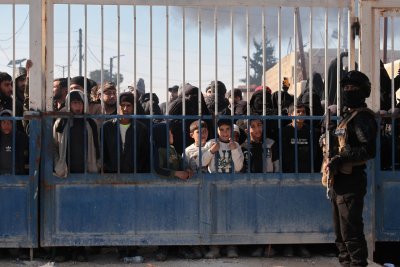

1 of 5 | Members of the Syrian security forces stand in front of the gate of the al-Hol camp, which houses families of suspected ISIS fighters, after the Syrian government took control of the area, in Hasakeh province, Syria, on Jan. 21. The Syrian government said Wednesday that there was a “mass escape” last month at the camp. It has since been closed. Photo by Mohammed Al-Rifai/EPA
Feb. 25 (UPI) — Syrian officials announced Wednesday that there was a “mass escape” last month from the country’s Kurdish-controlled al-Hol camp, which held ISIS-linked families.
It’s believed that thousands may have escaped, CNN reported.
The Wall Street Journal reported that about 15,000 to 20,000 people, including ISIS affiliates, were at large following the escape from al-Hol, citing U.S. intelligence agencies, CNN reported. The United Nations said al-Hol camp held more than 30,000 people.
“When our forces arrived, they found cases of collective escapes due to the camp having been opened up in a haphazard manner,” Syrian Interior Ministry spokesperson Noureddine al-Baba said at a press conference Wednesday.
The Kurdish Syrian Democratic Forces were in charge of the camp and were an ally to U.S. forces fighting ISIS in Syria. But the U.S. drawdown from the country in 2019 left the SDF struggling, especially after the Assad regime fell in 2024. Syrian President Ahmad al-Sharaa joined the U.S.-led anti-ISIS coalition in November, and his forces continue to hunt for ISIS fighters
In January, the SDF said it abandoned the al-Hol camp because of “international indifference” to ISIS and “the failure of the international community to assume its responsibilities in addressing this serious matter,” CNN reported.
The two main camps — al-Hol and al-Roj — detained ISIS fighters and their family members, but were mostly populated with women and children.
Until mid-January, the camps together housed about 28,000 people. About 12,500 were foreign nationals from more than 60 countries, including about 4,000 Iraqis, according to Human Rights Watch.
The al-Roj camp, which holds around 2,300 foreign women and children, is still under SDF control but it is expected to close.
In 2014, ISIS declared a caliphate in a swath of land across parts of Syria and Iraq, calling Raqqa, Syria, its capital. The caliphate was led by Iraqi-born Abu Bakr al-Baghdadi. Muslims from around the world who identified with ISIS moved there to be a part of it. A U.S.-led coalition mostly destroyed the enclave in 2019, and the SDF managed the camps. Baghdadi died by suicide just before he could be captured by U.S. forces.
Countries around the world have been facing pressure to repatriate their citizens who have been stuck in the camps since the fall of the caliphate. Most of them are women and children. But most countries cite national security as a reason not to allow them back in.
Last week, Australian Prime Minister Anthony Albanese said he would not allow Australian ISIS detainees from al-Roj to repatriate.
A naturalized American citizen pleaded guilty in June to fighting against U.S. forces for ISIS in the region and was sentenced to 10 years.
The al-Roj camp also houses Shamina Begum, a British woman who left London at age 15 to marry an ISIS fighter. In 2015, she lost her British citizenship.