Cliff is sitting in his farm truck scanning the hillsides with powerful binoculars. “It’s the rams,” he says. “They can stray at this time of year.” I follow his direction of gaze, down a golden hillside covered in bracken and boulders to a dark patch in the valley bottom. “Hopefully not down there,” he adds. “That’s the quaking bog.”
Sometimes a chance encounter can transform your appreciation of an area, and that is about to happen for me. I’m heading up Craig y Garn mountain to catch the sunrise over the Llŷn peninsula and the first rays are already stealing over the tops of distant Cadair Idris, rousing giant shadows from under the trees. Cliff, who also happens to be my landlord for the week, points to the house on a hill above the bog: “Where you’re staying was my great-grandmother’s house – or at least what is now the living room. She kept one pig, one sheep and one cow, and made buttermilk where the conservatory is.”

Below the house, mostly out of sight, is the local village. “There used to be a pub and a shop. The school had 150 in it when I was there 70 years ago.” He grins. “I didn’t speak a word of English till I was seven.”
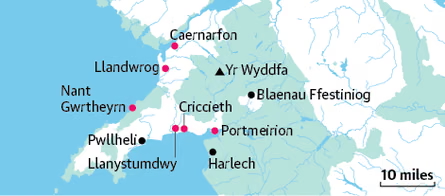
The tale of decline in rural amenities is a common one, but I am here to investigate an area that is pushing back hard. The Llŷn is leading the way in opening community pubs, restaurants, cafes and shops, facilities that, combined with the Wales Coast Path, make it a great area to explore.
For Cliff, the rural decline was a family lived experience. “Great uncle Bob left on a ship from Caernarfon in 1900 and joined the Klondike goldrush. Lots of people here were slate miners so could get jobs in North America.”
In fact, throughout the late 19th century, parts of Wales were gripped by emigration fever. Posters went up advertising passage on “fine fast-sailing barques”, usually with a “ballast of slates”. After many adventures, great uncle Bob settled in Whitehorse, in Canada’s Yukon, and is buried in its Pioneer Cemetery.
I leave Cliff and run up to the summit. The shadow giants have all disappeared, but the view is still dazzling, a reminder that the Llŷn is an extraordinary place. To the east, Yr Wyddfa (Snowdon) is white with ice. Looking west, I can see the Irish Sea on both sides and on the north coast a trio of conical mountains, like volcanic plugs. The tallest, Garn Ganol (561m), is an extraordinary granite intrusion that was once a busy mining area, one of only two sources in the world for curling stones. Nearby is one of the first-ever community pubs in Britain, the Tafarn y Fic, established in 1988, where I aim to finish my first walk.
I start right under Garn Ganol peak, heading down a steep and spectacular valley towards a shingle beach and the village of Nant Gwrtheyrn. The settlement was abandoned when the mines closed, but local doctor Carl Clowes set about reviving it as a cultural centre in 1978, with courses in the Welsh language. (The doctor’s cultural impact didn’t stop there: two of his sons played in the rock band Super Furry Animals, a big part of the Welsh musical renaissance of the 1990s.)
From the beach, the path winds up over a headland to St Beuno’s chapel near the hamlet of Pistyll. This simple church is more like an ancient sacred cave with its bare stone walls and straw-covered floor. From here, I loop back over the hill to Tafarn y Fic in Llithfaen.
Back in the 1980s, this village was in decline, but its relative isolation proved a vital factor in triggering community action. With alternative pubs and shops a long drive away, the defunct Victoria Hotel (the “Vic”, which transliterates as Fic in Welsh) was bought out by locals and reopened. When I drop in for a pint, there are teenagers playing pool and darts while a couple of locals are working on their laptops by the fire. Across the road is a community shop.
The pioneering Tafarn y Fic proved an inspiration to other villages in the area. My next walk is along the south coast from the village of Llanystumdwy, where Tafarn y Plu (The Feathers) stands. Here, they have a fun little honesty shop outside and a stage for concerts. “It got so busy last summer that we ran out of beer,” the barmaid tells me. “Luckily, all the other community pubs sent barrels over.”
Llanystumdwy is famous for its most successful son: David Lloyd George. The great political orator grew up here, deeply immersed in Welsh nonconformist liberalism, factors that are arguably still at play in the strong tradition of collective action. Not that community spirit is necessarily benevolent: when Lloyd George came back to speak here in 1912 as chancellor of the exchequer, suffragette hecklers were beaten unconscious by locals.
I walk through the village, past the lovely stone bridge and the great man’s grave in the woods. There is a museum, too, closed for winter at the time of my visit. Back on the coastal path, I reach Criccieth, a lovely town with an impressive castle, still much as it was when sketched by JMW Turner back in 1798, having been left in ruins by Owain Glyndwr’s forces in 1404.
Just beyond, on the town beach, is a lovely art deco building, now Dylan’s restaurant. Designed by Clough Williams Ellis, known for nearby Portmeirion, it was not actually built until the 1950s and now makes a rather stylish lunch stop on the walk.
The coastal path here follows the long, broad beaches with stunning views of Harlech Castle, the Rhinogs and Cadair Idris mountains across the bay. No wonder Turner loved the area: there is always something going on with the light. The sea is suddenly snarling with whitecaps or else washed with an orange blush. As the bay narrows into the estuary, a steam train puffs out across the causeway and a squadron of curlews lands on one of many sandbanks.
I was hoping to catch the northern branch of the Ffestiniog and Welsh Highland Line to Caernarfon and pick up the coastal path again, but that plan is foiled by a landslip. In summer, however, this would be a great option. The two heritage lines, one up to Caernarfon and one to Blaenau Ffestiniog, are fine examples of community effort too, having been rescued from oblivion by volunteers and enthusiasts who even built four new kilometres of track after the Electricity Board unhelpfully flooded part of the line in 1954. Together with the mainline to Pwllheli, they are a convenient means to starting or finishing non-circular walks.
Once I reach Caernarfon, I find a lovely ancient town with a newly redeveloped old slate-loading quay, Cei Llechi, right under the famous castle walls. The coastal path here follows the Menai Strait, circling around Foryd Bay bird reserve, then the long beach at Dinas Dinlle. Just back from the beach in the village of Llandwrog is the latest addition to the roster of community ventures: the Ty’n Llan community pub, restaurant and hotel. This vibrant and extensive project is testament to the growing confidence and capability of the community-ownership movement. It’s also a great spot to start learning Welsh, as it’s the main language of the public bar. So, iechyd da – cheers!
The trip was provided by the Wales Coast Path which follows the Llŷn peninsula for 96 miles. Pen y Braich Uchaf cottage sleeps six and is bookable through Sykes Cottages from £714 a week. Tafarn y Plu will reopen in autumn 2026 after a £2m upgrade