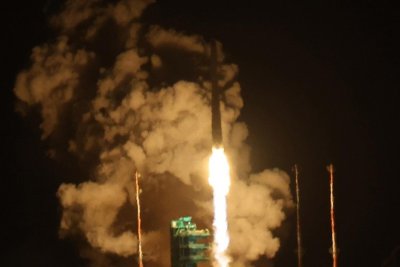

The Nuri space rocket, carrying 13 satellites, takes off from Naro Space Center in Goheung, South Korea. Photo by YONHAP/ EPA
June 25 (Asia Today) — South Korea is preparing to conduct the fifth launch of its homegrown Nuri rocket in September as the government moves to expand launch infrastructure and accommodate growing commercial demand.
Taeseog Oh, administrator of the Korea AeroSpace Administration, said Wednesday that the agency plans to convene a launch management committee in early August to set the final launch date.
“At this point, we expect the launch to take place in September,” Oh said during a news conference at the agency’s headquarters in Sacheon, about 190 miles southeast of Seoul.
Assembly of the rocket’s individual stages is expected to be completed this week. Full assembly of the three-stage launch vehicle is scheduled to begin next week.
After the fifth launch, the agency plans to begin upgrading the Naro Space Center in Goheung, South Jeolla Province, which has handled South Korea’s major space launches.
“The supplementary work required under the Naro Space Center modernization project is moving forward,” Oh said. “The project is currently undergoing a preliminary feasibility review, and work is expected to begin next year.”
The agency is also planning a second national space center to meet an expected increase in government and commercial launches and support future launch vehicles.
Oh said South Korea plans to begin the second space center project in 2028 and establish infrastructure capable of supporting reusable launch vehicles by the mid-2030s.
“A reusable launch vehicle requires not only a launch site but also a landing site,” Oh said. “By the mid-2030s, we intend to secure future-oriented launch infrastructure capable of operating reusable vehicles.”
The agency began accepting applications Monday from local governments seeking to host the center. A final candidate site is expected to be selected in October.
Oh said some South Korean companies have reported difficulty securing launch slots from U.S. companies such as SpaceX because of rising global demand.
“We will work to establish conditions in which satellites developed domestically can be launched aboard our own launch vehicles,” he said.
The agency also plans to upgrade the existing Naro Space Center while developing the second facility.
The expansion is intended to support more frequent satellite launches, newly developed launch vehicles and the reusable rocket South Korea aims to develop by 2035.
Oh also emphasized the need to increase government investment as the country seeks to shift toward NewSpace, an industry model driven more heavily by private companies.
The government is reviewing the agency’s budget proposal for next year.
“The government recognizes the importance of the aerospace budget, and we will work to expand it,” Oh said.
“In South Korea, even the government-led Old Space model was not sufficiently developed,” he said. “Government investment and private-sector participation must occur simultaneously for an aerospace industry ecosystem to take shape.”
— Reported by Asia Today; translated by UPI
© Asia Today. Unauthorized reproduction or redistribution prohibited.
Original Korean report: https://www.asiatoday.co.kr/kn/view.php?key=20260625010008848