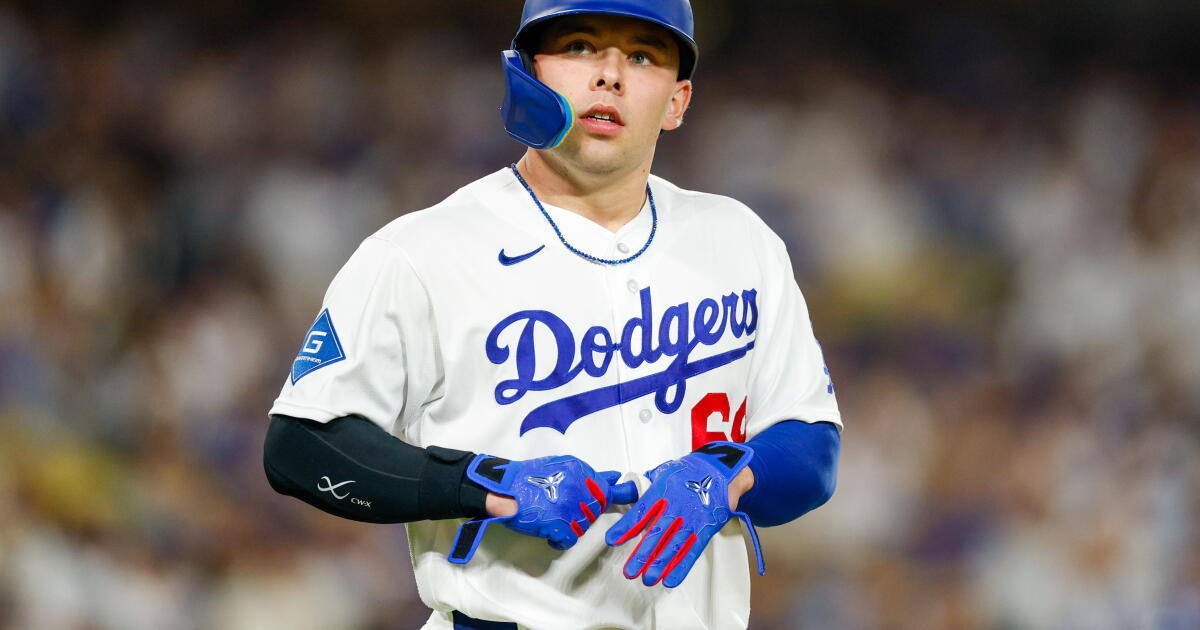
Dodgers catcher Dalton Rushing was scheduled to undergo elbow surgery Wednesday, according to multiple people with knowledge of the situation who weren’t authorized to speak publicly on the matter.
To address a partial UCL tear, he was expected to undergo a hybrid internal brace procedure, which would set him up to return to catching full time in nine months. He would be able to hit well before then.
Rushing had two stints on the injured list with a flexor strain in his right forearm, along with the UCL tear. He said last month that imaging suggested the slight tear in his UCL hadn’t worsened since 2022.
Rushing took on a larger role this season when primary catcher Will Smith was sidelined for three months by a nagging neck injury. By Aug. 1, Rushing had already logged 245 plate appearances, dwarfing his 2025 rookie season’s total in the majors (155).
Though he’d carried high workloads in the minors before, being a major-league starting catcher comes with added responsibility. Rushing went through a learning curve juggling his defensive and offensive responsibilities, and navigating intense online scrutiny of his outbursts on the field and in the dugout.
He’d settled into the role, and owned an .809 OPS, when his elbow injury flared while throwing before a game on Aug. 2. He landed on the IL the next day and returned at the beginning of September in a pinch-hitting role.
Rushing logged just four at-bats (0-for-4) before he aggravated the injury trying to build up in a throwing program. He returned again for the last series of the regular season, firmly in a battle for a postseason roster spot as a bat off the bench, and went hitless in three at-bats.
Rushing had initially been hopeful he’d be able to avoid surgery.
“My main plan moving into playing every day in the future is, make sure that my body can hold whatever stress or whatever is needed for this team — first base, behind the plate, whatever they need,” Rushing told the Times last month. “I want to make sure my body can handle it and do it for 162.”
Denis Bouanga and Son Heung-min both contributed to all three goals for LAFC in a 3-1 victory over Austin FC on Wednesday night at BMO Stadium.
Neither team found the net until Bouanga took a pass from Son seven minutes into the second half and scored to give LAFC (12-9-9) the lead.
Austin’s Brandon Vázquez scored for the second time this season, using an assist from Myrto Uzuni, to knot the score in the 66th minute.
Bouanga answered the following minute with his 17th netter off another assist from Son, his league-leading 15th of the season, and LAFC went back in front 2-1.
Bouanga returned the favor when he notched his eighth assist on Son’s sixth goal of the season in the 72nd minute for a two-score advantage. Jacob Shaffelburg picked up his career-high fifth assist.
Hugo Lloris totaled three saves for LAFC, which is 2-2-3 since the start of September.
Brad Stuver stopped 10 shots, one off his career high, for Austin (7-11-11), which has lost two straight following an eight-match unbeaten streak.
LAFC improved to 9-3-3 at home, while Austin dropped to 3-8-4 on the road.
The clubs played to a scoreless draw in Austin to close out March.
Fuel prices flared again in September, driving a sharp rise in headline consumer inflation even as everyday expenses like food, cars and healthcare remained relatively calm.
November 2026 vote delayed and joint presidential and legislative elections set for next year, president says in decree.
Published On 10 Oct 202610 Oct 2026
President Mahmoud Abbas has postponed what would have been the first Palestinian elections in nearly 20 years, issuing a decree to further delay voting for the Palestinian Legislative Council for almost another year.
According to the decree, legislative elections planned for next month will be combined with a presidential vote and set for September 11, 2027, Wafa, the official Palestinian news agency, said on Saturday.
Recommended Stories
list of 4 itemsend of list
The long-awaited parliamentary vote was originally set for November 28, with a presidential election expected in early 2027.
The decree came after a committee of top Palestinian officials met on Saturday morning to discuss postponing the vote.
The Palestine Liberation Organization’s (PLO) Executive Committee, which Abbas heads, said in a statement that conditions in occupied East Jerusalem, the West Bank and the Gaza Strip were not conducive to holding elections, noting that Israel had not allowed election materials or international observers to enter Gaza.
Israeli interference, including military raids, settlement expansion and settler violence in the occupied West Bank, has made a fair vote in November impossible, Wafa reported.
The agency also cited Israel’s systemic withholding of Palestinian tax revenues and its restrictions on electoral candidates and international observers entering Gaza and occupied East Jerusalem, as reasons.
As for Gaza, it said that the lack of progress on reconstruction and on deploying an international stabilisation force factored into the decision as well.
The postponement leaves entrenched Palestinian leaders unchallenged and threatens to further erode the Palestinian Authority’s (PA) credibility among Palestinians and donor countries who fund it.
On Friday, the Israeli Minister of Foreign Affairs, Gideon Saar, accused Abbas of “fooling the international community” by planning to cancel promised elections.
A source told the AFP news agency on Thursday that Palestinian factions, including Abbas’s Palestinian National Liberation Movement – also known as the Fatah party – had agreed to hold a “national dialogue” before legislative elections and that they wanted to postpone the vote.
The last parliamentary elections held in the Palestinian territories were in 2006, when Hamas defeated Fatah, which dominates the PA. The split led to factional fighting and Hamas later seized control of Gaza.
Ninety-year-old Abbas won the last presidential election in 2005. His term should have ended in 2009, but he has ruled by decree since then. In June, he signed a decree calling for the presidential election to be held in early 2027.
ATLANTA — When Edwin Díaz envisioned his first season with the Dodgers, it looked nothing like this. He was going to stay healthy all year, pitch like an All-Star. He certainly was going to throw in more than 21 regular-season appearances.
A slew of injuries, with mechanical issues layered on top, had other plans. But everything resets in the postseason. And against the odds, the right-hander is back in the closer conversation.
“It means a lot,” Díaz said in a conversation with the Times Monday. “Because I was nowhere, basically this season. They gave me the last week and a half of the season to come and pitch. And I was ready every day.”
If he can keep pitching the way he has since returning from the IL in September, it’ll strengthen the Dodgers’ chances at a three-peat. They went into the postseason with a closer-by-committee approach. But manager Dave Roberts said before the Dodgers’ workout at Truist Park on Monday that they could get to a consistent closer by the end of the postseason.
“Certainly that last outing was as good as we’ve seen him throw, and it’s hard to imagine throwing any better,” Roberts said of Díaz’s perfect inning against the Atlanta Braves Sunday, which included three fastballs over 100 mph. “We built him up, regained the confidence in himself. So, I think that it’s certainly a viable option for [Tuesday] night. I feel very confident [with] him finishing a game.”
Though his first postseason outing for the Dodgers was in the sixth inning of Game 2 of the National League Division Series, Díaz has been mainly in high leverage in his playoff career — he owns a 2.19 ERA in nine postseason appearances. The former Mets closer even recorded a four-out save at Dodger Stadium in Game 2 of the 2024 National League Championship Series.
“I don’t try to think, ‘Oh, there’s many thousands of fans here,” he said. “Just me against the hitter, and I trust myself. And like I always tell myself, ‘You are a warrior, you are you are the best, and go and compete.’”
The Dodgers’ closer situation has been in flux all year. They had signed Díaz to a three-year, $69 million contract with that role in mind. And even when he missed three months for arthroscopic surgery to remove loose bodies from his elbow, and lefty Tanner Scott took over in the ninth inning, the spot was open for Díaz when he returned.
That was not the case after his second IL stint. And it was during that month-long road back that he finally re-found himself on the mound.
“I was like this maybe in the [World Baseball Classic] and first couple games early in the year before I got hurt,” Diaz said. “But now I feel way better than everything. So I think this is the best I ever felt this year.”
The process started with treating his neck. Díaz was feeling tightness around the front side of his right trapezius muscle, which could have contributed to Díaz dropping his arm angle. He received medication and needling therapy to address the issue, he said.
Trainers used manual manipulation to find Diaz’ ideal arm slot and build muscle memory, and he was quickly cleared to resume throwing.
“I’ve been doing that for so long, I just lost it for a little,” Díaz said of his arm angle. “And we’ve got a really good group of coaches right here, and they found it right away.”
Díaz began a rehab assignment with Triple-A Oklahoma City in early September. But it wasn’t smooth sailing. In his fourth outing, Díaz issued three walks and surrendered five runs in just two-thirds of an inning.
“I got mad at myself because I knew I was better than that,” Díaz said. “I wasn’t able to control my fastball. So after that game, I talked to the pitching coaches in Triple-A to say, ‘We need to find something because I want to be back in the big-leagues, I want to help this team to win.’”
They dug into Díaz’ biomechanics and found that his hip position was different from last year. When he’s right, Díaz explained, his leg lift starts with his hip. But he’d begun to rush the move, which caused his arm to lag behind.
He threw a bullpen with the adjustment and then took it into one final rehab appearance, a one-hit outing.
“I told the team, ‘I’m ready to go,’” Díaz said.
He sure was. Díaz posted a spotless ERA in six games down the stretch, limiting opponents to one hit combined. And that success carried into his Dodgers postseason debut.
“He’s put himself in a position to be the closer,” Roberts said. “And in October, I don’t pay too much attention to the long sample of a season in a lot of cases because in October things happen quickly, and you’ve got to be willing to read and react.”
For Díaz, the season may not have gone as planned, but his vision of the next few weeks is as clear as ever. He wants to record the final out of the World Series.
“I know how to control my emotions,” he said. “I learned that during my career, and I’m pretty good at that. I just can’t wait to be in that position, and if I’m in there, I will give my 100%.”
Downward revisions and finance and insurance job losses paint a pessimistic picture for the U.S. labor market.
In the last jobs numbers report before a contentious U.S. mid-term election, the Bureau of Labor Statistics (BLS) reported that seasonally adjusted nonfarm payrolls added 29,000 jobs in September, while the unemployment rate remained stable at 4.2%
The BLS also revised its July numbers for a second time, now showing a loss of 10,000 jobs compared to its first revision, which upped the number of jobs created to 21,000 from a loss of 23,000 jobs. It also revised August’s number down to 132,000 from 162,000.
The report may have underwhelmed market expectations, but economists at RBC say that doesn’t mean the labor market is weak.
“The 29,000 payroll gain is quite healthy in the context of our breakeven estimate of 20,000 jobs per month,” they wrote in an RBC Economics note. Gains were broad-based, and the declines more likely reflect retirements than layoffs, especially in sectors with an older workforce (e.g., the median worker age in financial services is 44.2 years compared to 42.1 years overall). Despite a slowdown in health care hiring, strength was driven by the goods sector, which continued to recover from the post–Liberation Day layoffs earlier in 2025.”
Finance Sector Feels the Bite
Despite the overall positive number, the finance and insurance sector lost 7,000 jobs, with credit intermediation and related activities accounting for 4,600 fewer jobs, followed by insurance carrier and related activities, which lost 2,300 positions.
Employment in the capital markets remained unchanged, with no job gains or losses compared to August.
The information industry took a harder hit than the finance and insurance sector, losing 10,000 jobs. Publishing lost 4,000 jobs, while broadcast and content providers lost 3,000 jobs, and computing infrastructure providers, data processing, and web hosting and related services eliminated 1,600 jobs.
Private Optimism
Using a proprietary methodology developed with the Stanford Digital Economy Lab, ADP is far sunnier in its view, estimating that U.S. private employers added 90,000 jobs over the same period, according to its ADP National Employment Report for September.
“It’s a strong report. After a three-month slowdown, job creation rebounded, and pay growth remained solid,” said Nela Richardson, chief economist at ADP, in a prepared statement.
However, the report’s authors have no good news for those working in financial activities, which lost the most jobs (-16,000) of any sector, while professional and business services lost the second-largest amount (-11,000).
The information sector managed to eke out growth, adding 3,000 new positions.
Mid-sized companies (50 to 499 employees) created more than half of the new jobs (54,000). Small companies (1 to 49 employees) added 23,000 new positions, while large companies (more than 500 employees) added the fewest jobs (14,000).
However, not everyone shares the optimism.
The BLS report reflects an economy that has not set itself up for growth, Michele Evermore, a senior fellow at the National Employment Law Project, told Global Finance.
“Nobody was planning to build a manufacturing economy in the United States again,” she said. “Growth was going to come from innovation. If we get rid of the core government research, that is what was going to build jobs of the future, I’m afraid this is par for the course for the foreseeable future until either the AI bubble crashes or AI turns out to be amazing and starts taking over jobs.”
Rob Daly covers fintech and the economy. Contact him at rdaly@gfmag.com.
Eurozone annual inflation accelerated to 3.8% in September, up from 3.2% in August and above market expectations of 3.6%, according to preliminary estimates.
Core inflation, which excludes energy and food, rose to 2.5% from 2.4%, in line with expectations.
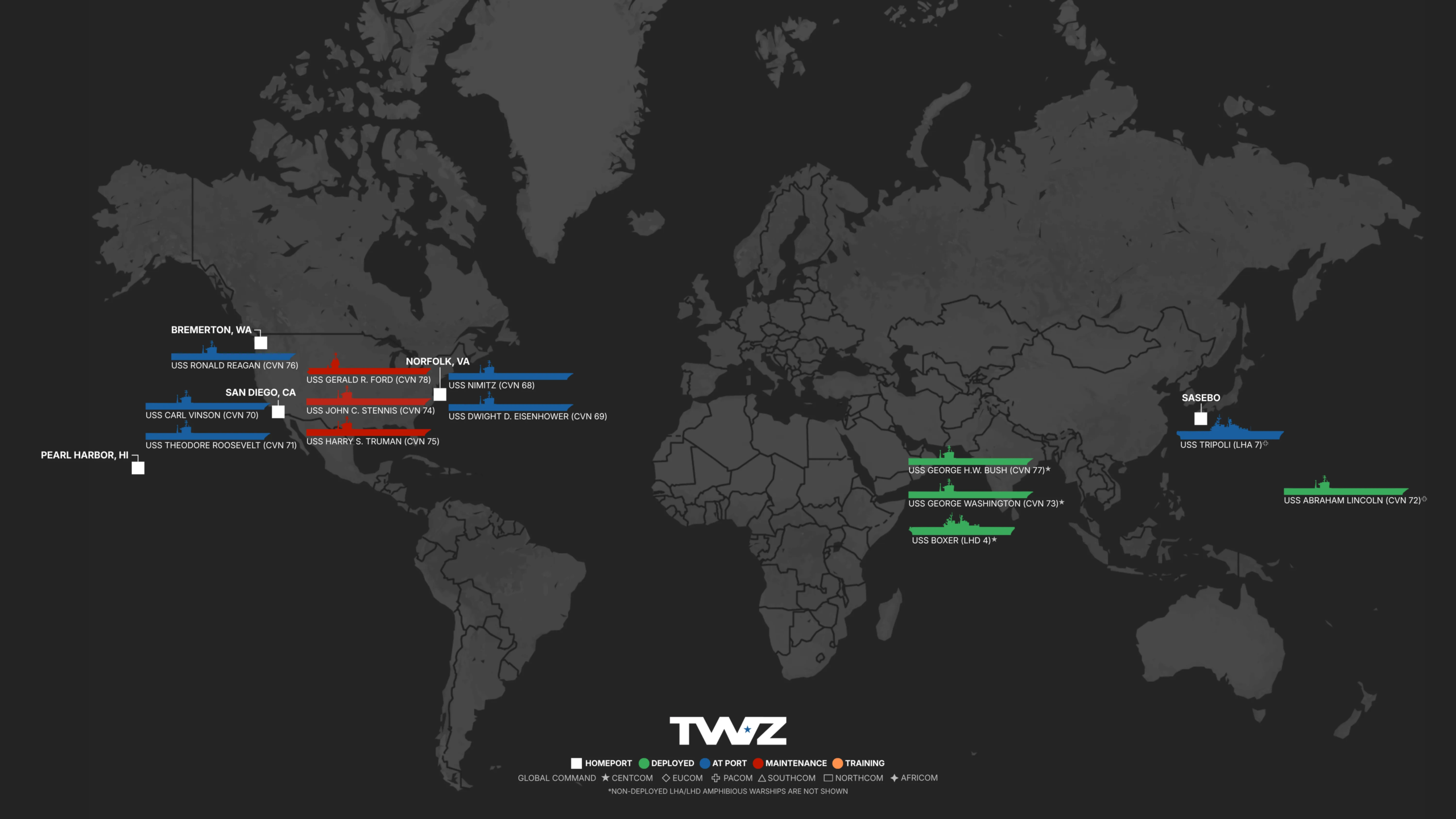
On a hazy, humid Sunday morning, just before 9:30 a.m. local time, the USS Theodore Rooseveltsailed out of San Diego Bay for a much-anticipated but little-advertised deployment. The Nimitz class flagship of Carrier Strike Group 9 (CSG-9), nicknamed “The Big Stick,” departed on September 27 and is expected to head to the Middle East to relieve one of the two carriers on station supporting operations against Iran, according to USNI News. As is common with deployments from the West Coast, the departure was not announced by the Navy publicly, although there were several unconfirmed claims on social media that highlighted the impending cruise.
The three-ship Makin Island Amphibious Ready Group (ARG), packed with thousands of Marines who specialize in expeditionary operations, followed Roosevelt’s path out of the harbor the next day. While the Makin Island ARGs ultimate destination is unclear, the Boxer ARG, currently operating in the Middle East, left the United States on March 18 and is due for relief.
Here’s TWZ’s weekly carrier tracker monitoring America’s flattop fleet, including deployed CSGs and ARGs, using publicly available open-source information. Check out last week’s report here.
TWZ/IAN ELLIS-JONES
Theodore Roosevelt Carrier Strike Group Deploys, Reportedly Bound For The Middle East
USS Theodore Roosevelt keyed her Automatic Identification System (AIS) transponder on at 9:10 a.m. Pacific Daylight Time on September 27, broadcasting her precise position publicly via MarineTraffic, and got underway less than 20 minutes later with the help of a few tugs. The supercarrier steamed past Point Loma at seven knots before sailing west and picking up speed, topping 24 knots, then made a hard turn south and stopped transmitting on AIS roughly three hours after departing. She briefly flipped AIS back on again, 55 nautical miles southwest of her previous location, but has been dark since.
USS Theodore Roosevelt’s transit leaving San Diego. Source: MarineTraffic/KPLER (Reprinted with permission)
Three guided-missile destroyers, USS Paul Hamilton, USS Decatur, and USS Carl M. Levin, are part of CSG-9 and will escort the flattop, TWZ has learned. Rounding out the five-ship CSG is Ticonderoga class guided-missile cruiser USS Chosin, which will serve as the Integrated Air and Missile Defense (IAMD) commander for the CSG. The IAMD warfare commander is responsible for coordinating air defense for the entire strike group − a vital role since Roosevelt will be entering an active combat zone. Tico cruisers have 122 Vertical Launch System (VLS) cells, more than the 90 to 96 that Arleigh Burke destroyers are equipped with, and are being retired without a comparable cruiser lined up to replace the aging fleet; however, the newest Flight III Burke destroyers will take on the air warfare commander role.
The carrier has embarked, or is in the process of taking on, Carrier Air Wing (CVW) 11 off the West Coast before beginning the long journey toward the Western Pacific. CVW 11 includes a squadron of stealthy fifth-generation F-35C Lightning IIs, in addition to three squadrons of F/A-18E/F Super Hornets and one of EA-18G Growlers. Support squadrons of E-2D Hawkeyes, MH-60R Seahawks, and MH-60S Seahawks are also aboard, as well as a detachment of CMV-22B Ospreys.
Flight deck of USS Theodore Roosevelt. U.S. Navy photo MH-60S Sea Hawk on USS Theodore Roosevelt. U.S. Navy photo
USNI News was the first outlet to confirm the deployment and suggests the CSG is headed to the Middle East. “The Theodore Roosevelt Carrier Strike Group is expected to move to U.S. Central Command to relieve the Japan-based USS George Washington (CVN-73),” they wrote in a report published on Monday.
In response to a request to confirm the deployment, a Navy official told TWZ, “The Theodore Roosevelt Carrier Strike Group is underway conducting routine operations in the U.S. 3rd Fleet area of operations. U.S. 3rd Fleet leads naval forces in the region and provides the realistic, relevant training necessary to execute our Navy’s role across the full spectrum of military operations – from combat operations to humanitarian assistance and disaster response. U.S. 3rd Fleet works together with allies and partners to advance freedom of navigation and overflight, the rule of law, and other principles that underpin security for the region.”
The underway was live-streamed on San Diego Web Cam, which had a few hundred viewers at the peak. TWZ was monitoring the feed at the time after rumors surfaced that a departure was imminent. Notably, Sailors were not spotted manning the rails, which is usually an easy tell that a warship is deploying rather than training. However, several public posts on social media by individual Sailors, as well as their friends and family, pointed to the ship heading on its long-awaited cruise.
USS Theodore Roosevelt (CVN-71) Departs San Diego on Deployment | San Diego Web Cam
Video: @SanDiegoWebCam/YouTube
Video: @SanDiegoWebCam/YouTube
Roosevelt has been preparing for the cruise for the better part of a year. The CSG last deployed from January 11 to October 15, 2024, to the U.S. 5th and 7th Fleet areas of responsibility (AOR) in support of Operation Prosperity Guardian. After arriving back home nearly two years ago, the carrier underwent an eight-month Planned Incremental Availability (PIA). Following the PIA, she completed flight deck certification and carrier qualifications from July 23 to July 29, 2025. In 2026, the carrier conducted Composite Unit Training Exercise (COMPTUEX) from April 14 to May 15, and then steamed to Hawaii for the large-scale, biennial Rim of the Pacific (RIMPAC) exercise from June 24 to July 28. Most recently, Roosevelt completed a brief pierside availability prior to deploying, as TWZfirst reported.
In February, Vice Adm. Brendan McLane told reporters at WEST 2026 that a medium unmanned surface vessel (MUSV) would deploy with the strike group for the first time. During COMPTUEX and RIMPAC, the Roosevelt CSG drilled alongside Leidos’ MUSV Seahawk, which TWZ was the first to report. We asked the Navy to confirm whether an MUSV would accompany the group, but have not received a response. As of publication, Seahawk was still pierside in San Diego, and it’s unclear if the drone boat will operate with the CSG or remain in San Diego.
Transit of USS Theodore Roosevelt and MUSV Seahawk during COMPTUEX training. Source: MarineTraffic/KPLER (Reprinted with permission) and DVIDS
Makin Island Amphibious Ready Group Also Deploys, Destination Unknown
The three-ship Makin Island ARG, with the 13th Marine Expeditionary Unit (MEU) embarked, got underway for a deployment on September 28, a Navy official also confirmed to USNI News. In addition to the flagship Wasp class amphibious assault ship (LHD), USS Makin Island, two San Antonio class amphibious transport dock ships (LPD), USS John P. Murtha and USS Anchorage, left on the same day and round out the expeditionary group.
USS Makin Island (LHD 8) Departs San Diego on Deployment
Video: @SanDiegoWebCam/YouTube
Video: @SanDiegoWebCam/YouTube
No destination has been formally announced. However, there is an obvious candidate for relief: the Boxer ARG. Currently on station in the U.S. Central Command (CENTCOM) AOR supporting blockade and interdiction operations in the Arabian Sea and Indian Ocean, the group has been deployed since mid-March. The amphibious fleet is notorious for experiencing maintenance issues, and these ships have been pushed hard without a port call in months. Amphibious ships move slower than carriers, and if CENTCOM turns out to be the final destination, the Makin Island ARG would have to hustle to arrive before November.
Makin Islandembarks short takeoff and vertical landing (STOVL) F-35B Lightning IIs, assigned to the “Wake Island Avengers” of Marine Fighter Attack Squadron (VMFA) 211, and MV-22B Ospreys with Marine Medium Tiltrotor Squadron (VMM) 364 (Reinforced). The Bravos recently conducted a simulated airstrike off the coast of California.
13th MEU conducts a simulated airstrike aboard USS Makin Island (LHD 8) off the coast of California. U.S. Navy video
Abraham Lincoln Days Away From Well-Deserved Homecoming
Acting Secretary of the Navy Hung Cao flew out to the flight deck of USS Abraham Lincoln as she was sailing eastbound in the Hawaiian Islands operating area, en route to her homeport in San Diego. “Today, our warfighters aboard USS Abraham Lincoln demonstrated the overwhelming capacity and capability that they brought to bear on our adversaries for the last 10 months,” he wrote in a post on Sunday.
USS Abraham Lincoln transiting in the U.S. 7th Fleet AOR. U.S. Navy photo
USS Frank E. Petersen Jr., a destroyer that escorted Lincoln throughout the 10-month deployment, peeled off and moored at Joint Base Pearl Harbor-Hickam on Monday. “Over the course of 300 days, Frank E. Petersen Jr.’s crew conducted 45 replenishments-at-sea, sailed over 85,000 nautical miles, safely transferred over 7,544,486 gallons of F-76 fuel and 175,288 gallons of JP-5 fuel, and completed 1,094 hours of flight quarters,” according to a press release. The statement also confirmed that the warship served as IAMD commander for the group. The destroyer defended against more than 100 missile and drone attacks, Stars and Stripes recently reported.
Petersen Jr. and USS Michael Murphy became the first U.S. warships to transit the Strait of Hormuz since the war began when they entered the Persian Gulf in April in support of mine-clearance efforts.
USS Frank E. Petersen Jr. returns to Pearl Harbor. U.S. Navy photo
Lincoln is now 314 days into her deployment and less than two weeks shy of surpassing the 326-day record USS Gerald R. Ford set in May. Approximately 2,000 nautical miles separate Hawaii from Naval Air Station North Island, but assuming a straight shot, it does not appear Lincoln will break the record.
Growler Mishap On Dwight D. Eisenhower
Two crew members from an EA-18G Growler embarked on the aircraft carrier USS Dwight D. Eisenhower (Ike) were rescued after ejecting due to an arresting gear failure, the Navy announced in a statement. The incident took place on Monday around 6:18 p.m. Eastern Daylight Time as the vessel was underway off the coast of Virginia.
The aviators, assigned to the “Zappers” of Electronic Attack Squadron (VAQ) 130 and attached to CVW 3, “safely returned to the ship and are being evaluated by medical personnel,” according to the release. The “Dusty Dogs” of Helicopter Sea Combat Squadron (HSC) 7 recovered the crew using MH-60S Seahawk helos.
Transit of USS Dwight D. Eisenhower off the East Coast. Source: MarineTraffic/KPLER (Reprinted with permission)
Four shipboard personnel “were also injured during the mishap and are receiving medical care,” the Navy said. “One Sailor is being transported to a Norfolk-area hospital for treatment of non-life-threatening injuries,” according to the original statement. In total, eight sailors were evaluated by the ship’s medical team.
The cause of the accident is still under investigation, and it’s unclear whether the aircraft was lost or if there was any damage to the carrier. TWZ has reached out to the Navy to find out more details.
A Growler landing on the USS Dwight D. Eisenhower. U.S. Navy photo/Released
Eisenhowerwrapped an extended 15-month PIA earlier this year in April. The flattop had been pierside at Naval Station Norfolk since September 2 after being at sea for 12 days completing Fleet Replacement Squadron and Training Command Carrier Qualifications (CQ) in the Virginia Capes and Jacksonville operating areas. She got underway again on the afternoon of September 28, based on public AIS data, for Tailored Ship’s Training Availability, Final Evaluation Problem, and CQ, one of the final steps before onloading ammunition for COMPTUEX, where the full strike group certifies for deployment.
Ike is working up in preparation for a future deployment scheduled for the first half of 2027, TWZpreviously reported.
Reports Surface That George H.W. Bush Is Headed To Thailand For A Port Call
Multiple news outlets in Thailand reported Tuesday that USS George H.W. Bush and destroyer USS Delbert D. Black, which have both been in the Middle East in support of operations against Iran, will make a port call in Phuket in early October. If such a transit occurs, this would leave one carrier, the USS George Washington, on station in the U.S. 5th Fleet AOR for the first time since April. The Navy has not formally made an announcement, and TWZ has not verified the accounts.
USS George H.W. Bush operating in CENTCOM. U.S. Navy photo Super Hornet on USS George H.W. Bush. U.S. Navy photo
The reports are based on a meeting that representatives of the U.S. Embassy in Thailand allegedly held with the Patong police to discuss security protocols during the stop. “The visit has prompted coordination between Thai authorities and US officials over security, public order, and the movement of visiting military personnel during shore leave,” Phuket News wrote. According to the article, Patong police met with two deputy assistant defense attachés, Lou Pham and Robert Robinson, to discuss the visit. U.S. personnel were advised to comply with Thai laws during their stay, a specific request that may have been triggered by the recent visit of Lincoln.
There are conflicting accounts of when Bush would arrive in Phuket’s deep-sea port, but the visit will likely last five or six days, which is similar to Lincoln’s recent port call in the Southeast Asian country. If the timeline holds, it means Bush is likely already en route from her station in the Arabian Sea, where the CSG was most recently operating as of September 25, according to DVIDS. The Bangkok Post and Thai Examiner also reported the upcoming visit.
Notably, the reports do not mention any of the other warships that have been part of the Bush CSG in the past, including USS Donald Cook, USS Ross, USS Mason, or USS Princeton. The composition of the Bush CSG has shifted throughout the cruise.
Big Deck Fleet At A Glance
Overall, four U.S. carriers are deployed (with one heading home), three are working up in various states of readiness, three are in current or upcoming maintenance, one is being used primarily for training before deactivation next year, and the future USS John F. Kennedy, the second Ford class carrier, has received preliminary acceptance ahead of delivery in spring 2027. Two amphibious ready groups are deployed, one is forward-deployed, three are working up or in port, and three are in maintenance.
Note: Positions are general approximations.Non-deployed LHA/LHD amphibious warships are not shown.
Dodgers right fielder Kyle Tucker has never shied away from just how bad his performance at the plate was for much of his first season in Los Angeles.
For the first five months of the season, when he’d show brief glimpses of progress before sinking back into an extended slump, Tucker’s .683 OPS was the third-worst among Dodgers hitters with at least 100 plate appearances, better than only Hyeseong Kim and Kyle Freeland, who both spent time in triple A.
In September, however, he found a sustainable adjustment. He fixed his bat path, extending through the ball more consistently instead of pulling off of it. He posted a .889 OPS in September, on par with his four straight All-Star seasons before signing with the Dodgers.
Now, all of a sudden, he looks like a potential difference-maker in the postseason.
“The last month or so is more or less what I expect out of myself,” Tucker said in a recent conversation with The Times. “The biggest thing is we have an opportunity now being in the playoffs to win another World Series. Once the playoffs start, you can forget about any stats or personal numbers. The only one that really matters is the win column. So that’s just what I’m gonna try and contribute towards.”
The Dodgers offense had a lot of success stories like Tucker’s in the final month of the regular season. He helped carry the offense, along with Teoscar Hernández and Mookie Betts, who turned around their seasons down the stretch, and Will Smith, who returned from the IL and quickly found his home run swing.
The Dodgers’ starting rotation is their biggest strength going into the postseason. But the offense’s performance against elite pitching, and the bullpen’s execution in tight games, could make or break a series.
Here’s how some other key players are trending going into the postseason:
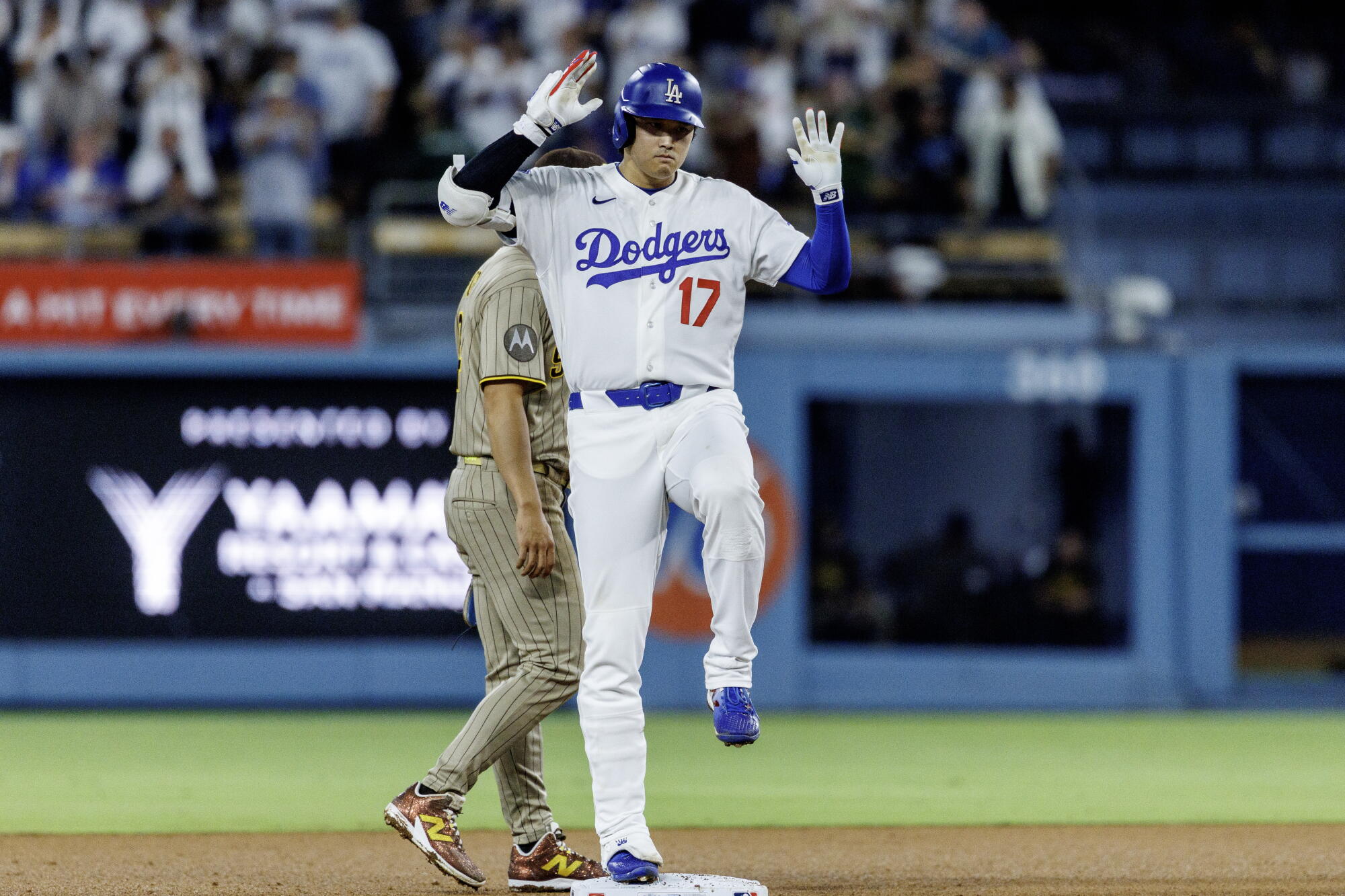
Designated hitter Shohei Ohtani: Fortunate to have the bye
Shohei Ohtani appears on the right track for a successful postseason.
(Gina Ferazzi / Los Angeles Times)
Ohtani returned from the IL with five games left in the season, and he went five for 21 with one extra-base hit.
All indications from general manager Brandon Gomes and manager Dave Roberts in video conference calls before the Dodgers’ closed workout Tuesday were that Ohtani was feeling good physically.
“I feel confident that you’re going to see the best version of Shohei of the last two months,” Roberts said. “I know that’s sort of a low bar given his injury, but I do think that he’s as healthy as he’s been in quite some time, and every day from the training staff, it keeps getting better. So, number one, he’ll be a threat being in the lineup, but I do think that the performance piece will be what we’re hoping for.”
First baseman Freddie Freeman: Ice cold
Freddie Freeman did not hit well in September.
(Ronaldo Bolaños / Los Angeles Times)
Freeman, who pushed through a bout with tendinitis in his right knee earlier this month, hit just .184 in September and went 0-for-7 in his last two games.
On Tuesday, Freeman said he had no pain in his knee. But finally acknowledged that the injury could have affected his swing mechanics, while again emphasizing that he wouldn’t use that as an excuse.
Freeman has a plan for the bye week that he hopes will set him in the right direction for the playoffs.
“I’m going to hit on the field every day,” he said Sunday. “I already know how my Tuesday is going to go. There’s going to be a lot of blocked balls to left [field], a lot of flares into left. I’m hoping as Tuesday goes Wednesday, I’ll come back and those will be put down a little more. Thursday they’ll be moved over to shortstop and by Friday I will be feeling good. That is how my head is thinking right now.”
Center fielder Andy Pages: Out of the gate running
It was hard to predict how the center fielder would look at the plate when he returned from a fracture in his left hand. He recorded a 1.181 OPS in six games and homered twice in the final regular-season series against the San Francisco Giants.
“He went into last October really scuffling, and it sort of bled into October,” Roberts said over the weekend. “Where, I think right now he feels really confident, swinging the bat well, and the hope is that this one bleeds into October as well.”
Reliever Edgardo Henriquez: Healthy
Henriquez is “trending really well” after throwing live batting practice, Gomes said. If this week continues to go smoothly, the flame-throwing right-hander is expected to be on the NLDS roster.
“Given the body of work, what he’s done, the unique skill set,” Roberts said, “could be huge for us — will be huge for us.”
Reliever Edwin Díaz: Strong finish
Díaz made five appearances after his latest return from the IL (neck). He gave up just one hit in those games, with a 52.9% strikeout rate.
“I don’t know if we could have asked much more out of Edwin,” Gomes said. “Felt like each outing was more and more sharp and looking more like himself. So feel that he’s in a great place right now. Stuff out of hand is as good as it’s been all year. And we know that he has pitched in the hottest of hot games in the past and in any role, especially in the postseason. So he’s looked great, and glad that he’s in the position that he’s in and was able to bounce back after the IL stint.”
NLDS weather: Sweltering
Los Angeles’ weather forecast for this weekend, when the Dodgers are set to host the first two games of the NLDS, shows temperatures reaching the high 90s. The Dodgers are scheduled to play Game 2 at 5 p.m. on Sunday. But Saturday’s game time will depend on the results of the wild-card round. First pitch for Game 1 could be at 1 p.m. or 6 p.m.
Durban, South Africa – Bishop Raphael Bahebwa is in hiding, afraid he could be attacked for speaking out for the rights of foreigners in South Africa.
“I am in hiding now because they say they are going to kill me for speaking about the rights of foreigners,” he told Al Jazeera.
Bahebwa has lived in South Africa for 26 years, after arriving as a refugee from the Democratic Republic of the Congo (DRC).
In that time, he has watched antiforeigner sentiment flare repeatedly in the country he came to call home. But he says this year feels different.
A September 30 deadline declared by March and March, an anti-immigration movement that has led protests across South Africa this year, has renewed fears of violence among migrant communities.
The group has called for undocumented foreign nationals to leave South Africa and has warned of further demonstrations if its demands are not met.
For Bahebwa and other refugees in Durban, however, the distinction between documented and undocumented migrants offers little comfort. They say the hostility they experience on the streets rarely begins with a request to see their papers.
Fears of renewed violence
South Africa will hold local government elections on November 4, in a campaign in which migration has become an increasingly prominent political and social issue.
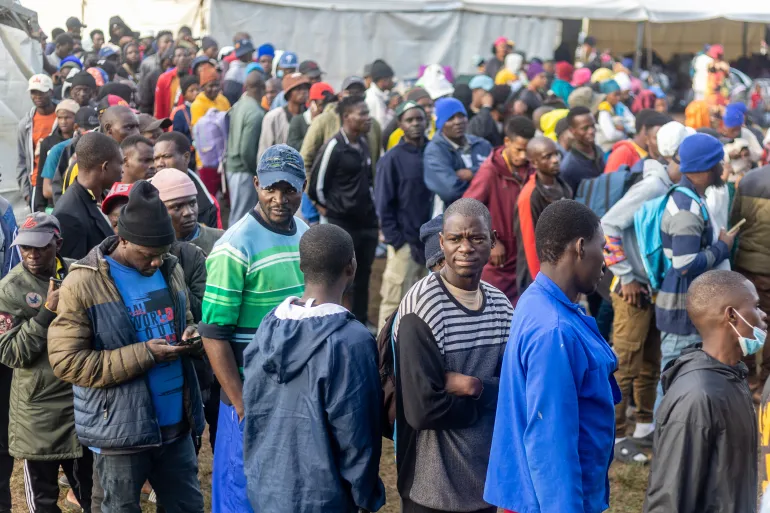
For months, Bahebwa was among hundreds of refugees and asylum seekers who slept on the pavement outside the Durban Refugee Reception Centre on Che Guevara Road.
Many were from the DRC and Burundi, with others from Uganda, Mozambique and Tanzania. They said they had fled their communities because they feared antiforeigner attacks.
They arrived outside the Department of Home Affairs (DHA) office seeking safety.
Instead, the pavement became their home.
For roughly four months, men, women and children slept outside, exposed to the elements and dependent on civil society organisations and volunteers for food and other necessities.
“It has been very tough,” Bahebwa said. “Never before have I experienced something like this.”
Some of the migrants told Al Jazeera that conditions became desperate. They described irregular access to food and medication and said one man who had tuberculosis died while living at the camp. Al Jazeera has not independently established the circumstances of his death.
The camp was also not far removed from the hostility its residents said they had fled.
On September 3, members of March and March confronted refugees and asylum seekers living outside the centre. Violence broke out, and police intervened. At least four people were reported injured.
At another protest days later, police officers stood between the two groups, forming a barrier as tensions rose.
March and March has described its mobilisation as a campaign against undocumented immigration, crime and deteriorating conditions in South African communities.
The group says the government’s response to immigration enforcement has been insufficient.
Its leaders have repeatedly rejected accusations that their campaign is xenophobic and insist their target is undocumented migration rather than foreign nationals generally.
Bahebwa said documented and undocumented migrants alike have been caught in the hostility.
Earlier this year, six refugees working in salons around Durban’s Warwick Street Market were beaten by men carrying sticks, according to public-interest news outlet GroundUp. Two were hospitalised.
Bahebwa said the migrants had also struggled to obtain help from the authorities after earlier attacks.
“Police said we can’t open cases because we are foreigners. We had nowhere to go,” he alleged. Police have not publicly responded to that specific allegation.
Nowhere obvious to return to
In mid-September, the government moved to clear the makeshift camp outside the refugee centre.
The refugees were given a choice: return to the communities they had fled or accept temporary accommodation at the Lindela facility in Gauteng, hundreds of kilometres from Durban. Lindela is a government-run immigration detention facility used to hold people facing deportation.
The choice divided them.
Malawi migrants to South Africa line up for supplies at an informal refugee camp in Sherwood, Durban, South Africa, after fleeing their homes amid fears of xenophobic attacks [File: EPA]
Some feared going to Lindela, a facility historically associated with immigration detention and repatriation. Others felt they could no longer endure life on the pavement.
On September 15, 274 people were transported by bus from Durban to Lindela. About 150 others chose to remain in Durban and began trying to find alternative accommodation.
For those who stayed behind, leaving the pavement did not resolve the problem that had brought them there in the first place.
Kafuti Muyumba, a small business owner from the DRC and a representative of the refugee community, said many were afraid to return to neighbourhoods where they had built businesses and lives.
People are afraid, he said. “Even the police allow March and March violence. They came with sticks and say we are attacking them,” Muyumba told Al Jazeera.
He said many refugees had lost their livelihoods during the months of upheaval and were now desperate to find accommodation.
“This is not the first time we are experiencing xenophobia,” he said. “In 2008 and then in 2015 we also experienced this.”
In 2008, xenophobic violence spread through townships and informal settlements, killing dozens and displacing thousands.
Further outbreaks of violence against foreign nationals followed in subsequent years.
For Muyumba, those memories make the rhetoric surrounding September 30 difficult to dismiss.
“We don’t trust the police. They are not being fair with us. Some of them are also saying we must go,” he said.
Police have said there are no plans to change their normal policing approach because of the September 30 deadline and that any protesters will be expected to remain within the law.
March and March said all it wants is for undocumented immigrants to leave the country and return home.
But Muyumba said returning to the DRC is not a viable alternative for many Congolese refugees.
“There is still war there,” he said.
A country tightening its borders
In response to ongoing protests, the South African government said it had intensified its immigration enforcement.
Between June 14 and August 20, authorities processed 86,596 foreign nationals for deportation and repatriation, according to the government’s Inter-Ministerial Committee on Migration.
Malawians made up the largest group, followed by Zimbabweans and Mozambicans.
Government data says 90 percent of those repatriated had entered South Africa illegally, while 95 percent were classified as having crossed the border outside official ports of entry.
The government says the operations form part of a broader effort to strengthen border management and enforce immigration law.
At the same time, officials have repeatedly warned private groups against taking immigration enforcement into their own hands.
March and March’s September 30 deadline has no legal authority. The government says common citizens cannot deport anyone from South Africa.
Protesters hold placards during an anti-immigration march in Durban, South Africa, calling for tighter border controls and the deportation of undocumented migrants [File: Thuli Dlamini/Reuters]
But deadlines do not need legal force to create fear, as was the case for an earlier deadline of June 30. For the refugees who spent months sleeping outside the DHA office in Durban, September 30 is another uncertainty layered on top of many others.
Some have been moved hundreds of kilometres away.
Others are trying to find new homes in the same communities they once fled. But among the migrants Al Jazeera spoke to, there is a shared anxiety that paperwork may offer limited protection when anger is directed first at being foreign.
Bahebwa has spent more than a quarter of a century in South Africa. For now, he says he is hiding and does not know what September 30 will bring.
“They are scapegoating us as foreigners,” he said. “It is not going to end on September 30. It has to do with the elections.”
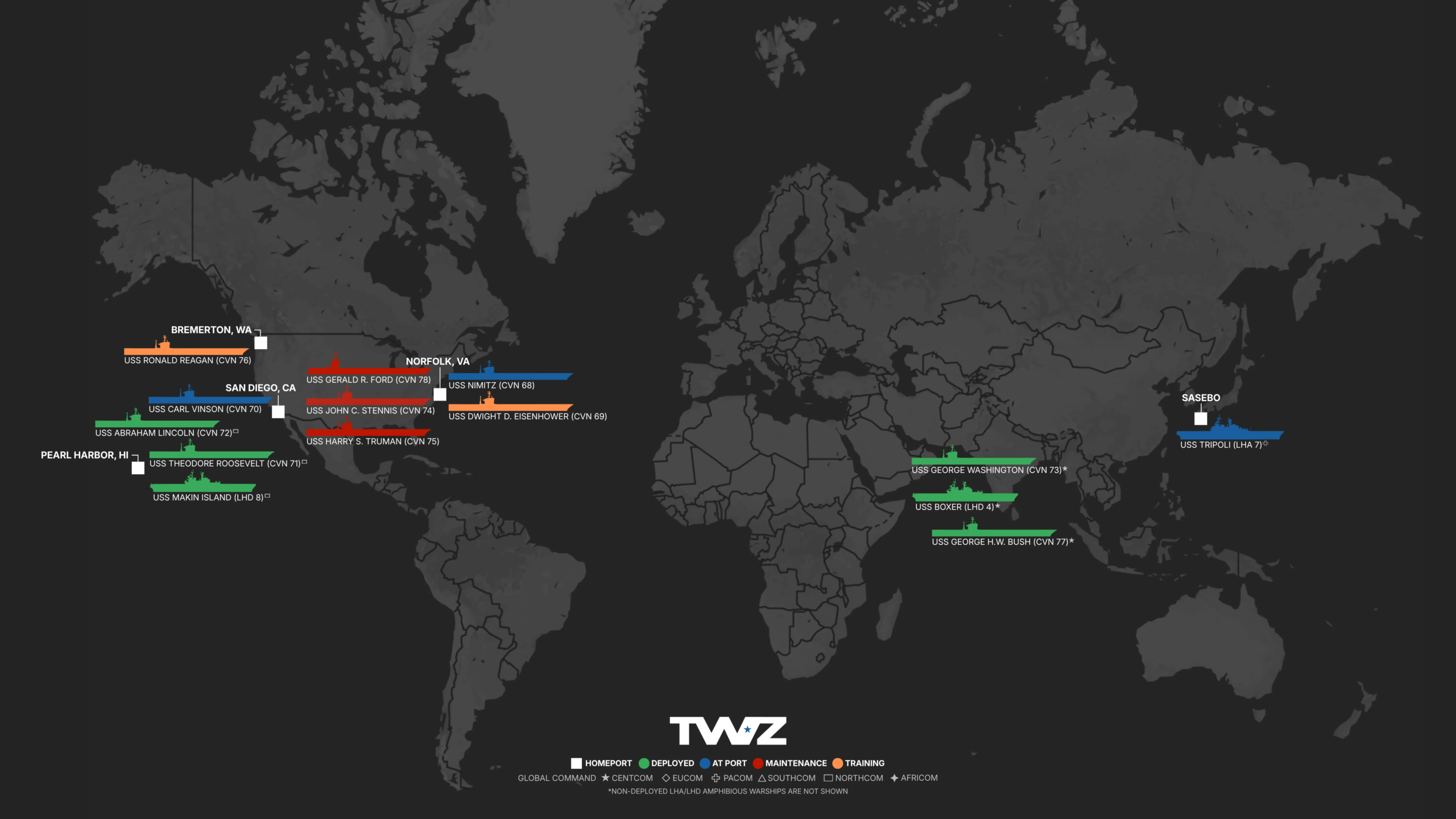
The crew of the USS Abraham Lincoln touched American soil for the first time in nine months, when the strike group pulled into Apra Harbor, Guam, for a brief logistics stop and on-base liberty. The supercarrier, alongside guided-missile destroyer USS Frank E. Petersen Jr., arrived on September 19 and left the next day. Lincoln is 307 days into her deployment, 19 short of the record set earlier this year by the USS Gerald R. Ford, and is now just weeks away from San Diego. Meanwhile, two flattops are on station in the Middle East supporting blockade operations, and the USS Ronald Reagan has rejoined the fleet after an extended maintenance availability.
Here’s TWZ’s weekly carrier tracker monitoring America’s flattop fleet, including deployed Carrier Strike Groups (CSG) and Amphibious Ready Groups (ARG), using publicly available open-source information. Check out our last report here.
Abraham Lincoln Departs Guam, Continuing Her Journey Home
The USS Abraham Lincoln is currently conducting routine operations at an undisclosed location in the U.S. 7th Fleet area of responsibility (AOR), presumably steaming east en route to her homeport at Naval Air Station North Island in San Diego. After leaving Thailand on September 6 following a five-day liberty port call, Lincolntopped off the Petersen Jr. in the Gulf of Thailand and linked up with two Royal Australian Navy frigates for joint training in the South China Sea. Publicly available flight tracking data shows the carrier transited the Balabac Strait eastbound around September 13, and the Surigao Strait northbound two days later to enter the Philippine Sea. After going dark for a few days, she resurfaced in Guam and moored at Kilo Wharf over the weekend.
Lincoln transits the Philippine Sea. U.S. Navy photo Lincoln transits the Philippine Sea. U.S. Navy photo
“Due to the brief nature of the logistics stop, the crew were afforded on-base liberty to access base services and attend a Navy Entertainment-sponsored concert,” CSG-3 spokesman Lt. Cmdr. Tyler Barker wrote in an email to Stars and Stripes. The carrier took on stores, mail, and equipment, according to Barker, and 13 Fleet and Family counselors are now aboard to run return-and-reunion classes but “the crew and ship remain focused and ready.”
USS Abraham Lincoln (CVN 72) arrives in Guam on Sept. 19, 2026. U.S. Navy photo
A homecoming date has not been announced publicly. Unless Lincoln makes another stop (in Hawaii, for example) or conducts additional training on the way, she should arrive in early October just shy of Ford’s record. The Chief of Naval Operations, Adm. Daryl Caudle, said in June that Lincoln would likely shift her homeport to Naval Base Kitsap-Bremerton in Washington state, which aligns with TWZ’sreporting that she is expected to begin a Drydocking Planned Incremental Availability (DPIA) after returning stateside. The timeline for the DPIA is unclear.
George Washington and George H.W. Bush Project Power In The Middle East
The American public got a rare look at ongoing combat operations aboard the USS George Washington when two reporters embarked earlier this month. Fox News’ Trey Yingst and CBS News’ Tom Hanson reported live from the flight deck, as F-35C Lightning IIs and F/A-18E/F Super Hornets launched behind them, in hits that aired September 11 to 14. The only other publicized media embark since the war began on February 28 went to CNN’s Pamela Brown, who reported on the conditions aboard the USS Abraham Lincoln while the flattop was still in theater.
An F-35C launches from Washington. U.S. Navy photo A pair of Super Hornets on Washington. U.S. Navy photo
“Last weekend, the aircraft carrier came under Iranian missile attack; the first of three attacks on US warships in the last week alone,” Yingst said, indicating it was the USS George Washington, and not the USS George H.W. Bush, that was targeted by the Islamic Revolutionary Guard Corps (IRGC) in early September. The Navy declined to comment when TWZ asked which carrier was targeted after Iranian state media claimed the strike had been successful. “We’re pretty much employing all our capabilities right now,” Washington’s commanding officer (CO), Capt. Nicholas DeLeo, told Yingst.
Night flight ops aboard USS George Washington. U.S. Navy photos
“The GW is surrounded by four to five guided-missile destroyers at any moment,” Yingst also reported. He flew out to USS Shoup, positioned off the starboard side at the time, to make the point and speak with the warship’s CO. Shoup is the only destroyer officially confirmed to be part of CSG-5. “My ship is in charge of coordinating defense amongst the various other units, allocating defensive assets to it, be it potentially a missile to shoot something down or just aircraft to go identify and monitor the picture,” Capt. William Buford said. Based on that description, Shoup’s CO appears to be coordinating Integrated Air and Missile Defense (IAMD) for the strike group, a question we’ve been asking the Navy to confirm. TWZ understands additional destroyers operating in the U.S. Central Command (CENTCOM) AOR are also escorting Washington, but a U.S. official declined to say which ones.
Hanson asked DeLeo about the recent IRGC ballistic missile threat targeting Navy ships in the region. “We have a variety of ways to protect, both offensively and defensively, a Navy ship, and we employ all these methods,” he told the network. “It’s something that we train to.” Hanson also pressed the commander of CSG-5, Rear Adm. Jeff Heames, on whether he was concerned about the munitions stockpile, a dynamic TWZ detailed in a special feature yesterday. “Of course we’re concerned about the expenditure to some degree, but I have no concerns locally at my level here,” Heames replied.
Gun shoot aboard USS George Washington (CVN 73), Sept. 15, 2026. U.S. Navy video
In addition to Washington, Bush is still working the blockade from the Arabian Sea, nearly six months into her deployment. As of CENTCOM’s latest social media update on September 21, U.S. forces in the region had redirected 110 commercial vessels to ensure “total compliance” with the blockade. More than 50 ships “supporting humanitarian efforts” have been allowed through, according to the command. CENTCOM recently stopped publishing the number of ships boarded, seized, or disabled kinetically.
An MH-60S Sea Hawk lifts cargo from the flight deck of USS George H.W. Bush, Sept. 18, 2026. U.S. Navy photo
Ronald Reagan Rejoins the Fleet
The USS Ronald Reagan is officially back. The Navy, in a recent statement, confirmed the flattop “returned to the fleet capable and mission-ready.” The carrier had been out of action since March 2025 for a DPIA at Puget Sound Naval Shipyard in Washington state and completed four days of sea trials in early September. While the Navy does not comment on upcoming deployments due to operational security, current speculation points to a spring 2027 deployment, but that is not confirmed.
Counter measure wash down on USS Ronald Reagan in the Pacific Ocean on Sept. 6, 2026. U.S. Navy photo
Reagan is the only carrier currently homeported at Naval Base Kitsap-Bremerton in Washington. Previously, she was America’s only forward-deployed carrier based in Yokosuka, Japan, until swapping hulls with the USS George Washington in 2024. USS Nimitz was stationed at Naval Base Kitsap-Bremerton before circumnavigating South America to Naval Station Norfolk this summer, where she is being used primarily for training before deactivation in 2027. The yet-to-be-commissioned PCU John F. Kennedy, the second and newest Ford class supercarrier, is slated to homeport in Washington state no earlier than 2029.
U.S. Navy Big Deck Fleet At A Glance
Overall, three U.S. carriers are deployed (with one heading home), one is preparing to deploy in the near term, three are working up in various states of readiness, three are in current or upcoming maintenance, and one is being used primarily for training before deactivation next year. One amphibious ready group is deployed, one is forward-stationed and in port, four are working up or in port, and three are in maintenance.
Note: Positions are general approximations.Non-deployed LHA/LHD amphibious warships are not shown.
Contact the author: ian.ellis-jones@recurrent.ioor @ianellisjones










![Protesters hold placards during an anti-immigration march in Durban, South Africa, calling for tighter border controls and the deportation of undocumented migrants [Thuli Dlamini/Reuters]](https://i0.wp.com/www.aljazeera.com/wp-content/uploads/2026/06/2025-11-07T155727Z_1005019881_RC2NRHA84QWK_RTRMADP_3_SAFRICA-PROTEST-1782784993.jpg?w=640&ssl=1)