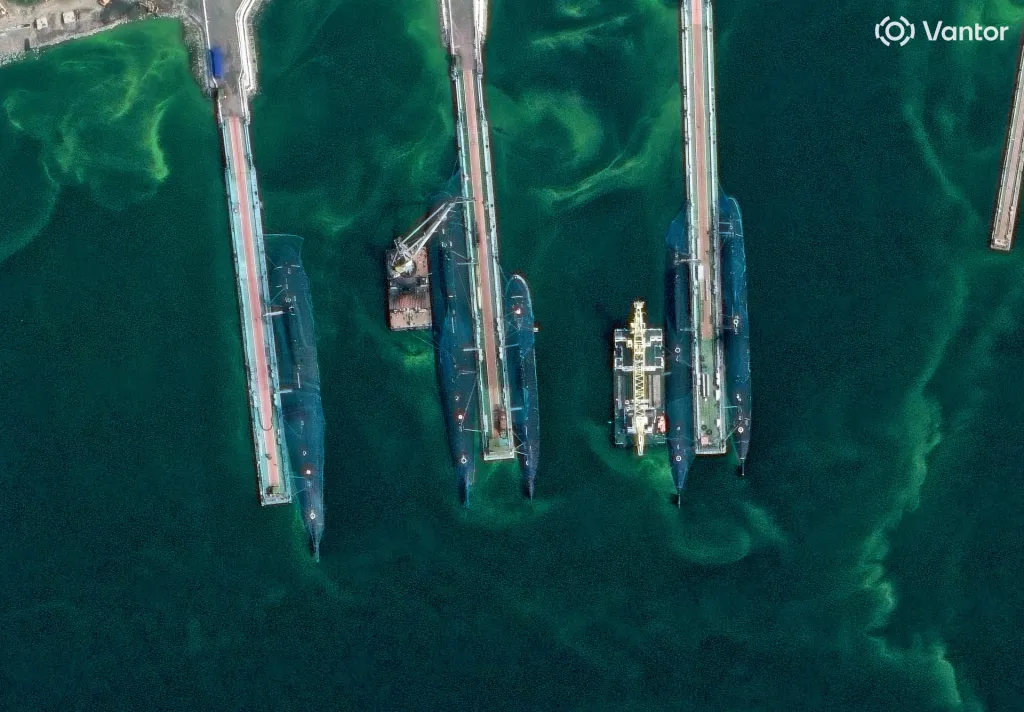
From recent satellite imagery, the Russian Navy now looks to be using nets to protect submarines from drone attacks at a highly strategic base on the country’s far eastern Kamchatka Peninsula. There are also signs that Russian forces have been taking new steps at a separate base along the Black Sea to shield submarines against uncrewed aerial threats. The appearance of the nets over the submarines at the base in Kamchatka point to how Russia’s concerns about drone threats have extended to critical facilities far removed from the battlefields of Ukraine.
TWZ obtained the imagery showing the netting in place over submarines at the Russian Navy’s base at Rybachiy from Vantor. Business insider was first to report on these images. Rybachiy is notably the homeport for the vast majority of Borei and Borei-A class nuclear ballistic missile submarines, or SSBNs, in service in Russia today. It is also home to various other guided missile and attack submarines assigned to the Russian Navy’s Pacific Fleet.
Images of Rybachiy from Vantor taken on August 4, seen at the top of this story and below, show several different types of submarines fully covered by nets. What is visible in the imagery is broadly consistent with netting that Russian forces have employed in and around Ukraine as a countermeasure against kamikaze drone attacks against assets on the ground and in the water. Similar netting has also observed in use by other armed forces elsewhere globally.


Russian forces at Rybachiy look to have started using these nets back in May based on additional imagery from Vantor. The imagery from May and August show crane barges being used to help erect the nets around submarines at their moorings.


As an aside, floating booms are also seen strung around the piers at Rybachiy. This is something else that is now commonplace at naval bases across Russia, and can help provide an additional barrier to certain threats on or near the surface, particularly explosive-laden kamikaze drone boats.
On Tuesday, the Ministry of Defense in the United Kingdom also published additional imagery from Vantor of the Russian Navy’s base in Novorossiysk along the Black Sea taken back on June 13. The images show several Kilo class attack submarines partially submerged in port. Three of the boats also appear to have anti-drone armor screens installed over their conning towers. A cursory review of additional satellite imagery in Planet Labs’ archive suggests screens were a relatively new additional at that time.

“The Russian Black Sea Fleet has equipped three of its four Kilo class submarines with counter-UAS [uncrewed aerial systems] cages covering the vessels’ conning towers. This was applied as a preventive measure in response to Ukraine’s increased ability to strike targets further from the front line,” according to an accompanying assessment from British authorities earlier this week. “Analysis of commercial satellite imagery dated 13 June 2026 identified that three of the submarines had loosened their moorings and had submerged within the basin. Whilst the majority of the hull was below the surface, their conning towers remained above the waterline, explaining the need for the counter-UAS cage.”
“The fourth submarine, which had not been fitted with a counter-UAS cage, had slipped its mooring lines, manoeuvred away from nearby surface vessels and submerged within the harbour, its conning tower visible above the waterline,” the British government’s assessment continued. “The lack of a counter-UAS cage likely signifies this vessel has been de-prioritised compared to the other three.”
TWZ has also now obtained the June 13 image of Novorossiysk directly from Vantor, as well as another one taken on June 17, which shows the submarines surfaced and at their moorings as usual. This, in turn raises questions about whether or not the boats were submerged in response an attack or indications that one might be imminent. There could be another explanation for why the submarines were temporarily submerged in port, including a force protection readiness exercise in preparation for such an incident.


Growing threats posed by uncrewed aerial systems, as well as uncrewed surface vessels (USV), have already had a marked impact on the establishment of new defensive capabilities and force protection postures at Russian naval and other facilities. This is especially true of sites in more immediate proximity to Ukraine.
Back in 2024, satellite imagery of Novorossiysk notably showed that forces there had painted a silhouette of a submarine and built an actual mock conning tower on a pier at the base. This reflected a broader trend at the time to implement countermeasures against Ukrainian munitions with autonomous image-matching targeting capabilities.
Also in 2024, what looked to be additional overhead protection against drone attacks appeared on the Delta-IV class nuclear ballistic missile submarine Tula at the Russian Navy’s base in Gadzhiyevo in the country’s far northern Murmansk region. What was seen fitted to Tula at that time very rudimentary compared to what has now been seen erected over submarines at Novorossiysk and Rybachiy, which offers far greater and more elaborate coverage . More extensive counter-drone screens have also now appeared on other types of Russian naval vessels.

Ukrainian forces only continue to expand the area, both at sea and on land, that they can hold at risk with uncrewed systems, as well as more traditional missiles. As it stands now, Ukraine uses its ever more diverse arsenal of long-range kamikaze drones and cruise missiles to strike targets across whole swaths of Western Russia, including around the capital Moscow, on a near daily basis.
Ukrainian kamikaze USVs also regularly prowl the Black Sea. Submarines at Novorossiysk, as well as bases on the occupied Crimean Peninsula, have been the wide array of targets struck. There sas another daytime USV attack just yesterday on the Russian-occupied port of Yalta in Crimea. It’s also worth noting here that Ukraine has developed USVs capable of launching kamikaze UAS, combining those two capabilities and creating additional threat vectors Russia’s force have to contend with. In addition, Ukraine now has the ability to hit even moving targets using long-range drones equipped with miniaturized satellite communications terminals. This leaves even ships not sitting static in port very much at risk, which Ukraine has highlighted in recent months as it goes after Russia’s logistics ships in the Sea of Azov, a campaign that is only accelerating and spreading.
As noted, the appearance of the nets at Rybachiy, which sits thousands of miles from Ukraine, speaks to how much further the threat of drone attacks has expanded. This goes beyond long-range strikes, as well. Ukraine’s unprecedented Operation Spiderweb attacks on Russian airbases last year highlighted the dangers posed by near-field attacks launched from deep inside hostile territory closer to their actual targets. Bases in Russia’s far eastern regions were among those targeted in the clandestine operation. Ukrainian forces have also launched attacks on Russian-linked ships in the Mediterranean Sea.
It also worth mentioning here that just this week, a small quadcopter drone equipped with explosive payload was discovered at next to Ukrainian An-124 cargo plane at an airport in Germany. CNN reported today that U.S. authorities have now assessed that uncrewed aerial system to have belonged to a Russian intelligence service. This follows year now of concerning drone incursions over military bases and other critical infrastructure across Western Europe.
Uncrewed aerial threats large and small are not at all limited to the context of the conflict in Ukraine and spillover from it into Europe, either. Drones have been a major factor in the conflict this year with Iran, as well as in other crises in and around the Middle East in recent years.
With the barrier to entry so low, drone threats are only becoming more commonplace globally as they proliferate to increasingly more capable degrees even among smaller nation state armed forces and non-state actors. For the U.S. government, counter-drone defenses for military installations and other critical infrastructure within the homeland, as to protect forces abroad, has become a major priority. Still, American authorities continue to lag in many respects in responding to the serious dangers that very present already.
Altogether, the expansion of counter-drone defenses around submarines at the Russian Navy’s bases at Rybachiy and Novorossiysk reflect very immediate threats emanating from Ukraine, but are also a sign of larger trends globally. Similar force protection measures could well continue to emerge elsewhere, and not just in Russia.
Contact the author: joe@twz.com