The true story behind the family drama “Rosemead” may not be the saddest tale ever brought to the screen. But boy, it’s up there.
Inspired by a shattering 2017 Times article by then-staff writer Frank Shyong (and now the first narrative feature film from LA Times Studios), “Rosemead” has long been a passion project for its star, Lucy Liu, also a producer. It’s not hard to see why.
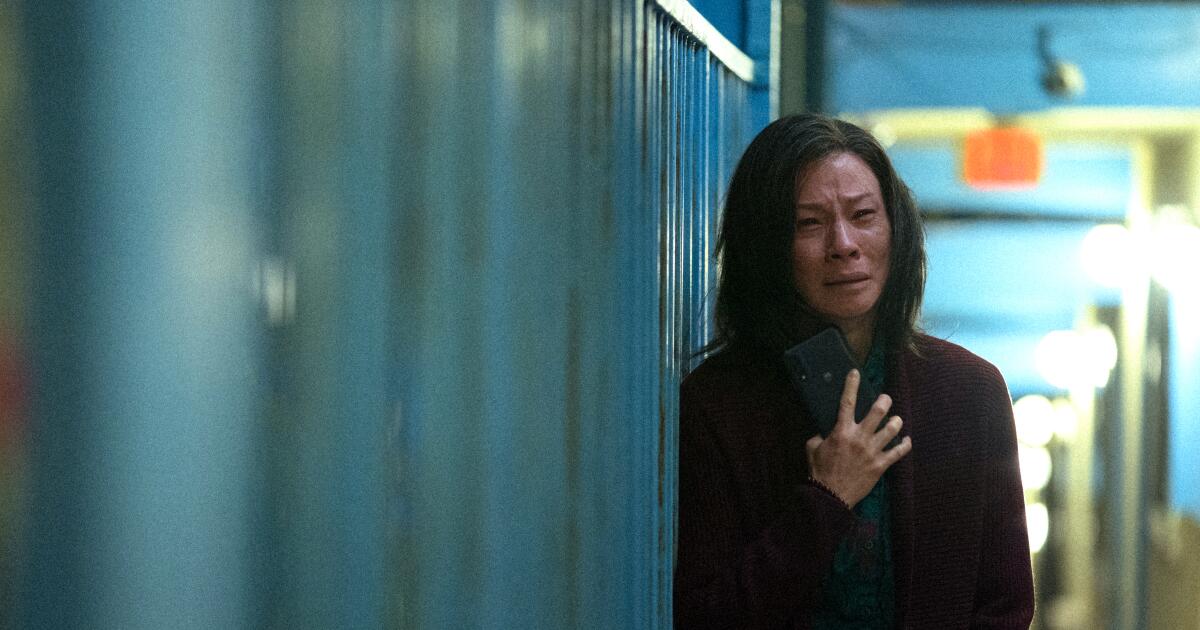
This powerful account of humble, terminally ill Taiwanese American widow Irene Chao (based on real-life Rosemead resident Lai Hang), who takes the fate of her schizophrenic teen son into her own hands, offers the transformational role of a lifetime for Liu. Best known for stylish, commanding turns in the “Charlie’s Angels” and “Kill Bill” movies and in TV series such as “Ally McBeal” and “Elementary,” she’s a revelation here.
But the narrative also shines a crucial spotlight on L.A.’s Asian American community and its sometimes insular approach to handling emotional trauma, particularly mental illness. Shame over the condition’s perceived stigma, language barriers and a general fear of expressing oneself add to this cultural dilemma, one that hasn’t been widely explored on the big screen.
Liu is tender and heartbreaking as Irene, who runs the local print shop that her husband (Orion Lee, seen in flashbacks) left behind several years ago. She also helps out in the herbal pharmacy run by childhood best friend Kai-Li (Jennifer Lim). Given that Irene displays a troubling cough from the start, it’s no surprise where her health is heading.
Of more immediate worry to Irene, though, is her only child, Joe (an excellent Lawrence Shou), a high school senior diagnosed with schizophrenia after his beloved dad’s untimely death — and it’s gotten worse. This downturn has impacted his grades, competitive swimming status and overall focus; he obsessively doodles eerie clusters of spiders and draws a disturbing map of his school’s floor plan.
Joe maintains a supportive circle of friends, but they, like Irene and other observers, are ever more alarmed by his bouts of extreme behavior. The boy’s abrupt, inexplicable disappearances are increasingly commonplace, as is a destructive streak.
If that wasn’t enough, Joe has secretly stopped taking his meds. He’s also seemingly become fixated on guns and the endless string of school shootings that make the news.
His deeply concerned therapist, Dr. Hsu (James Chen), assures Irene, who has kept herself at arm’s length, “Most people with schizophrenia don’t engage in violence.” But it’s cold comfort to a mother whose days are numbered by a dire diagnosis. She’s convinced that when she is no longer there to monitor and protect her son, he will hurt himself and others.
Something must be done. The result is an act so unthinkable that, if it hadn’t happened in real life, Marilyn Fu’s otherwise sensitively constructed screenplay might seem beyond repair. But, as they say, truth is stranger than fiction and viewers won’t soon forget the film’s devastating conclusion.
Eric Lin, who has served as cinematographer on such disparate indie films as “The Exploding Girl,” “My Blind Brother” and “Hearts Beat Loud,” makes a worthy feature directing debut here, even if the picture tends to unfold a bit more prosaically than its singular story might demand. Yet when Lin attempts to break out using strobe effects to reflect Joe’s schizophrenic episodes, it comes off more jarring than immersive.
Still, with an able assist from cinematographer Lyle Vincent (“A Girl Walks Home Alone at Night”), Lin vividly captures the look and feel of life in and around Rosemead. This is a special achievement since only about a quarter of the movie was shot in L.A. The rest was filmed in Queens, Brooklyn and Long Island to take advantage of New York’s tax incentives. No matter: The final product, featuring an effective array of SoCal exteriors to tie things together, looks seamless.
Enough can’t be said about Liu’s astonishing, naturalistic turn. She’s a physical marvel here, making herself as small and inconspicuous — yet also as quietly resolute — as her complex character requires. Liu, who was raised in a Chinese-speaking New York household, proves a verbal wonder as well, impeccably toggling between Irene’s halting English and her fluent native Mandarin. Prizes may elude Liu this awards season, but she should be in the conversation.
Despite the film’s downbeat subject matter and its grim finale, watching “Rosemead” isn’t as wholly depressing as it may sound. Like many films and TV shows that have dealt with life’s most unimaginable trials, there are profound human and societal lessons to be gleaned. Moreover, at this moment in time, any truthful, heartfelt story about America’s immigrant experience deserves our attention. That the film contains one of the year’s finest performances may seal the deal for more serious viewers.
‘Rosemead’
In English and Mandarin, with subtitles
Rated: R, for some language
Running time: 1 hour, 37 minutes
Playing: In limited release Friday, Dec. 12