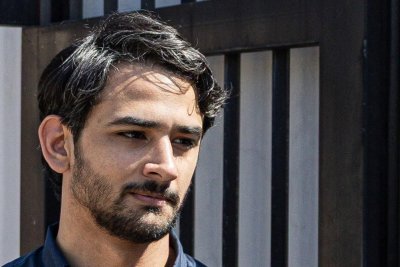

The son of opposition leader Juan Pablo Guanipa, Ramon Guanipa, speaks to the press in Maracaibo, Venezuela, on February 10. Juan Pablo Guanipa was at his residence in the city of Maracaibo, where he will serve house arrest after being detained hours after his release from prison, his son, said. Photo by Henry Chirinos/EPA
Feb. 18 (UPI) — Human Rights Watch urged Venezuela’s government led by Delcy Rodriguez to dismantle what it described as the country’s repressive state apparatus and implement deep judicial and electoral reform.
The group noted that recent political prisoner releases have not dismantled mechanisms used to suppress dissent.
The rights group said the releases mark progress, but warned that institutions responsible for arbitrary detentions and political persecution remain active amid what Venezuelan authorities call a process of “national pacification.”
The organization called for the removal of Attorney General Tarek William Saab, saying he “led the state action that resulted in human rights violations” after the 2024 presidential election and describing him as part of “the government’s repressive machinery.”
The statement follows the Jan. 3 capture of former President Nicolas Maduro and his wife, Cilia Flores, during a U.S. military operation and the subsequent release of hundreds of detainees held for political reasons.
The Trump administration has continued working with former Vice President Delcy Rodriguez in what it describes as a plan with phases of “stabilization, recovery and transition,” focused largely on reforms in Venezuela’s oil sector, the organization said.
“The release of political prisoners is an important relief, but the repressive apparatus used to detain them remains in place,” said Juanita Goebertus, Americas director at Human Rights Watch.
“Venezuelan authorities must carry out real reforms of their laws and judicial and electoral institutions,” she said. “Anything else would amount to a simulated transition that may serve the interests of the governments of Venezuela and the United States, but will not vindicate the rights of the Venezuelan people.”
Human Rights Watch said some 600 people remain imprisoned for political reasons, and that an amnesty bill under debate in Venezuela’s National Assembly, the country’s legislature, does not guarantee unconditional release for all those arbitrarily detained for political events dating to 1999.
“Its discussion should not be used as an excuse to delay the unconditional release of political prisoners or the structural reforms needed to restore democracy in Venezuela,” Goebertus said.
The organization said many people released from prison remain under criminal investigation and face restrictions on free expression and political participation. Some have been placed under house arrest, including opposition leader Juan Pablo Guanipa, who was freed Feb. 9 and detained again hours later after calling for protests.
Human Rights Watch also called for measures to restore judicial independence, which it said was weakened after a 2004 reform under then-President Hugo Chavez, and reiterated its demand for Saab’s removal, saying his continued tenure is incompatible with meaningful reform.
The group further urged steps to ensure free and fair elections, including a review of the National Electoral Council, the body responsible for organizing elections, whose members backed Maduro’s reelection and blocked opposition candidacies such as Maria Corina Machado.
Human Rights Watch said only sustained structural reforms will allow a credible political transition and full restoration of human rights in Venezuela.