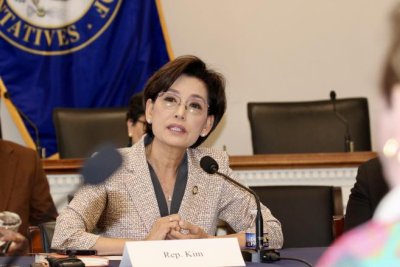

1 of 4 | Rep. Young Kim, chair of the House Foreign Affairs Subcommittee on East Asia and the Pacific, leads a roundtable with 11 North Korean defectors at the Rayburn House Office Building in Washington on Tuesday. Photo by Asia Today
April 30 (Asia Today) — U.S. Rep. Young Kim on Tuesday pledged to work for the swift reauthorization of the North Korea Human Rights Act, which has lapsed for more than six years, vowing to serve as a “voice” for North Korean defectors.
Kim made the remarks while chairing a roundtable at the Rayburn House Office Building in Washington attended by 11 North Korean defectors as part of North Korea Freedom Week.
“I will do my best to ensure the North Korea Human Rights Act is reauthorized as soon as possible in this Congress,” Kim said.
Kim stresses urgency of reauthorization, shifts from English to Korean
Kim opened the meeting in English, noting that she has been involved in North Korea human rights issues for more than 30 years, including 21 years as a congressional staffer and later as an elected lawmaker.
After listening to defectors’ testimony, she switched to Korean without an interpreter, appearing to emphasize her commitment more directly.
“The most important thing from what you said is that we must work together to reauthorize the North Korea Human Rights Act,” she said in Korean.
She highlighted that a key component of the legislation is funding for broadcasting into North Korea.
“Broadcast resources are essential,” Kim said, noting that transmissions into North Korea have weakened, including those from outlets such as Radio Free Asia and Voice of America.
“I will be your voice and speak with my colleagues to ensure the act is reauthorized,” she said.
Susan Scholte, head of the North Korea Freedom Coalition and the Defense Forum Foundation, said Sen. Tim Kaine is preparing to introduce a Senate version of the bill corresponding to the House legislation.
Kim says human rights conditions worsening despite greater information access
Kim said North Korea’s human rights situation has not improved over decades and has in some respects worsened.
“Even after decades, nothing has changed,” she said. “If anything has changed, it is that North Korean people now know more about the outside world than ever before, while crackdowns on external media have reached unprecedented levels.”
She argued that any meaningful change in North Korea must come from within, driven by the spread of information.
“If regime change happens, it must come from inside,” Kim said. “It should begin with people like those here who share information through broadcasting.”
Defectors recount hardships, escapes and role of outside information
Defectors at the roundtable shared personal accounts of life in North Korea and their paths to escape.
One defector said he came to understand the reality of the regime after listening to foreign radio broadcasts, which ultimately influenced his decision to flee.
Another described being detained in Russia after drifting into its waters while fishing and later seeking help from human rights groups after exposure to South Korean media via USB devices.
Others recounted losing family members to starvation, enduring forced labor and being trafficked into China before eventually reaching South Korea.
One defector said she had been forcibly repatriated to North Korea eight times and was separated from her young child, whose fate remains unknown.
Survey shows role of broadcasts, concerns over China surveillance
Kim Ji-young, head of Free North Korea Radio, presented survey results of 75 defectors who arrived in South Korea after 2022.
She said 66% reported accessing foreign broadcasts at least once a week, which inspired aspirations for freedom and motivated their escape.
All respondents said North Korea’s so-called “three major repressive laws” reflect fears of regime instability and efforts to maintain authoritarian control.
Kim also raised concerns about defectors in China, including cases in which children born to North Korean women and Chinese fathers are left stateless, as well as reports that Chinese authorities use artificial intelligence-based facial recognition to track and repatriate defectors.
One participant said she has avoided traveling to China due to fears of abduction or poisoning, adding that South Korean authorities have advised her against visiting.
U.S. lawmaker calls for stronger joint efforts
Rep. James Moylan said the United States and South Korea should strengthen cooperation to bring about meaningful change in North Korea without another decades-long delay.
In an interview with Voice of America, Moylan said radio broadcasting is an effective tool for change, adding that increased access to information, combined with support from advocacy groups and the United States, can help drive transformation.
— Reported by Asia Today; translated by UPI
© Asia Today. Unauthorized reproduction or redistribution prohibited.
Original Korean report: https://www.asiatoday.co.kr/kn/view.php?key=20260430010009822