Private adversary air company Top Aces has now begun flying its F-16 Vipers, the only ones currently in the hands of a private operator, with the ubiquitous military data link capability known as Link-16. The addition of Link-16 completes a vision started years ago for an adversary aircraft that truly represents the current 4th-generation-plus fighter threat. Equipped with Top Aces’ open architecture Advanced Aggressor Mission System (AAMS), these aircraft can now replicate the high-end threats that U.S. military pilots may soon face in the Pacific and elsewhere.
Top Aces began receiving its F-16s, which are early block ex-Israeli Air Force F-16A/B Netz variants, in 2021 and subsequently began upgrading them with a host of new capabilities. The AAMS is the core of that upgrade package and includes an active electronically scanned array (AESA) radar, an infrared-search-and-track (IRST) pod, the Thales Visionix Gen III Scorpion helmet-mounted display system, and, with a recent provisional approval to operate Link-16, now has a fully integrated datalink. AAMS permits the rapid integration of new sensors and functions that a customer wishes to use to improve the threat representations to their fleet pilots, such as IRST and advanced jamming pods like the ALQ-188.
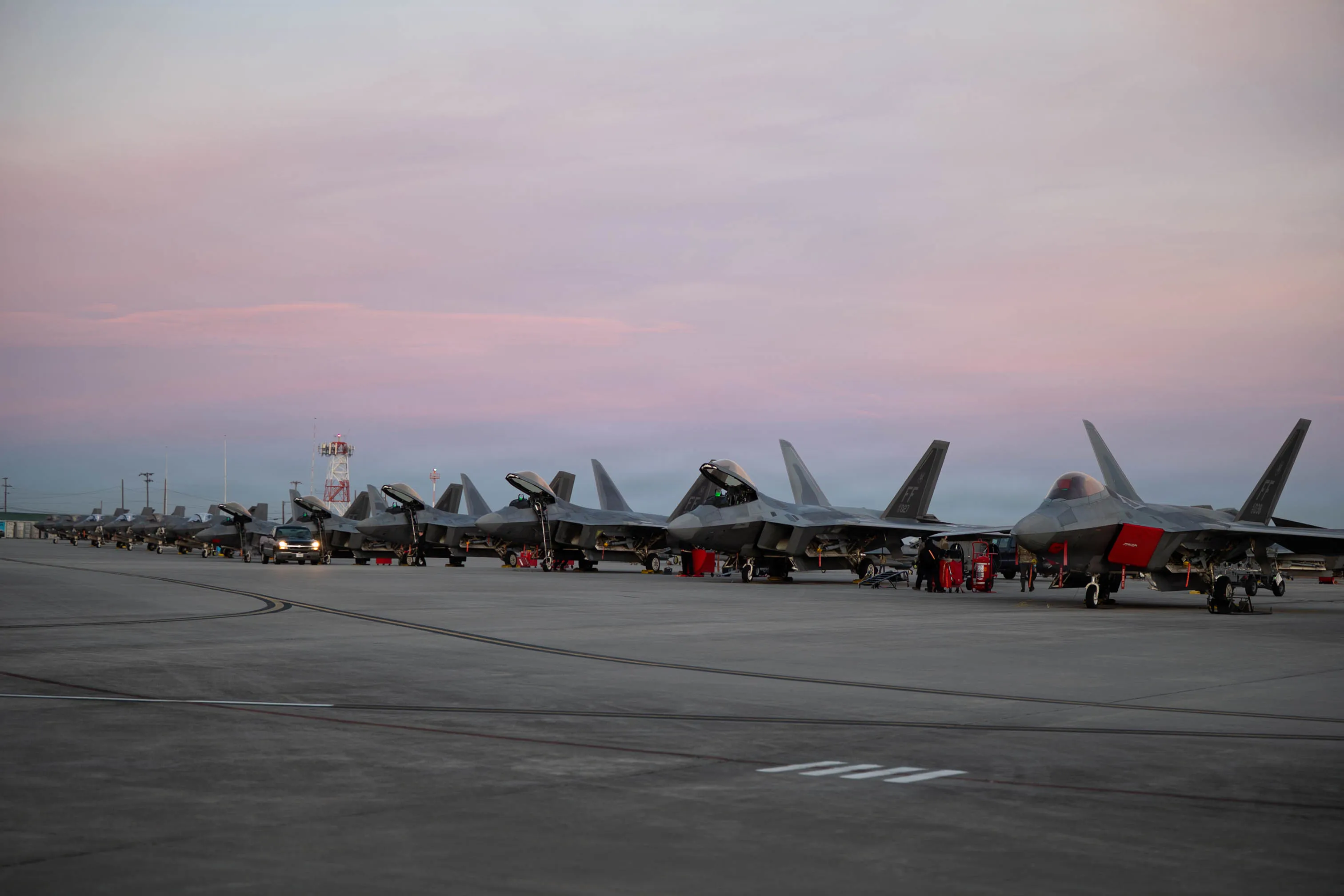
The War Zone was on hand as the newly integrated aircraft (N854TA) performed adversary missions with other Top Aces F-16s during a large force exercise known as Sentry South 26.1. The private aggressor support firm actually led the entire ‘red air’ operation for the exercise, which is a unique arrangement that puts immense trust on an entity that exists outside of the Department of War.

Sentry South 26.1 and the Air Dominance Center (ADC), which acts as a hub for the exercise, were created to help Air National Guard (ANG) pilots have the best fighter training available. Located in Savannah, Georgia, at the southern end of the Savannah/Hilton Head International Airport, the ADC’s footprint is small, but its training impact is huge for both ANG pilots and their active-duty counterparts. The exercise was developed by fighter pilots to provide 5th-generation fighter integration through a focused, tailored, cost-effective approach. The airspace they have, just 30 miles off the coast, runs 200 miles north to south and 120 miles east to west. That box is among the best military flying areas anywhere in the country, and it’s ideally suited for fighter training.
This iteration of Sentry South involved over 75 aircraft from the Air Force, Navy, and Marines. It was a mix of both 4th and 5th-generation fighters. Over 700 sorties were flown over the two-week exercise, focusing on both offensive and defensive counter-air missions. For many of the pilots, it was their capstone exercise for their initial training on the F-22. It is a multi-day, high-intensity scenario designed to test trainees or validate operational concepts in simulated, contested environments. Its goal is to validate the combat readiness of student pilots while improving their tactical decision making.

Matthew ‘Bang’ Belle is the adversary air program manager for Top Aces. He is in charge of all Top Aces operations in the United States, as well as for any foreign partners trained here on U.S. soil. He has been with the company for about 18 months after retiring from the USAF, where he flew the F-16 as an aggressor, accumulating over 2,000 hours during his career.
Belle told The War Zone, “We got some great reviews from all of the forces that participated in Sentry South 26.1. They really enjoyed having us take over the red air lead and run the mission commander spot from the aggressor side. It was the culmination of everything we have been doing to the aircraft over the last few years. The exercise is all about challenging blue air’s thinking in the air-to-air domain. It is meant to complicate things that they do not see at their home station.”
“The vision when we first started was that we were going to be the legacy bearers from the aggressors. Russ ‘Puck’ Quinn (former Top Aces president) saw a niche that needed to be filled. He knew there were a bunch of 3rd-generation fighters throughout the market and believed there was a place for 4th-generation fighters. So he made that happen, and so we got this 1978 jet (early block F-16A/B), and we saw that we could provide the Air Force and allies a good representation of what our adversaries are doing right now. It’s not just a jet with wings and a cool motor that makes it go really fast and really high. These current 4th-generation fighters are fully integrated, so they have near-5th-generation avionics but in a 4th-generation body. Puck saw that is where we needed to go.”

The AAMS and the AESA radar, along with the Scorpion helmet and Link-16, have really upped the game in terms of quality adversary support in a crowded adversary air services provider (ADAIR) market. The Scorpion helmet allows the pilot to avoid turning the aircraft’s nose towards the enemy aircraft to target it when employing certain weapons and sensors. This is especially true when employing simulated heat-seeking missile shots. The helmet also displays basic flight and navigational data and can also project objects from the aircraft’s new Link 16 datalink system out into the visual space all around the aircraft. In other words, if a friendly is 30 miles away at 10 o’clock high, it can shoot that in augmented reality to the pilot.
Top Aces is also using the Air Force’s AN/ALQ-188 jamming pod. The AN/ALQ-188 is a common sight at U.S. air combat exercises and can simulate certain types of hostile electronic countermeasures systems. Top Aces F-16s have controls inside their aircraft that allow the pilots to scale the electronic attack to whatever the blue air wants, whether it be just a nuisance or a full scale ‘melt your face off’ EW attack. Top Aces is also the only ADAIR company that is authorized to refuel from USAF KC-135 tankers, which helps them stay in the fight longer and provides more presentations for blue forces.

Belle states, “The key that has unlocked everything in the past month was that our engineering section here at Top Aces and our chief test pilot were able to get a provisional approval (from the Federal Aviation Administration) to operate Link-16 on our AAMS aircraft. That was the missing key we now have that ties it all together, so we can present this integrated solution that we think closely resembles a 4th-gen-plus adversary aircraft. It’s a real game-changer. The fact that I can be well outside of normal influence ranges on blue air, have them on my scope with Link-16, where they don’t know that I have that situational awareness (SA), and then transition that SA to the IRST pod, and they still don’t know they are being targeted. So they are making decisions like they are not targeted and not vulnerable. As they get closer, I have all of my weapon solutions cued up and ready to shoot with the AESA radar. Link-16 enables all of that to happen.”
“It also allows us to fly red air tactics with the F-35. It is just like we are one of them. We are replicating 5th and 4th gen packages. It gives blue air not just reps in the gym for blocking and tackling, it affects training outcomes completely and that is what we are really excited about. Link-16 ties it all together.”
What the pilot sees on his center pedestal display showing the Link 16 data is also totally customizable, which is critical for achieving highly-tailored training goals. For instance, the system can easily filter out information that would give the red air team too big of advantage or that would not accurately reflect the capabilities of an enemy. This scalability based on the training objectives makes it far more than just a datalink system for the red air force, it can dramatically boost the fidelity of the threat being presented.

Chris ‘Bluce’ Wee is Top Aces chief test pilot and flew several missions with the upgraded jet during Sentry South 26.1. Wee was a former test pilot in the USAF and was in charge of a host of modernization projects for both the F-16 and all variants of the F-15, including the F-15EX.
Wee told The War Zone, “I’ve been doing modernization and development, making fighters better for the better part of the past 12 or 13 years, and so it was really cool to jump in at Top Aces and look at what we’ve got and look at where we wanted to be and find things that we can improve on. A couple of things that I jumped into right away was really the optimization of our systems together. The idea that we could take old Israeli airplanes and make them high-end aggressors was really fascinating to me.”
“I first learned of Top Aces sometime in 2022. I was out at Black Flag at the 442 (422nd Test and Evaluation Squadron), the OT test organization out there at Nellis, when I came around the corner and saw some old pilots I knew from my aggressor days. I had no idea what they were doing, but when I got talking to them, I was amazed. There is nothing as maneuverable as this airplane (the F-16A, the agility of which you can read about here), and then you stack on top of that modern equipment, it’s amazing. There are limitations; no company in the world is, from a regulatory standpoint or even a monetary standpoint, able to go out there and buy an APG-83 or APG-82 (AESA radar) or any frontline fighter radar or some of, you know, ‘exquisite’ technologies that are protected by classified information. The fact that we’re doing that to the best of our ability was really intriguing to me.”
Wee was able to jump into the chief test pilot position and immediately review the systems and begin providing recommendations to improve integration.
Wee added, “We were able to tweak some things here in the software and really go out and develop that to the point where you know it’s really optimized. You get in this airplane and you know the between the helmet, the Link-16, the AESA radar, the IRST, you just have all these tools available to you to do this really important mission that is training the next generation of fighter pilots that are going to be out there, you know, protecting the nation for the rest of my life, at least, which is [a] pretty neat thing to be a part of.”

During Sentry South 26.1, Wee flew four missions in the updated AAMS jet, accumulating over 10 hours, and conducted several aerial refuelings from KC-135s.
Speaking about the new Link-16 capability, Wee explained:
“Datalink, from a very basic standpoint, is when you can look at the picture in your jet and immediately see what everyone’s doing and where they are; you don’t have to be looking outside necessarily to do that. In fact, I would really prefer my wingman to be like miles away from me because we’re probably not gonna hit each other if he’s miles away from me, and I don’t have to worry about him as much. I can just look at my screen, and I know where my wingman is, and what he’s doing. I can see that he’s targeting something because I can see data being passed between our airplanes, which is really helpful to know, not only within our own airplanes but also with the joint force airplanes. We were flying with Marines, F-35s, and guard F-16s. Being able to see where people are and what they’re doing and if they’re doing what I’ve told them to do, just by looking at the link, is a huge capability.”
Top Aces flew twice a day for four days during the exercise. During the first and last day, they focused on defensive-counter-air missions. Blue air students were tasked with defending the target area during a 90-minute vulnerability period (vul), and so they wanted to maximize the number of red forces across the ‘lane,’ so they could challenge their ability to defend a geographical area.

Wee explained, “As red air, we were trying to get in and protect the strikers. We were using the T-38 as strikers and were trying to help them get into the target area. If we could get to the target band, that would drive the debrief focus points on why the blue forces did not properly protect the lane for the period of time required. Were they allocating their radars to the right spot, and were they looking with the right modes on their radars? We were operating as MiG-1 (lead aggressor) for all sorties, which was really cool for us because we were able to lead the red package in all eight vuls we supported. We were able to manage our forces to align with the blue forces’ learning objectives. We worked very closely with the mission commanders as to what kind of threat they wanted and when they wanted to see it.”
On Wednesday and Thursday, the roles reversed to offensive counter air (OCA), and blue forces were trying to fight their way into the target band and hit targets on land and then fight their way out. Wee led a red force presentation that fought the blue air on the way in, then regenerated from pretend airfields to fight the blue forces on the way out of the target area.

Lt. Col. Joseph ‘Stone’ Walz, who flew F-16s and F-35s and is now part of the Georgia Air National Guard, is the exercise director for Sentry South. Speaking about the value of having aircraft like Top Aces F-16s in his exercise, he told us, “I had the opportunity to bring in Top Aces to Sentry South 26.1. They normally support the 33rd Fighter Wing at Eglin. I like to build something that represents what pilots would expect if they were to go out and fly an operational plan. It’s about honing and shaping our pilots into the most combat-ready force we could be if we had to go to war. How Top Aces factors into that is if we get real aircraft and actual fighter jets that can prosecute errors and punish errors in the training environment, and now when my pilots have those errors, they get shot and can now go into the debrief and learn those lessons in a training environment so they don’t make the same mistakes in war. We can do that with other aircraft, but every aircraft I bring here, if I have to put them as red air, that is one less person who can fly blue air. Red air is a tax we all have to pay, but having these guys gets us more training, and you never know the lesson that someone will learn that will save their life someday.”
Being asked to lead red air forces as ‘MiG-1’ during Sentry South 26.1, Top Aces is proving that experience matters, which is their motto.
Belle explained, “We are mostly all former aggressor pilots who have done the really big exercises at Nellis and in Alaska. We have handled 100 aircraft LFEs (large force exercises) and know how to build scenarios that really stress blue air’s weak points. We know where their change-outs are going to be, so we are a thinking adversary that brings in all the other red air like the F-35s and F-22s and puts it all together and says what would the Chinese do? We replicate that. We put the 4th and 5th-gen packages together, led by an experienced aggressor who knows how to exploit weaknesses. I can tell you from being on the blue side that when your bulletproof game plan is completely exploited and torn apart, you leave humbled, knowing you have to up your game. We are not there just to win, we are there to teach. We are there to have you leave the debrief with an outcome that says, I have to go back to the drawing board because what I thought works against my normal red air at Langley or Eglin didn’t work today. Why not?”

Top Aces has recently done much more software development to optimize what’s presented to the pilot and how the pilot interacts with the radar, the link, and the IRST pod, along with the helmet. It is all about placing information in the right place to make the pilot safer and more effective. Looking at human factors optimization, Top Aces is looking to make an even more threatening aggressor.
The IRST system that Top Aces flew during Sentry South 26.1 consists of a Northrop Grumman OpenPod, a modular, open-architecture design, equipped with Leonardo’s SkyWard, a long-wave IRST sensor. It is a scannable IRST pod, which means it has the ability to identify multiple contacts inside of a very large search area.
Wee explained, “IRST is difficult for everyone. It is very susceptible to the conditions of the day whether it be humidity or clouds. We have some longer-range goals to improve our IRST system and achieve more accurate tracks through exquisite means. Right now, we only have one pod but we are actively seeking more. You can imagine having azimuth and elevation from one pod is pretty good, but having azimuth and elevation from more than one pod makes the solutions get better, especially if you leverage Link-16 and are able to pass some of that data between airplanes (triangulating range). These are all things we want to do to better replicate the threat.”

Another major training capability that Top Aces Link-16-enabled aircraft are now providing is called Constructive Wingman. This gives the upgraded aircraft the ability to lay out synthetic tracks of non-existent aircraft.
Belle explained, “When the blue air looks at us, no longer do they see just one contact. They may now see two or three contacts and that is just complicating the training and driving better outcomes for their learning. The pilot pushes a few buttons to place an aircraft on my right at two miles and one on my left at two miles. I have a series of 10 commands that I can give it. I can tell it to go 50 miles from blue air and then reform behind me at 20 miles. Or better yet, I am going to turn around as the live fighter and these two contacts will continue going so blue air now thinks he has a bigger problem. But really, he/she is concentrating on synthetic tracks.”
This capability will help new F-35 student pilots as they will now see a more complicated tactical picture during their training. Currently, Top Aces provides aggressor training through the Air Force’s Combat Air Force Contracted Air Support (CAFCAS) program to F-35 pilots going through Formal Training Units (FTUs) at both Eglin Air Force Base in Florida and at Luke AFB in Arizona. The basic course lasts eight months and provides pilots with the training to accomplish a variety of missions.
The last few months have been extremely busy for Top Aces. Last summer, they went to Nellis AFB to participate in a large-force exercise at the end of weapons school, called Weapons School Integration (WSINT). WSINT is a series of complex, large-force employment missions that serve as the capstone portion of Weapons School classes. With their ability to air refuel, they participated in three- to four- hour missions. They also participated in Sentry North at Volk Field before flying to Mountain Home AFB to support training for the Dutch F-35As and the resident F-15E Strike Eagles.
We will be sure to keep you updated as Top Aces continues to add new capabilities to its unique AAMS F-16s.
Contact the editor: Tyler@twz.com