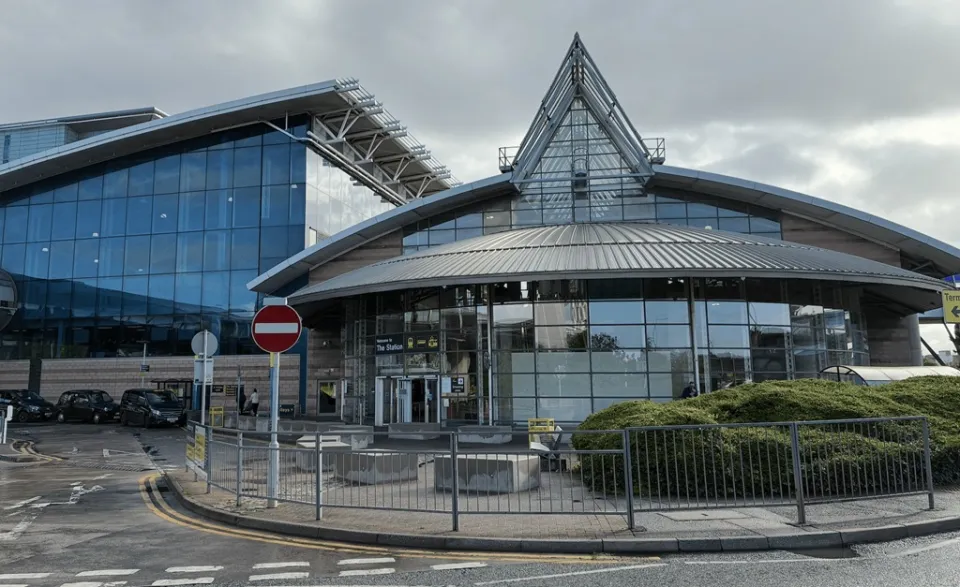
A TRAIN station said to be one of the prettiest in the country is in the midst of a huge makeover.
Huddersfield Railway Station in West Yorkshire is used by more than 3.1million passengers a year.
Sign up for the Travel newsletter
Thank you!
Huddersfield Railway Station is undergoing a £70million makeoverCredit: Alamy
And it is undergoing a £70million transformation which will include reconstructing the inside of the Grade-I listed station as well as extending three platforms.
The station – which was named last year by Lonely Planet as the third best in the country – opened in 1850 and was praised as being “the most splendid in England” by the former Poet Laureate Sir John Betjeman.
Inside, historical features such as the station’s historic tearoom are being renovated.
In fact, all 8,000 pieces of the tearoom are being restored and then brought back to the station to rebuild the tearoom in time for the station’s reopening next year.
The station will get a new footbridge too and rail infrastructure to help boost power for the rail lines – with the 70mile stretch between Manchester, Huddersfield, Leeds and York expected to be fully electric by 2030.
Work on the station started back in November 2023, with an opening date set for February 2 next year.
Before then, the station will close a couple of times to allow works to be completed.
The station is currently closed until June 27 impacting services between Huddersfield, Dewsbury and Leeds and then a second closure will take place between Christmas Eve and February 1, 2027.
In addition to recognising the station’s period features and modern amenities, Lonely Planet stated: “Huddersfield also does something most towns don’t: it puts a great pub right inside the station.
“The Head of Steam serves Yorkshire ales in surroundings full of character.
“The station has some equally beautiful neighbors, including the Grade II-listed Britannia Buildings, designed by Sir William Tite.”
The station was even famously home to a cat, Felix, who even had a Sunday Times bestselling biography before passing away in 2023.
AN abandoned English train station has been revamped with a £50,000 upgrade.
After years of disrepair, the 19th century station has now transformed into a luxury retreat that is opento the public.
Sign up for the Travel newsletter
Thank you!
Rowden Mill Station in North Herefordshire has been transformed in a £50,000 renovationCredit: SWNSOwners Cecilia Chavez-Brandon and Paul Kirwan have kept the authentic 1950s feelCredit: SWNS
Rowden Mill Station in North Herefordshire has been renovated into a vintage-inspired hotel, offering the perfect retreat for keen trainspotters.
Cecilia Chavez-Brandon and husband Paul Kirwan took on this dream renovation project in 2017, paying £395,000 for the 2.7 acre site that had been abandoned since the 1950s.
The site was primarily used for moving injured soldiers to field hospitals during the war and transporting livestock, losing its appeal as cars became more popular in the 1950s.
Inside were original buildings and a set of train tracks, which they have modernised into an experience that transports visitors back to the 1950s and 1960s.
To add to the vintage feel, they bought an 18ft inspection saloon coach, coated with British Railway livery for historic railway fans.
Cecilia told SWNS: “It was not until the 1980s that the former owners found the station and bought it from the farmers.
“They built the rail track back. We arrived after they had been here 32 years and helped modernise it.
“They restored the station building and the parcel office and converted it into accommodation rather than a station.
“The booking office is now the kitchen, the waiting room is now the lounge. The gentleman’s toilet is now a full bathroom.
“The parcel office is a separate building and we converted it and put central heating in and new carpets. We turned that into a full studio with an ensuite.”
A steady stream of visitors can look around the renovated station, which has transformed ladies’ waiting areas into main bedrooms and carriages into accommodations.
Tourists can pay £260 per night to enjoy a luxurious stay overlooking the countryside in their renovated coaches fitted with an en suite and heating.
Visitors can pay £260 per night to stay in renovated train coachesCredit: SWNSThe location is an ideal spot for trainspotting enthusiasts who enjoy a countryside retreatCredit: SWNS
The main station building also has accommodation at £430 for two nights, or the Parcel Office studio at £220 for two nights.
Cecilia said: “We have a parcel office with a studio for two on the main platform. For anyone staying here, it’s like waking up in a railway station from the 1950s and 60s.”
The couple also bought an original 20-tonne brake van back in 2018 to create another luxury accommodation for the site.
Maintaining this beloved location has become a career for the couple: “We didn’t really start out as railway buffs but you obviously become one. It’s like going down a rabbit hole.
“You end up being a whole network of railway people and it’s really something amazing.
“The very first guest arrived in September 2017 and they came with books and were clear railway buffs and knew more about the branch line than we did at the time.
“In terms of guests we obviously have the railway buffs, even children with technical knowledge. We have station masters and train drivers – we get quite a range of fans.
“The whole site is great. It’s so peaceful, with gorgeous views and our other passion is nature. We’ve got our own meadows, hedgerows and wildlife ponds.”
ONE of the UK’s oldest indoor swimming pools is getting a huge makeover after being forced to close three years ago.
Moseley Road Baths in Balsall Heath, Birmingham, opened back in 1907 but has been shut to the public since 2023.
Sign up for the Travel newsletter
Thank you!
Moseley Road Baths in Birmingham are getting a £16m makeoverCredit: Google maps /Moseley Road BathsThe baths feature three pools including the Gala Pool (pictured) which will be restoredCredit: Google maps /Moseley Road Baths
Follow The Sun’s award-winning travel team on Instagram and Tiktok for top holiday tips and inspiration@thesuntravel.
Now, the Grade II-listed Edwardian pool will be brought back to life with a new community health and wellbeing hub as well as restored main pool.
The baths are split into three main pools: the Gala Pool (which used to be for upper class men); the second class men’s pool and then the women’s baths.
The Gala Pool – which closed back in 2003 due to safety concerns – will be completely restored and reopened, as will the mezzanine gallery around the pool and there will be a new ground-floor viewing area too.
According to Visit Birmingham, the pool is “the grandest space in the building” with cast iron arches and viewing balconies on three sides of the pool.
The second pool onsite will then be converted into a flexible event space.
The Women’s Slipper Baths – which locals used to pay a small fee to bathe right up until 2004 – will be made into a community health and wellbeing hub and the Men’s Second Class Slipper Baths will be transformed into a community gym.
The former boiler room will then be made into another flexible studio space.
The other two pools will be transformed in to community spaces and a gymCredit: moseleyroadbaths.orgMany of the original features will be kept inside such ad the terrazzo floorsCredit: Alamy
Following all of the upgrades, the baths are expected to reopen in late 2028.
Previous restoration works started in September last year, of the roofs at the baths and the Balsall Heath Library, which is getting a new mezzanine level.
Many original features will be kept though throughout the building, such as the oak wood ticket offices and 30-metre Gothic Renaissance facade with red brick and terracotta.
Other original features include glazed bricks in ivory, turquoise and cream and terrazzo floors.
Joe Holyoak, Chair, Friends of Moseley Road Baths said: “For more than two decades, our community has fought to keep Moseley Road Baths open and to secure its future.
The historic red brick and terracotta facade will also be keptCredit: AlamyThe baths are expected to reopen in late 2028Credit: moseleyroadbaths.org
“Today’s news is a moment of immense pride.
“We will swim in the Gala Pool again, and this magnificent building will be a home for our community for generations to come.
“We’re hugely grateful to everyone who has played their part in making this happen, and to the swimmers who supported us along the way.”
Richard Parker, Mayor of the West Midlands said: “Moseley Road Baths is a real Birmingham icon and it’s now closer than ever to reopening to the public because local people never gave up on it.”
Weekly insights and analysis on the latest developments in military technology, strategy, and foreign policy.
Plans for a new tranche of upgrades for U.S. Army special operations MH-60M Black Hawk helicopters are heavily tied to continued progress, or lack thereof, on an improved engine. Work on the Army’s Improved Turbine Engine Program (ITEP) is ongoing now, but there have also been threats to cancel it entirely in recent years, and its future remains murky.
Officials from U.S. Special Operations Command (SOCOM) talked about the intersection of future plans for the MH-60M fleet and ITEP during a roundtable at the annual SOF Week conference yesterday. TWZ was in attendance, along with other outlets. The Army’s elite 160th Special Operations Aviation Regiment, also known as the Night Stalkers, operates the MH-60Ms.
Special operators rappel from a Night Stalker MH-60M during a capability demonstration outside the 2026 SOF Week conference. Jamie Hunter
The Army selected General Electric’s (GE) T901 as the winner of the ITEP competition in 2019. The engine remains in development, with flight testing involving a modified Black Hawk beginning in May 2025.
“We are following very closely what the Army is doing with ITEP. We are hoping that we will get it,” Lt. Col. Aron Hauquitz, head of the Technology Applications Program Office (TAPO), said at the roundtable yesterday. “We’ll be able to put it in our aircraft, and we’ll create the Block 2 variant of the MH-60M.”
A T901 turbine engine. GE
In “FY30 [Fiscal Year 2030], we’re going to start either the Block 1.2 or the Block 2” upgrade program for the MH-60M fleet, Lt. Col. Cameron Keogh, the Program Manager for the MH-60 within SOCOM’s Program Executive Office for Rotary Wing (PEO-RW), also said at the roundtable. “It’s going to hinge on what’s going on with the Improved Turbine Engine, the T901 program that the Army’s running. We’re closely following that. If it continues to be successful, we will integrate that engine.”
To take a step back quickly, Night Stalker Black Hawks today already have an array of unique features compared to other H-60 variants in service elsewhere across the U.S. military and globally. This includes a terrain-following/terrain avoidance radar and other sensors, a variety of defensive systems, and an extensive communications suite, which you can read about in more detail here. A subset of the MH-60Ms are also configured as Direct Action Penetrators (DAP), which can be armed with a mix of guns, missiles, launched effects, and rockets to provide organic close air support during missions.
A pair of Night Stalker MH-60M configured as Direct Action Penetrators (DAP). USMC/Cpl. Matthew Williams
Cramming all of these capabilities on the MH-60Ms also requires significant changes to their core structure, and they are notably heavier than other typical H-60 variants. To account for this, the 160th’s Black Hawks already have YT706 turbine engines that are more powerful than the T701s found on standard Army models. GE makes both of these engines.
The YT706 has “higher fuel consumption, but it also has a higher output to help us keep that extra weight in the air,” Lt. Col. Keogh noted yesterday.
Integrating the T901 onto a typical Black Hawk will provide “50 percent more shaft‑power while delivering significantly higher fuel efficiency,” according to Lockheed Martin. Sikorsky, the prime contractor behind the H-60 family of helicopters, became a subsidiary of Lockheed Martin in 2015.
“The 50% power increase means a Black Hawk can transport additional fuel or payloads, such as launched effects, medical evacuation litters, forward area resupply loads or advanced sensor packages, without compromising aircraft performance,” Lockheed Martin highlighted in a press release earlier this month. “The engine’s performance at high altitude, high temperature conditions expands the Black Hawk’s envelope, giving commanders more options for insertion, extraction and reconnaissance missions in austere environments.”
Sikorsky Begins Black Hawk® Ground Runs with U.S. Army T901 Improved Turbine Engines
“Higher fuel efficiency and lower maintenance demands lessen the supply chain burden in contested environments, a core tenet of the Army’s continuous transformation strategy,” the press release noted. “Improved specific fuel consumption reduces the number of refuel stops, extending mission endurance and shrinking the fuel footprint in forward operating bases.”
The boost in capability that the T901 is set to bring is especially relevant for Night Stalker MH-60Ms, given their unique attributes and mission requirements. The maintenance and logistics benefits would also be particularly attractive for the 160th. The Regiment routinely flies extremely demanding missions, often conducted across long distances and under adverse conditions, and staged from far-flung locations with limited access to established support chains.
Plans otherwise for the Block 1.2/Block 2.0 MH-60M upgrades are still evolving.
Right now, the core “focus on that is payload restoration. We’re trying to take weight out of the airplane [sic], [and] we’re trying to move the CG, the center of gravity, forward,” Lt. Col. Keogh explained. “How we’re doing that without reducing capabilities is we’re just kind of moving the capabilities around.”
An MH-60M flies low over the water during the capabilities demonstration outside this year’s SOF Week conference. Jamie Hunter
“Somebody asked me earlier if we’re going to take the anti-ice system off the airplane to lose some weight. We’re not. We need the anti-ice, especially up in Washington State,” he continued. “We’re taking some of our heavier boxes, a lot of our avionics, we’re putting them up forward into the crew department, we’re putting them behind the pilots. That’s going to shorten cable runs – copper weighs a lot, you’d be surprised – and then it also helped with our CG shift, as well.”
“That’ll give the operators more butts in seats as they head out to the objective, and also give the air crews better fuel flexibility for mission planning,” he added.
To go back to ITEP, the new engine has long been expected to offer a major leap in performance to regular Army Black Hawks, as well as the service’s AH-64 Apache attack helicopters. However, as noted, the program has faced major uncertainty in recent years. The effort has suffered significant delays tied to manufacturing and supply chain issues. The T901 was also a central component of the Army’sFuture Attack Recon Aircraft (FARA) program, which the service axed in 2024.
Last year, there were indications the Army was moving to cancel ITEP, too, with the service requesting no additional funding for the program in its 2026 Fiscal Year budget proposal. Congress subsequently interceded, appropriating another $238 million for continued work on the engine in the current fiscal cycle.
In its 2027 Fiscal Year budget request, the Army is again not asking for any new money for ITEP, which has raised new questions about the program’s future.
T901 First Engine to Test Mission Accomplished
At the Army Aviation Association of America’s (AAAA) 2026 Warfighting Summit last month, Army Maj. Gen. Clair Gill said he was “very excited about where they’re going there” with ITEP and that the engine was “almost nearing completion of certification.” Gill is the service’s Program Acquisition Executive for Maneuver Air.
ITEP is “performing as intended,” and “the resourcing that Congress added in 2025 and the resourcing that Congress added in 2026 is being used to deliberately continue that testing,” Army Brig. Gen. David Phillips also told TWZ and other outlets at a roundtable at the AAAA conference, but did not elaborate on future plans for the engine. Phillips is the Deputy Portfolio Acquisition Executive for Maneuver Air.
“We will need a little bit more money to get through the EMD [engineering, manufacturing and development] program, but it’s certainly not anywhere close to the money that we’ve already received for the program,” Mike Sousa, GE’s Executive Program Manager for the T901, had also told members of the media ahead of the AAAA conference, according to Breaking Defense. “So there is a little bit of money that is still required.”
Another factor now in all of this for the Army, as well as the Night Stalkers, is the expected arrival of the new MV-75 Cheyenne II tiltrotor in the next few years. The MV-75 offers massive boosts in range and speed compared to any Black Hawk variant. At the same time, that is also expected to come at a cost. As it stands now, the MV-75 is not expected to replace all of the Army’s H-60s, which will continue to play important roles for years to come. SOCOM and the 160th have a similar vision when it comes to the fielding of a special operations-specific version of the MV-75 and the future of the MH-60M.
A rendering of a special operations-specific version of the MV-75. Jamie Hunter
“There will not be a one-for-one swap for MH-60M and MV-75. Don’t ask me what that exact number will be,” Dr. Steven Smith, head of SOCOM’s PEO-RW, also said at the roundtable yesterday. “We’re still going to need analysis to determine what that will be, but it will not be a one-for-one swap. We recognize that the M-60s will be required for the crisis response mission.”
Altogether, the MH-60M is still on track to be a central component of the Night Stalker’s fleets for years to come, whether the helicopters are re-engined in the end or not.
The stations’ decades-old tracks and platforms will be given a revamp.
The closures will take place between Sunday, July 26, and Sunday, August 16, as well as on Sunday, May 31, and Sunday, June 7.
There will also be a full weekend closure from Saturday, August 22, to Sunday, August 23, – and again from Saturday, October 10, to Sunday, October 11.
The closures will allow a £20million revamp project to go aheadCredit: AlamyRepairs will be made to the Hungerford BridgeCredit: Alamy
On these dates, no trains will stop at Charing Cross or Waterloo East, although the Southeastern services will continue throughout the closures.
Trains that usually terminate at Charing Cross will be diverted to London Victoria, London Blackfriars, London Cannon Street or London Bridge. Tickets will be accepted on these alternative routes.
Meanwhile the London Underground service from Charing Cross will run as normal.
The closures will allow a £20million engineering project to be completed, with almost two kilometres of 36-year-old track set to be replaced.
Sections of Charing Cross’s platforms will undergo repairs along with updates to the drainage systems on the tracks.
Structural repairs to the Waterloo East to London Waterloo pedestrian link bridge and the Hungerford Bridge are also required.
Scott Brightwell, train services director at Southeastern Railway, said: “The £20 million investment we are delivering will see 1990s track and platforms upgraded to make journeys safer and more reliable, and Victorian era structures strengthened to remain fit for the future.
“By consolidating the work into 22‑day closure, supported by preparation and follow‑up weekends, we can complete the work more quickly and with less disruption overall than the alternative options of 60 weekend closures or four to five 9-day closures.”
Urging passengers to “plan ahead and check before they travel”, he added: “We have planned the closure for the summer, when passenger numbers are around 20 per cent lower and schools are closed, to help manage the impact on customers.”
GRACEFULLY stepping on to the red-carpeted gangplank, I turn and wave to the crowd.
Well, I say crowd. It’s a coach party from Aberdeen, who, like me, have come to snoop around our late Queen’s favourite floating home.
Sign up for the Travel newsletter
Thank you!
The Royal Yacht Britannia, docked in Edinburgh’s Port of Leith for the past 28 yearsCredit: Marc Millar/Royal Yacht BrittaniaThe royal ship attracts lots of visitorsCredit: Marc Millar/Royal Yacht Brittania
Built in 1953 in Clydebank, Glasgow, Britannia sailed more than a million nautical miles during her 44-year reign over the waves and accompanied the Royal Family on 968 state visits to 135 countries.
Her new £3million visitor centre leads with a photo-heavy exhibition about the ship’s history, including an interesting Day In The Life Of Queen Elizabeth II.
An excellent audio tour then guides me through the five decks on board.
On the bridge, I sit in the captain’s chair overlooking a rather grey Firth of Forth and imagine the sights seen from here over the years, such as the Sydney Opera House and Hong Kong skyline.
A modest royal cabinCredit: SuppliedThe regal state dining roomCredit: Supplied
But the Queen simply adored sailing around the Hebrides on her annual royal holiday, which she described as “the one place I can truly relax”.
Walking the scrubbed teak decks, I get a glimpse of royal life on board this floating palace.
There’s Her Majesty’s office, where she would work each day, and the Sun Room — a teak-panelled lounge with bar and rum tub said to have been the Queen’s favourite spot on the ship.
It overlooks the Veranda Deck, where Prince Philip would set up his easel to paint.
I can picture myself playing quoits with Princess Anne or enjoying a Dubonnet and a game of whist with Princess Margaret.
On board, it’s like time has stood still.
Not least because every clock is set at 3.01pm, when the Queen and Prince Philip disembarked for the final time on December 11, 1997.
Echoing the plush decor found in other royal homes, the State Drawing Room is the family room. In the corner is a Welmar baby grand piano — bolted to the floor to withstand the waves — which was played over the years by guests including playwright Noel Coward and Princess Diana.
The Vestibule Deck has the State Apartments — including the somewhat modest adjoining cabins of the Queen and Prince Philip, with single beds.
Only one suite has a double bed — installed on request by Prince Charles for his first honeymoon.
The Sun’s Tracey Davies sits on the bridge with a sea viewCredit: SuppliedThe Royal Yacht Britannia has been named the World’s Best Attraction at TripAdvisor’s The Travellers’ Choice Awards 2026Credit: Marc Millar/Royal Yacht Brittania
Like Princess Margaret, I’m also partial to a pre-lunch sharpener.
The Royal Deck Tearoom serves her favourite Dubonnet cocktail (£16), as well as Moet by the glass or bottle (£15/£78), and a great coronation chicken sandwich (£10).
But the State Dining Room — rarely open to us commoners — is where VIP guests, such as Sir Winston Churchill, would dine with the Royal Family.
Below deck, I wind through the galley, laundry and medical room — with operating theatre — to discover how the 220-strong crew ran the ship like clockwork.
In the gift shop, you can get everything from a stuffed corgi (£25) to a Launer handbag (£2,850), a favourite of Her Maj.
As the State Apartments are not yet on Airbnb, you can enjoy a similar experience nearby at The Fingal, a former lighthouse tender turned luxury floating hotel.
GO: LEITH
GETTING THERE: Advance tickets from London to Edinburgh Waverley Station from £41.40 each way.
BRITISH Airways’ multi-million pound superjumbo refit faces certification delays over fears crew cannot safely restrain drunk passengers in its new business class seats.
The airline is in the process of upgrading its Airbus A380 fleet with its latest Club Suite, which comes with a sliding privacy door.
Sign up for the Travel newsletter
Thank you!
But the makeover could hit delays because of concerns over how staff would deal with an air rage passenger on the upper deck.
BA plans to move a small section economy seats off the top floor and replace them with a larger Club World cabin.
Its passenger restraint kit is understood to be approved for economy and premium economy seats – not the new suite-style business seats.
That could leave crew with a major problem if a passenger became violent or disruptive upstairs.
Sources said hauling a violent passenger down the A380’s narrow staircases could put crew and other passengers at risk.
The first aircraft are currently being worked on in Manila, Philippines, as part of the refurbishment programme.
Industry sources have also suggested there may be certification concerns over the weight of the new business seats, which include motors and sliding doors.
Extra weight on the upper deck could affect the plane’s payload limits.
However, any delay may also be linked to wider supply chain issues affecting premium aircraft seats across the industry.
British Airways said the A380 refit programme remains on schedule for 2026.
A UK HOLIDAY park that’s been compared to Portugal has reopened for the season – along with a £1million upgrade.
Ladram Bay Holiday Park in Budleigh Salterton, Devon is now open with some big new changes.
Sign up for the Travel newsletter
Thank you!
Ladram Bay Holiday Park in Devon has had a £1million upgradeCredit: Alamy
Onsite are now 13 new modern holiday homes, which will all have three bedrooms.
Dubbed the Lobster Lodges, they are the most spacious lodges onsite and feature luxury interiors with a double bedroom, a bedroom with two single beds and also a sofa bed.
The best part though is that each lodge has a hot tub on the decking with amazing views of the coastline.
The children’s outdoor play area, which features a pirate ship dubbed ‘NaNa of Ladram’ has been rebuilt and the indoor soft play has been updated as well.
The Beach Shack is being upgraded too, with a typical seaside feel inside including an ice cream counter and is set to open by the summer.
Those who like to boogie will be happy to hear the park has also launched silent discos.
And as the summer approaches, there will be new outdoor furniture and speakers at the Pebbles restaurant for events and the splash park will reopen.
The family-run holiday park sits on the top of a cliff and is home to around 140 caravans as well as three apartments, safari tents and glamping pods and a renovated former fisherman’s cottage.
The Sun’s Executive Daily News Editor, Emma Glanfield, recently visited Ladram Bay Holiday Park.
She said: “With a glass of wine in hand, watching the sun set over the sea as clear waters lap the shore, I could have been in the Algarve.
“But no, rather than basking in Portugal, I was holidaying with the family at a caravan park on east Devon’s Jurassic Coast.”
Emma added: “Ladram overlooks a gorgeous section of the coast and even has its own private beach — accessible only to guests, via a slipway at the bottom of the park.”
“As well as an on-site gym, huge outdoor adventure playground, indoor soft-play centre and enormous amusement arcade, the park also boasts pottery and art classes in its new studio.
Upgrades include new luxury lodges with hot tubsCredit: FacebookThe holiday park has also upgraded its Beach Shack which will open in time for the summerCredit: Facebook
“The indoor poolis magnificent — one of the cleanest I’ve ever known — and offers free family playtimes as well as exercise classes.
“The adjoining outdoor splash park is brilliant, too, for cooling off on a hot day, while the indoor fun slide kept us all entertained — even the grandparents.
“That’s before you even start on the evening entertainment in Waves Bar — with bingo, a pool table, darts, kids’ disco, singers and the Ladram Stars Showtime.
“And when we visited Portugal just a few weeks later, I looked out at the coastline, from our accommodation, and realised it didn’t look too different at all from that special view back at Ladram.”
Currently, you can get 20 per cent off stays at the park by using the code ‘DEVON20’.
In the local area, there are a number of attractions guests can visit.
For example, the holiday park sits on the South West Coast Path which featured in the recent Salt Path film and is ideal for breezy walks with views of the coast.
From the holiday park, you can head to SidmouthCredit: AlamyIn Sidmouth, you will find a popular beachCredit: Getty
Then just down the road is Crealy Theme Park, which is great for kids who aren’t ready for big rollercoasters – like those found at Thorpe Park or Alton Towers – quite yet.
There are over 60 attractions to explore at the park, including the Maximus train rollercoaster and the Tidal Wave log flume.
Travel reporter Cyann Fielding visited the park many times growing up.
She said: “Crealy Theme Park is great no matter the weather as it has an even amount of indoor and outdoor attractions.
“Outside, the Maximus rollercoaster is a great introduction to rides for children – it is slick and smooth, but not too jolty or fast.
“The Tidal Wave log flume is a bit more of a thrill – but definitely leave it until last as you will get soaked (though the park has drying machines you stand in that you can pay for).”
You can also spend a day at Crealy Theme Park, which has both indoor and outdoor attractionsCredit: Alamy
If you want to explore more of the Devonshire coastline, then a short drive away from Ladram Bay is also the seaside town of Sidmouth, which has a large pebble beach.
Another beach to head to in Sidmouth that is the more secluded Jacob’s Ladder Beach which has red sand, rock pools and dramatic cliffs.
And nine miles down the road at the park’s sister site – Castle Brake, near Woodbury – there are also £300,000 improvements.
The park now has a new static caravan area with two holiday lodges.
The park also has new roads and hard-standing bases making it suitable for a mix of two-bed and three-bed static caravans.