With this year’s theme as ‘Red card to child labour: Fair play for children, decent work for adults’, the campaign for World Day Against Child Labour advocates for stronger action on quality education, social protection, decent work, stronger laws and enforcement across the world, as well as other measures that address the root causes of child labour.
A survey in 2022 by the National Bureau of Statistics in collaboration with the International Labour Organisation and the Federal Ministry of Labour and Employment of Nigeria revealed that about 24.67 million children in Nigeria, who represent 39.2 per cent of the country’s youth, aged 5 to 17, are engaged in child labour. About 22.9 per cent of the children are engaged in hazardous work.
The Child Rights Act of 2023, a legislation that protects children and young adults in Nigeria, frowns at the involvement of children in any form of labour that is harmful to their development. While the minimum age for employment is 15, the Act states that the work must not interfere with the children’s education.
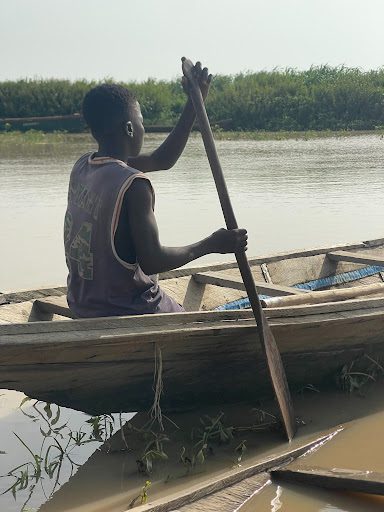
13-year-old Harrison Luka works at the River Gongola bank in Adamawa State as a canoe paddler. The boy makes at least 6 trips to and fro daily, carrying passengers and goods from one end of the river to the other and sometimes, paddles passengers to riverine communities. Photo: Saduwo Banyawa/HumAngle
Although he is enrolled at the Government Day secondary school in Numan and is in JSS1, Harrison often skips school because his parents rely on a part of his daily earnings for survival. Photo: Saduwo Banyawa/HumAngle.
Danladi Christopher is a 14-year-old JSS3 student who has to fend for himself, so he comes to the Gongola bank every day after school to work as a canoe paddler. He paddles passengers to and fro and makes around ₦1,000 to ₦1,500 daily. Photo: Saduwo Banyawa/HumAngle.
11-year-old Al’amin works as a mechanic in the Monkin area of Zing in Taraba State. He earns around ₦500 daily and uses his earnings to support himself and his younger ones. Photo: Ahmed Abubakar Bature/HumAngle
Al’amin comes to the workshop every day, sometimes skipping school. Photo: Ahmed Abubakar Bature/HumAngle
Even though Primary and Secondary education are free in Adamawa State, 15-year-old Fanapwa Rueben dropped out of school to become a full-time fisherman. He sets out at dawn, and when he makes a catch, he sells it to the women at the bank. Sometimes, he stays till 8 p.m., casting his net while using the moonlight for illumination. Photo: Saduwo Banyawa/HumAngle.
Fanapwa considers himself the ‘little breadwinner’ of the family as his income puts food on his family’s table. Photo: Saduwo Banyawa/HumAngle.
Philemon Monday is a 12-year-old commercial farmer from Taraba State who earns between ₦500 and ₦1,000 daily by working on people’s farms. The income covers his feeding and personal expenses. Photo: Ahmed Abubakar Bature/HumAngle.
Although he’s enrolled in school, Philemon says it’s very far from his community, which affects his attendance. Someday, he wants to be a teacher. Photo: Ahmed Abubakar Bature/HumAngle
Philip John from Taraba State is 10 years old. He works on people’s farms to earn money so he can feed himself and his younger siblings, as food is scarce at home. Photo: Ahmed Abubakar Bature/HumAngle.
Philip has never been to school. He is determined to join the Nigerian army when he’s older. Photo: Ahmed Abubakar Bature/HumAngle
In 2025, HumAngle photographed Ibrahim and other children working along the banks of Mandal Bogul in Gunda, Borno State. The boys spend their days filtering minerals instead of attending school. Photo: Al’amin Umar/HumAngle.
In Gunda, young adults and children separate minerals from stones along the banks of Manda Bogul, a local stream in the area where they toil daily. Photo: Al’amin Umar/HumAngle.
According to the Child Rights Act, no child must lift or move anything heavy that might affect their physical health or social development. Also, no child must be employed in an industrial setting that is not registered as a technical school or similar approved institution.