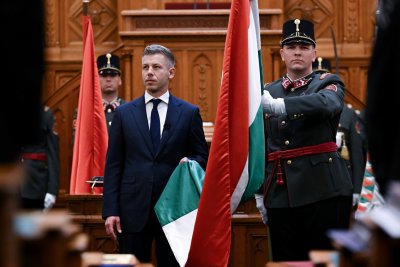

1 of 2 | Peter Magyar, left, takes the oath of office as prime minister of Hungary during the inaugural session of the new National Assembly in Budapest, Hungary, Saturday. Photo by Tibor Illyes/EPA
May 9 (UPI) — Péter Magyar has been sworn in as Hungary’s new prime minister, ending Viktor Orban’s 16-year, right-wing leadership.
“I will not rule over Hungary — I will serve my country,” Magyar said Saturday after he took the oath of office in parliament, The BBC reported.
Magyar’s Tisza Party now holds 141 out of 199 seats in the parliament. That’s up from none because the party was formed two years ago.
Orbán’s Fidesz party dropped from 135 to 52 seats in the election in April.
Tisza is not a strong swing to the left; Magyar, 44, was once a Fidesz Party operative. But on March 15, 2024, he left the party to join Tisza, then an unknown startup.
Now, Magyar is a center-right politician: not quite a liberal or progressive, and definitely a conservative. But he is pro-Europe and European Union, which Orbán was not.
The EU flag was hung on the Hungarian parliament building for the first time since 2014.
Magyar had invited people to join him to “write Hungarian history” together Saturday and “step through the gate of regime change.” Supporters gathered outside the parliament building, cheering and waving Hungarian flags.
Leftist and liberal parties will have no seats in the parliament for the first time since 1990, when Hungary broke free of the Soviet Union. But Budapest’s liberal mayor Gergely Karácsony said the new regime is still cause for celebration.
“Teachers fired, civilians and journalists humiliated, small churches torn apart,” Karácsony wrote on social media. “We can finally leave this era behind us — but first, let us remember the everyday heroes and express our gratitude with a farewell to the system.”
“This is the first time I feel like it’s good to be Hungarian,” Erzsébet Medve, 68, from Miskolc in northeastern Hungary, told The Guardian. “I feel like I could cry.”
Orbán and the Fidesz government cut education funding in Hungary. “The government had enough money, but they didn’t spend it there,” said Medve, a teacher.
Marianna Szűcs, 70, said she hoped Hungary would become more livable. “Now we feel like our children and grandchildren have a future here.”
New Tisza ministers said that while there will be no revenge against Orban’s people, those guilty of financial crimes will be held accountable. There will be a new office created to “recover stolen assets.”
“I don’t think that we should talk about a guillotine,” said Zoltán Tarr, incoming minister for Social Relations and Culture.
“We are talking about investigations and actions which are totally in line with the rule of law. Interestingly enough, the current chief prosecutor, and the police, have started certain investigations which they did not start before the election. They are questioning people.”
The Magyar government plans to convince the EU to release $20 billion in funds that the EU had held back from the Orbán government.
“I’m not worried, I’m excited,” Tarr said. “We are serving the country. We are serving the people. We are not here to rule. We are here to serve. We are here to fulfill a mandate.”